
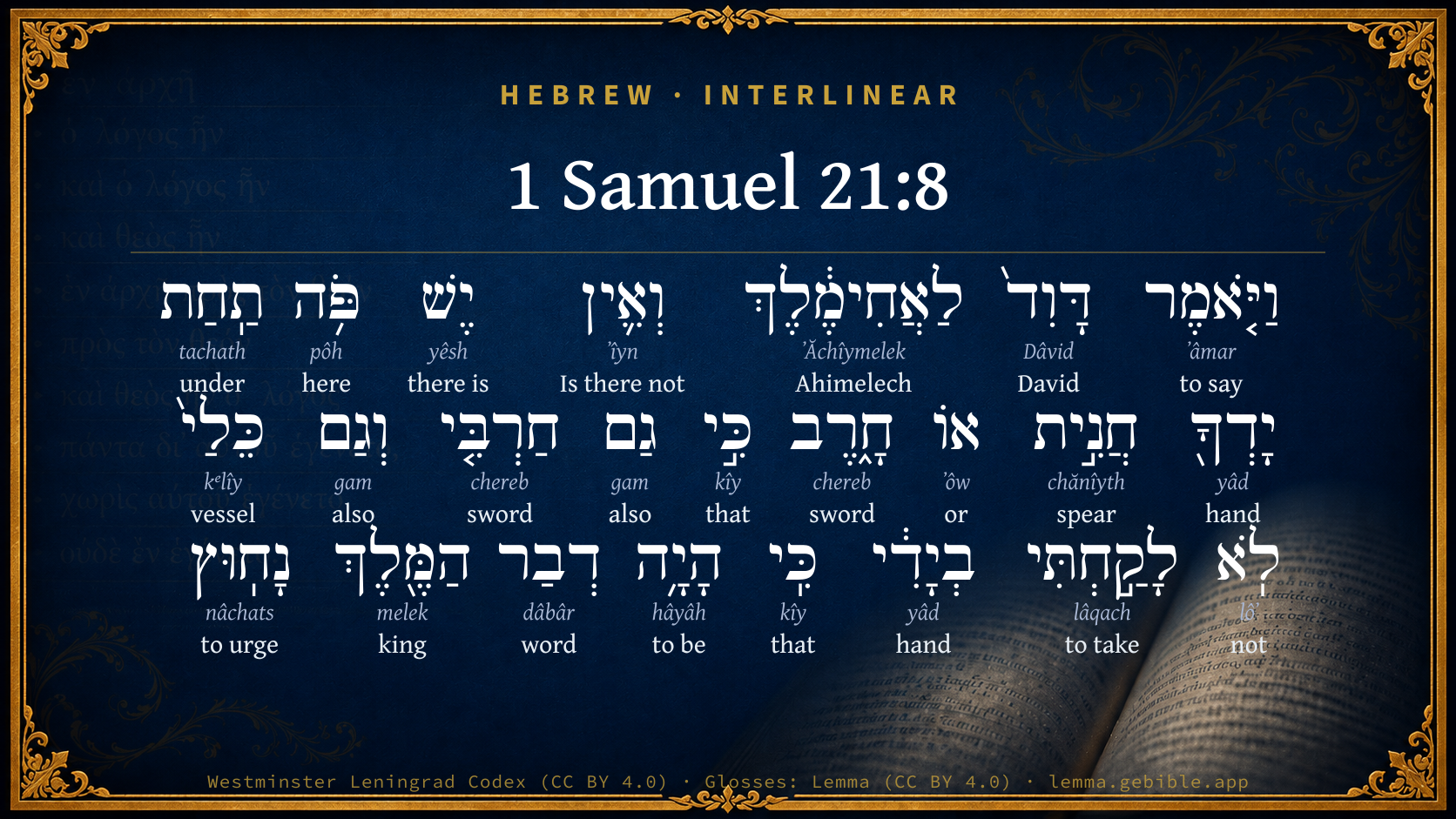
1 Samuel 21:8

Hebrew (Westminster Leningrad Codex) 1 Samuel 21:8 appears in the Hebrew Old Testament. The text above is from the Westminster Leningrad Codex. Each word links to its Strong’s number, a concise gloss, and parsing drawn from the Open Scriptures Hebrew Bible morphology. Click any word for its full Brown-Driver-Briggs (BDB) entry.
Download image
Cite this verse

1 Samuel 21:8 (World English Bible). Public Domain. Lemma interlinear Bible study tool, https://lemma.gebible.app/v/1-samuel/21/8.

Show BibTeX & RIS
BibTeX
RIS
English Translation
David said to Ahimelech, Isn't there here under your hand spear or sword? for I have neither brought my sword nor my weapons with me, because the king's business required haste.
World English Bible · Public Domain
Highlights
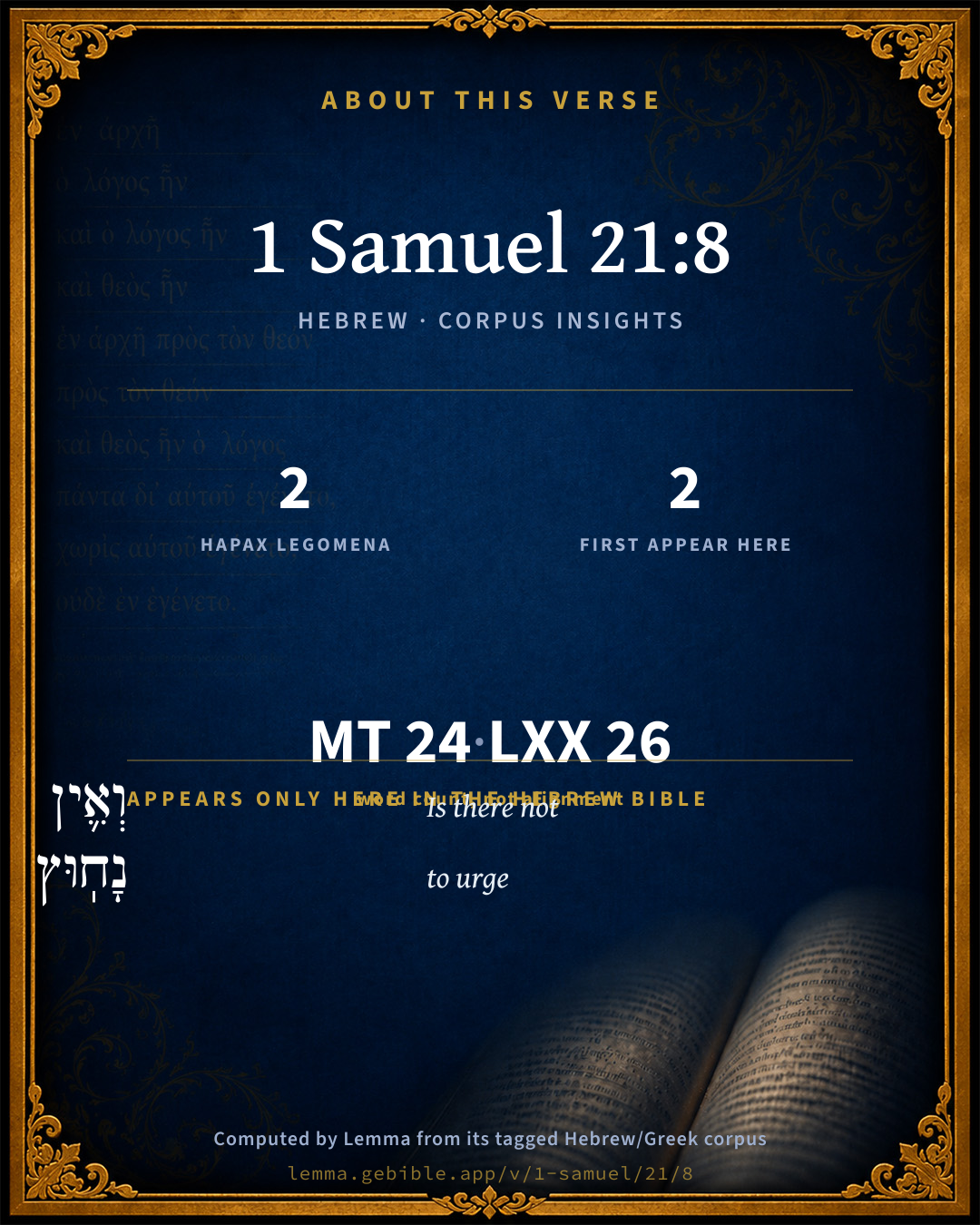
  • 2 hapax legomena — only here in the Hebrew Bible
  • 2 first appearances in the Hebrew Bible
Full analysis ↓
Download a study sheet

One document with this verse’s original text, its word-by-word gloss line, the meaning frame, cross-references with their text, attributed commentary, and full source and license credits — printable, and it pastes into notes with its structure intact.

This verse Autodidact and up

Study sheet (.html) Plain text (.txt)

A passage Seminary Student

Up to 50 verses in one chapter. A passage sheet keeps up to 6 commentary sources and 12 cross-references per verse, in the order this page ranks them, and says so on the sheet whenever that leaves anything out. Ask for a single verse and you get the Autodidact verse sheet above.

Everything on this page stays free to read, with no account — the sheet is a download of what is already on screen, not access to it.

Want to remove ads? Support Godless Engineer
Compare translations 3

The same verse in 3 English versions, stacked beneath the original-language interlinear above. Click any original word for its lexicon entry.

Each is an independent rendering of the whole verse — the interlinear is not word-aligned to these translations.

Highlighted words mark where these versions differ — a whole-verse word diff, not a word-by-word alignment.

  • World English Bible Public Domain
    David said to Ahimelech, Isn't there here under your hand spear or sword? for I have neither brought my sword nor my weapons with me, because the king's business required haste.
  • King James Version Public Domain
    And David said unto Ahimelech, And is there not here under thine hand spear or sword? for I have neither brought my sword nor my weapons with me, because the king's business required haste.
  • unfoldingWord Literal Text CC BY-SA 4.0
    And David said to Ahimelech, “And is there not here under your hand a spear or a sword? For both my sword and also my weapons I did not take in my hand, because the matter of the king was being urged.”

unfoldingWord Literal Text — © unfoldingWord, licensed CC BY-SA 4.0. Word-aligned USFM3 via Door43 (git.door43.org/unfoldingWord/en_ult).

Versions to compare (up to 4)

3 of 4 selected

Show all 18 translations

Every available English version of this verse, each an independent rendering of the whole verse.

  • World English Bible Public Domain
    David said to Ahimelech, Isn't there here under your hand spear or sword? for I have neither brought my sword nor my weapons with me, because the king's business required haste.
  • Berean Standard Bible Public Domain
    Then David asked Ahimelech, “Is there not a spear or sword on hand here? For I have brought neither my sword nor my weapons with me, because the king’s business was urgent.”
  • Majority Standard Bible Public Domain
    Then David asked Ahimelech, “Is there not a spear or sword on hand here? For I have brought neither my sword nor my weapons with me, because the king’s mission was urgent.”
  • King James Version Public Domain
    And David said unto Ahimelech, And is there not here under thine hand spear or sword? for I have neither brought my sword nor my weapons with me, because the king's business required haste.
  • American Standard Version (1901) Public Domain
    And David said unto Ahimelech, And is there not here under thy hand spear or sword? for I have neither brought my sword nor my weapons with me, because the king's business required haste.
  • Revised Version (1885) Public Domain
    And David said unto Ahimelech, And is there not here under thine hand spear or sword? for I have neither brought my sword nor my weapons with me, because the king’s business required haste.
  • Geneva Bible (1599) Public Domain
    And Dauid said vnto Ahimelech, Is there not here vnder thine hand a speare or a sworde? for I haue neither brought my sworde nor mine harnesse with me, because the Kings businesse required haste.
  • Douay-Rheims (1899) Public Domain
    And David said to Achimelech: Hast thou here at hand a spear, or a sword? for I brought not my own sword, nor my own weapons with me, for the king's business required haste.
  • Young's Literal Translation Public Domain
    And David saith to Ahimelech, `And is there not here under thy hand spear or sword? for neither my sword nor my vessels have I taken in my hand, for the matter of the king was urgent.'
  • Literal Standard Version CC BY-SA 4.0
    And David says to Ahimelech, “And is there not spear or sword here under your hand? For I have taken neither my sword nor my vessels in my hand, for the matter of the king was urgent.”
  • Unlocked Literal Bible CC BY-SA 4.0
    David said to Ahimelech, “Now is there not here on hand any spear or sword? For I brought neither my sword nor my weapons with me, because the king's business was urgent.”
  • unfoldingWord Literal Text CC BY-SA 4.0
    And David said to Ahimelech, “And is there not here under your hand a spear or a sword? For both my sword and also my weapons I did not take in my hand, because the matter of the king was being urged.”
  • Darby Bible Public Domain
    And David said to Ahimelech, And is there not here under thy hand spear or sword? for I have neither brought my sword nor my weapons with me, for the king's business was urgent.
  • World Messianic Bible Public Domain
    David said to Ahimelech, “Isn’t there here under your hand spear or sword? For I haven’t brought my sword or my weapons with me, because the king’s business required haste.”
  • Webster's Bible Public Domain
    And David said to Ahimelech, And is there not here under thy hand a spear or sword? for I have neither brought my sword nor my weapons with me, because the king's business required haste.
  • Free Bible Version CC BY-SA 4.0
    “Have you got a spear or sword here?” David asked Ahimelech. “I didn't bring my sword or any of my weapons with me, because what the king needed me to do was urgent.”
  • Bible in Basic English Public Domain
    And David said to Ahimelech, Have you no sword or spear with you here? for I have come without my sword and other arms, because the king's business had to be done quickly.
  • JPS Tanakh (1917) Public Domain
    (21-9) And David said unto Ahimelech: 'And is there peradventure here under thy hand spear or sword? for I have neither brought my sword nor my weapons with me, because the king's business required haste.'

Literal Standard Version (2020), Covenant Press — licensed CC BY-SA 4.0. Text via the HelloAO Bible API (eBible.org). Unlocked Literal Bible (unfoldingWord) — licensed CC BY-SA 4.0. Text via the HelloAO Bible API (eBible.org). unfoldingWord Literal Text — © unfoldingWord, licensed CC BY-SA 4.0. Word-aligned USFM3 via Door43 (git.door43.org/unfoldingWord/en_ult). Free Bible Version, Dr. Jonathan Gallagher — licensed CC BY-SA 4.0. Text via the HelloAO Bible API (eBible.org).

Word by word

More ways to search: Search by grammar → Find every occurrence → Compare this word →

Practice this passage: Drill this verse → Learn its vocabulary →

וְאִ֛ין
ʼîyn
H371
“and · Is there not”
Conjunction + Particle, Negative
Part of Speech
Conjunction + Particle
Type
Negative
Full BDB Definition

Origin: apparently a shortened form of H369

TWOT: 81

Is there not?, Have you not?
  1. וַיֹּ֤אמֶר ʼâmar H559 “and · to say” Conjunction + Verb, Qal, Sequential Imperfect, 3rd Person, Masculine, Singular
  2. דָּוִד֙ Dâvid H1732 “David” Noun, Proper
  3. לַאֲחִימֶ֔לֶךְ ʼĂchîymelek H288 “to/for · Ahimelech” Preposition + Noun, Proper
  4. יֶשׁ yêsh H3426 “there is” Particle, Demonstrative
  5. פֹּ֥ה pôh H6311 “here” Adverb
  6. תַֽחַת tachath H8478 “under” Preposition
  7. יָדְךָ֖ yâd H3027 “hand · your” Noun, Common, Both, Singular, Construct + Suffix, Personal, 2nd Person, Masculine, Singular
  8. חֲנִ֣ית chănîyth H2595 “spear” Noun, Common, Feminine, Singular, Absolute
  9. אוֹ ʼôw H176 “or” Conjunction
  10. חָ֑רֶב chereb H2719 “sword” Noun, Common, Feminine, Singular, Absolute
  11. כִּ֣י kîy H3588 “that” Conjunction
  12. גַם gam H1571 “also” Adverb
  13. חַרְבִּ֤י chereb H2719 “sword · my” Noun, Common, Feminine, Singular, Construct + Suffix, Personal, 1st Person, Common, Singular
  14. וְגַם gam H1571 “and · also” Conjunction + Particle, Accusative
  15. כֵּלַי֙ kᵉlîy H3627 “vessels · my” Noun, Common, Masculine, Plural, Construct + Suffix, Personal, 1st Person, Common, Singular
  16. לֹֽא lôʼ H3808 “not” Particle, Negative
  17. לָקַ֣חְתִּי lâqach H3947 “to take” Verb, Qal, Perfect, 1st Person, Common, Singular
  18. בְיָדִ֔י yâd H3027 “in/at · hand · my” Preposition + Noun, Common, Both, Singular, Construct + Suffix, Personal, 1st Person, Common, Singular
  19. כִּֽי kîy H3588 “that” Conjunction
  20. הָיָ֥ה hâyâh H1961 “to be” Verb, Qal, Perfect, 3rd Person, Masculine, Singular
  21. דְבַר dâbâr H1697 “word of” Noun, Common, Masculine, Singular, Construct
  22. הַמֶּ֖לֶךְ melek H4428 “the · king” Particle, Definite Article + Noun, Common, Masculine, Singular, Absolute
  23. נָחֽוּץ nâchats H5169 “urged” Verb, Qal, Participle Passive, Masculine, Singular, Absolute

About this verse

These counts appear in no published source. They are computed here, from the morphology-tagged text and Lemma’s own curated glosses. What Lemma adds →

24
words
20
distinct lemmas
Historical
section

Notable vocabulary

2 hapax legomena — words that appear only here in the entire Hebrew Bible:

  • וְאִ֛ין Is there not H371
  • נָחֽוּץ to urge H5169

First appearance in Scripture

These words make their first canonical appearance in the Hebrew Bible here:

  • וְאִ֛ין Is there not H371
  • נָחֽוּץ to urge H5169

Shared distinctive vocabulary

לַאֲחִימֶ֔לֶךְ Ahimelech H288 occurs in 16 verses of the Hebrew Bible. Also found in:

Grammatical profile

  • 4 verbs
  • 10 nouns
  • 1 preposition
  • 3 conjunctions
  • 2 adverbs
  • 4 particles

Verb forms

  • וַיֹּ֤אמֶר Qal · Sequential Imperfect
  • לָקַ֣חְתִּי Qal · Perfect
  • הָיָ֥ה Qal · Perfect
  • נָחֽוּץ Qal · Participle Passive

Repetition

Words recur within this verse — often emphatic in Hebrew:

  • יָדְךָ֖ hand H3027 ×2
  • חָ֑רֶב sword H2719 ×2
  • גַם also H1571 ×2
  • כִּ֣י that H3588 ×2

Hebrew & Septuagint length

In English translation the verse runs 31 words from the Hebrew and 37 from the Septuagint (LXX English) — closely comparable.

A rough comparison of the two English renderings, which tokenize alike — not a word-level alignment.

Word counts can differ between the Hebrew and the Greek without any difference in meaning — e.g. the Hebrew direct-object marker אֵת has no separate Greek word, and Greek often adds the article ὁ.

In the original languages it is 24 Hebrew tokens and 26 Greek tokens — but the two are counted differently (Hebrew bundles its prefixes and suffixes into one token; the Greek is in lemma form), so that isn’t a like-for-like length.

Hebrew and Greek witnesses Masoretic Hebrew ↔ Greek Septuagint

The same verse in the two great witnesses to the Old Testament, shown verse-for-verse.

These are two independent witnesses, not word-aligned to each other, and the Septuagint is shown in lemma (dictionary) form.

Hebrew 1 Samuel 21:8 Masoretic · Westminster Leningrad Codex

וַיֹּ֤אמֶר דָּוִד֙ לַאֲחִימֶ֔לֶךְ וְאִ֛ין יֶשׁ פֹּ֥ה תַֽחַת יָדְךָ֖ חֲנִ֣ית אוֹ חָ֑רֶב כִּ֣י גַם חַרְבִּ֤י וְגַם כֵּלַי֙ לֹֽא לָקַ֣חְתִּי בְיָדִ֔י כִּֽי הָיָ֥ה דְבַר הַמֶּ֖לֶךְ נָחֽוּץ

David said to Ahimelech, Isn't there here under your hand spear or sword? for I have neither brought my sword nor my weapons with me, because the king's business required haste.

World English Bible · Public Domain

Greek LXX 1 Samuel 21:8 Septuagint · lemma form

καί ἐκεῖ εἰμί εἷς ὁ παιδάριον ὁ σαούλ ἐν ὁ ἡμέρα ἐκεῖνος συνἔχω νεεσσαραν ἐνώπιον κύριος καί ὄνομα αὐτός δωηκ ὁ σύρος νέμω ὁ ἡμίονος σαούλ

And David said to Abimelech, See if there is here under your hand spear or sword, for I have not brought in my hand my sword or my weapons, for the word of the king was urgent.

LXX2012 (modern English Septuagint) · Public Domain

Hebrew: Westminster Leningrad Codex (CC BY 4.0). Greek: Septuagint (public domain); English from LXX2012 (modern English Septuagint) (Public Domain). How the Septuagint differs from the Hebrew →

Targum (Aramaic paraphrase)

1

The Targum is the ancient Jewish Aramaic paraphrase of the Hebrew Scriptures — an interpretive translation, not the Hebrew text itself. Onkelos (literal) and Pseudo-Jonathan (expansive) render the Torah, and Jonathan the Prophets. Coverage is partial: where no permissively-licensed English translation exists for a verse, only the Aramaic is shown. This is verse-level text, not a word-by-word alignment to the Hebrew.

  1. Targum Jonathan Prophets (Joshua–Malachi)
    וְתַמָן גַבְרָא מֵעַבְדֵי שָׁאוּל בְּיוֹמָא הַהוּא כְּנִישׁ קֳדָם יְיָ וּשְׁמֵיהּ דוֹאֵג אֱדוֹמָא רַב רַעְיָא דִלְשָׁאוּל:

    (no public-domain English translation for this verse)

    Targum Jonathan — Aramaic: “Mikraot Gedolot” (public domain). English: “Sefaria Community Translation” (CC0 1.0 (public-domain dedication)); “London "Chaldee Paraphrase," 1871” (public domain). Text via Sefaria.

Commentary

Notes on 1 Samuel 21:8 from classic Christian and Jewish commentators (each source and its license shown beneath its notes). The classic Christian expositions comment on the surrounding passage and are grouped to its opening verse, so a note may address several verses; the Jewish commentaries on the Tanakh (Rashi and others) are per-verse, so they appear only where the commentator wrote on this verse.

Lemma curates 59 commentaries, every one of them public domain or Creative Commons licensed, each selected and text-cleaned for this edition rather than reprinted as found. About our sources →

Trapp's Complete Commentary

John Trapp

1Sa 21:8 And David said unto Ahimelech, And is there not here under thine hand spear or sword? for I have neither brought my sword nor my weapons with me, because the king’s business required haste.

Ver. 8. Is there not here under thine hand spear or sword?] He well knew there was Goliath’s sword, and he greatly desired it; as knowing that there was more in it than metal and form: he counted it as it were a sacrament, saith Peter Martyr; and his arm was not so much strengthened by it as his faith. At this therefore did his suit here aim. It is good to take all occasions of renewing the remembrance of God’s mercies to us, and our obligations to him.

Because the king’ s business.] Another lie. See 1Sa 21:2. Sin is of an encroaching nature, one lie makes way for another. See Psa 119:69. {See Trapp on "Psa 119:69"}

John Trapp, A Commentary or Exposition upon All the Books of the Old and New Testament (1647–1656) — public domain. Text from a community e-Sword module.

The Biblical Illustrator

Joseph S. Exell

1Sa_21:8

The kings business required haste.

Haste! Haste!

1. We are always called upon to work as if we had but one day to work in.

2. Such impetuosity need not involve carelessness.

3. The most deliberate things are to be done with the intensest earnestness, and the intensest earnestness is never to allow itself to be deprived of the advantage and utility of the highest spiritual dignity.

When the kings business relates to the salvation of souls, who dare say there is a moment to be lost?

4. In all things let us hear the voice of the Saviour saying, That thou doest, do quickly. (J. Parker, D. D.)

The Biblical Illustrator, edited by Joseph S. Exell (c. 1880s–1900s) — public domain. Text from a community e-Sword module.

Joseph Benson's Commentary

1Sa 21:8-9. The king’s business required haste — He pretended to Ahimelech, that the reason why he had not brought his sword or any weapon with him was, because he had not time to go to his house; the king pressing him to go immediately about his business. Wrapped in a cloth behind the ephod — That is, behind that holy place allotted for the keeping of the sacred, or priestly garments; all which are here comprehended under the ephod; which, as the chief, is put for all the rest. Here it was laid up as a sacred monument of God’s power and goodness. There is none like it — Because it not only served him for his use, for he was a strong and tall man, and one that could wield that sword; but it was also a pledge of God’s favour to him. Whenever he looked upon it, it would be a support to his faith, by reminding him of what God had already done.

Joseph Benson's Commentary on the Old and New Testaments (1811–1818) — public domain. Text from a community e-Sword module.

Ellicott's Commentary for English Readers

(8) Spear or sword?—We may well suppose to what David pointed when he made his request—the famous sword, the trophy of the combat which had for ever made his name illustrious. In the first flush of gratitude to the invisible One who had stood by him in the hour of peril, he had doubtless taken and presented to the sanctuary guardians, as an offering to be kept for ever, a memorial of the victory of Israel over the uncircumcised; but now, in his hour of need and humiliation, he needed all the credentials he could gather together of his ability and power to lead men, so he trusts the priest will let him have his glorious prize back again. This seems to have been really the meaning of his petition to Ahimelech, and so evidently the priest understood David, for at once he suggested restoring the well-known, treasured sword. The sanctuary, he said, possesses no war weapon but that one which hangs up among us, a votive offering.

A Bible Commentary for English Readers, edited by Charles John Ellicott (1878–1897) — public domain. Text from a community e-Sword module.

John Gill's Exposition

And David said unto Ahimelech,.... After he had given him some of the loaves of the shewbread:

and is there not here under thine hand spear or sword? any weapon, meaning in the tabernacle, and in his keeping, and at his disposal; he knew the sword of Goliath was there, and perhaps had a principal view to it, and put this question in order to get that in his possession:

for I have neither brought my sword nor my weapons with me; neither his sword, nor any part of his armour, but was come quite naked and unarmed and, as he pretended:

because the king's business required haste; still continuing his lie; whereas the true reason was, he was let down in haste by his wife through a window of his house, and could not stay to take his armour with him; and had lain hid for some time, and passed incognito from place to place, and without armour, that he might be the less known and observed, and least suspected; though it may seem strange that Jonathan had not provided him with a sword.

John Gill's Exposition of the Whole Bible (1746–1763) — public domain (CC PDM 1.0). Text via the HelloAO Bible API.

Matthew Poole's English Annotations

He left his weapons behind him, that he might with less suspicion remove from place to place, and hide himself from Saul and his spies.

The king’s business required haste; the message came to me when I was unarmed, and the business required so great expedition that I could not go home to fetch my weapons.

Matthew Poole's English Annotations on the Holy Bible (1683–1685) — public domain. Text from a community e-Sword/MySword module.

The Pulpit Commentary

Vers. 8, 9. Is there not here under thine hand spear or sword? The sight of Doeg made David feel how helpless he was in case of attack, and he excuses his request for weapons by saying that he had left home unarmed because of the urgeney of the king"s business. The whole matter must have seemed very suspicious to Ahimelech, but he was powerless, and answers that the only weapon in the sanctuary was David"s own votive offering, the sword of Goliath, carefully deposited in a place of honour behind the ephod with the Urim and Thummim, and wrapped in a cloth for its protection. As the word is used in Isa_9:5 of military attire, itmay mean Goliath"s war mantle, but more probably it was a covering to preserve it from rust and damp. In 1Sa_17:54 it is said that Goliath"s armour became David"s private property, and nothing could be more natural than that he should thus lay up the sword in the tabernacle, as a thank offering to God. He now takes it with pleasure, saying, There is none like that; for it was a memorial of his greatest achievement, and might be the presage of good fortune again.

Vers. 8-10. (NOB)

The sword of Goliath.

is none like that; give it me" (ver. 9). When David slew Goliath "he put his armour in his tent" ("the ancient word for dwelling"). But he appears to have afterwards deposited his sword in the tabernacle at Nob as a sacred relic, dedicatory offering, memorial, and sign; and on seeking for means of defence during his flight "from the face of Saul" (ver. 10) it was still there, carefully "wrapped in a cloth behind the ephod," and was handed over to him by the priest. It was of special significance for him, and (as other memorials often do to others) it must have spoken to him with an almost oracular voice in the way of

I REMEMBRANCE of the help of God; afforded

1. In the gaining of a notable victory over the enemies of the Lord and hispeople.

2. At a time of imminent peril and utmost extremity.

3. Through faith "in the name of the Lord of hosts." David"s deliverance,as he then acknowledged, was accomplished not by the sling and stone, nor yet by the sword, but by the Lord on whom he relied; and he much needed to be reminded of it now.

II ENCOURAGEMENT to trust in God.

1. In his service, in conflict with his enemies and obedience to hisdirections, the Lord is with his servants. They are not "alone" (ver. 1), but he is on their side. (Psa_118:6)

2. In the greatest extremity, when ordinary means seem unavailing, he isable to deliver them by those which are extraordinary.

3. The confidence which they place in him he never disappoints. "Fearnot." "It is better to trust in the Lord than to put confidence in princes.

III WARNING against confidence in man. Overwhelmed with fear, he was about to take the daring step of leaving his people and seeking shelter with the Philistines, and eagerly grasped the weapon as an omen of the success of his scheme. But if he had reflected it would surely have taught him that

1. There is no safety for a servant of God in dependence upon or in alliancewith his enemies. None might be like "the Sword of Goliath" when used in "the Lord"s battles," but in no other.

2. His own wisdom and strength avail nothing "without the Lord." And hewas now evidently venturing on an erroneous and presumptuous course, in which he had no assurance of Divine guidance and help.

3. The weapon which has been powerful by faith is powerless without it,and may even be turned against him who employs it. Ancient memorials, institutions, methods are valueless apart from the spirit which they represent. It is probable that David was discovered in the native place of Goliath by the sword he bore; and the next thing we hear is that he and the renowned weapon he so highly prized were in the hands of the Philistines. D.

Vers. 8-15.

The hero unheroic.

I A WEAPON WAS GIVEN TO DAVID AT NOB THAT SHOULD HAVE STIRRED ALL THE HEROIC ELEMENT IN HIM AND RESTORED HIS FALTERING FAITH. Had he forgotten that the sword of Goliath was in custody of the priests? Or did he remember it, and was it for a sight and a grasp of this mighty weapon that he longed? Who can tell? The priest reminded him of the day when, with that very sword, he beheaded the prostrate giant in the valley of Elah. The words must have sent a thrill through David"s heart, and touched some chord of shame. Why was he now so much afraid? Why could he not trust the Lord who had saved him in that dreadful combat to protect him now? He was all eagerness to have the sword in his hand again is none like it; give it me." It may have been too ponderous for a man of ordinary size and strength to wield with any freedom, but its associations and memories made it more to David than ninny weapons of war. He ought to have been of good cheer when in one day he got both bread and sword out of the sanctuary. Is not this suggestive of a way of help and encouragement for all who know the Lord? In new emergencies let them recall past deliverances. As Matthew Henry says, "experiences are great encouragements." The God who helped us in some past time of need is able to help us again. The grace which gained one victory is strong enough to gain another. But

II RECOLLECTION WITHOUT ACTIVE FAITH AVAILS LITTLE. The courage which must have leaped up in David"s breast at the sight and touch of Goliath"s sword soon ebbed away. His mood of despondency returned as he neared the frontier, and he relapsed into shifts unworthy both of his past and of his future. It must be owned that his position was very critical. To cross the western frontier was to expose himself to suspicion and obloquy in Israel, and to run great risk of his life among the Philistines. He was between two fires: enraged Saul behind him, and before him the king of Oath, who might very probably avenge upon him the humiliation and death of the great champion of Oath, Goliath. When the latter of these risks actually threatened him, David, always quick to scent danger, perceived his extreme predicament; and, equally quick in suggestion and resource, fell on an ingenious plan to save his life. It was not dignified it was not worthy of a devout and upright man; but it was clever and successful. David had often seen Saul in his frenzy, and knew how to counterfeit the symptoms. So he feigned insanity, and was allowed to leave the Philistine town unmolested, and to escape to his native land. (Illustrate from the stories of Ulysses and of Lucius Junius Brutus.) What may pass without censure in heathen Greeks and Romans may not so pass in a Hebrew like David, who knew the true God; and though we should not judge severely the action of a man under imminent mortal peril, we are disappointed to see the son of Jesse betake himself to stratagem and deceit. We are vexed to find the hero unheroic, the saint unsaintly. But

III ALL THE WHILE THERE WAS A DEEP VEIN OF DEVOUT FEELING IN DAVID"S MIND. Two of his psalms are said to refer to this time of trouble at Oath. The first of these is the thirty-fourth. It makes no definite allusion to the events related here, but we see no reason to disregard the old tradition embodied in its title, which refers its origin to the time of David"s narrow escape from the Philistines. Not that he composed it on the spur of the moment, for the elaborate acrostic structure of the ode forbids that supposition. But the sweet singer, recalling his escape, recalled the devout feeling which it awakened. He did not introduce into his song any of the actual incidents at Gath, for he must have felt that, so far as his own behaviour was concerned, the incidents were not worthy of celebration; but he recorded his experience of Divine succour for the consolation of others in their extremity, ending with "Jehovah redeemeth the soul of his servants: and none of them that trust in him shall be desolate." The other psalm to which we allude is the fifty-sixth. This, too, is ascribed to "David when the Philistines laid hold on him in Gath." It vividly describes his condition and his alarm, and tells where his hope of deliverance really lay. God knew his wanderings and regarded his tears; and thoughts of God were in David"s heart even when he was playing the part of a maniac to delude the Philistines. "In God I put my trust: I am not afraid: what can man do unto me?" We do not palliate anything in David"s conduct at Nob or at Gath that was unbecoming a servant of God. We must go to the great Son of David to learn a faultless morality, so that no guile may proceed out of our mouths, and we may use no pretexts to gain our objects, but count the keeping of a good conscience superior to all considerations of comfort and even of life, and have no fear of them who can kill the body, "but are not able to kill the soul." But the Psalms come in well to prevent our doing David any injustice. All through this painful passage of his life in his flight, his grief, his mortal peril his heart was crying out for God. So he was saved out of the hands of enemies. Goliath could not hurt him, nor Saul, nor Achish either. Not that God sanctioned any shift or subteruge; but God heard him, and saved him out of all his distresses. F.

The Pulpit Commentary (1880–1919), ed. H.D.M. Spence-Jones & Joseph S. Exell — public domain. Text from a community e-Sword module.

unfoldingWord translationNotes

Door43 World Missions Community

Now is there not here on hand any spear or sword?

Here "on hand" is a metonym meaning "available." See how you translated this in 1 Samuel 21:3. AT: "Do you have a spear or sword that you can give me?" (See: Metonymy)

weapons

a general name for such things as swords, knives, bows and arrows, and spears

Valley of Elah

This is the name of a place in Israel. (See: How to Translate Names)

translationWords

David

spear

sword

king

priest

Goliath

Philistines

ephod

unfoldingWord translationNotes — © Distant Shores Media and the Door43 World Missions Community, licensed CC BY-SA 4.0. Source: git.door43.org/Door43/en_tn.

Rashi

Rabbi Shlomo Yitzchaki (Rashi)

Who remained before Adonoy. He tarried before the Tent of Meeting to engage in the study of Torah.

Chief of Shaul's shepherds. The head of the tribunal.

Rashi on the Tanakh — English translations: “The Judaica Press complete Tanach with Rashi, translated by A. J. Rosenberg” (CC BY 4.0); “Pentateuch with Rashi's commentary by M. Rosenbaum and A.M. Silbermann, 1929-1934” (public domain); “The Metsudah Tanach series, Lakewood, N.J” (CC BY 4.0); and “The Book of Joshua, Metsudah Publications, 1997” (CC BY 4.0). Text via Sefaria.

Lesson kit

Teaching starters — assembled from the data on this page, not authored interpretation. Every prompt links to the verse data it draws on. Edit before teaching.

1 Samuel, in the Historical, opens this verse with 24 words (20 distinct Hebrew lemmas). Its most distinctive word is ʼîyn (“Is there not”). A historical commentator’s framing appears above. Read the whole chapter for the surrounding context.

Discussion questions

  1. The word ʼîyn carries the sense “Is there not.” How does it shape the verse?
  2. 2 words here appear nowhere else in the Hebrew Bible. Why might the author reach for such rare wording?
  3. 2 words make their first appearance in Scripture here. What does this debut establish?
  4. How does 1 Samuel 21:1, which shares the word «Ahimelech», read alongside this verse?
  5. What does the repetition of “hand” (2× in this one verse) do in this verse?
  6. These translations render this verse differently; the difference is in the English rendering, not the original. What questions does that raise?
  7. «וַיֹּ֤אמֶר» is a Qal Sequential Imperfect verb. How does that grammatical form shape the action described?
  8. Compare how Trapp's Complete Commentary and The Biblical Illustrator read this verse. Where do they agree or differ?

Things to notice

  • 2 words in this verse appear nowhere else in the Hebrew Bible.
  • 2 words make their first canonical appearance in Scripture here.
  • This verse counts 24 Hebrew ↔ 26 Greek words.
  • These translations choose different wording for 17 words in this verse.
  • “hand” occurs 2× in this single verse.

Reading settings

Reading text

Shown beneath each verse's original-language words.

Old Testament
Old Testament edition

Read the OT as the Masoretic Hebrew (MT) or the Greek Septuagint (LXX).

English shown for the Greek Septuagint (in the Hebrew ↔ Greek comparison).

Comparing translations? Open the Compare panel on any verse page to stack up to four side by side.