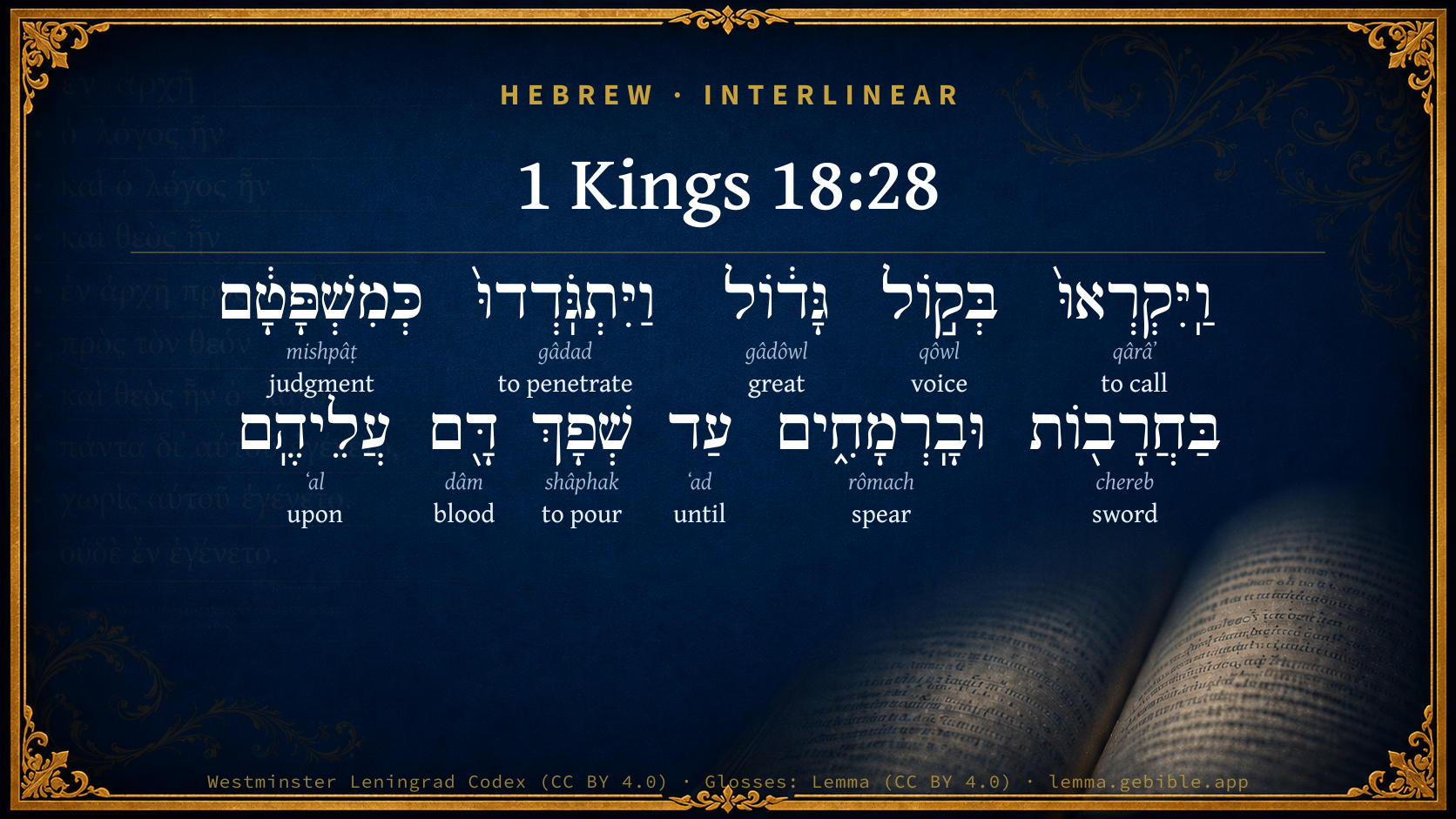
1 Kings 18:28

Hebrew (Westminster Leningrad Codex) 1 Kings 18:28 appears in the Hebrew Old Testament. The text above is from the Westminster Leningrad Codex. Each word links to its Strong’s number, a concise gloss, and parsing drawn from the Open Scriptures Hebrew Bible morphology. Click any word for its full Brown-Driver-Briggs (BDB) entry.
Download image
Cite this verse

1 Kings 18:28 (World English Bible). Public Domain. Lemma interlinear Bible study tool, https://lemma.gebible.app/v/1-kings/18/28.

Show BibTeX & RIS
BibTeX
RIS
English Translation
They cried aloud, and cut themselves after their manner with knives and lances, until the blood gushed out on them.
World English Bible · Public Domain
Download a study sheet

One document with this verse’s original text, its word-by-word gloss line, the meaning frame, cross-references with their text, attributed commentary, and full source and license credits — printable, and it pastes into notes with its structure intact.

This verse Autodidact and up

Study sheet (.html) Plain text (.txt)

A passage Seminary Student

Up to 50 verses in one chapter. A passage sheet keeps up to 6 commentary sources and 12 cross-references per verse, in the order this page ranks them, and says so on the sheet whenever that leaves anything out. Ask for a single verse and you get the Autodidact verse sheet above.

Everything on this page stays free to read, with no account — the sheet is a download of what is already on screen, not access to it.

Want to remove ads? Support Godless Engineer
Compare translations 3

The same verse in 3 English versions, stacked beneath the original-language interlinear above. Click any original word for its lexicon entry.

Each is an independent rendering of the whole verse — the interlinear is not word-aligned to these translations.

Highlighted words mark where these versions differ — a whole-verse word diff, not a word-by-word alignment.

  • World English Bible Public Domain
    They cried aloud, and cut themselves after their manner with knives and lances, until the blood gushed out on them.
  • King James Version Public Domain
    And they cried aloud, and cut themselves after their manner with knives and lancets, till the blood gushed out upon them.
  • unfoldingWord Literal Text CC BY-SA 4.0
    And they called out with a great voice, and they cut themselves, according to their custom, with swords and with spears until a pouring of blood on them.

unfoldingWord Literal Text — © unfoldingWord, licensed CC BY-SA 4.0. Word-aligned USFM3 via Door43 (git.door43.org/unfoldingWord/en_ult).

Versions to compare (up to 4)

3 of 4 selected

Show all 18 translations

Every available English version of this verse, each an independent rendering of the whole verse.

  • World English Bible Public Domain
    They cried aloud, and cut themselves after their manner with knives and lances, until the blood gushed out on them.
  • Berean Standard Bible Public Domain
    So they shouted louder and cut themselves with knives and lances, as was their custom, until the blood gushed over them.
  • Majority Standard Bible Public Domain
    So they shouted louder and cut themselves with knives and lances, as was their custom, until the blood gushed over them.
  • King James Version Public Domain
    And they cried aloud, and cut themselves after their manner with knives and lancets, till the blood gushed out upon them.
  • American Standard Version (1901) Public Domain
    And they cried aloud, and cut themselves after their manner with knives and lances, till the blood gushed out upon them.
  • Revised Version (1885) Public Domain
    And they cried aloud, and cut themselves after their manner with knives and lances, till the blood gushed out upon them.
  • Geneva Bible (1599) Public Domain
    And they cryed loude, and cut them selues as their maner was, with kniues and launcers, till the blood gushed out vpon them.
  • Douay-Rheims (1899) Public Domain
    So they cried with a loud voice, and cut themselves after their manner with knives and lancets, till they were all covered with blood.
  • Young's Literal Translation Public Domain
    And they call with a loud voice, and cut themselves, according to their ordinance, with swords and with spears, till a flowing of blood `is' on them;
  • Literal Standard Version CC BY-SA 4.0
    And they call with a loud voice, and cut themselves, according to their ordinance, with swords and with spears, until a flowing of blood [is] on them;
  • Unlocked Literal Bible CC BY-SA 4.0
    So they shouted more loudly, and they cut themselves, as they usually did, with swords and spears, until their blood flowed out over themselves.
  • unfoldingWord Literal Text CC BY-SA 4.0
    And they called out with a great voice, and they cut themselves, according to their custom, with swords and with spears until a pouring of blood on them.
  • Darby Bible Public Domain
    And they cried aloud, and cut themselves after their manner with swords and spears, till the blood gushed out upon them.
  • World Messianic Bible Public Domain
    They cried aloud, and cut themselves in their way with knives and lances until the blood gushed out on them.
  • Webster's Bible Public Domain
    And they cried aloud, and cut themselves after their manner with knives and lancets, till the blood gushed out upon them.
  • Free Bible Version CC BY-SA 4.0
    They shouted even louder and cut themselves with swords and spears until they bled. This was their usual way of worshiping.
  • Bible in Basic English Public Domain
    So they gave loud cries, cutting themselves with knives and swords, as was their way, till the blood came streaming out all over them.
  • JPS Tanakh (1917) Public Domain
    And they cried aloud, and cut themselves after their manner with swords and lances, till the blood gushed out upon them.

Literal Standard Version (2020), Covenant Press — licensed CC BY-SA 4.0. Text via the HelloAO Bible API (eBible.org). Unlocked Literal Bible (unfoldingWord) — licensed CC BY-SA 4.0. Text via the HelloAO Bible API (eBible.org). unfoldingWord Literal Text — © unfoldingWord, licensed CC BY-SA 4.0. Word-aligned USFM3 via Door43 (git.door43.org/unfoldingWord/en_ult). Free Bible Version, Dr. Jonathan Gallagher — licensed CC BY-SA 4.0. Text via the HelloAO Bible API (eBible.org).

Word by word

More ways to search: Search by grammar → Find every occurrence → Compare this word →

Practice this passage: Drill this verse → Learn its vocabulary →

וַיִּתְגֹּֽדְדוּ֙
gâdad
H1413
“and · to penetrate”
Conjunction + Verb, Hithpolel, Sequential Imperfect, 3rd Person, Masculine, Plural
Part of Speech
Conjunction + Verb
Stem
Hithpolel
Form
Sequential Imperfect
Person
3rd Person
Gender
Masculine
Number
Plural
Full BDB Definition

Origin: a primitive root [compare H1464 ]

TWOT: 313

to penetrate, cut, attack, invade - (Qal) to penetrate, cut into - (Hithpoel) - to cut oneself - to gather in troops or crowds
  1. וַֽיִּקְרְאוּ֙ qârâʼ H7121 “and · to call” Conjunction + Verb, Qal, Sequential Imperfect, 3rd Person, Masculine, Plural
  2. בְּק֣וֹל qôwl H6963 “in/at · voice” Preposition + Noun, Common, Masculine, Singular, Absolute
  3. גָּד֔וֹל gâdôwl H1419 “great” Adjective, Adjective, Masculine, Singular, Absolute
  4. כְּמִשְׁפָּטָ֔ם mishpâṭ H4941 “like/as · judgment · their” Preposition + Noun, Common, Masculine, Singular, Construct + Suffix, Personal, 3rd Person, Masculine, Plural
  5. בַּחֲרָב֖וֹת chereb H2719 “in/at the · swords” Preposition, Determined + Noun, Common, Feminine, Plural, Absolute
  6. וּבָֽרְמָחִ֑ים rômach H7420 “and · in/at the · spears” Conjunction + Preposition, Determined + Noun, Common, Masculine, Plural, Absolute
  7. עַד ʻad H5704 “until” Preposition
  8. שְׁפָךְ shâphak H8210 “to pour” Verb, Qal, Infinitive Construct
  9. דָּ֖ם dâm H1818 “blood” Noun, Common, Masculine, Singular, Absolute
  10. עֲלֵיהֶֽם ʻal H5921 “upon · them” Preposition + Suffix, Personal, 3rd Person, Masculine, Plural

About this verse

These counts appear in no published source. They are computed here, from the morphology-tagged text and Lemma’s own curated glosses. What Lemma adds →

11
words
11
distinct lemmas
Historical
section

Notable vocabulary

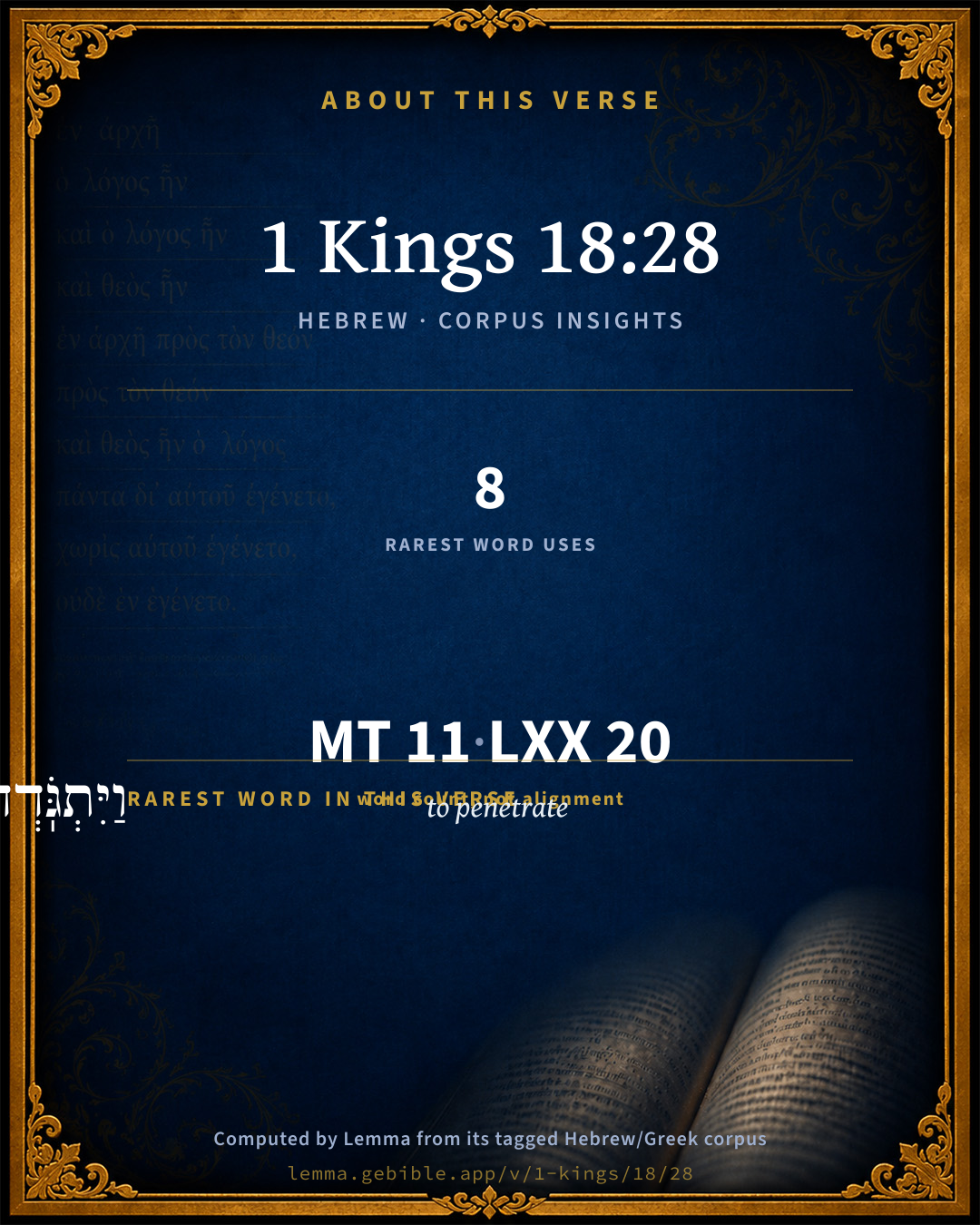
The rarest word here is וַיִּתְגֹּֽדְדוּ֙ to penetrate H1413 — appearing just 8 times in the whole Hebrew Bible.

Shared distinctive vocabulary

וַיִּתְגֹּֽדְדוּ֙ to penetrate H1413 occurs in 8 verses of the Hebrew Bible. Also found in:

Grammatical profile

  • 3 verbs
  • 5 nouns
  • 1 adjective
  • 2 prepositions

Verb forms

  • וַֽיִּקְרְאוּ֙ Qal · Sequential Imperfect
  • וַיִּתְגֹּֽדְדוּ֙ Hithpolel · Sequential Imperfect
  • שְׁפָךְ Qal · Infinitive Construct

Hebrew & Septuagint length

In English translation the verse runs 20 words from the Hebrew and 25 from the Septuagint (LXX English) — closely comparable.

A rough comparison of the two English renderings, which tokenize alike — not a word-level alignment.

Word counts can differ between the Hebrew and the Greek without any difference in meaning — e.g. the Hebrew direct-object marker אֵת has no separate Greek word, and Greek often adds the article ὁ.

In the original languages it is 11 Hebrew tokens and 20 Greek tokens — but the two are counted differently (Hebrew bundles its prefixes and suffixes into one token; the Greek is in lemma form), so that isn’t a like-for-like length.

Cross-references

5

Topical passages linked to 1 Kings 18:28 in the Treasury of Scripture Knowledge — connected by theme and wording, ordered by reader-vote popularity; previews shown in the World English Bible.

  • Leviticus 19:28 "'You shall not make any cuttings in your flesh for the dead, nor tattoo any marks on you. I am Yahweh.
  • Deuteronomy 14:1 You are the children of Yahweh your God: you shall not cut yourselves, nor make any baldness between your eyes for the dead.
  • Mark 5:5 Always, night and day, in the tombs and in the mountains, he was crying out, and cutting himself with stones.
  • Micah 6:7 Will Yahweh be pleased with thousands of rams? With tens of thousands of rivers of oil? Shall I give my firstborn for my disobedience? The fruit of my body for the sin of my soul?
  • Mark 9:22 Often it has cast him both into the fire and into the water, to destroy him. But if you can do anything, have compassion on us, and help us."

Cross-references courtesy of OpenBible.info (CC BY 4.0).

Hebrew and Greek witnesses Masoretic Hebrew ↔ Greek Septuagint

The same verse in the two great witnesses to the Old Testament, shown verse-for-verse.

These are two independent witnesses, not word-aligned to each other, and the Septuagint is shown in lemma (dictionary) form.

Hebrew 1 Kings 18:28 Masoretic · Westminster Leningrad Codex

וַֽיִּקְרְאוּ֙ בְּק֣וֹל גָּד֔וֹל וַיִּתְגֹּֽדְדוּ֙ כְּמִשְׁפָּטָ֔ם בַּחֲרָב֖וֹת וּבָֽרְמָחִ֑ים עַד שְׁפָךְ דָּ֖ם עֲלֵיהֶֽם

They cried aloud, and cut themselves after their manner with knives and lances, until the blood gushed out on them.

World English Bible · Public Domain

Greek LXX 1 Kings 18:28 Septuagint · lemma form

καί ἐπικαλέω ἐν φωνή μέγας καί κατατέμνω κατά ὁ ἐθισμός αὐτός ἐν μάχαιρα καί σειρομάστης ἕως ἐκχύσις αἷμα ἐπί αὐτός

And they cried with a loud voice, and cut themselves according to their custom with knives and lancets until the blood gushed out upon them.

LXX2012 (modern English Septuagint) · Public Domain

Hebrew: Westminster Leningrad Codex (CC BY 4.0). Greek: Septuagint (public domain); English from LXX2012 (modern English Septuagint) (Public Domain). How the Septuagint differs from the Hebrew →

Targum (Aramaic paraphrase)

1

The Targum is the ancient Jewish Aramaic paraphrase of the Hebrew Scriptures — an interpretive translation, not the Hebrew text itself. Onkelos (literal) and Pseudo-Jonathan (expansive) render the Torah, and Jonathan the Prophets. Coverage is partial: where no permissively-licensed English translation exists for a verse, only the Aramaic is shown. This is verse-level text, not a word-by-word alignment to the Hebrew.

  1. Targum Jonathan Prophets (Joshua–Malachi)
    וּקְרוֹ בְּקַל רַב וְאִתְחַמָמוּ כְּנִימוּסֵיהוֹן בְּסַיְפִין וּבְרוֹמְחִין עַד דְאִשְׁתַּפִיךְ דְמָא עֲלֵיהוֹן:

    (no public-domain English translation for this verse)

    Targum Jonathan — Aramaic: “Mikraot Gedolot” (public domain). English: “Sefaria Community Translation” (CC0 1.0 (public-domain dedication)); “London "Chaldee Paraphrase," 1871” (public domain). Text via Sefaria.

Commentary

Notes on 1 Kings 18:28 from classic Christian and Jewish commentators (each source and its license shown beneath its notes). The classic Christian expositions comment on the surrounding passage and are grouped to its opening verse, so a note may address several verses; the Jewish commentaries on the Tanakh (Rashi and others) are per-verse, so they appear only where the commentator wrote on this verse.

Lemma curates 59 commentaries, every one of them public domain or Creative Commons licensed, each selected and text-cleaned for this edition rather than reprinted as found. About our sources →

Trapp's Complete Commentary

John Trapp

1Ki 18:28 And they cried aloud, and cut themselves after their manner with knives and lancets, till the blood gushed out upon them.

Ver. 28. And they cried aloud, and cut themselves.] To their vocis intentio, they added cutis incisio - and this they had learned of their heathen neighbours {Deu 14:1} - but all would not do.

Till the blood gushed out upon them.] This they did by the instigation of that old manslayer, who delighteth in sucking man’s blood, the blood of souls especially. He it is that set awork the priests of Cybele to do the like, and still the Flagellatores among the Papists, who, the week before Easter, whip themselves till the blood followeth, as also the Turkish priests, whose custom is to wound and lance themselves, qua satisfactione existimant se praestare Deo culturm ex opere operato, saith mine author, wherein they think they do God singular good service.

John Trapp, A Commentary or Exposition upon All the Books of the Old and New Testament (1647–1656) — public domain. Text from a community e-Sword module.

Matthew Poole's English Annotations

They cried aloud; as if Elijah had spoken the truth, and their god needed rousing.

Cut themselves; mingling their own blood with their sacrifices; as knowing by experience, that nothing was more acceptable to their Baal (which was indeed the devil) than human blood, and hoping hereby to move their god to pity and help them. And this indeed was the practice of divers heathens in the worship of their false gods, as is manifest both from Scripture, as Lev 19:28; Deu 14:1; 1Ki 18:28, and from the express testimonies of Plutarch, Lucian, Apuleius, and many others.

Matthew Poole's English Annotations on the Holy Bible (1683–1685) — public domain. Text from a community e-Sword/MySword module.

Joseph Benson's Commentary

1Ki 18:28. They cried aloud — They were so far from being convinced and put to shame by the just reproach which Elijah cast upon them, that it made them the more earnest and violent in their proceedings, and induced them to act more ridiculously. A deceived heart having turned them aside, they could not deliver their souls by inquiring, Is there not a lie in our right hand? And cut themselves after their manner, &c. — Observe their zeal! They mingled their own blood with their sacrifices; as knowing by experience, that nothing was more acceptable to their Baal (who was indeed the devil) than human blood; and hoping thereby to move their god to help them. And this indeed was the practice of divers heathen in the worship of their false gods. Plutarch, in his book De Superstitione, tells us that the priests of Bellona, when they sacrificed to that goddess, were wont to besmear the victim with their own blood. The Persian magi, according to Herodotus, used to appease tempests and allay the winds by making incisions in their flesh. They who carried about the Syrian goddess, as Apuleius relates, among other mad pranks, were every now and then cutting and slashing themselves with knives, till the blood gushed out; and even to this very day, we are informed, in Turkey, Persia, and in several parts of the Indies, there are a kind of fanatics who think they do a very meritorious service, and highly acceptable to the deity, by cutting and mangling their own flesh.” — Calmet, and Picart’s Religious Ceremonies.

Joseph Benson's Commentary on the Old and New Testaments (1811–1818) — public domain. Text from a community e-Sword module.

Tyndale Open Study Notes

Tyndale Open Resources

18:28-29 shouted . . . cut themselves . . . raved: The prophets of Baal demonstrated ecstatic behavior common in ancient pagan religions, but their efforts produced no response. Of course, there is only one true God (Deut 4:35; 6:4; Isa 44:8); all other hopes are doomed to failure (Isa 45:22).

Tyndale Open Study Notes — © Tyndale Open Resources, licensed CC BY-SA 4.0. Text via the HelloAO Bible API.

Adam Clarke's Commentary

Verse 28. They cried aloud] The poor fools acted as they were bidden.

And cut themselves after their manner] This was done according to the rites of that barbarous religion; if the blood of the bullock would not move him they thought their own blood might; and with it they smeared themselves and their sacrifice. This was not only the custom of the idolatrous Israelites, but of the Syrians, Persians, Greeks, Indians, and in short of all the heathen world.

Adam Clarke's Commentary on the Bible (1810–1826) — public domain. Text from a community e-Sword/MySword module.

Ellicott's Commentary for English Readers

(28) Lancets—should be lances. This self-mutilation, common in Oriental frenzy, was possibly a portion, or a survival, of human sacrifice, in the notion that self-torture and shedding of human blood must win Divine favour—a delusion not confined to heathen religions, though excusable only in them.

A Bible Commentary for English Readers, edited by Charles John Ellicott (1878–1897) — public domain. Text from a community e-Sword module.

The Cambridge Bible for Schools and Colleges

gen. ed. J. J. S. Perowne

28. And they cried aloud] Not recognizing the mockery of Elijah, but admitting that Baal might be overtaken by the necessities or occupations implied in the prophet’s words.

after their manner] For devotees to wound and mutilate themselves in the worship of their divinities was common in other cults beside that of Baal and Ashêrah.

with knives and lancets] R.V. lances. The former of these nouns is commonly rendered ‘sword,’ though it is also used of other instruments for cutting, as of a razor (Eze_5:1), and an axe (Eze_26:9). The second is constantly employed for ‘spear’ in connexion with ‘shield’ of a fully-armed soldier. The Baal-dance was most likely performed by the chief devotees with weapons in their hands, and with these it was that in their frenzy they wounded themselves.

The Cambridge Bible for Schools and Colleges (gen. ed. J. J. S. Perowne; Cambridge University Press, 1878–1918) — public domain. Text from a community e-Sword module.

John Gill's Exposition

And Elijah said unto all the people, come near unto me,.... And observe what I do, and what will be done at my request:

and all the people came near unto him; left the prophets of Baal to themselves, and took no more notice of them, but attended to what the prophet should say and do:

and he repaired the altar of the Lord that was broken down; which had been set up when high places and altars were allowed of, while the tabernacle was unsettled, and the temple not built; this is supposed to have been erected in the times of the judges; though, according to a tradition of the Jews (d), it was built by Saul, see Sa1 15:12 but had been thrown down by the idolatrous Israelites, who demolished such as were erected to the name of the Lord everywhere, and built new ones for their idols, Kg1 19:10. Benjamin of Tudela (e) says, that on the top of Mount Carmel is now to be seen the place of the altar Elijah repaired, which is four cubits round.

(d) Jarchi & Kimchi in loc. (e) ltinerar. p. 37.

John Gill's Exposition of the Whole Bible (1746–1763) — public domain (CC PDM 1.0). Text via the HelloAO Bible API.

Albert Barnes' Notes on the Bible

Elijah’s scorn roused the Baal-priests to greater exertions. At length, when the frenzy had reached its height, knives were drawn, and the blood spirted forth from hundreds of self-inflicted wounds, while an ecstasy of enthusiasm seized many, and they poured forth incoherent phrases, or perhaps an unintelligible jargon, which was believed to come from divine inspiration, and constituted one of their modes of prophecy.

The practice of inflicting gashes on their limbs, in their religious exercises, was common among the Carians, the Syrians, and the Phrygians. We may regard it as a modification of the idea of human sacrifice. The gods were supposed to be pleased with the shedding of human blood.

Lancets - Lancets, in our modern sense of the word, can scarcely have been intended by our translators. The Hebrew word is elsewhere always translated “spears,” or “lances;” and this is probably its meaning here.

Albert Barnes' Notes on the Bible (1834–1885) — public domain. Text from a community e-Sword/MySword module.

Haydock's Catholic Bible Commentary

Blood. Strange infatuation! which has nevertheless prevailed in many pagan mysteries and countries. Thus were Bellona, Cybele, the Syrian goddess, &c., honoured and appeased. (Calmet) --- God prohibits this fury, Deuteronomy xiv. 1. The devil always endeavours to destroy or to injure man. (Menochius) "Ipsa bipenne suos cædit violenta lacertos,

Sanguineque effuso spargit inepta deam." (Tebullus)

George Leo Haydock (1774–1849), Haydock's Catholic Family Bible and Commentary, 1859 edition — public domain. Excludes Psalms (Douay-Rheims chapter numbering differs from Protestant) and Deuterocanonical books (Catholic canon only).

Whedon's Commentary on the Bible

Daniel D. Whedon

28. Cut themselves… till the blood gushed out — “The prophets of Baal took Elijah at his word. Like the dervishes, who eat glass, seize living snakes with their teeth, throw themselves prostrate for their mounted chief to ride over them — like the Corybantian priests of Cybele — like the fakirs of India — they now, in their frenzied state, tossed to and fro the swords and lances which formed part of their fantastic worship, and gashed themselves and each other till they were smeared with blood, and mingled with their loud yells to the… divinity those ravings which formed the dark side of ancient prophecy.” — Stanley.

Daniel D. Whedon (gen. ed.), Commentary on the Old and New Testaments (1874–1909) — public domain. Text from a community e-Sword module.

The Pulpit Commentary

And they cried aloud Heb. in a great voice, as above. It was not that they took Elijah"s words au serieux, but his scorn led them to redouble their efforts, if only to testify their faith in their god. The frantic cries of the Greek Easter (see Porter, 1:168; Conder, 176-178) in Jerusalem, the prayers of the pilgrims for the descent of the holy fire, may help us to realize the scene here described, and cut themselves cf. Deu_14:1; Jer_16:6 Jer_41:5 Jer_47:5 after their manner Keil quotes from Movers, Phoniz. 1. pp. 682-83, a description of the religious dances offered to the Dea Syria. "A discordant howling opens the scene. Then they rush wildly about in perfect confusion, with their heads bowed down to the ground, but always revolving in circles, so that the loosened hair drags through the mire; then they begin to bite their arms, and end with cutting themselves with the two-edged swords which they are in the habit of carrying. A new scene then opens. One of them, who surpasses all the rest in frenzy, begins to prophesy with sighs and groans," etc. In the "Contemporary Review," vol. 27, pp. 371 sqq., Bishop Caldwell has graphically described the devil dances of Southern India a description which may be read with profit in this connexion. One sentence may be transcribed here: "He cuts and hacks and hews himself, and not unfrequently kills himself there and then." Kitto mentions "the furious gashes which the Persians inflict upon themselves in their frantic annual lamentation for Hossein." Rawlinson says this was also common among the Carians and Phrygians with knives Heb. swords and lancets Heb. lances, spears. The A.V is misleading. The instruments they used were weapons of heavy-armed troops. For (see Num_25:7; Jud_1:5:8; Jer_46:4) till the blood gushed out upon them. Heb. until the shedding of blood upon them. It is perfectly clear that their faith in Baal was sincere and profound. Making due allowance for the fact that they were under the eyes of their king and patron, and of representatives of the entire people, it is still impossible to doubt their sincerity. Some of them, it is probable, were Phoenicians. "Of one thing I am assured the devil dancer never shams excitement" (Caldwell).

The Pulpit Commentary (1880–1919), ed. H.D.M. Spence-Jones & Joseph S. Exell — public domain. Text from a community e-Sword module.

John Wesley's Explanatory Notes

Cut themselves - Mingling their own blood with their sacrifices; as knowing by experience, that nothing was more acceptable to their Baal (who was indeed the devil) than human blood; and hoping thereby to move their God to help them. And this indeed was the practice of divers Heathens in the worship of their false gods.

John Wesley, Explanatory Notes Upon the Whole Bible (1754–1765) — public domain. Text via the GEBible commentary corpus.

Rashi

Rabbi Shlomo Yitzchaki (Rashi)

And they gashed themselves. An expression of tearing the flesh with an instrument, for such was their custom.

Rashi on the Tanakh — English translations: “The Judaica Press complete Tanach with Rashi, translated by A. J. Rosenberg” (CC BY 4.0); “Pentateuch with Rashi's commentary by M. Rosenbaum and A.M. Silbermann, 1929-1934” (public domain); “The Metsudah Tanach series, Lakewood, N.J” (CC BY 4.0); and “The Book of Joshua, Metsudah Publications, 1997” (CC BY 4.0). Text via Sefaria.

Lesson kit

Teaching starters — assembled from the data on this page, not authored interpretation. Every prompt links to the verse data it draws on. Edit before teaching.

1 Kings, in the Historical, opens this verse with 11 words (11 distinct Hebrew lemmas). Its most distinctive word is gâdad (“to penetrate”). A historical commentator’s framing appears above. Read the whole chapter for the surrounding context.

Discussion questions

  1. What does “to penetrate” (gâdad) contribute to the verse as a whole?
  2. Deuteronomy 14:1 shares the word «to penetrate» with this verse. How do the two illuminate each other?
  3. The translations on this page render this verse differently — a whole-verse word diff, not a word-by-word alignment. What might account for the different wordings?
  4. The verb «וַֽיִּקְרְאוּ֙» is Qal Sequential Imperfect. How does its form color the action?
  5. Reading how Trapp's Complete Commentary and Matthew Poole's English Annotations read this verse, where do the two commentators agree and where do they part?

Things to notice

Reading settings

Reading text

Shown beneath each verse's original-language words.

Old Testament
Old Testament edition

Read the OT as the Masoretic Hebrew (MT) or the Greek Septuagint (LXX).

English shown for the Greek Septuagint (in the Hebrew ↔ Greek comparison).

Comparing translations? Open the Compare panel on any verse page to stack up to four side by side.