
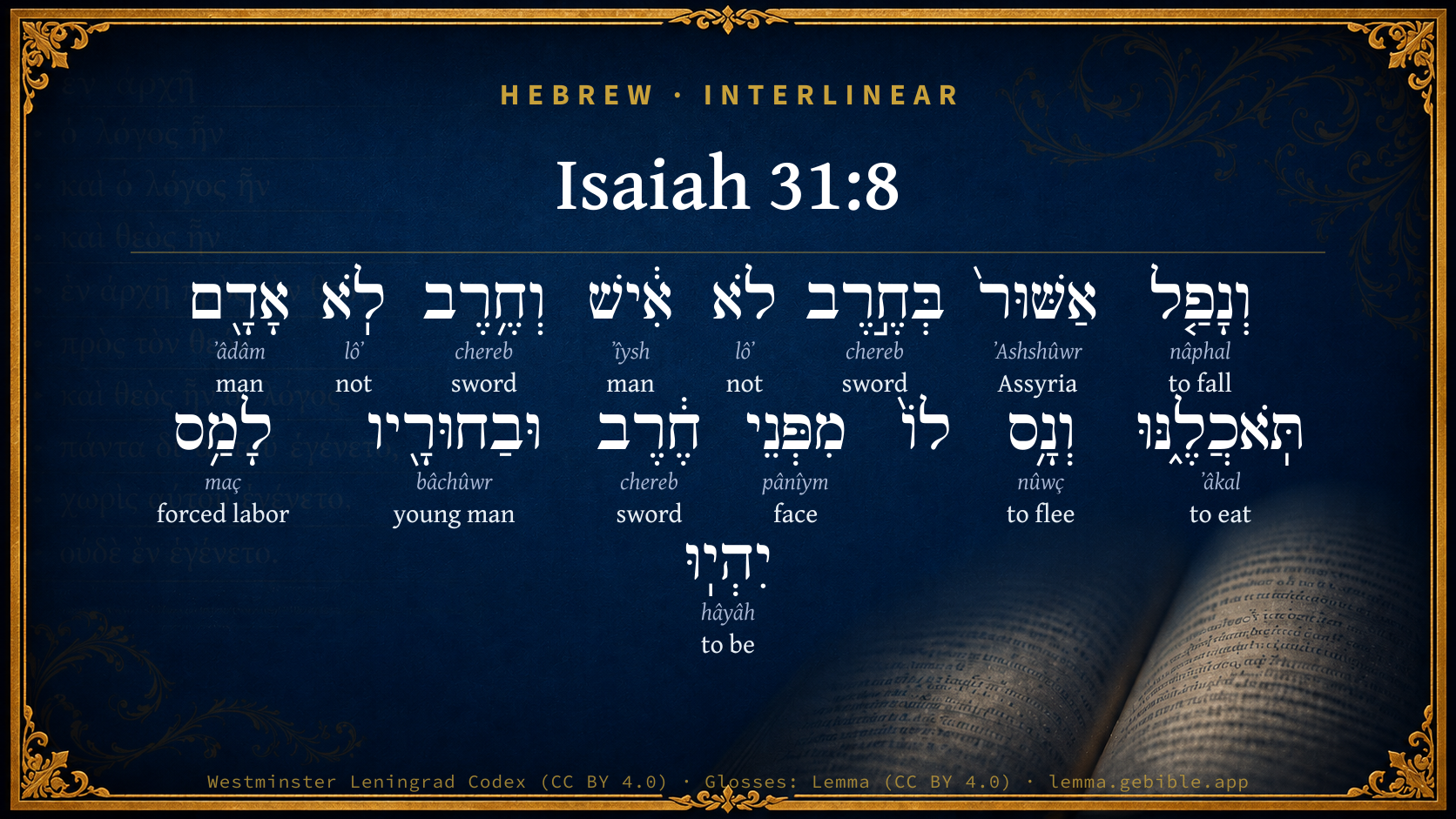
Isaiah 31:8

Hebrew (Westminster Leningrad Codex) Isaiah 31:8 appears in the Hebrew Old Testament. The text above is from the Westminster Leningrad Codex. Each word links to its Strong’s number, a concise gloss, and parsing drawn from the Open Scriptures Hebrew Bible morphology. Click any word for its full Brown-Driver-Briggs (BDB) entry.
Download image
Cite this verse

Isaiah 31:8 (World English Bible). Public Domain. Lemma interlinear Bible study tool, https://lemma.gebible.app/v/isaiah/31/8.

Show BibTeX & RIS
BibTeX
RIS
English Translation
The Assyrian shall fall by the sword, not of man; and the sword, not of men, shall devour him; and he shall flee from the sword, and his young men shall become subject to forced labor.
World English Bible · Public Domain
Download a study sheet

One document with this verse’s original text, its word-by-word gloss line, the meaning frame, cross-references with their text, attributed commentary, and full source and license credits — printable, and it pastes into notes with its structure intact.

This verse Autodidact and up

Study sheet (.html) Plain text (.txt)

A passage Seminary Student

Up to 50 verses in one chapter. A passage sheet keeps up to 6 commentary sources and 12 cross-references per verse, in the order this page ranks them, and says so on the sheet whenever that leaves anything out. Ask for a single verse and you get the Autodidact verse sheet above.

Everything on this page stays free to read, with no account — the sheet is a download of what is already on screen, not access to it.

Want to remove ads? Support Godless Engineer
Compare translations 3

The same verse in 3 English versions, stacked beneath the original-language interlinear above. Click any original word for its lexicon entry.

Each is an independent rendering of the whole verse — the interlinear is not word-aligned to these translations.

Highlighted words mark where these versions differ — a whole-verse word diff, not a word-by-word alignment.

  • World English Bible Public Domain
    The Assyrian shall fall by the sword, not of man; and the sword, not of men, shall devour him; and he shall flee from the sword, and his young men shall become subject to forced labor.
  • King James Version Public Domain
    Then shall the Assyrian fall with the sword, not of a mighty man; and the sword, not of a mean man, shall devour him: but he shall flee from the sword, and his young men shall be discomfited.
  • unfoldingWord Literal Text CC BY-SA 4.0
    “And Assyria will fall by a sword not man, and a sword not mankind will devour him. And he will flee for himself from the face of the sword, and his young men will be for forced labor.

unfoldingWord Literal Text — © unfoldingWord, licensed CC BY-SA 4.0. Word-aligned USFM3 via Door43 (git.door43.org/unfoldingWord/en_ult).

Versions to compare (up to 4)

3 of 4 selected

Show all 18 translations

Every available English version of this verse, each an independent rendering of the whole verse.

  • World English Bible Public Domain
    The Assyrian shall fall by the sword, not of man; and the sword, not of men, shall devour him; and he shall flee from the sword, and his young men shall become subject to forced labor.
  • Berean Standard Bible Public Domain
    “Then Assyria will fall, but not by the sword of man; a sword will devour them, but not one made by mortals. They will flee before the sword, and their young men will be put to forced labor.
  • Majority Standard Bible Public Domain
    “Then Assyria will fall, but not by the sword of man; a sword will devour them, but not one made by mortals. They will flee before the sword, and their young men will be put to forced labor.
  • King James Version Public Domain
    Then shall the Assyrian fall with the sword, not of a mighty man; and the sword, not of a mean man, shall devour him: but he shall flee from the sword, and his young men shall be discomfited.
  • American Standard Version (1901) Public Domain
    And the Assyrian shall fall by the sword, not of man; and the sword, not of men, shall devour him; and he shall flee from the sword, and his young men shall become subject to taskwork.
  • Revised Version (1885) Public Domain
    Then shall the Assyrian fall with the sword, not of man; and the sword, not of men, shall devour him: and he shall flee from the sword, and his young men shall become tributary.
  • Geneva Bible (1599) Public Domain
    Then shall Asshur fall by the sworde, not of man, neither shall the sworde of man deuoure him, and hee shall flee from the sworde, and his yong men shall faint.
  • Douay-Rheims (1899) Public Domain
    And the Assyrian shall fall by the sword not of a man, and the sword not of a man shall devour him, and he shall flee not at the face of the sword: and his young men shall be tributaries.
  • Young's Literal Translation Public Domain
    And fallen hath Asshur by sword, not of the high, Yea, a sword -- not of the low, doth consume him, And he hath fled for himself from the face of a sword, And his young men become tributary.
  • Literal Standard Version CC BY-SA 4.0
    And Asshur has fallen by sword, not of the high, || Indeed, a sword—not of the low, consumes him, || And he has fled for himself from the face of a sword, || And his young men become tributary.
  • Unlocked Literal Bible CC BY-SA 4.0
    Assyria will fall by the sword; a sword not wielded by man will consume him. He will flee from the sword, and his young men will be forced to do hard labor.
  • unfoldingWord Literal Text CC BY-SA 4.0
    “And Assyria will fall by a sword not man, and a sword not mankind will devour him. And he will flee for himself from the face of the sword, and his young men will be for forced labor.
  • Darby Bible Public Domain
    And Asshur shall fall by the sword, not of a great man; and the sword, not of a mean man, shall devour him: and he shall flee from the sword, and his young men shall become tributary;
  • World Messianic Bible Public Domain
    “The Assyrian will fall by the sword, not of man; and the sword, not of mankind, shall devour him. He will flee from the sword, and his young men will become subject to forced labor.
  • Webster's Bible Public Domain
    Then shall the Assyrian fall with the sword, not of a mighty man; and the sword, not of a mean man, shall devour him: but he shall flee from the sword, and his young men shall be discomfited.
  • Free Bible Version CC BY-SA 4.0
    The Assyrians will be killed by the sword of one who is not a man. They will destroyed by the sword of one who is not mortal. They will run away at the sight of the sword, and the young Assyrian men will be taken away as slave laborers.
  • Bible in Basic English Public Domain
    Then the Assyrian will come down by the sword, but not of man; the sword, not of men, will be the cause of his destruction: and he will go in flight from the sword, and his young men will be put to forced work.
  • JPS Tanakh (1917) Public Domain
    Then shall Asshur fall with the sword, not of man, and the sword, not of men, shall devour him; and he shall flee from the sword, and his young men shall become tributary.

Literal Standard Version (2020), Covenant Press — licensed CC BY-SA 4.0. Text via the HelloAO Bible API (eBible.org). Unlocked Literal Bible (unfoldingWord) — licensed CC BY-SA 4.0. Text via the HelloAO Bible API (eBible.org). unfoldingWord Literal Text — © unfoldingWord, licensed CC BY-SA 4.0. Word-aligned USFM3 via Door43 (git.door43.org/unfoldingWord/en_ult). Free Bible Version, Dr. Jonathan Gallagher — licensed CC BY-SA 4.0. Text via the HelloAO Bible API (eBible.org).

Word by word

More ways to search: Search by grammar → Find every occurrence → Compare this word →

Practice this passage: Drill this verse → Learn its vocabulary →

לָמַ֥ס
maç
H4522
“to/for · forced labor”
Preposition + Noun, Common, Masculine, Singular, Absolute
Part of Speech
Preposition + Noun
Type
Common
Gender
Masculine
Number
Singular
State
Absolute
Full BDB Definition

Origin: from H4549

TWOT: 1218

gang or body of forced labourers, task-workers, labour band or gang, forced service, task-work, serfdom, tributary, tribute, levy, taskmasters, discomfited - labour-band, labour-gang, slave gang - gang-overseers - forced service, serfdom, tribute, enforced payment
  1. וְנָפַ֤ל nâphal H5307 “and · to fall” Conjunction + Verb, Qal, Sequential Perfect, 3rd Person, Masculine, Singular
  2. אַשּׁוּר֙ ʼAshshûwr H804 “Assyria” Noun, Proper
  3. בְּחֶ֣רֶב chereb H2719 “in/at · sword” Preposition + Noun, Common, Feminine, Singular, Absolute
  4. לֹא lôʼ H3808 “not” Particle, Negative
  5. אִ֔ישׁ ʼîysh H376 “man” Noun, Common, Masculine, Singular, Absolute
  6. וְחֶ֥רֶב chereb H2719 “and · sword” Conjunction + Noun, Common, Feminine, Singular, Absolute
  7. לֹֽא lôʼ H3808 “not” Particle, Negative
  8. אָדָ֖ם ʼâdâm H120 “man” Noun, Common, Masculine, Singular, Absolute
  9. תֹּֽאכֲלֶ֑נּוּ ʼâkal H398 “to eat · him” Verb, Qal, Imperfect, 3rd Person, Feminine, Singular + Suffix, Personal, 3rd Person, Masculine, Singular
  10. וְנָ֥ס nûwç H5127 “and · to flee” Conjunction + Verb, Qal, Sequential Perfect, 3rd Person, Masculine, Singular
  11. מִפְּנֵי pânîym H6440 “from · face(s) of” Preposition + Noun, Common, Both, Plural, Construct
  12. חֶ֔רֶב chereb H2719 “sword” Noun, Common, Feminine, Singular, Absolute
  13. וּבַחוּרָ֖יו bâchûwr H970 “and · young men · his” Conjunction + Noun, Common, Masculine, Plural, Construct + Suffix, Personal, 3rd Person, Masculine, Singular
  14. יִהְיֽוּ hâyâh H1961 “to be” Verb, Qal, Imperfect, 3rd Person, Masculine, Plural

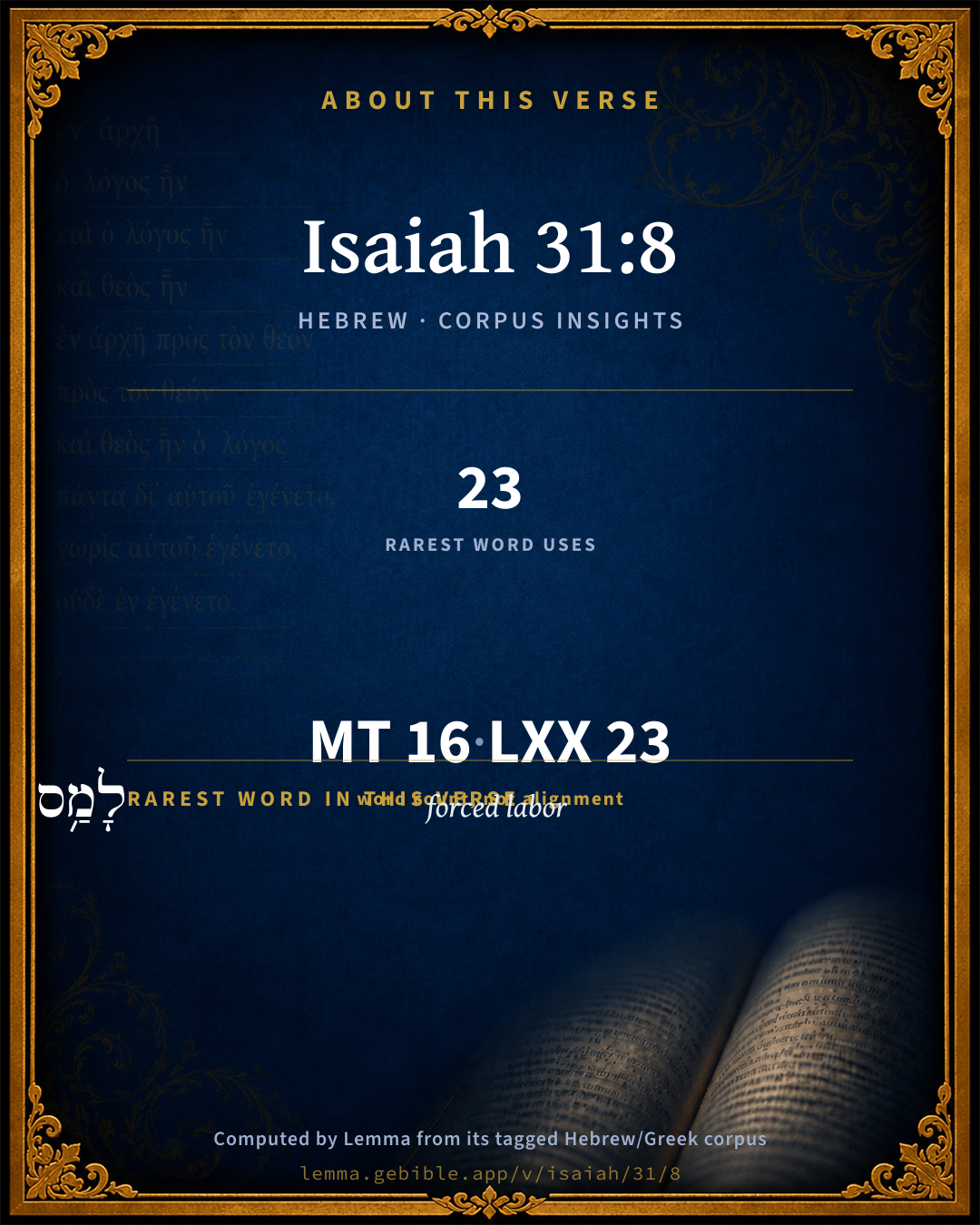
About this verse

These counts appear in no published source. They are computed here, from the morphology-tagged text and Lemma’s own curated glosses. What Lemma adds →

16
words
12
distinct lemmas
Prophets
section

Notable vocabulary

The rarest word here is לָמַ֥ס forced labor H4522 — appearing just 23 times in the whole Hebrew Bible.

Shared distinctive vocabulary

לָמַ֥ס forced labor H4522 occurs in 22 verses of the Hebrew Bible. Also found in:

Grammatical profile

  • 4 verbs
  • 9 nouns
  • 1 preposition
  • 2 particles

Verb forms

  • וְנָפַ֤ל Qal · Sequential Perfect
  • תֹּֽאכֲלֶ֑נּוּ Qal · Imperfect
  • וְנָ֥ס Qal · Sequential Perfect
  • יִהְיֽוּ Qal · Imperfect

Repetition

Words recur within this verse — often emphatic in Hebrew:

  • בְּחֶ֣רֶב sword H2719 ×3
  • לֹא not H3808 ×2

Hebrew & Septuagint length

In English translation the verse runs 36 words from the Hebrew and 39 from the Septuagint (LXX English) — closely comparable.

A rough comparison of the two English renderings, which tokenize alike — not a word-level alignment.

Word counts can differ between the Hebrew and the Greek without any difference in meaning — e.g. the Hebrew direct-object marker אֵת has no separate Greek word, and Greek often adds the article ὁ.

In the original languages it is 16 Hebrew tokens and 23 Greek tokens — but the two are counted differently (Hebrew bundles its prefixes and suffixes into one token; the Greek is in lemma form), so that isn’t a like-for-like length.

Cross-references

12

Topical passages linked to Isaiah 31:8 in the Treasury of Scripture Knowledge — connected by theme and wording, ordered by reader-vote popularity; previews shown in the World English Bible.

  • Isaiah 14:25 that I will break the Assyrian in my land, and on my mountains tread him under foot: then shall his yoke depart from off them, and his burden depart from off their shoulder.
  • Genesis 49:15 He saw a resting-place, that it was good, The land, that it was pleasant; He bows his shoulder to the burden, And becomes a servant doing forced labor.
  • 2 Kings 19:34–37 For I will defend this city to save it, for my own sake, and for my servant David's sake.
  • Isaiah 10:12 Therefore it shall happen that, when the Lord has performed his whole work on Mount Zion and on Jerusalem, I will punish the fruit of the stout heart of the king of Assyria, and the glory of his high looks.
  • Isaiah 10:16–19 Therefore will the Lord, Yahweh of Hosts, send among his fat ones leanness; and under his glory there shall be kindled a burning like the burning of fire.
  • Isaiah 10:33–34 Behold, the Lord, Yahweh of Hosts, will lop the boughs with terror: and the high of stature shall be hewn down, and the lofty shall be brought low.
  • Isaiah 29:5 But the multitude of your foes shall be like small dust, and the multitude of the awesome ones as chaff that passes away: yes, it shall be in an instant suddenly.
  • Isaiah 30:27–33 Behold, the name of Yahweh comes from far, burning with his anger, and in thick rising smoke: his lips are full of indignation, and his tongue is as a devouring fire;
  • Isaiah 37:7 Behold, I will put a spirit in him, and he shall hear news, and shall return to his own land; and I will cause him to fall by the sword in his own land.
  • Isaiah 37:35–38 For I will defend this city to save it, for my own sake, and for my servant David's sake.
  • Hosea 1:7 But I will have mercy on the house of Judah, and will save them by Yahweh their God, and will not save them by bow, nor by sword, nor by battle, by horses, nor by horsemen."
  • 2 Chronicles 32:21 Yahweh sent an angel, who cut off all the mighty men of valor, and the leaders and captains, in the camp of the king of Assyria. So he returned with shame of face to his own land. When he was come into the house of his god, those who came forth from his own bowels killed him there with the sword.

Cross-references courtesy of OpenBible.info (CC BY 4.0).

Hebrew and Greek witnesses Masoretic Hebrew ↔ Greek Septuagint

The same verse in the two great witnesses to the Old Testament, shown verse-for-verse.

These are two independent witnesses, not word-aligned to each other, and the Septuagint is shown in lemma (dictionary) form.

Hebrew Isaiah 31:8 Masoretic · Westminster Leningrad Codex

וְנָפַ֤ל אַשּׁוּר֙ בְּחֶ֣רֶב לֹא אִ֔ישׁ וְחֶ֥רֶב לֹֽא אָדָ֖ם תֹּֽאכֲלֶ֑נּוּ וְנָ֥ס לוֹ֙ מִפְּנֵי חֶ֔רֶב וּבַחוּרָ֖יו לָמַ֥ס יִהְיֽוּ

The Assyrian shall fall by the sword, not of man; and the sword, not of men, shall devour him; and he shall flee from the sword, and his young men shall become subject to forced labor.

World English Bible · Public Domain

Greek LXX Isaiah 31:8 Septuagint · lemma form

καί πίπτω ασσουρ οὐ μάχαιρα ἀνήρ οὐδέ μάχαιρα ἄνθρωπος καταἐσθίω αὐτός καί φεύγω οὐ ἀπό πρόσωπον μάχαιρα ὁ δέ νεανίσκος εἰμί εἰς ἥττημα

And the Assyrian shall fall: not the sword of a great man, nor the sword of a mean man shall devour him; neither shall he flee from the face of the sword: but the young men shall be overthrown:

LXX2012 (modern English Septuagint) · Public Domain

On this verse, Albert Barnes' Notes on the Bible discusses the Septuagint’s reading. Read the note in Commentary ↓

Hebrew: Westminster Leningrad Codex (CC BY 4.0). Greek: Septuagint (public domain); English from LXX2012 (modern English Septuagint) (Public Domain). How the Septuagint differs from the Hebrew →

Targum (Aramaic paraphrase)

1

The Targum is the ancient Jewish Aramaic paraphrase of the Hebrew Scriptures — an interpretive translation, not the Hebrew text itself. Onkelos (literal) and Pseudo-Jonathan (expansive) render the Torah, and Jonathan the Prophets. Coverage is partial: where no permissively-licensed English translation exists for a verse, only the Aramaic is shown. This is verse-level text, not a word-by-word alignment to the Hebrew.

  1. Targum Jonathan Prophets (Joshua–Malachi)
    וְיִפּוֹל אַתּוּרָאָה בְּחֶרֶב לָא אֱנַשׁ וְחֶרֶב לָא אֱנשׁ תְּשֵׁיצִינֵהּ וְיֶעְרוֹק לֵיהּ כְּמִן קֳדָם דְקַטְלִין בְּחַרְבָּא וְגִבְרוֹהִי לִתְּבַר יְהוֹן:

    Then shall the Assyrian fall by a sword not of man; and the sword not of a man shall destroy him: and he shall betake himself to flight as from before those who slay with the sword, and his heroes shall be for destruction.

    Targum Jonathan — Aramaic: “Mikraot Gedolot” (public domain). English: “Sefaria Community Translation” (CC0 1.0 (public-domain dedication)); “London "Chaldee Paraphrase," 1871” (public domain). Text via Sefaria.

Commentary

Notes on Isaiah 31:8 from classic Christian and Jewish commentators (each source and its license shown beneath its notes). The classic Christian expositions comment on the surrounding passage and are grouped to its opening verse, so a note may address several verses; the Jewish commentaries on the Tanakh (Rashi and others) are per-verse, so they appear only where the commentator wrote on this verse.

Lemma curates 59 commentaries, every one of them public domain or Creative Commons licensed, each selected and text-cleaned for this edition rather than reprinted as found. About our sources →

Trapp's Complete Commentary

John Trapp

Isa 31:8 Then shall the Assyrian fall with the sword, not of a mighty man; and the sword, not of a mean man, shall devour him: but he shall flee from the sword, and his young men shall be discomfited.

Ver. 8. Then shall the Assyrian fall.] Fall in his forces, flee in his person; but evil shall hunt that violent man to destroy him. {Psa 140:11}

Not of a mighty man.] Or, Of a mean man, but of an angel.

And his young men shall be discomfited.] Heb., Shall be unto melting; they shall melt away. {1Sa 14:16} Vide hic, saith A Lapide; see here how this world is nothing else but a perpetual ruin of all kinds and conditions of men.

John Trapp, A Commentary or Exposition upon All the Books of the Old and New Testament (1647–1656) — public domain. Text from a community e-Sword module.

Joseph Benson's Commentary

Isa 31:8-9. Then shall the Assyrian, &c. — When you have cast away your idols, and seriously sought unto God for help; both which things were performed by Hezekiah; fall by the sword, not of a mighty man, &c. — Not of any man, mean or mighty, but of an angel. But he shall flee from the sword — From, or for fear of, that plague, which so strangely and suddenly destroyed his army. And his young men — Hebrew, בחוריו, his choice young men, his guards, and valiant commanders, and soldiers, shall be discomfited — Hebrew, למס יהיו, shall be for melting, or shall melt away; a great part of them being destroyed by the angel, and the hearts of the rest melting for fear. And he shall pass to his stronghold — Sennacherib shall flee away with all speed from Jerusalem, to his strong city of Nineveh. Or, as it is in the margin, which see. And his princes shall be afraid of the ensign — Of the Lord’s ensign, which he hath lifted up against them. Or, as וחתו מנס, may be properly rendered, shall be struck with consternation at his flight. Saith the Lord, whose fire is in Zion — That is, either, 1st, whose fire is continually burning upon the altar in Zion; a sign that his presence and residence are there. Or, rather, 2d, who is, and will appear to be, in Zion like a fire, to defend his people, and to consume their enemies. Thus God promises that he would be, unto Jerusalem, a wall of fire round about, Zec 2:5. See also Zec 12:6.

Joseph Benson's Commentary on the Old and New Testaments (1811–1818) — public domain. Text from a community e-Sword module.

Geneva Bible (1599)

Geneva Bible translators

When your repentance appeareth.

Geneva Bible (1599) marginal notes — public domain. Text via Bolls.life.

Jamieson, Fausset & Brown

Robert Jamieson, A. R. Fausset & David Brown

Assyrian--Sennacherib, representative of some powerful head of the ungodly in the latter ages [HORSLEY].

sword, not of . . . mighty . . . mean man--but by the unseen sword of God.

flee--Sennacherib alone fled homewards after his army had been destroyed (Isa 37:37).

young men--the flower of his army.

discomfited--rather, "shall be subject to slavery"; literally, "shall be liable to tribute," that is, personal service (Deu 20:11; Jos 9:21) [MAURER]. Or, not so well, "shall melt away" [ROSENMULLER].

Jamieson, Fausset & Brown — Commentary Critical and Explanatory on the Whole Bible (1871) — public domain (CC PDM 1.0). Text via the HelloAO Bible API.

Adam Clarke's Commentary

Verse 8. Then shall the Assyrian fall, c.] Because he was to be discomfited by the angel of the Lord, destroying in his camp, in one night, upwards of one hundred and eighty thousand men and Sennacherib himself fell by the hands of the princes, his own sons. Not mighty men, for they were not soldiers; not mean men, for they were princes.

Adam Clarke's Commentary on the Bible (1810–1826) — public domain. Text from a community e-Sword/MySword module.

Ellicott's Commentary for English Readers

(8) Not of a mighty man . . .—The Hebrew has no adjectives, but the nouns are those which are commonly opposed to each other in this way, as in Isa_2:9, like the Latin vir and homo. The thought expressed is, of course, that the whole work would be of God, and not of man. The “sword” was that of the Divine judgment (Deu_32:41), perhaps, as in 1Ch_21:16, of the destroying angel of the pestilence.

A Bible Commentary for English Readers, edited by Charles John Ellicott (1878–1897) — public domain. Text from a community e-Sword module.

The Cambridge Bible for Schools and Colleges

gen. ed. J. J. S. Perowne

8. not of a mighty man … mean man] R.V. not of man … men (see on ch. Isa_2:9). Lit. “of a Not-man … Not-mortal,” i.e. a superhuman sword.

shall be discomfited] R.V. shall become tributary, “be subjected to bond-service,” as 1Ki_9:21 f., &c.

8, 9. The discomfiture of the Assyrians will be accomplished by Jehovah Himself. The connexion with what precedes is not very close.

The Cambridge Bible for Schools and Colleges (gen. ed. J. J. S. Perowne; Cambridge University Press, 1878–1918) — public domain. Text from a community e-Sword module.

John Gill's Exposition

Then shall the Assyrian fall with the sword, not of a mighty man,.... That is, the Assyrian army under Sennacherib their king, which besieged Jerusalem in Hezekiah's time; which, as soon as the people were brought to a sense of their sin, and repentance for it, and cast away their idols as a proof of it, were utterly destroyed; but not in battle, not by the sword of Hezekiah, or any of his valiant generals:

and the sword, not of a mean man, shall devour him; neither the sword of a general, nor of a private soldier, nor indeed of any man, but of an angel; see Kg2 19:35,

but he shall flee from the sword; from the drawn sword of the angel, who very probably appeared in such a form as in Ch1 21:16 which Sennacherib king of Assyria seeing, as well as the slaughter made in his army by him, fled from it; in the Hebrew text it is added, "for himself" (y); he fled for his life, for his own personal security; see Kg2 19:36,

and his young men shall be discomfited; his choice ones, the flower of his army: or "melt away" (z), through fear; or die by the stroke of the angel upon them: the sense of becoming "tributary" seems to have no foundation.

(y) "fugiet sibi", Pagninus, Montanus, Cocceius; "fuga consulet sibi", Junius & Tremellius. (z) "in liquefactionem, erunt", Vatablus; "colliquescent", Piscator.

John Gill's Exposition of the Whole Bible (1746–1763) — public domain (CC PDM 1.0). Text via the HelloAO Bible API.

Albert Barnes' Notes on the Bible

Then shall the Assyrian fall with the sword - The sword is often used as an instrument of punishment. It is not meant here literally that the sword would be used, but it is employed to denote that complete destruction would come upon them.

Not of a mighty man - The idea here is, that the army should not fall by the valor of a distinguished warrior, but that it should be done by the direct interposition of God (see Isa 37:36).

Of a mean man - Of a man of humble rank. His army shall not be slain by the hand of mortals.

But he shall flee - The Assyrian monarch escaped when his army was destroyed, and fled toward his own land; Isa 37:37.

From the sword - Margin, ‘For fear of.’ The Hebrew is ‘From the face of the sword;’ and the sense is, that he would flee in consequence of the destruction of his host, here represented as destroyed by the sword of Yahweh.

And his young men - The flower and strength of his army.

Shall be discomfited - Margin, ‘For melting;’ or ‘tribute,’ or ‘tributary.’ Septuagint, Εἰς ἥττημα Eis hēttēma - ‘For destruction.’ The Hebrew word (מס mas), derived probably from מסס mâsas, “to melt away, to dissolve”) is most usually employed to denote a levy, fine, or tax - so called, says Taylor, because it wastes or exhausts the substance and strength of a people. The word is often used to denote that people become tributary, or vassals, as in Gen 49:15; Deu 20:11; compare Jos 16:10; 2Sa 20:24; 1Ki 4:6; 1Ki 5:13; Est 10:1. Probably it does not here mean that the strength of the Assyrian army would become literally tributary to the Jews, but that they would be as if they had been placed under a levy to them; their vigor and strength would melt away; as property and numbers do under taxation and tribute.

Albert Barnes' Notes on the Bible (1834–1885) — public domain. Text from a community e-Sword/MySword module.

Haydock's Catholic Bible Commentary

Flee not. Hebrew, "flee to himself," lo. Septuagint and Vulgate have read la, "not." The angel destroyed the army, and the king was slain at his return. --- Tributaries. Ninive being afterwards subject to the Chaldeans, &c. (Calmet) --- Hebrew, "shall melt." (Vatable)

George Leo Haydock (1774–1849), Haydock's Catholic Family Bible and Commentary, 1859 edition — public domain. Excludes Psalms (Douay-Rheims chapter numbering differs from Protestant) and Deuterocanonical books (Catholic canon only).

Matthew Poole's English Annotations

Then; when you have cast away your idols, and seriously sought to me for help; both which things were performed by Hezekiah.

With the sword, not of a mighty man; and the sword, not of a mean man; by the sword, not of any man, either mean or mighty, but of an angel.

From the sword; from, or for fear of, that plague which so strangely and suddenly destroyed his army.

His young men, Heb. his choice young men; his guards and valiant commanders and soldiers.

Shall be discomfited, Heb. shall melt away, a great part of them being destroyed by the angel; and the hearts of the rest melting for fear.

Matthew Poole's English Annotations on the Holy Bible (1683–1685) — public domain. Text from a community e-Sword/MySword module.

The Pulpit Commentary

Then shall the Assyrian fall with the sword, not of a mighty man; rather, and Assyria shall fall by the sword of one who is not a man Assyria"s destruction will not be by the visible swords of human enemies, but by the invisible sword of God. (comp. 2Ki_19:35) And the sword, not of a mean man, shall devour him; rather, and the sword of one who is not a mortal shall detour him an instance of "synonymous parallelism." He shall flee; more literally, betake himself to flight. His young men shall be discomfited; rather, as in the margin, shall be for tribute. They shall become the vassals of a foreign power.

Vers. 8, 9. Fleeing away.

Here is a prophetic vision of flight, which may suggest other kinds and instances of "fleeing away." Sennacherib comes up vain-gloriously against Jerusalem, confidently reckoning on complete success, thinking to swallow up Judah as a pleasant morsel; and, behold! he is found hurrying homewards as one that is pursued by overtaking legions, not staying at his first fortification, but, in his terror and humiliation, "passing on beyond his stronghold" for fear, his princes frightened away by the flags" of the enemy that was to have been so easily and so utterly subdued. Our thoughts may be directed to

I THE VANQUISHED FLEEING FROM THE VICTORIOUS. The annals of human history, which have hitherto been principally the record of human strife, are only too full of heart-rending illustrations (see, among others, Erckmann-Chatrian"s "Waterloo").

II CRIME FLEEING FROM THE FEET OF JUSTICE. Both fact and fiction will supply abundant illustrations of the intolerable wretchedness of those who, pursued by the officers of law, are dogged by apprehension and alarm at every step they take. "Let no man talk of murderers escaping justice, and hint that Providence must sleep: there were twenty score of violent deaths in one long minute of that agony of fear.

III WRONG FLEEING FROM REVENGE. See the vivid picture of Carker fleeing from Dombey (Dickens): "Shame, disappointment, and discomfiture gnawing at his heart, a constant apprehension of being overtaken: the same intolerable awe and dread that had come upon him in the night returned unweakened in the day... rolling on and on, always postponing thought, and always racked with thinking... pressing on ... change upon change... long roads and dread of night... and still the old monotony of bells and wheels and horses" feet, and no rest.

IV GUILT FLEEING FROM THE FACE OF GOD. Guilt fleeing:

1. Weakly and vainly. Long before Jonah, in the hour of self-reproach that followed his act of disobedience, "fled from the presence of the Lord," men had tried to put a distance between their sin and its rightful Judge. And long since then have they tried to escape his eye and his hand. Saddest of all vain endeavors is the thrice-guilty deed of the suicide, who acts as if, by entering another world, he could flee from the face of the Omnipresent One.

2. But there is a sense in which guilt flies away from the face of God really and most blessedly. When God"s conditions of penitence and faith have been fulfilled, then is our guilt "purged away," our transgressions are removed from us as far as the east is from the west," our sins are "hidden from his face," they are "cast into the depths of the sea". (Psa_65:3 Psa_103:12 Psa_51:9 Mic_7:19) Moreover, we look forward to the time when there shall be a glorious fulfillment of the Divine promises, and we shall have

V EVIL DISAPPEARING FROM THE FACE OF MAN; when sorrow and sighing shall flee away," when "death and hell shall be cast into the lake of fire," when "there shall be no more death, neither sorrow nor crying... for the former things are passed away". C. (Isa_35:10 Rev_20:14 Rev_21:4)

The surprise of the Lord"s deliverances.

No inhabitant of Jerusalem could have imagined how God intended to deliver the city from Sennacherib. God"s way is in the sea, his footsteps are not known; but he leads his people safely like a flock. The following points will recall familiar illustrations.

I GOD"S PROMISED DELIVERANCES ALWAYS DO COME. "If it tarry, wait for it; it will surely come, it will not tarry." "No good thing has failed God"s people of all that he has promised." "This poor man cried, and the Lord heard, and saved him out of all his troubles.

II THEY COME WHEN WE DO NOT EXPECT THEM, And therefore we are constantly urged to keep watchful and expectant. Disraeli truly remarked that "the unexpected is the thing that happens.

III THEY COME IN WAYS THAT SEEM STRANGE. In some cases not seeming at all to be the deliverances which they really are.

IV THE SURPRISE THEY BRING IS USUALLY FULL OF GRATITUDE AND JOY. For in most cases it is manifestly better than our thought. Then let God save us and deliver us just in his own way and time. Enough for us to wait earnestly on him in our prayer, and wait patiently for him, trustingly sure that he always has his "set time in which to favor Zion. R.T.

The Pulpit Commentary (1880–1919), ed. H.D.M. Spence-Jones & Joseph S. Exell — public domain. Text from a community e-Sword module.

John Wesley's Explanatory Notes

The sword - Not of any man, but of an angel. Discomfited - Hebrew. shall melt away, a great part of them being destroyed by the angel; and the hearts of the rest melting for fear.

John Wesley, Explanatory Notes Upon the Whole Bible (1754–1765) — public domain. Text via the GEBible commentary corpus.

Keil & Delitzsch

C. F. Keil & F. Delitzsch

The second motive is, that Israel will not be rescued by men, but by Jehovah alone; so that even He from whom they have now so deeply fallen will prove Himself the only true ground of confidence. "And Asshur falls by a sword not of a man, and a sword not of a man will devour him; and he flees before a sword, and his young men become tributary. And his rock, for fear will it pass away, and his princes be frightened away by the flags: the saying of Jehovah, who has His fire in Zion, and His furnace in Jerusalem." The lxx and Jerome render this falsely φεύξεται οὐκ (לא) ἀπὸ προσώπου μαχαίρας. לו is an ethical dative, and the prophet intentionally writes "before a sword" without any article, to suggest the idea of the unbounded, infinite, awful (cf., Isa 28:2, beyâd; Psalter, vol. i. p. 15). A sword is drawn without any human intervention, and before this Asshur falls, or at least so many of the Assyrians as are unable to save themselves by flight. The power of Asshur is for ever broken; even its young men will henceforth become tributary, or perform feudal service. By "his rock" most commentators understand the rock upon which the fugitive would gladly have taken refuge, but did not dare (Rosenmller, Gesenius, Knobel, etc.); others, again, the military force of Asshur, as its supposed invincible refuge (Saad., etc.); others, the apparently indestructible might of Asshur generally (Vulgate, Rashi, Hitzig). But the presence of "his princes" in the parallel clause makes it most natural to refer "his rock" to the king; and this reference is established with certainty by what Isa 32:2 affirms of the king and princes of Judah. Luther also renders it thus: und jr Fels wird fur furcht wegzihen (and their rock will withdraw for fear). Sennacherib really did hurry back to Assyria after the catastrophe in a most rapid flight. Minnēs are the standards of Asshur, which the commanders of the army fly away from in terror, without attempting to rally those that were scattered. Thus speaks Jehovah, and this is what He decrees who has His 'ūr and tannūr in Jerusalem. We cannot suppose that the allusion here is to the fire and hearth of the sacrifices; for tannūr does not mean a hearth, but a furnace (from nūr, to burn). The reference is to the light of the divine presence, which was outwardly a devouring fire for the enemies of Jerusalem, an unapproachable red-hot furnace (ignis et caminus qui devorat peccatores et ligna, faenum stipulamque consumit: Jerome).

Keil & Delitzsch — Biblical Commentary on the Old Testament (1861–1891) — public domain (CC PDM 1.0). Text via the HelloAO Bible API. (Old Testament only.)

J. A. Alexander on Isaiah

Joseph Addison Alexander

This future abandonment of all false confidences is described as springing from the demonstration of Jehovah’s willingness and power to save. “And Assyria shall fall by no man’s sword, and no mortal’s sword shall devour him, and (yet) he shall flee from before the sword, and his young men (or chosen warriors) shall become tributary (literally, tribute).” No man’s sword, but that of God. The objection that the prophecy, as thus explained, was not fulfilled, proceeds upon the false assumption that it refers exclusively to the overthrow of Sennacherib’s host, whereas it describes the decline and fall of the Assyrian power after that catastrophe.

Joseph Addison Alexander, The Prophecies of Isaiah (1846–1847; New York: Scribner, 1870–1878) — public domain. Text from a community e-Sword module.

unfoldingWord translationNotes

Door43 World Missions Community

General Information:

Yahweh continues speaking to the people of Judah, referring to the Assyrians as though they are one person.

Assyria will fall by the sword; a sword not wielded by man will consume him

"Sword" refers to military might. This can be stated in active form. AT: "God's sword, and not a man's sword, will destroy the Assyrian army" (See: Metonymy and Active or Passive)

He will flee

"The Assyrians will flee"

They will lose all confidence because of terror

The word "confidence" can be expressed with the adjective "confident." The word "terror" can be expressed with the adjective "terrified." AT: "They will no longer be confident because they are so terrified" (See: Abstract Nouns)

his young men will be forced to do hard labor

This can be stated in active form. AT: "enemies will capture their young men and force them to do hard labor" (See: Active or Passive)

his princes

"their leaders"

at the sight of Yahweh's battle flag

The word "sight" can be expressed with the verb "see." AT: "when they see the flag of Yahweh's army" (See: Abstract Nouns)

this is Yahweh's declaration

Yahweh speaks of himself by name to express the certainty of what he is declaring. Translate as in Isaiah 30:1. AT: "this is what Yahweh has declared" or "this is what I, Yahweh, have declared" (See: First, Second, or Third Person)

whose fire is in Zion and whose firepot is in Jerusalem

Both of these clauses mean the same thing and are used together for emphasis. Here God's presence and his power to judge and destroy are spoken of as if they were a fire. AT: "whose powerful presence is in Zion" (See: Parallelism and Metaphor)

translationWords

Assyria

sword

labor

confidence

terror

prince

fear

Yahweh

fire

Zion

Jerusalem

unfoldingWord translationNotes — © Distant Shores Media and the Door43 World Missions Community, licensed CC BY-SA 4.0. Source: git.door43.org/Door43/en_tn.

Ibn Ezra

Rabbi Abraham ibn Ezra

With a sword, not of a mighty man, but with the drawn sword of an angel. The sword is a figurative expression.

And his young men that will have escaped shall be discomfited, shall be overtaken on the ways in which they try to flee.

Ibn Ezra on the Tanakh — English translations: “Sefaria Community Translation” (CC0 1.0 (public-domain dedication)); “Yalkut, Sifsei Chachomim Chumash, Metsudah Publications, 2009” (CC BY 4.0); and “Commentary of Ibn Ezra on Isaiah - trans. by M. Friedlander, 1873” (public domain). Text via Sefaria.

Lesson kit

Teaching starters — assembled from the data on this page, not authored interpretation. Every prompt links to the verse data it draws on. Edit before teaching.

Isaiah, in the Prophets, opens this verse with 16 words (12 distinct Hebrew lemmas). Its most distinctive word is maç (“forced labor”). A historical commentator’s framing appears above. Read the whole chapter for the surrounding context.

Discussion questions

  1. How does “forced labor” (maç) shape what this verse is saying?
  2. How does Genesis 49:15, which shares the word «forced labor», read alongside this verse?
  3. What does the repetition of “sword” (3× in this one verse) do in this verse?
  4. These translations render this verse differently; the difference is in the English rendering, not the original. What questions does that raise?
  5. «וְנָפַ֤ל» is a Qal Sequential Perfect verb. How does that grammatical form shape the action described?
  6. Compare how Trapp's Complete Commentary and Joseph Benson's Commentary read this verse. Where do they agree or differ?

Things to notice

Reading settings

Reading text

Shown beneath each verse's original-language words.

Old Testament
Old Testament edition

Read the OT as the Masoretic Hebrew (MT) or the Greek Septuagint (LXX).

English shown for the Greek Septuagint (in the Hebrew ↔ Greek comparison).

Comparing translations? Open the Compare panel on any verse page to stack up to four side by side.