Amos 7:9

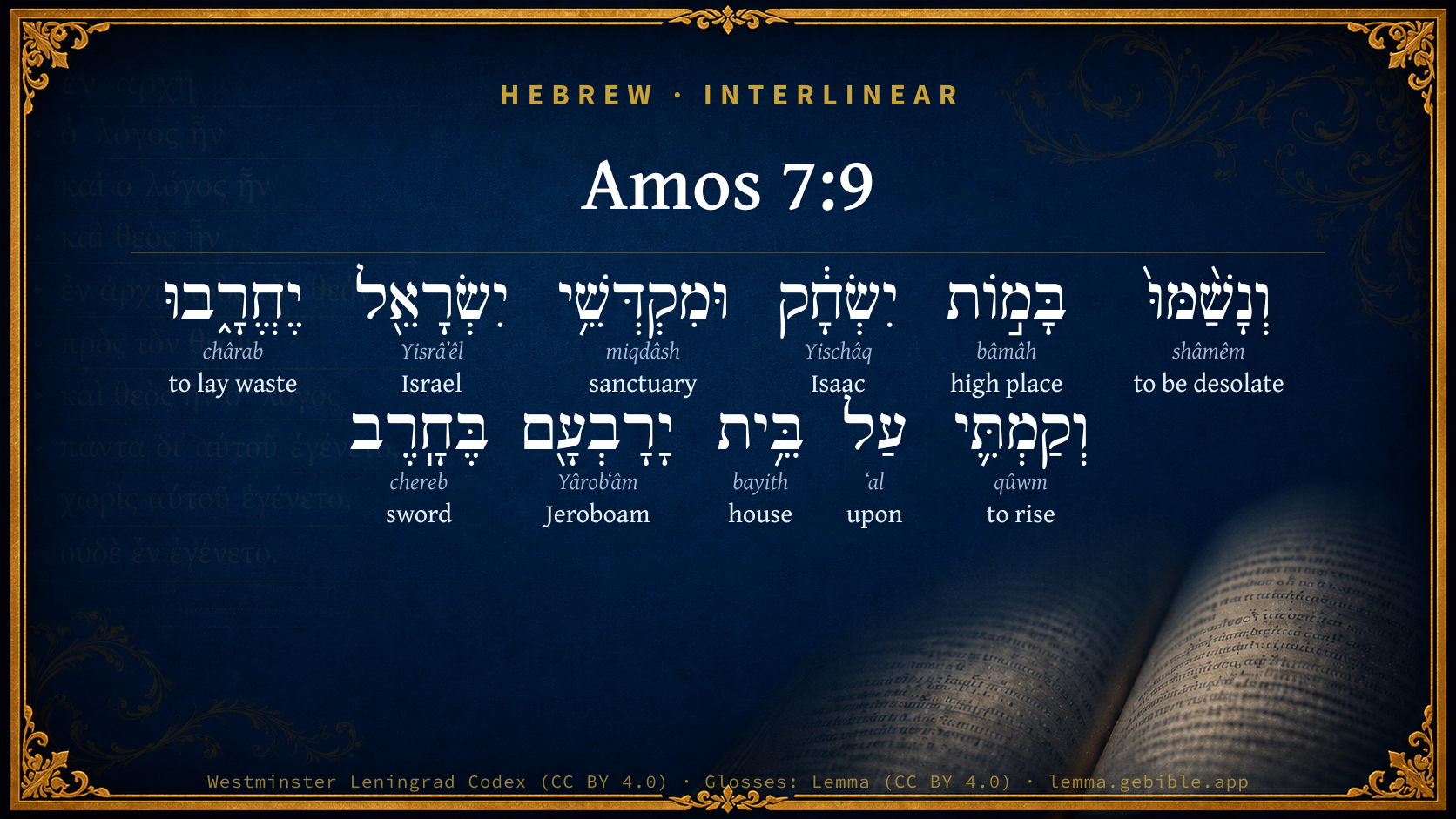
Hebrew (Westminster Leningrad Codex) Amos 7:9 appears in the Hebrew Old Testament. The text above is from the Westminster Leningrad Codex. Each word links to its Strong’s number, a concise gloss, and parsing drawn from the Open Scriptures Hebrew Bible morphology. Click any word for its full Brown-Driver-Briggs (BDB) entry.
Download image
Cite this verse

Amos 7:9 (World English Bible). Public Domain. Lemma interlinear Bible study tool, https://lemma.gebible.app/v/amos/7/9.

Show BibTeX & RIS
BibTeX
RIS
English Translation
The high places of Isaac will be desolate, the sanctuaries of Israel will be laid waste; and I will rise against the house of Jeroboam with the sword."
World English Bible · Public Domain
Download a study sheet

One document with this verse’s original text, its word-by-word gloss line, the meaning frame, cross-references with their text, attributed commentary, and full source and license credits — printable, and it pastes into notes with its structure intact.

This verse Autodidact and up

Study sheet (.html) Plain text (.txt)

A passage Seminary Student

Up to 50 verses in one chapter. A passage sheet keeps up to 6 commentary sources and 12 cross-references per verse, in the order this page ranks them, and says so on the sheet whenever that leaves anything out. Ask for a single verse and you get the Autodidact verse sheet above.

Everything on this page stays free to read, with no account — the sheet is a download of what is already on screen, not access to it.

Want to remove ads? Support Godless Engineer
Compare translations 3

The same verse in 3 English versions, stacked beneath the original-language interlinear above. Click any original word for its lexicon entry.

Each is an independent rendering of the whole verse — the interlinear is not word-aligned to these translations.

Highlighted words mark where these versions differ — a whole-verse word diff, not a word-by-word alignment.

  • World English Bible Public Domain
    The high places of Isaac will be desolate, the sanctuaries of Israel will be laid waste; and I will rise against the house of Jeroboam with the sword."
  • King James Version Public Domain
    And the high places of Isaac shall be desolate, and the sanctuaries of Israel shall be laid waste; and I will rise against the house of Jeroboam with the sword.
  • unfoldingWord Literal Text CC BY-SA 4.0
    The high places of Isaac will be destroyed, the sanctuaries of Israel will be ruined, and I will rise against the house of Jeroboam with the sword.”

unfoldingWord Literal Text — © unfoldingWord, licensed CC BY-SA 4.0. Word-aligned USFM3 via Door43 (git.door43.org/unfoldingWord/en_ult).

Versions to compare (up to 4)

3 of 4 selected

Show all 18 translations

Every available English version of this verse, each an independent rendering of the whole verse.

  • World English Bible Public Domain
    The high places of Isaac will be desolate, the sanctuaries of Israel will be laid waste; and I will rise against the house of Jeroboam with the sword."
  • Berean Standard Bible Public Domain
    The high places of Isaac will be deserted, and the sanctuaries of Israel will be laid waste; and I will rise up against the house of Jeroboam with My sword.”
  • Majority Standard Bible Public Domain
    The high places of Isaac will be deserted, and the sanctuaries of Israel will be laid waste; and I will rise up against the house of Jeroboam with My sword.”
  • King James Version Public Domain
    And the high places of Isaac shall be desolate, and the sanctuaries of Israel shall be laid waste; and I will rise against the house of Jeroboam with the sword.
  • American Standard Version (1901) Public Domain
    and the high places of Isaac shall be desolate, and the sanctuaries of Israel shall be laid waste; and I will rise against the house of Jeroboam with the sword.
  • Revised Version (1885) Public Domain
    and the high places of Isaac shall be desolate, and the sanctuaries of Israel shall be laid waste; and I will rise against the house of Jeroboam with the sword.
  • Geneva Bible (1599) Public Domain
    And the hye places of Izhak shalbe desolate, and the temples of Israel shalbe destroyed: and I wil rise against the house of Ieroboam with the sworde.
  • Douay-Rheims (1899) Public Domain
    And the high places of the idol shall be thrown down, and the sanctuaries of Israel shall be laid waste: and I will rise up against the house of Jeroboam with the sword.
  • Young's Literal Translation Public Domain
    And desolated have been high places of Isaac, And sanctuaries of Israel are wasted, And I have risen against the house of Jeroboam with a sword.'
  • Literal Standard Version CC BY-SA 4.0
    And high places of Isaac have been desolated, || And sanctuaries of Israel are dried up, || And I have risen against the house of Jeroboam with a sword.”
  • Unlocked Literal Bible CC BY-SA 4.0
    The high places of Isaac will be destroyed, the sanctuaries of Israel will be ruined, and I will rise against the house of Jeroboam with the sword.”
  • unfoldingWord Literal Text CC BY-SA 4.0
    The high places of Isaac will be destroyed, the sanctuaries of Israel will be ruined, and I will rise against the house of Jeroboam with the sword.”
  • Darby Bible Public Domain
    And the high places of Isaac shall be desolated, and the sanctuaries of Israel shall be laid waste; and I will arise against the house of Jeroboam with the sword.
  • World Messianic Bible Public Domain
    The high places of Isaac will be desolate, the sanctuaries of Israel will be laid waste; and I will rise against the house of Jeroboam with the sword.”
  • Webster's Bible Public Domain
    And the high places of Isaac shall be desolate, and the sanctuaries of Israel shall be laid waste; and I will rise against the house of Jeroboam with the sword.
  • Free Bible Version CC BY-SA 4.0
    The high places of the descendants of Isaac will be torn down, and the holy places of Israel will be destroyed. Sword in hand, I will rise up against the house of Jeroboam.”
  • Bible in Basic English Public Domain
    And the high places of Isaac will be unpeopled, and the holy places of Israel will be made waste; and I will come up against the family of Jeroboam with the sword.
  • JPS Tanakh (1917) Public Domain
    And the high places of Isaac shall be desolate, and the sanctuaries of Israel shall be laid waste; and I will rise against the house of Jeroboam with the sword.

Literal Standard Version (2020), Covenant Press — licensed CC BY-SA 4.0. Text via the HelloAO Bible API (eBible.org). Unlocked Literal Bible (unfoldingWord) — licensed CC BY-SA 4.0. Text via the HelloAO Bible API (eBible.org). unfoldingWord Literal Text — © unfoldingWord, licensed CC BY-SA 4.0. Word-aligned USFM3 via Door43 (git.door43.org/unfoldingWord/en_ult). Free Bible Version, Dr. Jonathan Gallagher — licensed CC BY-SA 4.0. Text via the HelloAO Bible API (eBible.org).

Word by word

More ways to search: Search by grammar → Find every occurrence → Compare this word →

Practice this passage: Drill this verse → Learn its vocabulary →

About this verse

These counts appear in no published source. They are computed here, from the morphology-tagged text and Lemma’s own curated glosses. What Lemma adds →

11
words
11
distinct lemmas
Prophets
section

Notable vocabulary

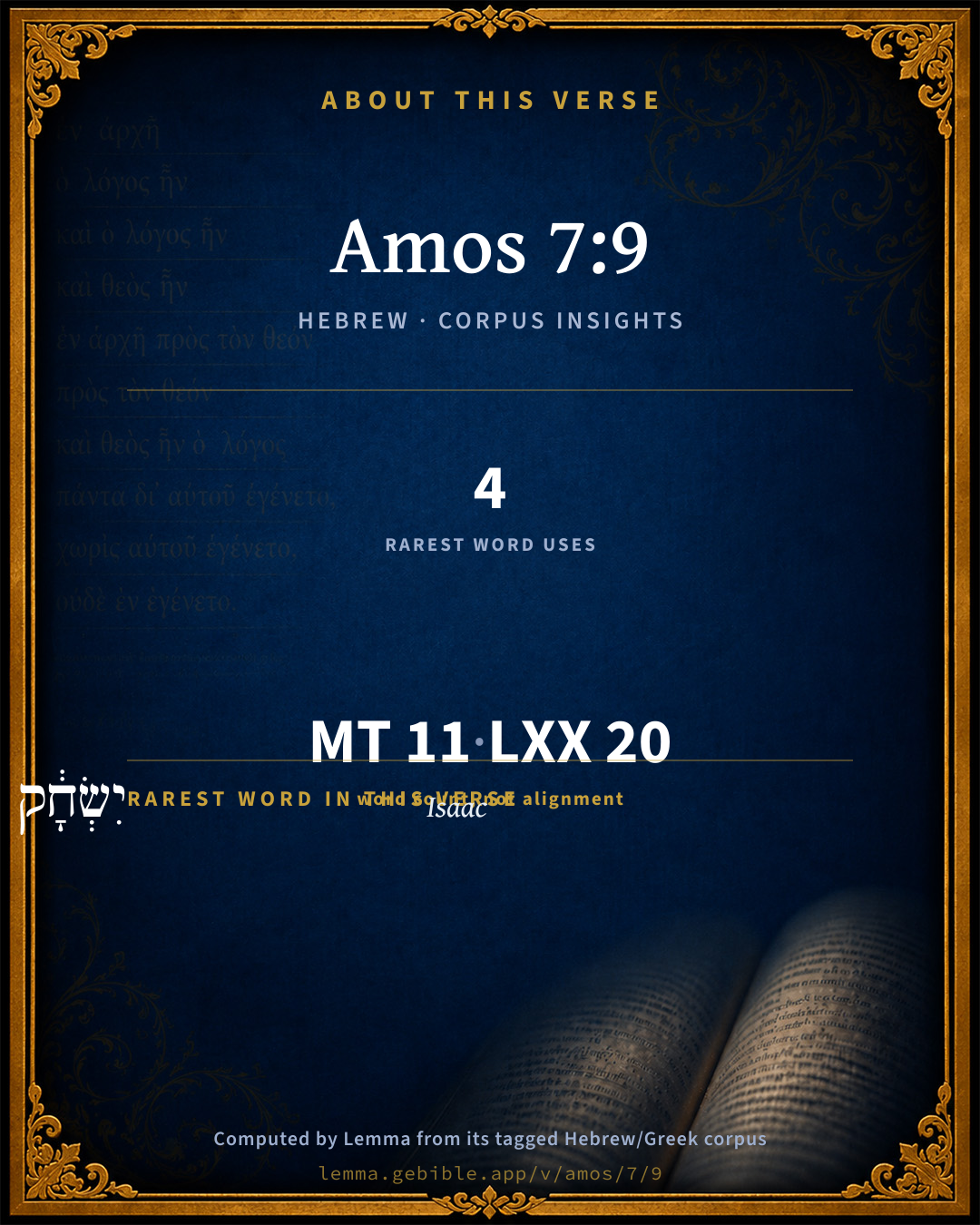
The rarest word here is יִשְׂחָ֔ק Isaac H3446 — appearing just 4 times in the whole Hebrew Bible.

Shared distinctive vocabulary

יִשְׂחָ֔ק Isaac H3446 occurs in 4 verses of the Hebrew Bible. Also found in:

Grammatical profile

  • 3 verbs
  • 7 nouns
  • 1 preposition

Verb forms

  • וְנָשַׁ֨מּוּ֙ Niphal · Sequential Perfect
  • יֶחֱרָ֑בוּ Qal · Imperfect
  • וְקַמְתִּ֛י Qal · Sequential Perfect

Hebrew & Septuagint length

In English translation the verse runs 28 words from the Hebrew and 29 from the Septuagint (LXX English) — closely comparable.

A rough comparison of the two English renderings, which tokenize alike — not a word-level alignment.

Word counts can differ between the Hebrew and the Greek without any difference in meaning — e.g. the Hebrew direct-object marker אֵת has no separate Greek word, and Greek often adds the article ὁ.

In the original languages it is 11 Hebrew tokens and 20 Greek tokens — but the two are counted differently (Hebrew bundles its prefixes and suffixes into one token; the Greek is in lemma form), so that isn’t a like-for-like length.

Cross-references

9

Topical passages linked to Amos 7:9 in the Treasury of Scripture Knowledge — connected by theme and wording, ordered by reader-vote popularity; previews shown in the World English Bible.

  • 2 Kings 15:8–10 In the thirty-eighth year of Azariah king of Judah did Zechariah the son of Jeroboam reign over Israel in Samaria six months.
  • Genesis 46:1 Israel traveled with all that he had, and came to Beersheba, and offered sacrifices to the God of his father, Isaac.
  • Genesis 26:23–25 He went up from there to Beersheba.
  • Leviticus 26:30–31 I will destroy your high places, and cut down your incense altars, and cast your dead bodies upon the bodies of your idols; and my soul will abhor you.
  • Isaiah 63:18 Your holy people possessed [it] but a little while: our adversaries have trodden down your sanctuary.
  • Hosea 10:8 The high places also of Aven, the sin of Israel, will be destroyed. The thorn and the thistle will come up on their altars. They will tell the mountains, "Cover us!" and the hills, "Fall on us!"
  • Amos 3:14 "For in the day that I visit the transgressions of Israel on him, I will also visit the altars of Bethel; And the horns of the altar will be cut off, And fall to the ground.
  • Amos 5:5 But don't seek Bethel, Nor enter into Gilgal, And don't pass to Beersheba: For Gilgal shall surely go into captivity, And Bethel shall come to nothing.
  • Amos 8:14 Those who swear by the sin of Samaria, And say, 'As your god, Dan, lives;' And, 'As the way of Beersheba lives;' They will fall, and never rise up again."

Cross-references courtesy of OpenBible.info (CC BY 4.0).

Hebrew and Greek witnesses Masoretic Hebrew ↔ Greek Septuagint

The same verse in the two great witnesses to the Old Testament, shown verse-for-verse.

These are two independent witnesses, not word-aligned to each other, and the Septuagint is shown in lemma (dictionary) form.

Hebrew Amos 7:9 Masoretic · Westminster Leningrad Codex

וְנָשַׁ֨מּוּ֙ בָּמ֣וֹת יִשְׂחָ֔ק וּמִקְדְּשֵׁ֥י יִשְׂרָאֵ֖ל יֶחֱרָ֑בוּ וְקַמְתִּ֛י עַל בֵּ֥ית יָרָבְעָ֖ם בֶּחָֽרֶב

The high places of Isaac will be desolate, the sanctuaries of Israel will be laid waste; and I will rise against the house of Jeroboam with the sword."

World English Bible · Public Domain

Greek LXX Amos 7:9 Septuagint · lemma form

καί ἀπο ἀναἵζω βωμός ὁ γέλως καί ὁ τελετή ὁ ἰσραήλ ἐκἐρημόω καί ἀναἵστημι ἐπί ὁ οἶκος ιεροβοαμ ἐν ῥομφαία

And the joyful altars shall be abolished, and the sacrifices of Israel shall be set aside; and I will rise up against the house of Jeroboam with the sword.

LXX2012 (modern English Septuagint) · Public Domain

On this verse, Ellicott's Commentary for English Readers discusses the Septuagint’s reading. Read the note in Commentary ↓

Hebrew: Westminster Leningrad Codex (CC BY 4.0). Greek: Septuagint (public domain); English from LXX2012 (modern English Septuagint) (Public Domain). How the Septuagint differs from the Hebrew →

Targum (Aramaic paraphrase)

1

The Targum is the ancient Jewish Aramaic paraphrase of the Hebrew Scriptures — an interpretive translation, not the Hebrew text itself. Onkelos (literal) and Pseudo-Jonathan (expansive) render the Torah, and Jonathan the Prophets. Coverage is partial: where no permissively-licensed English translation exists for a verse, only the Aramaic is shown. This is verse-level text, not a word-by-word alignment to the Hebrew.

  1. Targum Jonathan Prophets (Joshua–Malachi)
    וְיִצְדוּן בְּמָת יִשְׂחָק וּמַקְדְשֵׁי יִשְׂרָאֵל יֶחֱרְבוּן וַאֲקֵם עַל בֵּית יְרָבְעָם דְקָטְלִין בְּחַרְבָּא:

    (no public-domain English translation for this verse)

    Targum Jonathan — Aramaic: “Mikraot Gedolot” (public domain). English: “Sefaria Community Translation” (CC0 1.0 (public-domain dedication)); “London "Chaldee Paraphrase," 1871” (public domain). Text via Sefaria.

Commentary

Notes on Amos 7:9 from classic Christian and Jewish commentators (each source and its license shown beneath its notes). The classic Christian expositions comment on the surrounding passage and are grouped to its opening verse, so a note may address several verses; the Jewish commentaries on the Tanakh (Rashi and others) are per-verse, so they appear only where the commentator wrote on this verse.

Lemma curates 59 commentaries, every one of them public domain or Creative Commons licensed, each selected and text-cleaned for this edition rather than reprinted as found. About our sources →

Trapp's Complete Commentary

John Trapp

Amo 7:9 And the high places of Isaac shall be desolate, and the sanctuaries of Israel shall be laid waste; and I will rise against the house of Jeroboam with the sword.

Ver. 9. And the high places of Isaac shall be desolate] The Edomites also came of Isaac; but by a synecdoche {a} the Israelites only are here, and Amo 7:16, to be understood. Like as elsewhere Heber is put for the Israelites only, Num 24:24, and Joseph for Ephraim, Rev 7:8. Some think that the high places of Isaac are here mentioned to show that they were erected by the people in an apish imitation, either of Beersheba, where Isaac worshipped, or of Mount Moriah, where Isaac should have been offered: and that Isaac is here written with sin, and not tsadi, to show that God held himself not adored, but derided by those high places of derision, or those ridiculous altars, which therefore he threateneth to desolate and lay waste.

And I will rise against the house of Jeroboam with the sword] As a prelude to the utter extermination of all by the Assyrians. See this fulfilled, 2Ki 15:10; 2Ki 17:5-6; Jeroboam was very prosperous and victorious; yet designed to destruction. It is said of wicked men, that foenea quadam felicitate temporaliter floreant, they flourish today as grass, and tomorrow are cast into the oven, Mat 6:30 : and as the metal whereof men make glass is nearest melting when it shineth brightest, so are graceless persons nearest destruction when at greatest lustre. The Turks, observing that few of their viziers die in their beds, have this proverb among them, that the greatest man is but as a statue of glass.

{a} A figure by which a more comprehensive term is used for a less comprehensive or vica versa; as whole for part or part for whole, genus for species or species for genus, etc. ŒD

John Trapp, A Commentary or Exposition upon All the Books of the Old and New Testament (1647–1656) — public domain. Text from a community e-Sword module.

Tyndale Open Study Notes

Tyndale Open Resources

7:9 pagan shrines . . . temples: Every vestige of the apostate Israelite religion, from the common high places to the royal shrine at Bethel, would be destroyed. • of your ancestors (literally of Isaac): Isaac stands for Israel’s ancestors, the fathers of the nation. • dynasty of King Jeroboam: Jeroboam II died of natural causes (2 Kgs 14:29), but the murder of his son and successor, Zechariah, after a reign of less than a year (2 Kgs 15:8-10; see 2 Kgs 10:28-31), initiated instability in Israel’s government that it never overcame (2 Kgs 15:10-31).

Tyndale Open Study Notes — © Tyndale Open Resources, licensed CC BY-SA 4.0. Text via the HelloAO Bible API.

Jamieson, Fausset & Brown

Robert Jamieson, A. R. Fausset & David Brown

high places--dedicated to idols.

of Isaac--They boasted of their following the example of their forefather Isaac, in erecting high places at Beer-sheba (Amo 5:5; compare Gen 26:23-24; Gen 46:1); but he and Abraham erected them before the temple was appointed at Jerusalem--and to God; whereas they did so, after the temple had been fixed as the only place for sacrifices--and to idols. In the Hebrew here "Isaac" is written with s, instead of the usual ts; both forms mean "laughter"; the change of spelling perhaps expresses that their "high places of Isaac" may be well so called, but not as they meant by the name; for they are only fit to be laughed at in scorn. Probably, however, the mention of "Isaac" and "Israel" simply expresses that these names, which their degenerate posterity boasted in as if ensuring their safety, will not save them and their idolatrous "sanctuaries" on which they depended from ruin (compare Amo 8:14).

house of Jeroboam with . . . sword--fulfilled in the extinction of Zachariah, son of Jeroboam II, the last of the descendants of Jeroboam I, who had originated the idolatry of the calves (Kg2 15:8-10).

Jamieson, Fausset & Brown — Commentary Critical and Explanatory on the Whole Bible (1871) — public domain (CC PDM 1.0). Text via the HelloAO Bible API.

Adam Clarke's Commentary

Verse 9. And the high places of Isaac shall be desolate] Their total destruction is at hand. The high place of Isaac was Beer-sheba, where Isaac had built an altar to the Lord, Ge 26:25. This high place, which had been abused to idolatrous uses, was demolished by Josiah, king of Judah, as we read in 2Kg 23:8, for he defiled all the high places from Geba to Beersheba.

I will rise against the house of Jeroboam] The Lord had promised to Jehu, the ancestor of Jeroboam, that his family should sit on the throne of Israel to the fourth generation. Zechariah, the son of Jeroboam, was the fourth in order after Jehu; and on him the threatening in this verse fell; for he was murdered by Shallum after he had reigned six months, and in him the family became extinct. See 2Kg 10:30; 2Kg 15:8-10.

Adam Clarke's Commentary on the Bible (1810–1826) — public domain. Text from a community e-Sword/MySword module.

John Calvin's Commentaries

It now follows, And destroyed shall be the high places of Isaac, and overthrown shall be the sanctuaries (some render palaces) of Israel; and I will rise up against the house of Jeroboam with the sword. The Prophet here distinctly declares, that the people in vain trusted in their temples and superstitions, for by these they kindled the more against themselves the wrath of God. He would not indeed have expressly threatened the high places and the temples, unless the Israelites had provoked in this way, as I have already said, the vengeance of God against themselves, inasmuch as they had corrupted the true and lawful worship of God.

Destroyed then shall be the high places of Isaac It may be asked, Why does he mention here the name of Isaac, which is rarely done by the Prophets? And there is also a change of one letter; for the word Isaac is commonly written with ץ, tsade, but here it is written with ש, shin; but it is well known that ש, shin and ץ, tsade, are interchangeably used. It is, however, beyond dispute, that the Prophet speaks here of the holy man Isaac; and the reason seems to be plainly this, — because the Israelites absurdly pretended to imitate their father in their superstitions; for temples, we know, had been erected where Isaac had worshipped God, and also their father Abraham and Jacob. Inasmuch then as the Israelites boasted of the examples of holy fathers, the Prophet here condemns this vain and false boasting. They who understand by the word Isaac, that the Prophet threatens the Idumeans as well as the Israelites, have no reason for their opinion; but the reason which I have already mentioned is quite sufficient.

We indeed know, that the Israelites had ever in their mouths the examples of the fathers, like the woman of Samaria, who said to Christ, ‘Our fathers worshipped in this mountain,’ (John 4:20) So also the Israelites were wont formerly to allege, that the holy patriarchs worshipped God in those places, — that God appeared in Bethel to holy Jacob, and also that in other places altars were built. Being armed with the examples of the fathers, they thought them to be their shield. The case is the same with the Papists in our day; when they hear of anything as having been done by the fathers, they instantly lay hold on it; but these are vain excuses. Like them were also the Israelites; hence the Prophet says, “Behold, ye gain nothing by this fallacious pretense; for destroyed shall be the high places of Isaac, even those which are now covered by an honorable name: and at the same time the temples or palaces of Israel shall be overthrown.

And I will rise against the house of Jeroboam with the sword We learn from this last clause that things were then, as we have stated elsewhere, in a prosperous state in the kingdom of Israel, though God had in various ways wasted it before Jeroboam: but they had been ever obstinate. He afterwards restored them to a better condition; for the state of the people greatly improved under Jeroboam: he recovered many cities enlarged the borders of his kingdoms and then the people, in their affluence began to grow wanton against God. As then the Prophet thus saw that they abused God’s goodness, he denounced destruction on Jeroboam; hence he says, Against the house of Jeroboam I will rise up with the sword; that is, “I will begin to execute my judgment on the offspring of the king himself; though I may spare him, yet his posterity shall not escape my hand.”

John Calvin's Commentaries (1540-1563) — public domain. Text from the Calvin Translation Society English edition (1840s-50s) via the Christian Classics Ethereal Library (ccel.org). Calvin's coverage is partial (roughly two-thirds of the Bible); uncommented books and verses are honest gaps, never fabricated. The 19th-century editor's footnotes and remarks are omitted so the notes are faithfully Calvin's own voice.

Ellicott's Commentary for English Readers

(9) High places of Isaac.—The name Isaac is here spelt somewhat differently in the Hebrew from the form we have in Genesis. The LXX. misunderstand the word, and render “altars of laughter,” in accordance with the etymological sense of the proper name. The residents in the neighbourhood of Beersheba may have boasted of the favour or honour belonging to them, as occupying the home of Isaac and the birthplace of Jacob.

Will rise against.—This dreadful doom fell on the house of Jeroboam, and was the prelude of the final destruction of the nations by Shalmaneser IV., in 721 (2Ki_15:10).

A Bible Commentary for English Readers, edited by Charles John Ellicott (1878–1897) — public domain. Text from a community e-Sword module.

The Cambridge Bible for Schools and Colleges

gen. ed. J. J. S. Perowne

9. high places] local sanctuaries, usually situated on eminences (1Ki_14:23; 2Ki_17:10 f.), a little outside the towns to which they belonged (cf. 1Sa_9:12; 1Sa_9:14; 1Sa_9:19; 1Sa_9:25; 1Sa_10:5), sometimes, where no natural eminence was available, erected, it is probable, upon artificial mounds (cf. Jer_7:31; 2Ki_17:9). The custom of worshipping at such spots was borrowed, as seems evident (cf. Deu_12:2), from the Canaanites: it also prevailed in Moab (Isa_15:2; Isa_16:12 : Mesha also, in his Inscription, Isa_50:3, tells us that he had “made a high-place” for his god Chemosh). The sanctuaries in question consisted of a “house,” or shrine (1Ki_12:31; 1Ki_13:32), with an altar, and were served by priests (1Ki_12:31-33; 1Ki_13:33; 2Ki_23:9): they are often alluded to as popular places of sacrifice, especially during the period of the monarchy (1 Sam. ll. cc.; 1Ki_22:43; 2Ki_12:3; 2Ki_14:4; 2Ki_15:4, &c.). Worship at such local sanctuaries, down to the 7th cent. b.c., in so far as it was not contaminated with heathen elements, was regarded as quite regular (comp. Exo_20:24; 1Sa_9:13, where Samuel presides at and blesses the sacrifice at such a bâmâh; 1Ki_3:4; 1Ki_18:30); but under the centralizing influence of Deuteronomy, a change came in, and it was treated as illegitimate. The compiler of the Book of Kings, in his condemnation of the worship at the high-places, reflects the Deuteronomic standpoint. Amos, in so far as he refers to the bâmôth with disparagement, does so, not on account of their conflicting with the Deuteronomic law of the single sanctuary, but on account of the unspiritual character of the worship carried on at them. Comp. Nowack, Heb. Arch. ii. 12–14.

Isaac] As in Amo_7:16, a poetic synonym of Israel (not so elsewhere).

and I will rise, &c.] For the expression, cf. Isa_30:2; for the thought, Hos_1:4, where the same dissatisfaction with the dynasty of Jehu finds expression.

with the sword] Jehovah’s agent, then, will be the army of an invader, the nation, viz., whom in Amo_6:14 He says that He will “raise up” against Israel.

The Cambridge Bible for Schools and Colleges (gen. ed. J. J. S. Perowne; Cambridge University Press, 1878–1918) — public domain. Text from a community e-Sword module.

John Gill's Exposition

And the high places of Isaac shall be desolate,.... Such as the ten tribes of Israel, who descended from Isaac, built at Beersheba, in imitation of Isaac, and pleading his example; who worshipped there, though not idols, as they, but the true God; and in commemoration of his being bound upon an altar on Mount Moriah: but these, as the Septuagint version renders it, were "high places of laughter", ridiculous in the eyes of the Lord, despised by him, and so should be made desolate:

and the sanctuaries of Israel shall be laid waste; the temples built for the calves at Dan and Bethel, and other places:

and I will rise against the house of Jeroboam with the sword; or, as the Targum,

"I will raise up against the house of Jeroboam those that slay with the sword;''

this was fulfilled by Shallum, who conspired against Zachariah the son of Jeroboam, and slew him, and reigned in his stead, which put an end to the family of Jeroboam, Kg2 15:10.

John Gill's Exposition of the Whole Bible (1746–1763) — public domain (CC PDM 1.0). Text via the HelloAO Bible API.

Albert Barnes' Notes on the Bible

The high places of Isaac - He probably calls the ten tribes by the name of Isaac, as well as of Israel, in order to contrast their deeds with the blameless, gentle piety of Isaac, as well as the much-tried faithfulness of Israel. It has been thought too that he alludes to the first meaning of the name of Isaac. His name was given from the joyous laughter at the unheard-of promise of God, to give children to those past age; their high places should be a laughter, but the laughter of mockery . The “sanctuaries” were perhaps the two great idol-temples at Bethel and Dan, over against the one “sanctuary” of God at Jerusalem; the “high places” were the shrines of idolatry, especially where God had shown mercy to the patriarchs and Israel, but also all over the land. All were to be wasted, because all were idolatrous.

I will rise against the house of Jeroboam with the sword - God speaks after the manner of people, who, having been still, arise against the object of their enmity. He makes Himself so far one with the instruments of His sentence, that, what they do, He ascribes to Himself. Jeroboam II must, from his military success, have been popular among his people. Successful valor is doubly prized, and he had both valor and success. God had “saved Israel by” His “hand” 2Ki 14:27. A weak successor is often borne with for the merits of his father. There were no wars from without which called for strong military energy or talent, and which might furnish an excuse for superseding a faineant king. Ephraim had no ambition of foreign glory, to gratify. Zechariah, Jeroboam’s son, was a sensualist ; but many sensualists have, at all times, reigned undisturbed. Shallum who murdered Zechariah was simply a “conspirator” 2Ki 15:10; he represented no popular impulse, and was slain himself a month 2Ki 15:13-14 after. Yet Amos foretells absolutely that the house of Jeroboam should perish by the sword, and in the next generation his name was clean put out.

Albert Barnes' Notes on the Bible (1834–1885) — public domain. Text from a community e-Sword/MySword module.

Haydock's Catholic Bible Commentary

Idol. Hebrew, "Isaac." (Calmet) --- Septuagint, "laughter." (Haydock) --- Isaac had resided for some time at Bersabee, which was place frequented by idolaters, chap. v. 5., and viii. 14. Josias overthrew (4 Kings xxiii. 8.; Calmet) the profane "altars." (Haydock) --- Sword. His son Zacharias was slain after six months reign, ver. 6, 11.

George Leo Haydock (1774–1849), Haydock's Catholic Family Bible and Commentary, 1859 edition — public domain. Excludes Psalms (Douay-Rheims chapter numbering differs from Protestant) and Deuterocanonical books (Catholic canon only).

Matthew Poole's English Annotations

The high places; the temples on high mountains built to idols, or for the worship of God, though he forbade them. Of Isaac: the father is here named, but his children are intended, all the seed of Isaac. I cannot, though some do, think the prophet alludes to Isaac’s being offered upon a high mountain.

Shall be desolate; shall be rased to the foundation, or left to moulder and fall with length of time, and assaults of storms and weather.

The sanctuaries of Israel shall be laid waste: this explains the former, and, speaking after the custom of those times, the prophet calls the idol temples sanctuaries, whether in Dan and Beth-el or elsewhere.

I will rise; God will, but not immediately, rise up: he will stir up some or other to do what he threatens.

Against the house of Jeroboam; in the days of Zachariah, (son of Jeroboam,) murdered by Shallum. With the sword, first of a conspirator, Shallum, next of civil war.

Matthew Poole's English Annotations on the Holy Bible (1683–1685) — public domain. Text from a community e-Sword/MySword module.

The Pulpit Commentary

The high places of Issac. The shrines of idolatry all over the land. The bamoth are the altars erected on high places and now dedicated to idols. (1Ki_3:2 2Ki_23:8 Isa_16:12 Hos_10:8) Isaac here and in ver. 16 is used as a synonym for Israel, perhaps with some ides of contrasting the deeds of the people with the blameless life of the patriarch and his gentle piety (Pusey). Septuagint, bwmoi tou gelwtov , with reference to the meaning of the name Issac, "altars of derision," whence Jerome"s version, excelsa Idoli. the sanctuaries of Israel. The idol temples at Dan and Bethel, (1Ki_12:29) at Gilgal, (Amo_4:4) and perhaps in other places, which had been sanctified by ancient patriarchal worship. Septuagint, ai teleetai tou Israhl , "the rites of Israel;" Vulgate, sanctificationes Israel. with the sword. God is represented as standing like an armed warrior taking vengeance on the guilty family. Jeroboam II had roved Israel from Syria, and was popular owing to his success in war; (2Ki_14:25-28) but his dynasty was overthrown, and this overthrow was the destruction of the Israelitish monarchy. The murder of his son Zachariah by Shallum (2Ki_15:10) led to those disastrous commotions which culminated in the conquest of Samaria by the Assyrians and the deportation of the people.

The Pulpit Commentary (1880–1919), ed. H.D.M. Spence-Jones & Joseph S. Exell — public domain. Text from a community e-Sword module.

John Wesley's Explanatory Notes

The high places - The temples on high mountains built to idols. Of Isaac - The seed of Isaac.

John Wesley, Explanatory Notes Upon the Whole Bible (1754–1765) — public domain. Text via the GEBible commentary corpus.

Scofield Reference Notes

C. I. Scofield

raise

As prophesied and fulfilled, 2Ki 15:10.

The Scofield Reference Bible (1917 edition), notes by C. I. Scofield — public domain. Text from a community e-Sword module.

unfoldingWord translationNotes

Door43 World Missions Community

The high places of Isaac will be destroyed, the sanctuaries of Israel will be ruined, and I will rise against the house of Jeroboam with the sword

Here "sword" represents an army. This can be stated in active form. AT: "I will send an army to attack the house of Jeroboam, and the army will destroy the high places of Isaac and the sanctuaries of Israel" (See: Metonymy and Active or Passive)

Isaac ... Israel

Both of these represent the people of Israel. AT: "the descendants of Isaac ... the people of Israel" (See: Metonymy)

the house of Jeroboam

Here "house" represents "family." Translate "Jeroboam" as you did in Amos 1:1. AT: "Jeroboam and his family" (See: Metonymy)

translationWords

high place

Isaac

ruin

house

Jeroboam

sword

unfoldingWord translationNotes — © Distant Shores Media and the Door43 World Missions Community, licensed CC BY-SA 4.0. Source: git.door43.org/Door43/en_tn.

Rashi

Rabbi Shlomo Yitzchaki (Rashi)

and the sanctuaries of Israel—That is Bethel, as it is said: (verse 13) “For it is the sanctuary of a king.”

upon the house of Jeroboam—son of Joash.

Rashi on the Tanakh — English translations: “The Judaica Press complete Tanach with Rashi, translated by A. J. Rosenberg” (CC BY 4.0); “Pentateuch with Rashi's commentary by M. Rosenbaum and A.M. Silbermann, 1929-1934” (public domain); “The Metsudah Tanach series, Lakewood, N.J” (CC BY 4.0); and “The Book of Joshua, Metsudah Publications, 1997” (CC BY 4.0). Text via Sefaria.

Lesson kit

Teaching starters — assembled from the data on this page, not authored interpretation. Every prompt links to the verse data it draws on. Edit before teaching.

Amos, in the Prophets, opens this verse with 11 words (11 distinct Hebrew lemmas). Its most distinctive word is Yischâq (“Isaac”). A historical commentator’s framing appears above. Read the whole chapter for the surrounding context.

Discussion questions

  1. What does “Isaac” (Yischâq) contribute to the verse as a whole?
  2. Psalms 105:9 shares the word «Isaac» with this verse. How do the two illuminate each other?
  3. These translations render this verse differently; the difference is in the English rendering, not the original. What questions does that raise?
  4. The verb «וְנָשַׁ֨מּוּ֙» is Niphal Sequential Perfect. How does its form color the action?
  5. Reading how Trapp's Complete Commentary and Tyndale Open Study Notes read this verse, where do the two commentators agree and where do they part?

Things to notice

Reading settings

Reading text

Shown beneath each verse's original-language words.

Old Testament
Old Testament edition

Read the OT as the Masoretic Hebrew (MT) or the Greek Septuagint (LXX).

English shown for the Greek Septuagint (in the Hebrew ↔ Greek comparison).

Comparing translations? Open the Compare panel on any verse page to stack up to four side by side.