
2 Chronicles 21:4

Hebrew (Westminster Leningrad Codex) 2 Chronicles 21:4 appears in the Hebrew Old Testament. The text above is from the Westminster Leningrad Codex. Each word links to its Strong’s number, a concise gloss, and parsing drawn from the Open Scriptures Hebrew Bible morphology. Click any word for its full Brown-Driver-Briggs (BDB) entry.
Download image
Cite this verse

2 Chronicles 21:4 (World English Bible). Public Domain. Lemma interlinear Bible study tool, https://lemma.gebible.app/v/2-chronicles/21/4.

Show BibTeX & RIS
BibTeX
RIS
English Translation
Now when Jehoram was risen up over the kingdom of his father, and had strengthened himself, he killed all his brothers with the sword, and various also of the princes of Israel.
World English Bible · Public Domain
Download a study sheet

One document with this verse’s original text, its word-by-word gloss line, the meaning frame, cross-references with their text, attributed commentary, and full source and license credits — printable, and it pastes into notes with its structure intact.

This verse Autodidact and up

Study sheet (.html) Plain text (.txt)

A passage Seminary Student

Up to 50 verses in one chapter. A passage sheet keeps up to 6 commentary sources and 12 cross-references per verse, in the order this page ranks them, and says so on the sheet whenever that leaves anything out. Ask for a single verse and you get the Autodidact verse sheet above.

Everything on this page stays free to read, with no account — the sheet is a download of what is already on screen, not access to it.

Want to remove ads? Support Godless Engineer
Compare translations 3

The same verse in 3 English versions, stacked beneath the original-language interlinear above. Click any original word for its lexicon entry.

Each is an independent rendering of the whole verse — the interlinear is not word-aligned to these translations.

Highlighted words mark where these versions differ — a whole-verse word diff, not a word-by-word alignment.

  • World English Bible Public Domain
    Now when Jehoram was risen up over the kingdom of his father, and had strengthened himself, he killed all his brothers with the sword, and various also of the princes of Israel.
  • King James Version Public Domain
    Now when Jehoram was risen up to the kingdom of his father, he strengthened himself, and slew all his brethren with the sword, and divers also of the princes of Israel.
  • unfoldingWord Literal Text CC BY-SA 4.0
    And Jehoram rose over the kingdom of his father and he strengthened himself. And he killed all his brothers with the sword, and also some of the chiefs of Israel.

unfoldingWord Literal Text — © unfoldingWord, licensed CC BY-SA 4.0. Word-aligned USFM3 via Door43 (git.door43.org/unfoldingWord/en_ult).

Versions to compare (up to 4)

3 of 4 selected

Show all 18 translations

Every available English version of this verse, each an independent rendering of the whole verse.

  • World English Bible Public Domain
    Now when Jehoram was risen up over the kingdom of his father, and had strengthened himself, he killed all his brothers with the sword, and various also of the princes of Israel.
  • Berean Standard Bible Public Domain
    When Jehoram had established himself over his father’s kingdom, he strengthened himself by putting to the sword all his brothers along with some of the princes of Israel.
  • Majority Standard Bible Public Domain
    When Jehoram had established himself over his father’s kingdom, he strengthened himself by putting to the sword all his brothers along with some of the princes of Israel.
  • King James Version Public Domain
    Now when Jehoram was risen up to the kingdom of his father, he strengthened himself, and slew all his brethren with the sword, and divers also of the princes of Israel.
  • American Standard Version (1901) Public Domain
    Now when Jehoram was risen up over the kingdom of his father, and had strengthened himself, he slew all his brethren with the sword, and divers also of the princes of Israel.
  • Revised Version (1885) Public Domain
    Now when Jehoram was risen up over the kingdom of his father, and had strengthened himself, he slew all his brethren with the sword, and divers also of the princes of Israel.
  • Geneva Bible (1599) Public Domain
    And Iehoram rose vp vpon the kingdom of his father, and made himselfe strong, and slew all his brethren with the sworde, and also of the princes of Israel.
  • Douay-Rheims (1899) Public Domain
    So Joram rose up over the kingdom of his father: and when he had established himself, he slew all his brethren with the sword, and some of the princes of Israel.
  • Young's Literal Translation Public Domain
    And Jehoram riseth up over the kingdom of his father, and strengtheneth himself, and slayeth all his brethren with the sword, and also -- of the heads of Israel.
  • Literal Standard Version CC BY-SA 4.0
    And Jehoram rises up over the kingdom of his father, and strengthens himself, and slays all his brothers with the sword, and also of the heads of Israel.
  • Unlocked Literal Bible CC BY-SA 4.0
    Now when Jehoram had risen up over his father's kingdom and had firmly established himself as king, he killed all his brothers with the sword, and also various other leaders of Israel.
  • unfoldingWord Literal Text CC BY-SA 4.0
    And Jehoram rose over the kingdom of his father and he strengthened himself. And he killed all his brothers with the sword, and also some of the chiefs of Israel.
  • Darby Bible Public Domain
    And Jehoram established himself over the kingdom of his father, and strengthened himself; and he slew all his brethren with the sword, and [certain] also of the princes of Israel.
  • World Messianic Bible Public Domain
    Now when Jehoram had risen up over the kingdom of his father, and had strengthened himself, he killed all his brothers with the sword, and also some of the princes of Israel.
  • Webster's Bible Public Domain
    Now when Jehoram had risen to the kingdom of his father, he strengthened himself, and slew all his brethren with the sword, and divers also of the princes of Israel.
  • Free Bible Version CC BY-SA 4.0
    But once Jehoram had secured the kingdom, he made sure of his position by killing all his brothers, along with some of the princes of Judah.
  • Bible in Basic English Public Domain
    Now when Jehoram had taken his place over his father's kingdom, and had made his position safe, he put all his brothers to death with the sword, as well as some of the princes of Israel.
  • JPS Tanakh (1917) Public Domain
    Now when Jehoram was risen up over the kingdom of his father, and had strengthened himself, he slew all his brethren with the sword, and divers also of the princes of Israel.

Literal Standard Version (2020), Covenant Press — licensed CC BY-SA 4.0. Text via the HelloAO Bible API (eBible.org). Unlocked Literal Bible (unfoldingWord) — licensed CC BY-SA 4.0. Text via the HelloAO Bible API (eBible.org). unfoldingWord Literal Text — © unfoldingWord, licensed CC BY-SA 4.0. Word-aligned USFM3 via Door43 (git.door43.org/unfoldingWord/en_ult). Free Bible Version, Dr. Jonathan Gallagher — licensed CC BY-SA 4.0. Text via the HelloAO Bible API (eBible.org).

Word by word

More ways to search: Search by grammar → Find every occurrence → Compare this word →

Practice this passage: Drill this verse → Learn its vocabulary →

יְהוֹרָ֜ם
Yᵉhôwrâm
H3088
“Jehoram”
Noun, Proper
Part of Speech
Noun
Type
Proper
Full BDB Definition

Origin: from H3068 and H7311

TWOT: None

Jehoram or Joram = "Jehovah is exalted" - son of king Jehoshaphat of Judah and himself king of Judah for 8 years; his wife was the wicked Athaliah who was probably the instigator for his returning the nation of Judah to the worship of Baal - son of king Ahab of the northern kingdom of Israel and king of Israel himself for 12 years; he was murdered by Jehu on the plot of land for which his father had murdered Naboth thus fulfilling the prophecy of Elijah to the very letter - a priest in the reign of Jehoshaphat
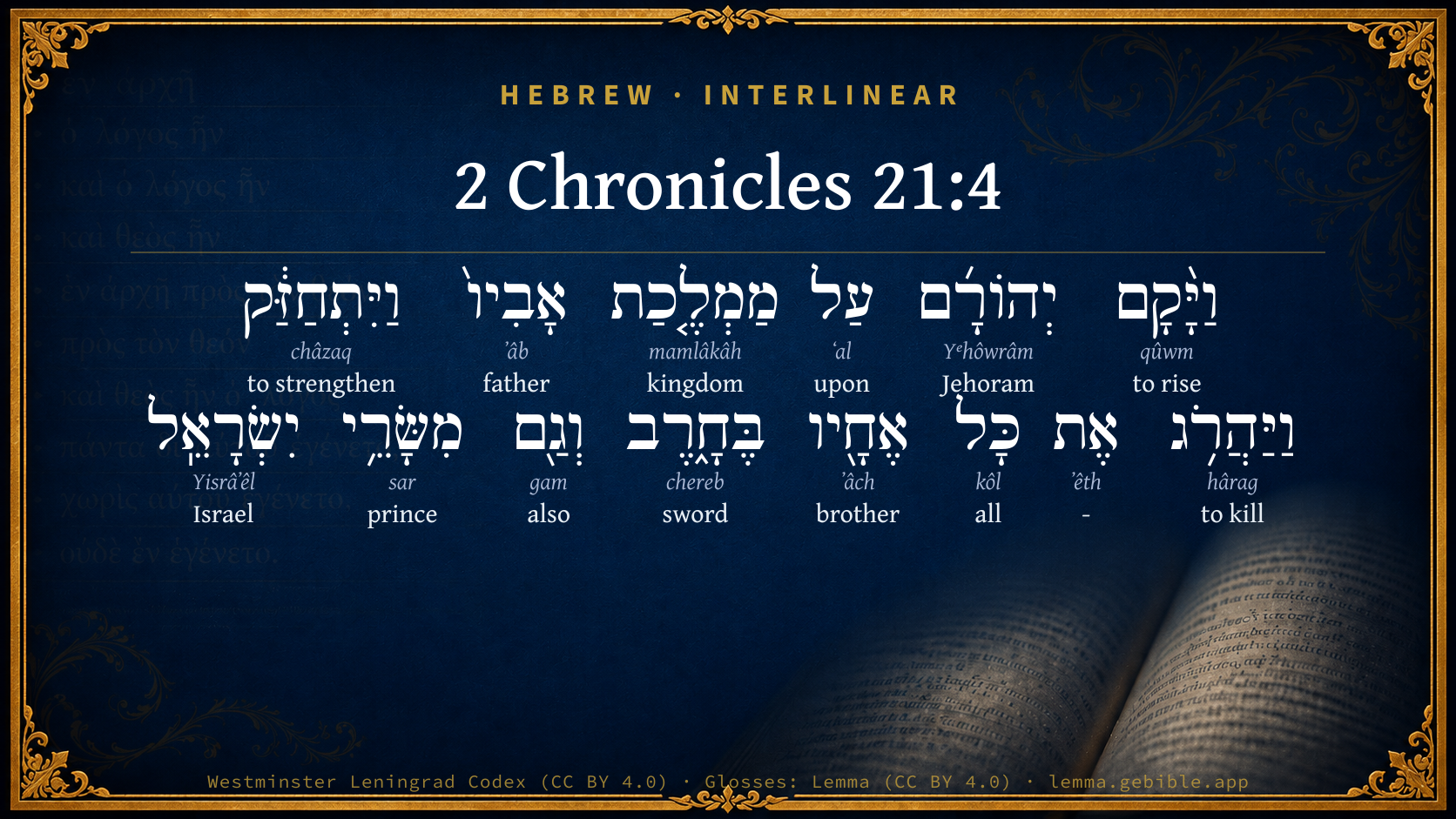
  1. וַיָּ֨קָם qûwm H6965 “and · to rise” Conjunction + Verb, Qal, Sequential Imperfect, 3rd Person, Masculine, Singular
  2. עַל ʻal H5921 “upon” Preposition
  3. מַמְלֶ֤כַת mamlâkâh H4467 “kingdom of” Noun, Common, Feminine, Singular, Construct
  4. אָבִיו֙ ʼâb H1 “father · his” Noun, Common, Masculine, Singular, Construct + Suffix, Personal, 3rd Person, Masculine, Singular
  5. וַיִּתְחַזַּ֔ק châzaq H2388 “and · to strengthen” Conjunction + Verb, Hithpael, Sequential Imperfect, 3rd Person, Masculine, Singular
  6. וַיַּהֲרֹ֥ג hârag H2026 “and · to kill” Conjunction + Verb, Qal, Sequential Imperfect, 3rd Person, Masculine, Singular
  7. אֶת ʼêth H853 “-” Particle, Direct Object
  8. כָּל kôl H3605 “all of” Noun, Common, Masculine, Singular, Construct
  9. אֶחָ֖יו ʼâch H251 “brothers · his” Noun, Common, Masculine, Plural, Construct + Suffix, Personal, 3rd Person, Masculine, Singular
  10. בֶּחָ֑רֶב chereb H2719 “in/at the · sword” Preposition, Determined + Noun, Common, Feminine, Singular, Absolute
  11. וְגַ֖ם gam H1571 “and · also” Conjunction + Particle, Accusative
  12. מִשָּׂרֵ֥י sar H8269 “from · princes of” Preposition + Noun, Common, Masculine, Plural, Construct
  13. יִשְׂרָאֵֽל Yisrâʼêl H3478 “Israel” Noun, Proper

About this verse

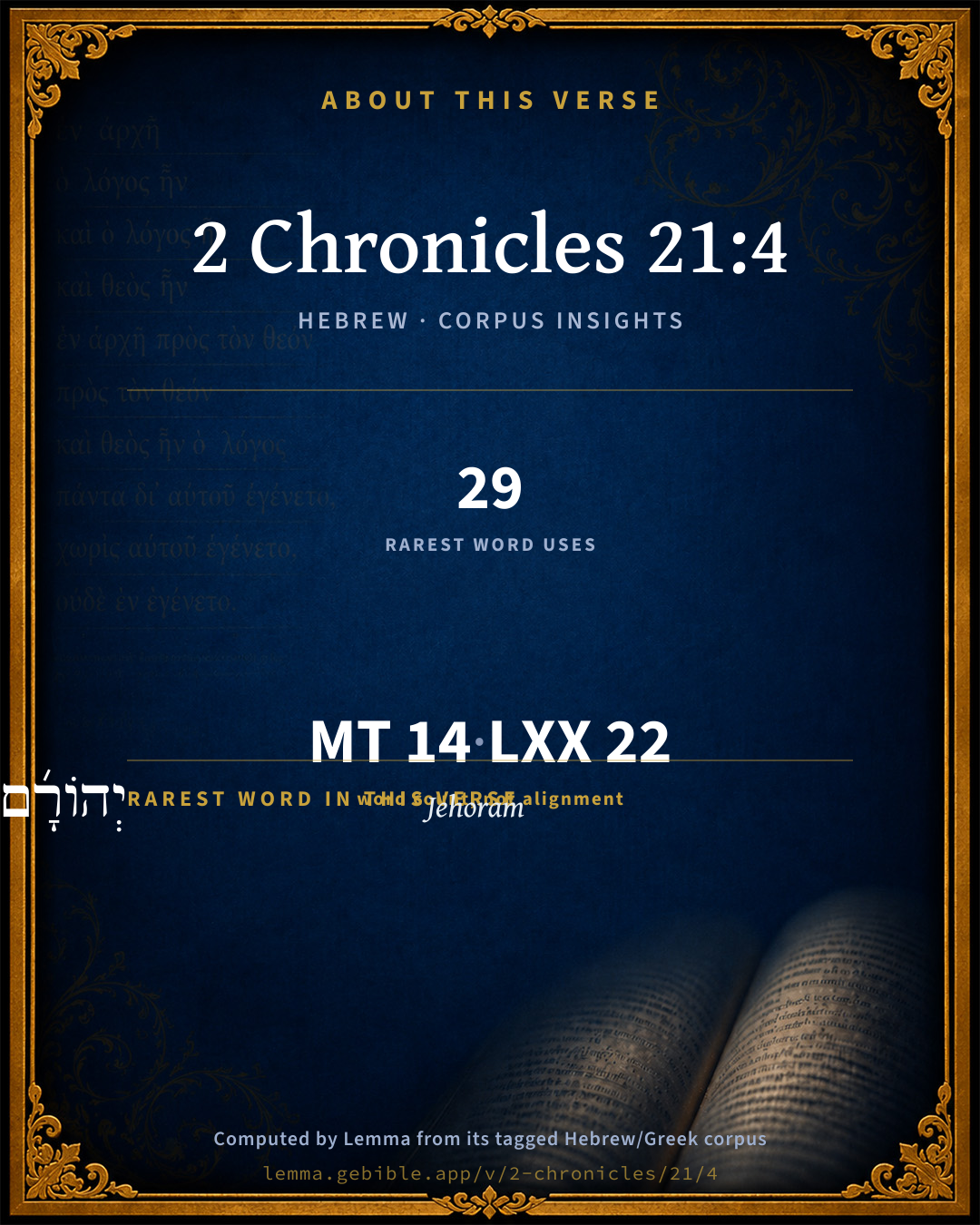
These counts appear in no published source. They are computed here, from the morphology-tagged text and Lemma’s own curated glosses. What Lemma adds →

14
words
14
distinct lemmas
Historical
section

Shared distinctive vocabulary

יְהוֹרָ֜ם Jehoram H3088 occurs in 26 verses of the Hebrew Bible. Also found in:

Grammatical profile

  • 3 verbs
  • 8 nouns
  • 1 preposition
  • 2 particles

Verb forms

  • וַיָּ֨קָם Qal · Sequential Imperfect
  • וַיִּתְחַזַּ֔ק Hithpael · Sequential Imperfect
  • וַיַּהֲרֹ֥ג Qal · Sequential Imperfect

Hebrew & Septuagint length

In English translation the verse runs 32 words from the Hebrew and 24 from the Septuagint (LXX English) — closely comparable.

A rough comparison of the two English renderings, which tokenize alike — not a word-level alignment.

Word counts can differ between the Hebrew and the Greek without any difference in meaning — e.g. the Hebrew direct-object marker אֵת has no separate Greek word, and Greek often adds the article ὁ.

In the original languages it is 14 Hebrew tokens and 22 Greek tokens — but the two are counted differently (Hebrew bundles its prefixes and suffixes into one token; the Greek is in lemma form), so that isn’t a like-for-like length.

Cross-references

7

Topical passages linked to 2 Chronicles 21:4 in the Treasury of Scripture Knowledge — connected by theme and wording, ordered by reader-vote popularity; previews shown in the World English Bible.

  • Judges 9:5 He went to his father's house at Ophrah, and killed his brothers the sons of Jerubbaal, being seventy persons, on one stone: but Jotham the youngest son of Jerubbaal was left; for he hid himself.
  • Genesis 4:8 Cain said to Abel, his brother, "Let's go into the field." It happened, when they were in the field, that Cain rose up against Abel, his brother, and killed him.
  • 2 Chronicles 21:17 and they came up against Judah, and broke into it, and carried away all the substance that was found in the king's house, and his sons also, and his wives; so that there was never a son left him, save Jehoahaz, the youngest of his sons.
  • 2 Chronicles 22:10 Now when Athaliah the mother of Ahaziah saw that her son was dead, she arose and destroyed all the seed royal of the house of Judah.
  • Judges 9:56–57 Thus God requited the wickedness of Abimelech, which he did to his father, in killing his seventy brothers;
  • 2 Chronicles 22:8 It happened, when Jehu was executing judgment on the house of Ahab, that he found the princes of Judah, and the sons of the brothers of Ahaziah, ministering to Ahaziah, and killed them.
  • 1 John 3:12 unlike Cain, who was of the evil one, and killed his brother. Why did he kill him? Because his works were evil, and his brother's righteous.

Cross-references courtesy of OpenBible.info (CC BY 4.0).

Hebrew and Greek witnesses Masoretic Hebrew ↔ Greek Septuagint

The same verse in the two great witnesses to the Old Testament, shown verse-for-verse.

These are two independent witnesses, not word-aligned to each other, and the Septuagint is shown in lemma (dictionary) form.

Hebrew 2 Chronicles 21:4 Masoretic · Westminster Leningrad Codex

וַיָּ֨קָם יְהוֹרָ֜ם עַל מַמְלֶ֤כַת אָבִיו֙ וַיִּתְחַזַּ֔ק וַיַּהֲרֹ֥ג אֶת כָּל אֶחָ֖יו בֶּחָ֑רֶב וְגַ֖ם מִשָּׂרֵ֥י יִשְׂרָאֵֽל

Now when Jehoram was risen up over the kingdom of his father, and had strengthened himself, he killed all his brothers with the sword, and various also of the princes of Israel.

World English Bible · Public Domain

Greek LXX 2 Chronicles 21:4 Septuagint · lemma form

καί ἀναἵστημι ιωραμ ἐπί ὁ βασιλεία αὐτός καί κραταιόω καί ἀποκτείνω πᾶς ὁ ἀδελφός αὐτός ἐν ῥομφαία καί ἀπό ὁ ἄρχων ἰσραήλ

And Joram entered upon his kingdom, and strengthened himself, and killed all his brothers with the sword, and some of the princes of Israel.

LXX2012 (modern English Septuagint) · Public Domain

Hebrew: Westminster Leningrad Codex (CC BY 4.0). Greek: Septuagint (public domain); English from LXX2012 (modern English Septuagint) (Public Domain). How the Septuagint differs from the Hebrew →

Commentary

Notes on 2 Chronicles 21:4 from classic Christian and Jewish commentators (each source and its license shown beneath its notes). The classic Christian expositions comment on the surrounding passage and are grouped to its opening verse, so a note may address several verses; the Jewish commentaries on the Tanakh (Rashi and others) are per-verse, so they appear only where the commentator wrote on this verse.

Lemma curates 59 commentaries, every one of them public domain or Creative Commons licensed, each selected and text-cleaned for this edition rather than reprinted as found. About our sources →

Trapp's Complete Commentary

John Trapp

2Ch 21:4 Now when Jehoram was risen up to the kingdom of his father, he strengthened himself, and slew all his brethren with the sword, and [divers] also of the princes of Israel.

Ver. 4. He strengthened himself.] By gifts, likely, he gained to his party vain men, as Jeroboam also did, in those cities that were given to his brethren.

He slew all his brethren with the sword.] All, lewd losel (profligate)! what a bloody foundation was here laid of his kingdom - not unlike that of Cain, of Cambyses, of Romulus, of Jugurtha, of Caracalla, of the cruel Turks at this day - but it came home to him, as God is the avenger of all such. See God’s judgments upon his sons shortly after, {2Ch 21:17} and also upon his grandchildren. {2Ch 22:10-11} Only Jehoahaz was left of the one, and Joash of the other; and these also merely for God’s promise’ sake to David. {2Ch 21:7}

John Trapp, A Commentary or Exposition upon All the Books of the Old and New Testament (1647–1656) — public domain. Text from a community e-Sword module.

Joseph Benson's Commentary

2Ch 21:4. He strengthened himself — Hardened his heart, as the word חזק, chazak, often signifies; and slew all his brethren with the sword — Either by false accusation, under colour of law, or rather by assassination, pretending, it is likely, that he could not think himself safe in the government till they were taken out of the way. Those that mean ill themselves, are commonly, without cause, jealous of those about them. And divers also of the princes of Israel — Either, 1st, Of Judah, here called Israel, as in 2Ch 21:2. Or rather, 2d, Of Israel properly so called; not the princes of all Israel, or of the several tribes thereof, but the chief of those Israelites who, out of love to God and the true religion, had forsaken their estates in the kingdom of Israel, and were now incorporated with the kingdom of Judah: these he slew, because he thought they would be most zealous for that religion which he was resolved to oppose.

Joseph Benson's Commentary on the Old and New Testaments (1811–1818) — public domain. Text from a community e-Sword module.

Geneva Bible (1599)

Geneva Bible translators

Because the wicked live ever in fear, and also are ambitious, they become cruel, and spare not to murder them, whom by nature they ought most to cherish and defend.

Meaning, of Judah and Benjamin.

Geneva Bible (1599) marginal notes — public domain. Text via Bolls.life.

Adam Clarke's Commentary

Verse 4. Slew all his brethren] What a truly diabolic thing is the lust of power! it destroys all the charities of life, and renders those who are under its influence the truest resemblants of the arch fiend. That he might sit the more secure upon his throne, this execrable man imbrues his hands in the blood of his own brothers! There are more instances of this species of cruelty among bad Asiatic kings than among any other class of men. The history of every country abounds in proofs; even that of our own is not the least barren.

Adam Clarke's Commentary on the Bible (1810–1826) — public domain. Text from a community e-Sword/MySword module.

The Cambridge Bible for Schools and Colleges

gen. ed. J. J. S. Perowne

4. to the kingdom] R.V. over the kingdom.

he strengthened himself, and slew] R.V. and had strengthened himself, he slew. For “strengthened himself” cp. 2Ch_1:1 (note).

The Cambridge Bible for Schools and Colleges (gen. ed. J. J. S. Perowne; Cambridge University Press, 1878–1918) — public domain. Text from a community e-Sword module.

John Gill's Exposition

Jehoram was thirty two years old,.... Of these verses; see Gill on Kg2 8:17, Kg2 8:18, Kg2 8:19, Kg2 8:20, Kg2 8:21, Kg2 8:22

2 Chronicles 21:11

ch2 21:11

ch2 21:11

ch2 21:11Moreover, he made high places in the mountains of Judah,.... Temples and altars for idols, which, being built on mountains, had the name of high places; and these Jehoram made or rebuilt were those which had been pulled down by Asa and Jehoshaphat:

and caused the inhabitants of Jerusalem to commit fornication; that is, idolatry, drawing them by his own example to worship Baal, for he did what Ahab and his family did, Ch2 21:6, and compelled Judah thereto; the inhabitants of Jerusalem falling into the same idolatrous practice with him, he forced the inhabitants of the cities, and in the country, to do the same, who it seems were not so willing and ready to comply therewith.

John Gill's Exposition of the Whole Bible (1746–1763) — public domain (CC PDM 1.0). Text via the HelloAO Bible API.

Albert Barnes' Notes on the Bible

The execution of several “princes of Israel” (i. e. of Judah; see 2Ch 20:34 note) implies that Jehoram’s brothers found supporters among the chief men of the country, and that Jehoram’s sole sovereignty was not established without a struggle.

Albert Barnes' Notes on the Bible (1834–1885) — public domain. Text from a community e-Sword/MySword module.

Haydock's Catholic Bible Commentary

Sword. This cruel policy (H.) has been very common in the East. C. --- Israel. They had perhaps opposed his impious plans, animated by his brethren. God presently chastised him with the rebellion of Idumea; and though Joram gained a victory over Seir, (4 K. viii. 21.) he was not able to reduce the nation, being called off by other wars, v. 16. His own subjects at Lobna, a Levitical city in Juda, also abandoned him. Dreadful evils were denounced in a letter from the prophet Elias, who had been translated to paradise nine years before, and at last the honours of sepulture were denied to the wicked king. T.

George Leo Haydock (1774–1849), Haydock's Catholic Family Bible and Commentary, 1859 edition — public domain. Excludes Psalms (Douay-Rheims chapter numbering differs from Protestant) and Deuterocanonical books (Catholic canon only).

Matthew Poole's English Annotations

He strengthened himself; he took courage and hardened his heart, as that word sometimes signifies.

Slew all his brethren with the sword; partly because they either did, or he knew that they would, oppose him in his wicked designs; and partly for his own security, lest his people, who, as he believed, would be highly exasperated with the execution of his counsels, should advance any of them to the throne, and depose him.

Of the princes of Israel; either,

1. Of Judah, here called Israel, or which See Poole "2Ch 21:2". Or,

2. The princes or chief men of Israel, properly so called; not the princes of all Israel, or of the several tribes thereof, but the chief of those Israelites who, out of love to God and to the true religion, had forsaken their estates and worthy advantages in the kingdom of Israel, and were now incorporated with the kingdom of Judah. These he especially struck at, either,

1. Because his wife instigated him thereunto, both to punish them for their revolt from her father, and to deter others from following their example. Or,

2. Because he justly and truly thought these would be most firm and constant to and zealous for that religion which he was resolved to oppose, being both by their conscience and interest obliged to it.

Matthew Poole's English Annotations on the Holy Bible (1683–1685) — public domain. Text from a community e-Sword/MySword module.

The Pulpit Commentary

Slew all his brethren and also of the princes of Israel. It may be, as suggested by the genius of the last clause of our yet. 13, that Jehoram"s wicked heart prompted him the rather because his own works were evil and his brothers" righteous. He may have thought their practical witness against him, and that of the "princes" who shared their fate, would be growingly inconvenient, and would work in them a necessary disloyalty. (Jud 9:1-5) On the ether showing, the "princes" now cut down may have shown partiality and affection to the six brothers, one or other of them.

The Pulpit Commentary (1880–1919), ed. H.D.M. Spence-Jones & Joseph S. Exell — public domain. Text from a community e-Sword module.

John Wesley's Explanatory Notes

Strengthened himself - He hardened his heart, as that word sometimes signifies. Princes - The chief of those Israelites, who out of love to God and the true religion, had forsaken their estates in the kingdom of Israel, and were now incorporated with the kingdom of Judah: because he thought these would be most zealous for that religion which he was resolved to oppose.

John Wesley, Explanatory Notes Upon the Whole Bible (1754–1765) — public domain. Text via the GEBible commentary corpus.

unfoldingWord translationNotes

Door43 World Missions Community

risen up over his father's kingdom

To "rise up over" something is an idiom that means to control it. AT: "taken complete control over his father's kingdom" (See: Idiom)

he killed all his brothers with the sword

Jehoram probably did not kill them personally, but had other people do it for him. AT: "he caused all of his younger brothers to be killed" (See: Metonymy)

translationWords

kingdom

sword

reign

Jerusalem

unfoldingWord translationNotes — © Distant Shores Media and the Door43 World Missions Community, licensed CC BY-SA 4.0. Source: git.door43.org/Door43/en_tn.

Lesson kit

Teaching starters — assembled from the data on this page, not authored interpretation. Every prompt links to the verse data it draws on. Edit before teaching.

2 Chronicles, in the Historical, opens this verse with 14 words (14 distinct Hebrew lemmas). Its most distinctive word is Yᵉhôwrâm (“Jehoram”). A historical commentator’s framing appears above. Read the whole chapter for the surrounding context.

Discussion questions

  1. How does “Jehoram” (Yᵉhôwrâm) shape what this verse is saying?
  2. How does 1 Kings 22:50, which shares the word «Jehoram», read alongside this verse?
  3. The translations on this page render this verse differently — a whole-verse word diff, not a word-by-word alignment. What might account for the different wordings?
  4. «וַיָּ֨קָם» is a Qal Sequential Imperfect verb. How does that grammatical form shape the action described?
  5. Compare how Trapp's Complete Commentary and Joseph Benson's Commentary read this verse. Where do they agree or differ?

Things to notice

Reading settings

Reading text

Shown beneath each verse's original-language words.

Old Testament
Old Testament edition

Read the OT as the Masoretic Hebrew (MT) or the Greek Septuagint (LXX).

English shown for the Greek Septuagint (in the Hebrew ↔ Greek comparison).

Comparing translations? Open the Compare panel on any verse page to stack up to four side by side.