
Isaiah 1:20

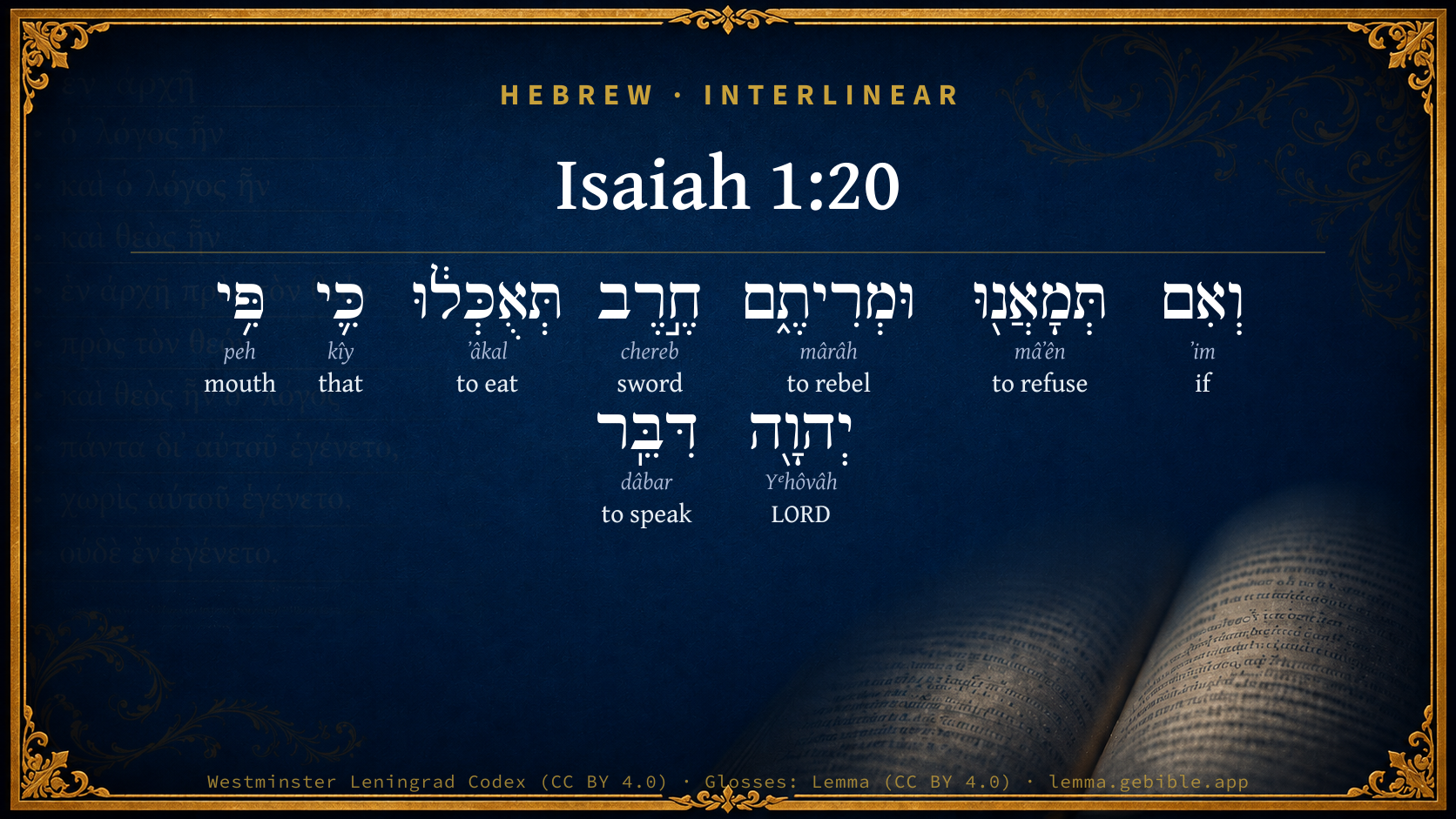
Hebrew (Westminster Leningrad Codex) Isaiah 1:20 appears in the Hebrew Old Testament. The text above is from the Westminster Leningrad Codex. Each word links to its Strong’s number, a concise gloss, and parsing drawn from the Open Scriptures Hebrew Bible morphology. Click any word for its full Brown-Driver-Briggs (BDB) entry.
Download image
Cite this verse

Isaiah 1:20 (World English Bible). Public Domain. Lemma interlinear Bible study tool, https://lemma.gebible.app/v/isaiah/1/20.

Show BibTeX & RIS
BibTeX
RIS
English Translation
But if you refuse and rebel, you shall be devoured with the sword; For the mouth of Yahweh has spoken it."
World English Bible · Public Domain
Download a study sheet

One document with this verse’s original text, its word-by-word gloss line, the meaning frame, cross-references with their text, attributed commentary, and full source and license credits — printable, and it pastes into notes with its structure intact.

This verse Autodidact and up

Study sheet (.html) Plain text (.txt)

A passage Seminary Student

Up to 50 verses in one chapter. A passage sheet keeps up to 6 commentary sources and 12 cross-references per verse, in the order this page ranks them, and says so on the sheet whenever that leaves anything out. Ask for a single verse and you get the Autodidact verse sheet above.

Everything on this page stays free to read, with no account — the sheet is a download of what is already on screen, not access to it.

Want to remove ads? Support Godless Engineer
Compare translations 3

The same verse in 3 English versions, stacked beneath the original-language interlinear above. Click any original word for its lexicon entry.

Each is an independent rendering of the whole verse — the interlinear is not word-aligned to these translations.

Highlighted words mark where these versions differ — a whole-verse word diff, not a word-by-word alignment.

  • World English Bible Public Domain
    But if you refuse and rebel, you shall be devoured with the sword; For the mouth of Yahweh has spoken it."
  • King James Version Public Domain
    But if ye refuse and rebel, ye shall be devoured with the sword: for the mouth of the LORD hath spoken it.
  • unfoldingWord Literal Text CC BY-SA 4.0
    But if you refuse and you rebel, you will be devoured the sword,” for the mouth of Yahweh has spoken. q1

unfoldingWord Literal Text — © unfoldingWord, licensed CC BY-SA 4.0. Word-aligned USFM3 via Door43 (git.door43.org/unfoldingWord/en_ult).

Versions to compare (up to 4)

3 of 4 selected

Show all 18 translations

Every available English version of this verse, each an independent rendering of the whole verse.

  • World English Bible Public Domain
    But if you refuse and rebel, you shall be devoured with the sword; For the mouth of Yahweh has spoken it."
  • Berean Standard Bible Public Domain
    But if you resist and rebel, you will be devoured by the sword.” For the mouth of the LORD has spoken.
  • Majority Standard Bible Public Domain
    But if you resist and rebel, you will be devoured by the sword.” For the mouth of the LORD has spoken.
  • King James Version Public Domain
    But if ye refuse and rebel, ye shall be devoured with the sword: for the mouth of the LORD hath spoken it.
  • American Standard Version (1901) Public Domain
    but if ye refuse and rebel, ye shall be devoured with the sword; for the mouth of Jehovah hath spoken it.
  • Revised Version (1885) Public Domain
    but if ye refuse and rebel, ye shall be devoured with the sword: for the mouth of the LORD hath spoken it.
  • Geneva Bible (1599) Public Domain
    But if ye refuse and be rebellious, ye shalbe deuoured with the sword: for the mouth of the Lord hath spoken it.
  • Douay-Rheims (1899) Public Domain
    But if you will not, and will provoke me to wrath: the sword shall devour you because the mouth of the Lord hath spoken it.
  • Young's Literal Translation Public Domain
    And if ye refuse, and have rebelled, `By' the sword ye are consumed, For the mouth of Jehovah hath spoken.
  • Literal Standard Version CC BY-SA 4.0
    And if you refuse, and have rebelled, || You are consumed [by] the sword,” || For the mouth of YHWH has spoken.
  • Unlocked Literal Bible CC BY-SA 4.0
    but if you refuse and rebel, the sword will devour you,” for the mouth of Yahweh has spoken it.
  • unfoldingWord Literal Text CC BY-SA 4.0
    But if you refuse and you rebel, you will be devoured the sword,” for the mouth of Yahweh has spoken. q1
  • Darby Bible Public Domain
    but if ye refuse and rebel, ye shall be devoured with the sword: for the mouth of Jehovah hath spoken.
  • World Messianic Bible Public Domain
    but if you refuse and rebel, you will be devoured with the sword; for the LORD’s mouth has spoken it.”
  • Webster's Bible Public Domain
    But if ye refuse and rebel, ye shall be devoured with the sword: for the mouth of the LORD hath spoken it.
  • Free Bible Version CC BY-SA 4.0
    But if you are defiant, and if you are rebellious, you'll be killed by the sword. This is what the Lord has declared!
  • Bible in Basic English Public Domain
    But if your hearts are turned against me, I will send destruction on you by the sword; so the Lord has said.
  • JPS Tanakh (1917) Public Domain
    But if ye refuse and rebel, ye shall be devoured with the sword; for the mouth of the LORD hath spoken.

Literal Standard Version (2020), Covenant Press — licensed CC BY-SA 4.0. Text via the HelloAO Bible API (eBible.org). Unlocked Literal Bible (unfoldingWord) — licensed CC BY-SA 4.0. Text via the HelloAO Bible API (eBible.org). unfoldingWord Literal Text — © unfoldingWord, licensed CC BY-SA 4.0. Word-aligned USFM3 via Door43 (git.door43.org/unfoldingWord/en_ult). Free Bible Version, Dr. Jonathan Gallagher — licensed CC BY-SA 4.0. Text via the HelloAO Bible API (eBible.org).

Word by word

More ways to search: Search by grammar → Find every occurrence → Compare this word →

Practice this passage: Drill this verse → Learn its vocabulary →

About this verse

These counts appear in no published source. They are computed here, from the morphology-tagged text and Lemma’s own curated glosses. What Lemma adds →

9
words
9
distinct lemmas
Prophets
section

Shared distinctive vocabulary

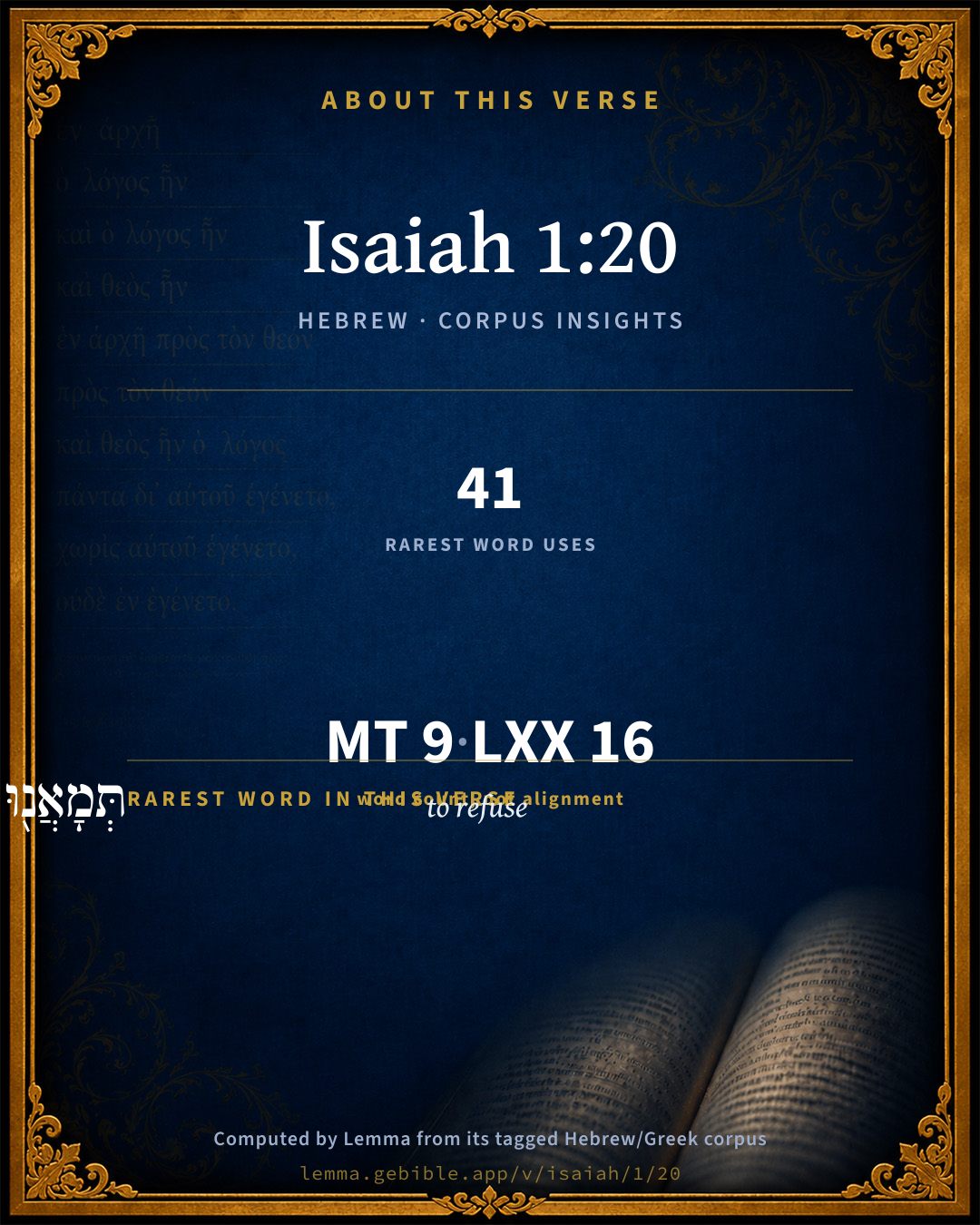
תְּמָאֲנ֖וּ to refuse H3985 occurs in 39 verses of the Hebrew Bible. Also found in:

Grammatical profile

  • 4 verbs
  • 3 nouns
  • 2 conjunctions

Verb forms

  • תְּמָאֲנ֖וּ Piel · Imperfect
  • וּמְרִיתֶ֑ם Qal · Sequential Perfect
  • תְּאֻכְּל֔וּ Qal Passive · Imperfect
  • דִּבֵּֽר Piel · Perfect

Hebrew & Septuagint length

In English translation the verse runs 21 words from the Hebrew and 24 from the Septuagint (LXX English) — closely comparable.

A rough comparison of the two English renderings, which tokenize alike — not a word-level alignment.

Word counts can differ between the Hebrew and the Greek without any difference in meaning — e.g. the Hebrew direct-object marker אֵת has no separate Greek word, and Greek often adds the article ὁ.

In the original languages it is 9 Hebrew tokens and 16 Greek tokens — but the two are counted differently (Hebrew bundles its prefixes and suffixes into one token; the Greek is in lemma form), so that isn’t a like-for-like length.

Cross-references

13

Topical passages linked to Isaiah 1:20 in the Treasury of Scripture Knowledge — connected by theme and wording, ordered by reader-vote popularity; previews shown in the World English Bible.

  • Isaiah 65:12 I will destine you to the sword, and you shall all bow down to the slaughter; because when I called, you did not answer; when I spoke, you did not hear; but you did that which was evil in my eyes, and chose that in which I didn't delight.
  • Isaiah 58:14 then shall you delight yourself in Yahweh; and I will make you to ride on the high places of the earth; and I will feed you with the heritage of Jacob your father: for the mouth of Yahweh has spoken it.
  • Numbers 23:19 God is not a man, that he should lie, Neither the son of man, that he should repent: Has he said, and will he not do it? Or has he spoken, and will he not make it good?
  • Isaiah 40:5 and the glory of Yahweh shall be revealed, and all flesh shall see it together; for the mouth of Yahweh has spoken it.
  • Isaiah 3:11 Woe to the wicked! Disaster is upon them; For the deeds of his hands will be paid back to him.
  • Isaiah 3:25 Your men shall fall by the sword, And your mighty in the war.
  • Leviticus 26:33 I will scatter you among the nations, and I will draw out the sword after you: and your land will be a desolation, and your cities shall be a waste.
  • 1 Samuel 12:25 But if you shall still do wickedly, you shall be consumed, both you and your king."
  • 2 Chronicles 36:14–16 Moreover all the chiefs of the priests, and the people, trespassed very greatly after all the abominations of the nations; and they polluted the house of Yahweh which he had made holy in Jerusalem.
  • Micah 4:4 But they will sit every man under his vine and under his fig tree; And no one will make them afraid: For the mouth of Yahweh of Hosts has spoken.
  • Titus 1:2 in hope of eternal life, which God, who can't lie, promised before eternal times;
  • 1 Samuel 15:29 Also the Strength of Israel will not lie nor repent; for he is not a man, that he should repent.
  • Hebrews 2:1–3 Therefore we ought to pay greater attention to the things that were heard, lest perhaps we drift away.

Cross-references courtesy of OpenBible.info (CC BY 4.0).

Hebrew and Greek witnesses Masoretic Hebrew ↔ Greek Septuagint

The same verse in the two great witnesses to the Old Testament, shown verse-for-verse.

These are two independent witnesses, not word-aligned to each other, and the Septuagint is shown in lemma (dictionary) form.

Hebrew Isaiah 1:20 Masoretic · Westminster Leningrad Codex

וְאִם תְּמָאֲנ֖וּ וּמְרִיתֶ֑ם חֶ֣רֶב תְּאֻכְּל֔וּ כִּ֛י פִּ֥י יְהוָ֖ה דִּבֵּֽר

But if you refuse and rebel, you shall be devoured with the sword; For the mouth of Yahweh has spoken it."

World English Bible · Public Domain

Greek LXX Isaiah 1:20 Septuagint · lemma form

ἐάν δέ μή θέλω μηδέ εἰςἀκούω ἐγώ μάχαιρα σύ καταἐσθίω ὁ γάρ στόμα κύριος λαλέω οὗτος

but if you⌃ be not willing, nor listen to me, a sword shall devour you: for the mouth of the Lord has spoken this.

LXX2012 (modern English Septuagint) · Public Domain

On this verse, Adam Clarke's Commentary discusses the Septuagint’s reading. Read the note in Commentary ↓

Hebrew: Westminster Leningrad Codex (CC BY 4.0). Greek: Septuagint (public domain); English from LXX2012 (modern English Septuagint) (Public Domain). How the Septuagint differs from the Hebrew →

Targum (Aramaic paraphrase)

1

The Targum is the ancient Jewish Aramaic paraphrase of the Hebrew Scriptures — an interpretive translation, not the Hebrew text itself. Onkelos (literal) and Pseudo-Jonathan (expansive) render the Torah, and Jonathan the Prophets. Coverage is partial: where no permissively-licensed English translation exists for a verse, only the Aramaic is shown. This is verse-level text, not a word-by-word alignment to the Hebrew.

  1. Targum Jonathan Prophets (Joshua–Malachi)
    וְאִם תְּסָרְבוּן וְלָא תְקַבְּלוּן לְמֵימְרִי בְּחֶרֶב סָגְאָה תִּתְקַטְלוּן אֲרֵי מֵימְרָא דַייָ גְזַר כֵּן:

    But if ye refuse, and will not be obedient to my Word, ye shall be slain with the sword of the enemy; for the Word of the Lord has decreed it thus.

    Targum Jonathan — Aramaic: “Mikraot Gedolot” (public domain). English: “Sefaria Community Translation” (CC0 1.0 (public-domain dedication)); “London "Chaldee Paraphrase," 1871” (public domain). Text via Sefaria.

Commentary

Notes on Isaiah 1:20 from classic Christian and Jewish commentators (each source and its license shown beneath its notes). The classic Christian expositions comment on the surrounding passage and are grouped to its opening verse, so a note may address several verses; the Jewish commentaries on the Tanakh (Rashi and others) are per-verse, so they appear only where the commentator wrote on this verse.

Lemma curates 59 commentaries, every one of them public domain or Creative Commons licensed, each selected and text-cleaned for this edition rather than reprinted as found. About our sources →

Trapp's Complete Commentary

John Trapp

Isa 1:20 But if ye refuse and rebel, ye shall be devoured with the sword: for the mouth of the LORD hath spoken [it].

Ver. 20. But if ye refuse and rebel.] The Romans sent the Carthaginians caduceum et hastam, that they might take their choice of peace upon submission, or war upon refusal so to do. Similarily dealeth the Lord by this people here. {Deu 30:19}

Ye shall be devoured with the sword.] War is threatened, which is, saith one, the slaughter house of mankind, and the hell of this present world; and that we may not think that these are but big words, brute thunderbolts, it is added for confirmation,

For the mouth of the Lord hath spoken it.] Now whatsoever he hath spoken with his mouth, he will surely make good with his hand, as Solomon phraseth it in his prayer. The original hath it, "For the mouth of the Lord hath spoken" - q.d., Let his Word stand for a law with you. Justinian telleth us in his Institutes, that it was a prerogative belonging to the Roman emperor, Quicquid principi placuerit, legis habet vigorem, Whatsoever he pleased be bid be done was a law. And the French kings’ edicts or proclamations always end with these binding words, Car bel est nostre plasir, For such is our pleasure, and we look to be obeyed. May not the King of kings say so much more?

John Trapp, A Commentary or Exposition upon All the Books of the Old and New Testament (1647–1656) — public domain. Text from a community e-Sword module.

Tyndale Open Study Notes

Tyndale Open Resources

1:20 I, the Lord, have spoken! This statement marks the solemnity of what God has just promised. The phrase is used eleven times in Isaiah.

Tyndale Open Study Notes — © Tyndale Open Resources, licensed CC BY-SA 4.0. Text via the HelloAO Bible API.

Jamieson, Fausset & Brown

Robert Jamieson, A. R. Fausset & David Brown

Lord hath spoken it--Isaiah's prophecies rest on the law (Lev 26:33). God alters not His word Numbers 23. 19).

Jamieson, Fausset & Brown — Commentary Critical and Explanatory on the Whole Bible (1871) — public domain (CC PDM 1.0). Text via the HelloAO Bible API.

Adam Clarke's Commentary

Verse 20. Ye shall be devoured with the sword - "Ye shall be food for the sword"] The Septuagint and Vulgate read תאכלכם tochalchem, "the sword shall devour you;" which is of much more easy construction than the present reading of the text.

The Chaldee seems to read בחרב אויב תאכלו bechereb oyeb teachelu, "ye shall be consumed by the sword of the enemy." The Syriac also reads בחרב bechereb and renders the verb passively. And the rhythmus seems to require this addition. - Dr. JUBB.

Adam Clarke's Commentary on the Bible (1810–1826) — public domain. Text from a community e-Sword/MySword module.

The Cambridge Bible for Schools and Colleges

gen. ed. J. J. S. Perowne

20. ye shall be devoured with the sword] “Sword” is here taken as an acc. of instrument, a construction of more than doubtful validity in Hebr. A more idiomatic rendering is: ye shall be made to eat the sword. An exactly similar expression is used by the Arabs, although Hebr. analogies are wanting.

21 ff. The elegy (qînâh, distinguished by a peculiar rhythm and by the opening word ’êkâh, “how”) is a frequent vehicle of prophetic utterance. This is the clearest instance in the genuine writings of Isaiah, and it is characteristic of the ‘city prophet’ (Cheyne), that the subject is not the nation but the idealised capital. Isaiah is in a good sense ‘laudator temporis acti.’ He laments the degeneracy of Jerusalem, looking back probably to the days of David, when it was the abode of judgment and righteousness.

The Cambridge Bible for Schools and Colleges (gen. ed. J. J. S. Perowne; Cambridge University Press, 1878–1918) — public domain. Text from a community e-Sword module.

John Gill's Exposition

But if ye refuse and rebel,.... The Targum is, "and do not receive my Word"; the Messiah, when come, neither his person, nor his doctrines and ordinances:

ye shall be devoured with the sword; of the Roman armies, as they were under Titus Vespasian; see Mat 22:7.

for the mouth of the Lord hath spoken it; now, by Isaiah, as well as in former times, Lev 26:25.

John Gill's Exposition of the Whole Bible (1746–1763) — public domain (CC PDM 1.0). Text via the HelloAO Bible API.

Albert Barnes' Notes on the Bible

But if ye refuse, ye shall be devoured with the sword - Your enemies shall come in, and lay waste the land. This prediction was fulfilled, in consequence of their continuing to rebel, when the land was desolated by Nebuchadnezzar, and the nation was carried captive to Babylon. It illustrates a general principle of the divine government, that if people persevere in rebelling against God, they shall be destroyed. The word devour is applied to the sword, as if it were insatiable for destruction. Whatever destroys may be figuratively said to devour; see the notes at Isa 34:5-6; compare Isa 5:24; Lam 2:3; Eze 15:4; Joe 2:3; Rev 11:5 - where fire is said to devour.

The mouth of the Lord - Yahweh Himself. This had been spoken by the mouth of the Lord, and recorded, Lev 26:33 :

And I will scatter you among the heathen,

And will draw out a sword after you;

And your land shall be desolate

And your cities waste.

On these points God proposed to reason; or rather, perhaps, these principles are regarded as reasonable, or as commending themselves to men. They are the great principles of the divine administration, that if people obey God they shall prosper; if not, they shall be punished. They commend themselves to people as just and true; and they are seen and illustrated every where.

Albert Barnes' Notes on the Bible (1834–1885) — public domain. Text from a community e-Sword/MySword module.

Matthew Poole's English Annotations

If ye refuse and rebel; if you obstinately persist in your disobedience to me, as hitherto you have done.

The mouth of the Lord hath spoken it; he hath said it, who can as easily do it as speak the words, and who cannot lie, and therefore will do it.

Matthew Poole's English Annotations on the Holy Bible (1683–1685) — public domain. Text from a community e-Sword/MySword module.

The Pulpit Commentary

If ye refuse and rebel; i.e. "if ye neither consent in will, nor obey in act," antithetical to the two verbs in the first clause of ver. 19. Ye shall be devoured; or, ye shall be eaten. The same verb as in the latter clause of ver. 19. With the sword. The metaphor is not a common one, but occurs in Jeremiah (Jer_2:30 Jer_12:12 Jer_46:10, Jer_46:14) and Nahum. (Nah_2:13) The mouth of the Lord hath spoken it. A weighty ending, indicating the certainty of fulfillment, Jehovah, who cannot lie, has spoken; the result will assuredly follow.

The Pulpit Commentary (1880–1919), ed. H.D.M. Spence-Jones & Joseph S. Exell — public domain. Text from a community e-Sword module.

J. A. Alexander on Isaiah

Joseph Addison Alexander

This is the converse of the nineteenth verse, a threat corresponding to the promise. “And if ye refuse to comply with my conditions, and rebel,” continue to resist my authority, “by the sword of the enemy shall ye be eaten.” This is no human menace but a sure prediction, “for the mouth of Jehovah speaks,” not man’s.

Joseph Addison Alexander, The Prophecies of Isaiah (1846–1847; New York: Scribner, 1870–1878) — public domain. Text from a community e-Sword module.

Rashi

Rabbi Shlomo Yitzchaki (Rashi)

for the mouth of the Lord spoke Where did He speak? (Lev. 26:25) “And I will bring upon you a sword.”

Rashi on the Tanakh — English translations: “The Judaica Press complete Tanach with Rashi, translated by A. J. Rosenberg” (CC BY 4.0); “Pentateuch with Rashi's commentary by M. Rosenbaum and A.M. Silbermann, 1929-1934” (public domain); “The Metsudah Tanach series, Lakewood, N.J” (CC BY 4.0); and “The Book of Joshua, Metsudah Publications, 1997” (CC BY 4.0). Text via Sefaria.

Ibn Ezra

Rabbi Abraham ibn Ezra

You shall be devoured with the sword. That is to say, If you be obedient you shall eat the good, and if you rebel you shall be devoured with the sword. Supply before חֶרֶב ‘ the sword,’ either the verbal noun אֲכִילַת. ‘ a devouring of,’ or the preposition ב ‘ with ’; comp. בבית ═ בית ‘ in the house ’ (2 Kings 18:15).

For the mouth of the Lord hath spoken it. Be sure that this prediction will be fulfilled, for the mouth, etc.

Ibn Ezra on the Tanakh — English translations: “Sefaria Community Translation” (CC0 1.0 (public-domain dedication)); “Yalkut, Sifsei Chachomim Chumash, Metsudah Publications, 2009” (CC BY 4.0); and “Commentary of Ibn Ezra on Isaiah - trans. by M. Friedlander, 1873” (public domain). Text via Sefaria.

Lesson kit

Teaching starters — assembled from the data on this page, not authored interpretation. Every prompt links to the verse data it draws on. Edit before teaching.

Isaiah, in the Prophets, opens this verse with 9 words (9 distinct Hebrew lemmas). Its most distinctive word is mâʼên (“to refuse”). A historical commentator’s framing appears above. Read the whole chapter for the surrounding context.

Discussion questions

  1. How does “to refuse” (mâʼên) shape what this verse is saying?
  2. Genesis 37:35 shares the word «to refuse» with this verse. How do the two illuminate each other?
  3. These translations render this verse differently. What is at stake in choosing one wording over another?
  4. The verb «תְּמָאֲנ֖וּ» is Piel Imperfect. How does its form color the action?
  5. Reading how Trapp's Complete Commentary and Tyndale Open Study Notes read this verse, where do the two commentators agree and where do they part?

Things to notice

Reading settings

Reading text

Shown beneath each verse's original-language words.

Old Testament
Old Testament edition

Read the OT as the Masoretic Hebrew (MT) or the Greek Septuagint (LXX).

English shown for the Greek Septuagint (in the Hebrew ↔ Greek comparison).

Comparing translations? Open the Compare panel on any verse page to stack up to four side by side.