
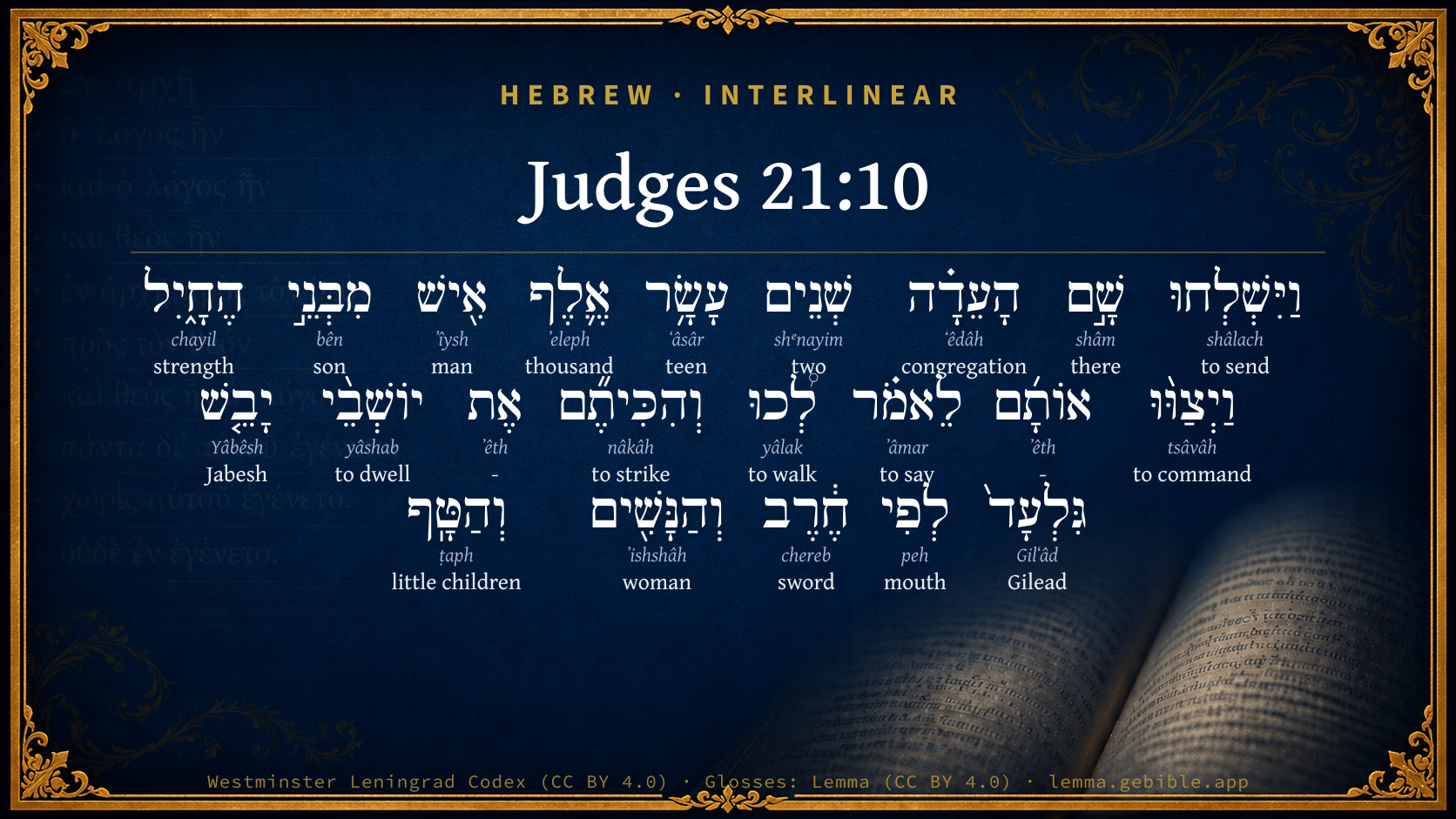
Judges 21:10

Hebrew (Westminster Leningrad Codex) Judges 21:10 appears in the Hebrew Old Testament. The text above is from the Westminster Leningrad Codex. Each word links to its Strong’s number, a concise gloss, and parsing drawn from the Open Scriptures Hebrew Bible morphology. Click any word for its full Brown-Driver-Briggs (BDB) entry.
Download image
Cite this verse

Judges 21:10 (World English Bible). Public Domain. Lemma interlinear Bible study tool, https://lemma.gebible.app/v/judges/21/10.

Show BibTeX & RIS
BibTeX
RIS
English Translation
The congregation sent there twelve thousand men of the most valiant, and commanded them, saying, Go and strike the inhabitants of Jabesh Gilead with the edge of the sword, with the women and the little ones.
World English Bible · Public Domain
Download a study sheet

One document with this verse’s original text, its word-by-word gloss line, the meaning frame, cross-references with their text, attributed commentary, and full source and license credits — printable, and it pastes into notes with its structure intact.

This verse Autodidact and up

Study sheet (.html) Plain text (.txt)

A passage Seminary Student

Up to 50 verses in one chapter. A passage sheet keeps up to 6 commentary sources and 12 cross-references per verse, in the order this page ranks them, and says so on the sheet whenever that leaves anything out. Ask for a single verse and you get the Autodidact verse sheet above.

Everything on this page stays free to read, with no account — the sheet is a download of what is already on screen, not access to it.

Want to remove ads? Support Godless Engineer
Compare translations 3

The same verse in 3 English versions, stacked beneath the original-language interlinear above. Click any original word for its lexicon entry.

Each is an independent rendering of the whole verse — the interlinear is not word-aligned to these translations.

Highlighted words mark where these versions differ — a whole-verse word diff, not a word-by-word alignment.

  • World English Bible Public Domain
    The congregation sent there twelve thousand men of the most valiant, and commanded them, saying, Go and strike the inhabitants of Jabesh Gilead with the edge of the sword, with the women and the little ones.
  • King James Version Public Domain
    And the congregation sent thither twelve thousand men of the valiantest, and commanded them, saying, Go and smite the inhabitants of Jabeshgilead with the edge of the sword, with the women and the children.
  • unfoldingWord Literal Text CC BY-SA 4.0
    So the congregation sent 12,000 men there from the sons of the army and they commanded them, saying, “Go, and you shall strike the dwellers of Jabesh Gilead to the mouth of the sword, even the women and the children.

unfoldingWord Literal Text — © unfoldingWord, licensed CC BY-SA 4.0. Word-aligned USFM3 via Door43 (git.door43.org/unfoldingWord/en_ult).

Versions to compare (up to 4)

3 of 4 selected

Show all 18 translations

Every available English version of this verse, each an independent rendering of the whole verse.

  • World English Bible Public Domain
    The congregation sent there twelve thousand men of the most valiant, and commanded them, saying, Go and strike the inhabitants of Jabesh Gilead with the edge of the sword, with the women and the little ones.
  • Berean Standard Bible Public Domain
    So the congregation sent 12,000 of their most valiant men and commanded them: “Go and put to the sword those living in Jabesh-gilead, including women and children.
  • Majority Standard Bible Public Domain
    So the congregation sent 12,000 of their most valiant men and commanded them: “Go and put to the sword those living in Jabesh-gilead, including women and children.
  • King James Version Public Domain
    And the congregation sent thither twelve thousand men of the valiantest, and commanded them, saying, Go and smite the inhabitants of Jabeshgilead with the edge of the sword, with the women and the children.
  • American Standard Version (1901) Public Domain
    And the congregation sent thither twelve thousand men of the valiantest, and commanded them, saying, Go and smite the inhabitants of Jabesh-gilead with the edge of the sword, with the women and the little ones.
  • Revised Version (1885) Public Domain
    And the congregation sent thither twelve thousand men of the valiantest, and commanded them, saying, Go and smite the inhabitants of Jabesh-gilead with the edge of the sword, with the women and the little ones.
  • Geneva Bible (1599) Public Domain
    Therefore the Congregation sent thither twelue thousande men of the most valiant, and commanded them, saying, Goe, and smite the inhabitants of Iabesh Gilead with the edge of the sword, both women, and children.
  • Douay-Rheims (1899) Public Domain
    So they sent ten thousand of the most valiant men, and commanded them, saying: Go and put the inhabitants of Jabes Galaad to the sword, with their wives and their children.
  • Young's Literal Translation Public Domain
    And the company send there twelve thousand men of the sons of valour, and command them, saying, `Go -- and ye have smitten the inhabitants of Jabesh-Gilead by the mouth of the sword, even the women and the infants.
  • Literal Standard Version CC BY-SA 4.0
    And the congregation sends twelve thousand men of the sons of valor there, and commands them, saying, “Go—and you have struck the inhabitants of Jabesh-Gilead by the mouth of the sword, even the women and the infants.
  • Unlocked Literal Bible CC BY-SA 4.0
    The assembly sent twelve thousand of their bravest men with instructions to go and strike the inhabitants of Jabesh Gilead with the edge of the sword, including the women and children.
  • unfoldingWord Literal Text CC BY-SA 4.0
    So the congregation sent 12,000 men there from the sons of the army and they commanded them, saying, “Go, and you shall strike the dwellers of Jabesh Gilead to the mouth of the sword, even the women and the children.
  • Darby Bible Public Domain
    So the congregation sent thither twelve thousand of their bravest men, and commanded them, "Go and smite the inhabitants of Ja'besh-gil'ead with the edge of the sword; also the women and the little ones.
  • World Messianic Bible Public Domain
    The congregation sent twelve thousand of the most valiant men there, and commanded them, saying, “Go and strike the inhabitants of Jabesh Gilead with the edge of the sword, with the women and the little ones.
  • Webster's Bible Public Domain
    And the congregation sent thither twelve thousand men of the most valiant, and commanded them, saying, Go and smite the inhabitants of Jabesh-gilead with the edge of the sword, with the women and the children.
  • Free Bible Version CC BY-SA 4.0
    So the assembly sent twelve thousand of their best warriors there. They gave them orders, saying, “Go and kill the inhabitants of Jabesh-gilead with your swords, even the women and children.
  • Bible in Basic English Public Domain
    So they (the meeting) sent twelve thousand of the best fighting-men, and gave them orders, saying, Go and put the people of Jabesh-gilead to the sword without mercy, with their women and their little ones.
  • JPS Tanakh (1917) Public Domain
    And the congregation sent thither twelve thousand men of the valiantest, and commanded them, saying: 'Go and smite the inhabitants of Jabesh-gilead with the edge of the sword, with the women and the little ones.

Literal Standard Version (2020), Covenant Press — licensed CC BY-SA 4.0. Text via the HelloAO Bible API (eBible.org). Unlocked Literal Bible (unfoldingWord) — licensed CC BY-SA 4.0. Text via the HelloAO Bible API (eBible.org). unfoldingWord Literal Text — © unfoldingWord, licensed CC BY-SA 4.0. Word-aligned USFM3 via Door43 (git.door43.org/unfoldingWord/en_ult). Free Bible Version, Dr. Jonathan Gallagher — licensed CC BY-SA 4.0. Text via the HelloAO Bible API (eBible.org).

Word by word

More ways to search: Search by grammar → Find every occurrence → Compare this word →

Practice this passage: Drill this verse → Learn its vocabulary →

יָבֵ֤שׁ
Yâbêsh
H3003
“Jabesh”
Noun, Proper
Part of Speech
Noun
Type
Proper
Full BDB Definition

Origin: the same as H3002 (also Yabeysh yaw-bashe')

TWOT: None

Jabesh = "dry" - a town in the territory of Gilead; according to Eusebius, it is beyond the Jordan, 6 miles (10 kilometers) from Pella, on the mountain road to Gerasa; site unknown but may be modern 'Wadi Yabes' (noun proper locative) - father of Shallum, the 15th king of the northern kingdom (noun proper masculine)
  1. וַיִּשְׁלְחוּ shâlach H7971 “and · to send” Conjunction + Verb, Qal, Sequential Imperfect, 3rd Person, Masculine, Plural
  2. שָׁ֣ם shâm H8033 “there” Adverb
  3. הָעֵדָ֗ה ʻêdâh H5712 “the · congregation” Particle, Definite Article + Noun, Common, Feminine, Singular, Absolute
  4. שְׁנֵים shᵉnayim H8147 “two” Adjective, Cardinal number, Masculine, Dual, Absolute
  5. עָשָׂ֥ר ʻâsâr H6240 “teen” Adjective, Cardinal number, Masculine, Singular, Absolute
  6. אֶ֛לֶף ʼeleph H505 “thousand” Adjective, Cardinal number, Both, Singular, Absolute
  7. אִ֖ישׁ ʼîysh H376 “man” Noun, Common, Masculine, Singular, Absolute
  8. מִבְּנֵ֣י bên H1121 “from · sons of” Preposition + Noun, Common, Masculine, Plural, Construct
  9. הֶחָ֑יִל chayil H2428 “the · strength” Particle, Definite Article + Noun, Common, Masculine, Singular, Absolute
  10. וַיְצַוּ֨וּ tsâvâh H6680 “and · to command” Conjunction + Verb, Piel, Sequential Imperfect, 3rd Person, Masculine, Plural
  11. אוֹתָ֜ם ʼêth H853 “- · them” Particle, Direct Object + Suffix, Personal, 3rd Person, Masculine, Plural
  12. לֵאמֹ֗ר ʼâmar H559 “to say” Preposition + Verb, Qal, Infinitive Construct
  13. לְ֠כוּ yâlak H3212 “walk” Verb, Qal, Imperative, 2nd Person, Masculine, Plural
  14. וְהִכִּיתֶ֞ם nâkâh H5221 “and · to strike” Conjunction + Verb, Hiphil, Perfect, 2nd Person, Masculine, Plural
  15. אֶת ʼêth H853 “-” Particle, Direct Object
  16. יוֹשְׁבֵ֨י yâshab H3427 “dwelling” Verb, Qal, Participle Active, Masculine, Plural, Construct
  17. גִּלְעָד֙ Gilʻâd H1568 “Gilead” Noun, Proper
  18. לְפִי peh H6310 “to/for · mouth of” Preposition + Noun, Common, Masculine, Singular, Construct
  19. חֶ֔רֶב chereb H2719 “sword” Noun, Common, Feminine, Singular, Absolute
  20. וְהַנָּשִׁ֖ים ʼishshâh H802 “and · the · women” Conjunction + Particle, Definite Article + Noun, Common, Feminine, Plural, Absolute
  21. וְהַטָּֽף ṭaph H2945 “and · the · little children” Conjunction + Particle, Definite Article + Noun, Common, Masculine, Singular, Absolute

About this verse

These counts appear in no published source. They are computed here, from the morphology-tagged text and Lemma’s own curated glosses. What Lemma adds →

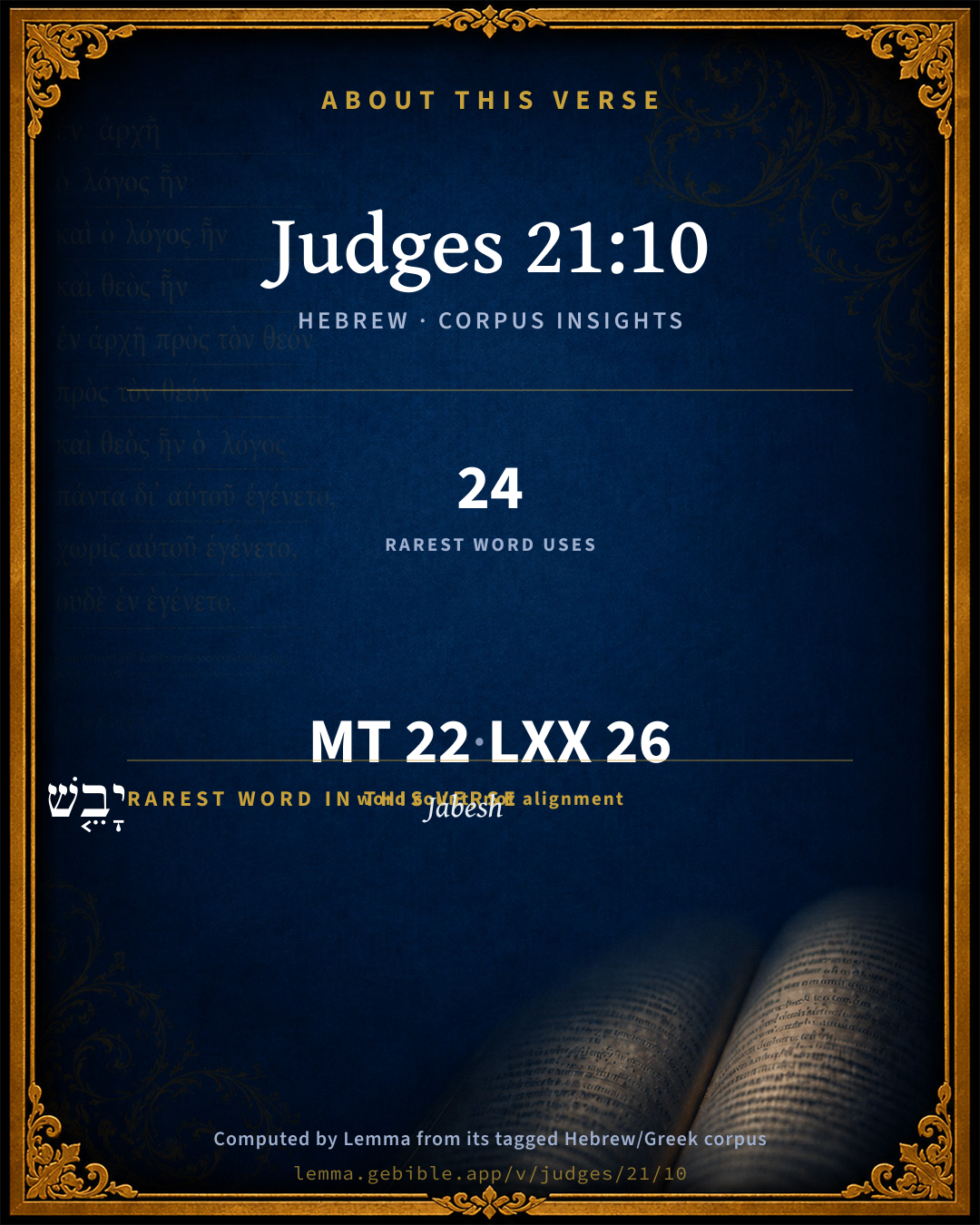
22
words
21
distinct lemmas
Historical
section

Notable vocabulary

The rarest word here is יָבֵ֤שׁ Jabesh H3003 — appearing just 24 times in the whole Hebrew Bible.

Shared distinctive vocabulary

יָבֵ֤שׁ Jabesh H3003 occurs in 21 verses of the Hebrew Bible. Also found in:

Grammatical profile

  • 6 verbs
  • 10 nouns
  • 3 adjectives
  • 1 adverb
  • 2 particles

Verb forms

  • וַיִּשְׁלְחוּ Qal · Sequential Imperfect
  • וַיְצַוּ֨וּ Piel · Sequential Imperfect
  • לֵאמֹ֗ר Qal · Infinitive Construct
  • לְ֠כוּ Qal · Imperative
  • וְהִכִּיתֶ֞ם Hiphil · Perfect
  • יוֹשְׁבֵ֨י Qal · Participle Active

Hebrew & Septuagint length

In English translation the verse runs 36 words from the Hebrew and 31 from the Septuagint (LXX English) — closely comparable.

A rough comparison of the two English renderings, which tokenize alike — not a word-level alignment.

Word counts can differ between the Hebrew and the Greek without any difference in meaning — e.g. the Hebrew direct-object marker אֵת has no separate Greek word, and Greek often adds the article ὁ.

In the original languages it is 22 Hebrew tokens and 26 Greek tokens — but the two are counted differently (Hebrew bundles its prefixes and suffixes into one token; the Greek is in lemma form), so that isn’t a like-for-like length.

Cross-references

6

Topical passages linked to Judges 21:10 in the Treasury of Scripture Knowledge — connected by theme and wording, ordered by reader-vote popularity; previews shown in the World English Bible.

  • Judges 5:23 Curse you Meroz, said the angel of Yahweh. Curse you bitterly the inhabitants of it, Because they didn't come to the help of Yahweh, To the help of Yahweh against the mighty.
  • Judges 21:5 The children of Israel said, Who is there among all the tribes of Israel who didn't come up in the assembly to Yahweh? For they had made a great oath concerning him who didn't come up to Yahweh to Mizpah, saying, He shall surely be put to death.
  • 1 Samuel 11:7 He took a yoke of oxen, and cut them in pieces, and sent them throughout all the borders of Israel by the hand of messengers, saying, Whoever doesn't come forth after Saul and after Samuel, so shall it be done to his oxen. The dread of Yahweh fell on the people, and they came out as one man.
  • Deuteronomy 13:15 you shall surely strike the inhabitants of that city with the edge of the sword, destroying it utterly, and all that is therein and the cattle of it, with the edge of the sword.
  • Joshua 7:24 Joshua, and all Israel with him, took Achan the son of Zerah, and the silver, and the mantle, and the wedge of gold, and his sons, and his daughters, and his oxen, and his donkeys, and his sheep, and his tent, and all that he had: and they brought them up to the valley of Achor.
  • 1 Samuel 15:3 Now go and strike Amalek, and utterly destroy all that they have, and don't spare them; but kill both man and woman, infant and suckling, ox and sheep, camel and donkey.

Cross-references courtesy of OpenBible.info (CC BY 4.0).

Hebrew and Greek witnesses Masoretic Hebrew ↔ Greek Septuagint

The same verse in the two great witnesses to the Old Testament, shown verse-for-verse.

These are two independent witnesses, not word-aligned to each other, and the Septuagint is shown in lemma (dictionary) form.

Hebrew Judges 21:10 Masoretic · Westminster Leningrad Codex

וַיִּשְׁלְחוּ שָׁ֣ם הָעֵדָ֗ה שְׁנֵים עָשָׂ֥ר אֶ֛לֶף אִ֖ישׁ מִבְּנֵ֣י הֶחָ֑יִל וַיְצַוּ֨וּ אוֹתָ֜ם לֵאמֹ֗ר לְ֠כוּ וְהִכִּיתֶ֞ם אֶת יוֹשְׁבֵ֨י יָבֵ֤שׁ גִּלְעָד֙ לְפִי חֶ֔רֶב וְהַנָּשִׁ֖ים וְהַטָּֽף

The congregation sent there twelve thousand men of the most valiant, and commanded them, saying, Go and strike the inhabitants of Jabesh Gilead with the edge of the sword, with the women and the little ones.

World English Bible · Public Domain

Greek LXX Judges 21:10 Septuagint · lemma form

καί ἀποστέλλω ἐκεῖ ὁ συναγωγή δώδεκα χιλιάς ἀνήρ ἀπό υἱός ὁ δύναμις καί ἐντέλλομαι αὐτός λέγω πορεύομαι καί πατάσσω ὁ οἰκέω ιαβις γαλαάδ ἐν στόμα ῥομφαία

And the congregation sent there twelve thousand men of the strongest, and they charged them, saying, Go you⌃ and strike the inhabitants of Jabis Galaad with the edge of the sword.

LXX2012 (modern English Septuagint) · Public Domain

On this verse, John Gill's Exposition discusses the Septuagint’s reading. Read the note in Commentary ↓

Hebrew: Westminster Leningrad Codex (CC BY 4.0). Greek: Septuagint (public domain); English from LXX2012 (modern English Septuagint) (Public Domain). How the Septuagint differs from the Hebrew →

Targum (Aramaic paraphrase)

1

The Targum is the ancient Jewish Aramaic paraphrase of the Hebrew Scriptures — an interpretive translation, not the Hebrew text itself. Onkelos (literal) and Pseudo-Jonathan (expansive) render the Torah, and Jonathan the Prophets. Coverage is partial: where no permissively-licensed English translation exists for a verse, only the Aramaic is shown. This is verse-level text, not a word-by-word alignment to the Hebrew.

  1. Targum Jonathan Prophets (Joshua–Malachi)
    וּשְׁלַחוּ תַמָן כְּנִשְׁתָּא תְּרֵי עֲסַר אַלְפִין גַבְרָא מְזָרְזֵי חֵילָא וּפַקִידוּ יַתְהוֹן לְמֵימָר אֱזִילוּ וְתִמְחוּן יַת יַתְבֵי יָבֵשׁ גִלְעָד לְפִתְגַם דְחָרֶב וּנְשַׁיָא וְטַפְלָא:

    (no public-domain English translation for this verse)

    Targum Jonathan — Aramaic: “Mikraot Gedolot” (public domain). English: “Sefaria Community Translation” (CC0 1.0 (public-domain dedication)); “London "Chaldee Paraphrase," 1871” (public domain). Text via Sefaria.

Commentary

Notes on Judges 21:10 from classic Christian and Jewish commentators (each source and its license shown beneath its notes). The classic Christian expositions comment on the surrounding passage and are grouped to its opening verse, so a note may address several verses; the Jewish commentaries on the Tanakh (Rashi and others) are per-verse, so they appear only where the commentator wrote on this verse.

Lemma curates 59 commentaries, every one of them public domain or Creative Commons licensed, each selected and text-cleaned for this edition rather than reprinted as found. About our sources →

Trapp's Complete Commentary

John Trapp

Jdg 21:10 And the congregation sent thither twelve thousand men of the valiantest, and commanded them, saying, Go and smite the inhabitants of Jabeshgilead with the edge of the sword, with the women and the children.

Ver. 10. Of the valiantest.] Heb., Of the sons of valour; such as were those duo fulmina belli, the two Scipios.

With the women and the children.] Why, what had those poor sheep done, that they must be slaughtered? {a} This is surely Exemplum nimiae severitatis saevientis in innocentes, as Piscator noteth: an excess of severity, raging against innocents that could not resist. Egregiam vero laudem! Surely, if these men had rightly repented of their cruelty toward the Benjamites, as they even now pretended, those of Jabeshgilead had found more mercy. David had not yet recovered his foul fall, when he dealt so cruelly with the Ammonites. {2Sa 12:31}

{a} Here again rash zeal outruns right reason.

John Trapp, A Commentary or Exposition upon All the Books of the Old and New Testament (1647–1656) — public domain. Text from a community e-Sword module.

Geneva Bible (1599)

Geneva Bible translators

Hebrew, children of strength.

Geneva Bible (1599) marginal notes — public domain. Text via Bolls.life.

Ellicott's Commentary for English Readers

(10) Twelve thousand men.—The Vulgate has 10,000, but it is doubtless meant to imply that each tribe sent a thousand “valiant men” (Gen_47:6, &c.), as in the war against the Midianites, in which Balaam was slain and at which Phinehas had been present (Num_31:6).

A Bible Commentary for English Readers, edited by Charles John Ellicott (1878–1897) — public domain. Text from a community e-Sword module.

The Cambridge Bible for Schools and Colleges

gen. ed. J. J. S. Perowne

10. twelve thousand men] No doubt reckoning 1000 men from each tribe, cf. Num_31:4 f.; the writer forgot that Benjamin could not be counted.

The Cambridge Bible for Schools and Colleges (gen. ed. J. J. S. Perowne; Cambridge University Press, 1878–1918) — public domain. Text from a community e-Sword module.

John Gill's Exposition

And the congregation sent thither twelve thousand men of the valiantest,.... That were in their army; in the Vulgate Latin version it is only 10,000; but the Targum, Septuagint, Syriac, and Arabic versions, and Josephus (c), agree with the Hebrew text. This place, according to Bunting, to which this army was sent, was fifty two miles from Shiloh (d):

and commanded them, saying; these were the orders they gave them, when they marched out:

go and smite the inhabitants of Jabeshgilead with the edge of the sword, with the women and the children; which it seems was according to the oath they had made, Jdg 21:5.

(c) Ut supra. (Antiqu. l. 5. c. 2. sect. 10.) (d) Travels, &c. p. 121.

John Gill's Exposition of the Whole Bible (1746–1763) — public domain (CC PDM 1.0). Text via the HelloAO Bible API.

Albert Barnes' Notes on the Bible

And the congregation sent 12,000 men - A thousand from each tribe; they followed the precedent of Num 31:4.

Albert Barnes' Notes on the Bible (1834–1885) — public domain. Text from a community e-Sword/MySword module.

Haydock's Catholic Bible Commentary

Ten. Hebrew, Chaldean, Septuagint, and Josephus read, twelve. The refusal to serve in the national army was punished like a sort of rebellion, with death, no less than to desert. Debora cursed the inhabitants of Meros, on this account, chap. v. 23.

George Leo Haydock (1774–1849), Haydock's Catholic Family Bible and Commentary, 1859 edition — public domain. Excludes Psalms (Douay-Rheims chapter numbering differs from Protestant) and Deuterocanonical books (Catholic canon only).

Matthew Poole's English Annotations

Who in such public and scandalous crimes were, for the greater terror of such transgressors, and prevention of the like sins, oft involved in the same punishment with the men, as Deu 13:15; Jos 7:24, &c.

Matthew Poole's English Annotations on the Holy Bible (1683–1685) — public domain. Text from a community e-Sword/MySword module.

Whedon's Commentary on the Bible

Daniel D. Whedon

10. Go and smite — They attempt to help one calamity by causing another. It is noticeable that in all this action it is not said that they asked counsel of Jehovah.

Daniel D. Whedon (gen. ed.), Commentary on the Old and New Testaments (1874–1909) — public domain. Text from a community e-Sword module.

The Pulpit Commentary

Vers. 10, 11. Ye shall utterly destroy, etc. Devote to destruction, as a herem, an accursed thing. They followed in the severity of the punishment the precedent of the destruction of the Midianites, (see Num_31:17) and even in the numbers sent to destroy them a thousand from every. (Num_31:5) Revolting to our feelings as such wholesale massacres are, including women and children, it must be remembered in mitigation that the hereto was the solemn devotion of a thing or person to destruction under the sanction of an oath. Of the valiantest. The sons of valour simply means valiant men. (2Sa_13:28 2Sa_17:10)

The Pulpit Commentary (1880–1919), ed. H.D.M. Spence-Jones & Joseph S. Exell — public domain. Text from a community e-Sword module.

Lesson kit

Teaching starters — assembled from the data on this page, not authored interpretation. Every prompt links to the verse data it draws on. Edit before teaching.

Judges, in the Historical, opens this verse with 22 words (21 distinct Hebrew lemmas). Its most distinctive word is Yâbêsh (“Jabesh”). A historical commentator’s framing appears above. Read the whole chapter for the surrounding context.

Discussion questions

  1. The word Yâbêsh carries the sense “Jabesh.” How does it shape the verse?
  2. Judges 21:8 shares the word «Jabesh» with this verse. How do the two illuminate each other?
  3. These translations render this verse differently. What is at stake in choosing one wording over another?
  4. The verb «וַיִּשְׁלְחוּ» is Qal Sequential Imperfect. How does its form color the action?
  5. Reading how Trapp's Complete Commentary and Geneva Bible (1599) read this verse, where do the two commentators agree and where do they part?

Things to notice

Reading settings

Reading text

Shown beneath each verse's original-language words.

Old Testament
Old Testament edition

Read the OT as the Masoretic Hebrew (MT) or the Greek Septuagint (LXX).

English shown for the Greek Septuagint (in the Hebrew ↔ Greek comparison).

Comparing translations? Open the Compare panel on any verse page to stack up to four side by side.