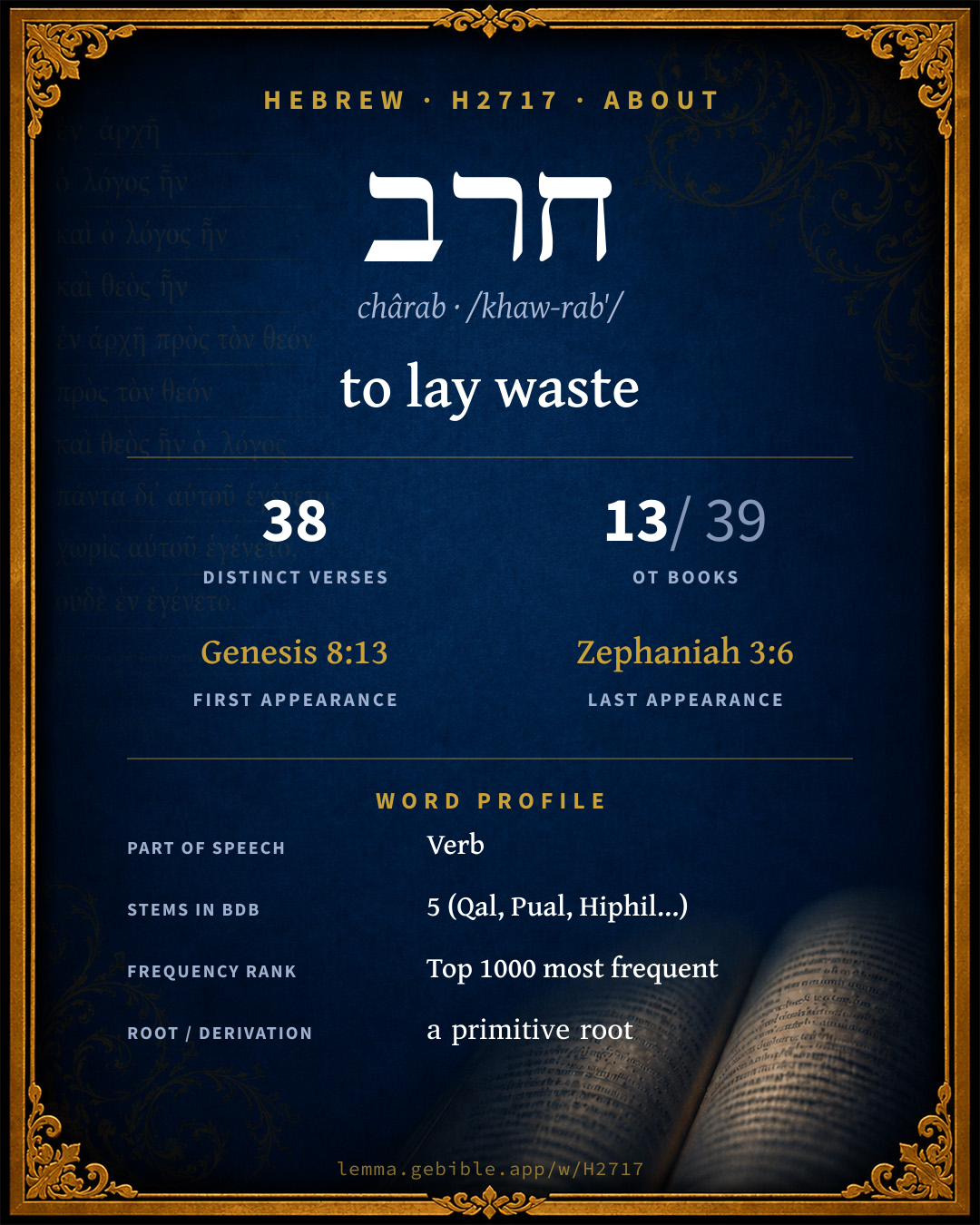
חרב
to lay waste
‘to lay waste’ is one of 6 main senses fuller range ↓
Full lexicon entry — Brown-Driver-Briggs (BDB)
From Brown-Driver-Briggs (BDB)
Where this word appears
See every Qal verb in the Hebrew Bible →
Grammar key — what these labels mean
Part of speech
- Verb
- An action or state-of-being word.
- Adjective
- A word that describes or qualifies a noun.
Stem
- Qal
- The basic, simple active stem — the plain form of the verb (“he wrote”). Here: ‘of ground’
- Hiphil
- The causative active stem (“he caused / brought about”).
- Pual
- The passive counterpart of the Piel.
- Hophal
- The passive counterpart of the Hiphil (“he was caused to…”).
- Niphal
- Usually the simple passive or reflexive of the Qal (“he was written”).
Form
- Imperfect
- An incomplete, ongoing, or future action (“he will / would write”).
- Perfect
- A completed action or state — Hebrew marks aspect (completeness) more than strict tense (“he wrote”).
- Imperative
- A direct command (“write!”).
- Sequential Perfect
- A perfect with prefixed waw continuing a preceding imperfect or command (waw-consecutive perfect).
- Participle Active
- A verbal adjective expressing ongoing or characteristic action (“writing / one who writes”).
- Sequential Imperfect
- An imperfect with prefixed waw — the standard past-narrative form (waw-consecutive imperfect).
- Infinitive Absolute
- An unbound verbal noun, often intensifying or standing in for a finite verb.
- Participle Passive
- A verbal adjective expressing action received (“written”).
State
- Absolute
- The independent form of a noun, not bound to a following word.
- Construct
- A noun bound to a following noun in a possessive / “of” relationship (the construct chain).
Person
- 3rd Person
- The one spoken about (“he / she / it / they”).
- 1st Person
- The speaker (“I / we”).
- 2nd Person
- The one addressed (“you”).
Gender
- Masculine
- Grammatically masculine.
- Feminine
- Grammatically feminine.
- Common
- Either gender — not distinguished for this form.
Number
- Plural
- More than one (in Hebrew, generally three or more).
- Singular
- One.
Grammatical forms 27 distinct
- Verb, Hiphil, Imperfect, 1st Person, Common, Singular 4 times (10%)
- Verb, Qal, Imperfect, 3rd Person, Masculine, Plural 3 times (7%)
- Verb, Qal, Imperfect, 3rd Person, Masculine, Singular 3 times (7%)
- Adjective, Adjective, Feminine, Singular, Absolute 2 times (5%)
- Verb, Pual, Perfect, 3rd Person, Common, Plural 2 times (5%)
- Verb, Hiphil, Perfect, 3rd Person, Common, Plural 2 times (5%)
- Verb, Hiphil, Perfect, 3rd Person, Masculine, Singular 2 times (5%)
- Verb, Qal, Imperfect, 3rd Person, Feminine, Plural 2 times (5%)
+19 more forms (22 occurrences)
Parsed forms decoded from the imported morphology (morphhb / Westminster Leningrad Codex — WLC text public domain, morphhb tagging CC BY 4.0), counted across 42 parsed occurrences — not distinct verses.
Every verse where H2717 appears — 38 distinct verses across 13 books. Click any verse to open its interlinear word-by-word view. Verse text shown in the World English Bible for context — . Each verse’s Hebrew form is shown with its reference; the English is not keyword-highlighted, since the data carries no word-level English alignment. Use “Compare translations” on any verse to read it across multiple English versions. This concordance covers the Hebrew Bible; Septuagint (Greek Old Testament) occurrences are not indexed here.
Genesis 1 verse
Judges 3 verses
- Judges 16:7 חֹרָ֑בוּ Pual pf 3cp Samson said to her, If they bind me with seven green cords that were never dried, then shall I become weak, and be as another man.
- Judges 16:8 חֹרָ֑בוּ Pual pf 3cp Then the lords of the Philistines brought up to her seven green cords which had not been dried, and she bound him with them.
- Judges 16:24 מַחֲרִ֣יב Hiphil ptcp.act ms cs When the people saw him, they praised their god; for they said, Our god has delivered into our hand our enemy, and the destroyer of our country, who has slain many of us.
2 Kings 3 verses
- 2 Kings 3:23 הָחֳרֵ֤ב נֶֽחֶרְבוּ֙ Hophal inf.abs Niphal pf 3cp and they said, This is blood; the kings are surely destroyed, and they have struck each man his fellow: now therefore, Moab, to the spoil.
- 2 Kings 19:17 הֶחֱרִ֜יבוּ Hiphil pf 3cp Of a truth, Yahweh, the kings of Assyria have laid waste the nations and their lands,
- 2 Kings 19:24 וְ/אַחְרִב֙ conj + Hiphil impf 1cs I have dug and drunk strange waters, and with the sole of my feet will I dry up all the rivers of Egypt.
Nehemiah 2 verses
- Nehemiah 2:3 חֲרֵבָ֔ה adj Adjective fs I said to the king, Let the king live forever: why should not my face be sad, when the city, the place of my fathers' tombs, lies waste, and the gates of it are consumed with fire?
- Nehemiah 2:17 חֲרֵבָ֔ה adj Adjective fs Then said I to them, You see the evil case that we are in, how Jerusalem lies waste, and the gates of it are burned with fire: come, and let us build up the wall of Jerusalem, that we be no more a reproach.
Job 1 verse
Psalms 1 verse
Isaiah 11 verses
- Isaiah 19:5 יֶחֱרַ֥ב Qal impf 3ms The waters shall fail from the sea, and the river shall be wasted and become dry.
- Isaiah 19:6 וְ/חָרְב֖וּ conj + Qal wpf 3cp The rivers shall become foul; the streams of Egypt shall be diminished and dried up; the reeds and flags shall wither away.
- Isaiah 34:10 תֶּחֱרָ֔ב Qal impf 3fs It shall not be quenched night nor day; the smoke of it shall go up for ever; from generation to generation it shall lie waste; none shall pass through it forever and ever.
- Isaiah 37:18 הֶחֱרִ֜יבוּ Hiphil pf 3cp Of a truth, Yahweh, the kings of Assyria have laid waste all the countries, and their land,
- Isaiah 37:25 וְ/אַחְרִב֙ conj + Hiphil impf 1cs I have dug and drunk water, and with the sole of my feet will I dry up all the rivers of Egypt.
- Isaiah 42:15 אַחֲרִ֤יב Hiphil impf 1cs I will lay waste mountains and hills, and dry up all their herbs; and I will make the rivers islands, and will dry up the pools.
- Isaiah 44:27 חֳרָ֑בִי Qal impv 2fs who says to the deep, Be dry, and I will dry up your rivers;
- Isaiah 49:17 וּ/מַחֲרִבַ֖יִ/ךְ conj + Hiphil ptcp.act mp cs + sfx pers 2fs Your children make haste; your destroyers and those who made you waste shall go forth from you.
- Isaiah 50:2 אַחֲרִ֣יב Hiphil impf 1cs Why, when I came, was there no man? when I called, was there none to answer? Is my hand shortened at all, that it can't redeem? or have I no power to deliver? Behold, at my rebuke I dry up the sea, I make the rivers a wilderness: their fish stink, because there is no water, and die for thirst.
- Isaiah 51:10 הַ/מַּחֲרֶ֣בֶת ptcl def.art + Hiphil ptcp.act fs Isn't it you who dried up the sea, the waters of the great deep; who made the depths of the sea a way for the redeemed to pass over?
- Isaiah 60:12 חָרֹ֥ב יֶחֱרָֽבוּ Qal inf.abs Qal impf 3mp For that nation and kingdom that will not serve you shall perish; yes, those nations shall be utterly wasted.
Jeremiah 5 verses
- Jeremiah 2:12 חָרְב֥וּ Qal impv 2mp Be astonished, you heavens, at this, and be horribly afraid, be you very desolate, says Yahweh.
- Jeremiah 26:9 תֶּחֱרַ֖ב Qal impf 3fs Why have you prophesied in the name of Yahweh, saying, This house shall be like Shiloh, and this city shall be desolate, without inhabitant? All the people were gathered to Jeremiah in the house of Yahweh.
- Jeremiah 50:21 חֲרֹ֨ב Qal impv 2ms Go up against the land of Merathaim, even against it, and against the inhabitants of Pekod: kill and utterly destroy after them, says Yahweh, and do according to all that I have commanded you.
- Jeremiah 50:27 חִרְבוּ֙ Qal impv 2mp Kill all her bulls; let them go down to the slaughter: woe to them! for their day is come, the time of their visitation.
- Jeremiah 51:36 וְ/הַחֲרַבְתִּי֙ conj + Hiphil wpf 1cs Therefore thus says Yahweh: Behold, I will plead your cause, and take vengeance for you; and I will dry up her sea, and make her fountain dry.
Ezekiel 7 verses
- Ezekiel 6:6 תֶּחֱרַ֔בְנָה יֶחֶרְב֨וּ Qal impf 3fp Qal impf 3mp In all your dwelling-places the cities shall be laid waste, and the high places shall be desolate; that your altars may be laid waste and made desolate, and your idols may be broken and cease, and your sun-images may be hewn down, and your works may be abolished.
- Ezekiel 12:20 תֶּחֱרַ֔בְנָה Qal impf 3fp The cities that are inhabited shall be laid waste, and the land shall be a desolation; and you shall know that I am Yahweh.
- Ezekiel 19:7 הֶחֱרִ֑יב Hiphil pf 3ms He knew their palaces, and laid waste their cities; and the land was desolate, and the fullness of it, because of the noise of his roaring.
- Ezekiel 26:2 הָחֳרָֽבָה Hophal pf 3fs Son of man, because Tyre has said against Jerusalem, Aha, she is broken: the gate of the peoples; she is turned to me; I shall be replenished, now that she is laid waste:
- Ezekiel 26:19 נֶחֱרֶ֔בֶת Niphal ptcp.pass fs For thus says the Lord Yahweh: When I shall make you a desolate city, like the cities that are not inhabited; when I shall bring up the deep on you, and the great waters shall cover you;
- Ezekiel 29:12 מָֽחֳרָבוֹת֙ Hophal ptcp.pass fp I will make the land of Egypt a desolation in the midst of the countries that are desolate; and her cities among the cities that are laid waste shall be a desolation forty years; and I will scatter the Egyptians among the nations, and will disperse them through the countries.
- Ezekiel 30:7 נַחֲרָב֖וֹת Niphal ptcp.pass fp They shall be desolate in the midst of the countries that are desolate; and her cities shall be in the midst of the cities that are wasted.
Hosea 1 verse
Amos 1 verse
Nahum 1 verse
Zephaniah 1 verse
About this entry
At a glance — auto-summarized from this page’s data, not written by a person. Every figure links to its source below. This summary describes the numbers; it doesn’t interpret them.
“to lay waste” is the headline sense of the Hebrew verb חרב (chârab). Across 5 stems, its meaning turns on the binyan (Qal, Pual). The Hebrew Bible uses it across 38 verses — moderately common. More than a quarter of its appearances fall in Isaiah. Its earliest occurrence is Genesis 8:13. The sections below give every sense, occurrence, and version rendering.
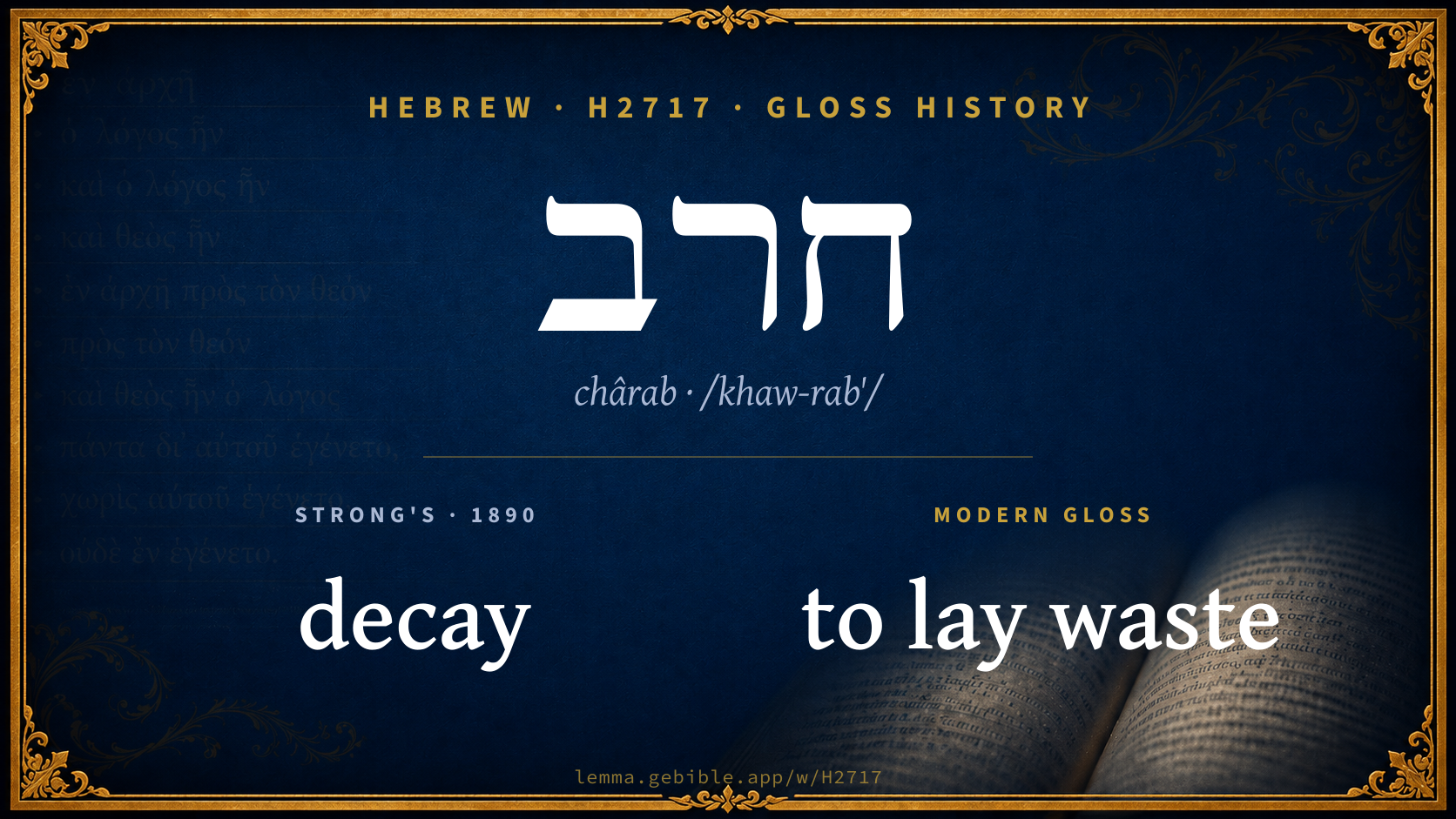
Gloss history
Strong's 1890 vs modern scholarship
About this word
Strong's H2717 catalogs a Hebrew word from the Hebrew Old Testament.
These counts are not copied from any lexicon or concordance. They are computed here, from the morphology-tagged Hebrew Old Testament. What Lemma adds →
- 38
- distinct verses
- The word appears in 38 distinct verses.
- 13 / 39
- OT books
- The word appears in 13 of 39 Old Testament books.
- #864
- by frequency
- Top 1000 most frequent Hebrew words (rank 864 of 8,640 Hebrew words by occurrence).
View all 38 occurrences in the concordance →
By section of the Old Testament
By traditional corpus
Conventional, traditional groupings — biblical authorship is debated, so this is a traditional corpus grouping, not an authorship claim. Each share is this word’s portion of its verses in that division of the Hebrew canon. Each figure is a share of the word’s 38 distinct verses.
- Prophets (Nevi'im) 33 verses · 87%
- Writings (Ketuvim) 4 verses · 11%
- Torah (Pentateuch) 1 verse · 3%
How translations render this word
Counts come from each version’s own published word-to-Strong’s tagging or interlinear alignment — an approximate guide to how each version renders this word, not a word-level alignment the data otherwise carries. Because each total is that version’s own tagged count, the per-version totals vary from one another and need not match the appearance or distinct-verse counts above. These counts may also differ from a printed concordance because Lemma counts each distinctly tagged rendering and does not collapse phrase taggings into a single head-word total. This is a fixed set of word-tagged versions (KJV, ASV, BSB, ULT) and does not change with the reading translation you choose elsewhere. Each version’s license is shown beside its name below (and on Sources).
BDB lists this Strong’s number as 5 distinct words (homographs). Each count above pools all of them and is not split by sense — see the Senses section below. A low-frequency rendering may belong to a different one of those words, not the primary meaning.
- King James Version†: Shall be laid waste 3×, Waste 2×
- American Standard Version†: Shall be laid waste 3×, Have laid waste 2×, Slay 2×
- Berean Standard Bible†: Will be laid waste 4×, Been dried 2×, Dried up 2×
- unfoldingWord Literal Text†: And 3×, Been dried 2×, Desolate 2×
King James Version Public Domain
Renders H2717 across 40† tagged occurrences — most commonly:
Plus 35 renderings that appear only once — usually multi-word phrases or single function words the recovered tagging swept in, not distinct renderings.
American Standard Version Public Domain
Renders H2717 across 40† tagged occurrences — most commonly:
Plus 33 renderings that appear only once — usually multi-word phrases or single function words the recovered tagging swept in, not distinct renderings.
Berean Standard Bible Public Domain
Renders H2717 across 38† tagged occurrences — most commonly:
Plus 24 renderings that appear only once — usually multi-word phrases or single function words the recovered tagging swept in, not distinct renderings. Not rendered by a distinct English word in 2 further occurrences.
unfoldingWord Literal Text CC BY-SA 4.0
Renders H2717 across 45† tagged occurrences — most commonly:
Plus 26 renderings that appear only once — usually multi-word phrases or single function words the recovered tagging swept in, not distinct renderings.
8 senses and sub-senses in the full BDB
Hebrew verbs can shift meaning by stem (binyan): Qal is the basic action, Niphal is often passive or reflexive, Piel often intensifies or makes it factitive, and Hiphil is typically causative. The senses below are grouped under the stem BDB assigns to each. This entry also uses Pual (the passive of Piel) and Hophal (the passive of Hiphil).
What do BDB’s symbols mean?
BDB uses these scholarly abbreviations:
| Symbol | Meaning |
|---|---|
| 𝔊 | the Septuagint (the ancient Greek translation, LXX) |
| 𝔙 | the Vulgate (the Latin translation) |
| 𝔖 | the Syriac version (the Peshitta) |
| 𝔗 | the Targum (the Aramaic translation) |
| ψ | the Psalms |
| √ | root (the underlying root or stem) |
| ‖ | parallel passage (a synonymous or contrasted parallel) |
| † | the dagger: every passage where the word occurs is cited |
The 8 senses and sub-senses the full Brown-Driver-Briggs lexicon distinguishes for this word, in lexicon order (not ranked by frequency), with BDB’s own verbatim wording and sub-sense lettering. Shown in Hebrew script with BDB’s own scholarly abbreviations. The condensed entry is in the Lexicon Entry tab. See also the Forms in the corpus table below.
חרב I be dry, dried up (cf. יָבֵשׁ) (Aramaic חֲרוֹב be dry, חוּרְבָּא drought)
Qal
- Pf. 3 pl. חָֽרְבוּ Gn 8:13(×2), Is 19:6; Impf. 3 ms. יֶחֱרַב Ho 13:15 + 2 times, וַיֶּחֱרָ֑ב ψ 106:9; Imv. fs. חֳרָ֑בִי Is 44:27;—be dry, dried up: e.g. Genesis 8:13
- 1. of ground, be freed from waters of flood ח׳ פְּנֵי הָאֲדָמָה Gn 8:13b (J). e.g. Genesis 8:13
- 2. of waters, be dried up, taken away; of waters of flood Gn 8:13a (P); of Nile וְנָהָר יֶחֱרַב וְיָבֵשׁ Is 19:5 (‖ וְנִשְּׁתוּ־מַיִם מֵהַיָּם), v. same combination Jb 14:11 (‖ אָֽזְלוּ מַיִם מִנִּי־יָם); Is 19:6 (‖ דָּֽלֲלוּ) 44:27 (‖ הוֹבִישׁ); of Red Sea ψ 106:9; fig. of Ephraim’s freshness and vigour Ho 13:15. e.g. Genesis 8:13
Pual
- Pf. 3 pl. לֹא חֹרָ֑בוּ Ju 16:7, 8, of fresh bow-strings (of gut, v. Bla). e.g. Judges 16:7
Hiphil
- Pf. הֶחֱרִיב Na 1:4, of י׳’s drying up rivers (‖ וַיַּבְּשֵׁהוּ), perhaps also Is 11:15 (for MT החרים) v. 𝔊 𝔖 𝔙 𝔗; וְהַחֲרַבְתִּ֫י the Euphrates Je 51:36 (‖ הוֹבַשְׁתִּי); Impf. אַחֲרִיב יָם Is 50:2, subj. י׳, I dry up a sea (‖ אָשִׂים נְהָרוֹת מִדְבָּר); אַחְרִב Is 37:25 = אַחֲרִב 2 K 19:24, of king of Assyria drying up rivers of Egypt; Pt. fs. הַמַּחֲרֶבֶת Is 51:10 of י׳’s arm drying up (Red) Sea. e.g. Nahum 1:4
חרב II dry, only fs. חֲרֵבָה Lv 7
חרב III be waste, desolate (NH חָרֵב id.
חרב IV waste, desolate
חרב V (Aramaic and rare) attack, smite down (cf. Arabic حَرَبَ plunder, iii. wage war with, vi. fight together, حَرْبٌ war, battle
Qal
- Imv. ms. חֲרֹב Je 50:21 attack (+ וְהַחֲרֵם אַחֲרֵיהֶם); mpl. חִרְבוּ v 27 obj. כָּל־פָּרֶיהָ, fig. of men of Babylon. e.g. Jeremiah 50:21
Niphal
- Pf. 3 pl. נֶחֶרְבוּ המלכים (v. Hoph.) הָחֳרֵב 2 K 3:23 the kings have attacked one another, fought together (‖ וַיַּכּוּ אִישׁ אֶת־רֵעֵהוּ). e.g. 2 Kings 3:23
Hophal
- Inf. abs. 2 K 3:23, v. Niph., but read perhaps הֵחָרֵב, cf. Dr Lv 19:20, note. e.g. 2 Kings 3:23
Senses from the full Brown-Driver-Briggs lexicon (Brown, Driver, Briggs; Oxford 1906 — public domain), digitized via Sefaria, supplemented by the OpenScriptures HebrewLexicon (CC BY 4.0). Full attribution on Sources.
Word origin
I. vb. be dry, dried up (cf. יָבֵשׁ) (Aramaic חֲרוֹב be dry, חוּרְבָּא drought);—
II. adj. dry, only fs. חֲרֵבָה Lv 7:10 of meal-offering not moistened (with oil; P); פַּת־חֲרֵבָה Pr 17:1 a dry morsel.
III. be waste, desolate (NH חָרֵב id.; Aramaic חֲרוֹב, ܚܪܰܒ be laid waste; Zinj. חרב adj.; Arabic خَرِبَ be in ruins, waste, depopulated; Assyrian ḫarâbu, be waste, DlPr 175, ḫuribtu, desert, LotzTP);—Qal Impf. 3 fs. תֶּחֱרַ֔ב Je 26:9, תֶּחֱרָ֔ב Is 34:10; 3 mpl. יֶחֶרְבוּ Ez 6:6, יֶחֱרָ֑בוּ Am 7:9 Is 60:12; 3 fpl. תֶּחֱרַבְנָה Ez 6:2; 12:20; Imv. חֳרָבִי Is 44:27, חָרְבוּ (so, not חָֽרְבוּ—Theile—v. Köi. 244) Je 2:12; Inf. abs. חָרֹב Is 60:12;—be waste, desolate; of sanctuaries of Isr. Am 7:9 (‖ נָשַׁמּוּ), of altars Ez 6:6; of cities Je 26:9; Ez 6:6; 12:20 (‖ שׁמם); of nations Is 34:10, חָרֹב יֶחֱרָ֑בוּ 60:12 (‖ יֹאבֵדוּ); fig., in address to the heavens חָרְבוּ מְאֹד Je 2:12—(‖ שֹׁמּוּ, וְשַׂעֲרוּ), be very desolate (at sins of Isr.); others, be amazed, astounded (on relation of meanings v. שׁמם). Niph. Pt. f. נֶחֱרֶבֶת Ez 26:19 as adj., desolate city, i.e. uninhabited, v. context; נַחֲרָבוֹת 30:7 of desolate countries (‖ נָשַׁמּוּ). Hiph. Pf. הֶחֱרִיב Ez 19:7; 1 s. הֶחֱרַבְתִּי Zp 3:6; 3 pl. הֶחֱרִיבוּ Is 37:18 2 K 19:17; Impf. 1 s. אַחֲרִיב Is 42:15; Pt. מַחֲרִיב Ju 16:24; pl. c. sf. מַחֲרִיבַיִךְ Is 49:17;—lay waste, make desolate, human subj.; nations and lands Is 37:18 = 2 K 19:17, Is 42:15, cf. pt. Is 49:17 (‖ מְהָֽרְסַיִךְ); add prob. with We Am 4:9 (הֶחֱרַבְתִּי for the untranslateable הַרְבּוֹת) I have devastated your gardens and vineyards; pt. Ju 16:24 desolater of our country (‖ הִרְבָּה אֶת־חֲלָלֵ֑נוּ); obj. cities Ez 19:7; streets Zp 3:6 (‖ נָשַׁמּוּ). Hoph. Pf. 3 fs. הָחֳרָ֑בָה Ez 26:2 she is laid waste, of a city; Pt. מָחֳרָבוֹת Ez 29:12 laid waste, of cities (‖ שׁמם).
IV. adj. waste, desolate;—ms. abs. ח׳ Je 33:10 + 5 times; fs. חֲרֵבָה Ne 2:3 + 2 times; fpl. הֶחֳרֵבוֹת Ez 36:35, 38 (v. Köi. 241);—of a city, defined מֵאֵין אָדָם וּמֵאֵין בְּהֵמָה Je 33:10, cf. v 12; also Ne 2:3, 17; הֶעָרִים הֶחֳרֵבוֹת Ez 36:35 (+ הַנְשַׁמּוֹת, הַנֶּהֱרָסוֹת; opp. בְּצוּרוֹת יָשָׁ֑בוּ), Hg 1:4, 9 (בַּיִת).
I. vb. (Aramaic and rare) attack, smite down (cf. Arabic حَرَبَ plunder, iii. wage war with, vi. fight together, حَرْبٌ war, battle; Syriac ܚܪܰܒ smith, slay)—
— Brown-Driver-Briggs (Oxford 1906, public domain), digitized via Sefaria, supplemented by the OpenScriptures HebrewLexicon (CC BY 4.0). See Sources.
Origin: a primitive root
Jastrow Dictionary
A second Hebrew/Aramaic lexicon for comparison, covering Aramaic and post-biblical (Talmudic, Targumic, Midrashic) usage that the biblical-Hebrew BDB does not. Matched by lemma rather than by Strong’s number, so a lemma may carry more than one Jastrow headword (shown separately below), and the entries cover usage well beyond the Bible.
חָרִב I
- (b. h.) to be burned, dried up, ruined, waste. Snh. 22ᵃ כאלו ח׳ בה"מ וכ׳ as if the Temple had been destroyed in his days. Tosef. Men. XIII, 22 מפני מה חָרְבָה וכ׳ why was Shiloh destroyed?; Yoma 9ᵃ. Kil. IV, 1 (expl. קרחת הכרם) כרם שח׳ באמצעו a vineyard the central part of which is laid waste. Ib. V, 1; a. fr. [Num. R. s. 7, end בבל ח׳ מקדש, read: החריב. Taan. 29ᵃ כשח׳ טורנוס, read: כשחרש, v. Rabb. D. S. a. l.]
- to be destroyed. Erub. 18ᵇ. Yoma 39ᵇ שסופך עתיד לֵיחָרֵב that it is thy final destiny to be destroyed; a. fr.
- same. Pesik. R. s. 31 שיִתְחָרֵב. [Pirké d’R. El. ch. XXXIII, v. חָרַךְ.]
- to destroy, lay waste. Tosef. M. Kat. I, 5 מַחֲרִיבִין חורי וכ׳ you may destroy ant-stores (during the festive week). Num. R. s. 7, end שהֶחֱרִיבוּ בה"מ for they (the Romans) destroyed the Temple; a. fr.
- to be destroyed. Pes. 42ᵇ (ref. to Ez. XXVI, 2) אי מלאה זו הָחְרְבָה זו Ms. M. (ed. חרבה, v. Rabb. D. S. a. l. note 9) when the one (Jerusalem) is populated, the other (Caesarea) is laid waste; Yalk. Gen. 110 חֲרֵיבָה. e.g. Ezekiel 26:2
חֲרֵב
- Targ. Ez. XXVI, 2. Targ. Hos. XIII, 15. Targ. Is. XIX, 5; a. fr.—Naz. 32ᵇ דח׳ בה"מ that the Temple has been destroyed. Ib. דיִחְרוֹב that it will be destroyed. Gitt. 56ᵃ דלא לִיחֲרוֹב וכ׳ that Jerusalem may not be destroyed. Y. Ber. II, 5ᵃ top דברגליה חריב with whose arrival it was destroyed; a. fr.
- to destroy, lay waste. Targ. Is. XLII, 15. Targ. Jud. XVI, 24; a. fr.—Yoma 69ᵇ דאַחְרְבֵיה וכ׳ who destroyed the Temple. Taan. 29ᵃ top לאַחְרוּבֵי Ms. M. a. Rashi (ed. לַחְרוּבֵי); Gitt. 56ᵃ לַחְרוּבֵי; a. fr.
- to be destroyed. Y. Ber. l. c.
חָרֵב II
- preced. wds.)
- 1. ruined. Y. Ber. IV, 8ᵃ. Yalk. Gen. 110, p. חָרֵב I; a. fr.—Pl. חֲרֵבִים, חֲרֵי׳; f. חֲרֵבוֹת, חֲרֵי׳. Ex. R. s. 31 (ref. to Num. XXIV, 5) ומַשְׁכנותיך כשהם ח׳ thy pledges, when they are in ruins, v. מַשְׁכּוֹן; a. fr. e.g. Numbers 24:5
- 2. dry. Y. Sot. III, beg. 18ᶜ ח׳ של חטין the dry (oil-less) offering of wheat, opp. בלול. Kidd. 62ᵃ top; a. e.
חָרֵב
- ch., v. חָרוֹב
חֶרֶב
- 1. sword. Ḥull. 3ᵃ, v. חָלָל I. B. Bath. 8ᵇ ח׳ קשה וכ׳ death in war is a greater affliction than natural death. Snh. 116ᵃ מהם הרגו בח׳ some of them they put to death by the sword. Tanḥ. Balak 8; Num. R. s. 20 אא"כ שלף חַרְבּוֹ without drawing his sword. Ib. בח׳ חייהם live on their sword. Taan. III, 5 על הח׳ on the sword, i.e. when armies are passing the country. Ib. 22ᵃ ח׳ של שלום a friendly army passing; a. fr.
- 2. the sword-shaped handle of a plough. Kel. XXI, 2. Tosef. Kel. B. Bath. I, 7.—Pl. חֲרָבוֹת. Pesik. R. s. 21 ח׳ מכאן וכ׳ (soldiers with) swords here &c.; a. e.
חָרֶב
- same. Targ. Gen. XXXIV, 26. Ib. III, 24; a. fr.—Sabb. 123ᵇ, v. אוּשְׁכָּפָא; (Ar. scraping knife).
חָרֶב ²
- (חרב) dry eruption. Targ. Y. Deut. XXVIII, 27 Ar. ed. Koh. חרב (oth. ed. חרבא, חרבונא; Targ. ed. גרבא; h. text גרב).
A Dictionary of the Targumim, the Talmud Babli and Yerushalmi, and the Midrashic Literature (Marcus Jastrow; London, Luzac, 1903) — Public Domain. Digitized via Sefaria. Digitized via Sefaria. Full attribution on Sources.
Forms in the corpus
The 36 distinct written forms H2717 takes in the Hebrew Bible, most frequent first — each parse links to that stem’s occurrences in the concordance. Hebrew forms include their vowel points and cantillation, so a single lemma takes many written forms.
Same root — word family
Other BDB entries built from the same root as H2717, grouped by Strong’s listed origin. These share a root / origin per the lexicon — not necessarily a shared meaning. Each links to that word’s own entry.
Derived from this word
- חרב chărab H2718 to dry up
- חרב chereb H2719 sword
- חרב chârêb H2720 desolate
- חרבון chărâbôwn H2725 drought
Proper names from this root
People and places named from this root — a name, not an additional meaning of the word.
Compare all same-root words → Showing 4 of 6 — not the complete family. 1 of the same-root words is a proper name (a person or place). They share a root, not necessarily a meaning.
Septuagint verse parallels
This word appears in 33 verses that also exist in the Greek Old Testament (Septuagint), out of the 38 Hebrew verses it occurs in. You can read those verses in Greek by switching the Old Testament edition to the Septuagint.
Read these verses in the Septuagint
- Genesis 8:13
- Judges 16:7
- 2 Kings 3:23
- Job 14:11
- Psalms 106:9
- Isaiah 19:5
- Jeremiah 2:12
- Ezekiel 6:6
- Hosea 13:15
- Amos 7:9
- Nahum 1:4
- Zephaniah 3:6
This is a verse-level parallel only — the same verses exist in both the Hebrew and Greek Old Testaments. No word-level Hebrew↔Greek correspondence is claimed: the data carries no such alignment, so no Greek word is shown as this Hebrew word’s translation. Coverage is not total — the Septuagint omits the deuterocanon and renumbers the Psalms, so some Hebrew verses have no direct Greek parallel.