1 Samuel 13:19

Hebrew (Westminster Leningrad Codex) 1 Samuel 13:19 appears in the Hebrew Old Testament. The text above is from the Westminster Leningrad Codex. Each word links to its Strong’s number, a concise gloss, and parsing drawn from the Open Scriptures Hebrew Bible morphology. Click any word for its full Brown-Driver-Briggs (BDB) entry.
Download image
Cite this verse

1 Samuel 13:19 (World English Bible). Public Domain. Lemma interlinear Bible study tool, https://lemma.gebible.app/v/1-samuel/13/19.

Show BibTeX & RIS
BibTeX
RIS
English Translation
Now there was no smith found throughout all the land of Israel; for the Philistines said, Lest the Hebrews make them swords or spears:
World English Bible · Public Domain
Highlights
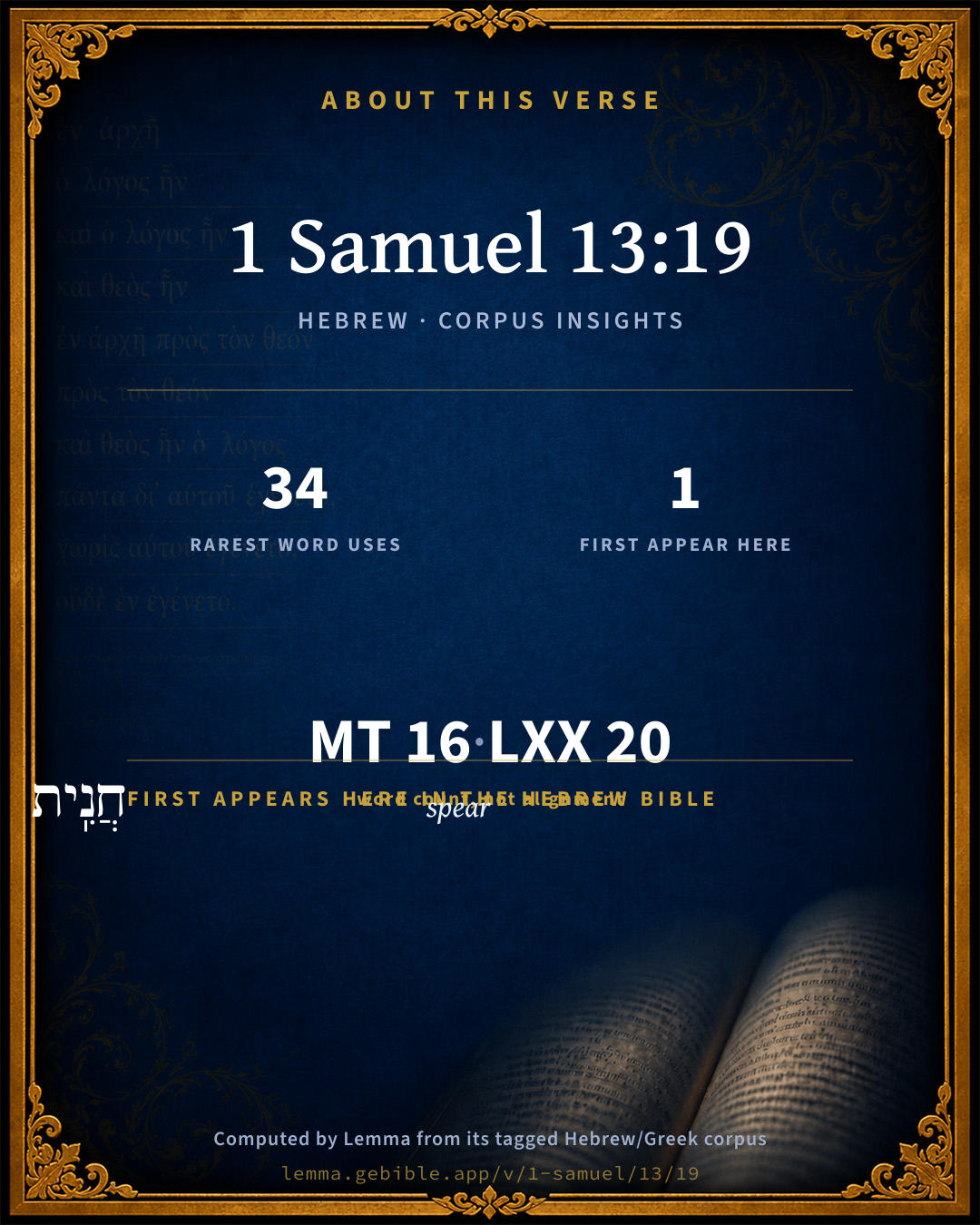
  • 1 first appearance in the Hebrew Bible
Full analysis ↓
Download a study sheet

One document with this verse’s original text, its word-by-word gloss line, the meaning frame, cross-references with their text, attributed commentary, and full source and license credits — printable, and it pastes into notes with its structure intact.

This verse Autodidact and up

Study sheet (.html) Plain text (.txt)

A passage Seminary Student

Up to 50 verses in one chapter. A passage sheet keeps up to 6 commentary sources and 12 cross-references per verse, in the order this page ranks them, and says so on the sheet whenever that leaves anything out. Ask for a single verse and you get the Autodidact verse sheet above.

Everything on this page stays free to read, with no account — the sheet is a download of what is already on screen, not access to it.

Want to remove ads? Support Godless Engineer
Compare translations 3

The same verse in 3 English versions, stacked beneath the original-language interlinear above. Click any original word for its lexicon entry.

Each is an independent rendering of the whole verse — the interlinear is not word-aligned to these translations.

Highlighted words mark where these versions differ — a whole-verse word diff, not a word-by-word alignment.

  • World English Bible Public Domain
    Now there was no smith found throughout all the land of Israel; for the Philistines said, Lest the Hebrews make them swords or spears:
  • King James Version Public Domain
    Now there was no smith found throughout all the land of Israel: for the Philistines said, Lest the Hebrews make them swords or spears:
  • unfoldingWord Literal Text CC BY-SA 4.0
    Now a blacksmith was not found in all of the land of Israel. For the Philistines had said, “Lest the Hebrews make a sword or a spear.”

unfoldingWord Literal Text — © unfoldingWord, licensed CC BY-SA 4.0. Word-aligned USFM3 via Door43 (git.door43.org/unfoldingWord/en_ult).

Versions to compare (up to 4)

3 of 4 selected

Show all 18 translations

Every available English version of this verse, each an independent rendering of the whole verse.

  • World English Bible Public Domain
    Now there was no smith found throughout all the land of Israel; for the Philistines said, Lest the Hebrews make them swords or spears:
  • Berean Standard Bible Public Domain
    And no blacksmith could be found in all the land of Israel, because the Philistines had said, “The Hebrews must not be allowed to make swords or spears.”
  • Majority Standard Bible Public Domain
    And no blacksmith could be found in all the land of Israel, because the Philistines had said, “The Hebrews must not be allowed to make swords or spears.”
  • King James Version Public Domain
    Now there was no smith found throughout all the land of Israel: for the Philistines said, Lest the Hebrews make them swords or spears:
  • American Standard Version (1901) Public Domain
    Now there was no smith found throughout all the land of Israel; for the Philistines said, Lest the Hebrews make them swords or spears:
  • Revised Version (1885) Public Domain
    Now there was no smith found throughout all the land of Israel: for the Philistines said, Lest the Hebrews make them swords or spears:
  • Geneva Bible (1599) Public Domain
    Then there was no smith founde throughout all the land of Israel: for the Philistims sayde, Lest the Ebrewes make them swordes or speares.
  • Douay-Rheims (1899) Public Domain
    Now there was no smith to be found in all the land of Israel, for the Philistines had taken this precaution, lest the Hebrews should make them swords or spears.
  • Young's Literal Translation Public Domain
    And an artificer is not found in all the land of Israel, for the Philistines said, `Lest the Hebrews make sword or spear;'
  • Literal Standard Version CC BY-SA 4.0
    And a craftsman is not found in all the land of Israel, for the Philistines said, “Lest the Hebrews make sword or spear”;
  • Unlocked Literal Bible CC BY-SA 4.0
    No blacksmith could be found throughout all of Israel, because the Philistines said, “Otherwise the Hebrews would make swords or spears for themselves.”
  • unfoldingWord Literal Text CC BY-SA 4.0
    Now a blacksmith was not found in all of the land of Israel. For the Philistines had said, “Lest the Hebrews make a sword or a spear.”
  • Darby Bible Public Domain
    Now there was no smith found throughout the land of Israel; for the Philistines said, Lest the Hebrews make them swords or spears.
  • World Messianic Bible Public Domain
    Now there was no blacksmith found throughout all Eretz-Israel, for the Philistines said, “Lest the Hebrews make themselves swords or spears”;
  • Webster's Bible Public Domain
    Now there was no smith found throughout all the land of Israel: (for the Philistines said, Lest the Hebrews make them swords or spears:)
  • Free Bible Version CC BY-SA 4.0
    There wasn't a blacksmith to be found anywhere in Israel, because the Philistines had said, “So that the Hebrews don't make swords and spears.”
  • Bible in Basic English Public Domain
    Now there was no iron-worker in all the land of Israel: for the Philistines said, For fear the Hebrews make themselves swords or spears:
  • JPS Tanakh (1917) Public Domain
    Now there was no smith found throughout all the land of Israel; for the Philistines said: 'Lest the Hebrews make them swords or spears';

Literal Standard Version (2020), Covenant Press — licensed CC BY-SA 4.0. Text via the HelloAO Bible API (eBible.org). Unlocked Literal Bible (unfoldingWord) — licensed CC BY-SA 4.0. Text via the HelloAO Bible API (eBible.org). unfoldingWord Literal Text — © unfoldingWord, licensed CC BY-SA 4.0. Word-aligned USFM3 via Door43 (git.door43.org/unfoldingWord/en_ult). Free Bible Version, Dr. Jonathan Gallagher — licensed CC BY-SA 4.0. Text via the HelloAO Bible API (eBible.org).

Word by word

More ways to search: Search by grammar → Find every occurrence → Compare this word →

Practice this passage: Drill this verse → Learn its vocabulary →

הָעִבְרִ֔ים
ʻIbrîy
H5680
“the · Hebrews”
Particle, Definite Article + Noun, Gentilic, Masculine, Plural, Absolute
Part of Speech
Particle + Noun
Type
Gentilic
Gender
Masculine
Number
Plural
State
Absolute
Full BDB Definition

Origin: patronymic from H5677

TWOT: None

Hebrew = "one from beyond" - a designation of the patriarchs and the Israelites (noun proper) - a designation of the patriarchs and the Israelites (adjective)
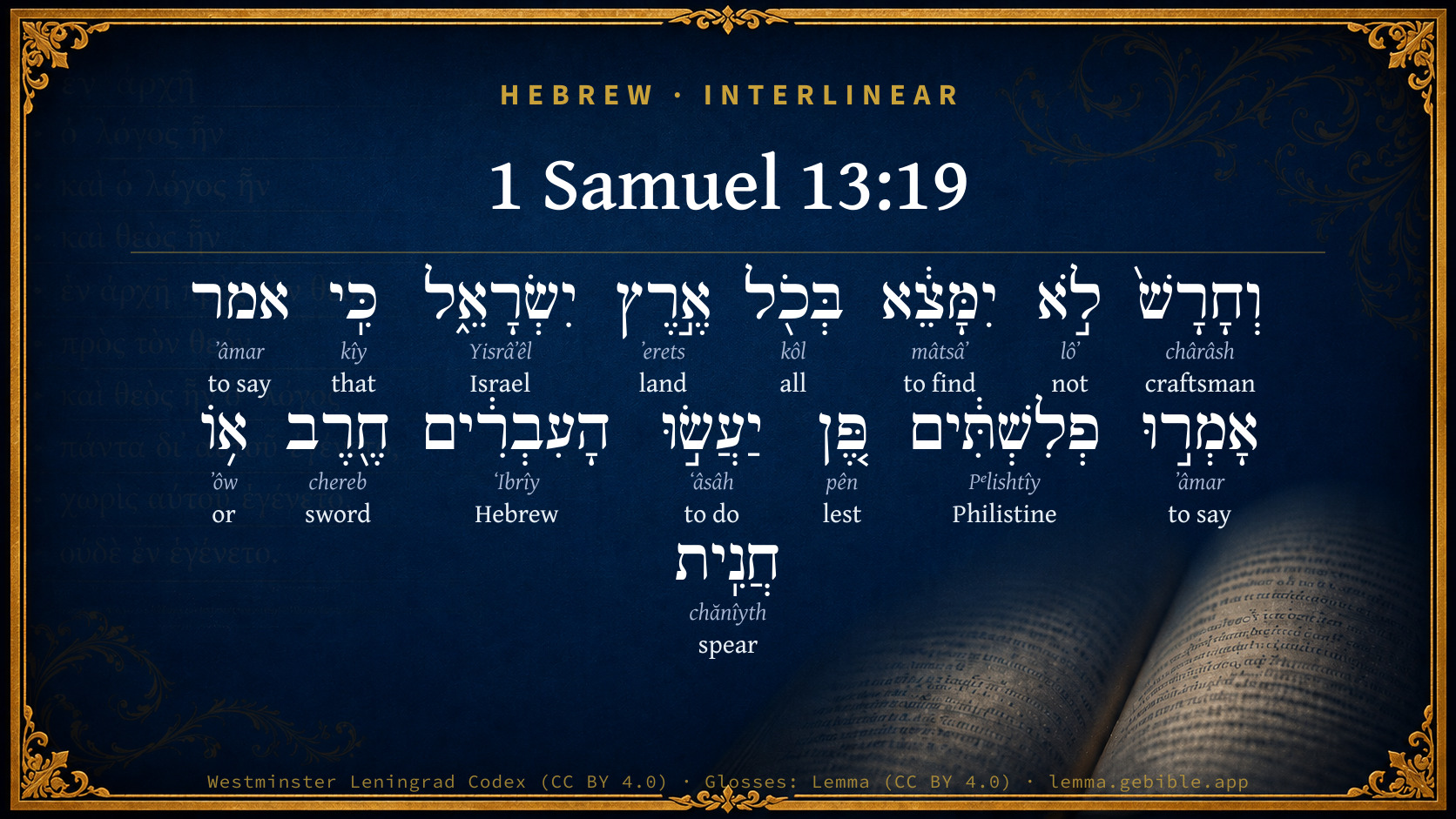
  1. וְחָרָשׁ֙ chârâsh H2796 “and · craftsman” Conjunction + Noun, Common, Masculine, Singular, Absolute
  2. לֹ֣א lôʼ H3808 “not” Particle, Negative
  3. יִמָּצֵ֔א mâtsâʼ H4672 “to find” Verb, Niphal, Imperfect, 3rd Person, Masculine, Singular
  4. בְּכֹ֖ל kôl H3605 “in/at · all of” Preposition + Noun, Common, Masculine, Singular, Construct
  5. אֶ֣רֶץ ʼerets H776 “land of” Noun, Common, Both, Singular, Construct
  6. יִשְׂרָאֵ֑ל Yisrâʼêl H3478 “Israel” Noun, Proper
  7. כִּֽי kîy H3588 “that” Conjunction
  8. אמר ʼâmar H559 “to say” Verb, Qal, Perfect, 3rd Person, Masculine, Singular
  9. אָמְר֣וּ ʼâmar H559 “to say” Verb, Qal, Perfect, 3rd Person, Common, Plural
  10. פְלִשְׁתִּ֔ים Pᵉlishtîy H6430 “Philistines” Noun, Gentilic, Masculine, Plural, Absolute
  11. פֶּ֚ן pên H6435 “lest” Conjunction
  12. יַעֲשׂ֣וּ ʻâsâh H6213 “to do” Verb, Qal, Imperfect, 3rd Person, Masculine, Plural
  13. חֶ֖רֶב chereb H2719 “sword” Noun, Common, Feminine, Singular, Absolute
  14. א֥וֹ ʼôw H176 “or” Conjunction
  15. חֲנִֽית chănîyth H2595 “spear” Noun, Common, Feminine, Singular, Absolute

About this verse

These counts appear in no published source. They are computed here, from the morphology-tagged text and Lemma’s own curated glosses. What Lemma adds →

16
words
15
distinct lemmas
Historical
section

First appearance in Scripture

This word makes its first canonical appearance in the Hebrew Bible here:

  • חֲנִֽית spear H2595

Shared distinctive vocabulary

הָעִבְרִ֔ים Hebrew H5680 occurs in 32 verses of the Hebrew Bible. Also found in:

Grammatical profile

  • 4 verbs
  • 8 nouns
  • 3 conjunctions
  • 1 particle

Verb forms

  • יִמָּצֵ֔א Niphal · Imperfect
  • אמר Qal · Perfect
  • אָמְר֣וּ Qal · Perfect
  • יַעֲשׂ֣וּ Qal · Imperfect

Repetition

A word recurs within this verse — often emphatic in Hebrew:

  • אמר to say H559 ×2

Hebrew & Septuagint length

In English translation the verse runs 24 words from the Hebrew and 25 from the Septuagint (LXX English) — closely comparable.

A rough comparison of the two English renderings, which tokenize alike — not a word-level alignment.

Word counts can differ between the Hebrew and the Greek without any difference in meaning — e.g. the Hebrew direct-object marker אֵת has no separate Greek word, and Greek often adds the article ὁ.

In the original languages it is 16 Hebrew tokens and 20 Greek tokens — but the two are counted differently (Hebrew bundles its prefixes and suffixes into one token; the Greek is in lemma form), so that isn’t a like-for-like length.

Cross-references

4

Topical passages linked to 1 Samuel 13:19 in the Treasury of Scripture Knowledge — connected by theme and wording, ordered by reader-vote popularity; previews shown in the World English Bible.

  • 2 Kings 24:14 He carried away all Jerusalem, and all the princes, and all the mighty men of valor, even ten thousand captives, and all the craftsmen and the smiths; none remained, save the poorest sort of the people of the land.
  • Judges 5:8 They chose new gods; Then was war in the gates: Was there a shield or spear seen Among forty thousand in Israel?
  • Jeremiah 24:1 Yahweh shown me, and, behold, two baskets of figs set before the temple of Yahweh, after that Nebuchadrezzar king of Babylon had carried away captive Jeconiah the son of Jehoiakim, king of Judah, and the princes of Judah, with the craftsmen and smiths, from Jerusalem, and had brought them to Babylon.
  • Isaiah 54:16 Behold, I have created the smith who blows the fire of coals, and brings forth a weapon for his work; and I have created the waster to destroy.

Cross-references courtesy of OpenBible.info (CC BY 4.0).

Hebrew and Greek witnesses Masoretic Hebrew ↔ Greek Septuagint

The same verse in the two great witnesses to the Old Testament, shown verse-for-verse.

These are two independent witnesses, not word-aligned to each other, and the Septuagint is shown in lemma (dictionary) form.

Hebrew 1 Samuel 13:19 Masoretic · Westminster Leningrad Codex

וְחָרָשׁ֙ לֹ֣א יִמָּצֵ֔א בְּכֹ֖ל אֶ֣רֶץ יִשְׂרָאֵ֑ל כִּֽי אמר אָמְר֣וּ פְלִשְׁתִּ֔ים פֶּ֚ן יַעֲשׂ֣וּ הָעִבְרִ֔ים חֶ֖רֶב א֥וֹ חֲנִֽית

Now there was no smith found throughout all the land of Israel; for the Philistines said, Lest the Hebrews make them swords or spears:

World English Bible · Public Domain

Greek LXX 1 Samuel 13:19 Septuagint · lemma form

καί τέκτων σίδηρος οὐ εὑρίσκω ἐν πᾶς γῆ ἰσραήλ ὅτι εἶπον ὁ ἀλλόφυλος μή ποιέω ὁ εβραῖος ῥομφαία καί δόρυ

And there was not found a smith in all the land of Israel, for the Philistines said, Lest the Hebrews make themselves sword or spear.

LXX2012 (modern English Septuagint) · Public Domain

Hebrew: Westminster Leningrad Codex (CC BY 4.0). Greek: Septuagint (public domain); English from LXX2012 (modern English Septuagint) (Public Domain). How the Septuagint differs from the Hebrew →

Targum (Aramaic paraphrase)

1

The Targum is the ancient Jewish Aramaic paraphrase of the Hebrew Scriptures — an interpretive translation, not the Hebrew text itself. Onkelos (literal) and Pseudo-Jonathan (expansive) render the Torah, and Jonathan the Prophets. Coverage is partial: where no permissively-licensed English translation exists for a verse, only the Aramaic is shown. This is verse-level text, not a word-by-word alignment to the Hebrew.

  1. Targum Jonathan Prophets (Joshua–Malachi)
    וְאוּמַן עֲבֵיד זְיַן לָא מִשְׁתְּכַח בְּכָל תְּחוּם אַרְעָא דְיִשְׂרָאֵל אֲרֵי אֲמָרוּ פְלִשְׁתָּאֵי דִלְמָא יַעְבְּדוּן יְהוּדָאִין סַיְפִין אוֹ רוֹמְחִין:

    (no public-domain English translation for this verse)

    Targum Jonathan — Aramaic: “Mikraot Gedolot” (public domain). English: “Sefaria Community Translation” (CC0 1.0 (public-domain dedication)); “London "Chaldee Paraphrase," 1871” (public domain). Text via Sefaria.

Commentary

Notes on 1 Samuel 13:19 from classic Christian and Jewish commentators (each source and its license shown beneath its notes). The classic Christian expositions comment on the surrounding passage and are grouped to its opening verse, so a note may address several verses; the Jewish commentaries on the Tanakh (Rashi and others) are per-verse, so they appear only where the commentator wrote on this verse.

Lemma curates 59 commentaries, every one of them public domain or Creative Commons licensed, each selected and text-cleaned for this edition rather than reprinted as found. About our sources →

Trapp's Complete Commentary

John Trapp

1Sa 13:19 Now there was no smith found throughout all the land of Israel: for the Philistines said, Lest the Hebrews make [them] swords or spears:

Ver. 19. Now there was no smith found.] For the Philistines had either slain them, or carried them away, By a like wicked policy, Julian the Apostate forbade Christians the use of the liberal arts: and Antichrist, the Word of God.

Lest the Hebrews make them swords or spears.] See the like care of disarming, and disabling an enemy to rebel, in Jdg 5:8. So Cyrus disarmed the Lydians, after that he had subdued them: {a} and William the Conqueror the commons of England; he prevented also their night meetings with a heavy penalty, that every man at the day closing should cover his fire, and depart to his rest, &c. {b}

{a} Justin., lib. i.

{b} Daniel’s Hist., p. 46.

John Trapp, A Commentary or Exposition upon All the Books of the Old and New Testament (1647–1656) — public domain. Text from a community e-Sword module.

The Biblical Illustrator

Joseph S. Exell

1Sa_13:19-21

Now there was no smith found throughout all the land of Israel.

The blacksmiths captivity

What a scalding subjugation for the Israelites! The Philistines had carried off all the blacksmiths, and torn down all the blacksmiths shops, and abolished the blacksmiths trade in the land of Israel. The farmers and the mechanics having nothing to whet up the coulter, and the goad, and the pick-axe, save a simple file, industry was hindered, and work practically disgraced. The great idea of these Philistines was to keep the Israelites disarmed.

I. I learn first from this subject, how dangerous it is for the church of God to allow its weapons to stay in the hands of its enemies. We are too willing to give up our weapons to the enemy. The world boasts that it has gobbled up the schools, and the colleges, and the arts, and the sciences, and the literature, and the printing press. Infidelity is making a mighty attempt to get all our weapons in its hand, and then to keep them. You know it is making this boast all the time; and after a while, when the great battle between sin and righteousness has opened, if we do not look out we will be as badly off as these Israelites, without any swords to fight with, and without any sharpening instruments. I call upon the superintendents of literary institutions to see to it that the men who go into the class rooms to stand beside the Leyden jars and the electric batteries, and the microscopes and telescopes, be children of God not Philistines. We want to capture all the philosophical apparatus, and swing around the telescopes on the swivel, until through them we can see the morning star of the Redeemer, and with mineralogical hammer discover the Rock of Ages, and amid the flora of all realms find the Rose of Sharon and the lily of the valley. Recapture these weapons. Let men of God go out and take possession of the platform. Let the debauched printing press of this country he recaptured for Christ, and the reporters, and the type setters, and the editors, and publishers be made to swear allegiance to the Lord God of Truth.

II. Again, I learn from this subject what a large amount of the Churchs resources is actually hidden, and buried, and undeveloped. The Bible intimates that that was a very rich land--this land of Israel. It says: The stones are iron, and out of the bills thou shalt dig brass, and yet hundreds of thousands of dollars worth of this metal was kept, under the hills. Well, that is the difficulty with the Church of God at this day. Its talent is not developed. The vast majority of Christians in this day are useless. The most of the Lords battalion belong to the reserve corps. The most of the crew are asleep in the hammocks. The most of the metal is under the hills. O, is it not time for the Church of God to rouse up and understand that we want all the energies, all the talent, and all the wealth enlisted for Christs sake? I like the nickname that the English soldiers gave to Blucher, the Commander. They called him Old Forwards. We have had enough retreats in the Church of Christ; let us have a glorious advance. And I say to you tonight, as the General said when his troops were affrighted. Rising up in his stirrups, his hair flying in the wind, he lifted up his voice until 20,000 troops heard him, crying out: Forward, the whole line!

III. Again: I learn from this subject, that we sometimes do well to take advantage of the worlds sharpening instruments. Let us go over among sharp business men, and among sharp literary men, and find out what their tact is, and then transfer it to the cause of Christ. If they have science and art it will do us good to rub against it. In other words, let us employ the worlds grindstones. We will listen to their music, and we will watch their acumen, and we will use their grindstones; and we will borrow their philosophical apparatus to make our experiments, and we will borrow their printing presses to publish our Bibles, and we will borrow their rail trains to carry our Christian literature, and we will borrow their ships to transport our missionaries. That was what made Paul such a master in his day. He not only got all the learning he could get of Doctor Gamaliel, but afterward, standing on Mars Hill, and in crowded thoroughfare, quoted their poetry, and grasped their logic, and wielded their eloquence, and employed their mythology, until Dionysius the Areopagite, learned in the schools of Athens and Heliopolis, went down under his tremendous powers. That was what gave Thomas Chalmers his power in his day. He conquered the worlds astronomy and compelled it to ring out the wisdom and greatness of the Lord, until for the second time, the morning stars sang together and all the sons of God shouted for joy.

IV. Again, my subject teaches us on what a small allowance Philistine iniquity puts a man. Yes; these Philistines shut up the mines, and then they took the spears and the swords, then they took the blacksmiths, then they took the grindstones, and they took everything but a file. O, that is the way sin works; it grabs everything. It begins with robbery, and it ends with robbery. It despoils this faculty and that faculty, and keeps on until the whole nature is gone. Was the man eloquent before, it generally thickens his tongue. Was he fine in personal appearance, it mars his visage. Was he affluent, it sends the sheriff to sell him out. Was be influential, it destroys his popularity. Was be placid, and genial, and loving, it makes him splenetic and cross; and so utterly is he changed that you can see he is sarcastic and rasping, and that the Philistines have left him nothing but a file. So it was with Voltaire, the most applauded man of his day. Seized with hemorrhage of the lungs in Paris, where be had gone to be crowned in the theatre as the idol of all France, he sends a messenger to get a priest, that he may be reconciled to the Church before he dies A great terror falls upon him. He makes the place all round about him so dismal that the nurse declares that she would not for all the wealth of Europe see another infidel die. Philistine iniquity had promised him all the worlds garlands, but in the last hour of his life, when he needed solacing, sent tearing across his conscience and his nerves a file, a file. So it was with Lord Byron. Is it not so, Herod? Is it not so, Hildebrand? Is it not so, Robespierre? Aye! aye! it is so; it is so. The way of the wicked He turneth upside down. History tells us that when Rome was founded, on that day there were twelve vultures flying through the air; but when a transgressor dies, the sky is black with whole flocks of them. When I see sin robbing so many of my hearers, and I see them going down day by day, and week by week, I must give a plain warning.

V. I learn from this subject what a sad thing it is when the Church of God loses its metal. These Philistines saw that if they could only get all the metallic weapons out of the hands of the Israelites all would be well, and, therefore, they took the swords and the spears. They did not want them to have a single metallic weapon. When the metal of the Israelites was gone their strength was gone. This is the trouble with the Church of God today. It is surrendering its courage It has not got enough metal (T. De Witt Talmage.)

Philistinian policy

The care here taken by the Philistines to leave no smith in Israel, who should make any arms for their defence, is an usual policy with conquerors, in order to disarm and keep in subjection those whom they have subdued. Our spiritual enemy, represented by these Philistines, never failed to use the like stratagem. The souls which they hold in captivity they first deprive of their arms, and prevent, as much as possible, the use of any weapons which may rescue them from their tyranny and regain their liberty. These arms are principally the word of God, and the use of the Holy Scriptures, which are not only a light and lantern to our path, but a buckler of defence, and a sword to smite and subdue our enemies. Thus the spirits of error and lies employ their utmost efforts and craft to take away both the knowledge and means of truth.

The Biblical Illustrator, edited by Joseph S. Exell (c. 1880s–1900s) — public domain. Text from a community e-Sword module.

Joseph Benson's Commentary

1Sa 13:19. There was no smith found throughout all the land of Israel — To this miserable condition the Philistines had reduced them during the forty years’ tyranny which they exercised over them, as we read Jdg 13:1. But after Samuel had put an end to that tyranny, by the great overthrow which he gave the Philistines at Eben-ezer, it seems something strange they had not restored their artificers. But the sloth of the Israelites appears in their whole story: and it was not easy, in so short a time, for men to learn this trade, which the Philistines wisely destroyed, as the Chaldeans, when they took Jerusalem, carried away all the smiths to Babylon, that they who remained in the land might not arm themselves again, 2Ki 24:14.

Joseph Benson's Commentary on the Old and New Testaments (1811–1818) — public domain. Text from a community e-Sword module.

Whedon's Commentary on the Bible

Daniel D. Whedon

19. No smith — חרשׁ, a graver, a workman: whether in wood, stone, or metals, is usually determined by the context. The Philistines, like other conquerors, had, during the long period of their dominion over Israel, removed all the artificers. After their deliverance by the hand of Samuel, (1Sa_7:13,) the Israelites seem to have taken no measures to supply themselves with workmen and arms, such as they had formerly possessed. For the purpose of sharpening their agricultural implements they were obliged to resort to their enemies; and yet so loth were they to do this that their instruments often became very dull. See on 1Sa_13:21. In the war with the Ammonites the Israelites probably found the sling and the bow (see note on 1Sa_11:9) so serviceable that they saw no particular necessity for swords and spears, and took no pains to collect them. Still, we are not to suppose that Saul and his son were the only ones in all Israel that had weapons of this kind. 1Sa_13:22 expressly tells us that it was with the people who were with Saul and Jonathan, that is, the six hundred with Saul, (1Sa_13:15 and 1Sa_14:2,) and perhaps a still smaller number with Jonathan, that neither sword nor spear was found. The writer’s object in introducing the statements of 1Sa_13:19-22 seems to have been to show how illy prepared, according to all human appearance, the Israelitish army under Saul and Jonathan was to cope with its thoroughly equipped antagonist.

Daniel D. Whedon (gen. ed.), Commentary on the Old and New Testaments (1874–1909) — public domain. Text from a community e-Sword module.

Tyndale Open Study Notes

Tyndale Open Resources

13:19-22 no blacksmiths: The Philistines kept the Israelites unarmed by gaining a monopoly on the iron necessary to make weapons. Iron technology had not existed long in Canaan; it might have developed in the Aegean area, and metalworking skills were possibly introduced into Canaan through seafaring peoples, including the Philistines.

Tyndale Open Study Notes — © Tyndale Open Resources, licensed CC BY-SA 4.0. Text via the HelloAO Bible API.

Jamieson, Fausset & Brown

Robert Jamieson, A. R. Fausset & David Brown

Now there was no smith found throughout . . . Israel--The country was in the lowest state of depression and degradation. The Philistines, after the great victory over the sons of Eli, had become the virtual masters of the land. Their policy in disarming the natives has been often followed in the East. For repairing any serious damage to their agricultural implements, they had to apply to the neighboring forts.

Jamieson, Fausset & Brown — Commentary Critical and Explanatory on the Whole Bible (1871) — public domain (CC PDM 1.0). Text via the HelloAO Bible API.

Adam Clarke's Commentary

Verse 19. Now there was no smith found] It is very likely that in the former wars the Philistines carried away all the smiths from Israel, as Porsenna did in the peace which he granted to the Romans, not permitting any iron to be forged except for the purposes of agriculture: "Ne ferro, nisi in agricultura, uterentur." The Chaldeans did the same to the Jews in the time of Nebuchadnezzar; they carried away all the artificers, 2Kg 24:14; Jer 24:1; Jer 29:2. And in the same manner did Cyrus treat the Lydians, Herod. lib. i., c. 145. See several examples in Calmet.

Adam Clarke's Commentary on the Bible (1810–1826) — public domain. Text from a community e-Sword/MySword module.

Ellicott's Commentary for English Readers

(19) Now there was no smith found.—We must allow a year, perhaps two or three, to have elapsed while “Saul and Jonathan . . . abode in Gibeah,” during which period the Philistine raids went on unchecked, the Israelitish forces being too weak to venture with any hope of success into the open country. The statement respecting the destruction of the smithies probably only specially refers to the southern districts of Canaan—especially the territory of Benjamin, whence Saul and Jonathan, in the earlier years of the former’s reign, drew, no doubt, the majority of their men of war. These devastating forays are alluded to in 1Sa_13:17-18.

A Bible Commentary for English Readers, edited by Charles John Ellicott (1878–1897) — public domain. Text from a community e-Sword module.

The Cambridge Bible for Schools and Colleges

gen. ed. J. J. S. Perowne

19–23. The disarmament of the Israelites

19. Now there was no smith found, &c.] A signal proof of the severity of the Philistine oppression, and the difficulties against which Saul had to contend. This general disarmament clearly points to the lasting subjugation of a large district in the later years of Samuel’s judgeship and the beginning of Saul’s reign, and was not merely the temporary result of the present invasion. A similar tyranny was practised by the Canaanites before Deborah’s victory (Jdg_5:8, cp. Jdg_3:31); and Porsena is reported by Pliny to have prohibited the Romans from using iron except for agricultural purposes (Hist. Nat. XXXIV. 14).

The Cambridge Bible for Schools and Colleges (gen. ed. J. J. S. Perowne; Cambridge University Press, 1878–1918) — public domain. Text from a community e-Sword module.

John Gill's Exposition

Now there was no smith found throughout all the land of Israel,.... The Philistines, when they ruled over them, having removed them into their own country, and forbid any to learn or exercise that trade in Israel:

for the Philistines said, lest the Hebrews make swords or spears: this they did to prevent their having arms, and the use of them, that they might not rebel against them, and fight with them, and overcome them; it was a piece of policy to keep them subject to them; so Nebuchadnezzar, when he conquered the Jews and carried them captive, took care particularly to carry away their smiths, and left none but the poorest sort of people in the land, Kg2 24:14 and Porsena, king of the Etrusci, when he made a covenant with the Romans, upon the expulsion of their kings, made this a condition of peace with them, that they should use no iron but in husbandry (h). When this course was taken by the Philistines with the Israelites, and how long it had continued is not certain; it is probable it might be in the space of forty years they ruled over Israel, in which Samson was born, for we never read of any sword or spear that he made use of; and though there were two battles in the times of Eli, in both which Israel were beaten, they might make use only of bows and arrows, slings, and stones, clubs, &c, as also in the battle of Saul with the Ammonites; and as for the defeat of the Philistines in the time of Samuel, it was by thunder; and though the Philistines were then subdued, yet, as Samuel grew old, they regained their power in a good measure, and the Israelites had not spirit enough to oppose them, nor diligence and industry to learn and revive the trade of smiths among them; not even for what was necessary to husbandry, as the following verse shows.

(h) Plin. Nat. Hist. l. 34. c. 14.

John Gill's Exposition of the Whole Bible (1746–1763) — public domain (CC PDM 1.0). Text via the HelloAO Bible API.

Albert Barnes' Notes on the Bible

There was no smith - This was the result of the fierce inroads described in the preceding verses, and the method adopted to make the Philistine conquests permanent.

Albert Barnes' Notes on the Bible (1834–1885) — public domain. Text from a community e-Sword/MySword module.

Haydock's Catholic Bible Commentary

Smith. The Philistines had taken these precautions before Samuel gained the victory over them, and he consented that the people should employ the Philistines as before, when he made peace with them; (Salien) or they had again begun to get the upper hand at the beginning of Saul’s reign, as the Israelites had been long in the enjoyment of peace, and negligent. (Tirinus) --- Josephus extends this species of servitude only to the neighbourhood of Gabaa, and says the major part of Saul’s 600 men "was destitute of arms, because that country had neither iron nor people to make arms." The immense army which had so lately discomfited the Ammonites, was surely not without weapons. But most of them had retired, (Haydock) and those who accompanied the king might rely chiefly on their expertness in using the sling, Judges xx. 16. (Menochius) --- The brave men who came to join David, are praised on this account, as well as for shooting with bow and arrow, 1 Paralipomenon xii. 2. Furious battles have been also fought with sharpened stakes, burnt at the end, (Virgil, Æneid vii.) and with various implements of husbandry, of which the Hebrews were not deprived. In the defeat of Sisara, they had not a buckler nor a lance among 40,000 (Judges v. 8.; Calmet) as the Philistines had already begun to deprive the Israelites of such weapons. (Haydock) -- Other nations have since imitated their policy, 4 Kings xxiv. 14. (Justin. i. 7.)

George Leo Haydock (1774–1849), Haydock's Catholic Family Bible and Commentary, 1859 edition — public domain. Excludes Psalms (Douay-Rheims chapter numbering differs from Protestant) and Deuterocanonical books (Catholic canon only).

Matthew Poole's English Annotations

This was a politic course of the Philistines, which also other nations have used. So the Chaldeans took away their smiths, 2Ki 24:14; Jer 24:1; 30:2; and Porsenna obliged the Romans by covenant, that they should use no iron but in the tillage of their lands.

Matthew Poole's English Annotations on the Holy Bible (1683–1685) — public domain. Text from a community e-Sword/MySword module.

The Pulpit Commentary

DESCRIPTION OF ISRAEL"S EXTREME STATE OF OPPRESSION (vers. 19-23).

There was no smith. This accounts for the contemptuous disregard of Saul by the Philistines. The people were disarmed, and resistance impossible. Apparently this policy had been long followed; but we need fuller information of what had happened between Samuel"s victory at Mizpah and Saul"s appointment as king, to enable us to understand the evident weakness of Israel at this time. But probably this description applies fully only to the districts of Benjamin, near the Philistines, The people further away had arms with which they defeated the Ammonites, and Saul and his men would have secured all the weapons which the enemy then threw away. But evidently no manufacture of weapons was allowed, and no one as far as possible permitted either to wear or possess arms.

The Pulpit Commentary (1880–1919), ed. H.D.M. Spence-Jones & Joseph S. Exell — public domain. Text from a community e-Sword module.

unfoldingWord translationNotes

Door43 World Missions Community

General Information:

The narrative shifts to background information regarding blacksmiths in Israel.

No blacksmith could be found

This can be stated in active form. AT: "No one could find a blacksmith" (See: Active or Passive)

blacksmith

Here "blacksmith" refers to someone who made or sharpened metal tools and weapons.

sharpen his plow points

The words "plow points" refer to the point of a metal tool used for digging up the ground for planting crops.

mattock ... ax ... sickle

These are common garden tools.

mattock

A "mattock" is a broad-bladed axe, with a horizontal blade that is used for breaking up hard soil.

sickle

a curved blade for cutting grasses and grain stalks

two-thirds of a shekel

The shekel is divided into 3 parts, 2 of 3 parts are given. "2/3 of a shekel" (See: Biblical Money)

straightening the goads

"taking out the bend and making the ox goad straight again so it could be used"

translationWords

Hebrew

sword

spear

ax

unfoldingWord translationNotes — © Distant Shores Media and the Door43 World Missions Community, licensed CC BY-SA 4.0. Source: git.door43.org/Door43/en_tn.

Rashi

Rabbi Shlomo Yitzchaki (Rashi)

A blacksmith was not to be found. I.e., was not available at the beginning of Shaul's reign, because the Philistines who ruled over Yisroel, eliminated all the iron smiths from Yisroel, lest they make weapons to wage war.

Rashi on the Tanakh — English translations: “The Judaica Press complete Tanach with Rashi, translated by A. J. Rosenberg” (CC BY 4.0); “Pentateuch with Rashi's commentary by M. Rosenbaum and A.M. Silbermann, 1929-1934” (public domain); “The Metsudah Tanach series, Lakewood, N.J” (CC BY 4.0); and “The Book of Joshua, Metsudah Publications, 1997” (CC BY 4.0). Text via Sefaria.

Lesson kit

Teaching starters — assembled from the data on this page, not authored interpretation. Every prompt links to the verse data it draws on. Edit before teaching.

1 Samuel, in the Historical, opens this verse with 16 words (15 distinct Hebrew lemmas). Its most distinctive word is ʻIbrîy (“Hebrew”). A historical commentator’s framing appears above. Read the whole chapter for the surrounding context.

Discussion questions

  1. How does “Hebrew” (ʻIbrîy) shape what this verse is saying?
  2. The word “spear” first appears here in Scripture. What is being introduced at this debut?
  3. Genesis 14:13 shares the word «Hebrew» with this verse. How do the two illuminate each other?
  4. “to say” occurs 2× in this one verse. What is the effect of the repetition?
  5. These translations render this verse differently; the difference is in the English rendering, not the original. What questions does that raise?
  6. The verb «יִמָּצֵ֔א» is Niphal Imperfect. How does its form color the action?
  7. Reading how Trapp's Complete Commentary and The Biblical Illustrator read this verse, where do the two commentators agree and where do they part?

Things to notice

Reading settings

Reading text

Shown beneath each verse's original-language words.

Old Testament
Old Testament edition

Read the OT as the Masoretic Hebrew (MT) or the Greek Septuagint (LXX).

English shown for the Greek Septuagint (in the Hebrew ↔ Greek comparison).

Comparing translations? Open the Compare panel on any verse page to stack up to four side by side.