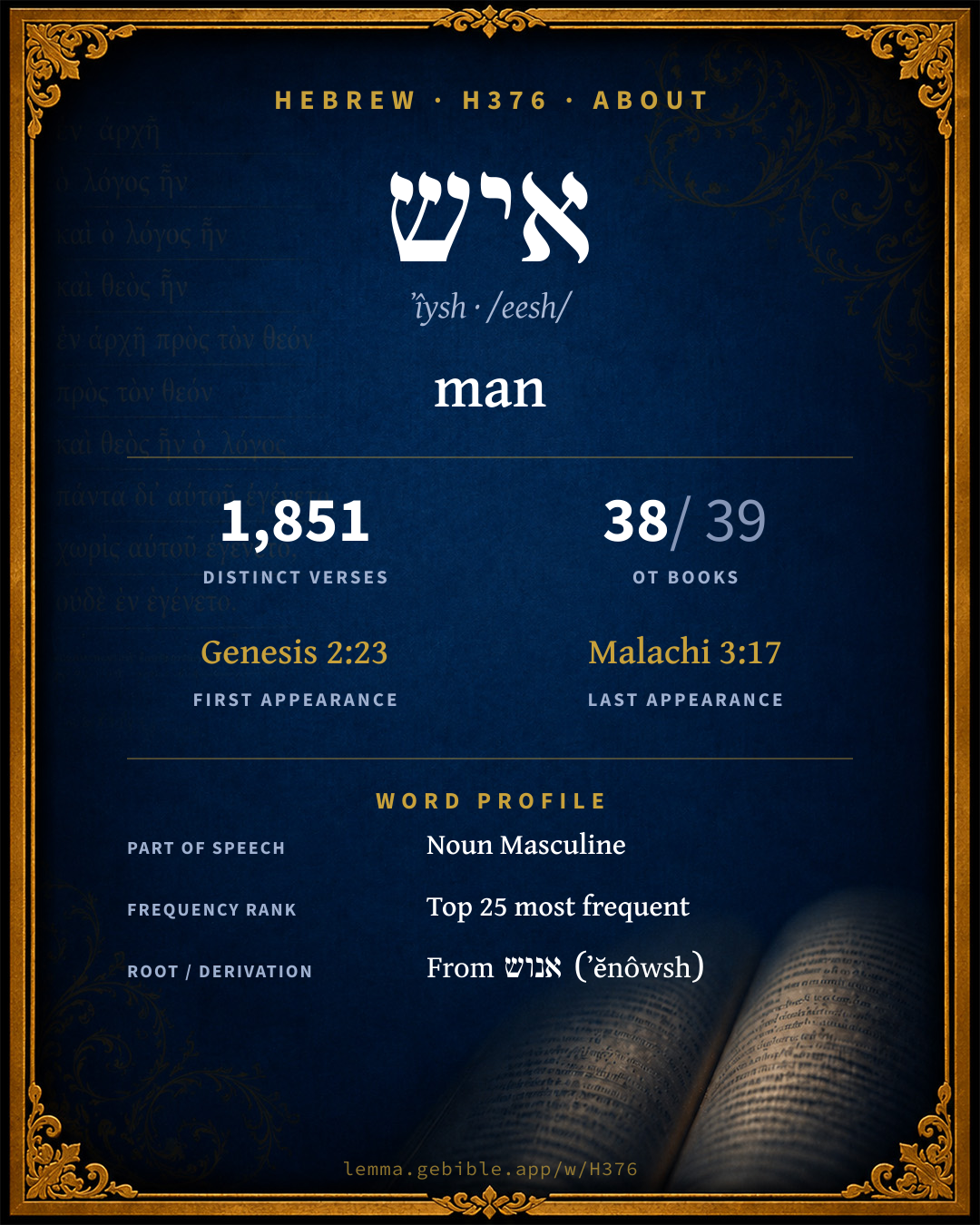
אִישׁ
man
‘man’ is one of 3 main senses fuller range ↓
Full lexicon entry — Brown-Driver-Briggs (BDB)
From Brown-Driver-Briggs (BDB)
Where this word appears
See every Absolute-state word in the Hebrew Bible →
Grammar key — what these labels mean
Part of speech
- Noun
- A naming word — a person, place, thing, or idea.
Noun type
- Common
- A common noun — a general class of person, place, or thing (“king,” “city,” “water”), not a specific name.
State
- Absolute
- The independent form of a noun, not bound to a following word.
- Construct
- A noun bound to a following noun in a possessive / “of” relationship (the construct chain).
Gender
- Masculine
- Grammatically masculine.
Number
- Singular
- One.
- Plural
- More than one (in Hebrew, generally three or more).
Grammatical forms
- Noun, Common, Masculine, Singular, Absolute 1,328 times (61%)
- Noun, Common, Masculine, Singular, Construct 332 times (15%)
- Noun, Common, Masculine, Plural, Absolute 273 times (12%)
- Noun, Common, Masculine, Plural, Construct 254 times (12%)
Parsed forms decoded from the imported morphology (morphhb / Westminster Leningrad Codex — WLC text public domain, morphhb tagging CC BY 4.0), counted across 2,187 parsed occurrences — not distinct verses.
Page 1 of 10 — showing verses 1–200 of 1,851 distinct verses where H376 appears, across 38 books. Click any verse to open its interlinear word-by-word view. Verse text shown in the World English Bible for context — . Each verse’s Hebrew form is shown with its reference; the English is not keyword-highlighted, since the data carries no word-level English alignment. Use “Compare translations” on any verse to read it across multiple English versions. This concordance covers the Hebrew Bible; Septuagint (Greek Old Testament) occurrences are not indexed here.
Genesis 137 verses
- Genesis 2:23 מֵ/אִ֖ישׁ prep + n c ms The man said, "This is now bone of my bones, and flesh of my flesh. She will be called Woman, because she was taken out of Man."
- Genesis 2:24 אִ֔ישׁ n c ms Therefore a man will leave his father and his mother, and will join with his wife, and they will be one flesh.
- Genesis 3:6 לְ/אִישָׁ֛/הּ prep + n c ms cs + sfx pers 3fs When the woman saw that the tree was good for food, and that it was a delight to the eyes, and that the tree was to be desired to make one wise, she took of the fruit of it, and ate; and she gave some to her husband with her, and he ate.
- Genesis 3:16 אִישֵׁ/ךְ֙ n c ms cs + sfx pers 2fs To the woman he said, "I will greatly multiply your pain in childbirth. In pain you will bring forth children. Your desire will be for your husband, and he will rule over you."
- Genesis 4:1 אִ֖ישׁ n c ms The man knew Eve his wife. She conceived, and gave birth to Cain, and said, "I have gotten a man with Yahweh's help."
- Genesis 4:23 אִ֤ישׁ n c ms Lamech said to his wives, "Adah and Zillah, Hear my voice, You wives of Lamech, listen to my speech, For I have slain a man for wounding me, A young man for bruising me.
- Genesis 6:4 אַנְשֵׁ֥י n c mp cs The Nephilim were in the earth in those days, and also after that, when God's sons came to men's daughters. They bore children to them: the same were the mighty men who were of old, men of renown.
- Genesis 6:9 אִ֥ישׁ n c ms This is the history of the generations of Noah. Noah was a righteous man, blameless among the people of his time. Noah walked with God.
- Genesis 7:2 אִ֣ישׁ אִ֥ישׁ n c ms n c ms You shall take seven pairs of every clean animal with you, the male and his female. Of the animals that are not clean, take two, the male and his female.
- Genesis 9:5 אִ֣ישׁ n c ms cs I will surely require your blood of your lives. At the hand of every animal I will require it. At the hand of man, even at the hand of every man's brother, I will require the life of man.
- Genesis 9:20 אִ֣ישׁ n c ms cs Noah began to be a farmer, and planted a vineyard.
- Genesis 10:5 אִ֖ישׁ n c ms Of these were the isles of the nations divided in their lands, everyone after his language, after their families, in their nations.
- Genesis 11:3 אִ֣ישׁ n c ms They said one to another, "Come, let's make brick, and burn them thoroughly." They had brick for stone, and they used tar for mortar.
- Genesis 11:7 אִ֖ישׁ n c ms Come, let's go down, and there confuse their language, that they may not understand one another's speech."
- Genesis 12:20 אֲנָשִׁ֑ים n c mp Pharaoh gave men charge concerning him: and they brought him on the way, and his wife, and all that he had.
- Genesis 13:8 אֲנָשִׁ֥ים n c mp Abram said to Lot, "Please, let there be no strife between me and you, and between my herdsmen and your herdsmen; for we are relatives.
- Genesis 13:11 אִ֖ישׁ n c ms So Lot chose the Plain of the Jordan for himself. Lot traveled east, and they separated themselves the one from the other.
- Genesis 13:13 וְ/אַנְשֵׁ֣י conj + n c mp cs Now the men of Sodom were exceedingly wicked and sinners against Yahweh.
- Genesis 13:16 אִ֗ישׁ n c ms I will make your offspring as the dust of the earth, so that if a man can number the dust of the earth, then your seed may also be numbered.
- Genesis 14:24 הָֽ/אֲנָשִׁ֔ים ptcl def.art + n c mp Except only that which the young men have eaten, and the portion of the men who went with me, Aner, Eshcol, and Mamre: let them take their portion."
- Genesis 15:10 אִישׁ n c ms He took him all these, and divided them in the middle, and laid each half opposite the other; but he didn't divide the birds.
- Genesis 16:3 אִישָׁ֖/הּ n c ms cs + sfx pers 3fs Sarai, Abram's wife, took Hagar the Egyptian, her handmaid, after Abram had lived ten years in the land of Canaan, and gave her to Abram her husband to be his wife.
- Genesis 17:23 בְּ/אַנְשֵׁ֖י prep + n c mp cs Abraham took Ishmael his son, all who were born in his house, and all who were bought with his money; every male among the men of Abraham's house, and circumcised the flesh of their foreskin in the same day, as God had said to him.
- Genesis 17:27 אַנְשֵׁ֤י n c mp cs All the men of his house, those born in the house, and those bought with money of a foreigner, were circumcised with him.
- Genesis 18:2 אֲנָשִׁ֔ים n c mp He lifted up his eyes and looked, and saw that three men stood opposite him. When he saw them, he ran to meet them from the tent door, and bowed himself to the earth,
- Genesis 18:16 הָֽ/אֲנָשִׁ֔ים ptcl def.art + n c mp The men rose up from there, and looked toward Sodom. Abraham went with them to see them on their way.
- Genesis 18:22 הָֽ/אֲנָשִׁ֔ים ptcl def.art + n c mp The men turned from there, and went toward Sodom, but Abraham stood yet before Yahweh.
- Genesis 19:4 וְ/אַנְשֵׁ֨י אַנְשֵׁ֤י conj + n c mp cs n c mp cs But before they lay down, the men of the city, the men of Sodom, surrounded the house, both young and old, all the people from every quarter.
- Genesis 19:5 הָ/אֲנָשִׁ֛ים ptcl def.art + n c mp They called to Lot, and said to him, "Where are the men who came in to you this night? Bring them out to us, that we may have sex with them."
- Genesis 19:8 אִ֔ישׁ לָֽ/אֲנָשִׁ֤ים n c ms prep det + n c mp See now, I have two virgin daughters. Please let me bring them out to you, and do you to them as is good in your eyes. Only don't do anything to these men, because they have come under the shadow of my roof."
- Genesis 19:9 בָ/אִ֤ישׁ prep det + n c ms They said, "Stand back!" They said, "This one fellow came in to live as a foreigner, and he appoints himself a judge. Now will we deal worse with you, than with them!" They pressed hard on the man, even Lot, and drew near to break the door.
- Genesis 19:10 הָֽ/אֲנָשִׁים֙ ptcl def.art + n c mp But the men put forth their hand, and brought Lot into the house to them, and shut the door.
- Genesis 19:11 הָ/אֲנָשִׁ֞ים ptcl def.art + n c mp They struck the men who were at the door of the house with blindness, both small and great, so that they wearied themselves to find the door.
- Genesis 19:12 הָ/אֲנָשִׁ֜ים ptcl def.art + n c mp The men said to Lot, "Do you have anybody else here? Sons-in-law, your sons, your daughters, and whoever you have in the city, bring them out of the place:
- Genesis 19:16 הָ/אֲנָשִׁ֜ים ptcl def.art + n c mp But he lingered; and the men laid hold on his hand, and on the hand of his wife, and on the hand of his two daughters, Yahweh being merciful to him; and they took him out, and set him outside of the city.
- Genesis 19:31 וְ/אִ֨ישׁ conj + n c ms The firstborn said to the younger, "Our father is old, and there is not a man in the earth to come in to us after the manner of all the earth.
- Genesis 20:7 הָ/אִישׁ֙ ptcl def.art + n c ms Now therefore, restore the man's wife. For he is a prophet, and he will pray for you, and you will live. If you don't restore her, know for sure that you will die, you, and all who are yours."
- Genesis 20:8 הָ/אֲנָשִׁ֖ים ptcl def.art + n c mp Abimelech rose early in the morning, and called all his servants, and told all these things in their ear. The men were very scared.
- Genesis 23:6 אִ֣ישׁ n c ms "Hear us, my lord. You are a prince of God among us. In the choice of our tombs bury your dead. None of us will withhold from you his tomb, but that you may bury your dead."
- Genesis 24:13 אַנְשֵׁ֣י n c mp cs Behold, I am standing by the spring of water. The daughters of the men of the city are coming out to draw water.
- Genesis 24:16 וְ/אִ֖ישׁ conj + n c ms The young lady was very beautiful to look at, a virgin, neither had any man known her. She went down to the spring, filled her pitcher, and came up.
- Genesis 24:21 וְ/הָ/אִ֥ישׁ conj + ptcl def.art + n c ms The man looked steadfastly at her, holding his peace, to know whether Yahweh had made his journey prosperous or not.
- Genesis 24:22 הָ/אִישׁ֙ ptcl def.art + n c ms It happened, as the camels had done drinking, that the man took a golden ring of half a shekel weight, and two bracelets for her hands of ten shekels weight of gold,
- Genesis 24:26 הָ/אִ֔ישׁ ptcl def.art + n c ms The man bowed his head, and worshiped Yahweh.
- Genesis 24:29 הָ/אִ֛ישׁ ptcl def.art + n c ms Rebekah had a brother, and his name was Laban. Laban ran out to the man, to the spring.
- Genesis 24:30 הָ/אִ֑ישׁ הָ/אִ֔ישׁ ptcl def.art + n c ms ptcl def.art + n c ms It happened, when he saw the ring, and the bracelets on his sister's hands, and when he heard the words of Rebekah his sister, saying, "This is what the man said to me," that he came to the man. Behold, he was standing by the camels at the spring.
- Genesis 24:32 הָ/אִישׁ֙ הָ/אֲנָשִׁ֖ים ptcl def.art + n c ms ptcl def.art + n c mp The man came into the house, and he unloaded the camels. He gave straw and provender for the camels, and water to wash his feet and the feet of the men who were with him.
- Genesis 24:54 וְ/הָ/אֲנָשִׁ֥ים conj + ptcl def.art + n c mp They ate and drank, he and the men who were with him, and stayed all night. They rose up in the morning, and he said, "Send me away to my master."
- Genesis 24:58 הָ/אִ֣ישׁ ptcl def.art + n c ms They called Rebekah, and said to her, "Will you go with this man?" She said, "I will go."
- Genesis 24:59 אֲנָשָֽׁי/ו n c mp cs + sfx pers 3ms They sent away Rebekah, their sister, with her nurse, Abraham's servant, and his men.
- Genesis 24:61 הָ/אִ֑ישׁ ptcl def.art + n c ms Rebekah arose with her ladies. They rode on the camels, and followed the man. The servant took Rebekah, and went his way.
- Genesis 24:65 הָ/אִ֤ישׁ ptcl def.art + n c ms She said to the servant, "Who is the man who is walking in the field to meet us?" The servant said, "It is my master." She took her veil, and covered herself.
- Genesis 25:27 אִ֛ישׁ אִ֣ישׁ אִ֣ישׁ n c ms n c ms cs n c ms The boys grew. Esau was a skillful hunter, a man of the field. Jacob was a quiet man, living in tents.
- Genesis 26:7 אַנְשֵׁ֤י אַנְשֵׁ֤י n c mp cs n c mp cs The men of the place asked him about his wife. He said, "She is my sister," for he was afraid to say, "My wife," lest, he thought, the men of the place might kill me for Rebekah, because she was beautiful to look on.
- Genesis 26:11 בָּ/אִ֥ישׁ prep det + n c ms Abimelech charged all the people, saying, "He who touches this man or his wife will surely be put to death."
- Genesis 26:13 הָ/אִ֑ישׁ ptcl def.art + n c ms The man grew great, and grew more and more until he became very great.
- Genesis 26:31 אִ֣ישׁ n c ms They rose up some time in the morning, and swore one to another. Isaac sent them away, and they departed from him in peace.
- Genesis 27:11 אִ֣ישׁ אִ֥ישׁ n c ms n c ms Jacob said to Rebekah his mother, "Behold, Esau my brother is a hairy man, and I am a smooth man.
- Genesis 29:19 לְ/אִ֣ישׁ prep + n c ms Laban said, "It is better that I give her to you, than that I should give her to another man. Stay with me."
- Genesis 29:22 אַנְשֵׁ֥י n c mp cs Laban gathered together all the men of the place, and made a feast.
- Genesis 29:32 אִישִֽׁ/י n c ms cs + sfx pers 1cs Leah conceived, and bore a son, and she named him Reuben. For she said, "Because Yahweh has looked at my affliction. For now my husband will love me."
- Genesis 29:34 אִישִׁ/י֙ n c ms cs + sfx pers 1cs She conceived again, and bare a son. Said, "Now this time will my husband be joined to me, because I have borne him three sons." Therefore was his name called Levi.
- Genesis 30:15 אִישִׁ֔/י n c ms cs + sfx pers 1cs She said to her, "Is it a small matter that you have taken away my husband? Would you take away my son's mandrakes, also?" Rachel said, "Therefore he will lie with you tonight for your son's mandrakes."
- Genesis 30:18 לְ/אִישִׁ֑/י prep + n c ms cs + sfx pers 1cs Leah said, "God has given me my hire, because I gave my handmaid to my husband." She named him Issachar.
- Genesis 30:20 אִישִׁ֔/י n c ms cs + sfx pers 1cs Leah said, "God has endowed me with a good dowry. Now my husband will live with me, because I have borne him six sons." She named him Zebulun.
- Genesis 30:43 הָ/אִ֖ישׁ ptcl def.art + n c ms The man increased exceedingly, and had large flocks, maid-servants and men-servants, and camels and donkeys.
- Genesis 31:49 אִ֥ישׁ n c ms and Mizpah, for he said, "Yahweh watch between me and you, when we are absent one from another.
- Genesis 31:50 אִ֖ישׁ n c ms If you will afflict my daughters, and if you will take wives besides my daughters, no man is with us; behold, God is witness between me and you."
- Genesis 32:6 אִ֖ישׁ n c ms The messengers returned to Jacob, saying, "We came to your brother Esau. Not only that, but he comes to meet you, and four hundred men with him."
- Genesis 32:24 אִישׁ֙ n c ms Jacob was left alone, and wrestled with a man there until the breaking of the day.
- Genesis 32:28 אֲנָשִׁ֖ים n c mp He said, "Your name will no longer be called 'Jacob,' but, 'Israel,' for you have fought with God and with men, and have prevailed."
- Genesis 33:1 אִ֑ישׁ n c ms Jacob lifted up his eyes, and looked, and, behold, Esau was coming, and with him four hundred men. He divided the children between Leah, Rachel, and to the two handmaids.
- Genesis 34:7 הָֽ/אֲנָשִׁ֔ים ptcl def.art + n c mp The sons of Jacob came in from the field when they heard it. The men were grieved, and they were very angry, because he had done folly in Israel in lying with Jacob's daughter; which thing ought not to be done.
- Genesis 34:14 לְ/אִ֖ישׁ prep + n c ms and said to them, "We can't do this thing, to give our sister to one who is uncircumcised; for that is a reproach to us.
- Genesis 34:20 אַנְשֵׁ֥י n c mp cs Hamor and Shechem, his son, came to the gate of their city, and talked with the men of their city, saying,
- Genesis 34:21 הָ/אֲנָשִׁ֨ים ptcl def.art + n c mp "These men are peaceful with us. Therefore let them live in the land and trade in it. For, behold, the land is large enough for them. Let us take their daughters to us for wives, and let us give them our daughters.
- Genesis 34:22 הָ/אֲנָשִׁים֙ ptcl def.art + n c mp Only on this condition will the men consent to us to dwell with us, to become one people, if every male among us be circumcised, as they are circumcised.
- Genesis 34:25 אִ֣ישׁ n c ms It happened on the third day, when they were sore, that two of Jacob's sons, Simeon and Levi, Dinah's brothers, each took his sword, came upon the unsuspecting city, and killed all the males.
- Genesis 37:15 אִ֔ישׁ הָ/אִ֛ישׁ n c ms ptcl def.art + n c ms A certain man found him, and behold, he was wandering in the field: and the man asked him, saying, "What are you looking for?"
- Genesis 37:17 הָ/אִישׁ֙ ptcl def.art + n c ms The man said, "They have left here, for I heard them say, 'Let us go to Dothan.'" Joseph went after his brothers, and found them in Dothan.
- Genesis 37:19 אִ֣ישׁ n c ms They said one to another, "Behold, this dreamer comes.
- Genesis 37:28 אֲנָשִׁ֨ים n c mp Midianites who were merchants passed by, and they drew and lifted up Joseph out of the pit, and sold Joseph to the Ishmaelites for twenty pieces of silver. They brought Joseph into Egypt.
- Genesis 38:1 אִ֥ישׁ n c ms It happened at that time, that Judah went down from his brothers, and visited a certain Adullamite, whose name was Hirah.
- Genesis 38:2 אִ֥ישׁ n c ms Judah saw there a daughter of a certain Canaanite whose name was Shua. He took her, and went in to her.
- Genesis 38:21 אַנְשֵׁ֤י n c mp cs Then he asked the men of her place, saying, "Where is the prostitute, that was at Enaim by the road?" They said, "There has been no prostitute here."
- Genesis 38:22 אַנְשֵׁ֤י n c mp cs He returned to Judah, and said, "I haven't found her; and also the men of the place said, 'There has been no prostitute here.'"
- Genesis 38:25 לְ/אִישׁ֙ prep + n c ms When she was brought forth, she sent to her father-in-law, saying, "By the man, whose these are, I am with child." She also said, "Please discern whose are these-- the signet, and the cords, and the staff."
- Genesis 39:1 אִ֣ישׁ n c ms Joseph was brought down to Egypt. Potiphar, an officer of Pharaoh's, the captain of the guard, an Egyptian, bought him from the hand of the Ishmaelites that had brought him down there.
- Genesis 39:2 אִ֣ישׁ n c ms cs Yahweh was with Joseph, and he was a prosperous man. He was in the house of his master the Egyptian.
- Genesis 39:11 אִ֜ישׁ מֵ/אַנְשֵׁ֥י n c ms prep + n c mp cs It happened about this time, that he went into the house to do his work, and there were none of the men of the house inside.
- Genesis 39:14 לְ/אַנְשֵׁ֣י אִ֥ישׁ prep + n c mp cs n c ms that she called to the men of her house, and spoke to them, saying, "Behold, he has brought in a Hebrew to us to mock us. He came in to me to lie with me, and I cried with a loud voice.
- Genesis 40:5 אִ֤ישׁ אִ֖ישׁ n c ms n c ms They both dreamed a dream, each man his dream, in one night, each man according to the interpretation of his dream, the cupbearer and the baker of the king of Egypt, who were bound in the prison.
- Genesis 41:11 אִ֛ישׁ n c ms We dreamed a dream in one night, I and he. We dreamed each man according to the interpretation of his dream.
- Genesis 41:12 אִ֥ישׁ n c ms There was with us there a young man, a Hebrew, servant to the captain of the guard, and we told him, and he interpreted to us our dreams. To each man according to his dream he interpreted.
- Genesis 41:33 אִ֖ישׁ n c ms Now therefore let Pharaoh look for a discreet and wise man, and set him over the land of Egypt.
- Genesis 41:38 אִ֕ישׁ n c ms Pharaoh said to his servants, "Can we find such a one as this, a man in whom is the Spirit of God?"
- Genesis 41:44 אִ֧ישׁ n c ms Pharaoh said to Joseph, "I am Pharaoh, and without you shall no man lift up his hand or his foot in all the land of Egypt."
- Genesis 42:11 אִישׁ n c ms We are all one man's sons; we are honest men. Your servants are not spies."
- Genesis 42:13 אִישׁ n c ms They said, "We, your servants, are twelve brothers, the sons of one man in the land of Canaan; and, behold, the youngest is this day with our father, and one is no more."
- Genesis 42:21 אִ֣ישׁ n c ms They said one to another, "We are most assuredly guilty concerning our brother, in that we saw the distress of his soul, when he begged us, and we wouldn't listen. Therefore this distress has come on us."
- Genesis 42:25 אִ֣ישׁ n c ms Then Joseph commanded to fill their bags with grain, and to restore every man's money into his sack, and to give them food for the way. So it done to them.
- Genesis 42:28 אִ֤ישׁ n c ms He said to his brothers, "My money is restored! Behold, it is even in my sack." Their hearts failed them, and they turned trembling one to another, saying, "What is this that God has done to us?"
- Genesis 42:30 הָ/אִ֨ישׁ ptcl def.art + n c ms "The man, the lord of the land, spoke roughly with us, and took us for spies of the country.
- Genesis 42:33 הָ/אִישׁ֙ ptcl def.art + n c ms The man, the lord of the land, said to us, 'Hereby will I know that you are honest men. Leave one of your brothers with me, and take grain for the famine of your houses, and go your way.
- Genesis 42:35 אִ֥ישׁ n c ms It happened as they emptied their sacks, that behold, every man's bundle of money was in his sack. When they and their father saw their bundles of money, they were afraid.
- Genesis 43:3 הָ/אִ֤ישׁ ptcl def.art + n c ms Judah spoke to him, saying, "The man solemnly warned us, saying, 'You shall not see my face, unless your brother is with you.'
- Genesis 43:5 הָ/אִ֞ישׁ ptcl def.art + n c ms but if you will not send him, we will not go down, for the man said to us, 'You shall not see my face, unless your brother is with you.'"
- Genesis 43:6 לָ/אִ֔ישׁ prep det + n c ms Israel said, "Why did you treat me so badly, telling the man that you had another brother?"
- Genesis 43:7 הָ֠/אִישׁ ptcl def.art + n c ms They said, "The man asked directly concerning ourselves, and concerning our relatives, saying, 'Is your father still alive? Have you another brother?' We just answered his questions. Is there any way we could know that he would say, 'Bring your brother down?'"
- Genesis 43:11 לָ/אִ֖ישׁ prep det + n c ms Their father, Israel, said to them, "If it be so now, do this. Take from the choice fruits of the land in your bags, and carry down a present for the man, a little balm, a little honey, spices and myrrh, nuts, and almonds;
- Genesis 43:13 הָ/אִֽישׁ ptcl def.art + n c ms Take also your brother, and arise, go again to the man.
- Genesis 43:14 הָ/אִ֔ישׁ ptcl def.art + n c ms May God Almighty give you mercy before the man, that he may release to you your other brother and Benjamin. If I am bereaved of my children, I am bereaved."
- Genesis 43:15 הָֽ/אֲנָשִׁים֙ ptcl def.art + n c mp The men took that present, and they took double money in their hand, and Benjamin; and rose up, went down to Egypt, and stood before Joseph.
- Genesis 43:16 הָ/אֲנָשִׁ֖ים הָ/אֲנָשִׁ֖ים ptcl def.art + n c mp ptcl def.art + n c mp When Joseph saw Benjamin with them, he said to the steward of his house, "Bring the men into the house, and butcher an animal, and make ready; for the men will dine with me at noon."
- Genesis 43:17 הָ/אִ֔ישׁ הָ/אִ֛ישׁ הָ/אֲנָשִׁ֖ים ptcl def.art + n c ms ptcl def.art + n c ms ptcl def.art + n c mp The man did as Joseph commanded, and the man brought the men to Joseph's house.
- Genesis 43:18 הָֽ/אֲנָשִׁ֗ים ptcl def.art + n c mp The men were afraid, because they were brought to Joseph's house; and they said, "Because of the money that was returned in our sacks at the first time are we brought in; that he may seek occasion against us, and fall on us, and take us for bondservants, along with our donkeys."
- Genesis 43:19 הָ/אִ֔ישׁ ptcl def.art + n c ms They came near to the steward of Joseph's house, and they spoke to him at the door of the house,
- Genesis 43:21 אִישׁ֙ n c ms and it happened, when we came to the lodging-place, that we opened our sacks, and, behold, every man's money was in the mouth of his sack, our money in full weight. We have brought it again in our hand.
- Genesis 43:24 הָ/אִ֛ישׁ הָ/אֲנָשִׁ֖ים ptcl def.art + n c ms ptcl def.art + n c mp The man brought the men into Joseph's house, and gave them water, and they washed their feet. He gave their donkeys fodder.
- Genesis 43:33 הָ/אֲנָשִׁ֖ים אִ֥ישׁ ptcl def.art + n c mp n c ms They sat before him, the firstborn according to his birthright, and the youngest according to his youth, and the men marveled one with another.
- Genesis 44:1 הָֽ/אֲנָשִׁים֙ אִ֖ישׁ ptcl def.art + n c mp n c ms He commanded the steward of his house, saying, "Fill the men's sacks with food, as much as they can carry, and put every man's money in his sack's mouth.
- Genesis 44:3 וְ/הָ/אֲנָשִׁ֣ים conj + ptcl def.art + n c mp As soon as the morning was light, the men were sent away, they and their donkeys.
- Genesis 44:4 הָֽ/אֲנָשִׁ֑ים ptcl def.art + n c mp When they had gone out of the city, and were not yet far off, Joseph said to his steward, "Up, follow after the men. When you overtake them, ask them, 'Why have you rewarded evil for good?
- Genesis 44:11 אִ֥ישׁ אִ֥ישׁ n c ms n c ms Then they hurried, and took down every man his sack to the ground, and opened every man his sack.
- Genesis 44:13 אִ֣ישׁ n c ms Then they tore their clothes, and loaded every man his donkey, and returned to the city.
- Genesis 44:15 אִ֖ישׁ n c ms Joseph said to them, "What deed is this that you have done? Don't you know that such a man as I can indeed divine?"
- Genesis 44:17 הָ/אִ֡ישׁ ptcl def.art + n c ms He said, "Far be it from me that I should do so. The man in whose hand the cup is found, he will be my bondservant; but as for you, go up in peace to your father."
- Genesis 44:26 הָ/אִ֔ישׁ ptcl def.art + n c ms We said, 'We can't go down. If our youngest brother is with us, then will we go down: for we may not see the man's face, unless our youngest brother is with us.'
- Genesis 45:1 אִ֖ישׁ אִישׁ֙ n c ms n c ms Then Joseph couldn't control himself before all those who stood before him, and he cried, "Cause every man to go out from me!" There stood no man with him, while Joseph made himself known to his brothers.
- Genesis 45:22 לָ/אִ֖ישׁ prep det + n c ms To all of them he gave each man changes of clothing, but to Benjamin he gave three hundred pieces of silver and five changes of clothing.
- Genesis 46:32 וְ/הָ/אֲנָשִׁים֙ אַנְשֵׁ֥י conj + ptcl def.art + n c mp n c mp cs These men are shepherds, for they have been keepers of cattle, and they have brought their flocks, and their herds, and all that they have.'
- Genesis 46:34 אַנְשֵׁ֨י n c mp cs that you shall say, 'Your servants have been keepers of cattle from our youth even until now, both we, and our fathers:' that you may dwell in the land of Goshen; for every shepherd is an abomination to the Egyptians."
- Genesis 47:2 אֲנָשִׁ֑ים n c mp From among his brothers he took five men, and presented them to Pharaoh.
- Genesis 47:6 אַנְשֵׁי n c mp cs The land of Egypt is before you. Make your father and your brothers dwell in the best of the land. Let them dwell in the land of Goshen. If you know any able men among them, then put them in charge of my cattle."
- Genesis 47:20 אִ֣ישׁ n c ms So Joseph bought all the land of Egypt for Pharaoh, for the Egyptians sold every man his field, because the famine was severe on them, and the land became Pharaoh's.
- Genesis 49:6 אִ֔ישׁ n c ms My soul, don't come into their council; My glory, don't be united to their assembly; For in their anger they killed a man, In their self-will they hamstrung an ox.
- Genesis 49:28 אִ֛ישׁ n c ms All these are the twelve tribes of Israel, and this is what their father spoke to them and blessed them. He blessed everyone according to his blessing.
Exodus 82 verses
- Exodus 1:1 אִ֥ישׁ n c ms Now these are the names of the sons of Israel, who came into Egypt (every man and his household came with Jacob):
- Exodus 2:1 אִ֖ישׁ n c ms A man of the house of Levi went and took a daughter of Levi as his wife.
- Exodus 2:11 אִ֣ישׁ אִישׁ n c ms n c ms It happened in those days, when Moses had grown up, that he went out to his brothers, and looked at their burdens. He saw an Egyptian striking a Hebrew, one of his brothers.
- Exodus 2:12 אִ֑ישׁ n c ms He looked this way and that way, and when he saw that there was no one, he killed the Egyptian, and hid him in the sand.
- Exodus 2:13 אֲנָשִׁ֥ים n c mp He went out the second day, and, behold, two men of the Hebrews were fighting with each other. He said to him who did the wrong, "Why do you strike your fellow?"
- Exodus 2:14 לְ/אִ֨ישׁ prep + n c ms He said, "Who made you a prince and a judge over us? Do you plan to kill me, as you killed the Egyptian?" Moses was afraid, and said, "Surely this thing is known."
- Exodus 2:19 אִ֣ישׁ n c ms They said, "An Egyptian delivered us out of the hand of the shepherds, and moreover he drew water for us, and watered the flock."
- Exodus 2:20 הָ/אִ֔ישׁ ptcl def.art + n c ms He said to his daughters, "Where is he? Why is it that you have left the man? Call him, that he may eat bread."
- Exodus 2:21 הָ/אִ֑ישׁ ptcl def.art + n c ms Moses was content to dwell with the man. He gave Moses Zipporah, his daughter.
- Exodus 4:10 אִ֨ישׁ n c ms cs Moses said to Yahweh, "Oh, Lord, I am not eloquent, neither before now, nor since you have spoken to your servant; for I am slow of speech, and of a slow tongue."
- Exodus 4:19 הָ֣/אֲנָשִׁ֔ים ptcl def.art + n c mp Yahweh said to Moses in Midian, "Go, return into Egypt; for all the men who sought your life are dead."
- Exodus 5:9 הָ/אֲנָשִׁ֖ים ptcl def.art + n c mp Let heavier work be laid on the men, that they may labor therein; and don't let them pay any attention to lying words."
- Exodus 7:12 אִ֣ישׁ n c ms For they cast down every man his rod, and they became serpents: but Aaron's rod swallowed up their rods.
- Exodus 10:7 הָ֣/אֲנָשִׁ֔ים ptcl def.art + n c mp Pharaoh's servants said to him, "How long will this man be a snare to us? Let the men go, that they may serve Yahweh, their God. Don't you yet know that Egypt is destroyed?"
- Exodus 10:23 אִ֣ישׁ אִ֥ישׁ n c ms n c ms They didn't see one another, neither did anyone rise from his place for three days; but all the children of Israel had light in their dwellings.
- Exodus 11:2 אִ֣ישׁ n c ms Speak now in the ears of the people, and let them ask every man of his neighbor, and every woman of her neighbor, jewels of silver, and jewels of gold."
- Exodus 11:3 הָ/אִ֣ישׁ ptcl def.art + n c ms Yahweh gave the people favor in the sight of the Egyptians. Moreover the man Moses was very great in the land of Egypt, in the sight of Pharaoh's servants, and in the sight of the people.
- Exodus 11:7 לְ/מֵ/אִ֖ישׁ prep + prep + n c ms But against any of the children of Israel a dog won't even bark or move its tongue, against man or animal; that you may know that Yahweh makes a distinction between the Egyptians and Israel.
- Exodus 12:3 אִ֛ישׁ n c ms Speak to all the congregation of Israel, saying, 'On the tenth day of this month, they shall take to them every man a lamb, according to their fathers' houses, a lamb for a household;
- Exodus 12:4 אִ֚ישׁ n c ms and if the household be too little for a lamb, then he and his neighbor next to his house shall take one according to the number of the souls; according to what everyone can eat you shall make your count for the lamb.
- Exodus 12:22 אִ֥ישׁ n c ms You shall take a bunch of hyssop, and dip it in the blood that is in the basin, and strike the lintel and the two side-posts with the blood that is in the basin; and none of you shall go out of the door of his house until the morning.
- Exodus 12:44 אִ֖ישׁ n c ms but every man's servant who is bought for money, when you have circumcised him, then shall he eat of it.
- Exodus 15:3 אִ֣ישׁ n c ms cs Yahweh is a man of war. Yahweh is his name.
- Exodus 16:15 אִ֤ישׁ n c ms When the children of Israel saw it, they said one to another, "What is it?" For they didn't know what it was. Moses said to them, "It is the bread which Yahweh has given you to eat."
- Exodus 16:16 אִ֖ישׁ אִ֛ישׁ n c ms n c ms This is the thing which Yahweh has commanded: "Gather of it everyone according to his eating; an omer a head, according to the number of your persons, shall you take it, every man for those who are in his tent."
- Exodus 16:18 אִ֥ישׁ n c ms When they measured it with an omer, he who gathered much had nothing over, and he who gathered little had no lack. They gathered every man according to his eating.
- Exodus 16:19 אִ֕ישׁ n c ms Moses said to them, "Let no one leave of it until the morning."
- Exodus 16:20 אֲנָשִׁ֤ים n c mp Notwithstanding they didn't listen to Moses, but some of them left of it until the morning, and it bred worms, and became foul: and Moses was angry with them.
- Exodus 16:21 אִ֖ישׁ n c ms They gathered it morning by morning, everyone according to his eating. When the sun grew hot, it melted.
- Exodus 16:29 אִ֣ישׁ אִ֛ישׁ n c ms n c ms Behold, because Yahweh has given you the Sabbath, therefore he gives you on the sixth day the bread of two days. Everyone stay in his place. Let no one go out of his place on the seventh day."
- Exodus 17:9 אֲנָשִׁ֔ים n c mp Moses said to Joshua, "Choose men for us, and go out, fight with Amalek. Tomorrow I will stand on the top of the hill with God's rod in my hand."
- Exodus 18:7 אִישׁ n c ms Moses went out to meet his father-in-law, and bowed and kissed him. They asked each other of their welfare, and they came into the tent.
- Exodus 18:16 אִ֖ישׁ n c ms When they have a matter, they come to me, and I judge between a man and his neighbor, and I make them know the statutes of God, and his laws."
- Exodus 18:21 אַנְשֵׁי אַנְשֵׁ֥י n c mp cs n c mp cs Moreover you shall provide out of all the people able men, such as fear God: men of truth, hating unjust gain; and place such over them, to be rulers of thousands, rulers of hundreds, rulers of fifties, and rulers of tens.
- Exodus 18:25 אַנְשֵׁי n c mp cs Moses chose able men out of all Israel, and made them heads over the people, rulers of thousands, rulers of hundreds, rulers of fifties, and rulers of tens.
- Exodus 19:13 אִ֖ישׁ n c ms No hand shall touch him, but he shall surely be stoned or shot through; whether it is animal or man, he shall not live.' When the trumpet sounds long, they shall come up to the mountain."
- Exodus 21:7 אִ֛ישׁ n c ms "If a man sells his daughter to be a maid-servant, she shall not go out as the men-servants do.
- Exodus 21:12 אִ֛ישׁ n c ms "One who strikes a man so that he dies shall surely be put to death,
- Exodus 21:14 אִ֛ישׁ n c ms If a man schemes and comes presumptuously on his neighbor to kill him, you shall take him from my altar, that he may die.
- Exodus 21:16 אִ֧ישׁ n c ms "Anyone who kidnaps someone and sells him, or if he is found in his hand, he shall surely be put to death.
- Exodus 21:18 אֲנָשִׁ֔ים אִישׁ֙ n c mp n c ms "If men quarrel and one strikes the other with a stone, or with his fist, and he doesn't die, but is confined to bed;
- Exodus 21:20 אִ֨ישׁ n c ms "If a man strikes his servant or his maid with a rod, and he dies under his hand, he shall surely be punished.
- Exodus 21:22 אֲנָשִׁ֗ים n c mp "If men fight and hurt a pregnant woman so that she gives birth prematurely, and yet no harm follows, he shall be surely fined as much as the woman's husband demands and the judges allow.
- Exodus 21:26 אִ֜ישׁ n c ms "If a man strikes his servant's eye, or his maid's eye, and destroys it, he shall let him go free for his eye's sake.
- Exodus 21:28 אִ֛ישׁ n c ms "If a bull gores a man or a woman to death, the bull shall surely be stoned, and its flesh shall not be eaten; but the owner of the bull shall not be held responsible.
- Exodus 21:29 אִ֖ישׁ n c ms But if the bull had a habit of goring in the past, and it has been testified to its owner, and he has not kept it in, but it has killed a man or a woman, the bull shall be stoned, and its owner shall also be put to death.
- Exodus 21:33 אִ֜ישׁ אִ֛ישׁ n c ms n c ms "If a man opens a pit, or if a man digs a pit and doesn't cover it, and a bull or a donkey falls into it,
- Exodus 21:35 אִ֛ישׁ n c ms "If one man's bull injures another's, so that it dies, then they shall sell the live bull, and divide its price; and they shall also divide the dead animal.
- Exodus 22:1 אִישׁ֙ n c ms "If a man steals an ox or a sheep, and kills it, or sells it; he shall pay five oxen for an ox, and four sheep for a sheep.
- Exodus 22:5 אִישׁ֙ n c ms "If a man causes a field or vineyard to be eaten, and lets his animal loose, and it grazes in another man's field, he shall make restitution from the best of his own field, and from the best of his own vineyard.
- Exodus 22:7 אִ֨ישׁ הָ/אִ֑ישׁ n c ms ptcl def.art + n c ms "If a man delivers to his neighbor money or stuff to keep, and it is stolen out of the man's house; if the thief is found, he shall pay double.
- Exodus 22:10 אִ֨ישׁ n c ms "If a man delivers to his neighbor a donkey, an ox, a sheep, or any animal to keep, and it dies or is injured, or driven away, no man seeing it;
- Exodus 22:14 אִ֛ישׁ n c ms "If a man borrows anything of his neighbor's, and it is injured, or dies, the owner of it not being with it, he shall surely make restitution.
- Exodus 22:16 אִ֗ישׁ n c ms "If a man entices a virgin who isn't pledged to be married, and lies with her, he shall surely pay a dowry for her to be his wife.
- Exodus 22:31 וְ/אַנְשֵׁי conj + n c mp cs "You shall be holy men to me, therefore you shall not eat any flesh that is torn by animals in the field. You shall cast it to the dogs.
- Exodus 25:2 אִישׁ֙ n c ms "Speak to the children of Israel, that they take an offering for me. From everyone whose heart makes him willing you shall take my offering.
- Exodus 25:20 אִ֣ישׁ n c ms The cherubim shall spread out their wings upward, covering the mercy seat with their wings, with their faces toward one another. The faces of the cherubim shall be toward the mercy seat.
- Exodus 28:21 אִ֣ישׁ n c ms The stones shall be according to the names of the children of Israel, twelve, according to their names; like the engravings of a signet, everyone according to his name, they shall be for the twelve tribes.
- Exodus 30:12 אִ֣ישׁ n c ms "When you take a census of the children of Israel, according to those who are numbered among them, then each man shall give a ransom for his soul to Yahweh, when you number them; that there be no plague among them when you number them.
- Exodus 30:33 אִ֚ישׁ n c ms Whoever compounds any like it, or whoever puts any of it on a stranger, he shall be cut off from his people.'"
- Exodus 30:38 אִ֛ישׁ n c ms Whoever shall make any like that, to smell of it, he shall be cut off from his people."
- Exodus 32:1 הָ/אִ֗ישׁ ptcl def.art + n c ms When the people saw that Moses delayed to come down from the mountain, the people gathered themselves together to Aaron, and said to him, "Come, make us gods, which shall go before us; for as for this Moses, the man who brought us up out of the land of Egypt, we don't know what has become of him."
- Exodus 32:23 הָ/אִ֗ישׁ ptcl def.art + n c ms For they said to me, 'Make us gods, which shall go before us; for as for this Moses, the man who brought us up out of the land of Egypt, we don't know what has become of him.'
About this entry
At a glance — auto-summarized from this page’s data, not written by a person. Every figure links to its source below. This summary describes the numbers; it doesn’t interpret them.
At its core, איש (ʼîysh) means “man.” The King James Version also renders it “every man,” a usage modern versions have dropped for “man” — see the renderings breakdown. Spanning 1,851 verses in 38 books, it ranks among the most common words of the Hebrew Bible. It first appears in Genesis 2:23. Ranging over 3 senses, it is not a single-sense word. Each statement above links to its evidence; the full detail follows below.
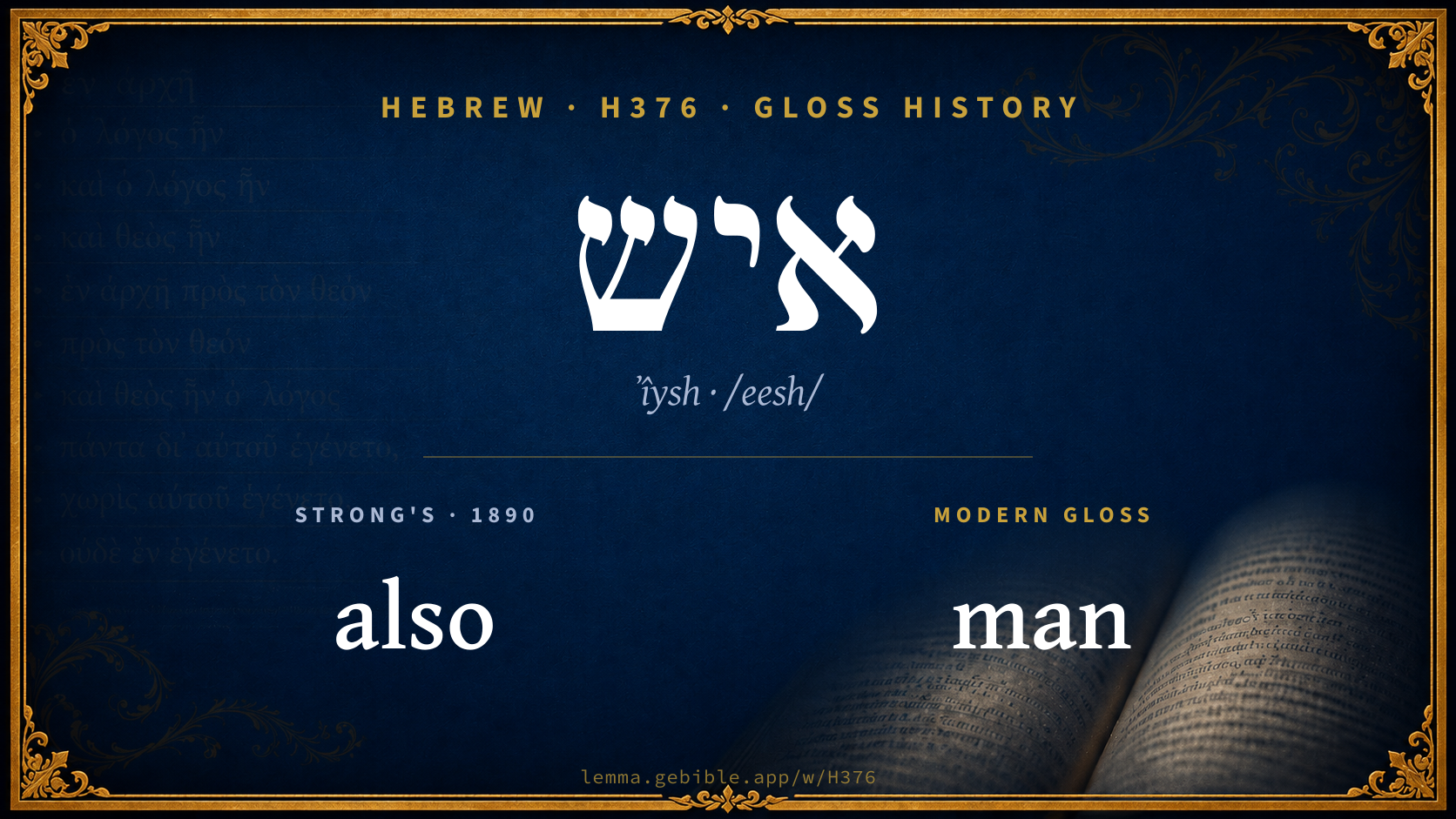
Gloss history
Strong's 1890 vs modern scholarship
About this word
Strong's H376 catalogs a Hebrew word from the Hebrew Old Testament.
These counts are not copied from any lexicon or concordance. They are computed here, from the morphology-tagged Hebrew Old Testament. What Lemma adds →
- 1,851
- distinct verses
- The word appears in 1,851 distinct verses.
- 38 / 39
- OT books
- The word appears in 38 of 39 Old Testament books.
- #19
- by frequency
- Top 25 most frequent Hebrew words (rank 19 of 8,640 Hebrew words by occurrence).
View all 1,851 occurrences in the concordance →
By section of the Old Testament
By traditional corpus
Conventional, traditional groupings — biblical authorship is debated, so this is a traditional corpus grouping, not an authorship claim. Each share is this word’s portion of its verses in that division of the Hebrew canon. Each figure is a share of the word’s 1,851 distinct verses.
- Prophets (Nevi'im) 1,006 verses · 54%
- Torah (Pentateuch) 477 verses · 26%
- Writings (Ketuvim) 368 verses · 20%
How translations render this word
Counts come from each version’s own published word-to-Strong’s tagging or interlinear alignment — an approximate guide to how each version renders this word, not a word-level alignment the data otherwise carries. Because each total is that version’s own tagged count, the per-version totals vary from one another and need not match the appearance or distinct-verse counts above. These counts may also differ from a printed concordance because Lemma counts each distinctly tagged rendering and does not collapse phrase taggings into a single head-word total. This is a fixed set of word-tagged versions (KJV, ASV, BSB, ULT) and does not change with the reading translation you choose elsewhere. Each version’s license is shown beside its name below (and on Sources).
- King James Version: Man 560×, Men 175×, Every man 154×
- American Standard Version: Man 521×, Men 165×, Every man 146×
- Berean Standard Bible: Man 556×, Men 188×, Each 97×
- unfoldingWord Literal Text: Man 921×, Men 425×, Men of 210×
King James Version Public Domain
Renders H376 across 1,623 tagged occurrences — most commonly:
Plus other, less common renderings. Plus 221 renderings that appear only once — usually multi-word phrases or single function words the recovered tagging swept in, not distinct renderings. Not rendered by a distinct English word in 16 further occurrences.
American Standard Version Public Domain
Renders H376 across 1,625 tagged occurrences — most commonly:
Plus other, less common renderings. Plus 297 renderings that appear only once — usually multi-word phrases or single function words the recovered tagging swept in, not distinct renderings. Not rendered by a distinct English word in 1 further occurrence.
Berean Standard Bible Public Domain
Renders H376 across 1,396 tagged occurrences — most commonly:
Plus other, less common renderings. Plus 132 renderings that appear only once — usually multi-word phrases or single function words the recovered tagging swept in, not distinct renderings. Not rendered by a distinct English word in 266 further occurrences.
unfoldingWord Literal Text CC BY-SA 4.0
Renders H376 across 2,256 tagged occurrences — most commonly:
Plus other, less common renderings. Plus 79 renderings that appear only once — usually multi-word phrases or single function words the recovered tagging swept in, not distinct renderings.
Senses in BDB
The 3 senses BDB distinguishes for this word, in lexicon order (not ranked by frequency or importance). The full entry — with sub-senses — is in the Lexicon Entry tab.
- man
- whosoever
- each (adjective)
Word origin
n.m. man (= vir) (MI, SI, Ph. אש, perh. also Sab. אסם cf. Prät l.c., but DHMZMG 1883, 330)—א׳ abs. Gn 2:23 +; cstr. Gn 25:27 +; sf. אִישִׁי Gn 29:32 +, etc.; pl. אִישִׁים ψ 141:4 + 2 textual (Ph. אשם); usually אֲנָשִׁים Gn 12:20 +, fr. √ אנשׁ q.v.; cstr. אַנְשֵׁי Ju 6:27 +; sf. אֲנָשַׁי 1 S 23:12 etc.;—man, opp. woman Gn 2:23, 24 Lv 20:27 Nu 5:6 Dt 17:2f Jos 6:21; 8:25 Je 40:7, emph. on sexual distinction & relation Gn 19:8; 24:16; 38:25 Ex 22:15 Lv 15:16 (שִׁכְבַת זָ֑רַע) v 18 (וְאִשָּׁה אֲשֶׁר יִשְׁכַּב אִישׁ אֹתָהּ שׁ׳־ז׳) 20:10f Nu 5:13f Dt 22:22f Is 4:1 +; thence = husband, especially c. sf. Gn 3:6, 16; 16:3; 29:32, 34 Lv 21:7 Nu 30:7f Dt 28:56 Ju 13:6f Ru 1:3f 1 S 25:19 Je 29:6 Ez 16:45 +; fig. of י׳ as husb. of Isr. אִישִׁי Ho 2:18 (opp. בַּעְלִי); man as procreator, father Ec 6:3; of male child Gn 4:1 cf. זֶרַע אֲנָשִׁים 1 S 1:11, man, opp. beast Ex 11:7 Lv 20:15 (cf. אָדָם); cf. fig. ψ 22:7 but also of male of animals Gn 7:2(×2) (אִישׁ וְאִשְׁתּוֹ); man, opp. God Gn 32:29 Nu 23:19 לֹא אִישׁ אֵל וִיכַזֵּב (‖ וּבֶן־אָדָם וְיִתְנֶחָ֑ם); Jb 9:32; 32:13 Ho 11:9 cf. Is 31:8 Jb 12:10 (רוּחַ כָּל־בְּשַׂר־אִישׁ); hence in phrases to denote ordinary, customary, common שֵׁבֶט אֲנָשִׁים 2 S 7:14 (‖ נִגְעֵי בְּנֵי אָדָם); לֶחֶם אֲנָשִׁים Ez 24:17, 22 (cf. Is 8:1); אֲנָשִׁים Ez 24:17, 22 is textual error; We (ap. Sm) אֲנֻשִׁים; ToyHpt אוֹנִים (Ho 9:4). אַמַּת־אִישׁ Dt 3:11; but also contr. אָדָם ψ 49:3; 62:10; man, as valiant 1 S 4:9(×2) (וִהְיוּ לַאֲנָשִׁים) so 1 K 2:2 cf. 1 S 26:15; so אִישׁ חַיִל 31:12 2 S 24:9 1 K 1:42 +; also אִישׁ מִלְחָמָה Nu 31:49 Dt 2:14, 16 Jos 5:4, 6 +; even of י׳ Ex 15:3 יהוה אִישׁ מִלְחָמָה; oft. prefixed to other nouns in app. הא׳ אָדוֹן Gn 42:30, 33, א׳ שַׂר וְשֹׁפֵט Ex 2:14, א׳ כֹּהֵן Lv 21:9, א׳ סָרִיס Je 38:7; partic. bef. adj. gent. אִישׁ מִצְרִי Gn 39:1 Ex 2:11, 19 cf. Gn 37:28; 38:1, 2; 39:14 1 S 17:12; 30:11, 13 +; a man as resident in, or belonging to a place or people Nu 25:6 Ju 10:1 + (so Ph.); usually pl. אַנְשֵׁי יִשְׂרָאֵל 1 S 7:11; 31:7(×2) cf. Jos 7:4, 5 +; also sg. coll. Dt 27:14 Jos 9:6, 7 Ju 20:11 1 S 11:8 (v. Dr) +; 2 S 10:6, 8 (א׳ טוֹב); (so MI 10. 13); men = retainers, followers, soldiers 1 S 18:27; 23:3f; 24:3; 25:13 + cf. Dt 33:8 sg. coll. v. Di; אִישׁ אֱלֹהִים man of God = proph. Dt 33:1 Jos 14:6 1 S 9:6f 1 K 12:22; 13:1f + (v. אלהים); in phrase sq. abstr. v. supr.; א׳ רִיב Ju 12:2 Je 15:10, א׳ שֵׂיבָה Dt 32:25, א׳ הַדָּמִים 2 S 16:7 cf. v. 8, א׳ הַבְּלִיַּעַל 2 S 16:7, א׳ מָוֶת 1 K 2:26, א׳ חָמָס ψ 140:12 Pr 3:31 +; sq. word of occupation, etc. א׳ שָׂדֶה Gn 25:27, א׳ הָאֲדָמָה Gn 9:20 (cf. Zc 13:5), א׳ הַבֵּנַיִם champion 1 S 17:4 (cf. Dr) v 23, א׳ בְּשֹׂרָה 2 S 18:20, אִישׁ עֲצָתוֹ his counsellor Is 40:13, cf. אִישׁ חֶרְמִי 1 K 20:42, א׳ רֵעִים Pr 18:24; oft. distrib. = each, every Gn 9:5; 10:5; 40:5(×2) Ex 12:3 +; incl. women Jb 42:11 1 Ch 16:3 וַיְחַלֵּק לְכָל־אִישׁ יִשְׂרָאֵל מֵאִישׁ וְעַד אִשָּׁה לְאִישׁ כִּכַּר־לֶחֶם; of inanim. things 1 K 7:30, 36; also אִישׁ אִישׁ Ex 36:4 Nu 4:19, 49 Ez 14:4, 7 +; any one Ex 34:3(×2), 24 +; also אִישׁ אִישׁ Lv 15:2; 22:4, 18 +; of gods 2 K 18:33 = Is 36:18; one … another וְהִרְגוּ אִישׁ־אֶת־אָחִיו וְאִישׁ אֶת־רֵעֵהוּ וְאִישׁ אֶת־קְרֹבוֹ Ex 32:27, אִישׁ … אָחִיו Dt 1:16 Mi 7:2 (v. אָח), אִישׁ … רֵעֵהוּ Gn 11:3, 7 + (v. רֵעַ) of inanimate things Gn 15:10.
— Brown-Driver-Briggs (Oxford 1906, public domain), digitized via Sefaria, supplemented by the OpenScriptures HebrewLexicon (CC BY 4.0). See Sources.
Derived from אנוש (ʼĕnôwsh) (H582) — man.
Jastrow Dictionary
A second Hebrew/Aramaic lexicon for comparison, covering Aramaic and post-biblical (Talmudic, Targumic, Midrashic) usage that the biblical-Hebrew BDB does not. Matched by lemma rather than by Strong’s number, so a lemma may carry more than one Jastrow headword (shown separately below), and the entries cover usage well beyond the Bible.
אִישׁ
- , v. אֱינָשׁ) being, man; husband; lord.—א׳ ירושלים a native or citizen of Jerusalem Aboth I, 4; a. fr.—Yoma I, 7 אִישִׁי כה"ג my lord the High-priest. Sot. 17ᵃ א׳ ואשה husband and wife; a. fr.—Pl. אֲנָשִׁים, v. אֱנוֹשׁ.
A Dictionary of the Targumim, the Talmud Babli and Yerushalmi, and the Midrashic Literature (Marcus Jastrow; London, Luzac, 1903) — Public Domain. Digitized via Sefaria. Digitized via Sefaria. Full attribution on Sources.
Forms in the corpus
The 285 distinct written forms H376 takes in the Hebrew Bible, most frequent first — each parse links to that state’s occurrences in the concordance. Hebrew forms include their vowel points and cantillation, so a single lemma takes many written forms.
The 60 most common forms are shown; 225 rarer forms follow in the full concordance.
Same root — word family
Other BDB entries built from the same root as H376, grouped by Strong’s listed origin. These share a root / origin per the lexicon — not necessarily a shared meaning. Each links to that word’s own entry.
Derives from
Shares the same root
Derived from this word
- איש ʼîysh H377 to be a man
- אישון ʼîyshôwn H380 pupil
- אישחיל ʼÎysh-Chayil H381 a mighty man, valiant man
- אשה ʼishshâh H802 woman
Proper names from this root
People and places named from this root — a name, not an additional meaning of the word.
- אנוש ʼĔnôwsh H583 Enos
- אישבשת ʼÎysh-Bôsheth H378 Ishbosheth
- אישהוד ʼÎyshᵉhôwd H379 Ishod
- אישטוב ʼÎysh-Ṭôwb H382 Ish-tob
- אשבעל ʼEshbaʻal H792 Eshbaal
- בןימיני Ben-yᵉmîynîy H1145 Benjamite
Compare all same-root words → Showing 4 of 13 — not the complete family. 6 of the same-root words are proper names (people or places). They share a root, not necessarily a meaning.
Septuagint verse parallels
This word appears in 1,751 verses that also exist in the Greek Old Testament (Septuagint), out of the 1,851 Hebrew verses it occurs in. You can read those verses in Greek by switching the Old Testament edition to the Septuagint.
Read these verses in the Septuagint
- Genesis 2:23
- Exodus 1:1
- Leviticus 7:8
- Numbers 1:4
- Deuteronomy 1:13
- Joshua 1:5
- Judges 1:4
- Ruth 1:1
- 1 Samuel 1:1
- 2 Samuel 1:2
- 1 Kings 1:5
- 2 Kings 1:6
This is a verse-level parallel only — the same verses exist in both the Hebrew and Greek Old Testaments. No word-level Hebrew↔Greek correspondence is claimed: the data carries no such alignment, so no Greek word is shown as this Hebrew word’s translation. Coverage is not total — the Septuagint omits the deuterocanon and renumbers the Psalms, so some Hebrew verses have no direct Greek parallel.