Exodus 25:2

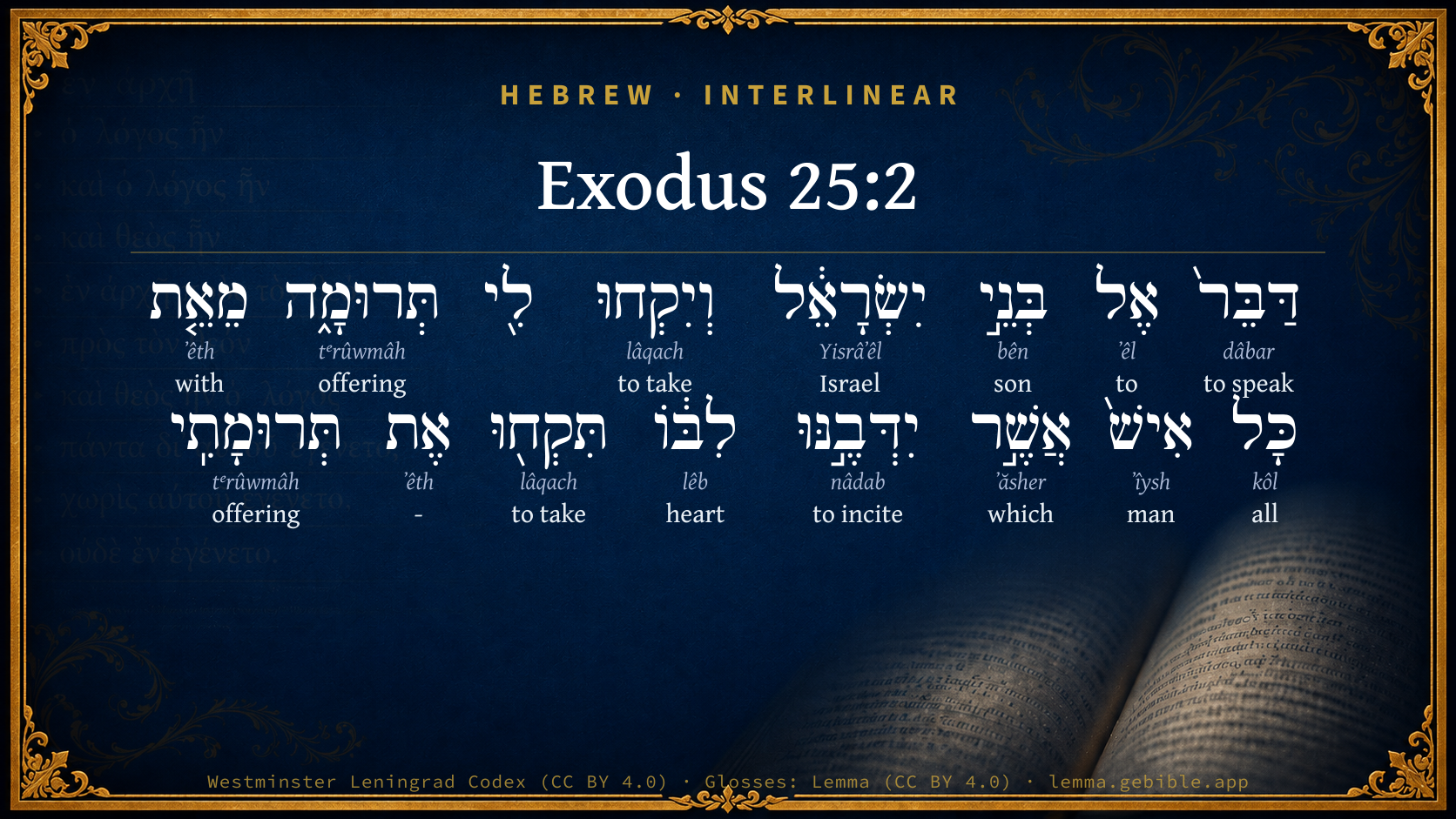
Hebrew (Westminster Leningrad Codex) Exodus 25:2 appears in the Hebrew Old Testament. The text above is from the Westminster Leningrad Codex. Each word links to its Strong’s number, a concise gloss, and parsing drawn from the Open Scriptures Hebrew Bible morphology. Click any word for its full Brown-Driver-Briggs (BDB) entry.
Download image
Cite this verse

Exodus 25:2 (World English Bible). Public Domain. Lemma interlinear Bible study tool, https://lemma.gebible.app/v/exodus/25/2.

Show BibTeX & RIS
BibTeX
RIS
English Translation
"Speak to the children of Israel, that they take an offering for me. From everyone whose heart makes him willing you shall take my offering.
World English Bible · Public Domain
Highlights
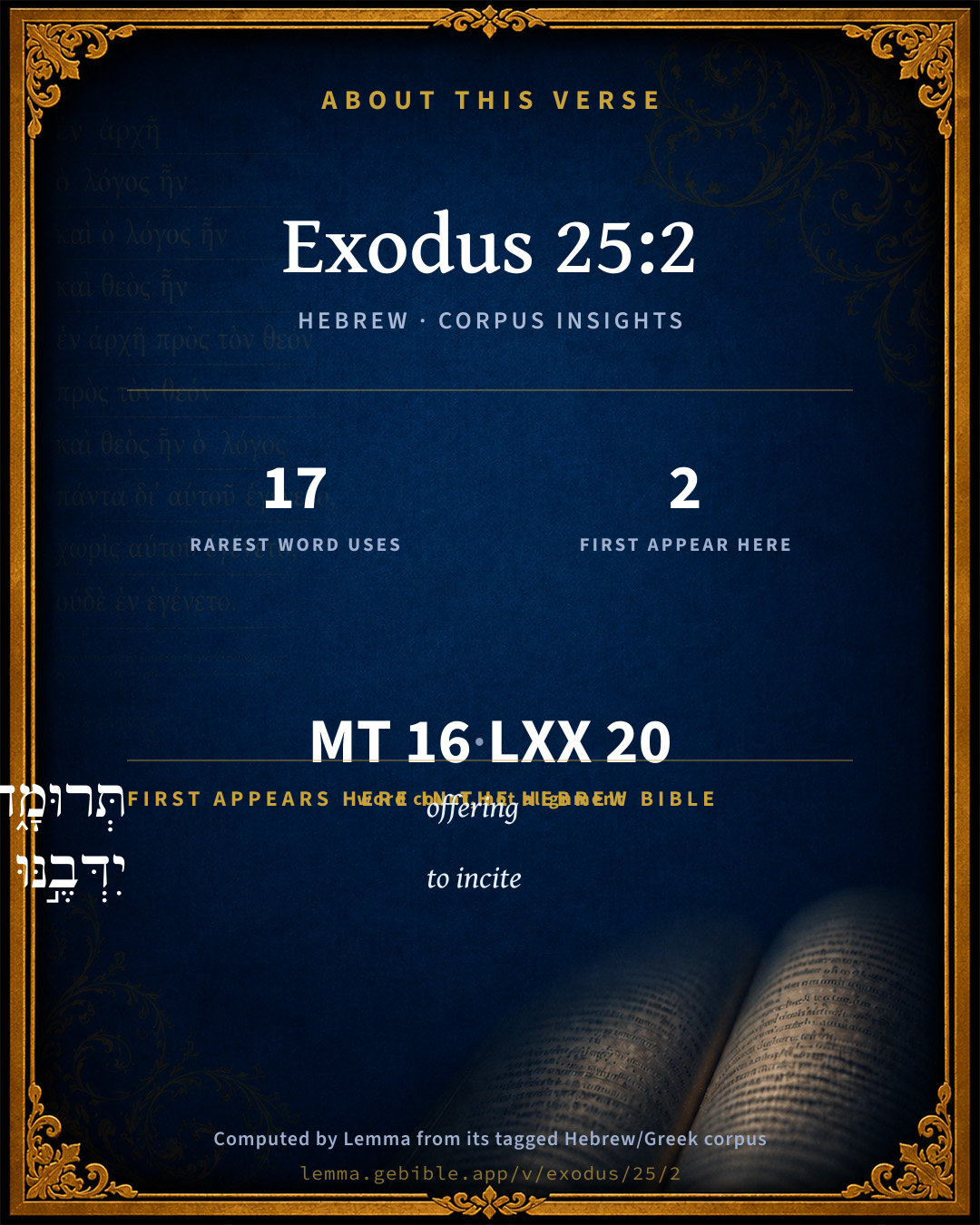
  • 2 first appearances in the Hebrew Bible
Full analysis ↓
Download a study sheet

One document with this verse’s original text, its word-by-word gloss line, the meaning frame, cross-references with their text, attributed commentary, and full source and license credits — printable, and it pastes into notes with its structure intact.

This verse Autodidact and up

Study sheet (.html) Plain text (.txt)

A passage Seminary Student

Up to 50 verses in one chapter. A passage sheet keeps up to 6 commentary sources and 12 cross-references per verse, in the order this page ranks them, and says so on the sheet whenever that leaves anything out. Ask for a single verse and you get the Autodidact verse sheet above.

Everything on this page stays free to read, with no account — the sheet is a download of what is already on screen, not access to it.

Want to remove ads? Support Godless Engineer
Compare translations 3

The same verse in 3 English versions, stacked beneath the original-language interlinear above. Click any original word for its lexicon entry.

Each is an independent rendering of the whole verse — the interlinear is not word-aligned to these translations.

Highlighted words mark where these versions differ — a whole-verse word diff, not a word-by-word alignment.

  • World English Bible Public Domain
    "Speak to the children of Israel, that they take an offering for me. From everyone whose heart makes him willing you shall take my offering.
  • King James Version Public Domain
    Speak unto the children of Israel, that they bring me an offering: of every man that giveth it willingly with his heart ye shall take my offering.
  • unfoldingWord Literal Text CC BY-SA 4.0
    “Speak to the sons of Israel, and they shall take a contribution for me. You shall take my contribution from every man whose heart incites him.

unfoldingWord Literal Text — © unfoldingWord, licensed CC BY-SA 4.0. Word-aligned USFM3 via Door43 (git.door43.org/unfoldingWord/en_ult).

Versions to compare (up to 4)

3 of 4 selected

Show all 18 translations

Every available English version of this verse, each an independent rendering of the whole verse.

  • World English Bible Public Domain
    "Speak to the children of Israel, that they take an offering for me. From everyone whose heart makes him willing you shall take my offering.
  • Berean Standard Bible Public Domain
    “Tell the Israelites to bring Me an offering. You are to receive My offering from every man whose heart compels him.
  • Majority Standard Bible Public Domain
    “Tell the Israelites to bring Me an offering. You are to receive My offering from every man whose heart compels him.
  • King James Version Public Domain
    Speak unto the children of Israel, that they bring me an offering: of every man that giveth it willingly with his heart ye shall take my offering.
  • American Standard Version (1901) Public Domain
    Speak unto the children of Israel, that they take for me an offering: of every man whose heart maketh him willing ye shall take my offering.
  • Revised Version (1885) Public Domain
    Speak unto the children of Israel, that they take for me an offering: of every man whose heart maketh him willing ye shall take my offering.
  • Geneva Bible (1599) Public Domain
    Speake vnto the children of Israel, that they receiue an offring for me: of euery man, whose heart giueth it freely, ye shall take the offring for me.
  • Douay-Rheims (1899) Public Domain
    Speak to the children of Israel, that they bring firstfruits to me: of every man that offereth of his own accord, you shall take them.
  • Young's Literal Translation Public Domain
    `Speak unto the sons of Israel, and they take for Me a heave-offering; from every man whose heart impelleth him ye do take My heave-offering.
  • Literal Standard Version CC BY-SA 4.0
    “Speak to the sons of Israel, and they take a raised-offering for Me; you take My raised-offering from every man whose heart impels him.
  • Unlocked Literal Bible CC BY-SA 4.0
    “Tell the Israelites to take an offering for me from every person who is motivated by a willing heart. You must receive these offerings for me.
  • unfoldingWord Literal Text CC BY-SA 4.0
    “Speak to the sons of Israel, and they shall take a contribution for me. You shall take my contribution from every man whose heart incites him.
  • Darby Bible Public Domain
    Speak unto the children of Israel, that they bring me a heave-offering: of every one whose heart prompteth him, ye shall take my heave-offering.
  • World Messianic Bible Public Domain
    “Speak to the children of Israel, that they take an offering for me. From everyone whose heart makes him willing you shall take my offering.
  • Webster's Bible Public Domain
    Speak to the children of Israel, that they bring me an offering: of every man that giveth it willingly with his heart ye shall take my offering.
  • Free Bible Version CC BY-SA 4.0
    “Instruct the Israelites to bring me an offering. You are to receive my offering from everyone who willingly wants to give.
  • Bible in Basic English Public Domain
    Say to the children of Israel that they are to make me an offering; from every man who has the impulse in his heart take an offering for me.
  • JPS Tanakh (1917) Public Domain
    'Speak unto the children of Israel, that they take for Me an offering; of every man whose heart maketh him willing ye shall take My offering.

Literal Standard Version (2020), Covenant Press — licensed CC BY-SA 4.0. Text via the HelloAO Bible API (eBible.org). Unlocked Literal Bible (unfoldingWord) — licensed CC BY-SA 4.0. Text via the HelloAO Bible API (eBible.org). unfoldingWord Literal Text — © unfoldingWord, licensed CC BY-SA 4.0. Word-aligned USFM3 via Door43 (git.door43.org/unfoldingWord/en_ult). Free Bible Version, Dr. Jonathan Gallagher — licensed CC BY-SA 4.0. Text via the HelloAO Bible API (eBible.org).

Word by word

More ways to search: Search by grammar → Find every occurrence → Compare this word →

Practice this passage: Drill this verse → Learn its vocabulary →

יִדְּבֶ֣נּוּ
nâdab
H5068
“to incite · him”
Verb, Qal, Imperfect, 3rd Person, Masculine, Singular + Suffix, Personal, 3rd Person, Masculine, Singular
Part of Speech
Verb
Stem
Qal
Form
Imperfect
Person
3rd Person
Gender
Masculine
Number
Singular
Full BDB Definition

Origin: a primitive root

TWOT: 1299

to incite, impel, make willing - (Qal) to incite, impel - (Hithpael) - to volunteer - to offer free-will offerings
  1. דַּבֵּר֙ dâbar H1696 “speak” Verb, Piel, Imperative, 2nd Person, Masculine, Singular
  2. אֶל ʼêl H413 “to” Preposition
  3. בְּנֵ֣י bên H1121 “sons of” Noun, Common, Masculine, Plural, Construct
  4. יִשְׂרָאֵ֔ל Yisrâʼêl H3478 “Israel” Noun, Proper
  5. וְיִקְחוּ lâqach H3947 “and · to take” Conjunction + Verb, Qal, Jussive, 3rd Person, Masculine, Plural
  6. תְּרוּמָ֑ה tᵉrûwmâh H8641 “offering” Noun, Common, Feminine, Singular, Absolute
  7. מֵאֵ֤ת ʼêth H854 “from · with” Preposition + Preposition
  8. כָּל kôl H3605 “all of” Noun, Common, Masculine, Singular, Construct
  9. אִישׁ֙ ʼîysh H376 “man” Noun, Common, Masculine, Singular, Absolute
  10. אֲשֶׁ֣ר ʼăsher H834 “which” Particle, Relative
  11. לִבּ֔וֹ lêb H3820 “heart · his” Noun, Common, Masculine, Singular, Construct + Suffix, Personal, 3rd Person, Masculine, Singular
  12. תִּקְח֖וּ lâqach H3947 “to take” Verb, Qal, Imperfect, 2nd Person, Masculine, Plural
  13. אֶת ʼêth H853 “-” Particle, Direct Object
  14. תְּרוּמָתִֽי tᵉrûwmâh H8641 “offering · my” Noun, Common, Feminine, Singular, Construct + Suffix, Personal, 1st Person, Common, Singular

About this verse

These counts appear in no published source. They are computed here, from the morphology-tagged text and Lemma’s own curated glosses. What Lemma adds →

16
words
13
distinct lemmas
Pentateuch
section

Notable vocabulary

The rarest word here is יִדְּבֶ֣נּוּ to incite H5068 — appearing just 17 times in the whole Hebrew Bible.

First appearance in Scripture

These words make their first canonical appearance in the Hebrew Bible here:

  • תְּרוּמָ֑ה offering H8641
  • יִדְּבֶ֣נּוּ to incite H5068

Shared distinctive vocabulary

יִדְּבֶ֣נּוּ to incite H5068 occurs in 15 verses of the Hebrew Bible. Also found in:

Grammatical profile

  • 4 verbs
  • 7 nouns
  • 3 prepositions
  • 2 particles

Verb forms

  • דַּבֵּר֙ Piel · Imperative
  • וְיִקְחוּ Qal · Jussive
  • יִדְּבֶ֣נּוּ Qal · Imperfect
  • תִּקְח֖וּ Qal · Imperfect

Repetition

Words recur within this verse — often emphatic in Hebrew:

  • וְיִקְחוּ to take H3947 ×2
  • תְּרוּמָ֑ה offering H8641 ×2

Hebrew & Septuagint length

In English translation the verse runs 25 words from the Hebrew and 28 from the Septuagint (LXX English) — closely comparable.

A rough comparison of the two English renderings, which tokenize alike — not a word-level alignment.

Word counts can differ between the Hebrew and the Greek without any difference in meaning — e.g. the Hebrew direct-object marker אֵת has no separate Greek word, and Greek often adds the article ὁ.

In the original languages it is 16 Hebrew tokens and 20 Greek tokens — but the two are counted differently (Hebrew bundles its prefixes and suffixes into one token; the Greek is in lemma form), so that isn’t a like-for-like length.

Cross-references

14

Topical passages linked to Exodus 25:2 in the Treasury of Scripture Knowledge — connected by theme and wording, ordered by reader-vote popularity; previews shown in the World English Bible.

  • 2 Corinthians 9:7 Let each man give according as he has determined in his heart; not grudgingly, or under compulsion; for God loves a cheerful giver.
  • Nehemiah 11:2 The people blessed all the men who willingly offered themselves to dwell in Jerusalem.
  • Ezra 2:68 Some of the heads of fathers' [houses], when they came to the house of Yahweh which is in Jerusalem, offered willingly for the house of God to set it up in its place:
  • Ezra 1:6 All those who were round about them strengthened their hands with vessels of silver, with gold, with goods, and with animals, and with precious things, besides all that was willingly offered.
  • Ezra 7:16 and all the silver and gold that you shall find in all the province of Babylon, with the freewill-offering of the people, and of the priests, offering willingly for the house of their God which is in Jerusalem;
  • Ezra 3:5 and afterward the continual burnt-offering, and [the offerings] of the new moons, and of all the set feasts of Yahweh that were consecrated, and of everyone who willingly offered a freewill-offering to Yahweh.
  • 1 Chronicles 29:1–30 David the king said to all the assembly, Solomon my son, whom alone God has chosen, is yet young and tender, and the work is great; for the palace is not for man, but for Yahweh God.
  • Psalms 110:3 Your people offer themselves willingly in the day of your power, in holy array. Out of the womb of the morning, you have the dew of your youth.
  • Numbers 18:24 For the tithe of the children of Israel, which they offer as a heave-offering to Yahweh, I have given to the Levites for an inheritance: therefore I have said to them, Among the children of Israel they shall have no inheritance.
  • Deuteronomy 16:16–17 Three times in a year shall all your males appear before Yahweh your God in the place which he shall choose: in the feast of unleavened bread, and in the feast of weeks, and in the feast of tents; and they shall not appear before Yahweh empty:
  • Judges 5:9 My heart is toward the governors of Israel, Who offered themselves willingly among the people: Bless you Yahweh.
  • Exodus 35:4–29 Moses spoke to all the congregation of the children of Israel, saying, "This is the thing which Yahweh commanded, saying,
  • Numbers 7:3–88 and they brought their offering before Yahweh, six covered wagons, and twelve oxen; a wagon for every two of the princes, and for each one an ox: and they presented them before the tabernacle.
  • 2 Corinthians 8:11–12 But now complete the doing also, that as there was the readiness to be willing, so there may be the completion also out of your ability.

Cross-references courtesy of OpenBible.info (CC BY 4.0).

Hebrew and Greek witnesses Masoretic Hebrew ↔ Greek Septuagint

The same verse in the two great witnesses to the Old Testament, shown verse-for-verse.

These are two independent witnesses, not word-aligned to each other, and the Septuagint is shown in lemma (dictionary) form.

Hebrew Exodus 25:2 Masoretic · Westminster Leningrad Codex

דַּבֵּר֙ אֶל בְּנֵ֣י יִשְׂרָאֵ֔ל וְיִקְחוּ לִ֖י תְּרוּמָ֑ה מֵאֵ֤ת כָּל אִישׁ֙ אֲשֶׁ֣ר יִדְּבֶ֣נּוּ לִבּ֔וֹ תִּקְח֖וּ אֶת תְּרוּמָתִֽי

"Speak to the children of Israel, that they take an offering for me. From everyone whose heart makes him willing you shall take my offering.

World English Bible · Public Domain

Greek LXX Exodus 25:2 Septuagint · lemma form

εἶπον ὁ υἱός ἰσραήλ καί λαμβάνω ἐγώ ἀπαρχή παρά πᾶς ὅς ἄν δοκέω ὁ καρδία καί λαμβάνω ὁ ἀπαρχή ἐγώ

Speak to the children of Israel, and take first fruits of all, who may be disposed in their heart to give; and you⌃ shall take my first fruits.

LXX2012 (modern English Septuagint) · Public Domain

On this verse, The Cambridge Bible for Schools and Colleges discusses the Septuagint’s reading. Read the note in Commentary ↓

Hebrew: Westminster Leningrad Codex (CC BY 4.0). Greek: Septuagint (public domain); English from LXX2012 (modern English Septuagint) (Public Domain). How the Septuagint differs from the Hebrew →

Targum (Aramaic paraphrase)

2

The Targum is the ancient Jewish Aramaic paraphrase of the Hebrew Scriptures — an interpretive translation, not the Hebrew text itself. Onkelos (literal) and Pseudo-Jonathan (expansive) render the Torah, and Jonathan the Prophets. Coverage is partial: where no permissively-licensed English translation exists for a verse, only the Aramaic is shown. This is verse-level text, not a word-by-word alignment to the Hebrew.

  1. Targum Onkelos Torah (Genesis–Deuteronomy)
    מַלֵיל עִם בְּנֵי יִשְׂרָאֵל וְיַפְרְשׁוּן קֳדָמַי אַפְרָשׁוּתָא מִן כָּל גְבַר דִי יִתִּרְעֵי לִבֵּהּ תִּסְבוּן יָת אַפְרָשׁוּתִי:

    (no public-domain English translation for this verse)

    Targum Onkelos — Aramaic: “Onkelos Genesis” (public domain); “Onkelos Exodus” (public domain); “Onkelos Leviticus” (public domain); “Onkelos Numbers” (public domain); “Onkelos Deuteronomy” (public domain). English: “Sefaria Community Translation” (CC0 1.0 (public-domain dedication)); “J.W. Etheridge. The Targums of Onkelos and Jonathan Ben Uzziel on the Pentateuch. London: Longmans, Green, 1862” (public domain). Text via Sefaria.

  2. Targum Pseudo-Jonathan Torah (Genesis–Deuteronomy)
    מַלֵּיל עִם בְּנֵי יִשְרָאֵל וְיִסְבוּן קֳדָמַי אַפְרְשׁוּתָא מִן כָּל דְּיִתְרְעֵי לִבֵּיהּ וְלָא בְּאַלְמוּתָא תִסְבוּן יַת אַפְרָשׁוּתִי

    Speak unto the children of Israel, that they shall set apart (take) before me a Separation: of every one whose heart is willing, but not by constraint, ye shall take my separation.

    Targum Pseudo-Jonathan — Aramaic: “Targum Jonathan on Genesis” (public domain); “Targum Jonathan on Exodus” (public domain); “Targum Jonathan on Leviticus” (public domain); “Targum Jonathan on Numbers” (public domain); “Targum Jonathan on Deuteronomy” (public domain). English: “The Targum of Jonathan ben Uzziel, trans. J. W. Etheridge, London, 1862” (public domain). Text via Sefaria.

Commentary

Notes on Exodus 25:2 from classic Christian and Jewish commentators (each source and its license shown beneath its notes). The classic Christian expositions comment on the surrounding passage and are grouped to its opening verse, so a note may address several verses; the Jewish commentaries on the Tanakh (Rashi and others) are per-verse, so they appear only where the commentator wrote on this verse.

Lemma curates 59 commentaries, every one of them public domain or Creative Commons licensed, each selected and text-cleaned for this edition rather than reprinted as found. About our sources →

Trapp's Complete Commentary

John Trapp

Exo 25:2 Speak unto the children of Israel, that they bring me an offering: of every man that giveth it willingly with his heart ye shall take my offering.

Ver. 2. That giveth it willingly.] Virtus nolentium nulla est; God strains upon no man. If ye consent and obey, &c. If there be a willing mind, God accepteth, &c. {2Co 8:11-12}

“ Si desint vires, tamen est laudanda voluntas:

Hac ego contentos auguror esse Deos. ” - Ovid.

John Trapp, A Commentary or Exposition upon All the Books of the Old and New Testament (1647–1656) — public domain. Text from a community e-Sword module.

Joseph Benson's Commentary

Exo 25:2. Speak unto the children of Israel — Doubtless when Moses went into the midst of the cloud, and abode there so long, he saw and heard glorious things, but they were things which it was not lawful or possible to utter, and therefore in the records which he kept of the transactions there, he saith nothing to satisfy curiosity, but writes that only which he was to deliver to the people. And God, having now solemnly ratified his covenant with Israel to be their God, and that they should be his subjects and servants, gives orders next concerning a place for his solemn worship, where by visible symbols of his divine presence he might reside among them as their Deliverer, Protector, and the great object of their worship, and might keep his court as their King, that while they had that place in the midst of them they might never again ask, “Is the Lord among us or not?” And because in the wilderness they dwelt in tents, even this royal palace was to be a tabernacle too, a kind of portable temple suitable to their travelling condition, that it might move with them. Probably there never was any house or temple built for sacred uses before this tabernacle was erected by Moses. And the frame, fashion, utensils, ministers, and services of it were to be such as would be a model of that more magnificent temple, its furniture and service, which was to be afterward erected in the land of Canaan, even as that temple itself, with its whole economy, was to be but a figurative resemblance of a more complete and spiritual dispensation under the Messiah. For these holy places made with hands were the figures of the true, Heb 9:24. The gospel church is the true tabernacle which the Lord pitched, and not man, Heb 8:2. And the body of Christ, in and by which he made atonement, was the greater and more perfect tabernacle, Heb 9:11. The Word was made flesh, and dwelt among us as in a tabernacle. That they bring me an offering — This offering was to be given willingly, and with the heart. It was not prescribed to them what or how much they must give, but it was left to their generosity, that they might show their good-will to the house of God, and the offices thereof.

Joseph Benson's Commentary on the Old and New Testaments (1811–1818) — public domain. Text from a community e-Sword module.

Tyndale Open Study Notes

Tyndale Open Resources

25:2 all whose hearts are moved: There is a marked difference in motivation between meeting needs in God’s way and attempting to meet them in our own way, as when Aaron used coercion in creating the gold calf (see 32:1-4).

Tyndale Open Study Notes — © Tyndale Open Resources, licensed CC BY-SA 4.0. Text via the HelloAO Bible API.

Geneva Bible (1599)

Geneva Bible translators

After the moral and judicial law he giveth them the ceremonial law that nothing should be left to man’s invention.

Geneva Bible (1599) marginal notes — public domain. Text via Bolls.life.

Jamieson, Fausset & Brown

Robert Jamieson, A. R. Fausset & David Brown

bring me an offering of every man that giveth it willingly, &c.--Having declared allegiance to God as their sovereign, they were expected to contribute to His state, as other subjects to their kings; and the "offering" required of them was not to be imposed as a tax, but to come from their own loyal and liberal feelings.

Jamieson, Fausset & Brown — Commentary Critical and Explanatory on the Whole Bible (1871) — public domain (CC PDM 1.0). Text via the HelloAO Bible API.

Adam Clarke's Commentary

Verse 2. That they bring me an offering] The offering here mentioned is the תרומה terumah, a kind of free-will offering, consisting of any thing that was necessary for the occasion. It signifies properly any thing that was lifted up, the heave-offering, because in presenting it to God it was lifted up to be laid on his altar; but See Clarke on Ex 29:27. God requires that they should build him a tent, suited in some sort to his dignity and eminence, because he was to act as their king, and to dwell among them; and they were to consider themselves as his subjects, and in this character to bring him presents, which was considered to be the duty of every subject appearing before his prince. See Ex 23:15.

Adam Clarke's Commentary on the Bible (1810–1826) — public domain. Text from a community e-Sword/MySword module.

Ellicott's Commentary for English Readers

XXV.

THE GIFTS WHICH MIGHT BE GIVEN FOR THE TABERNACLE AND THE PRIESTS’ DRESSES.

(2) Speak unto the children of Israel that they bring me an offering.—God, being about to command the construction of a dwelling for Himself, such as the circumstances of the case allowed, prefaced His directions concerning its materials and form by instructing Moses to invite the people to contribute from their stores, as an offering to Himself, the various substances which were suitable for the dwelling and its appurtenances. The erection of sanctuaries is one of the fittest occasions for man to shew his gratitude to God by giving to Him of His own, largely and liberally.

Of every man that giveth it willingly with his heart.—Heb., of every man whose heart impels him. Unless gifts come from the heart, they are an offence to God. He “loveth a cheerful giver.” When the time came, a noble and liberal spirit was not wanting. (See Exo_35:21-29; Exo_36:3-7.)

My offering.—Literally, my heave-offering. But the word seems to be intended in a generic sense.

A Bible Commentary for English Readers, edited by Charles John Ellicott (1878–1897) — public domain. Text from a community e-Sword module.

The Cambridge Bible for Schools and Colleges

gen. ed. J. J. S. Perowne

2. offering] better, contribution. The Heb. tãrûmâh (from hçrîm, to lift or take off) denotes properly what is ‘taken off’ from a larger mass, and so separated from it for sacred purposes (LXX. often ἀφαίρεμα, ‘something taken off’; Targ. אפרשותא, ‘something separated’). RVm. heave-offering (also sometimes in the text, as Num_18:8; Num_18:11) is due to the mistaken idea that the term implies a rite of elevation: see against this, Oehler, Theol. of OT. § 133, or Di. on Lev_7:32. Tìrûmâh is used in particular (1) of gifts taken from the produce of the soil (as tithe, firstfruits, and firstlings), Deu_12:6; Deu_12:11; Deu_12:17, Num_15:19-21; Num_18:11 (see vv. 12, 13), Neh_10:37; Neh_10:39; (2) of contributions of money, spoil, &c., offered for sacred purposes, as here, v. 3, Exo_30:13-15, Exo_35:5; Exo_35:21; Exo_35:24, Exo_36:3; Exo_36:6, Num_31:29, Ezr_8:25; and in Ezek. of the land reserved for the priests and Levites (Eze_45:1; Eze_45:6-7, &c.—here rendered ‘oblation’); (3) in connexion with sacrifices, only of portions ‘taken off’ the rest, and forming the priest’s due, especially of the so-called ‘heave-’ thigh (comp. on Exo_29:27). See more fully the writer’s note on Deu_12:6, or DB. Offer, Offering, 5. The term is a distinctive one, and differs entirely in both meaning and application from minḥâh and ḳorbân, both of which are also in RV. often rendered ‘offering,’ ‘oblation’: see DB. l.c. The reader who wishes to distinguish accurately the uses of these three terms is advised to ascertain, with the help of the Englishman’s Heb. Concordance to the OT., their occurrences, and to place a mark against each on the margin—ת׳ (t.), מ׳ (m.), or ק׳ (ḳ.), as the case may be.

whose heart maketh him willing] or liberal, ready: cf. Exo_35:5, Exodus 21, 22, 29; also the cognate verb, in the reflexive conj., Jdg_5:2; Jdg_5:9 (of volunteering in a campaign), and 16 times in Chr., Ezr., Neh., esp. in the chronicler’s representations of the offerings made willingly for both the first and the second Temples (1Ch_29:5-6; 1Ch_29:9; 1Ch_29:14; 1Ch_29:17; Ezr_1:6; Ezr_2:68; Ezr_3:5).

The Cambridge Bible for Schools and Colleges (gen. ed. J. J. S. Perowne; Cambridge University Press, 1878–1918) — public domain. Text from a community e-Sword module.

John Gill's Exposition

Speak unto the children of Israel,.... That is, when he should go down from the mountain to the camp:

that they bring me an offering; the Targums of Onkelos and Jonathan call it a "separation": something separated from their substance, and devoted to the service of God, and for the use of the sanctuary afterwards to be built:

of every man that giveth it willingly, with his heart, ye shall take my offering; or take what was offered to him, be it more or less, and of whatsoever person, high and low, rich and poor, so be it it is freely given from the heart; not grudgingly or through force, as the Targum of Jonathan adds; and in such manner did David and his people many hundreds of years after this offer towards building of the temple, and the vessels belonging to that, see Ch1 29:6 according to the Jewish writers, none but the children of Israel were to offer to this service, and only such who knew what they did; for thus they criticize on the words,"speak unto the children of "Israel": this exempts an Heathen and an idolater; "of every man"; this excludes a little one; "that giveth it willingly with his heart"; this exempts a deaf and dumb man, and a fool, because they have no knowledge to offer freely (z)''however, this we may learn from hence, that whatever we do for the worship and service of God, we should do it freely, cheerfully, and cordially; for God loves a cheerful giver; and if this was required under the legal dispensation, it is much more necessary and obligatory under the Gospel dispensation, and more suitable to it where all things are done and given freely of God, and such large blessings of grace are liberally bestowed by him on persons undeserving.

(z) Maimon. & Bartenora in Misn. Trumot, c. 1. sect. 1.

John Gill's Exposition of the Whole Bible (1746–1763) — public domain (CC PDM 1.0). Text via the HelloAO Bible API.

Haydock's Catholic Bible Commentary

First-fruits: offerings, of some of the best and choicest of their goods. (Challoner) --- This was the first time such a voluntary offering was made by the Hebrews. (Menochius) --- It is a lesson for Christians to be liberal for God’s service. (Worthington)

George Leo Haydock (1774–1849), Haydock's Catholic Family Bible and Commentary, 1859 edition — public domain. Excludes Psalms (Douay-Rheims chapter numbering differs from Protestant) and Deuterocanonical books (Catholic canon only).

The Pulpit Commentary

Speak unto the children of Israel that they bring me an offering. The word translated "offering" is that commonly rendered" heave-offering;" but it seems to be used here (as in Exo_30:13 Exo_35:5, etc.) in a generic sense. The propriety of the people, when God was about establishing his habitation among them, presenting to God all the materials needed, is self-evident and requires no comment. Of every man that giveth it willingly. Literally, "of every man whose heart drives him." God will have no gifts but such as are freely offered. He "loveth a cheerful giver. If a man gives grudgingly or of necessity," God rejects the gift. On the noble spirit which the people showed when the appeal was made to them, see Exo_35:21-29; and Exo_36:3-7.

The Pulpit Commentary (1880–1919), ed. H.D.M. Spence-Jones & Joseph S. Exell — public domain. Text from a community e-Sword module.

John Wesley's Explanatory Notes

Speak unto the children of Israel that they bring me an offering - This offering was to be given willingly, and with the heart. It was not prescribed to them what or how much they must give, but it was left to their generosity, that they might shew their goodwill to the house of God, and the offices thereof.

John Wesley, Explanatory Notes Upon the Whole Bible (1754–1765) — public domain. Text via the GEBible commentary corpus.

Scofield Reference Notes

C. I. Scofield

willingly

(See Scofield "2Co 8:1").

The Scofield Reference Bible (1917 edition), notes by C. I. Scofield — public domain. Text from a community e-Sword module.

Rashi

Rabbi Shlomo Yitzchaki (Rashi)

ויקחו לי תרומה THAT THEY TAKE ME A HEAVE OFFERING — “Me” means to the glory of My Name (Midrash Tanchuma, Terumah 1).

תרומה is something set apart (cf. Onkelos); the meaning is: let them set apart from their possessions a voluntary gift in My honour.

ידבנו לבו — The word ידבנו is of the same root as נדבה (the נ in the latter being replaced by the Dagesh in the ד); it is a term denoting “good-will”, apaisement in old French (cf. Rashi on Genesis 33:10 and Leviticus 19:5).

תקחו את תרומתי YE SHALL TAKE MY HEAVE OFFERING — Our Rabbis said: the expression תרומה is used here three times, being an allusion to three different heave offerings; one is the heave offering which consisted of a beka (half a shekel) a head, and of which the sockets were made, as is set forth in the section אלה פקודי (Exodus 39:26-27); another is the heave offering for the altar — a beka a head that was given to the funds (more lit., “the basket”, in which collections for communal or charitable purposes were made) from which to purchase the communal sacrifices; (see Rashi on Exodus 30:15) and the other one is that implied in the word תרומתי “My heave offering” and referred to by the word כסף in the next verse — the heave offering for the Tabernacle which was a free-will gift from each individual (Jerusalem Talmud Shekalim 1:1). Thirteen different articles (cf. Tanchuma) that are mentioned in this section were all required either for the work of the Tabernacle (i. e. the construction of the Tabernacle or making the articles contained therein), or for the priests’ garments, as you will find when you look closely into the matter.

Rashi on the Tanakh — English translations: “The Judaica Press complete Tanach with Rashi, translated by A. J. Rosenberg” (CC BY 4.0); “Pentateuch with Rashi's commentary by M. Rosenbaum and A.M. Silbermann, 1929-1934” (public domain); “The Metsudah Tanach series, Lakewood, N.J” (CC BY 4.0); and “The Book of Joshua, Metsudah Publications, 1997” (CC BY 4.0). Text via Sefaria.

Lesson kit

Teaching starters — assembled from the data on this page, not authored interpretation. Every prompt links to the verse data it draws on. Edit before teaching.

Exodus, in the Pentateuch, opens this verse with 16 words (13 distinct Hebrew lemmas). Its most distinctive word is nâdab (“to incite”). A historical commentator’s framing appears above. Read the whole chapter for the surrounding context.

Discussion questions

  1. What does “to incite” (nâdab) contribute to the verse as a whole?
  2. 2 words make their first appearance in Scripture here. What does this debut establish?
  3. How does Exodus 35:21, which shares the word «to incite», read alongside this verse?
  4. What does the repetition of “to take” (2× in this one verse) do in this verse?
  5. The translations on this page render this verse differently — a whole-verse word diff, not a word-by-word alignment. What might account for the different wordings?
  6. «דַּבֵּר֙» is a Piel Imperative verb. How does that grammatical form shape the action described?
  7. Compare how Trapp's Complete Commentary and Joseph Benson's Commentary read this verse. Where do they agree or differ?

Things to notice

Reading settings

Reading text

Shown beneath each verse's original-language words.

Old Testament
Old Testament edition

Read the OT as the Masoretic Hebrew (MT) or the Greek Septuagint (LXX).

English shown for the Greek Septuagint (in the Hebrew ↔ Greek comparison).

Comparing translations? Open the Compare panel on any verse page to stack up to four side by side.