
Genesis 24:22

Hebrew (Westminster Leningrad Codex) Genesis 24:22 appears in the Hebrew Old Testament. The text above is from the Westminster Leningrad Codex. Each word links to its Strong’s number, a concise gloss, and parsing drawn from the Open Scriptures Hebrew Bible morphology. Click any word for its full Brown-Driver-Briggs (BDB) entry.
Download image
Cite this verse

Genesis 24:22 (World English Bible). Public Domain. Lemma interlinear Bible study tool, https://lemma.gebible.app/v/genesis/24/22.

Show BibTeX & RIS
BibTeX
RIS
English Translation
It happened, as the camels had done drinking, that the man took a golden ring of half a shekel weight, and two bracelets for her hands of ten shekels weight of gold,
World English Bible · Public Domain
Highlights
  • 4 first appearances in the Hebrew Bible
Full analysis ↓
Download a study sheet

One document with this verse’s original text, its word-by-word gloss line, the meaning frame, cross-references with their text, attributed commentary, and full source and license credits — printable, and it pastes into notes with its structure intact.

This verse Autodidact and up

Study sheet (.html) Plain text (.txt)

A passage Seminary Student

Up to 50 verses in one chapter. A passage sheet keeps up to 6 commentary sources and 12 cross-references per verse, in the order this page ranks them, and says so on the sheet whenever that leaves anything out. Ask for a single verse and you get the Autodidact verse sheet above.

Everything on this page stays free to read, with no account — the sheet is a download of what is already on screen, not access to it.

Want to remove ads? Support Godless Engineer
Compare translations 3

The same verse in 3 English versions, stacked beneath the original-language interlinear above. Click any original word for its lexicon entry.

Each is an independent rendering of the whole verse — the interlinear is not word-aligned to these translations.

Highlighted words mark where these versions differ — a whole-verse word diff, not a word-by-word alignment.

  • World English Bible Public Domain
    It happened, as the camels had done drinking, that the man took a golden ring of half a shekel weight, and two bracelets for her hands of ten shekels weight of gold,
  • King James Version Public Domain
    And it came to pass, as the camels had done drinking, that the man took a golden earring of half a shekel weight, and two bracelets for her hands of ten shekels weight of gold;
  • unfoldingWord Literal Text CC BY-SA 4.0
    Then it happened, when the camels had finished drinking, then the man took out a gold nose ring, its weight a beka, and two gold bracelets for her arms, their weight ten shekels.

unfoldingWord Literal Text — © unfoldingWord, licensed CC BY-SA 4.0. Word-aligned USFM3 via Door43 (git.door43.org/unfoldingWord/en_ult).

Versions to compare (up to 4)

3 of 4 selected

Show all 18 translations

Every available English version of this verse, each an independent rendering of the whole verse.

  • World English Bible Public Domain
    It happened, as the camels had done drinking, that the man took a golden ring of half a shekel weight, and two bracelets for her hands of ten shekels weight of gold,
  • Berean Standard Bible Public Domain
    And after the camels had finished drinking, he took out a gold ring weighing a beka, and two gold bracelets for her wrists weighing ten shekels.
  • Majority Standard Bible Public Domain
    And after the camels had finished drinking, he took out a gold ring weighing a beka, and two gold bracelets for her wrists weighing ten shekels.
  • King James Version Public Domain
    And it came to pass, as the camels had done drinking, that the man took a golden earring of half a shekel weight, and two bracelets for her hands of ten shekels weight of gold;
  • American Standard Version (1901) Public Domain
    And it came to pass, as the camels had done drinking, that the man took a golden ring of half a shekel weight, and two bracelets for her hands of ten shekels weight of gold,
  • Revised Version (1885) Public Domain
    And it came to pass, as the camels had done drinking, that the man took a golden ring of half a shekel weight, and two bracelets for her hands of ten shekels weight of gold;
  • Geneva Bible (1599) Public Domain
    And when the camels had left drinking, the man tooke a golden abillement of halfe a shekell weight, and two bracelets for her hands, of ten shekels weight of golde:
  • Douay-Rheims (1899) Public Domain
    And after that the camels had drunk, the man took out golden earrings, weighing two sicles: and as many bracelets of ten sicles weight.
  • Young's Literal Translation Public Domain
    And it cometh to pass when the camels have finished drinking, that the man taketh a golden ring (whose weight `is' a bekah), and two bracelets for her hands (whose weight `is' ten `bekahs' of gold),
  • Literal Standard Version CC BY-SA 4.0
    And it comes to pass, when the camels have finished drinking, that the man takes a golden ring (whose weight [is] a bekah), and two bracelets for her hands (whose weight [is] ten [bekahs] of gold),
  • Unlocked Literal Bible CC BY-SA 4.0
    As the camels finished drinking, the man brought out a gold nose ring weighing half a shekel, and two gold bracelets for her arms weighing ten shekels,
  • unfoldingWord Literal Text CC BY-SA 4.0
    Then it happened, when the camels had finished drinking, then the man took out a gold nose ring, its weight a beka, and two gold bracelets for her arms, their weight ten shekels.
  • Darby Bible Public Domain
    And it came to pass when the camels had drunk enough, that the man took a gold ring, of half a shekel weight, and two bracelets for her hands, ten [shekels] weight of gold,
  • World Messianic Bible Public Domain
    As the camels had finished drinking, the man took a golden ring of half a shekel weight, and two bracelets for her hands of ten shekels weight of gold,
  • Webster's Bible Public Domain
    And it came to pass as the camels had done drinking, that the man took a golden ear-ring of half a shekel weight, and two bracelets for her hands of ten shekels weight of gold;
  • Free Bible Version CC BY-SA 4.0
    Once the camels had finished drinking, he gave her a gold nose-ring and two heavy gold bracelets for her wrists.
  • Bible in Basic English Public Domain
    And when the camels had had enough, the man took a gold nose-ring, half a shekel in weight, and two ornaments for her arms of ten shekels weight of gold;
  • JPS Tanakh (1917) Public Domain
    And it came to pass, as the camels had done drinking, that the man took a golden ring of half a shekel weight, and two bracelets for her hands of ten shekels weight of gold;

Literal Standard Version (2020), Covenant Press — licensed CC BY-SA 4.0. Text via the HelloAO Bible API (eBible.org). Unlocked Literal Bible (unfoldingWord) — licensed CC BY-SA 4.0. Text via the HelloAO Bible API (eBible.org). unfoldingWord Literal Text — © unfoldingWord, licensed CC BY-SA 4.0. Word-aligned USFM3 via Door43 (git.door43.org/unfoldingWord/en_ult). Free Bible Version, Dr. Jonathan Gallagher — licensed CC BY-SA 4.0. Text via the HelloAO Bible API (eBible.org).

Word by word

More ways to search: Search by grammar → Find every occurrence → Compare this word →

Practice this passage: Drill this verse → Learn its vocabulary →

בֶּ֖קַע
beqaʻ
H1235
“half”
Noun, Common, Masculine, Singular, Absolute
Part of Speech
Noun
Type
Common
Gender
Masculine
Number
Singular
State
Absolute
Full BDB Definition

Origin: from H1234

TWOT: 271a

half, part also called " shekel of the sanctuary" or " holy shekel" - half a shekel (metonymy) There appears to be at least three different shekels, one of silver, gold and copper. See a Bible Dictionary for a complete treatment of the subject.
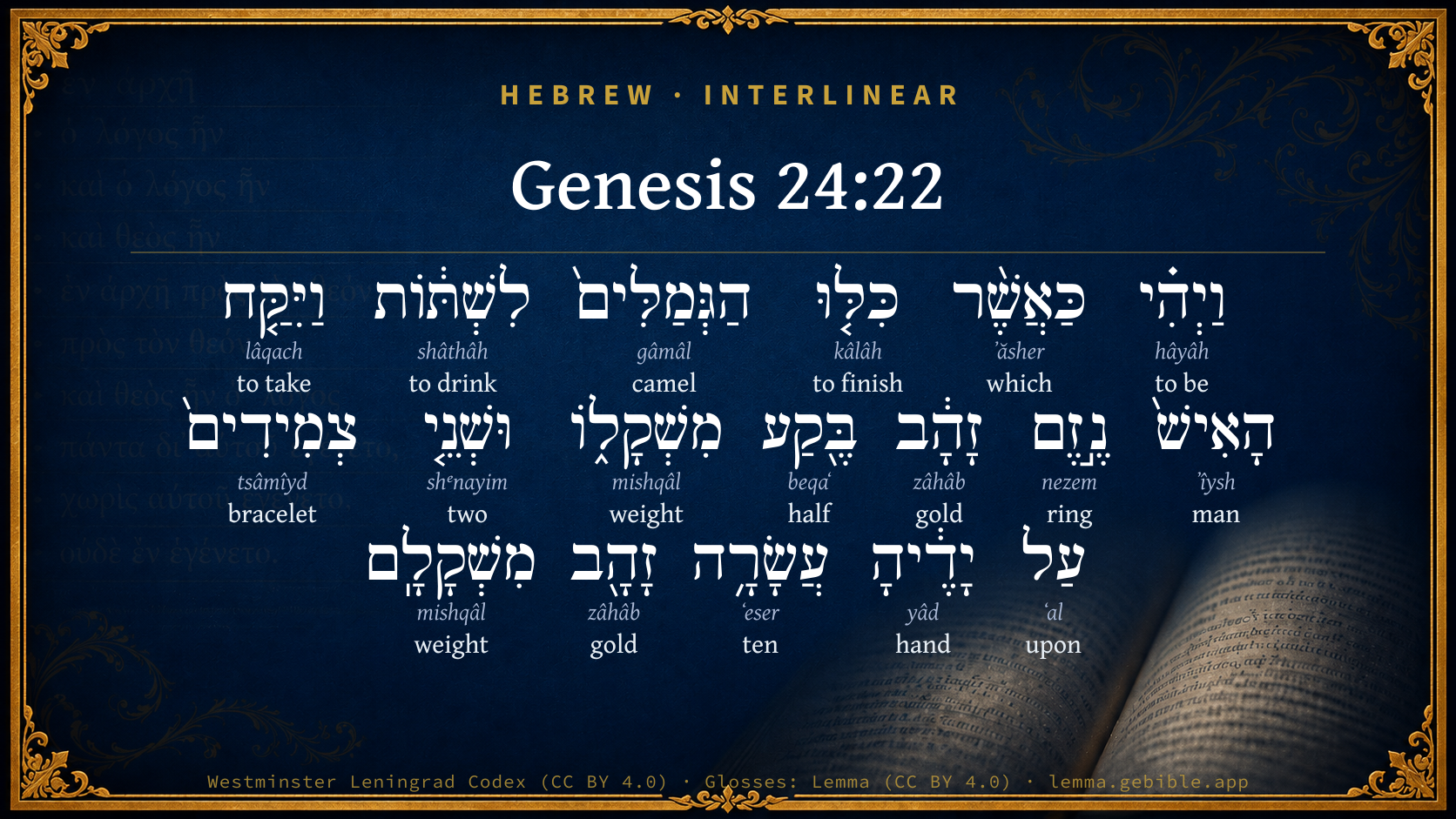
  1. וַיְהִ֗י hâyâh H1961 “and · to be” Conjunction + Verb, Qal, Sequential Imperfect, 3rd Person, Masculine, Singular
  2. כַּאֲשֶׁ֨ר ʼăsher H834 “like/as · which” Preposition + Particle, Relative
  3. כִּלּ֤וּ kâlâh H3615 “to finish” Verb, Piel, Perfect, 3rd Person, Common, Plural
  4. הַגְּמַלִּים֙ gâmâl H1581 “the · camels” Particle, Definite Article + Noun, Common, Masculine, Plural, Absolute
  5. לִשְׁתּ֔וֹת shâthâh H8354 “to drink” Preposition + Verb, Qal, Infinitive Construct
  6. וַיִּקַּ֤ח lâqach H3947 “and · to take” Conjunction + Verb, Qal, Sequential Imperfect, 3rd Person, Masculine, Singular
  7. הָאִישׁ֙ ʼîysh H376 “the · man” Particle, Definite Article + Noun, Common, Masculine, Singular, Absolute
  8. נֶ֣זֶם nezem H5141 “ring of” Noun, Common, Masculine, Singular, Construct
  9. זָהָ֔ב zâhâb H2091 “gold” Noun, Common, Masculine, Singular, Absolute
  10. מִשְׁקָל֑וֹ mishqâl H4948 “weight · his” Noun, Common, Masculine, Singular, Construct + Suffix, Personal, 3rd Person, Masculine, Singular
  11. וּשְׁנֵ֤י shᵉnayim H8147 “and · two” Conjunction + Adjective, Cardinal number, Masculine, Dual, Construct
  12. צְמִידִים֙ tsâmîyd H6781 “bracelets” Noun, Common, Masculine, Plural, Absolute
  13. עַל ʻal H5921 “upon” Preposition
  14. יָדֶ֔יהָ yâd H3027 “hands · her” Noun, Common, Both, Dual, Construct + Suffix, Personal, 3rd Person, Feminine, Singular
  15. עֲשָׂרָ֥ה ʻeser H6235 “ten” Adjective, Cardinal number, Masculine, Singular, Absolute
  16. זָהָ֖ב zâhâb H2091 “gold” Noun, Common, Masculine, Singular, Absolute
  17. מִשְׁקָלָֽם mishqâl H4948 “weight · their” Noun, Common, Masculine, Singular, Construct + Suffix, Personal, 3rd Person, Masculine, Plural

About this verse

These counts appear in no published source. They are computed here, from the morphology-tagged text and Lemma’s own curated glosses. What Lemma adds →

18
words
16
distinct lemmas
Pentateuch
section

Notable vocabulary

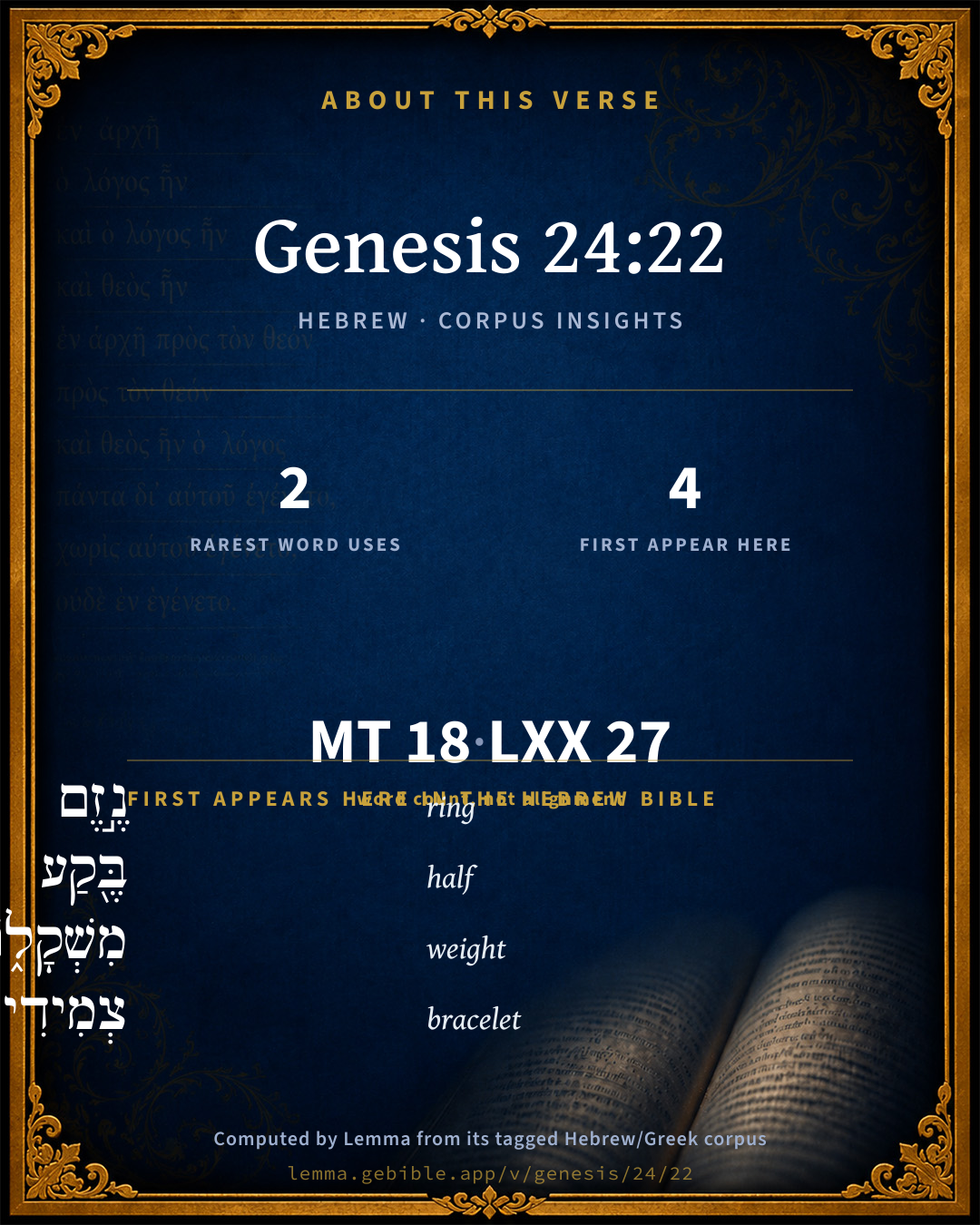
The rarest word here is בֶּ֖קַע half H1235 — appearing just 2 times in the whole Hebrew Bible.

First appearance in Scripture

These words make their first canonical appearance in the Hebrew Bible here:

  • נֶ֣זֶם ring H5141
  • בֶּ֖קַע half H1235
  • מִשְׁקָל֑וֹ weight H4948
  • צְמִידִים֙ bracelet H6781

Shared distinctive vocabulary

בֶּ֖קַע half H1235 occurs in 2 verses of the Hebrew Bible. Also found in:

Grammatical profile

  • 4 verbs
  • 10 nouns
  • 2 adjectives
  • 1 preposition
  • 1 particle

Verb forms

  • וַיְהִ֗י Qal · Sequential Imperfect
  • כִּלּ֤וּ Piel · Perfect
  • לִשְׁתּ֔וֹת Qal · Infinitive Construct
  • וַיִּקַּ֤ח Qal · Sequential Imperfect

Repetition

Words recur within this verse — often emphatic in Hebrew:

  • זָהָ֔ב gold H2091 ×2
  • מִשְׁקָל֑וֹ weight H4948 ×2

Hebrew & Septuagint length

In English translation the verse runs 32 words from the Hebrew and 37 from the Septuagint (LXX English) — closely comparable.

A rough comparison of the two English renderings, which tokenize alike — not a word-level alignment.

Word counts can differ between the Hebrew and the Greek without any difference in meaning — e.g. the Hebrew direct-object marker אֵת has no separate Greek word, and Greek often adds the article ὁ.

In the original languages it is 18 Hebrew tokens and 27 Greek tokens — but the two are counted differently (Hebrew bundles its prefixes and suffixes into one token; the Greek is in lemma form), so that isn’t a like-for-like length.

Cross-references

11

Topical passages linked to Genesis 24:22 in the Treasury of Scripture Knowledge — connected by theme and wording, ordered by reader-vote popularity; previews shown in the World English Bible.

  • Ezekiel 16:11–12 I decked you with ornaments, and I put bracelets on your hands, and a chain on your neck.
  • Exodus 32:2–3 Aaron said to them, "Take off the golden rings, which are in the ears of your wives, of your sons, and of your daughters, and bring them to me."
  • Genesis 23:15–16 "My lord, listen to me. What is a piece of land worth four hundred shekels of silver between me and you? Therefore bury your dead."
  • Genesis 24:30 It happened, when he saw the ring, and the bracelets on his sister's hands, and when he heard the words of Rebekah his sister, saying, "This is what the man said to me," that he came to the man. Behold, he was standing by the camels at the spring.
  • Genesis 24:47 I asked her, and said, 'Whose daughter are you?' She said, 'The daughter of Bethuel, Nahor's son, whom Milcah bare to him.' I put the ring on her nose, and the bracelets on her hands.
  • Jeremiah 2:32 Can a virgin forget her ornaments, or a bride her attire? yet my people have forgotten me days without number.
  • Esther 5:1 Now it happened on the third day, that Esther put on her royal clothing, and stood in the inner court of the king's house, over against the king's house: and the king sat on his royal throne in the royal house, over against the entrance of the house.
  • Isaiah 3:19–23 the earrings, the bracelets, the veils,
  • 1 Timothy 2:9–10 In the same way, that women also adorn themselves in decent clothing, with modesty and propriety; not just with braided hair, gold, pearls, or expensive clothing;
  • 1 Peter 3:3 Let your beauty be not just the outward adorning of braiding the hair, and of wearing jewels of gold, or of putting on fine clothing;
  • 1 Peter 3:8 Finally, be all like-minded, compassionate, loving as brothers, tenderhearted, courteous,

Cross-references courtesy of OpenBible.info (CC BY 4.0).

Hebrew and Greek witnesses Masoretic Hebrew ↔ Greek Septuagint

The same verse in the two great witnesses to the Old Testament, shown verse-for-verse.

These are two independent witnesses, not word-aligned to each other, and the Septuagint is shown in lemma (dictionary) form.

Hebrew Genesis 24:22 Masoretic · Westminster Leningrad Codex

וַיְהִ֗י כַּאֲשֶׁ֨ר כִּלּ֤וּ הַגְּמַלִּים֙ לִשְׁתּ֔וֹת וַיִּקַּ֤ח הָאִישׁ֙ נֶ֣זֶם זָהָ֔ב בֶּ֖קַע מִשְׁקָל֑וֹ וּשְׁנֵ֤י צְמִידִים֙ עַל יָדֶ֔יהָ עֲשָׂרָ֥ה זָהָ֖ב מִשְׁקָלָֽם

It happened, as the camels had done drinking, that the man took a golden ring of half a shekel weight, and two bracelets for her hands of ten shekels weight of gold,

World English Bible · Public Domain

Greek LXX Genesis 24:22 Septuagint · lemma form

γίγνομαι δέ ἡνίκα παύω πᾶς ὁ κάμηλος πίνω λαμβάνω ὁ ἄνθρωπος ἐνώτιον χρύσεος ἀνά δραχμή ὁλκή καί δύο ψέλιον ἐπί ὁ χείρ αὐτός δέκα χρυσοῦς ὁλκή αὐτός

And it came to pass when all the camels ceased drinking, that the man took golden ear-rings, each of a drachm weight, and he put two bracelets on her hands, their weight was ten pieces of gold.

LXX2012 (modern English Septuagint) · Public Domain

On this verse, The Cambridge Bible for Schools and Colleges discusses the Septuagint’s reading. Read the note in Commentary ↓

Hebrew: Westminster Leningrad Codex (CC BY 4.0). Greek: Septuagint (public domain); English from LXX2012 (modern English Septuagint) (Public Domain). How the Septuagint differs from the Hebrew →

Targum (Aramaic paraphrase)

2

The Targum is the ancient Jewish Aramaic paraphrase of the Hebrew Scriptures — an interpretive translation, not the Hebrew text itself. Onkelos (literal) and Pseudo-Jonathan (expansive) render the Torah, and Jonathan the Prophets. Coverage is partial: where no permissively-licensed English translation exists for a verse, only the Aramaic is shown. This is verse-level text, not a word-by-word alignment to the Hebrew.

  1. Targum Onkelos Torah (Genesis–Deuteronomy)
    וַהֲוָה כַּד סַפִּיקוּ גַּמְלַיָּא לְמִשְׁתֵּי וּנְסֵיב גַּבְרָא קָדָשָׁא דְדַהֲבָא תִּקְלָא מַתְקְלֵהּ וּתְרֵין שֵׁירִין עַל יְדָהָא מַתְקַל עֲשַׂר סִלְעִין דְּדַהֲבָא מַתְקַלְהוֹן

    (no public-domain English translation for this verse)

    Targum Onkelos — Aramaic: “Onkelos Genesis” (public domain); “Onkelos Exodus” (public domain); “Onkelos Leviticus” (public domain); “Onkelos Numbers” (public domain); “Onkelos Deuteronomy” (public domain). English: “Sefaria Community Translation” (CC0 1.0 (public-domain dedication)); “J.W. Etheridge. The Targums of Onkelos and Jonathan Ben Uzziel on the Pentateuch. London: Longmans, Green, 1862” (public domain). Text via Sefaria.

  2. Targum Pseudo-Jonathan Torah (Genesis–Deuteronomy)
    וַהֲוָה כַּד סְפִּיקַן גַמְלַיָא לְמִמְלֵי וּנְסִיב גַבְרָא קָדָשָׁא דְדַהֲבָא דַרְכְּמוֹנָא מַתְקְלֵיהּ קֳבֵל דַרְכְּמוֹנָא לְגַלְגֶלְתָּא דְאִיטְמוּסִין בְּנָהָא לְמֵיתַב לְעִיבִידַת מַשְׁכְּנָא וּתְרֵין שִׁירִין יְהַב עַל יְדָהָא מַתְקַל עֲשַר סַלְעִין דְדַהֲבָא סְכוּם מַתְקַלְהוֹן קֳבֵל תְּרֵין לוּחַיָא דִכְתִיבִין בְהוֹן עֲשַרְתִּי דִבְּרַיָא

    And it was when the camels had been satisfied with drink, that the man took an earring of gold, of a drachma in weight, the counterpart of the drachma of the head (money) which her children presented for the work of the sanctuary; and he set two golden bracelets upon her hands, in weight ten sileen of gold; the sum of their weight being the counterpart of the two tables on which were inscribed the Ten Words.

    Targum Pseudo-Jonathan — Aramaic: “Targum Jonathan on Genesis” (public domain); “Targum Jonathan on Exodus” (public domain); “Targum Jonathan on Leviticus” (public domain); “Targum Jonathan on Numbers” (public domain); “Targum Jonathan on Deuteronomy” (public domain). English: “The Targum of Jonathan ben Uzziel, trans. J. W. Etheridge, London, 1862” (public domain). Text via Sefaria.

Commentary

Notes on Genesis 24:22 from classic Christian and Jewish commentators (each source and its license shown beneath its notes). The classic Christian expositions comment on the surrounding passage and are grouped to its opening verse, so a note may address several verses; the Jewish commentaries on the Tanakh (Rashi and others) are per-verse, so they appear only where the commentator wrote on this verse.

Lemma curates 59 commentaries, every one of them public domain or Creative Commons licensed, each selected and text-cleaned for this edition rather than reprinted as found. About our sources →

Adam Clarke's Commentary

Verse 22. The man took a golden ear-ring] נזם זהב nezem zahab. That this could not be an ear-ring is very probable from its being in the singular number. The margin calls it a jewel for the forehead; but it most likely means a jewel for the nose, or nose-ring, which is in universal use through all parts of Arabia and Persia, particularly among young women. They are generally worn in the left nostril. The word is very properly translated επιρρινον, an ornament for the nose, by Symmachus.

Half a shekel] For the weight of a shekel, See Clarke on Ge 20:16.

And two bracelets] ושני צמידים usheney tsemidim. As tsemidim comes from צמד tsamad, to join or couple together, it may very properly mean bracelets, or whatever may clasp round the arms or legs; for rings and ornaments are worn round both by females in India and Persia. The small part of the leg is generally decorated in this way, and so is the whole arm from the shoulder to the wrist. As these tsemidim were given to Rebekah for her hands, it sufficiently distinguishes them from a similar ornament used for the ankles.

In different parts of the sacred writings there are allusions to ornaments of various kinds still in use in different Asiatic countries. They are of seven different sorts.

1. for the forehead;

2. for the nose;

3. for the ears;

4. for the arms;

5. for the fingers;

6. for the neck and breast;

7. for the ankles.

See Ge 24:22, Ge 24:47; also Eze 16:12; Pr 11:22; Isa 3:21; Ge 35:4; Ex 32:2, Ex 32:3; Job 42:11; Jdg 8:24. The principal female ornaments are enumerated in the third chapter of Isaiah, which are very nearly the same that are in use in Persia and India to the present time.

Adam Clarke's Commentary on the Bible (1810–1826) — public domain. Text from a community e-Sword/MySword module.

Trapp's Complete Commentary

John Trapp

Gen 24:22 And it came to pass, as the camels had done drinking, that the man took a golden earring of half a shekel weight, and two bracelets for her hands of ten [shekels] weight of gold;

Ver. 22. The man took a golden earring.] Abiliment, or jewel; Ut imponeret naso eius, saith Junius, to hang upon her nose, or forehead. {as Gen 24:47} Each country hath its fashions and garnishes. In very many places of America, they have their lower lips bored through; as likewise, the upper parts of their ears, and something put into them. Which, as it seems to themselves to be a point of beauty, so it makes them appear to others to be wondrous ugly. {a}

{a} Archb. Abbot’s Geog., 278.

John Trapp, A Commentary or Exposition upon All the Books of the Old and New Testament (1647–1656) — public domain. Text from a community e-Sword module.

Joseph Benson's Commentary

Gen 24:22. Two bracelets of ten shekels weight of gold — That is, about six ounces. According to Sir J. Chardin, the women wear rings and bracelets of as great weight as this through all Asia, and even much heavier. St. Paul and St. Peter have directed Christians to a more excellent way of adorning themselves; “not with gold, or pearls, or costly array, but (which becometh women professing godliness) with good works;” “whose adorning, let it not be that outward plaiting of the hair, and of wearing of gold, but in that which is not corruptible, the ornament of a meek and quiet spirit, which, in the sight of God, is of great price.”

Joseph Benson's Commentary on the Old and New Testaments (1811–1818) — public domain. Text from a community e-Sword module.

Tyndale Open Study Notes

Tyndale Open Resources

24:22 The servant showed his gratitude by giving the girl expensive jewelry.

Tyndale Open Study Notes — © Tyndale Open Resources, licensed CC BY-SA 4.0. Text via the HelloAO Bible API.

Geneva Bible (1599)

Geneva Bible translators

Or, earring.

The golden shekel is here meant and not that of silver.

God permitted many things both in apparel and other things which are now forbid: specially when they appertain not to our mortification.

Geneva Bible (1599) marginal notes — public domain. Text via Bolls.life.

Jamieson, Fausset & Brown

Robert Jamieson, A. R. Fausset & David Brown

the man took a golden earring, &c.--The ring was not for the ear, but the nose; the armlets, such as young women in Syria and Arabia still appear daily at wells decked in. They are worn from the elbow to the wrist, commonly made of silver, copper, brass, or horn.

Jamieson, Fausset & Brown — Commentary Critical and Explanatory on the Whole Bible (1871) — public domain (CC PDM 1.0). Text via the HelloAO Bible API.

John Calvin's Commentaries

22. The man took a golden ear-ring. His adorning the damsel with precious ornaments is a token of his confidence. For since it is evident by many proofs that he was an honest and careful servant, he would not throw away without discretion the treasures of his master. He knows, therefore, that these gifts will not be ill-bestowed; or, at least, relying on the goodness of God, he gives them, in faith, as an earnest of future marriage. But it may be asked, Whether God approves ornaments of this kind, which pertain not so much to neatness as to pomp? I answer, that the things related in Scripture are not always proper to be imitated. Whatever the Lord commands in general terms is to be accounted as an inflexible rule of conduct; but to rely on particular examples is not only dangerous, but even foolish and absurd. Now we know how highly displeasing to God is not only pomp and ambition in adorning the body, but all kind of luxury. In order to free the heart from inward cupidity, he condemns that immoderate and superfluous splendor, which contains within itself many allurements to vice. Where, indeed, is pure sincerity of heart found under splendid ornaments? Certainly all acknowledge this virtue to be rare. It is not, however, for us expressly to forbid every kind of ornament; yet because whatever exceeds the frugal use of such things is tarnished with some degree of vanity; and more especially, because the cupidity of women is, on this point, insatiable; not only must moderation, but even abstinence, be cultivated as far as possible. Further, ambition silently creeps in, so that the somewhat excessive adorning of the person soon breaks out into disorder. With respect to the earrings and bracelets of Rebekah, as I do not doubt that they were those in use among the rich, so the uprightness of the age allowed them to be sparingly and frugally used; and yet I do not excuse the fault. This example, however, neither helps us, nor alleviates our guilt, if, by such means, we excite and continually inflame those depraved lusts which, even when all incentives are removed, it is excessively difficult to restrain. The women who desire to shine in gold, seek in Rebekah a pretext for their corruption. Why, therefore, do they not, in like manner, conform to the same austere kind of life and rustic labor to which she applied herself? But, as I have just said, they are deceived who imagine that the examples of the saints can sanction them in opposition to the common law of God. Should any one object that it is abhorrent to the modesty of a virtuous and chaste maiden to receive earrings and bracelets from a man who was a stranger, and whom she had never before seen. In the first place, it may be, that Moses passes over much conversation held on both sides, by which it is probable she was induced to venture on the reception of them. It may also be, that he relates first what was last in order. For it follows soon afterwards in the context, that the servant of Abraham inquired whose daughter she was. We must also take into account the simplicity of that age. Whence does it arise that it was not disreputable for a maid to go alone out of the city, unless that then the morals of mankind did not require so severe a guard for the preservation of modesty? Indeed, it appears from the context, that the ornaments were not given her for a dishonorable purpose; but a portion is offered to the parents to facilitate the contract for marriage. Interpreters are not agreed respecting the value of the presents. Moses estimates the earrings at half a shekel, and the bracelets at ten shekels. Jerome, instead of half a shekel, reads two shekels. I conceive the genuine sense to be, that the bracelets were worth ten shekels, and the frontal ornament or earrings worth half that sum, or five shekels. For since nothing is added after the word בקע (bekah,) it has reference to the greater number. Otherwise here is no suitable proportion between the bracelets and the ornaments for the head. Moreover, if we take the shekel for four Attic drachms, the value is trifling; therefore I think the weight of gold is indicated, which makes the sum much greater than the piece of money called a shekel.

John Calvin's Commentaries (1540-1563) — public domain. Text from the Calvin Translation Society English edition (1840s-50s) via the Christian Classics Ethereal Library (ccel.org). Calvin's coverage is partial (roughly two-thirds of the Bible); uncommented books and verses are honest gaps, never fabricated. The 19th-century editor's footnotes and remarks are omitted so the notes are faithfully Calvin's own voice.

Ellicott's Commentary for English Readers

(22) Earring.—Really nose-ring; for in Gen_24:47 the man places it on her nose, wrongly translated face in our version. The word occurs again in Eze_16:12, where it is rendered jewel, and again is placed “on the nose;” it is also similarly translated jewel in Pro_11:22, where it is placed in “a swine’s snout.” It was hung not from the central cartilage of the nose, but from the left nostril, the flesh of which was pierced for the purpose; and such rings are still the usual betrothal present in Arabia, and are commonly worn both there and in Persia, made not only of gold and of silver but of coral, mother-of-pearl, and even cheaper materials. (See Quotation in Note on Gen_24:16.) Its weight, about a quarter of an ounce, would make it not more disfiguring than many of the personal ornaments worn at the present time.

Bracelets are profusely worn at this day by Oriental women, the whole arm to the elbow being usually covered by them.

A Bible Commentary for English Readers, edited by Charles John Ellicott (1878–1897) — public domain. Text from a community e-Sword module.

The Cambridge Bible for Schools and Colleges

gen. ed. J. J. S. Perowne

22. a golden ring] The ring (nezem) was probably a nose-ring, cf. Gen_24:47. So the Samaritan version here reads “and put it on her nose.” LXX ἐνώτια, Lat. inaures = “earrings.”

See for the nezem Pro_11:22, Isa_3:21, Eze_16:12, where in each case a nose-jewel is indicated.

half a shekel weight] Heb. beḳa. See Exo_38:26. Half a shekel weighed one quarter of an ounce. There is only mention of one ring, and this is of light weight. The two bracelets weighed 10 shekels, or 5 ounces. These gifts reward her kindness in a lavish manner, and lead up to the request for a lodging at her home. On the shekel, see Gen_20:16, Gen_23:15.

The Cambridge Bible for Schools and Colleges (gen. ed. J. J. S. Perowne; Cambridge University Press, 1878–1918) — public domain. Text from a community e-Sword module.

John Gill's Exposition

And it came to pass, as the camels had done drinking,.... Having had enough to abate their thirst and satisfy them, by means of Rebekah's drawing water for them:

that the man took a golden earring; out of his pocket, or out of a box or parcel that was upon the camels; it is in the margin of our Bibles, "a jewel for the forehead"; or, as some render it, a "nose jewel" (y); and so in Gen 24:47, "an earring upon her face", or "nose"; and this was a jewel that hung from the forehead upon a lace or ribbon between the eyes down upon the nose; and such the daughters of Sion wore in later times, Isa 3:21; see Eze 16:12; and nose jewels are still in use with the Levant Arabs, as Dr. Shaw (z) relates. Rauwolff (a), who travelled through Mesopotamia and the parts adjacent in 1574, says of the women in those parts that are of greater substance, and have a mind to be richer and finer in their dress, that they wear silver and gold rings in one of their nostrils, wherein are set garnets, turquoise, rubies, and pearls: and in Egypt they wear nose jewels (b) and small gold rings in their right nostrils, with a piece of coral set in them (c) and this earring or jewel was

of half a shekel weight; which was eighty barley corns, for a whole shekel weighed one hundred and sixty. The Targum of Jonathan is,"the weight of a drachma, which was the half of a didrachma or common shekel:"

and two bracelets for her hands, of ten shekels weight of gold; a shekel of gold, according to Calmet (d), was worth eighteen shillings and three pence of English money, so that ten of them amount to nine pounds two shillings and six pence; according to Waserus (e), these made twenty Hungarian pieces of gold, which were worth upwards of ninety pounds of Swiss money. A handsome present this was, and suitable to a virgin. Jarchi and Jonathan allegorize the two bracelets of the two tables of the law, and the ten shekels of the ten commands on them.

(y) "imponeret naso ejus monile aureum", Junius & Tremellius. (z) Travels, p. 241. Ed. 2. (a) Travels, par. 2. ch. 5. p. 128, 129. (b) Pitts's Account of Mahometanism, p. 68. (c) Egmont and Heyman's Travels, vol. 2. p. 85. (d) Dictionary, in the word "Shekel". (e) De Antiqu. numis, Heb. l. 2. c. 10.

John Gill's Exposition of the Whole Bible (1746–1763) — public domain (CC PDM 1.0). Text via the HelloAO Bible API.

Matthew Poole's English Annotations

The man took, i.e. gave to her, (as that word of taking, or receiving, is oft used, as Gen 12:19; Exo 18:12; 29:25; Psa 68:18, compared with Eph 4:8),

a golden earring; so the word signifies, Gen 35:4; Exo 32:2,3. Or, jewels for the forehead, which hung down from the forehead to the nose, or between the eyes. So the word is used, Gen 24:47; Eze 16:12.

Matthew Poole's English Annotations on the Holy Bible (1683–1685) — public domain. Text from a community e-Sword/MySword module.

Whedon's Commentary on the Bible

Daniel D. Whedon

22. Earring — נזםis generally believed to have been a nose ring, for in Gen_24:47 he is said to have put it on her face; Hebrews, nose (אŠ.)

Bracelets — All sorts of jewels are highly prized among the women of the East, and rings, bracelets, or ornaments of some kind, such as each person can afford or obtain, are universally worn. The weight of this ring, half a shekel, or a beka, has been estimated at a quarter of an ounce, and the bracelets at over four ounces. But our knowledge of these ancient weights is very uncertain.

Daniel D. Whedon (gen. ed.), Commentary on the Old and New Testaments (1874–1909) — public domain. Text from a community e-Sword module.

The Pulpit Commentary

Vers. 22-27. And it came to pass, as the camels had done drinking, it is remembered that camels, though endowed in an almostmarvelous degree with the power of enduring thirst, drink, when an opportunity offers, an enormous quantity of water, it will be acknowledged that the trouble to which the maiden cheerfully submitted required more than ordinary, patience" (Kalisch)that the man took a golden earring of half a shekel weight, the was neither a pendant for the ear (LXX, Vulgate) nor a jewel for the forehead (A.V, margin), but a ring for the nose (ver. 47), the side cartilage, and sometimes the central wall, of which was pierced for the purpose of admitting it (cf. Eze_16:11, Eze_16:12) Such rings are still worn by Oriental women, and in particular "the nose-ring is now the usual engagement present among the Bedouins" (Delitzsch). The weight of that presented to Rebekah was one qb, or half ( sc. shekel), from qb; to divideand two bracelets for her hands of ten shekels weight of gold; the rymi; from rmx; to bind or fasten, meant a circle of gold for the wrist or arm. So favorite an ornament is this of Oriental ladies, that sometimes the whole arm from wrist to elbow is covered with them; some- times two or more are worn one above the other; and not infrequently are they so numerous and heavy as almost to appear burdensome to the fair owners (Kalisch)and said, Whose daughter art thou! tell me, I pray thee: is there room in thy father"s house for us to lodge in? The production of the bridal presents, and the tenor of the old man"s inquiries, indicate that already he entertained the belief that he looked upon the object of his search. All dubiety was dispelled by Rebekah"s answer. And she said unto him, I am the daughter of Bethuel the son of Milcah, to show that she was not descended from Nahor"s concubine (cf. ver. 15) which she bare unto Nahor. This appears to have been the stage at which the jewels were presented (ver. 47). She said moreover unto him, We have both straw and provender enough, and room to lodge in. It was now conclusively determined, by her answering all the pre-arranged criteria, that the Lord had heard his prayer and prospered his way, and that the heaven-appointed bride stood before him. And the man bowed down his head, and worshipped the Lord. The first verb expressing reverent inclination of the head, and the second complete prostration of the body, and both combining "to indicate the aged servant"s deep thankfulness for the guidance of the Lord." And he said, Blessed be the Lord God of my master Abraham (on the import of vide, (Gen_2:2-6) who hath not left destitute my master of his mercy and his truth: literally, who hath not taken away his grace (i.e. the free favor which bestows) and ale truth (i.e. the faithfulness which implements promises) from (=from the house of, as in Exo_8:8, Exo_8:25, Exo_8:26; Gesenius) my master (cf. Psa_57:3; Pro_20:28) I being in the way, the Lord led (or, hath led) me to the house of my master"s brethren.

The Pulpit Commentary (1880–1919), ed. H.D.M. Spence-Jones & Joseph S. Exell — public domain. Text from a community e-Sword module.

Keil & Delitzsch

C. F. Keil & F. Delitzsch

After the watering of the camels was over, the man took a golden nose-ring of the weight of a beka, i.e., half a shekel (Exo 38:26), and two golden armlets of 10 shekels weight, and (as we find from Gen 24:30 and Gen 24:47) placed these ornaments upon her, not as a bridal gift, but in return for her kindness. He then asked her about her family, and whether there was room in her father's house for him and his attendants to pass the night there; and it was not trill after Rebekah had told him that she was the daughter of Bethuel, the nephew of Abraham, and had given a most cheerful assent to his second question, that he felt sure that this was the wife appointed by Jehovah for Isaac. He then fell down and thanked Jehovah for His grace and truth, whilst Rebekah in the meantime had hastened home to relate all that had occurred to "her mother's house," i.e., to the female portion of her family. חסד the condescending love, אמת the truth which God had displayed in the fulfilment of His promise, and here especially manifested to him in bringing him to the home of his master's relations.

Keil & Delitzsch — Biblical Commentary on the Old Testament (1861–1891) — public domain (CC PDM 1.0). Text via the HelloAO Bible API. (Old Testament only.)

Rashi

Rabbi Shlomo Yitzchaki (Rashi)

בקע BEKA (half a Shekel) — a symbol of the Shekels of the Israelites of which it is said (Exodus 38:26) “a Beka (half a Shekel) a head” (cf. Targum Jon).

ושני צמידים AND TWO BRACELETS (the word for bracelet signifies something joined or united) — a symbol of the two Tablets of stone, joined one to another (Genesis Rabbah 60:6).

עשרה זהב משקלם TEN SHEKELS OF GOLD WAS THEIR WEIGHT —a symbol of the Ten Commandments written on them (the Tablets) (Genesis Rabbah 60:6).

Rashi on the Tanakh — English translations: “The Judaica Press complete Tanach with Rashi, translated by A. J. Rosenberg” (CC BY 4.0); “Pentateuch with Rashi's commentary by M. Rosenbaum and A.M. Silbermann, 1929-1934” (public domain); “The Metsudah Tanach series, Lakewood, N.J” (CC BY 4.0); and “The Book of Joshua, Metsudah Publications, 1997” (CC BY 4.0). Text via Sefaria.

Ramban (Nachmanides)

Rabbi Moshe ben Nachman (Ramban / Nachmanides)

AND THE MAN TOOK A GOLDEN RING… AND TWO BRACELETS UPON HER HANDS. This verse omits the deed for it should have said: “And the man took a golden ring and put it upon her nose and two bracelets upon her hands.” Therefore I say that the interpretation of the verse is as follows: And the man took a golden ring and two bracelets which would be upon her hands, and he said to her, Whose daughter art thou? And after she had told him, I am the daughter of Bethuel, he put the ring upon her nose and the bracelets upon her hands, as he told them. Here, however, Scripture omits the actual giving, and similarly in many places.

Ramban (Nachmanides) on the Tanakh — English translation: “Commentary on the Torah by Ramban (Nachmanides). Translated and annotated by Charles B. Chavel. New York, Shilo Pub. House, 1971-1976” (CC BY 4.0). Text via Sefaria.

Sforno

Rabbi Ovadia Sforno

When the camels had finished. He did not give her the jewelry immediately after she finished drawing the water because he was waiting to see if she would ask for remuneration.

Sforno on the Tanakh — English translation: “Yalkut, Sifsei Chachomim Chumash, Metsudah Publications, 2009” (CC BY 4.0). Text via Sefaria.

Radak

Rabbi David Kimhi (Radak)

ויהי...ויקח, “he took out the jewelry planning to give it to her after he had asked her the relevant questions. This is also how he describes the sequence of what occurred at the well when he relates the nature of his mission in Betuel’s home before eating the first course of the meal served (verse 46)

בקע, a half shekel. He placed it on her nose as mentioned in verse 46. Similarly, in sequence, he placed the other pieces of jewelry on her hands, bracelets

weighing ten pieces of gold (ten סלעים in weight according to Onkelos).

Radak on the Tanakh — English translations: “Sefaria Community Translation” (CC0 1.0 (public-domain dedication)); “Eliyahu Munk, HaChut Hameshulash” (CC BY 4.0); “Rabbi Mike Feuer, Jerusalem Anthology” (CC BY 4.0); and “R. David Kimhi on the first book of Psalms, Translated by R.G. Finch, London, 1919” (public domain). Text via Sefaria.

Lesson kit

Teaching starters — assembled from the data on this page, not authored interpretation. Every prompt links to the verse data it draws on. Edit before teaching.

Genesis, in the Pentateuch, opens this verse with 18 words (16 distinct Hebrew lemmas). Its most distinctive word is beqaʻ (“half”). A historical commentator’s framing appears above. Read the whole chapter for the surrounding context.

Discussion questions

  1. What does “half” (beqaʻ) contribute to the verse as a whole?
  2. 4 words here appear for the first time in Scripture. What is being introduced at this debut?
  3. Exodus 38:26 shares the word «half» with this verse. How do the two illuminate each other?
  4. “gold” occurs 2× in this one verse. What is the effect of the repetition?
  5. These translations render this verse differently. What is at stake in choosing one wording over another?
  6. The verb «וַיְהִ֗י» is Qal Sequential Imperfect. How does its form color the action?
  7. Reading how Adam Clarke's Commentary and Trapp's Complete Commentary read this verse, where do the two commentators agree and where do they part?

Things to notice

Reading settings

Reading text

Shown beneath each verse's original-language words.

Old Testament
Old Testament edition

Read the OT as the Masoretic Hebrew (MT) or the Greek Septuagint (LXX).

English shown for the Greek Septuagint (in the Hebrew ↔ Greek comparison).

Comparing translations? Open the Compare panel on any verse page to stack up to four side by side.