Exodus 2:20

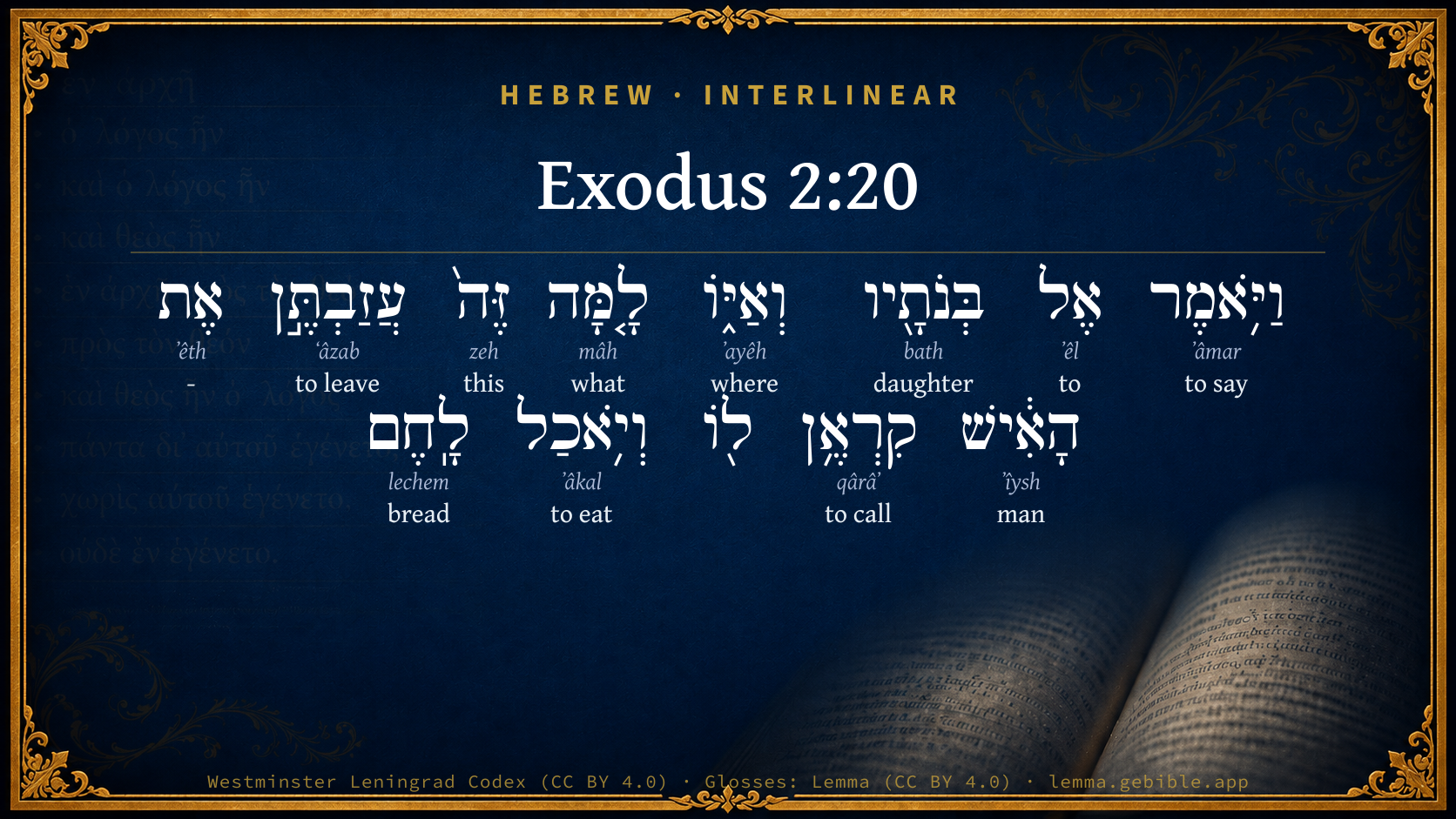
Hebrew (Westminster Leningrad Codex) Exodus 2:20 appears in the Hebrew Old Testament. The text above is from the Westminster Leningrad Codex. Each word links to its Strong’s number, a concise gloss, and parsing drawn from the Open Scriptures Hebrew Bible morphology. Click any word for its full Brown-Driver-Briggs (BDB) entry.
Download image
Cite this verse

Exodus 2:20 (World English Bible). Public Domain. Lemma interlinear Bible study tool, https://lemma.gebible.app/v/exodus/2/20.

Show BibTeX & RIS
BibTeX
RIS
English Translation
He said to his daughters, "Where is he? Why is it that you have left the man? Call him, that he may eat bread."
World English Bible · Public Domain
Download a study sheet

One document with this verse’s original text, its word-by-word gloss line, the meaning frame, cross-references with their text, attributed commentary, and full source and license credits — printable, and it pastes into notes with its structure intact.

This verse Autodidact and up

Study sheet (.html) Plain text (.txt)

A passage Seminary Student

Up to 50 verses in one chapter. A passage sheet keeps up to 6 commentary sources and 12 cross-references per verse, in the order this page ranks them, and says so on the sheet whenever that leaves anything out. Ask for a single verse and you get the Autodidact verse sheet above.

Everything on this page stays free to read, with no account — the sheet is a download of what is already on screen, not access to it.

Want to remove ads? Support Godless Engineer
Compare translations 3

The same verse in 3 English versions, stacked beneath the original-language interlinear above. Click any original word for its lexicon entry.

Each is an independent rendering of the whole verse — the interlinear is not word-aligned to these translations.

Highlighted words mark where these versions differ — a whole-verse word diff, not a word-by-word alignment.

  • World English Bible Public Domain
    He said to his daughters, "Where is he? Why is it that you have left the man? Call him, that he may eat bread."
  • King James Version Public Domain
    And he said unto his daughters, And where is he? why is it that ye have left the man? call him, that he may eat bread.
  • unfoldingWord Literal Text CC BY-SA 4.0
    And he said to his daughters, “And where is he? What is this? You left the man? Call him and he shall eat bread!”

unfoldingWord Literal Text — © unfoldingWord, licensed CC BY-SA 4.0. Word-aligned USFM3 via Door43 (git.door43.org/unfoldingWord/en_ult).

Versions to compare (up to 4)

3 of 4 selected

Show all 18 translations

Every available English version of this verse, each an independent rendering of the whole verse.

  • World English Bible Public Domain
    He said to his daughters, "Where is he? Why is it that you have left the man? Call him, that he may eat bread."
  • Berean Standard Bible Public Domain
    “So where is he?” their father asked. “Why did you leave the man behind? Invite him to have something to eat.”
  • Majority Standard Bible Public Domain
    “So where is he?” their father asked. “Why did you leave the man behind? Invite him to have something to eat.”
  • King James Version Public Domain
    And he said unto his daughters, And where is he? why is it that ye have left the man? call him, that he may eat bread.
  • American Standard Version (1901) Public Domain
    And he said unto his daughters, And where is he? Why is it that ye have left the man? Call him, that he may eat bread.
  • Revised Version (1885) Public Domain
    And he said unto his daughters, And where is he? why is it that ye have left the man? call him, that he may eat bread.
  • Geneva Bible (1599) Public Domain
    Then he saide vnto his daughters, And where is he? why haue ye so left the man? call him that he may eate bread.
  • Douay-Rheims (1899) Public Domain
    But he said: Where is he? why have you let the man go? call him that he may eat bread.
  • Young's Literal Translation Public Domain
    and he saith unto his daughters, `And where `is' he? why `is' this? -- ye left the man! call for him, and he doth eat bread.'
  • Literal Standard Version CC BY-SA 4.0
    and he says to his daughters, “And where [is] he? Why [is] this [that] you left the man? Call for him, and he eats bread.”
  • Unlocked Literal Bible CC BY-SA 4.0
    He said to his daughters, “So where is he? Why did you leave the man? Call him so he can eat a meal with us.”
  • unfoldingWord Literal Text CC BY-SA 4.0
    And he said to his daughters, “And where is he? What is this? You left the man? Call him and he shall eat bread!”
  • Darby Bible Public Domain
    And he said to his daughters, And where is he? why then have ye left the man behind? Call him, that he may eat bread.
  • World Messianic Bible Public Domain
    He said to his daughters, “Where is he? Why is it that you have left the man? Call him, that he may eat bread.”
  • Webster's Bible Public Domain
    And he said to his daughters, And where is he? why is it that ye have left the man? call him, that he may eat bread.
  • Free Bible Version CC BY-SA 4.0
    “So where is he?” Reuel asked his daughters. “You didn't just leave him there, did you? Go and invite him to eat with us!”
  • Bible in Basic English Public Domain
    And he said to his daughters, Where is he? why have you let the man go? make him come in and give him a meal.
  • JPS Tanakh (1917) Public Domain
    And he said unto his daughters: 'And where is he? Why is it that ye have left the man? call him, that he may eat bread.'

Literal Standard Version (2020), Covenant Press — licensed CC BY-SA 4.0. Text via the HelloAO Bible API (eBible.org). Unlocked Literal Bible (unfoldingWord) — licensed CC BY-SA 4.0. Text via the HelloAO Bible API (eBible.org). unfoldingWord Literal Text — © unfoldingWord, licensed CC BY-SA 4.0. Word-aligned USFM3 via Door43 (git.door43.org/unfoldingWord/en_ult). Free Bible Version, Dr. Jonathan Gallagher — licensed CC BY-SA 4.0. Text via the HelloAO Bible API (eBible.org).

Word by word

More ways to search: Search by grammar → Find every occurrence → Compare this word →

Practice this passage: Drill this verse → Learn its vocabulary →

וְאַיּ֑וֹ
ʼayêh
H346
“and · where · him”
Conjunction + Particle, Interrogative + Suffix, Personal, 3rd Person, Masculine, Singular
Part of Speech
Conjunction + Particle
Type
Interrogative
Full BDB Definition

Origin: prolonged from H335

TWOT: 75a

where? - of persons, things - rhetorical
  1. וַיֹּ֥אמֶר ʼâmar H559 “and · to say” Conjunction + Verb, Qal, Sequential Imperfect, 3rd Person, Masculine, Singular
  2. אֶל ʼêl H413 “to” Preposition
  3. בְּנֹתָ֖יו bath H1323 “daughters · his” Noun, Common, Feminine, Plural, Construct + Suffix, Personal, 3rd Person, Masculine, Singular
  4. לָ֤מָּה mâh H4100 “to/for · what” Preposition + Particle, Interrogative
  5. זֶּה֙ zeh H2088 “this” Pronoun, Demonstrative, Masculine, Singular
  6. עֲזַבְתֶּ֣ן ʻâzab H5800 “to leave” Verb, Qal, Perfect, 2nd Person, Feminine, Plural
  7. אֶת ʼêth H853 “-” Particle, Direct Object
  8. הָאִ֔ישׁ ʼîysh H376 “the · man” Particle, Definite Article + Noun, Common, Masculine, Singular, Absolute
  9. קִרְאֶ֥ן qârâʼ H7121 “call” Verb, Qal, Imperative, 2nd Person, Feminine, Plural
  10. וְיֹ֥אכַל ʼâkal H398 “and · to eat” Conjunction + Verb, Qal, Imperfect, 3rd Person, Masculine, Singular
  11. לָֽחֶם lechem H3899 “bread” Noun, Common, Both, Singular, Absolute

About this verse

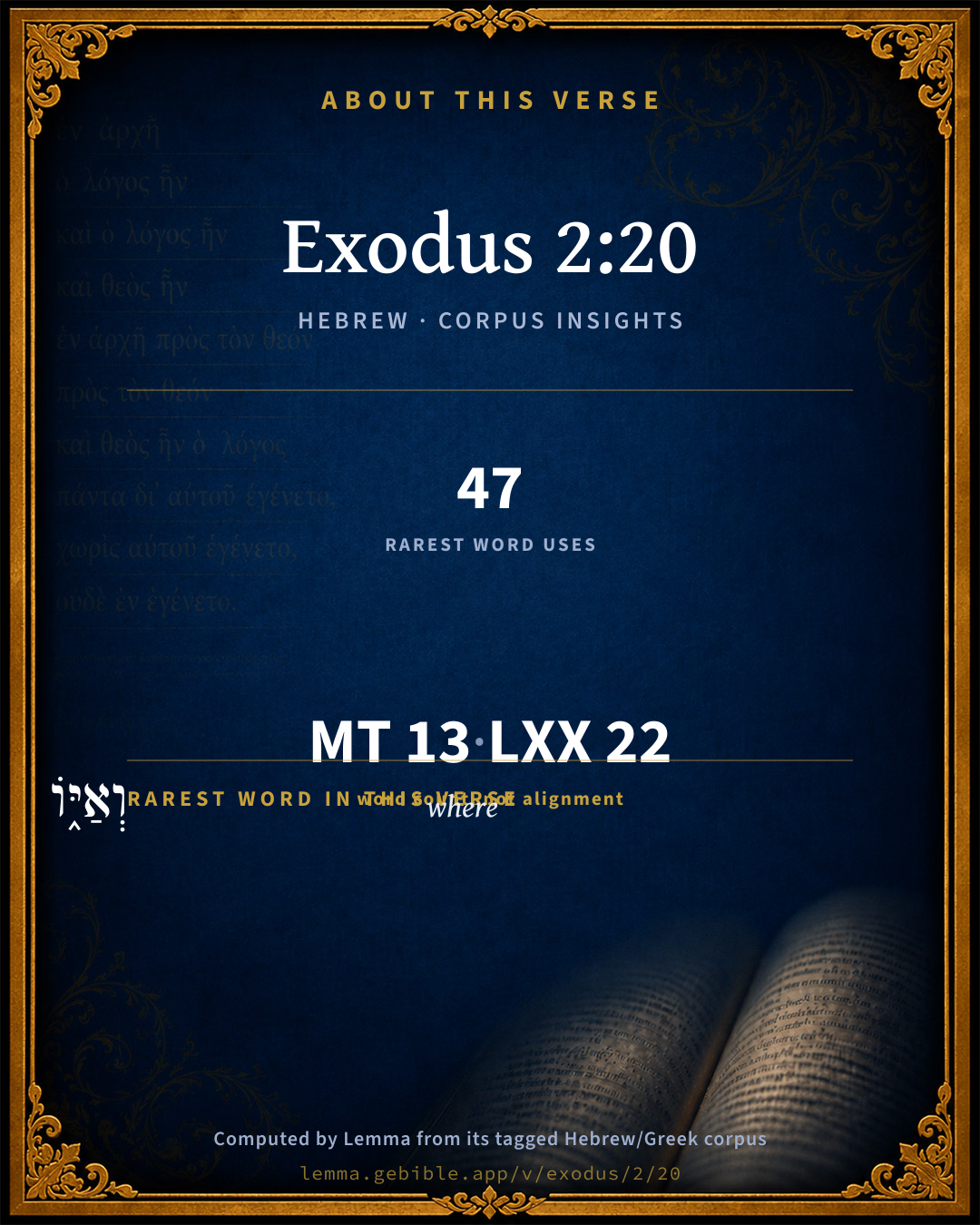
These counts appear in no published source. They are computed here, from the morphology-tagged text and Lemma’s own curated glosses. What Lemma adds →

13
words
12
distinct lemmas
Pentateuch
section

Shared distinctive vocabulary

וְאַיּ֑וֹ where H346 occurs in 40 verses of the Hebrew Bible. Also found in:

Grammatical profile

  • 4 verbs
  • 3 nouns
  • 1 pronoun
  • 2 prepositions
  • 3 particles

Verb forms

  • וַיֹּ֥אמֶר Qal · Sequential Imperfect
  • עֲזַבְתֶּ֣ן Qal · Perfect
  • קִרְאֶ֥ן Qal · Imperative
  • וְיֹ֥אכַל Qal · Imperfect

Hebrew & Septuagint length

In English translation the verse runs 24 words from the Hebrew and 25 from the Septuagint (LXX English) — closely comparable.

A rough comparison of the two English renderings, which tokenize alike — not a word-level alignment.

Word counts can differ between the Hebrew and the Greek without any difference in meaning — e.g. the Hebrew direct-object marker אֵת has no separate Greek word, and Greek often adds the article ὁ.

In the original languages it is 13 Hebrew tokens and 22 Greek tokens — but the two are counted differently (Hebrew bundles its prefixes and suffixes into one token; the Greek is in lemma form), so that isn’t a like-for-like length.

Cross-references

10

Topical passages linked to Exodus 2:20 in the Treasury of Scripture Knowledge — connected by theme and wording, ordered by reader-vote popularity; previews shown in the World English Bible.

  • Genesis 31:54 Jacob offered a sacrifice in the mountain, and called his relatives to eat bread. They ate bread, and stayed all night in the mountain.
  • Genesis 43:25 They made ready the present for Joseph's coming at noon, for they heard that they should eat bread there.
  • Genesis 18:5 I will get a morsel of bread so you can refresh your heart. After that you may go your way, now that you have come to your servant." They said, "Very well, do as you have said."
  • Genesis 19:2–3 and he said, "See now, my lords, please turn aside into your servant's house, stay all night, wash your feet, and you will rise up early, and go on your way." They said, "No, but we will stay in the street all night."
  • Genesis 24:31–33 He said, "Come in, you blessed of Yahweh. Why do you stand outside? For I have prepared the house, and room for the camels."
  • Job 31:32 (The foreigner has not lodged in the street; But I have opened my doors to the traveler);
  • Job 42:11 Then came there to him all his brothers, and all his sisters, and all those who had been of his acquaintance before, and ate bread with him in his house. They comforted him, and consoled him concerning all the evil that Yahweh had brought on him. Everyone also gave him a piece of money, and everyone a ring of gold.
  • 1 Timothy 5:10 being approved by good works, if she has brought up children, if she has been hospitable to strangers, if she has washed the saints' feet, if she has relieved the afflicted, and if she has diligently followed every good work.
  • Hebrews 13:2 Don't forget to show hospitality to strangers, for in doing so, some have entertained angels without knowing it.
  • Genesis 29:13 It happened, when Laban heard the news of Jacob, his sister's son, that he ran to meet Jacob, and embraced him, and kissed him, and brought him to his house. Jacob told Laban all these things.

Cross-references courtesy of OpenBible.info (CC BY 4.0).

Hebrew and Greek witnesses Masoretic Hebrew ↔ Greek Septuagint

The same verse in the two great witnesses to the Old Testament, shown verse-for-verse.

These are two independent witnesses, not word-aligned to each other, and the Septuagint is shown in lemma (dictionary) form.

Hebrew Exodus 2:20 Masoretic · Westminster Leningrad Codex

וַיֹּ֥אמֶר אֶל בְּנֹתָ֖יו וְאַיּ֑וֹ לָ֤מָּה זֶּה֙ עֲזַבְתֶּ֣ן אֶת הָאִ֔ישׁ קִרְאֶ֥ן ל֖וֹ וְיֹ֥אכַל לָֽחֶם

He said to his daughters, "Where is he? Why is it that you have left the man? Call him, that he may eat bread."

World English Bible · Public Domain

Greek LXX Exodus 2:20 Septuagint · lemma form

ὁ δέ εἶπον ὁ θυγάτηρ αὐτός καί ποῦ εἰμί καί ἵνα τίς οὕτως καταλείπω ὁ ἄνθρωπος καλέω οὖν αὐτός ὅπως ἐσθίω ἄρτος

And he said to his daughters, And where is he? and why have you⌃ left the man? call him therefore, that he may eat bread.

LXX2012 (modern English Septuagint) · Public Domain

Hebrew: Westminster Leningrad Codex (CC BY 4.0). Greek: Septuagint (public domain); English from LXX2012 (modern English Septuagint) (Public Domain). How the Septuagint differs from the Hebrew →

Targum (Aramaic paraphrase)

2

The Targum is the ancient Jewish Aramaic paraphrase of the Hebrew Scriptures — an interpretive translation, not the Hebrew text itself. Onkelos (literal) and Pseudo-Jonathan (expansive) render the Torah, and Jonathan the Prophets. Coverage is partial: where no permissively-licensed English translation exists for a verse, only the Aramaic is shown. This is verse-level text, not a word-by-word alignment to the Hebrew.

  1. Targum Onkelos Torah (Genesis–Deuteronomy)
    וַאֲמַר לִבְנָתֵיהּ וְאָן הוּא לְמָא דְנַן שְׁבַקְתִּין יָת גַבְרָא קְרַן לֵהּ וְיֵכוּל לַחְמָא:

    (no public-domain English translation for this verse)

    Targum Onkelos — Aramaic: “Onkelos Genesis” (public domain); “Onkelos Exodus” (public domain); “Onkelos Leviticus” (public domain); “Onkelos Numbers” (public domain); “Onkelos Deuteronomy” (public domain). English: “Sefaria Community Translation” (CC0 1.0 (public-domain dedication)); “J.W. Etheridge. The Targums of Onkelos and Jonathan Ben Uzziel on the Pentateuch. London: Longmans, Green, 1862” (public domain). Text via Sefaria.

  2. Targum Pseudo-Jonathan Torah (Genesis–Deuteronomy)
    וַאֲמַר לִבְנָתֵיהּ דִבְרֵיהּ וְהָאן הוּא דְנַן שְׁבַקְתּוּן יַת גַבְרָא קְרֵין לֵיהּ וְיֵיכוּל לַחֲמָא

    And he said to his son's daughters, And where is he? Why did you leave the man? Call him, and let him eat bread.

    Targum Pseudo-Jonathan — Aramaic: “Targum Jonathan on Genesis” (public domain); “Targum Jonathan on Exodus” (public domain); “Targum Jonathan on Leviticus” (public domain); “Targum Jonathan on Numbers” (public domain); “Targum Jonathan on Deuteronomy” (public domain). English: “The Targum of Jonathan ben Uzziel, trans. J. W. Etheridge, London, 1862” (public domain). Text via Sefaria.

Commentary

Notes on Exodus 2:20 from classic Christian and Jewish commentators (each source and its license shown beneath its notes). The classic Christian expositions comment on the surrounding passage and are grouped to its opening verse, so a note may address several verses; the Jewish commentaries on the Tanakh (Rashi and others) are per-verse, so they appear only where the commentator wrote on this verse.

Lemma curates 59 commentaries, every one of them public domain or Creative Commons licensed, each selected and text-cleaned for this edition rather than reprinted as found. About our sources →

Trapp's Complete Commentary

John Trapp

Exo 2:20 And he said unto his daughters, And where [is] he? why [is] it [that] ye have left the man? call him, that he may eat bread.

Ver. 20. Call him, that he may eat bread.] If the watering of a sheep were thus rewarded, how shall God recompense a cup of cold water given to those of his little flock?

John Trapp, A Commentary or Exposition upon All the Books of the Old and New Testament (1647–1656) — public domain. Text from a community e-Sword module.

Geneva Bible (1599)

Geneva Bible translators

Wherein he declared a thankful mind, which would recompense the benefit done unto his.

Geneva Bible (1599) marginal notes — public domain. Text via Bolls.life.

Adam Clarke's Commentary

Verse 20. That he may eat bread.] That he may be entertained, and receive refreshment to proceed on his journey. Bread, among the Hebrews, was used to signify all kinds of food commonly used for the support of man's life.

Adam Clarke's Commentary on the Bible (1810–1826) — public domain. Text from a community e-Sword/MySword module.

Ellicott's Commentary for English Readers

(20) That he may eat bread.—Arab hospitality was offended that the stranger had not been invited into the tent to partake of the evening meal. The feeling of the modern Bedouin would be the same.

A Bible Commentary for English Readers, edited by Charles John Ellicott (1878–1897) — public domain. Text from a community e-Sword module.

The Cambridge Bible for Schools and Colleges

gen. ed. J. J. S. Perowne

20. The hospitable Arab is vexed that his daughters have not invited their defender to a meal; so he bids them call him.

The Cambridge Bible for Schools and Colleges (gen. ed. J. J. S. Perowne; Cambridge University Press, 1878–1918) — public domain. Text from a community e-Sword module.

John Gill's Exposition

And he said unto his daughters, and where is he?.... By the account Reuel's daughters gave of Moses, of his courage and humanity, he was very desirous of seeing him:

why is it that ye have left the man? behind them at the well, and had not brought him along with them; he seemed to be displeased, and chides them, and tacitly suggests that they were rude and ungrateful not to ask a stranger, and one that had been so kind to them, to come with them and refresh himself:

call him, that he may eat bread; take meat with them, bread being put for all provisions.

John Gill's Exposition of the Whole Bible (1746–1763) — public domain (CC PDM 1.0). Text via the HelloAO Bible API.

Matthew Poole's English Annotations

Heb. Have left the man thus, or now, at this time of the day, when it is so late, and he a stranger and traveller.

Matthew Poole's English Annotations on the Holy Bible (1683–1685) — public domain. Text from a community e-Sword/MySword module.

The Pulpit Commentary

Where is he? Reuel reproaches his daughters with a want of politeness even of gratitude. Why have they "left the man"? Why have they not invited him in? They must themselves remedy the omission they must go and "call him that he "may eat bread," or take his evening meal with them.

The Pulpit Commentary (1880–1919), ed. H.D.M. Spence-Jones & Joseph S. Exell — public domain. Text from a community e-Sword module.

Rashi

Rabbi Shlomo Yitzchaki (Rashi)

למה זה עזבתן — WHEREFORE HAVE YE LEFT [THE MAN]? — He recognised that he was of the offspring of Jacob because for him (Moses), as for Jacob, the water had risen in the well at his approach (Midrash Tanchuma, Shemot 11)

ויאכל לחם THAT HE MAY EAT BREAD — perhaps he will marry one of you — just as you say, (Genesis 39:6) “except the bread which he did eat” (cf. Rashi on this verse, where the word “bread” is explained as a euphemism) (Midrash Tanchuma, Shemot 11).

Rashi on the Tanakh — English translations: “The Judaica Press complete Tanach with Rashi, translated by A. J. Rosenberg” (CC BY 4.0); “Pentateuch with Rashi's commentary by M. Rosenbaum and A.M. Silbermann, 1929-1934” (public domain); “The Metsudah Tanach series, Lakewood, N.J” (CC BY 4.0); and “The Book of Joshua, Metsudah Publications, 1997” (CC BY 4.0). Text via Sefaria.

Lesson kit

Teaching starters — assembled from the data on this page, not authored interpretation. Every prompt links to the verse data it draws on. Edit before teaching.

Exodus, in the Pentateuch, opens this verse with 13 words (12 distinct Hebrew lemmas). Its most distinctive word is ʼayêh (“where”). A historical commentator’s framing appears above. Read the whole chapter for the surrounding context.

Discussion questions

  1. The word ʼayêh carries the sense “where.” How does it shape the verse?
  2. Genesis 18:9 shares the word «where» with this verse. How do the two illuminate each other?
  3. The translations on this page render this verse differently — a whole-verse word diff, not a word-by-word alignment. What might account for the different wordings?
  4. The verb «וַיֹּ֥אמֶר» is Qal Sequential Imperfect. How does its form color the action?
  5. Reading how Trapp's Complete Commentary and Geneva Bible (1599) read this verse, where do the two commentators agree and where do they part?

Things to notice

Reading settings

Reading text

Shown beneath each verse's original-language words.

Old Testament
Old Testament edition

Read the OT as the Masoretic Hebrew (MT) or the Greek Septuagint (LXX).

English shown for the Greek Septuagint (in the Hebrew ↔ Greek comparison).

Comparing translations? Open the Compare panel on any verse page to stack up to four side by side.