
Genesis 14:24

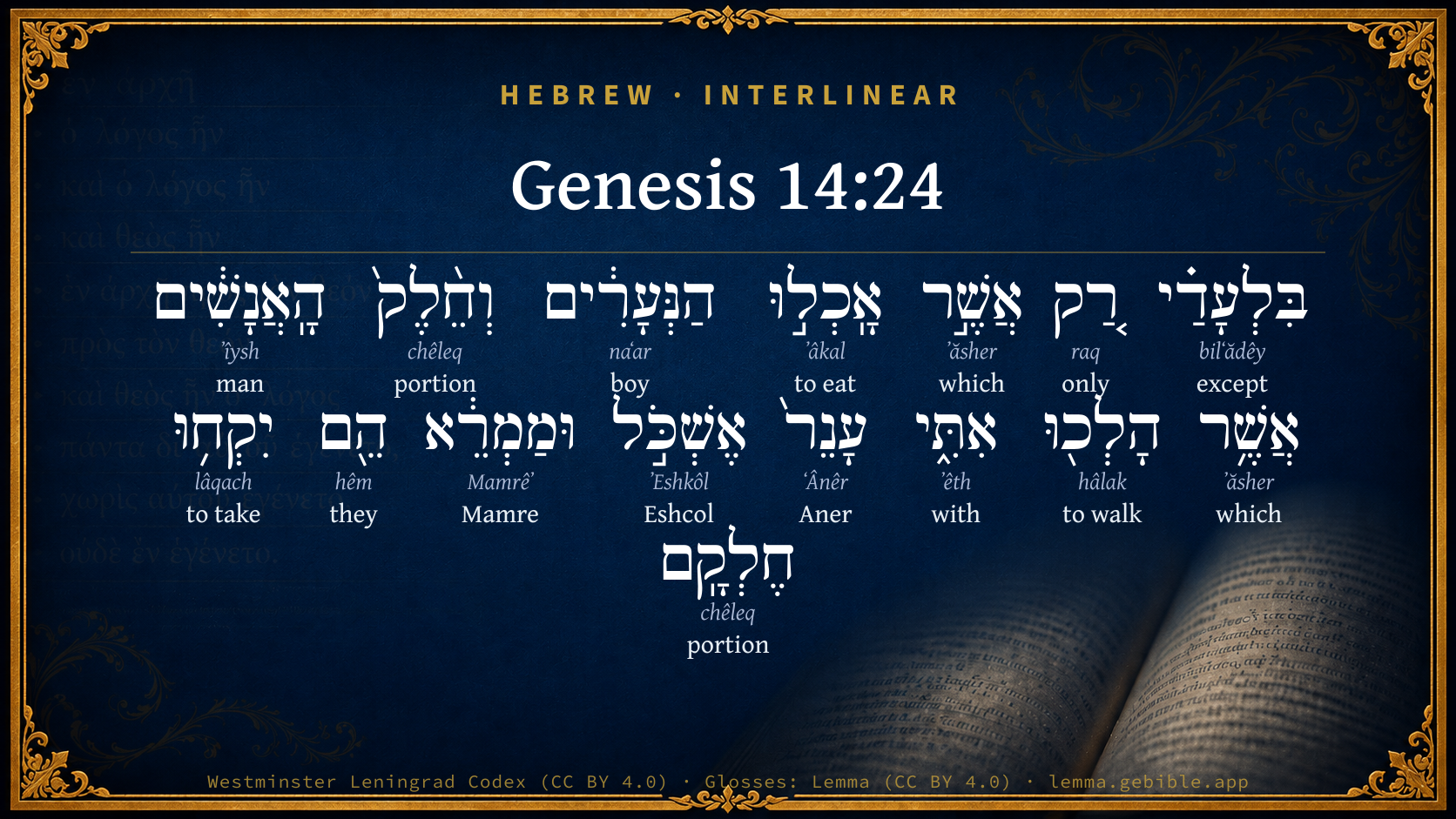
Hebrew (Westminster Leningrad Codex) Genesis 14:24 appears in the Hebrew Old Testament. The text above is from the Westminster Leningrad Codex. Each word links to its Strong’s number, a concise gloss, and parsing drawn from the Open Scriptures Hebrew Bible morphology. Click any word for its full Brown-Driver-Briggs (BDB) entry.
Download image
Cite this verse

Genesis 14:24 (World English Bible). Public Domain. Lemma interlinear Bible study tool, https://lemma.gebible.app/v/genesis/14/24.

Show BibTeX & RIS
BibTeX
RIS
English Translation
Except only that which the young men have eaten, and the portion of the men who went with me, Aner, Eshcol, and Mamre: let them take their portion."
World English Bible · Public Domain
Highlights
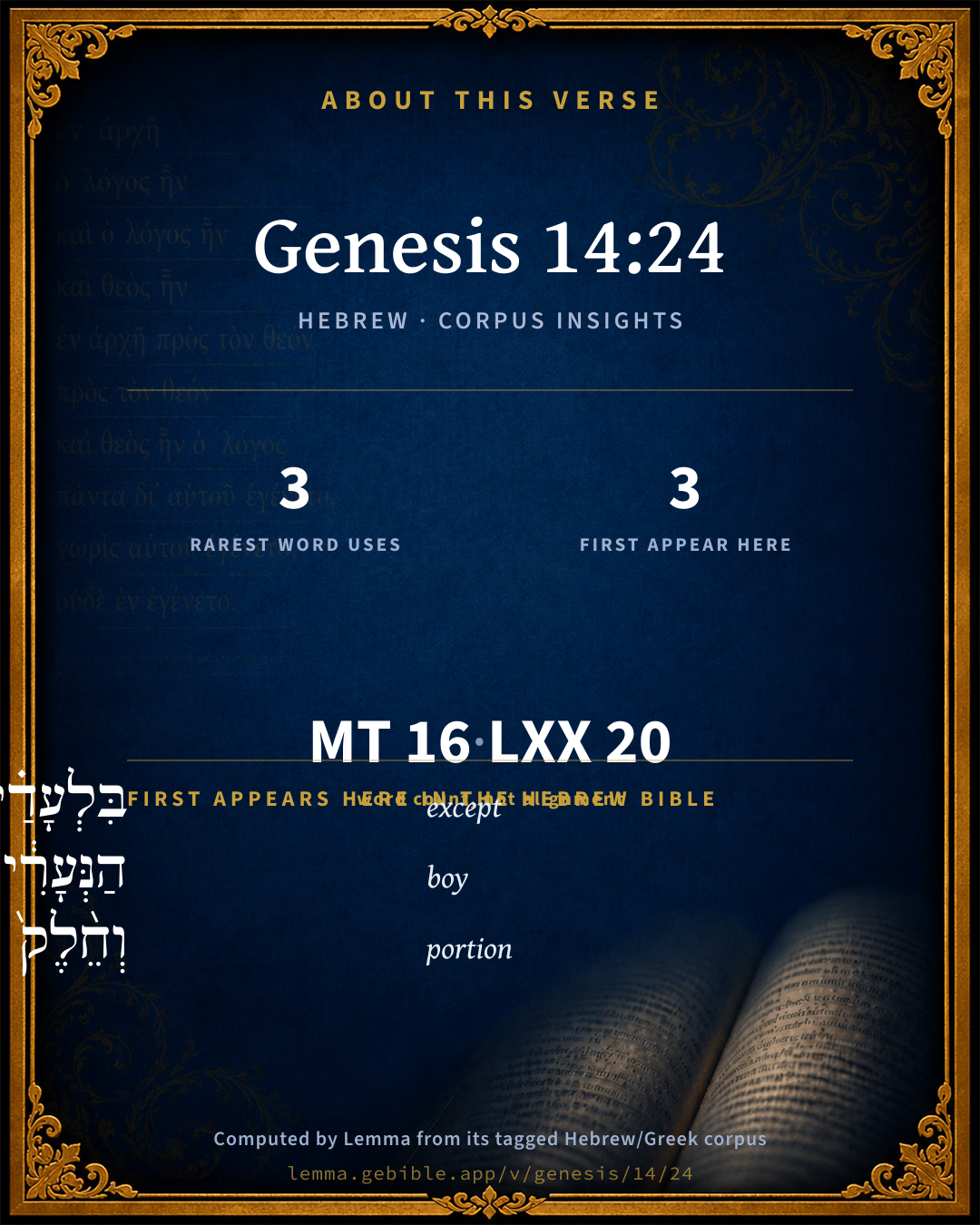
  • 3 first appearances in the Hebrew Bible
Full analysis ↓
Download a study sheet

One document with this verse’s original text, its word-by-word gloss line, the meaning frame, cross-references with their text, attributed commentary, and full source and license credits — printable, and it pastes into notes with its structure intact.

This verse Autodidact and up

Study sheet (.html) Plain text (.txt)

A passage Seminary Student

Up to 50 verses in one chapter. A passage sheet keeps up to 6 commentary sources and 12 cross-references per verse, in the order this page ranks them, and says so on the sheet whenever that leaves anything out. Ask for a single verse and you get the Autodidact verse sheet above.

Everything on this page stays free to read, with no account — the sheet is a download of what is already on screen, not access to it.

Want to remove ads? Support Godless Engineer
Compare translations 3

The same verse in 3 English versions, stacked beneath the original-language interlinear above. Click any original word for its lexicon entry.

Each is an independent rendering of the whole verse — the interlinear is not word-aligned to these translations.

Highlighted words mark where these versions differ — a whole-verse word diff, not a word-by-word alignment.

  • World English Bible Public Domain
    Except only that which the young men have eaten, and the portion of the men who went with me, Aner, Eshcol, and Mamre: let them take their portion."
  • King James Version Public Domain
    Save only that which the young men have eaten, and the portion of the men which went with me, Aner, Eshcol, and Mamre; let them take their portion.
  • unfoldingWord Literal Text CC BY-SA 4.0
    I nothing, except what the young men have eaten and the share of the other men who went with me: Aner, Eshcol, and Mamre. Let them take their share.”

unfoldingWord Literal Text — © unfoldingWord, licensed CC BY-SA 4.0. Word-aligned USFM3 via Door43 (git.door43.org/unfoldingWord/en_ult).

Versions to compare (up to 4)

3 of 4 selected

Show all 18 translations

Every available English version of this verse, each an independent rendering of the whole verse.

  • World English Bible Public Domain
    Except only that which the young men have eaten, and the portion of the men who went with me, Aner, Eshcol, and Mamre: let them take their portion."
  • Berean Standard Bible Public Domain
    I will accept nothing but what my men have eaten and the share for the men who went with me—Aner, Eshcol, and Mamre. They may take their portion.”
  • Majority Standard Bible Public Domain
    I will accept nothing but what my men have eaten and the share for the men who went with me—Aner, Eshcol, and Mamre. They may take their portion.”
  • King James Version Public Domain
    Save only that which the young men have eaten, and the portion of the men which went with me, Aner, Eshcol, and Mamre; let them take their portion.
  • American Standard Version (1901) Public Domain
    save only that which the young men have eaten, and the portion of the men that went with me, Aner, Eshcol, and Mamre. Let them take their portion.
  • Revised Version (1885) Public Domain
    save only that which the young men have eaten, and the portion of the men which went with me; Aner, Eshcol, and Mamre, let them take their portion.
  • Geneva Bible (1599) Public Domain
    Saue onely that, which the yong men haue eaten, and the partes of the men which went with me, Aner, Eshcol, and Mamre: let them take their partes.
  • Douay-Rheims (1899) Public Domain
    Except such things as the young men have eaten, and the shares of the men that came with me, Aner, Escol, and Mambre: these shall take their shares.
  • Young's Literal Translation Public Domain
    save only that which the young men have eaten, and the portion of the men who have gone with me -- Aner, Eshcol, and Mamre -- they take their portion.'
  • Literal Standard Version CC BY-SA 4.0
    save only that which the young men have eaten, and the portion of the men who have gone with me—Aner, Eshcol, and Mamre—they take their portion.”
  • Unlocked Literal Bible CC BY-SA 4.0
    I will take nothing except what the young men have eaten and the share of the men that went with me. Let Aner, Eshkol, and Mamre take their portion.”
  • unfoldingWord Literal Text CC BY-SA 4.0
    I nothing, except what the young men have eaten and the share of the other men who went with me: Aner, Eshcol, and Mamre. Let them take their share.”
  • Darby Bible Public Domain
    save only that which the young men have eaten, and the portion of the men that went with me, Aner, Eshcol, and Mamre, let them take their portion.
  • World Messianic Bible Public Domain
    I will accept nothing from you except that which the young men have eaten, and the portion of the men who went with me: Aner, Eshcol, and Mamre. Let them take their portion.”
  • Webster's Bible Public Domain
    Save only that which the young men have eaten, and the portion of the men who went with me, Aner, Eshcol, and Mamre; let them take their portion.
  • Free Bible Version CC BY-SA 4.0
    I won't take anything except what my men have eaten, and the share for those who accompanied me—Aner, Eshcol, and Mamre. Let them have their share.”
  • Bible in Basic English Public Domain
    Give me nothing but the food which the fighting-men who went with me have had; but let Aner and Eshcol and Mamre have their part of the goods.
  • JPS Tanakh (1917) Public Domain
    save only that which the young men have eaten, and the portion of the men which went with me, Aner, Eshcol, and Mamre, let them take their portion.'

Literal Standard Version (2020), Covenant Press — licensed CC BY-SA 4.0. Text via the HelloAO Bible API (eBible.org). Unlocked Literal Bible (unfoldingWord) — licensed CC BY-SA 4.0. Text via the HelloAO Bible API (eBible.org). unfoldingWord Literal Text — © unfoldingWord, licensed CC BY-SA 4.0. Word-aligned USFM3 via Door43 (git.door43.org/unfoldingWord/en_ult). Free Bible Version, Dr. Jonathan Gallagher — licensed CC BY-SA 4.0. Text via the HelloAO Bible API (eBible.org).

Word by word

More ways to search: Search by grammar → Find every occurrence → Compare this word →

Practice this passage: Drill this verse → Learn its vocabulary →

עָנֵר֙
ʻÂnêr
H6063
“Aner”
Noun, Proper
Part of Speech
Noun
Type
Proper
Full BDB Definition

Origin: probably for H5288

TWOT: None

Aner = "boy" - one of the Amorite chiefs who aided Abraham in the pursuit of the 4 invading kings (noun proper masculine) - a Levitical city west of the Jordan in Manasseh allotted to the Kohathite Levites (noun proper locative)
  1. בִּלְעָדַ֗י bilʻădêy H1107 “except · me” Preposition + Suffix, Personal, 1st Person, Common, Singular
  2. רַ֚ק raq H7535 “only” Particle, Accusative
  3. אֲשֶׁ֣ר ʼăsher H834 “which” Particle, Relative
  4. אָֽכְל֣וּ ʼâkal H398 “to eat” Verb, Qal, Perfect, 3rd Person, Common, Plural
  5. הַנְּעָרִ֔ים naʻar H5288 “the · boys” Particle, Definite Article + Noun, Common, Masculine, Plural, Absolute
  6. וְחֵ֨לֶק֙ chêleq H2506 “and · portion of” Conjunction + Noun, Common, Masculine, Singular, Construct
  7. הָֽאֲנָשִׁ֔ים ʼîysh H376 “the · men” Particle, Definite Article + Noun, Common, Masculine, Plural, Absolute
  8. אֲשֶׁ֥ר ʼăsher H834 “which” Particle, Relative
  9. הָלְכ֖וּ hâlak H1980 “to walk” Verb, Qal, Perfect, 3rd Person, Common, Plural
  10. אִתִּ֑י ʼêth H854 “with · me” Preposition + Suffix, Personal, 1st Person, Common, Singular
  11. אֶשְׁכֹּ֣ל ʼEshkôl H812 “Eshcol” Noun, Proper
  12. וּמַמְרֵ֔א Mamrêʼ H4471 “and · Mamre” Conjunction + Noun, Proper
  13. הֵ֖ם hêm H1992 “they” Pronoun, Personal, 3rd Person, Masculine, Plural
  14. יִקְח֥וּ lâqach H3947 “to take” Verb, Qal, Jussive, 3rd Person, Masculine, Plural
  15. חֶלְקָֽם chêleq H2506 “portion · their” Noun, Common, Masculine, Singular, Construct + Suffix, Personal, 3rd Person, Masculine, Plural

About this verse

These counts appear in no published source. They are computed here, from the morphology-tagged text and Lemma’s own curated glosses. What Lemma adds →

16
words
14
distinct lemmas
Pentateuch
section

Notable vocabulary

The rarest word here is עָנֵר֙ Aner H6063 — appearing just 3 times in the whole Hebrew Bible.

First appearance in Scripture

These words make their first canonical appearance in the Hebrew Bible here:

  • בִּלְעָדַ֗י except H1107
  • הַנְּעָרִ֔ים boy H5288
  • וְחֵ֨לֶק֙ portion H2506

Shared distinctive vocabulary

עָנֵר֙ Aner H6063 occurs in 3 verses of the Hebrew Bible. Also found in:

Grammatical profile

  • 3 verbs
  • 7 nouns
  • 1 pronoun
  • 2 prepositions
  • 3 particles

Verb forms

  • אָֽכְל֣וּ Qal · Perfect
  • הָלְכ֖וּ Qal · Perfect
  • יִקְח֥וּ Qal · Jussive

Repetition

Words recur within this verse — often emphatic in Hebrew:

  • וְחֵ֨לֶק֙ portion H2506 ×2
  • אֲשֶׁ֣ר which H834 ×2

Hebrew & Septuagint length

In English translation the verse runs 28 words from the Hebrew and 26 from the Septuagint (LXX English) — closely comparable.

A rough comparison of the two English renderings, which tokenize alike — not a word-level alignment.

Word counts can differ between the Hebrew and the Greek without any difference in meaning — e.g. the Hebrew direct-object marker אֵת has no separate Greek word, and Greek often adds the article ὁ.

In the original languages it is 16 Hebrew tokens and 20 Greek tokens — but the two are counted differently (Hebrew bundles its prefixes and suffixes into one token; the Greek is in lemma form), so that isn’t a like-for-like length.

Cross-references

6

Topical passages linked to Genesis 14:24 in the Treasury of Scripture Knowledge — connected by theme and wording, ordered by reader-vote popularity; previews shown in the World English Bible.

  • Genesis 14:13 One who had escaped came and told Abram, the Hebrew. Now he lived by the oaks of Mamre, the Amorite, brother of Eshcol, and brother of Aner; and these were allies of Abram.
  • Proverbs 3:27 Don't withhold good from those to whom it is due, When it is in the power of your hand to do it.
  • Matthew 7:12 Therefore whatever you desire for men to do to you, you shall also do to them; for this is the law and the prophets.
  • Romans 13:7–8 Give therefore to everyone what you owe: taxes to whom taxes are due; customs to whom customs; respect to whom respect; honor to whom honor.
  • 1 Corinthians 9:14–15 Even so the Lord ordained that those who proclaim the Gospel should live from the Gospel.
  • 1 Timothy 5:18 For the Scripture says, "You shall not muzzle the ox when it treads out the grain." And, "The laborer is worthy of his wages."

Cross-references courtesy of OpenBible.info (CC BY 4.0).

Hebrew and Greek witnesses Masoretic Hebrew ↔ Greek Septuagint

The same verse in the two great witnesses to the Old Testament, shown verse-for-verse.

These are two independent witnesses, not word-aligned to each other, and the Septuagint is shown in lemma (dictionary) form.

Hebrew Genesis 14:24 Masoretic · Westminster Leningrad Codex

בִּלְעָדַ֗י רַ֚ק אֲשֶׁ֣ר אָֽכְל֣וּ הַנְּעָרִ֔ים וְחֵ֨לֶק֙ הָֽאֲנָשִׁ֔ים אֲשֶׁ֥ר הָלְכ֖וּ אִתִּ֑י עָנֵר֙ אֶשְׁכֹּ֣ל וּמַמְרֵ֔א הֵ֖ם יִקְח֥וּ חֶלְקָֽם

Except only that which the young men have eaten, and the portion of the men who went with me, Aner, Eshcol, and Mamre: let them take their portion."

World English Bible · Public Domain

Greek LXX Genesis 14:24 Septuagint · lemma form

πλήν ὅς ἐσθίω ὁ νεανίσκος καί ὁ μερίς ὁ ἀνήρ ὁ συνπορεύομαι μετά ἐγώ εσχωλ αυναν μαμβρη οὗτος λαμβάνω μερίς

Except what things the young men have eaten, and the portion of the men that went with me, Eschol, Aunan, Mambre, these shall take a portion.

LXX2012 (modern English Septuagint) · Public Domain

Hebrew: Westminster Leningrad Codex (CC BY 4.0). Greek: Septuagint (public domain); English from LXX2012 (modern English Septuagint) (Public Domain). How the Septuagint differs from the Hebrew →

Targum (Aramaic paraphrase)

2

The Targum is the ancient Jewish Aramaic paraphrase of the Hebrew Scriptures — an interpretive translation, not the Hebrew text itself. Onkelos (literal) and Pseudo-Jonathan (expansive) render the Torah, and Jonathan the Prophets. Coverage is partial: where no permissively-licensed English translation exists for a verse, only the Aramaic is shown. This is verse-level text, not a word-by-word alignment to the Hebrew.

  1. Targum Onkelos Torah (Genesis–Deuteronomy)
    לְחוֹד (בַּר) מִדִאֲכָלוּ עוּלֵמַיָא וְחָלָק גֻבְרַיָא דִי אֲזָלוּ עִמִי עָנֵר אֶשְׁכּוֹל וּמַמְרֵא אִינוּן יְקַבְּלוּן חַלָקְהוֹן

    except of the food for the young men, and the share of the men who went with me, Aner, Eshkol, and Mamre, these will receive their shares.

    Targum Onkelos — Aramaic: “Onkelos Genesis” (public domain); “Onkelos Exodus” (public domain); “Onkelos Leviticus” (public domain); “Onkelos Numbers” (public domain); “Onkelos Deuteronomy” (public domain). English: “Sefaria Community Translation” (CC0 1.0 (public-domain dedication)); “J.W. Etheridge. The Targums of Onkelos and Jonathan Ben Uzziel on the Pentateuch. London: Longmans, Green, 1862” (public domain). Text via Sefaria.

  2. Targum Pseudo-Jonathan Torah (Genesis–Deuteronomy)
    הֲלָא לֵית לִי רְשׁוּ בְכּוֹלָא אַרְעָא דְבַר מִנִי אָכְלוּ עוּלֵימַיָא וְחוֹלַק גוּבְרַיָא דַאֲזָלוּ עִמִי עָנֵר אֶשְׁכּוֹל וּמַמְרֵא אַף הִינוּן יִסְבּוּן חוּלְקֵיהוֹן

    Have I not power over all the spoil?--Apart from what the young men have eaten, and the portion of the men who went with me, Aner, Eshkol, and Mamre, they also receiving their portion.

    Targum Pseudo-Jonathan — Aramaic: “Targum Jonathan on Genesis” (public domain); “Targum Jonathan on Exodus” (public domain); “Targum Jonathan on Leviticus” (public domain); “Targum Jonathan on Numbers” (public domain); “Targum Jonathan on Deuteronomy” (public domain). English: “The Targum of Jonathan ben Uzziel, trans. J. W. Etheridge, London, 1862” (public domain). Text via Sefaria.

Commentary

Notes on Genesis 14:24 from classic Christian and Jewish commentators (each source and its license shown beneath its notes). The classic Christian expositions comment on the surrounding passage and are grouped to its opening verse, so a note may address several verses; the Jewish commentaries on the Tanakh (Rashi and others) are per-verse, so they appear only where the commentator wrote on this verse.

Lemma curates 59 commentaries, every one of them public domain or Creative Commons licensed, each selected and text-cleaned for this edition rather than reprinted as found. About our sources →

Trapp's Complete Commentary

John Trapp

Gen 14:24 Save only that which the young men have eaten, and the portion of the men which went with me, Aner, Eshcol, and Mamre; let them take their portion.

Ver. 24. Let them take their portion.] In things indifferent, we may abridge ourselves; we may not prescribe to others, as if they must needs be just of our make. "My brethren, be not many masters," {Jas 3:1} as Magistri nostri parisienses . See 1Co 9:14-15.

John Trapp, A Commentary or Exposition upon All the Books of the Old and New Testament (1647–1656) — public domain. Text from a community e-Sword module.

Geneva Bible (1599)

Geneva Bible translators

He would not that his liberality should be hurtful to others.

Geneva Bible (1599) marginal notes — public domain. Text via Bolls.life.

Adam Clarke's Commentary

Verse 24. Save only that which the young men have eaten] His own servants had partaken of the victuals which the confederate kings had carried away; see Ge 14:11. This was unavoidable, and this is all he claims; but as he had no right to prescribe the same liberal conduct to his assistants, Aner, Eshcol, and Mamre, he left them to claim the share that by right of conquest belonged to them of the recaptured booty. Whether they were as generous as Abram we are not told.

THE great variety of striking incidents in this chapter the attentive reader has already carefully noted. To read and not understand is the property of the foolish and the inconsiderate.

1. We have already seen the danger to which Lot exposed himself in preferring a fertile region, though peopled with the workers of iniquity. His sorrows commence in the captivity of himself and family, and the loss of all his property, though by the good providence of God he and they were rescued.

2. Long observation has proved that the company a man keeps is not an indifferent thing; it will either be the means of his salvation or destruction.

3. A generous man cannot be contented with mere personal safety while others are in danger, nor with his own prosperity while others are in distress. Abram, hearing of the captivity of his nephew, determines to attempt his rescue; he puts himself at the head of his own servants, three hundred and eighteen in number, and the few assistants with which his neighbours, Mamre, Aner, and Eshcol, could furnish him; and, trusting in God and the goodness of his cause, marches off to attack four confederate kings!

4. Though it is not very likely that the armies of those petty kings could have amounted to many thousands, yet they were numerous enough to subdue almost the whole land of Canaan; and consequently, humanly speaking, Abram must know that by numbers he could not prevail, and that in this case particularly the battle was the Lord's.

5. While depending on the Divine blessing and succour he knew he must use the means he had in his power; he therefore divided his troops skilfully that he might attack the enemy at different points at the same time, and he chooses the night season to commence his attack, that the smallness of his force might not be discovered. God requires a man to use all the faculties he has given him in every lawful enterprise, and only in the conscientious use of them can he expect the Divine blessing; when this is done the event may be safely trusted in the hands of God.

6. Here is a war undertaken by Abram on motives the most honourable and conscientious; it was to repel aggression, and to rescue the innocent from the heaviest of sufferings and the worst of slavery, not for the purpose of plunder nor the extension of his territories; therefore he takes no spoils, and returns peaceably to his own possessions. How happy would the world be were every sovereign actuated by the same spirit!

7. We have already noticed the appearance, person, office, c., of Melchizedek and, without indulging in the wild theories of either ancient or modern visionaries, have considered him as the Scriptures do, a type of Christ.

All that has been already spoken on this head may be recapitulated in a few words.

1. The Redeemer of the world is the King of righteousness; he creates it, maintains it, and rules by it.

2. His empire is the empire of peace; this he proclaims to them who are afar off, and to them that are nigh; to the Jew and to the Gentile.

3. He is Priest of the most high God, and has laid down his life for the sin of the world; and through this sacrifice the blessing of God is derived on them that believe.

Reader, take him for thy King as well as thy Priest; he saves those only who submit to his authority. and take his Spirit for the regulator of their heart, and his word for the director of their conduct. How many do we find, among those who would be sorry to be rated so low as to rank only with nominal Christians, talking of Christ as their Prophet, Priest, and King, who are not taught by his word and Spirit, who apply not for redemption in his blood, and who submit not to his authority! Reader, learn this deep and important truth: "Where I am there also shall my servant be; and he that serveth me, him shall my Father honour."

Adam Clarke's Commentary on the Bible (1810–1826) — public domain. Text from a community e-Sword/MySword module.

Ellicott's Commentary for English Readers

(24) The young men . . . the men which went with me.—The former are Abram’s 318 servants, and they are to take only their food. The latter are the Amorites, and they are to have their fair share of the spoil.

We must notice in Abram’s policy that, while Lot had joined himself to the Canaanites, he stood aloof, ready to help on fit occasion, but even so maintaining his independence, and refusing to draw the bonds of friendship close together. Such, too, was the true policy of the people sprung from him. Standing apart from all nations, they were to trust in Jehovah alone for the maintenance of their liberty and rights; and so long as they did thus act they found in Him peace and security.

A Bible Commentary for English Readers, edited by Charles John Ellicott (1878–1897) — public domain. Text from a community e-Sword module.

The Cambridge Bible for Schools and Colleges

gen. ed. J. J. S. Perowne

24. save only that] Better, as R.V. marg., “let there be nothing for me; only that, &c.” The expression here used occurs again in Gen_41:16, It might be expressed in colloquial language: “nothing at all, please, so far as I am concerned.” Abram goes on to specify the two necessary exceptions, (1) a claim for the rations of his 318 followers: (2) a claim that an equitable share in the spoil should be assigned to his three confederates, mentioned in Gen_14:13, who, we here learn for the first time, had joined in the dangers of the enterprise. According to the rights of war, all the booty belonged to Abram: and he magnanimously renounces his claim.

The Cambridge Bible for Schools and Colleges (gen. ed. J. J. S. Perowne; Cambridge University Press, 1878–1918) — public domain. Text from a community e-Sword module.

John Gill's Exposition

Save only that which the young men have eaten,.... His three hundred and eighteen trained servants, and those of his confederates, who having recovered the victuals taken away from the inhabitants of Sodom and Gomorrah, had eaten of it for their refreshment, as it was but just and right they should:

and the portion of the men which went with me; the part in the spoil which belonged unto them by the laws of war; wherefore, though he abridged himself of rights and privileges that belonged unto him, which he might do, and thereby showed his great generosity, and that it was not covetousness but kindness that moved him to do what he did; yet he did not take upon him to abridge the rights and privileges of others, which would have been injurious to them: the men he means were Aner, Eshcol, and Mamre; his confederates, who went with him in the pursuit of the enemy, and were assisting to him in recovering the men and goods they had carried away: and as it was but justice they should have their share in the spoils, therefore he says:

let them take their portion; in the goods recovered, and in the spoils taken. Eupolemus (x), the Heathen writer above quoted, relates this affair thus, that"Abram being assisted by his servants became master of those who had captivated others, and carried captive the wives and children of the soldiers; and when ambassadors came to him to ransom them with money, he would not suffer the conquered to be insulted, but taking food for the young men, returned the captives freely.''

(x) Ut supra. (Apud Euseb. Evang. Praepar. l. 9. c. 17. p. 419.)

Next: Genesis Chapter 15

John Gill's Exposition of the Whole Bible (1746–1763) — public domain (CC PDM 1.0). Text via the HelloAO Bible API.

Haydock's Catholic Bible Commentary

Their shares, due to them on account of the danger to which they had exposed themselves. The king of Sodom could not but accept these conditions with gratitude. In a just war, whatever is taken by the enemy, cannot be reclaimed by the original proprietor, if it be retaken. (Grotius, iii. 6, de Jure.)

George Leo Haydock (1774–1849), Haydock's Catholic Family Bible and Commentary, 1859 edition — public domain. Excludes Psalms (Douay-Rheims chapter numbering differs from Protestant) and Deuterocanonical books (Catholic canon only).

Matthew Poole's English Annotations

For as Abram had a right to spoils, so had they, whether they joined with him in the battle, as it is conceived they did, or only abode by the stuff, 1Sa 30:24; and therefore though he might and did give away his own right, he could not give away other men’s.

Matthew Poole's English Annotations on the Holy Bible (1683–1685) — public domain. Text from a community e-Sword/MySword module.

Whedon's Commentary on the Bible

Daniel D. Whedon

24. The young men — The trained ones of his own household. Comp. Gen_14:14.

The men which went with me — His allies in the war. Abram keeps himself from all entanglement or occasion of reproach; but he allows his warriors their natural and obvious right, and his allies to act their own pleasure.

Daniel D. Whedon (gen. ed.), Commentary on the Old and New Testaments (1874–1909) — public domain. Text from a community e-Sword module.

The Pulpit Commentary

Save ydlBi, compounded of lB, not, and d, unto not unto; a particle of deprecation, meaning, "nothing shall come unto me" (Gen_41:16) only that which the young men rn, a primitive word (cf. Sanscrit, nara, man; nari, nari, woman; Zend., naere; Greek, ajnhr), applied to a new-born child (Exo_2:2-6; 1Sa_4:21) a youth of about twenty, (Gen_34:19 Gen_41:15) a servant, like (Gen_37:2; 2Ki_5:5) a common soldier. (1Ki_20:15, 1Ki_20:17, 1Ki_20:19; 2Ki_19:6) have eaten, and the portion of the men who went with me, Aner, Eshcol, and Mature; let them take their portion.

The Pulpit Commentary (1880–1919), ed. H.D.M. Spence-Jones & Joseph S. Exell — public domain. Text from a community e-Sword module.

Rashi

Rabbi Shlomo Yitzchaki (Rashi)

הנערים THE LADS — My servants who went with me. Then, again, the others ANER, ESHCOL AND MAMRE [THEY MAY TAKE THEIR PORTION ] — Although my servants took part in the battle as it is said (Genesis 14:15) “he and his servants and smote them” — whilst Aner and his friends remained with the baggage to guard it yet they may take their share. From him (Abraham) David took a lesson when he said, (1 Samuel 30:24) “But as his part is that goeth down to the battle, so shall his part be that tarrieth by the stuff: they shall share alike”; therefore it goes on to say (1 Samuel 30:25), “And this had been so from that day — ומעלה — and had been so from former times: therefore he (David) made it a statute and an ordinance” — it does not state והלאה “and henceforward”, for the statute had already been ordained) in the days of Abram (Genesis Rabbah 43:9).

Rashi on the Tanakh — English translations: “The Judaica Press complete Tanach with Rashi, translated by A. J. Rosenberg” (CC BY 4.0); “Pentateuch with Rashi's commentary by M. Rosenbaum and A.M. Silbermann, 1929-1934” (public domain); “The Metsudah Tanach series, Lakewood, N.J” (CC BY 4.0); and “The Book of Joshua, Metsudah Publications, 1997” (CC BY 4.0). Text via Sefaria.

Sforno

Rabbi Ovadia Sforno

I am excluding myself. Literally, “Without me” — i.e. “You can take it without asking me because I claim no part of it.”

Only what the lads have eaten. Avraham claimed only the cost of provisioning his men, but Aneir, Eshkol and Mamrei could take their share for themselves.

Sforno on the Tanakh — English translation: “Yalkut, Sifsei Chachomim Chumash, Metsudah Publications, 2009” (CC BY 4.0). Text via Sefaria.

Lesson kit

Teaching starters — assembled from the data on this page, not authored interpretation. Every prompt links to the verse data it draws on. Edit before teaching.

Genesis, in the Pentateuch, opens this verse with 16 words (14 distinct Hebrew lemmas). Its most distinctive word is ʻÂnêr (“Aner”). A historical commentator’s framing appears above. Read the whole chapter for the surrounding context.

Discussion questions

  1. What does “Aner” (ʻÂnêr) contribute to the verse as a whole?
  2. 3 words make their first appearance in Scripture here. What does this debut establish?
  3. How does Genesis 14:13, which shares the word «Aner», read alongside this verse?
  4. What does the repetition of “portion” (2× in this one verse) do in this verse?
  5. These translations render this verse differently; the difference is in the English rendering, not the original. What questions does that raise?
  6. «אָֽכְל֣וּ» is a Qal Perfect verb. How does that grammatical form shape the action described?
  7. Compare how Trapp's Complete Commentary and Geneva Bible (1599) read this verse. Where do they agree or differ?

Things to notice

Reading settings

Reading text

Shown beneath each verse's original-language words.

Old Testament
Old Testament edition

Read the OT as the Masoretic Hebrew (MT) or the Greek Septuagint (LXX).

English shown for the Greek Septuagint (in the Hebrew ↔ Greek comparison).

Comparing translations? Open the Compare panel on any verse page to stack up to four side by side.