Exodus 21:14

Hebrew (Westminster Leningrad Codex) Exodus 21:14 appears in the Hebrew Old Testament. The text above is from the Westminster Leningrad Codex. Each word links to its Strong’s number, a concise gloss, and parsing drawn from the Open Scriptures Hebrew Bible morphology. Click any word for its full Brown-Driver-Briggs (BDB) entry.
Download image
Cite this verse

Exodus 21:14 (World English Bible). Public Domain. Lemma interlinear Bible study tool, https://lemma.gebible.app/v/exodus/21/14.

Show BibTeX & RIS
BibTeX
RIS
English Translation
If a man schemes and comes presumptuously on his neighbor to kill him, you shall take him from my altar, that he may die.
World English Bible · Public Domain
Highlights
  • 1 first appearance in the Hebrew Bible
Full analysis ↓
Download a study sheet

One document with this verse’s original text, its word-by-word gloss line, the meaning frame, cross-references with their text, attributed commentary, and full source and license credits — printable, and it pastes into notes with its structure intact.

This verse Autodidact and up

Study sheet (.html) Plain text (.txt)

A passage Seminary Student

Up to 50 verses in one chapter. A passage sheet keeps up to 6 commentary sources and 12 cross-references per verse, in the order this page ranks them, and says so on the sheet whenever that leaves anything out. Ask for a single verse and you get the Autodidact verse sheet above.

Everything on this page stays free to read, with no account — the sheet is a download of what is already on screen, not access to it.

Want to remove ads? Support Godless Engineer
Compare translations 3

The same verse in 3 English versions, stacked beneath the original-language interlinear above. Click any original word for its lexicon entry.

Each is an independent rendering of the whole verse — the interlinear is not word-aligned to these translations.

Highlighted words mark where these versions differ — a whole-verse word diff, not a word-by-word alignment.

  • World English Bible Public Domain
    If a man schemes and comes presumptuously on his neighbor to kill him, you shall take him from my altar, that he may die.
  • King James Version Public Domain
    But if a man come presumptuously upon his neighbor, to slay him with guile; thou shalt take him from mine altar, that he may die.
  • unfoldingWord Literal Text CC BY-SA 4.0
    If a man willfully acts against his neighbor to kill him with cunning, then you shall take him from my altar for execution.

unfoldingWord Literal Text — © unfoldingWord, licensed CC BY-SA 4.0. Word-aligned USFM3 via Door43 (git.door43.org/unfoldingWord/en_ult).

Versions to compare (up to 4)

3 of 4 selected

Show all 18 translations

Every available English version of this verse, each an independent rendering of the whole verse.

  • World English Bible Public Domain
    If a man schemes and comes presumptuously on his neighbor to kill him, you shall take him from my altar, that he may die.
  • Berean Standard Bible Public Domain
    But if a man schemes and acts willfully against his neighbor to kill him, you must take him away from My altar to be put to death.
  • Majority Standard Bible Public Domain
    But if a man schemes and acts willfully against his neighbor to kill him, you must take him away from My altar to be put to death.
  • King James Version Public Domain
    But if a man come presumptuously upon his neighbor, to slay him with guile; thou shalt take him from mine altar, that he may die.
  • American Standard Version (1901) Public Domain
    And if a man come presumptuously upon his neighbor, to slay him with guile; thou shalt take him from mine altar, that he may die.
  • Revised Version (1885) Public Domain
    And if a man come presumptuously upon his neighbour, to slay him with guile; thou shalt take him from mine altar, that he may die.
  • Geneva Bible (1599) Public Domain
    But if a man come presumptuously vpon his neighbour to slay him with guile, thou shalt take him from mine altar, that he may die.
  • Douay-Rheims (1899) Public Domain
    If a man kill his neighbour on set purpose and by lying in wait for him: thou shalt take him away from my altar, that he may die.
  • Young's Literal Translation Public Domain
    `And when a man doth presume against his neighbour to slay him with subtilty, from Mine altar thou dost take him to die.
  • Literal Standard Version CC BY-SA 4.0
    And when a man presumes against his neighbor to slay him with subtlety, you take him from My altar to die.
  • Unlocked Literal Bible CC BY-SA 4.0
    If a man willfully attacks his neighbor and kills him according to a cunning plan, then you must take him, even if he is at God's altar, so that he may die.
  • unfoldingWord Literal Text CC BY-SA 4.0
    If a man willfully acts against his neighbor to kill him with cunning, then you shall take him from my altar for execution.
  • Darby Bible Public Domain
    But if a man act wantonly toward his neighbour, and slay him with guile, thou shalt take him from mine altar, that he may die.
  • World Messianic Bible Public Domain
    If a man schemes and comes presumptuously on his neighbor to kill him, you shall take him from my altar, that he may die.
  • Webster's Bible Public Domain
    But if a man shall come presumptuously upon his neighbor, to slay him with guile; thou shalt take him from my altar, that he may die.
  • Free Bible Version CC BY-SA 4.0
    But if someone deliberately plans and purposely kills another, you must take them away from my altar and execute them.
  • Bible in Basic English Public Domain
    But if a man makes an attack on his neighbour on purpose, to put him to death by deceit, you are to take him from my altar and put him to death.
  • JPS Tanakh (1917) Public Domain
    And if a man come presumptuously upon his neighbour, to slay him with guile; thou shalt take him from Mine altar, that he may die.

Literal Standard Version (2020), Covenant Press — licensed CC BY-SA 4.0. Text via the HelloAO Bible API (eBible.org). Unlocked Literal Bible (unfoldingWord) — licensed CC BY-SA 4.0. Text via the HelloAO Bible API (eBible.org). unfoldingWord Literal Text — © unfoldingWord, licensed CC BY-SA 4.0. Word-aligned USFM3 via Door43 (git.door43.org/unfoldingWord/en_ult). Free Bible Version, Dr. Jonathan Gallagher — licensed CC BY-SA 4.0. Text via the HelloAO Bible API (eBible.org).

Word by word

More ways to search: Search by grammar → Find every occurrence → Compare this word →

Practice this passage: Drill this verse → Learn its vocabulary →

בְעָרְמָ֑ה
ʻormâh
H6195
“in/at · prudence”
Preposition + Noun, Common, Feminine, Singular, Absolute
Part of Speech
Preposition + Noun
Type
Common
Gender
Feminine
Number
Singular
State
Absolute
Full BDB Definition

Origin: from H6193

TWOT: 1698b

shrewdness, craftiness, prudence
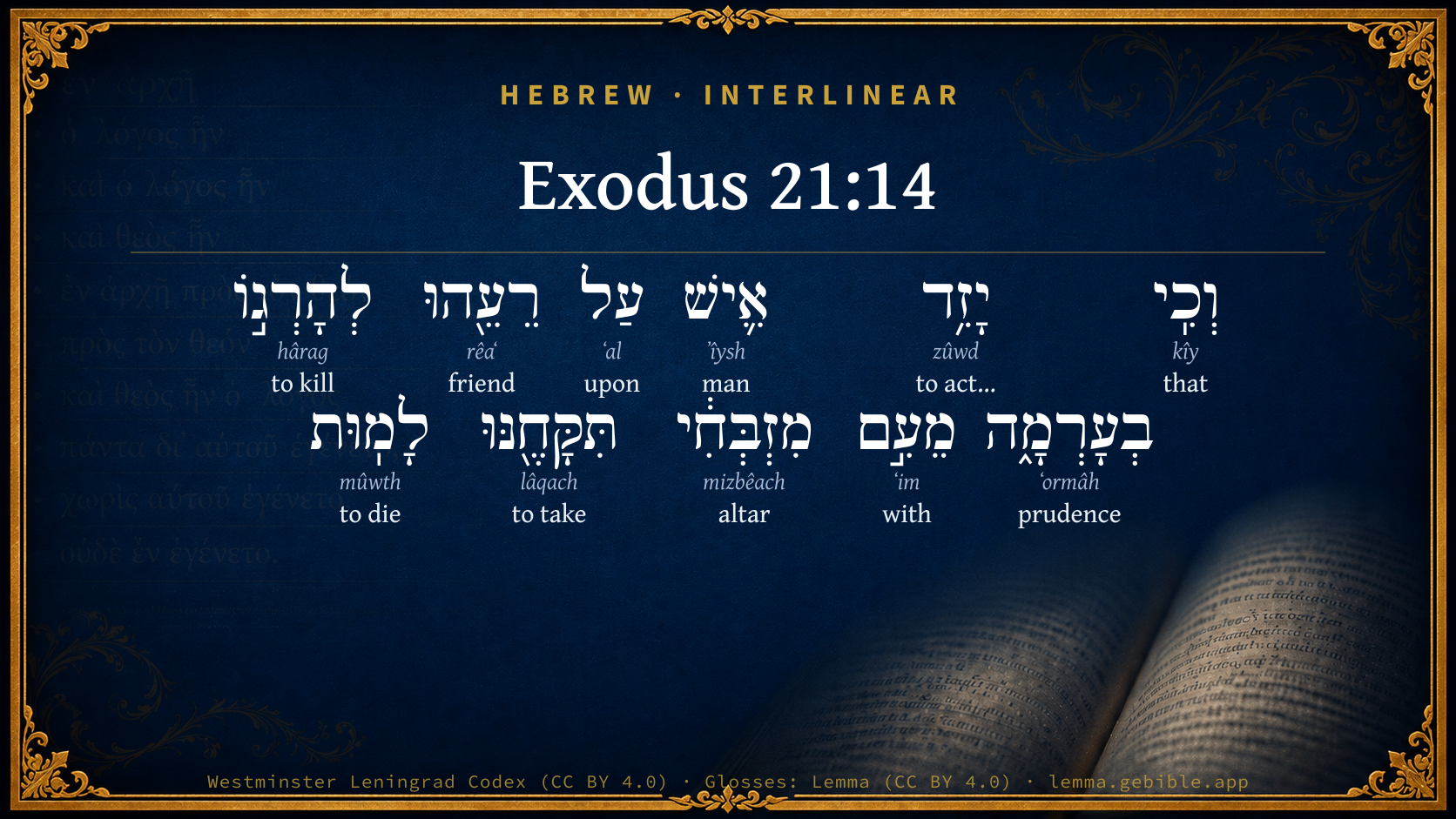
  1. וְכִֽי kîy H3588 “and · that” Conjunction + Conjunction
  2. יָזִ֥ד zûwd H2102 “to act presumptuously” Verb, Hiphil, Imperfect, 3rd Person, Masculine, Singular
  3. אִ֛ישׁ ʼîysh H376 “man” Noun, Common, Masculine, Singular, Absolute
  4. עַל ʻal H5921 “upon” Preposition
  5. רֵעֵ֖הוּ rêaʻ H7453 “friend · his” Noun, Common, Masculine, Singular, Construct + Suffix, Personal, 3rd Person, Masculine, Singular
  6. לְהָרְג֣וֹ hârag H2026 “to kill · him” Preposition + Verb, Qal, Infinitive Construct + Suffix, Personal, 3rd Person, Masculine, Singular
  7. מֵעִ֣ם ʻim H5973 “from · with” Preposition + Preposition
  8. מִזְבְּחִ֔י mizbêach H4196 “altar · my” Noun, Common, Masculine, Singular, Construct + Suffix, Personal, 1st Person, Common, Singular
  9. תִּקָּחֶ֖נּוּ lâqach H3947 “to take · him” Verb, Qal, Imperfect, 2nd Person, Masculine, Singular + Suffix, Personal, 3rd Person, Masculine, Singular
  10. לָמֽוּת mûwth H4191 “to die” Preposition + Verb, Qal, Infinitive Construct

About this verse

These counts appear in no published source. They are computed here, from the morphology-tagged text and Lemma’s own curated glosses. What Lemma adds →

11
words
11
distinct lemmas
Pentateuch
section

Notable vocabulary

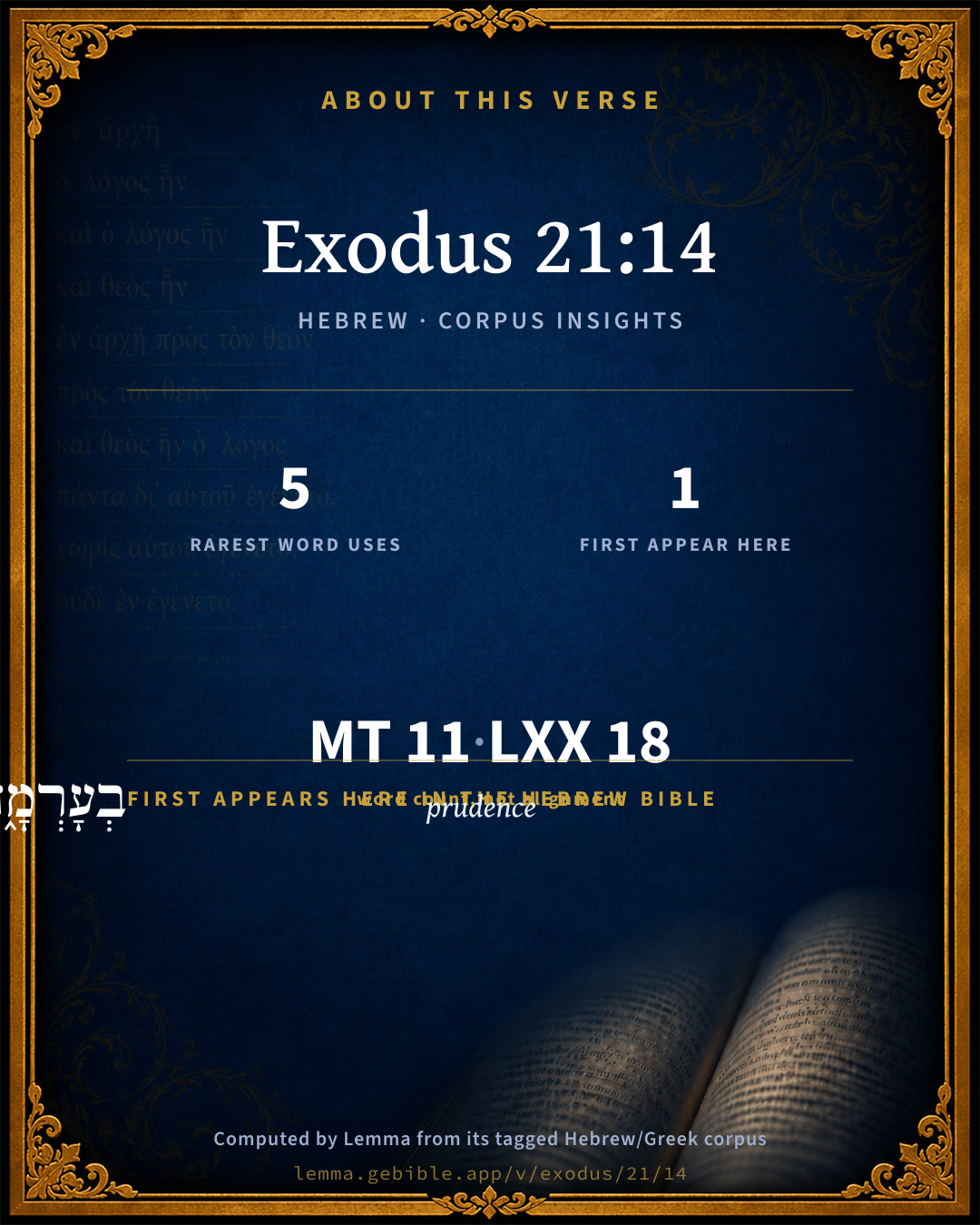
The rarest word here is בְעָרְמָ֑ה prudence H6195 — appearing just 5 times in the whole Hebrew Bible.

First appearance in Scripture

This word makes its first canonical appearance in the Hebrew Bible here:

  • בְעָרְמָ֑ה prudence H6195

Shared distinctive vocabulary

בְעָרְמָ֑ה prudence H6195 occurs in 5 verses of the Hebrew Bible. Also found in:

Grammatical profile

  • 4 verbs
  • 4 nouns
  • 2 prepositions
  • 1 conjunction

Verb forms

  • יָזִ֥ד Hiphil · Imperfect
  • לְהָרְג֣וֹ Qal · Infinitive Construct
  • תִּקָּחֶ֖נּוּ Qal · Imperfect
  • לָמֽוּת Qal · Infinitive Construct

Hebrew & Septuagint length

In English translation the verse runs 24 words from the Hebrew and 32 from the Septuagint (LXX English) — closely comparable.

A rough comparison of the two English renderings, which tokenize alike — not a word-level alignment.

Word counts can differ between the Hebrew and the Greek without any difference in meaning — e.g. the Hebrew direct-object marker אֵת has no separate Greek word, and Greek often adds the article ὁ.

In the original languages it is 11 Hebrew tokens and 18 Greek tokens — but the two are counted differently (Hebrew bundles its prefixes and suffixes into one token; the Greek is in lemma form), so that isn’t a like-for-like length.

Cross-references

15

Topical passages linked to Exodus 21:14 in the Treasury of Scripture Knowledge — connected by theme and wording, ordered by reader-vote popularity; previews shown in the World English Bible.

  • 1 Kings 2:28–34 The news came to Joab; for Joab had turned after Adonijah, though he didn't turn after Absalom. Joab fled to the Tent of Yahweh, and caught hold on the horns of the altar.
  • Hebrews 10:26 For if we sin willfully after we have received the knowledge of the truth, there remains no more a sacrifice for sins,
  • Numbers 15:30–31 But the soul who does anything with a high hand, whether he is home-born or a foreigner, the same blasphemes Yahweh; and that soul shall be cut off from among his people.
  • Numbers 35:20–21 If he thrust him of hatred, or hurled at him, lying in wait, so that he died,
  • Deuteronomy 1:43 So I spoke to you, and you didn't listen; but you rebelled against the commandment of Yahweh, and were presumptuous, and went up into the hill-country.
  • Deuteronomy 17:12–13 The man who does presumptuously, in not listening to the priest who stands to minister there before Yahweh your God, or to the judge, even that man shall die: and you shall put away the evil from Israel.
  • Deuteronomy 18:22 when a prophet speaks in the name of Yahweh, if the thing doesn't follow, nor happen, that is the thing which Yahweh has not spoken: the prophet has spoken it presumptuously, you shall not be afraid of him.
  • Deuteronomy 19:11–13 But if any man hate his neighbor, and lie in wait for him, and rise up against him, and strike him mortally so that he dies, and he flee into one of these cities;
  • Deuteronomy 27:24 Cursed be he who strikes his neighbor in secret. All the people shall say, Amen.
  • 2 Samuel 3:27 When Abner was returned to Hebron, Joab took him aside into the midst of the gate to speak with him quietly, and struck him there in the body, so that he died, for the blood of Asahel his brother.
  • 2 Samuel 20:9–10 Joab said to Amasa, Is it well with you, my brother? Joab took Amasa by the beard with his right hand to kiss him.
  • 1 Kings 1:50–51 Adonijah feared because of Solomon; and he arose, and went, and caught hold on the horns of the altar.
  • 2 Kings 11:15 Jehoiada the priest commanded the captains of hundreds who were set over the host, and said to them, Have her forth between the ranks; and him who follows her kill with the sword. For the priest said, Don't let her be slain in the house of Yahweh.
  • Psalms 19:13 Keep back your servant also from presumptuous sins. Let them not have dominion over me. Then I will be upright, I will be blameless and innocent of great transgression.
  • 2 Peter 2:10 but chiefly those who walk after the flesh in the lust of defilement, and despise authority. Daring, self-willed, they are not afraid to speak evil of dignitaries;

Cross-references courtesy of OpenBible.info (CC BY 4.0).

Hebrew and Greek witnesses Masoretic Hebrew ↔ Greek Septuagint

The same verse in the two great witnesses to the Old Testament, shown verse-for-verse.

These are two independent witnesses, not word-aligned to each other, and the Septuagint is shown in lemma (dictionary) form.

Hebrew Exodus 21:14 Masoretic · Westminster Leningrad Codex

וְכִֽי יָזִ֥ד אִ֛ישׁ עַל רֵעֵ֖הוּ לְהָרְג֣וֹ בְעָרְמָ֑ה מֵעִ֣ם מִזְבְּחִ֔י תִּקָּחֶ֖נּוּ לָמֽוּת

If a man schemes and comes presumptuously on his neighbor to kill him, you shall take him from my altar, that he may die.

World English Bible · Public Domain

Greek LXX Exodus 21:14 Septuagint · lemma form

ἐάν δέ τις ἐπιτίθημι ὁ πλησίον ἀποκτείνω αὐτός δόλος καί καταφεύγω ἀπό ὁ θυσιαστήριον ἐγώ λαμβάνω αὐτός θανατόω

And if any one lie in wait for his neighbor to kill him by craft, and he go for refuge, you shall take him from my altar to put him to death.

LXX2012 (modern English Septuagint) · Public Domain

Hebrew: Westminster Leningrad Codex (CC BY 4.0). Greek: Septuagint (public domain); English from LXX2012 (modern English Septuagint) (Public Domain). How the Septuagint differs from the Hebrew →

Targum (Aramaic paraphrase)

2

The Targum is the ancient Jewish Aramaic paraphrase of the Hebrew Scriptures — an interpretive translation, not the Hebrew text itself. Onkelos (literal) and Pseudo-Jonathan (expansive) render the Torah, and Jonathan the Prophets. Coverage is partial: where no permissively-licensed English translation exists for a verse, only the Aramaic is shown. This is verse-level text, not a word-by-word alignment to the Hebrew.

  1. Targum Onkelos Torah (Genesis–Deuteronomy)
    וַאֲרֵי יַרְשַׁע גְבַר עַל חַבְרֵהּ לְמִקְטְלֵהּ בִנְכִילוּ מִן מַדְבְּחִי תִּדְבְּרִנֵהּ לִמְמָת:

    (no public-domain English translation for this verse)

    Targum Onkelos — Aramaic: “Onkelos Genesis” (public domain); “Onkelos Exodus” (public domain); “Onkelos Leviticus” (public domain); “Onkelos Numbers” (public domain); “Onkelos Deuteronomy” (public domain). English: “Sefaria Community Translation” (CC0 1.0 (public-domain dedication)); “J.W. Etheridge. The Targums of Onkelos and Jonathan Ben Uzziel on the Pentateuch. London: Longmans, Green, 1862” (public domain). Text via Sefaria.

  2. Targum Pseudo-Jonathan Torah (Genesis–Deuteronomy)
    וַאֲרוּם יִרְשַׁע גְּבַר עַל חַבְרֵיהּ לְמִקְטְלֵיהּ בִּנְכִילוּ אֲפִילּוּ כַּהֲנָא הוּא וּמְשַׁמֵּשׁ עַל גַּבֵּי מַדְבְּחִי מִתַּמָּן תִּסְבוּנֵיהּ וְתִקְטְלִינֵיהּ בְּסַיָּיפָא

    But if a man come maliciously upon his neighbour to kill him with craft, though the priests are ministering at My altar, thence thou shalt take him, and slay him with the sword.

    Targum Pseudo-Jonathan — Aramaic: “Targum Jonathan on Genesis” (public domain); “Targum Jonathan on Exodus” (public domain); “Targum Jonathan on Leviticus” (public domain); “Targum Jonathan on Numbers” (public domain); “Targum Jonathan on Deuteronomy” (public domain). English: “The Targum of Jonathan ben Uzziel, trans. J. W. Etheridge, London, 1862” (public domain). Text via Sefaria.

Commentary

Notes on Exodus 21:14 from classic Christian and Jewish commentators (each source and its license shown beneath its notes). The classic Christian expositions comment on the surrounding passage and are grouped to its opening verse, so a note may address several verses; the Jewish commentaries on the Tanakh (Rashi and others) are per-verse, so they appear only where the commentator wrote on this verse.

Lemma curates 59 commentaries, every one of them public domain or Creative Commons licensed, each selected and text-cleaned for this edition rather than reprinted as found. About our sources →

Trapp's Complete Commentary

John Trapp

Exo 21:14 But if a man come presumptuously upon his neighbour, to slay him with guile; thou shalt take him from mine altar, that he may die.

Ver. 14. Thou shalt take him, &c.] "A man that doeth violence to the blood of any person shall flee to the pit; let none stay him"; - where {Pro 28:17} the word Adam, rendered man, hath in the original a little d, to show that a murderer is not worthy to be called a man; - he is to be drawn from the altar to the slaughter. {Hebrew Text Note}

John Trapp, A Commentary or Exposition upon All the Books of the Old and New Testament (1647–1656) — public domain. Text from a community e-Sword module.

Joseph Benson's Commentary

Exo 21:14. If a man come presumptuously — Do this boldly, purposely, and maliciously; for so the word signifies, thou shalt take him from mine altar. God so abhors murder that he will rather venture the pollution of his own altar than the escape of the murderer.

Joseph Benson's Commentary on the Old and New Testaments (1811–1818) — public domain. Text from a community e-Sword module.

Tyndale Open Study Notes

Tyndale Open Resources

21:14 dragged . . . from my altar: See 1 Kgs 2:28-33.

Tyndale Open Study Notes — © Tyndale Open Resources, licensed CC BY-SA 4.0. Text via the HelloAO Bible API.

Geneva Bible (1599)

Geneva Bible translators

The holiness of the place ought not to defend the murderer.

Geneva Bible (1599) marginal notes — public domain. Text via Bolls.life.

Adam Clarke's Commentary

Verse 14. Thou shalt take him from mine altar] Before the cities of refuge were assigned, the altar of God was the common asylum.

Adam Clarke's Commentary on the Bible (1810–1826) — public domain. Text from a community e-Sword/MySword module.

Ellicott's Commentary for English Readers

(14) If a man come presumptuously.—Rather, if a man come maliciously, or with premeditation. (Vulg., de industria.)

Thou shalt take him from mine altar.—Comp. 1Ki_2:28-34. In most parts of the ancient world a scruple was felt about putting criminals to death when once they had taken sanctuary, and those who did so were regarded as accursed (Herod. v. 71, 72; Thucyd. i. 126; Plut. Vit. Sol., § 12). The Mosaic Law regarded this scruple as a superstition, and refused to sanction it.

A Bible Commentary for English Readers, edited by Charles John Ellicott (1878–1897) — public domain. Text from a community e-Sword module.

The Cambridge Bible for Schools and Colleges

gen. ed. J. J. S. Perowne

14. But the protection of the altar is not to be extended to the wilful murderer. Cf. Deu_19:11-13; also the more detailed treatment of the case of wilful murder in the law of P (Num_35:16-21).

from mine altar] See 1Ki_1:50; 1Ki_2:28, which shew that the fugitive would seize hold of the ‘horns’ (see on ch. Exo_27:2) of the altar, in order to avail himself of its protection. The altar served as an asylum also among the Greeks (Thuc. iv. 98).

The Cambridge Bible for Schools and Colleges (gen. ed. J. J. S. Perowne; Cambridge University Press, 1878–1918) — public domain. Text from a community e-Sword module.

John Gill's Exposition

But if a man come presumptuously upon his neighbour, to slay him with guile,.... That comes with malice in his heart, with wrath in his countenance, in a bold, daring, hostile manner, using all the art, cunning, and contrivance he can, to take away the life of his neighbour; no asylum, no refuge, not anything to screen him from justice is to be allowed him: hence, a messenger of the sanhedrim, or an executioner, one that inflicts the forty stripes, save one, or a physician, or one that chastises his son or scholar, under whose hands persons may die, do not come under this law; for though what they do they may do wilfully, yet not with guile, as Jarchi and others observe, not with an ill design, but for good:

thou shalt take him from mine altar, that he may die: that being the place which in early times criminals had recourse unto, Joab and others, as well as in later times, to secure them from vengeance; but a man guilty of wilful murder was not to be protected in this way; and the Targum of Jonathan is,"though he is a priest, (the Jerusalem Targum has it, an high priest,) and ministers at mine altar, thou shalt take him from thence, and slay him with the sword,''so Jarchi; but the law refers not to a person ministering in his office at the altar of the Lord, but to one that should flee there for safety, which yet he should not have.

John Gill's Exposition of the Whole Bible (1746–1763) — public domain (CC PDM 1.0). Text via the HelloAO Bible API.

Haydock's Catholic Bible Commentary

Altar, if he should flee thither for safety. No asylum was allowed to such murderers. Thus Joab was slain by Solomon, 3 Kings ii. 31. (Menochius)

George Leo Haydock (1774–1849), Haydock's Catholic Family Bible and Commentary, 1859 edition — public domain. Excludes Psalms (Douay-Rheims chapter numbering differs from Protestant) and Deuterocanonical books (Catholic canon only).

Matthew Poole's English Annotations

If a man come presumptuously, i.e. do this proudly, boldly, purposely, and maliciously; for so the word signifies.

From mine altar, which not only in the wilderness, but afterward, seems to have been esteemed a place of refuge, 1Ki 1:50, as it also was among the heathens: but God so far abhors murder, that he will rather venture the pollution of his own altar than the escape of the murderer. See 2Ki 11:15.

Matthew Poole's English Annotations on the Holy Bible (1683–1685) — public domain. Text from a community e-Sword/MySword module.

Whedon's Commentary on the Bible

Daniel D. Whedon

14. Take him from mine altar — The cases of Adonijah and Joab, as read in 1Ki_1:50; 1Ki_2:28, are illustrations of the prevalent notion that the altar was a place of security from violence. This law aims to take away from the presumptuous murderer all hope of protection from the holy place.

Daniel D. Whedon (gen. ed.), Commentary on the Old and New Testaments (1874–1909) — public domain. Text from a community e-Sword module.

The Pulpit Commentary

Presumptuously. Or "proudly," "arrogantly." Thou shalt take him from mine altar. See the comment on ver. 12.

The Pulpit Commentary (1880–1919), ed. H.D.M. Spence-Jones & Joseph S. Exell — public domain. Text from a community e-Sword module.

Rashi

Rabbi Shlomo Yitzchaki (Rashi)

וכי יזד AND IF A MAN ACT INTENTIONALLY — Why is this stated at all (since v. 13 expressly provides a place for the murderer only if he does not lie in wait)? Since it is said, (v. 12) “Whosoever smiteth a man [so that he die shall be put to death]”, I might infer that this is so even if the victim is a heathen, and that there it included even a physician who kills a person as a result of his treatment, and a court-officer who kills a man when inflicting on him the forty lashes, and a father who beats and thereby kills his son, and a teacher who chastises his pupil and thereby kills him, and one who kills in error (שוגג, i. e. one who intended to kill a certain person but missed the mark and killed another instead — נתכוין להרוג את זה והרג את זה)! Scripture therefore states here: “if a man acts intentionally (יזיד)” — but not in error (שוגג); “against his fellowman (רעהו)” — but not against a heathen; “to slay with guile (בערמה)” — thus excluding the court-officer, the physician, and one who chastises his son or his pupil for all these though acting intentionally do not do so with guile (cf. Mekhilta).

מעם מזבחי תקחנו למות THOU SHALT TAKE HIM FROM MY ALTAR, THAT HE MAY DIE — even if he is a priest and stands at the altar intending to officiate thou shalt take him away that he die (cf. Mekhilta; Yoma 85a).

Rashi on the Tanakh — English translations: “The Judaica Press complete Tanach with Rashi, translated by A. J. Rosenberg” (CC BY 4.0); “Pentateuch with Rashi's commentary by M. Rosenbaum and A.M. Silbermann, 1929-1934” (public domain); “The Metsudah Tanach series, Lakewood, N.J” (CC BY 4.0); and “The Book of Joshua, Metsudah Publications, 1997” (CC BY 4.0). Text via Sefaria.

Lesson kit

Teaching starters — assembled from the data on this page, not authored interpretation. Every prompt links to the verse data it draws on. Edit before teaching.

Exodus, in the Pentateuch, opens this verse with 11 words (11 distinct Hebrew lemmas). Its most distinctive word is ʻormâh (“prudence”). A historical commentator’s framing appears above. Read the whole chapter for the surrounding context.

Discussion questions

  1. How does “prudence” (ʻormâh) shape what this verse is saying?
  2. The word “prudence” first appears here in Scripture. What is being introduced at this debut?
  3. Joshua 9:4 shares the word «prudence» with this verse. How do the two illuminate each other?
  4. The translations on this page render this verse differently — a whole-verse word diff, not a word-by-word alignment. What might account for the different wordings?
  5. The verb «יָזִ֥ד» is Hiphil Imperfect. How does its form color the action?
  6. Reading how Trapp's Complete Commentary and Joseph Benson's Commentary read this verse, where do the two commentators agree and where do they part?

Things to notice

Reading settings

Reading text

Shown beneath each verse's original-language words.

Old Testament
Old Testament edition

Read the OT as the Masoretic Hebrew (MT) or the Greek Septuagint (LXX).

English shown for the Greek Septuagint (in the Hebrew ↔ Greek comparison).

Comparing translations? Open the Compare panel on any verse page to stack up to four side by side.