
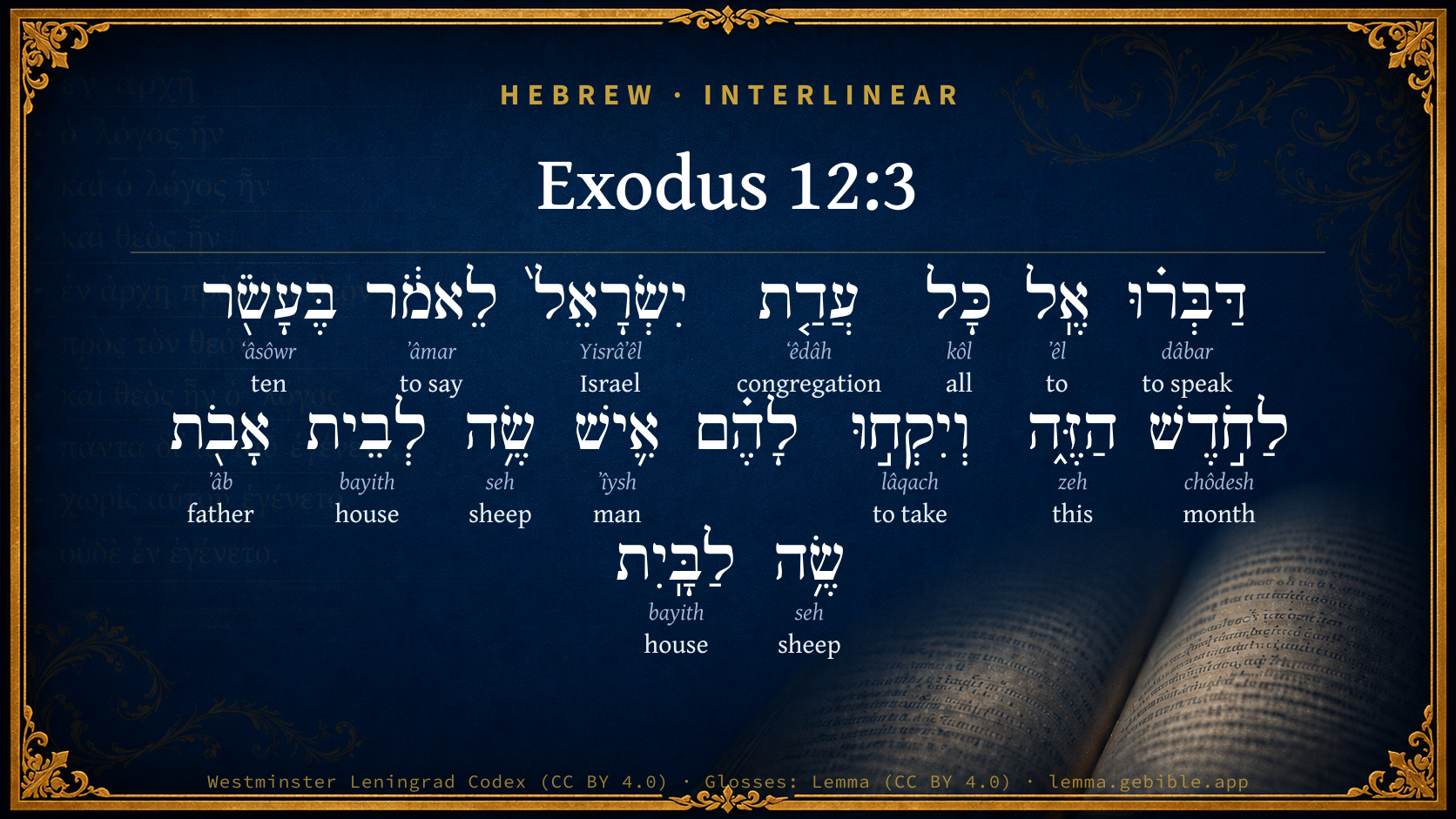
Exodus 12:3

Hebrew (Westminster Leningrad Codex) Exodus 12:3 appears in the Hebrew Old Testament. The text above is from the Westminster Leningrad Codex. Each word links to its Strong’s number, a concise gloss, and parsing drawn from the Open Scriptures Hebrew Bible morphology. Click any word for its full Brown-Driver-Briggs (BDB) entry.
Download image
Cite this verse

Exodus 12:3 (World English Bible). Public Domain. Lemma interlinear Bible study tool, https://lemma.gebible.app/v/exodus/12/3.

Show BibTeX & RIS
BibTeX
RIS
English Translation
Speak to all the congregation of Israel, saying, 'On the tenth day of this month, they shall take to them every man a lamb, according to their fathers' houses, a lamb for a household;
World English Bible · Public Domain
Highlights
  • 1 first appearance in the Hebrew Bible
Full analysis ↓
Download a study sheet

One document with this verse’s original text, its word-by-word gloss line, the meaning frame, cross-references with their text, attributed commentary, and full source and license credits — printable, and it pastes into notes with its structure intact.

This verse Autodidact and up

Study sheet (.html) Plain text (.txt)

A passage Seminary Student

Up to 50 verses in one chapter. A passage sheet keeps up to 6 commentary sources and 12 cross-references per verse, in the order this page ranks them, and says so on the sheet whenever that leaves anything out. Ask for a single verse and you get the Autodidact verse sheet above.

Everything on this page stays free to read, with no account — the sheet is a download of what is already on screen, not access to it.

Want to remove ads? Support Godless Engineer
Compare translations 3

The same verse in 3 English versions, stacked beneath the original-language interlinear above. Click any original word for its lexicon entry.

Each is an independent rendering of the whole verse — the interlinear is not word-aligned to these translations.

Highlighted words mark where these versions differ — a whole-verse word diff, not a word-by-word alignment.

  • World English Bible Public Domain
    Speak to all the congregation of Israel, saying, 'On the tenth day of this month, they shall take to them every man a lamb, according to their fathers' houses, a lamb for a household;
  • King James Version Public Domain
    Speak ye unto all the congregation of Israel, saying, In the tenth day of this month they shall take to them every man a lamb, according to the house of their fathers, a lamb for an house:
  • unfoldingWord Literal Text CC BY-SA 4.0
    Speak to all the congregation of Israel, saying, ‘On the tenth of this month they shall take to themselves, each man, a lamb to the house of the fathers: a lamb to a house.

unfoldingWord Literal Text — © unfoldingWord, licensed CC BY-SA 4.0. Word-aligned USFM3 via Door43 (git.door43.org/unfoldingWord/en_ult).

Versions to compare (up to 4)

3 of 4 selected

Show all 18 translations

Every available English version of this verse, each an independent rendering of the whole verse.

  • World English Bible Public Domain
    Speak to all the congregation of Israel, saying, 'On the tenth day of this month, they shall take to them every man a lamb, according to their fathers' houses, a lamb for a household;
  • Berean Standard Bible Public Domain
    Tell the whole congregation of Israel that on the tenth day of this month each man must select a lamb for his family, one per household.
  • Majority Standard Bible Public Domain
    Tell the whole congregation of Israel that on the tenth day of this month each man must select a lamb for his family, one per household.
  • King James Version Public Domain
    Speak ye unto all the congregation of Israel, saying, In the tenth day of this month they shall take to them every man a lamb, according to the house of their fathers, a lamb for an house:
  • American Standard Version (1901) Public Domain
    Speak ye unto all the congregation of Israel, saying, In the tenth `day' of this month they shall take to them every man a lamb, according to their fathers' houses, a lamb for a household:
  • Revised Version (1885) Public Domain
    Speak ye unto all the congregation of Israel, saying, In the tenth day of this month they shall take to them every man a lamb, according to their fathers’ houses, a lamb for an household:
  • Geneva Bible (1599) Public Domain
    Speake ye vnto all the congregation of Israel, saying, In the tenth of this moneth let euery man take vnto him a lambe, according to the house of the fathers, a lambe for an house.
  • Douay-Rheims (1899) Public Domain
    Speak ye to the whole assembly of the children of Israel, and say to them: On the tenth day of this month let every man take a lamb by their families and houses.
  • Young's Literal Translation Public Domain
    speak ye unto all the company of Israel, saying, In the tenth of this month -- they take to them each man a lamb for the house of the fathers, a lamb for a house.
  • Literal Standard Version CC BY-SA 4.0
    speak to all the congregation of Israel, saying, In the tenth of this month they take to themselves, each man, a lamb for the house of the fathers, a lamb for a house.
  • Unlocked Literal Bible CC BY-SA 4.0
    Tell the assembly of Israel, 'On the tenth day of this month they must each take a lamb or young goat for themselves, each family doing this, a lamb for each household.
  • unfoldingWord Literal Text CC BY-SA 4.0
    Speak to all the congregation of Israel, saying, ‘On the tenth of this month they shall take to themselves, each man, a lamb to the house of the fathers: a lamb to a house.
  • Darby Bible Public Domain
    Speak unto all the assembly of Israel, saying, On the tenth of this month let them take themselves each a lamb, for a father's house, a lamb for a house.
  • World Messianic Bible Public Domain
    Speak to all the congregation of Israel, saying, ‘On the tenth day of this month, they shall take to them every man a lamb, according to their fathers’ houses, a lamb for a household;
  • Webster's Bible Public Domain
    Speak ye to all the congregation of Israel, saying, In the tenth day of this month they shall take to them every man a lamb, according to the house of their fathers, a lamb for a house:
  • Free Bible Version CC BY-SA 4.0
    Tell all the Israelites that on the tenth day of this month, every man must choose a lamb for his family, one for each household.
  • Bible in Basic English Public Domain
    Say to all the children of Israel when they are come together, In the tenth day of this month every man is to take a lamb, by the number of their fathers' families, a lamb for every family:
  • JPS Tanakh (1917) Public Domain
    Speak ye unto all the congregation of Israel, saying: In the tenth day of this month they shall take to them every man a lamb, according to their fathers' houses, a lamb for a household;

Literal Standard Version (2020), Covenant Press — licensed CC BY-SA 4.0. Text via the HelloAO Bible API (eBible.org). Unlocked Literal Bible (unfoldingWord) — licensed CC BY-SA 4.0. Text via the HelloAO Bible API (eBible.org). unfoldingWord Literal Text — © unfoldingWord, licensed CC BY-SA 4.0. Word-aligned USFM3 via Door43 (git.door43.org/unfoldingWord/en_ult). Free Bible Version, Dr. Jonathan Gallagher — licensed CC BY-SA 4.0. Text via the HelloAO Bible API (eBible.org).

Word by word

More ways to search: Search by grammar → Find every occurrence → Compare this word →

Practice this passage: Drill this verse → Learn its vocabulary →

בֶּעָשֹׂ֖ר
ʻâsôwr
H6218
“in/at · ten”
Preposition + Noun, Common, Masculine, Singular, Absolute
Part of Speech
Preposition + Noun
Type
Common
Gender
Masculine
Number
Singular
State
Absolute
Full BDB Definition

Origin: from H6235

TWOT: 1711d

ten, decade - ten, tenth - ten-stringed, harp
  1. דַּבְּר֗וּ dâbar H1696 “speak” Verb, Piel, Imperative, 2nd Person, Masculine, Plural
  2. אֶֽל ʼêl H413 “to” Preposition
  3. כָּל kôl H3605 “all of” Noun, Common, Masculine, Singular, Construct
  4. עֲדַ֤ת ʻêdâh H5712 “congregation of” Noun, Common, Feminine, Singular, Construct
  5. יִשְׂרָאֵל֙ Yisrâʼêl H3478 “Israel” Noun, Proper
  6. לֵאמֹ֔ר ʼâmar H559 “to say” Preposition + Verb, Qal, Infinitive Construct
  7. לַחֹ֣דֶשׁ chôdesh H2320 “to/for the · month” Preposition, Determined + Noun, Common, Masculine, Singular, Absolute
  8. הַזֶּ֑ה zeh H2088 “the · this” Particle, Definite Article + Pronoun, Demonstrative, Masculine, Singular
  9. וְיִקְח֣וּ lâqach H3947 “and · to take” Conjunction + Verb, Qal, Imperfect, 3rd Person, Masculine, Plural
  10. אִ֛ישׁ ʼîysh H376 “man” Noun, Common, Masculine, Singular, Absolute
  11. שֶׂ֥ה seh H7716 “sheep” Noun, Common, Both, Singular, Absolute
  12. לְבֵית bayith H1004 “to/for · house of” Preposition + Noun, Common, Masculine, Singular, Construct
  13. אָבֹ֖ת ʼâb H1 “fathers” Noun, Common, Masculine, Plural, Absolute
  14. שֶׂ֥ה seh H7716 “sheep” Noun, Common, Both, Singular, Absolute
  15. לַבָּֽיִת bayith H1004 “to/for the · house” Preposition, Determined + Noun, Common, Masculine, Singular, Absolute

About this verse

These counts appear in no published source. They are computed here, from the morphology-tagged text and Lemma’s own curated glosses. What Lemma adds →

17
words
14
distinct lemmas
Pentateuch
section

Notable vocabulary

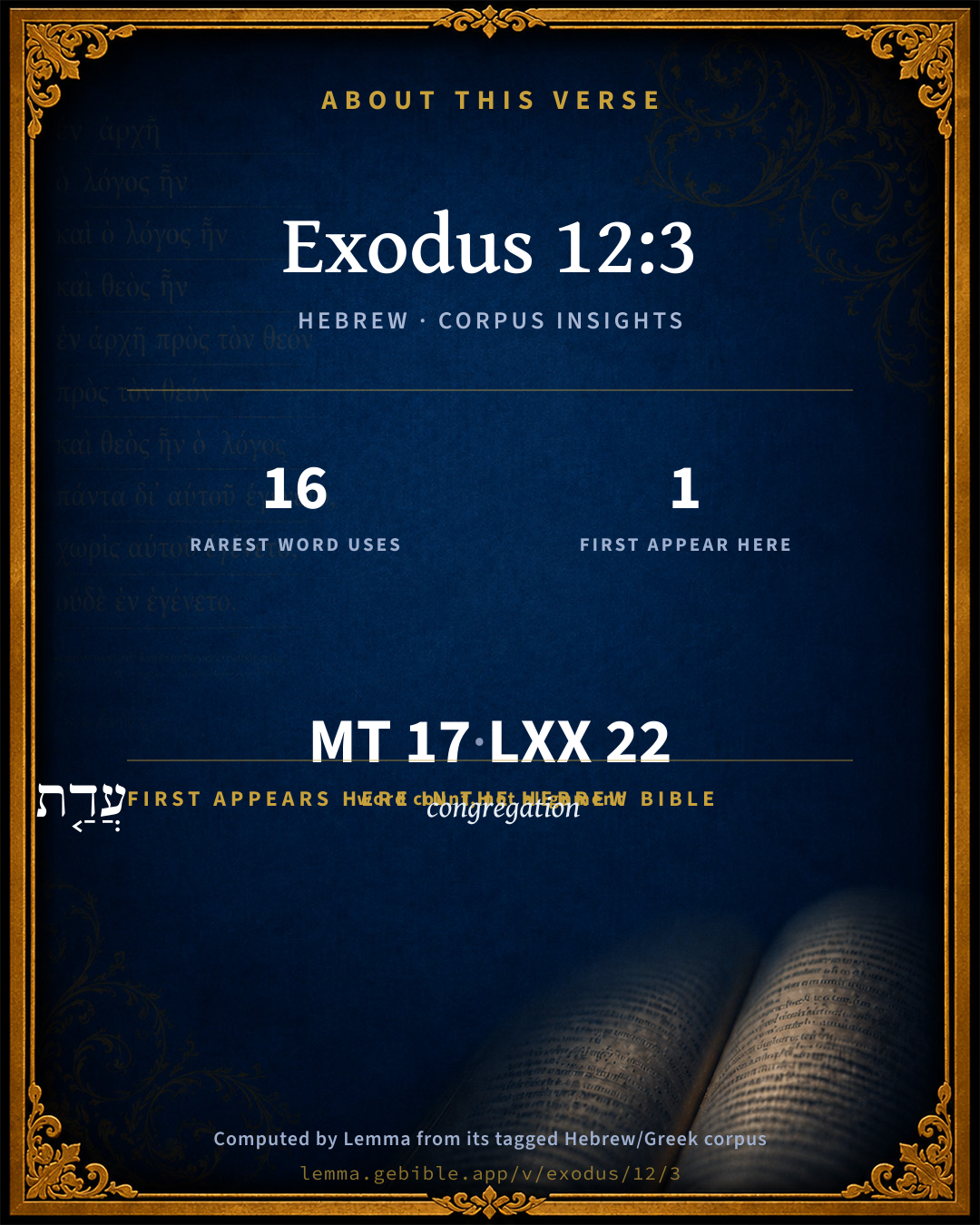
The rarest word here is בֶּעָשֹׂ֖ר ten H6218 — appearing just 16 times in the whole Hebrew Bible.

First appearance in Scripture

This word makes its first canonical appearance in the Hebrew Bible here:

  • עֲדַ֤ת congregation H5712

Shared distinctive vocabulary

בֶּעָשֹׂ֖ר ten H6218 occurs in 16 verses of the Hebrew Bible. Also found in:

Grammatical profile

  • 3 verbs
  • 11 nouns
  • 1 pronoun
  • 2 prepositions

Verb forms

  • דַּבְּר֗וּ Piel · Imperative
  • לֵאמֹ֔ר Qal · Infinitive Construct
  • וְיִקְח֣וּ Qal · Imperfect

Repetition

Words recur within this verse — often emphatic in Hebrew:

  • שֶׂ֥ה sheep H7716 ×2
  • לְבֵית house H1004 ×2

Hebrew & Septuagint length

In English translation the verse runs 34 words from the Hebrew and 38 from the Septuagint (LXX English) — closely comparable.

A rough comparison of the two English renderings, which tokenize alike — not a word-level alignment.

Word counts can differ between the Hebrew and the Greek without any difference in meaning — e.g. the Hebrew direct-object marker אֵת has no separate Greek word, and Greek often adds the article ὁ.

In the original languages it is 17 Hebrew tokens and 22 Greek tokens — but the two are counted differently (Hebrew bundles its prefixes and suffixes into one token; the Greek is in lemma form), so that isn’t a like-for-like length.

Cross-references

21

Topical passages linked to Exodus 12:3 in the Treasury of Scripture Knowledge — connected by theme and wording, ordered by reader-vote popularity; previews shown in the World English Bible.

  • Leviticus 1:2 "Speak to the children of Israel, and tell them, 'When anyone of you offers an offering to Yahweh, you shall offer your offering of the cattle, from the herd and from the flock.
  • Leviticus 5:6 and he shall bring his trespass offering to Yahweh for his sin which he has sinned, a female from the flock, a lamb or a goat, for a sin offering; and the priest shall make atonement for him concerning his sin.
  • John 1:29 The next day, he saw Jesus coming to him, and said, "Behold, the Lamb of God, who takes away the sin of the world!
  • 1 Corinthians 5:7 Purge out the old yeast, that you may be a new lump, even as you are unleavened. For indeed Christ, our Passover, has been sacrificed in our place.
  • Genesis 4:4 Abel also brought some of the firstborn of his flock and of the fat of it. Yahweh respected Abel and his offering,
  • Genesis 22:8 Abraham said, "God will provide himself the lamb for a burnt offering, my son." So they both went together.
  • Exodus 4:30 Aaron spoke all the words which Yahweh had spoken to Moses, and did the signs in the sight of the people.
  • Exodus 6:6 Therefore tell the children of Israel, 'I am Yahweh, and I will bring you out from under the burdens of the Egyptians, and I will rid you out of their bondage, and I will redeem you with an outstretched arm, and with great judgments:
  • Exodus 12:6 and you shall keep it until the fourteenth day of the same month; and the whole assembly of the congregation of Israel shall kill it at evening.
  • Numbers 15:11 Thus shall it be done for each bull, or for each ram, or for each of the he-lambs, or of the kids.
  • 2 Chronicles 35:7 Josiah gave to the children of the people, of the flock, lambs and kids, all of them for the Passover offerings, to all who were present, to the number of thirty thousand, and three thousand bulls: these were of the king's substance.
  • John 1:36 and he looked at Jesus as he walked, and said, "Behold, the Lamb of God!"
  • John 12:12 On the next day a great multitude had come to the feast. When they heard that Jesus was coming to Jerusalem,
  • Exodus 14:15 Yahweh said to Moses, "Why do you cry to me? Speak to the children of Israel, that they go forward.
  • Exodus 20:19 They said to Moses, "Speak with us yourself, and we will listen; but don't let God speak with us, lest we die."
  • Numbers 1:1–54 Yahweh spoke to Moses in the wilderness of Sinai, in the Tent of Meeting, on the first day of the second month, in the second year after they had come out of the land of Egypt, saying,
  • Joshua 7:14 In the morning therefore you shall be brought near by your tribes: and it shall be, that the tribe which Yahweh takes shall come near by families; and the family which Yahweh shall take shall come near by households; and the household which Yahweh shall take shall come near man by man.
  • 1 Samuel 7:9 Samuel took a sucking lamb, and offered it for a whole burnt-offering to Yahweh: and Samuel cried to Yahweh for Israel; and Yahweh answered him.
  • Revelation 5:6–13 I saw in the midst of the throne and of the four living creatures, and in the midst of the elders, a Lamb standing, as though it had been slain, having seven horns, and seven eyes, which are the seven Spirits of God, sent out into all the earth.
  • Revelation 7:9–14 After these things I looked, and behold, a great multitude, which no man could number, out of every nation and of all tribes, peoples, and languages, standing before the throne and before the Lamb, dressed in white robes, with palm branches in their hands.
  • Revelation 13:8 All who dwell on the earth will worship him, everyone whose name has not been written from the foundation of the world in the book of life of the Lamb who has been killed.

Cross-references courtesy of OpenBible.info (CC BY 4.0).

Hebrew and Greek witnesses Masoretic Hebrew ↔ Greek Septuagint

The same verse in the two great witnesses to the Old Testament, shown verse-for-verse.

These are two independent witnesses, not word-aligned to each other, and the Septuagint is shown in lemma (dictionary) form.

Hebrew Exodus 12:3 Masoretic · Westminster Leningrad Codex

דַּבְּר֗וּ אֶֽל כָּל עֲדַ֤ת יִשְׂרָאֵל֙ לֵאמֹ֔ר בֶּעָשֹׂ֖ר לַחֹ֣דֶשׁ הַזֶּ֑ה וְיִקְח֣וּ לָהֶ֗ם אִ֛ישׁ שֶׂ֥ה לְבֵית אָבֹ֖ת שֶׂ֥ה לַבָּֽיִת

Speak to all the congregation of Israel, saying, 'On the tenth day of this month, they shall take to them every man a lamb, according to their fathers' houses, a lamb for a household;

World English Bible · Public Domain

Greek LXX Exodus 12:3 Septuagint · lemma form

λαλέω πρός πᾶς συναγωγή υἱός ἰσραήλ λέγω ὁ δέκατος ὁ μήν οὗτος λαμβάνω ἕκαστος πρόβατον κατά οἶκος πάτριος ἕκαστος πρόβατον κατά οἰκία

Speak to all the congregation of the children of Israel, saying, On the tenth of this month let them take each man a lamb according to the houses of their families, every man a lamb for his household.

LXX2012 (modern English Septuagint) · Public Domain

On this verse, The Preacher's Complete Homiletical Commentary discusses the Septuagint’s reading. Read the note in Commentary ↓

Hebrew: Westminster Leningrad Codex (CC BY 4.0). Greek: Septuagint (public domain); English from LXX2012 (modern English Septuagint) (Public Domain). How the Septuagint differs from the Hebrew →

Targum (Aramaic paraphrase)

2

The Targum is the ancient Jewish Aramaic paraphrase of the Hebrew Scriptures — an interpretive translation, not the Hebrew text itself. Onkelos (literal) and Pseudo-Jonathan (expansive) render the Torah, and Jonathan the Prophets. Coverage is partial: where no permissively-licensed English translation exists for a verse, only the Aramaic is shown. This is verse-level text, not a word-by-word alignment to the Hebrew.

  1. Targum Onkelos Torah (Genesis–Deuteronomy)
    מַלִילוּ עִם כָּל כְּנִשְׁתָּא דְיִשְׂרָאֵל לְמֵימַר בְּעַסְרָא לְיַרְחָא הָדֵין וְיִסְבוּן לְהוֹן גְבַר אִמָר לְבֵית אַבָּא אִמָר לְבֵיתָא:

    Speak with all the gathered of Israel, to say: In the tenth of this month, also, a man will take up for himself a lamb, for their father's house, a lamb for their own house.

    Targum Onkelos — Aramaic: “Onkelos Genesis” (public domain); “Onkelos Exodus” (public domain); “Onkelos Leviticus” (public domain); “Onkelos Numbers” (public domain); “Onkelos Deuteronomy” (public domain). English: “Sefaria Community Translation” (CC0 1.0 (public-domain dedication)); “J.W. Etheridge. The Targums of Onkelos and Jonathan Ben Uzziel on the Pentateuch. London: Longmans, Green, 1862” (public domain). Text via Sefaria.

  2. Targum Pseudo-Jonathan Torah (Genesis–Deuteronomy)
    מַלִילוּ עִם כָּל כְּנִשְׁתָּא דִבְנֵי יִשְרָאֵל לְמֵימַר בְּעַשְרָא לְיַרְחָא הָדֵין זִמְנֵיהּ קָבִיעַ בַּהֲדָא זִימְנָא וְלָא לְדָרַיָא וְיִסְבוּן לְהוֹן אִימַר לְבֵית גְּנִיסְתָּא וְאִין סַגִּיאִין מִמִּנְיָנָא יִסְבוּן אִימְרָא לְבֵיתָא

    Speak to all the congregation of the children of Israel, saying, In the tenth of this month, whose time is appointed for this time (occasion), and not for (coming) generations, they shall take to them a lamb for the house of a family, and, if many in number, they shall take a lamb for a house:

    Targum Pseudo-Jonathan — Aramaic: “Targum Jonathan on Genesis” (public domain); “Targum Jonathan on Exodus” (public domain); “Targum Jonathan on Leviticus” (public domain); “Targum Jonathan on Numbers” (public domain); “Targum Jonathan on Deuteronomy” (public domain). English: “The Targum of Jonathan ben Uzziel, trans. J. W. Etheridge, London, 1862” (public domain). Text via Sefaria.

Commentary

Notes on Exodus 12:3 from classic Christian and Jewish commentators (each source and its license shown beneath its notes). The classic Christian expositions comment on the surrounding passage and are grouped to its opening verse, so a note may address several verses; the Jewish commentaries on the Tanakh (Rashi and others) are per-verse, so they appear only where the commentator wrote on this verse.

Lemma curates 59 commentaries, every one of them public domain or Creative Commons licensed, each selected and text-cleaned for this edition rather than reprinted as found. About our sources →

Trapp's Complete Commentary

John Trapp

Exo 12:3 Speak ye unto all the congregation of Israel, saying, In the tenth [day] of this month they shall take to them every man a lamb, according to the house of [their] fathers, a lamb for an house:

Ver. 3. In the tenth day.] The paschal lamb was taken up the tenth day, but not sacrificed till the fourteenth, that they might "so kill the passover" as first to "sanctify themselves and prepare their brethren." {2Ch 35:6} For which cause also it was a received tradition among the Jews, that during those four days the lamb was tied to their bedposts. {a}

{a} Hospin., De Orig. Fest., cap. 5.

John Trapp, A Commentary or Exposition upon All the Books of the Old and New Testament (1647–1656) — public domain. Text from a community e-Sword module.

The Biblical Illustrator

Joseph S. Exell

Exo_12:3-4

If the household be too little for the lamb.

Too little for the lamb

I. The text reminds us of a primary privilege.

1. That each man of Israel ate the passover for himself; every man according to his eating. So do we feed upon Jesus, each one as his appetite, capacity, and strength enable him to do.

2. But this same delicious fare should be enjoyed by all the family--a lamb for an house. Oh, that each of the parents and all the children and servants may be partakers of Christ!

II. The text is silent as to a certain contingency.

1. The lamb was never too little for the family; and assuredly the Lord Jesus was never too little even for the largest family, nor for the most sinful persons.

2. There is no reason to stint our prayers for fear we ask too much.

3. Nor to stay our labours because the Lord Jesus cannot give us strength enough, or grace enough.

4. Nor to restrain our hopes of salvation for the whole family, because of some supposed narrowness in the purpose, provision, or willingness of the Lord to bless.

III. The text mentions a possibility, and provides for it.

1. One family is certainly too small a reward for Jesus--too little for the Lamb.

2. One family is too little to render Him all the praise, worship, service, and love which He deserves.

3. One family is too little to do all the work of proclaiming the Lamb of God, maintaining the truth, visiting the Church, winning the world. Therefore let us call in the neighbour next unto our house.

(1) Our next neighbour has the first claim upon us.

(2) He is the most easy to reach, and by each calling his next neighbour all will be reached.

(3) He is the most likely person to be influenced by us. At any rate this is the rule, and we are to obey it (see Luk_24:47; Joh_1:41; Neh_3:28). If our neighbour does not come when invited, we are not responsible; but if he perished because we did not invite him, blood-guiltiness would be upon us (Eze_33:8).

IV. The whole subject suggests thoughts upon neighbourly fellowship in the gospel.

1. It is good for individuals and families to grow out of selfishness, and to seek the good of a wide circle.

2. It is a blessed thing when the centre of our society is the Lamb.

3. Innumerable blessings already flow to us from the friendships which have sprung out of our union in Jesus.

4. Our care for one another in Christ helps to realize the unity of the one body, even as the common eating of the passover proclaimed and assisted the solidarity of the people of Israel as one nation. This spiritual union is a high privilege.

5. Thoroughly carried out, heaven will thus be foreshadowed upon earth, for there love to Jesus and love to one another is found in every heart. (C. H. Spurgeon.)

Sharing religion with others

There are some things which can be shared with our neighbours, and some which cannot, in the religious life. In securing the means of grace we can go halves with our next-door neighbours; but not so in the great fact of personal salvation. We can join with a neighbour in taking a pew in church, or in getting a waggon to carry us to church, or in subscribing for a religious paper--and paying for it too; but we can share no neighbours seat in heaven; his team will never carry us there; the truths which benefit him from the weekly paper do not, because of their gain to him, do us any good. And if our nextdoor neighbours family is a household of faith, that doesnt make ours so. The members of his family may be saved and ours lost. Neighbourliness is commanded and commended of God; but God doesnt want you to leave your salvation in the hands of your next-door neighbour. The blood above your neighbours doorpost will not save your household from death. (H. C. Trumbull.)

The Biblical Illustrator, edited by Joseph S. Exell (c. 1880s–1900s) — public domain. Text from a community e-Sword module.

Joseph Benson's Commentary

Exo 12:3. In the tenth day of this month — It was necessary they should now begin to prepare the passover four days before, because otherwise it would have been difficult to get ready so many lambs in Egypt, especially as they were to depart in haste; besides, this being the first instance of the celebration of the ordinance, they would require more time to prepare for a ceremony entirely new. But in future ages they did not begin the preparation till the thirteenth, the day before the passover. They shall take every man a lamb — The Hebrew word signifies a lamb, or kid, (Deu 14:4,) as is evident from Exo 12:5; for they might take either for this sacrifice: but commonly they made choice of a lamb.

Joseph Benson's Commentary on the Old and New Testaments (1811–1818) — public domain. Text from a community e-Sword module.

The Preacher's Complete Homiletical Commentary

Joseph S. Exell (gen. ed.)

CRITICAL NOTES.—

Exo_12:3. The house of their fathers.] More exactly: “a father’s house.” The designation naturally imports “family” in the larger sense of “family of families,” the entire group formed by the union of grown-up sons and daughters with their children under the ancestral roof. Only in the event of this group being too small for a lamb, were mere neighbours to unite.—

Exo_12:6. Whole assembly of the congregation.] Here, at the very outset of Hebrew national history, is an illustration of the truth that, fundamentally, all Hebrews were priests (cf. Exo_19:6),—a truth which lives on in its interest when connected with unfulfilled prophecy (Isa_61:6), and with the antitypical realisation in the Christian ecclesia (1Pe_2:9). Moreover, it is observable that the first Passover was a domestic observance, and that the Lord’s Supper was instituted as a part and an outgrowth of such an observance in an upper room.—In the evening.] Literally, “between the two evenings,” “probably,’ says Dr. Davies (Heb. Lex.), “between sunset and dark (cf. Deu_16:6), as the Karaites and Samaritans hold, or perhaps the time between the sun’s declining and its actual setting, as the Pharisees insisted and the Jews now hold.” Kalisch, deeming the former view “the most rational,” translates the expression “at dusk,” and quotes with approval the following from Ebn Ezra: “We have two evenings; the first, the setting of the sun, that is, the time when he disappears beneath the horizon; and the second, the ceasing of the light which is reflected in the clouds; and between both lies an interval of about one hour and twenty minutes.”—

Exo_12:11. Passover.] Heb., Pesach, “a stepping over,” “sparing;” from pa-sach, to move away from, to move forward from, to move over from one object to another (Furst). The noun pesach occurs forty-eight times in the Old Testament, always rendered “passover” in the “Authorised Version;” and reappears in the Septuagint under the form pascha, which is then used in the New Testament twenty-nine times, most notably in connection with the Messiah’s death in the Gospels, when the New Feast was instituted, also, with more direct application to the same great fact, by the Apostle Paul, 1Co_5:7 (lit. “for OUR PASSOVER ALSO was slain [even] Christ”). The verb pa-sach is rendered “pass over” in Exo_12:13; Exo_12:23; Exo_12:27 of this chapter, and in Is. Exo_31:5.—

Exo_12:12. Gods or Egypt.] “Which words,” says Kalisch, “evidently mean that the uniform and general extirpation of all the first-born of the Egyptians, which calamity their gods will be powerless to avert, will be a manifest proof to those who have hitherto worshipped them that they are a vain support and an idle refuge: thus the authority of the idols will be destroyed in the eyes of the Egyptians, and this was the severest ‘judgment’ which the omnipotent Lord of the Universe could exercise against them”—

MAIN HOMILETICS OF THE PARAGRAPH.—Exo_12:3-13

THE INSTITUTION OF THE PASSOVER

I. The circumstances under which the Passover was instituted. The king of Egypt and his people had rebelled against the command of the Lord, as made known by Moses and Aaron, in not consenting to give Israel their freedom. Mercy had been tried, judgment had been inflicted, all to no purpose. The heart of Pharaoh was still hardened against the Divine request, and now Heaven is driven to the last extremity of retribution, and has determined on and announced the death of Egypt’s first-born. The Divine edict has gone forth. At this crisis the Passover was instituted for the safety of the children of Israel. How would the destroying angel know the homes of Egypt from the homes of Israel? and what token should he have of the safety of the latter? This was the question. The Passover was the answer. Blood was to be sprinkled on the upper door-post of the houses occupied by the Israelites. And so the world of unregenerate humanity is under the dire sentence of death, and the sentence is soon to be executed. But how shall the good escape the sword of the avenger? By taking immediate refuge in the Cross of Christ. This is the only refuge of man from moral and eternal death. The Cross was instituted to save men from the edict of moral death.

(1) It was instituted under perilous circumstances.

(2) It was instituted under exceptional circumstances.

(3) It was instituted under painful circumstances. And so the Cross of Christ was instituted under circumstances morally dangerous, morally exceptional, and morally painful, but under circumstances which rendered it most welcome to the true Israel.

II. The proceedings by which the Passover was characterised.

1. A lamb was slain in the houses of the Israelites (Exo_12:3-4). Every householder was to take a lamb, without blemish, of the first year, and, after keeping it four days in the house, was to kill it. This was emblematical of things in the Christian economy. Christ is the Lamb of God. He was taken from amongst the flock in the vigour of manhood. He was ordained to be slain from the foundation of the world. He was without moral defect. He was slain on Calvary.

2. The blood of the lamb thus slain was to be sprinkled on the upper door-post of the houses of the Israelites (Exo_12:7). It was not enough to kill the lamb; its blood must be sprinkled on the upper door-posts of the house, if the inmates are to be safe. And it is not sufficient for the safety of men that Christ died; His precious blood must be sprinkled on their hearts. The blood was not sprinkled on the threshold of the door, but high up on the posts. The blood of Christ is sacred, and must not be trampled under foot of men. The mark of a Christian life is to be evident to the world and easily discernible. There would be no difficulty in knowing the houses of the Israelites. The house of a good man should always be known by the token of the Cross upon it.

3. The slain lamb was eaten by the Israelites in an attitude of pilgrimage and haste (Exo_12:11). The slain lamb was to be eaten by the Israelites. It was not to be eaten raw, nor sodden at all with water, but roast with fire. None of the animal was to remain. All were to eat of it. During the repast, their loins were to be girt and their feet were to be shod. And so the soul must appropriate Christ; it must cultivate an attitude of moral haste, and it must be mindful of its pilgrim condition, if it is to be saved by Him.

III. The results by which the Passover was followed. (Exo_12:13.)

1. After the celebration of the Passover the Israelites were safe. After the sprinkling of the blood upon the door-post of the house the Israelites were safe from the stroke of the avenging angel. They were protected because they complied with the ordinance of God for their safety. And so men are only safe when they have yielded obedience to the terms of salvation which God requires. The Israelites might have done many wise things, and availed themselves of many preventatives against the destruction of the angel; but if they had not sprinkled the blood upon the door-posts they would have perished. Men may strive to do many things to ameliorate their condition as sinners, but the Cross of Christ is their only real protection.

2. After the celebration, of the Passover the Israelites were free. After the destruction of the first-born the Israelites were commanded to leave Egypt. The proud tyrant gave them their freedom. He had no wish, at that sad moment, to prolong the conflict with Jehovah, of whose power he had received sufficient demonstration. The souls of men are only free when they are sprinkled with the blood of Christ, and when they have made a personal appropriation of the Saviour. Then they are free from the tyranny of pride and passion; they enter upon the long and trying pilgrimage of moral goodness.

3. After the celebration of the Passover the Israelites were joyous. They were pleased with their freedom and the prospects before them. They were grateful for the terrible retribution they and their families had escaped through the abundant mercy of God. And so when the soul has received Christ, its first experiences, as it steps out into the new and mysterious life, are those of joy and gratitude. LESSONS:—

1. That every household should have an interest in the Lamb slain from the foundation of the world.

2. That to experience the saving benefit of Christ’s death the soul must personally receive Him.

3. That Christ as dying is the only hope of the soul.

4. That Christ died for all.

THE PASSOVER AS ILLUSTRATIVE OF THE ATONING WORK OF CHRIST, AND OF ITS RECEPTION BY THE BELIEVING SOUL

I. In the victim it provides. “Speak ye unto all the congregation of Israel, saying, In the tenth day of this month they shall take to them every man a lamb, according to the house of their fathers, a lamb for an house” (Exo_12:3). Thus the victim provided for the celebration of the Jewish Passover was a lamb. Jesus Christ is called the Lamb of God (Joh_1:29). He was innocent; He was meek. He was Divinely appointed to be a sacrifice for sin.

1. This lamb was to be a male of the first year (Exo_12:5). Because after that it would be no lamb, but a sheep, and because it must be perfect and strong. And so Christ was mighty in strength. He required to be strong. He had a great task to accomplish, and many hindrances to overcome. He had perfect strength (Psa_89:19; Isa_19:20; Tit_2:13). Men must render to God the activities of youth.

2. The lamb was to be without blemish (Exo_12:5). It was not to be lame or blind or sick, or in any way defective. So Christ was a perfect offering. He was pure. Sin strove in vain to soil Him. His enemies could find no fault in Him. He was sinless (1Pe_1:19).

3. The lamb was to be set apart four days (Exo_12:6). They were commanded to set apart the Paschal lamb four days, because if they had delayed it till the moment of their departure from Egypt, they might in the haste of other business have forgotten it; in order that they might detect any blemish in the lamb; that they might by a sight of the lamb be awakened to a grateful expectation of their approaching deliverance; and that they might repose a sure trust in the help of God against their enemies. And so Christ was ordained from eternity as the offering for human guilt. He was in every way tested.

II. In the sacrifice it requires. “And the whole assembly of the congregation of Israel shall kill it in the evening” (Exo_12:6). Thus the lamb was to be slain, and by all Israel. The continued life of the victim would not have ensured the needed safety. Its death was a necessity. And so in reference to Christ; we are saved by His death. Without shedding of blood there is no remission. He was slain by the entire congregation. The world, Jews and Gentiles, cried out, “Crucify Him! crucify Him!” The Paschal lamb was roast with fire. In this we have set forth the sufferings of Christ. No pain equal to that occasioned by burning. Christ in the agony of the garden and on the cross.

III. In the duty it enjoins. “And they shall take of the blood, and strike it on the two side-posts and on the upper door-post of the houses wherein they shall eat it” (Exo_12:7). The blood appointed to be a means to preserve the Hebrews from death is emblematical of the blood of Christ, whereby men are delivered from sin and everlasting death. True the destroying angel would know the houses of the Israelites without this sign on the door-post, but this shedding of blood was the Divinely-appointed method of safety, and was the token of God’s care over them. Christian families must have the blood of Christ sprinkled on the lintels of their doors. They must remember Christ when they go in and out; they must confess Christ to the unbelieving world; then they will be safe from the minister of vengeance. The blood of Christ is the only protection of the soul, and must be sprinkled as well as shed (Rom_5:11). The soul must make a personal appropriation of Christ. To know Christ will profit little. We must feast on Him by faith.

IV. In the spirit it demands. (Exo_12:22.) The bunch of hyssop signifies faith and humility. David said, “Wash me with hyssop and I shall be clean” (Psa_51:7). Hyssop is a lowly herb growing in rocky places. In the reception of Christ the soul must be humble. The Paschal lamb was also to be eaten with unleavened bread and with bitter herbs (Exo_12:8). Here we have shadowed forth the need of repentance and sincerity. And if the soul is to receive Christ, it must be with a contrite heart and with a deep sense of demerit. The Paschal lamb was to be eaten in the attitude of haste (Exo_12:11). The loins must be girded, the feet must be shod, the hands must hold the staff. The redeemed soul must sit loose to earthly things. The good are pilgrims in the world; they must be ready to go to Canaan.

V. In the peril it averts. “And when I see the blood, I will pass over you, and the plague shall not be upon you to destroy you” (Exo_12:13). Thus we see the peril escaped by the Israelites through the proper observance of the Passover, and in this we have an emblem of the dangers averted from men by a believing interest in the atonement of Jesus Christ. They are delivered from the power of the second death. They escape the stroke of the destroying angel. Their safety is welcome and happy.

VI. In the extent it contemplates. By a proper observance of the Passover all Israel would be preserved from the blow of the destroying angel, not one soul excepted. And so by application to the atonement of Jesus Christ the whole world may receive an eternal salvation from the awful penalties of sin. LESSONS:—

1. That Christ crucified is the only hope of moral safety.

2. That Christ appropriated is the only refuge of the soul.

3. That Christ must be received by repentance and faith.

SUGGESTIVE COMMENTS ON THE VERSES

Exo_12:3-13. God alone can ordain sacraments in His Church. Set times or days for duties can only be constantly appointed by God.

God leaves to prudence some smaller circumstances of worship, which nature and reason may judge fit (Exo_12:3-4).

The Passover is an evening sacrifice, sweet and real.… The blood of the Passover must be sprinkled to give benefit.… Houses in the law, but souls in the Gospel, must be sprinkled with blood.

The night of death to enemies God makes the night of feasting to His Church.

God’s rules must qualify persons at all times for His Passover communion.

Speed in the use of God’s ordinance must be used when God commands it.

The occasion of festival to the Church:—

1. The destruction of God’s enemies.

2. The destruction of false gods.

3. The deliverance of souls from bondage.

4. The demonstration of the Divine existence.

God sees and answers His own signs, and will spare His people in destroying sinners.

ILLUSTRATIONS

BY

REV. WM. ADAMSON

Passover-Relics! Exo_12:7. Millington says that the sprinkling of the blood upon the doorposts probably gave rise to certain traditions and customs among other nations. Pliny tells how houses may be preserved from the perils of sorcery, by sprinkling the door-posts with the blood of the hyæna; while in another place he relates how the newly-wedded bride was in the habit of anointing the door-posts of her home with the blood of a wolf. These, like many other heathen relics of Scripture customs and ceremonies, are sad declensions from the lofty and sublime ideals in Revelation. Though, after all, beneath their floating nebulous vapours there lies the solid germ of truth: the human conviction of the necessity of mediation and atonement for safety and preservation. So that, even these pass over-relics echo one voice—

“The Cross unfolds the mystery,—Jesus died;

The sinner lives; the law is satisfied.”

—Conder.

Passover-Safety! Exo_12:13. The Israelites had to sprinkle the blood, and this involved an act of faith. By grace were they saved, through faith. A gentleman, crossing a dreary moor, came at length upon a solitary cottage. Glad of the shelter, he could not help pondering upon the loneliness of its inmates, and wondering at their self-security. In the morning, when about to proceed on his way, he inquired of its occupant, whether she was not afraid to live in this lonely place. “Oh no!” responded his humble and aged hostess; “for faith closes the door at night, and mercy opens it in the morning.” Having by faith sprinkled the atoning blood upon the lintels, Israel’s host could repose securely until Mercy opened the door, with the cry: “The hour of deliverance has come.” And so can the Israel of God!

“Who know not where

His islands lift His fronded palms in air;

Who only know they cannot drift

Beyond His love and care.”

—Whittier.

Types and Shadows! Exo_12:3. When the miner, in the American prairies, sinks a shaft to strike the coal formation, he finds far down the images of beautiful plants, lying like lacework spread out upon tables of ebony; images of ferns, and leaves, and flowers, which millions of years ago perhaps ceased, from some change of climate, to open in the cold spring-time, and hence to fall into autumn. There these pictures lie, telling us of a time when perpetual summer-time reigned, and that where the drifting snows of December fall, tropical birds sang and fluttered in palm-trees, and flowers filled the whole day and night with perfume. In our own land, when men of scientific skill ascend the lofty mountains, they perceive traces of a time when huge icebergs grazed their peaks, just discernible above the waters of an Arctic Sea. Yet all these, whether tropical or arctic, dimly shadowed forth more perfect adaptations in nature and nature’s growth; and so all the Bible vegetation—the ritual growth, as well as moral and vicarious development—were images of good things to come; shadows of more glorious and blessed realities of life and salvation in Christ. But just as there are certain more clearly-defined type-memorials perceived by the scientific student, so, in Revelation, are there certain rites and ceremonies more distinctly prefigurative of the atoning blood of the Lamb. Such is the Passover—dim and shadowy memorial of that wondrous Paschal sacrifice—

“That sovereign balm for every wound,

That cordial for our fears.”

—Watts.

Jewish Passover! Exo_12:7. Bonar and M‘Cheyne record a visit paid to a family of Jews at Jassy. It was the night preceding the day of Atonement; on the eve of which solemn day it is the Jewish custom to kill a cock for every man, and a hen for every woman. In the morning, the “Shochet” or slayer, going round to the houses, arouses the inmates to bring out the fowls to be killed in a proper manner. This, says Trench, is the only blood that is shed in Israel now. Even the paschal lamb is no more slain. A cock and hen, killed by the knife of the Shochet, is all the sacrifice which Israel knows. It is for this wretched, self devised sacrifice that Israel rejects the blood of the “Lamb of God,” which taketh away the sin of the world!

“Dear, dying Lamb, Thy precious blood

Shall never lose its power.”

—Cowper.

Shelter! Exo_12:13. In the East Indies there grows a tree, which is called a nonconductor of lightning. When the dreadful thunderstorms burst in those tropical regions, the lightnings would strike the surrounding trees of the forest, but never touch this nonconductor. It was some time before the natives discovered this peculiar property; but, once ascertained, they invariably gathered their flocks and families beneath these singular trees, as soon as they saw the storms gathering. No matter how loud the thunder, how vivid the fiery gleams, the refugees were safe under its far-spreading arms. There was only one danger, which arose from the falling of some forest giant upon it, crushing it beneath the weight of the fall. If, however, this tree was stronger than the falling trunk, it stood firm. So amid the storms of life there is the Tree of Life, the Saviour of sinners, beneath whose extended wings fugitive penitents are safe. No lightnings of Divine wrath can injure that sacred Tree; and such is its almighty strength, that no riven, blasted trunks can crush it beneath their falling weight. Israel’s first-born, safe under the spreading branches of Divine providence and truth, were types and teachers of penitent sinners, who avail themselves of the salvation promised and presented beneath the outspread arms of the Cross of Calvary—

“We have no shelter from our sin,

But in Thy wounded side.”

—Alexander.

The Preacher's Complete Homiletical Commentary (gen. ed. Joseph S. Exell; Funk & Wagnalls, c. 1892) — public domain (pre-1929). A full-Bible homiletical/sermon-outline anthology covering 65 of 66 books (2 John is absent from the source module). Text from a community e-Sword module.

Geneva Bible (1599)

Geneva Bible translators

As the fathers of the household had great or small families.

Geneva Bible (1599) marginal notes — public domain. Text via Bolls.life.

Jamieson, Fausset & Brown

Robert Jamieson, A. R. Fausset & David Brown

Speak ye unto all the congregation of Israel--The recent events had prepared the Israelitish people for a crisis in their affairs, and they seem to have yielded implicit obedience at this time to Moses. It is observable that, amid all the hurry and bustle of such a departure, their serious attention was to be given to a solemn act of religion.

a lamb for an house--a kid might be taken (Exo 12:5). The service was to be a domestic one, for the deliverance was to be from an evil threatened to every house in Egypt.

Jamieson, Fausset & Brown — Commentary Critical and Explanatory on the Whole Bible (1871) — public domain (CC PDM 1.0). Text via the HelloAO Bible API.

Adam Clarke's Commentary

Verse 3. In the tenth day of this month] In after times they began their preparation on the thirteenth day or day before the PASSOVER, which was not celebrated till the fourteenth day, see Ex 12:6: but on the present occasion, as this was their first passover, they probably required more time to get ready in; as a state of very great confusion must have prevailed at this time. Mr. Ainsworth remarks that on this day the Israelites did afterwards go through Jordan into the land of Canaan; Jos 4:19. And Christ, our Paschal Lamb, on this day entered Jerusalem, riding on an ass; the people bearing palm branches, and crying, Hosanna, Joh 12:1; Joh 12:12-13, c.: and in him this type was truly fulfilled.

A lamb] The original word שה seh signifies the young of sheep and of goats, and may be indifferently translated either lamb or kid. See Ex 12:5.

A lamb for a house] The whole host of Israel was divided into twelve tribes, these tribes into families, the families into houses, and the houses into particular persons Num. i., Jos 7:14. -Ainsworth.

Adam Clarke's Commentary on the Bible (1810–1826) — public domain. Text from a community e-Sword/MySword module.

Ellicott's Commentary for English Readers

(3) In the tenth day.—It is evident that this direction must have been given before the tenth day had arrived, probably some days before. The object of the direction was to allow ample time for the careful inspection of the animal, so that its entire freedom from all blemish might be ascertained. The animal was not to be killed till four days later (Exo_12:6).

A lamb.—The word used (seh) is a vague one, applied equally to sheep and goats, of any age and of either sex. Sex and age were fixed subsequently (Exo_12:5), but the other ambiguity remained; and it is curious that practically only lambs seem to have been ever offered. The requirement indicates a social condition in which there was no extreme poverty. All Israelites are supposed either to possess a lamb or to be able to purchase one.

According to the house of their fathers.—Rather, for the house of their fathers: i.e., for their family.

A Bible Commentary for English Readers, edited by Charles John Ellicott (1878–1897) — public domain. Text from a community e-Sword module.

The Cambridge Bible for Schools and Colleges

gen. ed. J. J. S. Perowne

3. the congregation] P’s standing expression for Israel, as an organized religious community, or ‘church.’ It occurs in P more than 100 times, usually alone (‘the congregation’), sometimes with the addition of ‘of Israel’ (as here, vv. 6, 47, Lev_4:13), or ‘of the children of Israel’ (Exo_16:1-2, &c.). Except in P and the allied narrative of Joshua 22, it occurs in the historical books only in Jdg_21:10; Jdg_21:13; Jdg_21:16, 1Ki_8:5 (not in LXX.) = 2Ch_5:6, 1Ki_12:20.

the tenth day] perhaps (Di. Bä.) some sanctity attached to the day which closed the first decade of the month: the 10th day of the seventh month was the Day of Atonement (Lev_23:27); in Islam, also, as Di. observes, the 10th day of the 12th month is the day of the great sacrifice at the Mecca pilgrimage; cf. Benzinger, Arch. 2 p. 169.

a lamb] The Heb. seh denotes a single head of the tsôn, or smaller cattle (including both sheep and goats), without reference to age or sex; and may be used of either a sheep or a goat (hence RVm.): see v. 5b; and comp. Num_15:11 b (Lex. ‘or for a seh among the lambs or the goats’), Deu_14:4 b (Lex. ‘the seh of lambs and the seh of goats’).

fathers’ houses] A ‘father’s house’ is a common expression in P and Chr. for a family: see on Exo_6:14.

a lamb for an household] The Passover was to be a domestic institution: each lamb was to be partaken of only by members of one family, or (in the case provided for in v. 4) of two families living side by side.

The Cambridge Bible for Schools and Colleges (gen. ed. J. J. S. Perowne; Cambridge University Press, 1878–1918) — public domain. Text from a community e-Sword module.

John Gill's Exposition

Speak ye unto all the congregation of Israel,.... That is, to the elders of the people, and heads of families; unless we can suppose that they had been gradually gathered, and were now gathered together in a body by the direction of Moses, by whom they were assured that their departure was at hand; and the rather it may be thought that so it was, since the following order concerned the whole and every individual:

saying, in the tenth day of this month; the month Abib or Nisan, which shows that this direction must be given before that day, and so very probably on the first of the month, as before observed:

they shall take to them every man a lamb; not every individual person, but every master of a family, or head of an house, as follows:

according to the house of their fathers, a lamb for an house; if large enough to eat up a whole lamb, otherwise they were to do as next directed: the Targum of Jonathan suggests, that this direction of taking a lamb to them on the tenth day of the month was only for this time, and not for following ages; and so the Jewish doctors (c) commonly understand it as being peculiar to the passover in Egypt, and not in later times; for they (d) say,"what difference is there between the passover in Egypt, and the passover in later ages? the passover in Egypt was taken within the tenth day, and was obliged to sprinkling with a bunch of hyssop upon the lintel, and upon the two side posts, and was eaten with haste in one night, but the passover in later ages was kept all the seven days.''The ground and reason of this special direction for taking up a lamb on the tenth day was, that they might have a lamb ready; and that through the multiplicity of business, and the hurry they would be in at their departure, they might not forget it, and neglect it; and that they might have time enough to examine whether it had all the prerequisites and qualifications that were necessary; and that while they had it in view, they might be led to meditate upon, and talk of, expect and firmly believe their deliverance; yea, that their faith might be directed to a far greater deliverance by the Messiah, which this was only typical of, Heb 11:28 but some of these reasons would hold good in later times, and it seems by some circumstances that this rule was attended to.

(c) Ben Gersom in loc. Maimon. Korban Pesach. c. 10. sect. 15. (d) Misn. Pesach. c. 9. sect. 5.

John Gill's Exposition of the Whole Bible (1746–1763) — public domain (CC PDM 1.0). Text via the HelloAO Bible API.

Albert Barnes' Notes on the Bible

A lamb - The Hebrew word is general, meaning either a sheep or a goat - male or female - and of any age; the age and sex are therefore epecially defined in the following verse. The direction to select the lamb on the tenth day, the fourth day before it was offered, was intended to secure due care in the preparation for the great national festival. The custom certainly fell into desuetude at a later period, but probably not before the destruction of the temple.

Albert Barnes' Notes on the Bible (1834–1885) — public domain. Text from a community e-Sword/MySword module.

Haydock's Catholic Bible Commentary

Children; a word which has been dropped in the printed Hebrew and in the Chaldean, which has been assimilated to it, though found still in some manuscripts and in the Samaritan, Septuagint, Syriac and Arabic versions. (Kennicott) --- Day. This regarded only the present occasion. (Jonathan) --- The Jews no longer eat the paschal lamb, as they are banished from Chanaan. (Calmet) --- Man, who has a family sufficient to eat a lamb; Hebrew se, which means also a kid, (as either was lawful, ver. 13,) and perhaps also a calf, Deuteronomy xvi. 2.

George Leo Haydock (1774–1849), Haydock's Catholic Family Bible and Commentary, 1859 edition — public domain. Excludes Psalms (Douay-Rheims chapter numbering differs from Protestant) and Deuterocanonical books (Catholic canon only).

Matthew Poole's English Annotations

In the tenth day; partly, that they might have the lamb ready for the sacrifice, and might not be distracted about procuring it when they should be going to use it; partly, that by the frequent contemplation of the lamb, as a sign appointed by God, they might have their faith strengthened as to their approaching deliverance, and afterwards might have their minds quickened to the more serious consideration of that great deliverance out of Egypt, and of that more glorious deliverance from hell by Christ the true Passover, which should be offered for them; partly, to teach the church in all ages how necessary a thing preparation is to the solemn duties and exercises of religion; and partly, to signify that Christ should be first set apart, and separated to the ministry, which was done three or four prophetical days, i.e. years, before his death, and afterwards offered: most of which reasons being perpetual, it may seem this usage was so too, and not for the first passover only.

They shall take to them, into their houses, where the Jews tell us he was tied to the bed-post.

A lamb, or kid, Exo 12:5, for the same word signifies both, though a lamb was commonly used, and a kid only in case of the want of a lamb; and the Chaldee and LXX. do almost constantly translate the Hebrew word lamb. And Christ is seldom or never typified by a kid, but generally by a lamb, as he is called Joh 1:29, partly for his innocency, meekness, patience, &c., but principally with respect to the paschal lamb, instead whereof he was in due time to be offered; whence he is called our Passover, 1Co 5:7.

A lamb was to be disposed of to every house or family, according to its quantity, or the number of persons in it, as the next verse explains it. The several families are called

the houses of their fathers, because they consist of those persons which come from one father or grandfather. The people were divided into tribes, the tribes were subdivided into families, and the families again into houses, which were like sprigs taken from the greater branches, and planted apart, and each of these had their several fathers, from whom they were denominated, as here they are.

Matthew Poole's English Annotations on the Holy Bible (1683–1685) — public domain. Text from a community e-Sword/MySword module.

Whedon's Commentary on the Bible

Daniel D. Whedon

3, 4. In the tenth day — After this first passover there is no record of any instance where the lamb was selected before the fourteenth day.

A lamb for a house — No special number is here mentioned as necessary to constitute the paschal company, but a Jewish tradition fixed ten as the least number, and, reckoning children, it probably averaged about twenty. It became a custom for each person to eat a piece of the lamb about the size of an olive, which would allow the paschal company to be quite large. An individual might not eat the passover alone. Thus was symbolized the fellowship of the Church in partaking of Christ.

Daniel D. Whedon (gen. ed.), Commentary on the Old and New Testaments (1874–1909) — public domain. Text from a community e-Sword module.

The Pulpit Commentary

Speak ye unto all the congregation. Under the existing circumstances Moses could only venture to summon the elders of Israel to a meeting. He necessarily left it to them to signify his wishes to the people. (See ver. 21.) A lamb. The Hebrew word is one of much wider meaning than our "lamb." It is applicable to both sheep and goats, and to either animal without limit of age, In the present case the age was fixed at a year by subsequent enactment (ver. 5); but the offerer was left free with respect to the species. It is curious that, such being the case, the lamb alone should, so far as appears, ever have been offered. According to the house of their fathers. Literally, "for a father"s house," i.e. for a family.

Vers. 3-20. The Passover Proper.

The Passover may be viewed:

I AS A COMMEMORATIVE RITE. Instituted with reference to the tenth plague, and as a means by which the first-born of the Israelites might be saved from destruction, but accompanied by ceremonies which were connected with the prospective departure of the whole nation out of Egypt, the Passover feast, as established by an ordinance for ever," commemorated two distinct and different things.

(1) The passing over of the houses of the Israelites by Jehovah, when he went through the land in the character of "destroyer" (ver. 23), to smite the first-born; and

(2) the hurried departure of the nation out of Egypt in the night, with bread for their journey, which they had not had time to leaven (ver. 34). It was thus intended to remind them of two great mercies; the lesser one being the escape of their first-born from sudden death, and the greater one the deliverance of the whole people from the bondage and affliction of Egypt, with the consequence of such deliverance, the establishment of them as a nation under the direct government of God, and under laws which were communicated to them by God himself at Sinai. Man is so apt to forget the benefits which God confers upon him, that it has been found necessary, or at least desirable, in almost all countries, to establish, by authority, days of commemoration, when national deliverances, national triumphs, national recoveries, shall be brought prominently before the mind of the nation, and pressed upon its attention. The Passover must be regarded as one of the most effective of such commemorative ceremonies. It has continued to be celebrated for above three thousand years. It brings vividly to the recollection of the Jew that night of trepidation and excitement, when the lamb was first killed, the blood dashed upon the doorposts, and the sequel waited for that night, when "about midnight" was heard "a great cry," and in every house the Egyptians bewailed one dead that night, in which, after the cry, a murmur arose, and the Egyptians became "urgent" (ver. 33), and insisted that the Israelites should quit the land forthwith. It has all the political advantage of a great national celebration; and it exalts the political idea by uniting it with religious enthusiasm.

II AS A FEAST OF THANKSGIVING. The sacrifices of the Paschal week, with the exception of the Paschal lamb and the daily goat, must be viewed as thank-offerings. They consisted of fourteen bullocks, seven rams, and forty-nine lambs of the first year, provided by. the priests, and offered to God in the name of the nation. They were burnt on the altar as holocausts, accompanied by meat-offerings of flour mingled with oil. At the same time individuals offered their own private thank-offerings. So far, the special object of the thanksgiving was the great deliverance, with which might be conjoined, in thought, God"s further mercies in the history of the nation. On the second day of the feast, however, another subject of thankfulness was introduced. The season of the year was that in which the earliest grain ripened in Palestine; according to a conjecture already made, it was the time when the return of spring had been long celebrated among the Semites by a traditional observance. As each return of the Passover festival was intended to remind the Israelites of their national regeneration" (Kalisch), it was thought appropriate to bring the festival into connection with the regeneration of nature, and the return of vernal vegetation. On the second day, therefore, a sheaf of the first ripe barley was offered as the first-fruits of the coming harvest, and thanks were rendered to God for his bounty in once more bringing to perfection the fruits of the earth. During the remainder of the week, both subjects occupied the thoughts of the worshippers, who passed the time in innocent festivities, as songs, music, and dancing.

III AS A SYMBOLICAL CEREMONY. We have not to guess at the symbolical meaning of the Passover, as of so much that is contained in the Jewish law. Scripture distinctly declares it. "Christ, our Passover, is slain," says St. Paul; "therefore let us keep the feast." Christ, who was prefigured and foreshown in every sacrifice, was symbolised especially by the Paschal victim. He was "the Lamb of God", (Joh_1:29) "without spot or blemish", (1Pe_1:19) "holy, harmless, undefiled"; (Heb_7:26) offered to keep off "the destroyer," saving us by His blood from; (Act_20:28) slain that we might feed upon His flesh. (Joh_6:51) The Paschal lamb, when prepared for sacrifice, presented, as Justin Martyr informs us, a lively image of the Saviour upon "the accursed tree," being extended on a cross formed of two wooden spits, one longitudinal, and one transverse, placed at right angles each to the other. "Not a bone of it was to be broken," that it might the better typify Him whom God preserved from this indignity. (Psa_34:20; Joh_19:33) It was tobe consumed entirely, as Christ is to be taken entire into the heart of the faithful. (Gal_4:19) Scripture also distinctly declares the symbolical meaning of the unleavened bread. "Let us keep the feast," says St. Paul, "not with the leaven of malice and wickedness, but with the unleavened bread of sincerity and truth." He who would feed on Christ must first put away from him all corruption and impurity, eject all leaven out of the house wherein his spirit dwells, make himself fit to sit down at that heavenly banquet, by getting rid of all those "evil things which come from within, and defile the man". (Mar_7:23) There may be some doubt, however, as to the symbolism of the "bitter herbs," which Scripture leaves unexplained. The exegesis, that the bitter herbs symbolised the sufferings of the Israelites in Egypt, if taken as exhausting the meaning, is unsatisfactory. The memory of past sufferings inflicted by others is not a necessary accompaniment of present festal joy, though it may enhance that joy by contrast. The "bitterness" should be something that is always requisite before the soul can find in Christ rest, peace, and enjoyment something that must ever accompany that rest, peace, and enjoyment, and, so long as we are in the flesh, remain inseparable from it. Two things of this kind suggest themselves repentance and self-denial. The bitter herbs may perhaps symbolise both, pointing on the one hand to the important truth, that real repentance is a continuous act, never ceasing, while we live below, and on the other to the necessity of men"s "taking up their cross daily," and striving towards perfectness through suffering.

Vers. 3-6. The Passover lamb a prophetic picture of Christ and his salvation.

I FOR WHOM THE SACRIFICE AVAILS.

1. The families of Israel, the household of faith. There is no other bulwarkagainst the visitation of the angel of death, and it shields these only.

2. Those who feed upon him. Saving faith must be a real, appropriatingfaith. Mere assent to a form of words avails nothing, neither can a mere intellectual Conviction of the truth of Christianity or apprehension of the plan of salvation; it must be the soul"s food.

II THE CHARACTER OF THE SACRIFICE. A lamb without blemish; gentleness and blamelessness. He who dies for us is accepted, because he is faultless. The sin-bearer must be sinless. This is redemption"s great central mystery. But though the eternal reason of it may not be understood, the wisdom of it is shown in our experience. The power which changes us lies in this, that Christ died not for sins of his own, but solely for ours. "He bore our sins, in his own body on the tree.

III HIS STORY.

1. The lamb kept for four days within the house foretold that God"saccepted sacrifice should come forth from the homes of Israel. The four days may symbolise the nearly four years of our Lord"s ministry.

2. The day and hour of the Saviour"s death (ver. 6).

3. His death was to be Israel"s act; "the whole assembly" were to slay it.

(1) Our sins nailed him to the tree. He was stain by our iniquities.

(2) Israel"s act in the murder of the holy and just one was the expression of the sin which is in us all. None are free from this awful blood guiltiness, save the repentant and pardoned. U.

HOMILIES BY G.A. GOODHART

Vers. 3-11. If one died for all then all died.

Pharaoh"s heart still hardened. The crowning judgment needs no intermediary; Jehovah will reveal His own right arm. Exo_11:4. "Who shall live when God doeth this?" He who obeying His word shelters himself beneath His shadow. See:

I THE PREPARATION.

1. A carefully selected victim. Ver. 5, deliberately set apart four days beforehand. Pure within; innocence typified by inexperience, "the first year." Pure without, "no blemish.

2. A carefully conducted purification. The partaker of the sacrificial feast must endeavour after a purity resembling that of the victim. Leaven, evil, must be purged out that he may offer and receive worthily.

II THE PASSOVER. A sarifice to save from death, 5:6, 7. Notice

(1) Obedience ensured safety. The judgment was to go forth against the first-born; but the lamb slain his blood duly sprinkled would be accepted as a substitute. Obedience all that was demanded.

(2) The meaning of the command. Few types are arbitrary; almost always some ground of relation between them and the thing typified, even though we may not see it. Here the pure lamb represents the offerer as he ought to be; it says in his name "I would be pure; I would dedicate myself wholly to thy service; accept me, not for what I am but for what Thou canst make me. Take this lamb for me; make me as this lamb!" Obedience saves, but that which is commanded shadows forth the final result to be achieved by obedience.

2. Sustenance to nerve for duty. Lamb not merely to be killed but eaten. The people saved from the destroyer are to be released also from the oppressor; to commence at once the life of liberty. Strength needed for the march. That which saves is that which supports, if the lamb represents the offerer as he ought to be, feeding upon the lamb will represent feeding by faith upon the ideal thus figured. To become righteous we must hunger and thirst after righteousness, Mat_5:6. Dedication is the starting-point, but the road is persistent obedience, and they only can walk that road who feed upon the ideal first set before them. (Php_3:12-14)

III CHRIST OUR PASSOVER. The type leads naturally to the great antitype.

1. Our sacrifice.

(1) Pure, perfect. Slain for us. By faith accepting his work, peace with God; shelter from the avenging angel. This is what we mean by substitution Christ died for me. Notice however:

(2) Accepting this sacrifice we must still regard it as representative. Pleading its efficacy, we not merely mean "Forgive me for Christ"s sake," but also, "I would be like Christ, I would give myself up wholly to Thy will even as he has done Accept me in him, make me like him!" The doctrine of substitution is only explained by this underlying doctrine of identity, it could not otherwise be a doctrine of salvation.

2. Our sustenance. We too, saved in Christ, have to march on along the road which leads from slavery to freedom. To do this we must feed upon our ideal, "inwardly digest" it. What we ought to be; what we hope to be; what Christ is. Our great advantage over the Jew is that our ideal is realised in a person. To feed upon it is to feed upon Christ. To attain it is to be like Christ, to be one with him.

Application. Christ died for us. True, but Christ dying for us implies that we also die with him. Dedication of a substitute not enough unless self is dedicated in the substitute. Very well wishing to be happy, and the hope of many is little more than this. God, however, means us to be holy, and there is no easy road to holiness. Accept the ideal, accept Christ out and out, we shall find him more than an ideal: he will strengthen and sustain us till we attain it. Forget what the ideal is; forget what dedication means; we may yet find that it is possible for those who are saved from bondage to perish in the wilderness. G.

The Pulpit Commentary (1880–1919), ed. H.D.M. Spence-Jones & Joseph S. Exell — public domain. Text from a community e-Sword module.

John Wesley's Explanatory Notes

Take every man a lamb - In each of their families, or two or three families, if they were small, join for a lamb. The lamb was to be got ready four days before. and that afternoon they went, they were to kill it, (ver. 6,) as a sacrifice, not strictly, for it was not offered upon the altar, but as a religious ceremony, acknowledging God's goodness to them, not only in preserving them from, but in delivering them by the plagues inflicted on the Egyptians. The lamb so slain they were to eat roasted (we may suppose in its several quarters) with unleavened bread and bitter herbs; they were to eat it in haste, ver. 11, and to leave none of it until the morning; for God would have them to depend upon him for their daily bread. Before they eat the flesh of the lamb, they were to sprinkle the blood upon the door-posts; by which their houses were to be distinguished from the houses of the Egyptians, and so their first-born secured from the sword of the destroying angel. Dreadful work was to be made this night in Egypt; all the first-born both of man and beast were to be slain; and judgment executed upon the gods of Egypt, Num. xxxiii, 4. It is probable the idols which the Egyptians worshipped were defaced, those of metal melted, those of wood consumed, and those of stone broke to pieces. This was to be annually observed as a feast of the Lord in their generations, to which the feast of unleavened bread was annexed, during which, for seven days, they were to eat no bread but what was unleavened, in remembrance of their being confined to such bread for many days after they came out of Egypt, ver. 14- 20. There was much of the gospel in this ordinance: (1.) The paschal lamb was typical. Christ is our passover, 1 Cor. v, 7, and is the Lamb of God, John i, 29. 2. It was to be a male of the first year; in its prime. Christ offered up himself in the midst of his days. It notes the strength and sufficiency of the Lord Jesus, on whom our help was laid. 3. It was to be without blemish, noting the purity of the Lord Jesus, a lamb without spot, 1 Pet. i, 19. 4. It was to be set apart four days before, noting the designation of the Lord Jesus to be a saviour, both in the purpose and in the promise. It is observable, that as Christ was crucified at the passover, so he solemnly entered into Jerusalem four days before, the very day that the paschal lamb was set apart. 5. It was to be slain and roasted with fire, noting the exquisite sufferings of the Lord Jesus, even unto death, the death of the cross. 6. It was to be killed by the whole congregation between the two evenings, that is, between three o'clock and six. Christ suffered in the latter end of the world, Heb. ix, 26, by the hand of the Jews, the whole multitude of them, Luke xxiii, 18. 7. Not a bone of it must be broken, ver. 46, which is expressly said to be fulfilled in Christ, John xix, 33, 36. (2.) The sprinkling of the blood was typical. 1st, It was not enough that the blood of the lamb was shed, but it must be sprinkled, noting the application of the merits of Christ's death to our souls; 2ndly, It was to be sprinkled upon the door-posts, noting the open profession we are to make of faith in Christ, and obedience to him. The mark of the beast may be received in the forehead, or in the right hand, but the seal of the lamb is always in the forehead, Rev. vii, 3. 3rdly, The blood thus sprinkled was a means of the preservation of the Israelites from the destroying angel. If the blood of Christ be sprinkled upon our consciences, it will be our protection from the wrath of God, the curse of the law, and the damnation of hell. (3.) The solemn eating of the lamb was typical of our gospel duty to Christ. 1st, The paschal lamb was killed not to be looked upon only, but to be fed upon; so we must by faith make Christ ours, as we do that which we eat, and we must receive spiritual strength and nourishment from him, as from our food, and have delight in him, as we have in eating and drinking when we are hungry or thirsty. 2ndly, It was to be all eaten: those that, by faith, feed upon Christ, must feed upon a whole Christ. They must take Christ and his yoke, Christ and his cross, as well as Christ and his crown. 3rdly, It was to be eaten with bitter herbs, in remembrance of the bitterness of their bondage in Egypt; we must feed upon Christ with brokenness of heart, in remembrance of sin. 4thly, It was to be eaten in a departing posture ver. 11, when we feed upon Christ by faith, we must sit loose to the world, and every thing in it. (4.) The feast of unleavened bread was typical of the Christian life, 1 Cor. v, 7, 8. Having received Christ Jesus the Lord, 1st. We must keep a feast, in holy joy, continually delighting ourselves in Christ Jesus; If true believers have not a continual feast, it is their own fault. 2ndly, It must be a feast of unleavened bread, kept in charity, without the leaven of malice, and in sincerity, without the leaven of hypocrisy. All the old leaven of sin must be put far from us, with the utmost caution, if we would keep the feast of a holy life to the honour of Christ. 3rdly, It was to be an ordinance forever. As long as we live we must continue feeding upon Christ, and rejoicing in him always, with thankful mention of the great things he has done for us.

John Wesley, Explanatory Notes Upon the Whole Bible (1754–1765) — public domain. Text via the GEBible commentary corpus.

unfoldingWord translationNotes

Door43 World Missions Community

If the household is too small for a lamb

This means that there are not enough people in the family to eat an entire lamb. AT: "If there are not enough people in the household to eat an entire lamb" (See: Assumed Knowledge and Implicit Information)

the man and his next door neighbor

Here "the man" refers to the man who is the leader of the household.

translationWords

assembly

Israel

day

lamb

goat

household

neighbor

unfoldingWord translationNotes — © Distant Shores Media and the Door43 World Missions Community, licensed CC BY-SA 4.0. Source: git.door43.org/Door43/en_tn.

Rashi

Rabbi Shlomo Yitzchaki (Rashi)

דברו אל כל עדת SPEAK UNTO ALL THE CONGREGATION — But did Aaron speak? Has it not already been stated, (Exodus 7:2) “You (Moses) shall speak etc.”. But the explanation is: they paid respect one to the other, saying to each other, “Instruct me what to say”. and the divine communication in question issued from both of them, so that it was as though they were both speaking (Mekhilta).

דברו אל כל עדת ישראל לאמר בעשר לחדש i. e. SPEAK to-day — on the first of the month — THAT ON THE TENTH OF THE MONTH they should take it (the lamb) (Mekhilta).

הזה [ON THE TENTH OF] THIS [MONTH] — As regards the paschal lamb sacrificed in Egypt it had to be taken from the flock on the tenth, but this did not apply to the paschal-lamb offered by future generations (Pesachim 96a).

שה לבית אבות A LAMB FOR THE HOUSE OF THEIR FATHERS — i. e. a lamb for one family (“family” here means the larger unit comprising the father or grandfather with his married sons and their families). Consequently, if they (the members of such a family) were numerous, one might think that they may take one lamb for all of them (irrespective of whether this would suffice to provide a piece as large as an olive, the minimum quantity, for each person)! Therefore Scripture states: שה לבית A LAMB FOR EACH HOUSEHOLD (Mekhilta).

Rashi on the Tanakh — English translations: “The Judaica Press complete Tanach with Rashi, translated by A. J. Rosenberg” (CC BY 4.0); “Pentateuch with Rashi's commentary by M. Rosenbaum and A.M. Silbermann, 1929-1934” (public domain); “The Metsudah Tanach series, Lakewood, N.J” (CC BY 4.0); and “The Book of Joshua, Metsudah Publications, 1997” (CC BY 4.0). Text via Sefaria.

Ramban (Nachmanides)

Rabbi Moshe ben Nachman (Ramban / Nachmanides)

THEY SHALL TAKE TO THEM EVERY MAN A LAMB, ACCORDING TO THEIR FATHERS’ HOUSES. The reason for this commandment is that the constellation of Aries (the Ram) is at the height of its power in the month of Nisan, it being the sign of the zodiac which ascends the heavens. Therefore He commanded us to slaughter the sheep and to eat it in order to inform us that it was not by the power of that constellation that we went out from Egypt, but by decree of the Supreme One. And according to the opinion of our Rabbis, etc., (above, 8:22), Onkelos translated: “if we sacrifice that which the Egyptians worship.” In his Moreh Nebuchim (III, 46), Rambam also writes: “Scripture tells us, according to the version of Onkelos, that the Egyptians worshipped Aries, etc.” that the Egyptians worshipped it as a deity, He has all the more informed us through this that He subdued their gods and their powers at the height of their ascendancy. And thus the Rabbis have said: “Take you lambs and slaughter the gods of Egypt.”

Ramban (Nachmanides) on the Tanakh — English translation: “Commentary on the Torah by Ramban (Nachmanides). Translated and annotated by Charles B. Chavel. New York, Shilo Pub. House, 1971-1976” (CC BY 4.0). Text via Sefaria.

Lesson kit

Teaching starters — assembled from the data on this page, not authored interpretation. Every prompt links to the verse data it draws on. Edit before teaching.

Exodus, in the Pentateuch, opens this verse with 17 words (14 distinct Hebrew lemmas). Its most distinctive word is ʻâsôwr (“ten”). A historical commentator’s framing appears above. Read the whole chapter for the surrounding context.

Discussion questions

  1. How does “ten” (ʻâsôwr) shape what this verse is saying?
  2. The word “congregation” first appears here in Scripture. What is being introduced at this debut?
  3. Genesis 24:55 shares the word «ten» with this verse. How do the two illuminate each other?
  4. “sheep” occurs 2× in this one verse. What is the effect of the repetition?
  5. These translations render this verse differently; the difference is in the English rendering, not the original. What questions does that raise?
  6. The verb «דַּבְּר֗וּ» is Piel Imperative. How does its form color the action?
  7. Reading how Trapp's Complete Commentary and The Biblical Illustrator read this verse, where do the two commentators agree and where do they part?

Things to notice

Reading settings

Reading text

Shown beneath each verse's original-language words.

Old Testament
Old Testament edition

Read the OT as the Masoretic Hebrew (MT) or the Greek Septuagint (LXX).

English shown for the Greek Septuagint (in the Hebrew ↔ Greek comparison).

Comparing translations? Open the Compare panel on any verse page to stack up to four side by side.