Deuteronomy 22:23

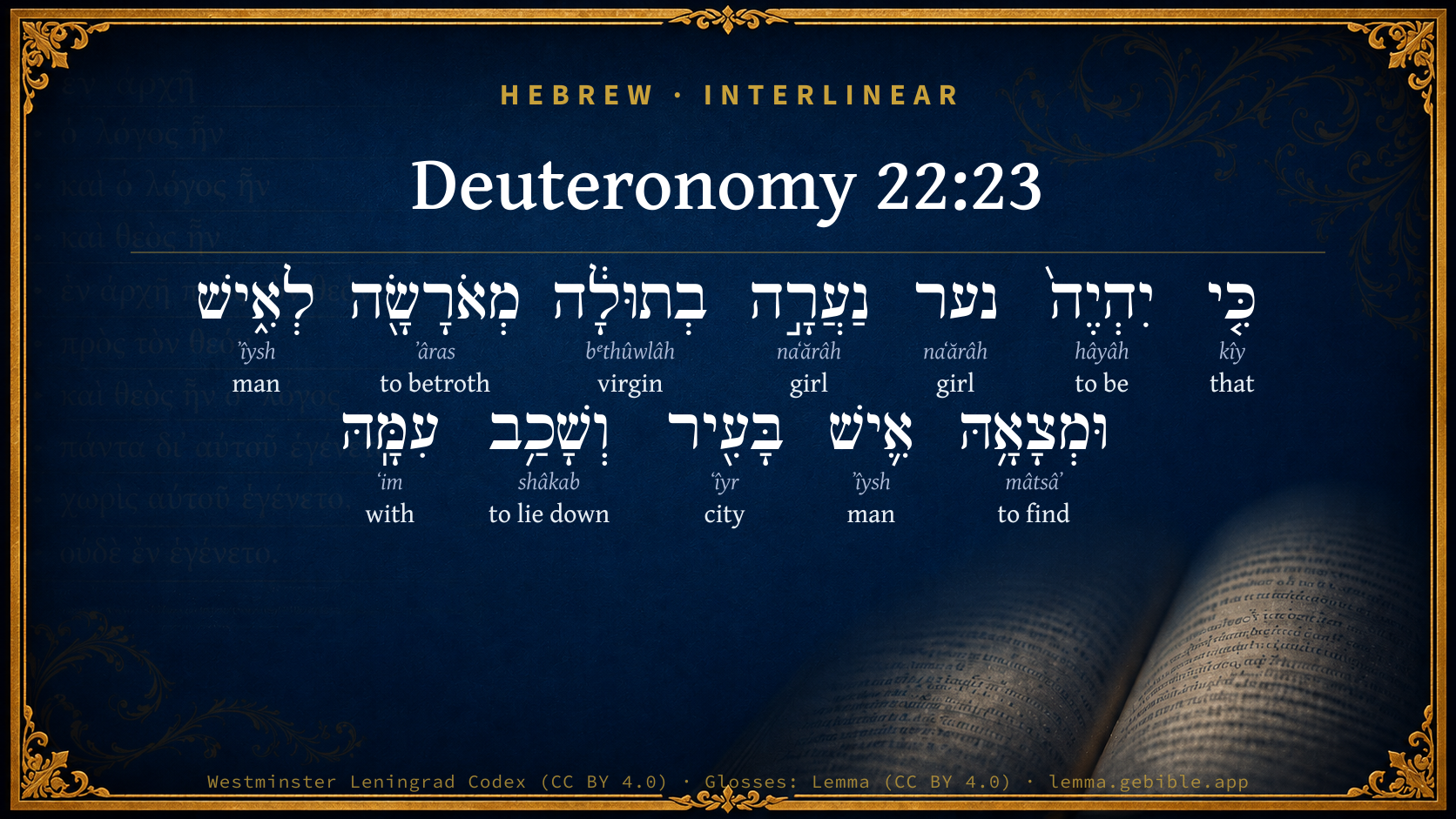
Hebrew (Westminster Leningrad Codex) Deuteronomy 22:23 appears in the Hebrew Old Testament. The text above is from the Westminster Leningrad Codex. Each word links to its Strong’s number, a concise gloss, and parsing drawn from the Open Scriptures Hebrew Bible morphology. Click any word for its full Brown-Driver-Briggs (BDB) entry.
Download image
Cite this verse

Deuteronomy 22:23 (World English Bible). Public Domain. Lemma interlinear Bible study tool, https://lemma.gebible.app/v/deuteronomy/22/23.

Show BibTeX & RIS
BibTeX
RIS
English Translation
If there be a young lady who is a virgin pledged to be married to a husband, and a man find her in the city, and lie with her;
World English Bible · Public Domain
Download a study sheet

One document with this verse’s original text, its word-by-word gloss line, the meaning frame, cross-references with their text, attributed commentary, and full source and license credits — printable, and it pastes into notes with its structure intact.

This verse Autodidact and up

Study sheet (.html) Plain text (.txt)

A passage Seminary Student

Up to 50 verses in one chapter. A passage sheet keeps up to 6 commentary sources and 12 cross-references per verse, in the order this page ranks them, and says so on the sheet whenever that leaves anything out. Ask for a single verse and you get the Autodidact verse sheet above.

Everything on this page stays free to read, with no account — the sheet is a download of what is already on screen, not access to it.

Want to remove ads? Support Godless Engineer
Compare translations 3

The same verse in 3 English versions, stacked beneath the original-language interlinear above. Click any original word for its lexicon entry.

Each is an independent rendering of the whole verse — the interlinear is not word-aligned to these translations.

Highlighted words mark where these versions differ — a whole-verse word diff, not a word-by-word alignment.

  • World English Bible Public Domain
    If there be a young lady who is a virgin pledged to be married to a husband, and a man find her in the city, and lie with her;
  • King James Version Public Domain
    If a damsel that is a virgin be betrothed unto an husband, and a man find her in the city, and lie with her;
  • unfoldingWord Literal Text CC BY-SA 4.0
    If is a virgin girl, engaged to a man, and man finds her in the city and lies with her,

unfoldingWord Literal Text — © unfoldingWord, licensed CC BY-SA 4.0. Word-aligned USFM3 via Door43 (git.door43.org/unfoldingWord/en_ult).

Versions to compare (up to 4)

3 of 4 selected

Show all 18 translations

Every available English version of this verse, each an independent rendering of the whole verse.

  • World English Bible Public Domain
    If there be a young lady who is a virgin pledged to be married to a husband, and a man find her in the city, and lie with her;
  • Berean Standard Bible Public Domain
    If there is a virgin pledged in marriage to a man, and another man encounters her in the city and sleeps with her,
  • Majority Standard Bible Public Domain
    If there is a virgin pledged in marriage to a man, and another man encounters her in the city and sleeps with her,
  • King James Version Public Domain
    If a damsel that is a virgin be betrothed unto an husband, and a man find her in the city, and lie with her;
  • American Standard Version (1901) Public Domain
    If there be a damsel that is a virgin betrothed unto a husband, and a man find her in the city, and lie with her;
  • Revised Version (1885) Public Domain
    If there be a damsel that is a virgin betrothed unto an husband, and a man find her in the city, and lie with her;
  • Geneva Bible (1599) Public Domain
    If a maid be betrothed vnto an husband, and a man finde her in the towne and lye with her,
  • Douay-Rheims (1899) Public Domain
    If a man have espoused a damsel that is a virgin, and some one find her in the city, and lie with her,
  • Young's Literal Translation Public Domain
    `When there is a damsel, a virgin, betrothed to a man, and a man hath found her in a city, and lain with her;
  • Literal Standard Version CC BY-SA 4.0
    When there is a girl, a virgin, betrothed to a man, and a man has found her in a city and lain with her,
  • Unlocked Literal Bible CC BY-SA 4.0
    If there is a girl who is a virgin, engaged to a man, and another man finds her in the city and sleeps with her,
  • unfoldingWord Literal Text CC BY-SA 4.0
    If is a virgin girl, engaged to a man, and man finds her in the city and lies with her,
  • Darby Bible Public Domain
    If a damsel, a virgin, be betrothed to some one, and a man find her in the city, and lie with her,
  • World Messianic Bible Public Domain
    If there is a young lady who is a virgin pledged to be married to a husband, and a man finds her in the city, and lies with her,
  • Webster's Bible Public Domain
    If a damsel that is a virgin shall be betrothed to a husband, and a man shall find her in the city, and lie with her;
  • Free Bible Version CC BY-SA 4.0
    If a man meets a girl, a virgin engaged to another man, and sleeps with her there in the town,
  • Bible in Basic English Public Domain
    If a young virgin has given her word to be married to a man, and another man meeting her in the town, has connection with her;
  • JPS Tanakh (1917) Public Domain
    If there be a damsel that is a virgin betrothed unto a man, and a man find her in the city, and lie with her;

Literal Standard Version (2020), Covenant Press — licensed CC BY-SA 4.0. Text via the HelloAO Bible API (eBible.org). Unlocked Literal Bible (unfoldingWord) — licensed CC BY-SA 4.0. Text via the HelloAO Bible API (eBible.org). unfoldingWord Literal Text — © unfoldingWord, licensed CC BY-SA 4.0. Word-aligned USFM3 via Door43 (git.door43.org/unfoldingWord/en_ult). Free Bible Version, Dr. Jonathan Gallagher — licensed CC BY-SA 4.0. Text via the HelloAO Bible API (eBible.org).

Word by word

More ways to search: Search by grammar → Find every occurrence → Compare this word →

Practice this passage: Drill this verse → Learn its vocabulary →

מְאֹרָשָׂ֖ה
ʼâras
H781
“betrothed”
Verb, Pual, Participle Passive, Feminine, Singular, Absolute
Part of Speech
Verb
Stem
Pual
Form
Participle Passive
Gender
Feminine
Number
Singular
State
Absolute
Full BDB Definition

Origin: a primitive root

TWOT: 170

to betroth, engage - (Piel) to betroth (man or woman) - (Pual) to be betrothed
  1. כִּ֤י kîy H3588 “that” Conjunction
  2. יִהְיֶה֙ hâyâh H1961 “to be” Verb, Qal, Imperfect, 3rd Person, Masculine, Singular
  3. נער naʻărâh H5291 “girl” Noun, Common, Feminine, Singular, Absolute
  4. נַעֲרָ֣ה naʻărâh H5291 “girl” Noun, Common, Feminine, Singular, Absolute
  5. בְתוּלָ֔ה bᵉthûwlâh H1330 “virgin” Noun, Common, Feminine, Singular, Absolute
  6. לְאִ֑ישׁ ʼîysh H376 “to/for · man” Preposition + Noun, Common, Masculine, Singular, Absolute
  7. וּמְצָאָ֥הּ mâtsâʼ H4672 “and · to find · her” Conjunction + Verb, Qal, Sequential Perfect, 3rd Person, Masculine, Singular + Suffix, Personal, 3rd Person, Feminine, Singular
  8. אִ֛ישׁ ʼîysh H376 “man” Noun, Common, Masculine, Singular, Absolute
  9. בָּעִ֖יר ʻîyr H5892 “in/at the · city” Preposition, Determined + Noun, Common, Feminine, Singular, Absolute
  10. וְשָׁכַ֥ב shâkab H7901 “and · to lie down” Conjunction + Verb, Qal, Sequential Perfect, 3rd Person, Masculine, Singular
  11. עִמָּֽהּ ʻim H5973 “with · her” Preposition + Suffix, Personal, 3rd Person, Feminine, Singular

About this verse

These counts appear in no published source. They are computed here, from the morphology-tagged text and Lemma’s own curated glosses. What Lemma adds →

12
words
10
distinct lemmas
Pentateuch
section

Notable vocabulary

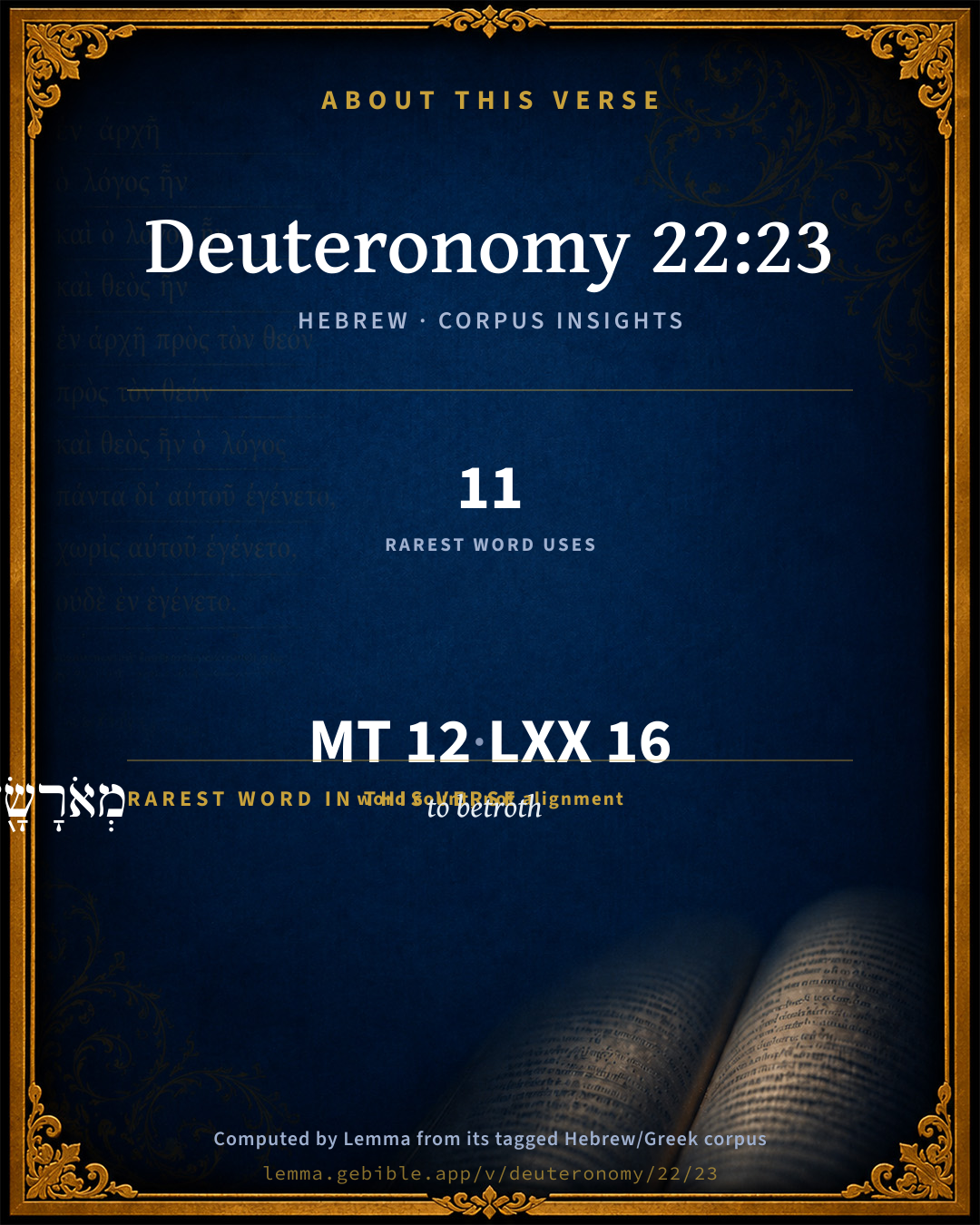
The rarest word here is מְאֹרָשָׂ֖ה to betroth H781 — appearing just 11 times in the whole Hebrew Bible.

Shared distinctive vocabulary

מְאֹרָשָׂ֖ה to betroth H781 occurs in 10 verses of the Hebrew Bible. Also found in:

Grammatical profile

  • 4 verbs
  • 6 nouns
  • 1 preposition
  • 1 conjunction

Verb forms

  • יִהְיֶה֙ Qal · Imperfect
  • מְאֹרָשָׂ֖ה Pual · Participle Passive
  • וּמְצָאָ֥הּ Qal · Sequential Perfect
  • וְשָׁכַ֥ב Qal · Sequential Perfect

Repetition

Words recur within this verse — often emphatic in Hebrew:

  • נער girl H5291 ×2
  • לְאִ֑ישׁ man H376 ×2

Hebrew & Septuagint length

In English translation the verse runs 29 words from the Hebrew and 26 from the Septuagint (LXX English) — closely comparable.

A rough comparison of the two English renderings, which tokenize alike — not a word-level alignment.

Word counts can differ between the Hebrew and the Greek without any difference in meaning — e.g. the Hebrew direct-object marker אֵת has no separate Greek word, and Greek often adds the article ὁ.

In the original languages it is 12 Hebrew tokens and 16 Greek tokens — but the two are counted differently (Hebrew bundles its prefixes and suffixes into one token; the Greek is in lemma form), so that isn’t a like-for-like length.

Cross-references

2

Topical passages linked to Deuteronomy 22:23 in the Treasury of Scripture Knowledge — connected by theme and wording, ordered by reader-vote popularity; previews shown in the World English Bible.

  • Matthew 1:18–19 Now the birth of Jesus Christ was like this; for after his mother, Mary, was engaged to Joseph, before they came together, she was found pregnant by the Holy Spirit.
  • Deuteronomy 20:7 What man is there who has pledged to be married a wife, and has not taken her? let him go and return to his house, lest he die in the battle, and another man take her.

Cross-references courtesy of OpenBible.info (CC BY 4.0).

Hebrew and Greek witnesses Masoretic Hebrew ↔ Greek Septuagint

The same verse in the two great witnesses to the Old Testament, shown verse-for-verse.

These are two independent witnesses, not word-aligned to each other, and the Septuagint is shown in lemma (dictionary) form.

Hebrew Deuteronomy 22:23 Masoretic · Westminster Leningrad Codex

כִּ֤י יִהְיֶה֙ נער נַעֲרָ֣ה בְתוּלָ֔ה מְאֹרָשָׂ֖ה לְאִ֑ישׁ וּמְצָאָ֥הּ אִ֛ישׁ בָּעִ֖יר וְשָׁכַ֥ב עִמָּֽהּ

If there be a young lady who is a virgin pledged to be married to a husband, and a man find her in the city, and lie with her;

World English Bible · Public Domain

Greek LXX Deuteronomy 22:23 Septuagint · lemma form

ἐάν δέ γίγνομαι παῖς παρθένος μνηστεύω ἀνήρ καί εὑρίσκω αὐτός ἄνθρωπος ἐν πόλις κοιμάω μετά αὐτός

And if there be a young damsel espoused to a man, and a man should have found her in the city and have lain with her;

LXX2012 (modern English Septuagint) · Public Domain

On this verse, The Cambridge Bible for Schools and Colleges discusses the Septuagint’s reading. Read the note in Commentary ↓

Hebrew: Westminster Leningrad Codex (CC BY 4.0). Greek: Septuagint (public domain); English from LXX2012 (modern English Septuagint) (Public Domain). How the Septuagint differs from the Hebrew →

Targum (Aramaic paraphrase)

2

The Targum is the ancient Jewish Aramaic paraphrase of the Hebrew Scriptures — an interpretive translation, not the Hebrew text itself. Onkelos (literal) and Pseudo-Jonathan (expansive) render the Torah, and Jonathan the Prophets. Coverage is partial: where no permissively-licensed English translation exists for a verse, only the Aramaic is shown. This is verse-level text, not a word-by-word alignment to the Hebrew.

  1. Targum Onkelos Torah (Genesis–Deuteronomy)
    אֲרֵי תְהֵי עוּלֶמְתָּא בְתֻלְתָּא דִמְאָרְסָא לִגְבַר וְיַשְׁכְּחִנַהּ גְבַר בְּקַרְתָּא וְיִשְׁכּוּב עִמַהּ

    (no public-domain English translation for this verse)

    Targum Onkelos — Aramaic: “Onkelos Genesis” (public domain); “Onkelos Exodus” (public domain); “Onkelos Leviticus” (public domain); “Onkelos Numbers” (public domain); “Onkelos Deuteronomy” (public domain). English: “Sefaria Community Translation” (CC0 1.0 (public-domain dedication)); “J.W. Etheridge. The Targums of Onkelos and Jonathan Ben Uzziel on the Pentateuch. London: Longmans, Green, 1862” (public domain). Text via Sefaria.

  2. Targum Pseudo-Jonathan Torah (Genesis–Deuteronomy)
    אֲרוּם תֶּהֱוֵי עוּלֵימְתָּא בְתוּלְתָּא מִיקַדְשָׁא לִגְבַר וְיִשְׁכְּחִינָהּ גְּבַר חוֹרַן בְּקַרְתָּא וִישַׁמֵּשׁ עִמָּהּ

    If a damsel a virgin is betrothed to a man, and another man find her in the city, and lie with her,

    Targum Pseudo-Jonathan — Aramaic: “Targum Jonathan on Genesis” (public domain); “Targum Jonathan on Exodus” (public domain); “Targum Jonathan on Leviticus” (public domain); “Targum Jonathan on Numbers” (public domain); “Targum Jonathan on Deuteronomy” (public domain). English: “The Targum of Jonathan ben Uzziel, trans. J. W. Etheridge, London, 1862” (public domain). Text via Sefaria.

Commentary

Notes on Deuteronomy 22:23 from classic Christian and Jewish commentators (each source and its license shown beneath its notes). The classic Christian expositions comment on the surrounding passage and are grouped to its opening verse, so a note may address several verses; the Jewish commentaries on the Tanakh (Rashi and others) are per-verse, so they appear only where the commentator wrote on this verse.

Lemma curates 59 commentaries, every one of them public domain or Creative Commons licensed, each selected and text-cleaned for this edition rather than reprinted as found. About our sources →

Ellicott's Commentary for English Readers

Deu_22:23-27. PURITY OF THE BETROTHED.

(24) His neighbour’s wife.—It is evident from the language of this precept that a betrothed virgin in Israel is regarded as a wife. The man who humbles her “hath humbled his neighbour’s wife.” This illustrates the language of Matthew 1 Joseph, when Mary was found with child, sought to put her away (as though she were already his wife). The angel said to him, “Joseph, thou son of David, fear not to take unto thee Mary thy wife.” He “took unto him his wife.” From the construction of this law it follows that Jesus was the son of Joseph, according to the Scripture. The Evangelists do not seem to think it worth while to prove that He was the son of David except through his father (in law).

A Bible Commentary for English Readers, edited by Charles John Ellicott (1878–1897) — public domain. Text from a community e-Sword module.

The Cambridge Bible for Schools and Colleges

gen. ed. J. J. S. Perowne

23. betrothed] see on Deu_20:7.

in the city] Cp. Deu_22:24. In the city she would have been heard had she cried, but as she did not she must have been a consenting party.

23–27. Of Intercourse with a Betrothed Virgin: (1) Deu_22:23 f., with her consent, in which case both she and the man are stoned, as in the case of Adultery (Deu_22:22), for the bride-price having been paid at betrothal the woman is as good as married (Gen_29:21, Joe_1:8); (2) Deu_22:25-27, without her consent, in which case the man alone dies and nothing is done to the woman. These two laws are peculiar to D. Note in Deu_22:24 the Pl. address, and also in Deu_22:26 according to Sam. LXX, but Heb. has here the Sg.

For such cases Ḫammurabi has but one law, § 130: If a man has ravished another’s betrothed, who is virgin, while still in her father’s house, and has been caught in the act, that man shall die, but the woman go free. Among the Arabs if the woman is unmarried her relatives are not obliged to kill her, but no one may marry her (Musil, Ethn. Ber. 210).

The Cambridge Bible for Schools and Colleges (gen. ed. J. J. S. Perowne; Cambridge University Press, 1878–1918) — public domain. Text from a community e-Sword module.

Keil & Delitzsch

C. F. Keil & F. Delitzsch

In connection with the seduction of a virgin (נער, puella, a marriageable girl; בּתוּלה, virgo immaculata, a virgin), two, or really three, cases are distinguished; viz., (1) whether she was betrothed (Deu 22:23-27), or not betrothed (Deu 22:28, Deu 22:29); (2) if she were betrothed, whether it was (a) in the town (Deu 22:23, Deu 22:24) or (b) in the open field (Deu 22:25-27) that she had been violated by a man.

Deu 22:23-24

If a betrothed virgin had allowed a man to have intercourse with her (i.e., one who was not her bridegroom), they were both of them, the man and the girl, to be led out to the gate of the town, and stoned that they might die: the girl, because she had not cried in the city, i.e., had not called for help, and consequently was to be regarded as consenting to the deed; the man, because he had humbled his neighbour's wife. The betrothed woman was placed in this respect upon a par with a married woman, and in fact is expressly called a wife in Deu 22:24. Betrothal was the first step towards marriage, even if it was not a solemn act attested by witnesses. Written agreements of marriage were not introduced till a later period (Tobit 7:14; Tr. Ketuboth i. 2).

Deu 22:25-27

If, on the other hand, a man met a betrothed girl in the field, and laid hold of her and lay with her, the man alone was to die, and nothing was to be done to the girl. "There is in the damsel no death-sin (i.e., no sin to be punished with death); but as when a man riseth against his neighbour and slayeth him, even so is this matter." In the open field the girl had called for help, but no one had helped her. It was therefore a forcible rape.

Deu 22:28-29

The last case: if a virgin was not betrothed, and a man seized her and lay with her, and they were found, i.e., discovered or convicted of their deed, the man was to pay the father of the girl fifty shekels of silver, for the reproach brought upon him and his house, and to marry the girl whom he had humbled, without ever being able to divorce her. This case is similar to the one mentioned in Exo 22:15-16. The omission to mention the possibility of the father refusing to give him his daughter for a wife, makes no essential difference. It is assumed as self-evident here, that such a right was possessed by the father.

Keil & Delitzsch — Biblical Commentary on the Old Testament (1861–1891) — public domain (CC PDM 1.0). Text via the HelloAO Bible API. (Old Testament only.)

John Gill's Exposition

Then ye shall bring them both out unto the gate of the city,.... Where the fact was committed; the Targum of Jonathan is,"to the gate of the court of judicature, which is in that city:"

and ye shall stone them with stones, that they die; a man that lay with a married woman, he and she were to be strangled; but this sort of adulterers and adulteresses were to be stoned, and it is thought that of this sort was the woman spoken of in Joh 8:3,

the damsel because she cried not, being in the city, and the man because he hath humbled his neighbour's wife; as she was by espousal, by contract, by promise, and so was guilty of adultery, which was punishable with death:

so thou shall put away evil from among you; see Deu 22:21.

John Gill's Exposition of the Whole Bible (1746–1763) — public domain (CC PDM 1.0). Text via the HelloAO Bible API.

Haydock's Catholic Bible Commentary

CHAPTER XXII.

George Leo Haydock (1774–1849), Haydock's Catholic Family Bible and Commentary, 1859 edition — public domain. Excludes Psalms (Douay-Rheims chapter numbering differs from Protestant) and Deuterocanonical books (Catholic canon only).

Matthew Poole's English Annotations

By this betrothing she had actually engaged herself to another man, and was in some sort his with, and therefore is sometimes so called, as Gen 29:21; Mat 1:20.

Matthew Poole's English Annotations on the Holy Bible (1683–1685) — public domain. Text from a community e-Sword/MySword module.

unfoldingWord translationNotes

Door43 World Missions Community

General Information:

Moses speaks to the Israelites as if they were one man, so the word "you" is singular. (See: Forms of You)

engaged to a man

"who is promised to marry a man"

take ... and stone

These commands are addressed to Israel as a group and so are plural. (See: Forms of You)

take both of them

"then you must bring both the girl and the man who slept with her"

because she did not cry out

"because she did not call for help"

because he violated his neighbor's wife

The Israelites at that time thought of a man and woman who had engaged each other for marriage as husband and wife. The full meaning of this statement can be made explicit. AT: "because he slept with a girl who belongs to a fellow Israelite" (See: Assumed Knowledge and Implicit Information)

you will remove the evil from among you

The adjective "evil" can be translated as a noun phrase. AT: "you must remove from among the Israelites the person who does this evil thing" or "you must execute this evil person" (See: Nominal Adjectives)

translationWords

virgin

gate

stone

die

evil

unfoldingWord translationNotes — © Distant Shores Media and the Door43 World Missions Community, licensed CC BY-SA 4.0. Source: git.door43.org/Door43/en_tn.

Rashi

Rabbi Shlomo Yitzchaki (Rashi)

ומצאה איש בעיר [IF A DAMSEL THAT IS A VIRGIN BE BETROTHED UNTO A MAN] AND A MAN FIND HER IN THE CITY [AND LIE WITH HER] — (Because he found her outdoors) therefore he lay with her: a breach in the wall invites the thief; if she had remained at home (as becomes a chaste Jewish girl) this would not have happened to her (Sifrei Devarim 242:2-3).

Rashi on the Tanakh — English translations: “The Judaica Press complete Tanach with Rashi, translated by A. J. Rosenberg” (CC BY 4.0); “Pentateuch with Rashi's commentary by M. Rosenbaum and A.M. Silbermann, 1929-1934” (public domain); “The Metsudah Tanach series, Lakewood, N.J” (CC BY 4.0); and “The Book of Joshua, Metsudah Publications, 1997” (CC BY 4.0). Text via Sefaria.

Ramban (Nachmanides)

Rabbi Moshe ben Nachman (Ramban / Nachmanides)

The subject of the betrothed maiden concerns a case of witnesses seeing from afar a man taking hold of a maiden and lying with her in the city, whereupon the witnesses shouted and warned them [of the sin thereof and its death-penalty]. In the opinion of our Rabbis, both of them are liable to stoning, for the woman also is under presumption of voluntary adultery since she did not cry out at all, for, it is normal for any woman who is raped in the city to scream for help and to be saved. If, however, the witnesses saw in the field that the man grabbed her and lay with her, she is under presumption of having been raped and is therefore free of punishment. The meaning of the phrase [For he found her in the field;] she cried is thus “that she probably screamed” [for even though the witnesses did not hear her cry it is presumed that she cried for help; or it may mean even if she had cried — there was none to save her,” for even if they heard that she did not cry she is free of punishment since there was none to save her. In general, if there are people to save her [and she did not cry] whether it be in the city or the field she is guilty; where there is none to save her whether it be in the city or the field she is free. Scripture speaks of the common case [i.e., that in the city there are people to save her, and in the field there are none — but the law as explained is the same in all cases].

Scripture states, and the man, because he afflicted the wife of his fellow. Now the term “affliction” applies only to forcible cohabitation, and yet the same verse already declared her guilty as if she committed adultery voluntarily!. Ramban asks: Since the term “affliction” applies only to forcible rape, how could she be condemned as if she had submitted voluntarily? The answer follows in the text. But the purport thereof is as follows: When we see a man take hold of a woman and lie with her we adjudge the woman to be consenting because she could have been saved from him, and we consider the man as if he is afflicting her for he did not entice her nor appeal to her to submit to him.Now, I know not the precise meaning of this law of “crying out.” If we see a maiden being overpowered by a man and she fights him with all her strength, weeps and takes hold of his clothes or his hair to save herself from him, and she did not realize [enough] to cry out, why should she be stoned? Rather, the “crying out” of which Scripture speaks is also the common case to deduce that ordinarily [if she did not cry for help] in the city it was a seduction [for had she cried out, people would have come to her rescue] and in the field [we presume] she was forced.

Ramban (Nachmanides) on the Tanakh — English translation: “Commentary on the Torah by Ramban (Nachmanides). Translated and annotated by Charles B. Chavel. New York, Shilo Pub. House, 1971-1976” (CC BY 4.0). Text via Sefaria.

Lesson kit

Teaching starters — assembled from the data on this page, not authored interpretation. Every prompt links to the verse data it draws on. Edit before teaching.

Deuteronomy, in the Pentateuch, opens this verse with 12 words (10 distinct Hebrew lemmas). Its most distinctive word is ʼâras (“to betroth”). A historical commentator’s framing appears above. Read the whole chapter for the surrounding context.

Discussion questions

  1. The word ʼâras carries the sense “to betroth.” How does it shape the verse?
  2. Exodus 22:16 shares the word «to betroth» with this verse. How do the two illuminate each other?
  3. “girl” occurs 2× in this one verse. What is the effect of the repetition?
  4. These translations render this verse differently; the difference is in the English rendering, not the original. What questions does that raise?
  5. The verb «יִהְיֶה֙» is Qal Imperfect. How does its form color the action?
  6. Reading how Ellicott's Commentary for English Readers and The Cambridge Bible for Schools and Colleges read this verse, where do the two commentators agree and where do they part?

Things to notice

Reading settings

Reading text

Shown beneath each verse's original-language words.

Old Testament
Old Testament edition

Read the OT as the Masoretic Hebrew (MT) or the Greek Septuagint (LXX).

English shown for the Greek Septuagint (in the Hebrew ↔ Greek comparison).

Comparing translations? Open the Compare panel on any verse page to stack up to four side by side.