
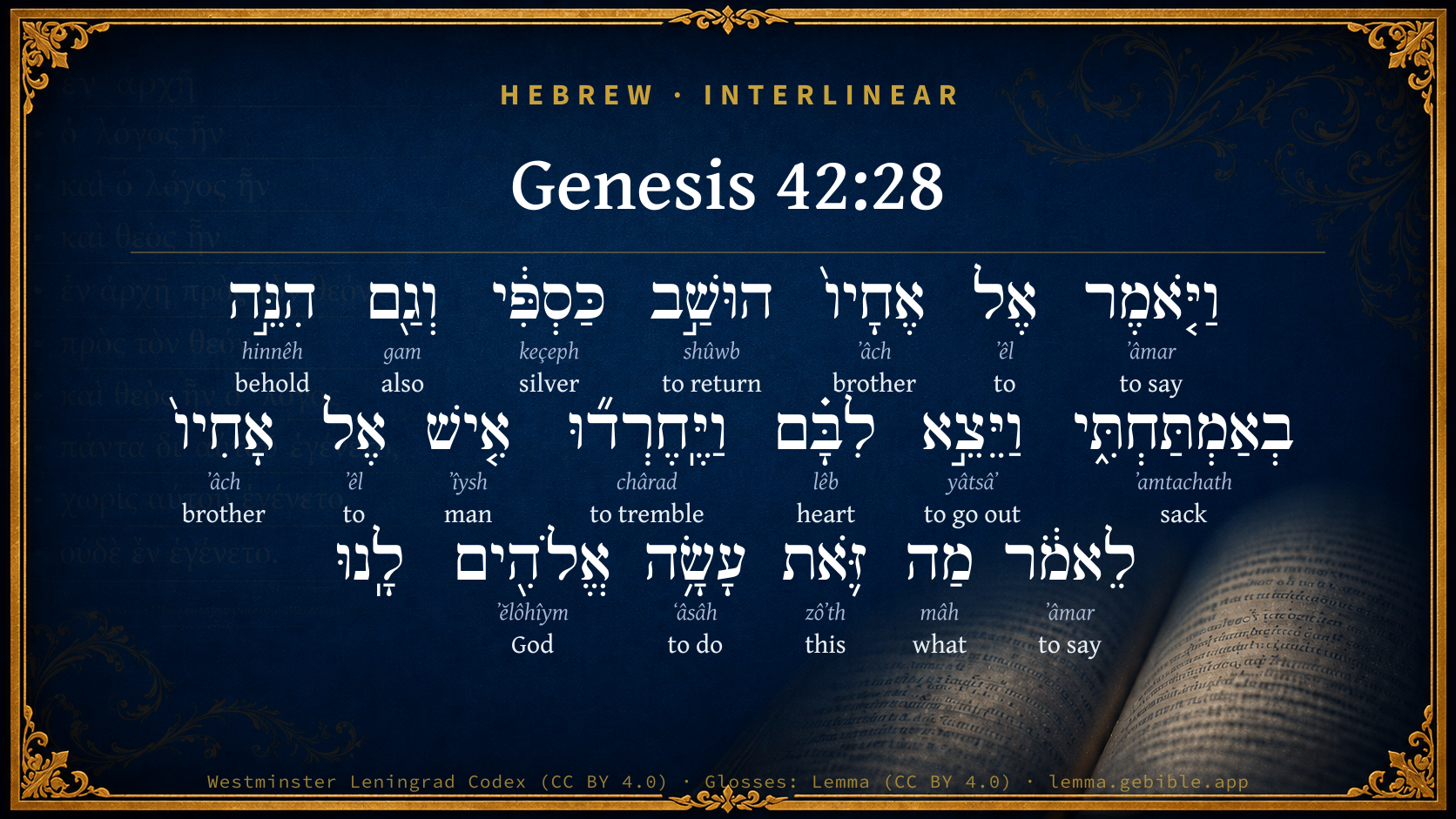
Genesis 42:28

Hebrew (Westminster Leningrad Codex) Genesis 42:28 appears in the Hebrew Old Testament. The text above is from the Westminster Leningrad Codex. Each word links to its Strong’s number, a concise gloss, and parsing drawn from the Open Scriptures Hebrew Bible morphology. Click any word for its full Brown-Driver-Briggs (BDB) entry.
Download image
Cite this verse

Genesis 42:28 (World English Bible). Public Domain. Lemma interlinear Bible study tool, https://lemma.gebible.app/v/genesis/42/28.

Show BibTeX & RIS
BibTeX
RIS
English Translation
He said to his brothers, "My money is restored! Behold, it is even in my sack." Their hearts failed them, and they turned trembling one to another, saying, "What is this that God has done to us?"
World English Bible · Public Domain
Download a study sheet

One document with this verse’s original text, its word-by-word gloss line, the meaning frame, cross-references with their text, attributed commentary, and full source and license credits — printable, and it pastes into notes with its structure intact.

This verse Autodidact and up

Study sheet (.html) Plain text (.txt)

A passage Seminary Student

Up to 50 verses in one chapter. A passage sheet keeps up to 6 commentary sources and 12 cross-references per verse, in the order this page ranks them, and says so on the sheet whenever that leaves anything out. Ask for a single verse and you get the Autodidact verse sheet above.

Everything on this page stays free to read, with no account — the sheet is a download of what is already on screen, not access to it.

Want to remove ads? Support Godless Engineer
Compare translations 3

The same verse in 3 English versions, stacked beneath the original-language interlinear above. Click any original word for its lexicon entry.

Each is an independent rendering of the whole verse — the interlinear is not word-aligned to these translations.

Highlighted words mark where these versions differ — a whole-verse word diff, not a word-by-word alignment.

  • World English Bible Public Domain
    He said to his brothers, "My money is restored! Behold, it is even in my sack." Their hearts failed them, and they turned trembling one to another, saying, "What is this that God has done to us?"
  • King James Version Public Domain
    And he said unto his brethren, My money is restored; and, lo, it is even in my sack: and their heart failed them, and they were afraid, saying one to another, What is this that God hath done unto us?
  • unfoldingWord Literal Text CC BY-SA 4.0
    So he said to his brothers, “My silver has been returned! And indeed behold, in my sack!” Then their hearts went out, and each trembled to his brother, saying, “What this God has done to us?”

unfoldingWord Literal Text — © unfoldingWord, licensed CC BY-SA 4.0. Word-aligned USFM3 via Door43 (git.door43.org/unfoldingWord/en_ult).

Versions to compare (up to 4)

3 of 4 selected

Show all 18 translations

Every available English version of this verse, each an independent rendering of the whole verse.

  • World English Bible Public Domain
    He said to his brothers, "My money is restored! Behold, it is even in my sack." Their hearts failed them, and they turned trembling one to another, saying, "What is this that God has done to us?"
  • Berean Standard Bible Public Domain
    “My silver has been returned!” he said to his brothers. “It is here in my sack.” Their hearts sank, and trembling, they turned to one another and said, “What is this that God has done to us?”
  • Majority Standard Bible Public Domain
    “My silver has been returned!” he said to his brothers. “It is here in my sack.” Their hearts sank, and trembling, they turned to one another and said, “What is this that God has done to us?”
  • King James Version Public Domain
    And he said unto his brethren, My money is restored; and, lo, it is even in my sack: and their heart failed them, and they were afraid, saying one to another, What is this that God hath done unto us?
  • American Standard Version (1901) Public Domain
    And he said unto his brethren, My money is restored; and, lo, it is even in my sack: and their heart failed them, and they turned trembling one to another, saying, What is this that God hath done unto us?
  • Revised Version (1885) Public Domain
    And he said unto his brethren, My money is restored; and, lo, it is even in my sack: and their heart failed them, and they turned trembling one to another, saying, What is this that God hath done unto us?
  • Geneva Bible (1599) Public Domain
    Then he sayde vnto his brethren, My money is restored: for loe, it is euen in my sacke. And their heart fayled them, and they were astonished, and sayde one to another, What is this, that God hath done vnto vs?
  • Douay-Rheims (1899) Public Domain
    And said to his brethren: My money is given me again, hehold it is in the sack. And thye were astonished, and troubled, and said to one another: What is this that God hath done unto us?
  • Young's Literal Translation Public Domain
    and he saith unto his brethren, `My money hath been put back, and also, lo, in my bag:' and their heart goeth out, and they tremble, one to another saying, `What `is' this God hath done to us!'
  • Literal Standard Version CC BY-SA 4.0
    and he says to his brothers, “My money has been put back, and also, behold, in my bag”: and their heart goes out, and they tremble, to one another saying, “What [is] this God has done to us!”
  • Unlocked Literal Bible CC BY-SA 4.0
    He said to his brothers, “My money has been put back. Look at it; it is in my sack.” Their hearts sank and they turned trembling to one another, saying, “What is this that God has done to us?”
  • unfoldingWord Literal Text CC BY-SA 4.0
    So he said to his brothers, “My silver has been returned! And indeed behold, in my sack!” Then their hearts went out, and each trembled to his brother, saying, “What this God has done to us?”
  • Darby Bible Public Domain
    And he said to his brethren, My money is returned [to me], and behold, it is even in my sack. And their heart failed [them], and they were afraid, saying one to another, What is this [that] God has done to us?
  • World Messianic Bible Public Domain
    He said to his brothers, “My money is restored! Behold, it is in my sack!” Their hearts failed them, and they turned trembling to one another, saying, “What is this that God has done to us?”
  • Webster's Bible Public Domain
    And he said to his brethren, My money is restored; and see it is even in my sack: and their heart failed them, and they were afraid, saying one to another, What is this that God hath done to us?
  • Free Bible Version CC BY-SA 4.0
    He told his brothers, “My money's been returned to me. It's right here at the top of my sack!” They were horrified! Trembling with fear they asked each other, “What is this that God's done to us?”
  • Bible in Basic English Public Domain
    And he said to his brothers, My money has been given back: it is in my bag; then their hearts became full of fear, and turning to one another they said, What is this which God has done to us?
  • JPS Tanakh (1917) Public Domain
    And he said unto his brethren: 'My money is restored; and, lo, it is even in my sack.' And their heart failed them, and they turned trembling one to another, saying: 'What is this that God hath done unto us?'

Literal Standard Version (2020), Covenant Press — licensed CC BY-SA 4.0. Text via the HelloAO Bible API (eBible.org). Unlocked Literal Bible (unfoldingWord) — licensed CC BY-SA 4.0. Text via the HelloAO Bible API (eBible.org). unfoldingWord Literal Text — © unfoldingWord, licensed CC BY-SA 4.0. Word-aligned USFM3 via Door43 (git.door43.org/unfoldingWord/en_ult). Free Bible Version, Dr. Jonathan Gallagher — licensed CC BY-SA 4.0. Text via the HelloAO Bible API (eBible.org).

Word by word

More ways to search: Search by grammar → Find every occurrence → Compare this word →

Practice this passage: Drill this verse → Learn its vocabulary →

בְאַמְתַּחְתִּ֑י
ʼamtachath
H572
“in/at · sack · my”
Preposition + Noun, Common, Feminine, Singular, Construct + Suffix, Personal, 1st Person, Common, Singular
Part of Speech
Preposition + Noun
Type
Common
Gender
Feminine
Number
Singular
State
Construct
Full BDB Definition

Origin: from H4969

TWOT: 1265a

sack, flexible container (for grain) - (TWOT) spread out
  1. וַיֹּ֤אמֶר ʼâmar H559 “and · to say” Conjunction + Verb, Qal, Sequential Imperfect, 3rd Person, Masculine, Singular
  2. אֶל ʼêl H413 “to” Preposition
  3. אֶחָיו֙ ʼâch H251 “brothers · his” Noun, Common, Masculine, Plural, Construct + Suffix, Personal, 3rd Person, Masculine, Singular
  4. הוּשַׁ֣ב shûwb H7725 “to return” Verb, Hophal, Perfect, 3rd Person, Masculine, Singular
  5. כַּסְפִּ֔י keçeph H3701 “silver · my” Noun, Common, Masculine, Singular, Construct + Suffix, Personal, 1st Person, Common, Singular
  6. וְגַ֖ם gam H1571 “and · also” Conjunction + Particle, Accusative
  7. הִנֵּ֣ה hinnêh H2009 “behold” Particle, Demonstrative
  8. וַיֵּצֵ֣א yâtsâʼ H3318 “and · to go out” Conjunction + Verb, Qal, Sequential Imperfect, 3rd Person, Masculine, Singular
  9. לִבָּ֗ם lêb H3820 “heart · their” Noun, Common, Masculine, Singular, Construct + Suffix, Personal, 3rd Person, Masculine, Plural
  10. וַיֶּֽחֶרְד֞וּ chârad H2729 “and · to tremble” Conjunction + Verb, Qal, Sequential Imperfect, 3rd Person, Masculine, Plural
  11. אִ֤ישׁ ʼîysh H376 “man” Noun, Common, Masculine, Singular, Absolute
  12. אֶל ʼêl H413 “to” Preposition
  13. אָחִיו֙ ʼâch H251 “brother · his” Noun, Common, Masculine, Singular, Construct + Suffix, Personal, 3rd Person, Masculine, Singular
  14. לֵאמֹ֔ר ʼâmar H559 “to say” Preposition + Verb, Qal, Infinitive Construct
  15. מַה mâh H4100 “what” Particle, Interrogative
  16. זֹּ֛את zôʼth H2063 “this” Pronoun, Demonstrative, Feminine, Singular
  17. עָשָׂ֥ה ʻâsâh H6213 “to do” Verb, Qal, Perfect, 3rd Person, Masculine, Singular
  18. אֱלֹהִ֖ים ʼĕlôhîym H430 “God(s)” Noun, Common, Masculine, Plural, Absolute

About this verse

These counts appear in no published source. They are computed here, from the morphology-tagged text and Lemma’s own curated glosses. What Lemma adds →

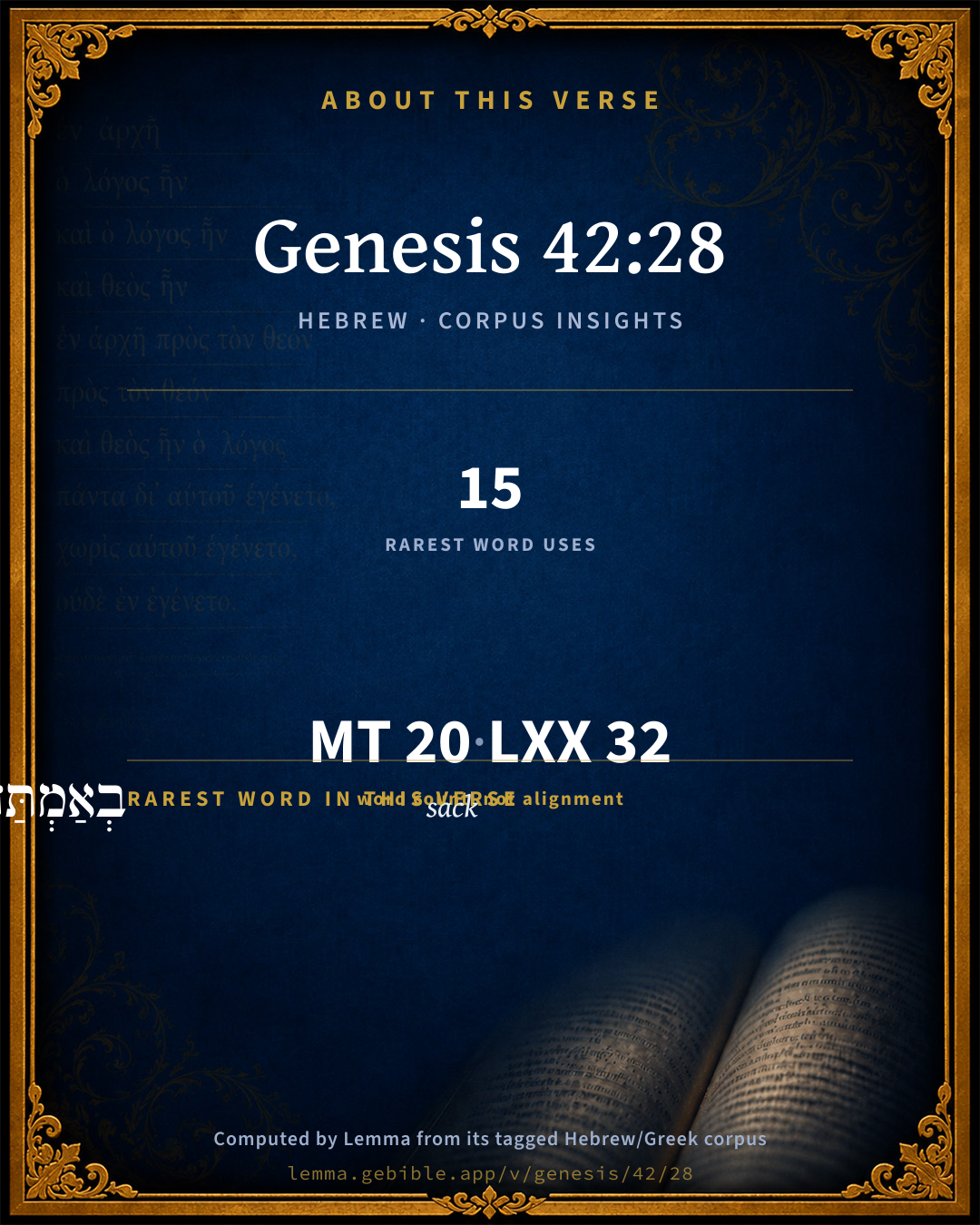
20
words
16
distinct lemmas
Pentateuch
section

Notable vocabulary

The rarest word here is בְאַמְתַּחְתִּ֑י sack H572 — appearing just 15 times in the whole Hebrew Bible.

Shared distinctive vocabulary

בְאַמְתַּחְתִּ֑י sack H572 occurs in 12 verses of the Hebrew Bible. Also found in:

Grammatical profile

  • 6 verbs
  • 7 nouns
  • 1 pronoun
  • 3 prepositions
  • 3 particles

Verb forms

  • וַיֹּ֤אמֶר Qal · Sequential Imperfect
  • הוּשַׁ֣ב Hophal · Perfect
  • וַיֵּצֵ֣א Qal · Sequential Imperfect
  • וַיֶּֽחֶרְד֞וּ Qal · Sequential Imperfect
  • לֵאמֹ֔ר Qal · Infinitive Construct
  • עָשָׂ֥ה Qal · Perfect

Repetition

Words recur within this verse — often emphatic in Hebrew:

  • וַיֹּ֤אמֶר to say H559 ×2
  • אֶחָיו֙ brother H251 ×2
  • אֶל to H413 ×2

Hebrew & Septuagint length

In English translation the verse runs 37 words from the Hebrew and 42 from the Septuagint (LXX English) — closely comparable.

A rough comparison of the two English renderings, which tokenize alike — not a word-level alignment.

Word counts can differ between the Hebrew and the Greek without any difference in meaning — e.g. the Hebrew direct-object marker אֵת has no separate Greek word, and Greek often adds the article ὁ.

In the original languages it is 20 Hebrew tokens and 32 Greek tokens — but the two are counted differently (Hebrew bundles its prefixes and suffixes into one token; the Greek is in lemma form), so that isn’t a like-for-like length.

Cross-references

13

Topical passages linked to Genesis 42:28 in the Treasury of Scripture Knowledge — connected by theme and wording, ordered by reader-vote popularity; previews shown in the World English Bible.

  • Isaiah 45:7 I form the light, and create darkness; I make peace, and create evil. I am Yahweh, who does all these things.
  • Lamentations 3:37 Who is he who says, and it comes to pass, when the Lord doesn't command it?
  • Genesis 27:33 Isaac trembled violently, and said, "Who, then, is he who has taken venison, and brought it me, and I have eaten of all before you came, and have blessed him? Yes, he will be blessed."
  • Genesis 42:36 Jacob, their father, said to them, "You have bereaved me of my children! Joseph is no more, Simeon is no more, and you want to take Benjamin away. All these things are against me."
  • Genesis 43:23 He said, "Peace be to you. Don't be afraid. Your God, and the God of your father, has given you treasure in your sacks. I received your money." He brought Simeon out to them.
  • Leviticus 26:36 "'As for those of you who are left, I will send a faintness into their hearts in the lands of their enemies: and the sound of a driven leaf will put them to flight; and they shall flee, as one flees from the sword; and they will fall when no one pursues.
  • Deuteronomy 28:65 Among these nations shall you find no ease, and there shall be no rest for the sole of your foot: but Yahweh will give you there a trembling heart, and failing of eyes, and pining of soul;
  • 1 Kings 10:5 and the food of his table, and the sitting of his servants, and the attendance of his ministers, and their clothing, and his cup bearers, and his ascent by which he went up to the house of Yahweh; there was no more spirit in her.
  • Psalms 61:2 From the end of the earth, I will call to you, when my heart is overwhelmed. Lead me to the rock that is higher than I.
  • Song of Solomon 5:6 I opened to my beloved; But my beloved left; gone away. My heart went out when he spoke. I looked for him, but I didn't find him. I called him, but he didn't answer.
  • Lamentations 2:17 Yahweh has done that which he purposed; he has fulfilled his word that he commanded in the days of old; He has thrown down, and has not pitied: He has caused the enemy to rejoice over you; he has exalted the horn of your adversaries.
  • Amos 3:6 Does the trumpet alarm sound in a city, Without the people being afraid? Does evil happen to a city, And Yahweh hasn't done it?
  • Luke 21:26 men fainting for fear, and for expectation of the things which are coming on the world: for the powers of the heavens will be shaken.

Cross-references courtesy of OpenBible.info (CC BY 4.0).

Hebrew and Greek witnesses Masoretic Hebrew ↔ Greek Septuagint

The same verse in the two great witnesses to the Old Testament, shown verse-for-verse.

These are two independent witnesses, not word-aligned to each other, and the Septuagint is shown in lemma (dictionary) form.

Hebrew Genesis 42:28 Masoretic · Westminster Leningrad Codex

וַיֹּ֤אמֶר אֶל אֶחָיו֙ הוּשַׁ֣ב כַּסְפִּ֔י וְגַ֖ם הִנֵּ֣ה בְאַמְתַּחְתִּ֑י וַיֵּצֵ֣א לִבָּ֗ם וַיֶּֽחֶרְד֞וּ אִ֤ישׁ אֶל אָחִיו֙ לֵאמֹ֔ר מַה זֹּ֛את עָשָׂ֥ה אֱלֹהִ֖ים לָֽנוּ

He said to his brothers, "My money is restored! Behold, it is even in my sack." Their hearts failed them, and they turned trembling one to another, saying, "What is this that God has done to us?"

World English Bible · Public Domain

Greek LXX Genesis 42:28 Septuagint · lemma form

καί εἶπον ὁ ἀδελφός αὐτός ἀποδίδωμι ἐγώ ὁ ἀργύριον καί ἰδού οὗτος ἐν ὁ μάρσιππος ἐγώ καί ἐκἵστημι ὁ καρδία αὐτός καί ταράσσω πρός ἀλλήλω λέγω τίς οὗτος ποιέω ὁ θεός ἐγώ

And he said to his brethren, My money has been restored to me, and behold this is in my sack. And their heart was wonder-struck, and they were troubled, saying one to another, What is this that God has done to us?

LXX2012 (modern English Septuagint) · Public Domain

Hebrew: Westminster Leningrad Codex (CC BY 4.0). Greek: Septuagint (public domain); English from LXX2012 (modern English Septuagint) (Public Domain). How the Septuagint differs from the Hebrew →

Targum (Aramaic paraphrase)

2

The Targum is the ancient Jewish Aramaic paraphrase of the Hebrew Scriptures — an interpretive translation, not the Hebrew text itself. Onkelos (literal) and Pseudo-Jonathan (expansive) render the Torah, and Jonathan the Prophets. Coverage is partial: where no permissively-licensed English translation exists for a verse, only the Aramaic is shown. This is verse-level text, not a word-by-word alignment to the Hebrew.

  1. Targum Onkelos Torah (Genesis–Deuteronomy)
    וַאֲמַר לַאֲחוֹהִי אִתּוֹתַב כַּסְפִּי וְאַף הָא בְטּוֹעֲנִי וּנְפַק מַדַּע לִבְּהוֹן וּתְוָהוּ גְּבַר לַאֲחוּהִי לְמֵימַר מָה דָּא עֲבַד יְיָ לָנָא

    (no public-domain English translation for this verse)

    Targum Onkelos — Aramaic: “Onkelos Genesis” (public domain); “Onkelos Exodus” (public domain); “Onkelos Leviticus” (public domain); “Onkelos Numbers” (public domain); “Onkelos Deuteronomy” (public domain). English: “Sefaria Community Translation” (CC0 1.0 (public-domain dedication)); “J.W. Etheridge. The Targums of Onkelos and Jonathan Ben Uzziel on the Pentateuch. London: Longmans, Green, 1862” (public domain). Text via Sefaria.

  2. Targum Pseudo-Jonathan Torah (Genesis–Deuteronomy)
    וַאֲמַר לְאָחוֹהִי אִיתּוֹתַב כַּסְפִּי וְאוּף הָא בְּטוֹנִי וּנְפַק מַנְדַע לִבְּהוֹן וְתַוְהוּ גְבַר לְאָחוּהִי לְמֵימַר מַה דָא עָבַד יְיָ וְלָא בְּחוֹבָא דִילָנָא

    And he said to his brothers, My money is returned, behold, it is in my pannier. And knowledge failed from their hearts, and each wondered with his brother, saying, What is this which the Lord hath done, and not for sin of ours?

    Targum Pseudo-Jonathan — Aramaic: “Targum Jonathan on Genesis” (public domain); “Targum Jonathan on Exodus” (public domain); “Targum Jonathan on Leviticus” (public domain); “Targum Jonathan on Numbers” (public domain); “Targum Jonathan on Deuteronomy” (public domain). English: “The Targum of Jonathan ben Uzziel, trans. J. W. Etheridge, London, 1862” (public domain). Text via Sefaria.

Commentary

Notes on Genesis 42:28 from classic Christian and Jewish commentators (each source and its license shown beneath its notes). The classic Christian expositions comment on the surrounding passage and are grouped to its opening verse, so a note may address several verses; the Jewish commentaries on the Tanakh (Rashi and others) are per-verse, so they appear only where the commentator wrote on this verse.

Lemma curates 59 commentaries, every one of them public domain or Creative Commons licensed, each selected and text-cleaned for this edition rather than reprinted as found. About our sources →

Trapp's Complete Commentary

John Trapp

Gen 42:28 And he said unto his brethren, My money is restored; and, lo, [it is] even in my sack: and their heart failed [them], and they were afraid, saying one to another, What [is] this [that] God hath done unto us?

Ver. 28. My money is restored.] Joseph had stolen this benefit upon them, which they misinterpret, their own misgiving hearts telling them that God’s just hand was in it for their harm. Conscience, being now awakened, meets them at every turn, till they were soundly humbled, and had made their peace. Better a sore than a seared conscience; as, better a tormentful strangury than a senseless lethargy. Bee masters tell us that those are the best hives that make the greatest noise.

John Trapp, A Commentary or Exposition upon All the Books of the Old and New Testament (1647–1656) — public domain. Text from a community e-Sword module.

Joseph Benson's Commentary

Gen 42:28. Their heart failed them, and they were afraid — Their awakened consciences set their sins in order before them, made them afraid of every thing, and threw them into the utmost dismay and consternation. Saying one to another, What is this that God hath done unto us? — They knew that the Egyptians abhorred a Hebrew, (Gen 43:32,) and therefore, since they could not expect to receive any kindness from them, they concluded that their money was put into their sacks with a design to pick a quarrel with them, and the rather, because the man, the lord of the land, had charged them as spies. Thus they construed every circumstance in this affair as the purpose of God to bring evil upon them, for their unnatural and cruel usage of their brother. When the events of Providence concerning us are surprising, it is good to inquire what it is that God has done, and is doing with us.

Joseph Benson's Commentary on the Old and New Testaments (1811–1818) — public domain. Text from a community e-Sword module.

Tyndale Open Study Notes

Tyndale Open Resources

42:28 What has God done to us? They knew that God was behind everything that had been happening, so they faced a day of reckoning for their sins.

Tyndale Open Study Notes — © Tyndale Open Resources, licensed CC BY-SA 4.0. Text via the HelloAO Bible API.

Geneva Bible (1599)

Geneva Bible translators

Hebrew, went out.

Because their conscience accused them of their sin, they thought God would have brought them to trouble by this money.

Geneva Bible (1599) marginal notes — public domain. Text via Bolls.life.

Adam Clarke's Commentary

Verse 28. Their heart failed them] ויצא לבם valyetse libbam, their heart went out. This refers to that spasmodic affection which is felt in the breast at any sudden alarm or fright. Among the common people in our own country we find an expression exactly similar, "My heart was ready to leap out at my mouth," used on similar occasions.

What is this that God hath done unto us?] Their guilty consciences, now thoroughly awakened, were in continual alarms; they felt that they deserved God's curse, and every occurrence served to confirm and increase their suspicions.

Adam Clarke's Commentary on the Bible (1810–1826) — public domain. Text from a community e-Sword/MySword module.

John Calvin's Commentaries

28. What is this that God has done unto us? They do not expostulate with God, as if they thought this danger had come upon them without cause: but, perceiving that God was angry with them in many ways, they deplore their wretchedness. But why do they not rather turn their thoughts to Joseph? For the suspicion was natural, that this had been done by fraud, because he wished to lay new snares for them. How does it happen, then, that losing sight of man, they set God as an avenger directly before them? Truly, because this single thought possessed their minds, that a just reward, and such as their sins deserved, would be given them; and, from that time, they referred whatever evils happened to the same cause. Before (as we have said) they were asleep: but from the time that they began to be affected by the lively fear of God’s judgment, his providence always presented itself to their view. So David, when, by the inward suggestion of the Spirit, he has learned that the rod with which he was chastised had been sent from heaven, is not distracted or perplexed, though he sees plainly that the evils have proceeded from another quarter; but prays to God to heal the wounds which He had made. It is no common act of prudence, and is at the same time profitable, whenever any adversity overtakes us, to accustom ourselves to the consideration of the judgments of God. We see how unbelievers, while they imagine their misfortunes to be accidental, or while they are bent on accusing their enemies, only exasperate their grief by fretting and raging, and thus cause the anger of God to burn the more against them. But he who, in his affliction, exercises himself in reflecting on his own sins, and sets God before him as his Judge, will humble himself in the divine presence, and will compose his mind to patience by the hope of pardon. Let us, however, remember that the providence of God is not truly acknowledged, except in connection with his justice. Forthough the men by whose hand he chastises us are often unjust, yet, in an incomprehensible manner, he executes his judgments through them, against which judgments it is not lawful for us either to reply or to murmur. For sometimes even the reprobate, though they acknowledge themselves to be stricken by the hand of God, yet do not cease to complain against him, as Moses teaches us by the example of Cain. I do not, however, understand that this complaint was made by the sons of Jacob, for the purpose of charging God with tyrannical violence; but because they, being overcome with fear, inferred from this double punishment that God was highly displeased with them.

John Calvin's Commentaries (1540-1563) — public domain. Text from the Calvin Translation Society English edition (1840s-50s) via the Christian Classics Ethereal Library (ccel.org). Calvin's coverage is partial (roughly two-thirds of the Bible); uncommented books and verses are honest gaps, never fabricated. The 19th-century editor's footnotes and remarks are omitted so the notes are faithfully Calvin's own voice.

Ellicott's Commentary for English Readers

(28) Their heart failed them.—This verse is far more poetical in the Hebrew, where, literally it is And their heart went forth, and they trembled each to his brother. Their courage left them, and they stood looking at one another in terror.

A Bible Commentary for English Readers, edited by Charles John Ellicott (1878–1897) — public domain. Text from a community e-Sword module.

The Cambridge Bible for Schools and Colleges

gen. ed. J. J. S. Perowne

28. their heart failed them] J’s account, as we see in Gen_43:21, must originally have represented the opening of all the sacks, and the finding of all the money, at the “lodging place.” As, however, in E this general discovery is not made until their return to their father, J’s narrative is here restricted to the experience of one of the brethren, and to the consternation it produced amongst them.

God hath done] They are conscious (1) that the thing is mysterious; (2) that they might be accused of robbery; (3) that their secret guiltiness is somehow being visited by a Power which knew all.

The Cambridge Bible for Schools and Colleges (gen. ed. J. J. S. Perowne; Cambridge University Press, 1878–1918) — public domain. Text from a community e-Sword module.

John Gill's Exposition

We be twelve brethren, sons of our father,.... All brethren by the father's side, though not by the mother's, and by one father; they had been twelve, and were so now, though they knew it not, supposing that one was dead, as is next observed:

one is not; is not alive, but dead; the Targum of Jonathan is,"what is become of one we know not"

and the youngest is this day with our father in the land of Canaan; see Gen 42:13.

John Gill's Exposition of the Whole Bible (1746–1763) — public domain (CC PDM 1.0). Text via the HelloAO Bible API.

Matthew Poole's English Annotations

They were afraid, lest this should be a design to entrap, and so destroy them. Whoever were the instruments, they knew that God was the chief author of this occurrent, and wisely reflect upon his providence in it, and their own guilt which provoked him against them.

Matthew Poole's English Annotations on the Holy Bible (1683–1685) — public domain. Text from a community e-Sword/MySword module.

Whedon's Commentary on the Bible

Daniel D. Whedon

28. God hath done — Every thing seems to them now as the condemning acts of God; and the feeling deepens more and more, until, on finding all their money returned (Gen_42:35) and Benjamin demanded, their aged father breaks out in a bitter wail of sorrow.

Daniel D. Whedon (gen. ed.), Commentary on the Old and New Testaments (1874–1909) — public domain. Text from a community e-Sword module.

The Pulpit Commentary

And he (i.e. the one who had opened his sack) said unto his brethren, My money is restored; and, lo, it is even in my sack (amtachath): and their heart failed them (literally, went forth; as it were, leapt into their mouths through sudden apprehension), and they were afraid, saying one to another (literally, they trembled each one to his brother, a constructio pregnans for they turned trembling towards one another, saying), What is this that God hath done unto us? Elohim is used, and not Jehovah, because the speakers simply desire to characterize the circumstance as supernatural.

The Pulpit Commentary (1880–1919), ed. H.D.M. Spence-Jones & Joseph S. Exell — public domain. Text from a community e-Sword module.

John Wesley's Explanatory Notes

Their heart failed them, and they were afraid, saying one to another, What is this that God hath done to us? - They knew that the Egyptians abhorred a Hebrew, chap. xliii, 32, and therefore, since they could not expect to receive any kindness from them, they concluded that this was done with a design to pick a quarrel with them, the rather because the man, the Lord of the land, had charged them as spies. Their own conscience were awake, and their sins set in order before them, and this puts them into confusion. When the events of providence concerning us are surprising, it is good to inquire what it is that God has done and is doing with us?

John Wesley, Explanatory Notes Upon the Whole Bible (1754–1765) — public domain. Text via the GEBible commentary corpus.

Keil & Delitzsch

C. F. Keil & F. Delitzsch

When this discovery was made known to the brethren, their hearts sank within them. They turned trembling to one another, and said, "What is this that God hath done to us!" Joseph had no doubt had the money returned, "merely because it was against his nature to trade with his father and brethren for bread;" just as he had caused them to be supplied with food for the journey, for no other reason than to give them a proof of his good-will. And even if he may have thought it possible that the brothers would be alarmed when they found the money, and thrown into a state of much greater anxiety from the fear of being still further accused by the stern lord of Egypt of cheating or of theft, there was no reason why he should spare them this anxiety, since it could only help to break their hard hearts still more. At any rate, this salutary effect was really produced, even if Joseph had no such intention. The brothers looked upon this incomprehensible affair as a punishment from God, and neglected in their alarm to examine the rest of the sacks.

Keil & Delitzsch — Biblical Commentary on the Old Testament (1861–1891) — public domain (CC PDM 1.0). Text via the HelloAO Bible API. (Old Testament only.)

Rashi

Rabbi Shlomo Yitzchaki (Rashi)

וגם הנה באמתחתי AND, LO, IT IS EVEN IN MY SACK — the money also (גם) is in it together with the grain.

מה זאת עשה אלהים לנו WHAT IS THIS THAT GOD HATH DONE UNTO US by bringing us into the danger of this accusation? For the money can only have been put back into our sacks in order to bring an accusation against us.

Rashi on the Tanakh — English translations: “The Judaica Press complete Tanach with Rashi, translated by A. J. Rosenberg” (CC BY 4.0); “Pentateuch with Rashi's commentary by M. Rosenbaum and A.M. Silbermann, 1929-1934” (public domain); “The Metsudah Tanach series, Lakewood, N.J” (CC BY 4.0); and “The Book of Joshua, Metsudah Publications, 1997” (CC BY 4.0). Text via Sefaria.

Radak

Rabbi David Kimhi (Radak)

ויצא לבם, as Joseph expected, discovery of the money was a major shock for them. The expression used by the Torah for this emotion is also found in Song of Songs 5,6 נפשי יצאה בדברו, “I fainted because of what he said.”

Radak on the Tanakh — English translations: “Sefaria Community Translation” (CC0 1.0 (public-domain dedication)); “Eliyahu Munk, HaChut Hameshulash” (CC BY 4.0); “Rabbi Mike Feuer, Jerusalem Anthology” (CC BY 4.0); and “R. David Kimhi on the first book of Psalms, Translated by R.G. Finch, London, 1919” (public domain). Text via Sefaria.

Lesson kit

Teaching starters — assembled from the data on this page, not authored interpretation. Every prompt links to the verse data it draws on. Edit before teaching.

Genesis, in the Pentateuch, opens this verse with 20 words (16 distinct Hebrew lemmas). Its most distinctive word is ʼamtachath (“sack”). A historical commentator’s framing appears above. Read the whole chapter for the surrounding context.

Discussion questions

  1. What does “sack” (ʼamtachath) contribute to the verse as a whole?
  2. Genesis 42:27 shares the word «sack» with this verse. How do the two illuminate each other?
  3. “to say” occurs 2× in this one verse. What is the effect of the repetition?
  4. The translations on this page render this verse differently — a whole-verse word diff, not a word-by-word alignment. What might account for the different wordings?
  5. The verb «וַיֹּ֤אמֶר» is Qal Sequential Imperfect. How does its form color the action?
  6. Reading how Trapp's Complete Commentary and Joseph Benson's Commentary read this verse, where do the two commentators agree and where do they part?

Things to notice

Reading settings

Reading text

Shown beneath each verse's original-language words.

Old Testament
Old Testament edition

Read the OT as the Masoretic Hebrew (MT) or the Greek Septuagint (LXX).

English shown for the Greek Septuagint (in the Hebrew ↔ Greek comparison).

Comparing translations? Open the Compare panel on any verse page to stack up to four side by side.