
Genesis 3:16

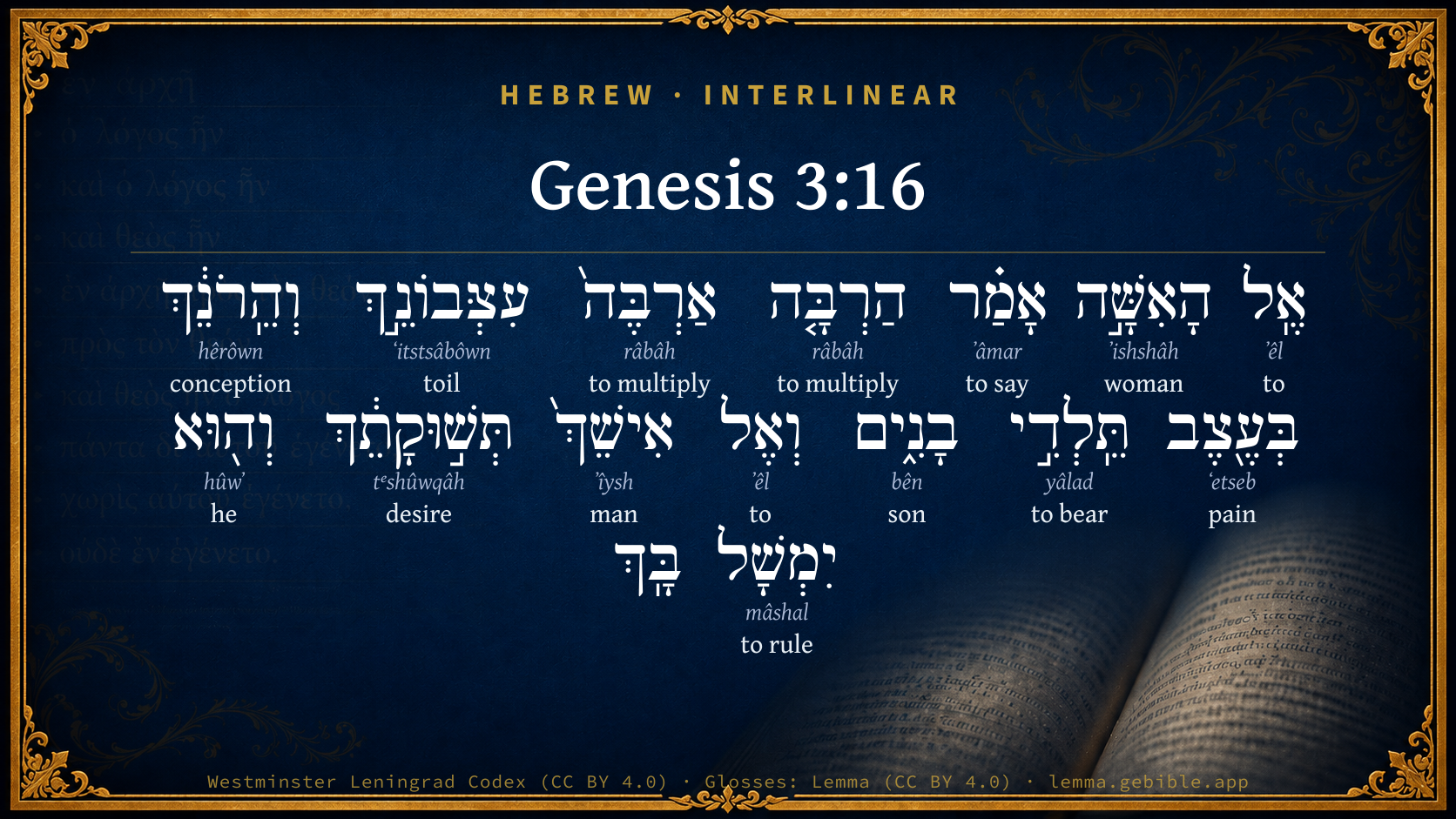
Hebrew (Westminster Leningrad Codex) Genesis 3:16 appears in the Hebrew Old Testament. The text above is from the Westminster Leningrad Codex. Each word links to its Strong’s number, a concise gloss, and parsing drawn from the Open Scriptures Hebrew Bible morphology. Click any word for its full Brown-Driver-Briggs (BDB) entry.
Download image
Cite this verse

Genesis 3:16 (World English Bible). Public Domain. Lemma interlinear Bible study tool, https://lemma.gebible.app/v/genesis/3/16.

Show BibTeX & RIS
BibTeX
RIS
English Translation
To the woman he said, "I will greatly multiply your pain in childbirth. In pain you will bring forth children. Your desire will be for your husband, and he will rule over you."
World English Bible · Public Domain
Highlights
  • 6 first appearances in the Hebrew Bible
Full analysis ↓
Download a study sheet

One document with this verse’s original text, its word-by-word gloss line, the meaning frame, cross-references with their text, attributed commentary, and full source and license credits — printable, and it pastes into notes with its structure intact.

This verse Autodidact and up

Study sheet (.html) Plain text (.txt)

A passage Seminary Student

Up to 50 verses in one chapter. A passage sheet keeps up to 6 commentary sources and 12 cross-references per verse, in the order this page ranks them, and says so on the sheet whenever that leaves anything out. Ask for a single verse and you get the Autodidact verse sheet above.

Everything on this page stays free to read, with no account — the sheet is a download of what is already on screen, not access to it.

Want to remove ads? Support Godless Engineer
Compare translations 3

The same verse in 3 English versions, stacked beneath the original-language interlinear above. Click any original word for its lexicon entry.

Each is an independent rendering of the whole verse — the interlinear is not word-aligned to these translations.

Highlighted words mark where these versions differ — a whole-verse word diff, not a word-by-word alignment.

  • World English Bible Public Domain
    To the woman he said, "I will greatly multiply your pain in childbirth. In pain you will bring forth children. Your desire will be for your husband, and he will rule over you."
  • King James Version Public Domain
    Unto the woman he said, I will greatly multiply thy sorrow and thy conception; in sorrow thou shalt bring forth children; and thy desire shall be to thy husband, and he shall rule over thee.
  • unfoldingWord Literal Text CC BY-SA 4.0
    To the woman he said, “To multiply I will multiply your pain and your childbearing; in pain you will bear children. Yet your desire for your husband, and he will rule over you.”

unfoldingWord Literal Text — © unfoldingWord, licensed CC BY-SA 4.0. Word-aligned USFM3 via Door43 (git.door43.org/unfoldingWord/en_ult).

Versions to compare (up to 4)

3 of 4 selected

Show all 18 translations

Every available English version of this verse, each an independent rendering of the whole verse.

  • World English Bible Public Domain
    To the woman he said, "I will greatly multiply your pain in childbirth. In pain you will bring forth children. Your desire will be for your husband, and he will rule over you."
  • Berean Standard Bible Public Domain
    To the woman He said: “I will sharply increase your pain in childbirth; in pain you will bring forth children. Your desire will be for your husband, and he will rule over you.”
  • Majority Standard Bible Public Domain
    To the woman He said: “I will sharply increase your pain in childbirth; in pain you will bring forth children. Your desire will be for your husband, and he will rule over you.”
  • King James Version Public Domain
    Unto the woman he said, I will greatly multiply thy sorrow and thy conception; in sorrow thou shalt bring forth children; and thy desire shall be to thy husband, and he shall rule over thee.
  • American Standard Version (1901) Public Domain
    Unto the woman he said, I will greatly multiply thy pain and thy conception; in pain thou shalt bring forth children; and thy desire shall be to thy husband, and he shall rule over thee.
  • Revised Version (1885) Public Domain
    Unto the woman he said, I will greatly multiply thy sorrow and thy conception; in sorrow thou shalt bring forth children; and thy desire shall be to thy husband, and he shall rule over thee.
  • Geneva Bible (1599) Public Domain
    Vnto the woman he said, I will greatly increase thy sorowes, and thy conceptions. In sorowe shalt thou bring foorth children, and thy desire shalbe subiect to thine husband, and he shall rule ouer thee.
  • Douay-Rheims (1899) Public Domain
    To the woman also he said: I will multiply thy sorrows, and thy conceptions: in sorrow shalt thou bring forth children, and thou shalt be under thy husband's power, and he shall have dominion over thee.
  • Young's Literal Translation Public Domain
    Unto the woman He said, `Multiplying I multiply thy sorrow and thy conception, in sorrow dost thou bear children, and toward thy husband `is' thy desire, and he doth rule over thee.'
  • Literal Standard Version CC BY-SA 4.0
    To the woman He said, “Multiplying I multiply your sorrow and your conception; you will bear children in sorrow, and your desire [is] toward your Man [[or husband]], and He [[or he]] will rule over you.”
  • Unlocked Literal Bible CC BY-SA 4.0
    To the woman he said, “I will greatly multiply your pain in having children; it is in pain that you will give birth to children. Your desire will be for your husband, but he will rule over you.”
  • unfoldingWord Literal Text CC BY-SA 4.0
    To the woman he said, “To multiply I will multiply your pain and your childbearing; in pain you will bear children. Yet your desire for your husband, and he will rule over you.”
  • Darby Bible Public Domain
    To the woman he said, I will greatly increase thy travail and thy pregnancy; with pain thou shalt bear children; and to thy husband shall be thy desire, and he shall rule over thee.
  • World Messianic Bible Public Domain
    To the woman he said, “I will greatly multiply your pain in childbirth. You will bear children in pain. Your desire will be for your husband, and he will rule over you.”
  • Webster's Bible Public Domain
    To the woman he said, I will greatly multiply thy sorrow and thy conception; in sorrow thou shalt bring forth children: and thy desire shall be to thy husband, and he shall rule over thee.
  • Free Bible Version CC BY-SA 4.0
    He told Eve, “I will make pregnancy much more difficult, and giving birth will be very painful. However, you will still desire your husband, but he will have control over you.”
  • Bible in Basic English Public Domain
    To the woman he said, Great will be your pain in childbirth; in sorrow will your children come to birth; still your desire will be for your husband, but he will be your master.
  • JPS Tanakh (1917) Public Domain
    Unto the woman He said: 'I will greatly multiply thy pain and thy travail; in pain thou shalt bring forth children; and thy desire shall be to thy husband, and he shall rule over thee.'

Literal Standard Version (2020), Covenant Press — licensed CC BY-SA 4.0. Text via the HelloAO Bible API (eBible.org). Unlocked Literal Bible (unfoldingWord) — licensed CC BY-SA 4.0. Text via the HelloAO Bible API (eBible.org). unfoldingWord Literal Text — © unfoldingWord, licensed CC BY-SA 4.0. Word-aligned USFM3 via Door43 (git.door43.org/unfoldingWord/en_ult). Free Bible Version, Dr. Jonathan Gallagher — licensed CC BY-SA 4.0. Text via the HelloAO Bible API (eBible.org).

Word by word

More ways to search: Search by grammar → Find every occurrence → Compare this word →

Practice this passage: Drill this verse → Learn its vocabulary →

עִצְּבוֹנֵ֣ךְ
ʻitstsâbôwn
H6093
“toil · your”
Noun, Common, Masculine, Singular, Construct + Suffix, Personal, 2nd Person, Feminine, Singular
Part of Speech
Noun
Type
Common
Gender
Masculine
Number
Singular
State
Construct
Full BDB Definition

Origin: from H6087

TWOT: 1666e

pain, labour, hardship, sorrow, toil
  1. אֶֽל ʼêl H413 “to” Preposition
  2. הָאִשָּׁ֣ה ʼishshâh H802 “the · woman” Particle, Definite Article + Noun, Common, Feminine, Singular, Absolute
  3. אָמַ֗ר ʼâmar H559 “to say” Verb, Qal, Perfect, 3rd Person, Masculine, Singular
  4. הַרְבָּ֤ה râbâh H7235 “to multiply” Verb, Hiphil, Infinitive Absolute
  5. אַרְבֶּה֙ râbâh H7235 “to multiply” Verb, Hiphil, Imperfect, 1st Person, Common, Singular
  6. וְהֵֽרֹנֵ֔ךְ hêrôwn H2032 “and · conception · your” Conjunction + Noun, Common, Masculine, Singular, Construct + Suffix, Personal, 2nd Person, Feminine, Singular
  7. בְּעֶ֖צֶב ʻetseb H6089 “in/at · pain” Preposition + Noun, Common, Masculine, Singular, Absolute
  8. תֵּֽלְדִ֣י yâlad H3205 “to bear” Verb, Qal, Imperfect, 2nd Person, Feminine, Singular
  9. בָנִ֑ים bên H1121 “sons” Noun, Common, Masculine, Plural, Absolute
  10. וְאֶל ʼêl H413 “and · to” Conjunction + Preposition
  11. אִישֵׁךְ֙ ʼîysh H376 “man · your” Noun, Common, Masculine, Singular, Construct + Suffix, Personal, 2nd Person, Feminine, Singular
  12. תְּשׁ֣וּקָתֵ֔ךְ tᵉshûwqâh H8669 “desire · your” Noun, Common, Feminine, Singular, Construct + Suffix, Personal, 2nd Person, Feminine, Singular
  13. וְה֖וּא hûwʼ H1931 “and · he” Conjunction + Pronoun, Personal, 3rd Person, Masculine, Singular
  14. יִמְשָׁל mâshal H4910 “to rule” Verb, Qal, Imperfect, 3rd Person, Masculine, Singular

About this verse

These counts appear in no published source. They are computed here, from the morphology-tagged text and Lemma’s own curated glosses. What Lemma adds →

16
words
13
distinct lemmas
Pentateuch
section

Notable vocabulary

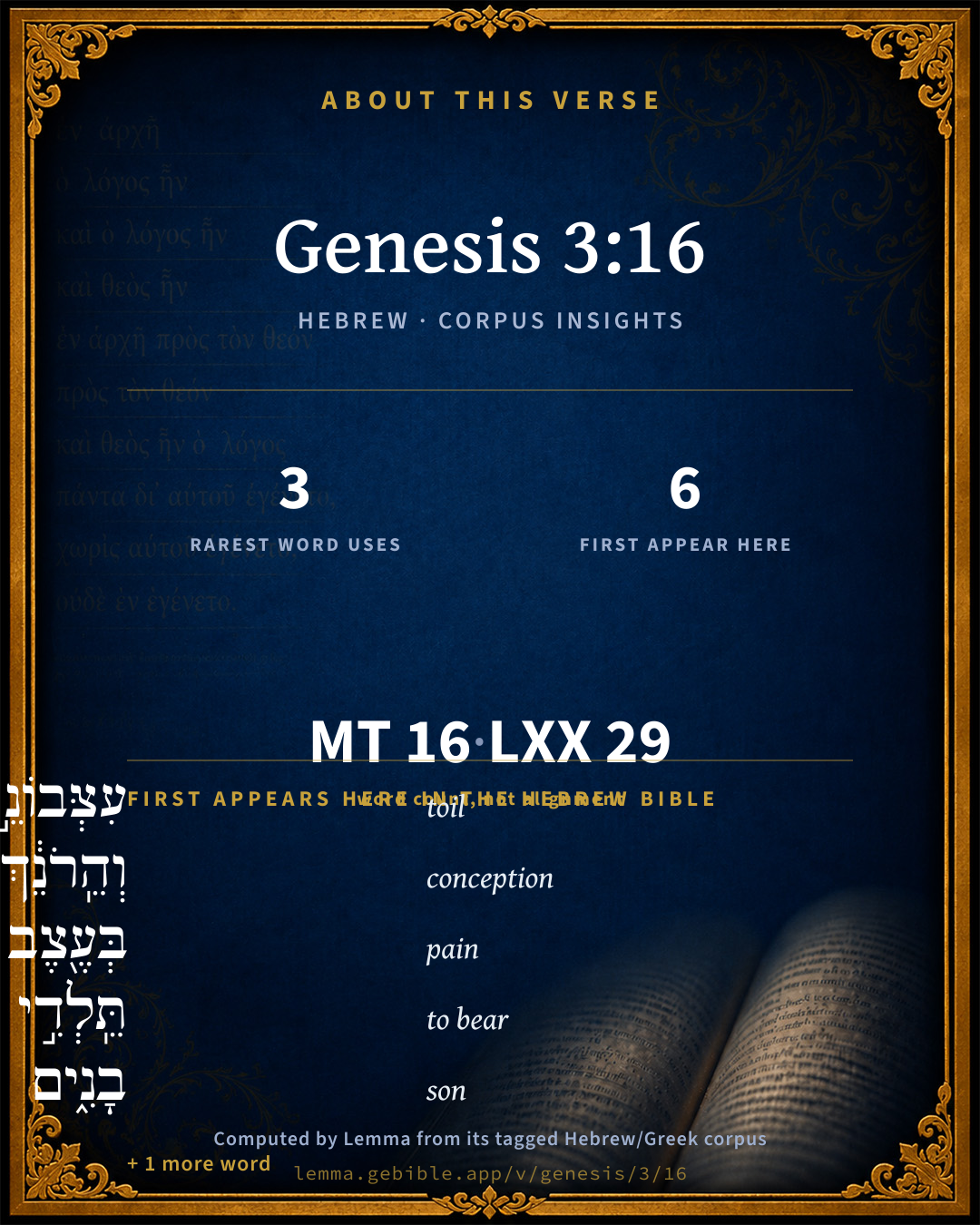
The rarest word here is עִצְּבוֹנֵ֣ךְ toil H6093 — appearing just 3 times in the whole Hebrew Bible.

First appearance in Scripture

These words make their first canonical appearance in the Hebrew Bible here:

  • עִצְּבוֹנֵ֣ךְ toil H6093
  • וְהֵֽרֹנֵ֔ךְ conception H2032
  • בְּעֶ֖צֶב pain H6089
  • תֵּֽלְדִ֣י to bear H3205
  • בָנִ֑ים son H1121
  • תְּשׁ֣וּקָתֵ֔ךְ desire H8669

Shared distinctive vocabulary

עִצְּבוֹנֵ֣ךְ toil H6093 occurs in 3 verses of the Hebrew Bible. Also found in:

Grammatical profile

  • 5 verbs
  • 7 nouns
  • 1 pronoun
  • 3 prepositions

Verb forms

  • אָמַ֗ר Qal · Perfect
  • הַרְבָּ֤ה Hiphil · Infinitive Absolute
  • אַרְבֶּה֙ Hiphil · Imperfect
  • תֵּֽלְדִ֣י Qal · Imperfect
  • יִמְשָׁל Qal · Imperfect

Repetition

Words recur within this verse — often emphatic in Hebrew:

  • הַרְבָּ֤ה to multiply H7235 ×2
  • אֶֽל to H413 ×2

Hebrew & Septuagint length

In English translation the verse runs 33 words from the Hebrew and 36 from the Septuagint (LXX English) — closely comparable.

A rough comparison of the two English renderings, which tokenize alike — not a word-level alignment.

Word counts can differ between the Hebrew and the Greek without any difference in meaning — e.g. the Hebrew direct-object marker אֵת has no separate Greek word, and Greek often adds the article ὁ.

In the original languages it is 16 Hebrew tokens and 29 Greek tokens — but the two are counted differently (Hebrew bundles its prefixes and suffixes into one token; the Greek is in lemma form), so that isn’t a like-for-like length.

Cross-references

28

Topical passages linked to Genesis 3:16 in the Treasury of Scripture Knowledge — connected by theme and wording, ordered by reader-vote popularity; previews shown in the World English Bible.

  • Titus 2:5 to be sober-minded, chaste, workers at home, kind, being in subjection to their own husbands, that God's word may not be blasphemed.
  • Colossians 3:18 Wives, be in subjection to your husbands, as is fitting in the Lord.
  • 1 Corinthians 11:3 But I would have you know that the head of every man is Christ, and the head of the woman is the man, and the head of Christ is God.
  • Ephesians 5:22–24 Wives, be subject to your own husbands, as to the Lord.
  • 1 Timothy 2:15 but she will be saved through her child-bearing, if they continue in faith, love, and sanctification with sobriety.
  • 1 Corinthians 14:34 let your wives keep silent in the assemblies, for it has not been permitted for them to speak; but let them be in subjection, as the law also says.
  • 1 Timothy 2:11–12 Let a woman learn in quietness with all subjection.
  • John 16:21 A woman, when she gives birth, has sorrow, because her time has come. But when she has delivered the child, she doesn't remember the anguish any more, for the joy that a human being is born into the world.
  • 1 Corinthians 7:4 The wife doesn't have authority over her own body, but the husband. Likewise also the husband doesn't have authority over his own body, but the wife.
  • Genesis 4:7 If you do well, will it not be lifted up? If you don't do well, sin crouches at the door. Its desire is for you, but you are to rule over it."
  • 1 Peter 3:1–6 In like manner, wives, be in subjection to your own husbands; so that, even if any don't obey the Word, they may be won by the behavior of their wives without a word;
  • Jeremiah 6:24 We have heard the report of it; our hands wax feeble: anguish has taken hold of us, [and] pangs as of a woman in travail.
  • Micah 4:9–10 Now why do you cry out aloud? Is there no king in you? Has your counselor perished, That pains have taken hold of you as of a woman in travail?
  • Numbers 30:13 Every vow, and every binding oath to afflict the soul, her husband may establish it, or her husband may make it void.
  • 1 Samuel 4:19–21 His daughter-in-law, Phinehas' wife, was with child, near to be delivered: and when she heard the news that the ark of God was taken, and that her father-in-law and her husband were dead, she bowed herself and brought forth; for her pains came on her.
  • Esther 1:20 When the king's decree which he shall make shall be published throughout all his kingdom (for it is great), all the wives will give to their husbands honor, both to great and small.
  • Isaiah 13:8 and they shall be dismayed; pangs and sorrows shall take hold [of them]; they shall be in pain as a woman in travail: they shall look in amazement one at another; their faces [shall be] faces of flame.
  • 1 Thessalonians 5:3 For when they are saying, "Peace and safety," then sudden destruction will come on them, like birth pains on a pregnant woman; and they will in no way escape.
  • Genesis 35:16–18 They traveled from Bethel. There was still some distance to come to Ephrath, and Rachel travailed. She had hard labor.
  • Isaiah 21:3 Therefore are my loins filled with anguish; pangs have taken hold on me, as the pangs of a woman in travail: I am pained so that I can't hear; I am dismayed so that I can't see.
  • Isaiah 26:17–18 Like as a woman with child, who draws near the time of her delivery, is in pain and cries out in her pangs; so we have been before you, Yahweh.
  • Jeremiah 13:21 What will you say, when he shall set over you as head those whom you have yourself taught to be friends to you? shall not sorrows take hold of you, as of a woman in travail?
  • Jeremiah 22:23 Inhabitant of Lebanon, who makes your nest in the cedars, how greatly to be pitied shall you be when pangs come on you, the pain as of a woman in travail!
  • Numbers 30:7–8 and her husband hear it, and hold his peace at her in the day that he hears it; then her vows shall stand, and her bonds with which she has bound her soul shall stand.
  • Psalms 48:6 Trembling took hold of them there, Pain, as of a woman in travail.
  • Isaiah 53:11 He shall see of the travail of his soul, [and] shall be satisfied: by the knowledge of himself shall my righteous servant justify many; and he shall bear their iniquities.
  • Jeremiah 4:31 For I have heard a voice as of a woman in travail, the anguish as of her who brings forth her first child, the voice of the daughter of Zion, who gasps for breath, who spreads her hands, [saying], Woe is me now! for my soul faints before the murderers.
  • Jeremiah 49:24 Damascus has grown feeble, she turns herself to flee, and trembling has seized on her: anguish and sorrows have taken hold of her, as of a woman in travail.

Cross-references courtesy of OpenBible.info (CC BY 4.0).

Hebrew and Greek witnesses Masoretic Hebrew ↔ Greek Septuagint

The same verse in the two great witnesses to the Old Testament, shown verse-for-verse.

These are two independent witnesses, not word-aligned to each other, and the Septuagint is shown in lemma (dictionary) form.

Hebrew Genesis 3:16 Masoretic · Westminster Leningrad Codex

אֶֽל הָאִשָּׁ֣ה אָמַ֗ר הַרְבָּ֤ה אַרְבֶּה֙ עִצְּבוֹנֵ֣ךְ וְהֵֽרֹנֵ֔ךְ בְּעֶ֖צֶב תֵּֽלְדִ֣י בָנִ֑ים וְאֶל אִישֵׁךְ֙ תְּשׁ֣וּקָתֵ֔ךְ וְה֖וּא יִמְשָׁל בָּֽךְ

To the woman he said, "I will greatly multiply your pain in childbirth. In pain you will bring forth children. Your desire will be for your husband, and he will rule over you."

World English Bible · Public Domain

Greek LXX Genesis 3:16 Septuagint · lemma form

καί ὁ γυνή εἶπον πληθύνω πληθύνω ὁ λύπη σύ καί ὁ στεναγμός σύ ἐν λύπη τίκτω τέκνον καί πρός ὁ ἀνήρ σύ ὁ ἀποστροφή σύ καί αὐτός σύ κυριεύω

And to the woman he said, I will greatly multiply your pains and your groanings; in pain you shall bring forth children, and your submission shall be to your husband, and he shall rule over you.

LXX2012 (modern English Septuagint) · Public Domain

On this verse, The Cambridge Bible for Schools and Colleges discusses the Septuagint’s reading. Read the note in Commentary ↓

Hebrew: Westminster Leningrad Codex (CC BY 4.0). Greek: Septuagint (public domain); English from LXX2012 (modern English Septuagint) (Public Domain). How the Septuagint differs from the Hebrew →

Targum (Aramaic paraphrase)

2

The Targum is the ancient Jewish Aramaic paraphrase of the Hebrew Scriptures — an interpretive translation, not the Hebrew text itself. Onkelos (literal) and Pseudo-Jonathan (expansive) render the Torah, and Jonathan the Prophets. Coverage is partial: where no permissively-licensed English translation exists for a verse, only the Aramaic is shown. This is verse-level text, not a word-by-word alignment to the Hebrew.

  1. Targum Onkelos Torah (Genesis–Deuteronomy)
    לְאִתְּתָא אֲמַר אַסְגָּאָה אַסְגֵּי צַעֲרַיְכִי וְעִדּוּיַיְכִי בְּצְעַר תֵּלְדִי בְנִין וּלְוַת בַּעְלִךְ תְּהֵא תִּאוּבְתִּיךְ וְהוּא יִשְׁלַט בִּךְ

    (no public-domain English translation for this verse)

    Targum Onkelos — Aramaic: “Onkelos Genesis” (public domain); “Onkelos Exodus” (public domain); “Onkelos Leviticus” (public domain); “Onkelos Numbers” (public domain); “Onkelos Deuteronomy” (public domain). English: “Sefaria Community Translation” (CC0 1.0 (public-domain dedication)); “J.W. Etheridge. The Targums of Onkelos and Jonathan Ben Uzziel on the Pentateuch. London: Longmans, Green, 1862” (public domain). Text via Sefaria.

  2. Targum Pseudo-Jonathan Torah (Genesis–Deuteronomy)
    לְאִינְתְּתָא אָמַר אַסְגָא אַסְגֵי סְגוּפַיִךְ בַּאֲדַם בְּתוּלִין וְעִידוּיֵךְ בְּצַעַר תַּלְדִין בְּנִין וּלְוַת בַּעֲלִיךְ תְּהֵי מַתְוָךְ וְהוּא יְהֵי שַׁלִיט בִּיךְ לְמִזְכֵּי וּלְמֶחְטֵי

    Unto the woman He said, Multiplying, I will multiply thy affliction by the blood of thy virginity, and by thy conception; in sorrow shalt thou bear children, and to thy husband shall be thy desire, and he will have rule over thee unto righteousness or unto sin.

    Targum Pseudo-Jonathan — Aramaic: “Targum Jonathan on Genesis” (public domain); “Targum Jonathan on Exodus” (public domain); “Targum Jonathan on Leviticus” (public domain); “Targum Jonathan on Numbers” (public domain); “Targum Jonathan on Deuteronomy” (public domain). English: “The Targum of Jonathan ben Uzziel, trans. J. W. Etheridge, London, 1862” (public domain). Text via Sefaria.

Commentary

Notes on Genesis 3:16 from classic Christian and Jewish commentators (each source and its license shown beneath its notes). The classic Christian expositions comment on the surrounding passage and are grouped to its opening verse, so a note may address several verses; the Jewish commentaries on the Tanakh (Rashi and others) are per-verse, so they appear only where the commentator wrote on this verse.

Lemma curates 59 commentaries, every one of them public domain or Creative Commons licensed, each selected and text-cleaned for this edition rather than reprinted as found. About our sources →

Trapp's Complete Commentary

John Trapp

Gen 3:16 Unto the woman he said, I will greatly multiply thy sorrow and thy conception; in sorrow thou shalt bring forth children; and thy desire [shall be] to thy husband, and he shall rule over thee.

Ver. 16. I will greatly multiply thy sorrow.] The greatest of sorrows this is, as we are given to understand, both out of divine and human writings. "I had rather die in battle ten times over, than bring forth but once only," said Medea in the tragedy. {a} But we have a better example, in the Ecclesiastical History, {b} of a Roman lady, called Sabina; who, being great with child, was cast in prison for the profession of Christ’s truth. Now when the time came that she should be delivered, and she cried out for extremity of pain, the keeper of the prison asked her why she made such a stir now; and how she would, two or three days hence, endure to die at a stake, or by the sword. She answered, "Now I suffer as a woman, the punishment of my sin; but then I shall not suffer, but Christ shall suffer in me." In peace offerings there might be oil mixed, not so in sin offerings. In our sufferings for Christ there is joy, not so when we suffer for our sins.

In sorrow thou shalt bring forth.] And in sorrow shalt thou bring up, after the birth. {as Gen 50:23} Children are certain cares, but uncertain comforts. {c} Eve had a great catch of it, when she had got a man-child of the Lord, she called him Cain, a possession, as David did Absalom, his father’s peace. But

“ Fallitur augurio spes bona saepe suo .”

Excellently St Gregory, Ante partum liberi sunt onerosi, in partu dolorosi, post partum laboriosi .

And he shall rule over thee בפדך.] Yet not with rigour. She must, though to her grief and regret, be subject to all her husband’s lawful commands and restraints. But he must carry himself as a man of knowledge towards her, and make her yoke as easy as may be. It is remarkable that when the apostle had bid "wives, submit to your own husbands," &c.; {Col 3:19} he doth not say, Husbands, rule over your wives, for that they will do fast enough without bidding; but, "Husbands, love your wives, and be not bitter unto them."

{a} Decies in bello mort mallem quam parere vel semel adhue. - Euripid.

{b} Job. Manlii, loc. com., p. 124.

{c} Liberi sunt dulcis acerbitas, seu - ut Tertul. loquitur - amarissima voluptas

John Trapp, A Commentary or Exposition upon All the Books of the Old and New Testament (1647–1656) — public domain. Text from a community e-Sword module.

The Biblical Illustrator

Joseph S. Exell

Gen_3:16

In sorrow thou shalt bring forth children

Motherhood a blessing and an education

I.

IN MATERNITY A WOMAN COMPLETES HER NATURE. Every sorrow of body or soul is made into a new thread in the web of affection which she weaves round the life of the child for whom she suffers.

II. SHE HAS ANOTHER BLESSING IN A CERTAIN EASE IN LOSING SELF. Men find it less natural to be unselfish. The mother almost spontaneously drops off the robe of self.

III. HER SORROW OF MATERNITY BRINGS A BLESSING TO THE WORLD. What silent, forceful lessons of the blessed life has motherhood given to the world!

IV. THIS SORROW HAS BEEN AN EDUCATION TO THE WORLD. The great thought of Christianity is that only through sacrifice of self can life be given to others, or life be realized by the giver. Motherhood permits woman to live her life in another life. It is the likest thing to Gods life.

V. THE SORROW OF MATERNITY IS A PROPHECY. Her joy in self-surrender for another life, and her better life so won is the joy in which the whole world shall he when, leaping from the womb of the past, it will break into the perfect life--born again, not of corruptible seed, but of incorruptible, by the word of God which liveth and abideth forever. (Stopford A. Brooke, M. A.)

Observations

I. ALL THE AFFLICTIONS OF CHRISTS MEMBERS ARE DISPENSED UNTO THEM UNDER THE COVENANT OF GRACE.

II. THOUGH GOD HAVE THROUGH CHRIST REMITTED TO HIS CHILDREN THE SENTENCE OF DEATH, YET HE HATH NOT FREED THEM FROM THE AFFLICTIONS OF THIS LIFE.

III. ALL THE AFFLICTIONS THAT GOD LAYS UPON HIS CHILDREN IN THIS LIFE HAVE MIXED WITH THEIR BITTERNESS SOME SWEETNESS OF MERCY. As there is some mixture of mercy with the bitterness of the afflictions of this life, so is there a mixture of bitterness with the blessings of this life. It is the wifes duty to be subject to the will and direction of her husband. The subjection of the wife to the husband must be, not only in outward obedience to his commands, but besides in the inward affection of the heart.

1. It is a duty to be performed to God, who will be served, not only with the outward man, but with the heart (Col_3:22-23).

2. Else the subjection must needs be burdensome, and the services done therein like that of Zipporah in circumcising her child (Exo_4:25). (J. White, M. A.)

The sentence on the woman

His sentence on the woman is, in part, a reversal of the first blessing, Multiply and replenish the earth. Gods blessing alone went out at first with the command to multiply, but now sortie drops of the curse are to be infused into it in remembrance of sin. The race was still to go on increasing; but henceforth it was to be in sorrow. The very perpetuation of the species was to be accompanied with marks of the displeasure of God. The dark cloud of sorrow was to take up its station above each man as he came into the world. And, kindred to these pangs of her corporeal frame, are the other varied sorrows which overshadow her lot--the weakness, the dependence, the fear, the rising and sinking of heart, the bitterness of disappointed hope, the wounds of unrequited affection--all these, as drops of the sad cup now put into her hands, woman has, from the beginning, been made to taste. The sentence falls on her specially as woman, not as one with the man, and part of the human race, but as woman. The things which mark her out as woman are the things which the sentence selects, It is as the mother and as the wife that she is to feel the weight of the sentence now pronounced. A mothers pangs (which otherwise would have been unknown); a wifes dependence (which, in all save Christian countries, is utter degradation); sorrow, not joy, in that appointed process through which the promised seed is to be born into the world; inferiority, instead of equality, in that relationship in reference to which it had been said by her husband, bone of my bone, and flesh of my flesh; not henceforth the husband cleaving to the wife, as at the first (Gen_2:24), but the wife cleaving to the husband, and the husband ruling over the wife. Such are the sad results of sin! (H. Bonar, D. D.)

Womans subjection to man

The subjection of the woman to the man and his rule over her was a just check of that bold taking upon her, both to talk so much with the serpent and also to do as he bade her, without any privity and knowledge of her husband. And it is as much as if God should have said to her: Because thou tookest so much upon thee without advice of thy husband, hereafter thy desire shall be subject unto him, and he shall rule over thee. Yet this authority of the man may not embolden him any way to wrong his wife, but teacheth him rather what manner of man he ought to be--namely, such an one as for gravity, wisdom, advice, and all government is able to direct her in all things to a good course. And her subjection should admonish her of her weakness and need of direction, and so abate all pride and conceit of herself, and work true honour in her heart toward him whom God hath made stronger than herself and given gifts to direct her by. This, I say, this authority in the man and subjection in the woman should effect. But alas, many men are rather to be ruled than to rule, and many women fitter to rule than to be ruled of such unruly husbands. On the other side, many men for ability most fit and able to rule, yet for pride in the heart, where subjection should be, shall have no leave to rule. So fit we sometimes to the order appointed of Almighty God. Amendment is good on both sides, for fear of His rod, whose order we break. (Bishop Babington.)

The Biblical Illustrator, edited by Joseph S. Exell (c. 1880s–1900s) — public domain. Text from a community e-Sword module.

Joseph Benson's Commentary

Gen 3:16. We have here the sentence passed on the woman: she is condemned to a state of sorrow and subjection: proper punishments of a sin in which she had gratified her pleasure and her pride. I will greatly multiply thy sorrow — In divers pains and infirmities peculiar to thy sex; and thy conception — Thou shalt have many, and those oft-times fruitless conceptions and abortive births. In sorrow shalt thou bring forth children — With more pain than any other creatures undergo in bringing forth their young: a lasting and terrible proof this that human nature is in a fallen state! Thy desire shall be to thy husband — That is, as appears from Gen 4:7, where the same phrase is used, Thy desires shall be referred or submitted to thy husband’s will and pleasure, to grant or deny them as he sees fit. She had eaten of the forbidden fruit, and thereby had committed a great sin, in compliance with her own desire, without asking her husband’s advice or consent, as in all reason she ought to have done in so weighty and doubtful a matter, and therefore she is thus punished. He shall rule over thee — Seeing for want of thy husband’s rule and guidance thou wast seduced, and didst abuse the power and influence I gave thee, by drawing thy husband into sin, thou shalt now be brought to a lower degree; and whereas thou wast made thy husband’s equal, thou shalt henceforward be his inferior, and he shall rule over thee — As thy lord and governor.

Joseph Benson's Commentary on the Old and New Testaments (1811–1818) — public domain. Text from a community e-Sword module.

Tyndale Open Study Notes

Tyndale Open Resources

3:16 Judgment falls on the woman’s unique role of childbearing and on her relationship with her husband. • And you will desire to control your husband, but he will rule over you: The marriage relationship now included an element of antagonism rather than just security and fulfillment. New life in Christ allows for the restoration of a man and a woman’s marriage relationship (Eph 5:18-32; cp. Matt 20:25-28).

Tyndale Open Study Notes — © Tyndale Open Resources, licensed CC BY-SA 4.0. Text via the HelloAO Bible API.

Geneva Bible (1599)

Geneva Bible translators

The Lord comforteth Adam by the promise of the blessed seed, and also punisheth the body for the sin which the soul should have been punished for; that the spirit having conceived hope of forgiveness, might live by faith.

Geneva Bible (1599) marginal notes — public domain. Text via Bolls.life.

Matthew Henry's Commentary

We have here the sentence passed upon the woman for her sin. Two things she is condemned to: a state of sorrow, and a state of subjection, proper punishments of a sin in which she had gratified her pleasure and her pride.

I. She is here put into a state of sorrow, one particular of which only is specified, that in bringing forth children; but it includes all those impressions of grief and fear which the mind of that tender sex is most apt to receive, and all the common calamities which they are liable to. Note, Sin brought sorrow into the world; it was this that made the world a vale of tears, brought showers of trouble upon our heads, and opened springs of sorrows in our hearts, and so deluged the world: had we known no guilt, we should have known no grief. The pains of child-bearing, which are great to a proverb, a scripture proverb, are the effect of sin; every pang and every groan of the travailing woman speak aloud the fatal consequences of sin: this comes of eating forbidden fruit. Observe, 1. The sorrows are here said to be multiplied, greatly multiplied. All the sorrows of this present time are so; many are the calamities which human life is liable to, of various kinds, and often repeated, the clouds returning after the rain, and no marvel that our sorrows are multiplied when our sins are: both are innumerable evils. The sorrows of child-bearing are multiplied; for they include, not only the travailing throes, but the indispositions before (it is sorrow from the conception), and the nursing toils and vexations after; and after all, if the children prove wicked and foolish, they are, more than ever, the heaviness of her that bore them. Thus are the sorrows multiplied; as one grief is over, another succeeds in this world. 2. It is God that multiplies our sorrows: I will do it. God, as a righteous Judge, does it, which ought to silence us under all our sorrows; as many as they are, we have deserved them all, and more: nay, God, as a tender Father, does it for our necessary correction, that we may be humbled for sin, and weaned from the world by all our sorrows; and the good we get by them, with the comfort we have under them, will abundantly balance our sorrows, how greatly soever they are multiplied.

II. She is here put into a state of subjection. The whole sex, which by creation was equal with man, is, for sin, made inferior, and forbidden to usurp authority, Ti1 2:11, Ti1 2:12. The wife particularly is hereby put under the dominion of her husband, and is not sui juris - at her own disposal, of which see an instance in that law, Num 30:6-8, where the husband is empowered, if he please, to disannul the vows made by the wife. This sentence amounts only to that command, Wives, be in subjection to your own husbands; but the entrance of sin has made that duty a punishment, which otherwise it would not have been. If man had not sinned, he would always have ruled with wisdom and love; and, if the woman had not sinned, she would always have obeyed with humility and meekness; and then the dominion would have been no grievance: but our own sin and folly make our yoke heavy. If Eve had not eaten forbidden fruit herself, and tempted her husband to eat it, she would never have complained of her subjection; therefore it ought never to be complained of, though harsh; but sin must be complained of, that made it so. Those wives who not only despise and disobey their husbands, but domineer over them, do not consider that they not only violate a divine law, but thwart a divine sentence.

III. Observe here how mercy is mixed with wrath in this sentence. The woman shall have sorrow, but it shall be in bringing forth children, and the sorrow shall be forgotten for joy that a child is born, Joh 16:21. She shall be subject, but it shall be to her own husband that loves her, not to a stranger, or an enemy: the sentence was not a curse, to bring her to ruin, but a chastisement, to bring her to repentance. It was well that enmity was not put between the man and the woman, as there was between the serpent and the woman.

Matthew Henry's Commentary on the Whole Bible (1708–1710) — public domain (CC PDM 1.0). Text via the HelloAO Bible API.

Jamieson, Fausset & Brown

Robert Jamieson, A. R. Fausset & David Brown

unto the woman he said, I will greatly multiply thy sorrow--She was doomed as a wife and mother to suffer pain of body and distress of mind. From being the help meet of man and the partner of his affections [Gen 2:18, Gen 2:23], her condition would henceforth be that of humble subjection.

Jamieson, Fausset & Brown — Commentary Critical and Explanatory on the Whole Bible (1871) — public domain (CC PDM 1.0). Text via the HelloAO Bible API.

Adam Clarke's Commentary

Verse 16. Unto the woman he said] She being second in the transgression is brought up the second to receive her condemnation, and to hear her punishment: I will greatly multiply, or multiplying I will multiply; i.e., I will multiply thy sorrows, and multiply those sorrows by other sorrows, and this during conception and pregnancy, and particularly so in parturition or child-bearing. And this curse has fallen in a heavier degree on the woman than on any other female. Nothing is better attested than this, and yet there is certainly no natural reason why it should be so; it is a part of her punishment, and a part from which even God's mercy will not exempt her. It is added farther, Thy desire shall be to thy husband -thou shalt not be able to shun the great pain and peril of child-bearing, for thy desire, thy appetite, shall be to thy husband; and he shall rule over thee, though at their creation both were formed with equal rights, and the woman had probably as much right to rule as the man; but subjection to the will of her husband is one part of her curse; and so very capricious is this will often, that a sorer punishment no human being can well have, to be at all in a state of liberty, and under the protection of wise and equal laws.

Adam Clarke's Commentary on the Bible (1810–1826) — public domain. Text from a community e-Sword/MySword module.

John Calvin's Commentaries

16. Unto the woman he said. In order that the majesty of the judge may shine the more brightly, God uses no long disputation; whence also we may perceive of what avail are all our tergiversations with him. In bringing the serpent forward, Eve thought she had herself escaped. God, disregarding her cavils, condemns her. Let the sinner, therefore, when he comes to the bar of God, cease to contend, lest he should more severely provoke against himself the anger of him whom he has already too highly offended. We must now consider the kind of punishment imposed upon the woman. When he says, ‘I will multiply thy pains,’ he comprises all the trouble women sustain during pregnancy

It is credible that the woman would have brought forth without pain, or at least without such great suffering, if she had stood in her original condition; but her revolt from God subjected her to inconveniences of this kind. The expression, ‘pains and conception,’ is to be taken by the figure hypallage, for the pains which they endure in consequence of conception. The second punishment which he exacts is subjection. For this form of speech, “Thy desire shall be unto thy husband,” is of the same force as if he had said that she should not be free and at her own command, but subject to the authority of her husband and dependent upon his will; or as if he had said, ‘Thou shalt desire nothing but what thy husband wishes.’ As it is declared afterwards, Unto thee shall be his desire, (Genesis 4:7.) Thus the woman, who had perversely exceeded her proper bounds, is forced back to her own position. She had, indeed, previously been subject to her husband, but that was a liberal and gentle subjection; now, however, she is cast into servitude.

John Calvin's Commentaries (1540-1563) — public domain. Text from the Calvin Translation Society English edition (1840s-50s) via the Christian Classics Ethereal Library (ccel.org). Calvin's coverage is partial (roughly two-thirds of the Bible); uncommented books and verses are honest gaps, never fabricated. The 19th-century editor's footnotes and remarks are omitted so the notes are faithfully Calvin's own voice.

Ellicott's Commentary for English Readers

(16) Unto the woman he said.—The woman is not cursed as the serpent was, but punished as next in guilt; and the retribution is twofold. First, God greatly multiplies “her sorrow and her conception,” that is, her sorrow generally, but especially in connection with pregnancy, when with anguish and peril of life she wins the joy of bringing a man into the world. But also “thy desire shall be to thy husband.” In the sin she had been the prime actor, and the man had yielded her too ready an obedience. Henceforward she was to live in subjection to him; yet not unhappy, because her inferiority was to be tempered by a natural longing for the married state and by love towards her master.—Among the heathen the punishment was made very bitter by the degradation to which woman was reduced; among the Jews the wife, though she never sank so low, was nevertheless purchased of her father, was liable to divorce at the husband’s will, and was treated as in all respects his inferior. In Christ the whole penalty, as St. Paul teaches, has been abrogated (Gal_3:28), and the Christian woman is no more inferior to the man than is the Gentile to the Jew, or the bondman to the free.

A Bible Commentary for English Readers, edited by Charles John Ellicott (1878–1897) — public domain. Text from a community e-Sword module.

The Cambridge Bible for Schools and Colleges

gen. ed. J. J. S. Perowne

16. I will greatly multiply] The sentence upon the woman deals with the two aspects of the married woman’s life, as wife and as mother. The story explains the pains of child-bearing as the penalty for the Fall. The possession of children is the Eastern woman’s strongest passion. The sentence upon the woman gratifies her desire, but crosses it with sorrow. The penalty brings also its blessing; and the blessing its discipline.

thy sorrow] Better, a Driver, “thy pain,” as the word, elsewhere used only in vv. 17, 29, is evidently not restricted to mental distress.

thy conception] Lat. conceptus tuos. But LXX τὸν στεναγμόν σου = “thy groaning,” according to a reading which differs by a very slight change in two Hebrew letters. This is preferred by some commentators, who represent that in the Israelite world a numerous family was regarded as a sign of God’s blessing, and not in the light of a penalty. But the change is needless. The sentence both upon the man and upon the woman is not so much punitive as disciplinary. The woman’s vocation to motherhood was her highest privilege and most intense happiness. The pains and disabilities of child-bearing, which darken the mystery of many a woman’s life, are declared to be the reminder that pain is part of God’s ordinance in the world, and that, in the human race, suffering enters largely into the shadow of sin.

in sorrow] viz. “in pain” as above.

thy desire, &c.] LXX ἡ ἀποστροφή σου, i.e. “thy turning or inclination,” with a very slight change of one letter in the Hebrew. But, again, there is no need to alter the reading. The two clauses present the antithesis of woman’s love and man’s lordship. Doubtless, there is a reference to the never ending romance of daily life, presented by the passionate attachment of a wife to her husband, however domineering, unsympathetic, or selfish he may be. But the primary reference will be to the condition of subservience which woman occupied, and still occupies, in the East; and to the position of man, as head of the family, and carrying the responsibility, as well as the authority, of “rule.”

This is emphasized in the Latin sub viri potestate eris.

The Cambridge Bible for Schools and Colleges (gen. ed. J. J. S. Perowne; Cambridge University Press, 1878–1918) — public domain. Text from a community e-Sword module.

John Gill's Exposition

Unto the woman he said,.... The woman receives her sentence next to the serpent, and before the man, because she was first and more deeply in the transgression, and was the means of drawing her husband into it.

I will greatly multiply thy sorrow and thy conception, or "thy sorrow of thy conception" (a), or rather "of thy pregnancy" (b); since not pain but pleasure is perceived in conception, and besides is a blessing; but this takes in all griefs and sorrows, disorders and pains, from the time of conception or pregnancy, unto the birth; such as a nausea, a loathing of food, dizziness, pains in the head and teeth, faintings and swoonings, danger of miscarriage, and many distresses in such a case; besides the trouble of bearing such a burden, especially when it grows heavy: and when it is said, "I will greatly multiply", or "multiplying I will multiply" (c), it not only denotes the certainty of it, but the many and great sorrows endured, and the frequent repetitions of them, by often conceiving, bearing, and bringing forth:

in sorrow shall thou bring forth children, sons and daughters, with many severe pangs and sharp pains, which are so very acute, that great tribulations and afflictions are often in Scripture set forth by them: and it is remarked by naturalists (d), that women bring forth their young with more pain than any other creature:

and thy desire shall be to thy husband, which some understand of her desire to the use of the marriage bed, as Jarchi, and even notwithstanding her sorrows and pains in child bearing; but rather this is to be understood of her being solely at the will and pleasure of her husband; that whatever she desired should be referred to him, whether she should have her desire or not, or the thing she desired; it should be liable to be controlled by his will, which must determine it, and to which she must be subject, as follows:

and he shall rule over thee, with less kindness and gentleness, with more rigour and strictness: it looks as if before the transgression there was a greater equality between the man and the woman, or man did not exercise the authority over the woman he afterwards did, or the subjection of her to him was more pleasant and agreeable than now it would be; and this was her chastisement, because she did not ask advice of her husband about eating the fruit, but did it of herself, without his will and consent, and tempted him to do the same.

(a) "tuum dolorem etiam conceptus tui", Junius & Tremellius, Piscator; "tuum dolorem conceptus tui", Drusius, Noldius, p. 315. No. 1978. (b) "Praegnationis sive gestationis", Gataker. (c) "multiplicando multiplicabo", Pagninus, Montanus. (d) Aristotel. Hist. Animal. l. 7. c. 9.

John Gill's Exposition of the Whole Bible (1746–1763) — public domain (CC PDM 1.0). Text via the HelloAO Bible API.

Haydock's Catholic Bible Commentary

And thy conceptions. Septuagint:"thy groaning." The multifarious sorrows of childbearing, must remind all mothers (the blessed Virgin alone excepted) of what they have incurred by original sin. If that had not taken place, they would have conceived with out concupiscence, and brought forth without sorrow. (St. Augustine, City of God xiv. 26.)--- Conceptions are multiplied on account of the many untimely deaths, in our fallen state. Power, which will sometimes be exercised with rigor. (Haydock) --- Moses here shews the original and natural subjection of wives to their husbands, in opposition to the Egyptians, who, to honour Isis, gave women the superiority by the marriage contract. (Diodorus i. 2.) (Calmet)

George Leo Haydock (1774–1849), Haydock's Catholic Family Bible and Commentary, 1859 edition — public domain. Excludes Psalms (Douay-Rheims chapter numbering differs from Protestant) and Deuterocanonical books (Catholic canon only).

Matthew Poole's English Annotations

I will greatly multiply, or certainly, as the repetition of the same word implies.

And thy conception, in diverse pains and infirmities peculiar to thy sex; i.e. Thou shalt have many, and those ofttimes, false and fruitless conceptions, and abortive births; and whereas thou mightest commonly have had many children at one conception, as some few women yet have, now thou shalt ordinarily undergo all the troubles and pains of conception, breeding, and birth, for every child which thou hast. Or,

thy sorrows and thy conception, by a figure called hendiaduo, are put for thy sorrows in conception, or rather in child-bearing, which the Hebrew word here used signifies, Gen 16:4; Jdg 13:3. Aristotle, in his Histor. Animal. 7, 9, observes, that women bring forth young with more pain than any other creatures.

Bring forth children, or bear, for the word notes all the pains and troubles which women have, both in the time of child-bearing, and in the act of bringing forth.

Sons, and daughters too, both being comprehended in the Hebrew word Sons, as Exo 22:24; Psa 128:6.

Thy desire shall be to thy husband; thy desires shall be referred or submitted to thy husband’s will and pleasure to grant or deny them, as he sees fit. Which sense is confirmed from Gen 4:7, where the same phrase is used in the same sense. And this punishment was both very proper for her that committed so great an error, as the eating of the forbidden fruit was, in compliance with her own desire, without asking her husband’s advice or consent, as in all reason she should have done in so weighty and doubtful a matter; and very grievous to her, because women’s affections use to be vehement, and it is irksome to them to have them restrained or denied. Seeing, for want of thy husband’s rule and conduct, thou wast seduced by the serpent, and didst abuse that power I gave thee together with thy husband to draw him to sin, thou shalt now be brought down to a lower degree, for he shall rule thee; not with that sweet and gentle hand which he formerly used, as a guide and counsellor only, but by a higher and harder hand, as a lord and governor, to whom I have now given a greater power and authority over thee than he had before, (which through thy pride and corruption will be far more uneasy unto thee than his former empire was), and who will usurp a further power than I have given him, and will, by my permission, for thy punishment, rule thee many times with rigour, tyranny, and cruelty, which thou wilt groan under, but shalt not be able to deliver thyself from it. See 1Co 14:34; 1Ti 2:11-12; 1Pe 3:6.

Matthew Poole's English Annotations on the Holy Bible (1683–1685) — public domain. Text from a community e-Sword/MySword module.

Whedon's Commentary on the Bible

Daniel D. Whedon

16. Unto the woman he said — A fourfold sentence: 1) multiplied pains of conception and pregnancy; 2) the pangs of childbirth; 3) the desire of the husband; and 4) the subjection to the authority of the man. Or the sentence may be treated as twofold by connecting the first and second together, the pains of pregnancy and childbirth being naturally associated; and the third and fourth are, in like manner, closely related in thought. The words thy sorrow and thy conception are properly regarded by most commentators as a hendiadys, meaning the sorrow of thy conception. The anxiety and pains of woman in conception, pregnancy, and childbirth are a most impressive commentary on this Scripture. The travail of childbirth is frequently alluded to as the image of deepest distress. Isa_13:8; Jer_30:6; Mic_4:9.

Thy desire shall be to thy husband — Not sensual desire, though that may be remotely implied, but that instinctive inclination and tendency of heart which the female sex has ever shown toward man. The woman seems to have aspired to headship and leadership, but, being first in transgression, is doomed to be the “weaker vessel,” instinctively clinging to the man who has lordship over her.

Daniel D. Whedon (gen. ed.), Commentary on the Old and New Testaments (1874–1909) — public domain. Text from a community e-Sword module.

The Pulpit Commentary

Unto the woman he said. Passing judgment on her first who had sinned first, but cursing neither her nor her husband, as "being candidates for restoration" (Tertullian). The sentence pronounced on Eve was twofold. I will greatly multiply thy sorrow and thy conception. A hendiadys for "the sorrow of thy conception" (Gesenius, Bush), though this is not necessary. The womanly and wifely sorrow of Eve was to be intensified, and in particular the pains of parturition were to be multiplied. (Jer_31:8) The second idea is more fully explained in the next clause. In sorrow shalt thou bring forth children. Literally, sons, daughters being included. The pains of childbirth are in Scripture emblematic of the severest anguish both of body and mind (cf. Mic_4:9, Mic_4:10; 1Th_5:3; Joh_16:21; Rev_12:2) The gospel gives a special promise to mothers. (1Ti_2:15) "By bringing forth is also meant bringing up after the birth, Gen_50:23" (Ainsworth). And thy desire shall be to thy husband. hqWvT from qWv to run, to have a vehement longing for a thing, may have the same meaning here as in Son_7:10 (Dathe, Rosenm Delitzsch, Keil, Bohlen, Kalisch, Alford); but is better taken as expressive of deferential submissiveness, as in Gen_4:7 (Luther, Calvin, Le Clerc, Lunge, Macdonald, Speaker"s "Commentary".) Following the LXX (ajpostrofh), Murphy explains it as meaning, "The determination of thy will shall be yielded to thy husband." According to the analogy of the two previous clauses, the precise import of this is expressed in the next, though by many it is regarded as a distinct item in the curse (Kalisch, Alford, Clarke, Wordsworth). And he shall rule over thee. Not merely a prophecy of woman"s subjection, but an investiture of man with supremacy over the woman; or rather a confirmation and perpetuation of that authority which had been assigned to the man at the creation. Woman had been given him as a helpmeet, (Gen_2:18) and her relation to the man from the first was constituted one of dependence. It was the reversal of this Divinely-established order that had led to the fall. (Gen_3:17) Henceforth, therefore, woman was to be relegated to, and fixed in, her proper sphere of subordination. On account of her subjection to man"s authority a wife is described as the possessed or subjected one of a lord. (Gen_20:3; Deu_20:2) and a husband as the lord of a woman. (Exo_21:3) Among the Hebrews the condition of the female sex was one of distinct subordination, though not of oppression, and certainly not of slavery, as it too often has been in heathen and Mohammedan countries. Christianity, while placing woman on the same platform with man as regards the blessings of the gospel, (Gal_3:28) explicitly inculcates her subordination to the man in the relationship of marriage (Eph_5:22; Col_3:18; 1Pe_3:1)

The Pulpit Commentary (1880–1919), ed. H.D.M. Spence-Jones & Joseph S. Exell — public domain. Text from a community e-Sword module.

John Wesley's Explanatory Notes

We have here the sentence past upon the woman; she is condemned to a state of sorrow and a state of subjection: proper punishments of a sin in which she had gratified her pleasure and her pride. (1.) She is here put into a state of sorrow; one particular of which only is instanced in, that in bringing forth children, but it includes all those impressions of grief and fear which the mind of that tender sex is most apt to receive, and all the common calamities which they are liable to. It is God that multiplies our sorrows, I will do it: God, as a righteous Judge, doth it, which ought to silence us under all our sorrows; as many as they are we have deserved them all, and more: nay, God as a tender Father doth it for our necessary correction, that we may be humbled for sin, and weaned from it. (2.) She is here put into a state of subjection: the whole sex, which by creation was equal with man, is for sin made inferior.

John Wesley, Explanatory Notes Upon the Whole Bible (1754–1765) — public domain. Text via the GEBible commentary corpus.

Keil & Delitzsch

C. F. Keil & F. Delitzsch

It was not till the prospect of victory had been presented, that a sentence of punishment was pronounced upon both the man and the woman on account of their sin. The woman, who had broken the divine command for the sake of earthly enjoyment, was punished in consequence with the sorrows and pains of pregnancy and childbirth. "I will greatly multiply (הרבּה is the inf. abs. for הרבּה, which had become an adverb: vid., Ewald, 240c, as in Gen 16:10 and Gen 22:17) thy sorrow and thy pregnancy: in sorrow thou shalt bring forth children." As the increase of conceptions, regarded as the fulfilment of the blessing to "be fruitful and multiply" (Gen 1:28), could be no punishment, והרנך must be understood as in apposition to עצּבונך thy sorrow (i.e., the sorrows peculiar to a woman's life), and indeed (or more especially) thy pregnancy (i.e., the sorrows attendant upon that condition). The sentence is not rendered more lucid by the assumption of a hendiadys. "That the woman should bear children was the original will of God; but it was a punishment that henceforth she was to bear them in sorrow, i.e., with pains which threatened her own life as well as that of the child" (Delitzsch). The punishment consisted in an enfeebling of nature, in consequence of sin, which disturbed the normal relation between body and soul. - The woman had also broken through her divinely appointed subordination to the man; she had not only emancipated herself from the man to listen to the serpent, but had led the man into sin. For that, she was punished with a desire bordering upon disease (תּשׁוּקה from שׁוּק to run, to have a violent craving for a thing), and with subjection to the man. "And he shall rule over thee." Created for the man, the woman was made subordinate to him from the very first; but the supremacy of the man was not intended to become a despotic rule, crushing the woman into a slave, which has been the rule in ancient and modern Heathenism, and even in Mahometanism also-a rule which was first softened by the sin-destroying grace of the Gospel, and changed into a form more in harmony with the original relation, viz., that of a rule on the one hand, and subordination on the other, which have their roots in mutual esteem and love.

Gen 3:17-19

"And unto Adam:" the noun is here used for the first time as a proper name without the article. In Gen 1:26 and Gen 2:5, Gen 2:20, the noun is appellative, and there are substantial reasons for the omission of the article. The sentence upon Adam includes a twofold punishment: first the cursing of the ground, and secondly death, which affects the woman as well, on account of their common guilt. By listening to his wife, when deceived by the serpent, Adam had repudiated his superiority to the rest of creation. As a punishment, therefore, nature would henceforth offer resistance to his will. By breaking the divine command, he had set himself above his Maker, death would therefore show him the worthlessness of his own nature. "Cursed be the ground for thy sake; in sorrow shalt thou eat it (the ground by synecdoche for its produce, as in Isa 1:7) all the days of thy life: thorns and thistles shall it bring forth to thee, and thou shalt eat the herb of the field." The curse pronounced on man's account upon the soil created for him, consisted in the fact, that the earth no longer yielded spontaneously the fruits requisite for his maintenance, but the man was obliged to force out the necessaries of life by labour and strenuous exertion. The herb of the field is in contrast with the trees of the garden, and sorrow with the easy dressing of the garden. We are not to understand, however, that because man failed to guard the good creation of God from the invasion of the evil one, a host of demoniacal powers forced their way into the material world to lay it waste and offer resistance to man; but because man himself had fallen into the power of the evil one, therefore God cursed the earth, not merely withdrawing the divine powers of life which pervaded Eden, but changing its relation to man. As Luther says, "primum in eo, quod illa bona non fert quae tulisset, si homo non esset lapsus, deinde in eo quoque, quod multa noxia fert quae non tulisset, sicut sunt infelix lolium, steriles avenae, zizania, urticae, spincae, tribuli, adde venena, noxias bestiolas, et si qua sunt alia hujus generis." But the curse reached much further, and the writer has merely noticed the most obvious aspect.

(Note: Non omnia incommoda enumerat Moses, quibus se homo per peccatum implicuit: constat enim ex eodem prodiisse fonte omnes praesentis vitae aerumnas, quas experientia innumeras esse ostendit. Aris intemperies, gelu, tonitrua, pluviae intempestivae, uredo, grandines et quicquid inordinatum est in mundo, peccati sunt fructus.

Nec alia morborum prima est causa: idque poeticis fabulis celebratum fuit: haud dubie quod per manus a patribus traditum esset. Unde illud Horatii:

- Post ignem aethera domo

- Subductum, macies et nova febrium

- Terris incubuit cohors:

- Semotique prius tarda necessitas

- Lethi corripuit gradum.

Sed Moses qui brevitati studet, suo more pro communi vulgi captu attingere contentus fuit quod magis apparuit: ut sub exemplo uno discamus, hominis vitio inversum fuisse totum naturae ordinem. Calvin.)

The disturbance and distortion of the original harmony of body and soul, which sin introduced into the nature of man, and by which the flesh gained the mastery over the spirit, and the body, instead of being more and more transformed into the life of the spirit, became a prey to death, spread over the whole material world; so that everywhere on earth there were to be seen wild and rugged wastes, desolation and ruin, death and corruption, or ματαιότης and φθορά (Rom 8:20-21). Everything injurious to man in the organic, vegetable and animal creation, is the effect of the curse pronounced upon the earth for Adam's sin, however little we may be able to explain the manner in which the curse was carried into effect; since our view of the causal connection between sin and evil even in human life is very imperfect, and the connection between spirit and matter in nature generally is altogether unknown. In this causal link between sin and the evils in the world, the wrath of God on account of sin was revealed; since, as soon as the creation (πᾶσα ἡ κτίοις, Rom 8:22) had been wrested through man from its vital connection with its Maker, He gave it up to its own ungodly nature, so that whilst, on the one hand, it has been abused by man for the gratification of his own sinful lusts and desires, on the other, it has turned against man, and consequently many things in the world and nature, which in themselves and without sin would have been good for him, or at all events harmless, have become poisonous and destructive since his fall. For in the sweat of his face man is to eat his bread (לחם the bread-corn which springs from the earth, as in Job 28:5; Psa 104:14) until he return to the ground. Formed out of the dust, he shall return to dust again. This was the fulfilment of the threat, "In the day thou eatest thereof thou shalt surely die," which began to take effect immediately after the breach of the divine command; for not only did man then become mortal, but he also actually came under the power of death, received into his nature the germ of death, the maturity of which produced its eventual dissolution into dust. The reason why the life of the man did not come to an end immediately after the eating of the forbidden fruit, was not that "the woman had been created between the threat and the fall, and consequently the fountain of human life had been divided, the life originally concentrated in one Adam shared between man and woman, by which the destructive influence of the fruit was modified or weakened." (v. Hoffmann), but that the mercy and long-suffering of God afforded space for repentance, and so controlled and ordered the sin of men and the punishment of sin, as to render them subservient to the accomplishment of His original purpose and the glorification of His name.

Keil & Delitzsch — Biblical Commentary on the Old Testament (1861–1891) — public domain (CC PDM 1.0). Text via the HelloAO Bible API. (Old Testament only.)

unfoldingWord translationNotes

Door43 World Missions Community

I will greatly multiply your pain

"I will make your pain increase much" or "I will make your pain to be very severe"

in having children

"in giving birth to children" or "when you give birth to children"

Your desire will be for your husband

"You will have a strong desire for your husband." Possible meanings are 1) "You will want very much to be with your husband" or 2) "You will want to control your husband"

he will rule over you

"he will be your master" or "he will control you"

unfoldingWord translationNotes — © Distant Shores Media and the Door43 World Missions Community, licensed CC BY-SA 4.0. Source: git.door43.org/Door43/en_tn.

Rashi

Rabbi Shlomo Yitzchaki (Rashi)

עצבנך THY PAIN — viz., the trouble of rearing children (Eruvin 100b).

והרונך AND THY CONCEPTION— viz., the pain of pregnancy.

בעצב תלדי בנים IN PAIN THOU SHALT BEAR CHILDREN — This refers to the pangs of childbirth (Eruvin 100b).

תשוקתך THY DESIRE — Similar to (Isaiah 29:8), ונפשו שוקקה “and his soul hath appetite”, (desires).

Rashi on the Tanakh — English translations: “The Judaica Press complete Tanach with Rashi, translated by A. J. Rosenberg” (CC BY 4.0); “Pentateuch with Rashi's commentary by M. Rosenbaum and A.M. Silbermann, 1929-1934” (public domain); “The Metsudah Tanach series, Lakewood, N.J” (CC BY 4.0); and “The Book of Joshua, Metsudah Publications, 1997” (CC BY 4.0). Text via Sefaria.

Ramban (Nachmanides)

Rabbi Moshe ben Nachman (Ramban / Nachmanides)

‘T’SHUKATHECH’ (AND THY DESIRE) SHALL BE TO THY HUSBAND, meaning for cohabitation. Yet you will not have the boldness to demand it by word, rather he shall rule over thee. It will all be from him and not from you. Thus are the words of Rashi. But this is not correct, for modesty is praiseworthy in a woman, just as the Rabbis have said: “This is a good quality in women.”Rabbi Abraham ibn Ezra said: “And thy desire shall be to thy husband, meaning your obedience.” This means you will obey whatever he commands you for you are under his authority to do his desire. However, I have found the expression t’shukah used only in connection with desire and lust.The correct interpretation appears to me to be that He punished her that her desire for her husband be exceedingly great and that she should not be deterred by the pain of pregnancy and birth or that he keeps her as a maid-servant. Now it is not customary for a servant to desire to acquire a master over himself, rather his desire is to flee from him. Thus her punishment is measure for measure; she gave [the fruit of the tree of knowledge] also to her husband and he ate at her command, and He punished her that she should no longer command him, but instead he should command her entirely at his will.

Ramban (Nachmanides) on the Tanakh — English translation: “Commentary on the Torah by Ramban (Nachmanides). Translated and annotated by Charles B. Chavel. New York, Shilo Pub. House, 1971-1976” (CC BY 4.0). Text via Sefaria.

Radak

Rabbi David Kimhi (Radak)

אל האשה...הרבה, the word הרבה here is in the infinitive mode.

עצבונך והרונך, the word עצבון appears again in connection with man eating bread, (verse 17), both words describe the pain and discomfort associated when woman as well as man try to achieve their major tasks, woman to have children, man to produce food from the soil. Everything will be achieved only with toil and wearing oneself out in the process. Rabbi Avraham Ibn Ezra explained that the pain referred to is the pain involved in a virgin losing her hymen. The word הרונך, on the other hand, refers to her subsequent experience when pregnant and carrying a fetus in her womb. My own father, of blessed memory, explained the word עצבונך as applying to the discomfort experienced during pregnancy, and the word הרונך as applying to the long period the pregnancy lasts. [as opposed to the almost immediate birth after fertilization which occurred in Gan Eden when Chavah bore Kayin and Hevel. Ed.] Our sages (Bereshit Rabbah 20,6) understand both words in a figurative manner, i.e. the frustrations experienced by the parents in raising their children in their image. They interpret the word תלדי as referring to the physical pain involved in giving birth, and the word בנים as referring to the mental anguish involved in raising these children.

תשוקתך, the meaning of the word is equivalent to תאותך, “your physical desire.

והוא ימשול בך, but he will rule over you, as a master over a slave telling him what to do. In Bereshit Rabbah 20,6 we are told that the numerical value of the word הרבה, i.e. 210 is an allusion that a fetus carried by its mother for 212 days before being born, is a viable baby.” [Each of the words הרבה ארבה, apparently counts as 1 also, in addition to the letters in the word הרבה. Ed.] This is the kind of baby born after 7 months pregnancy. Concerning babies born after 9 months of pregnancy, the Talmud Niddah 38 (also the same Midrash) states that a woman gives birth (normally) after 271, 272, or 273 days of pregnancy. Concerning impure large mammals the sages say that birth occurs 12 months after fertilization. Chiyah bar Ada, who attended the lecture of Rav and failed to comprehend what Rav explained to him. Upon trying again to explain the matter to him, Chiyah bar Abbah still did not understand it Upon being asked by Rav why he had such trouble understanding the matter, he said that his ass was in labour trying to give birth and he was nervous, fearing that the ass would die due to complications. Rav told him that an ass being overdue or giving birth a few days prematurely was nothing to worry about, seeing we do not know the precise day it is anyways beyond our power to arrange for the birth to occur on that precise date.. If she gives birth prematurely, she would not give birth in fewer days than corresponded to the respective lunar months. If she gave birth late, she would still not exceed the number of days in a solar year. Thereupon Chiyah bar Ada quoted the verse in Job 39,1 “do you know the precise season when the mountain goats give birth? Can you mind the time when the hinds calve?” [he meant that how can I be unconcerned?. Ed.] Rav answered him by quoting the very next verse in Job 39,2: “Do you know the season they give birth, when they couch to bring forth their offspring? He replied: “The one verse refers to smaller mammals, [whose period of gestation is shorter] the other verse refers to larger mammals, whose pregnancy is lengthier.

Radak on the Tanakh — English translations: “Sefaria Community Translation” (CC0 1.0 (public-domain dedication)); “Eliyahu Munk, HaChut Hameshulash” (CC BY 4.0); “Rabbi Mike Feuer, Jerusalem Anthology” (CC BY 4.0); and “R. David Kimhi on the first book of Psalms, Translated by R.G. Finch, London, 1919” (public domain). Text via Sefaria.

Lesson kit

Teaching starters — assembled from the data on this page, not authored interpretation. Every prompt links to the verse data it draws on. Edit before teaching.

Genesis, in the Pentateuch, opens this verse with 16 words (13 distinct Hebrew lemmas). Its most distinctive word is ʻitstsâbôwn (“toil”). A historical commentator’s framing appears above. Read the whole chapter for the surrounding context.

Discussion questions

  1. How does “toil” (ʻitstsâbôwn) shape what this verse is saying?
  2. 6 words here appear for the first time in Scripture. What is being introduced at this debut?
  3. Genesis 3:17 shares the word «toil» with this verse. How do the two illuminate each other?
  4. “to multiply” occurs 2× in this one verse. What is the effect of the repetition?
  5. The translations on this page render this verse differently — a whole-verse word diff, not a word-by-word alignment. What might account for the different wordings?
  6. The verb «אָמַ֗ר» is Qal Perfect. How does its form color the action?
  7. Reading how Trapp's Complete Commentary and The Biblical Illustrator read this verse, where do the two commentators agree and where do they part?

Things to notice

Reading settings

Reading text

Shown beneath each verse's original-language words.

Old Testament
Old Testament edition

Read the OT as the Masoretic Hebrew (MT) or the Greek Septuagint (LXX).

English shown for the Greek Septuagint (in the Hebrew ↔ Greek comparison).

Comparing translations? Open the Compare panel on any verse page to stack up to four side by side.