
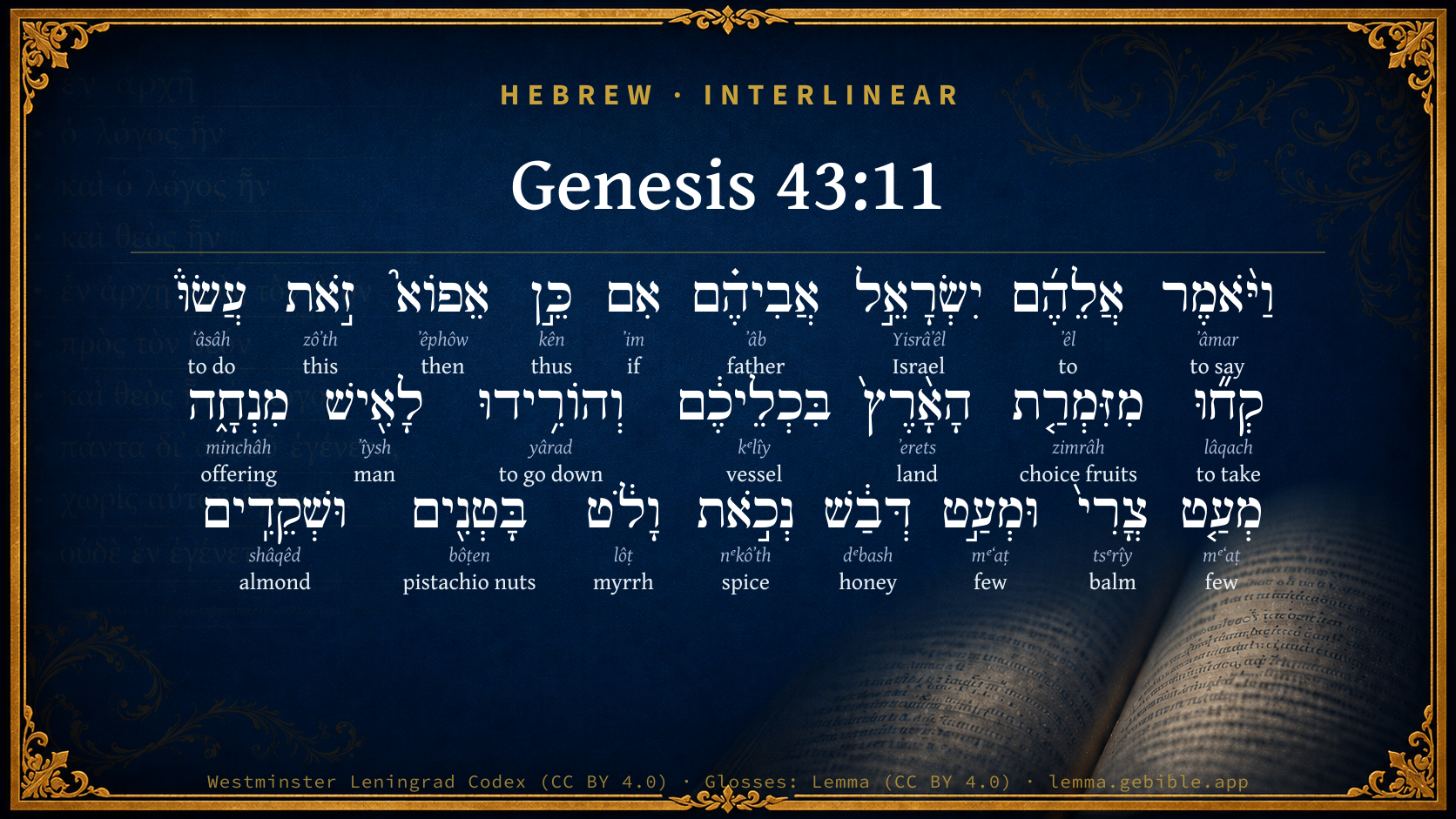
Genesis 43:11

Hebrew (Westminster Leningrad Codex) Genesis 43:11 appears in the Hebrew Old Testament. The text above is from the Westminster Leningrad Codex. Each word links to its Strong’s number, a concise gloss, and parsing drawn from the Open Scriptures Hebrew Bible morphology. Click any word for its full Brown-Driver-Briggs (BDB) entry.
Download image
Cite this verse

Genesis 43:11 (World English Bible). Public Domain. Lemma interlinear Bible study tool, https://lemma.gebible.app/v/genesis/43/11.

Show BibTeX & RIS
BibTeX
RIS
English Translation
Their father, Israel, said to them, "If it be so now, do this. Take from the choice fruits of the land in your bags, and carry down a present for the man, a little balm, a little honey, spices and myrrh, nuts, and almonds;
World English Bible · Public Domain
Highlights
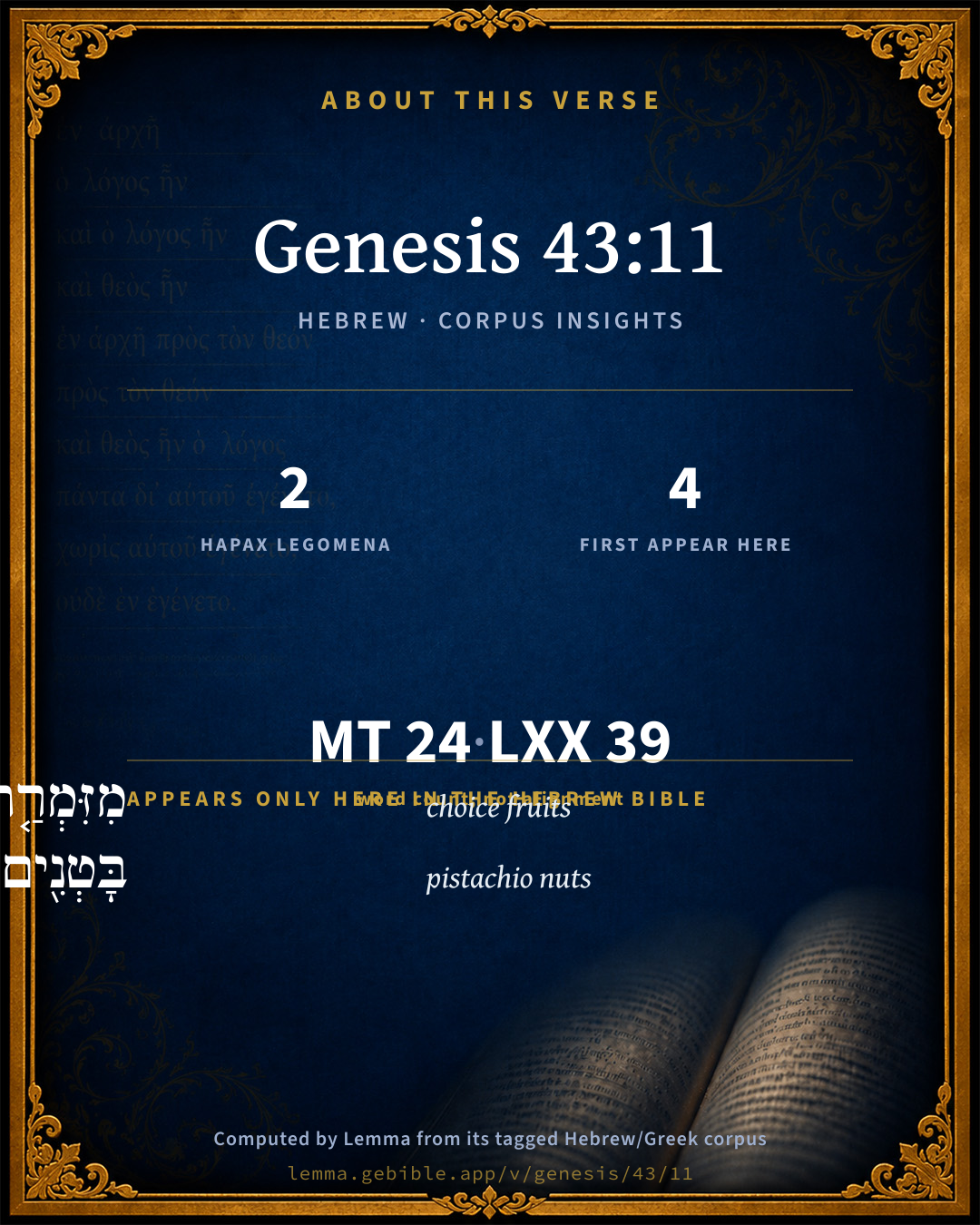
  • 2 hapax legomena — only here in the Hebrew Bible
  • 4 first appearances in the Hebrew Bible
Full analysis ↓
Download a study sheet

One document with this verse’s original text, its word-by-word gloss line, the meaning frame, cross-references with their text, attributed commentary, and full source and license credits — printable, and it pastes into notes with its structure intact.

This verse Autodidact and up

Study sheet (.html) Plain text (.txt)

A passage Seminary Student

Up to 50 verses in one chapter. A passage sheet keeps up to 6 commentary sources and 12 cross-references per verse, in the order this page ranks them, and says so on the sheet whenever that leaves anything out. Ask for a single verse and you get the Autodidact verse sheet above.

Everything on this page stays free to read, with no account — the sheet is a download of what is already on screen, not access to it.

Want to remove ads? Support Godless Engineer
Compare translations 3

The same verse in 3 English versions, stacked beneath the original-language interlinear above. Click any original word for its lexicon entry.

Each is an independent rendering of the whole verse — the interlinear is not word-aligned to these translations.

Highlighted words mark where these versions differ — a whole-verse word diff, not a word-by-word alignment.

  • World English Bible Public Domain
    Their father, Israel, said to them, "If it be so now, do this. Take from the choice fruits of the land in your bags, and carry down a present for the man, a little balm, a little honey, spices and myrrh, nuts, and almonds;
  • King James Version Public Domain
    And their father Israel said unto them, If it must be so now, do this; take of the best fruits in the land in your vessels, and carry down the man a present, a little balm, and a little honey, spices, and myrrh, nuts, and almonds:
  • unfoldingWord Literal Text CC BY-SA 4.0
    Then Israel their father said to them, “If so, then do this: Take of the choice produce of the land in your bags, and take down to the man a gift: a little balm, and a little honey, spices and myrrh, pistachio nuts and almonds.

unfoldingWord Literal Text — © unfoldingWord, licensed CC BY-SA 4.0. Word-aligned USFM3 via Door43 (git.door43.org/unfoldingWord/en_ult).

Versions to compare (up to 4)

3 of 4 selected

Show all 18 translations

Every available English version of this verse, each an independent rendering of the whole verse.

  • World English Bible Public Domain
    Their father, Israel, said to them, "If it be so now, do this. Take from the choice fruits of the land in your bags, and carry down a present for the man, a little balm, a little honey, spices and myrrh, nuts, and almonds;
  • Berean Standard Bible Public Domain
    Then their father Israel said to them, “If it must be so, then do this: Put some of the best products of the land in your packs and carry them down as a gift for the man—a little balm and a little honey, spices and myrrh, pistachios and almonds.
  • Majority Standard Bible Public Domain
    Then their father Israel said to them, “If it must be so, then do this: Put some of the best products of the land in your packs and carry them down as a gift for the man—a little balm and a little honey, spices and myrrh, pistachios and almonds.
  • King James Version Public Domain
    And their father Israel said unto them, If it must be so now, do this; take of the best fruits in the land in your vessels, and carry down the man a present, a little balm, and a little honey, spices, and myrrh, nuts, and almonds:
  • American Standard Version (1901) Public Domain
    And their father Israel said unto them, If it be so now, do this: take of the choice fruits of the land in your vessels, and carry down the man a present, a little balm, and a little honey, spicery and myrrh, nuts, and almonds;
  • Revised Version (1885) Public Domain
    And their father Israel said unto them, If it be so now, do this; take of the choice fruits of the land in your vessels, and carry down the man a present, a little balm, and a little honey, spicery and myrrh, nuts, and almonds:
  • Geneva Bible (1599) Public Domain
    Then their father Israel sayd vnto them, If it must needes be so now, do thus: take of the best fruites of the lande in your vessels, and bring the man a present, a little rosen, and a little hony, spices and myrrhe, nuttes, and almondes:
  • Douay-Rheims (1899) Public Domain
    Then Israel said to them: If it must needs be so, do what you will: take of the best fruits of the land in your vessels, and carry down presents to the man, a little balm, and honey, and storax, myrrh, turpentine, and almonds.
  • Young's Literal Translation Public Domain
    And Israel their father saith unto them, `If so, now, this do: take of the praised thing of the land in your vessels, and take down to the man a present, a little balm, and a little honey, spices and myrrh, nuts and almonds;
  • Literal Standard Version CC BY-SA 4.0
    And their father Israel says to them, “If so, now, do this: take of the praised thing of the land in your vessels, and take down to the man a present, a little balm, and a little honey, spices and myrrh, nuts and almonds;
  • Unlocked Literal Bible CC BY-SA 4.0
    Their father Israel said to them, “If it be so, now do this. Take some of the best products of the land in your bags. Carry down to the man a gift—some balm and honey, spices and myrrh, pistachio nuts and almonds.
  • unfoldingWord Literal Text CC BY-SA 4.0
    Then Israel their father said to them, “If so, then do this: Take of the choice produce of the land in your bags, and take down to the man a gift: a little balm, and a little honey, spices and myrrh, pistachio nuts and almonds.
  • Darby Bible Public Domain
    And their father Israel said to them, If it is then so, do this: take of the best fruits in the land in your vessels, and carry down the man a gift: a little balsam and a little honey, tragacanth and ladanum, pistacia-nuts and almonds.
  • World Messianic Bible Public Domain
    Their father, Israel, said to them, “If it must be so, then do this: Take from the choice fruits of the land in your bags, and carry down a present for the man, a little balm, a little honey, spices and myrrh, nuts, and almonds;
  • Webster's Bible Public Domain
    \\43:12\\And take double money in your hand; and the money that was returned in the mouth of your sacks, carry it again in your hand; it may be it was an oversight:
  • Free Bible Version CC BY-SA 4.0
    “If it has to be, then this is what you'll do,” Israel replied. “Take with you the best our country produces. Pack your bags with gifts for the man—balm, a little honey, spices, myrrh, pistachios, and almonds.
  • Bible in Basic English Public Domain
    And take twice as much money with you; that is to say, take back the money which was put in your bags, for it may have been an error;
  • JPS Tanakh (1917) Public Domain
    And their father Israel said unto them: 'If it be so now, do this: take of the choice fruits of the land in your vessels, and carry down the man a present, a little balm, and a little honey, spicery and ladanum, nuts, and almonds;

Literal Standard Version (2020), Covenant Press — licensed CC BY-SA 4.0. Text via the HelloAO Bible API (eBible.org). Unlocked Literal Bible (unfoldingWord) — licensed CC BY-SA 4.0. Text via the HelloAO Bible API (eBible.org). unfoldingWord Literal Text — © unfoldingWord, licensed CC BY-SA 4.0. Word-aligned USFM3 via Door43 (git.door43.org/unfoldingWord/en_ult). Free Bible Version, Dr. Jonathan Gallagher — licensed CC BY-SA 4.0. Text via the HelloAO Bible API (eBible.org).

Word by word

More ways to search: Search by grammar → Find every occurrence → Compare this word →

Practice this passage: Drill this verse → Learn its vocabulary →

מִזִּמְרַ֤ת
zimrâh
H2173
“from · choice fruits of”
Preposition + Noun, Common, Feminine, Singular, Construct
Part of Speech
Preposition + Noun
Type
Common
Gender
Feminine
Number
Singular
State
Construct
Full BDB Definition

Origin: from H2168

TWOT: 560a

choice fruits, choice products
  1. וַיֹּ֨אמֶר ʼâmar H559 “and · to say” Conjunction + Verb, Qal, Sequential Imperfect, 3rd Person, Masculine, Singular
  2. אֲלֵהֶ֜ם ʼêl H413 “to · them” Preposition + Suffix, Personal, 3rd Person, Masculine, Plural
  3. יִשְׂרָאֵ֣ל Yisrâʼêl H3478 “Israel” Noun, Proper
  4. אֲבִיהֶ֗ם ʼâb H1 “father · their” Noun, Common, Masculine, Singular, Construct + Suffix, Personal, 3rd Person, Masculine, Plural
  5. אִם ʼim H518 “if” Conjunction
  6. כֵּ֣ן kên H3651 “thus” Particle, Demonstrative
  7. אֵפוֹא֮ ʼêphôw H645 “then” Adverb
  8. זֹ֣את zôʼth H2063 “this” Pronoun, Demonstrative, Feminine, Singular
  9. עֲשׂוּ֒ ʻâsâh H6213 “do” Verb, Qal, Imperative, 2nd Person, Masculine, Plural
  10. קְח֞וּ lâqach H3947 “take” Verb, Qal, Imperative, 2nd Person, Masculine, Plural
  11. הָאָ֨רֶץ֙ ʼerets H776 “the · land” Particle, Definite Article + Noun, Common, Both, Singular, Absolute
  12. בִּכְלֵיכֶ֔ם kᵉlîy H3627 “in/at · vessels · your” Preposition + Noun, Common, Masculine, Plural, Construct + Suffix, Personal, 2nd Person, Masculine, Plural
  13. וְהוֹרִ֥ידוּ yârad H3381 “and · go down” Conjunction + Verb, Hiphil, Imperative, 2nd Person, Masculine, Plural
  14. לָאִ֖ישׁ ʼîysh H376 “to/for the · man” Preposition, Determined + Noun, Common, Masculine, Singular, Absolute
  15. מִנְחָ֑ה minchâh H4503 “offering” Noun, Common, Feminine, Singular, Absolute
  16. מְעַ֤ט mᵉʻaṭ H4592 “few of” Noun, Common, Masculine, Singular, Construct
  17. צֳרִי֙ tsᵉrîy H6875 “balm” Noun, Common, Masculine, Singular, Absolute
  18. וּמְעַ֣ט mᵉʻaṭ H4592 “and · few of” Conjunction + Noun, Common, Masculine, Singular, Construct
  19. דְּבַ֔שׁ dᵉbash H1706 “honey” Noun, Common, Masculine, Singular, Absolute
  20. נְכֹ֣את nᵉkôʼth H5219 “spice” Noun, Common, Feminine, Singular, Absolute
  21. וָלֹ֔ט lôṭ H3910 “and · myrrh” Conjunction + Noun, Common, Masculine, Singular, Absolute
  22. בָּטְנִ֖ים bôṭen H992 “pistachio nuts” Noun, Common, Masculine, Plural, Absolute
  23. וּשְׁקֵדִֽים shâqêd H8247 “and · almonds” Conjunction + Noun, Common, Masculine, Plural, Absolute

About this verse

These counts appear in no published source. They are computed here, from the morphology-tagged text and Lemma’s own curated glosses. What Lemma adds →

24
words
23
distinct lemmas
Pentateuch
section

Notable vocabulary

2 hapax legomena — words that appear only here in the entire Hebrew Bible:

  • מִזִּמְרַ֤ת choice fruits H2173
  • בָּטְנִ֖ים pistachio nuts H992

First appearance in Scripture

These words make their first canonical appearance in the Hebrew Bible here:

  • מִזִּמְרַ֤ת choice fruits H2173
  • דְּבַ֔שׁ honey H1706
  • בָּטְנִ֖ים pistachio nuts H992
  • וּשְׁקֵדִֽים almond H8247

Shared distinctive vocabulary

נְכֹ֣את spice H5219 occurs in 2 verses of the Hebrew Bible. Also found in:

Grammatical profile

  • 4 verbs
  • 15 nouns
  • 1 pronoun
  • 1 preposition
  • 1 conjunction
  • 1 adverb
  • 1 particle

Verb forms

  • וַיֹּ֨אמֶר Qal · Sequential Imperfect
  • עֲשׂוּ֒ Qal · Imperative
  • קְח֞וּ Qal · Imperative
  • וְהוֹרִ֥ידוּ Hiphil · Imperative

Repetition

A word recurs within this verse — often emphatic in Hebrew:

  • מְעַ֤ט few H4592 ×2

Hebrew & Septuagint length

In English translation the verse runs 44 words from the Hebrew and 42 from the Septuagint (LXX English) — closely comparable.

A rough comparison of the two English renderings, which tokenize alike — not a word-level alignment.

Word counts can differ between the Hebrew and the Greek without any difference in meaning — e.g. the Hebrew direct-object marker אֵת has no separate Greek word, and Greek often adds the article ὁ.

In the original languages it is 24 Hebrew tokens and 39 Greek tokens — but the two are counted differently (Hebrew bundles its prefixes and suffixes into one token; the Greek is in lemma form), so that isn’t a like-for-like length.

Cross-references

30

Topical passages linked to Genesis 43:11 in the Treasury of Scripture Knowledge — connected by theme and wording, ordered by reader-vote popularity; previews shown in the World English Bible.

  • Genesis 37:25 They sat down to eat bread, and they lifted up their eyes and looked, and saw a caravan of Ishmaelites was coming from Gilead, with their camels bearing spices and balm and myrrh, going to carry it down to Egypt.
  • Jeremiah 8:22 Is there no balm in Gilead? is there no physician there? why then isn't the health of the daughter of my people recovered?
  • 1 Samuel 9:7 Then said Saul to his servant, But, behold, if we go, what shall we bring the man? for the bread is spent in our vessels, and there is not a present to bring to the man of God: what have we?
  • Proverbs 18:16 A man's gift makes room for him, And brings him before great men.
  • Ezekiel 27:17 Judah, and the land of Israel, they were your traffickers: they traded for your merchandise wheat of Minnith, and confections, and honey, and oil, and balm.
  • Genesis 32:13–21 He lodged there that night, and took from that which he had with him, a present for Esau, his brother:
  • Genesis 33:10 Jacob said, "Please, no, if I have now found favor in your sight, then receive my present at my hand, because I have seen your face, as one sees the face of God, and you were pleased with me.
  • Genesis 43:14 May God Almighty give you mercy before the man, that he may release to you your other brother and Benjamin. If I am bereaved of my children, I am bereaved."
  • Deuteronomy 33:14 For the precious things of the fruits of the sun, For the precious things of the growth of the moons,
  • 1 Samuel 25:27 Now this present which your servant has brought to my lord, let it be given to the young men who follow my lord.
  • 1 Kings 4:21 Solomon ruled over all the kingdoms from the River to the land of the Philistines, and to the border of Egypt: they brought tribute, and served Solomon all the days of his life.
  • 1 Kings 10:15 besides [that which] the traders [brought], and the traffic of the merchants, and of all the kings of the mixed people, and of the governors of the country.
  • 1 Kings 10:25 They brought every man his tribute, vessels of silver, and vessels of gold, and clothing, and armor, and spices, horses, and mules, a rate year by year.
  • 1 Kings 15:19 [There is] a league between me and you, between my father and your father: behold, I have sent to you a present of silver and gold; go, break your league with Baasha king of Israel, that he may depart from me.
  • 2 Kings 8:8 The king said to Hazael, Take a present in your hand, and go, meet the man of God, and inquire of Yahweh by him, saying, Shall I recover of this sickness?
  • 2 Kings 16:8 Ahaz took the silver and gold that was found in the house of Yahweh, and in the treasures of the king's house, and sent it for a present to the king of Assyria.
  • 2 Kings 20:12 At that time Berodach-baladan the son of Baladan, king of Babylon, sent letters and a present to Hezekiah; for he had heard that Hezekiah had been sick.
  • Esther 4:16 Go, gather together all the Jews who are present in Shushan, and fast you for me, and neither eat nor drink three days, night or day: I also and my maidens will fast in like manner; and so will I go in to the king, which is not according to the law: and if I perish, I perish.
  • Psalms 68:29 Because of your temple at Jerusalem, Kings shall bring presents to you.
  • Psalms 72:10 The kings of Tarshish and of the isles will bring tribute. The kings of Sheba and Seba shall offer gifts.
  • Psalms 76:11 Make vows to Yahweh your God, and fulfill them! Let all of his neighbors bring presents to him who is to be feared.
  • Proverbs 17:18 A man void of understanding strikes hands, And becomes collateral in the presence of his neighbor.
  • Proverbs 19:6 Many will entreat the favor of a ruler, And everyone is a friend to a man who gives gifts.
  • Proverbs 21:14 A gift in secret pacifies anger; And a bribe in the cloak, strong wrath.
  • Song of Solomon 4:10 How beautiful is your love, my sister, my bride! How much better is your love than wine! The fragrance of your perfumes than all manner of spices!
  • Song of Solomon 4:14–5:1 Spikenard and saffron, Calamus and cinnamon, with every kind of incense tree; Myrrh and aloes, with all the best spices,
  • Song of Solomon 8:14 Come away, my beloved! Be like a gazelle or a young stag on the mountains of spices!
  • Ezekiel 27:15 The men of Dedan were your traffickers; many isles were the market of your hand: they brought you in exchange horns of ivory and ebony.
  • Acts 21:14 When he would not be persuaded, we ceased, saying, "The Lord's will be done."
  • Leviticus 20:24 But I have said to you, "You shall inherit their land, and I will give it to you to possess it, a land flowing with milk and honey." I am Yahweh your God, who has separated you from the peoples.

Cross-references courtesy of OpenBible.info (CC BY 4.0).

Hebrew and Greek witnesses Masoretic Hebrew ↔ Greek Septuagint

The same verse in the two great witnesses to the Old Testament, shown verse-for-verse.

These are two independent witnesses, not word-aligned to each other, and the Septuagint is shown in lemma (dictionary) form.

Hebrew Genesis 43:11 Masoretic · Westminster Leningrad Codex

וַיֹּ֨אמֶר אֲלֵהֶ֜ם יִשְׂרָאֵ֣ל אֲבִיהֶ֗ם אִם כֵּ֣ן אֵפוֹא֮ זֹ֣את עֲשׂוּ֒ קְח֞וּ מִזִּמְרַ֤ת הָאָ֨רֶץ֙ בִּכְלֵיכֶ֔ם וְהוֹרִ֥ידוּ לָאִ֖ישׁ מִנְחָ֑ה מְעַ֤ט צֳרִי֙ וּמְעַ֣ט דְּבַ֔שׁ נְכֹ֣את וָלֹ֔ט בָּטְנִ֖ים וּשְׁקֵדִֽים

Their father, Israel, said to them, "If it be so now, do this. Take from the choice fruits of the land in your bags, and carry down a present for the man, a little balm, a little honey, spices and myrrh, nuts, and almonds;

World English Bible · Public Domain

Greek LXX Genesis 43:11 Septuagint · lemma form

εἶπον δέ αὐτός ἰσραήλ ὁ πατήρ αὐτός εἰ οὕτως εἰμί οὗτος ποιέω λαμβάνω ἀπό ὁ καρπός ὁ γῆ ἐν ὁ ἀγγεῖον σύ καί καταἄγω ὁ ἄνθρωπος δῶρον ὁ ῥητίνη καί ὁ μέλι θυμίαμα καί στακτή καί τερέβινθος καί κάρυον

And Israel, their father, said to them, If it be so, do this; take of the fruits of the earth in your vessels, and carry down to the man presents of gum and honey, and frankincense, and stacte, and turpentine, and walnuts.

LXX2012 (modern English Septuagint) · Public Domain

On this verse, The Cambridge Bible for Schools and Colleges discusses the Septuagint’s reading. Read the note in Commentary ↓

Hebrew: Westminster Leningrad Codex (CC BY 4.0). Greek: Septuagint (public domain); English from LXX2012 (modern English Septuagint) (Public Domain). How the Septuagint differs from the Hebrew →

Targum (Aramaic paraphrase)

2

The Targum is the ancient Jewish Aramaic paraphrase of the Hebrew Scriptures — an interpretive translation, not the Hebrew text itself. Onkelos (literal) and Pseudo-Jonathan (expansive) render the Torah, and Jonathan the Prophets. Coverage is partial: where no permissively-licensed English translation exists for a verse, only the Aramaic is shown. This is verse-level text, not a word-by-word alignment to the Hebrew.

  1. Targum Onkelos Torah (Genesis–Deuteronomy)
    וַאֲמַר לְהוֹן יִשְׂרָאֵל אֲבוּהוֹן אִם כֵּן הָכָא דָּא עִיבִידוּ סִיבוּ מִדִּמְשַׁבַּח בְּאַרְעָא בְּמָנֵיכוֹן וְאוֹחִיתוּ לְגַבְרָא תִּקְרֻבְתָּא זְעֵיר קְטַף וּזְעֵיר דְּבַשׁ שְׁעַף וּלְטוֹם בָּטְנִין וְשִׁגְדִּין

    (no public-domain English translation for this verse)

    Targum Onkelos — Aramaic: “Onkelos Genesis” (public domain); “Onkelos Exodus” (public domain); “Onkelos Leviticus” (public domain); “Onkelos Numbers” (public domain); “Onkelos Deuteronomy” (public domain). English: “Sefaria Community Translation” (CC0 1.0 (public-domain dedication)); “J.W. Etheridge. The Targums of Onkelos and Jonathan Ben Uzziel on the Pentateuch. London: Longmans, Green, 1862” (public domain). Text via Sefaria.

  2. Targum Pseudo-Jonathan Torah (Genesis–Deuteronomy)
    וַאֲמַר לְהוֹם יִשְרָאֵל אֲבוּהוֹם אִין כְּדוֹן הוּא דָא עִיבִידוּ סְבוּ מִמַה דִמְשַׁבַּח בְּאַרְעָא וְהָבוּ בְּמָנֵיכוֹן וְאָחִיתוּ לְגַבְרָא דוֹרוֹנָא קָלִיל שְרָף קְטָף וְקָלִיל דְבַשׁ שַׁעֲוָה וּלְטוֹם מְשַׁח דְבוּטְנִין וּמְשַׁח דְלוּזִין

    And Israel their father said to them, If it must be so, do this: Take of the praiseworthy things of the land, and put them in your vessels, and carry down the man a present, a little gum and a little honey, wax and ladanum, the oil of nuts, and the oil of almonds,

    Targum Pseudo-Jonathan — Aramaic: “Targum Jonathan on Genesis” (public domain); “Targum Jonathan on Exodus” (public domain); “Targum Jonathan on Leviticus” (public domain); “Targum Jonathan on Numbers” (public domain); “Targum Jonathan on Deuteronomy” (public domain). English: “The Targum of Jonathan ben Uzziel, trans. J. W. Etheridge, London, 1862” (public domain). Text via Sefaria.

Commentary

Notes on Genesis 43:11 from classic Christian and Jewish commentators (each source and its license shown beneath its notes). The classic Christian expositions comment on the surrounding passage and are grouped to its opening verse, so a note may address several verses; the Jewish commentaries on the Tanakh (Rashi and others) are per-verse, so they appear only where the commentator wrote on this verse.

Lemma curates 59 commentaries, every one of them public domain or Creative Commons licensed, each selected and text-cleaned for this edition rather than reprinted as found. About our sources →

Matthew Henry's Commentary

Observe here, I. Jacob's persuasibleness. He would be ruled by reason, though they were his inferiors that urged it. He saw the necessity of the case; and, since there was no remedy, he consented to yield to the necessity (Gen 43:11): "If it must be so now, take your brother. If no corn can be had but upon those terms, we may as well expose him to the perils of the journey as suffer ourselves and families, and Benjamin amongst the rest, to perish for want of bread." Skin for skin, and all that a man has, even a Benjamin, the dearest of all, will he give for his life. No death so dreadful as that by famine, Lam 4:9. Jacob had said (Gen 42:38), My son shall not go down; but now he is over-persuaded to consent. Note, It is no fault, but our wisdom and duty, to alter our purposes and resolutions when there is a good reason for our so doing. Constancy is a virtue, but obstinacy is not. It is God's prerogative not to repent, and to make unchangeable resolves.

II. Jacob's prudence and justice, which appeared in three things: - 1. He sent back the money which they had found in the sacks' mouths, with this discreet construction of it, Peradventure it was an oversight. Note, Honesty obliges us to make restitution, not only of that which comes to us by our own fault, but of that which comes to us by the mistakes of others. Though we get it by oversight, if we keep it when the oversight is discovered, it is kept by deceit. In the stating of accounts, errors must be excepted, even those that make for us as well as those that make against us. Jacob's words furnish us with a favourable construction to put upon that which we are tempted to resent as an injury and affront; pass it by, and say, Peradventure it was an oversight. 2. He sent double money, as much again as they took the time before, upon supposition that the price of corn might have risen, - or to show a generous spirit, that they might be the more likely to find generous treatment with the man, the lord of the land. 3. He sent a present of such things as the land afforded, and as were scarce in Egypt - balm and honey, etc. (Gen 43:11), the commodities that Canaan exported, Gen 37:25. Note, (1.) Providence dispenses its gifts variously. Some countries produce one commodity, others another, that commerce may be preserved. (2.) Honey and spice will never make up the want of bread-corn. The famine was sore in Canaan, and yet they had balm and myrrh, etc. We may live well enough upon plain food without dainties; but we cannot live upon dainties without plain food. Let us thank God that that which is most needful and useful is generally most cheap and common. (3.) A gift in secret pacifies wrath, Pro 21:14. Jacob's sons were unjustly accused as spies, yet Jacob was willing to be at the expense of a present, to pacify the accuser. Sometimes we must not think it too much to buy peace even where we may justly demand it, and insist upon it as our right.

III. Jacob's piety appearing in his prayer: God Almighty give you mercy before the man! Gen 43:14. Jacob had formerly turned an angry brother into a kind one with a present and a prayer; and here he betakes himself to the same tried method, and it sped well. Note, Those that would find mercy with men must seek it of God, who has all hearts in his hands, and turns them as he pleases.

IV. Jacob's patience. He concludes all with this: "If I be bereaved of my children, I am bereaved; If I must part with them thus one after another, I must acquiesce, and say, The will of the Lord be done." Note, It is our wisdom to reconcile ourselves to the sorest afflictions, and make the best of them; for there is nothing got by striving with our Maker, Sa2 15:25, Sa2 15:26.

Matthew Henry's Commentary on the Whole Bible (1708–1710) — public domain (CC PDM 1.0). Text via the HelloAO Bible API.

Trapp's Complete Commentary

John Trapp

Gen 43:11 And their father Israel said unto them, If [it must be] so now, do this; take of the best fruits in the land in your vessels, and carry down the man a present, a little balm, and a little honey, spices, and myrrh, nuts, and almonds:

Ver. 11. If it must be so now, &c.] Perplexity is blind and untractable. Let the mind but settle, and it will soon yield to a reasonable motion, if seasonable, especially, as this of Judah was: for, besides the weightiness of his words, necessity now spake for him, that most powerful orator.

Take of the best fruits.] De laudatissimis rebus, saith Juulus. Of the verse or melody, saith the original; {a} that is, of the most praiseworthy fruits; such as deserve to be commended in verse, and sung of, to the praise of God the giver.

A little balm, and a little honey.] Great men regard not the worth of the gift, but the will of the giver. If I had had more, I would have given more, said that Greek to Augustus, {b} and it was accepted. The poor Persian that met Artaxerxes with a handful of water, out of the river Cyprus, went away well rewarded. So did the gardener that presented the Duke of Burgundy with a rape root; which, when the master of his house observed, he presented his lord with a brave small saddle horse, looking for like liberality, but was disappointed.

{a} Ex carmine, vel melodia, vel modulatione, vel denique Psalmo. - Isa. lxv. 8.

{b} Eι πλεον ειχον, πλεον εδιδουν. - Aelian.

John Trapp, A Commentary or Exposition upon All the Books of the Old and New Testament (1647–1656) — public domain. Text from a community e-Sword module.

Joseph Benson's Commentary

Gen 43:11. If it must be so now, take your brother — If no corn can be had but upon those terms, as good expose him to the perils of the journey, as suffer ourselves and families, and Benjamin among the rest, to perish for want of bread: it is no fault, but our wisdom and duty, to alter our resolutions, when there is a good reason for so doing: constancy is a virtue, but obstinacy is not: it is God’s prerogative to make unchangeable resolves.

Joseph Benson's Commentary on the Old and New Testaments (1811–1818) — public domain. Text from a community e-Sword module.

Tyndale Open Study Notes

Tyndale Open Resources

43:11-13 Jacob provided everything he could to ensure a favorable reception from the Egyptian governor (the man; cp. 32:13-21).

Tyndale Open Study Notes — © Tyndale Open Resources, licensed CC BY-SA 4.0. Text via the HelloAO Bible API.

Geneva Bible (1599)

Geneva Bible translators

Or, sweet smells.

Geneva Bible (1599) marginal notes — public domain. Text via Bolls.life.

Jamieson, Fausset & Brown

Robert Jamieson, A. R. Fausset & David Brown

take of the best fruits . . . a present--It is an Oriental practice never to approach a man of power without a present, and Jacob might remember how he pacified his brother (Pro 21:14) --balm, spices, and myrrh (see on Gen 37:25),

honey--which some think was dibs, a syrup made from ripe dates [BOCHART]; but others, the honey of Hebron, which is still valued as far superior to that of Egypt;

nuts--pistachio nuts, of which Syria grows the best in the world;

almonds--which were most abundant in Palestine.

Jamieson, Fausset & Brown — Commentary Critical and Explanatory on the Whole Bible (1871) — public domain (CC PDM 1.0). Text via the HelloAO Bible API.

Adam Clarke's Commentary

Verse 11. Carry down the man a present] From the very earliest times presents were used as means of introduction to great men. This is particularly noticed by Solomon: A man's gift maketh room for him, and bringeth him before great men, Pr 18:16. But what was the present brought to Joseph on this occasion? After all the labour of commentators, we are obliged to be contented with probabilities and conjecture. According to our translation, the gifts were balm, honey, spices, myrrh, nuts, and almonds.

Balm] צרי tsori is supposed to signify resin in general, or some kind of gum issuing from trees.

Honey] דבש debash has been supposed to be the same as the rob of grapes, called in Egypt dibs. Others think that honey, in the common sense of the term, is to be understood here: we know that honey was plentiful in Palestine.

Spices] נכאת nechoth is supposed to mean gum storax, which might be very valuable on account of its qualities as a perfume.

Myrrh] לט lot, supposed by some to mean stacte; by others to signify an ointment made of myrrh.

Nuts] בטנים botnim, by some rendered pistachio nuts, those produced in Syria being the finest in the world; by others, dates; others, walnuts; others, pine apples; others, the nuts of the terebinth tree.

Almonds] שקדים shekedim, correctly enough translated, and perhaps the only article in the collection of which we know any thing with certainty. It is generally allowed that the land of Canaan produces the best almonds in the east; and on this account they might be deemed a very acceptable present to the governor of Egypt. Those who wish to see this subject exhausted must have recourse to the Physica Sacra of Scheuehzer.

Adam Clarke's Commentary on the Bible (1810–1826) — public domain. Text from a community e-Sword/MySword module.

John Calvin's Commentaries

11. Take of the best fruits Though the fruits which Moses enumerates were, for the most part, not very precious, because the condition of holy Jacob was not such that he could send any royal present; yet, according to his slender ability, he wished to appease Joseph. Besides we know that fruits are not always estimated according to their cost. And now, having commanded his sons to do what he thought necessary, he has recourse to prayer, that God would give them favor with the governor of Egypt. We must attend to both these points whenever we are perplexed in any business; for we must not omit any of those things which are expedient, or which may seem to be of use; and yet we must place our reliance upon God. For the tranquillity of faith has no affinity with indolence: but he who expects a prosperous issue of his affairs from the Lord, will, at the same time, look closely to the means which are in his power, and will apply them to present use. Meanwhile, let the faithful observe this moderation, that when they have tried all means, they still ascribe nothing to their own industry. At the same time, let them be certainly convinced that all their endeavors will be in vain, unless the Lord bless them. It is to be observed, also, in the form of his supplication, that Jacob regards the hearts of men as subject to the will of God. When we have to deal with men, we too often neglect to look unto the Lord, because we do not sufficiently acknowledge him as the secret governor of their hearts. But to whatever extent unruly men may be carried away by violence, it is yet certain that their passions are turned by God in whatever direction he pleases, so that he can mitigate their ferocity as often as he sees good; or can permit those to become cruel, who before were disposed to mildness. So Jacob, although his sons had found an austere severity in Joseph, yet trusts that his heart will be so in the hand of God, that it shall be suddenly mounded to humanity. Therefore, as we must hope in the Lord, when men deal unjustly with us, and must pray that they may be changed for the better; so, on the other hand, we must remember that, when they act with severity towards us, it is not done without the counsel of God.

John Calvin's Commentaries (1540-1563) — public domain. Text from the Calvin Translation Society English edition (1840s-50s) via the Christian Classics Ethereal Library (ccel.org). Calvin's coverage is partial (roughly two-thirds of the Bible); uncommented books and verses are honest gaps, never fabricated. The 19th-century editor's footnotes and remarks are omitted so the notes are faithfully Calvin's own voice.

Ellicott's Commentary for English Readers

(11) The best fruits.—Heb., the song, that is, whatever in the land is most celebrated in song.

In your vessels.—The word used in Gen_42:25, where see Note. Concerning this present two remarks must be made; the first, that it proves that though there was not rain enough in Palestine to bring the corn to perfection, yet that there was some small supply, sufficient to maintain a certain amount of vegetation; and but for this Jacob could not have kept his cattle alive (Gen_47:1). And next, the smallness of the present does not so much show that Jacob had very simple ideas respecting the greatness of the king of Egypt, as that there was a scarcity even of these fruits. Probably the trade in them had ceased, and therefore even a moderate quantity ‘would be welcome. For the words rendered balm, spices and myrrh really balsam, gum-tragacanth and ladanum), see Note on Gen_37:25.

Honey.—As both the honey made by bees and date honey were common in Egypt, many suppose that this was grape-honey, prepared by boiling down the juice of ripe grapes to a third of its original quantity. Hebron is famous for its preparation, and even in modern times three hundred camel loads used to be exported thence annually into Egypt. Diluted with water it forms a very grateful drink, and it is also largely eaten with bread, as we eat butter.

Nuts.—That is, pistachio nuts, the fruit of the pistachio, vera. As the tree delights in dry, rocky situations, it will not grow in Egypt. It has an oily kernel, both palatable in itself and also much used for making savoury meats. These and the almonds, which also do not grow well in Egypt, would be acceptable gifts.

A Bible Commentary for English Readers, edited by Charles John Ellicott (1878–1897) — public domain. Text from a community e-Sword module.

The Cambridge Bible for Schools and Colleges

gen. ed. J. J. S. Perowne

11. do this] Jacob yields, but, true to the character of a shrewd man of the world, he advises that the formidable Grand Vizier should be propitiated with a suitable present.

choice fruits] The Hebrew word, zimrah, occurs only in this passage in the Pent. (cf. Amo_5:23): LXX καρποί = “fruits”; Lat. optimi fructus. The meaning is probable, though only conjectural. Some think that it may be from the Hebrew root zmr, “to make melody,” cf. mizmôr, “a psalm”: hence Targ. Onkelos, “What is praiseworthy in the land.” It has been suggested that “the melody of the land” would mean “the produce of the land celebrated in song.” Cf. Jer_51:41.

vessels] i.e. baggage, receptacles of various kinds, e.g. “sacks” (Gen_42:25); cf. 1Sa_9:7.

balm] See Gen_37:25.

honey] Possibly the material known in Syria and Palestine as dibs, which is the Arabian word for “grape juice boiled down to a syrup.” The Hebrew word d’bash, however, means real “honey,” and it is natural to suppose that a gift of real honey from the country would be a more acceptable offering to the Egyptian ruler. Cf. 1Ki_14:3.

spicery and myrrh] See Gen_37:25.

nuts] That is, pistachio nuts. The fruit of the pistacia vera, a rare tree in Palestine, regarded as a delicacy.

The Cambridge Bible for Schools and Colleges (gen. ed. J. J. S. Perowne; Cambridge University Press, 1878–1918) — public domain. Text from a community e-Sword module.

John Gill's Exposition

And take double money in your hand,.... Than what they carried before, either to buy as much more as they then did; or rather because of the greater scarcity of corn, as Jarchi observes, which made it doubly dearer; for this seems to be different from the money they are also bid to take in return for that found in their sacks, which was a third parcel, as follows:

and the money that was brought again in the mouth of your sacks, carry it again in your hand; that it might be ready to pay upon demand, should they be charged with nonpayment for the corn they had before:

peradventure it was an oversight; a mistake of the governors, or of those that were under him, concerned in the sale of the corn, and receiving money for it, or of Jacob's sons; he could not tell how it was, but some way or other he supposed a mistake was made.

John Gill's Exposition of the Whole Bible (1746–1763) — public domain (CC PDM 1.0). Text via the HelloAO Bible API.

Haydock's Catholic Bible Commentary

Best fruits: Hebrew literally, "of the praise, or song of the earth;" or of those things for which the country is most renowned, and which are not found in Egypt. (Origen) --- Balm. Literally, rosin, resinæ; but here by that name is meant balm. (Challoner) See chap. xxxvii. 25. --- Honey, or all sorts of sweet fruit. --- Storax: Septuagint, "incense," or perfumes. It is like balm; thick, odoriferous, and medicinal. --- Myrrh, (stactes); Hebrew Lot. A liquor stamped from fresh myrrh pilled, with a little water. (Calmet) --- Sometimes it is translated Gutta, a drop. (Psalm xliv. 9.) (Menochius) --- Turpentine. St. Jerome and the Septuagint seem to have read Bothmin instead of the present Hebrew Batenim, which some translate, "nuts of the pistacium," (Bochart); which hand in clusters, and are of an oblong shape. Vitellius first brought them out of Syria. (Pliny, Natural History xv. 22.) --- Almonds; Septuagint nuts, of which almonds are one species. (Menochius)

George Leo Haydock (1774–1849), Haydock's Catholic Family Bible and Commentary, 1859 edition — public domain. Excludes Psalms (Douay-Rheims chapter numbering differs from Protestant) and Deuterocanonical books (Catholic canon only).

Matthew Poole's English Annotations

Of all which see Gen 37:25. The

nuts were of that kind which we call pistaches, as some Hebrew and other expositors render the word; for that was both an excellent fruit, and peculiar to Judea and Syria, and well agreeing with the

almonds which here follow.

Matthew Poole's English Annotations on the Holy Bible (1683–1685) — public domain. Text from a community e-Sword/MySword module.

Whedon's Commentary on the Bible

Daniel D. Whedon

11. Take of the best fruits — Hebrews, take of the song of the land; the products celebrated in song. This suggests the answer to the objection that these fruits should be had in Canaan in such a time of dearth. The items of the present here named were luxuries, which might have been preserved from previous years. “Almost all of them,” says Kalisch, “require for their growth heat rather than moisture; and some develop themselves to the greatest advantage in dry years and in a dry soil.” So these may have grown and been abundant when the grains all failed. On balm, spices, and myrrh, see note on Gen_37:25, where it will be noticed that the Ishmaelite caravan carried these same articles into Egypt. The honey (רבשׁ) here mentioned was probably the grape honey, manufactured by art, not by the bees; a sort of molasses or syrup, called by the modern Arabs dibs.

Nuts — Probably the nuts of the pistachio tree, which somewhat resembles the terebinth. The Septuagint here translates the word by terebinth. The pistachio nut is said to be of an aromatic taste, and a favourite but not common fruit in the East. The almond tree was common in Palestine, but not in Egypt; its blossoms and fruit much resemble those of the peach tree.

Daniel D. Whedon (gen. ed.), Commentary on the Old and New Testaments (1874–1909) — public domain. Text from a community e-Sword module.

The Pulpit Commentary

And their father Israel said unto them, If it must be so now (literally, if so now), do this; take of the best fruits in the land (literally, of the song of the land, i.e. of its choicest and most praised productions) in your vessels, and carry down the man a present. That Jacob could propose to send a handsome present of rich fruits to the Egyptian viceroy has been regarded as inconsistent with the prevalence of a famine in the land of Canaan for over two or three years (Bohlen); but

(1) the failure of the cereal crops does not necessarily imply a like absence of fruit, and

(2) it does not follow that, though Jacob selected the under-mentioned articles for his gift, they existed in abundance, while

(3) if the fruit harvest was small, an offering such as is here described would only be all the more luxuriant and valuable on that account (Kurtz, Kalisch). A little balm, balsam (vide Gen_37:25) and a little honey, vbD, grape honey, called by the Arabians dibs, and the Persians dushab, was prepared by boiling down must or new wine to a third or half; hence called by the Greeks eyhma, and by the Romans sapa, defrutum. It is still imported into Egypt from the district of Hebron. That it was not the honey of bees, meli, (LXX), meg (Vulgate), is rendered probable by the circumstance that Egypt abounds in this excellent production of nature (vide Michaelis, Suppl., p. 391)spices, and myrrh, (wide Gen_27:25) nuts, an oblong species of nut, so called from its being fiat on one side and bellying out on the other (the pistacia vera of Linnaeus), having an oily kernel which is most palatable to Orientals (vide Kalisch in loco)and almonds. The dqev; or almond tree, so called because of all trees it is the first to arouse from the sleep of winter, the root being dqv to be sleepless, (Gesenius), does not seem to have been indigenous in Egypt, while it flourishes in Syria and Palestine (Kalisch).

The Pulpit Commentary (1880–1919), ed. H.D.M. Spence-Jones & Joseph S. Exell — public domain. Text from a community e-Sword module.

John Wesley's Explanatory Notes

If it must be so now, take your brother - If no corn can be had but upon those terms, as good expose him to the perils of the journey, as suffer ourselves and families, and Benjamin among the rest, to perish for want of bread: it is no fault, but our wisdom and duty, to alter our resolutions when there is a good reason for so doing: constancy is a virtue, but obstinacy is not: it is God's prerogative to make unchangeable resolves.

John Wesley, Explanatory Notes Upon the Whole Bible (1754–1765) — public domain. Text via the GEBible commentary corpus.

Keil & Delitzsch

C. F. Keil & F. Delitzsch

And their father Israel said unto them, If it must be so now, do this; take of the best fruits in the land in your vessels, and carry down the man a present, a little balm, and a little honey, spices, and myrrh, nuts, and almonds: After this, the old man gave way to what could not be avoided, and let Benjamin go. But that nothing might be wanting on his part, which could contribute to the success of the journey, he suggested that they should take a present for the man, and that they should also take the money which was brought back in their sacks, in addition to what was necessary for the corn they were to purchase; and he then commended them to the mercy of Almighty God. "If it must be so, yet do this (אפוא belongs to the imperative, although it precedes it here, cf. Gen 27:37): take of the prize (the most choice productions) of the land-a little balm and a little honey (דּבשׁ the Arabian dibs, either new honey from bees, or more probably honey from grapes, - a thick syrup boiled from sweet grapes, which is still carried every year from Hebron to Egypt), gum-dragon and myrrh (vid., Gen 37:25), pictachio nuts and almonds." בּטנים, which are not mentioned anywhere else, are, according to the Samar. vers., the fruit of the pistacia vera, a tree resembling the terebinth, - long angular nuts of the size of hazel-nuts, with an oily kernel of a pleasant flavour; it does not thrive in Palestine now, but the nuts are imported from Aleppo.

Keil & Delitzsch — Biblical Commentary on the Old Testament (1861–1891) — public domain (CC PDM 1.0). Text via the HelloAO Bible API. (Old Testament only.)

Kretzmann's Popular Commentary

Paul E. Kretzmann

Jacob Permits Benjamin to go

v. 11. And their father Israel said unto them, if it must be so now, do this: take of the best fruits in the land in your vessels, literally, the song of the country, that for which the country is known and praised everywhere, of this they were to take in their packs: and carry down the man a present, a little balm, and a little honey, spices, and myrrh, nuts, and almonds. The balm of Gilead, for which Canaan was famed, the honey of grapes, that is, must, boiled down, the white resinous tragacanth-gum, the nuts which at that time were obtained in Southern Canaan, and the fruits of the almond-tree made very acceptable presents.

v. 12. And take double money in your hand, second money in addition to that which they felt they still owed the Egyptian ruler; and the money that was brought again in the mouth of your sacks, carry it again in your hand; peradventure it was an oversight. The shrewdness of Jacob wanted to provide for every emergency.

v. 13. Take also your brother, and arise, go again unto the man;

v. 14. and God Almighty give you mercy before the man, that he may send away your other brother (Simeon)and Benjamin. He places the matter entirely into the hands of God, trusting, in simple confidence, that the Lord will stretch out over his sons the hand of His almighty protection and keep especially Benjamin from all harm. If I be bereaved of my children, I am bereaved, That was not a word of hopeless despair, but of trusting resignation: Jacob was willing to take also that upon himself, if the Lord willed it, that he would be childless. Thus the believers at all times commit their ways to the Lord and put their full trust in Him.

Paul E. Kretzmann, Popular Commentary of the Bible (1921–1924) — public domain. Text from a community e-Sword module.

unfoldingWord translationNotes

Door43 World Missions Community

If it be so, now do this

"If this is our only choice, then do it"

Carry down

It was common to use the word "down" when speaking of traveling from Canaan to Egypt.

balm

an oily substance with a sweet smell used for healing and protecting skin. See how you translated this word in Genesis 37:25. AT: "medicine"

spices

seasonings. See how you translated these words in Genesis 37:25.

pistachio nuts

small, green tree nuts (See: Translate Unknowns)

almonds

tree nuts with a sweet flavor (See: Translate Unknowns)

Take double money in your hand

Here "hand" stands for the whole person. AT: "Take double the money with you" (See: Synecdoche)

The money that was returned in the opening of your sacks, carry again in your hand

Here "hand" stands for the whole person. The phrase "that was returned" can be stated in active form. AT: "take back to Egypt the money someone put in your sacks" (See: Synecdoche and Active or Passive)

translationWords

Jacob

gift

honey

unfoldingWord translationNotes — © Distant Shores Media and the Door43 World Missions Community, licensed CC BY-SA 4.0. Source: git.door43.org/Door43/en_tn.

Rashi

Rabbi Shlomo Yitzchaki (Rashi)

אפוא NOW — This is really a redundant word used in Hebrew for stylistic purposes. If it be so that I am compelled to do this — that I must send him with you — I must endeavour to seek where (אי) there is here (פה) some measure and plan to propose to you and therefore, I say: “Do this”.

מזמרת הארץ OF THE CHOICE PRODUCTS OF THE LAND — This is rendered in the Targum by “Take of that which is praised in the land” — that about which people sing its praise (מזמרים) when it comes into existence (Genesis Rabbah 91:11).

נכאת is WAX (Genesis Rabbah 91:11; cf. 37:25).

בטנים PISTACHIO-NUTS — I do not know what these are. but in the definitions given in the Dictionary of R. Machir I have read that they are Pistachios; I think that they are peaches.

Rashi on the Tanakh — English translations: “The Judaica Press complete Tanach with Rashi, translated by A. J. Rosenberg” (CC BY 4.0); “Pentateuch with Rashi's commentary by M. Rosenbaum and A.M. Silbermann, 1929-1934” (public domain); “The Metsudah Tanach series, Lakewood, N.J” (CC BY 4.0); and “The Book of Joshua, Metsudah Publications, 1997” (CC BY 4.0). Text via Sefaria.

Radak

Rabbi David Kimhi (Radak)

אם כן אפוא, if the situation is such that I cannot detain Binyamin here,

זאת עשו, in order to curry favour with the ruler of the land;

מזמרת הארץ, of the produce which this land is especially famous for;

מעט צרי ומעט דבש, both of these products were known as exports from the land of Canaan. as is spelled out specifically in Ezekiel 27,17 יהודה וארץ ישראל המה רוכליך בחטי מנית ופגג ודבש ושמן וצרי, Yehudah and the Land of Israel, they were your peddlers. With wheat from Minis, balsam oil, honey, oil and balm, etc.” צרי is known as “balsam” nowadays.

נכאת, according to Bereshit Rabbah 91,11 this is wax. In the same paragraph there דבש is understood as “hard as stone.” Rabbi Saadyah Gaon explains the word צרי, as Triaki, and נכאת as some kind of cabbage (cauliflower), and לוט as lotononis, something better known today as armon, chestnut.

בטנים, which are known in Arabic as piniulash. Apparently this nut was known in Spain as tzenuvar.

ושקדים, almonds, something familiar to all of us. In Bereshit Rabbah 91,11 both the words בטנים and שקדים are understood as referring to an ointment based on the oil of these nuts. [why would Yaakov send something as common as peanuts and almonds? Ed.]

Radak on the Tanakh — English translations: “Sefaria Community Translation” (CC0 1.0 (public-domain dedication)); “Eliyahu Munk, HaChut Hameshulash” (CC BY 4.0); “Rabbi Mike Feuer, Jerusalem Anthology” (CC BY 4.0); and “R. David Kimhi on the first book of Psalms, Translated by R.G. Finch, London, 1919” (public domain). Text via Sefaria.

Lesson kit

Teaching starters — assembled from the data on this page, not authored interpretation. Every prompt links to the verse data it draws on. Edit before teaching.

Genesis, in the Pentateuch, opens this verse with 24 words (23 distinct Hebrew lemmas). Its most distinctive word is zimrâh (“choice fruits”). A historical commentator’s framing appears above. Read the whole chapter for the surrounding context.

Discussion questions

  1. How does “choice fruits” (zimrâh) shape what this verse is saying?
  2. 2 words here appear nowhere else in the Hebrew Bible. Why might the author reach for such rare wording?
  3. 4 words make their first appearance in Scripture here. What does this debut establish?
  4. How does Genesis 37:25, which shares the word «spice», read alongside this verse?
  5. What does the repetition of “few” (2× in this one verse) do in this verse?
  6. These translations render this verse differently. What is at stake in choosing one wording over another?
  7. «וַיֹּ֨אמֶר» is a Qal Sequential Imperfect verb. How does that grammatical form shape the action described?
  8. Compare how Matthew Henry's Commentary and Trapp's Complete Commentary read this verse. Where do they agree or differ?

Things to notice

  • 2 words in this verse appear nowhere else in the Hebrew Bible.
  • 4 words make their first canonical appearance in Scripture here.
  • This verse counts 24 Hebrew ↔ 39 Greek words.
  • These translations choose different wording for 12 words in this verse.
  • “few” occurs 2× in this single verse.

Reading settings

Reading text

Shown beneath each verse's original-language words.

Old Testament
Old Testament edition

Read the OT as the Masoretic Hebrew (MT) or the Greek Septuagint (LXX).

English shown for the Greek Septuagint (in the Hebrew ↔ Greek comparison).

Comparing translations? Open the Compare panel on any verse page to stack up to four side by side.