Genesis 11:7

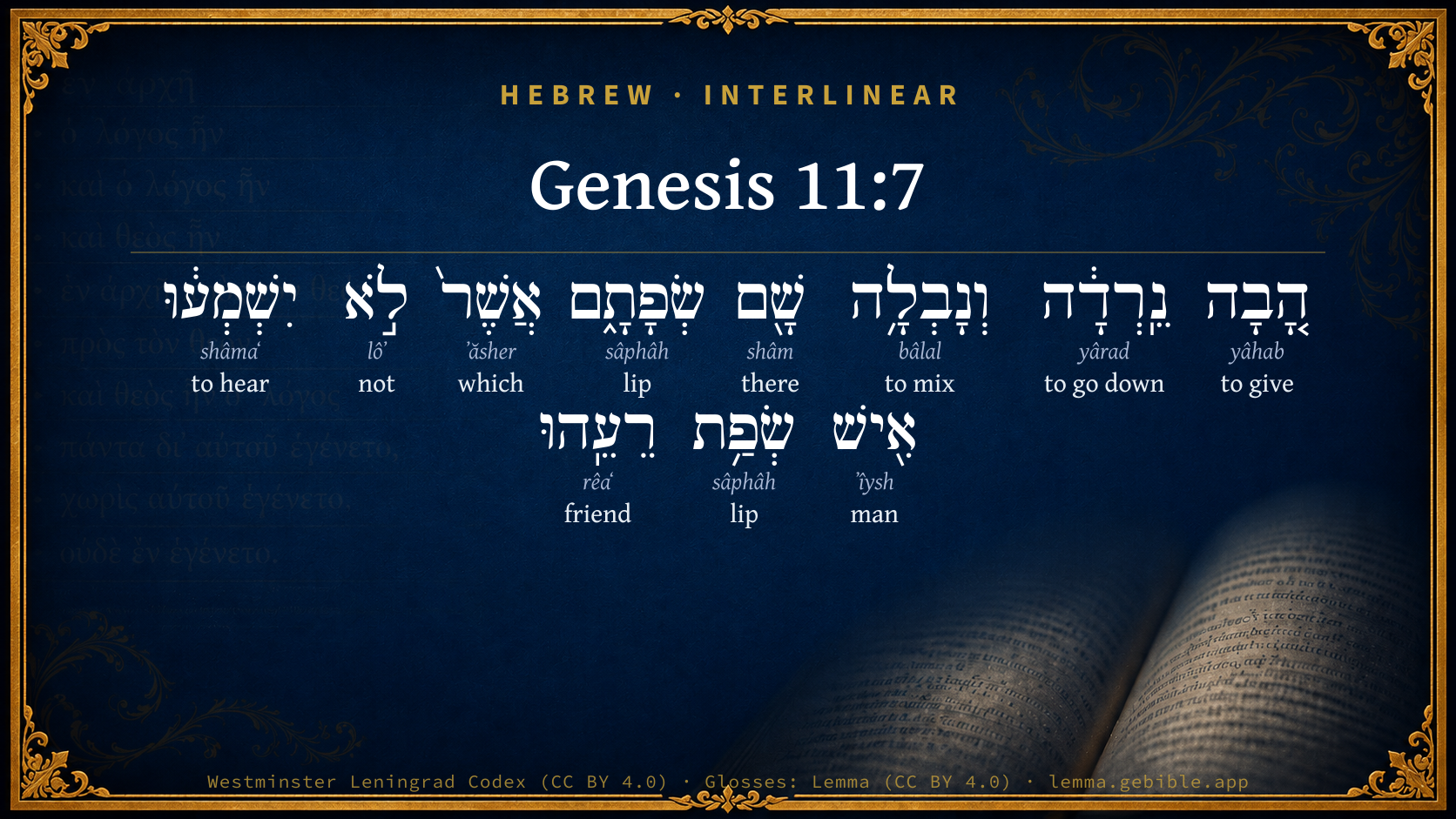
Hebrew (Westminster Leningrad Codex) Genesis 11:7 appears in the Hebrew Old Testament. The text above is from the Westminster Leningrad Codex. Each word links to its Strong’s number, a concise gloss, and parsing drawn from the Open Scriptures Hebrew Bible morphology. Click any word for its full Brown-Driver-Briggs (BDB) entry.
Download image
Cite this verse

Genesis 11:7 (World English Bible). Public Domain. Lemma interlinear Bible study tool, https://lemma.gebible.app/v/genesis/11/7.

Show BibTeX & RIS
BibTeX
RIS
English Translation
Come, let's go down, and there confuse their language, that they may not understand one another's speech."
World English Bible · Public Domain
Highlights
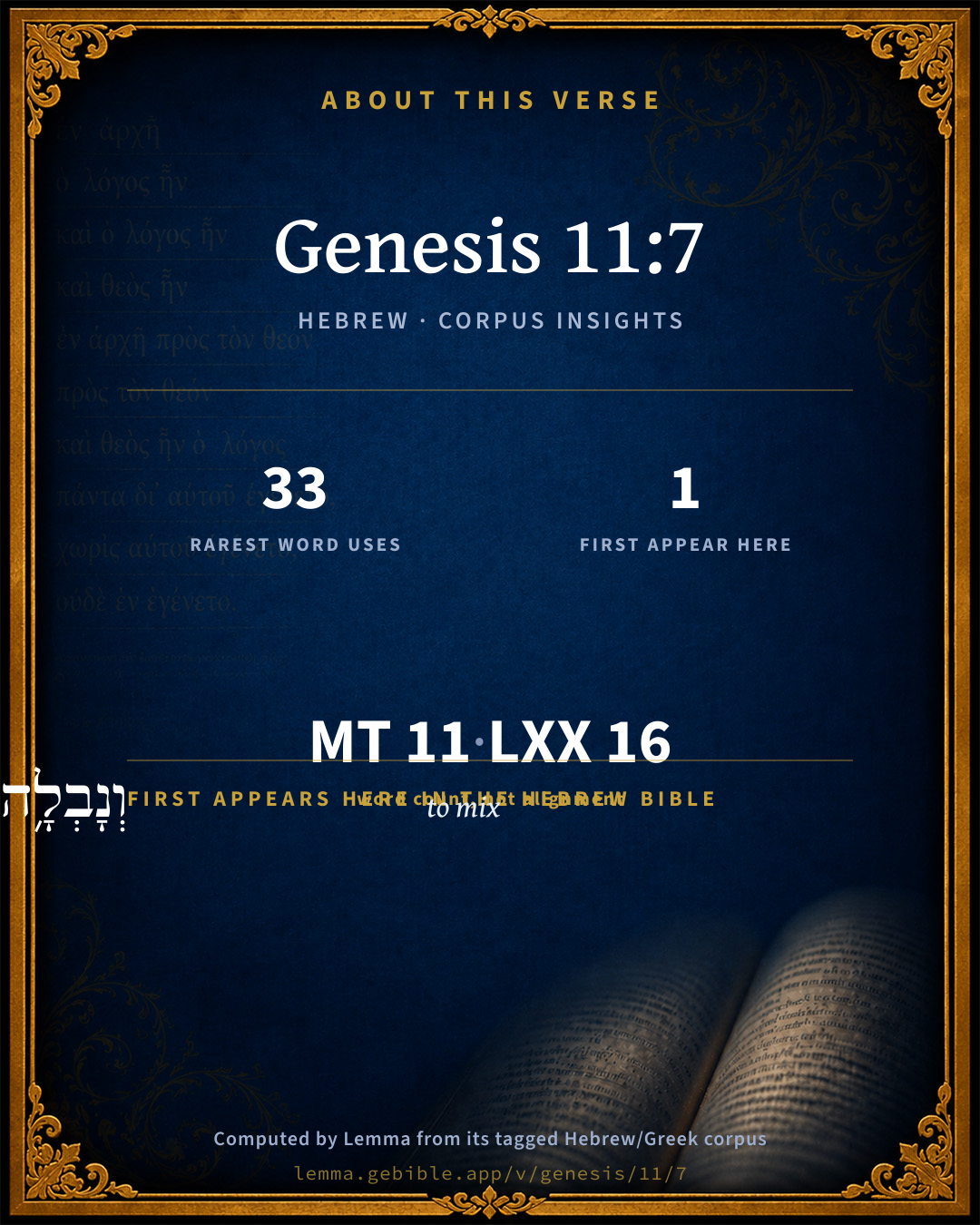
  • 1 first appearance in the Hebrew Bible
Full analysis ↓
Download a study sheet

One document with this verse’s original text, its word-by-word gloss line, the meaning frame, cross-references with their text, attributed commentary, and full source and license credits — printable, and it pastes into notes with its structure intact.

This verse Autodidact and up

Study sheet (.html) Plain text (.txt)

A passage Seminary Student

Up to 50 verses in one chapter. A passage sheet keeps up to 6 commentary sources and 12 cross-references per verse, in the order this page ranks them, and says so on the sheet whenever that leaves anything out. Ask for a single verse and you get the Autodidact verse sheet above.

Everything on this page stays free to read, with no account — the sheet is a download of what is already on screen, not access to it.

Want to remove ads? Support Godless Engineer
Compare translations 3

The same verse in 3 English versions, stacked beneath the original-language interlinear above. Click any original word for its lexicon entry.

Each is an independent rendering of the whole verse — the interlinear is not word-aligned to these translations.

Highlighted words mark where these versions differ — a whole-verse word diff, not a word-by-word alignment.

  • World English Bible Public Domain
    Come, let's go down, and there confuse their language, that they may not understand one another's speech."
  • King James Version Public Domain
    Go to, let us go down, and there confound their language, that they may not understand one another's speech.
  • unfoldingWord Literal Text CC BY-SA 4.0
    Come, let us go down and there confuse their language, so that they will not understand each other’s language.”

unfoldingWord Literal Text — © unfoldingWord, licensed CC BY-SA 4.0. Word-aligned USFM3 via Door43 (git.door43.org/unfoldingWord/en_ult).

Versions to compare (up to 4)

3 of 4 selected

Show all 18 translations

Every available English version of this verse, each an independent rendering of the whole verse.

  • World English Bible Public Domain
    Come, let's go down, and there confuse their language, that they may not understand one another's speech."
  • Berean Standard Bible Public Domain
    Come, let Us go down and confuse their language, so that they will not understand one another’s speech.”
  • Majority Standard Bible Public Domain
    Come, let Us go down and confuse their language, so that they will not understand one another’s speech.”
  • King James Version Public Domain
    Go to, let us go down, and there confound their language, that they may not understand one another's speech.
  • American Standard Version (1901) Public Domain
    Come, let us go down, and there confound their language, that they may not understand one another's speech.
  • Revised Version (1885) Public Domain
    Go to, let us go down, and there confound their language, that they may not understand one another’s speech.
  • Geneva Bible (1599) Public Domain
    Come on, let vs goe downe, and there confound their language, that euery one perceiue not anothers speache.
  • Douay-Rheims (1899) Public Domain
    Come ye, therefore, let us go down, and there may not understand one another's speech.
  • Young's Literal Translation Public Domain
    Give help, let us go down, and mingle there their pronunciation, so that a man doth not understand the pronunciation of his companion.'
  • Literal Standard Version CC BY-SA 4.0
    Give help, let us go down there and confuse their language, so that a man will not understand the language of his companion.”
  • Unlocked Literal Bible CC BY-SA 4.0
    Come, let us go down and confuse their language there, so that they may not understand each other.”
  • unfoldingWord Literal Text CC BY-SA 4.0
    Come, let us go down and there confuse their language, so that they will not understand each other’s language.”
  • Darby Bible Public Domain
    Come, let us go down, and there confound their language, that they may not understand one another's speech.
  • World Messianic Bible Public Domain
    Come, let’s go down, and there confuse their language, that they may not understand one another’s speech.”
  • Webster's Bible Public Domain
    Come, let us go down, and there confound their language, that they may not understand one another's speech.
  • Free Bible Version CC BY-SA 4.0
    We need to go down and mix up their language and make it confused so they won't be able to understand what they're saying to one other.”
  • Bible in Basic English Public Domain
    Come, let us go down and take away the sense of their language, so that they will not be able to make themselves clear to one another.
  • JPS Tanakh (1917) Public Domain
    Come, let us go down, and there confound their language, that they may not understand one another's speech.'

Literal Standard Version (2020), Covenant Press — licensed CC BY-SA 4.0. Text via the HelloAO Bible API (eBible.org). Unlocked Literal Bible (unfoldingWord) — licensed CC BY-SA 4.0. Text via the HelloAO Bible API (eBible.org). unfoldingWord Literal Text — © unfoldingWord, licensed CC BY-SA 4.0. Word-aligned USFM3 via Door43 (git.door43.org/unfoldingWord/en_ult). Free Bible Version, Dr. Jonathan Gallagher — licensed CC BY-SA 4.0. Text via the HelloAO Bible API (eBible.org).

Word by word

More ways to search: Search by grammar → Find every occurrence → Compare this word →

Practice this passage: Drill this verse → Learn its vocabulary →

הָ֚בָה
yâhab
H3051
“give”
Verb, Qal, Imperative, 2nd Person, Masculine, Singular + Suffix, h
Part of Speech
Verb
Stem
Qal
Form
Imperative
Person
2nd Person
Gender
Masculine
Number
Singular
Full BDB Definition

Origin: a primitive root

TWOT: 849

to give, provide, ascribe, come - (Qal) - to give - to set, place - to provide (with reflexive) - to ascribe (glory) - to grant, permit, come now
  1. נֵֽרְדָ֔ה yârad H3381 “to go down” Verb, Qal, Cohortative, 1st Person, Common, Plural
  2. וְנָבְלָ֥ה bâlal H1101 “and · to mix” Conjunction + Verb, Qal, Cohortative, 1st Person, Common, Plural
  3. שָׁ֖ם shâm H8033 “there” Adverb
  4. שְׂפָתָ֑ם sâphâh H8193 “lip · their” Noun, Common, Feminine, Singular, Construct + Suffix, Personal, 3rd Person, Masculine, Plural
  5. אֲשֶׁר֙ ʼăsher H834 “which” Particle, Relative
  6. לֹ֣א lôʼ H3808 “not” Particle, Negative
  7. יִשְׁמְע֔וּ shâmaʻ H8085 “to hear” Verb, Qal, Imperfect, 3rd Person, Masculine, Plural
  8. אִ֖ישׁ ʼîysh H376 “man” Noun, Common, Masculine, Singular, Absolute
  9. שְׂפַ֥ת sâphâh H8193 “lip of” Noun, Common, Feminine, Singular, Construct
  10. רֵעֵֽהוּ rêaʻ H7453 “friend · his” Noun, Common, Masculine, Singular, Construct + Suffix, Personal, 3rd Person, Masculine, Singular

About this verse

These counts appear in no published source. They are computed here, from the morphology-tagged text and Lemma’s own curated glosses. What Lemma adds →

11
words
10
distinct lemmas
Pentateuch
section

First appearance in Scripture

This word makes its first canonical appearance in the Hebrew Bible here:

  • וְנָבְלָ֥ה to mix H1101

Shared distinctive vocabulary

הָ֚בָה to give H3051 occurs in 29 verses of the Hebrew Bible. Also found in:

Grammatical profile

  • 4 verbs
  • 4 nouns
  • 1 adverb
  • 2 particles

Verb forms

  • הָ֚בָה Qal · Imperative
  • נֵֽרְדָ֔ה Qal · Cohortative
  • וְנָבְלָ֥ה Qal · Cohortative
  • יִשְׁמְע֔וּ Qal · Imperfect

Repetition

A word recurs within this verse — often emphatic in Hebrew:

  • שְׂפָתָ֑ם lip H8193 ×2

Hebrew & Septuagint length

In English translation the verse runs 17 words from the Hebrew and 22 from the Septuagint (LXX English) — closely comparable.

A rough comparison of the two English renderings, which tokenize alike — not a word-level alignment.

Word counts can differ between the Hebrew and the Greek without any difference in meaning — e.g. the Hebrew direct-object marker אֵת has no separate Greek word, and Greek often adds the article ὁ.

In the original languages it is 11 Hebrew tokens and 16 Greek tokens — but the two are counted differently (Hebrew bundles its prefixes and suffixes into one token; the Greek is in lemma form), so that isn’t a like-for-like length.

Cross-references

18

Topical passages linked to Genesis 11:7 in the Treasury of Scripture Knowledge — connected by theme and wording, ordered by reader-vote popularity; previews shown in the World English Bible.

  • Psalms 33:10 Yahweh brings the counsel of the nations to nothing. He makes the thoughts of the peoples to be of no effect.
  • Genesis 1:26 God said, "Let us make man in our image, after our likeness: and let them have dominion over the fish of the sea, and over the birds of the sky, and over the cattle, and over all the earth, and over every creeping thing that creeps on the earth."
  • Job 5:12–13 He frustrates the devices of the crafty, So that their hands can't perform their enterprise.
  • Psalms 55:9 Confuse them, Lord, and confound their language, For I have seen violence and strife in the city.
  • 1 Corinthians 14:2–11 For he who speaks in another language speaks not to men, but to God; for no one understands; but in the Spirit he speaks mysteries.
  • Genesis 42:23 They didn't know that Joseph understood them; for there was an interpreter between them.
  • Acts 2:4–11 They were all filled with the Holy Spirit, and began to speak with other languages, as the Spirit gave them the ability to speak.
  • 1 Corinthians 14:23 If therefore the whole assembly is assembled together and all speak with other languages, and unlearned or unbelieving people come in, won't they say that you are crazy?
  • Genesis 3:22 Yahweh God said, "Behold, the man has become like one of us, knowing good and evil. Now, lest he put forth his hand, and also take of the tree of life, and eat, and live forever..."
  • Deuteronomy 28:49 Yahweh will bring a nation against you from far, from the end of the earth, as the eagle flies; a nation whose language you shall not understand;
  • Job 12:20 He removes the speech of those who are trusted, And takes away the understanding of the elders.
  • Psalms 2:4 He who sits in the heavens will laugh. The Lord will have them in derision.
  • Jeremiah 5:15 Behold, I will bring a nation on you from far, house of Israel, says Yahweh: it is a mighty nation, it is an ancient nation, a nation whose language you don't know, neither understand what they say.
  • Genesis 10:20 These are the sons of Ham, after their families, after their languages, in their lands, in their nations.
  • Genesis 11:5 Yahweh came down to see the city and the tower, which the children of men built.
  • Isaiah 6:8 I heard the Lord's voice, saying, "Whom shall I send, and who will go for us?" Then I said, "Here I am. Send me!"
  • Genesis 10:5 Of these were the isles of the nations divided in their lands, everyone after his language, after their families, in their nations.
  • Genesis 10:32 These are the families of the sons of Noah, after their generations, in their nations. Of these were the nations divided in the earth after the flood.

Cross-references courtesy of OpenBible.info (CC BY 4.0).

Hebrew and Greek witnesses Masoretic Hebrew ↔ Greek Septuagint

The same verse in the two great witnesses to the Old Testament, shown verse-for-verse.

These are two independent witnesses, not word-aligned to each other, and the Septuagint is shown in lemma (dictionary) form.

Hebrew Genesis 11:7 Masoretic · Westminster Leningrad Codex

הָ֚בָה נֵֽרְדָ֔ה וְנָבְלָ֥ה שָׁ֖ם שְׂפָתָ֑ם אֲשֶׁר֙ לֹ֣א יִשְׁמְע֔וּ אִ֖ישׁ שְׂפַ֥ת רֵעֵֽהוּ

Come, let's go down, and there confuse their language, that they may not understand one another's speech."

World English Bible · Public Domain

Greek LXX Genesis 11:7 Septuagint · lemma form

δεῦτε καί καταβαίνω συνχέω ἐκεῖ αὐτός ὁ γλῶσσα ἵνα μή ἀκούω ἕκαστος ὁ φωνή ὁ πλησίον

Come, and having gone down let us there confound their tongue, that they may not understand each the voice of his neighbor.

LXX2012 (modern English Septuagint) · Public Domain

On this verse, Adam Clarke's Commentary discusses the Septuagint’s reading. Read the note in Commentary ↓

Hebrew: Westminster Leningrad Codex (CC BY 4.0). Greek: Septuagint (public domain); English from LXX2012 (modern English Septuagint) (Public Domain). How the Septuagint differs from the Hebrew →

Targum (Aramaic paraphrase)

2

The Targum is the ancient Jewish Aramaic paraphrase of the Hebrew Scriptures — an interpretive translation, not the Hebrew text itself. Onkelos (literal) and Pseudo-Jonathan (expansive) render the Torah, and Jonathan the Prophets. Coverage is partial: where no permissively-licensed English translation exists for a verse, only the Aramaic is shown. This is verse-level text, not a word-by-word alignment to the Hebrew.

  1. Targum Onkelos Torah (Genesis–Deuteronomy)
    הָבוּ נִתְגְּלִי וּנְבַלְבֵּל תַּמָּן לִישָׁנְהוֹן דְּלָא יִשְׁמְעוּן (גְּבַר) אֱנַשׁ לִישָׁן חַבְרֵהּ

    Come, We will be manifest, and will confuse their language there, that a man shall not bear the language of his companion.

    Targum Onkelos — Aramaic: “Onkelos Genesis” (public domain); “Onkelos Exodus” (public domain); “Onkelos Leviticus” (public domain); “Onkelos Numbers” (public domain); “Onkelos Deuteronomy” (public domain). English: “Sefaria Community Translation” (CC0 1.0 (public-domain dedication)); “J.W. Etheridge. The Targums of Onkelos and Jonathan Ben Uzziel on the Pentateuch. London: Longmans, Green, 1862” (public domain). Text via Sefaria.

  2. Targum Pseudo-Jonathan Torah (Genesis–Deuteronomy)
    וַאֲמַר יְיָ לְשַׁבְעִין מַלְאָכַיָא דְקַיְימִין קוֹמוֹי אִיתוּן כְּדֵין וְנָחִית וּנְעַרְבְּבָא תַּמָן לִישַׁנְהוֹן דְלָא יִשְׁמְעוּן אֱינַשׁ לִישָׁן חַבְרֵיהּ

    And the Lord said to the seventy angels which stand before Him, Come, we will descend and will there commingle their language, that a man shall not understand the speech of his neighbour.

    Targum Pseudo-Jonathan — Aramaic: “Targum Jonathan on Genesis” (public domain); “Targum Jonathan on Exodus” (public domain); “Targum Jonathan on Leviticus” (public domain); “Targum Jonathan on Numbers” (public domain); “Targum Jonathan on Deuteronomy” (public domain). English: “The Targum of Jonathan ben Uzziel, trans. J. W. Etheridge, London, 1862” (public domain). Text via Sefaria.

Commentary

Notes on Genesis 11:7 from classic Christian and Jewish commentators (each source and its license shown beneath its notes). The classic Christian expositions comment on the surrounding passage and are grouped to its opening verse, so a note may address several verses; the Jewish commentaries on the Tanakh (Rashi and others) are per-verse, so they appear only where the commentator wrote on this verse.

Lemma curates 59 commentaries, every one of them public domain or Creative Commons licensed, each selected and text-cleaned for this edition rather than reprinted as found. About our sources →

Trapp's Complete Commentary

John Trapp

Gen 11:7 Go to, let us go down, and there confound their language, that they may not understand one another’s speech.

Ver. 7. Go to, let us go down.] "Go to," say they: "Go to," saith He. "Let us build to heaven," say they: "Let us go down and see it," saith He. "Let us make us a name," say they: "Let us confound their language, that they may not so much as know their own names," saith He. "Lest we be scattered," say they: "Let us scatter them abroad the world," saith He. Thus God words it with them, and confutes their folly from point to point. Thus he sets himself in battle array against the proud, as St James has it, {αντιτασσεται, Jas 4:7} and overthrows them in plain field. He dealt more severely with David for numbering the people than for the matter of Uriah. He turned Nebuchadnezzar grazing among beasts, for pruning and priding himself upon this Babel. "Is not this great Babel, that I have built?" Why, no; Nimrod built it, and Ninus, and Semiramis: Nebuchadnezzar only beautified it, or, at utmost, enlarged it. But pride detracts from God and man, and is therefore justly hated and scorned of both.

And there confound their language.] When men began once θεομαχειν, they were compelled by God λογομαχειν.

“Bring me, quoth one, a trowel quickly; quick

One brings him up a hammer; hew this brick,

Another bids, and then they cleave a tree;

Make fast this rope, and then they let it flee.

One calls for plank; another mortar lacks:

They bring the first a stone, the last an axe.” - Dubartus.

Neither is there any better understanding and agreement among the Babel builders at this day ( Babylon enim altera, nempe propinquior atque recentior adhuc stat, cito itidem casura, si essetis viri , said Petrarch long since); witness their many sects and deadly dissensions among themselves, of which read the "Peace of Rome," "Rhemes against Rome," {a} and various other English treatises to the same purpose. Bellarmine teaches, that the bread in the sacrament is not turned into Christ’s body productive, but adductive. And this, saith he, is the opinion of the Church of Rome. This Suarez denies, and saith, it is not the Church’s opinion. {b} Thus these great master-builders are confounded in their language, and understand not their own mother. The greatest clerks among them cannot yet determine how the saints know our hearts and prayers - whether by hearing or seeing, or presence everywhere, or by God’s relating or revealing men’s prayers and needs unto them. All which ways some of them hold as possible or probable; and others deny and confute them as untrue. {c} Alsted calls Baronius’s "Annals" the Tower of Babel. And another saith, Baronius doth not write annals, but maketh them. How he takes up St Paul for reproving Peter at Antioch, and contradicts the Holy Ghost, is well known; as also how he thunders against the king of Spain, his sovereign, concerning the kingdom of Sicily; for the which rudeness, when he was reprehended by another cardinal, he thus defended himself: An imperious zeal hath no power to spare, no, not God himself. Was not this an apology well befitting a Babel builder? Christchurch, in Oxford, like the tower of Babel, saith one, began with such stupendous magnificence, under the pride of Wolsey (another cardinal of the Church of Rome), who resolved to make it a work of wonder, that the Controller of men’s actions determined to make it a work of confusion; and so, when the cardinal fell, the walls had fallen too, had not Henry VIII. looked graciously upon it, to set it up, to some purpose. {d}

{a} De Rom. utriusque Fort. Dial. , 118.

{b} Cade Of the Church, 247.

{c} Morton’s Appeal, lib. ii. cap. 12, sec. 5.

{d} Gainsf. Glor. of England.

John Trapp, A Commentary or Exposition upon All the Books of the Old and New Testament (1647–1656) — public domain. Text from a community e-Sword module.

Tyndale Open Study Notes

Tyndale Open Resources

11:7 Come, let’s go down: God addresses his angelic court (see 1:26; 3:22; and study notes). • won’t be able to understand each other: Their inability to communicate would curtail their unified sinful ambition. The God-honoring unity of language on the day of Pentecost was a symbolic reversal of the Babel dispersion (Acts 2:5-13; see Zeph 3:9).

Tyndale Open Study Notes — © Tyndale Open Resources, licensed CC BY-SA 4.0. Text via the HelloAO Bible API.

Geneva Bible (1599)

Geneva Bible translators

He speaketh as though he took counsel with his own wisdom and power: to wit, with the Son and holy Ghost: signifying the greatness and certainty of the punishment.

By this great plague of the confusion of tongues appeareth God’s horrible judgment against man’s pride and vain glory.

Geneva Bible (1599) marginal notes — public domain. Text via Bolls.life.

Jamieson, Fausset & Brown

Robert Jamieson, A. R. Fausset & David Brown

confound their language--literally, "their lip"; it was a failure in utterance, occasioning a difference in dialect which was intelligible only to those of the same tribe. Thus easily by God their purpose was defeated, and they were compelled to the dispersion they had combined to prevent. It is only from the Scriptures we learn the true origin of the different nations and languages of the world. By one miracle of tongues men were dispersed and gradually fell from true religion. By another, national barriers were broken down--that all men might be brought back to the family of God.

Jamieson, Fausset & Brown — Commentary Critical and Explanatory on the Whole Bible (1871) — public domain (CC PDM 1.0). Text via the HelloAO Bible API.

Adam Clarke's Commentary

Verse 7. Go to] A form of speech which, whatever it might have signified formerly, now means nothing. The Hebrew העה habah signifies come, make preparation, as it were for a journey, the execution of a purpose, c. Almost all the versions understand the word in this way the Septuagint have δευτε, the Vulgate venite, both signifying come, or come ye. This makes a very good sense, Come, let its go down, &c. For the meaning of these latter words see Ge 1:26, and Ge 18:21.

Adam Clarke's Commentary on the Bible (1810–1826) — public domain. Text from a community e-Sword/MySword module.

John Calvin's Commentaries

7. Go to, let us go down. We have said that Moses has represented the case to us by the figure hypotyposis, that the judgments of God may be the more clearly illustrated. For which reason, he now introduces God as the speaker, who declares that the work which they supposed could not be retarded, shall, without any difficulty, be destroyed. The meaning of the words is of this kind, ‘I will not use many instruments, I will only blow upon them, and they, through the confusion of tongues, shall be contemptibly scattered. And as they, having collected a numerous band, were contriving how they might reach the clouds; so on the other hand, God summons his troops, by whose interposition he may ward off their fury. It is, however, asked, what troops he intends? The Jews think that he addresses himself to the angels. But since no mention is made of the angels, and God places those to whom he speaks in the same rank with himself, this exposition is harsh, and deservedly rejected. This passage rather answers to the former, which occurs in the account of man’s creation, when the Lord said, “Let us make man after our image.” For God aptly and wisely opposes his own eternal wisdom and power to this great multitude; as if he had said, that he had no need of foreign auxiliaries, but possessed within himself what would suffice for their destruction. Wherefore, this passage is not improperly adduced in proof that Three Persons subsist in One Essence of Deity. Moreover, this example of Divine vengeance belongs to all ages: for men are always inflamed with the desire of daring to attempt what is unlawful. And this history shows that God will ever be adverse to such counsels and designs; so that we here behold, depicted before our eyes what Solomon says:

‘There is no counsel, nor prudence, nor strength against the Lord,’ (Proverbs 21:30.)

Unless the blessing of God be present, from which alone we may expect a prosperous issue, all that we attempt will necessarily perish. Since, then, God declares that he is at perpetual war with the unmeasured audacity of men; anything we undertake without his approval will end miserably, even though all creatures above and beneath should earnestly offer us their assistance. Now, although the world bears this curse to the present day; yet, in the midst of punishment, and of the most dreadful proofs of Divine anger against the pride of men, the admirable goodness of God is rendered conspicuous, because the nations hold mutual communication among themselves, though in different languages; but especially because He has proclaimed one gospel, in all languages, through the whole world, and has endued the Apostles with the gift of tongues. Whence it has come to pass, that they who before were miserably divided, have coalesced in the unity of the faith. In this sense Isaiah says, that the language of Canaan should be common to all under the reign of Christ, (Isaiah 19:18;) because, although their language may differ in sound, they all speak the same thing, while they cry, Abba, Father.

John Calvin's Commentaries (1540-1563) — public domain. Text from the Calvin Translation Society English edition (1840s-50s) via the Christian Classics Ethereal Library (ccel.org). Calvin's coverage is partial (roughly two-thirds of the Bible); uncommented books and verses are honest gaps, never fabricated. The 19th-century editor's footnotes and remarks are omitted so the notes are faithfully Calvin's own voice.

The Cambridge Bible for Schools and Colleges

gen. ed. J. J. S. Perowne

7. Go to, let us go down] For 1st pers. plur. see notes on Gen_1:26, Gen_3:5; Gen_3:22. Jehovah is represented probably as enthroned above the heaven, and either as addressing the powers of heaven, “the sons of Elohim,” who attend Him and minister to Him (cf. Job_1:6), or as announcing His purpose in the deliberative 1st pers. plur.

The Cambridge Bible for Schools and Colleges (gen. ed. J. J. S. Perowne; Cambridge University Press, 1878–1918) — public domain. Text from a community e-Sword module.

John Gill's Exposition

Go to, let us go down, and there confound their language,.... These words are not spoken to the angels, as the Targum and Aben Ezra; for, as Philo the Jew observes (h), they are said to some as co-workers with God, which angels could not be in this work of confounding the language of men; it being above the power of creatures so to work upon the mind, and on the faculty of speech, as to make such an alteration as was at the confusion of tongues, when men were made to forget their former language, and had another put into their minds, and a faculty of speaking it given; or, however, the first language was so differently inflected and pronounced, that it seemed another, and various; all which could not be done but by him who is almighty, even that Jehovah, Father, Son, and Spirit, said Gen 11:8 to confound man's language; and the first of these speaks to the other two, with whom he consulted about doing it, and with whom he did it. Not that every man had a new and distinct language given him, for then there could have been no society and converse in the world, but one was given to each family; or rather to as many families as constituted a nation or colony, designed for the same place of habitation; how many there were, cannot be said with any certainty. Euphorus, and many other historians (i), say they were seventy five, according to the number of Jacob's posterity that went down into Egypt; others say seventy two: the Jewish writers generally agree with the Targum of Jonathan in making them seventy, according to the number of the posterity of Noah's sons, recorded in the preceding chapter; but several of them spoke the same language, as Ashur, Arphaxad, and Aram, spoke the Chaldee or Syriac language; the sons of Canaan one and the same language; and the thirteen sons of Joktan the Arabic language; Javari and Elisha the Greek language; so that, as Bochart (k) observes, scarce thirty of the seventy will remain distinct: and it is an observation of Dr. Lightfoot (l) not to be despised, that"the fifteen named in Act 2:5 were enough to confound the work (at Babel), and they may very well be supposed to have been the whole number.''The end to be answered it was:

that they may not understand one another's speech; or "hear" (m), that is, so as to understand; the words were so changed, and so differently pronounced from what they had used to hear, that though they heard the sound, they could not tell the meaning of them: hence, as Jarchi observes, when one asked for a brick, another brought him clay or slime, on which he rose up against him, and dashed his brains out.

(h) De Confus. Ling. p. 344. (i) Apud Clement. Alexandr. Strom. l. 1. p. 338. (k) Phaleg. l. 1. c. 15. col. 55. (l) See his Works, vol. 1. p. 694. (m) "audiant", Pagninus, Montanus, &c.

John Gill's Exposition of the Whole Bible (1746–1763) — public domain (CC PDM 1.0). Text via the HelloAO Bible API.

Haydock's Catholic Bible Commentary

Come ye, &c. As men seemed bent on taking heaven by storm, like the ancient giants, God turns their expressions, as it were, against themselves, and shews them an example of humility, let us go down. He acts the part of a judge, and therefore will examine all with the utmost diligence, as he denotes by these expressions; being really incapable of moving from place to place, on account of his immensity. (Haydock) --- He seems nearer to men, by the effects or punishments which he inflicted. The address which he here makes is directed, not to the angels, but to the other co-equal powers of the Blessed Trinity. (Menochius)

George Leo Haydock (1774–1849), Haydock's Catholic Family Bible and Commentary, 1859 edition — public domain. Excludes Psalms (Douay-Rheims chapter numbering differs from Protestant) and Deuterocanonical books (Catholic canon only).

Matthew Poole's English Annotations

Let us, i.e. the blessed Trinity. See Gen 1:26.

Confound their language, by making them forget their former language, and by putting into their minds several languages; not a distinct language into each person, but into each family, or rather into each nation; that thereby they may be disenabled from that mutual commerce which was altogether necessary for the carrying on of that work.

Matthew Poole's English Annotations on the Holy Bible (1683–1685) — public domain. Text from a community e-Sword/MySword module.

Whedon's Commentary on the Bible

Daniel D. Whedon

7. Let us… confound their language — The solemn deliberation and decision of the Triune God is mysteriously intimated in this language. See note on Gen_1:1; Gen_1:26. So in the miracle of the Pentecost, which fore-shadowed the restoration of the unity shattered at Babel, CHRIST, at the right hand of the FATHER exalted, shed forth the SPIRIT upon the multitude from “every nation under heaven,” that is, representatives of the whole race.

The language of this verse certainly implies a sudden and miraculous, rather than a gradual and providential, action in the modification of human speech. The mode of such a miracle, as of all miracles, is, of course, inexplicable, for explanation is simply reference to some natural law, and where a miracle is concerned, causes above nature come into action. But the probable character of the miracle may be seen from considering the nature of language. All language, as shown above, can be reduced to some four or five hundred verbal roots, or consonantal combinations — for in the power to produce consonants man’s vocal organs differ essentially from those of brutes — and it was made natural, or instinctive, at creation, for man to produce these sounds to express the elementary ideas, (for example, to produce the sound st to denote fixedness, firmness, etc., as in stand, sto, ιστημι, see also on Gen_11:1,) just as the dove instinctively coos and the cock crows to express certain emotions. These roots furnished man’s primary outfit, from which, by manifold modifications, he has developed language. Originally these modifications, to express action, passion, time, manner of action, (voice, mood, tense, etc.,) were the same for all men; but now each family of languages has its own peculiar way of expressing them. The Shemitic family conveys these ideas mainly by internal modifications, interposing sounds between the root letters, the Aryan by external modifications, prefixes, and affixes. This may help us understand where the miraculous stroke fell on human nature at the Babel catastrophe, and thus was the “lip,” the manner of expression, not the essential matter, changed. Historical and geographical philology furnish a most remarkable confirmation of the miracle of Babel. The fixedness and generic persistency of the great linguistic types point to a violent cleavage and projection asunder in the remotest past. The Finnish was in Northern Europe before the Celts arrived, and there it still is. It may perish, but it will never change to Slavonic. The Gaelic survives in a few patches of the British Islands, dwindling slowly away, but while it lives it will ever be Gaelic, it cannot develop into English. It is many centuries since the Shemitic, stretching through the Euphrates valley and the Arabian peninsula, clove the Aryan district asunder. But, as in the days of Solomon, the Sanscrit lay on the east and the Pelasgic on the west of the Hebrew, so to-day the same Sanscrit and its children live in the Indian peninsula, and the children of the Greek and Latin and Teutonic flourish in Europe, while the Arabic, in all its Shemitic integrity, lies between, neither family mingling with the other. (See Lewis, Excursus on Genesis 11.)

Daniel D. Whedon (gen. ed.), Commentary on the Old and New Testaments (1874–1909) — public domain. Text from a community e-Sword module.

The Pulpit Commentary

Go to. An ironical contrast to the "Go to" of the builders (Lange). Let us (cf. Gen_1:26) go down, and there confound their language (vide infra, ver. 9), that they may not understand (literally, hear; so Gen_42:23; Isa_36:11; 1Co_14:2) one another"s speech. Not referring to individuals (singuli homines), since then society were impossible, but to families or nations (singulae cognationes), which each had its own tongue (Poole). Babel and Zion.

1. Confusion, division, dispersion.

2. Gathering the dispersed, uniting the divided, restoring order to the confused. W.

The Pulpit Commentary (1880–1919), ed. H.D.M. Spence-Jones & Joseph S. Exell — public domain. Text from a community e-Sword module.

John Wesley's Explanatory Notes

Go to, let us go down and there confound their language - This was not spoken to the angels, as if God needed either their advice or their assistance, but God speaks it to himself, or the Father to the Son and Holy Ghost. That they may not understand one another's speech - Nor could they well join hands when their tongues were divided: so that this was a proper means, both to take them off from their building, for if they could not understand one another, they could not help one another; and to dispose them to scatter, for when they could not understand one another, they could not enjoy one another. Accordingly three things were done,

1. Their language was confounded. God, who when he made man taught him to speak, now made those builders to forget their former language; and to speak a new one, which yet was the same to those of the same tribe or family, but not to others: those of one colony could converse together, but not with those of another. We all suffer hereby to this day: in all the inconveniences we sustain by the diversity of languages, and all the trouble we are at to learn the languages we have occasion for, we smart for the rebellion of our ancestors at Babel; nay, and those unhappy controversies, which are strifes of words, and arise from our misunderstanding of one another's languages, for ought I know, are owing to this confusion of tongues. The project of some to frame an universal character in order to an universal language, how desirable soever it may seem, yet I think is but a vain thing for it is to strive against a divine sentence, by which the languages of the nations will be divided while the world stands. We may here lament the loss of the universal use of the Hebrew tongue, which from henceforth was the vulgar language of the Hebrews only, and continued so till the captivity in Babylon, where, even among them, it was exchanged for the Syriac. As the confounding of tongues divided the children of men, and scattered them abroad, so the gift of tongues bestowed upon the Apostles, Acts ii, 4-11, contributed greatly to the gathering together of the children of God, which were scattered abroad, and the uniting of them in Christ, that with one mind and mouth they might glorify God, Rom. xv, 6.

1. The imagination of a late writer, that God did not confound their tongues, but their religious worship, is grounded on criticisms concerning the meaning of the Hebrew word, which are absolutely false. Beside, would God confound their religious worship? Surely, He is a God of order, and not of confusion.

2. Their building was stopped, they left off to build the city - This was the effect of the confusion of their tongue's; for it not only disabled them from helping one another, but probably struck a damp upon their spirits, since they saw the hand of the Lord gone out against them.

3. The builders were scattered abroad from thence upon the face of the whole earth - They departed in companies after their families and after their tongues, chap. x, 5, 20, 31, to the several countries and places allotted to them in the division that had been made, which they knew before, but would not go to take possession of, 'till now they were forced to it. Observe

1. The very thing which they feared came upon them; that dispersion which they thought to evade.

2. That it was God's work; the Lord scattered them; God's hand is to be acknowledged in all scattering providences; if the family be scattered, relations scattered, churches scattered, it is the Lord's doing.

3. That they left behind them a perpetual memorandum of their reproach in the name given to the place; it was called Babel, confusion.

4. The children of men were now finally scattered, and never will come all together again 'till the great day. when the Son of Man shall sit upon the throne of his glory, and all nations shall be gathered before him, Matt. xxv, 31, 32.

John Wesley, Explanatory Notes Upon the Whole Bible (1754–1765) — public domain. Text via the GEBible commentary corpus.

Rashi

Rabbi Shlomo Yitzchaki (Rashi)

הבה נרדה COME, LET US GO DOWN — He took counsel with His Judicial Court because of His exceeding meekness (Sanhedrin 38b)

הבה COME — measure for measure: they had said “Come, let us build“; He meted out to them correspondingly saying. “Come let us go down” (Midrash Tanchuma, Noach 18)

ונבלה means AND LET US CONFOUND The נ is the plural prefix, and the ה at the end is additional to the root as the ה in ונרדה.

ולא ישמעו — THEY MAY NOT UNDERSTAND — One asks for a brick and the other brings him lime: the former therefore attacks him and splits open his brains.

Rashi on the Tanakh — English translations: “The Judaica Press complete Tanach with Rashi, translated by A. J. Rosenberg” (CC BY 4.0); “Pentateuch with Rashi's commentary by M. Rosenbaum and A.M. Silbermann, 1929-1934” (public domain); “The Metsudah Tanach series, Lakewood, N.J” (CC BY 4.0); and “The Book of Joshua, Metsudah Publications, 1997” (CC BY 4.0). Text via Sefaria.

Radak

Rabbi David Kimhi (Radak)

הבה, we already explained this expression on verse 3. The entire verse is to be understood as a metaphor, seeing that the Creator does not mingle with the creature He has created. A similar expression in Isaiah 40,14 את מי נועץ ויבינהו, “who did He consult with, who made Him understand?” This is also to be understood metaphorically. G’d did not literally contemplate if there was someone He could consult with. Here too, when speaking to His angels who are His agents, He did not actually consult them.

ונבלה, the letter נ at the beginning of this word may either represent a plural prefix or a sign that the word is in the passive mode. שפתם, in either event it refers to the word שפתם. According to either interpretation the verb remains in the conjugation kal, [not in a transitive conjugation hiphil or piel. Ed] which would require the letter ב to have a dagesh. The meaning of the word is basically the same as the root בלל, to mix, to stir. If the letter נ would refer to the people saying this, i.e. a first person plural mode, then it should have had the vowel cholem instead of kametz. If it had been a hiphil conjugation then the letter ב should have had the vowel tzeyreh.

אשר לא ישמעו, that they will not understand. The root שמע is used here as “hearing” with one’s heart, as distinct from hearing with one’s ears. We encounter a parallel use of the root שמע in that sense in Deuteronomy 28,49 אשר לא תשמעו, “if you fail to heed, etc.” Words that come forth from the mouth are described as שפה or לשון, “language.”

Radak on the Tanakh — English translations: “Sefaria Community Translation” (CC0 1.0 (public-domain dedication)); “Eliyahu Munk, HaChut Hameshulash” (CC BY 4.0); “Rabbi Mike Feuer, Jerusalem Anthology” (CC BY 4.0); and “R. David Kimhi on the first book of Psalms, Translated by R.G. Finch, London, 1919” (public domain). Text via Sefaria.

Lesson kit

Teaching starters — assembled from the data on this page, not authored interpretation. Every prompt links to the verse data it draws on. Edit before teaching.

Genesis, in the Pentateuch, opens this verse with 11 words (10 distinct Hebrew lemmas). Its most distinctive word is yâhab (“to give”). A historical commentator’s framing appears above. Read the whole chapter for the surrounding context.

Discussion questions

  1. What does “to give” (yâhab) contribute to the verse as a whole?
  2. This is the first place “to mix” appears in Scripture (first appears here). What does its debut here establish?
  3. How does Genesis 11:3, which shares the word «to give», read alongside this verse?
  4. What does the repetition of “lip” (2× in this one verse) do in this verse?
  5. These translations render this verse differently. What is at stake in choosing one wording over another?
  6. «הָ֚בָה» is a Qal Imperative verb. How does that grammatical form shape the action described?
  7. Compare how Trapp's Complete Commentary and Tyndale Open Study Notes read this verse. Where do they agree or differ?

Things to notice

Reading settings

Reading text

Shown beneath each verse's original-language words.

Old Testament
Old Testament edition

Read the OT as the Masoretic Hebrew (MT) or the Greek Septuagint (LXX).

English shown for the Greek Septuagint (in the Hebrew ↔ Greek comparison).

Comparing translations? Open the Compare panel on any verse page to stack up to four side by side.