
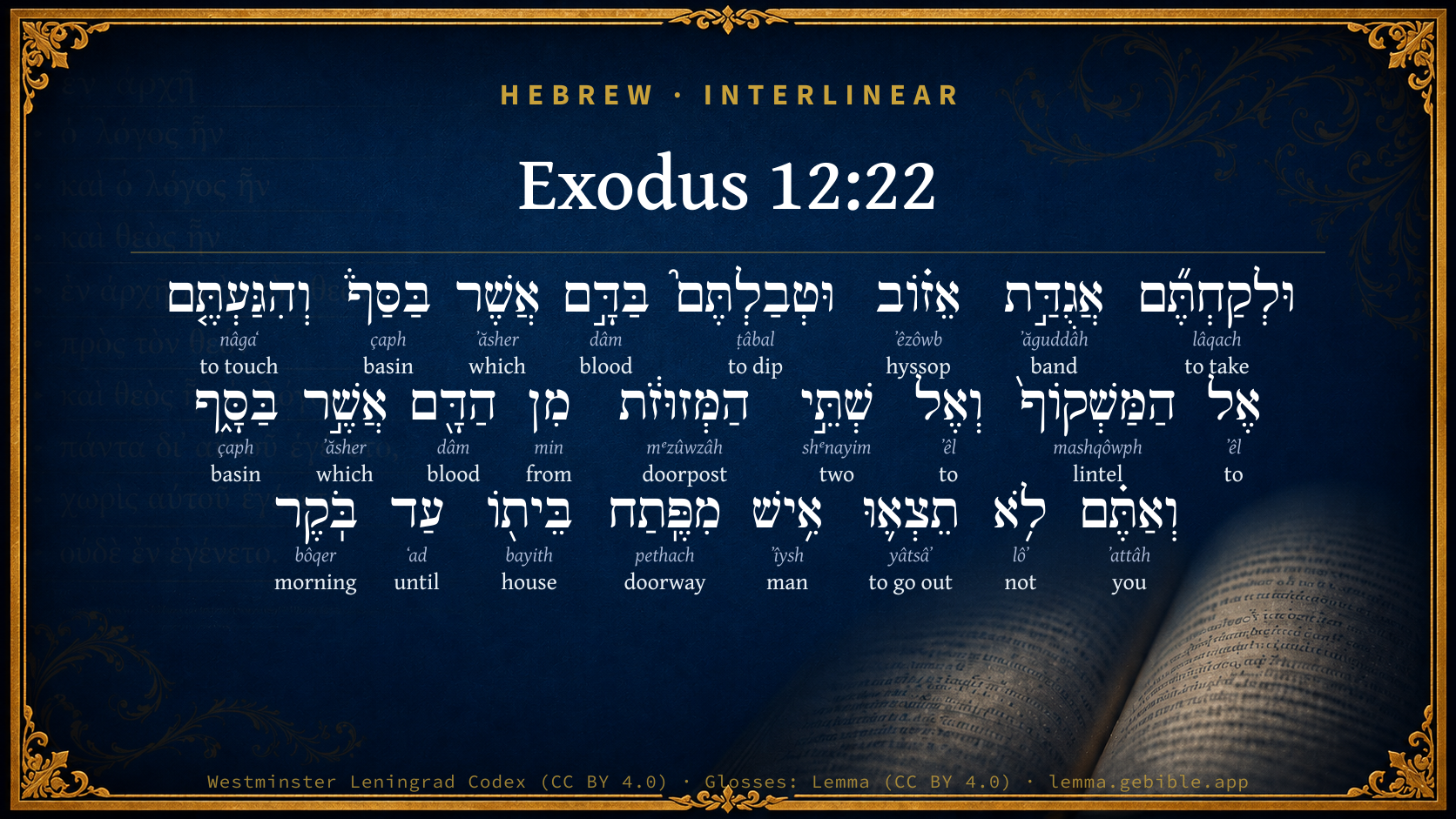
Exodus 12:22

Hebrew (Westminster Leningrad Codex) Exodus 12:22 appears in the Hebrew Old Testament. The text above is from the Westminster Leningrad Codex. Each word links to its Strong’s number, a concise gloss, and parsing drawn from the Open Scriptures Hebrew Bible morphology. Click any word for its full Brown-Driver-Briggs (BDB) entry.
Download image
Cite this verse

Exodus 12:22 (World English Bible). Public Domain. Lemma interlinear Bible study tool, https://lemma.gebible.app/v/exodus/12/22.

Show BibTeX & RIS
BibTeX
RIS
English Translation
You shall take a bunch of hyssop, and dip it in the blood that is in the basin, and strike the lintel and the two side-posts with the blood that is in the basin; and none of you shall go out of the door of his house until the morning.
World English Bible · Public Domain
Highlights
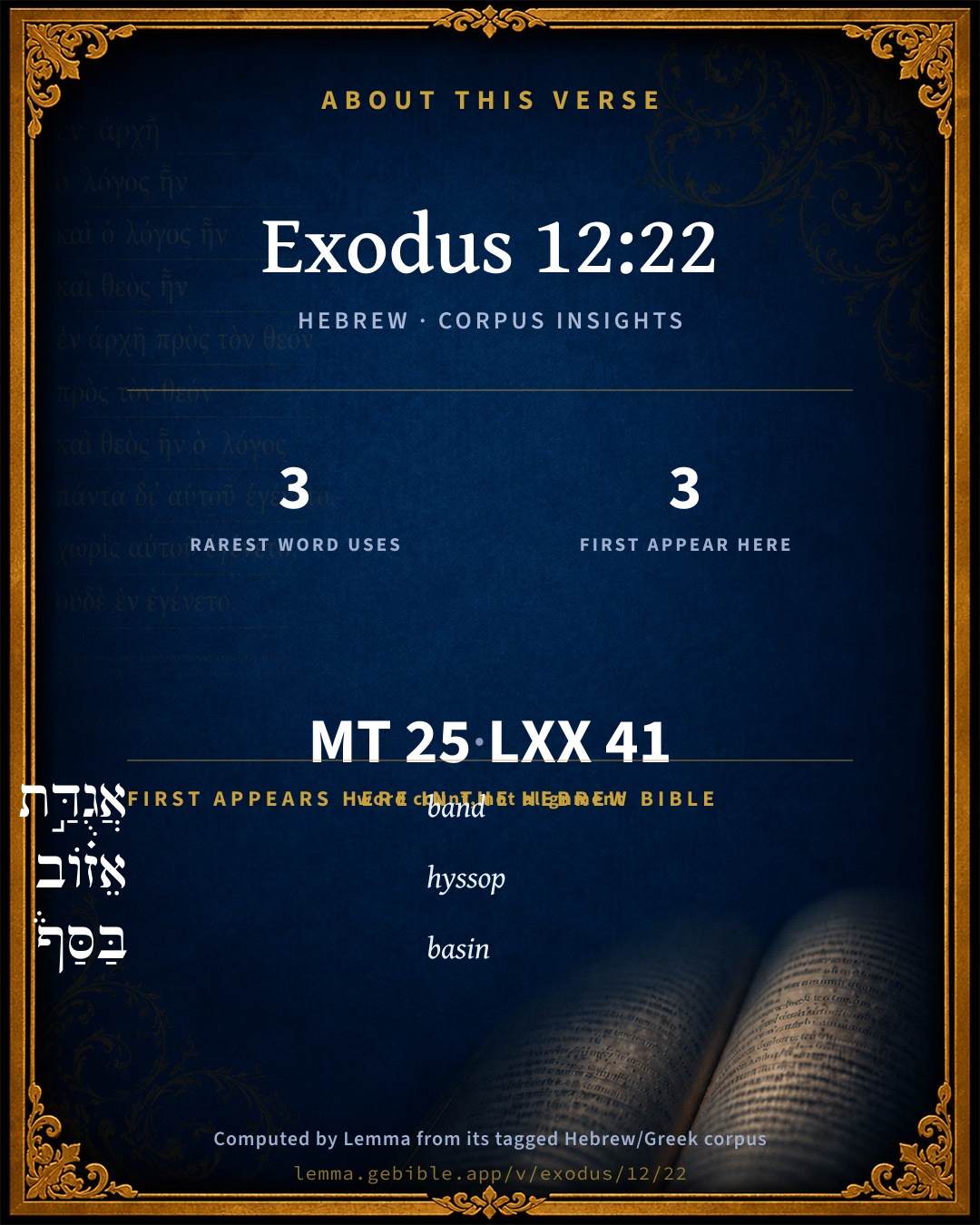
  • 3 first appearances in the Hebrew Bible
Full analysis ↓
Download a study sheet

One document with this verse’s original text, its word-by-word gloss line, the meaning frame, cross-references with their text, attributed commentary, and full source and license credits — printable, and it pastes into notes with its structure intact.

This verse Autodidact and up

Study sheet (.html) Plain text (.txt)

A passage Seminary Student

Up to 50 verses in one chapter. A passage sheet keeps up to 6 commentary sources and 12 cross-references per verse, in the order this page ranks them, and says so on the sheet whenever that leaves anything out. Ask for a single verse and you get the Autodidact verse sheet above.

Everything on this page stays free to read, with no account — the sheet is a download of what is already on screen, not access to it.

Want to remove ads? Support Godless Engineer
Compare translations 3

The same verse in 3 English versions, stacked beneath the original-language interlinear above. Click any original word for its lexicon entry.

Each is an independent rendering of the whole verse — the interlinear is not word-aligned to these translations.

Highlighted words mark where these versions differ — a whole-verse word diff, not a word-by-word alignment.

  • World English Bible Public Domain
    You shall take a bunch of hyssop, and dip it in the blood that is in the basin, and strike the lintel and the two side-posts with the blood that is in the basin; and none of you shall go out of the door of his house until the morning.
  • King James Version Public Domain
    And ye shall take a bunch of hyssop, and dip it in the blood that is in the basin, and strike the lintel and the two side posts with the blood that is in the basin; and none of you shall go out at the door of his house until the morning.
  • unfoldingWord Literal Text CC BY-SA 4.0
    And you shall take a bunch of hyssop, and dip it in the blood that is in the basin and apply to the lintel and to both the doorposts from the blood that is in the basin. And you, not a man shall go out from the door of his house until morning.

unfoldingWord Literal Text — © unfoldingWord, licensed CC BY-SA 4.0. Word-aligned USFM3 via Door43 (git.door43.org/unfoldingWord/en_ult).

Versions to compare (up to 4)

3 of 4 selected

Show all 18 translations

Every available English version of this verse, each an independent rendering of the whole verse.

  • World English Bible Public Domain
    You shall take a bunch of hyssop, and dip it in the blood that is in the basin, and strike the lintel and the two side-posts with the blood that is in the basin; and none of you shall go out of the door of his house until the morning.
  • Berean Standard Bible Public Domain
    Take a cluster of hyssop, dip it into the blood in the basin, and brush the blood on the top and sides of the doorframe. None of you shall go out the door of his house until morning.
  • Majority Standard Bible Public Domain
    Take a cluster of hyssop, dip it into the blood in the basin, and brush the blood on the top and sides of the doorframe. None of you shall go out the door of his house until morning.
  • King James Version Public Domain
    And ye shall take a bunch of hyssop, and dip it in the blood that is in the basin, and strike the lintel and the two side posts with the blood that is in the basin; and none of you shall go out at the door of his house until the morning.
  • American Standard Version (1901) Public Domain
    And ye shall take a bunch of hyssop, and dip it in the blood that is in the basin, and strike the lintel and the two side-posts with the blood that is in the basin; and none of you shall go out of the door of his house until the morning.
  • Revised Version (1885) Public Domain
    And ye shall take a bunch of hyssop, and dip it in the blood that is in the bason, and strike the lintel and the two side posts with the blood that is in the bason; and none of you shall go out of the door of his house until the morning.
  • Geneva Bible (1599) Public Domain
    And take a bunch of hyssop, and dip it in the blood that is in the basen, and strike the lintell, and the doore cheekes with the blood that is in the basen, and let none of you goe out at the doore of his house, vntill the morning.
  • Douay-Rheims (1899) Public Domain
    And dip a bunch of hyssop in the blood that is at the door, and sprinkle the transom of the door therewith, and both the door cheeks: let none of you go out of the door of his house till morning.
  • Young's Literal Translation Public Domain
    and ye have taken a bunch of hyssop, and have dipped `it' in the blood which `is' in the basin, and have struck `it' on the lintel, and on the two side-posts, from the blood which `is' in the basin, and ye, ye go not out each from the opening of his house till morning.
  • Literal Standard Version CC BY-SA 4.0
    and you have taken a bunch of hyssop, and have dipped [it] in the blood which [is] in the basin, and have struck [it] on the lintel, and on the two doorposts, from the blood which [is] in the basin, and you, you do not go out—each from the opening of his house—until morning.
  • Unlocked Literal Bible CC BY-SA 4.0
    Then take a bunch of hyssop and dip it in the blood that will be in a basin. Apply the blood in the basin to the top of the doorframe and the two doorposts. None of you is to go out of the door of his house until the morning.
  • unfoldingWord Literal Text CC BY-SA 4.0
    And you shall take a bunch of hyssop, and dip it in the blood that is in the basin and apply to the lintel and to both the doorposts from the blood that is in the basin. And you, not a man shall go out from the door of his house until morning.
  • Darby Bible Public Domain
    And take a bunch of hyssop, and dip [it] in the blood that is in the bason, and smear the lintel and the two door-posts with the blood that is in the bason; and none of you shall go out of the door of his house until the morning.
  • World Messianic Bible Public Domain
    You shall take a bunch of hyssop, and dip it in the blood that is in the basin, and strike the lintel and the two door posts with the blood that is in the basin. None of you shall go out of the door of his house until the morning.
  • Webster's Bible Public Domain
    And ye shall take a bunch of hyssop, and dip it in the blood that is in the basin, and strike the lintel and the two side-posts with the blood that is in the basin: and none of you shall go out at the door of his house till the morning.
  • Free Bible Version CC BY-SA 4.0
    Get a bunch of hyssop, dip it into the blood in the basin, and put some on the top and sides of the doorframe. None of you are to go out through door of the house until morning.
  • Bible in Basic English Public Domain
    And take some hyssop and put it in the blood in the basin, touching the two sides and the top of the doorway with the blood from the basin; and let not one of you go out of his house till the morning.
  • JPS Tanakh (1917) Public Domain
    And ye shall take a bunch of hyssop, and dip it in the blood that is in the basin, and strike the lintel and the two side-posts with the blood that is in the basin; and none of you shall go out of the door of his house until the morning.

Literal Standard Version (2020), Covenant Press — licensed CC BY-SA 4.0. Text via the HelloAO Bible API (eBible.org). Unlocked Literal Bible (unfoldingWord) — licensed CC BY-SA 4.0. Text via the HelloAO Bible API (eBible.org). unfoldingWord Literal Text — © unfoldingWord, licensed CC BY-SA 4.0. Word-aligned USFM3 via Door43 (git.door43.org/unfoldingWord/en_ult). Free Bible Version, Dr. Jonathan Gallagher — licensed CC BY-SA 4.0. Text via the HelloAO Bible API (eBible.org).

Word by word

More ways to search: Search by grammar → Find every occurrence → Compare this word →

Practice this passage: Drill this verse → Learn its vocabulary →

הַמַּשְׁקוֹף֙
mashqôwph
H4947
“the · lintel”
Particle, Definite Article + Noun, Common, Masculine, Singular, Absolute
Part of Speech
Particle + Noun
Type
Common
Gender
Masculine
Number
Singular
State
Absolute
Full BDB Definition

Origin: from H8259 in its original sense of overhanging

TWOT: 2458c

lintel (of door)
  1. וּלְקַחְתֶּ֞ם lâqach H3947 “and · to take” Conjunction + Verb, Qal, Sequential Perfect, 2nd Person, Masculine, Plural
  2. אֲגֻדַּ֣ת ʼăguddâh H92 “band of” Noun, Common, Feminine, Singular, Construct
  3. אֵז֗וֹב ʼêzôwb H231 “hyssop” Noun, Common, Masculine, Singular, Absolute
  4. וּטְבַלְתֶּם֮ ṭâbal H2881 “and · to dip” Conjunction + Verb, Qal, Sequential Perfect, 2nd Person, Masculine, Plural
  5. בַּדָּ֣ם dâm H1818 “in/at the · blood” Preposition, Determined + Noun, Common, Masculine, Singular, Absolute
  6. אֲשֶׁר ʼăsher H834 “which” Particle, Relative
  7. בַּסַּף֒ çaph H5592 “in/at the · basin” Preposition, Determined + Noun, Common, Masculine, Singular, Absolute
  8. וְהִגַּעְתֶּ֤ם nâgaʻ H5060 “and · to touch” Conjunction + Verb, Hiphil, Sequential Perfect, 2nd Person, Masculine, Plural
  9. אֶל ʼêl H413 “to” Preposition
  10. וְאֶל ʼêl H413 “and · to” Conjunction + Preposition
  11. שְׁתֵּ֣י shᵉnayim H8147 “two” Adjective, Cardinal number, Feminine, Dual, Construct
  12. הַמְּזוּזֹ֔ת mᵉzûwzâh H4201 “the · doorposts” Particle, Definite Article + Noun, Common, Feminine, Plural, Absolute
  13. מִן min H4480 “from” Preposition
  14. הַדָּ֖ם dâm H1818 “the · blood” Particle, Definite Article + Noun, Common, Masculine, Singular, Absolute
  15. אֲשֶׁ֣ר ʼăsher H834 “which” Particle, Relative
  16. בַּסָּ֑ף çaph H5592 “in/at the · basin” Preposition, Determined + Noun, Common, Masculine, Singular, Absolute
  17. וְאַתֶּ֗ם ʼattâh H859 “and · you” Conjunction + Pronoun, Personal, 2nd Person, Masculine, Plural
  18. לֹ֥א lôʼ H3808 “not” Particle, Negative
  19. תֵצְא֛וּ yâtsâʼ H3318 “to go out” Verb, Qal, Imperfect, 2nd Person, Masculine, Plural
  20. אִ֥ישׁ ʼîysh H376 “man” Noun, Common, Masculine, Singular, Absolute
  21. מִפֶּֽתַח pethach H6607 “from · doorway of” Preposition + Noun, Common, Masculine, Singular, Construct
  22. בֵּית֖וֹ bayith H1004 “house · his” Noun, Common, Masculine, Singular, Construct + Suffix, Personal, 3rd Person, Masculine, Singular
  23. עַד ʻad H5704 “until” Preposition
  24. בֹּֽקֶר bôqer H1242 “morning” Noun, Common, Masculine, Singular, Absolute

About this verse

These counts appear in no published source. They are computed here, from the morphology-tagged text and Lemma’s own curated glosses. What Lemma adds →

25
words
21
distinct lemmas
Pentateuch
section

Notable vocabulary

The rarest word here is הַמַּשְׁקוֹף֙ lintel H4947 — appearing just 3 times in the whole Hebrew Bible.

First appearance in Scripture

These words make their first canonical appearance in the Hebrew Bible here:

  • אֲגֻדַּ֣ת band H92
  • אֵז֗וֹב hyssop H231
  • בַּסַּף֒ basin H5592

Shared distinctive vocabulary

הַמַּשְׁקוֹף֙ lintel H4947 occurs in 3 verses of the Hebrew Bible. Also found in:

Grammatical profile

  • 4 verbs
  • 12 nouns
  • 1 adjective
  • 1 pronoun
  • 4 prepositions
  • 3 particles

Verb forms

  • וּלְקַחְתֶּ֞ם Qal · Sequential Perfect
  • וּטְבַלְתֶּם֮ Qal · Sequential Perfect
  • וְהִגַּעְתֶּ֤ם Hiphil · Sequential Perfect
  • תֵצְא֛וּ Qal · Imperfect

Repetition

Words recur within this verse — often emphatic in Hebrew:

  • בַּדָּ֣ם blood H1818 ×2
  • בַּסַּף֒ basin H5592 ×2
  • אֲשֶׁר which H834 ×2
  • אֶל to H413 ×2

Hebrew & Septuagint length

In English translation the verse runs 50 words from the Hebrew and 60 from the Septuagint (LXX English) — closely comparable.

A rough comparison of the two English renderings, which tokenize alike — not a word-level alignment.

Word counts can differ between the Hebrew and the Greek without any difference in meaning — e.g. the Hebrew direct-object marker אֵת has no separate Greek word, and Greek often adds the article ὁ.

In the original languages it is 25 Hebrew tokens and 41 Greek tokens — but the two are counted differently (Hebrew bundles its prefixes and suffixes into one token; the Greek is in lemma form), so that isn’t a like-for-like length.

Cross-references

11

Topical passages linked to Exodus 12:22 in the Treasury of Scripture Knowledge — connected by theme and wording, ordered by reader-vote popularity; previews shown in the World English Bible.

  • Hebrews 11:28 By faith, he kept the Passover, and the sprinkling of the blood, that the destroyer of the firstborn should not touch them.
  • Exodus 12:7 They shall take some of the blood, and put it on the two side-posts and on the lintel, on the houses in which they shall eat it.
  • Numbers 19:18 and a clean person shall take hyssop, and dip it in the water, and sprinkle it on the tent, and on all the vessels, and on the persons who were there, and on him who touched the bone, or the slain, or the dead, or the grave:
  • Psalms 51:7 Purify me with hyssop, and I will be clean. Wash me, and I will be whiter than snow.
  • Hebrews 9:1 Now indeed even the first covenant had ordinances of divine service, and an earthly sanctuary.
  • Hebrews 9:14 how much more will the blood of Christ, who through the eternal Spirit offered himself without blemish to God, cleanse your conscience from dead works to serve the living God?
  • Hebrews 9:19 For when every commandment had been spoken by Moses to all the people according to the law, he took the blood of the calves and the goats, with water and scarlet wool and hyssop, and sprinkled both the book itself and all the people,
  • Leviticus 14:6–7 As for the living bird, he shall take it, and the cedar wood, and the scarlet, and the hyssop, and shall dip them and the living bird in the blood of the bird that was killed over the running water.
  • Matthew 26:30 When they had sung a hymn, they went out to the Mount of Olives.
  • Hebrews 12:24 to Jesus, the mediator of a new covenant, and to the blood of sprinkling that speaks better than that of Abel.
  • 1 Peter 1:2 according to the foreknowledge of God the Father, in sanctification of the Spirit, that you may obey Jesus Christ and be sprinkled in his blood: Grace to you and peace be multiplied.

Cross-references courtesy of OpenBible.info (CC BY 4.0).

Hebrew and Greek witnesses Masoretic Hebrew ↔ Greek Septuagint

The same verse in the two great witnesses to the Old Testament, shown verse-for-verse.

These are two independent witnesses, not word-aligned to each other, and the Septuagint is shown in lemma (dictionary) form.

Hebrew Exodus 12:22 Masoretic · Westminster Leningrad Codex

וּלְקַחְתֶּ֞ם אֲגֻדַּ֣ת אֵז֗וֹב וּטְבַלְתֶּם֮ בַּדָּ֣ם אֲשֶׁר בַּסַּף֒ וְהִגַּעְתֶּ֤ם אֶל הַמַּשְׁקוֹף֙ וְאֶל שְׁתֵּ֣י הַמְּזוּזֹ֔ת מִן הַדָּ֖ם אֲשֶׁ֣ר בַּסָּ֑ף וְאַתֶּ֗ם לֹ֥א תֵצְא֛וּ אִ֥ישׁ מִפֶּֽתַח בֵּית֖וֹ עַד בֹּֽקֶר

You shall take a bunch of hyssop, and dip it in the blood that is in the basin, and strike the lintel and the two side-posts with the blood that is in the basin; and none of you shall go out of the door of his house until the morning.

World English Bible · Public Domain

Greek LXX Exodus 12:22 Septuagint · lemma form

λαμβάνω δέ δέσμη ὕσσοπος καί βάπτω ἀπό ὁ αἷμα ὁ παρά ὁ θύρα καθίγω ὁ φλιά καί ἐπί ἀμφότεροι ὁ σταθμός ἀπό ὁ αἷμα ὅς εἰμί παρά ὁ θύρα σύ δέ οὐ ἐκἔρχομαι ἕκαστος ὁ θύρα ὁ οἶκος αὐτός ἕως πρωΐ

And you⌃ shall take a bunch of hyssop, and having dipped it into some of the blood that is by the door, you⌃ shall touch the lintel, and shall put it upon both door-posts, even of the blood which is by the door; but you⌃ shall not go out every one from the door of his house till the morning.

LXX2012 (modern English Septuagint) · Public Domain

On this verse, Ellicott's Commentary for English Readers discusses the Septuagint’s reading. Read the note in Commentary ↓

Hebrew: Westminster Leningrad Codex (CC BY 4.0). Greek: Septuagint (public domain); English from LXX2012 (modern English Septuagint) (Public Domain). How the Septuagint differs from the Hebrew →

Targum (Aramaic paraphrase)

2

The Targum is the ancient Jewish Aramaic paraphrase of the Hebrew Scriptures — an interpretive translation, not the Hebrew text itself. Onkelos (literal) and Pseudo-Jonathan (expansive) render the Torah, and Jonathan the Prophets. Coverage is partial: where no permissively-licensed English translation exists for a verse, only the Aramaic is shown. This is verse-level text, not a word-by-word alignment to the Hebrew.

  1. Targum Onkelos Torah (Genesis–Deuteronomy)
    וְתִסְבּוּן אֱסָרַת אֵזוֹבָא וְתִטְבְּלוּן בִּדְמָא דִבְמָנָא וְתַדוּן לְשַׁקְפָא וְלִתְרֵין סִפַּיָא מִן דְמָא דִבְמָנָא וְאַתּוּן לָא תִפְּקוּן אֱנַשׁ מִתְּרַע בֵּיתֵהּ עַד צַפְרָא:

    (no public-domain English translation for this verse)

    Targum Onkelos — Aramaic: “Onkelos Genesis” (public domain); “Onkelos Exodus” (public domain); “Onkelos Leviticus” (public domain); “Onkelos Numbers” (public domain); “Onkelos Deuteronomy” (public domain). English: “Sefaria Community Translation” (CC0 1.0 (public-domain dedication)); “J.W. Etheridge. The Targums of Onkelos and Jonathan Ben Uzziel on the Pentateuch. London: Longmans, Green, 1862” (public domain). Text via Sefaria.

  2. Targum Pseudo-Jonathan Torah (Genesis–Deuteronomy)
    וְתִסְבוּן אֵיסָרַת אֵזוֹבָא וְתִטְמְשׁוּן בְּדָמָא דִבְמַן פַּחֲרָא וְתַדוּן לְאִיסְקוֹפָא עִלָּאָה מִלְּבַר וּלְתַרְתֵּין סִפַּיָא מִן דְּמָא דִבְמַן פַּחֲרָא וְאַתּוּן לָא תִפְקוּן אֱנַשׁ מִן תְּרַע בֵּיתֵיהּ עַד צַפְרָא

    And you shall take a bunch of hyssop, and dip it in the blood that is in the earthen vessel, and upon the upper bar without and upon the two posts you shall sprinkle of the blood which is in the earthen vessel, and not a man of you must come forth from the door of his hour till the morning.

    Targum Pseudo-Jonathan — Aramaic: “Targum Jonathan on Genesis” (public domain); “Targum Jonathan on Exodus” (public domain); “Targum Jonathan on Leviticus” (public domain); “Targum Jonathan on Numbers” (public domain); “Targum Jonathan on Deuteronomy” (public domain). English: “The Targum of Jonathan ben Uzziel, trans. J. W. Etheridge, London, 1862” (public domain). Text via Sefaria.

Commentary

Notes on Exodus 12:22 from classic Christian and Jewish commentators (each source and its license shown beneath its notes). The classic Christian expositions comment on the surrounding passage and are grouped to its opening verse, so a note may address several verses; the Jewish commentaries on the Tanakh (Rashi and others) are per-verse, so they appear only where the commentator wrote on this verse.

Lemma curates 59 commentaries, every one of them public domain or Creative Commons licensed, each selected and text-cleaned for this edition rather than reprinted as found. About our sources →

Trapp's Complete Commentary

John Trapp

Exo 12:22 And ye shall take a bunch of hyssop, and dip [it] in the blood that [is] in the bason, and strike the lintel and the two side posts with the blood that [is] in the bason; and none of you shall go out at the door of his house until the morning.

Ver. 22. A bunch of hyssop.] A herb of a purging property. See 1Co 6:11.

The blood that is in the bason.] The remembrance of Christ’s bloody passion must be kept fresh in our hearts. {a}

Strike the lintel.] Profess Christ crucified; honour him by a holy conversation; mind trim in your outgoings and incomings.

None of you shall go out.] Be not "of those that withdraw to perdition, but of them that believe to the salvation of the soul." {Heb 10:39} Mingle no more with the Egyptians.

{a} Tam recens mihi nunc Christus, ac si hac hora fudisset sanguinem. - Luth.

John Trapp, A Commentary or Exposition upon All the Books of the Old and New Testament (1647–1656) — public domain. Text from a community e-Sword module.

Joseph Benson's Commentary

Exo 12:22. Out of the door of his house — Of that house wherein he ate the passover: until the morning — That is, till toward the morning, when they would be called for to march out of Egypt; for they went forth very early in the morning. This command was peculiar to the first passover.

Joseph Benson's Commentary on the Old and New Testaments (1811–1818) — public domain. Text from a community e-Sword module.

Tyndale Open Study Notes

Tyndale Open Resources

12:22 Hyssop is a small bush with stiff, compact branches that can serve as a brush (see also Ps 51:7 and study note).

Tyndale Open Study Notes — © Tyndale Open Resources, licensed CC BY-SA 4.0. Text via the HelloAO Bible API.

Geneva Bible (1599)

Geneva Bible translators

Or, two side posts.

Heb. 21:28

Or, transom, or upper door post.

Geneva Bible (1599) marginal notes — public domain. Text via Bolls.life.

Jamieson, Fausset & Brown

Robert Jamieson, A. R. Fausset & David Brown

hyssop--a small red moss [HASSELQUIST]; the caper-plant [ROYLE]. It was used in the sprinkling, being well adapted for such purposes, as it grows in bushes--putting out plenty of suckers from a single root. And it is remarkable that it was ordained in the arrangements of an all-wise Providence that the Roman soldiers should undesignedly, on their part, make use of this symbolical plant to Christ when, as our Passover, He was sacrificed for us [Joh 19:29].

none . . . shall go out at the door of his house until the morning--This regulation was peculiar to the first celebration, and intended, as some think, to prevent any suspicion attaching to them of being agents in the impending destruction of the Egyptians; there is an allusion to it (Isa 26:20).

Jamieson, Fausset & Brown — Commentary Critical and Explanatory on the Whole Bible (1871) — public domain (CC PDM 1.0). Text via the HelloAO Bible API.

Adam Clarke's Commentary

Verse 22. A bunch of hyssop] The original word אזוב ezob has been variously translated musk, rosemary, polypody of the wall, mint, origanum, marjoram, and HYSSOP: the latter seems to be the most proper. Parkhurst says it is named from its detersive and cleansing qualities, whence it was used in sprinkling the blood of the paschal lamb, in cleansing the leprosy, Le 14:4; Le 14:6; Le 14:51-52; in composing the water of purification, Nu 19:6, and sprinkling it, Nu 19:18. It was a type of the purifying virtue of the bitter sufferings of Christ. And it is plain, from Ps 51:7, that the psalmist understood its meaning. Among botanists hyssop is described as "a genus of the gymnospermia (naked-seeded) order, belonging to the didynamia class of plants. It has under-shrubby, low, bushy stalks, growing a foot and a half high, small, spear-shaped, close-sitting, opposite leaves, with several smaller ones rising from the same joint; and all the stalks and branches terminated by erect whorled spikes of flowers of different colours, in the varieties of the plant. The leaves have an aromatic smell, and a warm pungent taste. The leaves of this plant are particularly recommended in humoral asthmas, and other disorders of the breast and lungs, and greatly promote expectoration." Its medicinal qualities were probably the reason why this plant was so particularly recommended in the Scriptures.

Adam Clarke's Commentary on the Bible (1810–1826) — public domain. Text from a community e-Sword/MySword module.

Ellicott's Commentary for English Readers

(22) A bunch of hyssop.—The “hyssop” (êzob) of the Old Testament is probably the caper plant, called now asaf, or asuf, by the Arabs, which grows plentifully in the Sinaitic region (Stanley: Sinai and Palestine, p. 21), and is well adapted for the purpose here spoken of. It was regarded as having purifying properties (Lev_14:4; Lev_14:49-52; Num_19:6; Psa_51:7), and was therefore suitable for sprinkling the blood of expiation.

In the bason.—The word translated “bason” has another meaning also, viz., “threshold;” and this meaning was preferred in the present place both by the LXX. and by Jerome. Whichever translation we adopt, there is a difficulty in the occurrence of the article, since neither the threshold nor any bason had been mentioned previously. Perhaps Moses assumed that whenever a victim was offered, the blood had to be caught in a bason, and therefore spoke of “the bason” as something familiar to his hearers in this connection. If the lamb had been sacrificed on the threshold, it would scarcely have been necessary to put the blood on the lintel and doorposts also.

None of you shall go out.—Moses seems to have given this command by his own authority, without any positive Divine direction. He understood that the Atoning blood was the sole protection from the destroying angel, and that outside the portal sprinkled with it was no safety.

A Bible Commentary for English Readers, edited by Charles John Ellicott (1878–1897) — public domain. Text from a community e-Sword module.

The Cambridge Bible for Schools and Colleges

gen. ed. J. J. S. Perowne

22. hyssop] A small plant, growing out of walls (1Ki_4:33), a wisp of which was well adapted for sprinkling, and is accordingly prescribed to be used in various purificatory rites (Lev_14:4; Lev_14:6; Lev_14:49-51, Num_19:6; Num_19:18 [Heb_9:19]: cf. Psa_51:7). What plant the ‘hyssop’ is, is, however, disputed; but it is in any case not our hyssop (Hyssopus officinalis, Linn.), which is not a native of Palestine. Saadiah (10 cent.) rendered by ṣa‘tar, i.e. some species of satureia, or (as Kimchi explains) origanum, marjoram; so also Abul-Walid, Maimonides, Kimchi; and this explanation is adopted by Ges., Di., and others. The Pesh. zupha also means the same plant (Löw, Aram. Pflanzennamen, No. 93)1[129]. Post (DB. s.v.) thinks that the particular species meant is the Origanum Maru, Linn. This grows in clefts of rocks, in chinks of old walls, and on the terrace walls throughout Palestine: it has straight, slender, leafy stalks, with small heads, several of the stalks growing from one root, so that a bunch or wisp suitable for sprinkling a liquid with could readily be broken off. Tristram (NHB. 456 ff.) argues in favour of the Caper (Capparis spinosa), a bright green creeper, which climbs out of fissures of rocks in the Sinaitic valleys, and hangs in abundance from the walls of Jerusalem, and the stalks of which, bearing from three to five blossoms each, would likewise be suitable for the same purpose; but the former interpretation has very strong support in ancient tradition, and there appears to be no sufficient reason for deserting it1[130].

[129] In the Talm. (Shabb. 109b), also, the Heb. ’çzôb is identified with the Arab. sumsaḳ, or marjoram.

[130] The Arab. ’aṣaf, which Tristram (NHB. 457) quotes in support of the caper, does not correspond phonetically to the Heb. ’çzôb. In support of marjoram, see esp. Löw’s learned discussion in the Sitzungsberichte of the Vienna Academy (phil. and hist. Classe), 1909, Abh. III.

Joh_19:29 ὑσσώπῳ περιθέντες (where Mat_27:48 = Mar_15:36 have περιθεὶς καλάμῳ) does not seem to have any bearing on the question which plant is meant. Different traditions may have been current; or the term ‘reed’ may have been used widely to denote the stalk of either marjoram, which may reach to 3 ft. (Löw, p. 16), or the caper.

strike the lintel … with, &c.] rather, apply some of the blood to (lit. make it draw near to or touch, as Exo_4:25) the lintel &c.

and none of you, &c.] So as to enjoy the protection of the house sprinkled with the blood. A direction not contained in vv. 1–13.

door] Heb. entrance (lit. opening). So v. 23, Exo_26:36, and often.

The Cambridge Bible for Schools and Colleges (gen. ed. J. J. S. Perowne; Cambridge University Press, 1878–1918) — public domain. Text from a community e-Sword module.

John Gill's Exposition

And ye shall take a bunch of hyssop,.... Which some take to be "mint", others "origanum" or "marjoram", as Kimchi (s), others "rosemary", as Piscator, Rivet, and many more; and indeed this seems to be fitter to strike or sprinkle with than hyssop; but it is more generally understood of hyssop, because the Hebrew word "ezob" is so near in sound to it; though whether it means the same herb we call hyssop is uncertain: Jarchi says, three stalks of it are called a bunch, and so the Misnic canon runs (t),"the command concerning hyssop is three stalks (which Maimonides on the place interprets roots), and in them three branches;''which some have allegorically applied to the Trinity, by whom the hearts of God's people are sprinkled with the blood of the true paschal Lamb, and are purged from dead works: the Heathens in their sacrifices used sometimes branches of laurel, and sometimes branches of the olive, to sprinkle with (u):

and dip it in the blood that is in the basin: which, according to the Targum of Jonathan, was an earthen vessel, into which the blood of the lamb was received when slain, and into this the bunch of hyssop was dipped; so it was usual with the Heathens to receive the blood of the sacrifice in cups or basins (x): the blood being received into a basin, and not spilled on the ground and trampled on, may denote the preciousness of the blood of Christ, the true passover lamb, which is for its worth and excellent efficacy to be highly prized and esteemed, and not to be counted as a common or unholy thing; and the dipping the bunch of hyssop into the blood of the lamb may signify the exercise of faith on the blood of Christ, which is a low and humble grace, excludes boasting in the creature, deals alone with the blood of Jesus for peace, pardon, and cleansing, and by which the heart is purified, as it deals with that blood:

and strike the lintel and the two side posts with the blood that is in the basin: an emblem of the sprinkling of the hearts and consciences of believers with the blood of Christ, and cleansing them from all sin by it:

and none of you shall go out at the door of his house until the morning; that they might not be in the way of the destroyer; and though the destroying angel knew an Israelite from an Egyptian, yet this was to be the ordinance of protection to them, abiding in their houses, marked with the blood of the passover lamb; signifying that their safety was in their being under that blood, as the safety of believers lies in their being justified by the blood of Christ; for to that it is owing that they are saved from wrath to come: this is the purple covering under which they pass safely through this world to the heavenly glory, Rom 5:9, this circumstance was peculiar to the passover in Egypt; in later times there was not the like danger.

(s) Sepher Shorash, rad. (t) Misn. Parah, c. 11. sect. 9. (u) Vid. Kipping. Rom. Antiqu. p. 241. Virgil Aeneid. 6. Ovid. Fast. l. 5. (x) "-------------tepidumque cruorem Succipiunt pateris----------" Virgil. Aeneid. 6.

John Gill's Exposition of the Whole Bible (1746–1763) — public domain (CC PDM 1.0). Text via the HelloAO Bible API.

Albert Barnes' Notes on the Bible

A bunch of hyssop - The species here designated does not appear to be the plant now bearing the name. It would seem to have been an aromatic plant, common in Palestine and near Mount Sinai, with a long straight stalk and leaves well adapted for the purpose of sprinkling.

Bason - The rendering rests on good authority and gives a good sense: but the word means “threshold” in some other passages and in Egyptian, and is taken here in that sense by some versions. If that rendering be correct it would imply that the lamb was slain on the threshold.

None ... shall go out ... - There would be no safety outside the precincts protected by the blood of the lamb; a symbolism explained by the margin reference.

Albert Barnes' Notes on the Bible (1834–1885) — public domain. Text from a community e-Sword/MySword module.

Haydock's Catholic Bible Commentary

Hyssop; Hebrew ezob: which some translate rosemary. (Menochius) --- Sprinkle, &c. This sprinkling the doors of the Israelites with the blood of the paschal lamb, in order to their being delivered from the sword of the destroying angel, was a lively figure of our redemption by the blood of Christ. (Challoner) --- St. Jerome, in Isaias lxvi, says the doors were to be sprinkled in the form of a cross.

George Leo Haydock (1774–1849), Haydock's Catholic Family Bible and Commentary, 1859 edition — public domain. Excludes Psalms (Douay-Rheims chapter numbering differs from Protestant) and Deuterocanonical books (Catholic canon only).

Matthew Poole's English Annotations

A bunch of hyssop; so the Hebrew word is rightly rendered, as appears from Heb 9:19.

The door of his house, i.e. of the house wherein he did eat the passover, which ofttimes was his neighbour’s house: see Exo 12:4.

Until the morning; till the beginning of the morning after midnight, and after the slaughter of the Egyptians’ first-born; which may reconcile those scriptures that seem to contradict one another, while some affirm they went out of Egypt by night, and others by day, for they went out in the morning very early when it was yet dark, as it is expressed in a like case, Joh 20:1.

Matthew Poole's English Annotations on the Holy Bible (1683–1685) — public domain. Text from a community e-Sword/MySword module.

Whedon's Commentary on the Bible

Daniel D. Whedon

22, 23. Hyssop — This has not been mentioned before. The hyssop included several species of herb, but that used in Egypt was, according to Kimchi and Maimonides, wild marjoram, an aromatic plant and condiment much used by the poorer classes in Egypt for food.

None of you shall go out at the door — Only within the blood-besprinkled door was safety.

The destroyer — Whether angel or pestilence, could not pass the line drawn in blood. Each sanctuary home in Israel was thus made a symbol of the fold whereof Christ is the door, and only behind hiswounds can sinful man be safe from the destroyer.

Daniel D. Whedon (gen. ed.), Commentary on the Old and New Testaments (1874–1909) — public domain. Text from a community e-Sword module.

The Pulpit Commentary

A bunch of hyssop. The hyssop was regarded as having purging or purifying qualities, and was used in the cleansing of the leper, (Lev_14:4) and of the leprous house (ibid. 51-52), and also formed an element in the "water of separation". (Num_19:6) It was a species of plant which grew on walls, and was generally low and insignificant, (1Ki_4:33) yet which could furnish a stick or stalk of some length. (Joh_19:29) It must also have been a common plant in Egypt, the wilderness, and Palestine. Two suggestions are made with respect to it. One, that it was a species of marjoram (Origanum Aegyptiacum, or O. Syriacum) common in both Egypt and Syria; the other that it was the caper plant (Capparis spinosa), which abounds especially in the Desert. (Stanley, Sinai and Palestine, p. 21.) It is in favour of this latter identification, that the modern Arabic name for the caper plant is asaf or asuf, which excellently represents the Hebrew ezob, the word uniformly rendered in our version by "hyssop" The blood that is in the basin. The Septuagint and Vulgate render is on the threshold. " Saph the word translated "basin" has the double meaning. None of you shall go out. Moses may well have given this advice on his own authority, without any Divine command. (See introductory paragraph.) He would feel that beyond the protection of the blood of the lamb, there was no assurance of safety.

HOMILETICS Ver. 22. No safety for man beyond the limits protected by the Lamb"s atoning blood.

No Israelite was to pass beyond the door of his house until the morning, lest he should be destroyed by the destroyer. Within the precincts, protected by the blood of the lamb, he was safe. Let Christians beware of stepping beyond the limits whereto the atoning blood extends. Those step beyond the limits

I WHO TEMPT GOD BY DALLYING WITH SIN. Atonement has been made for us, we feel We have had moments of assurance that atonement and forgiveness are ours. We have had an impression that we were safe. At once the Evil One begins to whisper to our hearts that there is no longer any need of our walking warily, of our being afraid to put ourselves in temptation"s way, of our flying all contact with evil; and we are too apt to listen to his suggestions, to regard the danger of falling from grace as past, and to allow ourselves a liberty in which there is too often awful peril. We draw near the confines of sin, confident that we shall sin no more; and lo! we are entangled in the meshes. And why? Because we have gone beyond the limits protected by the atoning blood. We have opened the door and stepped out. We have turned our backs upon the redeeming marks and put them behind us. We have been over-trustful in our own strength.

II WHO ARE PUFFED UP BY THE THOUGHT OF THEIR SPIRITUAL ATTAINMENTS AND PRIVILEGES. "Pride goeth before a fall." Pride was the great temptation of the Jew, who felt himself one of God"s peculiar people, to whom pertained "the adoption, and the glory, and the covenants, and the giving of the law, and the service of God, and the promises". (Rom_9:4) And pride often tempts the Christian, who has realised the work of Christ on his behalf, and the greatness of the salvation wrought for him. But pride is one of the deadly sins, and at once severs the soul from Christ. The blood of the covenant does not extend its protection over the paths which are trodden by the foot of pride. He who enters on them has wandered beyond the door which bears the redemption-marks, and is open to the assaults of the destroyer.

III WHO FOLD THEIR HANDS AND CEASE TO BE ZEALOUS OF GOOD WORKS, AS THOUGH THEY HAD ALREADY ATTAINED. Though we cannot, by anything that we can do, merit our own salvation, or redeem ourselves or others, (Psa_49:7) yet God will have us "work while it is day," and the atoning blood of Christ atones for those only who are "careful to maintain good works". (Tit_3:8) Idleness, apathy, sloth, are contrary to his will and his word; and the man who indulges in them has strayed beyond the prescribed limits and lost the needful protection. Well for him if he discovers his mistake in time to return, and, 6 do again the first works", (Rev_2:5) and so regain the lost shelter! It is needless to say that the atoning blood can avail none who

(1) reject the atonement; or,

(2) despise it, by giving it no thought; or,

(3) trample it under foot by leading an immoral and ungodly life. These are as far removed from its protection as were the Egyptians.

The Pulpit Commentary (1880–1919), ed. H.D.M. Spence-Jones & Joseph S. Exell — public domain. Text from a community e-Sword module.

John Wesley's Explanatory Notes

Out of the door of his house - Of that house, wherein he ate the passover: Until the morning - That is, till towards morning, when they would be called for to march out of Egypt. They went out very early in the morning.

John Wesley, Explanatory Notes Upon the Whole Bible (1754–1765) — public domain. Text via the GEBible commentary corpus.

Rashi

Rabbi Shlomo Yitzchaki (Rashi)

אזוב HYSSOP — a kind of herb which has thin stalks.

אגדת אזוב A BUNCH OF HYSSOP — three stalks are called a bunch (cf. Shabbat 109b; Sukkah 13a).

אשר בסף means WHICH IS IN THE VESSEL, as in (2 Kings 12:14) “basins (ספות) of silver.”

מן הדם אשר בסף WITH THE BLOOD WHICH IS IN THE BASIN — Why does Scripture repeat this (אשר בסף) again? In order that you should not say that one dipping of the hyssop in the basin suffices for the three sprinklings, therefore it is again stated: “[you shall touch the lintel…] “with the blood that is in the basin”, to show that each separate sprinkling must be with the blood which is in the basin — for each touching of the lintel and doorposts there must be a separate dipping (Mekhilta).

ואתם לא תצאו וגו׳ AND NONE OF YOU SHALL GO OUT etc. — This tells us that when once permission is given to the destroying angel to wound he makes no distinction between righteous and wicked (Mekhilta) — and nighttime is the domain of the destroying agencies as it is said, (Psalms 104:20) “[Thou makest darkness and it is night], wherein all the beasts of the forest creep forth”.

Rashi on the Tanakh — English translations: “The Judaica Press complete Tanach with Rashi, translated by A. J. Rosenberg” (CC BY 4.0); “Pentateuch with Rashi's commentary by M. Rosenbaum and A.M. Silbermann, 1929-1934” (public domain); “The Metsudah Tanach series, Lakewood, N.J” (CC BY 4.0); and “The Book of Joshua, Metsudah Publications, 1997” (CC BY 4.0). Text via Sefaria.

Lesson kit

Teaching starters — assembled from the data on this page, not authored interpretation. Every prompt links to the verse data it draws on. Edit before teaching.

Exodus, in the Pentateuch, opens this verse with 25 words (21 distinct Hebrew lemmas). Its most distinctive word is mashqôwph (“lintel”). A historical commentator’s framing appears above. Read the whole chapter for the surrounding context.

Discussion questions

  1. How does “lintel” (mashqôwph) shape what this verse is saying?
  2. 3 words make their first appearance in Scripture here. What does this debut establish?
  3. How does Exodus 12:7, which shares the word «lintel», read alongside this verse?
  4. What does the repetition of “blood” (2× in this one verse) do in this verse?
  5. These translations render this verse differently. What is at stake in choosing one wording over another?
  6. «וּלְקַחְתֶּ֞ם» is a Qal Sequential Perfect verb. How does that grammatical form shape the action described?
  7. Compare how Trapp's Complete Commentary and Joseph Benson's Commentary read this verse. Where do they agree or differ?

Things to notice

Reading settings

Reading text

Shown beneath each verse's original-language words.

Old Testament
Old Testament edition

Read the OT as the Masoretic Hebrew (MT) or the Greek Septuagint (LXX).

English shown for the Greek Septuagint (in the Hebrew ↔ Greek comparison).

Comparing translations? Open the Compare panel on any verse page to stack up to four side by side.