
Deuteronomy 3:11

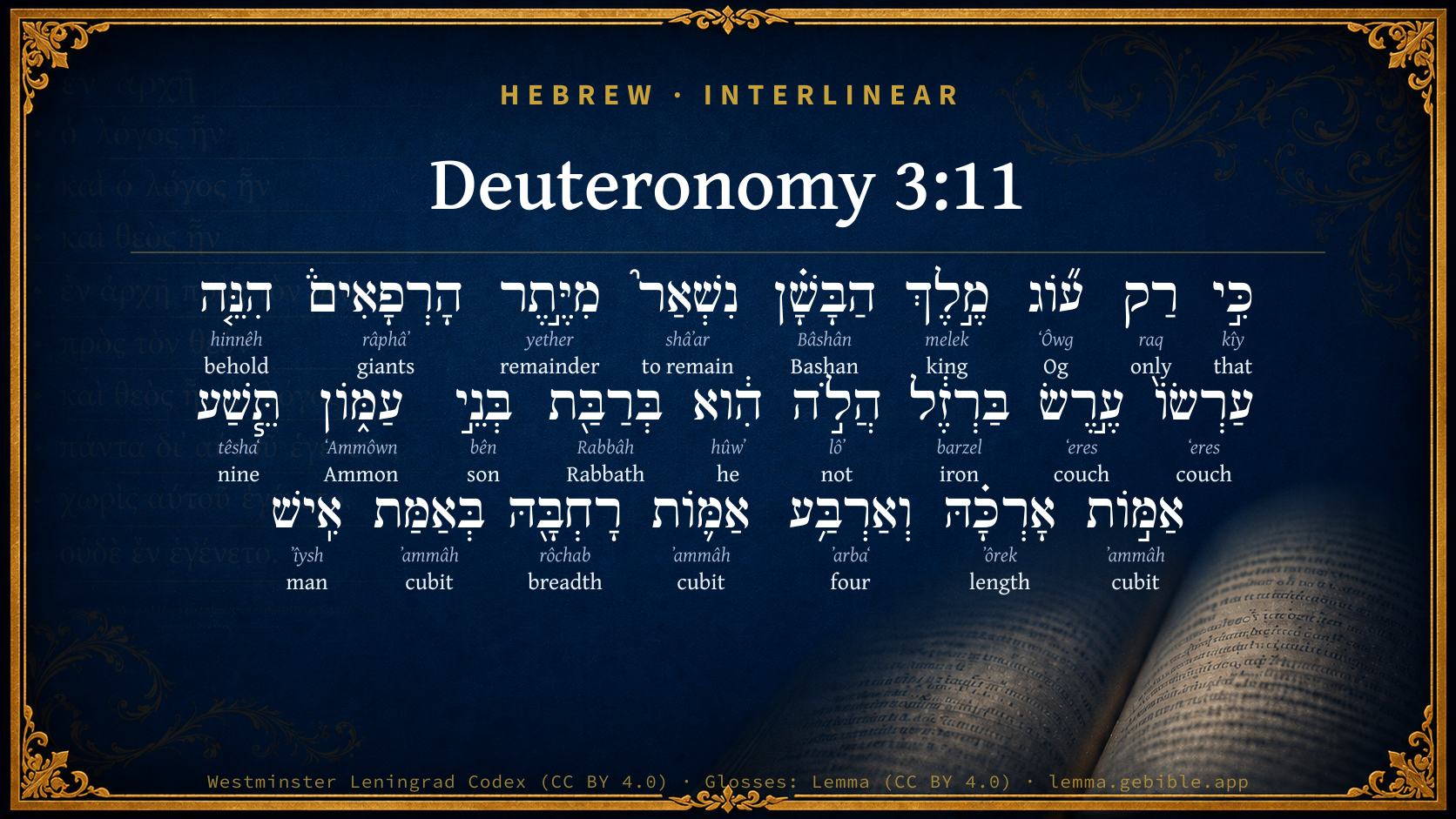
Hebrew (Westminster Leningrad Codex) Deuteronomy 3:11 appears in the Hebrew Old Testament. The text above is from the Westminster Leningrad Codex. Each word links to its Strong’s number, a concise gloss, and parsing drawn from the Open Scriptures Hebrew Bible morphology. Click any word for its full Brown-Driver-Briggs (BDB) entry.
Download image
Cite this verse

Deuteronomy 3:11 (World English Bible). Public Domain. Lemma interlinear Bible study tool, https://lemma.gebible.app/v/deuteronomy/3/11.

Show BibTeX & RIS
BibTeX
RIS
English Translation
(For only Og king of Bashan remained of the remnant of the Rephaim; behold, his bedstead was a bedstead of iron; isn't it in Rabbah of the children of Ammon? nine cubits was the length of it, and four cubits the breadth of it, after the cubit of a man.)
World English Bible · Public Domain
Highlights
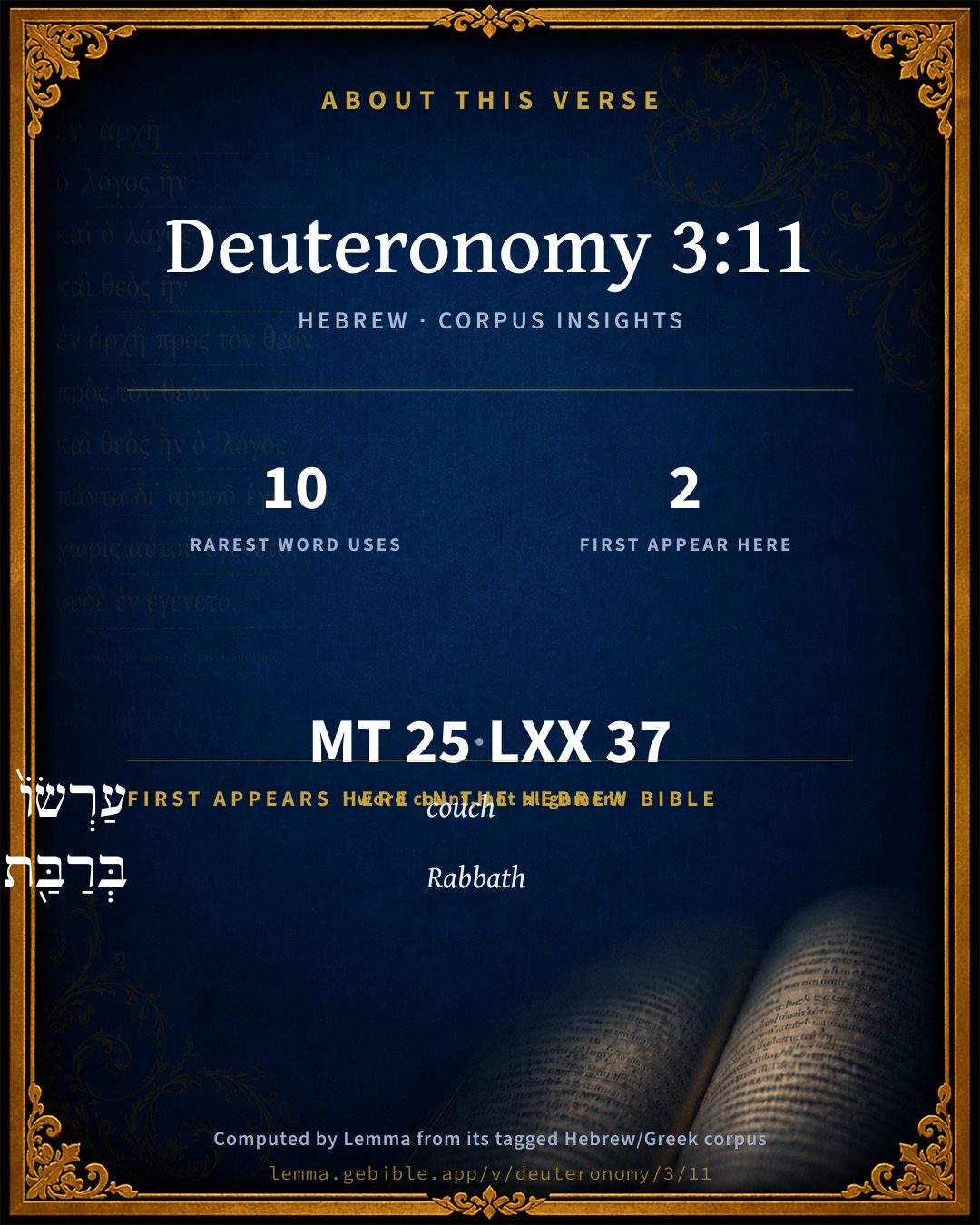
  • 2 first appearances in the Hebrew Bible
Full analysis ↓
Download a study sheet

One document with this verse’s original text, its word-by-word gloss line, the meaning frame, cross-references with their text, attributed commentary, and full source and license credits — printable, and it pastes into notes with its structure intact.

This verse Autodidact and up

Study sheet (.html) Plain text (.txt)

A passage Seminary Student

Up to 50 verses in one chapter. A passage sheet keeps up to 6 commentary sources and 12 cross-references per verse, in the order this page ranks them, and says so on the sheet whenever that leaves anything out. Ask for a single verse and you get the Autodidact verse sheet above.

Everything on this page stays free to read, with no account — the sheet is a download of what is already on screen, not access to it.

Want to remove ads? Support Godless Engineer
Compare translations 3

The same verse in 3 English versions, stacked beneath the original-language interlinear above. Click any original word for its lexicon entry.

Each is an independent rendering of the whole verse — the interlinear is not word-aligned to these translations.

Highlighted words mark where these versions differ — a whole-verse word diff, not a word-by-word alignment.

  • World English Bible Public Domain
    (For only Og king of Bashan remained of the remnant of the Rephaim; behold, his bedstead was a bedstead of iron; isn't it in Rabbah of the children of Ammon? nine cubits was the length of it, and four cubits the breadth of it, after the cubit of a man.)
  • King James Version Public Domain
    For only Og king of Bashan remained of the remnant of giants; behold his bedstead was a bedstead of iron; is it not in Rabbath of the children of Ammon? nine cubits was the length thereof, and four cubits the breadth of it, after the cubit of a man.
  • unfoldingWord Literal Text CC BY-SA 4.0
    (For only Og, king of Bashan, had remained from the remnant of the Raphaites. Behold, his couch a couch of iron. it not in Rabbah, of the sons of Ammon? nine cubits long and four cubits wide, by the cubit of man.)

unfoldingWord Literal Text — © unfoldingWord, licensed CC BY-SA 4.0. Word-aligned USFM3 via Door43 (git.door43.org/unfoldingWord/en_ult).

Versions to compare (up to 4)

3 of 4 selected

Show all 18 translations

Every available English version of this verse, each an independent rendering of the whole verse.

  • World English Bible Public Domain
    (For only Og king of Bashan remained of the remnant of the Rephaim; behold, his bedstead was a bedstead of iron; isn't it in Rabbah of the children of Ammon? nine cubits was the length of it, and four cubits the breadth of it, after the cubit of a man.)
  • Berean Standard Bible Public Domain
    (For only Og king of Bashan had remained of the remnant of the Rephaim. His bed of iron, nine cubits long and four cubits wide, is still in Rabbah of the Ammonites.)
  • Majority Standard Bible Public Domain
    (For only Og king of Bashan had remained of the remnant of the Rephaim. His bed of iron, nine cubits long and four cubits wide, is still in Rabbah of the Ammonites.)
  • King James Version Public Domain
    For only Og king of Bashan remained of the remnant of giants; behold his bedstead was a bedstead of iron; is it not in Rabbath of the children of Ammon? nine cubits was the length thereof, and four cubits the breadth of it, after the cubit of a man.
  • American Standard Version (1901) Public Domain
    (For only Og king of Bashan remained of the remnant of the Rephaim; behold, his bedstead was a bedstead of iron; is it not in Rabbah of the children of Ammon? nine cubits was the length thereof, and four cubits the breadth of it, after the cubit of a man.)
  • Revised Version (1885) Public Domain
    (For only Og king of Bashan remained of the remnant of the Rephaim; behold, his bedstead was a bedstead of iron; is it not in Rabbah of the children of Ammon? nine cubits was the length thereof, and four cubits the breadth of it, after the cubit of a man.)
  • Geneva Bible (1599) Public Domain
    For onely Og King of Bashan remained of the remnant of the gyants, whose bed was a bed of yron: is it not at Rabbath among the children of Ammon? the length thereof is nine cubites, and foure cubites the breadth of it, after the cubite of a man.
  • Douay-Rheims (1899) Public Domain
    For only Og king of Basan remained of the race of the giants. His bed of iron is shewn, which is in Rabbath of the children of Ammon, being nine cubits long, and four broad after the measure of the cubit of a man's hand.
  • Young's Literal Translation Public Domain
    for only Og king of Bashan had been left of the remnant of the Rephaim; lo, his bedstead `is' a bedstead of iron; is it not in Rabbath of the sons of Ammon? nine cubits its length, and four cubits its breadth, by the cubit of a man.
  • Literal Standard Version CC BY-SA 4.0
    For only Og king of Bashan had been left of the remnant of the Rephaim; behold, his bedstead [is] a bedstead of iron. Is it not in Rabbath of the sons of Ammon? Its length [is] nine cubits and its breadth [is] four cubits, by the cubit of a man.
  • Unlocked Literal Bible CC BY-SA 4.0
    (For of the remnant of the Rephaim, only Og king of Bashan had remained. Look! His bed was a bed of iron. Was it not in Rabbah, where the descendants of Ammon live? It was nine cubits long and four cubits wide, the way people measure.)
  • unfoldingWord Literal Text CC BY-SA 4.0
    (For only Og, king of Bashan, had remained from the remnant of the Raphaites. Behold, his couch a couch of iron. it not in Rabbah, of the sons of Ammon? nine cubits long and four cubits wide, by the cubit of man.)
  • Darby Bible Public Domain
    For only Og the king of Bashan remained of the residue of giants: behold, his bedstead was a bedstead of iron; is it not in Rabbah of the children of Ammon? its length was nine cubits, and its breadth four cubits, after the cubit of a man.
  • World Messianic Bible Public Domain
    (For only Og king of Bashan remained of the remnant of the Rephaim. Behold, his bedstead was a bedstead of iron. Isn’t it in Rabbah of the children of Ammon? Nine cubits was its length, and four cubits its width, after the cubit of a man.)
  • Webster's Bible Public Domain
    For only Og king of Bashan remained of the remnant of giants; behold, his bedstead was a bedstead of iron; is it not in Rabbath of the children of Ammon? nine cubits was the length of it, and four cubits the breadth of it, after the cubit of a man.
  • Free Bible Version CC BY-SA 4.0
    (Only Og, king of Bashan, was left of the race of the Rephaim. He had a bed made of iron that was nine cubits long and four cubits wide. It's still in the Ammonite town of Rabbah.)
  • Bible in Basic English Public Domain
    (For Og, king of Bashan, was the last of all the Rephaim; his bed was made of iron; is it not in Rabbah, in the land of the children of Ammon? It was nine cubits long and four cubits wide, measured by the common cubit.)
  • JPS Tanakh (1917) Public Domain
    For only Og king of Bashan remained of the remnant of the Rephaim; behold, his bedstead was a bedstead of iron; is it not in Rabbah of the children of Ammon? nine cubits was the length thereof, and four cubits the breadth of it, after the cubit of a man. —

Literal Standard Version (2020), Covenant Press — licensed CC BY-SA 4.0. Text via the HelloAO Bible API (eBible.org). Unlocked Literal Bible (unfoldingWord) — licensed CC BY-SA 4.0. Text via the HelloAO Bible API (eBible.org). unfoldingWord Literal Text — © unfoldingWord, licensed CC BY-SA 4.0. Word-aligned USFM3 via Door43 (git.door43.org/unfoldingWord/en_ult). Free Bible Version, Dr. Jonathan Gallagher — licensed CC BY-SA 4.0. Text via the HelloAO Bible API (eBible.org).

Word by word

More ways to search: Search by grammar → Find every occurrence → Compare this word →

Practice this passage: Drill this verse → Learn its vocabulary →

עַרְשׂוֹ֙
ʻeres
H6210
“couch · his”
Noun, Common, Feminine, Singular, Construct + Suffix, Personal, 3rd Person, Masculine, Singular
Part of Speech
Noun
Type
Common
Gender
Feminine
Number
Singular
State
Construct
Full BDB Definition

Origin: from an unused root meaning perhaps to arch

TWOT: 1706a

couch, divan, bed
  1. כִּ֣י kîy H3588 “that” Conjunction
  2. רַק raq H7535 “only” Particle, Accusative
  3. ע֞וֹג ʻÔwg H5747 “Og” Noun, Proper
  4. מֶ֣לֶךְ melek H4428 “king of” Noun, Common, Masculine, Singular, Construct
  5. הַבָּשָׁ֗ן Bâshân H1316 “the · Bashan” Particle, Definite Article + Noun, Proper
  6. נִשְׁאַר֮ shâʼar H7604 “to remain” Verb, Niphal, Perfect, 3rd Person, Masculine, Singular
  7. מִיֶּ֣תֶר yether H3499 “from · remainder of” Preposition + Noun, Common, Masculine, Singular, Construct
  8. הָרְפָאִים֒ râphâʼ H7497 “the · giants” Particle, Definite Article + Noun, Proper
  9. הִנֵּ֤ה hinnêh H2009 “behold” Particle, Demonstrative
  10. עֶ֣רֶשׂ ʻeres H6210 “couch of” Noun, Common, Feminine, Singular, Construct
  11. בַּרְזֶ֔ל barzel H1270 “iron” Noun, Common, Masculine, Singular, Absolute
  12. הֲלֹ֣ה lôʼ H3808 “not” Particle, Interrogative + Particle, Negative
  13. הִ֔וא hûwʼ H1931 “he” Pronoun, Personal, 3rd Person, Feminine, Singular
  14. בְּרַבַּ֖ת Rabbâh H7237 “in/at · Rabbath” Preposition + Noun, Proper
  15. בְּנֵ֣י bên H1121 “sons of” Noun, Common, Masculine, Plural, Construct
  16. עַמּ֑וֹן ʻAmmôwn H5983 “Ammon” Noun, Proper
  17. תֵּ֧שַׁע têshaʻ H8672 “nine” Adjective, Cardinal number, Feminine, Singular, Absolute
  18. אַמּ֣וֹת ʼammâh H520 “cubits” Noun, Common, Feminine, Plural, Absolute
  19. אָרְכָּ֗הּ ʼôrek H753 “length · her” Noun, Common, Masculine, Singular, Construct + Suffix, Personal, 3rd Person, Feminine, Singular
  20. וְאַרְבַּ֥ע ʼarbaʻ H702 “and · four” Conjunction + Adjective, Cardinal number, Feminine, Singular, Absolute
  21. אַמּ֛וֹת ʼammâh H520 “cubits” Noun, Common, Feminine, Plural, Absolute
  22. רָחְבָּ֖הּ rôchab H7341 “breadth · her” Noun, Common, Masculine, Singular, Construct + Suffix, Personal, 3rd Person, Feminine, Singular
  23. בְּאַמַּת ʼammâh H520 “in/at · cubit of” Preposition + Noun, Common, Feminine, Singular, Construct
  24. אִֽישׁ ʼîysh H376 “man” Noun, Common, Masculine, Singular, Absolute

About this verse

These counts appear in no published source. They are computed here, from the morphology-tagged text and Lemma’s own curated glosses. What Lemma adds →

25
words
22
distinct lemmas
Pentateuch
section

Notable vocabulary

The rarest word here is עַרְשׂוֹ֙ couch H6210 — appearing just 10 times in the whole Hebrew Bible.

First appearance in Scripture

These words make their first canonical appearance in the Hebrew Bible here:

  • עַרְשׂוֹ֙ couch H6210
  • בְּרַבַּ֖ת Rabbath H7237

Shared distinctive vocabulary

עַרְשׂוֹ֙ couch H6210 occurs in 9 verses of the Hebrew Bible. Also found in:

Grammatical profile

  • 1 verb
  • 17 nouns
  • 2 adjectives
  • 1 pronoun
  • 1 conjunction
  • 3 particles

Verb forms

  • נִשְׁאַר֮ Niphal · Perfect

Repetition

Words recur within this verse — often emphatic in Hebrew:

  • אַמּ֣וֹת cubit H520 ×3
  • עַרְשׂוֹ֙ couch H6210 ×2

Hebrew & Septuagint length

In English translation the verse runs 50 words from the Hebrew and 53 from the Septuagint (LXX English) — closely comparable.

A rough comparison of the two English renderings, which tokenize alike — not a word-level alignment.

Word counts can differ between the Hebrew and the Greek without any difference in meaning — e.g. the Hebrew direct-object marker אֵת has no separate Greek word, and Greek often adds the article ὁ.

In the original languages it is 25 Hebrew tokens and 37 Greek tokens — but the two are counted differently (Hebrew bundles its prefixes and suffixes into one token; the Greek is in lemma form), so that isn’t a like-for-like length.

Cross-references

10

Topical passages linked to Deuteronomy 3:11 in the Treasury of Scripture Knowledge — connected by theme and wording, ordered by reader-vote popularity; previews shown in the World English Bible.

  • Genesis 14:5 In the fourteenth year Chedorlaomer came, and the kings who were with him, and struck the Rephaim in Ashteroth Karnaim, and the Zuzim in Ham, and the Emim in Shaveh-kiriathaim,
  • 2 Samuel 12:26 Now Joab fought against Rabbah of the children of Ammon, and took the royal city.
  • Jeremiah 49:2 Therefore, behold, the days come, says Yahweh, that I will cause an alarm of war to be heard against Rabbah of the children of Ammon; and it shall become a desolate heap, and her daughters shall be burned with fire: then shall Israel possess those who did possess him, says Yahweh.
  • Deuteronomy 2:11 these also are accounted Rephaim, as the Anakim; but the Moabites call them Emim.
  • Deuteronomy 2:20 (That also is accounted a land of Rephaim: Rephaim lived therein before; but the Ammonites call them Zamzummim,
  • 1 Samuel 17:4 There went out a champion out of the camp of the Philistines, named Goliath, of Gath, whose height was six cubits and a span.
  • 2 Samuel 11:1 It happened, at the return of the year, at the time when kings go out [to battle], that David sent Joab, and his servants with him, and all Israel; and they destroyed the children of Ammon, and besieged Rabbah. But David stayed at Jerusalem.
  • Ezekiel 21:20 You shall appoint a way for the sword to come to Rabbah of the children of Ammon, and to Judah in Jerusalem the fortified.
  • Amos 1:14 But I will kindle a fire in the wall of Rabbah, And it will devour its palaces, With shouting in the day of battle, With a tempest in the day of the whirlwind;
  • Amos 2:9 Yet I destroyed the Amorite before them, Whose height was like the height of the cedars, And he was strong as the oaks; Yet I destroyed his fruit from above, and his roots from beneath.

Cross-references courtesy of OpenBible.info (CC BY 4.0).

Hebrew and Greek witnesses Masoretic Hebrew ↔ Greek Septuagint

The same verse in the two great witnesses to the Old Testament, shown verse-for-verse.

These are two independent witnesses, not word-aligned to each other, and the Septuagint is shown in lemma (dictionary) form.

Hebrew Deuteronomy 3:11 Masoretic · Westminster Leningrad Codex

כִּ֣י רַק ע֞וֹג מֶ֣לֶךְ הַבָּשָׁ֗ן נִשְׁאַר֮ מִיֶּ֣תֶר הָרְפָאִים֒ הִנֵּ֤ה עַרְשׂוֹ֙ עֶ֣רֶשׂ בַּרְזֶ֔ל הֲלֹ֣ה הִ֔וא בְּרַבַּ֖ת בְּנֵ֣י עַמּ֑וֹן תֵּ֧שַׁע אַמּ֣וֹת אָרְכָּ֗הּ וְאַרְבַּ֥ע אַמּ֛וֹת רָחְבָּ֖הּ בְּאַמַּת אִֽישׁ

(For only Og king of Bashan remained of the remnant of the Rephaim; behold, his bedstead was a bedstead of iron; isn't it in Rabbah of the children of Ammon? nine cubits was the length of it, and four cubits the breadth of it, after the cubit of a man.)

World English Bible · Public Domain

Greek LXX Deuteronomy 3:11 Septuagint · lemma form

ὅτι πλήν ωγ βασιλεύς βασαν καταλείπω ἀπό ὁ ραφαϊν ἰδού ὁ κλίνη αὐτός κλίνη σιδηροῦς ἰδού οὗτος ἐν ὁ ἄκρος ὁ υἱός αμμων ἐννέα πῆχυς ὁ μῆκος αὐτός καί τέσσαρες πῆχυς ὁ εὖρος αὐτός ἐν πῆχυς ἀνήρ

For only Og the king of Basan was left of the Raphain: behold, his bed was a bed of iron; behold, it is in the chief city of the children of Ammon; the length of it is nine cubits, and the breadth of it four cubits, according to the cubit of a man.

LXX2012 (modern English Septuagint) · Public Domain

On this verse, Haydock's Catholic Bible Commentary discusses the Septuagint’s reading. Read the note in Commentary ↓

Hebrew: Westminster Leningrad Codex (CC BY 4.0). Greek: Septuagint (public domain); English from LXX2012 (modern English Septuagint) (Public Domain). How the Septuagint differs from the Hebrew →

Targum (Aramaic paraphrase)

2

The Targum is the ancient Jewish Aramaic paraphrase of the Hebrew Scriptures — an interpretive translation, not the Hebrew text itself. Onkelos (literal) and Pseudo-Jonathan (expansive) render the Torah, and Jonathan the Prophets. Coverage is partial: where no permissively-licensed English translation exists for a verse, only the Aramaic is shown. This is verse-level text, not a word-by-word alignment to the Hebrew.

  1. Targum Onkelos Torah (Genesis–Deuteronomy)
    אֲרֵי לְחוֹד עוֹג מַלְכָּא דְמַתְנָן אִשְׁתָּאַר מִשְׁאָר גִבָּרַיָא הָא עַרְסֵהּ עַרְסָא דְפַרְזְלָא הֲלָא הִיא בְּרַבַּת בְּנֵי עַמוֹן תְּשַׁע אַמִין אָרְכַּהּ וְאַרְבַּע אַמִין פְּתָיַהּ בְּאַמַת מְלַךְ

    (no public-domain English translation for this verse)

    Targum Onkelos — Aramaic: “Onkelos Genesis” (public domain); “Onkelos Exodus” (public domain); “Onkelos Leviticus” (public domain); “Onkelos Numbers” (public domain); “Onkelos Deuteronomy” (public domain). English: “Sefaria Community Translation” (CC0 1.0 (public-domain dedication)); “J.W. Etheridge. The Targums of Onkelos and Jonathan Ben Uzziel on the Pentateuch. London: Longmans, Green, 1862” (public domain). Text via Sefaria.

  2. Targum Pseudo-Jonathan Torah (Genesis–Deuteronomy)
    אֲרוּם לְחוֹד עוֹג מַלְכָּא דְמַתְנָן אִשְׁתְּיַיר מִמוֹתַר גִּיבָּרַיָא דְאִשְׁתֵּצְיוּ בְּטוּבְעָנָא הָא שִׁיוְויֵהּ שַׁוְיָא דְפַרְזְלָא הָא הִיא יְהִיבָא בְּבֵית אַרְכֵיוַון בְּרַבַּת בְּנֵי עַמּוֹן תְּשַׁע אַמִּין אוּרְכָּהּ וְאַרְבַּע אַמִּין פּוּתְיָהּ בְּאַמְתָא דְגַרְמֵיהּ

    For only Og king of Mathnan remained of the remnant of the giants who perished in the deluge. Behold, his bedstead was a bedstead of iron; behold, it is placed in the archive-house in Rabbath, of the Beni Ammon, nine-cubits its length, and four cubits its breadth, in the cubit of his own (stature).

    Targum Pseudo-Jonathan — Aramaic: “Targum Jonathan on Genesis” (public domain); “Targum Jonathan on Exodus” (public domain); “Targum Jonathan on Leviticus” (public domain); “Targum Jonathan on Numbers” (public domain); “Targum Jonathan on Deuteronomy” (public domain). English: “The Targum of Jonathan ben Uzziel, trans. J. W. Etheridge, London, 1862” (public domain). Text via Sefaria.

Commentary

Notes on Deuteronomy 3:11 from classic Christian and Jewish commentators (each source and its license shown beneath its notes). The classic Christian expositions comment on the surrounding passage and are grouped to its opening verse, so a note may address several verses; the Jewish commentaries on the Tanakh (Rashi and others) are per-verse, so they appear only where the commentator wrote on this verse.

Lemma curates 59 commentaries, every one of them public domain or Creative Commons licensed, each selected and text-cleaned for this edition rather than reprinted as found. About our sources →

Trapp's Complete Commentary

John Trapp

Deu 3:11 For only Og king of Bashan remained of the remnant of giants; behold, his bedstead [was] a bedstead of iron; [is] it not in Rabbath of the children of Ammon? nine cubits [was] the length thereof, and four cubits the breadth of it, after the cubit of a man.

Ver. 11. Og, {a} king of Bashan, remained,] sc., In Bashan; and he seems to have been of the remnant of those Rephaims, whom Chedorlaomer and his company smote in Ashteroth. {Gen 14:5 Jos 13:12}

Is it not in Rabbath?] Kept for a monument of so mighty and massy a man.

{a} The Jews fable that he escaped in the flood by riding astride on the ark!

John Trapp, A Commentary or Exposition upon All the Books of the Old and New Testament (1647–1656) — public domain. Text from a community e-Sword module.

Joseph Benson's Commentary

Deu 3:11. Only Og remained of the remnant of giants — Namely, in those parts; for there were other giants among the Philistines, and elsewhere. When the Ammonites drove out the Zamzummims, mentioned Deu 2:20, Og might escape, and so be said to be left of the remnant of the giants, and afterward, fleeing to the Amorites, perhaps was made their king, because of his gigantic stature. His bedstead was a bedstead of iron — Bedsteads of iron, brass, and other metals, are not unusual in the warm countries, as a defence against vermin. In Rabbath — Where it might now be, either because the Ammonites, in some former battle with Og, had taken it as a spoil; or because, after Og’s death, the Ammonites desired to have this monument of his greatness, and the Israelites permitted them to carry it away to their chief city. Nine cubits —

So his bed was four yards and a half long, and two yards broad.

Joseph Benson's Commentary on the Old and New Testaments (1811–1818) — public domain. Text from a community e-Sword module.

Tyndale Open Study Notes

Tyndale Open Resources

3:11 His bed was probably wooden, inlaid with iron. Alternatively, the Hebrew word might suggest a sarcophagus or coffin. • Rabbah is the same city as Rabbath Ammon (see study note on Deut 2:19). Apparently there was some kind of museum at Rabbah when Deuteronomy was written, and this artifact could be seen there.

Tyndale Open Study Notes — © Tyndale Open Resources, licensed CC BY-SA 4.0. Text via the HelloAO Bible API.

Geneva Bible (1599)

Geneva Bible translators

The more terrible that this giant was, the greater occasion had they to glorify God for the victory.

Geneva Bible (1599) marginal notes — public domain. Text via Bolls.life.

Jamieson, Fausset & Brown

Robert Jamieson, A. R. Fausset & David Brown

only Og king of Bashan remained of the remnant of giants--literally, "of Rephaim." He was not the last giant, but the only living remnant in the trans-jordanic country (Jos 15:14), of a certain gigantic race, supposed to be the most ancient inhabitants of Palestine.

behold, his bedstead was a bedstead of iron--Although beds in the East are with the common people nothing more than a simple mattress, bedsteads are not unknown. They are in use among the great, who prefer them of iron or other metals, not only for strength and durability, but for the prevention of the troublesome insects which in warm climates commonly infest wood. Taking the cubit at half a yard, the bedstead of Og would measure thirteen and a half feet, so that as beds are usually a little larger than the persons who occupy them, the stature of the Amorite king may be estimated at about eleven or twelve feet; or he might have caused his bed to be made much larger than was necessary, as Alexander the Great did for each of his foot soldiers, to impress the Indians with an idea of the extraordinary strength and stature of his men [LE CLERC]. But how did Og's bedstead come to be in Rabbath, of the children of Ammon? In answer to this question, it has been said, that Og had, on the eve of engagement, conveyed it to Rabbath for safety. Or it may be that Moses, after capturing it, may have sold it to the Ammonites, who had kept it as an antiquarian curiosity till their capital was sacked in the time of David. This is a most unlikely supposition, and besides renders it necessary to consider the latter clause of this verse as an interpolation inserted long after the time of Moses. To avoid this, some eminent critics take the Hebrew word rendered "bedstead" to mean "coffin." They think that the king of Bashan having been wounded in battle, fled to Rabbath, where he died and was buried; hence the dimensions of his "coffin" are given [DATHE, ROOS].

Jamieson, Fausset & Brown — Commentary Critical and Explanatory on the Whole Bible (1871) — public domain (CC PDM 1.0). Text via the HelloAO Bible API.

Adam Clarke's Commentary

Verse 11. Og king of Bashan remained] Og was the last king of the Amorites; his kingdom appears to have taken its name from the hill of Bashan; the country has been since called Batanaea.

Remnant of giants] Of the Rephaim. See on De 2:10-11.

His bedstead was - of iron] Iron was probably used partly for its strength and durability, and partly to prevent noxious vermin from harbouring in it.

Is it not in Rabbath, of the children of Ammon?] The bedstead was probably taken in some battle between the Ammonites and Amorites, in which the former had gained the victory. The bedstead was carried a trophy and placed in Rabbath, which appears, from 2Sa 12:26, to have been the royal city of the children of Ammon.

Nine cubits was the length - four cubits the breadth] Allowing the bedstead to have been one cubit longer than Og, which is certainly sufficient, and allowing the cubit to be about eighteen inches long, for this is perhaps the average of the cubit of a man, then Og was twelve feet high. This may be deemed extraordinary, and perhaps almost incredible, and therefore many commentators have, according to their fancy, lengthened the bedstead and shortened the man, making the former one-third longer than the person who lay on it, that they might reduce Og to six cubits; but even in this way they make him at least nine feet high.

On this subject the rabbins have trifled most sinfully. I shall give one specimen. In the Targum of Jonathan ben Uzziel on Nu 21:33-35, it is said that "Og having observed that the camp of the Israelites extended six miles, he went and tore up a mountain six miles in its base, and put it on his head, and carried it towards the camp, that he might throw it on the Israelites and destroy them; but the word of the Lord prepared a worm, which bored a hole in the mountain over his head, so that it fell down upon his shoulders: at the same time his teeth growing out in all directions, stuck into the mountain, so that he could not cast it off his head. Moses, (who was himself ten cubits high,) seeing Og thus entangled, took an axe ten cubits long, and having leaped ten cubits in height, struck Og on the ankle bone, so that he fell and was slain."

From this account the distance from the sole of Og's foot to his ankle was thirty cubits in length! I give this as a very slight specimen of rabbinical comment. I could quote places in the Talmud in which Og is stated to be several miles high! This relation about Og I suppose to be also an historical note added by a subsequent hand.

Adam Clarke's Commentary on the Bible (1810–1826) — public domain. Text from a community e-Sword/MySword module.

Ellicott's Commentary for English Readers

(11) Of the remnant of giants—i.e., of the nation of Rephaim in these parts. (See Note on Gen_14:5.)

His bedstead.—The word may mean either bedstead or coffin. Both the word for “bedstead” and the word for “iron” have given rise to some discussion and difficulty. An iron bedstead and an iron coffin are almost equally improbable. Basalt has been suggested as an alternative. But though there is basalt in Argob, there is none in Rabbath-Ammon. Conder, who has recently explored Rabbath, has discovered a remarkable throne of stone on the side of a hill there, and he suggests that the Hebrew word rendered “bedstead,” which properly signifies a couch with a canopy, may apply to this. The word for “iron” (barzîl) in Talmudical language means also “a prince,” and this meaning has been suggested for the name Barzillai, which we find in the same district in later times. “His canopied throne was a princely one, and yet remains in Rabbath of the Ammonites,” would be the meaning of the passage, on this hypothesis. The dimensions of the throne recently discovered are said to be nearly those given in this verse.

After the cubit of a man-Ish (not adam) the distinctive and emphatic word for a man. Some think that the cubit of any man is meant; others that the man himself for whom it was made, viz., Og, is intended. (Comp. Rev_21:17, “according to the measure of a man—i.e., of an angel.”)

A Bible Commentary for English Readers, edited by Charles John Ellicott (1878–1897) — public domain. Text from a community e-Sword module.

The Cambridge Bible for Schools and Colleges

gen. ed. J. J. S. Perowne

11. Archaeological Note. ‘Ôg was the last survivor of the Repha‘îm (see on Deu_1:28). Bedstead, rather sarcophagus, for though the Heb. ‘eres elsewhere means couch, its synonyms miṭah (2Sa_3:31) and mishkab (Isa_57:2; Eze_32:25) are used for bier and tomb (the latter too in Phoen.), and the monumental character of this ‘eres proves it to have been the same. Iron, rather basalt; I have often heard basalt called iron in Ḥauran. The cubit of a man: the ordinary cubit, originally the length of the lower arm; later there was also a longer cubit (Eze_40:5; Eze_43:13). Taking it as about 18 in., ‘Ôg’s coffin was 13½ ft by 6. Some sites in E. Palestine are strewn with stone-coffins, e.g. Umm Keis, usually 7 to 8 ft by 2½ to 4. That of Eshmunazar, the Sidonian, Isaiah 7 by 4; ‘Hiram’s Tomb’ Isaiah 12 by 6. Cp. Doughty, Ar. Des. i. 18, on marble sarcophagi near Es-Salt, ‘little less than the bed of Og,’ and Cl. Ganneau, Arch. Res. ii. 233.

The Cambridge Bible for Schools and Colleges (gen. ed. J. J. S. Perowne; Cambridge University Press, 1878–1918) — public domain. Text from a community e-Sword module.

John Gill's Exposition

For only Og king of Bashan remained of the remnant of giants,.... The meaning seems to be, either that he was the only one that was left of the race of the giants the Ammonites found when they took possession of this country, Deu 2:20 or that was left when the Amorites took it from the Ammonites; and who having by some means or other ingratiated himself into their affections, because of his stature, strength, and courage, and other qualifications they might discern in him, made him their king:

behold, his bedstead was a bedstead of iron: his body being so large and bulky, he might think it most proper and safest for him to have a bedstead made of iron to lie upon, or to prevent noxious insects harbouring in it; nor was it unusual to have bedsteads made of other materials than wood, as of gold, silver, and ivory; See Gill on Amo 6:4. Some learned men (r) have been of opinion, that the beds of Typho in Syria, made mention of by Homer (s), refer to this bedstead of Og:

is it not in Rabbath of the children of Ammon? which was the royal city of the Ammonites, in the times of David, Sa2 12:26, now called Philadelphia, as Jerom says (t). This bedstead might be either sent thither by Og, before the battle at Edrei, for safety, or rather might be sold by the Israelites to the inhabitants of Rabbath, who kept it, as a great curiosity:

nine cubits was the length thereof, and four cubits the breadth of it, after the cubit of a man; a common cubit, so that it was four yards and a half long, and two yards broad. Onkelos renders it, after the king's cubit; and the king's cubit at Babylon, according to Herodotus (u), was larger by three fingers than the common one; such as the cubit in Eze 40:5, which was a cubit and an hand's breadth; and this makes the dimensions of the bedstead yet larger. And by this judgment may be made of the tallness of Og's stature, though this is not always a sure rule to go by; for Alexander, when in India, ordered his soldiers to make beds of five cubits long, to be left behind them, that they might be thought to be larger men than they were, as Diodorus Siculus (w) and Curtius (x) relate; but there is little reason to believe that Og's bedstead was made with such a view. Maimonides observes (y), that a bed in common is a third part larger than a man; so that Og, according to this way of reckoning, was six cubits high, and his stature doubly larger than a common man's; but less than a third part may well be allowed to a bed, which will make him taller still; the height of Og is reckoned by Wolfius (z) to be about thirteen feet eleven inches of Paris measure.

(r) Vid. Dickinson. Delph. Phaenieizant. c. 2. p. 12. (s) Iliad. z. (t) De loc. Heb. fol. 94. C. (u) Clio, sive, l. 1. c. 175. (w) Bibliothec. l. 17. p. 563. (x) Hist. l. 9. c. 3. (y) Moreh Nevochim, par. 2. c. 47. p. 325. (z) Apud Scheuchzer. Physic. Sacr. vol. 3. p. 401.

John Gill's Exposition of the Whole Bible (1746–1763) — public domain (CC PDM 1.0). Text via the HelloAO Bible API.

Albert Barnes' Notes on the Bible

Giants - Or Rephaim: see the marginal reference note.

A bedstead of iron - The “iron” was probably the black basalt of the country, which not only contains a large proportion, about 20 percent, of iron, but was actually called “iron,” and is still so regarded by the Arabians. Iron was indeed both known and used, principally for tools (see e. g. Deu 19:5 and compare Gen 4:22 note), at the date in question by the Semitic people of Palestine and the adjoining countries; but bronze was the ordinary metal of which weapons, articles of furniture, etc., were made.

The word translated “bedstead” is derived from a root signifying “to unite” or “bind together,” and so “to arch” or “cover with a vault.” The word may then certainly mean “bier,” and perhaps does so in this passage. Modern travelers have discovered in the territories of Og sarcophagi as well as many other articles made of the black basalt of the country.

Is it not in Rabbath of the children of Ammon? - Probably after the defeat and death of Og at Edrei the remnant of his army fled into the territory of the friendly Ammonites, and carried with them the corpse of the giant king.

After the cubit of a man - i. e. after the usual and ordinary cubit, counted as people are accustomed to count. Taking 18 inches to the cubit, the bedstead or sarcophagus would thus be from thirteen to fourteen feet long.

Albert Barnes' Notes on the Bible (1834–1885) — public domain. Text from a community e-Sword/MySword module.

Haydock's Catholic Bible Commentary

Giants. Hebrew, "Raphaim." Og was the only survivor of this family in Basan, though there were other giants dispersed throughout the land, 1 Paralipomenon xx. 6. (Tirinus) --- Some of the stock of Rapha were also seen afterwards at Geth, but they did not reign in the country of their fathers, as Og alone did at this time, Josue xv. 14., and xvii. 15. Hebrew may be, "Now Og, king of Basan, was a remnant of the Raphaim." (Calmet) --- Septuagint, "for, moreover, Og....was left of the Raphaim." --- His bed was 13½ feet long, and 6½ feet broad, taking the cubit at least 18 inches, with Arbuthnot; though Calmet allows 20½ French inches, which are greater than ours. As beds are commonly made larger than the person who lies in them, he concludes that Og might be 14 or 15 feet high, unless he was possessed with the same vanity as Alexander the Great, who caused beds five cubits long to be left in his camp, when he returned from his Indian expedition, in order that the people might think that his soldiers were of a gigantic stature. Allowances must here be made for a royal bed; and, at any rate, it will not easily be proved that a human body might not exceed 12 or 15 feet in height, without injuring the just proportions, as Thomas Paine would have us believe. We know that the difference in size between the inhabitants of Shetland and of Patagonia is still very great; and the people of the former island would act very irrationally, if they would not credit the existence of the Lincolnshire ox, or of the large dray horses in London, because their own oxen are not bigger than mastiffs. See Watson, p. 26. --- Iron. Bedsteads are frequently made of iron, brass, silver, or gold, in hot countries, for the sake of cleanliness and grandeur, Proverbs xxv. 11., Esther i. 6. The Parthian kings reserved to themselves the privilege of lying on golden beds. (Josephus, [Antiquities?] xx. 20.) The Thebans made beds of iron and brass out of the spoils of Platea, and consecrated them to Juno. (Thucydides, iii.) --- Ammon. Hebrew, "Behold his bedstead was of iron; is it not in Rabbath?" &c . This town is called Rabbatamana, by Polybius; and Ammana, by Eusebius, who says it had afterwards the name of Astarte, till Ptolemy Philadelphus gave it the title of Philadelphia. It lay to the east of Jazer, not far from the Arnon. (Cellarius, iii. 14.) It is probable that the bed of Og continued in this city till it was taken by David, 2 Kings xxii. 30. How the Ammonites got possession of it we do not know. It seems that the account of it, and of Jair, (ver. 15,) have been given by some one who lived a long time after these events had taken place. (Calmet) --- This conjecture, however, is not well founded, for though Moses was addressing those who had been witnesses to these transactions not many months before, his appeal to them gives the strongest authority to a narration, which was to be handed down to the latest posterity. They could attest the surprising stature of that giant, whom they had slain, and their neighbours kept his bed as a proof of his having existed, the terror of all that country. Until this present day, (ver. 14,) is an expression often used in Scripture to denote an event which had taken place at no very great distance of time, chap. xi. 4. Thus St. Matthew, (xxvii. 8,) writing about eight years after the ascension of our Saviour, says, the field was called Haceldama....even to this day. See Josue viii. 29. (Haydock) --- It is sufficient if the thing be still in the same state as it was before. (Menochius) --- Hand. Hebrew, "according to the cubit of a man." from the elbow to the finger ends. (Calmet) --- Syriac, "of giants." Chaldean, "of the king;" whence some have imagined, that the bed was nine times as long as the cubit of Og, which is very improbable. (Haydock) --- The Rabbins, who delight in fables, say that this bed was used by Og only while he was in his infancy: for he grew to be 120 cubits high; and some say his foot along was this length. He would have hurled a mountain to overwhelm all the Hebrews at once, only a bird, or some ants, made a hole in it, and the mountain falling upon his shoulders, he could not extricate his head, God causing his teeth to grow ten cubits, and in this condition he was taken and killed by Moses. (Lyranus, &c.) --- Noble discovery of these blind guides! (Calmet) --- The poets have not been more extravagant in their descriptions of Typheus, or Typho, whose name signifies burning, as well as that of Og, (or hog, he burnt) with whom he has probably been confounded. (Vossius on Idolat.) (Haydock)

George Leo Haydock (1774–1849), Haydock's Catholic Family Bible and Commentary, 1859 edition — public domain. Excludes Psalms (Douay-Rheims chapter numbering differs from Protestant) and Deuterocanonical books (Catholic canon only).

Matthew Poole's English Annotations

The other giants of Bashan were destroyed before; and therefore when Og was killed, the Israelites’ work was done.

In Rabbath of the children of Ammon; where it might now be, either because the Ammonites in some former-battle with Og had taken it as a spoil; or because after Og’s death the Ammonites desired to have this monument of his greatness, and the Israelites permitted them to carry it away to their chief city.

After the cubit of a man, to wit, of ordinary stature. So his bed was four yards and a half long, and two yards broad.

Matthew Poole's English Annotations on the Holy Bible (1683–1685) — public domain. Text from a community e-Sword/MySword module.

Whedon's Commentary on the Bible

Daniel D. Whedon

11. Only Og… remained of the… giants — In Abraham’s time the Rephaim were living in Bashan. Gen_14:5.

His bedstead was… of iron — It has been suggested that this was a sarcophagus of basalt. The black basalt of that region contains a large proportion of iron.

Is it not in Rabbath… Ammon — Afterward called Philadelphia, now identified with

Amman — about twenty-two miles from the Jordan.

After the cubit of a man — That is, the ordinary cubit, usually reckoned as eighteen inches. That there was more than one cubit is clear. It has been supposed that Og, in preparing his sarcophagus, intentionally exceeded the necessary size, so as to convey an exaggerated impression of his extraordinary stature. In like manner Diodorus Siculus (xvii, 95) says that Alexander, in his march to India, caused two couches to be prepared for every footsoldier, each five cubits long.

Daniel D. Whedon (gen. ed.), Commentary on the Old and New Testaments (1874–1909) — public domain. Text from a community e-Sword module.

The Pulpit Commentary

Bashan was of old possessed by a giant race, the Rephaim; (Gen_14:5) but of these Og, King of Bashan, was, at the time of the Israelitish invasion, the sole remnant. His vast size is indicated by the size of his bedstead, which was preserved in Rabbath-Ammon, perhaps as a trophy of some victory obtained by the Ammonites over their gigantic foe. This measured nine cubits in length, and four in breadth, "after the cubit of a man," i.e. according to the cubit in common use. Taking the cubit as equal to eighteen inches, the measure of the bedstead would be thirteen feet and a half by six feet. That Og even approximated to this height is incredible; if he reached nine or ten feet his height would exceed that of any one on record. It is probable, however, that he may have had his bed made vastly larger than himself, partly from ostentation, partly that he might leave a memorial that should impress upon posterity a sense of his gigantic size and resistless might; just as Alexander the Great is said (Died. Sic., 17:95) to have, on his march to India, caused couches to be made for his soldiers in their tents, each five cubits long, in order to impress the natives with an overwhelming sense of the greatness of his host. It has been suggested that it is not a bed that is here referred to, but a sarcophagus of basalt or ironstone in which, it is supposed, the corpse of Og was placed, and which was afterwards carried to Rabbath, and there deposited (J. D. Michaelis, Winer, Knobel, etc.). This implies that the passage is a later insertion, and not part of the original narrative as given by Moses. But with what view could such an insertion be introduced? Not to establish the credibility of the story of the victory of the Israelites over Og, for the existence of a sarcophagus in which a corpse had been placed would only attest the fact that such a one once lived and died, but would prove nothing as to how or when or where he came by his death. Not to show the vast size of the man, for a sarcophagus affords no measure whatever of the size of the person whose remains are placed in it, being an honorary monument, the size of which is proportioned to the real or supposed dignity of the person for whose honor it is made. A bed, on the contrary, which a man had used, or at least had caused to be made for himself, would afford some evidence of his size; and there is an obvious reason for Moses referring to this here, inasmuch as thereby he recalled-to the Israelites the remembrance, on the one hand, of what occasioned the fear with which they anticipated the approach of this terrible foe, and, on the other, of the grace of God to them in that he had delivered Og and all his people into their hand. It is idle to inquire how Moses could know of the existence of this bed at Rabbath; for we may be well assured that from all the peoples through whose territories he had passed reports of the strength and prowess and doings of this giant warrior would be poured into his ear.

The Pulpit Commentary (1880–1919), ed. H.D.M. Spence-Jones & Joseph S. Exell — public domain. Text from a community e-Sword module.

John Wesley's Explanatory Notes

In Rabbath - Where it might now be, either because the Ammonites in some former battle with Og, had taken it as a spoil: or because after Og's death, the Ammonites desired to have this monument of his greatness, and the Israelites permitted them to carry it away to their chief city. Nine cubits - So his bed was four yards and an half long, and two yards broad.

John Wesley, Explanatory Notes Upon the Whole Bible (1754–1765) — public domain. Text via the GEBible commentary corpus.

Keil & Delitzsch

C. F. Keil & F. Delitzsch

Even in Abraham's time, the giant tribe of Rephaim was living in Bashan (Gen 14:5). But out of the remnant of these, king Og, whom the Israelites defeated and slew, was the only one left. For the purpose of recalling the greatness of the grace of God that had been manifested in that victory, and not merely to establish the credibility of the statements concerning the size of Og ("just as things belonging to an age that has long passed away are shown to be credible by their remains," Spinoza, etc.), Moses points to the iron bed of this king, which was still in Rabbath-Ammon, and was nine cubits long and four broad, "after the cubit of a man," i.e., the ordinary cubit in common use (see the analogous expression, "a man's pen," Isa 8:1). הלה, for הלא, synonymous with הנּה. There is nothing to amaze is in the size of the bed or bedstead given here. The ordinary Hebrew cubit was only a foot and a half, probably only eighteen Dresden inches (see my Archologie, ii. p. 126, Anm. 4). Now a bed is always larger than the man who sleeps in it. But in this case Clericus fancies that Og "intentionally exceeded the necessary size, in order that posterity might be led to draw more magnificent conclusions from the size of the bed, as to the stature of the man who was accustomed to sleep in it." He also refers to the analogous case of Alexander the Great, of whom Diod. Sic. (xvii. 95) affirms, that whenever he was obliged to halt on his march to India, he made colossal arrangements of all kinds, causing, among other things, two couches to be prepared in the tents for every foot-soldier, each five cubits long, and two stalls for every horseman, twice as large as the ordinary size, "to represent a camp of heroes, and leave striking memorials behind for the inhabitants of the land, of gigantic men and their supernatural strength." With a similar intention Og may also have left behind him a gigantic bed as a memorial of his superhuman greatness, on the occasion of some expedition of his against the Ammonites; and this bed may have been preserved in their capital as a proof of the greatness of their foe.

(Note: "It will often be found, that very tall people are disposed to make themselves appear even taller than they actually are" (Hengstenberg, Diss. ii. p. 201). Moreover, there are still giants who are eight feet high and upwards. "According to the N. Preuss. Zeit. of 1857, there came a man to Berlin 8 feet 4 inches high, and possibly still growing, as he was only twenty years old; and he was said to have a great-uncle who was nine inches taller" (Schultz).)

Moses might then refer to this gigantic bed of Og, which was known to the Israelites; and there is no reason for resorting to the improbable conjecture, that the Ammonites had taken possession of a bed of king Og upon some expedition against the Amorites, and had carried it off as a trophy to their capital.

(Note: There is still less probability in the conjecture of J. D. Michaelis, Vater, Winer, and others, that Og's iron bed was a sarcophagus of basalt, such as are still frequently met with in those regions, as much as 9 feet long and 3 1/2 feet broad, or even as much as 12 feet long and 6 feet in breadth and height (vid., Burckhardt, pp. 220, 246; Robinson, iii. p. 385; Seetzen, i. pp. 355, 360); and the still further assumption, that the corpse of the fallen king was taken to Rabbah, and there interred in a royal way, is altogether improbable.)

"Rabbath of the sons of Ammon," or briefly Rabbah, i.e., the great (Jos 13:25; Sa2 11:1), was the capital of the Ammonites, afterwards called Philadelphia, probably from Ptolemaeus Philadelphus; by Polybius, Ῥαββατάμανα; by Abulfeda, Ammn, which is the name still given to the uninhabited ruins on the Nahr Ammn, i.e., the upper Jabbok (see Burckhardt, pp. 612ff. and v. Raumer, Pal. p. 268).

Keil & Delitzsch — Biblical Commentary on the Old Testament (1861–1891) — public domain (CC PDM 1.0). Text via the HelloAO Bible API. (Old Testament only.)

unfoldingWord translationNotes

Door43 World Missions Community

General Information:

Moses continues to speak to the people of Israel.

For of the remnant ... the way people measure

This is background information about King Og. (See: Background Information)

Rephaim

See how you translated this in Deuteronomy 2:11.

Look!

"Pay attention to the important thing I am going to tell you."

Was it not in Rabbah, ... live?

The writer uses a question to remind the people of Israel that they could go to Rabbah and see how large Og must have been. This rhetorical question can be translated as a statement. Possible meanings are 1) "It was in Rabbah, ... live." or 2) "It is in Rabbah ... live." (See: Rhetorical Question)

cubits

A cubit is 46 centimeters. (See: Biblical Distance)

the way people measure

"according to the cubit most people use"

translationWords

king

Bashan

Rabbah

descend

Ammon

unfoldingWord translationNotes — © Distant Shores Media and the Door43 World Missions Community, licensed CC BY-SA 4.0. Source: git.door43.org/Door43/en_tn.

Rashi

Rabbi Shlomo Yitzchaki (Rashi)

מיתר הרפאים [ONLY OG … REMAINED] OF THE REST OF THE REPHAIM whom Amraphel and his allies slew in Ashteroth-Karnaim (Genesis 14:5), and he (Og) escaped from the battle, as it is said, (Genesis 14:13) "And the fugitive came", and that was Og (Genesis Rabbah 42:8; cf. Rashi on Genesis 14.13.1).

באמת איש AFTER THE CUBIT OF A MAN — i.e. after the cubit of Og.

Rashi on the Tanakh — English translations: “The Judaica Press complete Tanach with Rashi, translated by A. J. Rosenberg” (CC BY 4.0); “Pentateuch with Rashi's commentary by M. Rosenbaum and A.M. Silbermann, 1929-1934” (public domain); “The Metsudah Tanach series, Lakewood, N.J” (CC BY 4.0); and “The Book of Joshua, Metsudah Publications, 1997” (CC BY 4.0). Text via Sefaria.

Ramban (Nachmanides)

Rabbi Moshe ben Nachman (Ramban / Nachmanides)

FOR ONLY OG KING OF BASHAN REMAINED OF THE REMNANT OF THE REPHAIM; BEHOLD, HIS BEDSTEAD WAS A BEDSTEAD OF IRON etc. The purport of the verse is to tell that this Og was called the king of the Amorites because he ruled over them, but he himself was of the Rephaim. And in order to tell of his height and strength, since the Rephaim were a people great, and many, and tall as the Anakim, it states that his bedstead was a bedstead of iron, no bedstead of wood being able to support him as it does other people. It is in the city of Rabbah which was his dwelling place, and when the children of Ammon destroyed the Rephaim as is mentioned above, Verse 21. and his city [Og’s capital, Ashtaroth] was captured, he alone was saved from the hands of the Ammonites. It is this which is stated, For only Og king of Bashan remained of the remnant of the Rephaim. His bed was left there in Rabbah which now belongs to the children of Ammon, and the Ammonites preserved it as testimony that they destroyed a great and tall people; and the mighty man whose height was like the height of the cedars, and he was strong as the oaks — from him they captured his kingdom. This is the sense of the word behold [behold, his bedstead …], meaning: “behold, the proof of [Og’s strength] still exists; it is the iron bedstead, very long and wide, and is to be found in Rabbah of the children of Ammon,” since his bedstead, which was in Ashtaroth, was plundered and lost.

NINE CUBITS WAS THE LENGTH THEREOF [of Og’s bedstead], AND FOUR CUBITS THE BREADTH OF IT, AFTER THE CUBIT OF A MAN. The meaning of after the cubit of a ‘man’ is that of the biggest man [i.e., Og], just as the expression, be thou strong and show yourself a man [which means “a strong man”]. And in the opinion of Onkelos, after the cubit of ‘a’ man means “after the cubit of ‘the’ man,” and the translation thereof [in Aramaic] is “the king” [indicating that no ordinary man is meant here — “the” man means the king]. Similarly, eth hakeves echad [which literally means: “the one lamb” — should be eth hakeves ha’echad: “the one ‘specific’ lamb”]; balailah hu [should be: balailah hahu — “in ‘that’ night”]. There are many similar cases. That is to say, [after the cubit of a man means] after the cubit of [“the” man] — Og himself.

Ramban (Nachmanides) on the Tanakh — English translation: “Commentary on the Torah by Ramban (Nachmanides). Translated and annotated by Charles B. Chavel. New York, Shilo Pub. House, 1971-1976” (CC BY 4.0). Text via Sefaria.

Lesson kit

Teaching starters — assembled from the data on this page, not authored interpretation. Every prompt links to the verse data it draws on. Edit before teaching.

Deuteronomy, in the Pentateuch, opens this verse with 25 words (22 distinct Hebrew lemmas). Its most distinctive word is ʻeres (“couch”). A historical commentator’s framing appears above. Read the whole chapter for the surrounding context.

Discussion questions

  1. How does “couch” (ʻeres) shape what this verse is saying?
  2. 2 words here appear for the first time in Scripture. What is being introduced at this debut?
  3. Job 7:13 shares the word «couch» with this verse. How do the two illuminate each other?
  4. “cubit” occurs 3× in this one verse. What is the effect of the repetition?
  5. The translations on this page render this verse differently — a whole-verse word diff, not a word-by-word alignment. What might account for the different wordings?
  6. The verb «נִשְׁאַר֮» is Niphal Perfect. How does its form color the action?
  7. Reading how Trapp's Complete Commentary and Joseph Benson's Commentary read this verse, where do the two commentators agree and where do they part?

Things to notice

Reading settings

Reading text

Shown beneath each verse's original-language words.

Old Testament
Old Testament edition

Read the OT as the Masoretic Hebrew (MT) or the Greek Septuagint (LXX).

English shown for the Greek Septuagint (in the Hebrew ↔ Greek comparison).

Comparing translations? Open the Compare panel on any verse page to stack up to four side by side.