
1 Kings 22:34

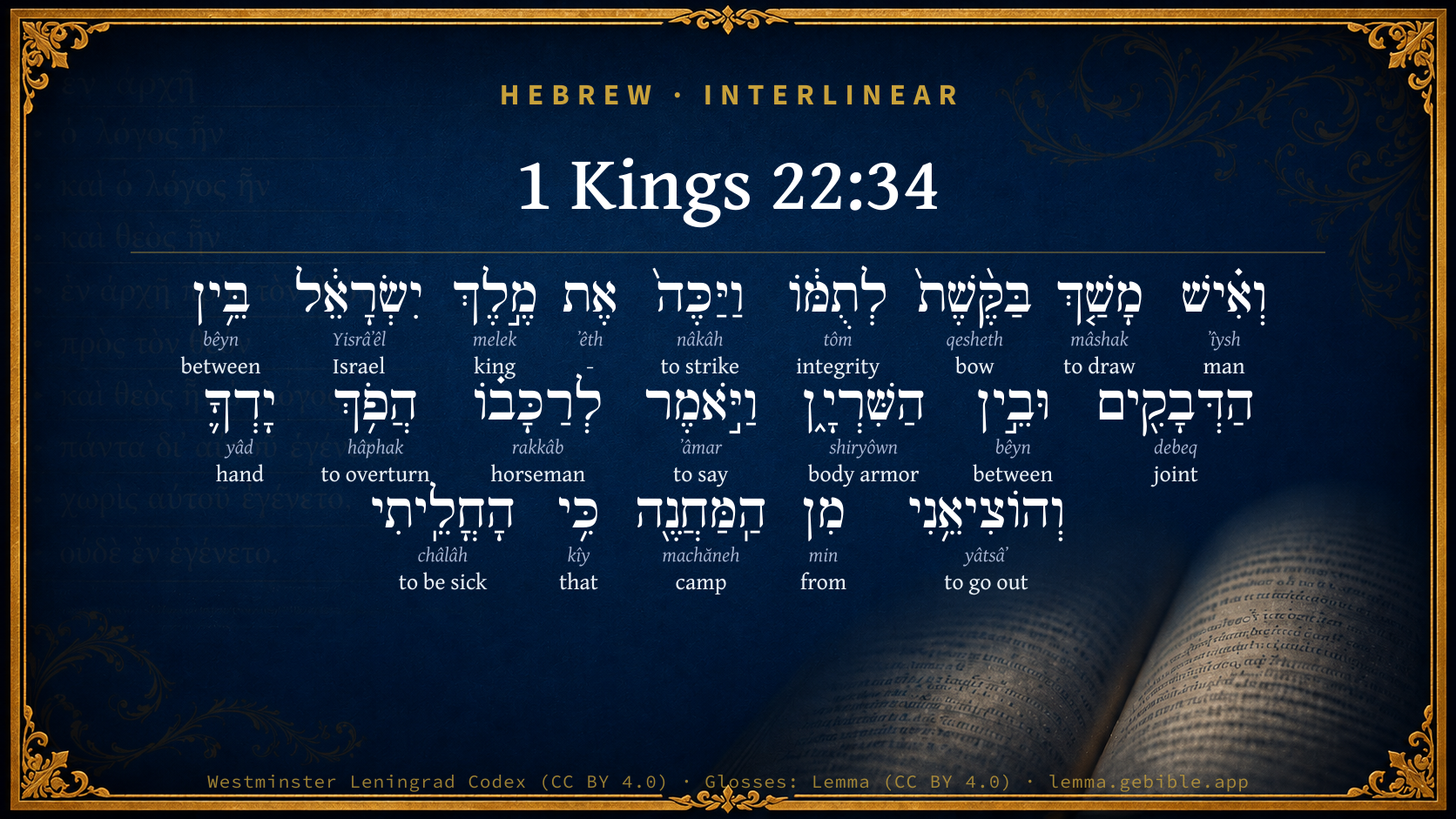
Hebrew (Westminster Leningrad Codex) 1 Kings 22:34 appears in the Hebrew Old Testament. The text above is from the Westminster Leningrad Codex. Each word links to its Strong’s number, a concise gloss, and parsing drawn from the Open Scriptures Hebrew Bible morphology. Click any word for its full Brown-Driver-Briggs (BDB) entry.
Download image
Cite this verse

1 Kings 22:34 (World English Bible). Public Domain. Lemma interlinear Bible study tool, https://lemma.gebible.app/v/1-kings/22/34.

Show BibTeX & RIS
BibTeX
RIS
English Translation
A certain man drew his bow at a venture, and struck the king of Israel between the joints of the armor: therefore he said to the driver of his chariot, Turn your hand, and carry me out of the host; for I am severely wounded.
World English Bible · Public Domain
Highlights
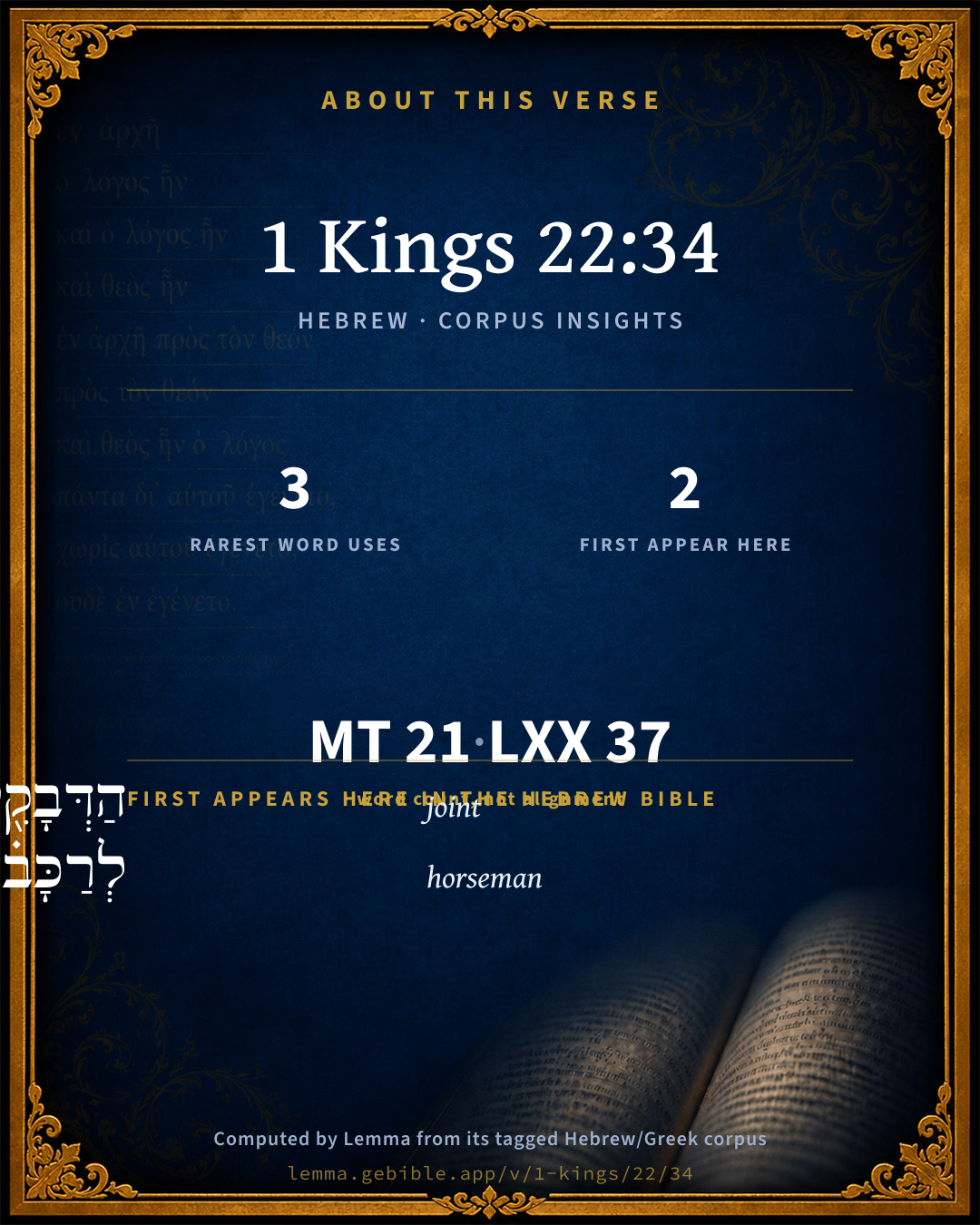
  • 2 first appearances in the Hebrew Bible
Full analysis ↓
Download a study sheet

One document with this verse’s original text, its word-by-word gloss line, the meaning frame, cross-references with their text, attributed commentary, and full source and license credits — printable, and it pastes into notes with its structure intact.

This verse Autodidact and up

Study sheet (.html) Plain text (.txt)

A passage Seminary Student

Up to 50 verses in one chapter. A passage sheet keeps up to 6 commentary sources and 12 cross-references per verse, in the order this page ranks them, and says so on the sheet whenever that leaves anything out. Ask for a single verse and you get the Autodidact verse sheet above.

Everything on this page stays free to read, with no account — the sheet is a download of what is already on screen, not access to it.

Want to remove ads? Support Godless Engineer
Compare translations 3

The same verse in 3 English versions, stacked beneath the original-language interlinear above. Click any original word for its lexicon entry.

Each is an independent rendering of the whole verse — the interlinear is not word-aligned to these translations.

Highlighted words mark where these versions differ — a whole-verse word diff, not a word-by-word alignment.

  • World English Bible Public Domain
    A certain man drew his bow at a venture, and struck the king of Israel between the joints of the armor: therefore he said to the driver of his chariot, Turn your hand, and carry me out of the host; for I am severely wounded.
  • King James Version Public Domain
    And a certain man drew a bow at a venture, and smote the king of Israel between the joints of the harness: wherefore he said unto the driver of his chariot, Turn thine hand, and carry me out of the host; for I am wounded.
  • unfoldingWord Literal Text CC BY-SA 4.0
    But a man drew with the bow in his innocence, and he struck the king of Israel between the joints and between the armor. And he said to his charioteer, “Turn your hand and bring me out from the camp, for I am wounded.”

unfoldingWord Literal Text — © unfoldingWord, licensed CC BY-SA 4.0. Word-aligned USFM3 via Door43 (git.door43.org/unfoldingWord/en_ult).

Versions to compare (up to 4)

3 of 4 selected

Show all 18 translations

Every available English version of this verse, each an independent rendering of the whole verse.

  • World English Bible Public Domain
    A certain man drew his bow at a venture, and struck the king of Israel between the joints of the armor: therefore he said to the driver of his chariot, Turn your hand, and carry me out of the host; for I am severely wounded.
  • Berean Standard Bible Public Domain
    However, a certain man drew his bow without taking special aim, and he struck the king of Israel between the joints of his armor. So the king said to his charioteer, “Turn around and take me out of the battle, for I am badly wounded!”
  • Majority Standard Bible Public Domain
    However, a certain man drew his bow without taking special aim, and he struck the king of Israel between the joints of his armor. So the king said to his charioteer, “Turn around and take me out of the battle, for I am badly wounded!”
  • King James Version Public Domain
    And a certain man drew a bow at a venture, and smote the king of Israel between the joints of the harness: wherefore he said unto the driver of his chariot, Turn thine hand, and carry me out of the host; for I am wounded.
  • American Standard Version (1901) Public Domain
    And a certain man drew his bow at a venture, and smote the king of Israel between the joints of the armor: wherefore he said unto the driver of his chariot, Turn thy hand, and carry me out of the host; for I am sore wounded.
  • Revised Version (1885) Public Domain
    And a certain man drew his bow at a venture, and smote the king of Israel between the joints of the harness: wherefore he said unto the driver of his chariot, Turn thine hand, and carry me out of the host; for I am sore wounded.
  • Geneva Bible (1599) Public Domain
    Then a certaine man drewe a bow mightily and smote the King of Israel betweene the ioyntes of his brigandine. Wherefore he sayde vnto his charet man, Turne thine hand and cary me out of the hoste: for I am hurt.
  • Douay-Rheims (1899) Public Domain
    And a certain man bent his bow, shooting at a venture, and chanced to strike the king of Israel between the lungs and the stomach. But he said to the driver of his chariot: Turn thy hand, and carry me out of the army, for I am grievously wounded.
  • Young's Literal Translation Public Domain
    And a man hath drawn with a bow, in his simplicity, and smiteth the king of Israel between the joinings and the coat of mail, and he saith to his charioteer, `Turn thy hand, and take me out from the camp, for I have become sick.'
  • Literal Standard Version CC BY-SA 4.0
    And a man has drawn with a bow in his simplicity, and strikes the king of Israel between the joinings and the coat of mail, and he says to his charioteer, “Turn your hand, and take me out from the camp, for I have become sick.”
  • Unlocked Literal Bible CC BY-SA 4.0
    But a certain man drew his bow at random and shot the king of Israel between the joints of his armor. Then Ahab said to the driver of his chariot, “Turn around and carry me out of the battle, for I am badly wounded.”
  • unfoldingWord Literal Text CC BY-SA 4.0
    But a man drew with the bow in his innocence, and he struck the king of Israel between the joints and between the armor. And he said to his charioteer, “Turn your hand and bring me out from the camp, for I am wounded.”
  • Darby Bible Public Domain
    And a man drew a bow at a venture, and smote the king of Israel between the fastenings and the corslet. And he said to his charioteer, Turn thy hand, and drive me out of the camp; for I am wounded.
  • World Messianic Bible Public Domain
    A certain man drew his bow at random, and struck the king of Israel between the joints of the armor. Therefore he said to the driver of his chariot, “Turn around, and carry me out of the battle, for I am severely wounded.”
  • Webster's Bible Public Domain
    And a certain man drew a bow at a venture, and smote the king of Israel between the joints of the harness: wherefore he said to the driver of his chariot, Turn thy hand, and carry me out of the host; for I am wounded.
  • Free Bible Version CC BY-SA 4.0
    However, an enemy archer shot an arrow at random, hitting the king of Israel between the joints of his armor by his breastplate. The king told his charioteer, “Turn around and get me out of the fight, because I've been wounded!”
  • Bible in Basic English Public Domain
    And a certain man sent an arrow from his bow without thought of its direction, and gave the king of Israel a wound where his breastplate was joined to his clothing; so he said to the driver of his war-carriage, Go to one side and take me away out of the army, for I am badly wounded.
  • JPS Tanakh (1917) Public Domain
    And a certain man drew his bow at a venture, and smote the king of Israel between the lower armour and the breastplate; wherefore he said unto the driver of his chariot: 'Turn thy hand, and carry me out of the host; for I am sore wounded.'

Literal Standard Version (2020), Covenant Press — licensed CC BY-SA 4.0. Text via the HelloAO Bible API (eBible.org). Unlocked Literal Bible (unfoldingWord) — licensed CC BY-SA 4.0. Text via the HelloAO Bible API (eBible.org). unfoldingWord Literal Text — © unfoldingWord, licensed CC BY-SA 4.0. Word-aligned USFM3 via Door43 (git.door43.org/unfoldingWord/en_ult). Free Bible Version, Dr. Jonathan Gallagher — licensed CC BY-SA 4.0. Text via the HelloAO Bible API (eBible.org).

Word by word

More ways to search: Search by grammar → Find every occurrence → Compare this word →

Practice this passage: Drill this verse → Learn its vocabulary →

הַדְּבָקִ֖ים
debeq
H1694
“the · joints”
Particle, Definite Article + Noun, Common, Masculine, Plural, Absolute
Part of Speech
Particle + Noun
Type
Common
Gender
Masculine
Number
Plural
State
Absolute
Full BDB Definition

Origin: from H1692

TWOT: 398a

joints, soldering, joining, appendage - joining, soldering, riveting - appendage, open joints of a breastplate
  1. וְאִ֗ישׁ ʼîysh H376 “and · man” Conjunction + Noun, Common, Masculine, Singular, Absolute
  2. מָשַׁ֤ךְ mâshak H4900 “to draw” Verb, Qal, Perfect, 3rd Person, Masculine, Singular
  3. בַּקֶּ֨שֶׁת֙ qesheth H7198 “in/at the · bow” Preposition, Determined + Noun, Common, Feminine, Singular, Absolute
  4. לְתֻמּ֔וֹ tôm H8537 “to/for · integrity · his” Preposition + Noun, Common, Masculine, Singular, Construct + Suffix, Personal, 3rd Person, Masculine, Singular
  5. וַיַּכֶּה֙ nâkâh H5221 “and · to strike” Conjunction + Verb, Hiphil, Sequential Imperfect, 3rd Person, Masculine, Singular
  6. אֶת ʼêth H853 “-” Particle, Direct Object
  7. מֶ֣לֶךְ melek H4428 “king of” Noun, Common, Masculine, Singular, Construct
  8. יִשְׂרָאֵ֔ל Yisrâʼêl H3478 “Israel” Noun, Proper
  9. בֵּ֥ין bêyn H996 “between” Preposition
  10. וּבֵ֣ין bêyn H996 “and · between” Conjunction + Preposition
  11. הַשִּׁרְיָ֑ן shiryôwn H8302 “the · body armor” Particle, Definite Article + Noun, Common, Both, Singular, Absolute
  12. וַיֹּ֣אמֶר ʼâmar H559 “and · to say” Conjunction + Verb, Qal, Sequential Imperfect, 3rd Person, Masculine, Singular
  13. לְרַכָּב֗וֹ rakkâb H7395 “to/for · horseman · his” Preposition + Noun, Common, Masculine, Singular, Construct + Suffix, Personal, 3rd Person, Masculine, Singular
  14. הֲפֹ֥ךְ hâphak H2015 “overturn” Verb, Qal, Imperative, 2nd Person, Masculine, Singular
  15. יָדְךָ֛ yâd H3027 “hand · your” Noun, Common, Both, Singular, Construct + Suffix, Personal, 2nd Person, Masculine, Singular
  16. וְהוֹצִיאֵ֥נִי yâtsâʼ H3318 “and · go out · me” Conjunction + Verb, Hiphil, Imperative, 2nd Person, Masculine, Singular + Suffix, Personal, 1st Person, Common, Singular
  17. מִן min H4480 “from” Preposition
  18. הַֽמַּחֲנֶ֖ה machăneh H4264 “the · camp” Particle, Definite Article + Noun, Common, Both, Singular, Absolute
  19. כִּ֥י kîy H3588 “that” Conjunction
  20. הָחֳלֵֽיתִי châlâh H2470 “to be sick” Verb, Hophal, Perfect, 1st Person, Common, Singular

About this verse

These counts appear in no published source. They are computed here, from the morphology-tagged text and Lemma’s own curated glosses. What Lemma adds →

21
words
20
distinct lemmas
Historical
section

Notable vocabulary

The rarest word here is הַדְּבָקִ֖ים joint H1694 — appearing just 3 times in the whole Hebrew Bible.

First appearance in Scripture

These words make their first canonical appearance in the Hebrew Bible here:

  • הַדְּבָקִ֖ים joint H1694
  • לְרַכָּב֗וֹ horseman H7395

Shared distinctive vocabulary

הַדְּבָקִ֖ים joint H1694 occurs in 3 verses of the Hebrew Bible. Also found in:

Grammatical profile

  • 6 verbs
  • 10 nouns
  • 3 prepositions
  • 1 conjunction
  • 1 particle

Verb forms

  • מָשַׁ֤ךְ Qal · Perfect
  • וַיַּכֶּה֙ Hiphil · Sequential Imperfect
  • וַיֹּ֣אמֶר Qal · Sequential Imperfect
  • הֲפֹ֥ךְ Qal · Imperative
  • וְהוֹצִיאֵ֥נִי Hiphil · Imperative
  • הָחֳלֵֽיתִי Hophal · Perfect

Repetition

A word recurs within this verse — often emphatic in Hebrew:

  • בֵּ֥ין between H996 ×2

Hebrew & Septuagint length

In English translation the verse runs 45 words from the Hebrew and 42 from the Septuagint (LXX English) — closely comparable.

A rough comparison of the two English renderings, which tokenize alike — not a word-level alignment.

Word counts can differ between the Hebrew and the Greek without any difference in meaning — e.g. the Hebrew direct-object marker אֵת has no separate Greek word, and Greek often adds the article ὁ.

In the original languages it is 21 Hebrew tokens and 37 Greek tokens — but the two are counted differently (Hebrew bundles its prefixes and suffixes into one token; the Greek is in lemma form), so that isn’t a like-for-like length.

Cross-references

7

Topical passages linked to 1 Kings 22:34 in the Treasury of Scripture Knowledge — connected by theme and wording, ordered by reader-vote popularity; previews shown in the World English Bible.

  • 2 Chronicles 35:23 The archers shot at king Josiah; and the king said to his servants, Have me away; for I am sore wounded.
  • Micah 6:13 Therefore I also have struck you with a grievous wound. I have made you desolate because of your sins.
  • 1 Samuel 17:49 David put his hand in his bag, and took there a stone, and slang it, and struck the Philistine in his forehead; and the stone sank into his forehead, and he fell on his face to the earth.
  • Revelation 9:9 They had breastplates, like breastplates of iron. The sound of their wings was like the sound of chariots, or of many horses rushing to war.
  • 2 Samuel 15:11 With Absalom went two hundred men out of Jerusalem, who were invited, and went in their simplicity; and they didn't know anything.
  • 2 Kings 9:24 Jehu drew his bow with his full strength, and struck Joram between his arms; and the arrow went out at his heart, and he sunk down in his chariot.
  • 2 Chronicles 18:30 Now the king of Syria had commanded the captains of his chariots, saying, Fight neither with small nor great, save only with the king of Israel.

Cross-references courtesy of OpenBible.info (CC BY 4.0).

Hebrew and Greek witnesses Masoretic Hebrew ↔ Greek Septuagint

The same verse in the two great witnesses to the Old Testament, shown verse-for-verse.

These are two independent witnesses, not word-aligned to each other, and the Septuagint is shown in lemma (dictionary) form.

Hebrew 1 Kings 22:34 Masoretic · Westminster Leningrad Codex

וְאִ֗ישׁ מָשַׁ֤ךְ בַּקֶּ֨שֶׁת֙ לְתֻמּ֔וֹ וַיַּכֶּה֙ אֶת מֶ֣לֶךְ יִשְׂרָאֵ֔ל בֵּ֥ין הַדְּבָקִ֖ים וּבֵ֣ין הַשִּׁרְיָ֑ן וַיֹּ֣אמֶר לְרַכָּב֗וֹ הֲפֹ֥ךְ יָדְךָ֛ וְהוֹצִיאֵ֥נִי מִן הַֽמַּחֲנֶ֖ה כִּ֥י הָחֳלֵֽיתִי

A certain man drew his bow at a venture, and struck the king of Israel between the joints of the armor: therefore he said to the driver of his chariot, Turn your hand, and carry me out of the host; for I am severely wounded.

World English Bible · Public Domain

Greek LXX 1 Kings 22:34 Septuagint · lemma form

καί ἐντείνω εἷς ὁ τόξον εὐστόχως καί πατάσσω ὁ βασιλεύς ἰσραήλ ἀνά μέσος ὁ πνεύμων καί ἀνά μέσος ὁ θώραξ καί εἶπον ὁ ἡνίοχος αὐτός ἐπιστρέφω ὁ χείρ σύ καί ἐκἄγω ἐγώ ἐκ ὁ πόλεμος ὅτι τιτρώσκω

And one drew a bow with a good aim, and struck the king of Israel between the lungs and the breast-plate: and he said to his charioteer, Turn your hands, and carry me away out of the battle, for I am wounded.

LXX2012 (modern English Septuagint) · Public Domain

On this verse, The Cambridge Bible for Schools and Colleges discusses the Septuagint’s reading. Read the note in Commentary ↓

Hebrew: Westminster Leningrad Codex (CC BY 4.0). Greek: Septuagint (public domain); English from LXX2012 (modern English Septuagint) (Public Domain). How the Septuagint differs from the Hebrew →

Targum (Aramaic paraphrase)

1

The Targum is the ancient Jewish Aramaic paraphrase of the Hebrew Scriptures — an interpretive translation, not the Hebrew text itself. Onkelos (literal) and Pseudo-Jonathan (expansive) render the Torah, and Jonathan the Prophets. Coverage is partial: where no permissively-licensed English translation exists for a verse, only the Aramaic is shown. This is verse-level text, not a word-by-word alignment to the Hebrew.

  1. Targum Jonathan Prophets (Joshua–Malachi)
    וְגַבְרָא נְגַד בְּקַשְׁתָּא לְקִבְלֵיהּ וּמְחָא יַת מַלְכָּא דְיִשְׂרָאֵל בֵּין דִבְקֵי וּבֵין שִׁרְיָנָא וַאֲמַר לְמַרְכַּבְנֵיהּ אִתְחֲזַר לַאֲחוֹרָךְ וְאַפֵּיקְנִי מִן מַשְׁרִיתָא אֲרֵי מְרַע אֲנָא:

    (no public-domain English translation for this verse)

    Targum Jonathan — Aramaic: “Mikraot Gedolot” (public domain). English: “Sefaria Community Translation” (CC0 1.0 (public-domain dedication)); “London "Chaldee Paraphrase," 1871” (public domain). Text via Sefaria.

Commentary

Notes on 1 Kings 22:34 from classic Christian and Jewish commentators (each source and its license shown beneath its notes). The classic Christian expositions comment on the surrounding passage and are grouped to its opening verse, so a note may address several verses; the Jewish commentaries on the Tanakh (Rashi and others) are per-verse, so they appear only where the commentator wrote on this verse.

Lemma curates 59 commentaries, every one of them public domain or Creative Commons licensed, each selected and text-cleaned for this edition rather than reprinted as found. About our sources →

Trapp's Complete Commentary

John Trapp

1Ki 22:34 And a [certain] man drew a bow at a venture, and smote the king of Israel between the joints of the harness: wherefore he said unto the driver of his chariot, Turn thine hand, and carry me out of the host; for I am wounded.

Ver. 34. Drew a bow at a venture.] Heb., In his simplicity, or with all his might; as did also that cursed cuirassier {heavily armed cavalry soldier}, that killed the late gallant king of Sweden, whom yet he knew but too well, saying when he shot him, This is the right bird.

For I am wounded.] Heb., Made sick. And now what joy could Ahab’s black soul, ready to depart, have of his ivory house? Who had not rather be a Micaiah in the jail than Ahab in the chariot? Wicked men have the advantage of the way, godly men of the end.

John Trapp, A Commentary or Exposition upon All the Books of the Old and New Testament (1647–1656) — public domain. Text from a community e-Sword module.

The Biblical Illustrator

Joseph S. Exell

1Ki_22:34

A certain man drew a bow at a venture.

Providence in accidents

I. The lords hand is concerned in those events which have the appearance of being wholly accidental, and of happening by chance or luck. The man who drew the bow by which the King of Israel received his death, drew it, as our text says, at a venture. He took no aim whatever. Men talk of chance, and luck, and fate, and accident, as if there was not a God that ruled the world. And some even pretend to think that it is doing a kind of dishonour to the Lord to suppose that He interferes in the events of life, beyond, perhaps, a mere general oversight or superintendence. But what says the Scripture? What says the Lord Himself of His own doings and appointments? He tells us that His hand is everywhere. He tells us that not a sparrow falleth to the ground without Him--that when the lot is cast into the lap, yet the whole disposal thereof is of Him.

II. God is true to his own threatenings. Look back into the former verses of this chapter, and you will find King Ahab was expressly warned of God that he should fall at Ramoth-Gilead, and that he should not return at all in peace. Men may encourage themselves in an evil matter; they may go on still in evil courses, with a most assured persuasion that their sins shall be unpunished; but true, nevertheless, is that word of the Lord which He hath spoken--The wages of sin is death. God shall shoot at them with an arrow; suddenly shall they be wounded.

III. That there is no fencing ourselves against the stroke of God by any efforts or devices of our own. Ahab, seeming, as he did, to hold Gods threatenings cheap, yet had some apprehensions notwithstanding. He who made you can make His weapon to approach unto you, and that all self-defences are in vain! There is a spiritual arrow, very strong and sharp, which may be called the arrow of conviction, and which consists in the bringing home a sense of guilt and danger to the sinners conscience. Let us consider such a case as this--a case where the arrow of conviction has come home to a mans heart through the power of the Holy Ghost. The spiritual wound which this poor sinner has received is grievous. Blessed be God! it is not like that of Ahab, hopeless and incurable. There is balm in Gilead, and there is a Physician there. That very Lord who made the preaching of His law so sharp and piercing--who made the arrow of conviction strike so deep, can heal as well as wound. He hath provided in His gospel a cure for the transgression of His law. To bind up the broken-hearted, to provide a precious remedy for dying sinners, was the errand of the Son of God when He visited our world. (A. Roberts, M. A.)

A bow at a venture

I. Where all is venture men act as if all were certain. Strong probability is not certainty.

1. No parent is certain that his child shall live to need the education he gives it.

2. No working man is certain that he shall require the provision he has made for a rainy day.

3. No merchant is certain of reaching that wealth with honour for which he toils. Yet the parent, the working man, and the merchant act as reasonable and responsible agents. Still, we have no certainty as to the result of any act viewed apart from its moral element. Thus viewed, however, all is certainty.

II. Where all is certain men act as if all were venture.

1. As a man sows morally, so shall he also reap; not necessarily from his fellow-men, but from God, in the harvest field of his own soul, etc. Experience, etc.

2. The most wicked deed ever perpetrated was first a thought. The accumulative force of moral evil is a certainty. Yet men lust as if lust would never bring forth; and covet as if covetousness never issued in actual theft, etc.

3. The Gospel is a certainty alike in its promises and its threatenings.

III. Deduce some practical lessons.

1. Be not afraid to draw a bow at a venture for the sake of Christ.

2. Be careful of all bows at a venture which are not for Christs sake. (The Study.)

Venture in Christian work

There is one recent example, vouched for by Miss Pratt of the Bible School, Yokohama. During the Chino-Japanese war a trainload of soldiers was passing the village of Suzakawa, and one of them tossed a copy of the Japanese gospels into the open window of a house. Through that single book, the owner of the house and his whole family have become Christians. (T. H. Darlow.)

The joints of the harness.--

Joints of the harness

We have here suggested the strength and the weakness of our defensive spiritual armour. We do not now refer to what St. Paul meant by the whole armour of God, so much as to a humanly framed defensive system of rules and principles and habits which is necessary to protect us during this exposed earthly life.

I. We may arm ourselves against the world by placing restrictions upon our intercourse with its social life. If specially susceptible to worldly influences, we may wisely make it a rule to keep absolutely clear from all its pleasant things in which any temptation can lurk; or we may allow ourselves some degree of liberty, which, however, we restrict by some rule or clearly drawn line beyond which we will not go. This is good defensive armour, but it will not make us invulnerable. No formal, outward separation from the world can absolutely shut out the spirit of the world. The armour of our restrictions may keep out the world bodily, so to speak; but the very trust we place in such armour may open the way for some arrow from the bow of the archer.

II. We may arm ourselves against the worldly influences which touch us through our necessary intercourse with the world--as, for instance, in our business relations with men--by joining regularly in religious services and Christian work. In business hours our life is on the open ground, where we are exposed to every temptation. But in the sanctuary of God what can harm us? It is surely from the standpoint of the sanctuary that we get our true ideals of lifes duties and aims, and that all the weak things about us are seen. It is there that faith can see and realise Divine things most clearly, and heaven seems so near, and the things of earth so small and poor. But religious services and activities will not necessarily make us safe. The archer is subtle, and has many devices.

III. We may further defend ourselves by an armour of religious habits. There is great strength and protection in habits as distinguished from fitful, varying acts. Let us keep our armour of defence as perfect as we can. Do not undervalue it because it is dangerous to overvalue it. Let the sense of weakness make us humble and watchful. Let us remember that there are places, books, company, and habits which should be labelled dangerous. The wise man will not court danger, but will flea from it. (Thomas Wilde.)

The Biblical Illustrator, edited by Joseph S. Exell (c. 1880s–1900s) — public domain. Text from a community e-Sword module.

Joseph Benson's Commentary

1Ki 22:34. A certain man drew a bow at a venture — Shot at a venture among the army, without care, or choice, or any design of reaching Ahab, or any particular person; and smote the king of Israel between the joints of the harness — Where the several parts of his armour were joined together; the only place about him where this arrow of death could find entrance. No armour is proof against the darts of divine vengeance. Case the criminal in steel, and it is all one; he that made him can make his sword approach him. And that which to us seems altogether casual, comes by the determined counsel of God.

Joseph Benson's Commentary on the Old and New Testaments (1811–1818) — public domain. Text from a community e-Sword module.

Tyndale Open Study Notes

Tyndale Open Resources

22:34-36 An Aramean soldier’s random shot fulfilled Micaiah’s prophecy about Ahab’s death. Ancient armor discovered during excavations in the Near East suggests that the arrow would have found a small unprotected area between the breastplate and the metal platelets that comprised the lower armor. Although he was badly wounded, Ahab displayed courage by remaining propped up in his chariot throughout the course of the day’s battle before calling for retreat.

Tyndale Open Study Notes — © Tyndale Open Resources, licensed CC BY-SA 4.0. Text via the HelloAO Bible API.

Geneva Bible (1599)

Geneva Bible translators

Hebrew, and between the brigandine.

Hebrew, sick.

Or, in his simplicity, and ignorantly.

Geneva Bible (1599) marginal notes — public domain. Text via Bolls.life.

Adam Clarke's Commentary

Verse 34. Drew a bow at a venture] It is supposed that he shot, as the archers in general did, not aiming at any person in particular.

The word לתמו lethummo, which we translate in his simplicity, has been variously understood; in his integrity, his uprightness; in his perfection; i.e., to the utmost of his skill and strength. This is most probably the meaning; and may imply both aim and power, having his butt full in view. In cases where the archers wished to do the greatest execution, they bent their bows, and pulled till the subtending string drew back the arrow up to its head. This they could not do always, because it required their whole strength; and they could not put forth their utmost effort each time and continue to discharge many shots. Our old national ballad of the Chevy-chace mentions the slaying of Sir Hugh Montgomery, who had slain Earl Percy, in nearly the same way that Ahab appears to have been shot: -

"And thus did both these nobles die,

Whose courage none could stain:

An English archer then perceived

His noble lord was slain,

Who had a bow bent in his hand

Made of a trusty tree;

An arrow, of a cloth-yard long,

Up to the head drew he;

Against Sir Hugh Montgomery then

So right his shaft he set,

The gray goose wing that was thereon

In his heart's blood was wet."

Between the joints of the harness] "Between the cuirass and the lower part of the helmet;" and then the arrow must pass through the neck, just above the breast: or "between the cuirass and the cuissarts;" and then the arrow must pass through the abdomen, or just where the armour of the thighs joins to that which covers the breast and belly.

The Vulgate has Inter pulmonem et stomachum; "Between the lungs and the stomach;" consequently, in the region of the heart.

Adam Clarke's Commentary on the Bible (1810–1826) — public domain. Text from a community e-Sword/MySword module.

Ellicott's Commentary for English Readers

(34) A certain man.—Josephus says, “a young man named Naaman.” (Comp. 2Ki_5:1 : “because by him the Lord had given deliverance to Syria.”)

The driver of his chariot.—In the Egyptian and Assyrian monuments, as subsequently in the Greek of the Homeric days, the war-chariot holds but two, the warrior and the charioteer. This is the first place where the chariot, introduced by Solomon from Egypt (1Ki_10:29), is mentioned as actually used in war. (See subsequently, 2Ki_9:16; 2Ki_9:21; 2Ki_23:30; and compare the proverbial expression of this period, “The chariot of Israel and the horsemen thereof,” 2Ki_2:12; 2Ki_13:14.)

A Bible Commentary for English Readers, edited by Charles John Ellicott (1878–1897) — public domain. Text from a community e-Sword module.

The Cambridge Bible for Schools and Colleges

gen. ed. J. J. S. Perowne

34. And a certain man] Josephus has given him a name. ‘A certain youth of the royal family of Adad [i.e. Ben-hadad] whose name was Aman.’ ‘Fate, the inevitable,’ he says, ‘found Ahab out even without his robes.’

drew a bow [R.V. his bow] at a venture] The noun is definite in form in the Hebrew, so that the change is necessary. The word rendered ‘at a venture’ is translated in other places, and on the margin of A.V. and R.V. ‘in his simplicity.’ It is also rendered ‘in his integrity’ (Pro_19:1) and ‘in his uprightness’ (Pro_28:6). The idea appears to be that the man taking aim at some one, was quite unaware at whom he was shooting. He levelled at some enemy and hit him, not knowing how he had contributed to the victory. ‘At a venture’ must therefore not be taken to mean ‘a shot at random.’ The LXX. εὐστόχως ‘with good aim’ is a conjecture.

between the joints of the harness] The margins of R.V. ‘between the lower armour and the breastplate’ and of A.V. ‘between the joints and the breastplate’ help us to understand what is meant. The former word, rendered ‘joints,’ indicates that part where the breastplate terminated and where the lower armour commenced. A part of the body would there necessarily be less securely protected.

wherefore he said unto the driver of his chariot] He would not wish to spread alarm among his soldiers, and so made his retreat without observation.

I am wounded] R.V. sore wounded. The literal rendering ‘made sick’ which is given on the margin of A.V. implies more than an ordinary wound. The translation ‘sore wounded’ is from 2Ch_35:23 (A.V.). Perhaps Ahab employed the word, which might have a certain vagueness, that the charioteer should not spread an alarm. For the driver knew of course who it was whom he was carrying.

The Cambridge Bible for Schools and Colleges (gen. ed. J. J. S. Perowne; Cambridge University Press, 1878–1918) — public domain. Text from a community e-Sword module.

John Gill's Exposition

And one washed the chariot in the pool of Samaria,.... After the body was taken out, very likely the chariot driver, who drove it into the pool, and plunged it into it, as the word signifies, to cleanse it from the blood of his master:

and the dogs licked up his blood; mixed with the water of the pool; the Septuagint adds, "the swine", which is not probable, such creatures not being bred in the land of Israel:

and they washed his armour; his coat of mail, through the joints of which the blood issued, and ran upon it. The word is sometimes used for whores, and is so translated here in the Greek version, and by Munster and Castalio; and both Ben Gersom and Abarbinel say, that women, who were harlots, washed here in his blood, mixed with water; and so Josephus (u) writes, that afterwards it was a custom for whores to wash in this pool; though some say (w) two whores were painted on Ahab's chariot, by the order of Jezebel, to inflame his lust, and these were what were washed; but the word signifies armour, or rather ornaments, clothes, jewels, &c.

and now all this was according to the word of the Lord which he spake; both by Elijah, that as the dogs licked the blood of Naboth, so they should his, as they now did, though not in the same place; nor was it necessary to fulfil the prophecy; see Gill on Kg1 21:19, though some have thought (x) that his blood, mixed with the water of the pool of Samaria, was carried in a stream down to Jezreel, and there licked by the dogs, where Naboth's was; but chiefly what was spoken by Micaiah is here respected, that thus Ahab fell at Ramothgilead, as he had prophesied, Kg1 22:17 and his life went for the life of Benhadad, as he had before declared, Kg1 20:42.

(u) Antiqu. l. 8. c. 15. sect. 6. (w) See Jarchi & Kimchi in loc. (x) Kimchi in loc.

John Gill's Exposition of the Whole Bible (1746–1763) — public domain (CC PDM 1.0). Text via the HelloAO Bible API.

Albert Barnes' Notes on the Bible

At a venture - literally, as in the margin, i. e. without intent to kill the king.

Between the joints of the harness - literally, as in the margin. The “joints” were probably pieces of armor which attached the breast-plate to the helmet or to the greaves. The arrow entered between the breastplate and one of these “joints.” breastplates made of metal scales were common both in Egypt and Assyria.

Turn thine hand - literally, “turn thy hands.” The driver of a chariot, both in Egypt and Assyria, held the reins with his two hands.

Albert Barnes' Notes on the Bible (1834–1885) — public domain. Text from a community e-Sword/MySword module.

Haydock's Catholic Bible Commentary

Stomach. Paralipomenon, between the neck and the shoulders. The arrow went in at the lungs, and came out at the shoulders, as it was shot from a lower ground. (Menochius) --- Some explain the Hebrew, "between the joints and the coat of mail." Protestants, "joints of the harness." Septuagint, "between the lungs and the thorax." (Haydock) --- Syriac, "between the juncture of the coat of mail," where it is connected with the armour of the thighs. (Grotius) --- God directed the random shot. (Salien) (Worthington) --- Hand. It was deemed unbecoming for the king to touch the reins. (Diodorus, Sic. xvii.; Brisson iii. p. 383.)

George Leo Haydock (1774–1849), Haydock's Catholic Family Bible and Commentary, 1859 edition — public domain. Excludes Psalms (Douay-Rheims chapter numbering differs from Protestant) and Deuterocanonical books (Catholic canon only).

Matthew Poole's English Annotations

At a venture, Heb. in simplicity, i.e. ignorantly, without care, or choice, or any design, or thought of reaching Ahab. Or, according to his perfection, i.e. with his perfect or utmost strength; which is mentioned as the reason why it pierced through the joints of his armour.

Between the joints of the harness; where the several parts of his armour are joined together; which possibly were not then joined with so much art and closeness as now they are.

Out of the host; out of the midst of the host, where the heat of the battle was, into a safer part of the army. See 1Ki 22:35.

Matthew Poole's English Annotations on the Holy Bible (1683–1685) — public domain. Text from a community e-Sword/MySword module.

Whedon's Commentary on the Bible

Daniel D. Whedon

34. A certain man — Josephus says he was a young nobleman whose name was Naaman; the same, perhaps, who afterwards became a leper and was healed by Elisha. See note on 2Ki_5:1.

At a venture — This is not a proper rendering. The Hebrew is לתמו, in his innocence; in his simplicity; that is, without any evil intent, and not expecting to strike so sacred a mark as the king. The thought is, not that he shot at random, but that he had no thought that the man at whom he aimed was Ahab.

Between the joints of the harness — Margin, joints and the breastplate. But to speak of smiting between the joints and a part of the armour is strange, and to render joints of the harness or breastplate is not allowable. The word rendered harness is coat of mail, on which see note at 1Sa_17:5. The word rendered joints, Bahr explains as a hanging skirt, which protected the lower part of the body, and understands that the arrow penetrated between these two parts of the king’s armour, and entered the lower part of the abdomen.

Daniel D. Whedon (gen. ed.), Commentary on the Old and New Testaments (1874–1909) — public domain. Text from a community e-Sword module.

The Pulpit Commentary

And a certain man Heb. a man. It was natural for some of the Rabbins to identify this archer with Naaman the tradition is found in Josephus. But it is directly contrary to the spirit of the narrative to attempt to identify him. As it was a chance arrow, so it was by an unknown archer drew a bow at a venture Heb. in his simplicity, i.e., with no intention of shooting Ahab: not knowing what he was doing. That this is the meaning is clear from the use of the words in 2Sa_15:11, and smote the king of Israel between the Joints of the harness The marg., joints and the breastplate, comes nearer the Hebrew. But it is clear that the rendering joints, notwithstanding that it has the support of Gesenius and others, is a mistaken one. "In the joints" we can understand, but "between the joints and the coat of mail," gives no sense. It is obvious that like yrVih following, must signify, some portion of the armour, and the meaning of the verb qb"d; , adhaesit, leads us to conclude that "the hanging skirt of parallel metal plates hence the plural (Bahr) is intended. The coat of mail only covered the breast and ribs. To this a fringe of movable plates of steel was attached or fastened, hence called d. So Luther, Zwischen den Panzer und Hengel. One is reminded here of the Parthian arrow which wrung from Julian the Apostate the dying confession, "Thou hast conquered, O Galilean." (Cf.: Psa_7:13, Psa_7:14) wherefore he said unto the driver of his chariot, Turn thine hand or, according to the Chethib, hands. The charioteers of Palestine, like those of Egypt and Assyria, or those of modern Russia, held a rein in each hand. Same expression 2Ki_9:23. The meaning is "turn round" and carry me Out of the host; for I am wounded, Heb. made sick. The king probably felt his wound to be mortal, as a wound in such a part, the abdomen (cf., 2Sa_2:23 2Sa_3:27 2Sa_20:10) would be Vulgate, graviter vulneratus sum. How far an arrow in such a place could penetrate, we may gather 2Ki_9:24; cf. Job_16:13. And he was seemingly anxious that the army should not know it, lest would soon discover it if he remained with the host; he can fight no longer; his wound needs attention; hence this command. It is quite possible that the charioteer, in the din and confusion of battle, may not have observed that his master was wounded. The arrow had not struck any part of the armour.

HOMILIES BY A. ROWLAND Ver. 34.

The Pierced Armour.

This occurred during the third campaign of Ben-hadad against Israel. Micaiah had forewarned Ahab against the danger he incurred, and was cast into prison for his pains. The warning was, however, taken sufficiently to heart to induce the king to disguise himself. Describe the expedient adopted, and its remarkable failure. Ahab was in many respects a typical sinner. He was an idolater, a persecutor, impenitent, though sometimes touched; and in the plenitude of power he fell. We see here

I A MAN ARMED AGAINST GOD. True he was fighting against the Syrians, but as he girded on his armour he remembered and defied the words of the prophet. His ominous prophecy should not be fulfilled, he would yet come back safe and victorious to put Macaiah to death, and with this determination he put Jehoshaphat in command, and clad himself with proof armour. In spirit, therefore, he was fighting not only against the hosts of Syria, but against the word of God. Hence let us depict one who is armed against God. Reverse the description St. Paul gives (Eph 6) of one armed by God. The impenitent sinner represented by Ahab defends himself.

1. By false hopes. (Deu_29:19, Deu_29:20) These constitute his "helmet," which wards off true thoughts of self and sin. He blindly trusts in Divine mercy, while sin is unrepented, forgetting that "a God all mercy is a God unjust" (Young). "There is none other name given under heaven whereby we may be saved," etc. "How shall we escape, if we neglect so great salvation?

2. By a hardened heart. This is his "breastplate." A man impenitent is a man lost. Some are;" past feeling," their consciences are "seared as with a hot iron," and God gives them over to their "hardness of heart," and to an "impenitent mind." "Who has hardened himself against God, and prospered?" We may become "hardened by the deceitfulness of sin.

3. By defiant words. There is a tongue which is set on fire of hell Adduce examples. Ahab defied Micaiah.

4. By an unbelieving mind. The king questioned the truth of the prophet"s message. He had more confidence in his own past success and in his military skill than in the declaration of a man who knew something of God but nothing of war. Unbelief ever prevents the inflowing of Divine goodness. Jesus "could do no mighty works because of their unbelief.

5. By a dumb spirit. No asking for pardon, no cry for mercy rose from Ahab"s heart, or it would not have proved too late; for the Lord is "not willing that any should perish.

II A MAN STRICKEN BY GOD. The chance arrow of the Syrian archer fulfilled the Divine purpose.

1. By the arrow of conviction. God"s word is sharp and powerful, and pierces even to the dividing asunder of soul and spirit, and is a discerner of the thoughts and intents of the heart.

(1) It may be shot unwittingly, as the archer drew at a venture not knowing what he might hit. Let our words for God be pointed, and be winged by faith, and He will see that they hit the mark.

(2) It may touch the one vulnerable spot. That arrow pierced "between the joints of armour" otherwise proof. So David"s stone would have fallen powerless on the greaves or the breastplate of the giant of Garb. God, who knows our hearts, tries every avenue. Through our reason, through our affections, through our conscience, His word seeks to find its way.

2. By the arrow of judgment.

(1) It was foretold (ver. 28). Ahab ran the risk. So do they who continue in sin after hearing of" a certain fearful looking for of judgment and fiery indignation, which shall devout-the adversaries.

(2) It was inevitable. All disguise and precaution were unavailing. The justice of God sooner or later reaches the right man.

(3) It was terrible. The weak, sensuous man, whose promise had sometimes been so fair, fell in a moment from kingship, from life, and from hope. "lie that being reproved hardeneth his neck, shall suddenly be destroyed, and that without often remedy. A.R.

The Pulpit Commentary (1880–1919), ed. H.D.M. Spence-Jones & Joseph S. Exell — public domain. Text from a community e-Sword module.

John Wesley's Explanatory Notes

The joints - Where the several parts of his armour were joined together. The only place about him where this arrow of death could find entrance. No armour is proof against the darts of divine vengeance. Case the criminal in steel, and it is all one: he that made him, can make his sword approach him. And that which to us seems altogether casual, comes by the determinate counsel of God.

John Wesley, Explanatory Notes Upon the Whole Bible (1754–1765) — public domain. Text via the GEBible commentary corpus.

unfoldingWord translationNotes

Door43 World Missions Community

drew his bow at random

Possible meanings are 1) he took aim to shoot a soldier without knowing that it was Ahab or 2) he drew his bow to shoot without any specific target in mind.

translationWords

bow and arrow

king

kingdom of Israel

armor

unfoldingWord translationNotes — © Distant Shores Media and the Door43 World Missions Community, licensed CC BY-SA 4.0. Source: git.door43.org/Door43/en_tn.

Rashi

Rabbi Shlomo Yitzchaki (Rashi)

A man drew. This was Naaman.

Innocently [without aiming]. He was not aware that he was the king of Yisroel.

Between the plates of armor. Some coats of mail are made of layers of scales, in the manner it is stated, “and a coat of mail,” and the scales fall on the holes of the coat and close them, and they are called “דבקים” [=attached].

Rashi on the Tanakh — English translations: “The Judaica Press complete Tanach with Rashi, translated by A. J. Rosenberg” (CC BY 4.0); “Pentateuch with Rashi's commentary by M. Rosenbaum and A.M. Silbermann, 1929-1934” (public domain); “The Metsudah Tanach series, Lakewood, N.J” (CC BY 4.0); and “The Book of Joshua, Metsudah Publications, 1997” (CC BY 4.0). Text via Sefaria.

Lesson kit

Teaching starters — assembled from the data on this page, not authored interpretation. Every prompt links to the verse data it draws on. Edit before teaching.

1 Kings, in the Historical, opens this verse with 21 words (20 distinct Hebrew lemmas). Its most distinctive word is debeq (“joint”). A historical commentator’s framing appears above. Read the whole chapter for the surrounding context.

Discussion questions

  1. How does “joint” (debeq) shape what this verse is saying?
  2. 2 words here appear for the first time in Scripture. What is being introduced at this debut?
  3. 2 Chronicles 18:33 shares the word «joint» with this verse. How do the two illuminate each other?
  4. “between” occurs 2× in this one verse. What is the effect of the repetition?
  5. The translations on this page render this verse differently — a whole-verse word diff, not a word-by-word alignment. What might account for the different wordings?
  6. The verb «מָשַׁ֤ךְ» is Qal Perfect. How does its form color the action?
  7. Reading how Trapp's Complete Commentary and The Biblical Illustrator read this verse, where do the two commentators agree and where do they part?

Things to notice

Reading settings

Reading text

Shown beneath each verse's original-language words.

Old Testament
Old Testament edition

Read the OT as the Masoretic Hebrew (MT) or the Greek Septuagint (LXX).

English shown for the Greek Septuagint (in the Hebrew ↔ Greek comparison).

Comparing translations? Open the Compare panel on any verse page to stack up to four side by side.