
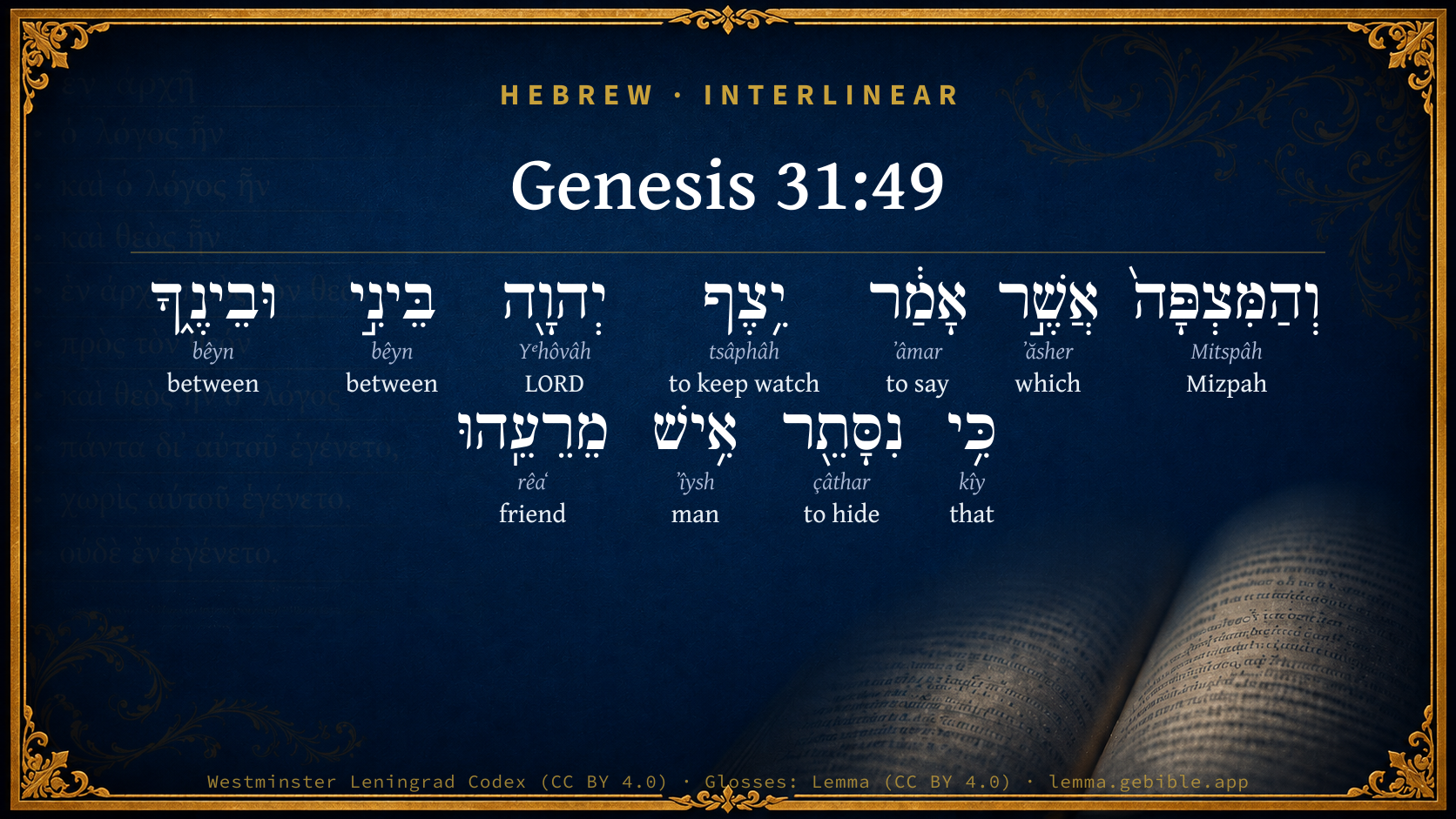
Genesis 31:49

Hebrew (Westminster Leningrad Codex) Genesis 31:49 appears in the Hebrew Old Testament. The text above is from the Westminster Leningrad Codex. Each word links to its Strong’s number, a concise gloss, and parsing drawn from the Open Scriptures Hebrew Bible morphology. Click any word for its full Brown-Driver-Briggs (BDB) entry.
Download image
Cite this verse

Genesis 31:49 (World English Bible). Public Domain. Lemma interlinear Bible study tool, https://lemma.gebible.app/v/genesis/31/49.

Show BibTeX & RIS
BibTeX
RIS
English Translation
and Mizpah, for he said, "Yahweh watch between me and you, when we are absent one from another.
World English Bible · Public Domain
Highlights
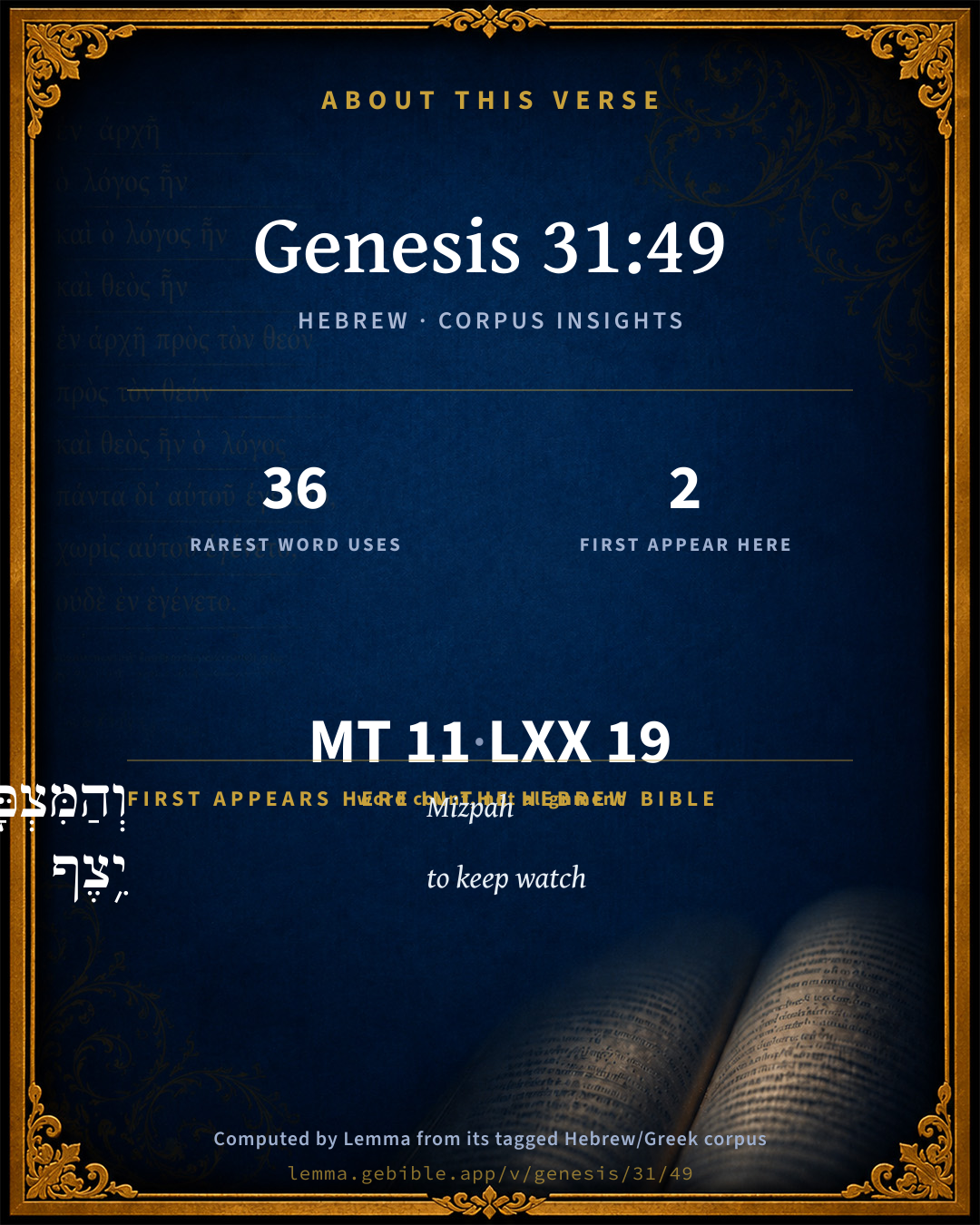
  • 2 first appearances in the Hebrew Bible
Full analysis ↓
Download a study sheet

One document with this verse’s original text, its word-by-word gloss line, the meaning frame, cross-references with their text, attributed commentary, and full source and license credits — printable, and it pastes into notes with its structure intact.

This verse Autodidact and up

Study sheet (.html) Plain text (.txt)

A passage Seminary Student

Up to 50 verses in one chapter. A passage sheet keeps up to 6 commentary sources and 12 cross-references per verse, in the order this page ranks them, and says so on the sheet whenever that leaves anything out. Ask for a single verse and you get the Autodidact verse sheet above.

Everything on this page stays free to read, with no account — the sheet is a download of what is already on screen, not access to it.

Want to remove ads? Support Godless Engineer
Compare translations 3

The same verse in 3 English versions, stacked beneath the original-language interlinear above. Click any original word for its lexicon entry.

Each is an independent rendering of the whole verse — the interlinear is not word-aligned to these translations.

Highlighted words mark where these versions differ — a whole-verse word diff, not a word-by-word alignment.

  • World English Bible Public Domain
    and Mizpah, for he said, "Yahweh watch between me and you, when we are absent one from another.
  • King James Version Public Domain
    And Mizpah; for he said, The LORD watch between me and thee, when we are absent one from another.
  • unfoldingWord Literal Text CC BY-SA 4.0
    also Mizpah, because he said, “May Yahweh watch between me and you when we are hidden one from the other.

unfoldingWord Literal Text — © unfoldingWord, licensed CC BY-SA 4.0. Word-aligned USFM3 via Door43 (git.door43.org/unfoldingWord/en_ult).

Versions to compare (up to 4)

3 of 4 selected

Show all 18 translations

Every available English version of this verse, each an independent rendering of the whole verse.

  • World English Bible Public Domain
    and Mizpah, for he said, "Yahweh watch between me and you, when we are absent one from another.
  • Berean Standard Bible Public Domain
    It was also called Mizpah, because Laban said, “May the LORD keep watch between you and me when we are absent from each other.
  • Majority Standard Bible Public Domain
    It was also called Mizpah, because Laban said, “May the LORD keep watch between you and me when we are absent from each other.
  • King James Version Public Domain
    And Mizpah; for he said, The LORD watch between me and thee, when we are absent one from another.
  • American Standard Version (1901) Public Domain
    and Mizpah, for he said, Jehovah watch between me and thee, when we are absent one from another.
  • Revised Version (1885) Public Domain
    and Mizpah, for he said, The LORD watch between me and thee, when we are absent one from another.
  • Geneva Bible (1599) Public Domain
    Also he called it Mizpah, because he said, The Lord looke betweene me and thee, when we shalbe departed one from another,
  • Douay-Rheims (1899) Public Domain
    The Lord behold and judge between us when we shall be gone one from the other.
  • Young's Literal Translation Public Domain
    Mizpah also, for he said, `Jehovah doth watch between me and thee, for we are hidden one from another;
  • Literal Standard Version CC BY-SA 4.0
    Mizpah also, for he said, “YHWH watches between me and you, for we are hidden from one another;
  • Unlocked Literal Bible CC BY-SA 4.0
    It is also called Mizpah, because Laban said, “May Yahweh watch between you and me, when we are out of sight one from another.
  • unfoldingWord Literal Text CC BY-SA 4.0
    also Mizpah, because he said, “May Yahweh watch between me and you when we are hidden one from the other.
  • Darby Bible Public Domain
    -- and Mizpah; for he said, Let Jehovah watch between me and thee, when we shall be hidden one from another:
  • World Messianic Bible Public Domain
    and Mizpah, for he said, “The LORD watch between me and you, when we are absent one from another.
  • Webster's Bible Public Domain
    And Mizpah; for he said, The LORD watch between me and thee, when we are absent one from another.
  • Free Bible Version CC BY-SA 4.0
    It was also called Mizpah, for as Laban said, “May the Lord keep a close eye on both of us when we're not together.
  • Bible in Basic English Public Domain
    And Mizpah, for he said, May the Lord keep watch on us when we are unable to see one another's doings.
  • JPS Tanakh (1917) Public Domain
    and Mizpah, for he said: 'The LORD watch between me and thee, when we are absent one from another.

Literal Standard Version (2020), Covenant Press — licensed CC BY-SA 4.0. Text via the HelloAO Bible API (eBible.org). Unlocked Literal Bible (unfoldingWord) — licensed CC BY-SA 4.0. Text via the HelloAO Bible API (eBible.org). unfoldingWord Literal Text — © unfoldingWord, licensed CC BY-SA 4.0. Word-aligned USFM3 via Door43 (git.door43.org/unfoldingWord/en_ult). Free Bible Version, Dr. Jonathan Gallagher — licensed CC BY-SA 4.0. Text via the HelloAO Bible API (eBible.org).

Word by word

More ways to search: Search by grammar → Find every occurrence → Compare this word →

Practice this passage: Drill this verse → Learn its vocabulary →

וְהַמִּצְפָּה֙
Mitspâh
H4709
“and · the · Mizpah”
Conjunction + Particle, Definite Article + Noun, Proper
Part of Speech
Conjunction + Particle + Noun
Type
Proper
Full BDB Definition

Origin: from H4708

TWOT: None

Mizpah = "watchtower" - a place in Gilead north of Jabbok and location of Laban's cairn - a place in Gilead south of Jabbok; site unknown - a place near Mount Hermon - an old sacred place in Benjamin
  1. אֲשֶׁ֣ר ʼăsher H834 “which” Particle, Relative
  2. אָמַ֔ר ʼâmar H559 “to say” Verb, Qal, Perfect, 3rd Person, Masculine, Singular
  3. יִ֥צֶף tsâphâh H6822 “to keep watch” Verb, Qal, Jussive, 3rd Person, Masculine, Singular
  4. יְהוָ֖ה Yᵉhôvâh H3068 “LORD” Noun, Proper
  5. בֵּינִ֣י bêyn H996 “between · me” Preposition + Suffix, Personal, 1st Person, Common, Singular
  6. וּבֵינֶ֑ךָ bêyn H996 “and · between · you” Conjunction + Preposition + Suffix, Personal, 2nd Person, Masculine, Singular
  7. כִּ֥י kîy H3588 “that” Conjunction
  8. נִסָּתֵ֖ר çâthar H5641 “to hide” Verb, Niphal, Imperfect, 1st Person, Common, Plural
  9. אִ֥ישׁ ʼîysh H376 “man” Noun, Common, Masculine, Singular, Absolute
  10. מֵרֵעֵֽהוּ rêaʻ H7453 “from · friend · his” Preposition + Noun, Common, Masculine, Singular, Construct + Suffix, Personal, 3rd Person, Masculine, Singular

About this verse

These counts appear in no published source. They are computed here, from the morphology-tagged text and Lemma’s own curated glosses. What Lemma adds →

11
words
10
distinct lemmas
Pentateuch
section

First appearance in Scripture

These words make their first canonical appearance in the Hebrew Bible here:

  • וְהַמִּצְפָּה֙ Mizpah H4709
  • יִ֥צֶף to keep watch H6822

Shared distinctive vocabulary

וְהַמִּצְפָּה֙ Mizpah H4709 occurs in 33 verses of the Hebrew Bible. Also found in:

Grammatical profile

  • 3 verbs
  • 4 nouns
  • 2 prepositions
  • 1 conjunction
  • 1 particle

Verb forms

  • אָמַ֔ר Qal · Perfect
  • יִ֥צֶף Qal · Jussive
  • נִסָּתֵ֖ר Niphal · Imperfect

Repetition

A word recurs within this verse — often emphatic in Hebrew:

  • בֵּינִ֣י between H996 ×2

Hebrew & Septuagint length

In English translation the verse runs 18 words from the Hebrew and 25 from the Septuagint (LXX English) — closely comparable.

A rough comparison of the two English renderings, which tokenize alike — not a word-level alignment.

Word counts can differ between the Hebrew and the Greek without any difference in meaning — e.g. the Hebrew direct-object marker אֵת has no separate Greek word, and Greek often adds the article ὁ.

In the original languages it is 11 Hebrew tokens and 19 Greek tokens — but the two are counted differently (Hebrew bundles its prefixes and suffixes into one token; the Greek is in lemma form), so that isn’t a like-for-like length.

Cross-references

6

Topical passages linked to Genesis 31:49 in the Treasury of Scripture Knowledge — connected by theme and wording, ordered by reader-vote popularity; previews shown in the World English Bible.

  • Judges 11:29 Then the Spirit of Yahweh came on Jephthah, and he passed over Gilead and Manasseh, and passed over Mizpeh of Gilead, and from Mizpeh of Gilead he passed over to the children of Ammon.
  • Judges 10:17 Then the children of Ammon were gathered together, and encamped in Gilead. The children of Israel assembled themselves together, and encamped in Mizpah.
  • 1 Samuel 7:5–6 Samuel said, Gather all Israel to Mizpah, and I will pray for you to Yahweh.
  • Judges 11:11 Then Jephthah went with the elders of Gilead, and the people made him head and chief over them: and Jephthah spoke all his words before Yahweh in Mizpah.
  • 1 Kings 15:22 Then king Asa made a proclamation to all Judah; none was exempted: and they carried away the stones of Ramah, and the timber of it, with which Baasha had built; and king Asa built therewith Geba of Benjamin, and Mizpah.
  • Hosea 5:1 "Listen to this, you priests! Listen, house of Israel, And give ear, house of the king! For the judgment is against you; For you have been a snare at Mizpah, And a net spread on Tabor.

Cross-references courtesy of OpenBible.info (CC BY 4.0).

Hebrew and Greek witnesses Masoretic Hebrew ↔ Greek Septuagint

The same verse in the two great witnesses to the Old Testament, shown verse-for-verse.

These are two independent witnesses, not word-aligned to each other, and the Septuagint is shown in lemma (dictionary) form.

Hebrew Genesis 31:49 Masoretic · Westminster Leningrad Codex

וְהַמִּצְפָּה֙ אֲשֶׁ֣ר אָמַ֔ר יִ֥צֶף יְהוָ֖ה בֵּינִ֣י וּבֵינֶ֑ךָ כִּ֥י נִסָּתֵ֖ר אִ֥ישׁ מֵרֵעֵֽהוּ

and Mizpah, for he said, "Yahweh watch between me and you, when we are absent one from another.

World English Bible · Public Domain

Greek LXX Genesis 31:49 Septuagint · lemma form

καί ὁ ὅρασις ὅς εἶπον ἐπιδίδωμι ὁ θεός ἀνά μέσος ἐγώ καί σύ ὅτι ἀποἵστημι ἕτερος ἀπό ὁ ἕτερος

And the vision of which he said—Let God look to it between me and you, because we are about to depart from each other, —

LXX2012 (modern English Septuagint) · Public Domain

On this verse, The Cambridge Bible for Schools and Colleges discusses the Septuagint’s reading. Read the note in Commentary ↓

Hebrew: Westminster Leningrad Codex (CC BY 4.0). Greek: Septuagint (public domain); English from LXX2012 (modern English Septuagint) (Public Domain). How the Septuagint differs from the Hebrew →

Targum (Aramaic paraphrase)

2

The Targum is the ancient Jewish Aramaic paraphrase of the Hebrew Scriptures — an interpretive translation, not the Hebrew text itself. Onkelos (literal) and Pseudo-Jonathan (expansive) render the Torah, and Jonathan the Prophets. Coverage is partial: where no permissively-licensed English translation exists for a verse, only the Aramaic is shown. This is verse-level text, not a word-by-word alignment to the Hebrew.

  1. Targum Onkelos Torah (Genesis–Deuteronomy)
    וְסָכוּתָא דִּי אֲמַר יִסֶּךְ מֵימְרָא דַּיְיָ בֵּינִי וּבֵינָךְ אֲרֵי נִתכַּסִּי גּבַר מֵחַבְרֵהּ

    (no public-domain English translation for this verse)

    Targum Onkelos — Aramaic: “Onkelos Genesis” (public domain); “Onkelos Exodus” (public domain); “Onkelos Leviticus” (public domain); “Onkelos Numbers” (public domain); “Onkelos Deuteronomy” (public domain). English: “Sefaria Community Translation” (CC0 1.0 (public-domain dedication)); “J.W. Etheridge. The Targums of Onkelos and Jonathan Ben Uzziel on the Pentateuch. London: Longmans, Green, 1862” (public domain). Text via Sefaria.

  2. Targum Pseudo-Jonathan Torah (Genesis–Deuteronomy)
    וּסְכוּתָא אִתְקְרִיאַת דִי אֲמַר יִסְתְּכִי יְיָ בֵּינָא וּבֵינָךְ אֲרוּם נִטְמַר גְבַר מִן חַבְרֵיהּ

    And The Observatory also it was called because he said The Lord shall observe between me and thee when we are hidden each man from his neighbour.

    Targum Pseudo-Jonathan — Aramaic: “Targum Jonathan on Genesis” (public domain); “Targum Jonathan on Exodus” (public domain); “Targum Jonathan on Leviticus” (public domain); “Targum Jonathan on Numbers” (public domain); “Targum Jonathan on Deuteronomy” (public domain). English: “The Targum of Jonathan ben Uzziel, trans. J. W. Etheridge, London, 1862” (public domain). Text via Sefaria.

Commentary

Notes on Genesis 31:49 from classic Christian and Jewish commentators (each source and its license shown beneath its notes). The classic Christian expositions comment on the surrounding passage and are grouped to its opening verse, so a note may address several verses; the Jewish commentaries on the Tanakh (Rashi and others) are per-verse, so they appear only where the commentator wrote on this verse.

Lemma curates 59 commentaries, every one of them public domain or Creative Commons licensed, each selected and text-cleaned for this edition rather than reprinted as found. About our sources →

Trapp's Complete Commentary

John Trapp

Gen 31:49 And Mizpah; for he said, The LORD watch between me and thee, when we are absent one from another.

Ver. 49. {See Trapp on "Gen 31:44"}

John Trapp, A Commentary or Exposition upon All the Books of the Old and New Testament (1647–1656) — public domain. Text from a community e-Sword module.

The Biblical Illustrator

Joseph S. Exell

Gen_31:49-55

The Lord watch between me and thee.

--

Lessons

1. Injurious persons are most apt to suspect the innocent for doing wrong.

2. Wicked men would not have others wrong their children though they do it themselves.

3. Nature denieth polygamy though mens lusts design and plead for it.

4. Want of human witness to require fealty is no ground of breaking covenant security.

5. God Himself is witness to the covenants of men, and will see right to be done by them or judge for it.

6. The most fraudulent men may be strict upon others to press on them the testimony of God (Gen_31:50). (G. Hughes, B. D.)

Lessons

1. Treacherous, deceitful men are most fearful of hurt pursuing them. So Laban.

2. Guilty fear makes men solicitous and intent to save themselves.

3. Sinful solicitousness for safety is full of words to little purpose (Gen_31:51).

4. Jealousy groundless contents not itself with Gods witness, but will have visible assurance.

5. Wickedness may sometimes be content not to do harm to others when it is afraid itself.

6. The most injurious are most solicitous to secure themselves from the innocent, who think no harm unto them (Gen_31:52). (G. Hughes, B. D.)

Lessons

1. An oath of God is a just means of confirmation to a lawful covenant for setting things out of doubt.

2. Superstitious men, though convinced of the true way of God, yet worship and swear in old corrupt ways.

3. Oaths taken by false gods, or the true in false ways, are yet binding.

4. in making peace with idolaters it is lawful to take their corrupt swearing, but net to follow it.

5. True saints, when called to swear, must do it in the true fear of the true God.

6. It is just for saints to glorify God by swearing in just cases and making Him Judge (Gen_31:53). (G. Hughes, B. D.)

Lessons

1. It is suitable unto a day of peacemaking for Gods servants to make a feast.

2. The spirits of good men are free and ingenious even to such as have been adversaries to them.

3. Friendly invitations and communion are the best issue of hot debates.

4. The power of God so overrules as to make persecutors sleep under the shelter of such whom they have oppressed (Gen_31:54). (G. Hughes, B. D.)

Lessons

1. The purposes of wicked men are not in their own hands to effect them. Laban goeth changed home.

2. Furious pursuits of the innocent God turneth to early departures of their enemies.

3. Overruling Providence can make unnatural men show natural affection.

4. Wicked men are convinced there cometh good to men only from the blessing of God.

5. Ungodly ones may use forms of blessing when yet they can procure none from God.

6. God turns oppressors to their own with rebukes who thirsted after the possessions of the innocent (Gen_31:55). So God delivereth His out of temptations. (G. Hughes, B. D.)

Mizpah

I. The ordinary use of this word is not quite the same as its original use. It is generally used as a kind of bond or link between parted friends; whereas it was first used as a SAFEGUARD AND WARNING between two men who were in some sort enemies, or, at least, but doubtful friends, and one of them very suspicious of the other.

1. When two men part, as Laban and Jacob parted, and their circumstances are such that, while absent from one another, one of them, or perhaps each of them, will have it in his power to injure the other in any way, in such a case let this word act as a wholesome warning: Mizpah, a beacon or watch-tower. The Lord Himself is such. He overlooks all.

2. A servant must often be free from the ken of master or mistress. But there is an eye on that servant always--the all-seeing eye of God. He stands as a watch-tower between servant and master or mistress, marking and judging how each fulfils his part. Is the master or mistress kind, just, considerate? Is the servant faithful and true, honest, upright, diligent?

3. Men have many dealings with one another in business. The Lord stands and overlooks each bargain.

II. But though the original application of the word was such, yet it may very well be applied also in that other way in which it is so often used. When those who love one another are called to part--when friends, for instance, go from each other, when brothers and sisters separate, when children leave home, when even a husband is called to a distance, perhaps to a foreign land, and that for a long time--it is A GREAT COMFORT to remember that the Lord is as a watch-tower between those thus parted. The closest and dearest of all bonds is that of having one Father, one Saviour, one Spirit, one hope now, one eternal home hereafter. Those thus united are hardly absent, even when parted in the body. (F. Bourdillon, M. A.)

Mizpah tokens

Tokens and memorials are not without use. The Mizpah on seal or ring, on locket or in book, may well bring to mind those absent, and even serve to draw the thoughts to God. The daughter, whose home is among strangers, will think of the fond mother who made that parting gift, and whose wish and prayer seems to be contained in that little word. The son, far off in a foreign land, carries with him a memorial of the same kind; and when he reads that word his thoughts go back to the home of his childhood, a father and mothers loving words and earnest prayers come back to his mind, his heart is softened, and he remembers Him who is above all, whose eye is in every place, and now watches over both him and those at home. (F. Bourdillon, M. A.)

.

The Biblical Illustrator, edited by Joseph S. Exell (c. 1880s–1900s) — public domain. Text from a community e-Sword module.

Tyndale Open Study Notes

Tyndale Open Resources

31:49 The witness pile was also called watchtower. God would watch over Jacob and Laban and keep them apart, for they could not trust each other.

Tyndale Open Study Notes — © Tyndale Open Resources, licensed CC BY-SA 4.0. Text via the HelloAO Bible API.

Geneva Bible (1599)

Geneva Bible translators

Or, watch tower.

Or, hid.

To punish the trespasser.

Geneva Bible (1599) marginal notes — public domain. Text via Bolls.life.

Adam Clarke's Commentary

Verse 48. - 49. I think these two verses are badly divided, and should be read thus:

Ver. 48. And Laban said, This heap is a witness between me and thee this day.

Ver. 49. Therefore was the name of it called Galeed and Mizpah; for he said, The Lord watch between me and thee, when we are absent one from another.

Mizpah] מעפה mitspah signifies a watch-tower; and Laban supposes that in consequence of the consecration of the place, and the covenant now solemnly made and ratified, that God would take possession of this heap, and stand on it as on a watch-tower, to prevent either of them from trenching on the conditions of their covenant.

Adam Clarke's Commentary on the Bible (1810–1826) — public domain. Text from a community e-Sword/MySword module.

John Calvin's Commentaries

49. The Lord watch between me and thee. Laban commits to the judgment of God, for vengeance, whatever offense either of them should be guilty of against the other in his absence; as if he would say, “Though the knowledge of the injury should not reach me, because I shall be far distant, yet the Lord, who is everywhere present, will behold it.” Which sentiment he more clearly expresses afterwards, when he says, “No one is with us; God will be witness between me and thee.” By which words he means, that God will be a severe avenger of every wickedness, though there should be no judge upon earth to decide the cause. And certainly if there were any religion flourishing within us, the presence of God would influence us far more than the observation of men. But it arises from the brutal stupidity of our flesh, that we reverence men only; as if we might mock God with impunity, when we are not convicted by the testimony of men. If, then, this common feeling of nature dictated to Laban, that the frauds which were hidden from men would come into judgment before God; we who enjoy the light of the gospel should indeed be ashamed to seek a covert for our fallacies. Hence also, we gather the legitimate use of an oath, which the Apostle declares in his epistle to the Hebrews; namely, that men, in order to put an end to their controversies, resort to the judgment of God.

John Calvin's Commentaries (1540-1563) — public domain. Text from the Calvin Translation Society English edition (1840s-50s) via the Christian Classics Ethereal Library (ccel.org). Calvin's coverage is partial (roughly two-thirds of the Bible); uncommented books and verses are honest gaps, never fabricated. The 19th-century editor's footnotes and remarks are omitted so the notes are faithfully Calvin's own voice.

Ellicott's Commentary for English Readers

(49) Mizpah.—That is, Watchtower. There is, probably, a play in this name upon the pillar which Laban proceeds to set up, and which in Hebrew is Mazebah. In the reason given for the name Labau calls Jacob’s God Jehovah, an appellation which he must have learned from Jacob. and which proves not merely that he had some knowledge of Hebrew but that he and Jacob had talked together upon religious subjects, and that he was not a mere idolater, though he did call the teraphim his gods.

A Bible Commentary for English Readers, edited by Charles John Ellicott (1878–1897) — public domain. Text from a community e-Sword module.

The Cambridge Bible for Schools and Colleges

gen. ed. J. J. S. Perowne

49. Mizpah] That is, The watch-tower. Cf. Jdg_11:29, “Mizpeh of Gilead,” and Gen_31:34, “Mizpah.” Probably a common name for a height. The mention of this name comes in very abruptly at this point, and may be a gloss. The Sam. reads maṣṣêbah, LXX καὶ ἡ ὅρασις = “the vision.” It has been suggested that the high point here indicated might be the Rammath-mizpeh of Jos_13:25, or the Mizpah in Gilead of Jdg_11:11. A third name for “the heap of stones” is very awkward, and the grammar barely tolerable. The text has undergone some dislocation.

The Lord] LXX ὁ Θεός. Jehovah is the third party in the solemn contract: He is witness; He will uphold the right, and punish the violator of the bond; cf. Gen_16:5.

between me and thee] The cairn on the hill is to be the witness of the covenant between two sets of people separated at a distance from one another, and tempted to take advantage of one another. The popular use of the word Mizpah, based on this verse, ignores the context, and, in particular, Gen_31:50. God is here invoked, because of the mutual distrust of the two parties, to watch lest one or the other should violate the compact.

absent] Heb. hidden, i.e. “separated and out of sight.”

The Cambridge Bible for Schools and Colleges (gen. ed. J. J. S. Perowne; Cambridge University Press, 1878–1918) — public domain. Text from a community e-Sword module.

John Gill's Exposition

This heap be witness,.... Agreeably to its name, which both he and Jacob gave unto it:

and this pillar be witness: which was set up for the same purpose:

that I will not pass over this heap to thee, and that thou shalt not pass over this heap and this pillar unto me, for harm; not that these were to be the boundaries of their respective countries; for neither of them at present were possessed of lands that reached hither, if of any at all; nor that it would be a breach of covenant to pass over or by those, from one country into another, but so as to do, or with an intent to do, hurt to each other.

John Gill's Exposition of the Whole Bible (1746–1763) — public domain (CC PDM 1.0). Text via the HelloAO Bible API.

Haydock's Catholic Bible Commentary

Behold. Hebrew, "and Mitspah," or "Hammitspah," the watch-tower, whence God will see us. (Calmet)

George Leo Haydock (1774–1849), Haydock's Catholic Family Bible and Commentary, 1859 edition — public domain. Excludes Psalms (Douay-Rheims chapter numbering differs from Protestant) and Deuterocanonical books (Catholic canon only).

Rashi

Rabbi Shlomo Yitzchaki (Rashi)

והמצפה אשר אמר AND MIZPAH (literally, the Mizpah); BECAUSE HE SAID etc. — The word והמצפה and the Mizpah must refer to some well-known place bearing this name (for there are several places named Mizpah) it refers to the Mizpah which is in Mount Gilead — as it is written (Judges 11:29) “and he passed over Mizpah of Gilead”. Why was it also called Mizpah? Because each of them said to the other, “The Lord watch (יצף) between me and thee that thou shouldst not violate this covenant”.

כי נסתר WHEN WE ARE ABSENT, and shall not see (be able to watch) one another.

Rashi on the Tanakh — English translations: “The Judaica Press complete Tanach with Rashi, translated by A. J. Rosenberg” (CC BY 4.0); “Pentateuch with Rashi's commentary by M. Rosenbaum and A.M. Silbermann, 1929-1934” (public domain); “The Metsudah Tanach series, Lakewood, N.J” (CC BY 4.0); and “The Book of Joshua, Metsudah Publications, 1997” (CC BY 4.0). Text via Sefaria.

Ramban (Nachmanides)

Rabbi Moshe ben Nachman (Ramban / Nachmanides)

AND MITZPAH. Rashi comments that the meaning of the verse is: “And the Mitzpah which is on Mount Gilead, as it is written, And he passed over Mitzpah of Gilead. Why was it called Mitzpah? Because each of them said to the other, The Eternal ‘yitzeph’ (watch).” And if so, Mitzpah is the name of a high place on top of the mountain. In my opinion, however, Mitzpah is the stone which Jacob set up for a pillar and is connected with the above verse: Therefore was the name of it called Galed, and he also called it the Mitzpah because he said, The Eternal watch between me and thee. It is possible that this stone is Mitzpah of Gilead, for the place was always called by the name of this stone.

Ramban (Nachmanides) on the Tanakh — English translation: “Commentary on the Torah by Ramban (Nachmanides). Translated and annotated by Charles B. Chavel. New York, Shilo Pub. House, 1971-1976” (CC BY 4.0). Text via Sefaria.

Radak

Rabbi David Kimhi (Radak)

והמצפה, this was the monument he had previously called מצפה, as he had erected it on an elevated spot to serve as a lookout point. Another reason why Yaakov had chosen this name was יצף ה' ביני וביניך, that he had invoked G’d’s benevolent intervention based on their truce. Lavan called it something corresponding in the Aramaic language.

כי נסתר, when they would live apart and not see each other so that neither would be aware of the other keeping to the terms of the agreement, G’d would be the witness between the two.

Radak on the Tanakh — English translations: “Sefaria Community Translation” (CC0 1.0 (public-domain dedication)); “Eliyahu Munk, HaChut Hameshulash” (CC BY 4.0); “Rabbi Mike Feuer, Jerusalem Anthology” (CC BY 4.0); and “R. David Kimhi on the first book of Psalms, Translated by R.G. Finch, London, 1919” (public domain). Text via Sefaria.

Lesson kit

Teaching starters — assembled from the data on this page, not authored interpretation. Every prompt links to the verse data it draws on. Edit before teaching.

Genesis, in the Pentateuch, opens this verse with 11 words (10 distinct Hebrew lemmas). Its most distinctive word is Mitspâh (“Mizpah”). A historical commentator’s framing appears above. Read the whole chapter for the surrounding context.

Discussion questions

  1. How does “Mizpah” (Mitspâh) shape what this verse is saying?
  2. 2 words make their first appearance in Scripture here. What does this debut establish?
  3. How does Joshua 11:3, which shares the word «Mizpah», read alongside this verse?
  4. What does the repetition of “between” (2× in this one verse) do in this verse?
  5. These translations render this verse differently; the difference is in the English rendering, not the original. What questions does that raise?
  6. «אָמַ֔ר» is a Qal Perfect verb. How does that grammatical form shape the action described?
  7. Compare how Trapp's Complete Commentary and The Biblical Illustrator read this verse. Where do they agree or differ?

Things to notice

Reading settings

Reading text

Shown beneath each verse's original-language words.

Old Testament
Old Testament edition

Read the OT as the Masoretic Hebrew (MT) or the Greek Septuagint (LXX).

English shown for the Greek Septuagint (in the Hebrew ↔ Greek comparison).

Comparing translations? Open the Compare panel on any verse page to stack up to four side by side.