
Genesis 46:34

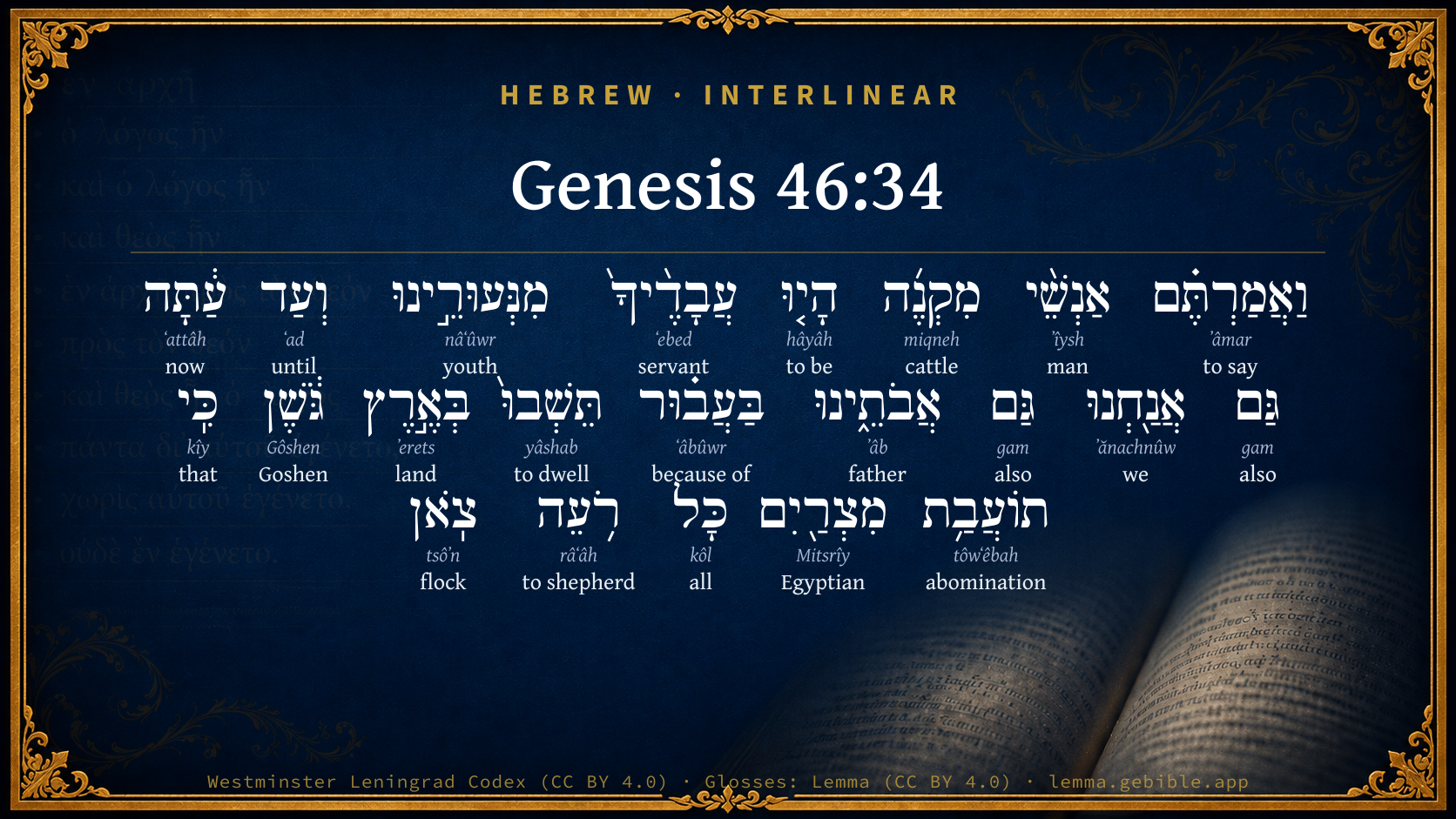
Hebrew (Westminster Leningrad Codex) Genesis 46:34 appears in the Hebrew Old Testament. The text above is from the Westminster Leningrad Codex. Each word links to its Strong’s number, a concise gloss, and parsing drawn from the Open Scriptures Hebrew Bible morphology. Click any word for its full Brown-Driver-Briggs (BDB) entry.
Download image
Cite this verse

Genesis 46:34 (World English Bible). Public Domain. Lemma interlinear Bible study tool, https://lemma.gebible.app/v/genesis/46/34.

Show BibTeX & RIS
BibTeX
RIS
English Translation
that you shall say, 'Your servants have been keepers of cattle from our youth even until now, both we, and our fathers:' that you may dwell in the land of Goshen; for every shepherd is an abomination to the Egyptians."
World English Bible · Public Domain
Download a study sheet

One document with this verse’s original text, its word-by-word gloss line, the meaning frame, cross-references with their text, attributed commentary, and full source and license credits — printable, and it pastes into notes with its structure intact.

This verse Autodidact and up

Study sheet (.html) Plain text (.txt)

A passage Seminary Student

Up to 50 verses in one chapter. A passage sheet keeps up to 6 commentary sources and 12 cross-references per verse, in the order this page ranks them, and says so on the sheet whenever that leaves anything out. Ask for a single verse and you get the Autodidact verse sheet above.

Everything on this page stays free to read, with no account — the sheet is a download of what is already on screen, not access to it.

Want to remove ads? Support Godless Engineer
Compare translations 3

The same verse in 3 English versions, stacked beneath the original-language interlinear above. Click any original word for its lexicon entry.

Each is an independent rendering of the whole verse — the interlinear is not word-aligned to these translations.

Highlighted words mark where these versions differ — a whole-verse word diff, not a word-by-word alignment.

  • World English Bible Public Domain
    that you shall say, 'Your servants have been keepers of cattle from our youth even until now, both we, and our fathers:' that you may dwell in the land of Goshen; for every shepherd is an abomination to the Egyptians."
  • King James Version Public Domain
    That ye shall say, Thy servants' trade hath been about cattle from our youth even until now, both we, and also our fathers: that ye may dwell in the land of Goshen; for every shepherd is an abomination unto the Egyptians.
  • unfoldingWord Literal Text CC BY-SA 4.0
    then you should say, ‘Your servants have been livestock men from our youth and until now, both we also our fathers,’ so that you can settle in the land of Goshen, because every herder of sheep an abomination Egyptians.”

unfoldingWord Literal Text — © unfoldingWord, licensed CC BY-SA 4.0. Word-aligned USFM3 via Door43 (git.door43.org/unfoldingWord/en_ult).

Versions to compare (up to 4)

3 of 4 selected

Show all 18 translations

Every available English version of this verse, each an independent rendering of the whole verse.

  • World English Bible Public Domain
    that you shall say, 'Your servants have been keepers of cattle from our youth even until now, both we, and our fathers:' that you may dwell in the land of Goshen; for every shepherd is an abomination to the Egyptians."
  • Berean Standard Bible Public Domain
    you are to say, ‘Your servants have raised livestock ever since our youth—both we and our fathers.’ Then you will be allowed to settle in the land of Goshen, since all shepherds are detestable to the Egyptians.”
  • Majority Standard Bible Public Domain
    you are to say, ‘Your servants have raised livestock ever since our youth—both we and our fathers.’ Then you will be allowed to settle in the land of Goshen, since all shepherds are detestable to the Egyptians.”
  • King James Version Public Domain
    That ye shall say, Thy servants' trade hath been about cattle from our youth even until now, both we, and also our fathers: that ye may dwell in the land of Goshen; for every shepherd is an abomination unto the Egyptians.
  • American Standard Version (1901) Public Domain
    that ye shall say, Thy servants have been keepers of cattle from our youth even until now, both we, and our fathers: that ye may dwell in the land of Goshen; for every shepherd is an abomination unto the Egyptians.
  • Revised Version (1885) Public Domain
    that ye shall say, Thy servants have been keepers of cattle from our youth even until now, both we, and our fathers: that ye may dwell in the land of Goshen; for every shepherd is an abomination unto the Egyptians.
  • Geneva Bible (1599) Public Domain
    Then ye shall say, Thy seruants are men occupied about cattell, from our childehood euen vnto this time, both we and our fathers: that yee may dwell in the lande of Goshen: for euery sheepe keeper is an abomination vnto the Egyptians.
  • Douay-Rheims (1899) Public Domain
    You shall answer: We thy servants are shepherds, from our infancy until now, both we and our fathers. And this you shall say, that you may dwell in the land of Gessen, because the Egyptians have all shepherds in abomination.
  • Young's Literal Translation Public Domain
    that ye have said, Thy servants have been men of cattle from our youth, even until now, both we and our fathers, -- in order that ye may dwell in the land of Goshen, for the abomination of the Egyptians is every one feeding a flock.'
  • Literal Standard Version CC BY-SA 4.0
    That you have said, Your servants have been men of livestock from our youth, even until now, both we and our fathers, in order that you may dwell in the land of Goshen, for the abomination of the Egyptians is everyone feeding a flock.”
  • Unlocked Literal Bible CC BY-SA 4.0
    that you should say, 'Your servants have been keepers of livestock from our youth until now, both we, and our forefathers.' Do this so that you may live in the land of Goshen, for every shepherd is an abomination to the Egyptians.”
  • unfoldingWord Literal Text CC BY-SA 4.0
    then you should say, ‘Your servants have been livestock men from our youth and until now, both we also our fathers,’ so that you can settle in the land of Goshen, because every herder of sheep an abomination Egyptians.”
  • Darby Bible Public Domain
    then ye shall say, Thy servants are men that have been occupied with cattle from our youth even until now, both we and our fathers; in order that ye may dwell in the land of Goshen; for every shepherd is an abomination to the Egyptians.
  • World Messianic Bible Public Domain
    that you shall say, ‘Your servants have been keepers of livestock from our youth even until now, both we, and our fathers:’ that you may dwell in the land of Goshen; for every shepherd is an abomination to the Egyptians.”
  • Webster's Bible Public Domain
    That ye shall say, The occupation of thy servants hath been about cattle from our youth even until now, both we, and also our fathers: that ye may dwell in the land of Goshen; for every shepherd is an abomination to the Egyptians.
  • Free Bible Version CC BY-SA 4.0
    tell him, ‘Your servants have looked after livestock since we were children, both us and our fathers before us.’ That way you'll be able to live here in Goshen, because Egyptians look down on shepherds.”
  • Bible in Basic English Public Domain
    You are to say, Your servants have been keepers of cattle from our early days up to now, like our fathers; in this way you will be able to have the land of Goshen for yourselves; because keepers of sheep are unclean in the eyes of the Egyptians.
  • JPS Tanakh (1917) Public Domain
    that ye shall say: Thy servants have been keepers of cattle from our youth even until now, both we, and our fathers; that ye may dwell in the land of Goshen; for every shepherd is an abomination unto the Egyptians.'

Literal Standard Version (2020), Covenant Press — licensed CC BY-SA 4.0. Text via the HelloAO Bible API (eBible.org). Unlocked Literal Bible (unfoldingWord) — licensed CC BY-SA 4.0. Text via the HelloAO Bible API (eBible.org). unfoldingWord Literal Text — © unfoldingWord, licensed CC BY-SA 4.0. Word-aligned USFM3 via Door43 (git.door43.org/unfoldingWord/en_ult). Free Bible Version, Dr. Jonathan Gallagher — licensed CC BY-SA 4.0. Text via the HelloAO Bible API (eBible.org).

Word by word

More ways to search: Search by grammar → Find every occurrence → Compare this word →

Practice this passage: Drill this verse → Learn its vocabulary →

גֹּ֔שֶׁן
Gôshen
H1657
“Goshen”
Noun, Proper
Part of Speech
Noun
Type
Proper
Full BDB Definition

Origin: probably of Egyptian origin

TWOT: 390

Goshen = "drawing near" - a region in northern Egypt, east of the lower Nile, where the children of Israel lived from the time of Joseph to the time of Moses - a district in southern Palestine between Gaza and Gibeon - a town in the mountains of Judah probably in the district of Goshen
  1. וַאֲמַרְתֶּ֗ם ʼâmar H559 “and · to say” Conjunction + Verb, Qal, Sequential Perfect, 2nd Person, Masculine, Plural
  2. אַנְשֵׁ֨י ʼîysh H376 “men of” Noun, Common, Masculine, Plural, Construct
  3. מִקְנֶ֜ה miqneh H4735 “cattle” Noun, Common, Masculine, Singular, Absolute
  4. הָי֤וּ hâyâh H1961 “to be” Verb, Qal, Perfect, 3rd Person, Common, Plural
  5. עֲבָדֶ֨יךָ֙ ʻebed H5650 “servants · your” Noun, Common, Masculine, Plural, Construct + Suffix, Personal, 2nd Person, Masculine, Singular
  6. מִנְּעוּרֵ֣ינוּ nâʻûwr H5271 “from · youth · our” Preposition + Noun, Common, Both, Plural, Construct + Suffix, Personal, 1st Person, Common, Plural
  7. וְעַד ʻad H5704 “and · until” Conjunction + Preposition
  8. עַ֔תָּה ʻattâh H6258 “now” Adverb
  9. גַּם gam H1571 “also” Particle, Accusative
  10. אֲנַ֖חְנוּ ʼănachnûw H587 “we” Pronoun, Personal, 1st Person, Common, Plural
  11. גַּם gam H1571 “also” Particle, Accusative
  12. אֲבֹתֵ֑ינוּ ʼâb H1 “fathers · our” Noun, Common, Masculine, Plural, Construct + Suffix, Personal, 1st Person, Common, Plural
  13. בַּעֲב֗וּר ʻâbûwr H5668 “in/at · because of of” Preposition + Noun, Common, Masculine, Singular, Construct
  14. תֵּשְׁבוּ֙ yâshab H3427 “to dwell” Verb, Qal, Imperfect, 2nd Person, Masculine, Plural
  15. בְּאֶ֣רֶץ ʼerets H776 “in/at · land of” Preposition + Noun, Common, Both, Singular, Construct
  16. כִּֽי kîy H3588 “that” Conjunction
  17. תוֹעֲבַ֥ת tôwʻêbah H8441 “abomination of” Noun, Common, Feminine, Singular, Construct
  18. מִצְרַ֖יִם Mitsrîy H4713 “Egyptian” Noun, Proper
  19. כָּל kôl H3605 “all of” Noun, Common, Masculine, Singular, Construct
  20. רֹ֥עֵה râʻâh H7462 “shepherding” Verb, Qal, Participle Active, Masculine, Singular, Construct
  21. צֹֽאן tsôʼn H6629 “flock” Noun, Common, Both, Singular, Absolute

About this verse

These counts appear in no published source. They are computed here, from the morphology-tagged text and Lemma’s own curated glosses. What Lemma adds →

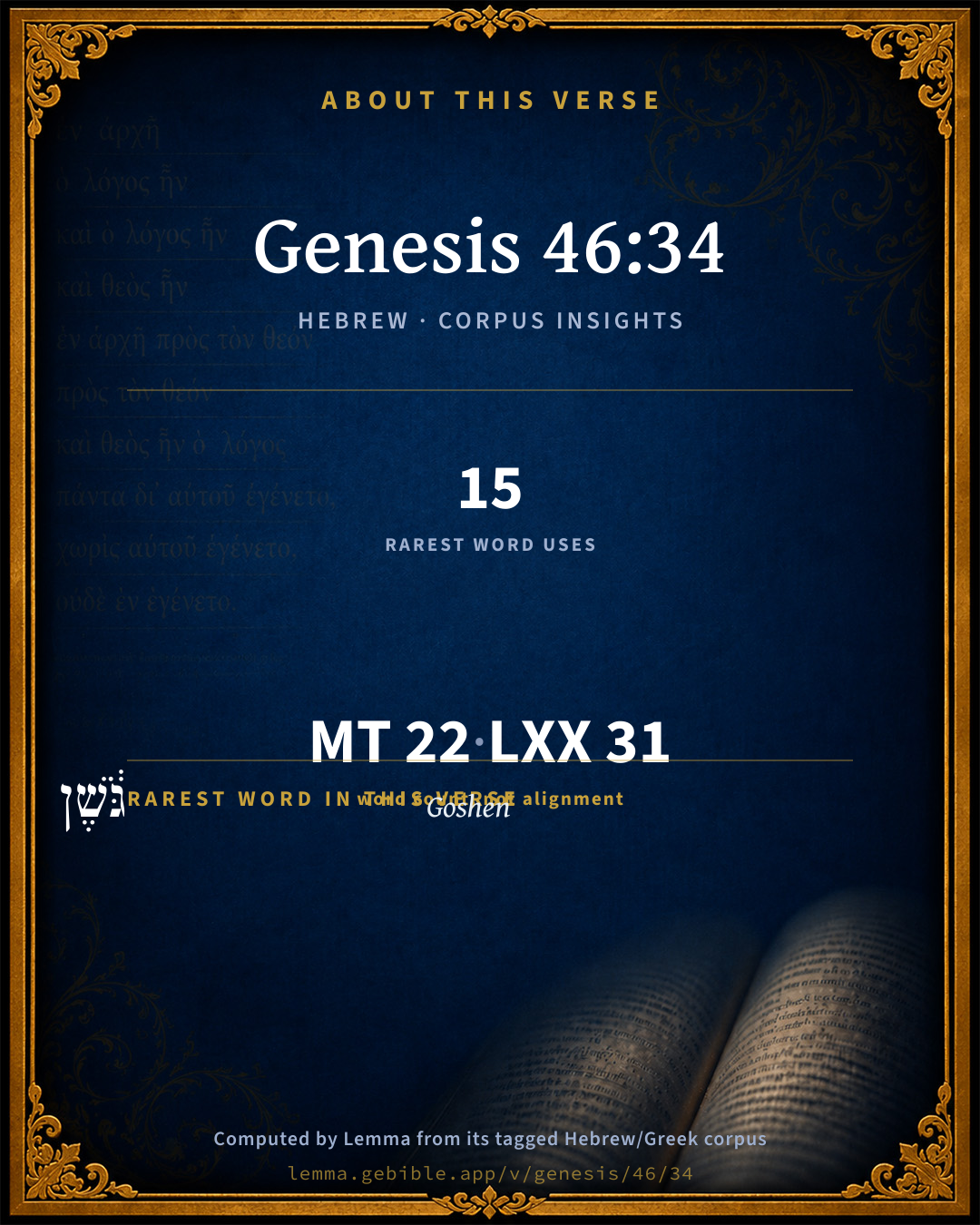
22
words
21
distinct lemmas
Pentateuch
section

Notable vocabulary

The rarest word here is גֹּ֔שֶׁן Goshen H1657 — appearing just 15 times in the whole Hebrew Bible.

Shared distinctive vocabulary

גֹּ֔שֶׁן Goshen H1657 occurs in 14 verses of the Hebrew Bible. Also found in:

Grammatical profile

  • 4 verbs
  • 12 nouns
  • 1 pronoun
  • 1 preposition
  • 1 conjunction
  • 1 adverb
  • 2 particles

Verb forms

  • וַאֲמַרְתֶּ֗ם Qal · Sequential Perfect
  • הָי֤וּ Qal · Perfect
  • תֵּשְׁבוּ֙ Qal · Imperfect
  • רֹ֥עֵה Qal · Participle Active

Repetition

A word recurs within this verse — often emphatic in Hebrew:

  • גַּם also H1571 ×2

Hebrew & Septuagint length

In English translation the verse runs 40 words from the Hebrew and 38 from the Septuagint (LXX English) — closely comparable.

A rough comparison of the two English renderings, which tokenize alike — not a word-level alignment.

Word counts can differ between the Hebrew and the Greek without any difference in meaning — e.g. the Hebrew direct-object marker אֵת has no separate Greek word, and Greek often adds the article ὁ.

In the original languages it is 22 Hebrew tokens and 31 Greek tokens — but the two are counted differently (Hebrew bundles its prefixes and suffixes into one token; the Greek is in lemma form), so that isn’t a like-for-like length.

Cross-references

6

Topical passages linked to Genesis 46:34 in the Treasury of Scripture Knowledge — connected by theme and wording, ordered by reader-vote popularity; previews shown in the World English Bible.

  • Exodus 8:26 Moses said, "It isn't appropriate to do so; for we shall sacrifice the abomination of the Egyptians to Yahweh our God. Behold, shall we sacrifice the abomination of the Egyptians before their eyes, and won't they stone us?
  • Genesis 43:32 They served him by himself, and them by themselves, and the Egyptians, that ate with him, by themselves, because the Egyptians don't eat bread with the Hebrews, for that is an abomination to the Egyptians.
  • Genesis 37:12 His brothers went to feed their father's flock in Shechem.
  • Genesis 46:32 These men are shepherds, for they have been keepers of cattle, and they have brought their flocks, and their herds, and all that they have.'
  • Genesis 30:35 That day, he removed the male goats that were streaked and spotted, and all the female goats that were speckled and spotted, every one that had white in it, and all the black ones among the sheep, and gave them into the hand of his sons.
  • Genesis 45:10 You shall dwell in the land of Goshen, and you will be near to me, you, your children, your children's children, your flocks, your herds, and all that you have.

Cross-references courtesy of OpenBible.info (CC BY 4.0).

Hebrew and Greek witnesses Masoretic Hebrew ↔ Greek Septuagint

The same verse in the two great witnesses to the Old Testament, shown verse-for-verse.

These are two independent witnesses, not word-aligned to each other, and the Septuagint is shown in lemma (dictionary) form.

Hebrew Genesis 46:34 Masoretic · Westminster Leningrad Codex

וַאֲמַרְתֶּ֗ם אַנְשֵׁ֨י מִקְנֶ֜ה הָי֤וּ עֲבָדֶ֨יךָ֙ מִנְּעוּרֵ֣ינוּ וְעַד עַ֔תָּה גַּם אֲנַ֖חְנוּ גַּם אֲבֹתֵ֑ינוּ בַּעֲב֗וּר תֵּשְׁבוּ֙ בְּאֶ֣רֶץ גֹּ֔שֶׁן כִּֽי תוֹעֲבַ֥ת מִצְרַ֖יִם כָּל רֹ֥עֵה צֹֽאן

that you shall say, 'Your servants have been keepers of cattle from our youth even until now, both we, and our fathers:' that you may dwell in the land of Goshen; for every shepherd is an abomination to the Egyptians."

World English Bible · Public Domain

Greek LXX Genesis 46:34 Septuagint · lemma form

εἶπον ἀνήρ κτηνοτρόφος εἰμί ὁ παῖς σύ ἐκ παῖς ἕως ὁ νῦν καί ἐγώ καί ὁ πατήρ ἐγώ ἵνα καταοἰκέω ἐν γῆ γεσεμ ἀραβία βδέλυγμα γάρ εἰμί αἰγύπτιος πᾶς ποιμήν πρόβατον

You⌃ shall say, We your servants are herdsmen from our youth until now, both we and our fathers: that you⌃ may dwell in the land of Gesem of Arabia, for every shepherd is an abomination to the Egyptians.

LXX2012 (modern English Septuagint) · Public Domain

On this verse, The Cambridge Bible for Schools and Colleges discusses the Septuagint’s reading. Read the note in Commentary ↓

Hebrew: Westminster Leningrad Codex (CC BY 4.0). Greek: Septuagint (public domain); English from LXX2012 (modern English Septuagint) (Public Domain). How the Septuagint differs from the Hebrew →

Targum (Aramaic paraphrase)

2

The Targum is the ancient Jewish Aramaic paraphrase of the Hebrew Scriptures — an interpretive translation, not the Hebrew text itself. Onkelos (literal) and Pseudo-Jonathan (expansive) render the Torah, and Jonathan the Prophets. Coverage is partial: where no permissively-licensed English translation exists for a verse, only the Aramaic is shown. This is verse-level text, not a word-by-word alignment to the Hebrew.

  1. Targum Onkelos Torah (Genesis–Deuteronomy)
    וְתֵימְרוּן גֻּבְרֵי מָרֵי גֵּיתֵי הֲווֹ עַבְדָּיךְ מֵעוּלֵמָנָא וְעַד כְּעַן אַף אֲנַחְנָא אַף אַבְהָתָנָא בְּדִיל דִּי תֵיתְבוּן בְּאַרְעָא דְגשֶׁן אֲרֵי מְרַחֲקִין מִצְרָאֵי כָּל רָעֵי עָנָא

    (no public-domain English translation for this verse)

    Targum Onkelos — Aramaic: “Onkelos Genesis” (public domain); “Onkelos Exodus” (public domain); “Onkelos Leviticus” (public domain); “Onkelos Numbers” (public domain); “Onkelos Deuteronomy” (public domain). English: “Sefaria Community Translation” (CC0 1.0 (public-domain dedication)); “J.W. Etheridge. The Targums of Onkelos and Jonathan Ben Uzziel on the Pentateuch. London: Longmans, Green, 1862” (public domain). Text via Sefaria.

  2. Targum Pseudo-Jonathan Torah (Genesis–Deuteronomy)
    וְתֵימְרוּן מָרֵי גֵיתֵי הֲווֹ עַבְדָךְ מִטַלְיוּתָנָא וְעַד כְּדוּן בְּגִין דְתֵיתְבוּן בְּאַרְעָא דְגשֶׁן אֲרוּם מְרַחְקִין מִצְרָאֵי כָּל רָעֵי עָנָא

    you must say, Thy servants have been masters of flocks from our youth until now: that you may dwell in the land of Goshen; because the Mizraee reject all shepherds.

    Targum Pseudo-Jonathan — Aramaic: “Targum Jonathan on Genesis” (public domain); “Targum Jonathan on Exodus” (public domain); “Targum Jonathan on Leviticus” (public domain); “Targum Jonathan on Numbers” (public domain); “Targum Jonathan on Deuteronomy” (public domain). English: “The Targum of Jonathan ben Uzziel, trans. J. W. Etheridge, London, 1862” (public domain). Text via Sefaria.

Commentary

Notes on Genesis 46:34 from classic Christian and Jewish commentators (each source and its license shown beneath its notes). The classic Christian expositions comment on the surrounding passage and are grouped to its opening verse, so a note may address several verses; the Jewish commentaries on the Tanakh (Rashi and others) are per-verse, so they appear only where the commentator wrote on this verse.

Lemma curates 59 commentaries, every one of them public domain or Creative Commons licensed, each selected and text-cleaned for this edition rather than reprinted as found. About our sources →

Adam Clarke's Commentary

Verse 34. Thy servants trade hath been about cattle] "The land of Goshen, called also the land of Rameses, lay east of the Nile, by which it was never overflowed, and was bounded by the mountains of the Thebaid on the south, by the Nile and Mediterranean on the west and north, and by the Red Sea and desert of Arabia on the east. It was the Heliopolitan nome or district, and its capital was called ON. Its proper name was Geshen, the country of grass or pasturage, or of the shepherds, in opposition to the rest of the land which was sown after having been overflowed by the Nile." - Bruce. As this land was both fruitful and pleasant, Joseph wished to fix his family in that part of Egypt; hence he advises them to tell Pharaoh that their trade had been in cattle from their youth: and because every shepherd is an abomination to the Egyptians, hence he concluded that there would be less difficulty to get them quiet settlement in Goshen, as they would then be separated from the Egyptians, and consequently have the free use of all their religious customs. This scheme succeeded, and the consequence was the preservation both of their religion and their lives, though some of their posterity did afterwards corrupt themselves; see Eze 20:8; Am 5:26. As it is well known that the Egyptians had cattle and flocks themselves, and that Pharaoh even requested that some of Joseph's brethren should be made rulers over his cattle, how could it be said, as in Ge 46:34, Every shepherd is an abomination unto the Egyptians? Three reasons may be assigned for this:

1. Shepherds and feeders of cattle were usually a sort of lawless, free-booting banditti, frequently making inroads on villages, c., carrying off cattle, and whatever spoils they could find. This might probably have been the case formerly, for it is well known it has often been the case since. On this account such persons must have been universally detested.

2. They must have abhorred shepherds if Manetho's account of the hycsos or king-shepherds can be credited. Hordes of marauders under this name, from Arabia, Syria, and Ethiopia, (whose chief occupation, like the Bedouin Arabs of the present day, was to keep flocks,) made a powerful irruption into Egypt, which they subdued and ruled with great tyranny for 259 years. Now, though they had been expelled from that land some considerable time before this, yet their name, and all persons of a similar occupation, were execrated by the Egyptians, on account of the depredations and long-continued ravages they had committed in the country.

3. The last and probably the best reason why the Egyptians abhorred such shepherds as the Israelites were, was, they sacrificed those very animals, the ox particularly, and the SHEEP, which the Egyptians held sacred. Hence the Roman historian Tacitus, speaking of the Jews, says: "Caeso ARIETE velut in contumelia AMMONIS Bos quoque immolatur, quem AEgyptii APIM colunt." "They sacrifice the ram in order to insult Jupiter Ammon, and they sacrifice the ox, which the Egyptians worship under the name of Apis." Though some contend that this idolatry was not as yet established in Egypt, and that the king-shepherds were either after the time of Joseph, or that Manetho by them intends the Israelites themselves; yet, as the arguments by which these conjectures are supported are not sufficient to overthrow those which are brought for the support of the contrary opinions, and as there was evidently an established religion and priesthood in Egypt before Joseph's time, (for we find the priests had a certain portion of the land of Egypt which was held so sacred that Joseph did not attempt to buy it in the time of the famine, when he bought all the land which belonged to the people, Ge 47:20-22,) and as that established priesthood was in all likelihood idolatrous, and as the worship of Apis under the form of an ox was one of the most ancient forms of worship in Egypt, we may rest tolerably certain that it was chiefly on this account that the shepherds, or those who fed on and sacrificed these objects of their worship, were an abomination to the Egyptians. Calmet has entered into this subject at large, and to his notes I must refer those readers who wish for farther information. See Clarke on Ge 43:32.

ON the principal subject of this chapter, the going down of Jacob and his family into Egypt, Bishop Warburton, in his Divine Legation of Moses, makes the following judicious refections: "The promise God made to Abraham, to give his posterity the land of Canaan, could not be performed till that family was grown strong enough to take and keep possession of it. In the meantime, therefore, they were necessitated to reside among idolaters, and to reside unmixed; but whoever examines their history will see that the Israelites had ever a violent propensity to join themselves to Gentile nations, and practise their manners. God therefore, in his infinite wisdom, brought them into Egypt, and kept them there during this period, the only place where they could remain for so long a time safe and unconfounded with the natives, the ancient Egyptians being by numerous institutions forbidden all fellowship with strangers, and bearing besides a particular aversion to the profession of the Israelites, who were shepherds. Thus the natural dispositions of the Israelites, which in Egypt occasioned their superstitions, and in consequence the necessity of a burdensome ritual, would in any other country have absorbed them into Gentilism, and confounded them with idolaters. From the Israelites going into Egypt arises a new occasion to adore the footsteps of Eternal Wisdom in his dispensations to his chosen people."

Adam Clarke's Commentary on the Bible (1810–1826) — public domain. Text from a community e-Sword/MySword module.

Trapp's Complete Commentary

John Trapp

Gen 46:34 That ye shall say, Thy servants’ trade hath been about cattle from our youth even until now, both we, [and] also our fathers: that ye may dwell in the land of Goshen; for every shepherd [is] an abomination unto the Egyptians.

Ver. 34. Thy servants’ trade hath been, &c.] They were not ashamed of their trade, though low and despicable. Malo miserandum quam erubescendum, saith Tertullian. {a} No lawful calling, but hath an honour put upon it by God; unlawful only are shameful. Ask a poor scavenger what his occupation is, he will answer, I am a scavenger; water bearer, &c. Ask a usurer, gamester, &c., that question; and he will not say, I am a usurer, &c.

That ye may dwell in the land of Goshen.] Which, as it was next to the land of Canaan, so it was most fat, fertile, and fit for their cattle. Sumen totius regionis, the like to Egypt, that Campania was to Italy; of which Florus thus writeth: Nihil mollius caelo, nihil uberius solo, nihil hospitalius mari, &c. Liberi, Cererisque certamen dicitur. {b}

For every shepherd is an abomination, &c.] An Israelite is still an abomination to an Egyptian, the righteous to the wicked, {Pro 29:27} and will be to the world’s end. And there is no love lost between them. The shepherds of Israel especially, are by profane great ones thought scarce worthy to wait upon their trenchers; the baser sort make songs of them, and the abjeets vilify them. Papists make more of hedge priests, than most among us do of powerful preachers: a sad forerunner of the departure of the gospel. If dishonour kept Christ from Nazareth, {Joh 4:44} much more will it it drive him thence when he is come.

{a} Tertul., De Fug. Persec.

{b} L. Flor., lib. i. cap. 16.

John Trapp, A Commentary or Exposition upon All the Books of the Old and New Testament (1647–1656) — public domain. Text from a community e-Sword module.

Joseph Benson's Commentary

Gen 46:34. That ye may dwell in the land of Goshen — In this choice, Joseph showed both his prudence and his piety. As he was not ashamed to own himself the brother of shepherds, although they were contemptible among the Egyptians; so he does not seek to advance them higher, which he certainly might have done, but continues them in their employment. And by placing them in Goshen, 1st, He kept them together, which was very much for their convenience in many respects. 2d, He secured them against envy, and, as far as was in his power, from the corruption of their religion and manners which probably would have taken place, had they mixed with the Egyptians. Every shepherd is an abomination to the Egyptians — Probably because they killed, eat, and offered in sacrifice, those animals which the Egyptians adored. Hence these animal sacrifices are said to be an abomination to the Egyptian. Another probable reason also has been assigned for this, namely, that some Phœnician shepherds had lately made an irruption into Egypt, and had committed great cruelties and depredations, burning divers cities and temples, and barbarously murdering a multitude of people. It is no wonder, therefore, that the employment of shepherds was out of credit with the Egyptians, and odious in their eyes.

Joseph Benson's Commentary on the Old and New Testaments (1811–1818) — public domain. Text from a community e-Sword module.

Tyndale Open Study Notes

Tyndale Open Resources

46:34 In contrast to the syncretistic Canaanites, who would have absorbed the Israelites had they stayed in Canaan, Egyptians detested Semitic shepherds out of a sense of ethnic superiority and observed a strict segregation (see 43:32). When Jacob’s family settled in Egypt, this separation would allow the people to grow into a great nation without losing their identity.

Tyndale Open Study Notes — © Tyndale Open Resources, licensed CC BY-SA 4.0. Text via the HelloAO Bible API.

Geneva Bible (1599)

Geneva Bible translators

God suffereth the world to hate his, that they may forsake the filth of the world, and cleave to him.

Geneva Bible (1599) marginal notes — public domain. Text via Bolls.life.

Ellicott's Commentary for English Readers

(34) For every shepherd is an abomination unto the Egyptians.—This is probably a remark of the narrator, and it is confirmed by the monuments, which generally represent shepherds as unshaven and ill-dressed. Necessarily the Egyptians had sheep and cattle (Gen_47:16-17), and even Pharaoh had herds (Gen_47:6); but the care of them was probably left by the peasantry to the women and children, while the men busied themselves with the cultivation of their fields. We need not go far to seek for the cause of this dislike. The word “abomination,” first of all, suggests a religious ground of difference; and not only did shepherds probably kill animals worshipped in different Egyptian districts, but their religion generally was diverse from that of the fixed population. But next, men who lead a settled life always dislike wandering clans, whose cattle are too likely to prey upon their enclosed land (see Note on Gen_4:8), and who, moving from place to place, are usually not very scrupulous as to the rights of property. Such nomades, too, are generally lower in civilisation, and more rude and rough, than men who have fixed homes. The subjugation of Egypt by the Hyksos was possibly subsequent to the era of Joseph; but we now know from Egyptian sources that there was perpetual war between Egypt and the Hittites, and probably raids were often made upon the rich fields on the banks of the Nile by other Semitic tribes dwelling upon its eastern frontier; and as all these wore regarded as shepherds, there was ground enough for the dislike of all nomades as a class, even though the Egyptians did not disdain to have cattle themselves. But as the land in the Nile Valley was arable, the cattle kept would only be such as were useful for agriculture, whereas they formed the main wealth of the Israelites.

A Bible Commentary for English Readers, edited by Charles John Ellicott (1878–1897) — public domain. Text from a community e-Sword module.

The Cambridge Bible for Schools and Colleges

gen. ed. J. J. S. Perowne

34. that ye may dwell] Joseph’s purpose is thus somewhat elaborately explained in these verses (31–34), in order to place on record how the Israelites came to occupy the fertile district on the eastern frontier of Egypt, most suitable for their own development, and most favourable to them at the crisis of the Exodus. The shrewdness and wisdom of Joseph are made to account for their occupation of Goshen.

Goshen] LXX ἐν γῇ Γέσεμ Ἀραβίᾳ, as in Gen_45:10.

every shepherd is an abomination … Egyptians] This statement seems hardly to be justified by what we know of the ancient Egyptians. Probably the word “shepherd” here, as in Gen_46:32, is used loosely so as to include “herdsman.” Moreover, the strong dislike of the Egyptians for the Asiatic nomads on their eastern frontier may well have contributed to this feeling. The tending of cattle and swine in Egypt was associated with a low class of people dwelling in the swampy northern regions of the Delta. For the word “abomination,” cf. Gen_43:32 and Exo_8:26. The writer’s note, contained in this verse, may have been inaccurate, and yet have faithfully recorded his impression as to the cause which would account for the sons of Jacob being assigned to a fertile region on the east of the Delta.

The Cambridge Bible for Schools and Colleges (gen. ed. J. J. S. Perowne; Cambridge University Press, 1878–1918) — public domain. Text from a community e-Sword module.

Haydock's Catholic Bible Commentary

Abomination. See chap. xliii. 32. The source of this hatred against foreign shepherds, was probably because, about 100 years before Abraham, the shepherd-kings, Hycussos, had got possession of a great part of Egypt, and were at last expelled by the kings of Thebais. See Manetho ap. Eusebius, Præp. x. 13. Another reason why they hated foreigners was, because they slew and eat sheep, &c., which they themselves adored. The Egyptians kept sheep for this purpose, and for the benefits to be derived from their wool, &c., chap. xlvii. 17. (Calmet) --- Joseph took advantage of this disposition of the inhabitants, to keep his brethren at a distance from them, that they might not be perverted. He does not introduce them at court, that no jealousy might be excited. He shews that he is not ashamed of his extraction. (Menochius)

George Leo Haydock (1774–1849), Haydock's Catholic Family Bible and Commentary, 1859 edition — public domain. Excludes Psalms (Douay-Rheims chapter numbering differs from Protestant) and Deuterocanonical books (Catholic canon only).

Matthew Poole's English Annotations

In this design and choice Joseph shows both his prudence and piety. He brings them not to court, where it had been easy for him to have put them all into the best places and offices of the court; and as he is not ashamed to own himself a brother to shepherds, which were contemptible among the Egyptians, so he seeks not to advance them higher, but continues them in their employment, and placeth them in Goshen: whereby,

1. He kept them together, which was very convenient for them in many respects.

2. He secured them both from envy, and, as far as he could, from the corruption of their religion and manners, which was likely to follow their mixture with the Egyptians, and especially their being at the court.

3. He put them into a capacity of returning to Canaan, when God gave them opportunity.

Every shepherd is an abomination unto the Egyptians; either,

1. Because they did both kill and eat those creatures which the Egyptians adored. Or,

2. Because of the fresh remembrance of the horrid cruelties lately committed there by the Phoenician shepherds, who, as some very ancient writers affirm, were seated in Egypt in great numbers, and had arrived to great power, and waged a cruel war with other Egyptians, wherein they wasted divers cities, and burned their temples, and barbarously murdered a multitude of people. And therefore it is no wonder if the calling of shepherds was grown out of use and credit among them. True it is, the Egyptians had some sheep, and other cattle, Gen 47:6,17; Exo 8:26; 9:3, which they kept for delight or profit by their milk, wool, &c., or for sale to others, but they did not use them, as other shepherds generally did, kill and eat them. And it is probable that they committed even the keeping of their sheep and cattle to those strangers which were dispersed among them, and looked upon the employment as too vile and mean for any Egyptian. And though Pharaoh offered it to Joseph’s brethren as a favour to be

rulers over his cattle, Gen 47:6, that might proceed only from hence, because he saw them firmly resolved upon that course of life, and therefore could not bestow any higher preferment upon them.

Matthew Poole's English Annotations on the Holy Bible (1683–1685) — public domain. Text from a community e-Sword/MySword module.

Whedon's Commentary on the Bible

Daniel D. Whedon

34. Land of Goshen — Concerning its admirable adaptation to the Israelitish colony, see note on Gen_47:6.

Daniel D. Whedon (gen. ed.), Commentary on the Old and New Testaments (1874–1909) — public domain. Text from a community e-Sword module.

Rashi

Rabbi Shlomo Yitzchaki (Rashi)

בעבור תשבו בארץ גשן IN ORDER THAT YE MAY ABIDE IN THE LAND OF GOSHEN — and this is the land that you require, for it is a land of pasture. If you tell him that you are inexperienced in other work he will send you far away from him and settle you there.

כי תועבת מצרים כל רעה צאן FOR EVERY SHEPHERD IS AN ABOMINATION TO THE EGYPTIANS — because they (sheep) are regarded by them as deities.

Rashi on the Tanakh — English translations: “The Judaica Press complete Tanach with Rashi, translated by A. J. Rosenberg” (CC BY 4.0); “Pentateuch with Rashi's commentary by M. Rosenbaum and A.M. Silbermann, 1929-1934” (public domain); “The Metsudah Tanach series, Lakewood, N.J” (CC BY 4.0); and “The Book of Joshua, Metsudah Publications, 1997” (CC BY 4.0). Text via Sefaria.

Radak

Rabbi David Kimhi (Radak)

בעבור תשבו בארץ גשן, seeing it was a land in which cattle were being raised. Furthermore, Joseph did what he did in order to prevent Pharaoh from enlisting his brothers in Pharaoh’s political and military echelon.

כי תועבת מצרים כל רועה צאן, seeing that they did not eat the flesh of sheep, they detested anyone raising these animals. They only raised the number of such animals needed for their wool and milk.

Radak on the Tanakh — English translations: “Sefaria Community Translation” (CC0 1.0 (public-domain dedication)); “Eliyahu Munk, HaChut Hameshulash” (CC BY 4.0); “Rabbi Mike Feuer, Jerusalem Anthology” (CC BY 4.0); and “R. David Kimhi on the first book of Psalms, Translated by R.G. Finch, London, 1919” (public domain). Text via Sefaria.

Ibn Ezra

Rabbi Abraham ibn Ezra

Since every shepherd is abhorrent. The Egyptians of those times were vegetarians like modern Hindus.

Ibn Ezra on the Tanakh — English translations: “Sefaria Community Translation” (CC0 1.0 (public-domain dedication)); “Yalkut, Sifsei Chachomim Chumash, Metsudah Publications, 2009” (CC BY 4.0); and “Commentary of Ibn Ezra on Isaiah - trans. by M. Friedlander, 1873” (public domain). Text via Sefaria.

Lesson kit

Teaching starters — assembled from the data on this page, not authored interpretation. Every prompt links to the verse data it draws on. Edit before teaching.

Genesis, in the Pentateuch, opens this verse with 22 words (21 distinct Hebrew lemmas). Its most distinctive word is Gôshen (“Goshen”). A historical commentator’s framing appears above. Read the whole chapter for the surrounding context.

Discussion questions

  1. How does “Goshen” (Gôshen) shape what this verse is saying?
  2. How does Genesis 45:10, which shares the word «Goshen», read alongside this verse?
  3. What does the repetition of “also” (2× in this one verse) do in this verse?
  4. These translations render this verse differently. What is at stake in choosing one wording over another?
  5. «וַאֲמַרְתֶּ֗ם» is a Qal Sequential Perfect verb. How does that grammatical form shape the action described?
  6. Compare how Adam Clarke's Commentary and Trapp's Complete Commentary read this verse. Where do they agree or differ?

Things to notice

Reading settings

Reading text

Shown beneath each verse's original-language words.

Old Testament
Old Testament edition

Read the OT as the Masoretic Hebrew (MT) or the Greek Septuagint (LXX).

English shown for the Greek Septuagint (in the Hebrew ↔ Greek comparison).

Comparing translations? Open the Compare panel on any verse page to stack up to four side by side.