Genesis 27:11

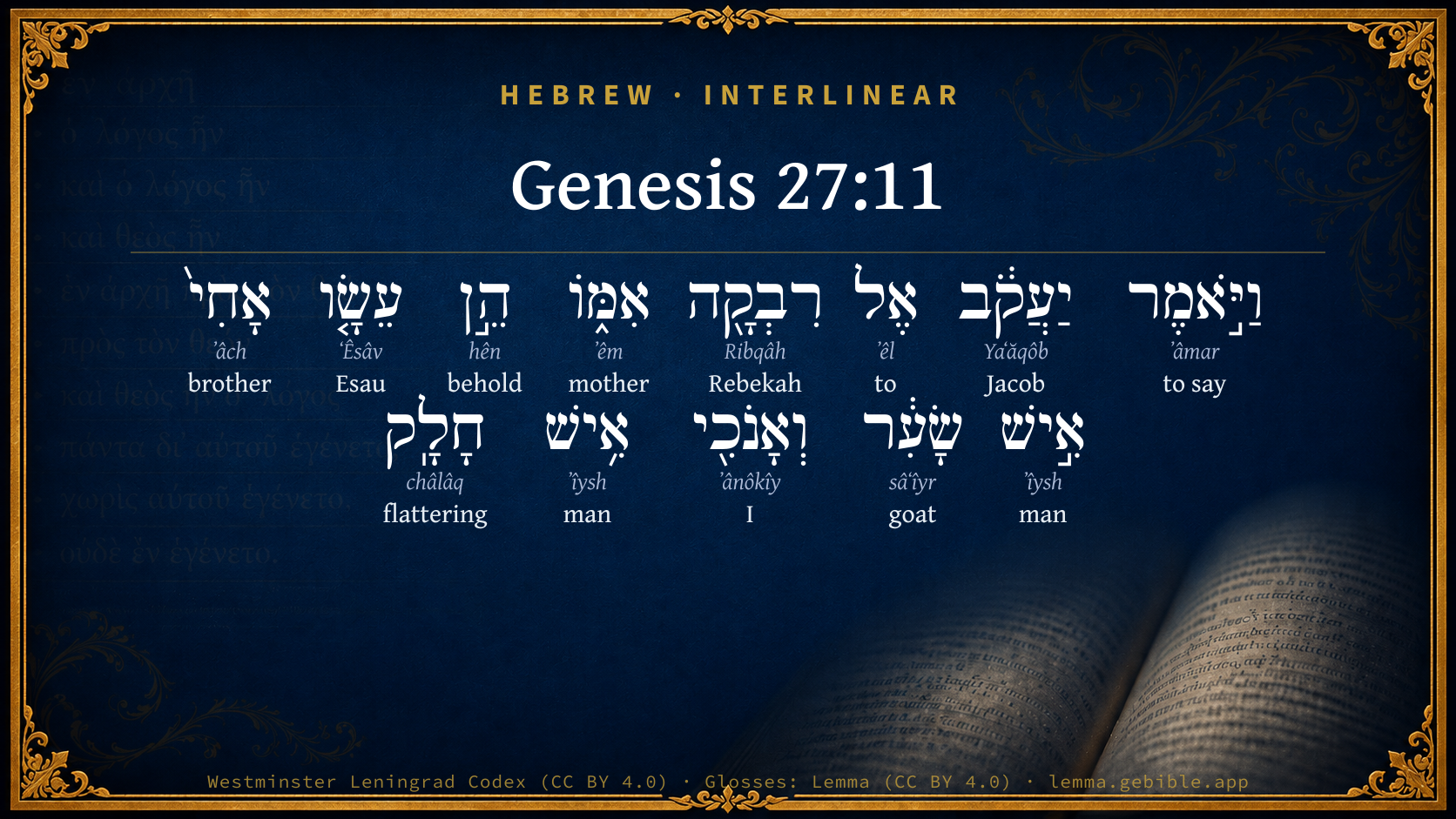
Hebrew (Westminster Leningrad Codex) Genesis 27:11 appears in the Hebrew Old Testament. The text above is from the Westminster Leningrad Codex. Each word links to its Strong’s number, a concise gloss, and parsing drawn from the Open Scriptures Hebrew Bible morphology. Click any word for its full Brown-Driver-Briggs (BDB) entry.
Download image
Cite this verse

Genesis 27:11 (World English Bible). Public Domain. Lemma interlinear Bible study tool, https://lemma.gebible.app/v/genesis/27/11.

Show BibTeX & RIS
BibTeX
RIS
English Translation
Jacob said to Rebekah his mother, "Behold, Esau my brother is a hairy man, and I am a smooth man.
World English Bible · Public Domain
Highlights
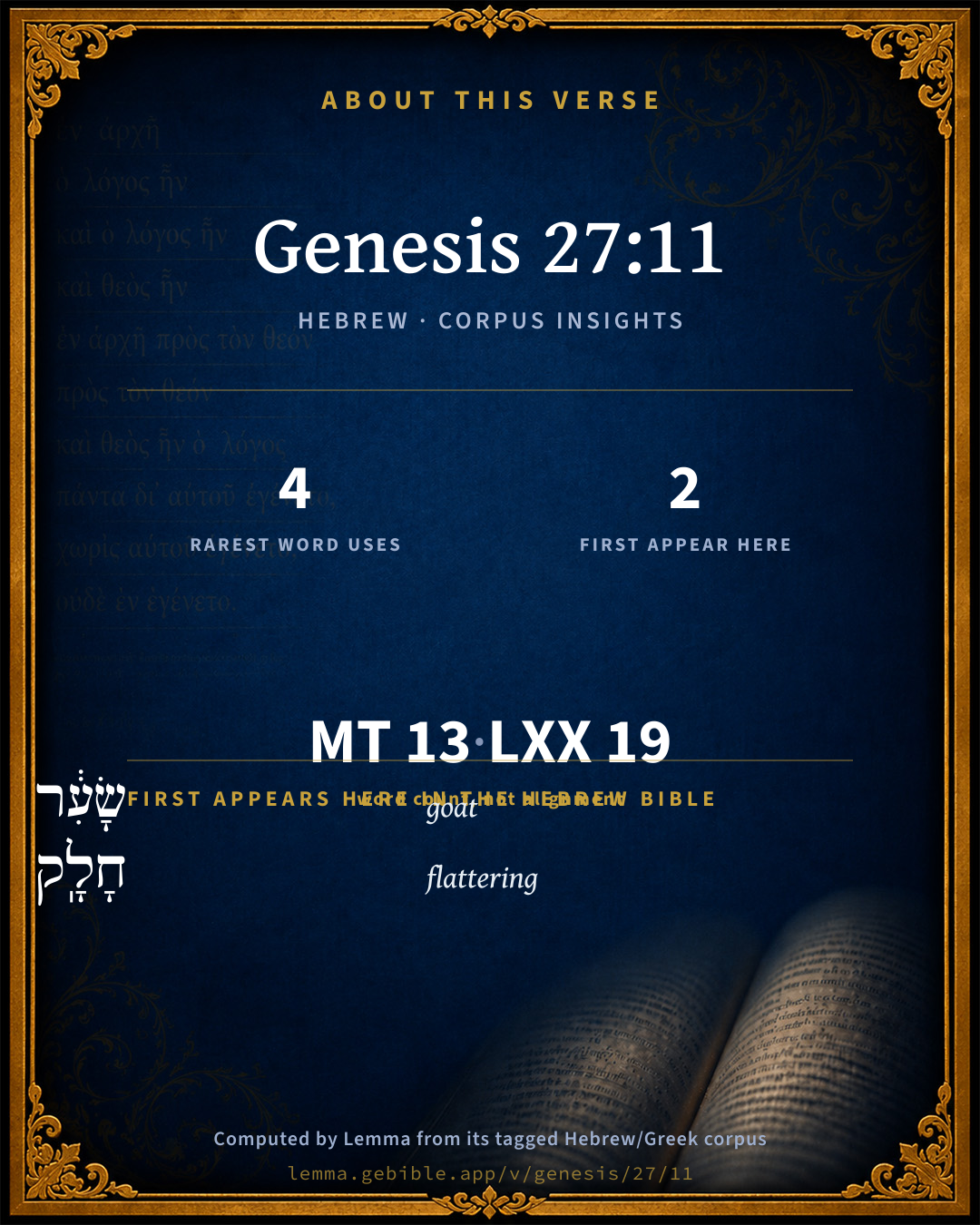
  • 2 first appearances in the Hebrew Bible
Full analysis ↓
Download a study sheet

One document with this verse’s original text, its word-by-word gloss line, the meaning frame, cross-references with their text, attributed commentary, and full source and license credits — printable, and it pastes into notes with its structure intact.

This verse Autodidact and up

Study sheet (.html) Plain text (.txt)

A passage Seminary Student

Up to 50 verses in one chapter. A passage sheet keeps up to 6 commentary sources and 12 cross-references per verse, in the order this page ranks them, and says so on the sheet whenever that leaves anything out. Ask for a single verse and you get the Autodidact verse sheet above.

Everything on this page stays free to read, with no account — the sheet is a download of what is already on screen, not access to it.

Want to remove ads? Support Godless Engineer
Compare translations 3

The same verse in 3 English versions, stacked beneath the original-language interlinear above. Click any original word for its lexicon entry.

Each is an independent rendering of the whole verse — the interlinear is not word-aligned to these translations.

Highlighted words mark where these versions differ — a whole-verse word diff, not a word-by-word alignment.

  • World English Bible Public Domain
    Jacob said to Rebekah his mother, "Behold, Esau my brother is a hairy man, and I am a smooth man.
  • King James Version Public Domain
    And Jacob said to Rebekah his mother, Behold, Esau my brother is a hairy man, and I am a smooth man:
  • unfoldingWord Literal Text CC BY-SA 4.0
    Then Jacob said to Rebekah his mother, “Behold, Esau my brother a hairy man, but I a smooth man.

unfoldingWord Literal Text — © unfoldingWord, licensed CC BY-SA 4.0. Word-aligned USFM3 via Door43 (git.door43.org/unfoldingWord/en_ult).

Versions to compare (up to 4)

3 of 4 selected

Show all 18 translations

Every available English version of this verse, each an independent rendering of the whole verse.

  • World English Bible Public Domain
    Jacob said to Rebekah his mother, "Behold, Esau my brother is a hairy man, and I am a smooth man.
  • Berean Standard Bible Public Domain
    Jacob answered his mother Rebekah, “Look, my brother Esau is a hairy man, but I am smooth-skinned.
  • Majority Standard Bible Public Domain
    Jacob answered his mother Rebekah, “Look, my brother Esau is a hairy man, but I am smooth-skinned.
  • King James Version Public Domain
    And Jacob said to Rebekah his mother, Behold, Esau my brother is a hairy man, and I am a smooth man:
  • American Standard Version (1901) Public Domain
    And Jacob said to Rebekah his mother, Behold, Esau my brother is a hairy man, and I am a smooth man.
  • Revised Version (1885) Public Domain
    And Jacob said to Rebekah his mother, Behold, Esau my brother is a hairy man, and I am a smooth man.
  • Geneva Bible (1599) Public Domain
    But Iaakob sayde to Rebekah his mother, Beholde, Esau my brother is rough, and I am smoothe.
  • Douay-Rheims (1899) Public Domain
    And he answered her: Thou knowest that Esau my brother is a hairy man, and I am smooth.
  • Young's Literal Translation Public Domain
    And Jacob saith unto Rebekah his mother, `Lo, Esau my brother `is' a hairy man, and I a smooth man,
  • Literal Standard Version CC BY-SA 4.0
    And Jacob says to his mother Rebekah, “Behold, my brother Esau [is] a hairy man, and I [am] a smooth man,
  • Unlocked Literal Bible CC BY-SA 4.0
    Jacob said to Rebekah his mother, “See, Esau my brother is a hairy man, and I am a smooth man.
  • unfoldingWord Literal Text CC BY-SA 4.0
    Then Jacob said to Rebekah his mother, “Behold, Esau my brother a hairy man, but I a smooth man.
  • Darby Bible Public Domain
    And Jacob said to Rebecca his mother, Behold, Esau my brother is a hairy man, and I am a smooth man.
  • World Messianic Bible Public Domain
    Jacob said to Rebekah his mother, “Behold, Esau my brother is a hairy man, and I am a smooth man.
  • Webster's Bible Public Domain
    And Jacob said to Rebekah his mother, Behold, Esau my brother is a hairy man, and I am a smooth man:
  • Free Bible Version CC BY-SA 4.0
    “But listen,” Jacob replied to his mother Rebekah, “my brother Esau is a hairy man, and I'm a smooth man.
  • Bible in Basic English Public Domain
    And Jacob said to Rebekah, his mother, But Esau my brother is covered with hair, while I am smooth:
  • JPS Tanakh (1917) Public Domain
    And Jacob said to Rebekah his mother: 'Behold, Esau my brother is a hairy man, and I am a smooth man.

Literal Standard Version (2020), Covenant Press — licensed CC BY-SA 4.0. Text via the HelloAO Bible API (eBible.org). Unlocked Literal Bible (unfoldingWord) — licensed CC BY-SA 4.0. Text via the HelloAO Bible API (eBible.org). unfoldingWord Literal Text — © unfoldingWord, licensed CC BY-SA 4.0. Word-aligned USFM3 via Door43 (git.door43.org/unfoldingWord/en_ult). Free Bible Version, Dr. Jonathan Gallagher — licensed CC BY-SA 4.0. Text via the HelloAO Bible API (eBible.org).

Word by word

More ways to search: Search by grammar → Find every occurrence → Compare this word →

Practice this passage: Drill this verse → Learn its vocabulary →

חָלָֽק
châlâq
H2509
“flattering”
Adjective, Adjective, Masculine, Singular, Absolute
Part of Speech
Adjective
Type
Adjective
Gender
Masculine
Number
Singular
State
Absolute
Full BDB Definition

Origin: from H2505

TWOT: 670b

flattering, smooth
  1. וַיֹּ֣אמֶר ʼâmar H559 “and · to say” Conjunction + Verb, Qal, Sequential Imperfect, 3rd Person, Masculine, Singular
  2. יַעֲקֹ֔ב Yaʻăqôb H3290 “Jacob” Noun, Proper
  3. אֶל ʼêl H413 “to” Preposition
  4. רִבְקָ֖ה Ribqâh H7259 “Rebekah” Noun, Proper
  5. אִמּ֑וֹ ʼêm H517 “mother · his” Noun, Common, Feminine, Singular, Construct + Suffix, Personal, 3rd Person, Masculine, Singular
  6. הֵ֣ן hên H2005 “behold” Particle, Demonstrative
  7. עֵשָׂ֤ו ʻÊsâv H6215 “Esau” Noun, Proper
  8. אָחִי֙ ʼâch H251 “brother · my” Noun, Common, Masculine, Singular, Construct + Suffix, Personal, 1st Person, Common, Singular
  9. אִ֣ישׁ ʼîysh H376 “man” Noun, Common, Masculine, Singular, Absolute
  10. שָׂעִ֔ר sâʻîyr H8163 “goat” Adjective, Adjective, Masculine, Singular, Absolute
  11. וְאָנֹכִ֖י ʼânôkîy H595 “and · I” Conjunction + Pronoun, Personal, 1st Person, Common, Singular
  12. אִ֥ישׁ ʼîysh H376 “man” Noun, Common, Masculine, Singular, Absolute

About this verse

These counts appear in no published source. They are computed here, from the morphology-tagged text and Lemma’s own curated glosses. What Lemma adds →

13
words
12
distinct lemmas
Pentateuch
section

Notable vocabulary

The rarest word here is חָלָֽק flattering H2509 — appearing just 4 times in the whole Hebrew Bible.

First appearance in Scripture

These words make their first canonical appearance in the Hebrew Bible here:

  • שָׂעִ֔ר goat H8163
  • חָלָֽק flattering H2509

Shared distinctive vocabulary

חָלָֽק flattering H2509 occurs in 4 verses of the Hebrew Bible. Also found in:

Grammatical profile

  • 1 verb
  • 7 nouns
  • 2 adjectives
  • 1 pronoun
  • 1 preposition
  • 1 particle

Verb forms

  • וַיֹּ֣אמֶר Qal · Sequential Imperfect

Repetition

A word recurs within this verse — often emphatic in Hebrew:

  • אִ֣ישׁ man H376 ×2

Hebrew & Septuagint length

In English translation the verse runs 20 words from the Hebrew and 19 from the Septuagint (LXX English) — closely comparable.

A rough comparison of the two English renderings, which tokenize alike — not a word-level alignment.

Word counts can differ between the Hebrew and the Greek without any difference in meaning — e.g. the Hebrew direct-object marker אֵת has no separate Greek word, and Greek often adds the article ὁ.

In the original languages it is 13 Hebrew tokens and 19 Greek tokens — but the two are counted differently (Hebrew bundles its prefixes and suffixes into one token; the Greek is in lemma form), so that isn’t a like-for-like length.

Cross-references

1

Topical passages linked to Genesis 27:11 in the Treasury of Scripture Knowledge — connected by theme and wording, ordered by reader-vote popularity; previews shown in the World English Bible.

  • Genesis 25:25 The first came out red all over, like a hairy garment. They named him Esau.

Cross-references courtesy of OpenBible.info (CC BY 4.0).

Hebrew and Greek witnesses Masoretic Hebrew ↔ Greek Septuagint

The same verse in the two great witnesses to the Old Testament, shown verse-for-verse.

These are two independent witnesses, not word-aligned to each other, and the Septuagint is shown in lemma (dictionary) form.

Hebrew Genesis 27:11 Masoretic · Westminster Leningrad Codex

וַיֹּ֣אמֶר יַעֲקֹ֔ב אֶל רִבְקָ֖ה אִמּ֑וֹ הֵ֣ן עֵשָׂ֤ו אָחִי֙ אִ֣ישׁ שָׂעִ֔ר וְאָנֹכִ֖י אִ֥ישׁ חָלָֽק

Jacob said to Rebekah his mother, "Behold, Esau my brother is a hairy man, and I am a smooth man.

World English Bible · Public Domain

Greek LXX Genesis 27:11 Septuagint · lemma form

εἶπον δέ ἰακώβ πρός ρεβεκκα ὁ μήτηρ αὐτός εἰμί ησαυ ὁ ἀδελφός ἐγώ ἀνήρ δασύς ἐγώ δέ ἀνήρ λεῖος

And Jacob said to his mother Rebecca, Esau my brother is a hairy man, and I a smooth man.

LXX2012 (modern English Septuagint) · Public Domain

Hebrew: Westminster Leningrad Codex (CC BY 4.0). Greek: Septuagint (public domain); English from LXX2012 (modern English Septuagint) (Public Domain). How the Septuagint differs from the Hebrew →

Targum (Aramaic paraphrase)

2

The Targum is the ancient Jewish Aramaic paraphrase of the Hebrew Scriptures — an interpretive translation, not the Hebrew text itself. Onkelos (literal) and Pseudo-Jonathan (expansive) render the Torah, and Jonathan the Prophets. Coverage is partial: where no permissively-licensed English translation exists for a verse, only the Aramaic is shown. This is verse-level text, not a word-by-word alignment to the Hebrew.

  1. Targum Onkelos Torah (Genesis–Deuteronomy)
    וַאֲמַר יַעֲקֹב לְרִבְקָה אִמֵּהּ הָא עֵשָׂו אָחִי גְּבַר שַׂעֲרָן וַאֲנָא גְּבַר שְׁעִיעַ

    (no public-domain English translation for this verse)

    Targum Onkelos — Aramaic: “Onkelos Genesis” (public domain); “Onkelos Exodus” (public domain); “Onkelos Leviticus” (public domain); “Onkelos Numbers” (public domain); “Onkelos Deuteronomy” (public domain). English: “Sefaria Community Translation” (CC0 1.0 (public-domain dedication)); “J.W. Etheridge. The Targums of Onkelos and Jonathan Ben Uzziel on the Pentateuch. London: Longmans, Green, 1862” (public domain). Text via Sefaria.

  2. Targum Pseudo-Jonathan Torah (Genesis–Deuteronomy)
    וְעַל דַהֲוָה יַעֲקב דָחִיל חֵיטָא דָחִיל דִלְמָא יְלַטְטִינֵיהּ אָבוֹי וַאֲמַר הָא עֵשָו אָחִי גְבַר שַעֲרָן וַאֲנָא גְבַר שְׁעִיעַ

    And because Jakob was afraid to sin, fearing lest his father might curse him, he said, Behold, Esau my brother is a hairy man, and I am a smooth man.

    Targum Pseudo-Jonathan — Aramaic: “Targum Jonathan on Genesis” (public domain); “Targum Jonathan on Exodus” (public domain); “Targum Jonathan on Leviticus” (public domain); “Targum Jonathan on Numbers” (public domain); “Targum Jonathan on Deuteronomy” (public domain). English: “The Targum of Jonathan ben Uzziel, trans. J. W. Etheridge, London, 1862” (public domain). Text via Sefaria.

Commentary

Notes on Genesis 27:11 from classic Christian and Jewish commentators (each source and its license shown beneath its notes). The classic Christian expositions comment on the surrounding passage and are grouped to its opening verse, so a note may address several verses; the Jewish commentaries on the Tanakh (Rashi and others) are per-verse, so they appear only where the commentator wrote on this verse.

Lemma curates 59 commentaries, every one of them public domain or Creative Commons licensed, each selected and text-cleaned for this edition rather than reprinted as found. About our sources →

Trapp's Complete Commentary

John Trapp

Gen 27:11 And Jacob said to Rebekah his mother, Behold, Esau my brother [is] a hairy man, and I [am] a smooth man:

Ver. 11. Esau my brother is a hairy man.] This Rebekah thought not of. Plus vident oculi, quam oculus. Two is better than one; but woe be to him that is alone. We want much of our strength, in the want of a faithful friend, who might be our monitor. Whence David so bemoans the loss of his Jonathan; and St Paul counted it a special mercy to him, that Epaphroditus recovered. {Php 2:25-27} This the heathen persecutors knew, and therefore banished the Christians, and confined them to isles and mines, where they could not have access one to another. {a} Dr Taylor rejoiced that ever he came into prison, there to be acquainted with that angel of God - so he calls him - John Bradford. While Ridley and Latimer lived, they kept up Cranmer from entertaining counsels of revolt. It was not for nothing, surely, that our Saviour sent forth his disciples by two and two. He knew, by experience, that Satan is readiest to assault when none is by to assist. Aaron may be for a mouth to Moses, Moses for a God to Aaron. {Exo 4:16}

{a} Cyprian, Epist.

John Trapp, A Commentary or Exposition upon All the Books of the Old and New Testament (1647–1656) — public domain. Text from a community e-Sword module.

The Preacher's Complete Homiletical Commentary

Joseph S. Exell (gen. ed.)

CRITICAL NOTES.—

Gen_27:15. Goodly raiment of her eldest son Esau.] Heb. The desirable garments. The choicest garments belonging to Esau were put upon Jacob. From Gen_27:27 it would appear that somewhat of the odour of the field clung to these garments. “They were probably best, or state garments of ‘my lord’ Esau, in which he sought the companies of his brother hunters, and redolent (Gen_27:29) of the aromatic shrubs of the wilderness which they had hasted through.” (Alford.)—

Gen_27:16. Skins of the kids of the goats.] These were the skins of the Syrian goat, the hair of which, though black, is long and soft. It looks and feels very much like human hair, whence the Romans employed it for wigs and other artificial coverings of the head.—

Gen_27:20. The Lord thy God brought it to me. The name for the covenant God of the patriarchs is used. Heb. Made to meet before me. The meaning is, God hath brought it in my way by making circumstances to meet together for my success.—

MAIN HOMILETICS OF THE PARAGRAPH.—Gen_27:11-24

REBEKAH’S CUNNING PLOT ACCEPTED AND CARRIED OUT BY JACOB

I. Reveals some qualities of Jacob’s character.

1. He was a weak and pliable man. He had little moral strength to resist temptation.

2. He lacked the power of self-determination. He had no skill of invention or contrivance. Hence he fell in with the designs of his mother.

3. He was fearful of consequences. He objects not to what is wrong in the proposed action, but to the risk he is running. (Gen_27:12.) It is enough, if he can only be assured of success.

4. He could long indulge the thought of that which was forbidden. He had formed the steady purpose to complete the sin which he had committed against his brother in taking away his birthright. He had long meditated evil things, and to such a man the opportunity, sooner or later, will present itself. The ambition to obtain the coveted blessing was long cherished, and the hour of temptation came and secured him as an easy victim.

II. Reveals the gradual debasement of Jacob’s character. He did not intend to cast off all moral restraints, and to allow himself to fall into the ways of wickedness. But he had little strength to resist temptation, and almost unknown to himself his character degenerates, he loses his former simplicity and becomes an accomplished deceiver. He who was once so diffident now shrinks at nothing.

1. He overcomes difficulties in the way of sin. He was cool and thoughtful enough, at first, to see that he should run a risk, even with his blind father. (Gen_27:12.) But if he can surmount the fear of consequences, he cares not for the sin.

2. He learns to act a falsehood. He covered himself with skins that he might appear hairy like his brother. (Gen_27:16.)

3. He proceeds to the direct falsehood. (Gen_27:19.) And in this he scruples not to make an impious use of the name of God. (Gen_27:20.) When once a man has entered upon a course of evil, new difficulties arise and he is led into deeper guilt.

4. He allows himself to be led into sin under the idea that he is carrying out the purpose of God. He knew that the end he contemplated was according to the declared will of God, and therefore considered that any means used to attain it must be right. How many evils have been wrought in the course of human history under colour of devotion to some religious idea! But neither the wrath nor the craft of man can work out the righteousness of God.

SUGGESTIVE COMMENTS ON THE VERSES

Gen_27:11-12. Sin is often feared, not for itself but for its consequences.

Our Heavenly Father will certainly feel us, and better feel us; and we shall feel Him, too, in His fatherly corrections before He bless us.—(Trapp.)

Gen_27:13. We cannot help regarding with a sort of admiration her lofty appreciation of that result which she sought, and her self-forgetful devotion to her beloved son; but it is as we feel the same sort of admiration for Lady Macbeth—with full consciousness of, and never forgetting, her crime.—(Alford.)

There is a touch of womanhood observable in her recklessness of personal consequences. So that only he might gain, she did not care: “upon me be thy curse, my son.” And it is this which forces us, even while we most condemn, to compassionate. Throughout the whole of this revolting scene of deceit and fraud we never can forget that Rebekah was a mother; hence a certain interest in and sympathy with her are sustained. And we mark another feminine trait; her act sprang from devotion to a person rather than to a principle. A man’s idolatry is for an idea, a woman’s for a person. A man suffers for a monarchy, a woman for a king. A man’s martyrdom differs from a woman’s. Nay, even in their religion personality marks the one, attachment to an idea or principle the other. Woman adores God in His personality; man in His attributes; at least, that is on the whole the characteristic difference. Here we have the idolatry of the woman, sacrificing husband, elder son, her own soul for an idolized person. For this was properly speaking, idolatry. Rebekah loved her son more than truth, that is more than God. This was to idolize; and hence Christ says, “If any man love father or mother more than Me, he is not worthy of Me.”—(Robertson.)

There are persons who would romantically admire this devotion of Rebekah, and call it beautiful. To sacrifice all, even principle, for another; what higher proof of affection can there be? O miserable sophistry! the only true affection is that which is subordinate to a higher. It has been truly said that in those who love little love is a primary affection, a secondary one in those who love much. Be sure he cannot love another much, “who loves not honour more.” For that higher affection sustains and elevates the lower one, casting round it a glory which mere personal feeling could never give. Compare, e.g., Rebekah’s love with that of Abraham for his son. Abraham was ready to sacrifice his son to duty; Rebekah sacrificed truth and duty to her son. Which loved a son the most? Which was the nobler love? Even as a question of permanence, which would last the longer? For consider what respect this guilty son and guilty mother could retain for each other after this! Would not love dwindle into shame, and love itself in recriminations? For affection will not long survive respect, however it may protract its life by effort.—(Robertson.)

Gen_27:14. Had his remonstrance arisen from an aversion to the evil, he would not so readily have yielded to her suggestions; but where temptation finds the heart fortified by nothing stronger than a regard to present consequences, it is very certain to prevail. Let us beware, however, how we are drawn by any authority whatever to the commission of evil. It will be of little avail to say, my adviser was my father or my mother; there is a plain path, from which no authority under heaven should induce us to swerve.—(Bush.)

Gen_27:15. Some suppose that this was a priestly robe worn by the elder son as priest of the household (Gen_49:3). But this is not implied in the text, though the terms used in the Greek are such as are applied to the holy garments of the priesthood, and may here denote the desirable robes of the birthright-son, kept in the tent as of sacred value. And though Isaac could not see them, he could identify them by the feeling.—(Jacobus.)

Gen_27:16-17. He suffers himself without remonstrance to be arrayed in the skin borrowed from a senseless animal, and the robes stolen from an unwitting brother. And led by the false fondness of a mother into the chamber which the seeming approach of death, as well as the solemn transaction then on hand, should have hallowed with an awful reverence of truth and righteousness,—he heaps he upon he with unscrupulous effrontery; abuses the simple confidence of the blind old man; and almost, if we may so speak, betraying his father with a kiss,—steals from him the birthright-blessing.—(Candlish.)

Gen_27:18. Jacob stands ready to do the mother’s bidding in this work of deception. How his soul must have quaked in consequence of the fraud he was practising upon his aged father! He will find the way of transgressors to be hard. Who art thou? Is he not already detected? How his heart sinks at such a question.—(Jacobus.)

Gen_27:19. Here he utters three lies in a breath besides intituling God to that he did (Gen_27:20), so taking that revered name in vain. This was his sin, and he smarted for it to his dying day; for he had scarce a merry hour after this; but God followed him with one sorrow upon another, to teach him and us what an “evil and bitter thing sin is” (Jer_2:19), and how it ensnares us. The Scripture reckons a lie among monstrous sins (Rev_21:8). Indeed, every lie is pernicious to ourselves or to others, or both; because flatly forbidden of God, and because it is against the order of nature, and for that “no lie is of the truth” (1Jn_2:21), but of the Devil, who began and still upholds his kingdom by lies. (Joh_8:44.) Contrarily, God is truth, and His children are such as will not lie. (Isa_63:8; Rev_14:5.)—(Trapp.)

To act and speak a falsehood requires boldness and a readiness to plunge into deeper sin, for one lie requires another to maintain it.

Gen_27:20. The answer is cunning but profane. Oh! how the man who undertakes to lie gets into deep water and mire, and must load his conscience with awful burdens of falsehood before he gets through! Here he must even bring in God Himself as having helped him to this result, when he knew that God must abhor the falsity. All this has come perhaps from a perverted conscience, supposing that because the birthright was his, of right, and his by Divine intent, therefore he could use wicked means to secure the end. As though God could not accomplish His own plan, or as though He was not to be trusted to do it.—(Jacobus.)

It is well to have God’s Word on our side, but we should not attempt to fulfil that word by acting contrary to the known laws of righteousness.

Many are alarmed when they find that some known truth of nature is likely to contradict some truth of Scripture, as if God’s Word were about to fail. They come forward with some scheme of their own to defend Divine truth, using all the arts and devices of special pleading. But God requires no man to act or speak wickedly for the vindication of His truth.

The answer intimates that his speedy success was owing to a particular Divine interference on his behalf! It is not easy to conceive a more daring piece of effrontery than this. It was bad enough to deal in so many gross equivocations, but to bring in the Lord God of his father in order to give them the appearance of truth was much worse, and what we should scarcely have expected but from one of the most depraved of men. But this was the natural result of a first wrong step. Jacob probably had no idea of going beyond a little stroke of dissimulation and fraud, yet here we find him treading upon the borders of absolute blasphemy, by making God Himself confederate in his sin!—(Bush.)

Gen_27:21. There is something about falsehood which, though it may silence, yet will not ordinarily satisfy. Isaac is yet suspicious, and therefore desires to feel his hands; and here the deception answered.—(Fuller.)

Oh, what a thrill of horror must this have sent through the deceiver’s soul! Luther says, “I should probably have run away with horror and let the dish fall”—(Jacobus.)

Gen_27:22. Now the cunning device of his mother proves a success. If this precaution had lacked, the whole scheme would have failed. If, like Abraham, Rebekah had possessed a faith that would have even lifted the knife to slay her son at the call of duty, trusting in God to raise him up, how much happier would have been the whole company? All of them suffer for this wrong. How the deceiver is recompensed by deceits practised upon him in the beautiful coat of Joseph! (Genesis 37).—(Jacobus.)

And now she wishes she could borrow Esau’s tongue as well as his garments, that she might securely deceive all the senses of him, which had suffered himself to be more dangerously deceived with his affection. But this is past her remedy: her son must name himself Esau with the voice of Jacob. It is hard if our tongue do not betray what we are, in spite of our habit. This was enough to work Isaac to a suspicion, to an inquiry, not to an incredulity. He that is good of himself, will hardly believe evil of another; and will rather distrust his own senses than the fidelity of those he trusted. All the senses are set to examine; none sticketh at the judgment but the ear; to deceive that, Jacob must second his dissimulation with three lies at one breath: I am Esau; as thou badest me; my venison. One sin entertained fetcheth in another; and if it be forced to lodge alone, either departeth, or dieth. I love Jacob’s blessing, but I hate his lie. I would not do that willingly which Jacob did weakly, upon condition of a blessing. (Bp. Hall.)

The hands, he thinks are Esau’s; but still it is mysterious, for “the voice is Jacob’s. Were it not for some such things as these, we might overlook the wisdom and goodness of God in affording so many marks by which to detect imposture, and distinguish man from man. Of all the multitudes of faces, voices, and figures in the world no two are perfectly alike; and if one sense fail us, the others are frequently improved.—(Fuller.)

Gen_27:23. The deed was done and could not be revoked. It was not done at this instant, but after eating the venison. (Gen_27:27.) We see how God works by various instruments; good and bad, and brings to pass His purposes by such strange links in the chain of events.—(Jacobus.)

Gen_27:24. Thus one sin entertained fetcheth in another; a lie especially, which being a blushful sin, is either denied by the liar who is ashamed to be taken with it, or else covered by another and another lie, as we see here in Jacob, who being once over shoes will be over boots too, but he will persuade his father that he is his very son Esau.—(Trapp.)

The father still again puts the question, and in a most pointed way, as if his suspicions were not yet utterly quieted. There seems to him something doubtful in this voice and in all the circumstances. He would put the question so pointedly as to admit of no evasion. It would seem that he knew Jacob’s character for cunning; and when one has lost confidence—when he has forfeited his character for straightforward and honest and truthful conduct—it is hard to put away doubt, and every little item stirs the suspicion afresh.—(Jacobus.)

Here was nothing but counterfeiting; a feigned person, a feigned name, feigned venison, a feigned answer, and yet behold a true blessing; but to the man, not to the means. Those were so unsound, that Jacob himself doth more fear their curse, than hope for their success. Isaac was now both simple and old; yet if he had perceived the fraud, Jacob had been more sure of a curse, than he could be sure that he should not be perceived.—(Bp. Hall.)

The Preacher's Complete Homiletical Commentary (gen. ed. Joseph S. Exell; Funk & Wagnalls, c. 1892) — public domain (pre-1929). A full-Bible homiletical/sermon-outline anthology covering 65 of 66 books (2 John is absent from the source module). Text from a community e-Sword module.

Tyndale Open Study Notes

Tyndale Open Resources

27:11-12 Jacob had no qualms about this deception; he only feared that it might not work and that he would be cursed for trying.

Tyndale Open Study Notes — © Tyndale Open Resources, licensed CC BY-SA 4.0. Text via the HelloAO Bible API.

Jamieson, Fausset & Brown

Robert Jamieson, A. R. Fausset & David Brown

Jacob said, Esau my brother is a hairy man--It is remarkable that his scruples were founded, not on the evil of the act, but on the risk and consequences of deception.

Jamieson, Fausset & Brown — Commentary Critical and Explanatory on the Whole Bible (1871) — public domain (CC PDM 1.0). Text via the HelloAO Bible API.

John Calvin's Commentaries

11. And Jacob said to Rebekah. That Jacob does not voluntarily present himself to his father, but rather fears lest, his imposture being detected, he should bring a curse upon himself, is very contrary to faith. For when the Apostle teaches, that “whatsoever is not of faith is sin,” (Romans 14:23,) he trains the sons of God to this sobriety, that they may not permit themselves to undertake anything with a doubtful and perplexed conscience. This firm persuasion is the only rule of right conduct, when we, relying on the command of God, go intrepidly wheresoever he calls us. Jacob, therefore, by debating with himself, shows that he was deficient in faith; and certainly, although he was not entirely without it, yet, in this point, he is convicted of failure. But by this example we are again taught, that faith is not always extinguished by a given fault; yet, if God sometimes bears with his servants thus far, that he turns, what they have done perversely, to their salvation, we must not hence take a license to sin. It happened by the wonderful mercy of God, that Jacob was not cut off from the grace of adoption. Who would not rather fear than become presumptuous? And whereas we see that his faith was obscured by doubting, let us learn to ask of the Lord the spirit of prudence to govern all our steps. There was added another error of no light kind: for why does he not rather reverence God than dread his father’s anger? Why does it not rather occur to his mind, that a foul blot would stain the hallowed adoption of God, when it seemed to owe its accomplishment to a lie? For although it tended to a right end, it was not lawful to attain that end, through this oblique course. Meanwhile, there is no doubt that faith prevailed over these impediments. For what was the cause why he preferred the bare and apparently empty benediction of his father, to the quiet which he then enjoyed, to the conveniences of home, and finally to life itself? According to the flesh, the father’s benediction, of which he was so desirous, that he knowingly and willingly plunged himself into great difficulties, was but an imaginary thing. Why did he act thus, but because in the exercise of simple faith in the word of God, he more highly valued the hope which was hidden from him, shall the desirable condition which he actually enjoyed? Besides, his fear of his father’s anger had its origin in the true fear of God. He says that he feared lest he should bring upon himself a curse. But he would not so greatly have dreaded a verbal censure, if he had not deemed the grace deposited in the hands of his father worth more than a thousand lives. It was therefore under an impulse of God that he feared his father, who was really God’s minister. For when the Lord sees us creeping on the earth, he draws us to himself by the hand of man.

John Calvin's Commentaries (1540-1563) — public domain. Text from the Calvin Translation Society English edition (1840s-50s) via the Christian Classics Ethereal Library (ccel.org). Calvin's coverage is partial (roughly two-thirds of the Bible); uncommented books and verses are honest gaps, never fabricated. The 19th-century editor's footnotes and remarks are omitted so the notes are faithfully Calvin's own voice.

The Cambridge Bible for Schools and Colleges

gen. ed. J. J. S. Perowne

11. And Jacob said, &c.] Jacob objects to the proposal, not because of its deceitfulness, but because of the risk of detection.

a hairy man] See Gen_25:25 (E).

The Cambridge Bible for Schools and Colleges (gen. ed. J. J. S. Perowne; Cambridge University Press, 1878–1918) — public domain. Text from a community e-Sword module.

John Gill's Exposition

And Jacob said to Rebekah his mother,.... Being timorous lest he should do an ill thing, and be accounted a deceiver, and bring a curse upon himself:

behold, Esau my brother is a hairy man; covered all over with hair; as with a hairy garment; so he was born, and so he continued, and no doubt his hair increased, Gen 25:25,

and I am a smooth man: without hair, excepting in those parts where it is common for all men to have it.

John Gill's Exposition of the Whole Bible (1746–1763) — public domain (CC PDM 1.0). Text via the HelloAO Bible API.

The Pulpit Commentary

And Jacob (who was not yet such an adept at trickery as he afterwards became, and who, if he had no scruples of conscience in either imposing on a senile parent or despoiling an open-hearted brother, was yet averse to being detected in his frauds, as deceivers usually are) said to Rebekah his mother, Behold, Esau my brother is a hairy man (vide Gen_25:25) and I am a smooth man ql; j; smooth (opposed to ryic;" hairy); the primary idea of which is to cut off the hair. Cf. calkov calix kolax glukov, gloiov gliscrov; glacies, glaber, gladius, glisco; gluten, glatt, gleiten, glas all of which convey the notion of smoothness ( vide Gesenius, p. 283).

The Pulpit Commentary (1880–1919), ed. H.D.M. Spence-Jones & Joseph S. Exell — public domain. Text from a community e-Sword module.

unfoldingWord translationNotes

Door43 World Missions Community

I am a smooth man

"I am a man with smooth skin" or "I am not hairy"

I will seem to him as a deceiver

"he will think that I am a liar" or "he will know that I am deceiving him"

I will bring a curse upon me and not a blessing

Being cursed or blessed is spoken of as if a curse and a blessing are objects that are placed on a person. AT: "Then because of this, he will curse me and not bless me" (See: Metaphor)

translationWords

Jacob

Rebekah

Esau

deceive

curse

bless

unfoldingWord translationNotes — © Distant Shores Media and the Door43 World Missions Community, licensed CC BY-SA 4.0. Source: git.door43.org/Door43/en_tn.

Rashi

Rabbi Shlomo Yitzchaki (Rashi)

איש שער means A HAIRY MAN.

Rashi on the Tanakh — English translations: “The Judaica Press complete Tanach with Rashi, translated by A. J. Rosenberg” (CC BY 4.0); “Pentateuch with Rashi's commentary by M. Rosenbaum and A.M. Silbermann, 1929-1934” (public domain); “The Metsudah Tanach series, Lakewood, N.J” (CC BY 4.0); and “The Book of Joshua, Metsudah Publications, 1997” (CC BY 4.0). Text via Sefaria.

Radak

Rabbi David Kimhi (Radak)

ויאמר...שעיר. seeing that his skin was covered with hair all over, even his hands and throat.

Radak on the Tanakh — English translations: “Sefaria Community Translation” (CC0 1.0 (public-domain dedication)); “Eliyahu Munk, HaChut Hameshulash” (CC BY 4.0); “Rabbi Mike Feuer, Jerusalem Anthology” (CC BY 4.0); and “R. David Kimhi on the first book of Psalms, Translated by R.G. Finch, London, 1919” (public domain). Text via Sefaria.

Lesson kit

Teaching starters — assembled from the data on this page, not authored interpretation. Every prompt links to the verse data it draws on. Edit before teaching.

Genesis, in the Pentateuch, opens this verse with 13 words (12 distinct Hebrew lemmas). Its most distinctive word is châlâq (“flattering”). A historical commentator’s framing appears above. Read the whole chapter for the surrounding context.

Discussion questions

  1. What does “flattering” (châlâq) contribute to the verse as a whole?
  2. 2 words make their first appearance in Scripture here. What does this debut establish?
  3. How does Proverbs 5:3, which shares the word «flattering», read alongside this verse?
  4. What does the repetition of “man” (2× in this one verse) do in this verse?
  5. These translations render this verse differently. What is at stake in choosing one wording over another?
  6. «וַיֹּ֣אמֶר» is a Qal Sequential Imperfect verb. How does that grammatical form shape the action described?
  7. Compare how Trapp's Complete Commentary and The Preacher's Complete Homiletical Commentary read this verse. Where do they agree or differ?

Things to notice

Reading settings

Reading text

Shown beneath each verse's original-language words.

Old Testament
Old Testament edition

Read the OT as the Masoretic Hebrew (MT) or the Greek Septuagint (LXX).

English shown for the Greek Septuagint (in the Hebrew ↔ Greek comparison).

Comparing translations? Open the Compare panel on any verse page to stack up to four side by side.