
Exodus 16:20

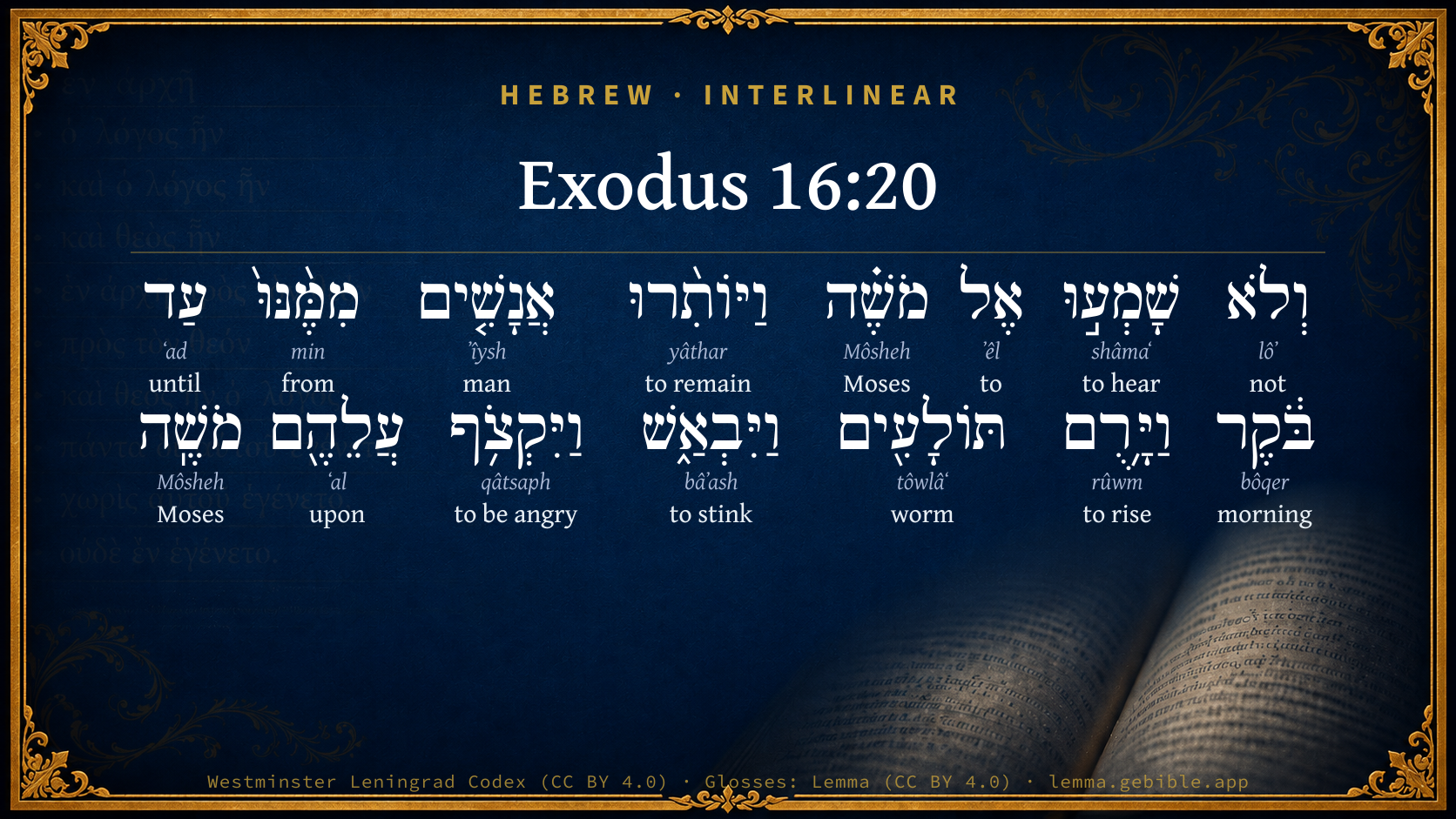
Hebrew (Westminster Leningrad Codex) Exodus 16:20 appears in the Hebrew Old Testament. The text above is from the Westminster Leningrad Codex. Each word links to its Strong’s number, a concise gloss, and parsing drawn from the Open Scriptures Hebrew Bible morphology. Click any word for its full Brown-Driver-Briggs (BDB) entry.
Download image
Cite this verse

Exodus 16:20 (World English Bible). Public Domain. Lemma interlinear Bible study tool, https://lemma.gebible.app/v/exodus/16/20.

Show BibTeX & RIS
BibTeX
RIS
English Translation
Notwithstanding they didn't listen to Moses, but some of them left of it until the morning, and it bred worms, and became foul: and Moses was angry with them.
World English Bible · Public Domain
Highlights
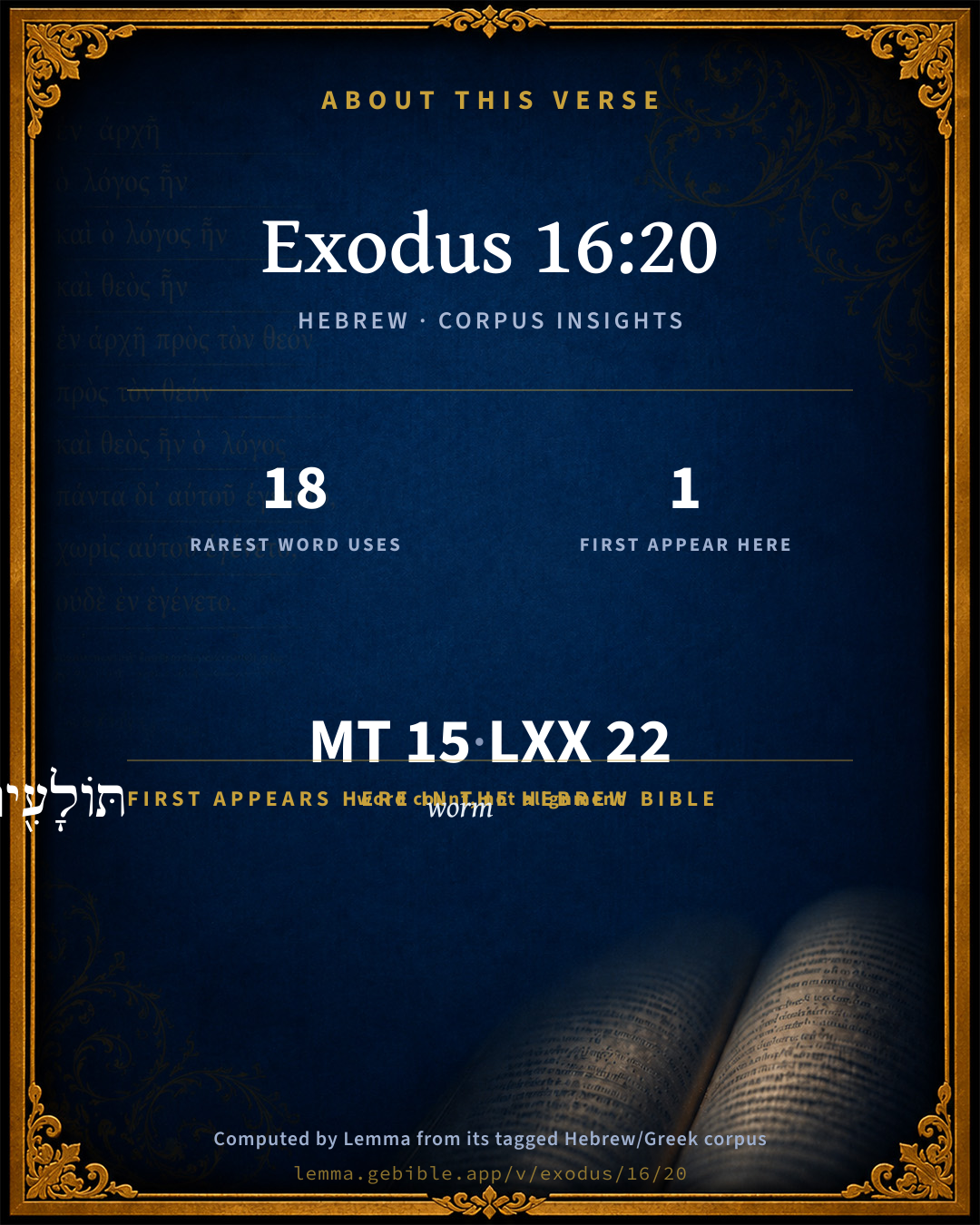
  • 1 first appearance in the Hebrew Bible
Full analysis ↓
Download a study sheet

One document with this verse’s original text, its word-by-word gloss line, the meaning frame, cross-references with their text, attributed commentary, and full source and license credits — printable, and it pastes into notes with its structure intact.

This verse Autodidact and up

Study sheet (.html) Plain text (.txt)

A passage Seminary Student

Up to 50 verses in one chapter. A passage sheet keeps up to 6 commentary sources and 12 cross-references per verse, in the order this page ranks them, and says so on the sheet whenever that leaves anything out. Ask for a single verse and you get the Autodidact verse sheet above.

Everything on this page stays free to read, with no account — the sheet is a download of what is already on screen, not access to it.

Want to remove ads? Support Godless Engineer
Compare translations 3

The same verse in 3 English versions, stacked beneath the original-language interlinear above. Click any original word for its lexicon entry.

Each is an independent rendering of the whole verse — the interlinear is not word-aligned to these translations.

Highlighted words mark where these versions differ — a whole-verse word diff, not a word-by-word alignment.

  • World English Bible Public Domain
    Notwithstanding they didn't listen to Moses, but some of them left of it until the morning, and it bred worms, and became foul: and Moses was angry with them.
  • King James Version Public Domain
    Notwithstanding they hearkened not unto Moses; but some of them left of it until the morning, and it bred worms, and stank: and Moses was wroth with them.
  • unfoldingWord Literal Text CC BY-SA 4.0
    But they did not listen to Moses. And men reserved some of it until morning, and it bred worms, and it stank. And Moses became angry with them.

unfoldingWord Literal Text — © unfoldingWord, licensed CC BY-SA 4.0. Word-aligned USFM3 via Door43 (git.door43.org/unfoldingWord/en_ult).

Versions to compare (up to 4)

3 of 4 selected

Show all 18 translations

Every available English version of this verse, each an independent rendering of the whole verse.

  • World English Bible Public Domain
    Notwithstanding they didn't listen to Moses, but some of them left of it until the morning, and it bred worms, and became foul: and Moses was angry with them.
  • Berean Standard Bible Public Domain
    But they did not listen to Moses; some people left part of it until morning, and it became infested with maggots and began to smell. So Moses was angry with them.
  • Majority Standard Bible Public Domain
    But they did not listen to Moses; some people left part of it until morning, and it became infested with maggots and began to smell. So Moses was angry with them.
  • King James Version Public Domain
    Notwithstanding they hearkened not unto Moses; but some of them left of it until the morning, and it bred worms, and stank: and Moses was wroth with them.
  • American Standard Version (1901) Public Domain
    Notwithstanding they hearkened not unto Moses; but some of them left of it until the morning, and it bred worms, and became foul: and Moses was wroth with them.
  • Revised Version (1885) Public Domain
    Notwithstanding they hearkened not unto Moses; but some of them left of it until the morning, and it bred worms, and stank: and Moses was wroth with them.
  • Geneva Bible (1599) Public Domain
    Notwithstanding they obeyed not Moses: but some of them reserued of it till morning, and it was full of wormes, and stanke: therefore Moses was angrie with them.
  • Douay-Rheims (1899) Public Domain
    And they hearkened not to him, but some of them left until the morning, and it began to be full of worms, an it putrefied, and Moses was angry with them.
  • Young's Literal Translation Public Domain
    and they have not hearkened unto Moses, and some of them do leave of it till morning, and it bringeth up worms and stinketh; and Moses is wroth with them.
  • Literal Standard Version CC BY-SA 4.0
    and they have not listened to Moses, and some of them leave of it until morning, and it brings up worms and stinks; and Moses is angry with them.
  • Unlocked Literal Bible CC BY-SA 4.0
    However, they did not listen to Moses. Some of them left some of it until morning, but it bred worms and became foul. Then Moses became angry with them.
  • unfoldingWord Literal Text CC BY-SA 4.0
    But they did not listen to Moses. And men reserved some of it until morning, and it bred worms, and it stank. And Moses became angry with them.
  • Darby Bible Public Domain
    But they did not hearken to Moses; and some men left of it until the morning; then worms bred in it and it stank. And Moses was wroth with them.
  • World Messianic Bible Public Domain
    Notwithstanding they didn’t listen to Moses, but some of them left of it until the morning, so it bred worms and became foul; and Moses was angry with them.
  • Webster's Bible Public Domain
    Notwithstanding, they hearkened not to Moses; but some of them left of it until the morning, and it bred worms, and became offensive; and Moses was wroth with them.
  • Free Bible Version CC BY-SA 4.0
    But some didn't listen to Moses. They did leave some of it until the morning, and it was full of maggots and smelled bad. Moses became angry with them.
  • Bible in Basic English Public Domain
    But they gave no attention to Moses, and some of them kept it till the morning and there were worms in it and it had an evil smell: and Moses was angry with them.
  • JPS Tanakh (1917) Public Domain
    Notwithstanding they hearkened not unto Moses; but some of them left of it until the morning, and it bred worms, and rotted; and Moses was wroth with them.

Literal Standard Version (2020), Covenant Press — licensed CC BY-SA 4.0. Text via the HelloAO Bible API (eBible.org). Unlocked Literal Bible (unfoldingWord) — licensed CC BY-SA 4.0. Text via the HelloAO Bible API (eBible.org). unfoldingWord Literal Text — © unfoldingWord, licensed CC BY-SA 4.0. Word-aligned USFM3 via Door43 (git.door43.org/unfoldingWord/en_ult). Free Bible Version, Dr. Jonathan Gallagher — licensed CC BY-SA 4.0. Text via the HelloAO Bible API (eBible.org).

Word by word

More ways to search: Search by grammar → Find every occurrence → Compare this word →

Practice this passage: Drill this verse → Learn its vocabulary →

וַיִּבְאַ֑שׁ
bâʼash
H887
“and · to stink”
Conjunction + Verb, Qal, Sequential Imperfect, 3rd Person, Masculine, Singular
Part of Speech
Conjunction + Verb
Stem
Qal
Form
Sequential Imperfect
Person
3rd Person
Gender
Masculine
Number
Singular
Full BDB Definition

Origin: a primitive root

TWOT: 195

to have a bad smell, stink, smell bad - (Qal) to stink, smell bad - (Niphal) - to become odious - to make oneself odious - (Hiphil) - to stink, emit a stinking odour - to cause to stink - of wickedness (figuratively) - (Hithpael) to make oneself odious - (TWOT) to abhor
  1. וְלֹא lôʼ H3808 “and · not” Conjunction + Particle, Negative
  2. שָׁמְע֣וּ shâmaʻ H8085 “to hear” Verb, Qal, Perfect, 3rd Person, Common, Plural
  3. אֶל ʼêl H413 “to” Preposition
  4. מֹשֶׁ֗ה Môsheh H4872 “Moses” Noun, Proper
  5. וַיּוֹתִ֨רוּ yâthar H3498 “and · to remain” Conjunction + Verb, Hiphil, Sequential Imperfect, 3rd Person, Masculine, Plural
  6. אֲנָשִׁ֤ים ʼîysh H376 “men” Noun, Common, Masculine, Plural, Absolute
  7. מִמֶּ֨נּוּ֙ min H4480 “from · us” Preposition + Suffix, Personal, 1st Person, Common, Plural
  8. עַד ʻad H5704 “until” Preposition
  9. בֹּ֔קֶר bôqer H1242 “morning” Noun, Common, Masculine, Singular, Absolute
  10. וַיָּ֥רֻם rûwm H7311 “and · to rise” Conjunction + Verb, Qal, Sequential Imperfect, 3rd Person, Masculine, Singular
  11. תּוֹלָעִ֖ים tôwlâʻ H8438 “worms” Noun, Common, Both, Plural, Absolute
  12. וַיִּקְצֹ֥ף qâtsaph H7107 “and · to be angry” Conjunction + Verb, Qal, Sequential Imperfect, 3rd Person, Masculine, Singular
  13. עֲלֵהֶ֖ם ʻal H5921 “upon · them” Preposition + Suffix, Personal, 3rd Person, Masculine, Plural
  14. מֹשֶֽׁה Môsheh H4872 “Moses” Noun, Proper

About this verse

These counts appear in no published source. They are computed here, from the morphology-tagged text and Lemma’s own curated glosses. What Lemma adds →

15
words
14
distinct lemmas
Pentateuch
section

Notable vocabulary

The rarest word here is וַיִּבְאַ֑שׁ to stink H887 — appearing just 18 times in the whole Hebrew Bible.

First appearance in Scripture

This word makes its first canonical appearance in the Hebrew Bible here:

  • תּוֹלָעִ֖ים worm H8438

Shared distinctive vocabulary

וַיִּבְאַ֑שׁ to stink H887 occurs in 17 verses of the Hebrew Bible. Also found in:

Grammatical profile

  • 5 verbs
  • 5 nouns
  • 4 prepositions
  • 1 particle

Verb forms

  • שָׁמְע֣וּ Qal · Perfect
  • וַיּוֹתִ֨רוּ Hiphil · Sequential Imperfect
  • וַיָּ֥רֻם Qal · Sequential Imperfect
  • וַיִּבְאַ֑שׁ Qal · Sequential Imperfect
  • וַיִּקְצֹ֥ף Qal · Sequential Imperfect

Repetition

A word recurs within this verse — often emphatic in Hebrew:

  • מֹשֶׁ֗ה Moses H4872 ×2

Hebrew & Septuagint length

In English translation the verse runs 29 words from the Hebrew and 27 from the Septuagint (LXX English) — closely comparable.

A rough comparison of the two English renderings, which tokenize alike — not a word-level alignment.

Word counts can differ between the Hebrew and the Greek without any difference in meaning — e.g. the Hebrew direct-object marker אֵת has no separate Greek word, and Greek often adds the article ὁ.

In the original languages it is 15 Hebrew tokens and 22 Greek tokens — but the two are counted differently (Hebrew bundles its prefixes and suffixes into one token; the Greek is in lemma form), so that isn’t a like-for-like length.

Cross-references

10

Topical passages linked to Exodus 16:20 in the Treasury of Scripture Knowledge — connected by theme and wording, ordered by reader-vote popularity; previews shown in the World English Bible.

  • Numbers 16:15 Moses was very angry, and said to Yahweh, "Don't respect their offering: I have not taken one donkey from them, neither have I hurt one of them."
  • Matthew 6:19 "Don't lay up treasures for yourselves on the earth, where moth and rust consume, and where thieves break through and steal;
  • Mark 3:5 When he had looked around at them with anger, being grieved at the hardening of their hearts, he said to the man, "Stretch out your hand." He stretched it out, and his hand was restored as healthy as the other.
  • Mark 10:14 But when Jesus saw it, he was moved with indignation, and said to them, "Allow the little children to come to me! Don't forbid them, for the Kingdom of God belongs to such as these.
  • Luke 12:15 He said to them, "Beware! Keep yourselves from covetousness, for a man's life doesn't consist of the abundance of the things which he possesses."
  • Luke 12:33 Sell that which you have, and give gifts to the needy. Make for yourselves purses which don't grow old, a treasure in the heavens that doesn't fail, where no thief approaches, neither moth destroys.
  • Ephesians 4:26 "Be angry, and don't sin." Don't let the sun go down on your wrath,
  • Hebrews 13:5 Be free from the love of money, content with such things as you have, for he has said, "I will in no way leave you, neither will I in any way forsake you."
  • James 5:2–3 Your riches are corrupted and your garments are moth-eaten.
  • Numbers 12:3 Now the man Moses was very humble, above all the men who were on the surface of the earth.

Cross-references courtesy of OpenBible.info (CC BY 4.0).

Hebrew and Greek witnesses Masoretic Hebrew ↔ Greek Septuagint

The same verse in the two great witnesses to the Old Testament, shown verse-for-verse.

These are two independent witnesses, not word-aligned to each other, and the Septuagint is shown in lemma (dictionary) form.

Hebrew Exodus 16:20 Masoretic · Westminster Leningrad Codex

וְלֹא שָׁמְע֣וּ אֶל מֹשֶׁ֗ה וַיּוֹתִ֨רוּ אֲנָשִׁ֤ים מִמֶּ֨נּוּ֙ עַד בֹּ֔קֶר וַיָּ֥רֻם תּוֹלָעִ֖ים וַיִּבְאַ֑שׁ וַיִּקְצֹ֥ף עֲלֵהֶ֖ם מֹשֶֽׁה

Notwithstanding they didn't listen to Moses, but some of them left of it until the morning, and it bred worms, and became foul: and Moses was angry with them.

World English Bible · Public Domain

Greek LXX Exodus 16:20 Septuagint · lemma form

καί οὐ εἰςἀκούω μωυσῆς ἀλλά καταλείπω τις ἀπό αὐτός εἰς ὁ πρωΐ καί ἐκζέω σκώληξ καί ἐπιὄζω καί πικραίνω ἐπί αὐτός μωυσῆς

But they did not listen to Moses, but some left of it till the morning; and it bred worms and stank: and Moses was irritated with them.

LXX2012 (modern English Septuagint) · Public Domain

Hebrew: Westminster Leningrad Codex (CC BY 4.0). Greek: Septuagint (public domain); English from LXX2012 (modern English Septuagint) (Public Domain). How the Septuagint differs from the Hebrew →

Targum (Aramaic paraphrase)

2

The Targum is the ancient Jewish Aramaic paraphrase of the Hebrew Scriptures — an interpretive translation, not the Hebrew text itself. Onkelos (literal) and Pseudo-Jonathan (expansive) render the Torah, and Jonathan the Prophets. Coverage is partial: where no permissively-licensed English translation exists for a verse, only the Aramaic is shown. This is verse-level text, not a word-by-word alignment to the Hebrew.

  1. Targum Onkelos Torah (Genesis–Deuteronomy)
    וְלָא קַבִּילוּ מִן משֶׁה וְאַשְׁאָרוּ גֻבְרַיָא מִנֵה עַד צַפְרָא וּרְחֵשׁ רִיחֲשָׁא וּסְרִי וּרְגַז עֲלֵיהוֹן משֶׁה:

    (no public-domain English translation for this verse)

    Targum Onkelos — Aramaic: “Onkelos Genesis” (public domain); “Onkelos Exodus” (public domain); “Onkelos Leviticus” (public domain); “Onkelos Numbers” (public domain); “Onkelos Deuteronomy” (public domain). English: “Sefaria Community Translation” (CC0 1.0 (public-domain dedication)); “J.W. Etheridge. The Targums of Onkelos and Jonathan Ben Uzziel on the Pentateuch. London: Longmans, Green, 1862” (public domain). Text via Sefaria.

  2. Targum Pseudo-Jonathan Torah (Genesis–Deuteronomy)
    וְלָא קַבִּילוּ מִן משֶׁה וְשַׁיְירוּ דָתָן וַאֲבִירָם גּוּבְרַיָיא חַיָיבַיָא מִנֵיהּ עַד צַפְרָא וְאַרְחֵשׁ מוֹרְנִין וּסְרֵי וּרְגַז עֲלֵיהוֹן משֶׁה

    But (some of them) hearkened not to Mosheh: Dathan and Abiram, men of wickedness, did reserve of it till the morning; but it produced worms and putrefied; and Mosheh was angry with them.

    Targum Pseudo-Jonathan — Aramaic: “Targum Jonathan on Genesis” (public domain); “Targum Jonathan on Exodus” (public domain); “Targum Jonathan on Leviticus” (public domain); “Targum Jonathan on Numbers” (public domain); “Targum Jonathan on Deuteronomy” (public domain). English: “The Targum of Jonathan ben Uzziel, trans. J. W. Etheridge, London, 1862” (public domain). Text via Sefaria.

Commentary

Notes on Exodus 16:20 from classic Christian and Jewish commentators (each source and its license shown beneath its notes). The classic Christian expositions comment on the surrounding passage and are grouped to its opening verse, so a note may address several verses; the Jewish commentaries on the Tanakh (Rashi and others) are per-verse, so they appear only where the commentator wrote on this verse.

Lemma curates 59 commentaries, every one of them public domain or Creative Commons licensed, each selected and text-cleaned for this edition rather than reprinted as found. About our sources →

Trapp's Complete Commentary

John Trapp

Exo 16:20 Notwithstanding they hearkened not unto Moses; but some of them left of it until the morning, and it bred worms, and stank: and Moses was wroth with them.

Ver. 20. Left of it until, &c.] Either through distrust or curiosity.

John Trapp, A Commentary or Exposition upon All the Books of the Old and New Testament (1647–1656) — public domain. Text from a community e-Sword module.

Joseph Benson's Commentary

Exo 16:20. Some of them left of it till the morning — Either distrusting God’s providence, for a future supply, or out of curiosity to learn the nature of this manna, and what they might do if occasion required; it bred worms and stank — Not so much of its own nature, which was pure and durable, as from God’s judgment. Thus will that be corrupted in which we do not trust in God, and which we do not employ for his glory.

Joseph Benson's Commentary on the Old and New Testaments (1811–1818) — public domain. Text from a community e-Sword module.

Geneva Bible (1599)

Geneva Bible translators

No creature is so pure, but being abused it turneth to our destruction.

Geneva Bible (1599) marginal notes — public domain. Text via Bolls.life.

Adam Clarke's Commentary

Verse 20. It bred worms] Their sinful curiosity and covetousness led them to make the trial; and they had a mass of the most loathsome putrefaction for their pains. How gracious is God! He is continually rendering disobedience and sin irksome to the transgressor; that finding his evil ways to be unprofitable, he may return to his Maker, and trust in God alone.

Adam Clarke's Commentary on the Bible (1810–1826) — public domain. Text from a community e-Sword/MySword module.

Ellicott's Commentary for English Readers

(20) It bred worms.—On the Sabbath it bred no worms (Exo_16:24), so that we must view the result spoken of as a punishment for disobedience, not as produced naturally. Neither of the natural mannas is subject to any very rapid decomposition.

A Bible Commentary for English Readers, edited by Charles John Ellicott (1878–1897) — public domain. Text from a community e-Sword module.

John Gill's Exposition

And they gathered it every morning,.... From the time the morning began, during four hours, or to the fourth hour, as the Targum of Jonathan; that is, till ten o'clock in the morning: this was a very wonderful thing that bread should be provided and rained every morning about the camp of Israel, in such plenty as to be sufficient to feed such a vast body of people; and that for forty years together:

every man according to his eating; according to the number of persons he had in his family to eat of it, and as much as everyone could eat; there never was any lack or scarcity of it, but every morning there it was for them, and they gathered it, an omer for everyone:

and when the sun waxed hot, it melted; and so what was left ungathered, being exhaled by the sun and laid up in the clouds, generated and increased, and became a provision to be let down the next morning; it being the will of God that it should not be trampled upon or exposed; and that the Israelites might be diligent, and not neglect the time of gathering it: and the Targum of Jonathan says, from the fourth hour, or ten o'clock and onward, the sun was hot upon it and melted it, which is the time of day when the sun is hottest: and some things, we may observe, are hardened by the sun, and others are softened, as the manna was, even to a liquefaction; though otherwise it was of so hard a nature as to be beaten in a mortar and ground in a mill, Num 11:8.

John Gill's Exposition of the Whole Bible (1746–1763) — public domain (CC PDM 1.0). Text via the HelloAO Bible API.

Albert Barnes' Notes on the Bible

It bred worms - This result was supernatural: no such tendency to rapid decomposition is recorded of common manna.

Albert Barnes' Notes on the Bible (1834–1885) — public domain. Text from a community e-Sword/MySword module.

Haydock's Catholic Bible Commentary

Putrified. So God was pleased to punish their diffidence in Providence. (Haydock)

George Leo Haydock (1774–1849), Haydock's Catholic Family Bible and Commentary, 1859 edition — public domain. Excludes Psalms (Douay-Rheims chapter numbering differs from Protestant) and Deuterocanonical books (Catholic canon only).

Matthew Poole's English Annotations

Some of them left of it; either distrusting God’s providence for their future provisions; or out of curiosity to learn the nature of this manna, and what they might do when occasion required. It stank, not so much from its own nature, which was pure and durable, as from God’s judgment.

Matthew Poole's English Annotations on the Holy Bible (1683–1685) — public domain. Text from a community e-Sword/MySword module.

The Pulpit Commentary

It bred worms. This was a supernatural, not a natural result. It served as a sort of punishment of the disobedient, and effectually checked the practice of laying up in store.

The Pulpit Commentary (1880–1919), ed. H.D.M. Spence-Jones & Joseph S. Exell — public domain. Text from a community e-Sword module.

Scofield Reference Notes

C. I. Scofield

left

As we are not nourished by the memory of food, so neither can spirituality be sustained on past appropriations of Christ.

The Scofield Reference Bible (1917 edition), notes by C. I. Scofield — public domain. Text from a community e-Sword module.

Rashi

Rabbi Shlomo Yitzchaki (Rashi)

ויותרו אנשים BUT SOME MEN LEFT OF IT — Dathan and Abiram (Shemot Rabbah 24:10; cf. Rashi on Exodus 2:13).

וירם תולעים AND IT BRED WORMS — the word וירם is of the same meaning and root as רִמָּה, worm.

ויבאש AND IT STANK — This is an inverted verse, because first it must have stunk and afterwards have become wormy, just as it is said, (v. 24) “And it did not stink and there was no worm therein — for this is the way of all things that become wormy (Mekhilta).

Rashi on the Tanakh — English translations: “The Judaica Press complete Tanach with Rashi, translated by A. J. Rosenberg” (CC BY 4.0); “Pentateuch with Rashi's commentary by M. Rosenbaum and A.M. Silbermann, 1929-1934” (public domain); “The Metsudah Tanach series, Lakewood, N.J” (CC BY 4.0); and “The Book of Joshua, Metsudah Publications, 1997” (CC BY 4.0). Text via Sefaria.

Ramban (Nachmanides)

Rabbi Moshe ben Nachman (Ramban / Nachmanides)

AND IT BRED WORMS, AND IT STANK. “This is a verse that is to be transposed, because [the manna that was left over until the morning] must have first stunk and afterwards become wormy, just as it is said, and it did not stink, neither was there any worm therein, this being the way of all things that become wormy.” Thus Rashi’s language. Now if the manna had become wormy in a natural way, as is the way of all things that become wormy, Rashi’s statement would be correct. But since the manna became wormy in a miraculous way, it is possible that it bred worms first, and there is thus no need for inverting] the verse. Moreover, the verse which states [concerning the manna which they retained for Sabbath morning], and it did not stink, neither was there any worm therein, proves that it was so, [i.e., that the manna left over by Dathan and Abiram bred worms first and then stank]. Had it not become wormy until it first stank, when Scripture says [concerning the manna left for the Sabbath], and it did not stink, it would thereby have already assured us that there was no worm therein. Why then should it repeat afterwards, neither was there any worm therein? If however, as the plain meaning of Scripture indicates, the manna that was left over until the morning by Dathan and Abiram became wormy first [in a supernatural way], it became necessary for Scripture to state that this manna [that was left over for the Sabbath] did not stink, nor did any worm come therein at all. Even things which become wormy in a natural way do not give off a stench unless they are warm and moist, but dry things only become wormy and do not give off an odor at all, just as wormy wood or fruits that become wormy when still growing or [immediately] afterwards. Thus Scripture relates that this manna [which Dathan and Abiram left over on a weekday, also stank [in the morning] by a miracle. And in Eileh Shemoth Rabbah we find that the Rabbis have said: “Is there anything that first becomes wormy and then gives off a stench? It is only that the Holy One, blessed be He, wanting to expose the deeds [of Dathan and Abiram] to the people, therefore caused [the left-over manna] to give off no stench at night lest they throw it out. Instead, during the entire night, it formed rows upon rows of worms, and at once Moses was wroth with them.”

Ramban (Nachmanides) on the Tanakh — English translation: “Commentary on the Torah by Ramban (Nachmanides). Translated and annotated by Charles B. Chavel. New York, Shilo Pub. House, 1971-1976” (CC BY 4.0). Text via Sefaria.

Lesson kit

Teaching starters — assembled from the data on this page, not authored interpretation. Every prompt links to the verse data it draws on. Edit before teaching.

Exodus, in the Pentateuch, opens this verse with 15 words (14 distinct Hebrew lemmas). Its most distinctive word is bâʼash (“to stink”). A historical commentator’s framing appears above. Read the whole chapter for the surrounding context.

Discussion questions

  1. What does “to stink” (bâʼash) contribute to the verse as a whole?
  2. This is the first place “worm” appears in Scripture (first appears here). What does its debut here establish?
  3. How does Genesis 34:30, which shares the word «to stink», read alongside this verse?
  4. What does the repetition of “Moses” (2× in this one verse) do in this verse?
  5. The translations on this page render this verse differently — a whole-verse word diff, not a word-by-word alignment. What might account for the different wordings?
  6. «שָׁמְע֣וּ» is a Qal Perfect verb. How does that grammatical form shape the action described?
  7. Compare how Trapp's Complete Commentary and Joseph Benson's Commentary read this verse. Where do they agree or differ?

Things to notice

Reading settings

Reading text

Shown beneath each verse's original-language words.

Old Testament
Old Testament edition

Read the OT as the Masoretic Hebrew (MT) or the Greek Septuagint (LXX).

English shown for the Greek Septuagint (in the Hebrew ↔ Greek comparison).

Comparing translations? Open the Compare panel on any verse page to stack up to four side by side.