
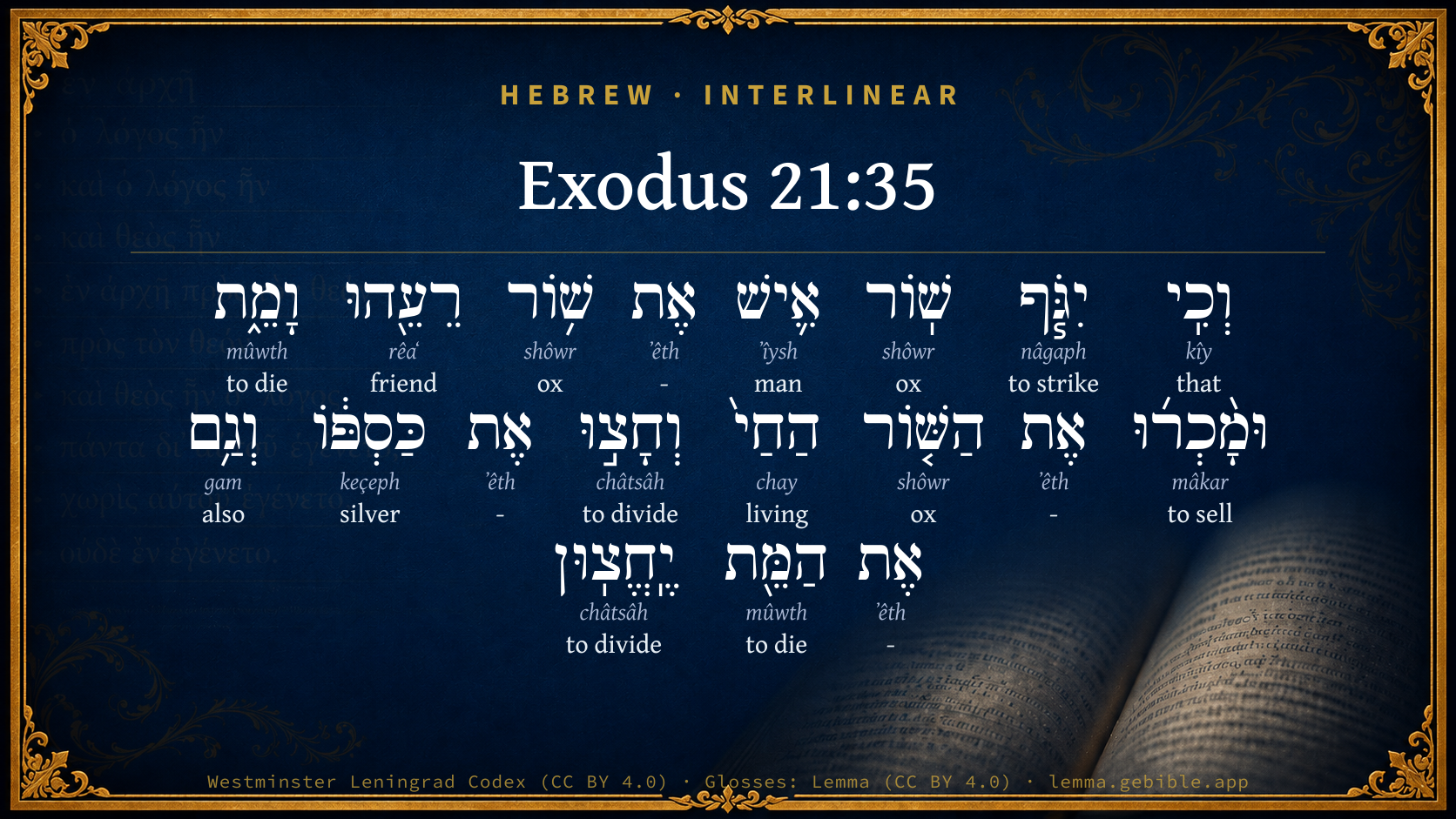
Exodus 21:35

Hebrew (Westminster Leningrad Codex) Exodus 21:35 appears in the Hebrew Old Testament. The text above is from the Westminster Leningrad Codex. Each word links to its Strong’s number, a concise gloss, and parsing drawn from the Open Scriptures Hebrew Bible morphology. Click any word for its full Brown-Driver-Briggs (BDB) entry.
Download image
Cite this verse

Exodus 21:35 (World English Bible). Public Domain. Lemma interlinear Bible study tool, https://lemma.gebible.app/v/exodus/21/35.

Show BibTeX & RIS
BibTeX
RIS
English Translation
"If one man's bull injures another's, so that it dies, then they shall sell the live bull, and divide its price; and they shall also divide the dead animal.
World English Bible · Public Domain
Download a study sheet

One document with this verse’s original text, its word-by-word gloss line, the meaning frame, cross-references with their text, attributed commentary, and full source and license credits — printable, and it pastes into notes with its structure intact.

This verse Autodidact and up

Study sheet (.html) Plain text (.txt)

A passage Seminary Student

Up to 50 verses in one chapter. A passage sheet keeps up to 6 commentary sources and 12 cross-references per verse, in the order this page ranks them, and says so on the sheet whenever that leaves anything out. Ask for a single verse and you get the Autodidact verse sheet above.

Everything on this page stays free to read, with no account — the sheet is a download of what is already on screen, not access to it.

Want to remove ads? Support Godless Engineer
Compare translations 3

The same verse in 3 English versions, stacked beneath the original-language interlinear above. Click any original word for its lexicon entry.

Each is an independent rendering of the whole verse — the interlinear is not word-aligned to these translations.

Highlighted words mark where these versions differ — a whole-verse word diff, not a word-by-word alignment.

  • World English Bible Public Domain
    "If one man's bull injures another's, so that it dies, then they shall sell the live bull, and divide its price; and they shall also divide the dead animal.
  • King James Version Public Domain
    And if one man's ox hurt another's, that he die; then they shall sell the live ox, and divide the money of it; and the dead ox also they shall divide.
  • unfoldingWord Literal Text CC BY-SA 4.0
    And if the ox of a man strikes the ox of another and it dies, then they shall sell the live ox and divide its silver, and they shall also divide the dead.

unfoldingWord Literal Text — © unfoldingWord, licensed CC BY-SA 4.0. Word-aligned USFM3 via Door43 (git.door43.org/unfoldingWord/en_ult).

Versions to compare (up to 4)

3 of 4 selected

Show all 18 translations

Every available English version of this verse, each an independent rendering of the whole verse.

  • World English Bible Public Domain
    "If one man's bull injures another's, so that it dies, then they shall sell the live bull, and divide its price; and they shall also divide the dead animal.
  • Berean Standard Bible Public Domain
    If a man’s ox injures his neighbor’s ox and it dies, they must sell the live one and divide the proceeds; they also must divide the dead animal.
  • Majority Standard Bible Public Domain
    If a man’s ox injures his neighbor’s ox and it dies, they must sell the live one and divide the proceeds; they also must divide the dead animal.
  • King James Version Public Domain
    And if one man's ox hurt another's, that he die; then they shall sell the live ox, and divide the money of it; and the dead ox also they shall divide.
  • American Standard Version (1901) Public Domain
    And if one man's ox hurt another's, so that it dieth, then they shall sell the live ox, and divide the price of it: and the dead also they shall divide.
  • Revised Version (1885) Public Domain
    And if one man’s ox hurt another’s, that he die; then they shall sell the live ox, and divide the price of it; and the dead also they shall divide.
  • Geneva Bible (1599) Public Domain
    And if a mans oxe hurt his neighbours oxe that he die, then they shall sel the liue oxe, and deuide the money thereof, and the dead oxe also they shall deuide.
  • Douay-Rheims (1899) Public Domain
    If one man's ox gore another man's ox, and he die: they shall sell the live ox, and shall divide the price, and the carcass of that which died they shall part between them:
  • Young's Literal Translation Public Domain
    `And when a man's ox doth smite the ox of his neighbour, and it hath died, then they have sold the living ox, and halved its money, and also the dead one they do halve;
  • Literal Standard Version CC BY-SA 4.0
    And when a man’s ox strikes the ox of his neighbor and it has died, then they have sold the living ox, and halved its money, and they also halve the dead one;
  • Unlocked Literal Bible CC BY-SA 4.0
    If one man's ox hurts another man's ox so that it dies, then they must sell the live ox and divide its price, and they must also divide the dead ox.
  • unfoldingWord Literal Text CC BY-SA 4.0
    And if the ox of a man strikes the ox of another and it dies, then they shall sell the live ox and divide its silver, and they shall also divide the dead.
  • Darby Bible Public Domain
    -- And if one man's ox gore his neighbour's ox, and it die, then they shall sell the live ox, and divide the money thereof, and divide the dead also.
  • World Messianic Bible Public Domain
    “If one man’s bull injures another’s, so that it dies, then they shall sell the live bull, and divide its price; and they shall also divide the dead animal.
  • Webster's Bible Public Domain
    And if one man's ox shall hurt another's that he shall die, then they shall sell the live ox, and divide the money of it, and the dead ox also they shall divide.
  • Free Bible Version CC BY-SA 4.0
    If someone's ox injures another's ox and it dies, they must sell the live one and share money received; they must also share the dead animal.
  • Bible in Basic English Public Domain
    And if one man's ox does damage to another man's ox, causing its death, then the living ox is to be exchanged for money, and division made of the price of it, and of the price of the dead one.
  • JPS Tanakh (1917) Public Domain
    And if one man's ox hurt another's, so that it dieth; then they shall sell the live ox, and divide the price of it; and the dead also they shall divide.

Literal Standard Version (2020), Covenant Press — licensed CC BY-SA 4.0. Text via the HelloAO Bible API (eBible.org). Unlocked Literal Bible (unfoldingWord) — licensed CC BY-SA 4.0. Text via the HelloAO Bible API (eBible.org). unfoldingWord Literal Text — © unfoldingWord, licensed CC BY-SA 4.0. Word-aligned USFM3 via Door43 (git.door43.org/unfoldingWord/en_ult). Free Bible Version, Dr. Jonathan Gallagher — licensed CC BY-SA 4.0. Text via the HelloAO Bible API (eBible.org).

Word by word

More ways to search: Search by grammar → Find every occurrence → Compare this word →

Practice this passage: Drill this verse → Learn its vocabulary →

וְחָצ֣וּ
châtsâh
H2673
“and · to divide”
Conjunction + Verb, Qal, Sequential Perfect, 3rd Person, Common, Plural
Part of Speech
Conjunction + Verb
Stem
Qal
Form
Sequential Perfect
Person
3rd Person
Gender
Common
Number
Plural
Full BDB Definition

Origin: a primitive root [compare H2686 ])

TWOT: 719

to divide, cut in two, cut short, live half (of one's life) - (Qal) - to divide - to half, cut in two - (Niphal) to be divided
  1. וְכִֽי kîy H3588 “and · that” Conjunction + Conjunction
  2. יִגֹּ֧ף nâgaph H5062 “to strike” Verb, Qal, Imperfect, 3rd Person, Masculine, Singular
  3. שֽׁוֹר shôwr H7794 “ox of” Noun, Common, Masculine, Singular, Construct
  4. אִ֛ישׁ ʼîysh H376 “man” Noun, Common, Masculine, Singular, Absolute
  5. אֶת ʼêth H853 “-” Particle, Direct Object
  6. שׁ֥וֹר shôwr H7794 “ox of” Noun, Common, Masculine, Singular, Construct
  7. רֵעֵ֖הוּ rêaʻ H7453 “friend · his” Noun, Common, Masculine, Singular, Construct + Suffix, Personal, 3rd Person, Masculine, Singular
  8. וָמֵ֑ת mûwth H4191 “and · to die” Conjunction + Verb, Qal, Sequential Perfect, 3rd Person, Masculine, Singular
  9. וּמָ֨כְר֜וּ mâkar H4376 “and · to sell” Conjunction + Verb, Qal, Sequential Perfect, 3rd Person, Common, Plural
  10. אֶת ʼêth H853 “-” Particle, Direct Object
  11. הַשּׁ֤וֹר shôwr H7794 “the · ox” Particle, Definite Article + Noun, Common, Masculine, Singular, Absolute
  12. הַחַי֙ chay H2416 “the · living” Particle, Definite Article + Adjective, Adjective, Masculine, Singular, Absolute
  13. אֶת ʼêth H853 “-” Particle, Direct Object
  14. כַּסְפּ֔וֹ keçeph H3701 “silver · his” Noun, Common, Masculine, Singular, Construct + Suffix, Personal, 3rd Person, Masculine, Singular
  15. וְגַ֥ם gam H1571 “and · also” Conjunction + Particle, Accusative
  16. אֶת ʼêth H853 “-” Particle, Direct Object
  17. הַמֵּ֖ת mûwth H4191 “the · dying” Particle, Definite Article + Verb, Qal, Participle Active, Masculine, Singular, Absolute
  18. יֶֽחֱצֽוּן châtsâh H2673 “to divide” Verb, Qal, Imperfect, 3rd Person, Masculine, Plural + Suffix, n

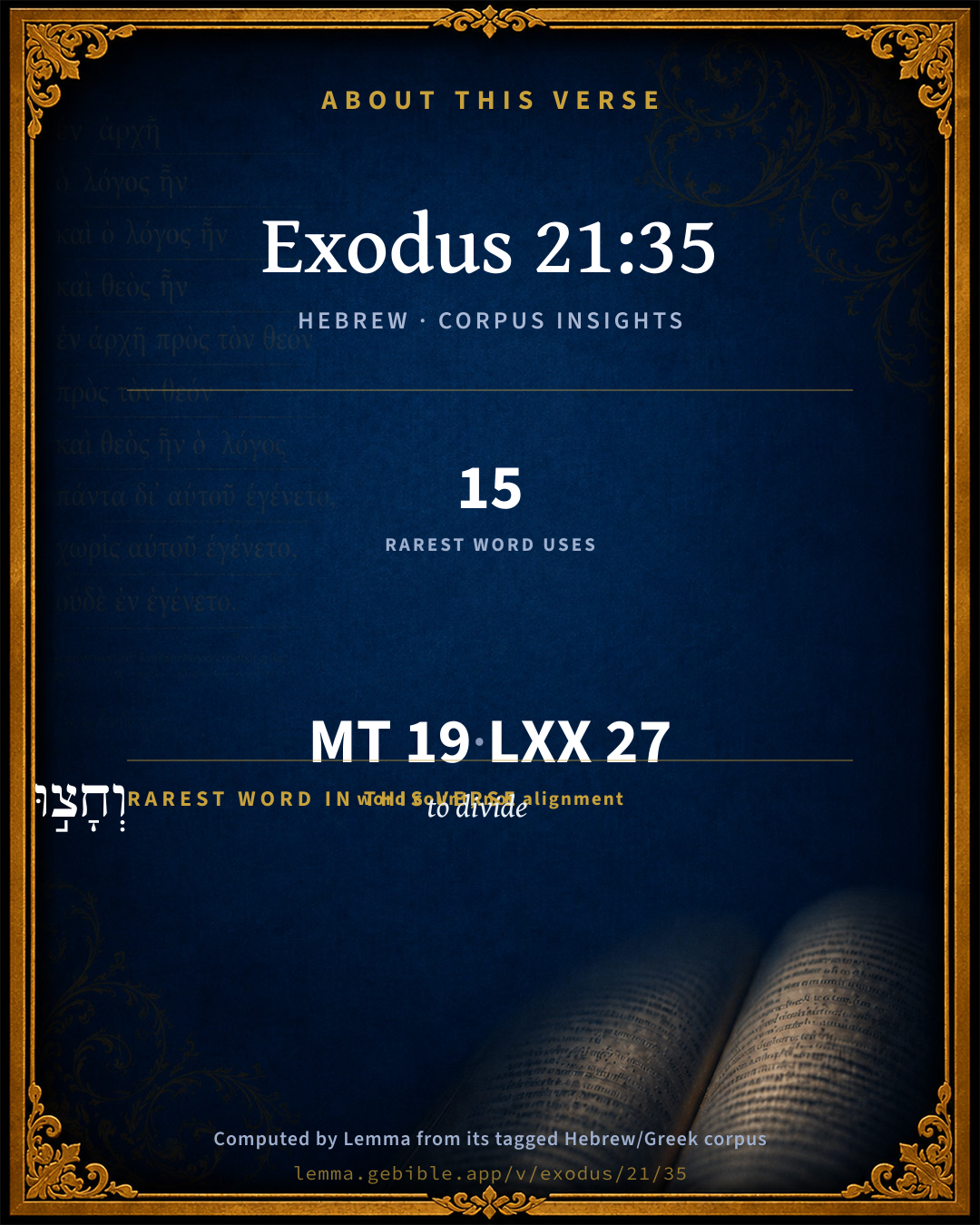
About this verse

These counts appear in no published source. They are computed here, from the morphology-tagged text and Lemma’s own curated glosses. What Lemma adds →

19
words
12
distinct lemmas
Pentateuch
section

Notable vocabulary

The rarest word here is וְחָצ֣וּ to divide H2673 — appearing just 15 times in the whole Hebrew Bible.

Shared distinctive vocabulary

וְחָצ֣וּ to divide H2673 occurs in 14 verses of the Hebrew Bible. Also found in:

Grammatical profile

  • 6 verbs
  • 6 nouns
  • 1 adjective
  • 1 conjunction
  • 5 particles

Verb forms

  • יִגֹּ֧ף Qal · Imperfect
  • וָמֵ֑ת Qal · Sequential Perfect
  • וּמָ֨כְר֜וּ Qal · Sequential Perfect
  • וְחָצ֣וּ Qal · Sequential Perfect
  • הַמֵּ֖ת Qal · Participle Active
  • יֶֽחֱצֽוּן Qal · Imperfect

Repetition

Words recur within this verse — often emphatic in Hebrew:

  • שֽׁוֹר ox H7794 ×3
  • וָמֵ֑ת to die H4191 ×2
  • וְחָצ֣וּ to divide H2673 ×2

Hebrew & Septuagint length

In English translation the verse runs 29 words from the Hebrew and 31 from the Septuagint (LXX English) — closely comparable.

A rough comparison of the two English renderings, which tokenize alike — not a word-level alignment.

Word counts can differ between the Hebrew and the Greek without any difference in meaning — e.g. the Hebrew direct-object marker אֵת has no separate Greek word, and Greek often adds the article ὁ.

In the original languages it is 19 Hebrew tokens and 27 Greek tokens — but the two are counted differently (Hebrew bundles its prefixes and suffixes into one token; the Greek is in lemma form), so that isn’t a like-for-like length.

Hebrew and Greek witnesses Masoretic Hebrew ↔ Greek Septuagint

The same verse in the two great witnesses to the Old Testament, shown verse-for-verse.

These are two independent witnesses, not word-aligned to each other, and the Septuagint is shown in lemma (dictionary) form.

Hebrew Exodus 21:35 Masoretic · Westminster Leningrad Codex

וְכִֽי יִגֹּ֧ף שֽׁוֹר אִ֛ישׁ אֶת שׁ֥וֹר רֵעֵ֖הוּ וָמֵ֑ת וּמָ֨כְר֜וּ אֶת הַשּׁ֤וֹר הַחַי֙ וְחָצ֣וּ אֶת כַּסְפּ֔וֹ וְגַ֥ם אֶת הַמֵּ֖ת יֶֽחֱצֽוּן

"If one man's bull injures another's, so that it dies, then they shall sell the live bull, and divide its price; and they shall also divide the dead animal.

World English Bible · Public Domain

Greek LXX Exodus 21:35 Septuagint · lemma form

ἐάν δέ κερατίζω τις ταῦρος ὁ ταῦρος ὁ πλησίον καί τελευτάω ἀποδίδωμι ὁ ταῦρος ὁ ζάω καί διααἱρέω ὁ ἀργύριον αὐτός καί ὁ ταῦρος ὁ θνήσκω διααἱρέω

And if any man's bull gore the bull of his neighbor, and it die, they shall sell the living bull and divide the money, and they shall divide the dead bull.

LXX2012 (modern English Septuagint) · Public Domain

Hebrew: Westminster Leningrad Codex (CC BY 4.0). Greek: Septuagint (public domain); English from LXX2012 (modern English Septuagint) (Public Domain). How the Septuagint differs from the Hebrew →

Targum (Aramaic paraphrase)

2

The Targum is the ancient Jewish Aramaic paraphrase of the Hebrew Scriptures — an interpretive translation, not the Hebrew text itself. Onkelos (literal) and Pseudo-Jonathan (expansive) render the Torah, and Jonathan the Prophets. Coverage is partial: where no permissively-licensed English translation exists for a verse, only the Aramaic is shown. This is verse-level text, not a word-by-word alignment to the Hebrew.

  1. Targum Onkelos Torah (Genesis–Deuteronomy)
    וַאֲרֵי יִגוֹף תּוֹר דִגְבַר יָת תּוֹרָא דְחַבְרֵהּ וִימוּת וִזַבְּנוּן יָת תּוֹרָא חַיָא וִיפַלְגוּן יָת כַּסְפֵּהּ וְאַף יָת דְמֵי מֵיתָא יְפַלְגוּן:

    (no public-domain English translation for this verse)

    Targum Onkelos — Aramaic: “Onkelos Genesis” (public domain); “Onkelos Exodus” (public domain); “Onkelos Leviticus” (public domain); “Onkelos Numbers” (public domain); “Onkelos Deuteronomy” (public domain). English: “Sefaria Community Translation” (CC0 1.0 (public-domain dedication)); “J.W. Etheridge. The Targums of Onkelos and Jonathan Ben Uzziel on the Pentateuch. London: Longmans, Green, 1862” (public domain). Text via Sefaria.

  2. Targum Pseudo-Jonathan Torah (Genesis–Deuteronomy)
    וַאֲרוּם יִנְגוֹף תּוֹר דִּגְבַר יַת תּוֹרָא דְּחַבְרֵיהּ וִימוּת וִיזַבְּנוּן יַת תּוֹרָה חַיָיא וְיִפְלְגוּן יַת דְּמֵיהּ וְאוּף יַת דְּמֵי מוֹתָא יִפְלְגוּן

    And when an ox woundeth his neighbour's ox, and he die, they shall sell the living ox, and divide the price, and the price of the dead one shall they also divide.

    Targum Pseudo-Jonathan — Aramaic: “Targum Jonathan on Genesis” (public domain); “Targum Jonathan on Exodus” (public domain); “Targum Jonathan on Leviticus” (public domain); “Targum Jonathan on Numbers” (public domain); “Targum Jonathan on Deuteronomy” (public domain). English: “The Targum of Jonathan ben Uzziel, trans. J. W. Etheridge, London, 1862” (public domain). Text via Sefaria.

Commentary

Notes on Exodus 21:35 from classic Christian and Jewish commentators (each source and its license shown beneath its notes). The classic Christian expositions comment on the surrounding passage and are grouped to its opening verse, so a note may address several verses; the Jewish commentaries on the Tanakh (Rashi and others) are per-verse, so they appear only where the commentator wrote on this verse.

Lemma curates 59 commentaries, every one of them public domain or Creative Commons licensed, each selected and text-cleaned for this edition rather than reprinted as found. About our sources →

Ellicott's Commentary for English Readers

(35-36) if one man’s ox hurt another’s.—Where no blame attached to the owner, the loss was to be equally shared. Where the dangerous character of the animal was, or ought to have been, known, the man whose ox was killed received its full value.

A Bible Commentary for English Readers, edited by Charles John Ellicott (1878–1897) — public domain. Text from a community e-Sword module.

The Cambridge Bible for Schools and Colleges

gen. ed. J. J. S. Perowne

35. ‘If this admirable statute were faithfully administered now, it would prevent many angry, and sometimes fatal, feuds between herds-men, and at the same time would be a very fair adjustment of the questions of equity that grow out of such accidents’ (Thomson, L. and B. ii. 283). It is now the ‘custom of the desert’ (Doughty, Arab. Deserta, i. 351).

35, 36. Injury done by an ox to one belonging to another person. If no neglect can be proved against the owner of the vicious ox, the damage is to be divided equally between the owners of the two animals (v. 35): but if the owner of the vicious ox culpably neglects to keep it in, he is to make full compensation to the owner of the ox which has been killed.

The Cambridge Bible for Schools and Colleges (gen. ed. J. J. S. Perowne; Cambridge University Press, 1878–1918) — public domain. Text from a community e-Sword module.

John Gill's Exposition

And if one man's ox hurt another's, that he die,.... By pushing with his horns, or his body, or by biting with his teeth, as Jarchi, or by any way whatever:

then they shall sell the live ox, and divide the money; the Scripture speaks, as the same writer observes, of one of equal value, otherwise the man that had his ox killed might be greatly a gainer by it; for if his ox was a poor one, and of little value, and the ox that killed his a good one, of value greatly superior, which according to this law was to be sold, and the money divided between the two owners, the man that lost his ox might have double the worth of it, or more, which was not equitable. On the other hand, according to the Jewish canons (t), the case stood thus,"when an ox of the value of one pound strikes an ox of the value of twenty, and kills him, and, lo, the carcass is of the value of four pounds, the owner of the ox is bound to pay him eight pounds, which is the half of the damage, (added to the half part of the price of the carcass,) but he is not bound to pay, but of the body of the ox which hurts, because it is said, "they shall sell the live ox"; wherefore if an ox of the value of twenty pieces of money should kill one of two hundred, and the carcass is valued at a pound, the master of the carcass cannot say to the master of the live ox, give me fifty pieces of money; but it will be said to him, lo, the ox which did the hurt is before thee, take him, and go thy way, although he is worth no more than a penny:"

and the dead ox also they shall divide; the money the carcass is worth; or it is sold for.

(t) Maimon. Hilchot Niske Mammon, c. 1. sect. 1.

John Gill's Exposition of the Whole Bible (1746–1763) — public domain (CC PDM 1.0). Text via the HelloAO Bible API.

Albert Barnes' Notes on the Bible

The dead ox in this case, as well as in the preceding one, must have been worth no more than the price of the hide, as the flesh could not be eaten. See Lev 17:1-6.

Albert Barnes' Notes on the Bible (1834–1885) — public domain. Text from a community e-Sword/MySword module.

Matthew Poole's English Annotations

They shall divide the money; not equally, for so the owner of the mischievous ox might be gainer by the mischief, his ox being much worse than that which was killed; but in such proportions as the judges shall think fit, considering the worth of the cattle, and the circumstances of the action.

Matthew Poole's English Annotations on the Holy Bible (1683–1685) — public domain. Text from a community e-Sword/MySword module.

The Pulpit Commentary

Vers. 35, 36. If one man"s ox hurt another"s, etc. The hurt might be purely accidental, and imply no neglect. In that ease the two parties were to divide the value of the living, and also of the dead oxi.e. , they were to share between them the loss caused by the accident equally. If, however, there was neglect, if the aggressive animal was known to be of a vicious disposition, then the man who had suffered the loss was to receive the full value of the slain animal, but to lose his share of the carcase. This explanation, which the words of the text not only admit, but invite, seems better than the Rabbinical one, "that the dead ox should also be the property of the injured party."

The Pulpit Commentary (1880–1919), ed. H.D.M. Spence-Jones & Joseph S. Exell — public domain. Text from a community e-Sword module.

unfoldingWord translationNotes

Door43 World Missions Community

divide its price

"divide the money" or "divide the money they receive"

if it was known

This can be stated in active form. AT: "if people knew" or "if the owner knew" (See: Active or Passive)

a habit of goring in time past

"had gored other animals before"

its owner has not kept it in

This means that the owner did not keep his ox securely inside a fence. This can be clearly stated in the translation. AT: "its owner did not keep it inside a fence" (See: Assumed Knowledge and Implicit Information)

he must surely pay ox for ox

The owner of the ox that killed must give an ox to the man who lost his ox. This can be stated clearly in the translation. AT: "the owner of the ox that killed must surely give a living ox to the owner of the ox that died" (See: Assumed Knowledge and Implicit Information)

unfoldingWord translationNotes — © Distant Shores Media and the Door43 World Missions Community, licensed CC BY-SA 4.0. Source: git.door43.org/Door43/en_tn.

Rashi

Rabbi Shlomo Yitzchaki (Rashi)

וכי יגף AND IF [AN OX] HURT [AN OX OF HIS FELLOW-MAN] — יגף means to thrust; whether it injures by horns or the whole body, or whether it kicks with its foot or bites it with its teeth, all are included in the term נגף, for נגף means nothing else than מכה — the impact of one thing upon another (Mekhilta).

שור איש means שור של איש THE OX OF A MAN (i. e. שור is in construct state to the word איש).‎

ומכרו את השור וגו׳ THEN THEY SHALL SELL THE LIVE ONE — Scripture is speaking of a case when both animals are of the same value: an ox of the value of 200 zuz that killed another also valued at 200 zuz. Then whether the carcass is worth much or whether it is worth little, as soon as one takes one-half of the living animal and one-half of the dead, and the other takes one-half of the living animal and one-half of the dead, it follows that each of them suffers the loss of half the damage which the death of the animal has caused. Scripture teaches us that the תם (which is the animal spoken of here — one that inflicted injury for the first time) always pays half damages. For from what it states about animals of the same value you may gather the rule for such as are of different values — that the law regarding the תם is for its owner to pay half damages, neither more nor less. Or perhaps you might say that also of animals which were of unequal value when living Scripture states that both of them must be halved! But if you say this, you will find that sometimes the man who occasions the damage may benefit considerably — namely, when the carcass is worth when sold unto heathens much more than the value of the ox which inflicted the injury. And you must admit that it is impossible that Scripture should say that the man who occasioned the damage should benefit by it. Or it may sometimes happen that the claimant will receive much more than the value of the whole damage — namely, when one-half of the value of the defendant’s ox is worth more than the whole value of the claimant’s ox. Consequently if you still maintain this (that the animals are to be halved even when they are of different value), the result may well be that the case of the תם is more severely dealt with than that of the מועד (when the claimant gets full damages — but not more). You must therefore needs admit that Scripture speaks here only of animals that are of equal value, and that it teaches you that the owner of a תם has to pay half damages; and from what is said in respect to animals of equal value you may derive the law in respect of such as are of different values — that in any case when a person is paid half the damages caused to him we value the carcass for him (the claimant); and as regards the depreciation in value caused by its death — he must accept a sum equal to half of that depreciation together with the carcass and has to be satisfied (Hebrew: and goes his way). But why does Scripture use this mode of expression and does not simply say: he (the owner of the תם) shall pay the half? To teach you by the way that the תם pays only to the extent of its own value (Hebrew: from what can be obtained for its body). So in case it gores another and itself dies, the claimant gets at most the carcass of the ox that caused the damage, and if that does not amount to one-half of the damage, he has to suffer the loss. Or take another case: an ox of the value of one maneh (200 zuz) that gored an ox of the value of 500 zuz (so that the loss is more than the whole value of the ox that caused it). The claimant still does not get more than the living ox; and the defendant is not bound to make up the deficiency from his own money, for the תם is not responsible to such an extent as to make its owner liable to pay from his own property) (Bava Kamma 16b).

Rashi on the Tanakh — English translations: “The Judaica Press complete Tanach with Rashi, translated by A. J. Rosenberg” (CC BY 4.0); “Pentateuch with Rashi's commentary by M. Rosenbaum and A.M. Silbermann, 1929-1934” (public domain); “The Metsudah Tanach series, Lakewood, N.J” (CC BY 4.0); and “The Book of Joshua, Metsudah Publications, 1997” (CC BY 4.0). Text via Sefaria.

Lesson kit

Teaching starters — assembled from the data on this page, not authored interpretation. Every prompt links to the verse data it draws on. Edit before teaching.

Exodus, in the Pentateuch, opens this verse with 19 words (12 distinct Hebrew lemmas). Its most distinctive word is châtsâh (“to divide”). A historical commentator’s framing appears above. Read the whole chapter for the surrounding context.

Discussion questions

  1. The word châtsâh carries the sense “to divide.” How does it shape the verse?
  2. How does Genesis 32:7, which shares the word «to divide», read alongside this verse?
  3. What does the repetition of “ox” (3× in this one verse) do in this verse?
  4. These translations render this verse differently; the difference is in the English rendering, not the original. What questions does that raise?
  5. «יִגֹּ֧ף» is a Qal Imperfect verb. How does that grammatical form shape the action described?
  6. Compare how Ellicott's Commentary for English Readers and The Cambridge Bible for Schools and Colleges read this verse. Where do they agree or differ?

Things to notice

Reading settings

Reading text

Shown beneath each verse's original-language words.

Old Testament
Old Testament edition

Read the OT as the Masoretic Hebrew (MT) or the Greek Septuagint (LXX).

English shown for the Greek Septuagint (in the Hebrew ↔ Greek comparison).

Comparing translations? Open the Compare panel on any verse page to stack up to four side by side.