
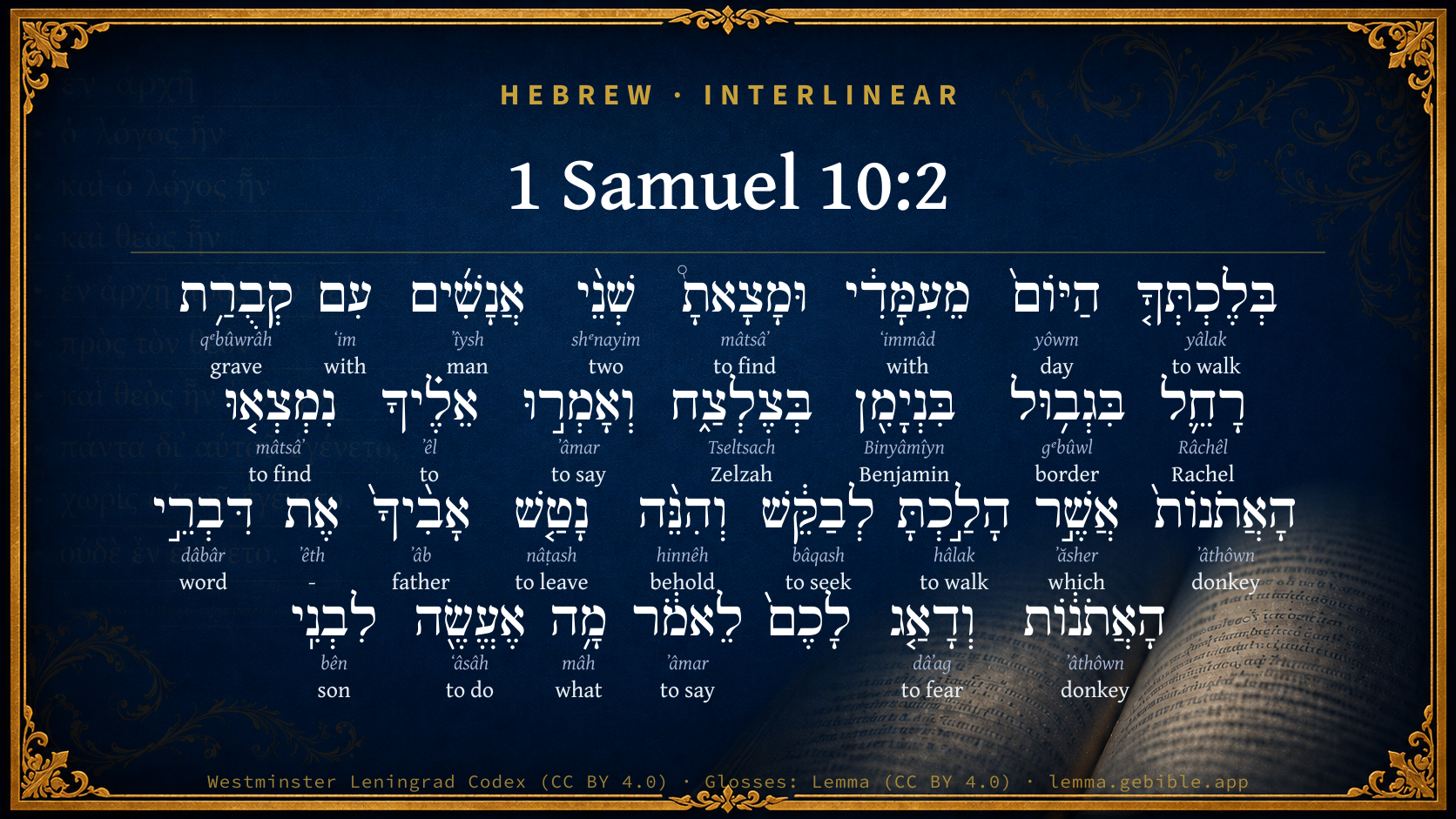
1 Samuel 10:2

Hebrew (Westminster Leningrad Codex) 1 Samuel 10:2 appears in the Hebrew Old Testament. The text above is from the Westminster Leningrad Codex. Each word links to its Strong’s number, a concise gloss, and parsing drawn from the Open Scriptures Hebrew Bible morphology. Click any word for its full Brown-Driver-Briggs (BDB) entry.
Download image
Cite this verse

1 Samuel 10:2 (World English Bible). Public Domain. Lemma interlinear Bible study tool, https://lemma.gebible.app/v/1-samuel/10/2.

Show BibTeX & RIS
BibTeX
RIS
English Translation
When you are departed from me today, then you shall find two men by Rachel's tomb, in the border of Benjamin at Zelzah; and they will tell you, The donkeys which you went to seek are found; and, behold, your father has left off caring for the donkeys, and is anxious for you, saying, What shall I do for my son?
World English Bible · Public Domain
Highlights
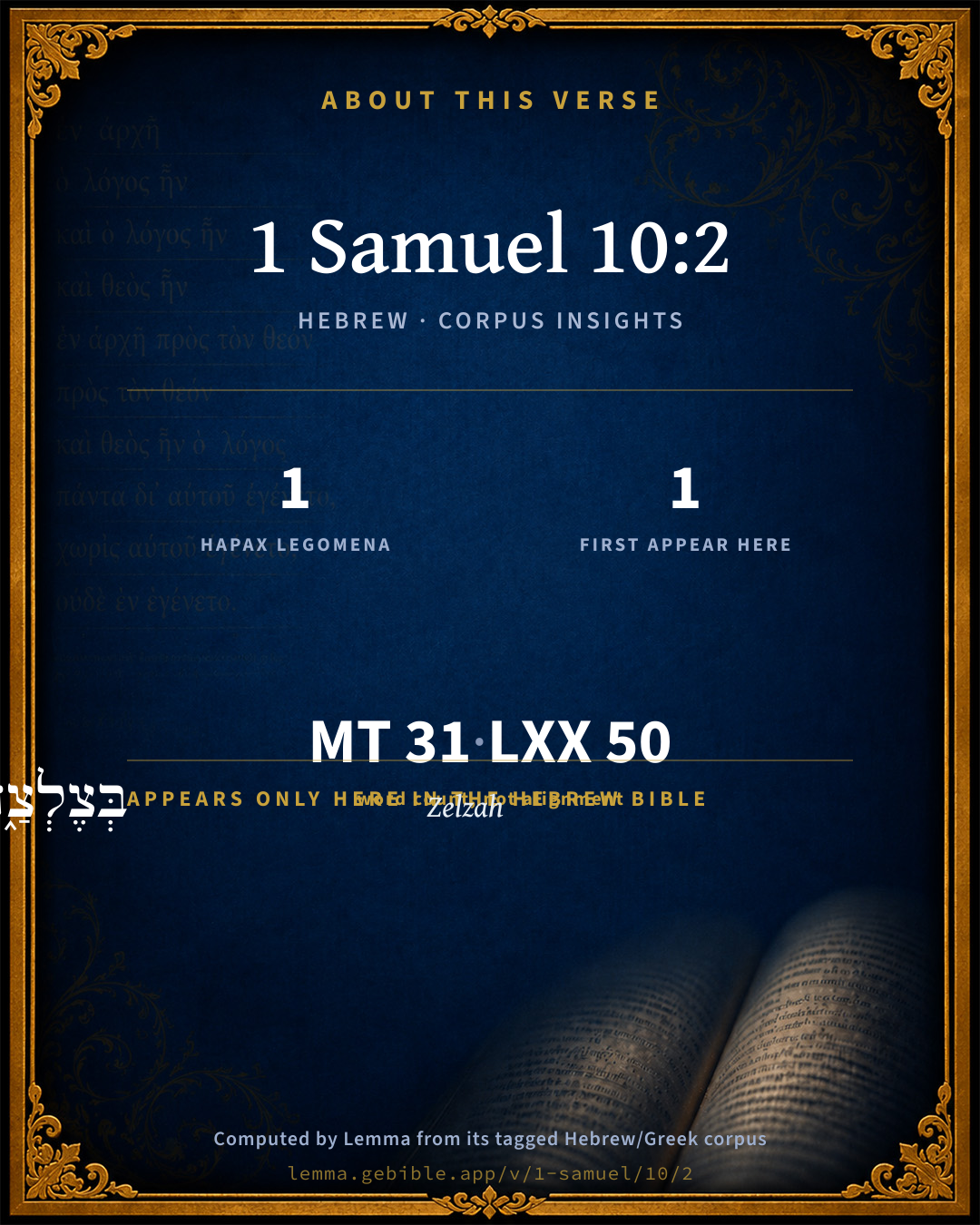
  • 1 hapax legomenon — only here in the Hebrew Bible
  • 1 first appearance in the Hebrew Bible
Full analysis ↓
Download a study sheet

One document with this verse’s original text, its word-by-word gloss line, the meaning frame, cross-references with their text, attributed commentary, and full source and license credits — printable, and it pastes into notes with its structure intact.

This verse Autodidact and up

Study sheet (.html) Plain text (.txt)

A passage Seminary Student

Up to 50 verses in one chapter. A passage sheet keeps up to 6 commentary sources and 12 cross-references per verse, in the order this page ranks them, and says so on the sheet whenever that leaves anything out. Ask for a single verse and you get the Autodidact verse sheet above.

Everything on this page stays free to read, with no account — the sheet is a download of what is already on screen, not access to it.

Want to remove ads? Support Godless Engineer
Compare translations 3

The same verse in 3 English versions, stacked beneath the original-language interlinear above. Click any original word for its lexicon entry.

Each is an independent rendering of the whole verse — the interlinear is not word-aligned to these translations.

Highlighted words mark where these versions differ — a whole-verse word diff, not a word-by-word alignment.

  • World English Bible Public Domain
    When you are departed from me today, then you shall find two men by Rachel's tomb, in the border of Benjamin at Zelzah; and they will tell you, The donkeys which you went to seek are found; and, behold, your father has left off caring for the donkeys, and is anxious for you, saying, What shall I do for my son?
  • King James Version Public Domain
    When thou art departed from me to day, then thou shalt find two men by Rachel's sepulchre in the border of Benjamin at Zelzah; and they will say unto thee, The asses which thou wentest to seek are found: and, lo, thy father hath left the care of the asses, and sorroweth for you, saying, What shall I do for my son?
  • unfoldingWord Literal Text CC BY-SA 4.0
    In your going today from with me, then you will find two men near the tomb of Rachel in the border of Benjamin in Zelzah. And they will say to you, ‘The female donkeys that you went to seek have been found. And behold, your father has abandoned the matters of the female donkeys and has become concerned about you, saying, “What shall I do about my son?”’

unfoldingWord Literal Text — © unfoldingWord, licensed CC BY-SA 4.0. Word-aligned USFM3 via Door43 (git.door43.org/unfoldingWord/en_ult).

Versions to compare (up to 4)

3 of 4 selected

Show all 18 translations

Every available English version of this verse, each an independent rendering of the whole verse.

  • World English Bible Public Domain
    When you are departed from me today, then you shall find two men by Rachel's tomb, in the border of Benjamin at Zelzah; and they will tell you, The donkeys which you went to seek are found; and, behold, your father has left off caring for the donkeys, and is anxious for you, saying, What shall I do for my son?
  • Berean Standard Bible Public Domain
    When you leave me today, you will find two men at Rachel’s tomb in Zelzah on the border of Benjamin. They will say to you, ‘The donkeys you seek have been found, and now your father has stopped worrying about the donkeys and started worrying about you, asking, “What should I do about my son?”’
  • Majority Standard Bible Public Domain
    When you leave me today, you will find two men at Rachel’s tomb in Zelzah on the border of Benjamin. They will say to you, ‘The donkeys you seek have been found, and now your father has stopped worrying about the donkeys and started worrying about you, asking, “What should I do about my son?”’
  • King James Version Public Domain
    When thou art departed from me to day, then thou shalt find two men by Rachel's sepulchre in the border of Benjamin at Zelzah; and they will say unto thee, The asses which thou wentest to seek are found: and, lo, thy father hath left the care of the asses, and sorroweth for you, saying, What shall I do for my son?
  • American Standard Version (1901) Public Domain
    When thou art departed from me to-day, then thou shalt find two men by Rachel's sepulchre, in the border of Benjamin at Zelzah; and they will say unto thee, The asses which thou wentest to seek are found; and, lo, thy father hath left off caring for the asses, and is anxious for you, saying, What shall I do for my son?
  • Revised Version (1885) Public Domain
    When thou art departed from me today, then thou shalt find two men by Rachel’s sepulchre, in the border of Benjamin at Zelzah; and they will say unto thee, The asses which thou wentest to seek are found: and, lo, thy father hath left the care of the asses, and taketh thought for you, saying, What shall I do for my son?
  • Geneva Bible (1599) Public Domain
    When thou shalt depart from me this day, thou shalt finde two men by Rahels sepulchre in the border of Beniamin, euen at Zelzah, and they will say vnto thee, The asses which thou wentest to seeke, are founde: and lo, thy father hath left the care of the asses, and soroweth for you, saying, What shall I doe for my sonne?
  • Douay-Rheims (1899) Public Domain
    When thou shalt depart from me this day, thou shalt find two men by the sepulchre of Rachel in the borders of Benjamin to the south, and they shall say to thee: The asses are found which thou wentest to seek: and thy father thinking no more of the asses is concerned for you, and saith: What shall I do for my son?
  • Young's Literal Translation Public Domain
    In thy going to-day from me -- then thou hast found two men by the grave of Rachel, in the border of Benjamin, at Zelzah, and they have said unto thee, The asses have been found which thou hast gone to seek; and lo, thy father hath left the matter of the asses, and hath sorrowed for you, saying, What do I do for my son?
  • Literal Standard Version CC BY-SA 4.0
    In your going from me today—then you have found two men by the grave of Rachel, in the border of Benjamin, at Zelzah, and they have said to you, The donkeys have been found which you have gone to seek; and behold, your father has left the matter of the donkeys, and has sorrowed for you, saying, What do I do for my son?
  • Unlocked Literal Bible CC BY-SA 4.0
    When you leave me today, you will find two men near Rachel's tomb, in the territory of Benjamin at Zelzah. They will say to you, 'The donkeys that you were looking for have been found. Now your father has stopped caring about the donkeys and is worried about you, saying, “What should I do about my son?”'
  • unfoldingWord Literal Text CC BY-SA 4.0
    In your going today from with me, then you will find two men near the tomb of Rachel in the border of Benjamin in Zelzah. And they will say to you, ‘The female donkeys that you went to seek have been found. And behold, your father has abandoned the matters of the female donkeys and has become concerned about you, saying, “What shall I do about my son?”’
  • Darby Bible Public Domain
    When thou goest from me to-day, thou shalt meet two men by Rachel's sepulchre in the border of Benjamin at Zelzah; and they will say to thee, The asses are found which thou wentest to seek, and behold, thy father has dismissed the matter of the asses, and is anxious about you, saying, What shall I do for my son?
  • World Messianic Bible Public Domain
    When you have departed from me today, then you will find two men by Rachel’s tomb, on the border of Benjamin at Zelzah. They will tell you, ‘The donkeys which you went to look for have been found; and behold, your father has stopped caring about the donkeys and is anxious for you, saying, “What shall I do for my son?”’
  • Webster's Bible Public Domain
    When thou hast departed from me to-day, then thou shalt find two men by Rachel's sepulcher in the border of Benjamin at Zelzah; and they will say to thee, The asses which thou wentest to seek are found: and lo, thy father hath left the care of the asses, and sorroweth for you, saying, What shall I do for my son?
  • Free Bible Version CC BY-SA 4.0
    When you leave me today, you will meet two men near Rachel's tomb in Zelzah, on the border of Benjamin. They will tell you that the donkeys you went to look for have been found. Now your father isn't concerned about them but is worried about you. He's wondering, ‘What about my son?’
  • Bible in Basic English Public Domain
    When you have gone away from me today, you will see two men by the resting-place of Rachel's body, in the land of Benjamin at Zelzah; and they will say to you, The asses which you went in search of have come back, and now your father, caring no longer for the asses, is troubled about you, saying, What am I to do about my son?
  • JPS Tanakh (1917) Public Domain
    When thou art departed from me to-day, then thou shalt find two men by the tomb of Rachel, in the border of Benjamin at Zelzah; and they will say unto thee: The asses which thou wentest to seek are found; and, lo, thy father hath left off caring for the asses, and is anxious concerning you, saying: What shall I do for my son?

Literal Standard Version (2020), Covenant Press — licensed CC BY-SA 4.0. Text via the HelloAO Bible API (eBible.org). Unlocked Literal Bible (unfoldingWord) — licensed CC BY-SA 4.0. Text via the HelloAO Bible API (eBible.org). unfoldingWord Literal Text — © unfoldingWord, licensed CC BY-SA 4.0. Word-aligned USFM3 via Door43 (git.door43.org/unfoldingWord/en_ult). Free Bible Version, Dr. Jonathan Gallagher — licensed CC BY-SA 4.0. Text via the HelloAO Bible API (eBible.org).

Word by word

More ways to search: Search by grammar → Find every occurrence → Compare this word →

Practice this passage: Drill this verse → Learn its vocabulary →

בְּצֶלְצַ֑ח
Tseltsach
H6766
“in/at · Zelzah”
Preposition + Noun, Proper
Part of Speech
Preposition + Noun
Type
Proper
Full BDB Definition

Origin: from H6738 and H6703

TWOT: None

Zelzah = "shadow" - a place on the boundary of Benjamin, close to Rachel's tomb, 5 miles (8 kilometers) southwest of Jerusalem
  1. בְּלֶכְתְּךָ֤ yâlak H3212 “in/at · to walk · you” Preposition + Verb, Qal, Infinitive Construct + Suffix, Personal, 2nd Person, Masculine, Singular
  2. הַיּוֹם֙ yôwm H3117 “the · day” Particle, Definite Article + Noun, Common, Masculine, Singular, Absolute
  3. מֵעִמָּדִ֔י ʻimmâd H5978 “from · with · me” Preposition + Preposition + Suffix, Personal, 1st Person, Common, Singular
  4. וּמָצָאתָ֩ mâtsâʼ H4672 “and · to find” Conjunction + Verb, Qal, Sequential Perfect, 2nd Person, Masculine, Singular
  5. שְׁנֵ֨י shᵉnayim H8147 “two” Adjective, Cardinal number, Masculine, Dual, Construct
  6. אֲנָשִׁ֜ים ʼîysh H376 “men” Noun, Common, Masculine, Plural, Absolute
  7. עִם ʻim H5973 “with” Preposition
  8. קְבֻרַ֥ת qᵉbûwrâh H6900 “grave of” Noun, Common, Feminine, Singular, Construct
  9. רָחֵ֛ל Râchêl H7354 “Rachel” Noun, Proper
  10. בִּגְב֥וּל gᵉbûwl H1366 “in/at · border of” Preposition + Noun, Common, Masculine, Singular, Construct
  11. בִּנְיָמִ֖ן Binyâmîyn H1144 “Benjamin” Noun, Proper
  12. וְאָמְר֣וּ ʼâmar H559 “and · to say” Conjunction + Verb, Qal, Sequential Perfect, 3rd Person, Common, Plural
  13. אֵלֶ֗יךָ ʼêl H413 “to · you” Preposition + Suffix, Personal, 2nd Person, Masculine, Singular
  14. נִמְצְא֤וּ mâtsâʼ H4672 “to find” Verb, Niphal, Perfect, 3rd Person, Common, Plural
  15. הָאֲתֹנוֹת֙ ʼâthôwn H860 “the · donkeys” Particle, Definite Article + Noun, Common, Feminine, Plural, Absolute
  16. אֲשֶׁ֣ר ʼăsher H834 “which” Particle, Relative
  17. הָלַ֣כְתָּ hâlak H1980 “to walk” Verb, Qal, Perfect, 2nd Person, Masculine, Singular
  18. לְבַקֵּ֔שׁ bâqash H1245 “to seek” Preposition + Verb, Piel, Infinitive Construct
  19. וְהִנֵּ֨ה hinnêh H2009 “and · behold” Conjunction + Particle, Demonstrative
  20. נָטַ֤שׁ nâṭash H5203 “to leave” Verb, Qal, Perfect, 3rd Person, Masculine, Singular
  21. אָבִ֨יךָ֙ ʼâb H1 “father · your” Noun, Common, Masculine, Singular, Construct + Suffix, Personal, 2nd Person, Masculine, Singular
  22. אֶת ʼêth H853 “-” Particle, Direct Object
  23. דִּבְרֵ֣י dâbâr H1697 “words of” Noun, Common, Masculine, Plural, Construct
  24. הָאֲתֹנ֔וֹת ʼâthôwn H860 “the · donkeys” Particle, Definite Article + Noun, Common, Feminine, Plural, Absolute
  25. וְדָאַ֤ג dâʼag H1672 “and · to fear” Conjunction + Verb, Qal, Perfect, 3rd Person, Masculine, Singular
  26. לֵאמֹ֔ר ʼâmar H559 “to say” Preposition + Verb, Qal, Infinitive Construct
  27. מָ֥ה mâh H4100 “what” Particle, Interrogative
  28. אֶעֱשֶׂ֖ה ʻâsâh H6213 “to do” Verb, Qal, Imperfect, 1st Person, Common, Singular
  29. לִבְנִֽי bên H1121 “to/for · son · my” Preposition + Noun, Common, Masculine, Singular, Construct + Suffix, Personal, 1st Person, Common, Singular

About this verse

These counts appear in no published source. They are computed here, from the morphology-tagged text and Lemma’s own curated glosses. What Lemma adds →

31
words
27
distinct lemmas
Historical
section

Notable vocabulary

1 hapax legomenon — a word that appears only here in the entire Hebrew Bible:

  • בְּצֶלְצַ֑ח Zelzah H6766

First appearance in Scripture

This word makes its first canonical appearance in the Hebrew Bible here:

  • בְּצֶלְצַ֑ח Zelzah H6766

Shared distinctive vocabulary

וְדָאַ֤ג to fear H1672 occurs in 7 verses of the Hebrew Bible. Also found in:

Grammatical profile

  • 10 verbs
  • 12 nouns
  • 1 adjective
  • 4 prepositions
  • 4 particles

Verb forms

  • בְּלֶכְתְּךָ֤ Qal · Infinitive Construct
  • וּמָצָאתָ֩ Qal · Sequential Perfect
  • וְאָמְר֣וּ Qal · Sequential Perfect
  • נִמְצְא֤וּ Niphal · Perfect
  • הָלַ֣כְתָּ Qal · Perfect
  • לְבַקֵּ֔שׁ Piel · Infinitive Construct
  • נָטַ֤שׁ Qal · Perfect
  • וְדָאַ֤ג Qal · Perfect
  • לֵאמֹ֔ר Qal · Infinitive Construct
  • אֶעֱשֶׂ֖ה Qal · Imperfect

Repetition

Words recur within this verse — often emphatic in Hebrew:

  • וּמָצָאתָ֩ to find H4672 ×2
  • וְאָמְר֣וּ to say H559 ×2
  • הָאֲתֹנוֹת֙ donkey H860 ×2

Hebrew & Septuagint length

In English translation the verse runs 61 words from the Hebrew and 69 from the Septuagint (LXX English) — closely comparable.

A rough comparison of the two English renderings, which tokenize alike — not a word-level alignment.

Word counts can differ between the Hebrew and the Greek without any difference in meaning — e.g. the Hebrew direct-object marker אֵת has no separate Greek word, and Greek often adds the article ὁ.

In the original languages it is 31 Hebrew tokens and 50 Greek tokens — but the two are counted differently (Hebrew bundles its prefixes and suffixes into one token; the Greek is in lemma form), so that isn’t a like-for-like length.

Cross-references

4

Topical passages linked to 1 Samuel 10:2 in the Treasury of Scripture Knowledge — connected by theme and wording, ordered by reader-vote popularity; previews shown in the World English Bible.

  • 1 Samuel 9:3–5 The donkeys of Kish, Saul's father, were lost. Kish said to Saul his son, Take now one of the servants with you, and arise, go seek the donkeys.
  • Genesis 35:19–20 Rachel died, and was buried in the way to Ephrath (the same is Bethlehem).
  • Joshua 18:28 and Zelah, Eleph, and the Jebusite (the same is Jerusalem), Gibeath, [and] Kiriath; fourteen cities with their villages. This is the inheritance of the children of Benjamin according to their families.
  • 1 Samuel 10:16 Saul said to his uncle, He told us plainly that the donkeys were found. But concerning the matter of the kingdom, of which Samuel spoke, he didn't tell him.

Cross-references courtesy of OpenBible.info (CC BY 4.0).

Hebrew and Greek witnesses Masoretic Hebrew ↔ Greek Septuagint

The same verse in the two great witnesses to the Old Testament, shown verse-for-verse.

These are two independent witnesses, not word-aligned to each other, and the Septuagint is shown in lemma (dictionary) form.

Hebrew 1 Samuel 10:2 Masoretic · Westminster Leningrad Codex

בְּלֶכְתְּךָ֤ הַיּוֹם֙ מֵעִמָּדִ֔י וּמָצָאתָ֩ שְׁנֵ֨י אֲנָשִׁ֜ים עִם קְבֻרַ֥ת רָחֵ֛ל בִּגְב֥וּל בִּנְיָמִ֖ן בְּצֶלְצַ֑ח וְאָמְר֣וּ אֵלֶ֗יךָ נִמְצְא֤וּ הָאֲתֹנוֹת֙ אֲשֶׁ֣ר הָלַ֣כְתָּ לְבַקֵּ֔שׁ וְהִנֵּ֨ה נָטַ֤שׁ אָבִ֨יךָ֙ אֶת דִּבְרֵ֣י הָאֲתֹנ֔וֹת וְדָאַ֤ג לָכֶם֙ לֵאמֹ֔ר מָ֥ה אֶעֱשֶׂ֖ה לִבְנִֽי

When you are departed from me today, then you shall find two men by Rachel's tomb, in the border of Benjamin at Zelzah; and they will tell you, The donkeys which you went to seek are found; and, behold, your father has left off caring for the donkeys, and is anxious for you, saying, What shall I do for my son?

World English Bible · Public Domain

Greek LXX 1 Samuel 10:2 Septuagint · lemma form

ὡς ἄν ἀποἔρχομαι σήμερον ἀπό ἐγώ καί εὑρίσκω δύο ἀνήρ πρός ὁ τάφος ραχηλ ἐν ὁ ὅριον βενιαμίν ἅλλομαι μέγας καί εἶπον σύ εὑρίσκω ὁ ὄνος ὅς πορεύομαι ζητέω καί ἰδού ὁ πατήρ σύ ἀποτινάσσω ὁ ῥῆμα ὁ ὄνος καί δαψιλεύω διά σύ λέγω τίς ποιέω ὑπέρ ὁ υἱός ἐγώ

As soon as you shall have departed this day from me, you shall find two men by the burial-place of Rachel on the mount of Benjamin, exulting greatly; and they shall say to you, The asses are found which you⌃ went to seek; and, behold, your father has given up the matter of the asses, and he is anxious for you, saying, What shall I do for my son?

LXX2012 (modern English Septuagint) · Public Domain

On this verse, Keil & Delitzsch discusses the Septuagint’s reading. Read the note in Commentary ↓

Hebrew: Westminster Leningrad Codex (CC BY 4.0). Greek: Septuagint (public domain); English from LXX2012 (modern English Septuagint) (Public Domain). How the Septuagint differs from the Hebrew →

Targum (Aramaic paraphrase)

1

The Targum is the ancient Jewish Aramaic paraphrase of the Hebrew Scriptures — an interpretive translation, not the Hebrew text itself. Onkelos (literal) and Pseudo-Jonathan (expansive) render the Torah, and Jonathan the Prophets. Coverage is partial: where no permissively-licensed English translation exists for a verse, only the Aramaic is shown. This is verse-level text, not a word-by-word alignment to the Hebrew.

  1. Targum Jonathan Prophets (Joshua–Malachi)
    בְּמַהֲכָךְ יוֹמָא דֵין מִנִי מִלְוָתִי וְתַשְׁכַּח תְּרֵין גַבְרִין עִם קְבוּרְתָּא דְרָחֵל בִּתְּחוּם בִּנְיָמִן בְּצֶלְצַח וְיֵימְרוּן לָךְ אִשְׁתְּכָחָא אֲתָנַיָא דַאֲזַלְתָּ לְמִבְעֵי יַתְהֶן וְהָא שְׁבַק אֲבוּךְ יַת עֵיסַק אֲתָנַיָא וְיַצִיף לְכוֹן לְמֵימַר מָה אַעְבֵיד לִבְרִי:

    (no public-domain English translation for this verse)

    Targum Jonathan — Aramaic: “Mikraot Gedolot” (public domain). English: “Sefaria Community Translation” (CC0 1.0 (public-domain dedication)); “London "Chaldee Paraphrase," 1871” (public domain). Text via Sefaria.

Commentary

Notes on 1 Samuel 10:2 from classic Christian and Jewish commentators (each source and its license shown beneath its notes). The classic Christian expositions comment on the surrounding passage and are grouped to its opening verse, so a note may address several verses; the Jewish commentaries on the Tanakh (Rashi and others) are per-verse, so they appear only where the commentator wrote on this verse.

Lemma curates 59 commentaries, every one of them public domain or Creative Commons licensed, each selected and text-cleaned for this edition rather than reprinted as found. About our sources →

Trapp's Complete Commentary

John Trapp

1Sa 10:2 When thou art departed from me to day, then thou shalt find two men by Rachel’s sepulchre in the border of Benjamin at Zelzah; and they will say unto thee, The asses which thou wentest to seek are found: and, lo, thy father hath left the care of the asses, and sorroweth for you, saying, What shall I do for my son?

Ver. 2. When thou art departed.] Saul is confirmed in his calling to the kingly office by sundry signs, which was dignatio stapenda. Think the same of our sacraments, given to confirm our faith in our high and heavenly calling by Christ.

By Rachel’s sepulchre.] Which stood in the borders of Judah and Benjamin; Gregory here noteth, that this sepulchre should have reminded him of his mortality; {a} a good allay to his new dignity. {b} It is reported that heretofore at Constantinople, when the emperor was first placed in his throne, a mason came to him with choice of stones, to ask him which of those he would please to choose for his tombstone.

{a} Monimenta quasi mentem monentia.

{b} Samuel sendeth Saul newly anointed to Rachel’s sepulchre, that he might not be glutted with the honour he was entering upon. - Mr Love.

John Trapp, A Commentary or Exposition upon All the Books of the Old and New Testament (1647–1656) — public domain. Text from a community e-Sword module.

Joseph Benson's Commentary

1Sa 10:2. By Rachel’s sepulchre — In the way to Beth-lehem, which city was in Judah; her sepulchre might be either in Judah, or in Benjamin; for the possessions of those two tribes were bordering one upon another. The first place he directs him to was a sepulchre, the sepulchre of one of his ancestors. There he must read a lecture of his own mortality, and, now he had a crown in his eye, must think of his grave, in which all his honour would be laid in the dust.

Joseph Benson's Commentary on the Old and New Testaments (1811–1818) — public domain. Text from a community e-Sword module.

Whedon's Commentary on the Bible

Daniel D. Whedon

2. When thou art departed from me — Samuel proceeds, 1Sa_10:2-7, to give Saul three signs by which he shall know that God had chosen him king.

Rachel’s sepulchre — See Gen_35:19-20. There is no sufficient reason to question the traditional site of this place, which is at the modern Kubbet Rahil, a little to the northwest of Beth-lehem.

In the border of Benjamin — This ran through the valley of Hinnom, just south of Jerusalem. Jos_18:16.

Zelzah — Some identify this place with the modern Beit-jala; but this passage would rather imply that it was situated north of Rachel’s tomb, and nearer to the border of Benjamin. It is nowhere mentioned again.

Left the care of the asses — Literally, the words of the asses; he has left off talking about them, and says more words about his absent son.

Daniel D. Whedon (gen. ed.), Commentary on the Old and New Testaments (1874–1909) — public domain. Text from a community e-Sword module.

Keil & Delitzsch

C. F. Keil & F. Delitzsch

To confirm the consecration of Saul as king over Israel, which had been effected through the anointing, Samuel gave him three more signs which would occur on his journey home, and would be a pledge to him that Jehovah would accompany his undertakings with His divine help, and practically accredit him as His anointed. These signs, therefore, stand in the closest relation to the calling conveyed to Saul through his anointing.

Sa1 10:2

The first sign: "When thou goest away from me to-day (i.e., now), thou wilst meet two men at Rachel's sepulchre, on the border of Benjamin at Zelzah; and they will say unto thee, The asses of thy father, which thou wentest to seek, are found. Behold, they father hath given up העתנות את־דּברי, the words (i.e., talking) about the asses, and troubleth himself about you, saying, What shall I do about my son?" According to Gen 35:16., Rachel's sepulchre was on the way from Bethel to Bethlehem, only a short distance from the latter place, and therefore undoubtedly on the spot which tradition has assigned to it since the time of Jerome, viz., on the site of the Kubbet Rahil, half an hour to the north-west of Bethlehem, on the left of the road to Jerusalem, about an hour and a half from the city (see at Gen 35:20). This suits the passage before us very well, if we give up the groundless assumption that Saul came to Samuel at Ramah and was anointed by him there, and assume that the place of meeting, which is not more fully defined in 1 Samuel 9, was situated to the south-west of Bethlehem.

(Note: As the account of Saul's meeting with Samuel, in 1 Samuel 9, when properly understood, is not at variance with the tradition concerning the situation of Rachel's tomb, and the passage before us neither requires us on the one had to understand the Ephratah of Gen 35:19 and Gen 48:7 as a different place from Bethlehem, and erase "that is Bethlehem" from both passages as a gloss that has crept into the text, and then invent an Ephratah in the neighbourhood of Bethel between Benjamin and Ephraim, as Thenius does, nor warrants us on the other hand in transferring Rachel's tomb to the neighbourhood of Bethel, in opposition to the ordinary tradition, as Kurtz proposes; so the words of Jer 31:15, "A voice was heard in Ramah, lamentation and bitter weeping, Rachel weeping for her children," etc., furnish no evident that Rachel's tomb was at Ramah (i.e., er Rm). "For here (in the cycle of prophecy concerning the restoration of all Israel, Jer 30-33) Rachel's weeping is occasioned by the fact of the exiles of Benjamin having assembled together in Ramah (Jer 40:1), without there being any reason why Rachel's tomb should be sought for in the neighbourhood of this Ramah" (Delitzsch on Gen 35:20).)

The expression "in the border of Benjamin" is not at variance with this. It is true that Kubbet Rahil is about an hour and a quarter from the southern boundary of Benjamin, which ran past the Rogel spring, through the valley of Ben-hinnom (Jos 18:16); but the expression קבוּרה עם must not be so pressed as to be restricted to the actual site of the grave, since otherwise the further definition "at Zelzah" would be superfluous, as Rachel's tomb was unquestionably a well-known locality at that time. If we suppose the place called Zelzah, the situation of which has not yet been discovered,

(Note: Ewald (Gesch. iii. p. 29) supposes Zelzah to be unsuitable to the context, if taken as the name of a place, and therefore follows the ἁλλομένους μεγάλα of the lxx, and renders the word "in great haste;" but he has neither given any reason why the name of a place is unsuitable here, nor considered that the Septuagint rendering is merely conjectural, and has nothing further to support it than the fact that the translators rendered צלח ἐφήλατο, "he sprang upon him," in Sa1 10:6 and Sa1 11:6, and took צלצח to be an emphatic form of צלח.)

to have been about mid-way between Rachel's tomb and the Rogel spring, Samuel could very well describe the spot where Saul would meet the two men in the way that he has done. This sign, by confirming the information which Samuel had given to Saul with reference to the asses, was to furnish him with a practical proof that what Samuel had said to him with regard to the monarchy would quite as certainly come to pass, and therefore not only to deliver him from all anxiety as to the lost animals of his father, but also to direct his thoughts to the higher destiny to which God had called him through Samuel's anointing.

Sa1 10:3-4

The second sign (Sa1 10:3, Sa1 10:4): "Then thou shalt go on forward from thence, and thou shalt come to the terebinth of Tabor; and there shall meet thee there three men going up to God to Bethel, carrying one three kinds, one three loaves of bread, and one a bottle of wine. They will ask thee after thy welfare, and give thee two loaves; receive them at their hands." The terebinth of Tabor is not mentioned anywhere else, and nothing further can be determined concerning it, than that it stood by the road leading from Rachel's tomb to Gibeah.

(Note: The opinion expressed by Ewald and Thenius, that Deborah's mourning oak (Gen 35:8) is intended, and that Tabor is either a different form of Deborah, or that Tabor should be altered into Deborah, has no foundation to rest upon; for the fact that the oak referred to stood below (i.e., to the south of) Bethel, and the three men whom Saul was to meet at the terebinth of Tabor were going to Bethel, by no means establishes the identity of the two, as their going up to Bethel does not prove that they were already in the neighbourhood of Bethel. Moreover, the Deborah oak was on the north of Gibeah, whereas Saul met the three men between Rachel's tomb and Gibeah, i.e., to the south of Gibeah.)

The fact that the three men were going up to God at Bethel, shows that there was still a place of sacrifice consecrated to the Lord at Bethel, where Abraham and Jacob had erected altars to the Lord who had appeared to them there (Gen 12:8; Gen 13:3-4; Gen 28:18-19; Gen 35:7); for the kids and loaves and wine were sacrificial gifts which they were about to offer. לשׁלום שׁאל, to ask after one's welfare, i.e., to greet in a friendly manner (cf. Jdg 18:15; Gen 43:27). The meaning of this double sign consisted in the fact that these men gave Saul two loaves from their sacrificial offerings. In this he was to discern a homage paid to the anointed of the Lord; and he was therefore to accept the gift in this sense at their hand.

Sa1 10:5-6

The third sign (Sa1 10:5, Sa1 10:6) Saul was to receive at Gibeah of God, where posts of the Philistines were stationed. Gibeath ha-Elohim is not an appellative, signifying a high place of God, i.e., a high place dedicated to God, but a proper name referring to Gibeah of Benjamin, the native place of Saul, which was called Gibeah of Saul from the time when Saul resided there as king (Sa1 10:16 : cf. Sa1 11:4; Sa1 15:34; Sa2 21:6; Isa 10:29). This is very apparent from the fact that, according to Sa1 10:10., all the people of Gibeah had known Saul of old, and therefore could not comprehend how he had all at once come to be among the prophets. The name Gibeah of God is here given to the town on account of a bamah or sacrificial height which rose within or near the town (Sa1 10:13), and which may possibly have been renowned above other such heights, as the seat of a society of prophets. פלשׁתּים נצבי are not bailiffs of the Philistines, still less columns erected as signs of their supremacy (Thenius), but military posts of the Philistines, as Sa1 13:3-4, and Sa2 8:6, Sa2 8:14, clearly show. The allusion here to the posts of the Philistines at Gibeah is connected with what was about to happen to Saul there. At the place where the Philistines, those severe oppressors of Israel, had set up military posts, the Spirit of God was to come upon Saul, and endow him with the divine power that was required for his regal office. "And it shall come to pass, when thou comest to the town there, thou wilt light upon a company of prophets coming down from the high place (bamah, the sacrificial height), before them lyre and tambourin, and flute, and harp, and they prophesying." חבל signifies a rope or cord, then a band or company of men. It does not follow that because this band of prophets was coming down from the high place, the high place at Gibeah must have been the seat of a school of the prophets. They might have been upon a pilgrimage to Gibeah. The fact that they were preceded by musicians playing, seems to indicate a festal procession. Nebel and Kinnor are stringed instruments which were used after David's time in connection with the psalmody of divine worship (Ch1 13:8; Ch1 15:20; Psa 33:2; Psa 43:4, etc.). The nebel was an instrument resembling a lyre, the kinnor was more like a guitar than a harp. Toph: the tambourin, which was played by Miriam at the Red Sea (Exo 15:20). Chalil: the flute; see my Bibl. Archaeology, ii. 137. By the prophesying of these prophets we are to understand an ecstatic utterance of religious feelings to the praise of God, as in the case of the seventy elders in the time of Moses (Num 11:25). Whether it took the form of a song or of an enthusiastic discourse, cannot be determined; in any case it was connected with a very energetic action indicative of the highest state of mental excitement. (For further remarks on these societies of prophets, see at Sa1 19:18.)

Sa1 10:6

"And the Spirit of Jehovah will come upon thee, and thou wilt prophesy with them, and be changed into another man." "Ecstatic states," says Tholuck (die Propheten, p. 53), "have something infectious about them. The excitement spreads involuntarily, as in the American revivals and the preaching mania in Sweden, even to persons in whose state of mind there is no affinity with anything of the kind." But in the instance before us there was something more than psychical infection. The Spirit of Jehovah, which manifested itself in the prophesying of the prophets, was to pass over to Saul, so that he would prophesy along with them (התנבּית formed like a verb הל for התנבאת; so again in Sa1 10:13), and was entirely to transform him. This transformation is not to be regarded indeed as regeneration in the Christian sense, but as a change resembling regeneration, which affected the entire disposition of mind, and by which Saul was lifted out of his former modes of thought and feeling, which were confined within a narrow earthly sphere, into the far higher sphere of his new royal calling, was filled with kingly thoughts in relation to the service of God, and received "another heart" (Sa1 10:9). Heart is used in the ordinary scriptural sense, as the centre of the whole mental and psychical life of will, desire, thought, perception, and feeling (see Delitzsch, Bibl. Psychol. pp. 248ff., ed. 2). Through this sign his anointing as king was to be inwardly sealed.

Sa1 10:7

"When these signs are come unto thee (the Kethibh תבאינה is to be read תּבאינה, as in Psa 45:16 and Est 4:4; and the Keri תּבאנה is a needless emendation), do to thee what thy hand findeth, i.e., act according to the circumstances (for this formula, see Jdg 9:33); for God will be with thee." The occurrence of the signs mentioned was to assure him of the certainty that God would assist him in all that he undertook as king. The first opportunity for action was afforded him by the Ammonite Nahash, who besieged Jabesh-gilead (Sa1 11:1-15).

Keil & Delitzsch — Biblical Commentary on the Old Testament (1861–1891) — public domain (CC PDM 1.0). Text via the HelloAO Bible API. (Old Testament only.)

Tyndale Open Study Notes

Tyndale Open Resources

10:2-6 These three “signs” were to convince a reluctant Saul (9:21) that he had in fact been chosen to be king.

10:2 Rachel’s tomb at Zelzah: See Gen 35:16-20; the precise location is unknown.

Tyndale Open Study Notes — © Tyndale Open Resources, licensed CC BY-SA 4.0. Text via the HelloAO Bible API.

Geneva Bible (1599)

Geneva Bible translators

Samuel confirmeth him by these signs, that God hath appointed him king.

Geneva Bible (1599) marginal notes — public domain. Text via Bolls.life.

Jamieson, Fausset & Brown

Robert Jamieson, A. R. Fausset & David Brown

When thou art departed from me to-day--The design of these specific predictions of what should be met with on the way, and the number and minuteness of which would arrest attention, was to confirm Saul's reliance on the prophetic character of Samuel, and lead him to give full credence to what had been revealed to him as the word of God.

Rachel's sepulchre--near Beth-lehem (see on Gen 35:16).

Zelzah--or Zelah, now Bet-jalah, in the neighborhood of that town.

Jamieson, Fausset & Brown — Commentary Critical and Explanatory on the Whole Bible (1871) — public domain (CC PDM 1.0). Text via the HelloAO Bible API.

Adam Clarke's Commentary

Verse 2. Rachel's sepulchre] This was nigh to Bethlehem. See Ge 35:19.

At Zelzah] If this be the name of a place, nothing is known of it.

The Hebrew בצלצח betseltsach is translated by the Septuagint ἁλλομενους μεγαλα, dancing greatly: now this may refer to the joy they felt and expressed on finding the asses, or it may refer to those religious exultations, or playing on instruments of music, mentioned in the succeeding verses.

Adam Clarke's Commentary on the Bible (1810–1826) — public domain. Text from a community e-Sword/MySword module.

Ellicott's Commentary for English Readers

(2) When thou art departed from me to day, then . . .—Here follows Samuel’s careful description of the three signs which should meet the future king as he went from Ramah to his father’s home in Benjamin. Each of these tokens, which were to strengthen the young Saul’s faith, contained a solemn lesson, the deep meaning of which, as his life went on, the future sovereign would be able to ponder over. Each of the three signs from heaven met him at one of the sacred spots which were so plentifully dotted over these southern districts of Canaan, memorable for the life-stories, first of Abraham and the patriarchs, and then of the warrior-chieftains of the Israel of the conquest. The selection of localities famous as homes of prayer, or sacred as the resting-place of the illustrious dead, taught the eternal truth “that help comes from the holy place.” At the sepulchre of Rachel, the loved ancestress of the warlike tribe of Benjamin, to which the new king belonged, men should meet him on his homeward journey with the news that the lost asses which he had gone to seek were found again. This showed him that henceforth in his new life he was to dismiss all lower cares, and give himself up alone to higher and more important matters. A king must take counsel and thought for the weal of a whole people; he must put aside now and for ever all consideration for himself and his family, all anxiety for the mere ordinary prosperity of life. God, who had chosen him, would provide for these things, as He had now done in the case of the lost asses. Further on in his journey, when he reached the terebinth-tree of Tabor, three men on a pilgrimage to the great Beth-el sanctuary would meet him, and would offer him some of the loaves which they proposed offering at Beth-el. The signification of this peculiar gift was that some portion of the products of the soil, which had hitherto been appropriated exclusively to the service and support of the sanctuary, in future should be devoted to the maintenance of the anointed of the Lord. The third sign which he should perceive would meet him as he approached his home, which was situated near a famous holy place of prayer, known as the “Gibeah,” or “Hill of God.” A number of prophets belonging to one of the “schools” of the prophets founded by Samuel, coming from the altar on the “hill of God,” where sacrifice had just been offered, would meet him. They would be plunged in prophetic raptures, he would hear them chanting hymns to the Eternal, accompanied by the music of their instruments. A new and mighty influence, Samuel told the astonished Saul, would, as he met this company of singers, come upon him, and involuntarily he who evidently had never joined before in any of these solemn choruses would sing his part with the rest. The new influence, said the old seer, which would then come upon him would be the Spirit of the Lord, and from that moment he would be a changed man. Never in his after days of glory and might was the king to forget how, in a moment, the Divine power had swept down and given him—the ignorant shepherd, the humble vine-dresser, the heir to a few asses and sheep, to some fields of corn or vineyards—wisdom, power, and a mighty kingdom. He must remember that in a moment the same Divine power might wing away from him its solemn flight; that was the lesson of the third sign which was to meet him on his homeward journey.

The LXX. and Vulg. have a somewhat long addition to 1Sa_10:1. It is, however, manifestly an explanatory gloss, and is made up from 1Sa_10:16-17 of 1 Samuel 9.

(2) Thou shalt find two men by Rachel’s sepulchre.—This tomb of the loved wife of the patriarch does not thus appear to have been very far from Ramah, whence Saul started. The words of Jer_31:15, which speak of the future massacre of the Bethlehem innocents by Herod, connects Ramah and Rachel’s tomb: “A voice was heard in Ramah, lamentation and bitter weeping: Rachel weeping for her children.”

At Zelzah.—This locality has never been identified. Some have supposed it was the same as Zela in Benjamin. the place where the bodies of Saul and Jonathan were eventually buried. The LXX. curiously render it as though it were a verb, “dancing (lit. springing) vehemently,” or, as Ewald would translate the Greek words, “in great haste,” of course, with reference to the two men who brought Saul the news of the recovered asses.

A Bible Commentary for English Readers, edited by Charles John Ellicott (1878–1897) — public domain. Text from a community e-Sword module.

The Cambridge Bible for Schools and Colleges

gen. ed. J. J. S. Perowne

2. Rachel’s sepulchre in the border of Benjamin at Zelzah] In Gen_35:16-20; Gen_48:7, Rachel’s grave is described as on the road from Bethel to Ephrath which is Bethlehem, a little way from Ephrath. This agrees with the site now marked by a tomb called Kubbet Rahil (dome of Rachel) a mile N. of Bethlehem. But if this is the true site of Rachel’s sepulchre, it is not easy to reconcile it with the notice here. (a) It is at least 4 miles S. of the southern border of Benjamin. (b) Supposing “the city” to be Ramah (see note on 1Sa_9:4-5), it is hard to see why Saul should be sent so far out of his way home. Various attempts have been made to explain the difficulty. (1) Thenius thinks that the Ephrath mentioned in Genesis was not Bethlehem, but a town in the neighbourhood of Ramah and Gibeah, so that Rachel’s sepulchre would be on the northern frontier of Benjamin. This involves rejecting (a) the statement in Genesis that Ephrath was Bethlehem, as a mistaken gloss, (b) the modern site of the tomb. (2) Keil supposes that the city from which Saul started was not Ramah, but some unknown city in the neighbourhood of Bethlehem. But the general impression given by the whole chapter is that the city was the seer’s usual residence. (3) The most plausible explanation seems to be that Samuel purposely sent Saul out of his way in order that he might meet the two men; and that the expressions “near Rachel’s sepulchre” and “in the border of Benjamin” must be understood as applied to Zelzah, which lay between the two, with considerable latitude.

In our uncertainty as to the exact sites, the true solution must remain uncertain.

at Zelzah] This place is mentioned nowhere else and cannot be identified. The Sept. does not regard it as a proper name, but translates it “two men leaping vigorously.” The Vulg. renders “in the south.”

and sorroweth] And is anxious, the same word as in 1Sa_9:5.

The Cambridge Bible for Schools and Colleges (gen. ed. J. J. S. Perowne; Cambridge University Press, 1878–1918) — public domain. Text from a community e-Sword module.

John Gill's Exposition

When thou art departed from me today,.... Not as soon as he was departed, for he had some few miles to go from Ramah to Rachel's grave near Bethlehem:

thou shalt find two men by Rachel's sepulchre, in the border of Benjamin, at Zelzah; the Jews move a difficulty here, that Rachel's sepulchre should be said to be in the border of Benjamin, when it was by Bethlehemephrath, in the tribe of Judah, Gen 35:19 and which they solve by observing, that these men were now, at the time Samuel was speaking, by the grave of Rachel, but as they were coming on he would meet them at Zelzah, in the border of Benjamin (z); but there is no need of this, Rachel's grave was not at Bethlehem, but in, the way to it; and besides, as these two tribes were contiguous, and this city being on the borders of both, it might be said at one time to be in the border of Benjamin, and at another in the border of Judah, or in Judah, without any contradiction. Of Zelzah we nowhere else read, but it is plain it was near the sepulchre of Rachel, and perhaps nearer than Bethlehem. The Arabic geographer (a) speaks of Rachel's grave as in the midway between Jerusalem and Bethlehem; and says there were twelve stones upon it, and a stone arched vault over it; and the same is affirmed by Benjamin of Tudela (b), who makes it to be but half a mile from Bethlehem. Jarchi would have Zelzah to be the same with Jerusalem, which is not probable:

and they will say unto thee, the asses which thou wentest to seek are found; as Samuel had before told Saul they were, Sa1 9:20.

and, lo, thy father hath left the care of the asses; or had left all thoughts about them, and concern for them, not minding whether he heard of them or not, and this before they were found; or otherwise it would have been no strange thing to drop all thoughts about them, when they were found:

and sorroweth for you; for Saul, and his servant; such was the anxiety and distress of his mind lest any evil should befall them, having been gone so long in quest of the asses, that he had as it were forgot them, and lost all care and concern about them, in comparison of his son and servant; but especially his sorrow rose high for his son, as follows:

saying, what shall I do for my son? though he was concerned for his servant, yet most for his son; he might have another servant, and not another son, and Saul seems to be his only one, which made his grief for him the greater, see Ch1 8:33. Now as these were contingent events here foretold, as meeting with two men at a certain place described, the words related expressly they should say to him when he met them, and these exactly coming to pass, would most clearly prove Samuel to be a true prophet, and confirm Saul in the belief of what he had said and done to him concerning the kingdom. Another sign follows.

(z) Bereshit Rabba, sect. 82. fol. 71. 4. R. Isaiah, Jarchi, Kimchi, Abarbinel, & Abendana in loc. (a) Chinat. 3. par. 5. (b) ltinerar. p. 47.

John Gill's Exposition of the Whole Bible (1746–1763) — public domain (CC PDM 1.0). Text via the HelloAO Bible API.

Albert Barnes' Notes on the Bible

How should Saul know that what Samuel said was the word of the Lord? Samuel gives him a sign, “Thou shalt find two men,” etc. (Compare Jdg 6:36-40; Isa 7:11-14; Joh 6:30; Mar 11:2; Mar 14:13, etc.)

Zelzah - A place absolutely unknown.

Albert Barnes' Notes on the Bible (1834–1885) — public domain. Text from a community e-Sword/MySword module.

Haydock's Catholic Bible Commentary

Rachel, near Bethlehem, Genesis xxxv. 16. --- South. Septuagint or "mid-day." Hebrew Tseltsach, is very obscure. Some take it for a proper name. (Calmet) --- Protestant, "at Zelzah." Others for some musical instrument, as if these travellers were "dancing," as the Septuagint insinuate, and playing on musical instruments, like the prophets, ver. 5. It does not appear how Saul would come near Bethlehem, in his journey from Ramatha to Gabaa, unless Ramatha lay more to the south that it is represented, which is could not do, being in the tribe of Ephraim; so that we might translate the Hebrew, "Thou wilt find two men of Zelzelach, a place near the tomb of Rachel, on the borders of Benjamin, and they," &c.

George Leo Haydock (1774–1849), Haydock's Catholic Family Bible and Commentary, 1859 edition — public domain. Excludes Psalms (Douay-Rheims chapter numbering differs from Protestant) and Deuterocanonical books (Catholic canon only).

Matthew Poole's English Annotations

In the borders of Benjamin; in the way to Bethlehem, Gen 35:19, which city was in Judah; and her sepulchre might be either in Judah or in Benjamin; for the possessions of those two tribes were bordering upon one another, and oft intermixed together: see Jos 18:11.

Matthew Poole's English Annotations on the Holy Bible (1683–1685) — public domain. Text from a community e-Sword/MySword module.

The Pulpit Commentary

The first signThou shalt find two men by Rachel"s sepulchre. In Jer_31:15 (quoted in Mat_2:18) Rachel"s sepulchre is connected with Ramah, but in Gen_35:19 it is placed near Bethlehem. The whole of the geography of Saul"s wanderings is very obscure, but Wilson ("Lands of the Bible," 1:401) places Zelzah at Beitjala, to the west of Bethlehem, in the neighbourhood of the Kabhet Rahil, or Tomb of Rachel, Though both are now in the tribe of Judah, yet by a slight rectification of the frontier, in conformity with Jos_18:11-28, Zelzah would be on the border of Benjamin, and there may have been local reasons for Saul and his companion not taking the most direct route for Gibeah. The news given by these men, that the asses were found, would set Saul"s mind at rest, and, freed from lower cares, he would be able to give his thoughts entirely to preparation for the higher duties that were before him. For an interesting note upon the journey of Saul home see Wilson, 2:36.

The Pulpit Commentary (1880–1919), ed. H.D.M. Spence-Jones & Joseph S. Exell — public domain. Text from a community e-Sword module.

John Wesley's Explanatory Notes

Rachel's sepulchre - In the way to Bethlehem, which city was in Judah; her sepulchre might be either in Judah, or in Benjamin; for the possessions of those two tribes were bordering one upon another. The first place he directs him to was a sepulchre, the sepulchre of one of his ancestors. There he must read a lecture of his own mortality, and now he had a crown in his eye, must think of his grave, in which all his honour would be laid in the dust.

John Wesley, Explanatory Notes Upon the Whole Bible (1754–1765) — public domain. Text via the GEBible commentary corpus.

Rashi

Rabbi Shlomo Yitzchaki (Rashi)

By Rochel's Tomb, at the border of Binyomin. Isn't Rochel's Tomb within Yehudah's border, in Beis Lechem? [The answer is that] they are now by Rochel's Tomb, but, 'when you will meet them, you will find them within Binyomin's border, in Tzeltzoch.' Thus was taught by the Tosefta of [Maseches] Sotah.

Tzeltzoch is a combination of the words צֵל לַצַּח of the Holy One, Blessed is He, Who is pure and ruddy; and this is Yerusholayim.

And is worrying about you. Has fears concerning you; every expression of דְּאָגָה [worry] is an expression of fear; dementer in O.F.

Rashi on the Tanakh — English translations: “The Judaica Press complete Tanach with Rashi, translated by A. J. Rosenberg” (CC BY 4.0); “Pentateuch with Rashi's commentary by M. Rosenbaum and A.M. Silbermann, 1929-1934” (public domain); “The Metsudah Tanach series, Lakewood, N.J” (CC BY 4.0); and “The Book of Joshua, Metsudah Publications, 1997” (CC BY 4.0). Text via Sefaria.

Lesson kit

Teaching starters — assembled from the data on this page, not authored interpretation. Every prompt links to the verse data it draws on. Edit before teaching.

1 Samuel, in the Historical, opens this verse with 31 words (27 distinct Hebrew lemmas). Its most distinctive word is Tseltsach (“Zelzah”). A historical commentator’s framing appears above. Read the whole chapter for the surrounding context.

Discussion questions

  1. How does “Zelzah” (Tseltsach) shape what this verse is saying?
  2. 1 word here appears nowhere else in the Hebrew Bible. Why might the author reach for such rare wording?
  3. This is the first place “Zelzah” appears in Scripture (first appears here). What does its debut here establish?
  4. How does 1 Samuel 9:5, which shares the word «to fear», read alongside this verse?
  5. What does the repetition of “to find” (2× in this one verse) do in this verse?
  6. These translations render this verse differently. What is at stake in choosing one wording over another?
  7. «בְּלֶכְתְּךָ֤» is a Qal Infinitive Construct verb. How does that grammatical form shape the action described?
  8. Compare how Trapp's Complete Commentary and Joseph Benson's Commentary read this verse. Where do they agree or differ?

Things to notice

  • 1 word in this verse appears nowhere else in the Hebrew Bible.
  • 1 word makes its first canonical appearance in Scripture here.
  • This verse counts 31 Hebrew ↔ 50 Greek words.
  • These translations choose different wording for 34 words in this verse.
  • “to find” occurs 2× in this single verse.

Reading settings

Reading text

Shown beneath each verse's original-language words.

Old Testament
Old Testament edition

Read the OT as the Masoretic Hebrew (MT) or the Greek Septuagint (LXX).

English shown for the Greek Septuagint (in the Hebrew ↔ Greek comparison).

Comparing translations? Open the Compare panel on any verse page to stack up to four side by side.