
Genesis 29:34

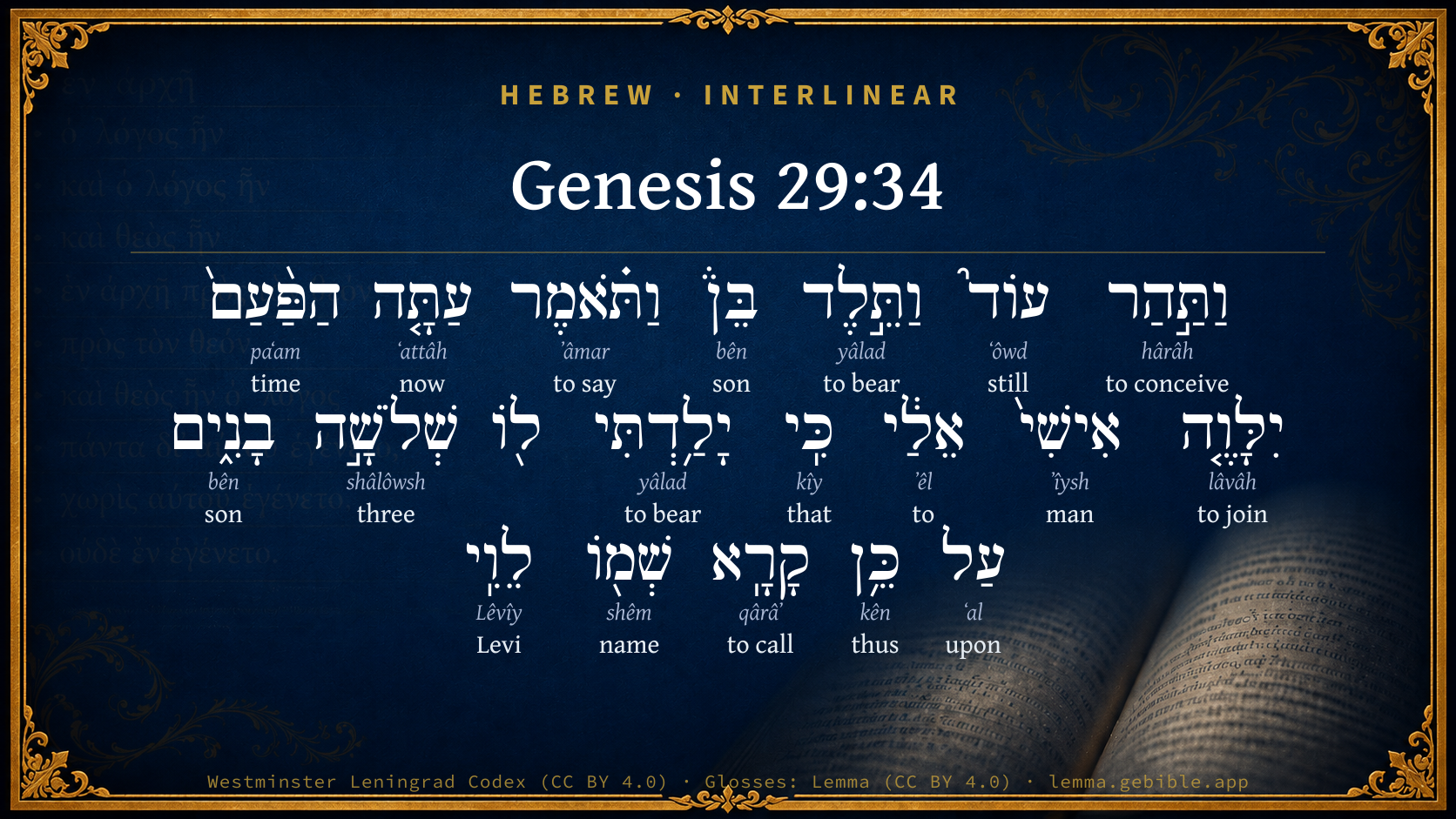
Hebrew (Westminster Leningrad Codex) Genesis 29:34 appears in the Hebrew Old Testament. The text above is from the Westminster Leningrad Codex. Each word links to its Strong’s number, a concise gloss, and parsing drawn from the Open Scriptures Hebrew Bible morphology. Click any word for its full Brown-Driver-Briggs (BDB) entry.
Download image
Cite this verse

Genesis 29:34 (World English Bible). Public Domain. Lemma interlinear Bible study tool, https://lemma.gebible.app/v/genesis/29/34.

Show BibTeX & RIS
BibTeX
RIS
English Translation
She conceived again, and bare a son. Said, "Now this time will my husband be joined to me, because I have borne him three sons." Therefore was his name called Levi.
World English Bible · Public Domain
Highlights
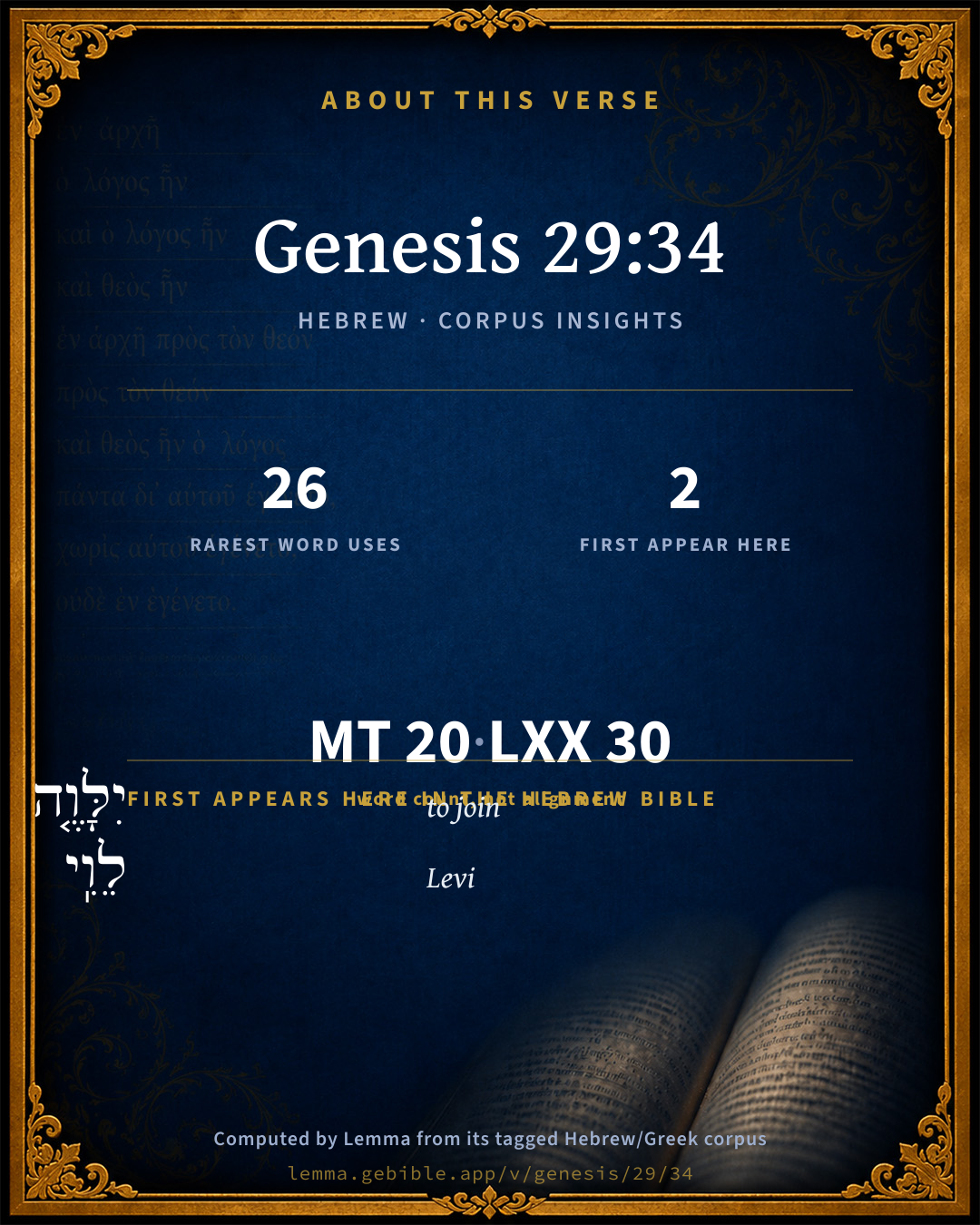
  • 2 first appearances in the Hebrew Bible
Full analysis ↓
Download a study sheet

One document with this verse’s original text, its word-by-word gloss line, the meaning frame, cross-references with their text, attributed commentary, and full source and license credits — printable, and it pastes into notes with its structure intact.

This verse Autodidact and up

Study sheet (.html) Plain text (.txt)

A passage Seminary Student

Up to 50 verses in one chapter. A passage sheet keeps up to 6 commentary sources and 12 cross-references per verse, in the order this page ranks them, and says so on the sheet whenever that leaves anything out. Ask for a single verse and you get the Autodidact verse sheet above.

Everything on this page stays free to read, with no account — the sheet is a download of what is already on screen, not access to it.

Want to remove ads? Support Godless Engineer
Compare translations 3

The same verse in 3 English versions, stacked beneath the original-language interlinear above. Click any original word for its lexicon entry.

Each is an independent rendering of the whole verse — the interlinear is not word-aligned to these translations.

Highlighted words mark where these versions differ — a whole-verse word diff, not a word-by-word alignment.

  • World English Bible Public Domain
    She conceived again, and bare a son. Said, "Now this time will my husband be joined to me, because I have borne him three sons." Therefore was his name called Levi.
  • King James Version Public Domain
    And she conceived again, and bare a son; and said, Now this time will my husband be joined unto me, because I have born him three sons: therefore was his name called Levi.
  • unfoldingWord Literal Text CC BY-SA 4.0
    Then she conceived again and bore a son, and she said, “This time now my husband will be joined to me, because I have born three sons for him.” For that he called his name Levi.

unfoldingWord Literal Text — © unfoldingWord, licensed CC BY-SA 4.0. Word-aligned USFM3 via Door43 (git.door43.org/unfoldingWord/en_ult).

Versions to compare (up to 4)

3 of 4 selected

Show all 18 translations

Every available English version of this verse, each an independent rendering of the whole verse.

  • World English Bible Public Domain
    She conceived again, and bare a son. Said, "Now this time will my husband be joined to me, because I have borne him three sons." Therefore was his name called Levi.
  • Berean Standard Bible Public Domain
    Once again Leah conceived and gave birth to a son, and she said, “Now at last my husband will become attached to me, because I have borne him three sons.” So he was named Levi.
  • Majority Standard Bible Public Domain
    Once again Leah conceived and gave birth to a son, and she said, “Now at last my husband will become attached to me, because I have borne him three sons.” So he was named Levi.
  • King James Version Public Domain
    And she conceived again, and bare a son; and said, Now this time will my husband be joined unto me, because I have born him three sons: therefore was his name called Levi.
  • American Standard Version (1901) Public Domain
    And she conceived again, and bare a son. And said, Now this time will my husband be joined unto me, because I have borne him three sons. Therefore was his name called Levi.
  • Revised Version (1885) Public Domain
    And she conceived again, and bare a son; and said, Now this time will my husband be joined unto me, because I have borne him three sons: therefore was his name called Levi.
  • Geneva Bible (1599) Public Domain
    And she conceiued againe and bare a sonne, and said, Now at this time wil my husband keepe mee company, because I haue borne him three sonnes: therefore was his name called Leui.
  • Douay-Rheims (1899) Public Domain
    And she conceived the third time, and bore another son: and said: Now also my husband will be joined to me, because I have borne him three sons: and therefore she called hi sname Levi.
  • Young's Literal Translation Public Domain
    And she conceiveth again, and beareth a son, and saith, `Now `is' the time, my husband is joined unto me, because I have born to him three sons,' therefore hath `one' called his name Levi.
  • Literal Standard Version CC BY-SA 4.0
    And she conceives again and bears a son, and says, “Now [is] the time, my husband is joined to me, because I have born to him three sons,” therefore has [one] called his name Levi.
  • Unlocked Literal Bible CC BY-SA 4.0
    Then she conceived again and bore a son. She said, “Now this time will my husband be attached to me, because I have borne him three sons.” Therefore his name was called Levi.
  • unfoldingWord Literal Text CC BY-SA 4.0
    Then she conceived again and bore a son, and she said, “This time now my husband will be joined to me, because I have born three sons for him.” For that he called his name Levi.
  • Darby Bible Public Domain
    And she again conceived, and bore a son, and said, Now this time will my husband be united to me, for I have borne him three sons; therefore was his name called Levi.
  • World Messianic Bible Public Domain
    She conceived again, and bore a son. She said, “Now this time my husband will be joined to me, because I have borne him three sons.” Therefore his name was called Levi.
  • Webster's Bible Public Domain
    And she conceived again, and bore a son; and said, Now this time will my husband adhere to me, because I have borne him three sons: therefore was his name called Levi.
  • Free Bible Version CC BY-SA 4.0
    Leah became pregnant for the third time, and had another son. She said, “Finally my husband will be attached to me because now I've given him three sons.” That's why he was named Levi.
  • Bible in Basic English Public Domain
    And she was with child again, and gave birth to a son; and said, Now at last my husband will be united to me, because I have given him three sons: so he was named Levi.
  • JPS Tanakh (1917) Public Domain
    And she conceived again, and bore a son; and said: 'Now this time will my husband be joined unto me, because I have borne him three sons.' Therefore was his name called Levi.

Literal Standard Version (2020), Covenant Press — licensed CC BY-SA 4.0. Text via the HelloAO Bible API (eBible.org). Unlocked Literal Bible (unfoldingWord) — licensed CC BY-SA 4.0. Text via the HelloAO Bible API (eBible.org). unfoldingWord Literal Text — © unfoldingWord, licensed CC BY-SA 4.0. Word-aligned USFM3 via Door43 (git.door43.org/unfoldingWord/en_ult). Free Bible Version, Dr. Jonathan Gallagher — licensed CC BY-SA 4.0. Text via the HelloAO Bible API (eBible.org).

Word by word

More ways to search: Search by grammar → Find every occurrence → Compare this word →

Practice this passage: Drill this verse → Learn its vocabulary →

יִלָּוֶ֤ה
lâvâh
H3867
“to join”
Verb, Niphal, Imperfect, 3rd Person, Masculine, Singular
Part of Speech
Verb
Stem
Niphal
Form
Imperfect
Person
3rd Person
Gender
Masculine
Number
Singular
Full BDB Definition

Origin: a primitive root

TWOT: 1087 , 1088

to join, be joined - (Qal) to join, be joined, attend - (Niphal) to join oneself to, be joined unto - to borrow, lend - (Qal) to borrow - (Hiphil) to cause to borrow, lend to
  1. וַתַּ֣הַר hârâh H2029 “and · to conceive” Conjunction + Verb, Qal, Sequential Imperfect, 3rd Person, Feminine, Singular
  2. עוֹד֮ ʻôwd H5750 “still” Adverb
  3. וַתֵּ֣לֶד yâlad H3205 “and · to bear” Conjunction + Verb, Qal, Sequential Imperfect, 3rd Person, Feminine, Singular
  4. בֵּן֒ bên H1121 “son” Noun, Common, Masculine, Singular, Absolute
  5. וַתֹּ֗אמֶר ʼâmar H559 “and · to say” Conjunction + Verb, Qal, Sequential Imperfect, 3rd Person, Feminine, Singular
  6. עַתָּ֤ה ʻattâh H6258 “now” Adverb
  7. הַפַּ֨עַם֙ paʻam H6471 “the · time” Particle, Definite Article + Noun, Common, Feminine, Singular, Absolute
  8. אִישִׁי֙ ʼîysh H376 “man · my” Noun, Common, Masculine, Singular, Construct + Suffix, Personal, 1st Person, Common, Singular
  9. אֵלַ֔י ʼêl H413 “to · me” Preposition + Suffix, Personal, 1st Person, Common, Singular
  10. כִּֽי kîy H3588 “that” Conjunction
  11. יָלַ֥דְתִּי yâlad H3205 “to bear” Verb, Qal, Perfect, 1st Person, Common, Singular
  12. שְׁלֹשָׁ֣ה shâlôwsh H7969 “three” Adjective, Cardinal number, Masculine, Singular, Absolute
  13. בָנִ֑ים bên H1121 “sons” Noun, Common, Masculine, Plural, Absolute
  14. עַל ʻal H5921 “upon” Preposition
  15. כֵּ֥ן kên H3651 “thus” Particle, Demonstrative
  16. קָרָֽא qârâʼ H7121 “to call” Verb, Qal, Perfect, 3rd Person, Masculine, Singular
  17. שְׁמ֖וֹ shêm H8034 “name · his” Noun, Common, Masculine, Singular, Construct + Suffix, Personal, 3rd Person, Masculine, Singular
  18. לֵוִֽי Lêvîy H3878 “Levi” Noun, Proper

About this verse

These counts appear in no published source. They are computed here, from the morphology-tagged text and Lemma’s own curated glosses. What Lemma adds →

20
words
17
distinct lemmas
Pentateuch
section

First appearance in Scripture

These words make their first canonical appearance in the Hebrew Bible here:

  • יִלָּוֶ֤ה to join H3867
  • לֵוִֽי Levi H3878

Shared distinctive vocabulary

יִלָּוֶ֤ה to join H3867 occurs in 22 verses of the Hebrew Bible. Also found in:

Grammatical profile

  • 6 verbs
  • 6 nouns
  • 1 adjective
  • 3 prepositions
  • 1 conjunction
  • 2 adverbs
  • 1 particle

Verb forms

  • וַתַּ֣הַר Qal · Sequential Imperfect
  • וַתֵּ֣לֶד Qal · Sequential Imperfect
  • וַתֹּ֗אמֶר Qal · Sequential Imperfect
  • יִלָּוֶ֤ה Niphal · Imperfect
  • יָלַ֥דְתִּי Qal · Perfect
  • קָרָֽא Qal · Perfect

Repetition

Words recur within this verse — often emphatic in Hebrew:

  • וַתֵּ֣לֶד to bear H3205 ×2
  • בֵּן֒ son H1121 ×2

Hebrew & Septuagint length

In English translation the verse runs 31 words from the Hebrew and 34 from the Septuagint (LXX English) — closely comparable.

A rough comparison of the two English renderings, which tokenize alike — not a word-level alignment.

Word counts can differ between the Hebrew and the Greek without any difference in meaning — e.g. the Hebrew direct-object marker אֵת has no separate Greek word, and Greek often adds the article ὁ.

In the original languages it is 20 Hebrew tokens and 30 Greek tokens — but the two are counted differently (Hebrew bundles its prefixes and suffixes into one token; the Greek is in lemma form), so that isn’t a like-for-like length.

Cross-references

8

Topical passages linked to Genesis 29:34 in the Treasury of Scripture Knowledge — connected by theme and wording, ordered by reader-vote popularity; previews shown in the World English Bible.

  • Exodus 32:26–29 then Moses stood in the gate of the camp, and said, "Whoever is on Yahweh's side, come to me!" All the sons of Levi gathered themselves together to him.
  • Genesis 49:5–7 "Simeon and Levi are brothers; Weapons of violence are their swords.
  • Genesis 34:25 It happened on the third day, when they were sore, that two of Jacob's sons, Simeon and Levi, Dinah's brothers, each took his sword, came upon the unsuspecting city, and killed all the males.
  • Genesis 35:23 The sons of Leah: Reuben (Jacob's firstborn), Simeon, Levi, Judah, Issachar, and Zebulun.
  • Genesis 46:11 The sons of Levi: Gershon, Kohath, and Merari.
  • Exodus 2:1 A man of the house of Levi went and took a daughter of Levi as his wife.
  • Numbers 18:2–4 Your brothers also, the tribe of Levi, the tribe of your father, bring you near with you, that they may be joined to you, and minister to you: but you and your sons with you shall be before the tent of the testimony.
  • Deuteronomy 33:8–10 Of Levi he said, Your Thummim and your Urim are with your godly one, Whom you did prove at Massah, With whom you did strive at the waters of Meribah;

Cross-references courtesy of OpenBible.info (CC BY 4.0).

Hebrew and Greek witnesses Masoretic Hebrew ↔ Greek Septuagint

The same verse in the two great witnesses to the Old Testament, shown verse-for-verse.

These are two independent witnesses, not word-aligned to each other, and the Septuagint is shown in lemma (dictionary) form.

Hebrew Genesis 29:34 Masoretic · Westminster Leningrad Codex

וַתַּ֣הַר עוֹד֮ וַתֵּ֣לֶד בֵּן֒ וַתֹּ֗אמֶר עַתָּ֤ה הַפַּ֨עַם֙ יִלָּוֶ֤ה אִישִׁי֙ אֵלַ֔י כִּֽי יָלַ֥דְתִּי ל֖וֹ שְׁלֹשָׁ֣ה בָנִ֑ים עַל כֵּ֥ן קָרָֽא שְׁמ֖וֹ לֵוִֽי

She conceived again, and bare a son. Said, "Now this time will my husband be joined to me, because I have borne him three sons." Therefore was his name called Levi.

World English Bible · Public Domain

Greek LXX Genesis 29:34 Septuagint · lemma form

καί συνλαμβάνω ἔτι καί τίκτω υἱός καί εἶπον ἐν ὁ νῦν καιρός πρός ἐγώ εἰμί ὁ ἀνήρ ἐγώ τίκτω γάρ αὐτός τρεῖς υἱός διά οὗτος καλέω ὁ ὄνομα αὐτός λευί

And she conceived yet again, and bore a son, and said, In the present time my husband will be with me, for I have born him three sons; therefore she called his name, Levi.

LXX2012 (modern English Septuagint) · Public Domain

Hebrew: Westminster Leningrad Codex (CC BY 4.0). Greek: Septuagint (public domain); English from LXX2012 (modern English Septuagint) (Public Domain). How the Septuagint differs from the Hebrew →

Targum (Aramaic paraphrase)

2

The Targum is the ancient Jewish Aramaic paraphrase of the Hebrew Scriptures — an interpretive translation, not the Hebrew text itself. Onkelos (literal) and Pseudo-Jonathan (expansive) render the Torah, and Jonathan the Prophets. Coverage is partial: where no permissively-licensed English translation exists for a verse, only the Aramaic is shown. This is verse-level text, not a word-by-word alignment to the Hebrew.

  1. Targum Onkelos Torah (Genesis–Deuteronomy)
    וְעַדִּיאַת עוֹד וִילִידַת בָּר וַאֲמֶרֶת הָדָא זִמְנָא יִתְחַבַּר לִי בַעֲלִי אֲרֵי יְלֵידִית לֵהּ תְּלָתָא בְנִין עַל כֵּן קְרָא שְׁמֵהּ לֵוִי

    (no public-domain English translation for this verse)

    Targum Onkelos — Aramaic: “Onkelos Genesis” (public domain); “Onkelos Exodus” (public domain); “Onkelos Leviticus” (public domain); “Onkelos Numbers” (public domain); “Onkelos Deuteronomy” (public domain). English: “Sefaria Community Translation” (CC0 1.0 (public-domain dedication)); “J.W. Etheridge. The Targums of Onkelos and Jonathan Ben Uzziel on the Pentateuch. London: Longmans, Green, 1862” (public domain). Text via Sefaria.

  2. Targum Pseudo-Jonathan Torah (Genesis–Deuteronomy)
    וְאִתְעַבְּרַת תּוּב וִילֵידַת בַּר וְאַמְרַת הָדָא זִמְנָא יִתְחַבֵּר עִמִי בַּעֲלִי אֲרוּם יְלֵדִית לֵיהּ תְּלָתָא בְּנִין וְהֵיכְדֵין עֲתִידִין בְּנוֹי לְמֶהֱוֵיהוֹן מִתְחַבְּרִין לְשַׁמָשָׁא קֳדָם יְיָ בְּגִין כֵּן קָרָא שְׁמֵיהּ לֵוִי

    And she conceived again, and bare a son, and said, This time will my husband be united to me, because I have borne him three sons; and thus will it be that my children shall be united to serve before the Lord: therefore she called his name Levi.

    Targum Pseudo-Jonathan — Aramaic: “Targum Jonathan on Genesis” (public domain); “Targum Jonathan on Exodus” (public domain); “Targum Jonathan on Leviticus” (public domain); “Targum Jonathan on Numbers” (public domain); “Targum Jonathan on Deuteronomy” (public domain). English: “The Targum of Jonathan ben Uzziel, trans. J. W. Etheridge, London, 1862” (public domain). Text via Sefaria.

Commentary

Notes on Genesis 29:34 from classic Christian and Jewish commentators (each source and its license shown beneath its notes). The classic Christian expositions comment on the surrounding passage and are grouped to its opening verse, so a note may address several verses; the Jewish commentaries on the Tanakh (Rashi and others) are per-verse, so they appear only where the commentator wrote on this verse.

Lemma curates 59 commentaries, every one of them public domain or Creative Commons licensed, each selected and text-cleaned for this edition rather than reprinted as found. About our sources →

Trapp's Complete Commentary

John Trapp

Gen 29:34 And she conceived again, and bare a son; and said, Now this time will my husband be joined unto me, because I have born him three sons: therefore was his name called Levi.

Ver. 34. And she conceived again.] So, what she wanted in beauty, she had in fecundity or fruitfuiness: and this redounded to God’s greater glory, by Leah’s thankfulness; who might say -

“ Si mihi difficilis formam natura negavit,

Laude Dei, formae, damna rependo, meae .”

- Sappho, apud Ovid.

John Trapp, A Commentary or Exposition upon All the Books of the Old and New Testament (1647–1656) — public domain. Text from a community e-Sword module.

Tyndale Open Study Notes

Tyndale Open Resources

29:34 Leah named her third son Levi, hoping that her husband would become “attached” to her since she had given him three sons. This hope was not fulfilled.

Tyndale Open Study Notes — © Tyndale Open Resources, licensed CC BY-SA 4.0. Text via the HelloAO Bible API.

Adam Clarke's Commentary

Verse 34. Therefore was his name called Levi.] לוי levi, joined; because she supposed that, in consequence of all these children, Jacob would become joined to her in as strong affection, at least, as he was to Rachel. From Levi sprang the tribe of Levites, who instead of the first-born, were joined unto the priests in the service of the sanctuary. See Gen 18:2; Gen 18:4.

Adam Clarke's Commentary on the Bible (1810–1826) — public domain. Text from a community e-Sword/MySword module.

The Cambridge Bible for Schools and Colleges

gen. ed. J. J. S. Perowne

34. joined] From the root lavah, “to join.” In Num_18:2; Num_18:4, this word lavah is especially used of the attachment of the sons of Levi to the service of Jehovah, as the priestly tribe. According to many scholars, the name denotes the tribe par excellence of the Leah group; which, owing to some great disaster, was broken up, and the name survived only in the guild of Priests and their assistants. See on chap. 34 and Gen_49:5-7. On the meaning of Leah, see note on Gen_29:16.

The Cambridge Bible for Schools and Colleges (gen. ed. J. J. S. Perowne; Cambridge University Press, 1878–1918) — public domain. Text from a community e-Sword module.

John Gill's Exposition

And she conceived again, and bare a son,.... A fourth son, a son in whose line, and from whose tribe, the Messiah was to spring:

and she said, now will I praise the Lord; she had praised him before for looking on her affliction, and hearing her cries, and giving her one son after another; but now she determines to praise him more than ever, having a fresh instance of his goodness to her: the Targum of Jonathan adds this as a reason,"because from this my son shall come forth kings, and from him shall come forth David the king, who shall praise the Lord.''And why may it not be as well supposed that she had knowledge of the Messiah springing from him, which would greatly heighten and increase her joy and praise?

and therefore she called his name Judah; which signifies "praise". A further improvement is made of this name, and the signification of it, in Gen 49:8. According to the Jewish writers (y), these four sons of Jacob were born, Reuben on the fourteenth day of Chisleu, or November, and lived one hundred and twenty four years; Simeon on the twenty first of Tebeth, or December, and lived one hundred and twenty years; Levi on the sixteenth of Nisan, or March, and lived one hundred and thirty seven years; and Judah on the fifteenth of Sivan, or May, and lived one hundred and nineteen years. And all these names being of the Hebrew language, and derived from words in it, show that this language, or what was much the same with it, was spoken in Laban's family, and had been continued from Nahor, as it had been in Isaac's family from Abraham:

and left bearing; that is, for a while, for after this she bore two sons and a daughter; see Gen 30:17.

(y) Shalshalet Hakabala, fol. 3. 2. & 4. 1.

Next: Genesis Chapter 30

John Gill's Exposition of the Whole Bible (1746–1763) — public domain (CC PDM 1.0). Text via the HelloAO Bible API.

Haydock's Catholic Bible Commentary

Levi, "adhesion or union." My husband will now stick to me.

George Leo Haydock (1774–1849), Haydock's Catholic Family Bible and Commentary, 1859 edition — public domain. Excludes Psalms (Douay-Rheims chapter numbering differs from Protestant) and Deuterocanonical books (Catholic canon only).

Matthew Poole's English Annotations

This time will my husband be joined unto me in more sincere and fervent affection.

Matthew Poole's English Annotations on the Holy Bible (1683–1685) — public domain. Text from a community e-Sword/MySword module.

Whedon's Commentary on the Bible

Daniel D. Whedon

34. Levi — Which means a joining. Fondly now does she hope for a deeper and truer heart union with her husband.

Daniel D. Whedon (gen. ed.), Commentary on the Old and New Testaments (1874–1909) — public domain. Text from a community e-Sword module.

The Pulpit Commentary

And she conceived again (say, in the third year of her marriage), and bare a son; and said, Now this time will my husband be joined unto me, hwl to join, is the root from which comes ywile. (Levi), her son"s name because I have borne him three sons: therefore was his name called Levi Associated, or Joined.

The Pulpit Commentary (1880–1919), ed. H.D.M. Spence-Jones & Joseph S. Exell — public domain. Text from a community e-Sword module.

Rashi

Rabbi Shlomo Yitzchaki (Rashi)

הפעם ילוה אישי THIS TIME WILL MY HUSBAND BECOME ATTACHED TO ME — Because the Matriarchs were prophetesses and knew that twelve tribes would issue from Jacob and that he would have four wives, she said, “From now he will have no fault to find with me, for I have assumed my full share in giving him children” (Midrash Tanchuma, Vayetzei 9).

על כן THEREFORE — Wherever in the case of the names given to Jacob’s sons the word “therefore” is used, that tribe had a numerous population (Genesis Rabbah 71:4), Levi forming an exception, because the Ark decimated them.

קרא שמו לוי [THEREFORE] WAS HIS NAME CALLED LEVI (literally, he called his name) — Of all of them (the sons) it is written “And she called”, but of this one Scripture writes “he called!” There is a Midrashic statement in Deuteronomy Rabbah that the Holy One, blessed be He, sent Gabriel who brought him (Levi) into His presence. He called him by this name and gave him the twenty-four perquisites with which the priesthood was favoured, and because He gave him these perquisites as an accompaniment (לוהו) He called him Levi (accompanied).

Rashi on the Tanakh — English translations: “The Judaica Press complete Tanach with Rashi, translated by A. J. Rosenberg” (CC BY 4.0); “Pentateuch with Rashi's commentary by M. Rosenbaum and A.M. Silbermann, 1929-1934” (public domain); “The Metsudah Tanach series, Lakewood, N.J” (CC BY 4.0); and “The Book of Joshua, Metsudah Publications, 1997” (CC BY 4.0). Text via Sefaria.

Radak

Rabbi David Kimhi (Radak)

ותהר...ילוה אישי אלי, he will be more inclined to respond to my love than to that of my sister. כי ילדתי שלשה בנים, seeing that what the righteous expect from their wives is that they bear sons for them.

על כן קרא שמו, Yaakov gave the boy this name because, as Leah had predicted, that he was so overjoyed at Levi’s birth. It is also possible that Yaakov had seen with a prophetic eye that the sons of Levi would be outstanding servants of the Lord and teachers of His Torah, and that they would constantly keep company with G’d, i.e. strive to fulfill His will. He therefore named this son both because of what his wife had proclaimed when he had been born, and because of the prophetic insight he had received regarding the descendants of this son. If we needed proof for this approach it is the fact that he was the only one of Yaakov’s sons who had been named by his father. The naming of Binyamin, respectively, renaming him, was due to a different consideration altogether. We will discuss this in due course.

Radak on the Tanakh — English translations: “Sefaria Community Translation” (CC0 1.0 (public-domain dedication)); “Eliyahu Munk, HaChut Hameshulash” (CC BY 4.0); “Rabbi Mike Feuer, Jerusalem Anthology” (CC BY 4.0); and “R. David Kimhi on the first book of Psalms, Translated by R.G. Finch, London, 1919” (public domain). Text via Sefaria.

Lesson kit

Teaching starters — assembled from the data on this page, not authored interpretation. Every prompt links to the verse data it draws on. Edit before teaching.

Genesis, in the Pentateuch, opens this verse with 20 words (17 distinct Hebrew lemmas). Its most distinctive word is lâvâh (“to join”). A historical commentator’s framing appears above. Read the whole chapter for the surrounding context.

Discussion questions

  1. What does “to join” (lâvâh) contribute to the verse as a whole?
  2. 2 words here appear for the first time in Scripture. What is being introduced at this debut?
  3. Exodus 22:25 shares the word «to join» with this verse. How do the two illuminate each other?
  4. “to bear” occurs 2× in this one verse. What is the effect of the repetition?
  5. These translations render this verse differently. What is at stake in choosing one wording over another?
  6. The verb «וַתַּ֣הַר» is Qal Sequential Imperfect. How does its form color the action?
  7. Reading how Trapp's Complete Commentary and Tyndale Open Study Notes read this verse, where do the two commentators agree and where do they part?

Things to notice

Reading settings

Reading text

Shown beneath each verse's original-language words.

Old Testament
Old Testament edition

Read the OT as the Masoretic Hebrew (MT) or the Greek Septuagint (LXX).

English shown for the Greek Septuagint (in the Hebrew ↔ Greek comparison).

Comparing translations? Open the Compare panel on any verse page to stack up to four side by side.