Ecclesiastes 9:15

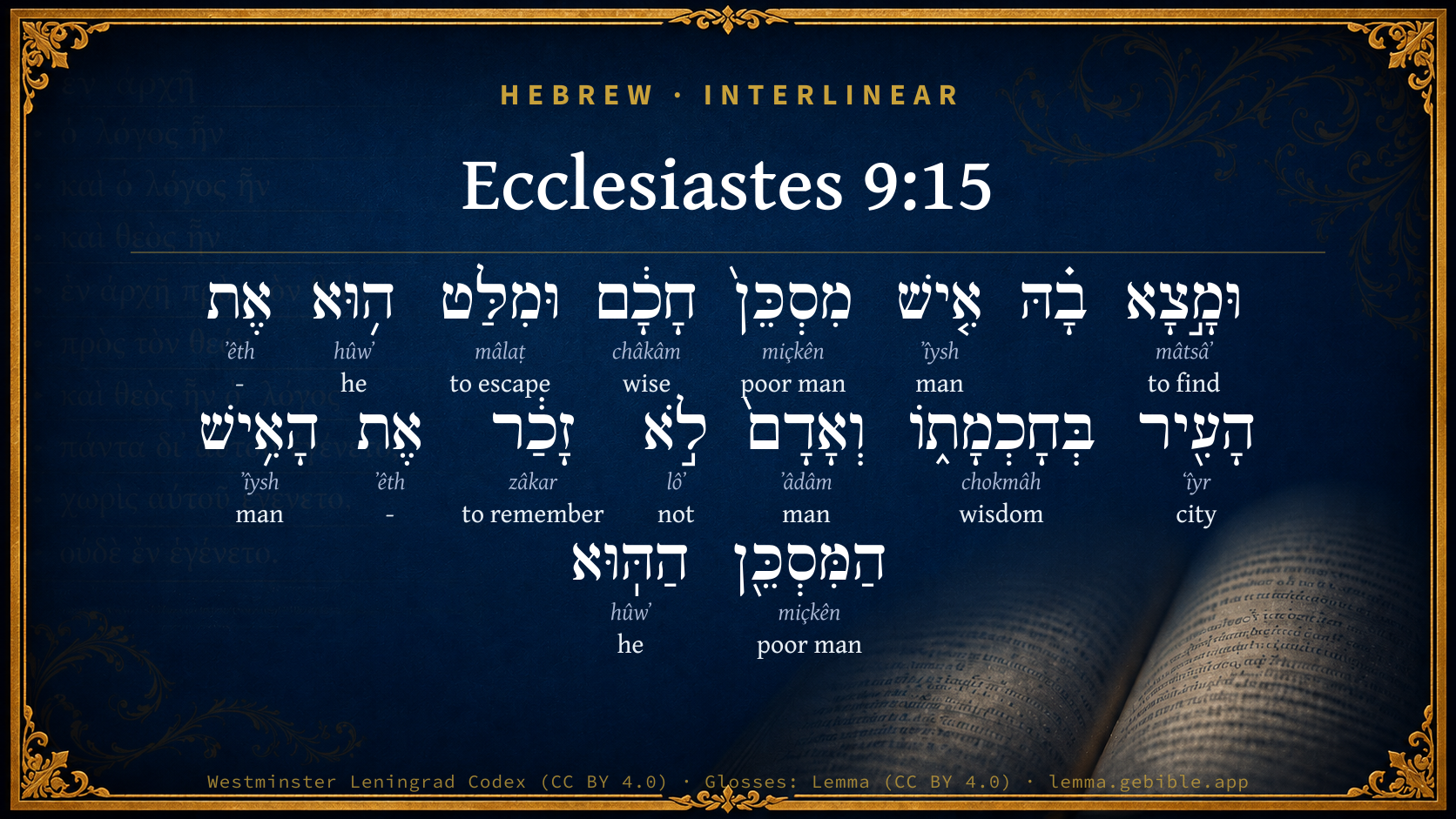
Hebrew (Westminster Leningrad Codex) Ecclesiastes 9:15 appears in the Hebrew Old Testament. The text above is from the Westminster Leningrad Codex. Each word links to its Strong’s number, a concise gloss, and parsing drawn from the Open Scriptures Hebrew Bible morphology. Click any word for its full Brown-Driver-Briggs (BDB) entry.
Download image
Cite this verse

Ecclesiastes 9:15 (World English Bible). Public Domain. Lemma interlinear Bible study tool, https://lemma.gebible.app/v/ecclesiastes/9/15.

Show BibTeX & RIS
BibTeX
RIS
English Translation
Now a poor wise man was found in it, and he by his wisdom delivered the city; yet no man remembered that same poor man.
World English Bible · Public Domain
Download a study sheet

One document with this verse’s original text, its word-by-word gloss line, the meaning frame, cross-references with their text, attributed commentary, and full source and license credits — printable, and it pastes into notes with its structure intact.

This verse Autodidact and up

Study sheet (.html) Plain text (.txt)

A passage Seminary Student

Up to 50 verses in one chapter. A passage sheet keeps up to 6 commentary sources and 12 cross-references per verse, in the order this page ranks them, and says so on the sheet whenever that leaves anything out. Ask for a single verse and you get the Autodidact verse sheet above.

Everything on this page stays free to read, with no account — the sheet is a download of what is already on screen, not access to it.

Want to remove ads? Support Godless Engineer
Compare translations 3

The same verse in 3 English versions, stacked beneath the original-language interlinear above. Click any original word for its lexicon entry.

Each is an independent rendering of the whole verse — the interlinear is not word-aligned to these translations.

Highlighted words mark where these versions differ — a whole-verse word diff, not a word-by-word alignment.

  • World English Bible Public Domain
    Now a poor wise man was found in it, and he by his wisdom delivered the city; yet no man remembered that same poor man.
  • King James Version Public Domain
    Now there was found in it a poor wise man, and he by his wisdom delivered the city; yet no man remembered that same poor man.
  • unfoldingWord Literal Text CC BY-SA 4.0
    And he found in it a poor, wise man, and he himself delivered the city with his wisdom. But a person did not remember that poor man.

unfoldingWord Literal Text — © unfoldingWord, licensed CC BY-SA 4.0. Word-aligned USFM3 via Door43 (git.door43.org/unfoldingWord/en_ult).

Versions to compare (up to 4)

3 of 4 selected

Show all 18 translations

Every available English version of this verse, each an independent rendering of the whole verse.

  • World English Bible Public Domain
    Now a poor wise man was found in it, and he by his wisdom delivered the city; yet no man remembered that same poor man.
  • Berean Standard Bible Public Domain
    Now a poor wise man was found in the city, and he saved the city by his wisdom. Yet no one remembered that poor man.
  • Majority Standard Bible Public Domain
    Now a poor wise man was found in the city, and he saved the city by his wisdom. Yet no one remembered that poor man.
  • King James Version Public Domain
    Now there was found in it a poor wise man, and he by his wisdom delivered the city; yet no man remembered that same poor man.
  • American Standard Version (1901) Public Domain
    Now there was found in it a poor wise man, and he by his wisdom delivered the city; yet no man remembered that same poor man.
  • Revised Version (1885) Public Domain
    Now there was found in it a poor wise man, and he by his wisdom delivered the city; yet no man remembered that same poor man.
  • Geneva Bible (1599) Public Domain
    And there was founde therein a poore and wise man, and he deliuered the citie by his wisedome: but none remembred this poore man.
  • Douay-Rheims (1899) Public Domain
    Now there was found in it a man poor and wise, and he delivered the city by his wisdom, and no man afterward remembered that poor man.
  • Young's Literal Translation Public Domain
    and there hath been found in it a poor wise man, and he hath delivered the city by his wisdom, and men have not remembered that poor man!
  • Literal Standard Version CC BY-SA 4.0
    and there has been found in it a poor wise man, and he has delivered the city by his wisdom, and men have not remembered that poor man!
  • Unlocked Literal Bible CC BY-SA 4.0
    Now in the city was found a poor, wise man, who by his wisdom saved the city. Yet later, no one remembered that same poor man.
  • unfoldingWord Literal Text CC BY-SA 4.0
    And he found in it a poor, wise man, and he himself delivered the city with his wisdom. But a person did not remember that poor man.
  • Darby Bible Public Domain
    and there was found in it a poor wise man, who by his wisdom delivered the city; but no man remembered that poor man.
  • World Messianic Bible Public Domain
    Now a poor wise man was found in it, and he by his wisdom delivered the city; yet no man remembered that same poor man.
  • Webster's Bible Public Domain
    Now there was found in it a poor wise man, and he by his wisdom delivered the city; yet no man remembered that same poor man.
  • Free Bible Version CC BY-SA 4.0
    In that town lived a man who was wise, but poor. He saved the town by his wisdom. But no one remembered to thank that poor man.
  • Bible in Basic English Public Domain
    Now there was in the town a poor, wise man, and he, by his wisdom, kept the town safe. But no one had any memory of that same poor man.
  • JPS Tanakh (1917) Public Domain
    now there was found in it a man poor and wise, and he by his wisdom delivered the city; yet no man remembered that same poor man.

Literal Standard Version (2020), Covenant Press — licensed CC BY-SA 4.0. Text via the HelloAO Bible API (eBible.org). Unlocked Literal Bible (unfoldingWord) — licensed CC BY-SA 4.0. Text via the HelloAO Bible API (eBible.org). unfoldingWord Literal Text — © unfoldingWord, licensed CC BY-SA 4.0. Word-aligned USFM3 via Door43 (git.door43.org/unfoldingWord/en_ult). Free Bible Version, Dr. Jonathan Gallagher — licensed CC BY-SA 4.0. Text via the HelloAO Bible API (eBible.org).

Word by word

More ways to search: Search by grammar → Find every occurrence → Compare this word →

Practice this passage: Drill this verse → Learn its vocabulary →

מִסְכֵּן֙
miçkên
H4542
“poor man”
Adjective, Adjective, Masculine, Singular, Absolute
Part of Speech
Adjective
Type
Adjective
Gender
Masculine
Number
Singular
State
Absolute
Full BDB Definition

Origin: from H5531

TWOT: 1221

poor, poor man
  1. וּמָ֣צָא mâtsâʼ H4672 “and · to find” Conjunction + Verb, Qal, Perfect, 3rd Person, Masculine, Singular
  2. אִ֤ישׁ ʼîysh H376 “man” Noun, Common, Masculine, Singular, Absolute
  3. חָכָ֔ם châkâm H2450 “wise” Adjective, Adjective, Masculine, Singular, Absolute
  4. וּמִלַּט mâlaṭ H4422 “and · to escape” Conjunction + Verb, Piel, Perfect, 3rd Person, Masculine, Singular
  5. ה֥וּא hûwʼ H1931 “he” Pronoun, Personal, 3rd Person, Masculine, Singular
  6. אֶת ʼêth H853 “-” Particle, Direct Object
  7. הָעִ֖יר ʻîyr H5892 “the · city” Particle, Definite Article + Noun, Common, Feminine, Singular, Absolute
  8. בְּחָכְמָת֑וֹ chokmâh H2451 “in/at · wisdom · his” Preposition + Noun, Common, Feminine, Singular, Construct + Suffix, Personal, 3rd Person, Masculine, Singular
  9. וְאָדָם֙ ʼâdâm H120 “and · man” Conjunction + Noun, Common, Masculine, Singular, Absolute
  10. לֹ֣א lôʼ H3808 “not” Particle, Negative
  11. זָכַ֔ר zâkar H2142 “to remember” Verb, Qal, Perfect, 3rd Person, Masculine, Singular
  12. אֶת ʼêth H853 “-” Particle, Direct Object
  13. הָאִ֥ישׁ ʼîysh H376 “the · man” Particle, Definite Article + Noun, Common, Masculine, Singular, Absolute
  14. הַמִּסְכֵּ֖ן miçkên H4542 “the · poor man” Particle, Definite Article + Adjective, Adjective, Masculine, Singular, Absolute
  15. הַהּֽוּא hûwʼ H1931 “the · he” Particle, Definite Article + Pronoun, Personal, 3rd Person, Masculine, Singular

About this verse

These counts appear in no published source. They are computed here, from the morphology-tagged text and Lemma’s own curated glosses. What Lemma adds →

17
words
12
distinct lemmas
Wisdom
section

Notable vocabulary

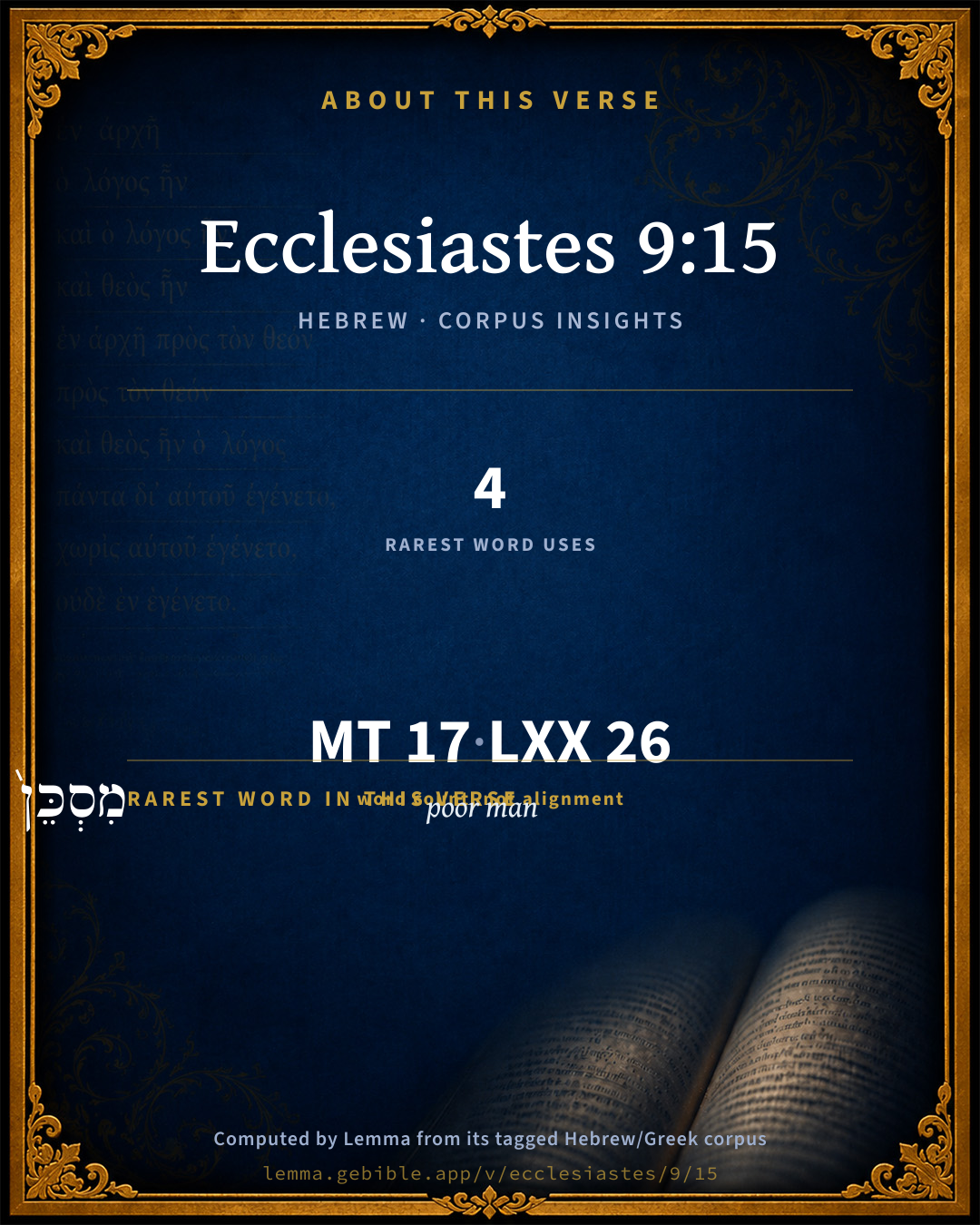
The rarest word here is מִסְכֵּן֙ poor man H4542 — appearing just 4 times in the whole Hebrew Bible.

Shared distinctive vocabulary

מִסְכֵּן֙ poor man H4542 occurs in 3 verses of the Hebrew Bible. Also found in:

Grammatical profile

  • 3 verbs
  • 5 nouns
  • 3 adjectives
  • 2 pronouns
  • 1 preposition
  • 3 particles

Verb forms

  • וּמָ֣צָא Qal · Perfect
  • וּמִלַּט Piel · Perfect
  • זָכַ֔ר Qal · Perfect

Repetition

Words recur within this verse — often emphatic in Hebrew:

  • אִ֤ישׁ man H376 ×2
  • מִסְכֵּן֙ poor man H4542 ×2
  • ה֥וּא he H1931 ×2

Hebrew & Septuagint length

In English translation the verse runs 25 words from the Hebrew and 26 from the Septuagint (LXX English) — closely comparable.

A rough comparison of the two English renderings, which tokenize alike — not a word-level alignment.

Word counts can differ between the Hebrew and the Greek without any difference in meaning — e.g. the Hebrew direct-object marker אֵת has no separate Greek word, and Greek often adds the article ὁ.

In the original languages it is 17 Hebrew tokens and 26 Greek tokens — but the two are counted differently (Hebrew bundles its prefixes and suffixes into one token; the Greek is in lemma form), so that isn’t a like-for-like length.

Cross-references

5

Topical passages linked to Ecclesiastes 9:15 in the Treasury of Scripture Knowledge — connected by theme and wording, ordered by reader-vote popularity; previews shown in the World English Bible.

  • Genesis 40:23 Yet the chief cupbearer didn't remember Joseph, but forgot him.
  • Ecclesiastes 4:13 Better is a poor and wise youth than an old and foolish king who doesn't know how to receive admonition any more.
  • Esther 6:2–3 It was found written that Mordecai had told of Bigthana and Teresh, two of the king's chamberlains, of those who kept the threshold, who had sought to lay hands on the king Ahasuerus.
  • 2 Samuel 20:22 Then the woman went to all the people in her wisdom. They cut off the head of Sheba the son of Bichri, and threw it out to Joab. He blew the trumpet, and they were dispersed from the city, every man to his tent. Joab returned to Jerusalem to the king.
  • Ecclesiastes 2:16 For of the wise man, even as of the fool, there is no memory for ever, seeing that in the days to come all will have been long forgotten. Indeed, the wise man must die just like the fool!

Cross-references courtesy of OpenBible.info (CC BY 4.0).

Hebrew and Greek witnesses Masoretic Hebrew ↔ Greek Septuagint

The same verse in the two great witnesses to the Old Testament, shown verse-for-verse.

These are two independent witnesses, not word-aligned to each other, and the Septuagint is shown in lemma (dictionary) form.

Hebrew Ecclesiastes 9:15 Masoretic · Westminster Leningrad Codex

וּמָ֣צָא בָ֗הּ אִ֤ישׁ מִסְכֵּן֙ חָכָ֔ם וּמִלַּט ה֥וּא אֶת הָעִ֖יר בְּחָכְמָת֑וֹ וְאָדָם֙ לֹ֣א זָכַ֔ר אֶת הָאִ֥ישׁ הַמִּסְכֵּ֖ן הַהּֽוּא

Now a poor wise man was found in it, and he by his wisdom delivered the city; yet no man remembered that same poor man.

World English Bible · Public Domain

Greek LXX Ecclesiastes 9:15 Septuagint · lemma form

καί εὑρίσκω ἐν αὐτός ἀνήρ πένης σοφός καί διασώζω αὐτός ὁ πόλις ἐν ὁ σοφία αὐτός καί ἄνθρωπος οὐ μιμνήσκω σύν ὁ ἀνήρ ὁ πένης ἐκεῖνος

and should find in it a poor wise man, and he should save the city through his wisdom: yet no man would remember that poor man.

LXX2012 (modern English Septuagint) · Public Domain

On this verse, The Pulpit Commentary discusses the Septuagint’s reading. Read the note in Commentary ↓

Hebrew: Westminster Leningrad Codex (CC BY 4.0). Greek: Septuagint (public domain); English from LXX2012 (modern English Septuagint) (Public Domain). How the Septuagint differs from the Hebrew →

Commentary

Notes on Ecclesiastes 9:15 from classic Christian and Jewish commentators (each source and its license shown beneath its notes). The classic Christian expositions comment on the surrounding passage and are grouped to its opening verse, so a note may address several verses; the Jewish commentaries on the Tanakh (Rashi and others) are per-verse, so they appear only where the commentator wrote on this verse.

Lemma curates 59 commentaries, every one of them public domain or Creative Commons licensed, each selected and text-cleaned for this edition rather than reprinted as found. About our sources →

Trapp's Complete Commentary

John Trapp

Ecc 9:15 Now there was found in it a poor wise man, and he by his wisdom delivered the city; yet no man remembered that same poor man.

Ver. 15. Now there was found in it a poor wise man.] Such as was Anaximenes at Lampsacum, {a} and Archimedes at Syracuse, of whose wisdom Plutarch testifieth, that it was above the ordinary possibility of a man, it was divine. {b} And of whose poverty Silius assures us, that he was

“ Nadus opum, sed cui coelum terraeque paterent. ”

By his warlike devices and engines he so defended his city against Marcellus, the Roman general, that the soldiers called him Briareus and Centimanus, a giant invincible; there was no taking of the town, as Livy relates it. The city of Abel was delivered by a wise woman that was in it. {2Sa 20:16-22} The city of Coecinum in the isle of Lemnos, by Marulla, a maiden of that city. {c} Hippo could not be taken while Augustine was in it; nor Heidelberg, while Pareus lived. Elisha preserved Samaria from the Syrians; and the prophet Isaiah, Jerusalem from the Assyrians. "They shall not shoot an arrow there, nor come before it with shields, nor cast a bank against it," saith the Lord. {Isa 37:33} Jeremiah had preserved it longer, but that his counsel was slighted. Indeed he was a physician to a dying state,

“ Tunc etenim docta plus valet arte malum. ”

Yet no man remembered that same poor man.] Had he been some Demetrius Phalereus, or suchlike magnifico, he should have had a hundred statues set up in honour of his good service. He should have heard, Saviour, saviour, as Flaminius the Roman general did, or, Father, father, as Huniades, after he had defeated Mesites the Turk. But being poor, he is soon set aside, and neither succoured nor honoured. This is merces mundi, the world’s wages. The Dutch have a proverb, that a man should bow to the tree that hath sheltered him in a storm. But many well deserving persons have cause to complain, as Elijah did when he sat under the juniper; or as Themistocles did when he compared himself to a plane tree, whereunto his countrymen, in a tempest, would run for refuge; but when once took up, they would not only leave him, but pull the leaves from him. {d} Are you weary, said he once to them, of receiving so many good turns from one man?

{a} Val. Max.

{b} Oνομα εχε, δαμονιου τινος, συνεσεως. - Plut., lib: xiv.

{c} Turkish History, 413.

{d} Sed restituta serenitate abeuntes vellicarent.

John Trapp, A Commentary or Exposition upon All the Books of the Old and New Testament (1647–1656) — public domain. Text from a community e-Sword module.

Jamieson, Fausset & Brown

Robert Jamieson, A. R. Fausset & David Brown

poor--as to the temporal advantages of true wisdom, though it often saves others. It receives little reward from the world, which admires none save the rich and great.

no man remembered-- (Gen 40:23).

Jamieson, Fausset & Brown — Commentary Critical and Explanatory on the Whole Bible (1871) — public domain (CC PDM 1.0). Text via the HelloAO Bible API.

The Cambridge Bible for Schools and Colleges

gen. ed. J. J. S. Perowne

15. and he by his wisdom delivered the city] The history of the siege of Abel-beth-Maachah in 2Sa_20:14-20 presents a suggestive parallel, but there the wisdom that delivered the city was that of a woman.

The Cambridge Bible for Schools and Colleges (gen. ed. J. J. S. Perowne; Cambridge University Press, 1878–1918) — public domain. Text from a community e-Sword module.

John Gill's Exposition

Now there was found in it a poor wise man,.... Christ, who is man, though not a mere man, but God as well as man; who was so in purpose, covenant, and promise, before his incarnation, since truly and really so; and "poor", as it was foretold he should be, and who became so for the sake of his church and people, Zac 9:9; yet "wise", even as man, being filled with wisdom, in which he increased, and gave such evident proofs of; on whom the spirit of wisdom rested, and in whom the treasures of it were hid, Luk 2:40, Col 2:3; he was found here by God his Father, who exalted one chosen out of the people, and made him Head over the church, who is the firstborn among many brethren, Psa 89:19; Or "and", or "but he found in it" (i); that is, Satan, the great king, found him here, contrary to his expectation, and to his great regret;

and he by his wisdom delivered the city; the church, from all enemies; from Satan and all his principalities and powers; from the world, the men and things of it; from sin, and all its sad consequences; from the law, its curse and condemnation; and from the second death, ruin and destruction: and though this deliverance was both by power and by price, yet also by wisdom; for the deliverance and redemption of the church by Christ is the fruit of infinite wisdom; it is a wise scheme to glorify all the divine perfections; to mortify Satan, and save sinners, and yet condemn sin; see Eph 1:7;

yet no man remembered that same poor man: before the deliverance wrought, as Aben Ezra and others; it never once entered into their thoughts that he could ever be their deliverer; they never imagined he had a capacity to advise, direct, or assist, in such service, or bring about such an affair: so Christ, when he appeared in the world, the Jews saw nothing that was promising in him; they could not believe that he was sent to be the Saviour and deliverer of them, and therefore rejected him, Isa 3:2; Or, "after it", so the Vulgate Latin version, "no man hereafter remembered", &c. took no notice of him after he had wrought this deliverances; bestowed no honour upon him, nor returned him thanks for what he had done; but he continued to live and die in obscurity and meanness: thus Christ, though he ought to be remembered and spoken well of, and the glory of salvation should be ascribed unto him, and thanks should be given him for it; yet there are none comparatively, or; but a few, who, like the Samaritan, glorify him on account of it. But if any choose to understand these words of political wisdom, and the use of it, by which sometimes a mean and obscure person does more good than others can by their power and strength, though he meets with no reward for it, I am not averse to it; and which agrees with what follows.

(i) "et invenit in ea", Mercerus, Drusius, Amama; "sed invenit in ea", Rambachius.

John Gill's Exposition of the Whole Bible (1746–1763) — public domain (CC PDM 1.0). Text via the HelloAO Bible API.

Haydock's Catholic Bible Commentary

Afterward, is not in Hebrew. The poor man was unnoticed before. (Calmet) --- Vulgate insinuates that he met with no return of gratitude, which is but too common; (Haydock) and this shews the vanity of the world.

George Leo Haydock (1774–1849), Haydock's Catholic Family Bible and Commentary, 1859 edition — public domain. Excludes Psalms (Douay-Rheims chapter numbering differs from Protestant) and Deuterocanonical books (Catholic canon only).

Matthew Poole's English Annotations

He was soon neglected, and his great service so far from being recompensed according to its merit, that both it and he were quite forgotten; which may be noted as another great vanity.

Matthew Poole's English Annotations on the Holy Bible (1683–1685) — public domain. Text from a community e-Sword/MySword module.

Whedon's Commentary on the Bible

Daniel D. Whedon

15. Poor wise man, etc. — Events like this are not very rare. Cooper’s “Naval History of the United States” relates, that the sailing-master of the flagship in the battle of Plattsburg, (Lake Champlain,) quietly arranged a cable before the action, by which alone it was afterward possible to bring the ship about, so that its remaining broadside could be brought to bear. The opening of this broadside turned the battle both on lake and shore. Yet the modest and skilful hero — though thanked by his commodore — received no public reward or recognition for nearly thirty years, when his widow was granted an ample pension. “Republics,” it is said, “are ungrateful;” rather, often unmindful.

Daniel D. Whedon (gen. ed.), Commentary on the Old and New Testaments (1874–1909) — public domain. Text from a community e-Sword module.

The Pulpit Commentary

Now there was found in it a poor wise man. The verb, regarded as impersonal, may be thus taken. Or we may continue the subject of the preceding verse and consider the king as spoken of: "He came across, met with unexpectedly, a poor man who was wise." So the Septuagint. The word for "poor in this passage is misken, for which see note on Ecc_4:13. He by his wisdom delivered the city. When the besieged city had neither soldiers nor arms to defend itself against its mighty enemies, the man of poor estate, hitherto unknown or little regarded, came forward, and by wise counsel relieved his countrymen from their perilous situation. How this was done we are left to conjecture. It may have been by some timely concessions or negotiations; or by the surrender of a chief offender as at Abel-Beth-maachah; or by the assassination of a general, as at Bethulia; (Jud_1:13:8) or by the clever application of mechanical arts, as at Syracuse, under the direction of Archimedes (Livy, 24:34; Plutarch, "Marcell.," 15-18.). Yet no man remembered that same poor man. As soon as the exigence which brought him forward was past, the poor man fell back into his insignificance, and was thought of no more; he gained no personal advantage, by his wisdom; his ungrateful countrymen forgot his very existence. Thus Joseph was treated by the chief butler. (Gen_40:23) Classical readers will think of Coriolanus, Scipio Africanus, Themistocles, Miltiades, who for their services to the state were rewarded with calumny, false accusation, obloquy, and banishment. The author of the Book of Wisdom gives a different and ideal experience. "I," he says, "for the sake of wisdom shall have estimation among the multitude, and honor with the elders, though I be young.... By the means of her I shall obtain immortality, and leave behind me an everlasting memorial". (RAPC Wis 8:10-13)

The Pulpit Commentary (1880–1919), ed. H.D.M. Spence-Jones & Joseph S. Exell — public domain. Text from a community e-Sword module.

John Wesley's Explanatory Notes

Yet - He was soon neglected and his great service forgotten.

John Wesley, Explanatory Notes Upon the Whole Bible (1754–1765) — public domain. Text via the GEBible commentary corpus.

Rashi

Rabbi Shlomo Yitzchaki (Rashi)

but no man remembered No one attributed any importance to him.

Rashi on the Tanakh — English translations: “The Judaica Press complete Tanach with Rashi, translated by A. J. Rosenberg” (CC BY 4.0); “Pentateuch with Rashi's commentary by M. Rosenbaum and A.M. Silbermann, 1929-1934” (public domain); “The Metsudah Tanach series, Lakewood, N.J” (CC BY 4.0); and “The Book of Joshua, Metsudah Publications, 1997” (CC BY 4.0). Text via Sefaria.

Lesson kit

Teaching starters — assembled from the data on this page, not authored interpretation. Every prompt links to the verse data it draws on. Edit before teaching.

Ecclesiastes, in the Wisdom, opens this verse with 17 words (12 distinct Hebrew lemmas). Its most distinctive word is miçkên (“poor man”). A historical commentator’s framing appears above. Read the whole chapter for the surrounding context.

Discussion questions

  1. What does “poor man” (miçkên) contribute to the verse as a whole?
  2. How does Ecclesiastes 4:13, which shares the word «poor man», read alongside this verse?
  3. What does the repetition of “man” (2× in this one verse) do in this verse?
  4. The translations on this page render this verse differently — a whole-verse word diff, not a word-by-word alignment. What might account for the different wordings?
  5. «וּמָ֣צָא» is a Qal Perfect verb. How does that grammatical form shape the action described?
  6. Compare how Trapp's Complete Commentary and Jamieson, Fausset & Brown read this verse. Where do they agree or differ?

Things to notice

Reading settings

Reading text

Shown beneath each verse's original-language words.

Old Testament
Old Testament edition

Read the OT as the Masoretic Hebrew (MT) or the Greek Septuagint (LXX).

English shown for the Greek Septuagint (in the Hebrew ↔ Greek comparison).

Comparing translations? Open the Compare panel on any verse page to stack up to four side by side.