
Deuteronomy 4:3

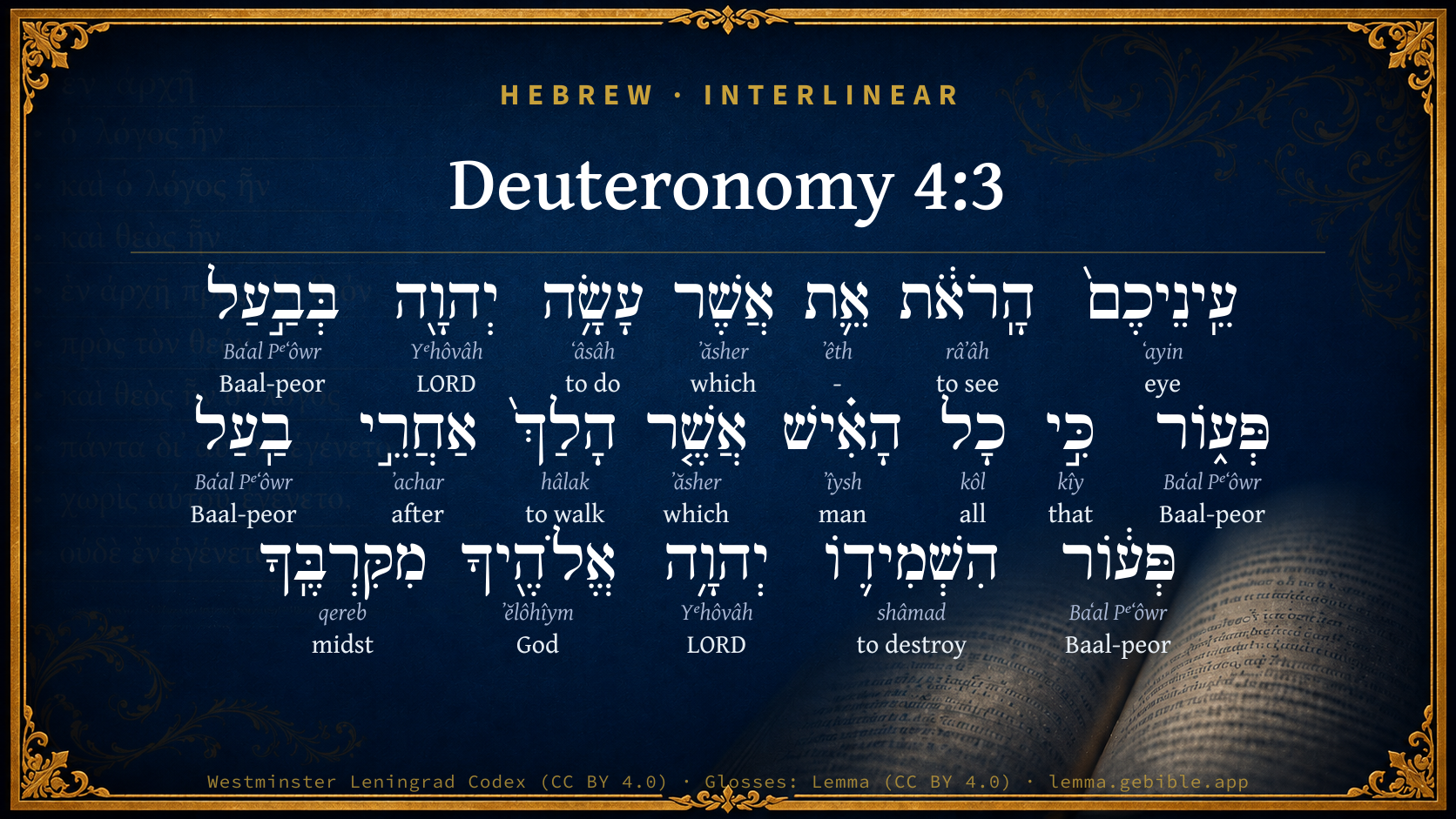
Hebrew (Westminster Leningrad Codex) Deuteronomy 4:3 appears in the Hebrew Old Testament. The text above is from the Westminster Leningrad Codex. Each word links to its Strong’s number, a concise gloss, and parsing drawn from the Open Scriptures Hebrew Bible morphology. Click any word for its full Brown-Driver-Briggs (BDB) entry.
Download image
Cite this verse

Deuteronomy 4:3 (World English Bible). Public Domain. Lemma interlinear Bible study tool, https://lemma.gebible.app/v/deuteronomy/4/3.

Show BibTeX & RIS
BibTeX
RIS
English Translation
Your eyes have seen what Yahweh did because of Baal Peor; for all the men who followed Baal Peor, Yahweh your God has destroyed them from the midst of you.
World English Bible · Public Domain
Download a study sheet

One document with this verse’s original text, its word-by-word gloss line, the meaning frame, cross-references with their text, attributed commentary, and full source and license credits — printable, and it pastes into notes with its structure intact.

This verse Autodidact and up

Study sheet (.html) Plain text (.txt)

A passage Seminary Student

Up to 50 verses in one chapter. A passage sheet keeps up to 6 commentary sources and 12 cross-references per verse, in the order this page ranks them, and says so on the sheet whenever that leaves anything out. Ask for a single verse and you get the Autodidact verse sheet above.

Everything on this page stays free to read, with no account — the sheet is a download of what is already on screen, not access to it.

Want to remove ads? Support Godless Engineer
Compare translations 3

The same verse in 3 English versions, stacked beneath the original-language interlinear above. Click any original word for its lexicon entry.

Each is an independent rendering of the whole verse — the interlinear is not word-aligned to these translations.

Highlighted words mark where these versions differ — a whole-verse word diff, not a word-by-word alignment.

  • World English Bible Public Domain
    Your eyes have seen what Yahweh did because of Baal Peor; for all the men who followed Baal Peor, Yahweh your God has destroyed them from the midst of you.
  • King James Version Public Domain
    Your eyes have seen what the LORD did because of Baalpeor: for all the men that followed Baalpeor, the LORD thy God hath destroyed them from among you.
  • unfoldingWord Literal Text CC BY-SA 4.0
    Your eyes have seen what Yahweh did in Baal Peor; for all the men who walked after the Baal of Peor, Yahweh your God has destroyed them from your midst.

unfoldingWord Literal Text — © unfoldingWord, licensed CC BY-SA 4.0. Word-aligned USFM3 via Door43 (git.door43.org/unfoldingWord/en_ult).

Versions to compare (up to 4)

3 of 4 selected

Show all 18 translations

Every available English version of this verse, each an independent rendering of the whole verse.

  • World English Bible Public Domain
    Your eyes have seen what Yahweh did because of Baal Peor; for all the men who followed Baal Peor, Yahweh your God has destroyed them from the midst of you.
  • Berean Standard Bible Public Domain
    Your eyes have seen what the LORD did at Baal-peor, for the LORD your God destroyed from among you all who followed Baal of Peor.
  • Majority Standard Bible Public Domain
    Your eyes have seen what the LORD did at Baal-peor, for the LORD your God destroyed from among you all who followed Baal of Peor.
  • King James Version Public Domain
    Your eyes have seen what the LORD did because of Baalpeor: for all the men that followed Baalpeor, the LORD thy God hath destroyed them from among you.
  • American Standard Version (1901) Public Domain
    Your eyes have seen what Jehovah did because of Baal-peor; for all the men that followed Baal-peor, Jehovah thy God hath destroyed them from the midst of thee.
  • Revised Version (1885) Public Domain
    Your eyes have seen what the LORD did because of Baal-peor: for all the men that followed Baal-peor, the LORD thy God hath destroyed them from the midst of thee.
  • Geneva Bible (1599) Public Domain
    Your eyes haue seene what the Lord did because of Baal-Peor, for al the men that folowed Baal-Peor the Lord thy God hath destroyed euery one from among you.
  • Douay-Rheims (1899) Public Domain
    Your eyes have seen all that the Lord hath done against Beelphegor, how he hath destroyed all his worshippers from among you.
  • Young's Literal Translation Public Domain
    `Your eyes are seeing that which Jehovah hath done in Baal-Peor, for every man who hath gone after Baal-Peor, Jehovah thy God hath destroyed him from thy midst;
  • Literal Standard Version CC BY-SA 4.0
    Your eyes are seeing that which YHWH has done in Ba‘al-Peor, for every man who has gone after Ba‘al-Peor, your God YHWH has destroyed him from your midst;
  • Unlocked Literal Bible CC BY-SA 4.0
    Your eyes have seen what Yahweh did because of Baal Peor; for all the men who followed the Baal of Peor, Yahweh your God has destroyed them from among you.
  • unfoldingWord Literal Text CC BY-SA 4.0
    Your eyes have seen what Yahweh did in Baal Peor; for all the men who walked after the Baal of Peor, Yahweh your God has destroyed them from your midst.
  • Darby Bible Public Domain
    Your eyes have seen what Jehovah did because of Baal-Peor; for all the men that followed Baal-Peor, Jehovah thy God hath destroyed them from among you;
  • World Messianic Bible Public Domain
    Your eyes have seen what the LORD did because of Baal Peor; for the LORD your God has destroyed all the men who followed Baal Peor from among you.
  • Webster's Bible Public Domain
    Your eyes have seen what the LORD did because of Baal-peor: for all the men that followed Baal-peor, the LORD thy God hath destroyed them from among you.
  • Free Bible Version CC BY-SA 4.0
    You've seen for yourselves what the Lord did at Baal-peor where the Lord your God killed everyone among you who worshiped Baal of Peor.
  • Bible in Basic English Public Domain
    Your eyes have seen what the Lord did because of Baal-peor: for destruction came from the Lord on all those among you who went after Baal-peor.
  • JPS Tanakh (1917) Public Domain
    Your eyes have seen what the LORD did in Baal-peor; for all the men that followed the Baal of Peor, the LORD thy God hath destroyed them from the midst of thee.

Literal Standard Version (2020), Covenant Press — licensed CC BY-SA 4.0. Text via the HelloAO Bible API (eBible.org). Unlocked Literal Bible (unfoldingWord) — licensed CC BY-SA 4.0. Text via the HelloAO Bible API (eBible.org). unfoldingWord Literal Text — © unfoldingWord, licensed CC BY-SA 4.0. Word-aligned USFM3 via Door43 (git.door43.org/unfoldingWord/en_ult). Free Bible Version, Dr. Jonathan Gallagher — licensed CC BY-SA 4.0. Text via the HelloAO Bible API (eBible.org).

Word by word

More ways to search: Search by grammar → Find every occurrence → Compare this word →

Practice this passage: Drill this verse → Learn its vocabulary →

בְּבַ֣עַל
Baʻal Pᵉʻôwr
H1187
“in/at · Baal-peor”
Preposition + Noun, Proper
Part of Speech
Preposition + Noun
Type
Proper
Full BDB Definition

Origin: from H1168 and H6465

TWOT: None

Baal-peor = "lord of the gap" - the deity worshipped at Peor with probable licentious rites
  1. עֵֽינֵיכֶם֙ ʻayin H5869 “eyes · your” Noun, Common, Both, Dual, Construct + Suffix, Personal, 2nd Person, Masculine, Plural
  2. הָֽרֹאֹ֔ת râʼâh H7200 “the · seeing” Particle, Definite Article + Verb, Qal, Participle Active, Feminine, Plural, Absolute
  3. אֵ֛ת ʼêth H853 “-” Particle, Direct Object
  4. אֲשֶׁר ʼăsher H834 “which” Particle, Relative
  5. עָשָׂ֥ה ʻâsâh H6213 “to do” Verb, Qal, Perfect, 3rd Person, Masculine, Singular
  6. יְהוָ֖ה Yᵉhôvâh H3068 “LORD” Noun, Proper
  7. פְּע֑וֹר Baʻal Pᵉʻôwr H1187 “Baal-peor” Noun, Proper
  8. כִּ֣י kîy H3588 “that” Conjunction
  9. כָל kôl H3605 “all of” Noun, Common, Masculine, Singular, Construct
  10. הָאִ֗ישׁ ʼîysh H376 “the · man” Particle, Definite Article + Noun, Common, Masculine, Singular, Absolute
  11. אֲשֶׁ֤ר ʼăsher H834 “which” Particle, Relative
  12. הָלַךְ֙ hâlak H1980 “to walk” Verb, Qal, Perfect, 3rd Person, Masculine, Singular
  13. אַחֲרֵ֣י ʼachar H310 “after” Preposition
  14. בַֽעַל Baʻal Pᵉʻôwr H1187 “Baal-peor” Noun, Proper
  15. פְּע֔וֹר Baʻal Pᵉʻôwr H1187 “Baal-peor” Noun, Proper
  16. הִשְׁמִיד֛וֹ shâmad H8045 “to destroy · him” Verb, Hiphil, Perfect, 3rd Person, Masculine, Singular + Suffix, Personal, 3rd Person, Masculine, Singular
  17. יְהוָ֥ה Yᵉhôvâh H3068 “LORD” Noun, Proper
  18. אֱלֹהֶ֖יךָ ʼĕlôhîym H430 “God(s) · your” Noun, Common, Masculine, Plural, Construct + Suffix, Personal, 2nd Person, Masculine, Singular
  19. מִקִּרְבֶּֽךָ qereb H7130 “from · midst · your” Preposition + Noun, Common, Masculine, Singular, Construct + Suffix, Personal, 2nd Person, Masculine, Singular

About this verse

These counts appear in no published source. They are computed here, from the morphology-tagged text and Lemma’s own curated glosses. What Lemma adds →

20
words
15
distinct lemmas
Pentateuch
section

Notable vocabulary

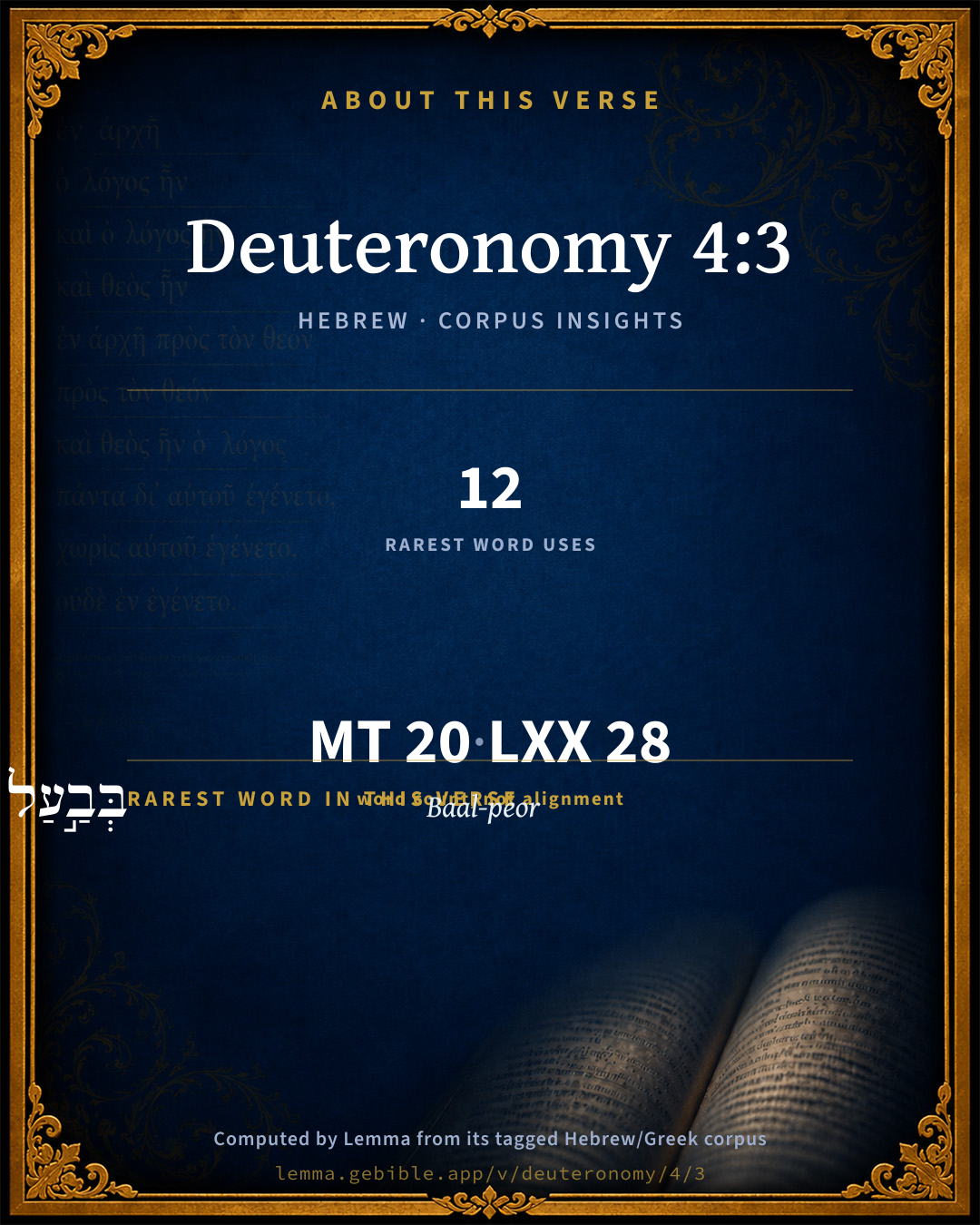
The rarest word here is בְּבַ֣עַל Baal-peor H1187 — appearing just 12 times in the whole Hebrew Bible.

Shared distinctive vocabulary

בְּבַ֣עַל Baal-peor H1187 occurs in 5 verses of the Hebrew Bible. Also found in:

Grammatical profile

  • 4 verbs
  • 11 nouns
  • 1 preposition
  • 1 conjunction
  • 3 particles

Verb forms

  • הָֽרֹאֹ֔ת Qal · Participle Active
  • עָשָׂ֥ה Qal · Perfect
  • הָלַךְ֙ Qal · Perfect
  • הִשְׁמִיד֛וֹ Hiphil · Perfect

Repetition

Words recur within this verse — often emphatic in Hebrew:

  • בְּבַ֣עַל Baal-peor H1187 ×4
  • יְהוָ֖ה LORD H3068 ×2
  • אֲשֶׁר which H834 ×2

Hebrew & Septuagint length

In English translation the verse runs 30 words from the Hebrew and 34 from the Septuagint (LXX English) — closely comparable.

A rough comparison of the two English renderings, which tokenize alike — not a word-level alignment.

Word counts can differ between the Hebrew and the Greek without any difference in meaning — e.g. the Hebrew direct-object marker אֵת has no separate Greek word, and Greek often adds the article ὁ.

In the original languages it is 20 Hebrew tokens and 28 Greek tokens — but the two are counted differently (Hebrew bundles its prefixes and suffixes into one token; the Greek is in lemma form), so that isn’t a like-for-like length.

Cross-references

6

Topical passages linked to Deuteronomy 4:3 in the Treasury of Scripture Knowledge — connected by theme and wording, ordered by reader-vote popularity; previews shown in the World English Bible.

  • Numbers 25:1–9 Israel abode in Shittim; and the people began to play the prostitute with the daughters of Moab:
  • Psalms 106:28–29 They joined themselves also to Baal Peor, And ate the sacrifices of the dead.
  • Numbers 26:64 But among these there was not a man of them who were numbered by Moses and Aaron the priest, who numbered the children of Israel in the wilderness of Sinai.
  • Numbers 31:16 Behold, these caused the children of Israel, through the counsel of Balaam, to commit trespass against Yahweh in the matter of Peor, and so the plague was among the congregation of Yahweh.
  • Joshua 22:17 Is the iniquity of Peor too little for us, from which we have not cleansed ourselves to this day, although there came a plague on the congregation of Yahweh,
  • Hosea 9:10 I found Israel like grapes in the wilderness. I saw your fathers as the first ripe in the fig tree at its first season; But they came to Baal Peor, and consecrated themselves to the shameful thing, And became abominable like that which they loved.

Cross-references courtesy of OpenBible.info (CC BY 4.0).

Hebrew and Greek witnesses Masoretic Hebrew ↔ Greek Septuagint

The same verse in the two great witnesses to the Old Testament, shown verse-for-verse.

These are two independent witnesses, not word-aligned to each other, and the Septuagint is shown in lemma (dictionary) form.

Hebrew Deuteronomy 4:3 Masoretic · Westminster Leningrad Codex

עֵֽינֵיכֶם֙ הָֽרֹאֹ֔ת אֵ֛ת אֲשֶׁר עָשָׂ֥ה יְהוָ֖ה בְּבַ֣עַל פְּע֑וֹר כִּ֣י כָל הָאִ֗ישׁ אֲשֶׁ֤ר הָלַךְ֙ אַחֲרֵ֣י בַֽעַל פְּע֔וֹר הִשְׁמִיד֛וֹ יְהוָ֥ה אֱלֹהֶ֖יךָ מִקִּרְבֶּֽךָ

Your eyes have seen what Yahweh did because of Baal Peor; for all the men who followed Baal Peor, Yahweh your God has destroyed them from the midst of you.

World English Bible · Public Domain

Greek LXX Deuteronomy 4:3 Septuagint · lemma form

ὁ ὀφθαλμός σύ ὁράω πᾶς ὅσος ποιέω κύριος ὁ θεός ἐγώ ὁ βεελφεγωρ ὅτι πᾶς ἄνθρωπος ὅστις πορεύομαι ὀπίσω βεελφεγωρ ἐκτρίβω αὐτός κύριος ὁ θεός σύ ἐκ σύ

Your eyes have seen all that the Lord our God did in the case of Beel-phegor; for every man that went after Beel-phegor, the Lord your God has utterly destroyed him from among you.

LXX2012 (modern English Septuagint) · Public Domain

On this verse, The Cambridge Bible for Schools and Colleges discusses the Septuagint’s reading. Read the note in Commentary ↓

Hebrew: Westminster Leningrad Codex (CC BY 4.0). Greek: Septuagint (public domain); English from LXX2012 (modern English Septuagint) (Public Domain). How the Septuagint differs from the Hebrew →

Targum (Aramaic paraphrase)

2

The Targum is the ancient Jewish Aramaic paraphrase of the Hebrew Scriptures — an interpretive translation, not the Hebrew text itself. Onkelos (literal) and Pseudo-Jonathan (expansive) render the Torah, and Jonathan the Prophets. Coverage is partial: where no permissively-licensed English translation exists for a verse, only the Aramaic is shown. This is verse-level text, not a word-by-word alignment to the Hebrew.

  1. Targum Onkelos Torah (Genesis–Deuteronomy)
    עֵינֵיכוֹן חָזָן יָת דִי עֲבַד יְיָ בְּבַעַל פְּעוֹר אֲרֵי כָּל גַבְרָא דִי אֲזַל בָּתַר בַּעַל פְּעוֹר שֵׁצְיֵהּ יְיָ אֱלָהָךְ מִבֵּינָךְ

    (no public-domain English translation for this verse)

    Targum Onkelos — Aramaic: “Onkelos Genesis” (public domain); “Onkelos Exodus” (public domain); “Onkelos Leviticus” (public domain); “Onkelos Numbers” (public domain); “Onkelos Deuteronomy” (public domain). English: “Sefaria Community Translation” (CC0 1.0 (public-domain dedication)); “J.W. Etheridge. The Targums of Onkelos and Jonathan Ben Uzziel on the Pentateuch. London: Longmans, Green, 1862” (public domain). Text via Sefaria.

  2. Targum Pseudo-Jonathan Torah (Genesis–Deuteronomy)
    עֵינֵיכוֹן חֲמִיתוּן יַת דְּעָבַד מֵימְרָא דַיְיָ בְּפַלְחֵי טַעֲוַות פְּעוֹר אֲרוּם כָּל בַּר נַשׁ דְּטָעָא בָּתַר טַעֲוַות פְּעוֹר שֵׁצְיֵיהּ יְיָ אֱלָהָךְ מִבֵּינָךְ

    Your eyes have seen what the Word of the Lord hath done to the worshippers of the idol Peor: for all the men who went astray after the idol Peor, the Lord thy God hath destroyed from among you;

    Targum Pseudo-Jonathan — Aramaic: “Targum Jonathan on Genesis” (public domain); “Targum Jonathan on Exodus” (public domain); “Targum Jonathan on Leviticus” (public domain); “Targum Jonathan on Numbers” (public domain); “Targum Jonathan on Deuteronomy” (public domain). English: “The Targum of Jonathan ben Uzziel, trans. J. W. Etheridge, London, 1862” (public domain). Text via Sefaria.

Commentary

Notes on Deuteronomy 4:3 from classic Christian and Jewish commentators (each source and its license shown beneath its notes). The classic Christian expositions comment on the surrounding passage and are grouped to its opening verse, so a note may address several verses; the Jewish commentaries on the Tanakh (Rashi and others) are per-verse, so they appear only where the commentator wrote on this verse.

Lemma curates 59 commentaries, every one of them public domain or Creative Commons licensed, each selected and text-cleaned for this edition rather than reprinted as found. About our sources →

Trapp's Complete Commentary

John Trapp

Deu 4:3 Your eyes have seen what the LORD did because of Baalpeor: for all the men that followed Baalpeor, the LORD thy God hath destroyed them from among you.

Ver. 3. Destroyed them.] Hanging them up in gibbets, as it were, before your eyes, to warn you.

John Trapp, A Commentary or Exposition upon All the Books of the Old and New Testament (1647–1656) — public domain. Text from a community e-Sword module.

Joseph Benson's Commentary

Deu 4:3-4. Are alive every one of you this day — A singular providence watched over them, to preserve them in such good healthy that not one of so many thousands was dead since that time. Nor, in the war with the Midianites, did they lose so much as one man, Num 31:7-49.

Joseph Benson's Commentary on the Old and New Testaments (1811–1818) — public domain. Text from a community e-Sword module.

Tyndale Open Study Notes

Tyndale Open Resources

4:3 Baal was the Canaanite god associated with the fertility of the soil and of human and animal life. Local pagan worship centers linked Baal with their own shrines and cultic rituals, as with the god of Peor (see 3:29).

Tyndale Open Study Notes — © Tyndale Open Resources, licensed CC BY-SA 4.0. Text via the HelloAO Bible API.

Geneva Bible (1599)

Geneva Bible translators

God’s judgments executed upon other idolaters ought to serve for our instruction, read Num. 25:3,4.

Geneva Bible (1599) marginal notes — public domain. Text via Bolls.life.

Jamieson, Fausset & Brown

Robert Jamieson, A. R. Fausset & David Brown

Your eyes have seen what the Lord did because of Baal-peor . . . the Lord thy God hath destroyed them from among you--It appears that the pestilence and the sword of justice overtook only the guilty in that affair (Num 25:1-9) while the rest of the people were spared. The allusion to that recent and appalling judgment was seasonably made as a powerful dissuasive against idolatry, and the fact mentioned was calculated to make a deep impression on people who knew and felt the truth of it.

Jamieson, Fausset & Brown — Commentary Critical and Explanatory on the Whole Bible (1871) — public domain (CC PDM 1.0). Text via the HelloAO Bible API.

Ellicott's Commentary for English Readers

(3) Your eyes have seen.—Literally, your eyes are they that see—i.e., you are witnesses of these things. The men who perished by the plague because of the iniquity of Beth peor—to the number of 24,000—seem to have been all members of the younger generation; for they had already passed the brook Zered. (See on Deu_2:13.)

A Bible Commentary for English Readers, edited by Charles John Ellicott (1878–1897) — public domain. Text from a community e-Sword module.

The Cambridge Bible for Schools and Colleges

gen. ed. J. J. S. Perowne

3. Your eyes have seen] Cp. Deu_3:21.

because of Baal-peor] Heb. in Ba‘al-Pe‘or (= in Beth-Ba‘al-Pe‘or), a place-name as in Hos_9:10; cp. Deu_3:29. The sin and its punishment are related by JE, Num_25:1-5; then follows, 6–16, a similar story about Israel and Midianite seductions, from P. Ba‘al of Pe‘or was a local deity, otherwise unknown to us. Driver (Deut. 63 f.) questions the usual opinion that he was a priapic deity, yet the close association of the charge of worshipping him with that of illicit intercourse with the daughters of Moab, combined with the notorious impurity of the Syrian religions, appears to confirm the opinion.

thy God … from the midst of thee] Note the change to the Sg. here from the Pl. in the beginning of the verse. Sam. and LXX, probably less originally, give Pl. throughout. For similar changes see Deu_4:25; Deu_4:29; Deu_4:34; Deu_11:13-14.

The Cambridge Bible for Schools and Colleges (gen. ed. J. J. S. Perowne; Cambridge University Press, 1878–1918) — public domain. Text from a community e-Sword module.

John Gill's Exposition

Your eyes have seen what the Lord did because of Baalpeor,.... Because of the idolatry the people of Israel fell into by worshipping that idol, being drawn into it by the daughters of Moab and Midian, through the counsel of Balaam, with whom they committed fornication; which led them to the other sin, and both highly provoking to God. The Targums of Onkelos and Jonathan are,"what the Word of the Lord has done to the worshippers of the idol Peor;"

for all the men that followed Baalpeor, the Lord thy God hath destroyed them from among you; 24,000 persons died on that account; which being a recent thing, fresh in memory, and what they were eyewitnesses of, was a caution to them to avoid the same sins, as it is to us on whom the ends of the world are come, Num 23:9.

John Gill's Exposition of the Whole Bible (1746–1763) — public domain (CC PDM 1.0). Text via the HelloAO Bible API.

Haydock's Catholic Bible Commentary

Among you, when the guilty Israelites and the Madianites were slain, Numbers xxv., and xxxi.

George Leo Haydock (1774–1849), Haydock's Catholic Family Bible and Commentary, 1859 edition — public domain. Excludes Psalms (Douay-Rheims chapter numbering differs from Protestant) and Deuterocanonical books (Catholic canon only).

Whedon's Commentary on the Bible

Daniel D. Whedon

3. Of Baal-peor — Moses refers to that recent judgment of God upon the sins of the people when twenty-four thousand were slain. Num_25:1-9.

Daniel D. Whedon (gen. ed.), Commentary on the Old and New Testaments (1874–1909) — public domain. Text from a community e-Sword module.

The Pulpit Commentary

Vers. 3, 4. The people had had personal experience of the danger, on the one hand, of transgressing, and the benefit, on the other, of keeping God"s Law; they had seen how those who sinned in worshipping Baal-peer were destroyed, (Num_25:3, Num_25:9) whilst those who remained faithful to the Lord were kept alive. This experience the people had had only lately before, so that a reference to it would be all the more impressive. Baalpeor, the idol whose cultus was observed at Peor. Baal (Bal, Be"cf., Bel, Lord) was the common name of the supreme deity among the northern of the Semitic-speaking people, the Canaanites, the Phoenicians, the Aramaeans, and the Assyrians. There were thus many Baals. Followed: walked after; a common Biblical expression for religious adherence and service (cf. Jer_8:2 Jer_9:14; and with a different formula, Num_32:12; Deu_1:36; Jos_14:8; Jud_1:2:12, etc.) Ye that did cleave unto Jehovah your God. "To cleave unto one" is expressive of the closest, most intimate attachment and communion (Gen_2:24; Isa_14:1) The phrase is frequently used of devotion to the service and worship of the true God (cf. Jos_22:5 Jos_23:8; Act_2:23, etc.) here it expresses the contrast between the conduct of those who remained faithful to Jehovah and those who forsook him to worship Baal. Are alive every one of you this day. "Thus they that keep themselves pure in general defections, are saved from the common destruction (Eze_9:4-6; Rev_20:4) (Ainsworth).

The Pulpit Commentary (1880–1919), ed. H.D.M. Spence-Jones & Joseph S. Exell — public domain. Text from a community e-Sword module.

unfoldingWord translationNotes

Door43 World Missions Community

General Information:

Moses continues speaking to the people of Israel.

Your eyes have seen

Here "eyes" refers to the people of Israel. AT: "You saw" (See: Synecdoche)

because of Baal Peor

The full meaning of this statement can be made clear. AT: "because of the sins you committed at Baal Peor" (See: Assumed Knowledge and Implicit Information)

Peor

See how you translated this in Deuteronomy 3:29.

Yahweh your God has destroyed them from among you

Moses speaks to the people of Israel as though they were one person, so "your" and "you" are singular. (See: Pronouns)

you who clung to Yahweh

The writer speaks as if trusting in Yahweh and obeying him were like physically holding on to a person. AT: "you who were careful to obey Yahweh" (See: Metaphor)

translationWords

Yahweh

Baal

God

unfoldingWord translationNotes — © Distant Shores Media and the Door43 World Missions Community, licensed CC BY-SA 4.0. Source: git.door43.org/Door43/en_tn.

Ramban (Nachmanides)

Rabbi Moshe ben Nachman (Ramban / Nachmanides)

YOUR EYES HAVE SEEN. Now Moses comes to forewarn on the details of the commandments, and he begins with [the prohibition against] idolatry which is the root of all [the commandments].

Ramban (Nachmanides) on the Tanakh — English translation: “Commentary on the Torah by Ramban (Nachmanides). Translated and annotated by Charles B. Chavel. New York, Shilo Pub. House, 1971-1976” (CC BY 4.0). Text via Sefaria.

Lesson kit

Teaching starters — assembled from the data on this page, not authored interpretation. Every prompt links to the verse data it draws on. Edit before teaching.

Deuteronomy, in the Pentateuch, opens this verse with 20 words (15 distinct Hebrew lemmas). Its most distinctive word is Baʻal Pᵉʻôwr (“Baal-peor”). A historical commentator’s framing appears above. Read the whole chapter for the surrounding context.

Discussion questions

  1. The word Baʻal Pᵉʻôwr carries the sense “Baal-peor.” How does it shape the verse?
  2. Numbers 25:3 shares the word «Baal-peor» with this verse. How do the two illuminate each other?
  3. “Baal-peor” occurs 4× in this one verse. What is the effect of the repetition?
  4. The translations on this page render this verse differently — a whole-verse word diff, not a word-by-word alignment. What might account for the different wordings?
  5. The verb «הָֽרֹאֹ֔ת» is Qal Participle Active. How does its form color the action?
  6. Reading how Trapp's Complete Commentary and Joseph Benson's Commentary read this verse, where do the two commentators agree and where do they part?

Things to notice

Reading settings

Reading text

Shown beneath each verse's original-language words.

Old Testament
Old Testament edition

Read the OT as the Masoretic Hebrew (MT) or the Greek Septuagint (LXX).

English shown for the Greek Septuagint (in the Hebrew ↔ Greek comparison).

Comparing translations? Open the Compare panel on any verse page to stack up to four side by side.