
Exodus 25:20

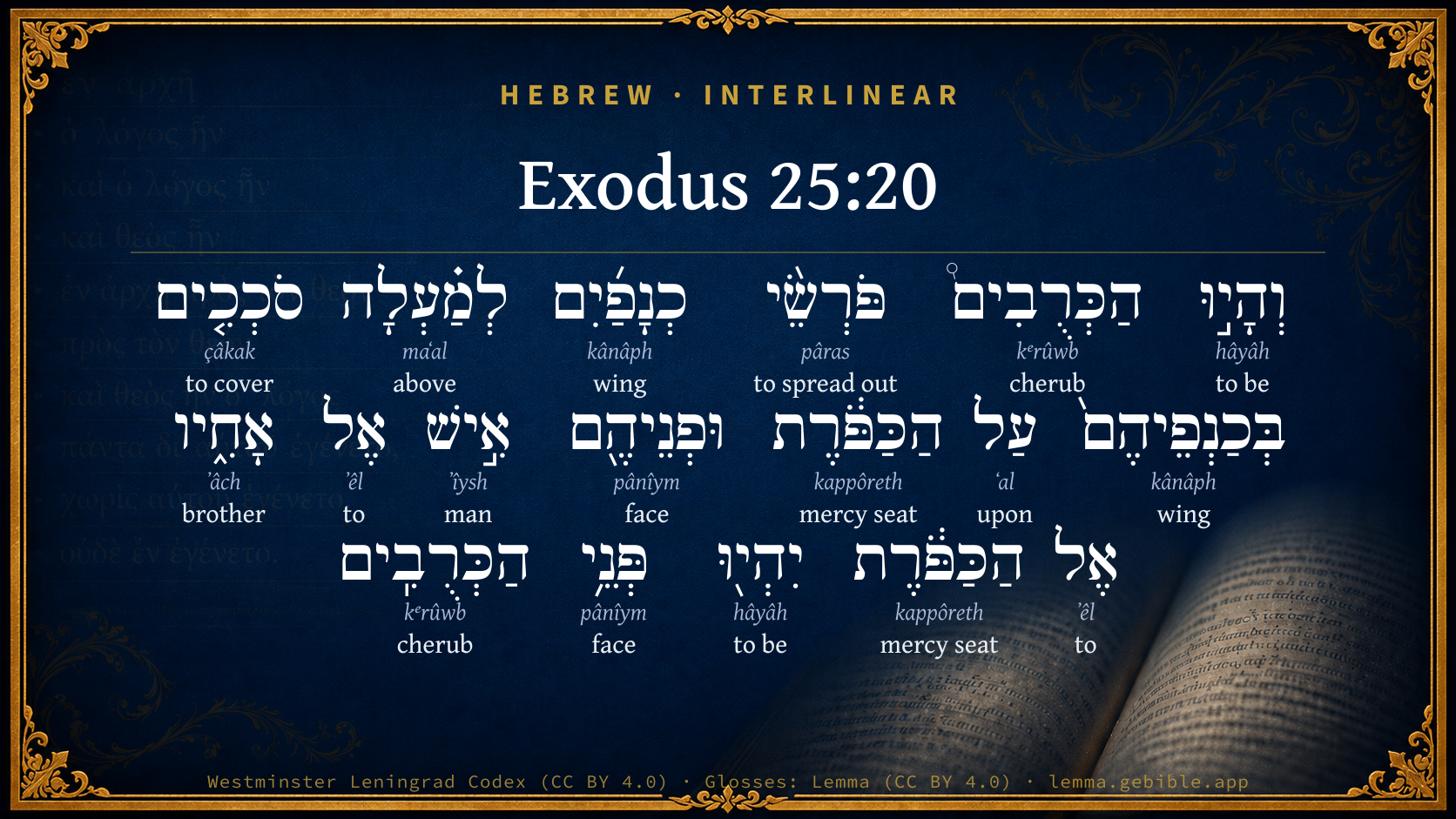
Hebrew (Westminster Leningrad Codex) Exodus 25:20 appears in the Hebrew Old Testament. The text above is from the Westminster Leningrad Codex. Each word links to its Strong’s number, a concise gloss, and parsing drawn from the Open Scriptures Hebrew Bible morphology. Click any word for its full Brown-Driver-Briggs (BDB) entry.
Download image
Cite this verse

Exodus 25:20 (World English Bible). Public Domain. Lemma interlinear Bible study tool, https://lemma.gebible.app/v/exodus/25/20.

Show BibTeX & RIS
BibTeX
RIS
English Translation
The cherubim shall spread out their wings upward, covering the mercy seat with their wings, with their faces toward one another. The faces of the cherubim shall be toward the mercy seat.
World English Bible · Public Domain
Highlights
  • 1 first appearance in the Hebrew Bible
Full analysis ↓
Download a study sheet

One document with this verse’s original text, its word-by-word gloss line, the meaning frame, cross-references with their text, attributed commentary, and full source and license credits — printable, and it pastes into notes with its structure intact.

This verse Autodidact and up

Study sheet (.html) Plain text (.txt)

A passage Seminary Student

Up to 50 verses in one chapter. A passage sheet keeps up to 6 commentary sources and 12 cross-references per verse, in the order this page ranks them, and says so on the sheet whenever that leaves anything out. Ask for a single verse and you get the Autodidact verse sheet above.

Everything on this page stays free to read, with no account — the sheet is a download of what is already on screen, not access to it.

Want to remove ads? Support Godless Engineer
Compare translations 3

The same verse in 3 English versions, stacked beneath the original-language interlinear above. Click any original word for its lexicon entry.

Each is an independent rendering of the whole verse — the interlinear is not word-aligned to these translations.

Highlighted words mark where these versions differ — a whole-verse word diff, not a word-by-word alignment.

  • World English Bible Public Domain
    The cherubim shall spread out their wings upward, covering the mercy seat with their wings, with their faces toward one another. The faces of the cherubim shall be toward the mercy seat.
  • King James Version Public Domain
    And the cherubim shall stretch forth their wings on high, covering the mercy seat with their wings, and their faces shall look one to another; toward the mercy seat shall the faces of the cherubim be.
  • unfoldingWord Literal Text CC BY-SA 4.0
    And the cherubim shall be spreading out their wings upward, covering over the atonement lid with their wings and their faces each toward his brother. The faces of the cherubim shall be toward the atonement lid.

unfoldingWord Literal Text — © unfoldingWord, licensed CC BY-SA 4.0. Word-aligned USFM3 via Door43 (git.door43.org/unfoldingWord/en_ult).

Versions to compare (up to 4)

3 of 4 selected

Show all 18 translations

Every available English version of this verse, each an independent rendering of the whole verse.

  • World English Bible Public Domain
    The cherubim shall spread out their wings upward, covering the mercy seat with their wings, with their faces toward one another. The faces of the cherubim shall be toward the mercy seat.
  • Berean Standard Bible Public Domain
    And the cherubim are to have wings that spread upward, overshadowing the mercy seat. The cherubim are to face each other, looking toward the mercy seat.
  • Majority Standard Bible Public Domain
    And the cherubim are to have wings that spread upward, overshadowing the mercy seat. The cherubim are to face each other, looking toward the mercy seat.
  • King James Version Public Domain
    And the cherubim shall stretch forth their wings on high, covering the mercy seat with their wings, and their faces shall look one to another; toward the mercy seat shall the faces of the cherubim be.
  • American Standard Version (1901) Public Domain
    And the cherubim shall spread out their wings on high, covering the mercy-seat with their wings, with their faces one to another; toward the mercy-seat shall the faces of the cherubim be.
  • Revised Version (1885) Public Domain
    And the cherubim shall spread out their wings on high, covering the mercy-seat with their wings, with their faces one to another; toward the mercy-seat shall the faces of the cherubim be.
  • Geneva Bible (1599) Public Domain
    And the Cherubims shall stretche their winges on hie, couering the Mercie seate with their winges, and their faces one to another: to the Mercie seate warde shall the faces of the Cherubims be.
  • Douay-Rheims (1899) Public Domain
    Let them cover both sides of the propitiatory, spreading their wings, and covering the oracle, and let them look one towards the other, their faces being turned towards the propitiatory wherewith the ark is to be covered.
  • Young's Literal Translation Public Domain
    `And the cherubs have been spreading out wings on high, covering the mercy-seat over with their wings, and their faces `are' one towards another -- towards the mercy-seat are the faces of the cherubs.
  • Literal Standard Version CC BY-SA 4.0
    And the cherubim have been spreading out wings on high, covering over the propitiatory covering with their wings, and their faces [are] toward one another—the faces of the cherubim are toward the propitiatory covering.
  • Unlocked Literal Bible CC BY-SA 4.0
    The cherubim must spread out their wings upward and overshadow the atonement lid with them. The cherubim must face one another and look toward the center of the atonement lid.
  • unfoldingWord Literal Text CC BY-SA 4.0
    And the cherubim shall be spreading out their wings upward, covering over the atonement lid with their wings and their faces each toward his brother. The faces of the cherubim shall be toward the atonement lid.
  • Darby Bible Public Domain
    And the cherubim shall stretch out [their] wings over it, covering over with their wings the mercy-seat, and their faces opposite to one another: toward the mercy-seat shall the faces of the cherubim be [turned].
  • World Messianic Bible Public Domain
    The cherubim shall spread out their wings upward, covering the mercy seat with their wings, with their faces toward one another. The faces of the cherubim shall be toward the mercy seat.
  • Webster's Bible Public Domain
    And the cherubim shall stretch forth their wings on high, covering the mercy-seat with their wings, and their faces shall look one to another; towards the mercy-seat shall the faces of the cherubim be.
  • Free Bible Version CC BY-SA 4.0
    The cherubim are to be designed with spread wings pointing upward, covering the atonement cover. The cherubim are to be placed facing each another, looking down towards the atonement cover.
  • Bible in Basic English Public Domain
    And their wings are to be outstretched over the cover, and the winged ones are to be opposite one another, facing the cover.
  • JPS Tanakh (1917) Public Domain
    And the cherubim shall spread out their wings on high, screening the ark-cover with their wings, with their faces one to another; toward the ark-cover shall the faces of the cherubim be.

Literal Standard Version (2020), Covenant Press — licensed CC BY-SA 4.0. Text via the HelloAO Bible API (eBible.org). Unlocked Literal Bible (unfoldingWord) — licensed CC BY-SA 4.0. Text via the HelloAO Bible API (eBible.org). unfoldingWord Literal Text — © unfoldingWord, licensed CC BY-SA 4.0. Word-aligned USFM3 via Door43 (git.door43.org/unfoldingWord/en_ult). Free Bible Version, Dr. Jonathan Gallagher — licensed CC BY-SA 4.0. Text via the HelloAO Bible API (eBible.org).

Word by word

More ways to search: Search by grammar → Find every occurrence → Compare this word →

Practice this passage: Drill this verse → Learn its vocabulary →

סֹכְכִ֤ים
çâkak
H5526
“covering”
Verb, Qal, Participle Active, Masculine, Plural, Absolute
Part of Speech
Verb
Stem
Qal
Form
Participle Active
Gender
Masculine
Number
Plural
State
Absolute
Full BDB Definition

Origin: a primitive root

TWOT: 1475 , 1492 , 2259 , 2260

(Qal) to hedge, fence about, shut in - to block, overshadow, screen, stop the approach, shut off, cover - (Qal) - to screen, cover - to cover oneself - protector (participle) - (Hiphil) - to screen, cover - to cover, defecate (euphemism) - (Qal) to cover, lay over - to weave together - (Qal) to weave together - (Pilpel) to weave, weave together
  1. וְהָי֣וּ hâyâh H1961 “and · to be” Conjunction + Verb, Qal, Sequential Perfect, 3rd Person, Common, Plural
  2. הַכְּרֻבִים֩ kᵉrûwb H3742 “the · cherubim” Particle, Definite Article + Noun, Common, Masculine, Plural, Absolute
  3. פֹּרְשֵׂ֨י pâras H6566 “spreading out” Verb, Qal, Participle Active, Masculine, Plural, Construct
  4. כְנָפַ֜יִם kânâph H3671 “wings” Noun, Common, Feminine, Dual, Absolute
  5. לְמַ֗עְלָה maʻal H4605 “to/for · above · toward” Preposition + Adverb + Suffix, Demonstrative
  6. בְּכַנְפֵיהֶם֙ kânâph H3671 “in/at · wings · their” Preposition + Noun, Common, Feminine, Dual, Construct + Suffix, Personal, 3rd Person, Masculine, Plural
  7. עַל ʻal H5921 “upon” Preposition
  8. הַכַּפֹּ֔רֶת kappôreth H3727 “the · mercy seat” Particle, Definite Article + Noun, Common, Feminine, Singular, Absolute
  9. וּפְנֵיהֶ֖ם pânîym H6440 “and · face(s) · their” Conjunction + Noun, Common, Both, Plural, Construct + Suffix, Personal, 3rd Person, Masculine, Plural
  10. אִ֣ישׁ ʼîysh H376 “man” Noun, Common, Masculine, Singular, Absolute
  11. אֶל ʼêl H413 “to” Preposition
  12. אָחִ֑יו ʼâch H251 “brother · his” Noun, Common, Masculine, Singular, Construct + Suffix, Personal, 3rd Person, Masculine, Singular
  13. אֶל ʼêl H413 “to” Preposition
  14. הַכַּפֹּ֔רֶת kappôreth H3727 “the · mercy seat” Particle, Definite Article + Noun, Common, Feminine, Singular, Absolute
  15. יִהְי֖וּ hâyâh H1961 “to be” Verb, Qal, Imperfect, 3rd Person, Masculine, Plural
  16. פְּנֵ֥י pânîym H6440 “face(s) of” Noun, Common, Both, Plural, Construct
  17. הַכְּרֻבִֽים kᵉrûwb H3742 “the · cherubim” Particle, Definite Article + Noun, Common, Masculine, Plural, Absolute

About this verse

These counts appear in no published source. They are computed here, from the morphology-tagged text and Lemma’s own curated glosses. What Lemma adds →

18
words
12
distinct lemmas
Pentateuch
section

Notable vocabulary

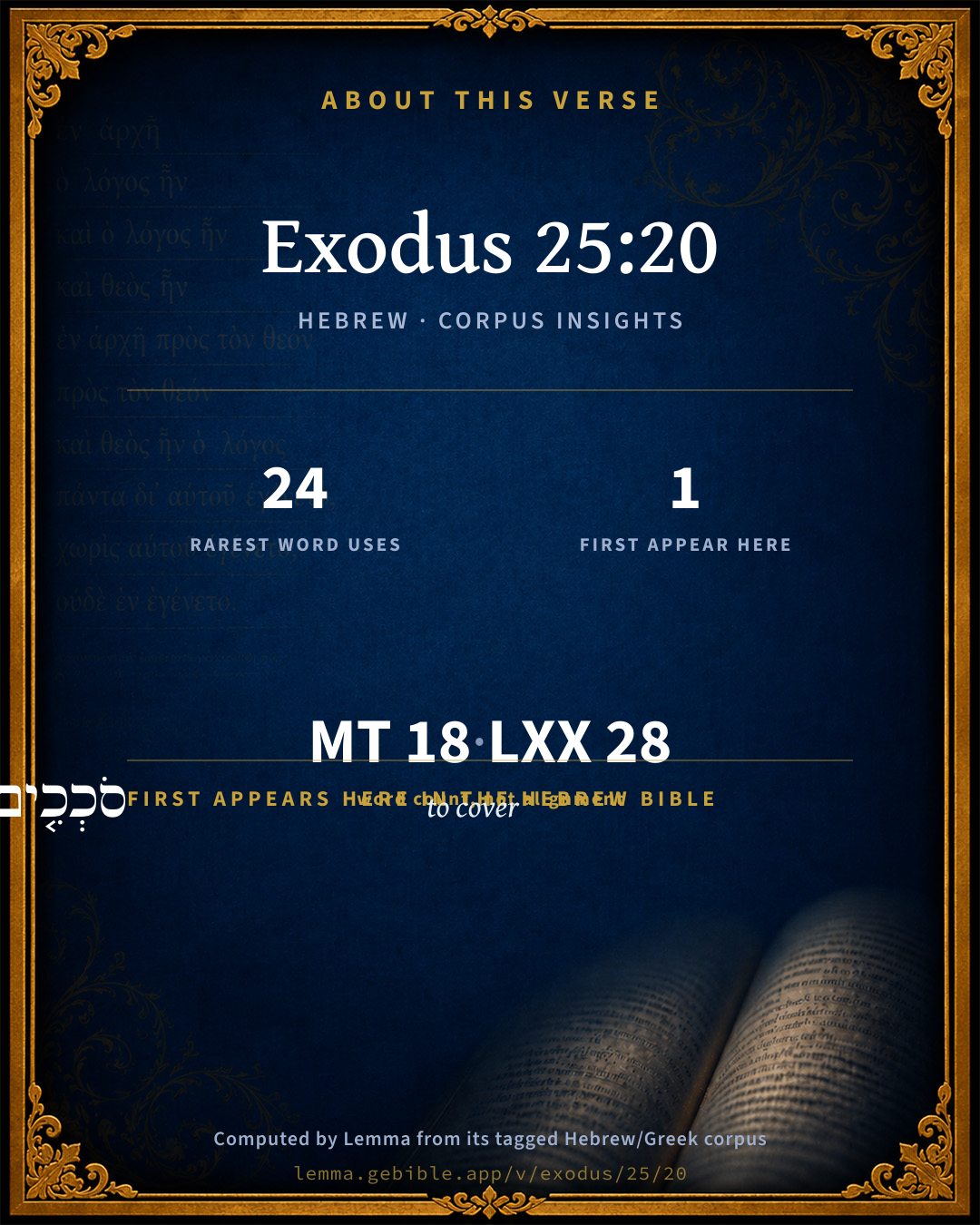
The rarest word here is סֹכְכִ֤ים to cover H5526 — appearing just 24 times in the whole Hebrew Bible.

First appearance in Scripture

This word makes its first canonical appearance in the Hebrew Bible here:

  • סֹכְכִ֤ים to cover H5526

Shared distinctive vocabulary

סֹכְכִ֤ים to cover H5526 occurs in 24 verses of the Hebrew Bible. Also found in:

Grammatical profile

  • 4 verbs
  • 10 nouns
  • 3 prepositions
  • 1 adverb

Verb forms

  • וְהָי֣וּ Qal · Sequential Perfect
  • פֹּרְשֵׂ֨י Qal · Participle Active
  • סֹכְכִ֤ים Qal · Participle Active
  • יִהְי֖וּ Qal · Imperfect

Repetition

Words recur within this verse — often emphatic in Hebrew:

  • וְהָי֣וּ to be H1961 ×2
  • הַכְּרֻבִים֩ cherub H3742 ×2
  • כְנָפַ֜יִם wing H3671 ×2
  • הַכַּפֹּ֔רֶת mercy seat H3727 ×2
  • וּפְנֵיהֶ֖ם face H6440 ×2
  • אֶל to H413 ×2

Hebrew & Septuagint length

In English translation the verse runs 32 words from the Hebrew and 32 from the Septuagint (LXX English) — the same length.

A rough comparison of the two English renderings, which tokenize alike — not a word-level alignment.

Word counts can differ between the Hebrew and the Greek without any difference in meaning — e.g. the Hebrew direct-object marker אֵת has no separate Greek word, and Greek often adds the article ὁ.

In the original languages it is 18 Hebrew tokens and 28 Greek tokens — but the two are counted differently (Hebrew bundles its prefixes and suffixes into one token; the Greek is in lemma form), so that isn’t a like-for-like length.

Cross-references

19

Topical passages linked to Exodus 25:20 in the Treasury of Scripture Knowledge — connected by theme and wording, ordered by reader-vote popularity; previews shown in the World English Bible.

  • 1 Kings 8:7 For the cherubim spread forth their wings over the place of the ark, and the cherubim covered the ark and the poles of it above.
  • 1 Chronicles 28:18 and for the altar of incense refined gold by weight; and gold for the pattern of the chariot, [even] the cherubim, that spread out [their wings], and covered the ark of the covenant of Yahweh.
  • Hebrews 9:5 and above it cherubim of glory overshadowing the mercy seat, of which things we can't now speak in detail.
  • Genesis 28:12 He dreamed. Behold, a stairway set up on the earth, and the top of it reached to heaven. Behold, the angels of God ascending and descending on it.
  • Exodus 25:18 You shall make two cherubim of hammered gold. You shall make them at the two ends of the mercy seat.
  • 2 Chronicles 3:10 In the most holy house he made two cherubim of image work; and they overlaid them with gold.
  • Isaiah 6:1–5 In the year that king Uzziah died, I saw the Lord sitting on a throne, high and lifted up; and his train filled the temple.
  • Ezekiel 1:20 Wherever the spirit was to go, they went; there was the spirit to go: and the wheels were lifted up beside them; for the spirit of the living creature was in the wheels.
  • Ezekiel 28:14 You were the anointed cherub who covers: and I set you, [so that] you were on the holy mountain of God; you have walked up and down in the midst of the stones of fire.
  • Matthew 24:31 He will send out his angels with a great sound of a trumpet, and they will gather together his chosen ones from the four winds, from one end of the sky to the other.
  • John 1:51 He said to him, "Most assuredly, I tell you, hereafter you will see heaven opened, and the angels of God ascending and descending on the Son of Man."
  • 1 Corinthians 4:9 For, I think that God has displayed us, the apostles, last of all, like men sentenced to death. For we are made a spectacle to the world, both to angels and men.
  • 1 Corinthians 11:10 For this cause the woman ought to have authority on her head, because of the angels.
  • Ephesians 3:10 to the intent that now through the assembly the manifold wisdom of God might be made known to the principalities and the powers in the heavenly places,
  • Colossians 2:10 and in him you are made full, who is the head of all principality and power;
  • Hebrews 1:14 Aren't they all ministering spirits, sent out to do service for the sake of those who will inherit salvation?
  • 1 Peter 1:12 To them it was revealed, that not to themselves, but to you, did they minister these things, which now have been announced to you through those who preached the Gospel to you by the Holy Spirit sent out from heaven; which things angels desire to look into.
  • 1 Peter 3:22 who is at the right hand of God, having gone into heaven, angels and authorities and powers being made subject to him.
  • Revelation 5:11–12 I saw, and I heard something like a voice of many angels around the throne, the living creatures, and the elders; and the number of them was ten thousands of ten thousands, and thousands of thousands;

Cross-references courtesy of OpenBible.info (CC BY 4.0).

Hebrew and Greek witnesses Masoretic Hebrew ↔ Greek Septuagint

The same verse in the two great witnesses to the Old Testament, shown verse-for-verse.

These are two independent witnesses, not word-aligned to each other, and the Septuagint is shown in lemma (dictionary) form.

Hebrew Exodus 25:20 Masoretic · Westminster Leningrad Codex

וְהָי֣וּ הַכְּרֻבִים֩ פֹּרְשֵׂ֨י כְנָפַ֜יִם לְמַ֗עְלָה סֹכְכִ֤ים בְּכַנְפֵיהֶם֙ עַל הַכַּפֹּ֔רֶת וּפְנֵיהֶ֖ם אִ֣ישׁ אֶל אָחִ֑יו אֶל הַכַּפֹּ֔רֶת יִהְי֖וּ פְּנֵ֥י הַכְּרֻבִֽים

The cherubim shall spread out their wings upward, covering the mercy seat with their wings, with their faces toward one another. The faces of the cherubim shall be toward the mercy seat.

World English Bible · Public Domain

Greek LXX Exodus 25:20 Septuagint · lemma form

εἰμί ὁ χερουβιμ ἐκτείνω ὁ πτέρυξ ἐπάνωθεν συνσκιάζω ὁ πτέρυξ αὐτός ἐπί ὁ ἱλαστήριον καί ὁ πρόσωπον αὐτός εἰς ἀλλήλω εἰς ὁ ἱλαστήριον εἰμί ὁ πρόσωπον ὁ χερουβιμ

The cherubs shall stretch forth their wings above, overshadowing the propitiatory with their wings; and their faces shall be toward each other, the faces of the cherubs shall be toward the propitiatory.

LXX2012 (modern English Septuagint) · Public Domain

Hebrew: Westminster Leningrad Codex (CC BY 4.0). Greek: Septuagint (public domain); English from LXX2012 (modern English Septuagint) (Public Domain). How the Septuagint differs from the Hebrew →

Targum (Aramaic paraphrase)

2

The Targum is the ancient Jewish Aramaic paraphrase of the Hebrew Scriptures — an interpretive translation, not the Hebrew text itself. Onkelos (literal) and Pseudo-Jonathan (expansive) render the Torah, and Jonathan the Prophets. Coverage is partial: where no permissively-licensed English translation exists for a verse, only the Aramaic is shown. This is verse-level text, not a word-by-word alignment to the Hebrew.

  1. Targum Onkelos Torah (Genesis–Deuteronomy)
    וִיהוֹן כְּרוּבַיָא פְּרִיסָן גַדְפֵיהוֹן לְעֵלָא מְטַלִין בְּגַדְפֵהוֹן עַל כַּפֻּרְתָּא וְאַפֵּיהוֹן חַד לָקֳבֵל חַד לָקֳבֵל כַּפֻּרְתָּא יְהוֹן אַפֵי כְרוּבַיָא:

    (no public-domain English translation for this verse)

    Targum Onkelos — Aramaic: “Onkelos Genesis” (public domain); “Onkelos Exodus” (public domain); “Onkelos Leviticus” (public domain); “Onkelos Numbers” (public domain); “Onkelos Deuteronomy” (public domain). English: “Sefaria Community Translation” (CC0 1.0 (public-domain dedication)); “J.W. Etheridge. The Targums of Onkelos and Jonathan Ben Uzziel on the Pentateuch. London: Longmans, Green, 1862” (public domain). Text via Sefaria.

  2. Targum Pseudo-Jonathan Torah (Genesis–Deuteronomy)
    וִיהוֹן כְּרוּבַיָא פְּרִיסַן גַּדְפֵיהוֹן לְעֵילָא כָּל קְבֵיל רֵישֵׁיהוֹם מְטַלְלִין בְּגַדְפֵיהוֹן עַל כַּפּוּרְתָּא וְאַפֵּיהוֹן חָד כָּל קְבֵיל חַד לִקְבֵיל כַּפּוּרְתָּא יְהוֹן אַפֵּי כְרוּבַיָא

    And the kerubaia shall stretch forth their wings above, their heads over against each other, their wings overshadowing the mercy-seat, and their faces over against each other; towards the mercy-seat shall be the faces of the kerubaia.

    Targum Pseudo-Jonathan — Aramaic: “Targum Jonathan on Genesis” (public domain); “Targum Jonathan on Exodus” (public domain); “Targum Jonathan on Leviticus” (public domain); “Targum Jonathan on Numbers” (public domain); “Targum Jonathan on Deuteronomy” (public domain). English: “The Targum of Jonathan ben Uzziel, trans. J. W. Etheridge, London, 1862” (public domain). Text via Sefaria.

Commentary

Notes on Exodus 25:20 from classic Christian and Jewish commentators (each source and its license shown beneath its notes). The classic Christian expositions comment on the surrounding passage and are grouped to its opening verse, so a note may address several verses; the Jewish commentaries on the Tanakh (Rashi and others) are per-verse, so they appear only where the commentator wrote on this verse.

Lemma curates 59 commentaries, every one of them public domain or Creative Commons licensed, each selected and text-cleaned for this edition rather than reprinted as found. About our sources →

Trapp's Complete Commentary

John Trapp

Exo 25:20 And the cherubims shall stretch forth [their] wings on high, covering the mercy seat with their wings, and their faces [shall look] one to another; toward the mercy seat shall the faces of the cherubims be.

Ver. 20. Toward the mercy seat shall the faces, &c.] Angels in the Syriac are called אפנים, of the face; because they look ever on the face of God, waiting his commands.

John Trapp, A Commentary or Exposition upon All the Books of the Old and New Testament (1647–1656) — public domain. Text from a community e-Sword module.

Ellicott's Commentary for English Readers

(20) The cherubims shall stretch forth their wings on high.—The two wings of both cherubs were to be elevated and advanced so as to overshadow the mercy seat, and, as it were, protect it. In the Egyptian figures of Ma, one wing only has this position, the other being depressed and falling behind the figure.

Towards the mercy seat.—Bent downwards, i.e., as though gazing on the mercy seat. (Compare Exo_37:9).

A Bible Commentary for English Readers, edited by Charles John Ellicott (1878–1897) — public domain. Text from a community e-Sword module.

The Cambridge Bible for Schools and Colleges

gen. ed. J. J. S. Perowne

20. shall spread out] Heb. shall be spreading out, describing their permanent condition: the idiom, as Gen_1:6, and frequently.

with their faces, &c.] These cherubim, unlike those of Ezek. (see above), are pictured therefore as having only one face each. The cherubim in Solomon’s Temple (1Ki_6:23-28), it is to be noted, differed materially from those here described. Solomon’s cherubim were colossal figures, each ten cubits (15 ft.) high; they were not of gold, but of olive wood, overlaid with gold; they were not upon the ark, nor did they face each other; they stood, one on each side of the ark, facing the entrance to the Holy of holies, and their four outstretched wings, each 5 cubits (7½ ft.) long, extended across from one wall of the Holy of holies to the other.

The Cambridge Bible for Schools and Colleges (gen. ed. J. J. S. Perowne; Cambridge University Press, 1878–1918) — public domain. Text from a community e-Sword module.

John Gill's Exposition

And there I will meet with thee,.... With Moses, and so with the high priest in later times, when he should enter into the holy of holies, and with the people of God as represented by him, when he should go in and inquire for them of the Lord:

and I will commune with thee from above the mercy seat, from between the two cherubim; converse with him and them about whatsoever they should apply unto him for, these being the symbols of the divine presence: hence the Lord is frequently described as "dwelling between the cherubim which are upon the ark of the testimony"; that is, which cherubim are upon it, being on the mercy seat, which was the cover of it; or rather "which is upon" (s), which mercy seat is upon the ark of the testimony, as it properly was; and here the Lord promises to commune

of all things which I shall give thee in commandment unto the children of Israel: what they shall do, respecting those things which by Moses, or the high priest, they should inquire the mind and will of God about: this may signify that the way to communion with God lies through Christ, the mercy seat and propitiation, through his blood and righteousness, through the vail, that is to say, his flesh; and the encouragement to it is from him, our great high priest, and from his propitiatory sacrifice; and the enjoyment of it is through him; our fellowship is with the Father, and his Son Jesus Christ; God speaks to us by him, and reveals himself in him.

(s) "quod est", Vatablus.

John Gill's Exposition of the Whole Bible (1746–1763) — public domain (CC PDM 1.0). Text via the HelloAO Bible API.

Matthew Poole's English Annotations

Towards God, who is supposed to sit there, whose face the angels in heaven always behold, and upon whom their eyes are fixed to observe and receive his commands; and towards Christ, the true propitiatory, which mystery they desire to look into, 1Pe 1:12; not envying mankind their near and happy relation to him, but taking pleasure in the contemplation of it.

Matthew Poole's English Annotations on the Holy Bible (1683–1685) — public domain. Text from a community e-Sword/MySword module.

The Pulpit Commentary

The cherubims shall stretch forth their wings on high. Compare Exo_37:9. It would seem that the two wings of both cherubs were advanced in front of them, and elevated, so as to overshadow the mercy seat. This was a departure from the patterns furnished by the figures of Ma (see the comment on ver. 18), since in them one wing only was elevated, and the other depressed. It is clear that in no case was any part of the Hebrew sacred furniture a mere reproduction of Egyptian models. Whatever was made use of was so transformed or modified as to acquire a new and independent character. Their faces, etc. The words are not without difficulty; but the generally received meaning appears to be correct that the faces were bent one towards the other, but that both looked downwards, towards the mercy seat. Thus the figures, whether they were standing or kneeling, which is uncertain, presented the appearance of guardian angels, who watched over the precious deposit below to wit, the two tables.

The Pulpit Commentary (1880–1919), ed. H.D.M. Spence-Jones & Joseph S. Exell — public domain. Text from a community e-Sword module.

Keil & Delitzsch

C. F. Keil & F. Delitzsch

"And let the cherubs be stretching out wings on high, screening (סככים, συσκιάζοντες) with their wings above the capporeth, and their faces (turned) one to the other; towards the capporeth let the faces of the cherubs be." That is to say, the cherubs were to spread out their wings in such a manner as to form a screen over the capporeth, with their faces turned towards one another, but inclining or stooping towards the capporeth. The reason for this is given in Exo 25:22. There - viz., above the capporeth that was placed upon the ark containing the testimony - Jehovah would present Himself to Moses (נועד, from יעד to appoint, to present one's self to a person at an appointed place, to meet with him), and talk with him "from above the capporeth, out from between the two cherubs upon the ark of testimony, all that I shall command thee for the sons of Israel" (cf. Exo 29:42). Through this divine promise and the fulfilment of it (Exo 40:35; Lev 1:1; Num 1:1; Num 16:19), the ark of the covenant together with the capporeth became the throne of Jehovah in the midst of His chosen people, the footstool of the God of Israel (Ch1 28:2, cf. Psa 132:7; Psa 99:5; Lam 2:1). The ark, with the tables of the covenant as the self-attestation of God, formed the foundation of this throne, to show that the kingdom of grace which was established in Israel through the medium of the covenant, was founded in justice and righteousness (Psa 89:15; Psa 97:2). The gold plate upon the ark formed the footstool of the throne for Him, who caused His name, i.e., the real presence of His being, to dwell in a cloud between the two cherubim above their outspread wings; and there He not only made known His will to His people in laws and commandments, but revealed Himself as the jealous God who visited sin and showed mercy (Exo 20:5-6; Exo 34:6-7), - the latter more especially on the great day of atonement, when, through the medium of the blood of the sin-offering sprinkled upon and in front of the capporeth, He granted reconciliation to His people for all their transgressions in all their sin (Lev 16:14.). Thus the footstool of God became a throne of grace (Heb 4:16, cf. Exo 9:5), which received its name capporeth or ἱλαστήριον from the fact that the highest and most perfect act of atonement under the Old Testament was performed upon it. Jehovah, who betrothed His people to Himself in grace and mercy for an everlasting covenant (Hos 2:2), was enthroned upon it, above the wings of the two cherubim, which stood on either side of His throne; and hence He is represented as "dwelling (between) the cherubim" הכּרבים ישׁב (Sa1 4:4; Sa2 6:2; Psa 80:2, etc.). The cherubs were not combinations of animal forms, taken from man, the lion, the ox, and the eagle, as many have inferred from Ezek 1 and 10, for even the composite beings which Ezekiel saw with four faces had a human figure (Eze 1:5); but they are to be regarded as figures made in a human form, and not in a kneeling posture, but, according to the analogy of Ch2 3:13, standing upright. Consequently, as the union of four faces in one cherub is peculiar to Ezekiel, and the cherubs of the ark of the covenant, like those of Solomon's temple, had but one face each, not only did the human type form the general basis of these figures, but in every respect, with the exception of the wings, they were made in the likeness of men. And this is the only form which would answer the purpose for which they were intended, viz., to represent the cherubim, or heavenly spirits, who were stationed to prevent the return of the first man to the garden of Eden after his expulsion thence, and keep the way to the tree of life. Standing upon the capporeth of the ark of the covenant, the typical foundation of the throne of Jehovah, which Ezekiel saw in the vision as רקיע דּמוּת רקי "the likeness of a firmament" (Eze 1:22, Eze 1:25), with their wings outspread and faces lowered, they represented the spirits of heaven, who surround Jehovah, the heavenly King, when seated upon His throne, as His most exalted servants and the witnesses of His sovereign and saving glory; so that Jehovah enthroned above the wings of the cherubim was set forth as the God of Hosts who is exalted above all the angels, surrounded by the assembly or council of the holy ones (Psa 89:6-9), who bow their faces towards the capporeth, studying the secrets of the divine counsels of love (Pe1 1:12), and worshipping Him that liveth for ever and ever (Rev 4:10).

Keil & Delitzsch — Biblical Commentary on the Old Testament (1861–1891) — public domain (CC PDM 1.0). Text via the HelloAO Bible API. (Old Testament only.)

Rashi

Rabbi Shlomo Yitzchaki (Rashi)

פרשי כנפים [AND THE CHERUBIM SHALL] SPREAD THEIR WINGS [ON HIGH] — i. e. that you shall not make their wings touching the body but spreading on high slightly above but almost on the same level with their heads so that the hollow space between the wings and the cover shall be ten handbreadths, as it is explained in Treatise Sukkah 5b.

Rashi on the Tanakh — English translations: “The Judaica Press complete Tanach with Rashi, translated by A. J. Rosenberg” (CC BY 4.0); “Pentateuch with Rashi's commentary by M. Rosenbaum and A.M. Silbermann, 1929-1934” (public domain); “The Metsudah Tanach series, Lakewood, N.J” (CC BY 4.0); and “The Book of Joshua, Metsudah Publications, 1997” (CC BY 4.0). Text via Sefaria.

Lesson kit

Teaching starters — assembled from the data on this page, not authored interpretation. Every prompt links to the verse data it draws on. Edit before teaching.

Exodus, in the Pentateuch, opens this verse with 18 words (12 distinct Hebrew lemmas). Its most distinctive word is çâkak (“to cover”). A historical commentator’s framing appears above. Read the whole chapter for the surrounding context.

Discussion questions

  1. How does “to cover” (çâkak) shape what this verse is saying?
  2. This is the first place “to cover” appears in Scripture (first appears here). What does its debut here establish?
  3. How does Exodus 33:22, which shares the word «to cover», read alongside this verse?
  4. What does the repetition of “to be” (2× in this one verse) do in this verse?
  5. The translations on this page render this verse differently — a whole-verse word diff, not a word-by-word alignment. What might account for the different wordings?
  6. «וְהָי֣וּ» is a Qal Sequential Perfect verb. How does that grammatical form shape the action described?
  7. Compare how Trapp's Complete Commentary and Ellicott's Commentary for English Readers read this verse. Where do they agree or differ?

Things to notice

Reading settings

Reading text

Shown beneath each verse's original-language words.

Old Testament
Old Testament edition

Read the OT as the Masoretic Hebrew (MT) or the Greek Septuagint (LXX).

English shown for the Greek Septuagint (in the Hebrew ↔ Greek comparison).

Comparing translations? Open the Compare panel on any verse page to stack up to four side by side.