
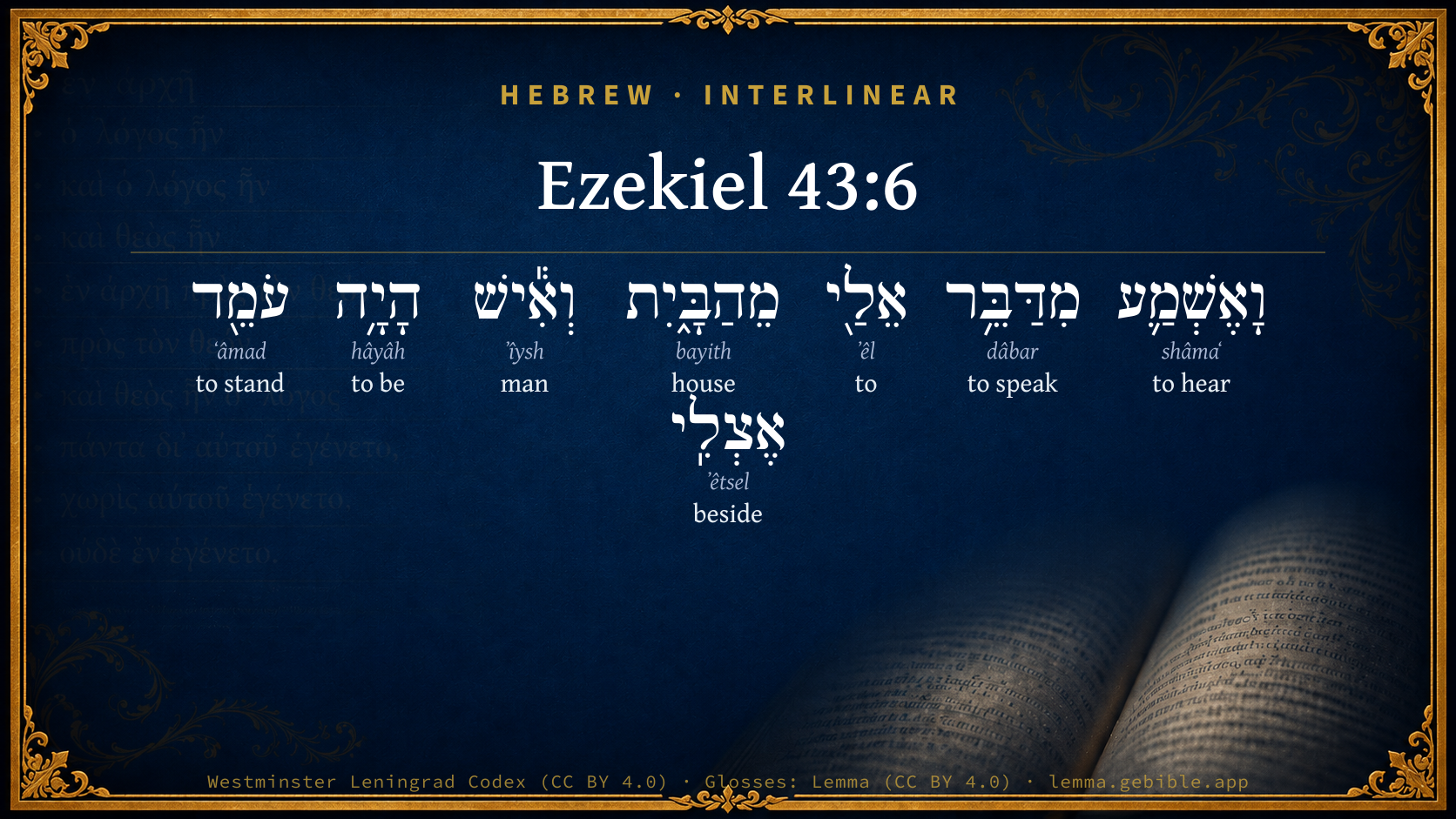
Ezekiel 43:6

Hebrew (Westminster Leningrad Codex) Ezekiel 43:6 appears in the Hebrew Old Testament. The text above is from the Westminster Leningrad Codex. Each word links to its Strong’s number, a concise gloss, and parsing drawn from the Open Scriptures Hebrew Bible morphology. Click any word for its full Brown-Driver-Briggs (BDB) entry.
Download image
Cite this verse

Ezekiel 43:6 (World English Bible). Public Domain. Lemma interlinear Bible study tool, https://lemma.gebible.app/v/ezekiel/43/6.

Show BibTeX & RIS
BibTeX
RIS
English Translation
I heard one speaking to me out of the house; and a man stood by me.
World English Bible · Public Domain
Download a study sheet

One document with this verse’s original text, its word-by-word gloss line, the meaning frame, cross-references with their text, attributed commentary, and full source and license credits — printable, and it pastes into notes with its structure intact.

This verse Autodidact and up

Study sheet (.html) Plain text (.txt)

A passage Seminary Student

Up to 50 verses in one chapter. A passage sheet keeps up to 6 commentary sources and 12 cross-references per verse, in the order this page ranks them, and says so on the sheet whenever that leaves anything out. Ask for a single verse and you get the Autodidact verse sheet above.

Everything on this page stays free to read, with no account — the sheet is a download of what is already on screen, not access to it.

Want to remove ads? Support Godless Engineer
Compare translations 3

The same verse in 3 English versions, stacked beneath the original-language interlinear above. Click any original word for its lexicon entry.

Each is an independent rendering of the whole verse — the interlinear is not word-aligned to these translations.

Highlighted words mark where these versions differ — a whole-verse word diff, not a word-by-word alignment.

  • World English Bible Public Domain
    I heard one speaking to me out of the house; and a man stood by me.
  • King James Version Public Domain
    And I heard him speaking unto me out of the house; and the man stood by me.
  • unfoldingWord Literal Text CC BY-SA 4.0
    The man was standing beside me, and I heard someone else speaking to me from the house.

unfoldingWord Literal Text — © unfoldingWord, licensed CC BY-SA 4.0. Word-aligned USFM3 via Door43 (git.door43.org/unfoldingWord/en_ult).

Versions to compare (up to 4)

3 of 4 selected

Show all 18 translations

Every available English version of this verse, each an independent rendering of the whole verse.

  • World English Bible Public Domain
    I heard one speaking to me out of the house; and a man stood by me.
  • Berean Standard Bible Public Domain
    While the man was standing beside me, I heard someone speaking to me from inside the temple,
  • Majority Standard Bible Public Domain
    While the man was standing beside me, I heard someone speaking to me from inside the temple,
  • King James Version Public Domain
    And I heard him speaking unto me out of the house; and the man stood by me.
  • American Standard Version (1901) Public Domain
    And I heard one speaking unto me out of the house; and a man stood by me.
  • Revised Version (1885) Public Domain
    And I heard one speaking unto me out of the house; and a man stood by me.
  • Geneva Bible (1599) Public Domain
    And I heard one speaking vnto me out of the house: and there stoode a man by me,
  • Douay-Rheims (1899) Public Domain
    And I heard one speaking to me out of the house, and the man that stood by me,
  • Young's Literal Translation Public Domain
    And I hear one speaking unto me from the house, and a man hath been standing near me,
  • Literal Standard Version CC BY-SA 4.0
    And I hear one speaking to me from the house, and a man has been standing near me,
  • Unlocked Literal Bible CC BY-SA 4.0
    The man was standing beside me, and I heard someone else speaking to me from the house.
  • unfoldingWord Literal Text CC BY-SA 4.0
    The man was standing beside me, and I heard someone else speaking to me from the house.
  • Darby Bible Public Domain
    And I heard one speaking unto me out of the house; and a man was standing by me.
  • World Messianic Bible Public Domain
    I heard one speaking to me out of the house, and a man stood by me.
  • Webster's Bible Public Domain
    And I heard him speaking to me out of the house; and the man stood by me.
  • Free Bible Version CC BY-SA 4.0
    I heard someone speaking to me from inside the Temple while the man was standing beside me.
  • Bible in Basic English Public Domain
    And the voice of one talking to me came to my ears from inside the house; and the man was by my side.
  • JPS Tanakh (1917) Public Domain
    And I heard one speaking unto me out of the house; and a man stood by me.

Literal Standard Version (2020), Covenant Press — licensed CC BY-SA 4.0. Text via the HelloAO Bible API (eBible.org). Unlocked Literal Bible (unfoldingWord) — licensed CC BY-SA 4.0. Text via the HelloAO Bible API (eBible.org). unfoldingWord Literal Text — © unfoldingWord, licensed CC BY-SA 4.0. Word-aligned USFM3 via Door43 (git.door43.org/unfoldingWord/en_ult). Free Bible Version, Dr. Jonathan Gallagher — licensed CC BY-SA 4.0. Text via the HelloAO Bible API (eBible.org).

Word by word

More ways to search: Search by grammar → Find every occurrence → Compare this word →

Practice this passage: Drill this verse → Learn its vocabulary →

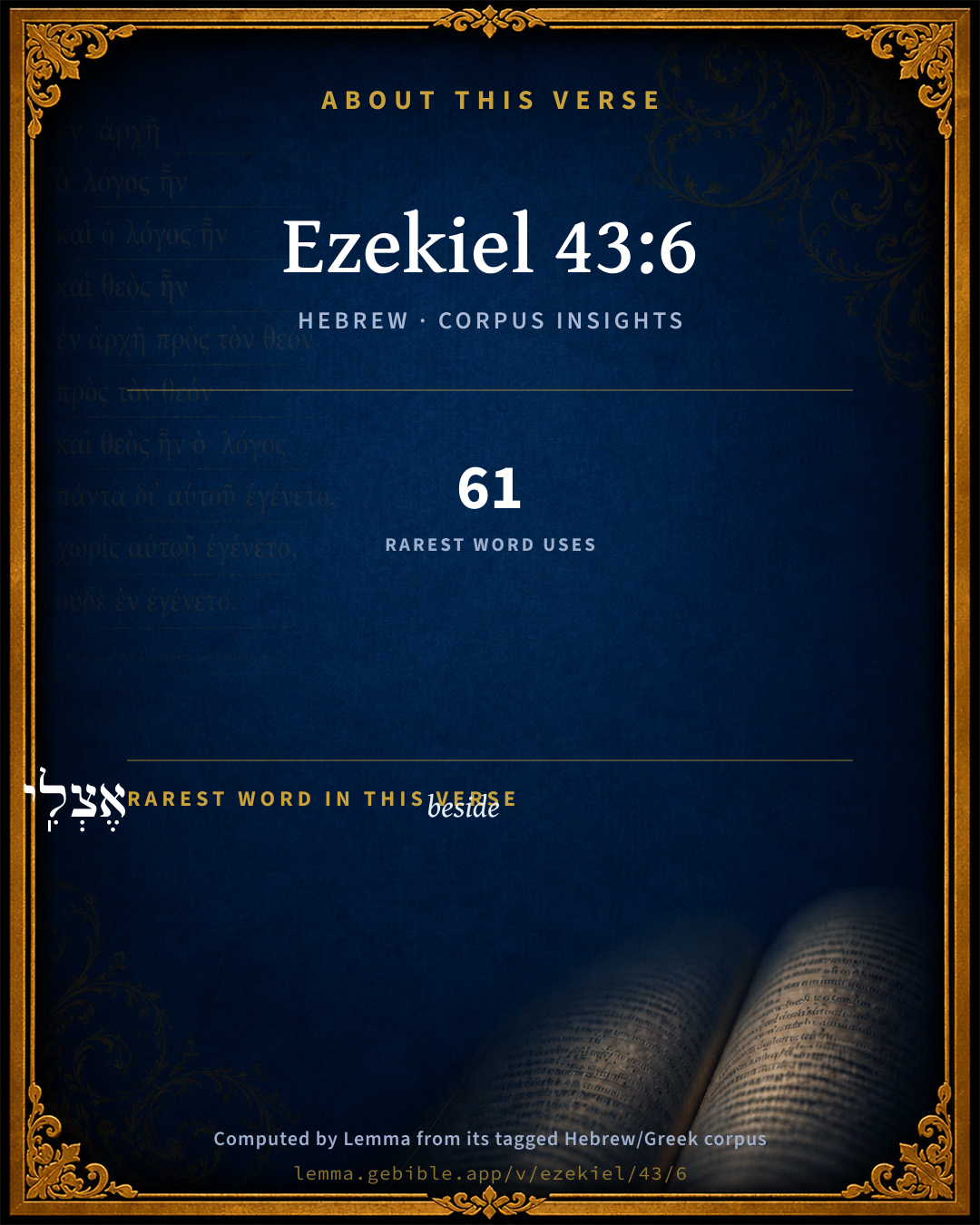
About this verse

These counts appear in no published source. They are computed here, from the morphology-tagged text and Lemma’s own curated glosses. What Lemma adds →

8
words
8
distinct lemmas
Prophets
section

Grammatical profile

  • 4 verbs
  • 2 nouns
  • 2 prepositions

Verb forms

  • וָאֶשְׁמַ֛ע Qal · Sequential Imperfect
  • מִדַּבֵּ֥ר Hithpael · Participle Active
  • הָיָ֥ה Qal · Perfect
  • עֹמֵ֖ד Qal · Participle Active

Hebrew & Septuagint length

In English translation the verse runs 16 words from the Hebrew and 24 from the Septuagint (LXX English) — the Septuagint runs noticeably longer here. See the side-by-side →

A rough comparison of the two English renderings, which tokenize alike — not a word-level alignment.

Word counts can differ between the Hebrew and the Greek without any difference in meaning — e.g. the Hebrew direct-object marker אֵת has no separate Greek word, and Greek often adds the article ὁ.

Cross-references

4

Topical passages linked to Ezekiel 43:6 in the Treasury of Scripture Knowledge — connected by theme and wording, ordered by reader-vote popularity; previews shown in the World English Bible.

  • Ezekiel 40:3 He brought me there; and, behold, there was a man, whose appearance was like the appearance of brass, with a line of flax in his hand, and a measuring reed; and he stood in the gate.
  • Leviticus 1:1 Yahweh called to Moses, and spoke to him out of the Tent of Meeting, saying,
  • Isaiah 66:6 A voice of tumult from the city, a voice from the temple, a voice of Yahweh that renders recompense to his enemies.
  • Revelation 16:1 I heard a loud voice out of the temple, saying to the seven angels, "Go and pour out the seven bowls of the wrath of God on the earth!"

Cross-references courtesy of OpenBible.info (CC BY 4.0).

Hebrew and Greek witnesses Masoretic Hebrew ↔ Greek Septuagint

The same verse in the two great witnesses to the Old Testament, shown verse-for-verse.

Here the Septuagint runs noticeably longer than the Hebrew — LXX2012 (modern English Septuagint) 24 words vs World English Bible 16. A rough length comparison of the two English translations, not a word-level alignment — read both below.

These are two independent witnesses, not word-aligned to each other, and the Septuagint is shown in lemma (dictionary) form.

Hebrew Ezekiel 43:6 Masoretic · Westminster Leningrad Codex

וָאֶשְׁמַ֛ע מִדַּבֵּ֥ר אֵלַ֖י מֵהַבָּ֑יִת וְאִ֕ישׁ הָיָ֥ה עֹמֵ֖ד אֶצְלִֽי

I heard one speaking to me out of the house; and a man stood by me.

World English Bible · Public Domain

Greek LXX Ezekiel 43:6 Septuagint · lemma form

καί ἵστημι καί ἰδού φωνή ἐκ ὁ οἶκος λαλέω πρός ἐγώ καί ὁ ἀνήρ ἵστημι ἔχω ἐγώ

And I stood, and behold there was a voice out of the house of one speaking to me, and a man stood near me,

LXX2012 (modern English Septuagint) · Public Domain

Hebrew: Westminster Leningrad Codex (CC BY 4.0). Greek: Septuagint (public domain); English from LXX2012 (modern English Septuagint) (Public Domain). How the Septuagint differs from the Hebrew →

Targum (Aramaic paraphrase)

1

The Targum is the ancient Jewish Aramaic paraphrase of the Hebrew Scriptures — an interpretive translation, not the Hebrew text itself. Onkelos (literal) and Pseudo-Jonathan (expansive) render the Torah, and Jonathan the Prophets. Coverage is partial: where no permissively-licensed English translation exists for a verse, only the Aramaic is shown. This is verse-level text, not a word-by-word alignment to the Hebrew.

  1. Targum Jonathan Prophets (Joshua–Malachi)
    וּשְׁמָעֵית דִי מְמַלֵל עִמִי מִלְגָיו וְגַבְרָא הֲוָה קָאִים לְקִבְלִי:

    (no public-domain English translation for this verse)

    Targum Jonathan — Aramaic: “Mikraot Gedolot” (public domain). English: “Sefaria Community Translation” (CC0 1.0 (public-domain dedication)); “London "Chaldee Paraphrase," 1871” (public domain). Text via Sefaria.

Commentary

Notes on Ezekiel 43:6 from classic Christian and Jewish commentators (each source and its license shown beneath its notes). The classic Christian expositions comment on the surrounding passage and are grouped to its opening verse, so a note may address several verses; the Jewish commentaries on the Tanakh (Rashi and others) are per-verse, so they appear only where the commentator wrote on this verse.

Lemma curates 59 commentaries, every one of them public domain or Creative Commons licensed, each selected and text-cleaned for this edition rather than reprinted as found. About our sources →

Trapp's Complete Commentary

John Trapp

Eze 43:6 And I heard [him] speaking unto me out of the house; and the man stood by me.

Ver. 6. And I heard him speaking unto me.] The man Christ Jesus, standing by. Here, then, is a meeting and the mystery of the blessed Trinity; yea, here is a double mystery to be taken notice of, viz., those two wonderful unions of three persons in one God, and of Christ’s two natures in one person.

John Trapp, A Commentary or Exposition upon All the Books of the Old and New Testament (1647–1656) — public domain. Text from a community e-Sword module.

Joseph Benson's Commentary

Eze 43:6. I heard him speaking unto me, &c. — The prophet now receives instructions more immediately from the glory of the Lord, as Moses did when God had taken possession of the tabernacle, Lev 1:1. When God’s glory shines in the church, we must from thence expect to receive divine oracles. And the man stood by me — We could not bear to hear the voice of God, any more than to see the face of God, if Jesus Christ did not stand by us as a Mediator. Or, if this was a created angel, it is observable, that when God began to speak to the prophet, he stood by, and gave way, having no more to say. Nay, he stood by the prophet as a learner with him; for to the principalities and powers, to the angels themselves, who desire to look into these things, is made known by the church the manifold wisdom of God, Eph 3:10.

Joseph Benson's Commentary on the Old and New Testaments (1811–1818) — public domain. Text from a community e-Sword module.

Jamieson, Fausset & Brown

Robert Jamieson, A. R. Fausset & David Brown

the man--who had been measuring the buildings (Eze 40:3).

Jamieson, Fausset & Brown — Commentary Critical and Explanatory on the Whole Bible (1871) — public domain (CC PDM 1.0). Text via the HelloAO Bible API.

Ellicott's Commentary for English Readers

(6) I heard him speaking.—Although the pronoun is not expressed in the original, there can be no question that God Himself spoke directly to the prophet, as in Eze_44:2; Eze_44:5; Eze_44:9, &c. “The man” is without the article in the Hebrew, which leaves it uncertain whether the same being is meant who had hitherto guided the prophet; but as measurements were also made by this guide (Eze_47:3-5), he was probably the same.

A Bible Commentary for English Readers, edited by Charles John Ellicott (1878–1897) — public domain. Text from a community e-Sword module.

The Cambridge Bible for Schools and Colleges

gen. ed. J. J. S. Perowne

6. heard him speaking] One speaking.

and the man] Possibly: and a man. No doubt the same man is meant as before. The prophet was transported into the inner court by the spirit, not led as in other instances by the man, who, however, reappears at his side. The man is merely the divine voice and word personified and interposed between the Lord and the prophet, hence though Ezekiel appears to hear one speaking from the house, the voice immediately takes the shape of a man beside him.

The Cambridge Bible for Schools and Colleges (gen. ed. J. J. S. Perowne; Cambridge University Press, 1878–1918) — public domain. Text from a community e-Sword module.

John Gill's Exposition

And I heard him speaking unto me out of the house,.... The holy place, the prophet being in the inward court: this is Jehovah the Father, the God of Israel, whose glory entered into it; who utters his voice out of Zion; who speaks in his church by his word, and the ministers of it; and which is to be heard and regarded, not as the word of man, but as the word of God:

and the man stood by me: whom he saw at first with a measuring line in his hand, Eze 40:3, and with whom he had been all along, and had seen him measure the house, and all belonging to it: he stood by him as the Mediator between God and him; as the medium of communion with him; as the advocate with the Father: he stood by him to interpret what was said to him; to guide him further into the knowledge of divine things; to assist him, protect and defend him, to continue him in fellowship with God, and to preserve him in grace to glory. Here is an appearance of the three Persons in the Godhead; the Father speaking to the prophet out of the house; the Son in human form standing by him; and the Spirit of the Lord, who had took him up from the ground, and had brought him into the inner court.

John Gill's Exposition of the Whole Bible (1746–1763) — public domain (CC PDM 1.0). Text via the HelloAO Bible API.

Albert Barnes' Notes on the Bible

The man - A “man.” Probably an angel different from “the man” who had hitherto accompanied the seer. That angel guided, measured, and explained; this is present only to guide.

Albert Barnes' Notes on the Bible (1834–1885) — public domain. Text from a community e-Sword/MySword module.

Matthew Poole's English Annotations

I heard, distinctly, intelligibly, so that I am sure it was no delusion.

Him; the Lord, who was in that glory.

Speaking; what was spoken appears in the next two verses.

Out of the house; God speaks to his out of his temple.

The man; Christ, Mediator.

Stood by, to encourage, inform, and strengthen him.

Matthew Poole's English Annotations on the Holy Bible (1683–1685) — public domain. Text from a community e-Sword/MySword module.

Whedon's Commentary on the Bible

Daniel D. Whedon

6-9. The prophet is here addressed by one speaking from within, while “the man” or “a man” — probably the man with the measuring reed (Eze_40:3) — stood by his side. This voice from the divine glory was that of Jehovah, who addressed the prophet by his well-known title (see note Eze_2:1) and declared, This is the place of my throne, and the place of the soles of my feet, where I will dwell in the midst of the children of Israel forever, etc. (Compare Isa_60:13; Psa_99:5; Psa_132:7.) This abiding presence of Jehovah is due to the holiness of his people, who will “no more defile my sacred name with their idolatry and with the corpses of their kings,” etc. Expositors here differ as to whether “kings” refers to the idols which had such dominion over them, or to the bodies of the Hebrew kings or princes which were buried not far from the temple (1Ki_2:10; 1Ki_11:43). But as Ezekiel in no other place indicated that the bones of the kings ought to be removed from their long resting place at the restoration, and as he is constantly using figures of speech fitted to arouse attention and comparison, the former seems to be the better view. The images which they had brought into their places of worship had already been broken down (Eze_6:4-6; Eze_6:13; Eze_8:10; Eze_8:18) and the princes and rulers of Israel had been slain and their carcasses left where they had fallen (Eze_8:16; Eze_9:6-7). Their idolatry and every vestige of such idolatry would now be removed.

Daniel D. Whedon (gen. ed.), Commentary on the Old and New Testaments (1874–1909) — public domain. Text from a community e-Sword module.

The Pulpit Commentary

And I heard him (better, one) speaking unto me out of the house; and the (literally, a) man stood by me. Two questions arise Who was the speaker? and, Who the man? As to the speaker, the natural reply is that the One who addressed Ezekiel from the interior of the "house" was Jehovah himself, whose "glory" had just entered in to take possession of the house, and this view is adopted by most interpreters, though Hengstenberg and Schroder regard the man who stood beside the prophet as the one who addressed him. As to the man, it cannot, as Kliefoth maintains, be decided solely by the absence of the article before "man" that this was a different person from the guide who had hitherto conducted the prophet and measured the Building. The article may have Been emitted because the important point to be recorded was not the circumstance that the "one" who stood beside him was his quondam guide, but the fact that this "one" was a man. That he was also Ezekiel"s old conductor is at least a natural suggestion when one finds him afterwards appearing as a measurer with a line in his hand. (Eze_47:3)

The Pulpit Commentary (1880–1919), ed. H.D.M. Spence-Jones & Joseph S. Exell — public domain. Text from a community e-Sword module.

John Wesley's Explanatory Notes

The man - Christ. Stood - To encourage, and strengthen him.

John Wesley, Explanatory Notes Upon the Whole Bible (1754–1765) — public domain. Text via the GEBible commentary corpus.

unfoldingWord translationNotes

Door43 World Missions Community

the corpses of their kings

The idols that the people's kings worshiped are spoken of as if they are corpses because the idols are not alive. AT: "the lifeless idols that their kings worshiped" (See: Metaphor)

They profaned

"The Israelites profaned"

disgusting actions

"the disgusting things they did." God was angry because the people were worshiping idols and false gods. See how you translated this in Ezekiel 5:9.

consumed them with my anger

The phrase "consumed" here means "completely destroyed." AT: "completely destroyed them because I was angry" (See: Idiom)

translationWords

Son of Man

throne

life

people of God

eternity

profane

holy

name

king

faithless

threshold

anger

unfoldingWord translationNotes — © Distant Shores Media and the Door43 World Missions Community, licensed CC BY-SA 4.0. Source: git.door43.org/Door43/en_tn.

Rashi

Rabbi Shlomo Yitzchaki (Rashi)

speaking to me [Heb. מִדַּבֵּר,] speaking to Himself with me. It is respectful to say concerning Heaven מִדַּבֵּר, equivalent to מִתְדַּבֵּר; i.e., He spoke between Himself and His glory, and the voice came to me.

Rashi on the Tanakh — English translations: “The Judaica Press complete Tanach with Rashi, translated by A. J. Rosenberg” (CC BY 4.0); “Pentateuch with Rashi's commentary by M. Rosenbaum and A.M. Silbermann, 1929-1934” (public domain); “The Metsudah Tanach series, Lakewood, N.J” (CC BY 4.0); and “The Book of Joshua, Metsudah Publications, 1997” (CC BY 4.0). Text via Sefaria.

Lesson kit

Teaching starters — assembled from the data on this page, not authored interpretation. Every prompt links to the verse data it draws on. Edit before teaching.

Ezekiel, in the Prophets, opens this verse with 8 words (8 distinct Hebrew lemmas). Its most distinctive word is ʼêtsel (“beside”). The Greek Septuagint runs longer here. A historical commentator’s framing appears above. Read the whole chapter for the surrounding context.

Discussion questions

  1. The word ʼêtsel carries the sense “beside.” How does it shape the verse?
  2. Ezekiel 40:3 shares this passage’s theme. How do the two illuminate each other?
  3. Compared with the Hebrew, the Septuagint runs longer here. What questions does that raise?
  4. The translations on this page render this verse differently — a whole-verse word diff, not a word-by-word alignment. What might account for the different wordings?
  5. The verb «וָאֶשְׁמַ֛ע» is Qal Sequential Imperfect. How does its form color the action?
  6. Reading how Trapp's Complete Commentary and Joseph Benson's Commentary read this verse, where do the two commentators agree and where do they part?

Things to notice

Reading settings

Reading text

Shown beneath each verse's original-language words.

Old Testament
Old Testament edition

Read the OT as the Masoretic Hebrew (MT) or the Greek Septuagint (LXX).

English shown for the Greek Septuagint (in the Hebrew ↔ Greek comparison).

Comparing translations? Open the Compare panel on any verse page to stack up to four side by side.