Genesis 31:50

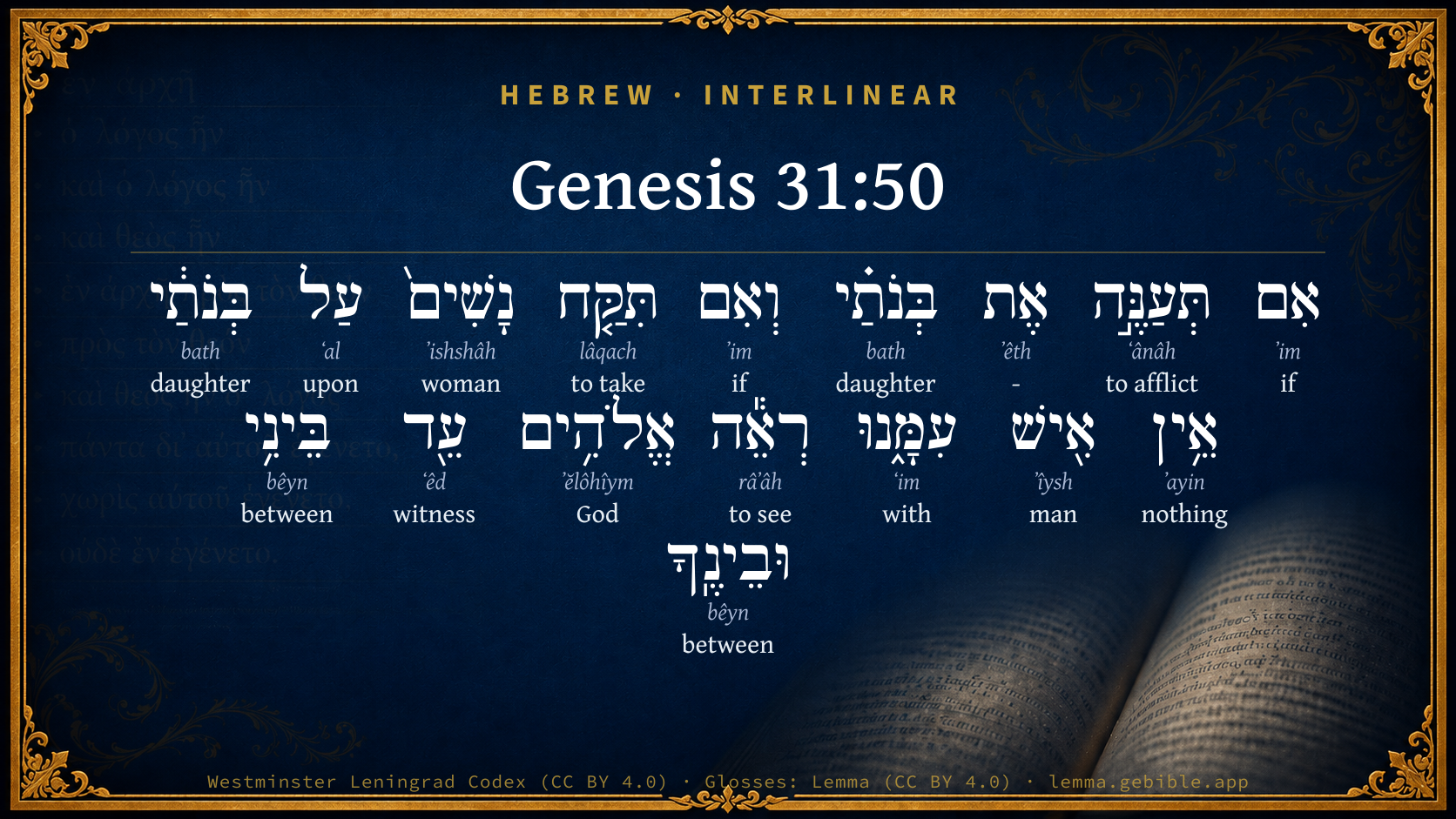
Hebrew (Westminster Leningrad Codex) Genesis 31:50 appears in the Hebrew Old Testament. The text above is from the Westminster Leningrad Codex. Each word links to its Strong’s number, a concise gloss, and parsing drawn from the Open Scriptures Hebrew Bible morphology. Click any word for its full Brown-Driver-Briggs (BDB) entry.
Download image
Cite this verse

Genesis 31:50 (World English Bible). Public Domain. Lemma interlinear Bible study tool, https://lemma.gebible.app/v/genesis/31/50.

Show BibTeX & RIS
BibTeX
RIS
English Translation
If you will afflict my daughters, and if you will take wives besides my daughters, no man is with us; behold, God is witness between me and you."
World English Bible · Public Domain
Download a study sheet

One document with this verse’s original text, its word-by-word gloss line, the meaning frame, cross-references with their text, attributed commentary, and full source and license credits — printable, and it pastes into notes with its structure intact.

This verse Autodidact and up

Study sheet (.html) Plain text (.txt)

A passage Seminary Student

Up to 50 verses in one chapter. A passage sheet keeps up to 6 commentary sources and 12 cross-references per verse, in the order this page ranks them, and says so on the sheet whenever that leaves anything out. Ask for a single verse and you get the Autodidact verse sheet above.

Everything on this page stays free to read, with no account — the sheet is a download of what is already on screen, not access to it.

Want to remove ads? Support Godless Engineer
Compare translations 3

The same verse in 3 English versions, stacked beneath the original-language interlinear above. Click any original word for its lexicon entry.

Each is an independent rendering of the whole verse — the interlinear is not word-aligned to these translations.

Highlighted words mark where these versions differ — a whole-verse word diff, not a word-by-word alignment.

  • World English Bible Public Domain
    If you will afflict my daughters, and if you will take wives besides my daughters, no man is with us; behold, God is witness between me and you."
  • King James Version Public Domain
    If thou shalt afflict my daughters, or if thou shalt take other wives beside my daughters, no man is with us; see, God is witness betwixt me and thee.
  • unfoldingWord Literal Text CC BY-SA 4.0
    If you afflict my daughters, or if you take wives besides my daughters, there is not someone with us, behold, God a witness between me and you.”

unfoldingWord Literal Text — © unfoldingWord, licensed CC BY-SA 4.0. Word-aligned USFM3 via Door43 (git.door43.org/unfoldingWord/en_ult).

Versions to compare (up to 4)

3 of 4 selected

Show all 18 translations

Every available English version of this verse, each an independent rendering of the whole verse.

  • World English Bible Public Domain
    If you will afflict my daughters, and if you will take wives besides my daughters, no man is with us; behold, God is witness between me and you."
  • Berean Standard Bible Public Domain
    If you mistreat my daughters or take other wives, although no one is with us, remember that God is a witness between you and me.”
  • Majority Standard Bible Public Domain
    If you mistreat my daughters or take other wives, although no one is with us, remember that God is a witness between you and me.”
  • King James Version Public Domain
    If thou shalt afflict my daughters, or if thou shalt take other wives beside my daughters, no man is with us; see, God is witness betwixt me and thee.
  • American Standard Version (1901) Public Domain
    If thou shalt afflict my daughters, and if thou shalt take wives besides my daughters, no man is with us; see, God is witness betwixt me and thee.
  • Revised Version (1885) Public Domain
    If thou shalt afflict my daughters, and if thou shalt take wives beside my daughters, no man is with us; see, God is witness betwixt me and thee.
  • Geneva Bible (1599) Public Domain
    If thou shalt vexe my daughters, or shalt take wiues beside my daughters: there is no man with vs, beholde, God is witnesse betweene me and thee.
  • Douay-Rheims (1899) Public Domain
    If thou afflict my daughters, and if thou bring in other wives over them: none is witness of our speech but God, who is present and beholdeth.
  • Young's Literal Translation Public Domain
    if thou afflict my daughters, or take wives beside my daughters -- there is no man with us -- see, God `is' witness between me and thee.'
  • Literal Standard Version CC BY-SA 4.0
    if you afflict my daughters, or take wives beside my daughters—there is no man with us—see, God [is] witness between me and you.”
  • Unlocked Literal Bible CC BY-SA 4.0
    If you mistreat my daughters, or if you take any wives besides my daughters, although no one else is with us, see, God is witness between you and me.”
  • unfoldingWord Literal Text CC BY-SA 4.0
    If you afflict my daughters, or if you take wives besides my daughters, there is not someone with us, behold, God a witness between me and you.”
  • Darby Bible Public Domain
    if thou shouldest afflict my daughters, or if thou shouldest take wives besides my daughters, -- no man is with us; see, God is witness between me and thee!
  • World Messianic Bible Public Domain
    If you afflict my daughters, or if you take wives in addition to my daughters, no man is with us; behold, God is witness between me and you.”
  • Webster's Bible Public Domain
    If thou shalt afflict my daughters, or if thou shalt take other wives besides my daughters; no man is with us; See, God is witness betwixt me and thee.
  • Free Bible Version CC BY-SA 4.0
    If you treat my daughters badly or marry more wives in addition to them, God will see what you do even if no one else finds out!”
  • Bible in Basic English Public Domain
    If you are cruel to my daughters, or if you take other wives in addition to my daughters, then though no man is there to see, God will be the witness between us.
  • JPS Tanakh (1917) Public Domain
    If thou shalt afflict my daughters, and if thou shalt take wives beside my daughters, no man being with us; see, God is witness betwixt me and thee.'

Literal Standard Version (2020), Covenant Press — licensed CC BY-SA 4.0. Text via the HelloAO Bible API (eBible.org). Unlocked Literal Bible (unfoldingWord) — licensed CC BY-SA 4.0. Text via the HelloAO Bible API (eBible.org). unfoldingWord Literal Text — © unfoldingWord, licensed CC BY-SA 4.0. Word-aligned USFM3 via Door43 (git.door43.org/unfoldingWord/en_ult). Free Bible Version, Dr. Jonathan Gallagher — licensed CC BY-SA 4.0. Text via the HelloAO Bible API (eBible.org).

Word by word

More ways to search: Search by grammar → Find every occurrence → Compare this word →

Practice this passage: Drill this verse → Learn its vocabulary →

עֵ֖ד
ʻêd
H5707
“witness”
Noun, Common, Masculine, Singular, Absolute
Part of Speech
Noun
Type
Common
Gender
Masculine
Number
Singular
State
Absolute
Full BDB Definition

Origin: contracted from H5749

TWOT: 1576b

witness - witness, testimony, evidence (of things) - witness (of people)
  1. אִם ʼim H518 “if” Conjunction
  2. תְּעַנֶּ֣ה ʻânâh H6031 “to afflict” Verb, Piel, Imperfect, 2nd Person, Masculine, Singular
  3. אֶת ʼêth H853 “-” Particle, Direct Object
  4. בְּנֹתַ֗י bath H1323 “daughters · my” Noun, Common, Feminine, Plural, Construct + Suffix, Personal, 1st Person, Common, Singular
  5. וְאִם ʼim H518 “and · if” Conjunction + Conjunction
  6. תִּקַּ֤ח lâqach H3947 “to take” Verb, Qal, Imperfect, 2nd Person, Masculine, Singular
  7. נָשִׁים֙ ʼishshâh H802 “women” Noun, Common, Feminine, Plural, Absolute
  8. עַל ʻal H5921 “upon” Preposition
  9. בְּנֹתַ֔י bath H1323 “daughters · my” Noun, Common, Feminine, Plural, Construct + Suffix, Personal, 1st Person, Common, Singular
  10. אֵ֥ין ʼayin H369 “nothing” Particle, Negative
  11. אִ֖ישׁ ʼîysh H376 “man” Noun, Common, Masculine, Singular, Absolute
  12. עִמָּ֑נוּ ʻim H5973 “with · us” Preposition + Suffix, Personal, 1st Person, Common, Plural
  13. רְאֵ֕ה râʼâh H7200 “see” Verb, Qal, Imperative, 2nd Person, Masculine, Singular
  14. אֱלֹהִ֥ים ʼĕlôhîym H430 “God(s)” Noun, Common, Masculine, Plural, Absolute
  15. בֵּינִ֥י bêyn H996 “between · me” Preposition + Suffix, Personal, 1st Person, Common, Singular
  16. וּבֵינֶֽךָ bêyn H996 “and · between · you” Conjunction + Preposition + Suffix, Personal, 2nd Person, Masculine, Singular

About this verse

These counts appear in no published source. They are computed here, from the morphology-tagged text and Lemma’s own curated glosses. What Lemma adds →

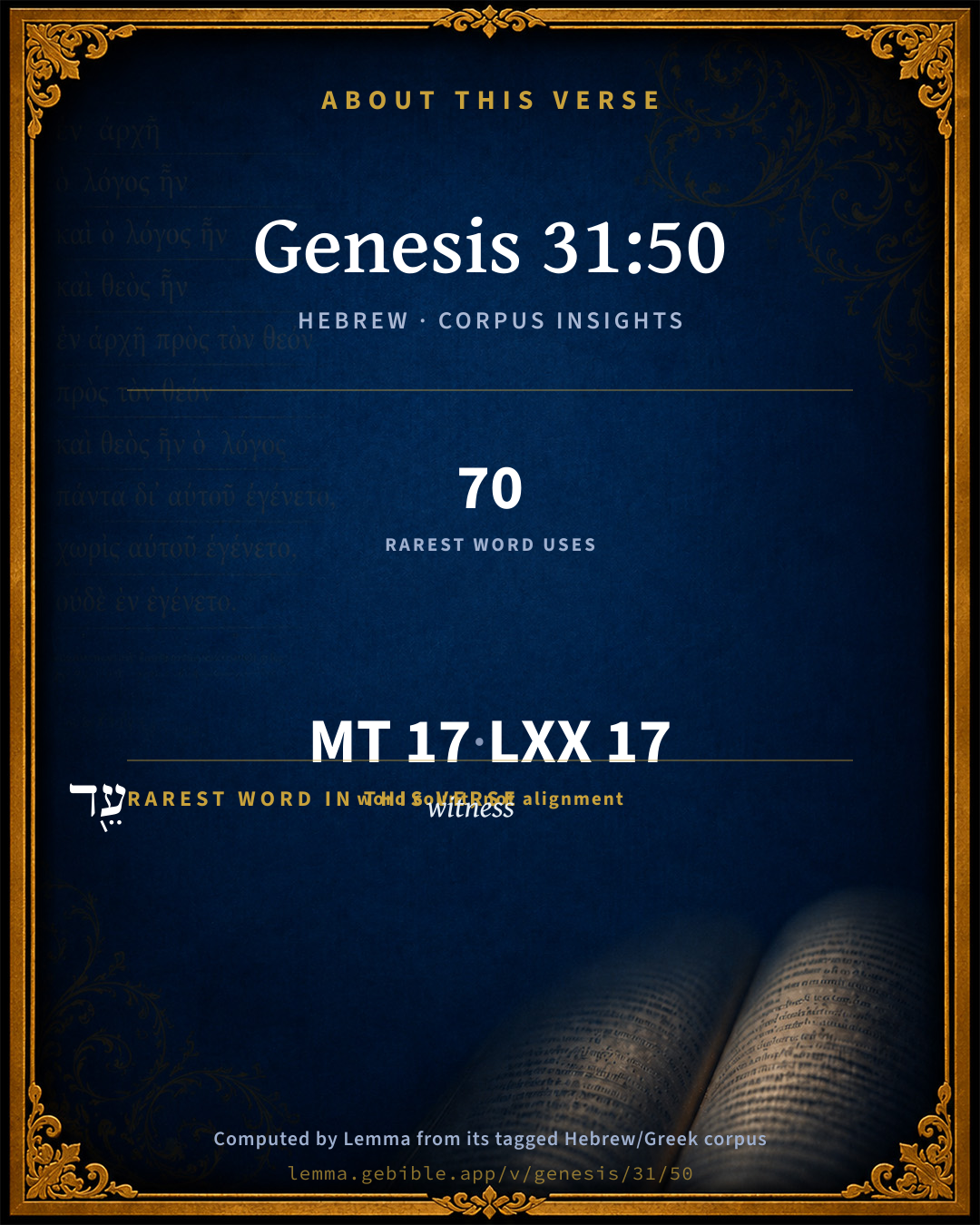
17
words
14
distinct lemmas
Pentateuch
section

Grammatical profile

  • 3 verbs
  • 6 nouns
  • 4 prepositions
  • 2 conjunctions
  • 2 particles

Verb forms

  • תְּעַנֶּ֣ה Piel · Imperfect
  • תִּקַּ֤ח Qal · Imperfect
  • רְאֵ֕ה Qal · Imperative

Repetition

Words recur within this verse — often emphatic in Hebrew:

  • בְּנֹתַ֗י daughter H1323 ×2
  • בֵּינִ֥י between H996 ×2
  • אִם if H518 ×2

Hebrew & Septuagint length

In English translation the verse runs 28 words from the Hebrew and 32 from the Septuagint (LXX English) — closely comparable.

A rough comparison of the two English renderings, which tokenize alike — not a word-level alignment.

Word counts can differ between the Hebrew and the Greek without any difference in meaning — e.g. the Hebrew direct-object marker אֵת has no separate Greek word, and Greek often adds the article ὁ.

In the original languages it is 17 Hebrew tokens and 17 Greek tokens — but the two are counted differently (Hebrew bundles its prefixes and suffixes into one token; the Greek is in lemma form), so that isn’t a like-for-like length.

Cross-references

10

Topical passages linked to Genesis 31:50 in the Treasury of Scripture Knowledge — connected by theme and wording, ordered by reader-vote popularity; previews shown in the World English Bible.

  • Jeremiah 42:5 Then they said to Jeremiah, Yahweh be a true and faithful witness among us, if we don't do according to all the word with which Yahweh your God shall send you to us.
  • Jeremiah 29:23 because they have worked folly in Israel, and have committed adultery with their neighbors' wives, and have spoken words in my name falsely, which I didn't command them; and I am he who knows, and am witness, says Yahweh.
  • Judges 11:10 The elders of Gilead said to Jephthah, Yahweh shall be witness between us; surely according to your word so will we do.
  • Micah 1:2 Hear, you peoples, all of you. Listen, O earth, and all that is therein: And let the Lord Yahweh be witness against you, The Lord from his holy temple.
  • Leviticus 18:18 "'You shall not take a wife to her sister, to be a rival, to uncover her nakedness, while her sister is yet alive.
  • 1 Samuel 12:5 He said to them, Yahweh is witness against you, and his anointed is witness this day, that you have not found anything in my hand. They said, He is witness.
  • Malachi 2:14 Yet you say, 'Why?' Because Yahweh has been witness between you and the wife of your youth, against whom you have dealt treacherously, though she is your companion, and the wife of your covenant.
  • Malachi 3:5 I will come near to you to judgment; and I will be a swift witness against the sorcerers, and against the adulterers, and against the perjurers, and against those who oppress the hireling in his wages, the widow, and the fatherless, and who deprive the foreigner of justice, and don't fear me," says Yahweh of Hosts.
  • Matthew 19:5–6 and said, 'For this cause a man shall leave his father and mother, and shall join to his wife; and the two shall become one flesh?'
  • 1 Thessalonians 2:5 For neither were we at any time found using words of flattery, as you know, nor a cloak of covetousness (God is witness),

Cross-references courtesy of OpenBible.info (CC BY 4.0).

Hebrew and Greek witnesses Masoretic Hebrew ↔ Greek Septuagint

The same verse in the two great witnesses to the Old Testament, shown verse-for-verse.

These are two independent witnesses, not word-aligned to each other, and the Septuagint is shown in lemma (dictionary) form.

Hebrew Genesis 31:50 Masoretic · Westminster Leningrad Codex

אִם תְּעַנֶּ֣ה אֶת בְּנֹתַ֗י וְאִם תִּקַּ֤ח נָשִׁים֙ עַל בְּנֹתַ֔י אֵ֥ין אִ֖ישׁ עִמָּ֑נוּ רְאֵ֕ה אֱלֹהִ֥ים עֵ֖ד בֵּינִ֥י וּבֵינֶֽךָ

If you will afflict my daughters, and if you will take wives besides my daughters, no man is with us; behold, God is witness between me and you."

World English Bible · Public Domain

Greek LXX Genesis 31:50 Septuagint · lemma form

εἰ ταπεινόω ὁ θυγάτηρ ἐγώ εἰ λαμβάνω γυνή ἐπί ὁ θυγάτηρ ἐγώ ὁράω οὐδείς μετά ἐγώ εἰμί

If you shall humble my daughters, if you should take wives in addition to my daughters, see, there is no one with us looking on. God is witness between me and you.

LXX2012 (modern English Septuagint) · Public Domain

Hebrew: Westminster Leningrad Codex (CC BY 4.0). Greek: Septuagint (public domain); English from LXX2012 (modern English Septuagint) (Public Domain). How the Septuagint differs from the Hebrew →

Targum (Aramaic paraphrase)

2

The Targum is the ancient Jewish Aramaic paraphrase of the Hebrew Scriptures — an interpretive translation, not the Hebrew text itself. Onkelos (literal) and Pseudo-Jonathan (expansive) render the Torah, and Jonathan the Prophets. Coverage is partial: where no permissively-licensed English translation exists for a verse, only the Aramaic is shown. This is verse-level text, not a word-by-word alignment to the Hebrew.

  1. Targum Onkelos Torah (Genesis–Deuteronomy)
    אִם תְּעַנֵּי יָת בְּנָתַי וְאִם תִּסַּב נְשִׁין עַל בְּנָתַי לֵית אֱנַשׁ עִמָּנָא חָזֵי מֵימְרָא דַּיְיָ סָהִיד בֵּינִי וּבֵינָךְ

    (no public-domain English translation for this verse)

    Targum Onkelos — Aramaic: “Onkelos Genesis” (public domain); “Onkelos Exodus” (public domain); “Onkelos Leviticus” (public domain); “Onkelos Numbers” (public domain); “Onkelos Deuteronomy” (public domain). English: “Sefaria Community Translation” (CC0 1.0 (public-domain dedication)); “J.W. Etheridge. The Targums of Onkelos and Jonathan Ben Uzziel on the Pentateuch. London: Longmans, Green, 1862” (public domain). Text via Sefaria.

  2. Targum Pseudo-Jonathan Torah (Genesis–Deuteronomy)
    אִין תַּסְגִיף יַת בְּרַתַּי לְמֶעֱבַד לָהֵן עוּלְבָּנָא וְאִם תִּיסַב עַל בְּרַתַּיַי לֵית אֵינַשׁ לְמִידַן יָתָן חָמֵי מֵימְרָא דַיְיָ סָהִיד בֵּינָא וּבֵינָךְ

    If thou shalt afflict my daughters, doing them injury, and if thou take upon my daughters, there is no man to judge us, the Word of the Lord seeing is the witness between me and thee.

    Targum Pseudo-Jonathan — Aramaic: “Targum Jonathan on Genesis” (public domain); “Targum Jonathan on Exodus” (public domain); “Targum Jonathan on Leviticus” (public domain); “Targum Jonathan on Numbers” (public domain); “Targum Jonathan on Deuteronomy” (public domain). English: “The Targum of Jonathan ben Uzziel, trans. J. W. Etheridge, London, 1862” (public domain). Text via Sefaria.

Commentary

Notes on Genesis 31:50 from classic Christian and Jewish commentators (each source and its license shown beneath its notes). The classic Christian expositions comment on the surrounding passage and are grouped to its opening verse, so a note may address several verses; the Jewish commentaries on the Tanakh (Rashi and others) are per-verse, so they appear only where the commentator wrote on this verse.

Lemma curates 59 commentaries, every one of them public domain or Creative Commons licensed, each selected and text-cleaned for this edition rather than reprinted as found. About our sources →

Trapp's Complete Commentary

John Trapp

Gen 31:50 If thou shalt afflict my daughters, or if thou shalt take [other] wives beside my daughters, no man [is] with us; see, God [is] witness betwixt me and thee.

Ver. 50. {See Trapp on "Gen 31:44"}

John Trapp, A Commentary or Exposition upon All the Books of the Old and New Testament (1647–1656) — public domain. Text from a community e-Sword module.

Tyndale Open Study Notes

Tyndale Open Resources

31:50-53 Laban added some face-saving stipulations to the treaty, using many words to cover up his own untrustworthiness and portray Jacob as the unethical party. He even took credit for the monument Jacob had erected (this monument I have set, 31:51). The women and children would be much safer and better cared for with Jacob than they ever were with Laban.

Tyndale Open Study Notes — © Tyndale Open Resources, licensed CC BY-SA 4.0. Text via the HelloAO Bible API.

Geneva Bible (1599)

Geneva Bible translators

Nature compelleth him to condemn that vice, whereunto through covetousness he forced Jacob.

Geneva Bible (1599) marginal notes — public domain. Text via Bolls.life.

Adam Clarke's Commentary

Verse 50. No man is with us] Though all were present at the sacrifice offered, yet it appears that in making the contract Jacob and Laban withdrew, and transacted the business in private, calling on God to witness it.

Jacob had already four wives; but Laban feared that he might take others, whose children would naturally come in for a share of the inheritance to the prejudice of his daughters and grandchildren. Though the Koran allows a man to have four wives if he can maintain them, yet we learn that in many cases where a man takes a wife, the parents or relatives of the woman stipulate that the man is not to take another during the lifetime of that one whom he now espouses; and notwithstanding the permission of the Koran, he is obliged to fulfil this agreement.

Adam Clarke's Commentary on the Bible (1810–1826) — public domain. Text from a community e-Sword/MySword module.

John Calvin's Commentaries

50. If thou shalt take other wives besides my daughters. Laban declares that it would be a species of perfidy, if Jacob should take to himself any other wives. But he had himself compelled Jacob to the act of polygamy: for whence was it that the holy man had more wives than one, except that Leah had been craftily substituted in the place of Rachel? But he now, from a pure sentiment of nature, condemns the fault, of which, blinded by avarice, he had wickedly been the author. And certainly, when the bond of marriage is broken, than which none among men is more sacred, the whole of human society sinks into decay. Wherefore, those fanatical men, who, at this day, delight to defend polygamy, have no need of any other judge than Laban.

John Calvin's Commentaries (1540-1563) — public domain. Text from the Calvin Translation Society English edition (1840s-50s) via the Christian Classics Ethereal Library (ccel.org). Calvin's coverage is partial (roughly two-thirds of the Bible); uncommented books and verses are honest gaps, never fabricated. The 19th-century editor's footnotes and remarks are omitted so the notes are faithfully Calvin's own voice.

The Cambridge Bible for Schools and Colleges

gen. ed. J. J. S. Perowne

50. wives beside my daughters] So that Leah and Rachel may not be exposed to the risk of any indignity. “Afflict,” cf. “dealt hardly” (Gen_16:6).

The Cambridge Bible for Schools and Colleges (gen. ed. J. J. S. Perowne; Cambridge University Press, 1878–1918) — public domain. Text from a community e-Sword module.

John Gill's Exposition

The God of Abraham, and the God of Nahor, the God of their father, judge between us,.... And the father of these was Terah, so that the god of them was not the true God, and is not meant, at least not as truly worshipped; but the god or gods of Terah, Nahor and Abraham worshipped while idolaters, and Laban still continued to do, though perhaps not in so gross a manner as some did:

and Jacob swore by the fear of his father Isaac; that is, by the true God his father Isaac feared, served, and worshipped: or "but Jacob" (r), &c. which seems plainly to suggest, that the God whom Laban called upon to be a judge between them, should they break covenant, and swore by, and he whom Jacob swore by, were different; each swore by their own deities.

(r) "sed juravit", Junius & Tremellius, Piscator.

John Gill's Exposition of the Whole Bible (1746–1763) — public domain (CC PDM 1.0). Text via the HelloAO Bible API.

Haydock's Catholic Bible Commentary

Over them. A wise precaution, which the rich Turks still observe when they give their daughters in marriage. (Busbeq. ep. 3.)

George Leo Haydock (1774–1849), Haydock's Catholic Family Bible and Commentary, 1859 edition — public domain. Excludes Psalms (Douay-Rheims chapter numbering differs from Protestant) and Deuterocanonical books (Catholic canon only).

Matthew Poole's English Annotations

The curse is here understood, as it commonly is, to maintain a greater reverence for oaths, and to beget a greater dread of the curse belonging to the violaters of it.

No man is with us, i.e. here is now no man with us, who when we are parted can witness and judge between us, and punish the transgressor. Or thus, Though now we have many with us, as witnesses of this agreement, yet shortly, when we shall be parted, no man will be with us, to observe and report our actions to the other, or to do the injured person right.

Matthew Poole's English Annotations on the Holy Bible (1683–1685) — public domain. Text from a community e-Sword/MySword module.

Rashi

Rabbi Shlomo Yitzchaki (Rashi)

בנתי....בנתי The word is written twice, referring once to Leah and Rachel and the second time to the handmaids, because Bilhah and Zilpah were also his daughters from a concubine (Genesis Rabbah 74:13).

אם תענה את בנתי IF THOU SHALT AFFLICT MY DAUGHTERS by refusing them thy companionship (Yoma 77b).

Rashi on the Tanakh — English translations: “The Judaica Press complete Tanach with Rashi, translated by A. J. Rosenberg” (CC BY 4.0); “Pentateuch with Rashi's commentary by M. Rosenbaum and A.M. Silbermann, 1929-1934” (public domain); “The Metsudah Tanach series, Lakewood, N.J” (CC BY 4.0); and “The Book of Joshua, Metsudah Publications, 1997” (CC BY 4.0). Text via Sefaria.

Radak

Rabbi David Kimhi (Radak)

אם תענה את בנותי, if you will deprive them of any of their needs, the ones stipulated as the obligation of a husband towards his wives, or even if you do not treat them with the respect due to them. According to our sages in Yuma 77 the words אם תענה refer to denial of marital relations, whereas the words אם תקח, refer to Yaaov marrying additional wives, competitors to the existing ones.

אין איש עמנו, a peculiar statement seeing there were plenty of people present at the time. What Lavan meant was that there would be a time when none of the people who now witnessed the covenant would be available to testify if a dispute concerning whether its terms had been kept erupted. Now that Yaakov returned home there was no one to remind him or even to report on observance or non-observance of the terms of the covenant. This is why Lavan invoked G’d as being the witness if the terms of the covenant were broken. He was to be the guarantor. [It is interesting to observe that in spite of Lavan being an idolater he always accepted that the G’d of Avraham was the One to Whom Yaakov owed allegiance, and according to Whose rules Yaakov had to conduct himself. This was not hypocrisy on his part. Ed.]

Radak on the Tanakh — English translations: “Sefaria Community Translation” (CC0 1.0 (public-domain dedication)); “Eliyahu Munk, HaChut Hameshulash” (CC BY 4.0); “Rabbi Mike Feuer, Jerusalem Anthology” (CC BY 4.0); and “R. David Kimhi on the first book of Psalms, Translated by R.G. Finch, London, 1919” (public domain). Text via Sefaria.

Lesson kit

Teaching starters — assembled from the data on this page, not authored interpretation. Every prompt links to the verse data it draws on. Edit before teaching.

Genesis, in the Pentateuch, opens this verse with 17 words (14 distinct Hebrew lemmas). Its most distinctive word is ʻêd (“witness”). A historical commentator’s framing appears above. Read the whole chapter for the surrounding context.

Discussion questions

  1. The word ʻêd carries the sense “witness.” How does it shape the verse?
  2. How does Jeremiah 42:5, which shares this passage’s theme, read alongside this verse?
  3. What does the repetition of “daughter” (2× in this one verse) do in this verse?
  4. The translations on this page render this verse differently — a whole-verse word diff, not a word-by-word alignment. What might account for the different wordings?
  5. «תְּעַנֶּ֣ה» is a Piel Imperfect verb. How does that grammatical form shape the action described?
  6. Compare how Trapp's Complete Commentary and Tyndale Open Study Notes read this verse. Where do they agree or differ?

Things to notice

Reading settings

Reading text

Shown beneath each verse's original-language words.

Old Testament
Old Testament edition

Read the OT as the Masoretic Hebrew (MT) or the Greek Septuagint (LXX).

English shown for the Greek Septuagint (in the Hebrew ↔ Greek comparison).

Comparing translations? Open the Compare panel on any verse page to stack up to four side by side.