
Ezekiel 9:4

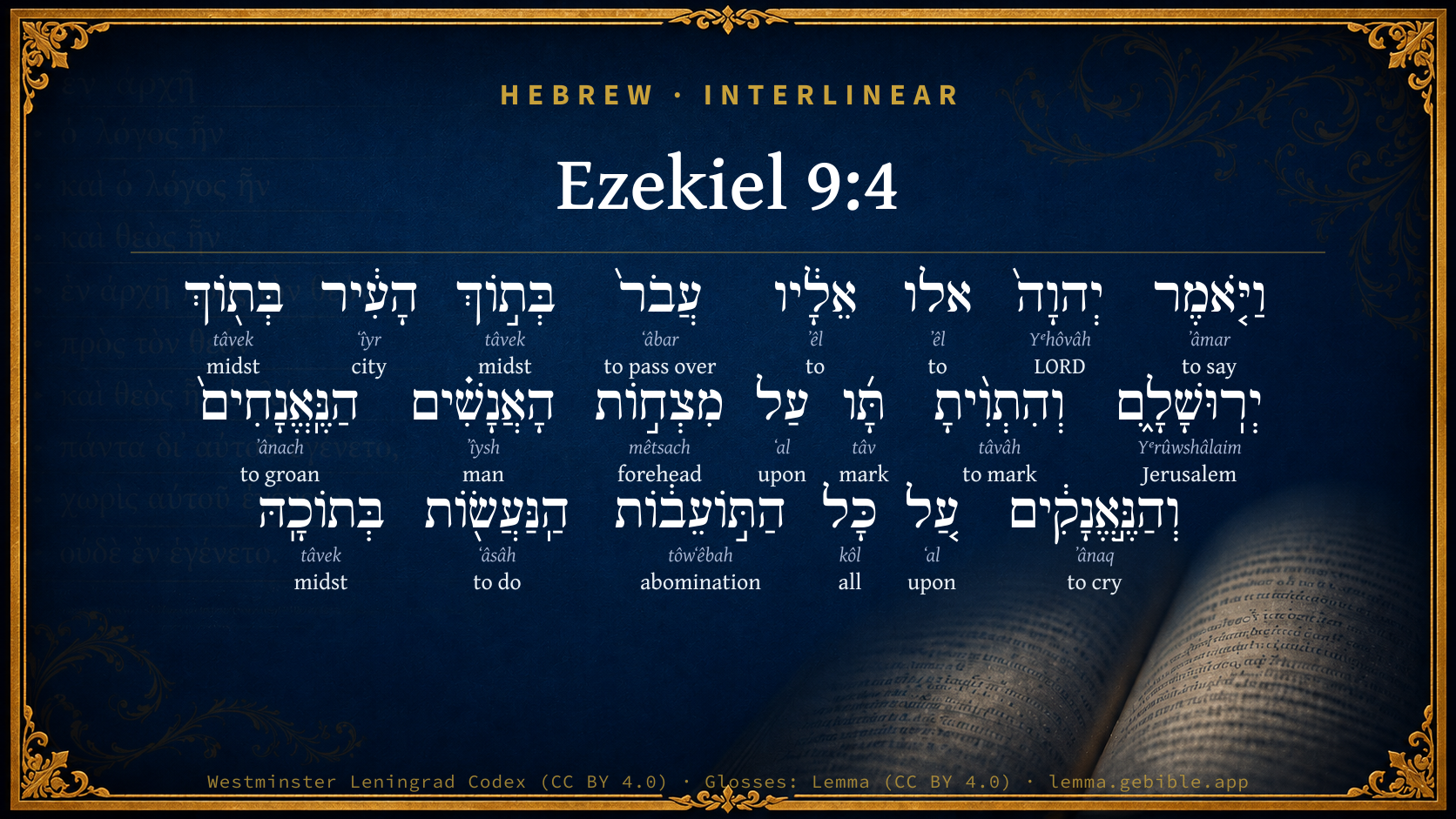
Hebrew (Westminster Leningrad Codex) Ezekiel 9:4 appears in the Hebrew Old Testament. The text above is from the Westminster Leningrad Codex. Each word links to its Strong’s number, a concise gloss, and parsing drawn from the Open Scriptures Hebrew Bible morphology. Click any word for its full Brown-Driver-Briggs (BDB) entry.
Download image
Cite this verse

Ezekiel 9:4 (World English Bible). Public Domain. Lemma interlinear Bible study tool, https://lemma.gebible.app/v/ezekiel/9/4.

Show BibTeX & RIS
BibTeX
RIS
English Translation
Yahweh said to him, Go through the midst of the city, through the midst of Jerusalem, and set a mark on the foreheads of the men that sigh and that cry over all the abominations that are done in the midst of it.
World English Bible · Public Domain
Download a study sheet

One document with this verse’s original text, its word-by-word gloss line, the meaning frame, cross-references with their text, attributed commentary, and full source and license credits — printable, and it pastes into notes with its structure intact.

This verse Autodidact and up

Study sheet (.html) Plain text (.txt)

A passage Seminary Student

Up to 50 verses in one chapter. A passage sheet keeps up to 6 commentary sources and 12 cross-references per verse, in the order this page ranks them, and says so on the sheet whenever that leaves anything out. Ask for a single verse and you get the Autodidact verse sheet above.

Everything on this page stays free to read, with no account — the sheet is a download of what is already on screen, not access to it.

Want to remove ads? Support Godless Engineer
Compare translations 3

The same verse in 3 English versions, stacked beneath the original-language interlinear above. Click any original word for its lexicon entry.

Each is an independent rendering of the whole verse — the interlinear is not word-aligned to these translations.

Highlighted words mark where these versions differ — a whole-verse word diff, not a word-by-word alignment.

  • World English Bible Public Domain
    Yahweh said to him, Go through the midst of the city, through the midst of Jerusalem, and set a mark on the foreheads of the men that sigh and that cry over all the abominations that are done in the midst of it.
  • King James Version Public Domain
    And the LORD said unto him, Go through the midst of the city, through the midst of Jerusalem, and set a mark upon the foreheads of the men that sigh and that cry for all the abominations that be done in the midst thereof.
  • unfoldingWord Literal Text CC BY-SA 4.0
    Yahweh said to him, “Pass through the midst of the city—the midst of Jerusalem—and make a mark on the foreheads of those who groan and sigh about all the abominations being performed in the midst of the city.”

unfoldingWord Literal Text — © unfoldingWord, licensed CC BY-SA 4.0. Word-aligned USFM3 via Door43 (git.door43.org/unfoldingWord/en_ult).

Versions to compare (up to 4)

3 of 4 selected

Show all 18 translations

Every available English version of this verse, each an independent rendering of the whole verse.

  • World English Bible Public Domain
    Yahweh said to him, Go through the midst of the city, through the midst of Jerusalem, and set a mark on the foreheads of the men that sigh and that cry over all the abominations that are done in the midst of it.
  • Berean Standard Bible Public Domain
    “Go throughout the city of Jerusalem,” said the LORD, “and put a mark on the foreheads of the men sighing and groaning over all the abominations committed there.”
  • Majority Standard Bible Public Domain
    “Go throughout the city of Jerusalem,” said the LORD, “and put a mark on the foreheads of the men sighing and groaning over all the abominations committed there.”
  • King James Version Public Domain
    And the LORD said unto him, Go through the midst of the city, through the midst of Jerusalem, and set a mark upon the foreheads of the men that sigh and that cry for all the abominations that be done in the midst thereof.
  • American Standard Version (1901) Public Domain
    And Jehovah said unto him, Go through the midst of the city, through the midst of Jerusalem, and set a mark upon the foreheads of the men that sigh and that cry over all the abominations that are done in the midst thereof.
  • Revised Version (1885) Public Domain
    And the LORD said unto him, Go through the midst of the city, through the midst of Jerusalem, and set a mark upon the foreheads of the men that sigh and that cry for all the abominations that be done in the midst thereof.
  • Geneva Bible (1599) Public Domain
    And the Lord said vnto him, Goe through the middes of the citie, euen through the middes of Ierusalem and set a marke vpon the foreheads of them that mourne, and cry for all the abominations that be done in the middes thereof.
  • Douay-Rheims (1899) Public Domain
    And the Lord said to him: Go through the midst of the city, through the midst of Jerusalem: and mark Thau upon the foreheads of the men that sigh, and mourn for all the abominations that are committed in the midst thereof.
  • Young's Literal Translation Public Domain
    And He calleth unto the man who is clothed with linen, who hath the scribe's inkhorn at his loins, and Jehovah saith unto him, `Pass on into the midst of the city, into the midst of Jerusalem, and thou hast made a mark on the foreheads of the men who are sighing and who are groaning for all the abominations that are done in its midst.'
  • Literal Standard Version CC BY-SA 4.0
    And He calls to the man who is clothed with linen, who has the scribe’s inkhorn at his loins, and YHWH says to him, “Pass on into the midst of the city, into the midst of Jerusalem, and you have made a mark on the foreheads of the men who are sighing and who are groaning for all the abominations that are done in its midst.”
  • Unlocked Literal Bible CC BY-SA 4.0
    Yahweh said to him, “Pass through the midst of the city—the midst of Jerusalem—and make a mark on the foreheads of those who groan and sigh about all the abominations being performed in the midst of the city.”
  • unfoldingWord Literal Text CC BY-SA 4.0
    Yahweh said to him, “Pass through the midst of the city—the midst of Jerusalem—and make a mark on the foreheads of those who groan and sigh about all the abominations being performed in the midst of the city.”
  • Darby Bible Public Domain
    and Jehovah said unto him, Go through the midst of the city, through the midst of Jerusalem, and set a mark upon the foreheads of the men that sigh and that cry for all the abominations that are done in the midst thereof.
  • World Messianic Bible Public Domain
    The LORD said to him, “Go through the middle of the city, through the middle of Jerusalem, and set a mark on the foreheads of the men that sigh and that cry over all the abominations that are done within it.”
  • Webster's Bible Public Domain
    And the LORD said to him, Go through the midst of the city, through the midst of Jerusalem, and set a mark upon the foreheads of the men that sigh and that cry for all the abominations that are done in the midst of it.
  • Free Bible Version CC BY-SA 4.0
    “Go through the whole the city of Jerusalem and place a mark on the foreheads of those who sighing and mourning at all the disgusting sins that are done there.”
  • Bible in Basic English Public Domain
    The Lord said to him, Go through the town, through the middle of Jerusalem, and put a mark on the brows of the men who are sorrowing and crying for all the disgusting things which are done in it.
  • JPS Tanakh (1917) Public Domain
    And the LORD said unto him: 'Go through the midst of the city, through the midst of Jerusalem, and set a mark upon the foreheads of the men that sigh and that cry for all the abominations that are done in the midst thereof.'

Literal Standard Version (2020), Covenant Press — licensed CC BY-SA 4.0. Text via the HelloAO Bible API (eBible.org). Unlocked Literal Bible (unfoldingWord) — licensed CC BY-SA 4.0. Text via the HelloAO Bible API (eBible.org). unfoldingWord Literal Text — © unfoldingWord, licensed CC BY-SA 4.0. Word-aligned USFM3 via Door43 (git.door43.org/unfoldingWord/en_ult). Free Bible Version, Dr. Jonathan Gallagher — licensed CC BY-SA 4.0. Text via the HelloAO Bible API (eBible.org).

Word by word

More ways to search: Search by grammar → Find every occurrence → Compare this word →

Practice this passage: Drill this verse → Learn its vocabulary →

וְהִתְוִ֨יתָ
tâvâh
H8427
“and · to mark”
Conjunction + Verb, Hiphil, Sequential Perfect, 2nd Person, Masculine, Singular
Part of Speech
Conjunction + Verb
Stem
Hiphil
Form
Sequential Perfect
Person
2nd Person
Gender
Masculine
Number
Singular
Full BDB Definition

Origin: a primitive root

TWOT: 2496

to scrabble, limit, mark, make or set a mark - (Piel) to mark - (Hiphil) to set a mark
  1. וַיֹּ֤אמֶר ʼâmar H559 “and · to say” Conjunction + Verb, Qal, Sequential Imperfect, 3rd Person, Masculine, Singular
  2. יְהוָה֙ Yᵉhôvâh H3068 “LORD” Noun, Proper
  3. אלו ʼêl H413 “to · him” Preposition + Suffix, Personal, 3rd Person, Masculine, Singular
  4. אֵלָ֔יו ʼêl H413 “to · him” Preposition + Suffix, Personal, 3rd Person, Masculine, Singular
  5. עֲבֹר֙ ʻâbar H5674 “pass over” Verb, Qal, Imperative, 2nd Person, Masculine, Singular
  6. בְּת֣וֹךְ tâvek H8432 “in/at · midst of” Preposition + Noun, Common, Masculine, Singular, Construct
  7. הָעִ֔יר ʻîyr H5892 “the · city” Particle, Definite Article + Noun, Common, Feminine, Singular, Absolute
  8. בְּת֖וֹךְ tâvek H8432 “in/at · midst of” Preposition + Noun, Common, Masculine, Singular, Construct
  9. יְרֽוּשָׁלִָ֑ם Yᵉrûwshâlaim H3389 “Jerusalem” Noun, Proper
  10. תָּ֜ו tâv H8420 “mark” Noun, Common, Masculine, Singular, Absolute
  11. עַל ʻal H5921 “upon” Preposition
  12. מִצְח֣וֹת mêtsach H4696 “foreheads of” Noun, Common, Masculine, Plural, Construct
  13. הָאֲנָשִׁ֗ים ʼîysh H376 “the · men” Particle, Definite Article + Noun, Common, Masculine, Plural, Absolute
  14. הַנֶּֽאֱנָחִים֙ ʼânach H584 “the · groaned” Particle, Definite Article + Verb, Niphal, Participle Passive, Masculine, Plural, Absolute
  15. וְהַנֶּ֣אֱנָקִ֔ים ʼânaq H602 “and · the · cried” Conjunction + Particle, Definite Article + Verb, Niphal, Participle Passive, Masculine, Plural, Absolute
  16. עַ֚ל ʻal H5921 “upon” Preposition
  17. כָּל kôl H3605 “all of” Noun, Common, Masculine, Singular, Construct
  18. הַתּ֣וֹעֵב֔וֹת tôwʻêbah H8441 “the · abominations” Particle, Definite Article + Noun, Common, Feminine, Plural, Absolute
  19. הַֽנַּעֲשׂ֖וֹת ʻâsâh H6213 “the · done” Particle, Definite Article + Verb, Niphal, Participle Passive, Feminine, Plural, Absolute
  20. בְּתוֹכָֽהּ tâvek H8432 “in/at · midst · her” Preposition + Noun, Common, Masculine, Singular, Construct + Suffix, Personal, 3rd Person, Feminine, Singular

About this verse

These counts appear in no published source. They are computed here, from the morphology-tagged text and Lemma’s own curated glosses. What Lemma adds →

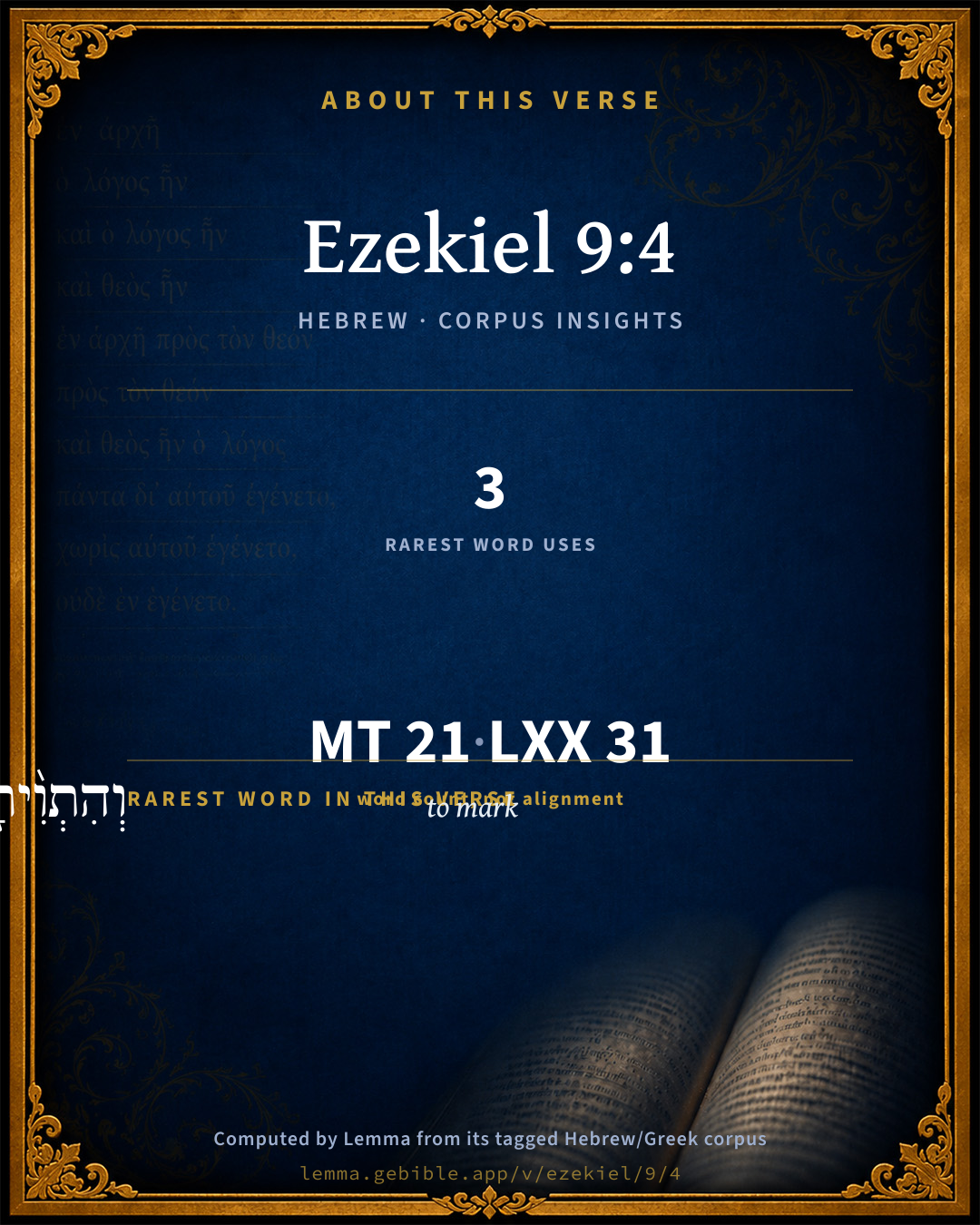
21
words
17
distinct lemmas
Prophets
section

Notable vocabulary

The rarest word here is וְהִתְוִ֨יתָ to mark H8427 — appearing just 3 times in the whole Hebrew Bible.

Shared distinctive vocabulary

וְהִתְוִ֨יתָ to mark H8427 occurs in 2 verses of the Hebrew Bible. Also found in:

Grammatical profile

  • 6 verbs
  • 11 nouns
  • 4 prepositions

Verb forms

  • וַיֹּ֤אמֶר Qal · Sequential Imperfect
  • עֲבֹר֙ Qal · Imperative
  • וְהִתְוִ֨יתָ Hiphil · Sequential Perfect
  • הַנֶּֽאֱנָחִים֙ Niphal · Participle Passive
  • וְהַנֶּ֣אֱנָקִ֔ים Niphal · Participle Passive
  • הַֽנַּעֲשׂ֖וֹת Niphal · Participle Passive

Repetition

Words recur within this verse — often emphatic in Hebrew:

  • בְּת֣וֹךְ midst H8432 ×3
  • עַל upon H5921 ×2
  • אלו to H413 ×2

Hebrew & Septuagint length

In English translation the verse runs 43 words from the Hebrew and 37 from the Septuagint (LXX English) — closely comparable.

A rough comparison of the two English renderings, which tokenize alike — not a word-level alignment.

Word counts can differ between the Hebrew and the Greek without any difference in meaning — e.g. the Hebrew direct-object marker אֵת has no separate Greek word, and Greek often adds the article ὁ.

In the original languages it is 21 Hebrew tokens and 31 Greek tokens — but the two are counted differently (Hebrew bundles its prefixes and suffixes into one token; the Greek is in lemma form), so that isn’t a like-for-like length.

Cross-references

21

Topical passages linked to Ezekiel 9:4 in the Treasury of Scripture Knowledge — connected by theme and wording, ordered by reader-vote popularity; previews shown in the World English Bible.

  • Revelation 9:4 They were told that they should not hurt the grass of the earth, neither any green thing, neither any tree, but only those people who don't have God's seal on their foreheads.
  • 2 Corinthians 1:22 who also sealed us, and gave us the down payment of the Spirit in our hearts.
  • Revelation 14:1 I saw, and behold, the Lamb standing on Mount Zion, and with him a number, one hundred forty-four thousand, having his name, and the name of his Father, written on their foreheads.
  • Revelation 7:2–3 I saw another angel ascend from the sunrise, having the seal of the living God. He cried with a loud voice to the four angels to whom it was given to harm the earth and the sea,
  • Revelation 20:4 I saw thrones, and they sat on them, and judgment was given to them. I saw the souls of those who had been beheaded for the testimony of Jesus, and for the word of God, and such as didn't worship the beast nor his image, and didn't receive the mark on their forehead and on their hand. They lived, and reigned with Christ for the thousand years.
  • 2 Timothy 2:19 However God's firm foundation stands, having this seal, "The Lord knows those who are his," and, "Let every one who names the name of the Lord depart from unrighteousness."
  • Psalms 119:136 Streams of tears run down my eyes, Because they don't observe your law.
  • Ephesians 4:30 Don't grieve the Holy Spirit of God, in whom you were sealed for the day of redemption.
  • Jeremiah 13:17 But if you will not hear it, my soul shall weep in secret for [your] pride; and my eye shall weep sore, and run down with tears, because Yahweh's flock is taken captive.
  • Exodus 12:7 They shall take some of the blood, and put it on the two side-posts and on the lintel, on the houses in which they shall eat it.
  • Exodus 12:13 The blood shall be to you for a token on the houses where you are: and when I see the blood, I will pass over you, and there shall no plague be on you to destroy you, when I strike the land of Egypt.
  • Psalms 119:53 Indignation has taken hold on me, Because of the wicked who forsake your law.
  • Isaiah 57:15 For thus says the high and lofty One who inhabits eternity, whose name is Holy: I dwell in the high and holy place, with him also who is of a contrite and humble spirit, to revive the spirit of the humble, and to revive the heart of the contrite.
  • Malachi 3:16 Then those who feared Yahweh spoke one with another; and Yahweh listened, and heard, and a book of memory was written before him, for those who feared Yahweh, and who honored his name.
  • 2 Peter 2:8–9 (for that righteous man dwelling among them, was tormented in his righteous soul from day to day with seeing and hearing lawless deeds):
  • Ezekiel 6:11 Thus says the Lord Yahweh: Smite with your hand, and stamp with your foot, and say, Alas! because of all the evil abominations of the house of Israel; for they shall fall by the sword, by the famine, and by the pestilence.
  • Ezekiel 21:6 Sigh therefore, you son of man; with the breaking of your loins and with bitterness shall you sigh before their eyes.
  • Revelation 13:6–7 He opened his mouth for blasphemy against God, to blaspheme his name, and his dwelling, those who dwell in heaven.
  • 2 Kings 22:19–20 because your heart was tender, and you did humble yourself before Yahweh, when you heard what I spoke against this place, and against the inhabitants of it, that they should become a desolation and a curse, and have torn your clothes, and wept before me; I also have heard you, says Yahweh.
  • 2 Corinthians 12:21 that again when I come my God would humble me before you, and I would mourn for many of those who have sinned before now, and not repented of the uncleanness and sexual immorality and lustfulness which they committed.
  • 2 Kings 22:13 Go you, inquire of Yahweh for me, and for the people, and for all Judah, concerning the words of this book that is found; for great is the wrath of Yahweh that is kindled against us, because our fathers have not listened to the words of this book, to do according to all that which is written concerning us.

Cross-references courtesy of OpenBible.info (CC BY 4.0).

Hebrew and Greek witnesses Masoretic Hebrew ↔ Greek Septuagint

The same verse in the two great witnesses to the Old Testament, shown verse-for-verse.

These are two independent witnesses, not word-aligned to each other, and the Septuagint is shown in lemma (dictionary) form.

Hebrew Ezekiel 9:4 Masoretic · Westminster Leningrad Codex

וַיֹּ֤אמֶר יְהוָה֙ אלו אֵלָ֔יו עֲבֹר֙ בְּת֣וֹךְ הָעִ֔יר בְּת֖וֹךְ יְרֽוּשָׁלִָ֑ם וְהִתְוִ֨יתָ תָּ֜ו עַל מִצְח֣וֹת הָאֲנָשִׁ֗ים הַנֶּֽאֱנָחִים֙ וְהַנֶּ֣אֱנָקִ֔ים עַ֚ל כָּל הַתּ֣וֹעֵב֔וֹת הַֽנַּעֲשׂ֖וֹת בְּתוֹכָֽהּ

Yahweh said to him, Go through the midst of the city, through the midst of Jerusalem, and set a mark on the foreheads of the men that sigh and that cry over all the abominations that are done in the midst of it.

World English Bible · Public Domain

Greek LXX Ezekiel 9:4 Septuagint · lemma form

καί εἶπον πρός αὐτός διαἔρχομαι μέσος ὁ ἰερουσαλήμ καί δίδωμι ὁ σημεῖον ἐπί ὁ μέτωπον ὁ ἀνήρ ὁ καταστενάζω καί ὁ καταὀδυνάω ἐπί πᾶς ὁ ἀνομία ὁ γίγνομαι ἐν μέσος αὐτός

And said to him, Go through the midst of Jerusalem, and set a mark on the foreheads of the men that groan and that grieve for all the iniquities that are done in the midst of them.

LXX2012 (modern English Septuagint) · Public Domain

On this verse, Keil & Delitzsch discusses the Septuagint’s reading. Read the note in Commentary ↓

Hebrew: Westminster Leningrad Codex (CC BY 4.0). Greek: Septuagint (public domain); English from LXX2012 (modern English Septuagint) (Public Domain). How the Septuagint differs from the Hebrew →

Targum (Aramaic paraphrase)

1

The Targum is the ancient Jewish Aramaic paraphrase of the Hebrew Scriptures — an interpretive translation, not the Hebrew text itself. Onkelos (literal) and Pseudo-Jonathan (expansive) render the Torah, and Jonathan the Prophets. Coverage is partial: where no permissively-licensed English translation exists for a verse, only the Aramaic is shown. This is verse-level text, not a word-by-word alignment to the Hebrew.

  1. Targum Jonathan Prophets (Joshua–Malachi)
    וַאֲמַר יְיָ לֵיהּ עֲבַר בְּגוֹ קַרְתָּא בְּגוֹ יְרוּשְׁלֵם וְתִרְשׁוֹם תְּוָא עַל בֵּית עֵינֵי גַבְרַיָא דִמְאַנְחִין וְדִמְאַנְקִין עַל כָּל תּוֹעֶבְתָּא דְאִתְעֲבִידָא בְּגַוָהּ:

    (no public-domain English translation for this verse)

    Targum Jonathan — Aramaic: “Mikraot Gedolot” (public domain). English: “Sefaria Community Translation” (CC0 1.0 (public-domain dedication)); “London "Chaldee Paraphrase," 1871” (public domain). Text via Sefaria.

Commentary

Notes on Ezekiel 9:4 from classic Christian and Jewish commentators (each source and its license shown beneath its notes). The classic Christian expositions comment on the surrounding passage and are grouped to its opening verse, so a note may address several verses; the Jewish commentaries on the Tanakh (Rashi and others) are per-verse, so they appear only where the commentator wrote on this verse.

Lemma curates 59 commentaries, every one of them public domain or Creative Commons licensed, each selected and text-cleaned for this edition rather than reprinted as found. About our sources →

Ellicott's Commentary for English Readers

(4) Set a mark upon the foreheads.—The word for mark is literally a Tau, the last letter of the Hebrew alphabet. This, in many of the ancient alphabets, and especially in that in use among the Hebrews up to this time, and long retained upon their coins, was in the form of a cross—X or +. Much stress was laid upon this use of the sign of the cross as the mark for the Divine mercy by the older Christian writers, Tertullian, Origen, Cyprian, and Jerome. This marking was done, it is true, in vision, but the symbolism is taken from such passages as Gen_4:15; Exo_12:7; Exo_12:13; Exo_28:36; and it is used several times in the Apocalypse (Eze_7:3; Eze_9:4; Eze_14:1). Such marks may be necessary for the guidance of the angelic executors of God’s commands, and at all events, the symbolism is of value to the human mind. It is with reference to such Scriptural instances of marking, doubtless, that the Church has provided for the signing of the baptized with the sign of the cross. It is to be observed here that the distinction of the marking has reference wholly and only to character. No regard is paid to birth or position; they and they only are marked who mourned for the prevailing sinfulness, and kept themselves apart from it.

A Bible Commentary for English Readers, edited by Charles John Ellicott (1878–1897) — public domain. Text from a community e-Sword module.

Trapp's Complete Commentary

John Trapp

Eze 9:4 And the LORD said unto him, Go through the midst of the city, through the midst of Jerusalem, and set a mark upon the foreheads of the men that sigh and that cry for all the abominations that be done in the midst thereof.

Ver. 4. And the Lord.] That great Imperator, General.

Go through the midst.] Discriminate; make a difference; "take out the precious from the vile." God will sever his saints from others in common calamities, and deliver them, if not from the common destruction, yet from the common distraction.

And set a mark upon the foreheads.] Vulgate, Et signa Thau. Whatever this mark was, it was signum salutare. The letter Tau some think it was, as part of the word Tichieh - i.e., Thou shalt live; according to that, "The just shall live by his faith." Or as part of the word Torah - i.e., The law, to show that these had the law of God written in their hearts, and this made them mourn to see it so little set by. Howsoever, it is not the sign of the cross, as Papists would have it, but rather the blood of the cross, wherewith, when believers are sprinkled from an evil conscience, as the houses of the Israelites in Goshen were with the blood of the paschal lamb, they are sure of safety here and salvation hereafter. The election of God is sure, and hath this seal, "The Lord knoweth who are his," {2Ti 2:19} and it shall appear by them. {Psa 91:1-16} Tau is the basis of the Hebrew alphabet, saith one, and marking by Christ is the basis of all true comfort and sound profession. Tau endeth and closeth up the alphabet, saith another; so he who persevereth to the end shall be saved. The mark here mentioned was not corporal but spiritual, even the merit and spirit of Christ, the value and virtue of his death and sufferings.

Of the men that sigh and cry.] That sigh deeply and cry out bitterly for their own and other men’s sins and miseries, and this out of piety and pity. These are not many, yet some such are found in all ages. {Rev 11:3} Inter vepres rosa nascitur, et inter feras nonnullae mitescunt. {a} Let us mourn in time of sinning: so shall we be marked in times of punishing.

{a} Ammian.

John Trapp, A Commentary or Exposition upon All the Books of the Old and New Testament (1647–1656) — public domain. Text from a community e-Sword module.

Keil & Delitzsch

C. F. Keil & F. Delitzsch

The Divine Command

Eze 9:4. And Jehovah said to him, Go through the midst of the city, through the midst of Jerusalem, and mark a cross upon the foreheads of the men who sigh and groan over all the abominations which take place in their midst. Eze 9:5. And to those he said in my ears: Go through the city behind him, and smite. Let not your eye look compassionately, and do not spare. Eze 9:6. Old men, young men, and maidens, and children, and women, slay to destruction: but ye shall not touch any one who has the cross upon him; and begin at my sanctuary. And they began with the old men, who were before the house. Eze 9:7. And He said to them, defile the house, and fill the courts with slain; go ye out. And they went out, and smote in the city. - God commands the man provided with the writing materials to mark on the forehead with a cross all the persons in Jerusalem who mourn over the abominations of the nation, in order that they may be spared in the time of the judgment. תּו, the last letter of the Hebrew alphabet, had the form of a cross in the earlier writing. התוה תּו, to mark a ת, is therefore the same as to make a mark in the form of a cross; although there was at first no other purpose in this sign than to enable the servants employed in inflicting the judgment of God to distinguish those who were so marked, so that they might do them no harm. Eze 9:6. And this was the reason why the תּו was to be marked upon the forehead, the most visible portion of the body; the early Christians, according to a statement in Origen, looked upon the sign itself as significant, and saw therein a prophetic allusion to the sign of the cross as the distinctive mark of Christians. A direct prophecy of the cross of Christ is certainly not to be found here, since the form of the letter Tâv was the one generally adopted as a sign, and, according to Job 31:35, might supply the place of a signature. Nevertheless, as Schmieder has correctly observed, there is something remarkable in this coincidence to the thoughtful observer of the ways of God, whose counsel has carefully considered all before hand, especially when we bear in mind that in the counterpart to this passage (Rev 7:3) the seal of the living God is stamped upon the foreheads of the servants of God, who are to be exempted from the judgment, and that according to Rev 14:1 they had the name of God written upon their foreheads. So much, at any rate, is perfectly obvious from this, namely, that the sign was not arbitrarily chosen, but was inwardly connected with the fact which it indicated; just as in the event upon which our vision is based (Exo 12:13, Exo 12:22.) the distinctive mark placed upon the houses of the Israelites in Egypt, in order that the destroying angel might pass them by, namely, the smearing of the doorposts with the blood of the paschal lamb that had been slain, was selected on account of its significance and its corresponding to the thing signified. The execution of this command is passed over as being self-evident; and it is not till Eze 9:11 that it is even indirectly referred to again.

In Eze 9:5, Eze 9:6 there follows, first of all, the command given to the other six men. They are to go through the city, behind the man clothed in white linen, and to smite without mercy all the inhabitants of whatever age or sex, with this exception, that they are not to touch those who are marked with the cross. The על for אל before תּחוס is either a slip of the pen, or, as the continued transmission of so striking an error is very improbable, is to be accounted for from the change of א into ע, which is so common in Aramaean. The Chetib עיניכם is the unusual form grammatically considered, and the singular, which is more correct, has been substituted as Keri. תּהרגוּ is followed by למשׁחית, to increase the force of the words and show the impossibility of any life being saved. They are to make a commencement at the sanctuary, because it has been desecrated by the worship of idols, and therefore has ceased to be the house of the Lord. To this command the execution is immediately appended; they began with the old men who were before the house, i.e., they began to slay them. האנשׁים הזּקנים are neither the twenty-five priests (Eze 8:16) nor the seventy elders (Eze 8:11). The latter were not לפני הבּית, but in a chamber by the outer temple gate; whereas לפני הבּית, in front of the temple house, points to the inner court. This locality makes it natural to think of priests, and consequently the lxx rendered ממּקדּשּׁי by ἀπὸ τῶν ἁγίων μου. But the expression אנשׁים זקנים is an unsuitable one for the priests. We have therefore no doubt to think of men advanced in years, who had come into the court possibly to offer sacrifice, and thereby had become liable to the judgment. In Eze 9:7 the command, which was interrupted in Eze 9:6, is once more resumed. They are to defile the house, i.e., the temple, namely, by filling the courts with slain. It is in this way that we are to connect together, so far as the sense is concerned, the two clauses, "defile...and fill." This is required by the facts of the case. For those slain "before the house" could only have been slain in the courts, as there was no space between the temple house and the courts in which men could have been found and slain. But לפני cannot be understood as signifying "in the neighbourhood of the temple," as Kliefoth supposes, for the simple reason that the progressive order of events would thereby be completely destroyed. The angels who were standing before the altar of burnt-offering could not begin their work by going out of the court to smite the sinners who happened to be in the neighbourhood of the temple, and then returning to the court to do the same there, and then again going out into the city to finish their work there. They could only begin by slaying the sinners who happened to be in the courts, and after having defiled the temple by their corpses, by going out into the city to slay all the ungodly there, as is related in the second clause of the verse (Eze 9:7).

Keil & Delitzsch — Biblical Commentary on the Old Testament (1861–1891) — public domain (CC PDM 1.0). Text via the HelloAO Bible API. (Old Testament only.)

Tyndale Open Study Notes

Tyndale Open Resources

9:4-6 Just as the man dressed in linen (9:2-3) reenacted the marking of those kept safe at the first Passover (Exod 12:7-13), the angels of destruction reenacted comprehensive judgment (Exod 12:28-30), this time on old and young, girls and women and little children. Not just the firstborn males, as in Egypt, but everyone who did not have the mark that identified them as those who mourned over the sins of the city (cp. Rev 7:1-8) were destroyed.

Tyndale Open Study Notes — © Tyndale Open Resources, licensed CC BY-SA 4.0. Text via the HelloAO Bible API.

Geneva Bible (1599)

Geneva Bible translators

Or, mark with [x].

He showeth what is the manner of God’s children, whom he marketh to salvation: to wit, to mourn and cry out against the wickedness, which they see committed against God’s glory.

Geneva Bible (1599) marginal notes — public domain. Text via Bolls.life.

Jamieson, Fausset & Brown

Robert Jamieson, A. R. Fausset & David Brown

midst of . . . city . . . midst of Jerusalem--This twofold designation marks more emphatically the scene of the divine judgments.

a mark--literally, the Hebrew letter Tau, the last in the alphabet, used as a mark ("my sign," Job 31:35, Margin); literally, Tau; originally written in the form of a cross, which TERTULLIAN explains as referring to the badge and only means of salvation, the cross of Christ. But nowhere in Scripture are the words which are now employed as names of letters used to denote the letters themselves or their figures [VITRINGA]. The noun here is cognate to the verb, "mark a mark." So in Rev 7:3 no particular mark is specified. We seal what we wish to guard securely. When all things else on earth are confounded, God will secure His people from the common ruin. God gives the first charge as to their safety before He orders the punishment of the rest (Psa 31:20; Isa 26:20-21). So in the case of Lot and Sodom (Gen 19:22); also the Egyptian first-born were not slain till Israel had time to sprinkle the blood-mark, ensuring their safety (compare Rev 7:3; Amo 9:9). So the early Christians had Pella provided as a refuge for them, before the destruction of Jerusalem.

upon the foreheads--the most conspicuous part of the person, to imply how their safety would be manifested to all (compare Jer 15:11; Jer 39:11-18). It was customary thus to mark worshippers (Rev 13:16; Rev 14:1, Rev 14:9) and servants. So the Church of England marks the forehead with the sign of the cross in baptizing. At the exodus the mark was on the houses, for then it was families; here, it is on the foreheads, for it is individuals whose safety is guaranteed.

sigh and . . . cry--similarly sounding verbs in Hebrew, as in English Version, expressing the prolonged sound of their grief. "Sigh" implies their inward grief ("groanings which cannot be uttered," Rom 8:26); "cry," the outward expression of it. So Lot (Pe2 2:7-8). Tenderness should characterize the man of God, not harsh sternness in opposing the ungodly (Psa 119:53, Psa 119:136; Jer 13:17; Co2 12:21); at the same time zeal for the honor of God (Psa 69:9-10; Jo1 5:19).

Jamieson, Fausset & Brown — Commentary Critical and Explanatory on the Whole Bible (1871) — public domain (CC PDM 1.0). Text via the HelloAO Bible API.

Adam Clarke's Commentary

Verse 4. Set a mark upon the foreheads of the men that sigh] This is in allusion to the ancient every-where-used custom of setting marks on servants and slaves, to distinguish them from others. It was also common for the worshippers of particular idols to have their idol's mark upon their foreheads, arms, c. These are called sectarian marks to the present day among the Hindoos and others in India. Hence by this mark we can easily know who is a follower of Vishnoo, who of Siva, who of Bramah, &c. The original words, והתוית תו vehithvitha tau, have been translated by the Vulgate, et signa thau, "and mark thou tau on the foreheads," &c. St. Jerome and many others have thought that the letter tau was that which was ordered to be placed on the foreheads of those mourners and Jerome says, that this Hebrew letter ת tau was formerly written like a cross. So then the people were to be signed with the sign of the cross! It is certain that on the ancient Samaritan coins, which are yet extant, the letter tau is in the form +, which is what we term St. Andrew's cross. The sense derived from this by many commentators is, that God, having ordered those penitents to be marked with this figure, which is the sign of the cross, intimated that there is no redemption nor saving of life but by the cross of Christ, and that this will avail none but the real penitent. All this is true in itself, but it is not true in respect to this place. The Hebrew words signify literally, thou shalt make a mark, or sign a sign, but give no intimation what that mark or sign was. It was intended here to be what the sprinkling of the blood of the paschal lamb on the lintels and door-posts of the Israelites was, namely, a notice to the destroying angel what house he should spare. As the whole of this matter only passed in vision we are bound to neither letter, nor any other kind of figure. The symbolical action teaches us that God, in general judgments, will make a distinction between the innocent and the guilty, between the penitent and the hardened sinner.

Adam Clarke's Commentary on the Bible (1810–1826) — public domain. Text from a community e-Sword/MySword module.

The Cambridge Bible for Schools and Colleges

gen. ed. J. J. S. Perowne

4–7. Command to seal those to be spared, and to slay without distinction all others

4. set a mark] The word is Tav, the last letter of the alphabet, the old form of which was a cross. The term is used here as in Job_31:35, of a mark in general, though perhaps the Tav or cross was the simplest form the mark could take. The passage is imitated, Revelation 7, though the mark there is the name of God. All who mourned over the abominations done in Jerusalem were to be thus sealed and spared.

The Cambridge Bible for Schools and Colleges (gen. ed. J. J. S. Perowne; Cambridge University Press, 1878–1918) — public domain. Text from a community e-Sword module.

John Gill's Exposition

And the Lord said unto him,.... This shows that a divine Person is meant by the glory of the God of Israel:

go through the midst of the city; that is, as it is next explained,

through the midst of Jerusalem; the city the six men had the charge over or against, Eze 9:1;

and set a mark upon the foreheads; not the Hebrew letter as some say, because in the form of a cross, and so signifying salvation by the cross of Christ; for this letter has no such form, neither in the characters used by the Jews, nor by the Samaritans, at least in the present character; though Origen and Jerom on the place say that the letter "tau" had the form of a cross in the letters the Samaritans used in their time; and this is defended by Walton (t), who observes, that Azariah in his Hebrew alphabet gives a double figure, one like that which is in present use, and another in the form of a cross, called St. Andrew's cross, and as it appears in some shekels; and in the Vatican alphabet, which Angelus E Roccha published, the last letter has the form of a cross; as have the Ethiopic and Coptic alphabets, which, it is certain, sprung from the ancient Hebrew; and so Montfaucon says (u), in some Samaritan coins, the letter "thau" has the form of a cross; which, if Scaliger had met with, he says he would never have opposed the testimonies of Origen and Jerom; though, after all, it seems to be no other than the form of the Greek "x"; and so the Talmudists say (w) the high priest, was anointed on his forehead in the same form: some think this letter was the mark, because it is the first letter of the word "the law"; as if it pointed out such who were obedient to it; or of the word "thou shall live". It is a Rabbinical fancy, mentioned by Kimchi (x), that Gabriel had orders to write the letter in ink upon the foreheads of the righteous, and in blood upon the foreheads of the wicked; in the one it signified "thou shall live", and in the other "thou shall die"; but, as Calvin observes, rather, if this letter could be thought to be meant, the reason of it was, because it is the last letter of the alphabet; and so may signify, that the Lord's people marked with it are the last among men, or the faith of the world; or that such who persevere to the end shall be saved: but the word signifies, not a letter, but a mark or sign; and so it is interpreted in the Septuagint version, and by the Targum, Jarchi, Kimchi, and others; and denotes the distinction the Lord had made by his grace between them and others; and now by his power and providence in the protection of them; for the, Lord knows them that are his, and will preserve them. The allusion is either to the marking of servants in their foreheads, by which they were known who they belonged to, Rev 7:3; or to the sprinkling of the posts of the Israelites' houses with blood, when the firstborn of Egypt were destroyed, Exo 12:22;

of the men that sigh and that cry for all the abominations that be done in the midst thereof; the abominations were those abominable idolatries mentioned in the preceding chapter, and those dreadful immoralities hinted at in Eze 9:9; all which were grieving and distressing to godly minds, because they were contrary to the nature and will of God; transgressions, of his righteous law; and on account of which his name was dishonoured, and his ways blasphemed and evil spoken of; for these they sighed and groaned in private, and mourned and lamented in public; bearing their testimony against them with bitter expressions of grief and sorrow, by groans, words, and tears; and such as these are taken notice of by the Lord; he comforts those that mourn in Zion, and preserves them.

(t) Supplementum de Sicl. Formis, p. 37. 3. Prolegom. 3. de lingua Hebr. sect. 36. (u) Palaeograph. Graec. l. 2. c. 3. (w) T. Bab. Ceritot, c. 1. fol. 5. 2. (x) Vid. T. Bab. Sabbat, fol. 55. 1.

John Gill's Exposition of the Whole Bible (1746–1763) — public domain (CC PDM 1.0). Text via the HelloAO Bible API.

Albert Barnes' Notes on the Bible

mercy precedes judgment. So in the case of Sodom Gen. 19, and in the last day Luk 21:18, Luk 21:28; Rev 7:1. This accords with the eschatological character of the predictions in this chapter (see the introduction of Ezekiel).

A mark - literally, “Tau,” the name of the last letter of the Hebrew alphabet. The old form of the letter was that of a cross. The Jews have interpreted this sign variously, some considering that “Tau,” being the last of the Hebrew letters, and so closing the alphabet, denoted completeness, and thus the mark indicated the completeness of the sorrow for sin in those upon whom it was placed. Others again observed that “Tau” was the first letter of Torah (“the Law”) and that the foreheads were marked as of men obedient to the Law. Christians, noting the resemblance of this letter in its most ancient form to a cross, have seen herein a reference to the cross with which Christians were signed. The custom for pagan gods and their votaries to bear certain marks furnishes instances, in which God was pleased to employ symbolism, generally in use, to express higher and more divine truth. The sign of the cross in baptism is an outward sign of the designation of God’s elect, who at the last day shall be exempted from the destruction of the ungodly Mat 24:22, Mat 24:31.

Albert Barnes' Notes on the Bible (1834–1885) — public domain. Text from a community e-Sword/MySword module.

Haydock's Catholic Bible Commentary

Mark Thau. Thau, or Tau, is the last letter in the Hebrew alphabet, and signifies a sign or a mark: which is the reason why some translators render this place set a mark, or mark a mark, without specifying what this mark was. But St. Jerome, and other interpreters, conclude it was the form of the letter thau, which, in the ancient Hebrew character, was the form of a cross. (Challoner) --- Of this many inscriptions still extant bear witness. (Montfaucon.) --- Some Rabbins allow that the last letter was used but in honour of "the law," Thorah. The cross is supposed to be the hieroglyphic of a future life, (Hist. Rufini. ii. 29.) and found frequently in the pictures or (Haydock) in the tables of Isis. But it rather represents a key. Soldiers who were acquitted received the letter T, and those who were sentenced to die had Greek: Th, (Calmet) alluding to Greek: Thanatos, "death." (Haydock) --- We may, however, suppose that if God designated any letter, it would be some letter of the Hebrew alphabet, and accordingly the last had formerly the figure of †. x. though this text may signify "a sign" in general. The virtuous would be discriminated from the guilty, as if they were marked. (Calmet) --- The door-posts of the Hebrews were stained with blood, in Egypt, to shew that all should be redeemed by that of Christ; and here those who shall be saved, received the mark of his cross. This sign has always been held in veneration among Christians, (Worthington) and used in conferring baptism, consecrating the blessed Eucharist, &c. (St. Chrysostom, hom. lv. in Matthew, and lxxxiv. in John) (St. Augustine, tr. cxviii. in John, and ser. ci. de temp., &c.) --- It appeared to Constantine with this inscription, "In this conquer;" (Eusebius, vit. i. 22.) and again over Jerusalem; (St. Cyril, ep. ad Constantium.) and will be borne before Christ, at his last coming, (Matthew xxiv.) to the joy of those who have performed their baptismal promises, and to the confusion (Worthington) of the enemies of the cross of Christ. (Haydock)

George Leo Haydock (1774–1849), Haydock's Catholic Family Bible and Commentary, 1859 edition — public domain. Excludes Psalms (Douay-Rheims chapter numbering differs from Protestant) and Deuterocanonical books (Catholic canon only).

Matthew Poole's English Annotations

The Lord said, spake from the midst of that glory, Eze 9:3.

Unto him, the man clothed in linen, i.e. to Christ.

Go through; pass through as men use to go who keep an even, steady pace.

The midst of the city; the chief street of the city.

Set a mark: it is too curious, and as useless, to inquire what mark this was. It is groundless to confine it to the sign of the cross, whatever some discourse of the antique form of the letter Thau. It is sufficient that, after the manner of man’s speaking, the Lord assures us his remnant are safe, as what is under a seal, which none can or dare break open.

Upon the foreheads, as the faithful servants of God, in allusion perhaps to the custom in the East, that servants wore their master’s name in their foreheads, or to let us know that now this deliverance would be not as in Egypt by whole families, but by single and selected persons.

That sigh, out of inward grief for other men’s sins and sorrows.

That cry; express their grief by vocal lamentations, who dare openly bewail the abominations of this wicked city, and so bear their testimony against it.

For all the abominations; not as if these mourners knew every particular abomination, but they mourned for all the kinds of wickedness which they knew of.

Matthew Poole's English Annotations on the Holy Bible (1683–1685) — public domain. Text from a community e-Sword/MySword module.

Whedon's Commentary on the Bible

Daniel D. Whedon

4. Set a mark upon the foreheads — Literally, set a tau (T) upon the foreheads. Tau was the last letter of the Hebrew alphabet, which in ancient times had the form of a cross. The cross is one of the simplest and therefore one of the most common “marks” used by ancient peoples. (See Job_31:35, Hebrews) Perhaps this is the only reason why it is commanded to be used here; yet it is a suggestive fact that centuries before Ezekiel’s time the cross had been used as a sacred symbol. The kings and nobles of Egypt covered themselves with long chains of interwoven crosses and held this “symbol of life” ( † ) in their dying hands as reverently as any Roman Christian ever cherished his crucifix. Among the Babylonians this same symbol is found. The Hebrews must have known of the symbolic value attached to the cross, and it is just like Ezekiel to express in this striking way the fact that the gift of life had come from God upon all those marked with the mysterious letter which, it may be noticed, was also the initial of the Hebrew word “live.” (Compare Rev_7:3; Rev_22:4.) This seal of grace was to be put upon all — men, women, and children (Eze_9:5-6) — who sorrowed over their city’s sin. The cross on the forehead corresponds exactly to the blood upon the doorposts when the destroying angel flew over Egypt. (Compare Gal_6:17.) Both marks — the blood and the cross — were chosen, not arbitrarily, but because they were “inwardly connected” with the facts indicated (Keil). Neither Moses nor Ezekiel could have known, but Infinite Wisdom foresaw, the peculiar significance and correspondence of these strange symbols. The man with the inkhorn was not to put any mark upon the foreheads of the people but this. It was the sign of the cross that saved them. “This mark was, of course, only visible to the angels.” — Orelli.

Daniel D. Whedon (gen. ed.), Commentary on the Old and New Testaments (1874–1909) — public domain. Text from a community e-Sword module.

The Pulpit Commentary

Set a mark upon the foreheads, etc. The command reminds us of that given to the destroying angel in Exo_12:13, and has its earlier and later analogues in the mark set upon Cain (Gen_4:15) and in the "sealing" of the servants of God in Rev_7:3. Here, as in the last example, the mark is set, not on the lintels of the doorposts, but upon the "foreheads" of the men. And the mark is the letter tau, in old Hebrew, that of a cross+, and like the "mark" of mediaeval and (in the case of the illiterate) of modern usage, seems to have been used as a signature, and is rightly so translated in the Revised Version of Job_31:35. Jewish writers have accounted for its being thus used, either

(1) from its being the last letter of the Hebrew alphabet, and thus denoting completeness, or

(2) from its being the first letter of the word thorah (Law); or

(3) from its standing in the same position in the Hebrew word for "thou shalt live." Christian writers (Origen, in loc.; Tertullian, "Adv. Marcion," 3:22) have not unnaturally seen in it a quasi-prophetic reference to the sign of the cross as used by Christians, and it is possible that the use of that sign in baptism may have originated in this passage. That was to be the sign of the elect of God in the midst of a world lying in wickedness. Possibly in older as in later forms of idolatry (as eg. in the cultus of Mithras, Vishnu, Sehiva), the votaries of this or that deity may have been distinguished by some outward note of this kind; but of this, though suggested by Currey, I do not find any evidence. It is clear, however, that there could be no anticipation of the Christian symbolism in the minds of Ezeldel or of his hearers. The "mark" was to be placed on all who were still faithful to the worship of their fathers, though they could show their faithfulness only by lamentation of the national apostasy. Such, of course, were Jeremiah, and Baruch, and Ahikam, and Shaphan, and Gedaliah, and others, and such as these Ezekiel may have had present in his thoughts. Against all others (ver. 5) they were sent forth with unsparing severity.

The mark upon the forehead.

I THE PENITENT ARE TO HAVE A MARK UPON THEIR FOREHEADS. "The men that sigh and that cry for all the abominations" are to be marked on the forehead by the man with the inkhorn. God looks for confession of sin and repentance. He does not expect primitive innocence, because we have all lost that fair grace of Eden; but he desires to see our admission of guilt and our sorrow for sin. The penitent publican is accepted. (Luk_18:13) The woman who washed Christ"s feet with her tears is forgiven. (Luk_7:37-48) Such a condition involves certain experiences.

1. A recognition of the fact of guilt. We are often just blind to sin. It is one great step gained when we abandon excuses and admit the charges God has against us.

2. A sense of sorrow for sin. These men "sigh." It is worse to admit guilt and to pride ourselves in it, or regard it with indifference, making light of sin, than to be ignorant of its enormity.

3. A public confession. These men "cry." They are known among their companions as penitents. Such are the men whom God marks.

II THE PENITENT ARE TO BE SAVED BY THE MARK ON THEIR FOREHEADS. When the slayers go about with their swords they are to spare all who have the mark. The use of this inkmark on the forehead is like the use of the blood smeared on the doorposts of the Hebrews on the night when the destroying angel went about to slay the firstborn of Egypt. God does not punish indiscriminately. In the midst of wrath he remembers mercy. There is a way of escape from Divine vengeance. When we repent of our sin he is ready to forgive and save.

1. The mark is set by a Divine command. The penitent do not mark themselves, nor do they mark one another. There may be wolves in sheep"s clothing in Christ"s flock. The seeming penitent may be a hypocrite; but "the Lord knoweth them that are his.

2. The mark is conspicuous. "On the forehead," not on some hidden part of the body. There can be no mistake about it. Men may be disowned by their brethren, but God will not forget his own.

III THE MARK OF THE PENITENT IS TYPICAL OF THE GRACE OF CHRIST. This whole scene is visionary. We may find in it illustrations of more than the people of the time guessed, or even the prophet himself dreamed. According to the best interpretation of the text, the mark seems to have been a cross. The penitent had the sign of the cross drawn in ink upon their foreheads. In Egypt the Hebrews sprinkled blood on their door posts. Look at these two symbols a cross; sprinkled blood! Both are for the same object to secure deliverance. Surely we have here, at least, most apt illustrations of the Christian redemption. No mere inkmark of the cross, nor sacramental wine, can effect spiritual deliverance. But the cross and blood of Christ, i.e. the giving of his life for us and to us, secure our salvation. We must see to it, however, that this cross, this "mark of the Lord Jesus", (Gal_6:17) is on each one of us individually.

HOMILIES BY J.R. THOMSON Ver. 4. The mark of spiritual concern.

The defection and idolatry already described in the previous chapter could neither be disregarded nor unavenged. A nation that bad enjoyed privileges so conspicuously great as Israel, and that had, in spite of all such privileges, apostatized from the God to whom they owed everything that distinguished them from the surrounding nations, had written its own sentence of condemnation. But the Divine retribution is never undiscriminating. The laws of national life are such that the righteous are often slain with the wicked; but their calamity is not a sign of Divine displeasure. And above this earth, upon which anomalies are ever witnessed anomalies calling for both submission and faith there is a region where perfect discrimination is ever exhibited. This passage teaches a precious lesson. The Judge of all the earth will do right; he will separate the wheat from the chaff. "The Lord knoweth them that are his." They bear his own mark, the impress of his own seal. They shall be delivered in the judgment that shall overtake the disobedient and rebellious. The Divine Priest of salvation himself gives the direction, "Come not near any man upon whom is the mark!

I THE PREVALENCE OF MORAL ABOMINATIONS IN A COMMUNITY. The various idolatries that had been brought into Jerusalem had led the population of that city into error and sin. Even in the neighbourhood and the precincts of the temple itself the worship and the practices of the heathen prevailed unchecked. A holy God, and commandments righteous and pure, were forsaken for deities and for rites which were the expression of human degradation and corruption. Where is the community in which there is nothing parallel to the state of things at Jerusalem in the time of Ezekiel? Wealth, luxury, pleasure, a worldly standard of judgment and of life, are too often substituted for the lofty and exacting religion of the Lord Jesus Christ. With irreligion come vice and crime in varying forms. Abominations are wrought in every great city in Christendom at which angels may weep.

II THE RETRIBUTIVE JUDGMENT OF GOD. The six men with the battle axes, whom the prophet saw in his vision, were directed to execute a righteous sentence upon the inhabitants of the city; they were without pity to slay the sinful and rebellious of every age and every class. There is something awful in the resolve of the Lord, as recorded by the prophet, "I will recompense their way upon their head." No one who has studied the history of the nations of the earth will question the action of a retributive Providence. In the facts which meet us there is indeed much that perplexes us; but we are not left in doubt as to the fate of the selfish, the worldly, the unjust, the cruel, the voluptuous, in a word, the idolatrous, those who forget and forsake God. However it may be hereafter, there is no room for questioning how it is in this world with those who rebel against God.

III THE INDIFFERENCE WITH WHICH PREVAILING INIQUITY IS TOO GENERALLY REGARDED. Such indifference is sometimes justified by argument: as when men say that the world"s sin is fated and inevitable, and that it is needless and useless to trouble ourselves concerning it. But generally this is merely a sign of selfishness and hardness of heart. Men shut their eyes and deafen their ears to the evidences of prevailing sin; to recognize it would disagreeably disturb them in their pursuits, their pleasures, their dreams.

IV THE SUFFERING AND DISTRESS OCCASIONED TO THE TRUE PEOPLE OF GOD BY THE SPECTACLE OF ABOUNDING INIQUITY. There are those, thank God, in every community of professed Christians who are not unaffected by the abominations which are done. They mark their sense of prevailing sin by their protests and rebukes, by their confessions and prayers, by their practical efforts for the improvement of their fellow men, and especially by their zeal in the proclamation of the gospel and in the furtherance of all means employed to bring before the minds of sinners the character, the ministry, the redeeming work of him who came "to seek and to save that which was lost.

V THIS SPIRITUAL CONCERN A MARK OF GOD"S SPECIAL FAVOUR, AND A SIGN OF FUTURE SALVATION. It was a common practice, and indeed still is, in the East, to set a mark upon the forehead of the deity worshipped, and upon the forehead of the worshipper. The practice is alluded to in other passages besides this in Ezekiel. The priest and intercessor placed the sign upon those who sighed and cried because of the abominations; and they were exempted from the general calamities and destruction. In this provision is a great spiritual truth. We should commit a mistake did we understand an outward and visible sign merely. This may be present or absent. It is the Lord"s own prerogative to mark his own people, to recognize their earnest spiritual concern, to assure them of his own favour and approval as partaking the sentiments, if it may so be expressed with reverence, of his own nature, and to secure them for the coming tribulation, to hide them as in the cleft of the rock, and to enrich them with the blessings of eternal salvation. There is no truer mark of the Divine Spirit than sorrow for prevalent sin, and solicitude for the cause of truth and righteousness. T.

The Pulpit Commentary (1880–1919), ed. H.D.M. Spence-Jones & Joseph S. Exell — public domain. Text from a community e-Sword module.

John Wesley's Explanatory Notes

That sigh - Out of grief for other mens sins and sorrows. Cry - Who dare openly bewail the abominations of this wicked city, and so bear their testimony against it.

John Wesley, Explanatory Notes Upon the Whole Bible (1754–1765) — public domain. Text via the GEBible commentary corpus.

Scofield Reference Notes

C. I. Scofield

set a mark

(See Scofield "Jer 15:21").

The Scofield Reference Bible (1917 edition), notes by C. I. Scofield — public domain. Text from a community e-Sword module.

Rashi

Rabbi Shlomo Yitzchaki (Rashi)

and you shall mark a sign You shall mark a sign.

on the foreheads of the [righteous] men in order to be for a sign that the destroyers should not strike them.

Rashi on the Tanakh — English translations: “The Judaica Press complete Tanach with Rashi, translated by A. J. Rosenberg” (CC BY 4.0); “Pentateuch with Rashi's commentary by M. Rosenbaum and A.M. Silbermann, 1929-1934” (public domain); “The Metsudah Tanach series, Lakewood, N.J” (CC BY 4.0); and “The Book of Joshua, Metsudah Publications, 1997” (CC BY 4.0). Text via Sefaria.

Lesson kit

Teaching starters — assembled from the data on this page, not authored interpretation. Every prompt links to the verse data it draws on. Edit before teaching.

Ezekiel, in the Prophets, opens this verse with 21 words (17 distinct Hebrew lemmas). Its most distinctive word is tâvâh (“to mark”). A historical commentator’s framing appears above. Read the whole chapter for the surrounding context.

Discussion questions

  1. The word tâvâh carries the sense “to mark.” How does it shape the verse?
  2. 1 Samuel 21:13 shares the word «to mark» with this verse. How do the two illuminate each other?
  3. “midst” occurs 3× in this one verse. What is the effect of the repetition?
  4. These translations render this verse differently. What is at stake in choosing one wording over another?
  5. The verb «וַיֹּ֤אמֶר» is Qal Sequential Imperfect. How does its form color the action?
  6. Reading how Ellicott's Commentary for English Readers and Trapp's Complete Commentary read this verse, where do the two commentators agree and where do they part?

Things to notice

Reading settings

Reading text

Shown beneath each verse's original-language words.

Old Testament
Old Testament edition

Read the OT as the Masoretic Hebrew (MT) or the Greek Septuagint (LXX).

English shown for the Greek Septuagint (in the Hebrew ↔ Greek comparison).

Comparing translations? Open the Compare panel on any verse page to stack up to four side by side.