Exodus 2:12

Hebrew (Westminster Leningrad Codex) Exodus 2:12 appears in the Hebrew Old Testament. The text above is from the Westminster Leningrad Codex. Each word links to its Strong’s number, a concise gloss, and parsing drawn from the Open Scriptures Hebrew Bible morphology. Click any word for its full Brown-Driver-Briggs (BDB) entry.
Download image
Cite this verse

Exodus 2:12 (World English Bible). Public Domain. Lemma interlinear Bible study tool, https://lemma.gebible.app/v/exodus/2/12.

Show BibTeX & RIS
BibTeX
RIS
English Translation
He looked this way and that way, and when he saw that there was no one, he killed the Egyptian, and hid him in the sand.
World English Bible · Public Domain
Download a study sheet

One document with this verse’s original text, its word-by-word gloss line, the meaning frame, cross-references with their text, attributed commentary, and full source and license credits — printable, and it pastes into notes with its structure intact.

This verse Autodidact and up

Study sheet (.html) Plain text (.txt)

A passage Seminary Student

Up to 50 verses in one chapter. A passage sheet keeps up to 6 commentary sources and 12 cross-references per verse, in the order this page ranks them, and says so on the sheet whenever that leaves anything out. Ask for a single verse and you get the Autodidact verse sheet above.

Everything on this page stays free to read, with no account — the sheet is a download of what is already on screen, not access to it.

Want to remove ads? Support Godless Engineer
Compare translations 3

The same verse in 3 English versions, stacked beneath the original-language interlinear above. Click any original word for its lexicon entry.

Each is an independent rendering of the whole verse — the interlinear is not word-aligned to these translations.

Highlighted words mark where these versions differ — a whole-verse word diff, not a word-by-word alignment.

  • World English Bible Public Domain
    He looked this way and that way, and when he saw that there was no one, he killed the Egyptian, and hid him in the sand.
  • King James Version Public Domain
    And he looked this way and that way, and when he saw that there was no man, he slew the Egyptian, and hid him in the sand.
  • unfoldingWord Literal Text CC BY-SA 4.0
    And he turned this way and that way, and he saw that there was no man, and he struck the Egyptian, and he hid him in the sand.

unfoldingWord Literal Text — © unfoldingWord, licensed CC BY-SA 4.0. Word-aligned USFM3 via Door43 (git.door43.org/unfoldingWord/en_ult).

Versions to compare (up to 4)

3 of 4 selected

Show all 18 translations

Every available English version of this verse, each an independent rendering of the whole verse.

  • World English Bible Public Domain
    He looked this way and that way, and when he saw that there was no one, he killed the Egyptian, and hid him in the sand.
  • Berean Standard Bible Public Domain
    After looking this way and that and seeing no one, he struck down the Egyptian and hid his body in the sand.
  • Majority Standard Bible Public Domain
    After looking this way and that and seeing no one, he struck down the Egyptian and hid his body in the sand.
  • King James Version Public Domain
    And he looked this way and that way, and when he saw that there was no man, he slew the Egyptian, and hid him in the sand.
  • American Standard Version (1901) Public Domain
    And he looked this way and that way, and when he saw that there was no man, he smote the Egyptian, and hid him in the sand.
  • Revised Version (1885) Public Domain
    And he looked this way and that way, and when he saw that there was no man, he smote the Egyptian, and hid him in the sand.
  • Geneva Bible (1599) Public Domain
    And he looked rounde about, and when he sawe no man, hee slewe the Egyptian, and hid him in the sande.
  • Douay-Rheims (1899) Public Domain
    And when he had looked about this way and that way, and saw no one there, he slew the Egyptian and hid him in the sand.
  • Young's Literal Translation Public Domain
    and he turneth hither and thither, and seeth that there is no man, and smiteth the Egyptian, and hideth him in the sand.
  • Literal Standard Version CC BY-SA 4.0
    and he turns here and there, and sees that there is no man, and strikes the Egyptian, and hides him in the sand.
  • Unlocked Literal Bible CC BY-SA 4.0
    He looked this way and that way, and when he saw that there was no one there, he killed the Egyptian and hid his body in the sand.
  • unfoldingWord Literal Text CC BY-SA 4.0
    And he turned this way and that way, and he saw that there was no man, and he struck the Egyptian, and he hid him in the sand.
  • Darby Bible Public Domain
    And he turned this way and that way, and when he saw that there was no man, he smote the Egyptian, and hid him in the sand.
  • World Messianic Bible Public Domain
    He looked this way and that way, and when he saw that there was no one, he killed the Egyptian, and hid him in the sand.
  • Webster's Bible Public Domain
    And he looked this way and that way, and when he saw that there was no man, he slew the Egyptian, and hid him in the sand.
  • Free Bible Version CC BY-SA 4.0
    He looked all around to make sure no one was watching, and then he killed the Egyptian and buried his body in the sand.
  • Bible in Basic English Public Domain
    And turning this way and that, and seeing no one, he put the Egyptian to death, covering his body with sand.
  • JPS Tanakh (1917) Public Domain
    And he looked this way and that way, and when he saw that there was no man, he smote the Egyptian, and hid him in the sand.

Literal Standard Version (2020), Covenant Press — licensed CC BY-SA 4.0. Text via the HelloAO Bible API (eBible.org). Unlocked Literal Bible (unfoldingWord) — licensed CC BY-SA 4.0. Text via the HelloAO Bible API (eBible.org). unfoldingWord Literal Text — © unfoldingWord, licensed CC BY-SA 4.0. Word-aligned USFM3 via Door43 (git.door43.org/unfoldingWord/en_ult). Free Bible Version, Dr. Jonathan Gallagher — licensed CC BY-SA 4.0. Text via the HelloAO Bible API (eBible.org).

Word by word

More ways to search: Search by grammar → Find every occurrence → Compare this word →

Practice this passage: Drill this verse → Learn its vocabulary →

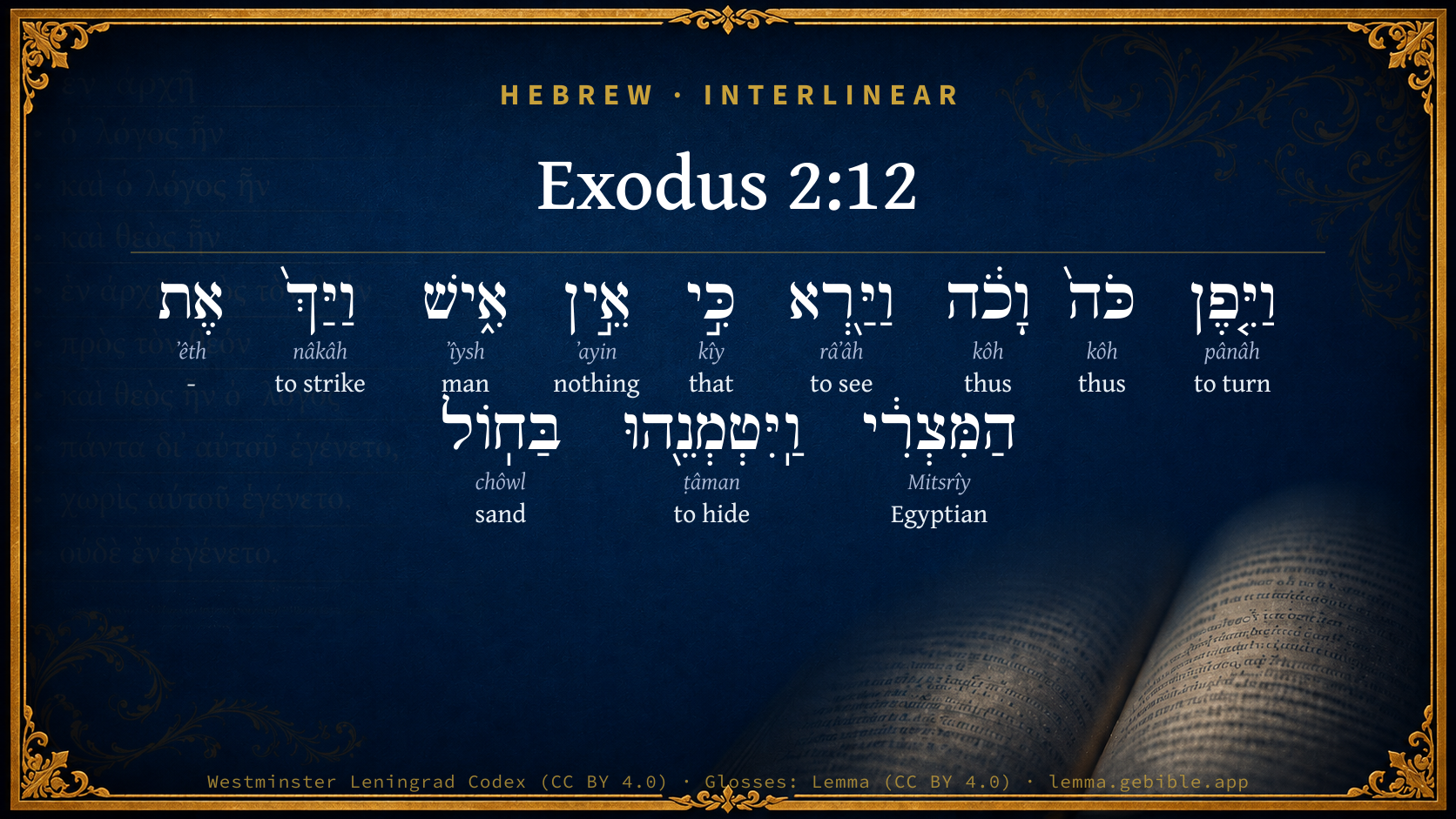
בַּחֽוֹל
chôwl
H2344
“in/at the · sand”
Preposition, Determined + Noun, Common, Masculine, Singular, Absolute
Part of Speech
Preposition + Noun
Type
Common
Gender
Masculine
Number
Singular
State
Absolute
Full BDB Definition

Origin: from H2342

TWOT: 623a

sand
  1. וַיִּ֤פֶן pânâh H6437 “and · to turn” Conjunction + Verb, Qal, Sequential Imperfect, 3rd Person, Masculine, Singular
  2. כֹּה֙ kôh H3541 “thus” Adverb
  3. וָכֹ֔ה kôh H3541 “and · thus” Conjunction + Adverb
  4. וַיַּ֖רְא râʼâh H7200 “and · to see” Conjunction + Verb, Qal, Sequential Imperfect, 3rd Person, Masculine, Singular
  5. כִּ֣י kîy H3588 “that” Conjunction
  6. אֵ֣ין ʼayin H369 “nothing” Particle, Negative
  7. אִ֑ישׁ ʼîysh H376 “man” Noun, Common, Masculine, Singular, Absolute
  8. וַיַּךְ֙ nâkâh H5221 “and · to strike” Conjunction + Verb, Hiphil, Sequential Imperfect, 3rd Person, Masculine, Singular
  9. אֶת ʼêth H853 “-” Particle, Direct Object
  10. הַמִּצְרִ֔י Mitsrîy H4713 “the · Egyptian” Particle, Definite Article + Noun, Gentilic, Masculine, Singular, Absolute
  11. וַֽיִּטְמְנֵ֖הוּ ṭâman H2934 “and · to hide · him” Conjunction + Verb, Qal, Sequential Imperfect, 3rd Person, Masculine, Singular + Suffix, Personal, 3rd Person, Masculine, Singular

About this verse

These counts appear in no published source. They are computed here, from the morphology-tagged text and Lemma’s own curated glosses. What Lemma adds →

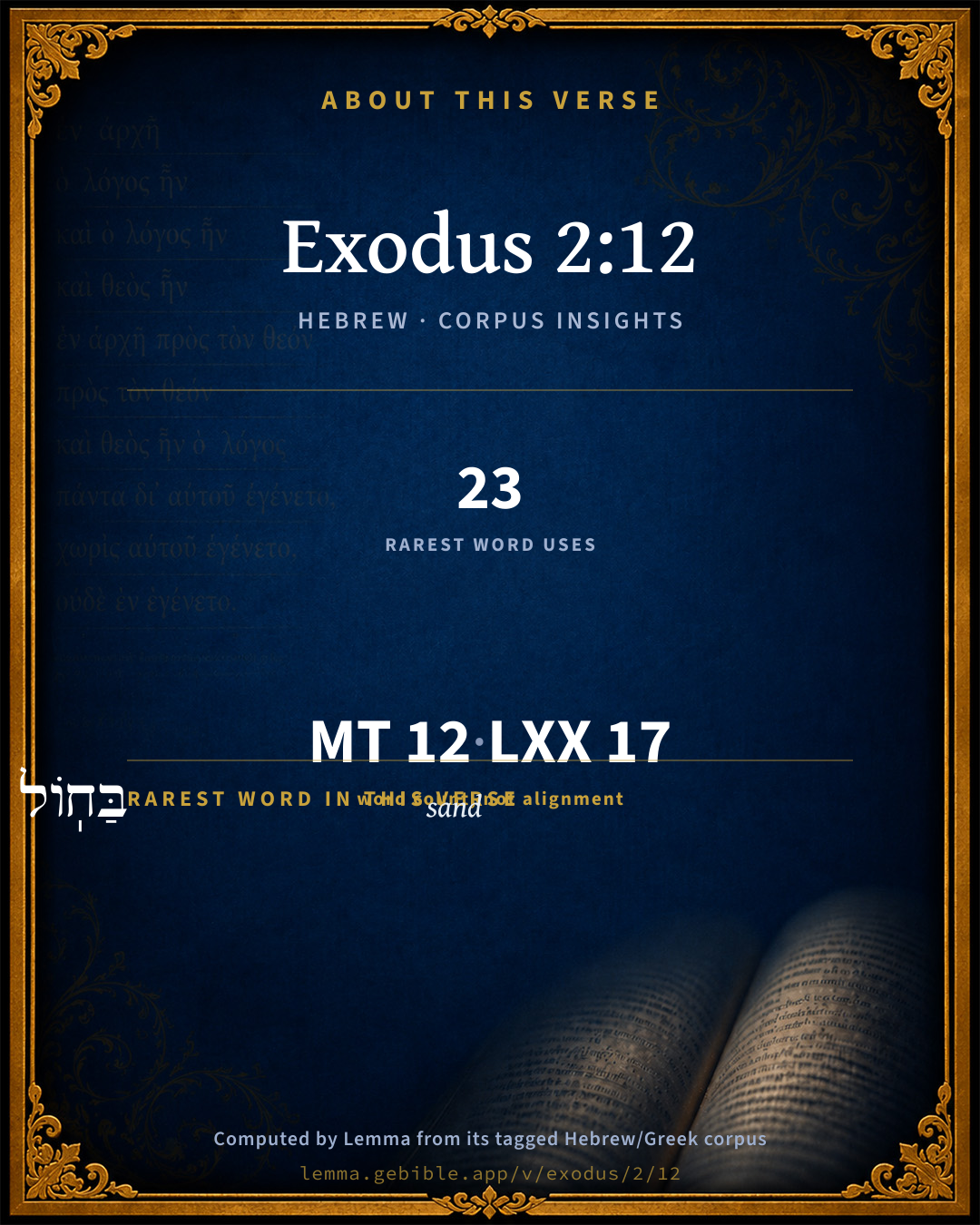
12
words
11
distinct lemmas
Pentateuch
section

Notable vocabulary

The rarest word here is בַּחֽוֹל sand H2344 — appearing just 23 times in the whole Hebrew Bible.

Shared distinctive vocabulary

בַּחֽוֹל sand H2344 occurs in 23 verses of the Hebrew Bible. Also found in:

Grammatical profile

  • 4 verbs
  • 3 nouns
  • 1 conjunction
  • 2 adverbs
  • 2 particles

Verb forms

  • וַיִּ֤פֶן Qal · Sequential Imperfect
  • וַיַּ֖רְא Qal · Sequential Imperfect
  • וַיַּךְ֙ Hiphil · Sequential Imperfect
  • וַֽיִּטְמְנֵ֖הוּ Qal · Sequential Imperfect

Repetition

A word recurs within this verse — often emphatic in Hebrew:

  • כֹּה֙ thus H3541 ×2

Hebrew & Septuagint length

In English translation the verse runs 26 words from the Hebrew and 24 from the Septuagint (LXX English) — closely comparable.

A rough comparison of the two English renderings, which tokenize alike — not a word-level alignment.

Word counts can differ between the Hebrew and the Greek without any difference in meaning — e.g. the Hebrew direct-object marker אֵת has no separate Greek word, and Greek often adds the article ὁ.

In the original languages it is 12 Hebrew tokens and 17 Greek tokens — but the two are counted differently (Hebrew bundles its prefixes and suffixes into one token; the Greek is in lemma form), so that isn’t a like-for-like length.

Cross-references

1

Topical passages linked to Exodus 2:12 in the Treasury of Scripture Knowledge — connected by theme and wording, ordered by reader-vote popularity; previews shown in the World English Bible.

  • Acts 7:24–26 Seeing one of them suffer wrong, he defended him, and avenged him who was oppressed, striking the Egyptian.

Cross-references courtesy of OpenBible.info (CC BY 4.0).

Hebrew and Greek witnesses Masoretic Hebrew ↔ Greek Septuagint

The same verse in the two great witnesses to the Old Testament, shown verse-for-verse.

These are two independent witnesses, not word-aligned to each other, and the Septuagint is shown in lemma (dictionary) form.

Hebrew Exodus 2:12 Masoretic · Westminster Leningrad Codex

וַיִּ֤פֶן כֹּה֙ וָכֹ֔ה וַיַּ֖רְא כִּ֣י אֵ֣ין אִ֑ישׁ וַיַּךְ֙ אֶת הַמִּצְרִ֔י וַֽיִּטְמְנֵ֖הוּ בַּחֽוֹל

He looked this way and that way, and when he saw that there was no one, he killed the Egyptian, and hid him in the sand.

World English Bible · Public Domain

Greek LXX Exodus 2:12 Septuagint · lemma form

περιβλέπω δέ ὧδε καί ὧδε οὐ ὁράω οὐδείς καί πατάσσω ὁ αἰγύπτιος κρύπτω αὐτός ἐν ὁ ἄμμος

And having looked round this way and that way, he sees no one; and he struck the Egyptian, and hid him in the sand.

LXX2012 (modern English Septuagint) · Public Domain

Hebrew: Westminster Leningrad Codex (CC BY 4.0). Greek: Septuagint (public domain); English from LXX2012 (modern English Septuagint) (Public Domain). How the Septuagint differs from the Hebrew →

Targum (Aramaic paraphrase)

2

The Targum is the ancient Jewish Aramaic paraphrase of the Hebrew Scriptures — an interpretive translation, not the Hebrew text itself. Onkelos (literal) and Pseudo-Jonathan (expansive) render the Torah, and Jonathan the Prophets. Coverage is partial: where no permissively-licensed English translation exists for a verse, only the Aramaic is shown. This is verse-level text, not a word-by-word alignment to the Hebrew.

  1. Targum Onkelos Torah (Genesis–Deuteronomy)
    וְאִתְפְּנֵי לְכָא וּלְכָא וַחֲזָא אֲרֵי לֵית גַבְרָא וּמְחָא יָת מִצְרָאָה וְטַמְרֵהּ בְּחָלָא:

    (no public-domain English translation for this verse)

    Targum Onkelos — Aramaic: “Onkelos Genesis” (public domain); “Onkelos Exodus” (public domain); “Onkelos Leviticus” (public domain); “Onkelos Numbers” (public domain); “Onkelos Deuteronomy” (public domain). English: “Sefaria Community Translation” (CC0 1.0 (public-domain dedication)); “J.W. Etheridge. The Targums of Onkelos and Jonathan Ben Uzziel on the Pentateuch. London: Longmans, Green, 1862” (public domain). Text via Sefaria.

  2. Targum Pseudo-Jonathan Torah (Genesis–Deuteronomy)
    וְאִיסְתַּכֵּל משֶׁה בְחָכְמַת דַעְתֵּיהּ וְאִתְבּוֹנָן בְּכָל דַר וְדַר וְהָא לָא קָאִים מִן הַהוּא מִצְרָאֵי גְבַר גִיוֹר וְלָא דְעָבִיד תְּתוּבָא מִן בְּנֵי בְּנוֹי עַד עַלְמָא וּמְחָא יַת מִצְרָאֵי וְטַמְרֵיהּ בְּחָלָא

    and Mosheh turned, and considered in the wisdom of his mind, and understood that in no generation would there arise a proselyte from that Mizraite man, and that none of his children's children would ever be converted; and he smote the Mizraite, and buried him in the sand.

    Targum Pseudo-Jonathan — Aramaic: “Targum Jonathan on Genesis” (public domain); “Targum Jonathan on Exodus” (public domain); “Targum Jonathan on Leviticus” (public domain); “Targum Jonathan on Numbers” (public domain); “Targum Jonathan on Deuteronomy” (public domain). English: “The Targum of Jonathan ben Uzziel, trans. J. W. Etheridge, London, 1862” (public domain). Text via Sefaria.

Commentary

Notes on Exodus 2:12 from classic Christian and Jewish commentators (each source and its license shown beneath its notes). The classic Christian expositions comment on the surrounding passage and are grouped to its opening verse, so a note may address several verses; the Jewish commentaries on the Tanakh (Rashi and others) are per-verse, so they appear only where the commentator wrote on this verse.

Lemma curates 59 commentaries, every one of them public domain or Creative Commons licensed, each selected and text-cleaned for this edition rather than reprinted as found. About our sources →

Trapp's Complete Commentary

John Trapp

Exo 2:12 And he looked this way and that way, and when he saw that [there was] no man, he slew the Egyptian, and hid him in the sand.

Ver. 12. He slew the Egyptian.] This deed of his was heroic and extraordinary, and therefore not to be imitated by every Birchet, who, by this example of Moses and that other of Ehud, persuaded himself it was lawful to kill such as oppose the truth of the gospel: whereupon he wounded Hawkins, slew his keeper, and thought he had a calling to kill a great personage in this kingdom, whom he took to be God’s enemy. The like madness is reported of the Monasterian Anabaptists. {a}

{a} Camden’s Elisab., fol. 174. Mr Bayly’s Dissuas., part 2.

John Trapp, A Commentary or Exposition upon All the Books of the Old and New Testament (1647–1656) — public domain. Text from a community e-Sword module.

Rashi

Rabbi Shlomo Yitzchaki (Rashi)

ויפן כה וכה AND HE TURNED THIS WAY AND THAT WAY — he saw what he had done to him in the house and what he had done to him in the field (outside the house. viz., the beating to which he had subjected him) (Exodus Rabbah 1.28). But according to the literal meaning it must be explained in its ordinary sense: he turned this way and that way.

וירא כי אין איש AND HE SAW THAT THERE WAS NO MAN destined to issue from him, who would become an adherent of Israel’s religion (Exodus Rabbah 1:29; cf. Targum Jonathan on Exodus 2:12).

Rashi on the Tanakh — English translations: “The Judaica Press complete Tanach with Rashi, translated by A. J. Rosenberg” (CC BY 4.0); “Pentateuch with Rashi's commentary by M. Rosenbaum and A.M. Silbermann, 1929-1934” (public domain); “The Metsudah Tanach series, Lakewood, N.J” (CC BY 4.0); and “The Book of Joshua, Metsudah Publications, 1997” (CC BY 4.0). Text via Sefaria.

Geneva Bible (1599)

Geneva Bible translators

Being assured that God had appointed him to deliver the Israelites, Acts 7:25.

Hebrew, thus and thus.

Geneva Bible (1599) marginal notes — public domain. Text via Bolls.life.

Jamieson, Fausset & Brown

Robert Jamieson, A. R. Fausset & David Brown

he slew the Egyptian, and hid him in the sand--This act of Moses may seem and indeed by some has been condemned as rash and unjustifiable--in plain terms, a deed of assassination. But we must not judge of his action in such a country and age by the standard of law and the notions of right which prevail in our Christian land; and, besides, not only is it not spoken of as a crime in Scripture or as distressing the perpetrator with remorse, but according to existing customs among nomadic tribes, he was bound to avenge the blood of a brother. The person he slew, however, being a government officer, he had rendered himself amenable to the laws of Egypt, and therefore he endeavored to screen himself from the consequences by concealment of the corpse.

Jamieson, Fausset & Brown — Commentary Critical and Explanatory on the Whole Bible (1871) — public domain (CC PDM 1.0). Text via the HelloAO Bible API.

Ellicott's Commentary for English Readers

(12) He looked this way and that way.—To see that no one observed him.

He slew the Egyptian.—Jewish commentators gloss over the act, or even eulogise it as patriotic and heroical. But it was clearly the deed of a hasty and undisciplined spirit. The offence did not deserve death, and if it had, Moses had neither legal office nor Divine call, justifying him in making himself an executioner. The result was, that, by his one wrong act, Moses put it out of his power to do anything towards alleviating the sufferings of his brethren for forty years.

Hid him in the sand.—To the east of the Delta the sand creeps up close to the cultivated grounds. There are even patches of it within the Delta itself. Moses naturally remembered that he dug the grave “in the sand.” Any other writer would probably have said “in the ground.”

A Bible Commentary for English Readers, edited by Charles John Ellicott (1878–1897) — public domain. Text from a community e-Sword module.

John Gill's Exposition

And he looked this way, and that way,.... All around, to observe if there were any within sight who could see what he did; which did not arise from any consciousness of any evil he was about to commit, but for his own preservation, lest if seen he should be accused to Pharaoh, and suffer for it:

and when he saw that there was no man; near at hand, that could see what he did, and be a witness against him:

he slew the Egyptian, and hid him in the sand; in a sandy desert place hard by, where having slain him with his sword, he dug a hole, and put him into it; See Gill on Act 7:24. Of the slaughter of the Egyptian, and the following controversy about it, Demetrius (g), an Heathen writer, treats of in perfect agreement with the sacred Scriptures.

(g) Apud Euseb. Praepar. Evangel. l. 9. c. 19. p. 439.

John Gill's Exposition of the Whole Bible (1746–1763) — public domain (CC PDM 1.0). Text via the HelloAO Bible API.

Albert Barnes' Notes on the Bible

The slaying of the Egyptian is not to be justified, or attributed to a divine inspiration, but it is to be judged with reference to the provocation, the impetuosity of Moses’ natural character, perhaps also to the habits developed by his training at the court of Pharaoh. The act involved a complete severance from the Egyptians, but, far from expediting, it delayed for many years the deliverance of the Israelites. Forty years of a very different training prepared Moses for the execution of that appointed work.

Albert Barnes' Notes on the Bible (1834–1885) — public domain. Text from a community e-Sword/MySword module.

Haydock's Catholic Bible Commentary

He slew the Egyptian. This he did by a particular inspiration of God; as a prelude to his delivering the people from their oppression and bondage. He thought, says St. Stephen, (Acts vii. 25,) that his brethren understood that God by his hand would save them. But such particular and extraordinary examples are not to be imitated. (Challoner) --- He was inspired, on this occasion, to stand up in defence of the innocent. (Menochius) (St. Thomas Aquinas, [Summa Theologiae] ii. 2, q. 60.) --- The laws of Egypt required every person to protect the oppressed; or, if unable to do it, he was to call in the aid of the magistrate. (Diodorus i.) (Calmet) --- Moses looked round to see if there was any help near. He was 40 years old when he was forced to flee.

George Leo Haydock (1774–1849), Haydock's Catholic Family Bible and Commentary, 1859 edition — public domain. Excludes Psalms (Douay-Rheims chapter numbering differs from Protestant) and Deuterocanonical books (Catholic canon only).

Matthew Poole's English Annotations

Looked this way and that way; not from conscience of guilt in what he intended, but from human and warrantable prudence.

This action of Moses was extraordinary, and is not to be justified by the common right of defending the oppressed, which belongs not to private persons, Rom 12:19; but only by his Divine and special vocation to be the ruler and deliverer of Israel. Which call of his, howsoever manifested, whether by his father, as Josephus saith, or immediately to himself, was evident to his own conscience, and he gave this as a signal to make it evident to the people.

Matthew Poole's English Annotations on the Holy Bible (1683–1685) — public domain. Text from a community e-Sword/MySword module.

The Pulpit Commentary

He looked this way and that way. Passion did not so move him as to make him reckless. He looked round to see that he was not observed, and then, when he saw there was no man, slew the Egyptian. A wrongful act, the outcome of an ardent but undisciplined spirit; not to be placed among the deeds "which history records as noble and magnanimous (Kalisch), but among those which are hasty and regrettable. A warm sympathetic nature, an indignant hatred of wrong-doing, may have lain at the root of the crime, but do not justify it, though they may qualify our condemnation of it. (See the remarks of St. Augustine quoted by Keil and Delitzsch, "Commentary on the Pentateuch," vol. 1. p. 451: "I affirm that the man, though criminal and really the offender, ought not to have been put to death by one who had no legal authority to do so. But minds that are capable of virtue often produce vices also, and show thereby for what virtue they would have been best adapted, if they had but been properely trained," etc.) And hid him in the sand. There is abundant "sand" in the "field of Zoan," and in all the more eastern portion of the land of Goshen. (See the "Quarterly Statement of the Palestine Exploration Fund" for July, 1880, p. 140.)

The Pulpit Commentary (1880–1919), ed. H.D.M. Spence-Jones & Joseph S. Exell — public domain. Text from a community e-Sword module.

John Wesley's Explanatory Notes

He slew the Egyptian - Probably it was one of the Egyptian task-masters, whom he found abusing his Hebrew slave. By special warrant from heaven (which makes not a precedent in ordinary cases) Moses slew the Egyptian, and rescued his oppressed brother. The Jew's tradition is, that he did not slay him with any weapon, but as Peter slew Ananias and Sapphira, with the word of his mouth.

John Wesley, Explanatory Notes Upon the Whole Bible (1754–1765) — public domain. Text via the GEBible commentary corpus.

Lesson kit

Teaching starters — assembled from the data on this page, not authored interpretation. Every prompt links to the verse data it draws on. Edit before teaching.

Exodus, in the Pentateuch, opens this verse with 12 words (11 distinct Hebrew lemmas). Its most distinctive word is chôwl (“sand”). A historical commentator’s framing appears above. Read the whole chapter for the surrounding context.

Discussion questions

  1. The word chôwl carries the sense “sand.” How does it shape the verse?
  2. How does Genesis 22:17, which shares the word «sand», read alongside this verse?
  3. What does the repetition of “thus” (2× in this one verse) do in this verse?
  4. These translations render this verse differently. What is at stake in choosing one wording over another?
  5. «וַיִּ֤פֶן» is a Qal Sequential Imperfect verb. How does that grammatical form shape the action described?
  6. Compare how Trapp's Complete Commentary and Rashi read this verse. Where do they agree or differ?

Things to notice

Reading settings

Reading text

Shown beneath each verse's original-language words.

Old Testament
Old Testament edition

Read the OT as the Masoretic Hebrew (MT) or the Greek Septuagint (LXX).

English shown for the Greek Septuagint (in the Hebrew ↔ Greek comparison).

Comparing translations? Open the Compare panel on any verse page to stack up to four side by side.