Genesis 43:3

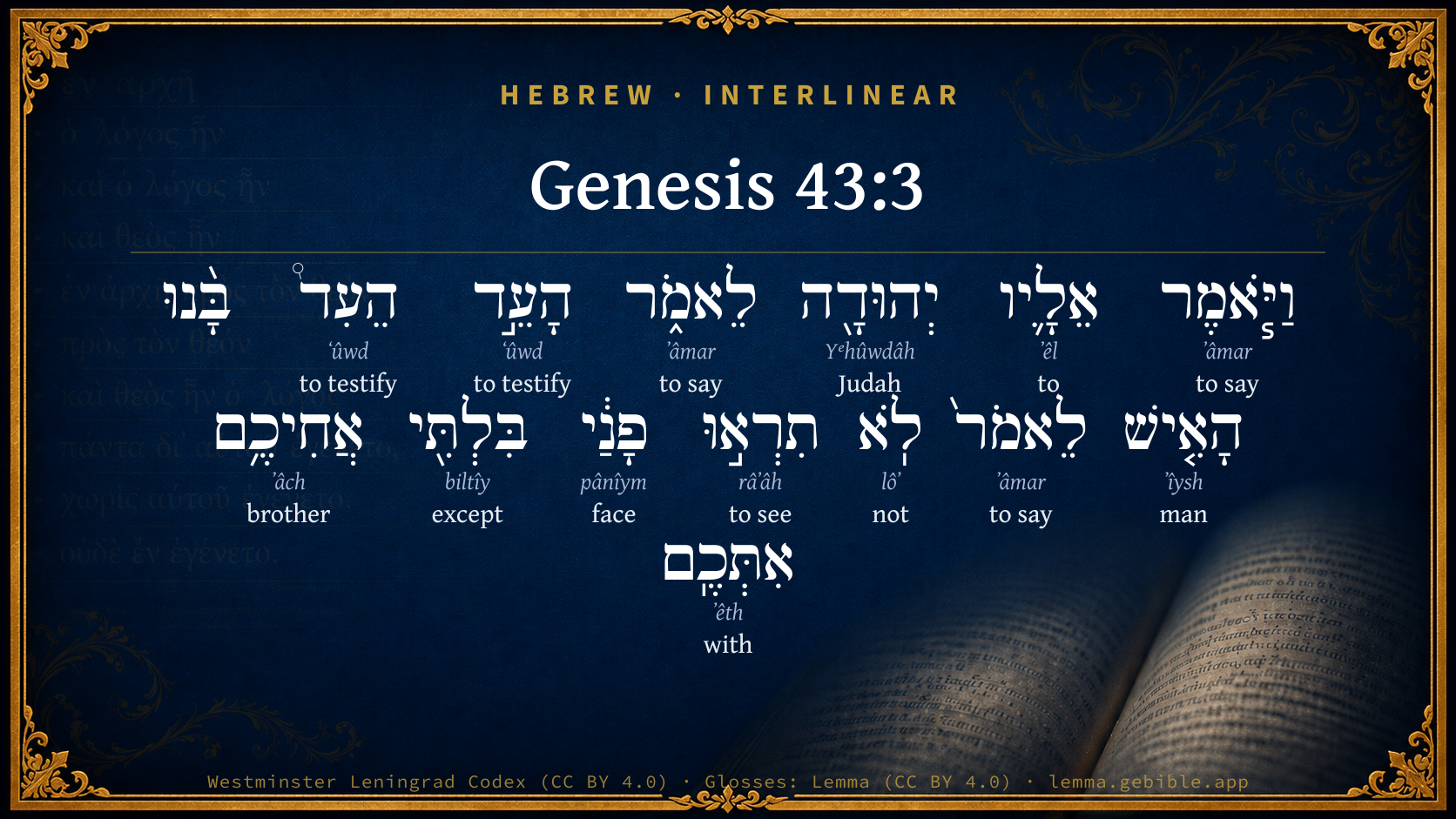
Hebrew (Westminster Leningrad Codex) Genesis 43:3 appears in the Hebrew Old Testament. The text above is from the Westminster Leningrad Codex. Each word links to its Strong’s number, a concise gloss, and parsing drawn from the Open Scriptures Hebrew Bible morphology. Click any word for its full Brown-Driver-Briggs (BDB) entry.
Download image
Cite this verse

Genesis 43:3 (World English Bible). Public Domain. Lemma interlinear Bible study tool, https://lemma.gebible.app/v/genesis/43/3.

Show BibTeX & RIS
BibTeX
RIS
English Translation
Judah spoke to him, saying, "The man solemnly warned us, saying, 'You shall not see my face, unless your brother is with you.'
World English Bible · Public Domain
Highlights
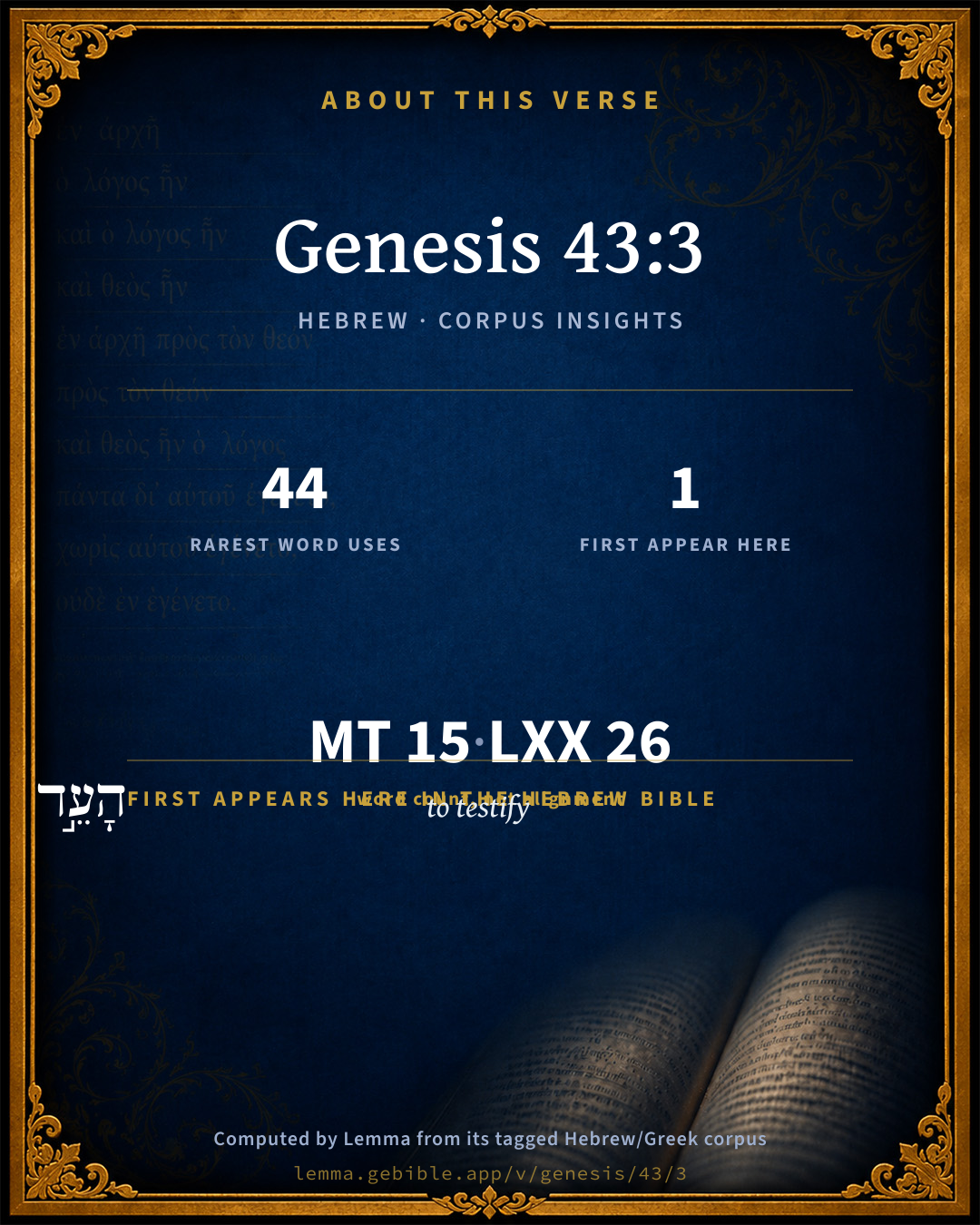
  • 1 first appearance in the Hebrew Bible
Full analysis ↓
Download a study sheet

One document with this verse’s original text, its word-by-word gloss line, the meaning frame, cross-references with their text, attributed commentary, and full source and license credits — printable, and it pastes into notes with its structure intact.

This verse Autodidact and up

Study sheet (.html) Plain text (.txt)

A passage Seminary Student

Up to 50 verses in one chapter. A passage sheet keeps up to 6 commentary sources and 12 cross-references per verse, in the order this page ranks them, and says so on the sheet whenever that leaves anything out. Ask for a single verse and you get the Autodidact verse sheet above.

Everything on this page stays free to read, with no account — the sheet is a download of what is already on screen, not access to it.

Want to remove ads? Support Godless Engineer
Compare translations 3

The same verse in 3 English versions, stacked beneath the original-language interlinear above. Click any original word for its lexicon entry.

Each is an independent rendering of the whole verse — the interlinear is not word-aligned to these translations.

Highlighted words mark where these versions differ — a whole-verse word diff, not a word-by-word alignment.

  • World English Bible Public Domain
    Judah spoke to him, saying, "The man solemnly warned us, saying, 'You shall not see my face, unless your brother is with you.'
  • King James Version Public Domain
    And Judah spake unto him, saying, The man did solemnly protest unto us, saying, Ye shall not see my face, except your brother be with you.
  • unfoldingWord Literal Text CC BY-SA 4.0
    But Judah said to him, saying, “The man strongly warned us, saying, ‘You will not see my face unless your brother with you!’

unfoldingWord Literal Text — © unfoldingWord, licensed CC BY-SA 4.0. Word-aligned USFM3 via Door43 (git.door43.org/unfoldingWord/en_ult).

Versions to compare (up to 4)

3 of 4 selected

Show all 18 translations

Every available English version of this verse, each an independent rendering of the whole verse.

  • World English Bible Public Domain
    Judah spoke to him, saying, "The man solemnly warned us, saying, 'You shall not see my face, unless your brother is with you.'
  • Berean Standard Bible Public Domain
    But Judah replied, “The man solemnly warned us, ‘You will not see my face again unless your brother is with you.’
  • Majority Standard Bible Public Domain
    But Judah replied, “The man solemnly warned us, ‘You will not see my face again unless your brother is with you.’
  • King James Version Public Domain
    And Judah spake unto him, saying, The man did solemnly protest unto us, saying, Ye shall not see my face, except your brother be with you.
  • American Standard Version (1901) Public Domain
    And Judah spake unto him, saying, The man did solemnly protest unto us, saying, Ye shall not see my face, except your brother be with you.
  • Revised Version (1885) Public Domain
    And Judah spake unto him, saying, The man did solemnly protest unto us, saying, Ye shall not see my face, except your brother be with you.
  • Geneva Bible (1599) Public Domain
    And Iudah answered him, saying, The man charged vs by an othe, saying, Neuer see my face, except your brother be with you.
  • Douay-Rheims (1899) Public Domain
    Juda answered: The man declared unto us with the atteststion of an oath, saying: You shall not see my face, unless you bring your youngest brother with you.
  • Young's Literal Translation Public Domain
    And Judah speaketh unto him, saying, `The man protesting protested to us, saying, Ye do not see my face without your brother `being' with you;
  • Literal Standard Version CC BY-SA 4.0
    And Judah speaks to him, saying, “The man protesting protested to us, saying, You do not see my face without your brother [being] with you;
  • Unlocked Literal Bible CC BY-SA 4.0
    Judah told him, “The man solemnly warned us, 'You will not see my face unless your brother is with you.'
  • unfoldingWord Literal Text CC BY-SA 4.0
    But Judah said to him, saying, “The man strongly warned us, saying, ‘You will not see my face unless your brother with you!’
  • Darby Bible Public Domain
    And Judah spoke to him, saying, The man did positively testify to us, saying, Ye shall not see my face, unless your brother be with you.
  • World Messianic Bible Public Domain
    Judah spoke to him, saying, “The man solemnly warned us, saying, ‘You shall not see my face, unless your brother is with you.’
  • Webster's Bible Public Domain
    \\43:4\\If thou wilt send our brother with us, we will go down and buy thee food:
  • Free Bible Version CC BY-SA 4.0
    But Judah responded, “The man was adamant when he warned us, ‘I won't even see you unless your brother is with you.’
  • Bible in Basic English Public Domain
    If you will let our brother go with us, we will go down and get food:
  • JPS Tanakh (1917) Public Domain
    And Judah spoke unto him, saying: 'The man did earnestly forewarn us, saying: Ye shall not see my face, except your brother be with you.

Literal Standard Version (2020), Covenant Press — licensed CC BY-SA 4.0. Text via the HelloAO Bible API (eBible.org). Unlocked Literal Bible (unfoldingWord) — licensed CC BY-SA 4.0. Text via the HelloAO Bible API (eBible.org). unfoldingWord Literal Text — © unfoldingWord, licensed CC BY-SA 4.0. Word-aligned USFM3 via Door43 (git.door43.org/unfoldingWord/en_ult). Free Bible Version, Dr. Jonathan Gallagher — licensed CC BY-SA 4.0. Text via the HelloAO Bible API (eBible.org).

Word by word

More ways to search: Search by grammar → Find every occurrence → Compare this word →

Practice this passage: Drill this verse → Learn its vocabulary →

הָעֵ֣ד
ʻûwd
H5749
“to testify”
Verb, Hiphil, Infinitive Absolute
Part of Speech
Verb
Stem
Hiphil
Form
Infinitive Absolute
Full BDB Definition

Origin: a primitive root

TWOT: 1576 , 1576d

to return, repeat, go about, do again - (Piel) to surround, go round and round - (Pilel) to restore, relieve - (Hithpalel) to be restored - to bear witness - (Qal) to bear witness, say again and again - (Hiphil) - to testify, bear witness - to cause to testify, take or call as witness, invoke - to protest, affirm solemnly, warn, exhort or enjoin solemnly, admonish, charge - (Hophal) to protest, give warning
  1. וַיֹּ֧אמֶר ʼâmar H559 “and · to say” Conjunction + Verb, Qal, Sequential Imperfect, 3rd Person, Masculine, Singular
  2. אֵלָ֛יו ʼêl H413 “to · him” Preposition + Suffix, Personal, 3rd Person, Masculine, Singular
  3. יְהוּדָ֖ה Yᵉhûwdâh H3063 “Judah” Noun, Proper
  4. לֵאמֹ֑ר ʼâmar H559 “to say” Preposition + Verb, Qal, Infinitive Construct
  5. הֵעִד֩ ʻûwd H5749 “to testify” Verb, Hiphil, Perfect, 3rd Person, Masculine, Singular
  6. הָאִ֤ישׁ ʼîysh H376 “the · man” Particle, Definite Article + Noun, Common, Masculine, Singular, Absolute
  7. לֵאמֹר֙ ʼâmar H559 “to say” Preposition + Verb, Qal, Infinitive Construct
  8. לֹֽא lôʼ H3808 “not” Particle, Negative
  9. תִרְא֣וּ râʼâh H7200 “to see” Verb, Qal, Imperfect, 2nd Person, Masculine, Plural
  10. פָנַ֔י pânîym H6440 “face(s) · my” Noun, Common, Both, Plural, Construct + Suffix, Personal, 1st Person, Common, Singular
  11. בִּלְתִּ֖י biltîy H1115 “except” Conjunction
  12. אֲחִיכֶ֥ם ʼâch H251 “brother · your” Noun, Common, Masculine, Singular, Construct + Suffix, Personal, 2nd Person, Masculine, Plural
  13. אִתְּכֶֽם ʼêth H854 “with · you” Preposition + Suffix, Personal, 2nd Person, Masculine, Plural

About this verse

These counts appear in no published source. They are computed here, from the morphology-tagged text and Lemma’s own curated glosses. What Lemma adds →

15
words
11
distinct lemmas
Pentateuch
section

First appearance in Scripture

This word makes its first canonical appearance in the Hebrew Bible here:

  • הָעֵ֣ד to testify H5749

Shared distinctive vocabulary

הָעֵ֣ד to testify H5749 occurs in 40 verses of the Hebrew Bible. Also found in:

Grammatical profile

  • 6 verbs
  • 4 nouns
  • 3 prepositions
  • 1 conjunction
  • 1 particle

Verb forms

  • וַיֹּ֧אמֶר Qal · Sequential Imperfect
  • לֵאמֹ֑ר Qal · Infinitive Construct
  • הָעֵ֣ד Hiphil · Infinitive Absolute
  • הֵעִד֩ Hiphil · Perfect
  • לֵאמֹר֙ Qal · Infinitive Construct
  • תִרְא֣וּ Qal · Imperfect

Repetition

Words recur within this verse — often emphatic in Hebrew:

  • וַיֹּ֧אמֶר to say H559 ×3
  • הָעֵ֣ד to testify H5749 ×2

Hebrew & Septuagint length

In English translation the verse runs 23 words from the Hebrew and 31 from the Septuagint (LXX English) — closely comparable.

A rough comparison of the two English renderings, which tokenize alike — not a word-level alignment.

Word counts can differ between the Hebrew and the Greek without any difference in meaning — e.g. the Hebrew direct-object marker אֵת has no separate Greek word, and Greek often adds the article ὁ.

In the original languages it is 15 Hebrew tokens and 26 Greek tokens — but the two are counted differently (Hebrew bundles its prefixes and suffixes into one token; the Greek is in lemma form), so that isn’t a like-for-like length.

Cross-references

11

Topical passages linked to Genesis 43:3 in the Treasury of Scripture Knowledge — connected by theme and wording, ordered by reader-vote popularity; previews shown in the World English Bible.

  • Genesis 44:23 You said to your servants, 'Unless your youngest brother comes down with you, you will see my face no more.'
  • Genesis 43:5 but if you will not send him, we will not go down, for the man said to us, 'You shall not see my face, unless your brother is with you.'"
  • Genesis 42:15–20 Hereby you shall be tested. By the life of Pharaoh you shall not go forth from here, unless your youngest brother come here.
  • Genesis 42:33–34 The man, the lord of the land, said to us, 'Hereby will I know that you are honest men. Leave one of your brothers with me, and take grain for the famine of your houses, and go your way.
  • 2 Samuel 3:13 He said, Well; I will make a league with you; but one thing I require of you: that is, you shall not see my face, except you first bring Michal, Saul's daughter, when you come to see my face.
  • 2 Samuel 14:24 The king said, Let him turn to his own house, but let him not see my face. So Absalom turned to his own house, and didn't see the king's face.
  • 2 Samuel 14:28 Absalom lived two full years in Jerusalem; and he didn't see the king's face.
  • 2 Samuel 14:32 Absalom answered Joab, Behold, I sent to you, saying, Come here, that I may send you to the king, to say, Why am I come from Geshur? it were better for me to be there still. Now therefore let me see the king's face; and if there be iniquity in me, let him kill me.
  • Acts 7:34 I have surely seen the affliction of my people that is in Egypt, and have heard their groaning. I have come down to deliver them. Now come, I will send you into Egypt.'
  • Acts 20:25 Now, behold, I know that you all, among whom I went about preaching the Kingdom of God, will see my face no more.
  • Acts 20:38 sorrowing most of all because of the word which he had spoken, that they should see his face no more. And they accompanied him to the ship.

Cross-references courtesy of OpenBible.info (CC BY 4.0).

Hebrew and Greek witnesses Masoretic Hebrew ↔ Greek Septuagint

The same verse in the two great witnesses to the Old Testament, shown verse-for-verse.

These are two independent witnesses, not word-aligned to each other, and the Septuagint is shown in lemma (dictionary) form.

Hebrew Genesis 43:3 Masoretic · Westminster Leningrad Codex

וַיֹּ֧אמֶר אֵלָ֛יו יְהוּדָ֖ה לֵאמֹ֑ר הָעֵ֣ד הֵעִד֩ בָּ֨נוּ הָאִ֤ישׁ לֵאמֹר֙ לֹֽא תִרְא֣וּ פָנַ֔י בִּלְתִּ֖י אֲחִיכֶ֥ם אִתְּכֶֽם

Judah spoke to him, saying, "The man solemnly warned us, saying, 'You shall not see my face, unless your brother is with you.'

World English Bible · Public Domain

Greek LXX Genesis 43:3 Septuagint · lemma form

εἶπον δέ αὐτός ἰούδας λέγω διαμαρτυρία διαμαρτυρέω ἐγώ ὁ ἄνθρωπος λέγω οὐ ὁράω ὁ πρόσωπον ἐγώ ἐάν μή ὁ ἀδελφός σύ ὁ νέος μετά σύ εἰμί

And Judas spoke to him, saying, The man, the lord of the country, positively testified to us, saying, You⌃ shall not see my face, unless your younger brother be with you.

LXX2012 (modern English Septuagint) · Public Domain

Hebrew: Westminster Leningrad Codex (CC BY 4.0). Greek: Septuagint (public domain); English from LXX2012 (modern English Septuagint) (Public Domain). How the Septuagint differs from the Hebrew →

Targum (Aramaic paraphrase)

2

The Targum is the ancient Jewish Aramaic paraphrase of the Hebrew Scriptures — an interpretive translation, not the Hebrew text itself. Onkelos (literal) and Pseudo-Jonathan (expansive) render the Torah, and Jonathan the Prophets. Coverage is partial: where no permissively-licensed English translation exists for a verse, only the Aramaic is shown. This is verse-level text, not a word-by-word alignment to the Hebrew.

  1. Targum Onkelos Torah (Genesis–Deuteronomy)
    וַאֲמַר לֵהּ יְהוּדָה לְמֵימָר אַסְהָדָא אַסְהֵד בָּנָא גַּבְרָא לְמֵימָר לָא תֶחֱזוּן אַפַּי אֶלָּהֵין כַּד אָחוּכוֹן עִמְּכוֹן

    (no public-domain English translation for this verse)

    Targum Onkelos — Aramaic: “Onkelos Genesis” (public domain); “Onkelos Exodus” (public domain); “Onkelos Leviticus” (public domain); “Onkelos Numbers” (public domain); “Onkelos Deuteronomy” (public domain). English: “Sefaria Community Translation” (CC0 1.0 (public-domain dedication)); “J.W. Etheridge. The Targums of Onkelos and Jonathan Ben Uzziel on the Pentateuch. London: Longmans, Green, 1862” (public domain). Text via Sefaria.

  2. Targum Pseudo-Jonathan Torah (Genesis–Deuteronomy)
    וַאֲמַר לֵיהּ יְהוּדָה לְמֵימַר מְסַהֲדָא אַסְהִיד בְּנָא גַבְרָא לְמֵימַר לָא תֵיחְמוּן סְבַר אַפַּי בִּדְלֵית אֲחוּכוֹן זְעֵירָא עִמְכוֹן

    And Jehuda spake to him, saying, The man attesting attested to us saying, You shall not see the sight of my face unless your youngest brother be with you.

    Targum Pseudo-Jonathan — Aramaic: “Targum Jonathan on Genesis” (public domain); “Targum Jonathan on Exodus” (public domain); “Targum Jonathan on Leviticus” (public domain); “Targum Jonathan on Numbers” (public domain); “Targum Jonathan on Deuteronomy” (public domain). English: “The Targum of Jonathan ben Uzziel, trans. J. W. Etheridge, London, 1862” (public domain). Text via Sefaria.

Commentary

Notes on Genesis 43:3 from classic Christian and Jewish commentators (each source and its license shown beneath its notes). The classic Christian expositions comment on the surrounding passage and are grouped to its opening verse, so a note may address several verses; the Jewish commentaries on the Tanakh (Rashi and others) are per-verse, so they appear only where the commentator wrote on this verse.

Lemma curates 59 commentaries, every one of them public domain or Creative Commons licensed, each selected and text-cleaned for this edition rather than reprinted as found. About our sources →

Trapp's Complete Commentary

John Trapp

Gen 43:3 And Judah spake unto him, saying, The man did solemnly protest unto us, saying, Ye shall not see my face, except your brother [be] with you.

Ver. 3. Ye shall not see my face, &c.] No acceptation without Benjamin, that son of sorrow: so, neither with God, without sound repentance. This is the rainbow, which if God sees shining in our hearts, he will never drown our souls.

John Trapp, A Commentary or Exposition upon All the Books of the Old and New Testament (1647–1656) — public domain. Text from a community e-Sword module.

unfoldingWord translationNotes

Door43 World Missions Community

Judah told him

"Judah told his father Jacob"

The man

This refers to Joseph, but the brothers did not know it was Joseph. They referred to him as "the man" or "the man, the lord of the land" as in Genesis 42:30.

warned us, 'You will not see my face unless your brother is with you.'

This has a quotation within a quotation. It can be stated as an indirect quotation. AT: "warned us that we would not see his face unless we brought our youngest brother with us" (See: Quotes Within Quotes and Direct and Indirect Quotations)

solemnly warned us

"was very serious when he warned us, saying"

You will not see my face

Judah uses this phrase twice in Gen 43:3-5 to emphasize to his father that they cannot return to Egypt without Benjamin. The phrase "my face" refers to the man, who is Joseph. AT: "You will not see me" (See: Synecdoche)

your brother is with you

Judah is referring to Benjamin, Rachel's last born before she died.

we will not go down

It was common to use the phrase "go down" when speaking of traveling from Canaan to Egypt.

translationWords

Judah

face

unfoldingWord translationNotes — © Distant Shores Media and the Door43 World Missions Community, licensed CC BY-SA 4.0. Source: git.door43.org/Door43/en_tn.

John Calvin's Commentaries

3. And Judah spake unto him, saying. Judah seems to feign something, for the purpose of extorting from his father what he knew he would not freely grant; but it is probable that many discourses had been held on both sides, which Moses, according to his custom, has not related. And since Joseph so ardently desired the sight of his brother Benjamin, it is not surprising that he should have labored, in every possible way, to obtain it. It may also have happened that he had caused some notification or legal summons to be served, by which his brother was cited to make his appearance, as in judicial causes. This however deserves to be noticed, that Moses relates the long disputation which Jacob had with his sons, in order that we may know with what difficulty he allowed his son Benjamin to be torn away from him. For, though hunger was pressing, he nevertheless contended for retaining him, just as if he were striving for the salvation of his whole family. Whence, again, we may conjecture, that he suspected his sons of a wicked conspiracy; and on this account Judah offers himself as a surety. For he does not promise anything respecting the event, but only, for the sake of clearing himself and his brethren, he takes Benjamin under his care, with this condition, that if any injury should be done to Benjamin, he would bear the punishment and the blame. From the example of Jacob let us learn patient endurance, should the Lord often compel us, by pressure of circumstances, to do many things contrary to the inclination of our own minds; for Jacob sends away his son, as if he were delivering him over unto death.

John Calvin's Commentaries (1540-1563) — public domain. Text from the Calvin Translation Society English edition (1840s-50s) via the Christian Classics Ethereal Library (ccel.org). Calvin's coverage is partial (roughly two-thirds of the Bible); uncommented books and verses are honest gaps, never fabricated. The 19th-century editor's footnotes and remarks are omitted so the notes are faithfully Calvin's own voice.

The Cambridge Bible for Schools and Colleges

gen. ed. J. J. S. Perowne

3. Judah] Judah is prominent throughout the J narrative. Cf. Gen_43:8, Gen_37:26, Gen_44:14-34, Gen_46:28.

except your brother be with you] Admission to Joseph’s presence and permission to buy corn were to depend on Benjamin’s accompanying them. The other two objects mentioned in Gen_42:34, (1) to disprove the charge of being spies, and (2) to obtain the release of Simeon, are not mentioned.

The Cambridge Bible for Schools and Colleges (gen. ed. J. J. S. Perowne; Cambridge University Press, 1878–1918) — public domain. Text from a community e-Sword module.

John Gill's Exposition

If thou wilt send our brother with us,.... Give orders for his going with us, and put him under our care:

we will go down and buy thee food; signifying, on the above condition, that they were ready and willing to take a journey into Egypt, and buy provisions for him and his family, otherwise not.

John Gill's Exposition of the Whole Bible (1746–1763) — public domain (CC PDM 1.0). Text via the HelloAO Bible API.

Matthew Poole's English Annotations

Ye shall not see my face. See the same expression, 2Sa 14:24,32; Act 20:25,38. Ye shall not be admitted into my presence, nor to the purchasing of any corn here.

Matthew Poole's English Annotations on the Holy Bible (1683–1685) — public domain. Text from a community e-Sword/MySword module.

Whedon's Commentary on the Bible

Daniel D. Whedon

3. Did solemnly protest — He had sworn by the life of Pharaoh. Gen_42:15-16.

Daniel D. Whedon (gen. ed.), Commentary on the Old and New Testaments (1874–1909) — public domain. Text from a community e-Sword module.

Keil & Delitzsch

C. F. Keil & F. Delitzsch

Judah then declared, that they would not go there again unless their father sent Benjamin with them; for the man (Joseph) had solemnly protested (העד העד) that they should not see his face without their youngest brother. Judah undertook the consultation with his father about Benjamin's going, because Reuben, the eldest son, had already been refused, and Levi, who followed Reuben and Simeon, had forfeited his father's confidence through his treachery to the Shechemites (Gen 34).

Keil & Delitzsch — Biblical Commentary on the Old Testament (1861–1891) — public domain (CC PDM 1.0). Text via the HelloAO Bible API. (Old Testament only.)

Rashi

Rabbi Shlomo Yitzchaki (Rashi)

העד העד [THE MAN] DID SOLEMNLY PROTEST UNTO US — The Hebrew is an expression signifying warning and it is derived from the root עוד to bear witness, because a warning is, as a rule, given in the presence of witnesses. Other examples are (Jeremiah 11:7) “I earnestly forewarned (העדותי) your fathers”, and (Exodus 19:21) “Go, warn (העד) the people.

“לא תראו מני בלתי אחיכם אתכם means YE SHALL NOT SEE ME IF YOUR BROTHER BE NOT WITH YOU — Onkelos renders it by אלהין כד אחוכון עמכון,“except when your brother is with you” adding the word כד when, to which there is no corresponding word in the Hebrew text. He gave the explanation of the word (בלתי) correctly, but he was not particular to translate according to the exact expression used in the text.

Rashi on the Tanakh — English translations: “The Judaica Press complete Tanach with Rashi, translated by A. J. Rosenberg” (CC BY 4.0); “Pentateuch with Rashi's commentary by M. Rosenbaum and A.M. Silbermann, 1929-1934” (public domain); “The Metsudah Tanach series, Lakewood, N.J” (CC BY 4.0); and “The Book of Joshua, Metsudah Publications, 1997” (CC BY 4.0). Text via Sefaria.

Radak

Rabbi David Kimhi (Radak)

העד העיד, when a caution is issued to people in the presence of witnesses, the caution is not called התראה, “warning,” but עדות, “testimony.”

Radak on the Tanakh — English translations: “Sefaria Community Translation” (CC0 1.0 (public-domain dedication)); “Eliyahu Munk, HaChut Hameshulash” (CC BY 4.0); “Rabbi Mike Feuer, Jerusalem Anthology” (CC BY 4.0); and “R. David Kimhi on the first book of Psalms, Translated by R.G. Finch, London, 1919” (public domain). Text via Sefaria.

Lesson kit

Teaching starters — assembled from the data on this page, not authored interpretation. Every prompt links to the verse data it draws on. Edit before teaching.

Genesis, in the Pentateuch, opens this verse with 15 words (11 distinct Hebrew lemmas). Its most distinctive word is ʻûwd (“to testify”). A historical commentator’s framing appears above. Read the whole chapter for the surrounding context.

Discussion questions

  1. The word ʻûwd carries the sense “to testify.” How does it shape the verse?
  2. The word “to testify” first appears here in Scripture. What is being introduced at this debut?
  3. Exodus 19:21 shares the word «to testify» with this verse. How do the two illuminate each other?
  4. “to say” occurs 3× in this one verse. What is the effect of the repetition?
  5. These translations render this verse differently. What is at stake in choosing one wording over another?
  6. The verb «וַיֹּ֧אמֶר» is Qal Sequential Imperfect. How does its form color the action?
  7. Reading how Trapp's Complete Commentary and unfoldingWord translationNotes read this verse, where do the two commentators agree and where do they part?

Things to notice

Reading settings

Reading text

Shown beneath each verse's original-language words.

Old Testament
Old Testament edition

Read the OT as the Masoretic Hebrew (MT) or the Greek Septuagint (LXX).

English shown for the Greek Septuagint (in the Hebrew ↔ Greek comparison).

Comparing translations? Open the Compare panel on any verse page to stack up to four side by side.