Genesis 25:27

Hebrew (Westminster Leningrad Codex) Genesis 25:27 appears in the Hebrew Old Testament. The text above is from the Westminster Leningrad Codex. Each word links to its Strong’s number, a concise gloss, and parsing drawn from the Open Scriptures Hebrew Bible morphology. Click any word for its full Brown-Driver-Briggs (BDB) entry.
Download image
Cite this verse

Genesis 25:27 (World English Bible). Public Domain. Lemma interlinear Bible study tool, https://lemma.gebible.app/v/genesis/25/27.

Show BibTeX & RIS
BibTeX
RIS
English Translation
The boys grew. Esau was a skillful hunter, a man of the field. Jacob was a quiet man, living in tents.
World English Bible · Public Domain
Highlights
  • 1 first appearance in the Hebrew Bible
Full analysis ↓
Download a study sheet

One document with this verse’s original text, its word-by-word gloss line, the meaning frame, cross-references with their text, attributed commentary, and full source and license credits — printable, and it pastes into notes with its structure intact.

This verse Autodidact and up

Study sheet (.html) Plain text (.txt)

A passage Seminary Student

Up to 50 verses in one chapter. A passage sheet keeps up to 6 commentary sources and 12 cross-references per verse, in the order this page ranks them, and says so on the sheet whenever that leaves anything out. Ask for a single verse and you get the Autodidact verse sheet above.

Everything on this page stays free to read, with no account — the sheet is a download of what is already on screen, not access to it.

Want to remove ads? Support Godless Engineer
Compare translations 3

The same verse in 3 English versions, stacked beneath the original-language interlinear above. Click any original word for its lexicon entry.

Each is an independent rendering of the whole verse — the interlinear is not word-aligned to these translations.

Highlighted words mark where these versions differ — a whole-verse word diff, not a word-by-word alignment.

  • World English Bible Public Domain
    The boys grew. Esau was a skillful hunter, a man of the field. Jacob was a quiet man, living in tents.
  • King James Version Public Domain
    And the boys grew: and Esau was a cunning hunter, a man of the field; and Jacob was a plain man, dwelling in tents.
  • unfoldingWord Literal Text CC BY-SA 4.0
    Then the boys grew up, and Esau became a man who knew hunting, a man of the field, and Jacob a quiet man who stayed among the tents.

unfoldingWord Literal Text — © unfoldingWord, licensed CC BY-SA 4.0. Word-aligned USFM3 via Door43 (git.door43.org/unfoldingWord/en_ult).

Versions to compare (up to 4)

3 of 4 selected

Show all 18 translations

Every available English version of this verse, each an independent rendering of the whole verse.

  • World English Bible Public Domain
    The boys grew. Esau was a skillful hunter, a man of the field. Jacob was a quiet man, living in tents.
  • Berean Standard Bible Public Domain
    When the boys grew up, Esau became a skillful hunter, a man of the field, while Jacob was a quiet man who stayed at home.
  • Majority Standard Bible Public Domain
    When the boys grew up, Esau became a skillful hunter, a man of the field, while Jacob was a quiet man who stayed at home.
  • King James Version Public Domain
    And the boys grew: and Esau was a cunning hunter, a man of the field; and Jacob was a plain man, dwelling in tents.
  • American Standard Version (1901) Public Domain
    And the boys grew. And Esau was a skilful hunter, a man of the field. And Jacob was a quiet man, dwelling in tents.
  • Revised Version (1885) Public Domain
    And the boys grew: and Esau was a cunning hunter, a man of the field; and Jacob was a plain man, dwelling in tents.
  • Geneva Bible (1599) Public Domain
    And the boyes grew, and Esau was a cunning hunter, and liued in the fields: but Iaakob was a plaine man, and dwelt in tentes.
  • Douay-Rheims (1899) Public Domain
    And when they were grown up, Esau became a skillful hunter, and a husbandman, but Jacob a plain man dwelt in tents.
  • Young's Literal Translation Public Domain
    And the youths grew, and Esau is a man acquainted `with' hunting, a man of the field; and Jacob `is' a plain man, inhabiting tents;
  • Literal Standard Version CC BY-SA 4.0
    And the youths grew, and Esau is a man acquainted [with] hunting, a man of the field; and Jacob [is] a plain man, inhabiting tents;
  • Unlocked Literal Bible CC BY-SA 4.0
    The boys grew up, and Esau became a skillful hunter, a man of the field; but Jacob was a quiet man, who spent his time in the tents.
  • unfoldingWord Literal Text CC BY-SA 4.0
    Then the boys grew up, and Esau became a man who knew hunting, a man of the field, and Jacob a quiet man who stayed among the tents.
  • Darby Bible Public Domain
    And the boys grew, and Esau became a man skilled in hunting, a man of the field; and Jacob was a homely man, dwelling in tents.
  • World Messianic Bible Public Domain
    The boys grew. Esau was a skillful hunter, a man of the field. Jacob was a quiet man, living in tents.
  • Webster's Bible Public Domain
    And the boys grew: and Esau was a skillful hunter, a man of the field; and Jacob was a plain man dwelling in tents.
  • Free Bible Version CC BY-SA 4.0
    The boys grew up and Esau became a skilled hunter, at home in the countryside. Jacob was quiet and liked to stay at home in the tents.
  • Bible in Basic English Public Domain
    And the boys came to full growth; and Esau became a man of the open country, an expert bowman; but Jacob was a quiet man, living in tents.
  • JPS Tanakh (1917) Public Domain
    And the boys grew; and Esau was a cunning hunter, a man of the field; and Jacob was a quiet man, dwelling in tents.

Literal Standard Version (2020), Covenant Press — licensed CC BY-SA 4.0. Text via the HelloAO Bible API (eBible.org). Unlocked Literal Bible (unfoldingWord) — licensed CC BY-SA 4.0. Text via the HelloAO Bible API (eBible.org). unfoldingWord Literal Text — © unfoldingWord, licensed CC BY-SA 4.0. Word-aligned USFM3 via Door43 (git.door43.org/unfoldingWord/en_ult). Free Bible Version, Dr. Jonathan Gallagher — licensed CC BY-SA 4.0. Text via the HelloAO Bible API (eBible.org).

Word by word

More ways to search: Search by grammar → Find every occurrence → Compare this word →

Practice this passage: Drill this verse → Learn its vocabulary →

תָּ֔ם
tâm
H8535
“perfect”
Adjective, Adjective, Masculine, Singular, Absolute
Part of Speech
Adjective
Type
Adjective
Gender
Masculine
Number
Singular
State
Absolute
Full BDB Definition

Origin: from H8552

TWOT: 2522c

perfect, complete - complete, perfect - one who lacks nothing in physical strength, beauty, etc - sound, wholesome - an ordinary, quiet sort of person - complete, morally innocent, having integrity - one who is morally and ethically pure
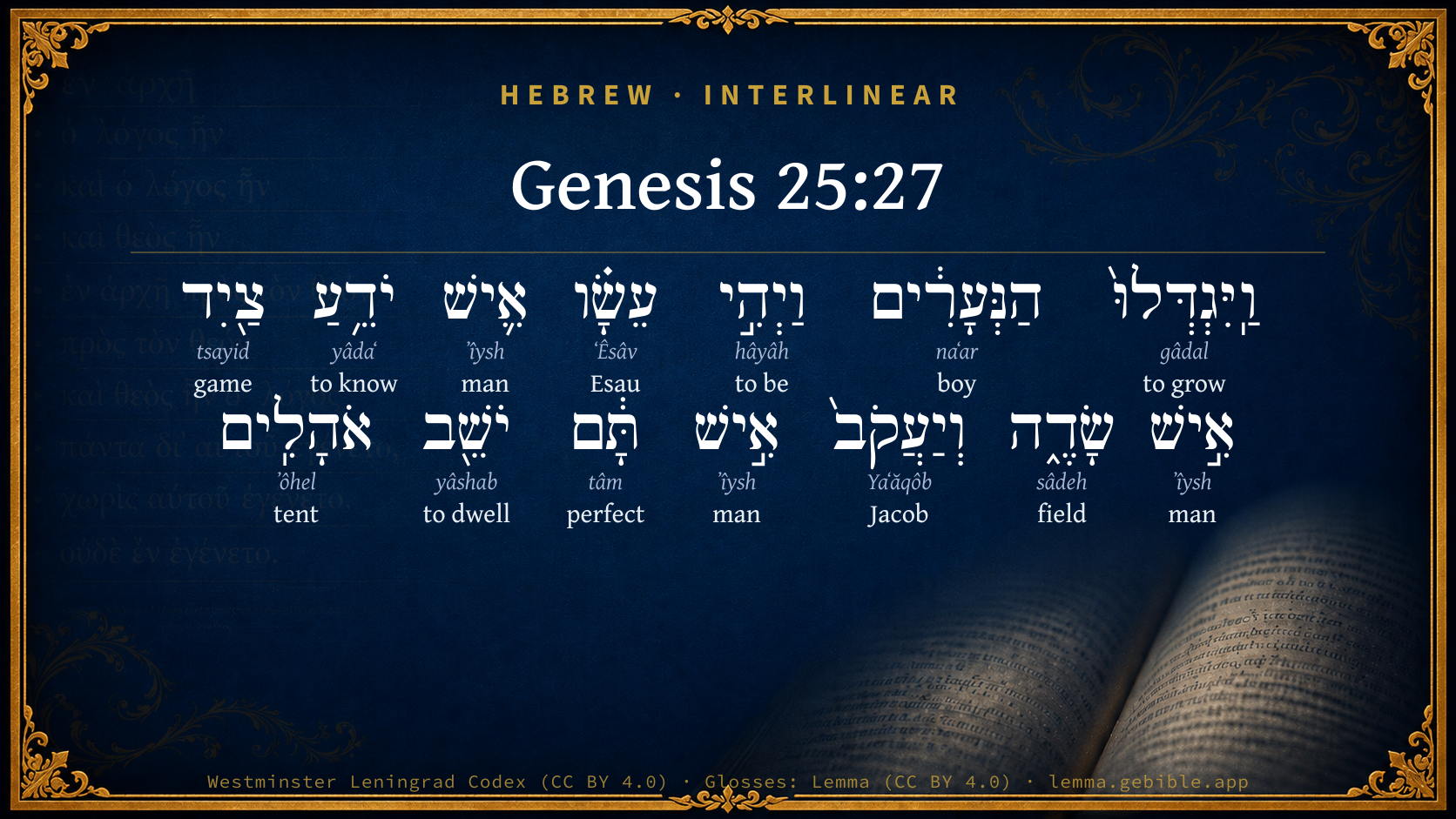
  1. וַֽיִּגְדְּלוּ֙ gâdal H1431 “and · to grow” Conjunction + Verb, Qal, Sequential Imperfect, 3rd Person, Masculine, Plural
  2. הַנְּעָרִ֔ים naʻar H5288 “the · boys” Particle, Definite Article + Noun, Common, Masculine, Plural, Absolute
  3. וַיְהִ֣י hâyâh H1961 “and · to be” Conjunction + Verb, Qal, Sequential Imperfect, 3rd Person, Masculine, Singular
  4. עֵשָׂ֗ו ʻÊsâv H6215 “Esau” Noun, Proper
  5. אִ֛ישׁ ʼîysh H376 “man” Noun, Common, Masculine, Singular, Absolute
  6. יֹדֵ֥עַ yâdaʻ H3045 “knowing” Verb, Qal, Participle Active, Masculine, Singular, Absolute
  7. צַ֖יִד tsayid H6718 “game” Noun, Common, Masculine, Singular, Absolute
  8. אִ֣ישׁ ʼîysh H376 “man of” Noun, Common, Masculine, Singular, Construct
  9. שָׂדֶ֑ה sâdeh H7704 “field” Noun, Common, Masculine, Singular, Absolute
  10. וְיַעֲקֹב֙ Yaʻăqôb H3290 “and · Jacob” Conjunction + Noun, Proper
  11. אִ֣ישׁ ʼîysh H376 “man” Noun, Common, Masculine, Singular, Absolute
  12. יֹשֵׁ֖ב yâshab H3427 “dwelling” Verb, Qal, Participle Active, Masculine, Singular, Absolute
  13. אֹהָלִֽים ʼôhel H168 “tents” Noun, Common, Masculine, Plural, Absolute

About this verse

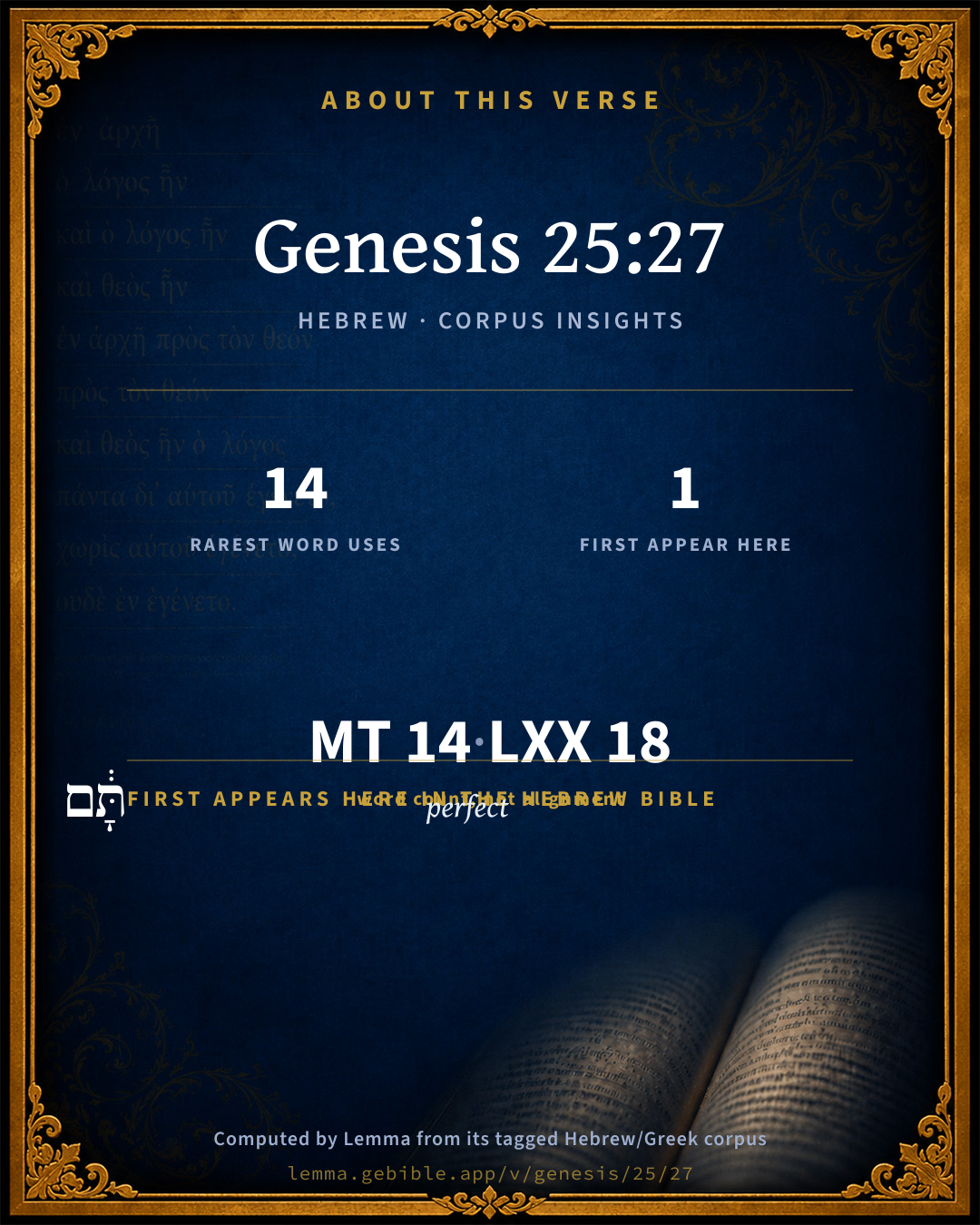
These counts appear in no published source. They are computed here, from the morphology-tagged text and Lemma’s own curated glosses. What Lemma adds →

14
words
12
distinct lemmas
Pentateuch
section

Notable vocabulary

The rarest word here is תָּ֔ם perfect H8535 — appearing just 14 times in the whole Hebrew Bible.

First appearance in Scripture

This word makes its first canonical appearance in the Hebrew Bible here:

  • תָּ֔ם perfect H8535

Shared distinctive vocabulary

תָּ֔ם perfect H8535 occurs in 14 verses of the Hebrew Bible. Also found in:

Grammatical profile

  • 4 verbs
  • 9 nouns
  • 1 adjective

Verb forms

  • וַֽיִּגְדְּלוּ֙ Qal · Sequential Imperfect
  • וַיְהִ֣י Qal · Sequential Imperfect
  • יֹדֵ֥עַ Qal · Participle Active
  • יֹשֵׁ֖ב Qal · Participle Active

Repetition

A word recurs within this verse — often emphatic in Hebrew:

  • אִ֛ישׁ man H376 ×3

Hebrew & Septuagint length

In English translation the verse runs 21 words from the Hebrew and 25 from the Septuagint (LXX English) — closely comparable.

A rough comparison of the two English renderings, which tokenize alike — not a word-level alignment.

Word counts can differ between the Hebrew and the Greek without any difference in meaning — e.g. the Hebrew direct-object marker אֵת has no separate Greek word, and Greek often adds the article ὁ.

In the original languages it is 14 Hebrew tokens and 18 Greek tokens — but the two are counted differently (Hebrew bundles its prefixes and suffixes into one token; the Greek is in lemma form), so that isn’t a like-for-like length.

Cross-references

13

Topical passages linked to Genesis 25:27 in the Treasury of Scripture Knowledge — connected by theme and wording, ordered by reader-vote popularity; previews shown in the World English Bible.

  • Genesis 21:20 God was with the boy, and he grew. He lived in the wilderness, and became, as he grew up, an archer.
  • Hebrews 11:9 By faith, he lived as an alien in the land of promise, as in a land not his own, dwelling in tents, with Isaac and Jacob, the heirs with him of the same promise.
  • Genesis 6:9 This is the history of the generations of Noah. Noah was a righteous man, blameless among the people of his time. Noah walked with God.
  • Genesis 10:9 He was a mighty hunter before Yahweh. Therefore it is said, "Like Nimrod, a mighty hunter before Yahweh."
  • Genesis 28:10–11 Jacob went out from Beersheba, and went toward Haran.
  • Genesis 27:3–5 Now therefore, please take your weapons, your quiver and your bow, and go out to the field, and take me venison.
  • Genesis 27:40 By your sword will you live, and you will serve your brother. It will happen, when you will break loose, That you shall shake his yoke from off your neck."
  • Genesis 31:39–41 That which was torn of animals, I didn't bring to you. I bore the loss of it. Of my hand you required it, whether stolen by day or stolen by night.
  • Genesis 46:34 that you shall say, 'Your servants have been keepers of cattle from our youth even until now, both we, and our fathers:' that you may dwell in the land of Goshen; for every shepherd is an abomination to the Egyptians."
  • Job 1:1 There was a man in the land of Uz, whose name was Job. That man was blameless and upright, and one who feared God, and turned away from evil.
  • Job 1:8 Yahweh said to Satan, "Have you considered my servant, Job? For there is none like him in the earth, a blameless and an upright man, one who fears God, and turns away from evil."
  • Psalms 37:37 Mark the perfect man, and see the upright, For there is a future for the man of peace.
  • Job 2:3 Yahweh said to Satan, "Have you considered my servant Job? For there is none like him in the earth, a blameless and an upright man, one who fears God, and turns away from evil. He still maintains his integrity, although you incited me against him, to ruin him without cause."

Cross-references courtesy of OpenBible.info (CC BY 4.0).

Hebrew and Greek witnesses Masoretic Hebrew ↔ Greek Septuagint

The same verse in the two great witnesses to the Old Testament, shown verse-for-verse.

These are two independent witnesses, not word-aligned to each other, and the Septuagint is shown in lemma (dictionary) form.

Hebrew Genesis 25:27 Masoretic · Westminster Leningrad Codex

וַֽיִּגְדְּלוּ֙ הַנְּעָרִ֔ים וַיְהִ֣י עֵשָׂ֗ו אִ֛ישׁ יֹדֵ֥עַ צַ֖יִד אִ֣ישׁ שָׂדֶ֑ה וְיַעֲקֹב֙ אִ֣ישׁ תָּ֔ם יֹשֵׁ֖ב אֹהָלִֽים

The boys grew. Esau was a skillful hunter, a man of the field. Jacob was a quiet man, living in tents.

World English Bible · Public Domain

Greek LXX Genesis 25:27 Septuagint · lemma form

αὐξάνω δέ ὁ νεανίσκος καί εἰμί ησαυ ἄνθρωπος οἶδα κυνηγέω ἄγροικος ἰακώβ δέ εἰμί ἄνθρωπος ἄπλαστος οἰκέω οἰκία

And the lads grew, and Esau was a man skilled in hunting, dwelling in the country, and Jacob a simple man, dwelling in a house.

LXX2012 (modern English Septuagint) · Public Domain

On this verse, The Pulpit Commentary discusses the Septuagint’s reading. Read the note in Commentary ↓

Hebrew: Westminster Leningrad Codex (CC BY 4.0). Greek: Septuagint (public domain); English from LXX2012 (modern English Septuagint) (Public Domain). How the Septuagint differs from the Hebrew →

Targum (Aramaic paraphrase)

2

The Targum is the ancient Jewish Aramaic paraphrase of the Hebrew Scriptures — an interpretive translation, not the Hebrew text itself. Onkelos (literal) and Pseudo-Jonathan (expansive) render the Torah, and Jonathan the Prophets. Coverage is partial: where no permissively-licensed English translation exists for a verse, only the Aramaic is shown. This is verse-level text, not a word-by-word alignment to the Hebrew.

  1. Targum Onkelos Torah (Genesis–Deuteronomy)
    וּרְבִיוּ עוּלֵמַיָּא וַהֲוָה עֵשָׂו גְבַר נַחְשִׁירְכָן גְבַר נָפֵק לְחַקְלָא וְיַעֲקֹב גְבַר שְׁלִים מְשַׁמֵשׁ בֵּית אוּלְפָנָא

    (no public-domain English translation for this verse)

    Targum Onkelos — Aramaic: “Onkelos Genesis” (public domain); “Onkelos Exodus” (public domain); “Onkelos Leviticus” (public domain); “Onkelos Numbers” (public domain); “Onkelos Deuteronomy” (public domain). English: “Sefaria Community Translation” (CC0 1.0 (public-domain dedication)); “J.W. Etheridge. The Targums of Onkelos and Jonathan Ben Uzziel on the Pentateuch. London: Longmans, Green, 1862” (public domain). Text via Sefaria.

  2. Targum Pseudo-Jonathan Torah (Genesis–Deuteronomy)
    וְרָבִיאוּ טַלְיָא וַהֲוָה עֵשָו גְבַר נַחְשִׁירְכָן לְמִצוֹד עוֹפַן וְחֵיוַון גְבַר נְפִיק חֲקַל קְטֵיל נַפְשִׁין דְהוּא קָטַל יַת נִמְרוֹד וְיַת חֲנוֹךְ בְּרֵיהּ וְיַעֲקב גְבַר שְׁלִים בְּעוֹבָדוֹי וּמְשַׁמֵשׁ בְּבֵית מֶדְרָשָׁא דְעֵבֶר תְּבַע אוּלְפַן מִן קֳדָם יְיָ

    And the lads grew; and Esau was a man of idleness to catch birds and beasts, a man going forth into the field to kill lives, as Nimrod had killed, and Hanok his son. But Jakob was a man peaceful in his words, a minister of the instruction-house of Eber, seeking instruction before the Lord.

    Targum Pseudo-Jonathan — Aramaic: “Targum Jonathan on Genesis” (public domain); “Targum Jonathan on Exodus” (public domain); “Targum Jonathan on Leviticus” (public domain); “Targum Jonathan on Numbers” (public domain); “Targum Jonathan on Deuteronomy” (public domain). English: “The Targum of Jonathan ben Uzziel, trans. J. W. Etheridge, London, 1862” (public domain). Text via Sefaria.

Commentary

Notes on Genesis 25:27 from classic Christian and Jewish commentators (each source and its license shown beneath its notes). The classic Christian expositions comment on the surrounding passage and are grouped to its opening verse, so a note may address several verses; the Jewish commentaries on the Tanakh (Rashi and others) are per-verse, so they appear only where the commentator wrote on this verse.

Lemma curates 59 commentaries, every one of them public domain or Creative Commons licensed, each selected and text-cleaned for this edition rather than reprinted as found. About our sources →

Trapp's Complete Commentary

John Trapp

Gen 25:27 And the boys grew: and Esau was a cunning hunter, a man of the field; and Jacob [was] a plain man, dwelling in tents.

Ver. 27. And the boys grew.] Nature, art, grace, all proceed from less perfect to more perfect. "Grow in grace," saith Peter: {2Pe 3:18} grow "unto a perfect man," even "unto the measure of the stature of the fulness of Christ," saith Paul. {Eph 4:13}

And Esau was a cunning hunter.] Like Nimrod and Ishmael, whom he chose to imitate, rather than Abraham, and those holy patriarchs that had lived before him.

A plain man.] Sept., Aπλαστος, without welt or gard, guile or gall. Gregory hereby notes the diverse dispositions of worldly and godly men.

John Trapp, A Commentary or Exposition upon All the Books of the Old and New Testament (1647–1656) — public domain. Text from a community e-Sword module.

The Biblical Illustrator

Joseph S. Exell

Gen_25:27

And the boys grew: and Esau was a cunning hunter

Esau, the hunter

I.

A man of strong physical nature, a man of passion, with little self-restraint.

II. A man of swift impulse.

III. A man reckless of consequences. The present, the immediate, arrests him.

IV. Esau had no sense of spiritual things. (L. D. Bevan.)

The animal and the spiritual

I. Esau was full of healthy vigour and the spirit of adventure, exulting in field sports, active, muscular, with the rough aspect and the bounding pulse of the free desert. Jacob was a harmless shepherd, pensive and tranquil, dwelling by the hearth and caring only for quiet occupations. Strength and speed and courage and endurance are blessings not lightly to be despised; but he who confines his ideal to them, as Esau did, chooses a low ideal, and one which can bring a man but little peace at the last. Esau reaches but half the blessing of a man, and that the meaner and temporal half; the other half seems seldom or never to have entered his thoughts.

II. So side by side the boys grew up; and the next memorable scene of their history shows us that the great peril of animal life--the peril lest it should forget God altogether and merge into mere uncontrolled, intemperate sensuality--had happened to Esau I For the mess of pottage the sensual hunter sells in one moment the prophecy of the far future and the blessing of a thousand years. Esaus epitaph is the epitaph of a lifetime recording for ever the consummated carelessness of a moment. Esau, a profane person, . . . who for one morsel of meat sold his birthright. Jacob, with all the contemptible faults which lay on the surface of his character, had deep within his soul the faith in the unseen, the sense of dependence on and love to God which Esau did not even comprehend.

1. Cultivate the whole of the nature which God has given you, and in doing so remember that the mind is of more moment than the body, and the soul than both.

2. Beware lest, in a moment of weakness and folly, you sell your birthright and barter your happy innocence for torment and fear and shame. (Archdeacon Farrar.)

Politic hunting

I. His STRENGTH: A HUNTER. Hunting in itself is a delight lawful and laudable, and may well be argued for from the disposition that God hath put into creatures. He hath naturally inclined one kind of beasts to pursue another for mans profit and pleasure. He hath given the dog a secret instinct to follow the hare, the hart, the fox, the boar, as if he would direct a man by the finger of nature to exercise those qualities which His Divine wisdom created in them.

1. This practice of hunting hath in it delight.

2. Benefit. Recreations have also their profitable use, if rightly undertaken.

(1) The health is preserved by a moderate exercise.

(2) The body is prepared and fitted by these sportive to more serious labours, when the hand of war shall set them to it.

(3) The mind, wearied with graver employments, hath thus some cool respiration given it, and is sent back to the service of God with a revived alacrity.

II. HIS POLICY: A CUNNING HUNTER.

1. He had a ravenous and intemperate desire. This appears from three phrases he used:

(1) Feed me, I pray thee (Gen_25:30); satisfy, saturate, satiate me; or, let me swallow at once, as some read it. The words of an appetite insufferable of delay.

(2) To show his eagerness, he doubles the word for haste: with that red, with that red pottage; red was his colour, red was his desire. He coveted red pottage; he dwelt in a red soil, called thereon Idumea; and in the text, therefore was his name called Edom.

(3) He says, I am faint, and (Gen_25:32) at the point to die, if I have it not. Like some longing souls that have so weak a hand over their appetites, that they must die if their humour be not fulfilled.

2. His folly may be argued from his base estimation of the birthright; that he would so lightly part from it, and on so easy conditions as pottage.

3. Another argument of his folly was ingratitude to God, who had in mercy vouchsafed him, though but by a few minutes, the privilege of primogeniture; wherewith divines hold that the priesthood was also conveyed.

4. His obstinacy taxeth his folly, that, after cold blood, leisure to think of the treasure he sold, and digestion of his pottage, he repented, not of his rashness, but (Gen_25:34) He did eat, and drink, and rose up, and went his way--filled his belly, rose up to his former customs, and went his way without a Quidfeci? Therefore it is added, he despised his birthright. He followed his pleasures without any interception of sorrow or interruption of conscience. His whole life was a circle of sinful customs; and not his birthrights loss can put him out of them.

5. Lastly, his perfidious nature appeareth, that though he had made an absolute conveyance of his birthright to Jacob, and sealed the deed with an oath, yet he seemed to make but a jest of it, and purposed in his heart not to perform it. Thus literally; let us now come to some moral application to ourselves. Hunting is, for the most part, taken in the Holy Scripture in the worst sense. So (Gen_10:9) Nimrod was a hunter, even to a proverb; and that before the Lord, as without fear of His majesty. Now, if it were so hateful to hunt beasts, what is it to hunt men? The wicked oppressors of the world are here typed and taxed, who employ both arm and brain to hunt the poor out of their habitations, and to drink the blood of the oppressed Herein observe--

I. The persons hunted.

II. The manner of hunting; and,

III. The hounds.

1. The poor are their prey: any man that either their wit or violence can practise on.

2. You hear the object they hunt; attend the manner. And this you shall find, as Esaus, to consist in two things--force and fraud. They are not only hunters, but cunning hunters.

3. Now for their hounds. Besides that they have long noses themselves, and hands longer than their noses, they have dogs of all sorts. Beagles, cunning intelligencers--the more crafty they are, the more commendable, Their setters, prowling promoters; whereof there may be necessary use, as men may have dogs, but they take them for mischievous purposes. Their spaniels, fawning sycophants, who lick their masters hands, but are brawling ever at poor strangers. Their great mastiffs; surly and sharking bailiffs, that can set a rankling tooth in the poor tenants ribs. Thus I have shown you a field of hunters; what should I add, but my prayers to heaven, and desires to earth, that these hunters may be hunted? The hunting of harmful beasts is commended: the wolf, the boar, the bear, the fox, the tiger, the otter. But the metaphorical hunting of these is more praiseworthy; the country wolves, or city foxes, deserve most to be hunted. (T. Adams.)

Jacob was a plain man, dwelling in tents

First impressions of Jacob

I. JACOB WAS THE FATHER OF THE JEWISH RACE, AND A TYPICAL JEW. If we can understand the life of Jacob, we can understand the history of his people. The extremes which startle us in them are all in him. Like them, he is the most successful schemer of his times; and, like them, he has that deep spirituality, that far-seeing faith, which are the grandest of all qualities, and make a man capable of the highest culture that a human spirit can receive. Like them, he spends the greatest part of his life in exile, and amid trying conditions of toil and sorrow; and, like them, he is inalienably attached to that dear land, his only hold on which was by the promise of God, and the graves of the heroic dead.

II. JACOB HAS SO MANY POINTS OF CONTACT WITH OURSELVES.

1. His failings speak to us.

2. His aspirations speak to us.

3. His sorrows speak to us.

III. IN JACOB WE CAN TRACE THE WORKINGS OF DIVINE LOVE. Jacob have I loved (Mal_1:2).

1. It was pre-natal love.

2. It was fervent love.

3. It was a disciplinary love.

IV. JACOBS LIFE GIVES A CLUE TO THE DOCTRINE OF ELECTION (see Rom_9:11). Election refers largely, if not primarily, to the service which the elect are qualified to render to their fellows throughout all coming time. (F. B. Meyer, B. A.)

Childhood shows the man

I. THAT CONDUCT IN THE DAYS OF YOUTH FOREBODES THE PROCEDURE OF AFTER DAYS.

II. THAT THE BIBLE INDICATES THE RIGHT WAY OF GROWING UP INTO A WORTHY MANHOOD.

III. THAT NATURAL TENDENCIES MUST BE UNDER CONTROL FROM THE OUTSET OF LIFE. Conclusion: Read this item in the life of Jacob and Esau--

1. To learn in what you may be tending to wrong.

2. To impress you with the truth that there are critical hours in every ones life.

3. To realize that there is present help against yielding. (D. G. Watt, M. A.)

Jacobs home life

I. FRATERNAL DISSIMILARITY.

II. PARENTAL PARTIALITY.

III. CONJUGAL, CONTRARIETY. Lessons:

1. The responsibility of parents.

2. The need of love as a cementing influence in home life.

3. The baseness of unbrotherliness.

4. The downward course of sin. (T. S. Dickson.)

Dwelling in tents

Two things are observable in the holy patriarchs, and commendable to all that will be heirs with them of eternal life.

1. Their contempt of the world. They that dwell in tents intend not a long dwelling in a place. They are moveables, ever ready to be transferred at the occasion and will of the inhabiter. Abraham dwelt in tents with Isaac and Jacob, the heirs with him of the same promise (Heb_11:9). The reason is added, for he looked for a city which hath foundations, whose builder and maker is God. These saints studied not to enlarge their barns, as the rich cosmopolite (Luk_12:1-59.), or to sing requiems to their souls, in the hoped perpetuity of earthly habitations. Soul, live; thou hast enough laid up for many years. Fool! he had not enough for that night. They had no thought that their houses should continue for ever, and their dwelling-places to all generations; thereupon calling their lands after their own Psa_49:11). God convinceth the foolish security of the Jews, to whom He had promised (by the Messiah to be purchased) an everlasting royalty in heaven, by the Rechabites (Jer_35:7), who built no houses, but dwelt in tents, as if they were strangers, ready on a short warning for removal. The Church esteems heaven her home, this world but a tent, a tent which we must all leave, build we as high as Babel, as strong as Babylon. When we have fortified, combined, feasted, death comes with a voider, and takes away all.

2. Their frugality should not pass unregarded. Here is no ambition of great buildings; a tent will serve. How differ our days and hearts from those! The fashion is now to build great houses to our lands, till we have no lands to our houses; and the credit of a good house is made, not to consist in outward hospitality, but in outward walls. (T. Adams.)

The advantages of plain dealing

1. The principal is to please God, whose displeasure against double-dealing the sad examples of Saul for the Amalekites, of Gehazi for the bribes, of Ananias for the inheritance, testify in their destruction. Whose delight in plain-dealing Himself affirms: Behold an Israelite indeed, in whom is no guile! (Joh_1:17).

2. The credit of a good name, which is a most worthy treasure, is thus preserved. The riches left thee by thy ancestors may miscarry through others negligence; the name not, save by thy own fault. It is the plain-dealers reward, his name shall be had in estimation; whereas no faith is given to the dissembler, even speaking truth. Every man is more ready to trust the poor plain-dealer than the glittering, false-tongued gallant.

3. It prevents and infatuates all the malicious plots of enemies. God, in regard to thy simplicity, brings to nought all their machinations. Thou, O Lord, hadst respect to my simple pureness. An innocent fool takes fearless steps, and walks as securely as if it stood girt with a wall of brass.

4. It preserves thy state from ruin. When by subtlety men think to scrape together much wealth, all is but the spiders web, artificial and weak. What plain-dealing-gets, sticks by us, and infallibly derives itself to our posterity. If thou wouldst be good to thyself and thine, use plainness.

5. It shall somewhat keep thee from the troubles and vexations of the world.

6. The curses of the poor shall never hurt thee. Though the causeless curse shall never come, yet it is happy for a man so to live that all may bless him. Now the plain man shall have this at last. Gallant prodigality, like fire in flax, makes a great blaze, a hot show, but plain hospitality, like fire in solid wood, holds out to warm the poor, because God blesseth it. So I have seen hot spurs in the way gallop amain; but the ivy bushes have so stayed them, that the plain traveller comes first to his journeys end.

7. It shall be thy best comfort on thy death-bed: the conscience of an innocent life. On this staff leans aged Samuel: Whose ox or ass have I taken?

8. Lastly, thou shalt find rest for thy soul. Thou hast dealt plainly; so will God with thee, multiplying upon thee His promised mercies. (T. Adams.)

Jacobs election; or, Divine sovereignty in its relation to life

I. Although Jacob obtained, in virtue of his election, a certain priority over Esau, yet was Esau also, equally with Jacob, the subject of Divine sovereignty.

II. The appointment of Gods sovereignty concerning these two brothers did in no wise determine their eternal destinies, but only the sphere of their human histories.

III. It may have been the case that the positions severally assigned to both Jacob and Esau in the family of Isaac, were just those which were best adapted to ensure the blessedness of both. Perhaps the only way to bring such a disposition as Esaus to esteem his birthright in Isaac was to transfer it to another. And that this discipline was not lost on Esau the event distinctly shows. (W. Roberts.)

And the boys grew

I. They grew bodily. Natural provision for this. Food, air, exercise, increase bulk of body. Explain. Grew in stature and in strength.

II. They grew mentally. Natural provision for this. Memory a storehouse for facts. Judgment a mill for grinding them up and digesting them. Some boys are careless, dull, disobedient, self-willed, grow slowly, become men bodily and remain children in mind. Providential provision for mental growth. Books, schools, &c. These boys had not these things.

III. They grew very unlike each other. Sketch their differences, bodily, mentally, morally. See rest of verse. Brothers often unlike in temper, taste, &c. With all mental and other differences they should be alike pious. Boy father of the man.

IV. They grew up into history. Which became the most prominent? Why? The practice of prayer at length made Jacob the better man. He overcame evil. Esau degenerated. Learn: You are all growing bodily: are you growing mentally? Do you grow in wisdom and in grace, and in the favour of God and man? Are you growing like Christ, growing up into Christ, growing more fit for heaven?

Constancy and inconstancy in the two brothers

It has been pointed out that the weakness in Esaus character which makes him so striking a contrast to his brother is his inconstancy.

That one error Fill him with faults; makes him run through all the sins.

Constancy, persistence, dogged tenacity is certainly the striking feature of Jacobs character. He could wait and bide his lime; he could retain one purpose year after year till it was accomplished. The very motto of his life was, I will not let Thee go except Thou bless me. He watched for Esaus weak moment, and took advantage of it. He served fourteen years for the woman he loved, and no hardship quenched his love. Nay, when a whole lifetime intervened, and he lay dying in Egypt, his constant heart still turned to Rachel, as if he had parted with her but yesterday. In contrast with his tenacious, constant character stands Esau, led by impulse, betrayed by appetite, everything by turns and nothing long. To-day despising his birthright, to-morrow breaking his heart because for its loss; to-day vowing he will murder his brother, to-morrow falling on his neck and kissing him; a man you cannot reckon upon, and of too shallow a nature for anything to root itself deeply in. (M. Dods, D. D.)

Life revealed in its progress

One ship is as good as another in the harbour. It is outside of the harbour that the comparative merits of different vessels are made to appear. There their qualities, whether superior or inferior, show themselves. It is what ships do on the sea that determines that one is better or worse than another. And as with ships, so with men. Two men start about alike on the morn of life. They go along at first about together. But follow them five or ten years, and about the fifth, the sixth, or the seventh year, the one--a man of pleasure, a godless man, a man that does not believe in a Divine supervision of the affairs of this world--begins to degenerate; while the other--a sober Christian man, who believes that God controls the world and all that are in it--in the beginning lays his foundation, going down so deep that he seems for a time to burrow like a marmot; but then, little by little, he begins to work upward, and he builds so that every hour men see that he is building strongly and surely. (H. W. Beecher.)

The Biblical Illustrator, edited by Joseph S. Exell (c. 1880s–1900s) — public domain. Text from a community e-Sword module.

Joseph Benson's Commentary

Gen 25:27. Jacob was a plain man — This probably means, that he was of a mild and gentle nature, of a contemplative turn of mind, and delighting in a pastoral life.

Joseph Benson's Commentary on the Old and New Testaments (1811–1818) — public domain. Text from a community e-Sword module.

Whedon's Commentary on the Bible

Daniel D. Whedon

SALE OF ESAU’S BIRTHRIGHT, Gen_25:27-34.

27. The boys grew — And their diverse dispositions and tendencies early developed themselves.

Esau was a cunning hunter — A man knowing the chase, or skilled in hunting. We are to think of him as the hairy man, rough, impulsive, desperate; loving the dangers and excitements of the chase.

Jacob was a plain man — אישׁ תם, a complete man. The word תם is generally used of moral uprightness and integrity. The kindred word תמים is used in Gen_17:1, where Jehovah says to Abraham, “walk before me and be thou perfect.” Here the word seems to mean simplicity, mildness, and inoffensiveness of disposition, in contrast with the wild and daring character of Esau. Jacob was a complete man in the simplicity and regularity of his temper and domestic habits.

Daniel D. Whedon (gen. ed.), Commentary on the Old and New Testaments (1874–1909) — public domain. Text from a community e-Sword module.

The Pulpit Commentary

CHAPTER 25:27-34

And the boys grew: and Esau was a cunning hunter, literally, skilled in hunting; eijdwv kunhgein (LXX); gnarus venandi (Vulgate); a sportsmana man of the field; not a husbandman, homo agricola (Vulgate), who is differently denominatedish haadhamah; (Gen_9:20) but one addicted to roaming through the fields in search of sport ajgroikov (LXX); an indication of the rough, fiery nature and wild, adventurous life of the elder of the two brothersand Jacob was a plain man, = aplastov (LXX); simplex (Vulgate); integer, i.e. mitis, of mild and gentle manners (Rosenm blameless, as a shepherd (Knobel); pious (Luther); righteous (Kalisch); obviously intended to describe Jacob as, both in character and life, the antithesis of Esaudwelling in tentsi.e. loving to stay at home, as opposed to Esau, who loved to wander afield; preferring a quiet, peaceable, domestic, and pious manner of existence to a life of "excitement, adventure, and danger," such as captivated Esau.

Vers. 27-34.

The twin brothers.

I THE GROWING LADS.

1. Diverse in daily calling. Esau elected to follow the adventurous and roving life of a hunter; Jacob, the simpler and less exciting occupation of keeping sheep. The principles that guided their respective choices are not explained; but, like the selection of trades by other inexperienced youths, these were doubtless due to physical constitution, mental temperament, the influence of example, the effect of parental counsel, and above all the overruling pro vide nce of God. Cf. Cain and Abel. (Gen_4:2)

2. Unlike in personal character. Esau was a wild man in disposition no less than in action, a youth of strong animal propensities and essentially mundane proclivities. Jacob, without being religious, was quiet, sedate, fond of home life, and studious of peace, though not without a vein of duplicity in his soul"s texture. This diversity in character, not due to parentage, birth, or education, which in both were alike, modem science would explain by molecular arrangement. Biblical theology goes a step behind, and traces it to God. (Rom_9:11)

3. Divided in parental favor. Esau was loved by Isaac, Jacob by Rebekah. Besides being sinful in itself scarcely anything can justify partiality in parental affection the conduct of Isaac and Rebekah was more than likely hurtful to the lads, leaving on their consciences a sense of injustice, estranging them from each other in fraternal regard, and helping them unconsciously to fulfill the untoward destiny of mutual rivalry and jealousy already predicted for them.

II THE TIRED HUNTER.

1. His famishing condition. If Esau was really faint, it indicated too great eagerness in following his sports. Even in honorable callings and profitable pursuits moderation is a duty. Rom_12:11 will assist traders and merchants to preserve the golden mean between slothfulness and slavishness in business. If Esau was not really faint, but only fatigued and hungry, it was an instance of exaggerated talking which with some is common, but by all should be avoided.

2. His ravenous request. This indicated an impatient spirit, which the words attempt to reproduce a spirit characteristic of ill-balanced natures, resulting m most instances from unsubdued selfishness, betraying frequently into sins and faults that might otherwise be avoided, and at all times ill-befitting noble souls and renewed hearts. It also discovered a gluttonous appetite. The glutton"s god is his belly, the glutton"s temple his kitchen, the glutton"s high priest his cook, the gluttons ritual, Let us eat and drink. Let saints beware of gluttony. (Pro_23:2)

III THE DESPISED BIRTHRIGHT.

1. The base proposal. "Sell me this day thy birthright." Jacob"s desire to deprive Esau of his right of primogeniture was envious, unbrotherly, and, in the light of the pre-natal oracle, impatient and unbelieving. The conditions of sale were mean, exacting, and selfish. That Jacob"s conduct was the fruit of grace or faith is difficult to credit, though God, who often works with despicable instruments, over-ruled it for the accomplishment of his own designs.

2. The foolish answer. "Behold, I am at the point to die: and what profit shall this birthright do to me?" An ejaculation discovering both contempt for spiritual and doubt of future things; the very essence of epicureanism, whether ancient or modern.

3. The unholy oath. "Swear to me this day; and he sware unto him." On the part of both giver and receiver this was wrong. Neither had Esau right to part with his birthright until God in his pro vide nce took it from him; nor had Jacob the right to accept that birthright until God transferred it to his hands.

4. The unequal exchange. Jacob got the birthright; Esau got the pottage, Esau the type of many who accept the devil"s bargain of the world (mostly an infinitesimal fragment of it) for a soul.

HOMILIES BY R.A. REDFORD

Ver. 27.

The cunning hunter" is set over against the plain man dwelling in tents.

I THE TWO KINGDOMS, that of material force and that of moral power, are thus represented in contrast and rivalry.

II GOD"S WAYS AND MAN"S WAYS CONTRASTED. The partialities of the parents foster the special faults of the children. Esau is more the man of fleshly impulse because Isaac loved him for his venison. Jacob is more the crafty supplanter because Rebekah by her favoritism encouraged him to take advantage of his brother.

III THE IMPORTANCE OF HOME LIFE IN THE DEVELOPMENT OF CHARACTER. The sins of parents are generally in some form transmitted to children. Esaus new name was Edom, memento of his selfish succumbing to appetite. Jacobs new name was Israel, memento of the victory which by the grace of God he obtained. Esau despised his birthright." It was the natural working of a sensual nature. We begin by yielding to the lower impulses without thinking how they bind their cords round us. At last we lose the power of distinguishing a mere passing evil from an overwhelming danger, and when we ought to fight, cry, I am at the point to die; then in wretched collapse all goes. What is this birthright, what profit?

1. The loss of the sense of responsibility.

2. The absorbing hunger after present gratification.

3. The blindness to all proportion in life.

4. The dullness and stupidity of the animalism which does not even care for the very birthright itself, though it is an earthly advantage.

These are the fearful payments which they have to render who, like Esau, give themselves up to a mere life of the flesh. R.

The Pulpit Commentary (1880–1919), ed. H.D.M. Spence-Jones & Joseph S. Exell — public domain. Text from a community e-Sword module.

MacLaren's Expositions of Holy Scripture

Alexander MacLaren

Genesis

A BAD BARGAIN

Gen 25:27 - Gen 25:34.

Isaac’s small household represented a great variety of types of character. He himself lacked energy, and seems in later life to have been very much of a tool in the hands of others. Rebekah had the stronger nature, was persistent, energetic, and managed her husband to her heart’s content. The twin brothers were strongly opposed in character; and, naturally enough, each parent loved best the child that was most unlike him or her: Isaac rejoicing in the very wildness of the adventurous, dashing Esau; and Rebekah finding an outlet for her womanly tenderness in an undue partiality for the quiet lad that was always at hand to help her and be petted by her.

One’s sympathy goes out to Esau. He was ‘a man of the field,’-by which is meant, not cultivated ground, but open country, which we might call prairie. He was a ‘backwoodsman,’-liked the wild hunter’s life better than sticking at home looking after sheep. He had the attractive characteristics of that kind of men, as well as their faults. He was frank, impulsive, generous, incapable of persevering work or of looking ahead, passionate. His descendants prefer cattle-ranching and gold-prospecting to keeping shops or sitting with their lungs squeezed against a desk.

Jacob had neither the high spirits nor the animal courage of his brother. He was ‘a plain man.’ The word is literally ‘perfect,’ but cannot be used in its deepest sense; for Jacob was very far indeed from being that, but seems to have a lower sense, which might perhaps be represented by ‘steady-going,’ or ‘respectable,’ in modern phraseology. He went quietly about his ordinary work, in contrast with his daring brother’s escapades and unsettledness.

The two types are intensified by civilisation, and the antagonism between them increased. City life tends to produce Jacobs, and its Esaus escape from it as soon as they can. But Jacob had the vices as well as the virtues of his qualities. He was orderly and domestic, but he was tricky, and keenly alive to his own interest. He was persevering and almost dogged in his tenacity of purpose, but he was not above taking mean advantages and getting at his ends by miry roads. He had little love for his brother, in whom he saw an obstacle to his ambition. He had the virtues and vices of the commercial spirit.

But we judge the two men wrongly if we let ourselves be fascinated, as Isaac was, by Esau, and forget that the superficial attractions of his character cover a core worthy of disapprobation. They are crude judges of character who prefer the type of man who spurns the restraints of patient industry and order; and popular authors, who make their heroes out of such, err in taste no less than in morals. There is a very unwholesome kind of literature, which is devoted to glorifying the Esaus as fine fellows, with spirit, generosity, and noble carelessness, whereas at bottom they are governed by animal impulses, and incapable of estimating any good which does not appeal to sense, and that at once.

The great lesson of this story lies on its surface. It is the folly and sin of buying present gratification of appetite or sense at the price of giving up far greater future good. The details are picturesquely told. Esau’s eagerness, stimulated by the smell of the mess of lentils, is strikingly expressed in the Hebrew: ‘Let me devour, I pray thee, of that red, that red there.’ It is no sin to be hungry, but to let appetite speak so clamorously indicates feeble self-control. Jacob’s coolness is an unpleasant foil to Esau’s impatience, and his cautious bargaining, before he will sell what a brother would have given, shows a mean soul, without generous love to his own flesh and blood. Esau lets one ravenous desire hide everything else from him. He wants the pottage which smokes there, and that one poor dish is for the moment more to him than birthright and any future good. Jacob knows the changeableness of Esau’s character, and is well aware that a hungry man will promise anything, and, when fed, will break his promise as easily as he made it. So he makes Esau swear; and Esau will do that, or anything asked. He gets his meal. The story graphically describes the greedy relish with which he ate, the short duration of his enjoyment, and the dark meaning of the seemingly insignificant event, by that accumulation of verbs, ‘He did eat and drink, and rose up and went his way: so Esau despised his birthright.’

Now we may learn, first, how profound an influence small temptations, yielded to, may exert on a life.

Many scoffs have been directed against this story, as if it were unworthy of credence that eating a dish of lentils should have shaped the life of a man and of his descendants. But is it not always the case that trifles turn out to be determining points? Hinges are very small, compared with the doors which move on them. Most lives are moulded by insignificant events. No temptation is small, for no sin is small; and if the occasion of yielding to sense and the present is insignificant, the yielding is not so.

But the main lesson is, as already noted, the madness of flinging away greater future good for present gratifications of sense. One cannot suppose that the spiritual side of ‘the birthright’ was in the thoughts of either brother. Esau and Jacob alike regarded it only as giving the headship of the family. It was merely the right of succession, with certain material accompanying advantages, which Jacob coveted and Esau parted with. But even in regard to merely worldly objects, the man who lives for only the present moment is distinctly beneath him who lives for a future good, however material it may be. Whoever subordinates the present, and is able steadily to set before himself a remote object, for which he is strong enough to subdue the desire of immediate gratifications of any sort, is, in so far, better than the man who, like a savage or an animal, lives only for the instant.

The highest form of that nobility is when time is clearly seen to be the ‘lackey to eternity,’ and life’s aims are determined with supreme reference to the future beyond the grave. But how many of us are every day doing exactly as Esau did-flinging away a great future for a small present! A man who lives only for such ends as may be attained on this side of the grave is as ‘profane’ a person as Esau, and despises his birthright as truly. He knew that he was hungry, and that lentil porridge was good, ‘What good shall the birthright do me?’ He failed to make the effort of mind and imagination needed in order to realise how much of the kind of ‘good’ that he could appreciate it would do to him. The smell of the smoking food was more to him than far greater good which he could only appreciate by an effort. A sixpence held close to the eye can shut out the sun. Resolute effort is needed to prevent the small, intrusive present from blotting out the transcendent greatness of the final future. And for lack of such effort men by the thousand fling themselves away.

To sell a birthright for a bowl of lentils was plain folly. But is it wiser to sell the blessedness and peace of communion with God here and of heaven hereafter for anything that earth can yield to sense or to soul? How many shrewd ‘men of the highest commercial standing’ are making as bad a bargain as Esau’ s! The ‘pottage’ is hot and comforting, but it is soon eaten; and when the bowl is empty, and the sense of hunger comes back in an hour or two, the transaction does not look quite as advantageous as it did. Esau had many a minute of rueful meditation on his bad bargain before he in vain besought his father’s blessing. And suspicions of the folly of their choice are apt to haunt men who prefer the present to the future, even before the future becomes the present, and the folly is manifest. ‘What doth it profit a man, to gain the whole world, and forfeit his life?’

So a character like Esau’s, though it has many fine possibilities about it, and attracts liking, is really of a low type, and may very easily slide into depths of degrading sensualism, and be dead to all nobleness. Enterprise, love of stirring life, impatience of dull plodding, are natural to young lives. Unregulated, impulsive characters, who live for the moment, and are very sensitive to all material delights, have often an air of generosity and joviality which hides their essential baseness; for it is base to live for flesh, either in more refined or more frankly coarse forms. It is base to be incapable of seeing an inch beyond the present. It is base to despise any good that cannot minister to fleeting lusts or fleshly pleasures, and to say of high thought, of ideal aims of any sort, and most of all to say of religion, ‘What good will it do me?’ To estimate such precious things by the standard of gross utility is like weighing diamonds in grocers’ scales. They will do very well for sugar, but not for precious stones. The sacred things of life are not those which do what the Esaus recognise as ‘good.’ They have another purpose, and are valuable for other ends. Let us take heed, then, that we estimate things according to their true relative worth; that we live, not for to-day, but for eternity; and that we suppress all greedy cravings. If we do not, we shall be ‘profane’ persons like Esau, ‘who for one morsel of meat sold his birthright.’

Alexander MacLaren, Expositions of Holy Scripture (1904–1910) — public domain. Text from a community e-Sword module.

Tyndale Open Study Notes

Tyndale Open Resources

25:27-34 Jacob and Esau each developed in accord with his initial characteristics (25:24-26). Esau, the reddish, hairy man, cared about physical things rather than spiritual things (see Heb 12:16); he was finally overcome by physical appetites and sold his birthright. Jacob, the heel grabber, knew the birthright’s value and drove a ruthless bargain to gain it presumptuously from his brother.

25:27 Esau was a skillful hunter and an outdoorsman—a wild man who loved wild country. Jacob had a quiet (or even) temperament and preferred to stay at home (literally dwelling in tents)—i.e., he was civilized.

Tyndale Open Study Notes — © Tyndale Open Resources, licensed CC BY-SA 4.0. Text via the HelloAO Bible API.

Geneva Bible (1599)

Geneva Bible translators

Hebrew, a man of the field.

Or, simple and innocent.

Geneva Bible (1599) marginal notes — public domain. Text via Bolls.life.

Jamieson, Fausset & Brown

Robert Jamieson, A. R. Fausset & David Brown

the boys grew--from the first, opposite to each other in character, manners, and habits.

Jamieson, Fausset & Brown — Commentary Critical and Explanatory on the Whole Bible (1871) — public domain (CC PDM 1.0). Text via the HelloAO Bible API.

Adam Clarke's Commentary

Verse 27. A man of the field] איש שדה ish sadeh, one who supported himself and family by hunting and by agriculture.

Jacob was a plain man] איש תם ish tam, a perfect or upright man; dwelling in tents - subsisting by breeding and tending cattle, which was considered in those early times the most perfect employment; and in this sense the word תם tam, should be here understood, as in its moral meaning it certainly could not be applied to Jacob till after his name was changed, after which time only his character stands fair and unblemished. See Ge 32:26-30.

Adam Clarke's Commentary on the Bible (1810–1826) — public domain. Text from a community e-Sword/MySword module.

John Calvin's Commentaries

27. And the boys grew. Moses now briefly describes the manners of them both. He does not, indeed, commend Jacob on account of those rare and excellent qualities, which are especially worthy of praise and of remembrance, but only says that he was simple. The word תם (tam,) although generally taken for upright and sincere, is here put antithetically. After the sacred writer has stated that Esau was robust, and addicted to hunting, he places on the opposite side the mild disposition of Jacob, who loved the quiet of home so much, that he might seem to be indolent; just as the Greeks call those persons οἰκόσιτους oikositous, who, dwelling at home, give no evidence of their industry. In short, the comparison implies that Moses praises Esau on account of his vigor, but speaks of Jacob as being addicted to domestic leisure; and that he describes the disposition of the former as giving promise that he would be a courageous man, while the disposition of the latter had nothing worthy of commendation. Seeing that, by a decree of heaven, the honor of primogeniture would be transferred to Jacob, why did God suffer him to lie down in his tent, and to slumber among ashes; unless it be, that he sometimes intends his election to be concealed for a time, lest men should attribute something to their own preparatory acts?

John Calvin's Commentaries (1540-1563) — public domain. Text from the Calvin Translation Society English edition (1840s-50s) via the Christian Classics Ethereal Library (ccel.org). Calvin's coverage is partial (roughly two-thirds of the Bible); uncommented books and verses are honest gaps, never fabricated. The 19th-century editor's footnotes and remarks are omitted so the notes are faithfully Calvin's own voice.

Ellicott's Commentary for English Readers

DEVELOPMENT OF THE CHARACTERS OF ESAU AND JACOB. ESATU SELLS HIS BIRTHRIGHT.

(27) The “boys grew.—With advancing years came also the formation of their characters. Esau became a skilful hunter, a “man of the field”: not a husbandman, but one who roamed over the open uncultivated wilderness (see Gen_4:8) in search of game; but “Jacob was a plain man.” This is a most inadequate rendering of a word translated perfect in Job_1:1; Job_1:8; Psa_37:37, &c, though this rendering is as much too strong as that in this verse is too weak. On Gen_6:9, we have shown that the word conveys no idea of perfection or blamelessness, but only of general integrity. Both the word there and in Gen_17:1, and the slightly different form of it used here, should in all places be translated upright.

Dwelling in tents.—Esau equally had a tent for his abode, but Jacob stayed at home, following domestic occupations, and busied about the flocks and cattle. Hence he was the mother’s darling, while Isaac preferred his more enterprising son. Thus the struggle between the twins led also to a divergence of feeling on the part of the parents. Throughout his history Jacob maintains this character, and appears as a man whose interests and happiness were centred in his home.

A Bible Commentary for English Readers, edited by Charles John Ellicott (1878–1897) — public domain. Text from a community e-Sword module.

The Cambridge Bible for Schools and Colleges

gen. ed. J. J. S. Perowne

27. a cunning hunter] That is a skilful, expert hunter. The word “cunning” is used in its old English sense, with no idea of craft or deceit; see 1Sa_16:16. The Heb. means having a knowledge of the chase. LXX εἰδὼς κυνηγεῖν, Lat. gnarus venandi.

a man of the field] i.e. a man who spends his days in the open country. But this meaning is missed by the versions, LXX ἄγροικος, Lat. agricola.

a plain man] i.e., as R.V. marg., quiet or harmless, Lat. integer. “Plain,” in Old English, is used for “simple,” “honest”: cf. “For he [Antonius] was a plaine man, without subletie” (North’s Plutarch, Antonius, p. 979); “Plaine, faithful, true, and enimy of shame” (Spenser, F. Q., i. 6, § 20).

The meaning seems to be that of a solid, simple, home-abiding man. LXX ἄπλαστος, Lat. simplex. Cf. the German fromm.

dwelling in tents] Cf. Gen_4:20. The life of Jacob, the herdsman and the shepherd, is contrasted with that of the fierce and roving huntsman. The ideal patriarchal habit of life seems to be pastoral.

The Cambridge Bible for Schools and Colleges (gen. ed. J. J. S. Perowne; Cambridge University Press, 1878–1918) — public domain. Text from a community e-Sword module.

John Gill's Exposition

And the boys grew,.... In stature, became strong and fit for business, and betook themselves to different employments:

and Esau was a cunning hunter, a man of the field: whose business lay in tilling and sowing it, which his father Isaac followed sometimes; or rather he chose to range about the field and hunt after beasts and birds, in which he was very expert, and contrived traps and snares to catch them in; and this course of life was most agreeable to his temper and disposition, being active, fierce, and cruel; according to the Targum of Jonathan, he was also a hunter and slayer of men, Nimrod and Henoch his son:

and Jacob was a plain man; an honest plain hearted man, whose heart and tongue went together; a quiet man, that gave no disturbance to others; a godly man, sincere, upright, and perfect, that had the truth of grace and holiness in him, as well as the perfect righteousness of his Redeemer on him:

dwelling in tents; keeping at home and attending the business of the family, as we afterwards find him boiling pottage, Gen 25:29; or rather this denotes his pastoral life, being a shepherd, he dwelt in tents, which could be removed from place to place for the convenience of pasturage: Jarchi's note is,"in the tent of Shem and in the tent of Eber;''agreeably to the Targum of Jonathan,"a minister in the school of Shem, seeking doctrine from the Lord;''a student there, where he resided awhile, in order to be instructed in the doctrines of truth and righteousness.

John Gill's Exposition of the Whole Bible (1746–1763) — public domain (CC PDM 1.0). Text via the HelloAO Bible API.

Haydock's Catholic Bible Commentary

A husbandman: a rustic, both in profession and manners, like Cain; while Jacob was a shepherd, in imitation of Abel, plain and honest. (Haydock)

George Leo Haydock (1774–1849), Haydock's Catholic Family Bible and Commentary, 1859 edition — public domain. Excludes Psalms (Douay-Rheims chapter numbering differs from Protestant) and Deuterocanonical books (Catholic canon only).

Matthew Poole's English Annotations

Esau was a hunter of wild beasts, and afterwards an oppressor of men. Compare Gen 10:9. This course of life was most agreeable to his complexion, fierce and violent.

A man of the field; one that delighted more in conversing abroad than at home, whose employment it was to pursue the beasts through fields, and woods, and mountains, who therefore chose a habitation fit for his purpose in Mount Seir.

A plain man, a sincere, honest, and plain-hearted man; or a just and perfect man, as the word is used, Gen 6:9;

dwelling in tents, quietly minding the management of his own domestic affairs, his lands and cattle, and giving no disturbance either to wild beasts or men.

Matthew Poole's English Annotations on the Holy Bible (1683–1685) — public domain. Text from a community e-Sword/MySword module.

John Wesley's Explanatory Notes

Esau was an hunter - And a man that knew how to live by his wits, for he was a cunning hunter. A man of the field - All for the game, and never so well but as when he was in pursuit of it. And Jacob was a plain man - An honest man, that dealt fairly. And dwelt in tents - Either,

1. As a shepherd, loving that safe and silent employment of keeping sheep, to which also he bred up his children, chap. xlvi, 34. Or,

2. As a student, he frequented the tents of Melchizedek or Heber, as some understand it, to be taught by them divine things.

John Wesley, Explanatory Notes Upon the Whole Bible (1754–1765) — public domain. Text via the GEBible commentary corpus.

Keil & Delitzsch

C. F. Keil & F. Delitzsch

Esau became "a cunning hunter, a man of the field," i.e., a man wandering about in the fields. He was his father's favourite, for "venison was in his mouth," i.e., he was fond of it. But Jacob was תּם אישׁ, "a pious man" (Luther); תּם, integer, denotes here a disposition that finds pleasure in the quiet life of home. אהלים ישׁב, not dwelling in tents, but sitting in the tents, in contrast with the wild hunter's life led by his brother; hence he was his mother's favourite.

Keil & Delitzsch — Biblical Commentary on the Old Testament (1861–1891) — public domain (CC PDM 1.0). Text via the HelloAO Bible API. (Old Testament only.)

unfoldingWord translationNotes

Door43 World Missions Community

became a skillful hunter

"became good at hunting and killing animals for food"

a quiet man

"a peaceful man" or "a less active man"

who spent his time in the tents

This speaks about time as if it were a commodity that someone could spend. AT: "who remained in the tents much of the time" (See: Metaphor)

Now

This word is used to mark a change in focus, shifting from the story to background information about Isaac and Rebekah. (See: Background Information)

Isaac loved

Here the word "loved" means "favored" or "preferred."

because he ate the animals that he had hunted

"because he ate the animals that Esau had hunted" or "because he enjoyed eating the wild animal meat that Esau caught"

translationWords

Esau

Jacob

tent

Isaac

love

Rebekah

unfoldingWord translationNotes — © Distant Shores Media and the Door43 World Missions Community, licensed CC BY-SA 4.0. Source: git.door43.org/Door43/en_tn.

Rashi

Rabbi Shlomo Yitzchaki (Rashi)

ויגדלו… ויהי עשו AND THEY GREW … AND ESAU WAS — So long as they were young they could not be distinguished by what they did and no one paid much attention to their characters, but when they reached the age of thirteen, one went his way to the houses of learning and the other went his way to the idolatrous temples (Genesis Rabbah 63:10).

יודע ציד A CUNNING HUNTER literally, understanding hunting — understanding how to entrap and deceive his father with his mouth. He would ask him, “Father how should salt and straw be tithed”? (Genesis Rabbah 63:10) (although he knew full well that these are not subject to the law of tithe). Consequently his father believed him to be very punctilious in observing the divine ordinances.

איש שדה A MAN OF THE FIELD — Explain it literally (i.e., not in a Midrashic manner): a man without regular occupation, hunting beasts and birds with his bow.

תם A PLAIN MAN — not expert in all these things: as his heart was his mouth (his thoughts and his words tallied). One who is not ingenious in deceiving people is called תם plain, simple.

יושב אהלים DWELLING IN TENTS — the tent of Shem and the tent of Eber (Genesis Rabbah 63:10).

Rashi on the Tanakh — English translations: “The Judaica Press complete Tanach with Rashi, translated by A. J. Rosenberg” (CC BY 4.0); “Pentateuch with Rashi's commentary by M. Rosenbaum and A.M. Silbermann, 1929-1934” (public domain); “The Metsudah Tanach series, Lakewood, N.J” (CC BY 4.0); and “The Book of Joshua, Metsudah Publications, 1997” (CC BY 4.0). Text via Sefaria.

Radak

Rabbi David Kimhi (Radak)

ויגדלו הנערים, as soon as they grew up their activities diverged completely from one another, one concentrating on mundane activities, activities which showed immediate profitable results, the other concentrating on the acquisition of knowledge, wisdom, i.e. abstract matters. One was an extrovert, at home in the fields, mountains, etc, whereas the other was an introvert as reflected in the term יושב אהלים.

אהלים, the reason why the Torah wrote this word in the plural mode is because Yaakov studied with any wise man he came across. He was indiscriminating in this regard, being totally devoid of deceit or evil, wanting only to amass knowledge.

Radak on the Tanakh — English translations: “Sefaria Community Translation” (CC0 1.0 (public-domain dedication)); “Eliyahu Munk, HaChut Hameshulash” (CC BY 4.0); “Rabbi Mike Feuer, Jerusalem Anthology” (CC BY 4.0); and “R. David Kimhi on the first book of Psalms, Translated by R.G. Finch, London, 1919” (public domain). Text via Sefaria.

Lesson kit

Teaching starters — assembled from the data on this page, not authored interpretation. Every prompt links to the verse data it draws on. Edit before teaching.

Genesis, in the Pentateuch, opens this verse with 14 words (12 distinct Hebrew lemmas). Its most distinctive word is tâm (“perfect”). A historical commentator’s framing appears above. Read the whole chapter for the surrounding context.

Discussion questions

  1. The word tâm carries the sense “perfect.” How does it shape the verse?
  2. The word “perfect” first appears here in Scripture. What is being introduced at this debut?
  3. Exodus 26:24 shares the word «perfect» with this verse. How do the two illuminate each other?
  4. “man” occurs 3× in this one verse. What is the effect of the repetition?
  5. The translations on this page render this verse differently — a whole-verse word diff, not a word-by-word alignment. What might account for the different wordings?
  6. The verb «וַֽיִּגְדְּלוּ֙» is Qal Sequential Imperfect. How does its form color the action?
  7. Reading how Trapp's Complete Commentary and The Biblical Illustrator read this verse, where do the two commentators agree and where do they part?

Things to notice

Reading settings

Reading text

Shown beneath each verse's original-language words.

Old Testament
Old Testament edition

Read the OT as the Masoretic Hebrew (MT) or the Greek Septuagint (LXX).

English shown for the Greek Septuagint (in the Hebrew ↔ Greek comparison).

Comparing translations? Open the Compare panel on any verse page to stack up to four side by side.