
Genesis 43:15

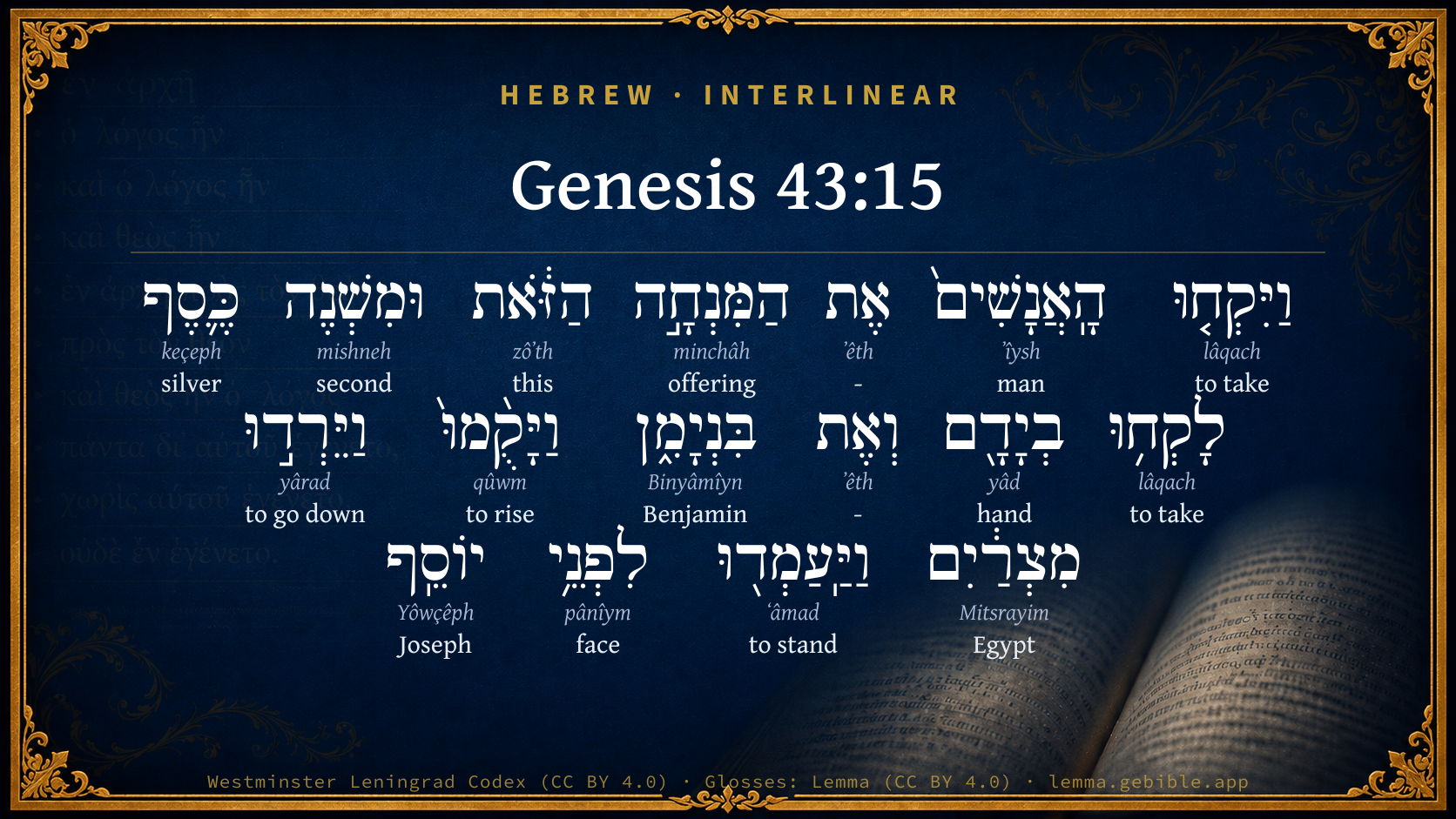
Hebrew (Westminster Leningrad Codex) Genesis 43:15 appears in the Hebrew Old Testament. The text above is from the Westminster Leningrad Codex. Each word links to its Strong’s number, a concise gloss, and parsing drawn from the Open Scriptures Hebrew Bible morphology. Click any word for its full Brown-Driver-Briggs (BDB) entry.
Download image
Cite this verse

Genesis 43:15 (World English Bible). Public Domain. Lemma interlinear Bible study tool, https://lemma.gebible.app/v/genesis/43/15.

Show BibTeX & RIS
BibTeX
RIS
English Translation
The men took that present, and they took double money in their hand, and Benjamin; and rose up, went down to Egypt, and stood before Joseph.
World English Bible · Public Domain
Download a study sheet

One document with this verse’s original text, its word-by-word gloss line, the meaning frame, cross-references with their text, attributed commentary, and full source and license credits — printable, and it pastes into notes with its structure intact.

This verse Autodidact and up

Study sheet (.html) Plain text (.txt)

A passage Seminary Student

Up to 50 verses in one chapter. A passage sheet keeps up to 6 commentary sources and 12 cross-references per verse, in the order this page ranks them, and says so on the sheet whenever that leaves anything out. Ask for a single verse and you get the Autodidact verse sheet above.

Everything on this page stays free to read, with no account — the sheet is a download of what is already on screen, not access to it.

Want to remove ads? Support Godless Engineer
Compare translations 3

The same verse in 3 English versions, stacked beneath the original-language interlinear above. Click any original word for its lexicon entry.

Each is an independent rendering of the whole verse — the interlinear is not word-aligned to these translations.

Highlighted words mark where these versions differ — a whole-verse word diff, not a word-by-word alignment.

  • World English Bible Public Domain
    The men took that present, and they took double money in their hand, and Benjamin; and rose up, went down to Egypt, and stood before Joseph.
  • King James Version Public Domain
    And the men took that present, and they took double money in their hand and Benjamin; and rose up, and went down to Egypt, and stood before Joseph.
  • unfoldingWord Literal Text CC BY-SA 4.0
    Then the men took that gift, and they took double the silver in their hand, and Benjamin. Then they got up and went down Egypt and stood before Joseph.

unfoldingWord Literal Text — © unfoldingWord, licensed CC BY-SA 4.0. Word-aligned USFM3 via Door43 (git.door43.org/unfoldingWord/en_ult).

Versions to compare (up to 4)

3 of 4 selected

Show all 18 translations

Every available English version of this verse, each an independent rendering of the whole verse.

  • World English Bible Public Domain
    The men took that present, and they took double money in their hand, and Benjamin; and rose up, went down to Egypt, and stood before Joseph.
  • Berean Standard Bible Public Domain
    So the men took these gifts, along with double the amount of silver, and Benjamin as well. Then they hurried down to Egypt and stood before Joseph.
  • Majority Standard Bible Public Domain
    So the men took these gifts, along with double the amount of silver, and Benjamin as well. Then they hurried down to Egypt and stood before Joseph.
  • King James Version Public Domain
    And the men took that present, and they took double money in their hand and Benjamin; and rose up, and went down to Egypt, and stood before Joseph.
  • American Standard Version (1901) Public Domain
    And the men took that present, and they took double money in their hand, and Benjamin; and rose up, and went down to Egypt, and stood before Joseph.
  • Revised Version (1885) Public Domain
    And the men took that present, and they took double money in their hand, and Benjamin; and rose up, and went down to Egypt, and stood before Joseph.
  • Geneva Bible (1599) Public Domain
    Thus the men tooke this present, and tooke twise so much money in their hande with Beniamin, and rose vp, and went downe to Egypt and stoode before Ioseph.
  • Douay-Rheims (1899) Public Domain
    So the men took the presents, and double money, and Benjamin: and went down into Egypt, and stood before Joseph.
  • Young's Literal Translation Public Domain
    And the men take this present, double money also they have taken in their hand, and Benjamin; and they rise, and go down to Egypt, and stand before Joseph;
  • Literal Standard Version CC BY-SA 4.0
    And the men take this present, double money also they have taken in their hand, and Benjamin; and they rise, and go down to Egypt, and stand before Joseph;
  • Unlocked Literal Bible CC BY-SA 4.0
    The men took this gift, and in their hand they took double the amount of money, along with Benjamin. They got up and went down to Egypt and stood before Joseph.
  • unfoldingWord Literal Text CC BY-SA 4.0
    Then the men took that gift, and they took double the silver in their hand, and Benjamin. Then they got up and went down Egypt and stood before Joseph.
  • Darby Bible Public Domain
    And the men took that gift, and took double money in their hand, and Benjamin, and rose up, and went down to Egypt, and came before Joseph.
  • World Messianic Bible Public Domain
    The men took that present, and they took double money in their hand, and Benjamin; and got up, went down to Egypt, and stood before Joseph.
  • Webster's Bible Public Domain
    \\43:16\\And when Joseph saw Benjamin with them, he said to the ruler of his house, Bring these men home, and slay, and make ready: for these men shall dine with me at noon.
  • Free Bible Version CC BY-SA 4.0
    So they packed the gifts, took double the money, and set off, accompanied by Benjamin. They arrived in Egypt and went to have an audience with Joseph.
  • Bible in Basic English Public Domain
    And when Joseph saw Benjamin, he said to his chief servant, Take these men into my house, and make ready a meal, for they will take food with me in the middle of the day.
  • JPS Tanakh (1917) Public Domain
    And the men took that present, and they took double money in their hand, and Benjamin; and rose up, and went down to Egypt, and stood before Joseph.

Literal Standard Version (2020), Covenant Press — licensed CC BY-SA 4.0. Text via the HelloAO Bible API (eBible.org). Unlocked Literal Bible (unfoldingWord) — licensed CC BY-SA 4.0. Text via the HelloAO Bible API (eBible.org). unfoldingWord Literal Text — © unfoldingWord, licensed CC BY-SA 4.0. Word-aligned USFM3 via Door43 (git.door43.org/unfoldingWord/en_ult). Free Bible Version, Dr. Jonathan Gallagher — licensed CC BY-SA 4.0. Text via the HelloAO Bible API (eBible.org).

Word by word

More ways to search: Search by grammar → Find every occurrence → Compare this word →

Practice this passage: Drill this verse → Learn its vocabulary →

וּמִשְׁנֶה
mishneh
H4932
“and · second”
Conjunction + Noun, Common, Masculine, Singular, Absolute
Part of Speech
Conjunction + Noun
Type
Common
Gender
Masculine
Number
Singular
State
Absolute
Full BDB Definition

Origin: from H8138

TWOT: 2421c

double, copy, second, repetition - double - copy (of law) - second (in order) - second rank - second in age - second quarter or district
  1. וַיִּקְח֤וּ lâqach H3947 “and · to take” Conjunction + Verb, Qal, Sequential Imperfect, 3rd Person, Masculine, Plural
  2. הָֽאֲנָשִׁים֙ ʼîysh H376 “the · men” Particle, Definite Article + Noun, Common, Masculine, Plural, Absolute
  3. אֶת ʼêth H853 “-” Particle, Direct Object
  4. הַמִּנְחָ֣ה minchâh H4503 “the · offering” Particle, Definite Article + Noun, Common, Feminine, Singular, Absolute
  5. הַזֹּ֔את zôʼth H2063 “the · this” Particle, Definite Article + Pronoun, Demonstrative, Feminine, Singular
  6. כֶּ֛סֶף keçeph H3701 “silver” Noun, Common, Masculine, Singular, Absolute
  7. לָקְח֥וּ lâqach H3947 “to take” Verb, Qal, Perfect, 3rd Person, Common, Plural
  8. בְיָדָ֖ם yâd H3027 “in/at · hand · their” Preposition + Noun, Common, Both, Singular, Construct + Suffix, Personal, 3rd Person, Masculine, Plural
  9. וְאֶת ʼêth H853 “and · -” Conjunction + Particle, Direct Object
  10. בִּנְיָמִ֑ן Binyâmîyn H1144 “Benjamin” Noun, Proper
  11. וַיָּקֻ֨מוּ֙ qûwm H6965 “and · to rise” Conjunction + Verb, Qal, Sequential Imperfect, 3rd Person, Masculine, Plural
  12. וַיֵּרְד֣וּ yârad H3381 “and · to go down” Conjunction + Verb, Qal, Sequential Imperfect, 3rd Person, Masculine, Plural
  13. מִצְרַ֔יִם Mitsrayim H4714 “Egypt” Noun, Proper
  14. וַיַּֽעַמְד֖וּ ʻâmad H5975 “and · to stand” Conjunction + Verb, Qal, Sequential Imperfect, 3rd Person, Masculine, Plural
  15. לִפְנֵ֥י pânîym H6440 “to/for · face(s) of” Preposition + Noun, Common, Both, Plural, Construct
  16. יוֹסֵֽף Yôwçêph H3130 “Joseph” Noun, Proper

About this verse

These counts appear in no published source. They are computed here, from the morphology-tagged text and Lemma’s own curated glosses. What Lemma adds →

17
words
15
distinct lemmas
Pentateuch
section

Shared distinctive vocabulary

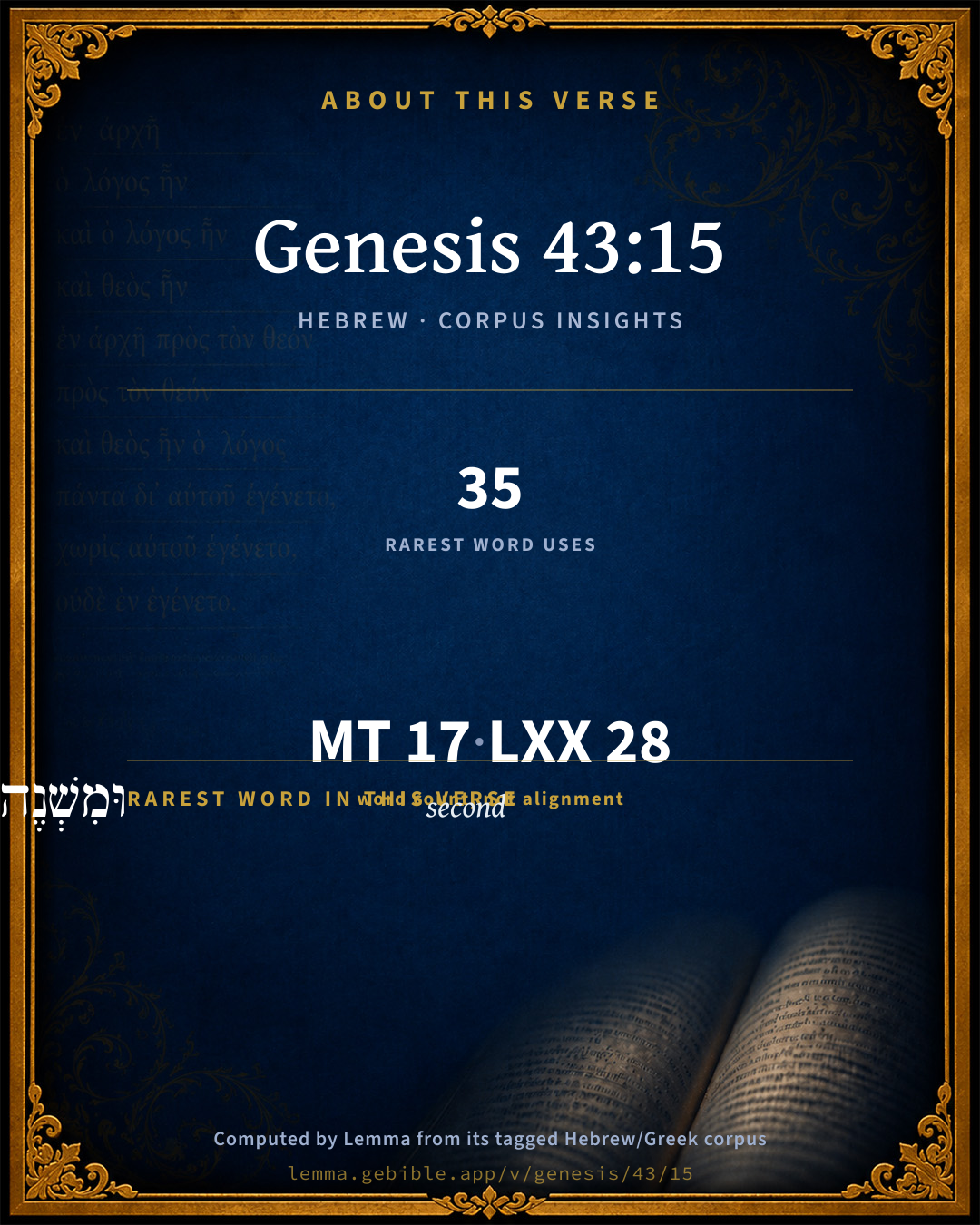
וּמִשְׁנֶה second H4932 occurs in 34 verses of the Hebrew Bible. Also found in:

Grammatical profile

  • 5 verbs
  • 9 nouns
  • 1 pronoun
  • 2 particles

Verb forms

  • וַיִּקְח֤וּ Qal · Sequential Imperfect
  • לָקְח֥וּ Qal · Perfect
  • וַיָּקֻ֨מוּ֙ Qal · Sequential Imperfect
  • וַיֵּרְד֣וּ Qal · Sequential Imperfect
  • וַיַּֽעַמְד֖וּ Qal · Sequential Imperfect

Repetition

A word recurs within this verse — often emphatic in Hebrew:

  • וַיִּקְח֤וּ to take H3947 ×2

Hebrew & Septuagint length

In English translation the verse runs 26 words from the Hebrew and 30 from the Septuagint (LXX English) — closely comparable.

A rough comparison of the two English renderings, which tokenize alike — not a word-level alignment.

Word counts can differ between the Hebrew and the Greek without any difference in meaning — e.g. the Hebrew direct-object marker אֵת has no separate Greek word, and Greek often adds the article ὁ.

In the original languages it is 17 Hebrew tokens and 28 Greek tokens — but the two are counted differently (Hebrew bundles its prefixes and suffixes into one token; the Greek is in lemma form), so that isn’t a like-for-like length.

Hebrew and Greek witnesses Masoretic Hebrew ↔ Greek Septuagint

The same verse in the two great witnesses to the Old Testament, shown verse-for-verse.

These are two independent witnesses, not word-aligned to each other, and the Septuagint is shown in lemma (dictionary) form.

Hebrew Genesis 43:15 Masoretic · Westminster Leningrad Codex

וַיִּקְח֤וּ הָֽאֲנָשִׁים֙ אֶת הַמִּנְחָ֣ה הַזֹּ֔את וּמִשְׁנֶה כֶּ֛סֶף לָקְח֥וּ בְיָדָ֖ם וְאֶת בִּנְיָמִ֑ן וַיָּקֻ֨מוּ֙ וַיֵּרְד֣וּ מִצְרַ֔יִם וַיַּֽעַמְד֖וּ לִפְנֵ֥י יוֹסֵֽף

The men took that present, and they took double money in their hand, and Benjamin; and rose up, went down to Egypt, and stood before Joseph.

World English Bible · Public Domain

Greek LXX Genesis 43:15 Septuagint · lemma form

λαμβάνω δέ ὁ ἀνήρ ὁ δῶρον οὗτος καί ὁ ἀργύριον διπλοῦς λαμβάνω ἐν ὁ χείρ αὐτός καί ὁ βενιαμίν καί ἀναἵστημι καταβαίνω εἰς αἴγυπτος καί ἵστημι ἐναντίον ιωσηφ

And the men having taken these presents, and the double money, took in their hands also Benjamin; and they rose up and went down to Egypt, and stood before Joseph.

LXX2012 (modern English Septuagint) · Public Domain

Hebrew: Westminster Leningrad Codex (CC BY 4.0). Greek: Septuagint (public domain); English from LXX2012 (modern English Septuagint) (Public Domain). How the Septuagint differs from the Hebrew →

Targum (Aramaic paraphrase)

2

The Targum is the ancient Jewish Aramaic paraphrase of the Hebrew Scriptures — an interpretive translation, not the Hebrew text itself. Onkelos (literal) and Pseudo-Jonathan (expansive) render the Torah, and Jonathan the Prophets. Coverage is partial: where no permissively-licensed English translation exists for a verse, only the Aramaic is shown. This is verse-level text, not a word-by-word alignment to the Hebrew.

  1. Targum Onkelos Torah (Genesis–Deuteronomy)
    וּנְסִיבוּ גֻּבְרַיָּא יָת תִּקְרֻבְתָּא הָדָא וְעַל חַד תְּרֵין כַּסְפָּא נְסִיבוּ בִידֵיהוֹן וּדְבָרוּ יָת בִּנְיָמִן וְקָמוּ וּנְחָתוּ לְמִצְרַיִם וְקָמוּ קֳדָם יוֹסֵף

    (no public-domain English translation for this verse)

    Targum Onkelos — Aramaic: “Onkelos Genesis” (public domain); “Onkelos Exodus” (public domain); “Onkelos Leviticus” (public domain); “Onkelos Numbers” (public domain); “Onkelos Deuteronomy” (public domain). English: “Sefaria Community Translation” (CC0 1.0 (public-domain dedication)); “J.W. Etheridge. The Targums of Onkelos and Jonathan Ben Uzziel on the Pentateuch. London: Longmans, Green, 1862” (public domain). Text via Sefaria.

  2. Targum Pseudo-Jonathan Torah (Genesis–Deuteronomy)
    וּנְסִיבוּ גוּבְרַיָא יַת דוֹרוֹנָא הָדָא וְעַל חַד תְּרֵין כַּסְפָּא נְסִיבוּ בִּידֵיהוֹן וּדְבָרוּ יַת בִּנְיָמִין וּנְחָתוּ לְמִצְרַיִם וְאִיתְעַתְּדוּ קֳדָם יוֹסֵף

    The men took the present, and the money two for one in their hands, and they took Benjamin, and went down to Mizraim, and stood before Joseph.

    Targum Pseudo-Jonathan — Aramaic: “Targum Jonathan on Genesis” (public domain); “Targum Jonathan on Exodus” (public domain); “Targum Jonathan on Leviticus” (public domain); “Targum Jonathan on Numbers” (public domain); “Targum Jonathan on Deuteronomy” (public domain). English: “The Targum of Jonathan ben Uzziel, trans. J. W. Etheridge, London, 1862” (public domain). Text via Sefaria.

Commentary

Notes on Genesis 43:15 from classic Christian and Jewish commentators (each source and its license shown beneath its notes). The classic Christian expositions comment on the surrounding passage and are grouped to its opening verse, so a note may address several verses; the Jewish commentaries on the Tanakh (Rashi and others) are per-verse, so they appear only where the commentator wrote on this verse.

Lemma curates 59 commentaries, every one of them public domain or Creative Commons licensed, each selected and text-cleaned for this edition rather than reprinted as found. About our sources →

Jamieson, Fausset & Brown

Robert Jamieson, A. R. Fausset & David Brown

ARRIVAL IN EGYPT. (Gen. 43:15-30)

stood before Joseph--We may easily imagine the delight with which, amid the crowd of other applicants, the eye of Joseph would fix on his brethren and Benjamin. But occupied with his public duties, he consigned them to the care of a confidential servant till he should have finished the business of the day.

Jamieson, Fausset & Brown — Commentary Critical and Explanatory on the Whole Bible (1871) — public domain (CC PDM 1.0). Text via the HelloAO Bible API.

Trapp's Complete Commentary

John Trapp

Gen 43:15 And the men took that present, and they took double money in their hand, and Benjamin; and rose up, and went down to Egypt, and stood before Joseph.

Ver. 15. Double money in their hand.] Both that they met with in their sacks’ mouths, and new money to buy more.

John Trapp, A Commentary or Exposition upon All the Books of the Old and New Testament (1647–1656) — public domain. Text from a community e-Sword module.

The Biblical Illustrator

Joseph S. Exell

Gen_43:15-18

The men were afraid, because they were brought into Josephs house

Josephs brethren under the influence of a guilty fear

I.

THEY DREAD SOME GREAT MISFORTUNE. They are driven to Egypt by a dire necessity. A presentiment of disaster weigh upon their hearts. They expect no favourable solution of their mysterious treatment.

II. THEY ARE POSSESSED BY AN INVETERATE SPIRIT OF MISTRUST, They interpret adversely even the most favourable appearances. The generous reception which was given them only serves to raise their worst suspicions and to alarm their fears. They cannot get rid of the belief that Joseph meant to entrap them by a cunning device.

III. THEY ARE HAUNTED BY THE MEMORY OF AN OLD CRIME. They are innocent respecting this money in their sacks, and yet they feel themselves to be guilty men. Conscience makes cowards of them everywhere. (T. H.Leale.)

Lessons

1. Fear misinterprets kindness.

2. We are often being tested while we are unconscious of the fact that we are so.

3. An illustration of the difference between the outer appearance and the inner life of a man. (W. M. Taylor, D. D.)

Bring these men home

It was a whisper aside, addressed to one who proved himself very capable of executing Josephs wishes. This device of bringing them home and feasting them gave Joseph opportunity for testing their feelings towards Benjamin; it allowed them a chance of recognizing their brother; and it used them to his love as mingled and contrasted with his severity. Joseph wished to produce these three effects; but I scarcely think he intended another effect, which, however, was the first--the re-awakening of their fears. It was God who intended that. (A. M.Symington, D. D.)

Use of animal food in Egypt

It has been objected here that the narrator must be in error in representing Joseph as giving orders for the slaughter of animals for food, since that must have been contrary to the customs of the Egyptians; but Wilkinson, in describing preparations for dinner, says, an ox, kid, wild-goat, gazelle, or oryx, and a quantity of geese, widgeons, quails, or other birds were obtained for the occasion; and Kalisch alleges that though there was scarcely an animal which was not held sacred in some province, there was, perhaps, with the only exception of the cow, none which was not eaten in other parts of the land; so that the description here is in perfect harmony with what we now know to have been the habit of the people. (W. M. Taylor, D. D.)

The Biblical Illustrator, edited by Joseph S. Exell (c. 1880s–1900s) — public domain. Text from a community e-Sword module.

The Preacher's Complete Homiletical Commentary

Joseph S. Exell (gen. ed.)

CRITICAL NOTES.—

Gen_43:16. Slay, and make ready.] “The objection which has been here found, that the higher castes of the Egyptians ate no animal food, only shows the ignorance of the objectors. We know abundantly from Herodotus and other authorities, that it was only from certain animals that the royal and priestly castes abstained, and only certain among them that abstained altogether; and the eating of birds was general.—(Alford.)—

MAIN HOMILETICS OF THE PARAGRAPH.—Gen_43:15-18

JOSEPH’S BRETHREN UNDER THE INFLUENCE OF A GUILTY FEAR

I. They dread some great misfortune. They are driven to Egypt by a dire necessity. A presentiment of disaster weighs upon their hearts. They expect no favourable solution of their mysterious treatment.

II. They are possessed by an inveterate spirit of mistrust. They interpret adversely even the most favourable appearances. The generous reception which was given them only serves to raise their worst suspicions and to alarm their fears. They cannot get rid of the belief that Joseph meant to entrap them by a cunning device.

III. They are haunted by the memory of an old crime. They are innocent respecting this money in their sacks, and yet they feel themselves to be guilty men. Conscience makes cowards of them everywhere. They dread that some mischievous plot is all the while preparing for their destruction. And why all this fear, since they knew that they were innocent of the only offence that could be charged against them? The true answer is, that they felt that they themselves were capable of a similar act of treachery. We dread the effects of that sin in others which has taken such a strong hold upon ourselves. The sense of having committed wrong makes us distrust even goodness itself, and we find fear where no fear is. The memory of sin depresses and spreads a gloom over our souls, so that we often misunderstand the gracious designs of Providence; and those things which in another state of mind would afford us relief and hope only bring us alarm and sorrow.

SUGGESTIVE COMMENTS ON THE VERSES

Gen_43:15-16. Joseph, looking upon them, beholds his brother Benjamin. It is likely his eyes would here be in some danger of betraying his heart; and that being conscious of this, he instantly gives orders to his steward to take these men home to his house, and prepare a dinner, for that they must dine with him at noon. By thi means he would be able to compose himself, and to form a plan how to conduct, and in what, manner to discover himself to them. See how fruitful love is of kind contrivance; seeking, and finding opportunities to gratify itself by closer and closer interviews. Thus when two of John’s disciples were kindly asked, “What seek ye?” they answered, “Master, where dwellest thou?” as if they should say, “We want to be better acquainted with thee, and to say more than could be said in this public place.” And thus when Jesus himself would commune with his disciples, He saith unto them, “Children, come and dine.”—(Fuller.)

Gen_43:17. Had he not known the deference due from servants to their masters, he would probably have desired to know the reason for so strange a proceeding; why the governor made such a difference between those men and the many thousands of strangers who came to the country to buy corn.—(Bush).

Gen_43:18. It was incredible that such a man as the Governor of Egypt, whose character for probity was very high, should invite men to his house with the intention of taking advantage of them and of robbing them of their asses, or of making them slaves. But in their present state of mind they scarcely knew what other construction to put upon it; so unhappy a thing it is to have guilt lying on the conscience, it deadens the enjoyments of life and embitters its sorrows; it raises fearful apprehensions on the slightest occasions; and continually arrays the Most High in an aspect of wrath. If we wish to be happy let us seek the removal of that never-failing source of misery.—(Bush).

When sinners refuse to be comforted, then they are forced to remember God and be troubled. (Psa_77:2-3).

As every body hath its shadow, so hath every sin its fear; and fear torment. (1Jn_4:18).—(Trapp).

The Preacher's Complete Homiletical Commentary (gen. ed. Joseph S. Exell; Funk & Wagnalls, c. 1892) — public domain (pre-1929). A full-Bible homiletical/sermon-outline anthology covering 65 of 66 books (2 John is absent from the source module). Text from a community e-Sword module.

Matthew Henry's Commentary

Jacob's sons, having got leave to take Benjamin with them, were observant of the orders their father had given them, and went down the second time into Egypt to buy corn. If we should ever know what a famine of the word means, let us not think it much to travel as far for spiritual food as they did for corporal food. Now here we have an account of what passed between them and Joseph's steward, who, some conjecture, was in the secret, and knew them to be Joseph's brethren, and helped to humour the thing; I rather think not, because no man was permitted to be present when Joseph afterwards made himself known to them, Gen 45:1. Observe, 1. Joseph's steward has orders from his master (who was busy selling corn, and receiving money) to take them to his house, and make ready for their entertainment. Though Joseph saw Benjamin there, he would not leave his work at working-time, nor trust another with it. Note, Business must take place of civility in its season. Our needful employments must not be neglected, no, not to pay respect to our friends. 2. Even this frightened them: They were afraid, because they were brought into Joseph's house, Gen 43:18. The just challenges of their own consciences, and Joseph's violent suspicions of them, forbade them to expect any favour, and suggested to them that this was done with a bad design upon them. Note, Those that are guilty and timorous are apt to make the worst of every thing. Now they thought they should be reckoned with about the money in the sacks' mouths, and should be charged as cheats, and men not fit to be dealt with, who had taken advantage of the hurry of the market to carry off their corn unpaid for. They therefore laid the case before the steward, that he, being apprized of it, might stand between them and danger; and, as a substantial proof of their honesty, before they were charged with taking back their money they produced it. Note, Integrity and uprightness will preserve us, and will clear themselves as the light of the morning. 3. The steward encouraged them (Gen 43:23): Peace be to you, fear not; though he knew not what his master drove at, yet he was aware these were men whom he meant no harm to, while he thus amused them; and therefore he directs them to look at the divine Providence in the return of their money: Your God, and the God of your father, has given you treasure in your sacks. Observe, (1.) Hereby he shows that he had no suspicion at all of dishonesty in them: for of what we get by deceit we cannot say, "God gives it to us." (2.) Hereby he silences their further enquiry about it. "Ask not how it came thither; Providence brought it to you, and let that satisfy you." (3.) It appears by what he said that, by his good master's instructions, he was brought to the knowledge of the true God, the God of the Hebrews. It may justly be expected that those who are servants in religious families should take all fit occasions to speak of God and his providence with reverence and seriousness. (4.) He directs them to look up to God, and acknowledge his providence in the good bargain they had. We must own ourselves indebted to God, as our God and the God of our fathers (a God in covenant with us and them) for all our successes and advantages, and the kindnesses of our friends; for every creature is that to us, and no more, which God makes it to be. The steward encouraged them, not only in words but in deeds; for he made very much of them till his master came, Gen 43:24.

Matthew Henry's Commentary on the Whole Bible (1708–1710) — public domain (CC PDM 1.0). Text via the HelloAO Bible API.

The Cambridge Bible for Schools and Colleges

gen. ed. J. J. S. Perowne

15–34. The Reception in Joseph’s House

15. stood before Joseph] The story is condensed. The men on arrival in Egypt are required to present themselves for purposes of trade before Joseph.

The Cambridge Bible for Schools and Colleges (gen. ed. J. J. S. Perowne; Cambridge University Press, 1878–1918) — public domain. Text from a community e-Sword module.

John Gill's Exposition

And when Joseph saw Benjamin with them,.... Whom he knew, though he had not seen him twenty two years, and though he must be very much altered, being but about ten years of age when Joseph was said into Egypt, yet being with the rest of his brethren, whom he knew very well, concluded it must be him:

he said to the ruler of his house; his steward, as be is after called, not his son Manasseh, as the Targum of Jonathan:

bring these men home; to his own house, for Joseph was now at or near the place where were the granaries of corn, and where that was said and distributed:

and slay, and make ready; or "slay a slaughter" (t), that is, of beasts for food; a sheep, or a lamb, or a calf, very probably, and order it to be dressed, boiled or roasted, or both, that it might be fit for food: wherefore Aben Ezra must be mistaken when Gen 46:34; he says, that the Egyptians in those times did not eat flesh, nor might any kill a sheep; for it cannot be thought that Joseph could order a dinner for his brethren, to whom as yet he did not choose to make himself known, in direct violation of the customs and laws of Egypt, and who, it is plain by what follows, dined as an Egyptian, and with the Egyptians, and not as an Hebrew, and with his brethren as Hebrews; besides, for what purpose did Pharaoh get and possess such herds and flocks of cattle, if not for food as well as other uses? see Gen 47:6; though in later times they abstained from eating various animals, as Porphyry (u) from Chaeremon relates, and particularly from sheep and goats, according to Juvenal (x):

for these men shall dine with me at noon; which was the usual time of dining with the eastern people, as it is now with us, though with the Romans at evening.

(t) "macta mactationem", Drusius, Schmidt; "macta animalia", Junius & Tremellius, Piscator. (u) De abstinentia, l. 4. sect. 6, 7. (x) "-----lanatis animalibus abstinet omnis Mensa, nefas illic foetus jugulare capellae." Satyr 15. ver. 11, 12.

John Gill's Exposition of the Whole Bible (1746–1763) — public domain (CC PDM 1.0). Text via the HelloAO Bible API.

The Pulpit Commentary

And the men took that present (which Jacob had specified), and they took double money (literally, a doubling of the money, i.e. the first money, and as much again for the new purchase; the phrase is different from that used in ver. 12, though the words are the same) in their hand, and Benjamin (so. they took with them); and rose up, and went down to Egypt, and stood before Joseph (i.e. in the corn-market).

The Pulpit Commentary (1880–1919), ed. H.D.M. Spence-Jones & Joseph S. Exell — public domain. Text from a community e-Sword module.

Kretzmann's Popular Commentary

Paul E. Kretzmann

The Brothers before Joseph

v. 15. And the men took that present, and they took double money in their hand, and Benjamin; and rose up, and went down to Egypt, and stood before Joseph. The journey is thus again disposed of in just a few words.

v. 16. And when Joseph saw Benjamin with them, he said to the ruler of his house, to his chief steward,Bring these men home, and slay, and make ready; for these men shall dine with me at noon. The presence of Benjamin in the midst of his brothers was to Joseph proof positive that they had practiced no treachery upon him, and so the order that they should dine with him at noon was a special favor.

v. 17. And the man did as Joseph bade; and the man brought the men in to Joseph’s house. The strangers from Canaan were simply bidden to follow.

v. 18. And the men were afraid because they were brought in to Joseph’s house; their former treatment caused them to suspect that they might again be thrown into prison. And they said, Because of the money that was returned in our sacks at the first time are we brought in, the punishment of a thief, if he was unable to make good the loss, consisted in his being sold as a slave; that he may seek occasion against us, and fall upon us, suddenly surprise and overcome them,and take us for bondmen, and our asses. This they wanted to avoid, if possible, since in the matter of the money, at any rate, they felt guiltless.

v. 19. And they came near to the steward of Joseph’s house, and they communed with him at the door of the house, before they ever consented to enter,

v. 20. and said, O sir, we came indeed down at the first time to buy food;

v. 21. and it came to pass, when we came to the inn, to the place where they camped for the night,that we opened our sacks, and, behold, every man’s money was in the mouth of his sack, our money in full weight. They summarize the two discoveries at the opening of the sacks, and prevent any accusation by declaring that their silver, in rings or pieces, had been there in full weight; and we have brought it again in our hand.

v. 22. And other money have we brought down in our hands to buy food; we can not tell who put our money in our sacks. Thus the brothers, with hearts full of fear, protested their innocence.

v. 23. And he said, Peace be to you, fear not; your God and the God of your father hath given you treasure in your sacks; I had your money. With all gentle kindliness the steward, who may have known the true God through the teaching of Joseph, calmed their fears and bade them not to worry, since their money had come to him in due payment. And he brought Simeon out unto them, thereby bringing about a happy reunion.

v. 24. And the man brought the men in to Joseph’s house, and gave them water, and they washed their feet; and he gave their asses provender. He showed them every attention that is given to honored guests.

v. 25. And they made ready the present against Joseph came at noon; for they heard that they should eat bread there. They laid out the various items that made up the present for the Egyptian lord that he might see them at once upon entering and thus be inclined to look upon them with favor.

Paul E. Kretzmann, Popular Commentary of the Bible (1921–1924) — public domain. Text from a community e-Sword module.

Rashi

Rabbi Shlomo Yitzchaki (Rashi)

ואת בנימין [AND THEY TOOK DOUBLE MONEY] AND BENJAMIN — We render this in the Targum by ודברו ית בנימן “and they led Benjamin away”, because the same expression cannot be used in Aramaic for taking money and for taking a person. In the case of a thing that can be taken in the hand the Targum uses ונסיב “and he carried” for the Hebrew verb לקח, whilst in the case of a person who is taken by persuasion (literally, by leading him with words) the Targum uses ודבר and he led away.

Rashi on the Tanakh — English translations: “The Judaica Press complete Tanach with Rashi, translated by A. J. Rosenberg” (CC BY 4.0); “Pentateuch with Rashi's commentary by M. Rosenbaum and A.M. Silbermann, 1929-1934” (public domain); “The Metsudah Tanach series, Lakewood, N.J” (CC BY 4.0); and “The Book of Joshua, Metsudah Publications, 1997” (CC BY 4.0). Text via Sefaria.

Radak

Rabbi David Kimhi (Radak)

ויעמדו לפני יוסף, they encountered Joseph in the public square while on their way to the hotel. When Joseph saw them he did not offer any kind of greeting in public until they would be in his house. However, as soon as he saw them he instructed his servant, the one in charge of his household, to bring them to his private residence.

Radak on the Tanakh — English translations: “Sefaria Community Translation” (CC0 1.0 (public-domain dedication)); “Eliyahu Munk, HaChut Hameshulash” (CC BY 4.0); “Rabbi Mike Feuer, Jerusalem Anthology” (CC BY 4.0); and “R. David Kimhi on the first book of Psalms, Translated by R.G. Finch, London, 1919” (public domain). Text via Sefaria.

Lesson kit

Teaching starters — assembled from the data on this page, not authored interpretation. Every prompt links to the verse data it draws on. Edit before teaching.

Genesis, in the Pentateuch, opens this verse with 17 words (15 distinct Hebrew lemmas). Its most distinctive word is mishneh (“second”). A historical commentator’s framing appears above. Read the whole chapter for the surrounding context.

Discussion questions

  1. How does “second” (mishneh) shape what this verse is saying?
  2. How does Genesis 41:43, which shares the word «second», read alongside this verse?
  3. What does the repetition of “to take” (2× in this one verse) do in this verse?
  4. The translations on this page render this verse differently — a whole-verse word diff, not a word-by-word alignment. What might account for the different wordings?
  5. «וַיִּקְח֤וּ» is a Qal Sequential Imperfect verb. How does that grammatical form shape the action described?
  6. Compare how Jamieson, Fausset & Brown and Trapp's Complete Commentary read this verse. Where do they agree or differ?

Things to notice

Reading settings

Reading text

Shown beneath each verse's original-language words.

Old Testament
Old Testament edition

Read the OT as the Masoretic Hebrew (MT) or the Greek Septuagint (LXX).

English shown for the Greek Septuagint (in the Hebrew ↔ Greek comparison).

Comparing translations? Open the Compare panel on any verse page to stack up to four side by side.