
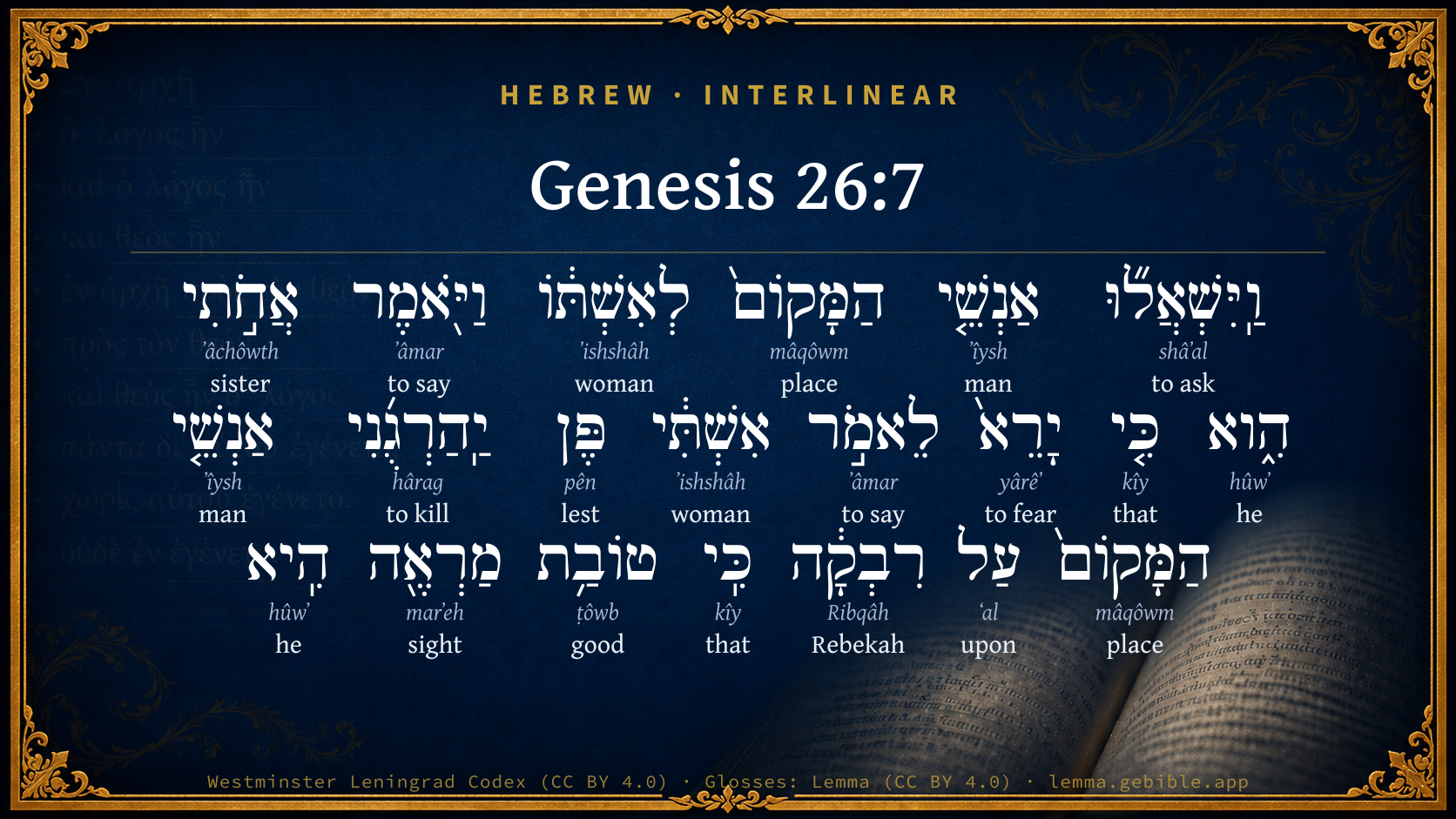
Genesis 26:7

Hebrew (Westminster Leningrad Codex) Genesis 26:7 appears in the Hebrew Old Testament. The text above is from the Westminster Leningrad Codex. Each word links to its Strong’s number, a concise gloss, and parsing drawn from the Open Scriptures Hebrew Bible morphology. Click any word for its full Brown-Driver-Briggs (BDB) entry.
Download image
Cite this verse

Genesis 26:7 (World English Bible). Public Domain. Lemma interlinear Bible study tool, https://lemma.gebible.app/v/genesis/26/7.

Show BibTeX & RIS
BibTeX
RIS
English Translation
The men of the place asked him about his wife. He said, "She is my sister," for he was afraid to say, "My wife," lest, he thought, the men of the place might kill me for Rebekah, because she was beautiful to look on.
World English Bible · Public Domain
Download a study sheet

One document with this verse’s original text, its word-by-word gloss line, the meaning frame, cross-references with their text, attributed commentary, and full source and license credits — printable, and it pastes into notes with its structure intact.

This verse Autodidact and up

Study sheet (.html) Plain text (.txt)

A passage Seminary Student

Up to 50 verses in one chapter. A passage sheet keeps up to 6 commentary sources and 12 cross-references per verse, in the order this page ranks them, and says so on the sheet whenever that leaves anything out. Ask for a single verse and you get the Autodidact verse sheet above.

Everything on this page stays free to read, with no account — the sheet is a download of what is already on screen, not access to it.

Want to remove ads? Support Godless Engineer
Compare translations 3

The same verse in 3 English versions, stacked beneath the original-language interlinear above. Click any original word for its lexicon entry.

Each is an independent rendering of the whole verse — the interlinear is not word-aligned to these translations.

Highlighted words mark where these versions differ — a whole-verse word diff, not a word-by-word alignment.

  • World English Bible Public Domain
    The men of the place asked him about his wife. He said, "She is my sister," for he was afraid to say, "My wife," lest, he thought, the men of the place might kill me for Rebekah, because she was beautiful to look on.
  • King James Version Public Domain
    And the men of the place asked him of his wife; and he said, She is my sister: for he feared to say, She is my wife; lest, said he, the men of the place should kill me for Rebekah; because she was fair to look upon.
  • unfoldingWord Literal Text CC BY-SA 4.0
    Then the men of the place asked about his wife, and he said, “She my sister,” because he was afraid to say, “ my wife.” “Lest the men of the place kill me on account of Rebekah, because she beautiful of appearance.”

unfoldingWord Literal Text — © unfoldingWord, licensed CC BY-SA 4.0. Word-aligned USFM3 via Door43 (git.door43.org/unfoldingWord/en_ult).

Versions to compare (up to 4)

3 of 4 selected

Show all 18 translations

Every available English version of this verse, each an independent rendering of the whole verse.

  • World English Bible Public Domain
    The men of the place asked him about his wife. He said, "She is my sister," for he was afraid to say, "My wife," lest, he thought, the men of the place might kill me for Rebekah, because she was beautiful to look on.
  • Berean Standard Bible Public Domain
    But when the men of that place asked about his wife, he said, “She is my sister.” For he was afraid to say, “She is my wife,” since he thought to himself, “The men of this place will kill me on account of Rebekah, because she is so beautiful.”
  • Majority Standard Bible Public Domain
    But when the men of that place asked about his wife, he said, “She is my sister.” For he was afraid to say, “She is my wife,” since he thought to himself, “The men of this place will kill me on account of Rebekah, because she is so beautiful.”
  • King James Version Public Domain
    And the men of the place asked him of his wife; and he said, She is my sister: for he feared to say, She is my wife; lest, said he, the men of the place should kill me for Rebekah; because she was fair to look upon.
  • American Standard Version (1901) Public Domain
    And the men of the place asked him of his wife. And he said, She is my sister. For he feared to say, My wife. Lest, `said he', the men of the place should kill me for Rebekah. Because she was fair to look upon.
  • Revised Version (1885) Public Domain
    and the men of the place asked him of his wife; and he said, She is my sister: for he feared to say, My wife; lest, said he, the men of the place should kill me for Rebekah: because she was fair to look upon.
  • Geneva Bible (1599) Public Domain
    And the men of the place asked him of his wife, and he sayd, She is my sister: for he feared to say, She is my wife, least, sayde he, the men of the place shoulde kill me, because of Rebekah: for she was beautifull to the eye.
  • Douay-Rheims (1899) Public Domain
    And when he was asked by the men of that place, concerning his wife, he answered: She is my sister; for he was afraid to confess that she was his wife, thinking lest perhaps they would like him because of her beauty.
  • Young's Literal Translation Public Domain
    and men of the place ask him of his wife, and he saith, `She `is' my sister:' for he hath been afraid to say, `My wife -- lest the men of the place kill me for Rebekah, for she `is' of good appearance.'
  • Literal Standard Version CC BY-SA 4.0
    and men of the place ask him of his wife, and he says, “She [is] my sister”: for he has been afraid to say, “My wife—lest the men of the place kill me for Rebekah, for she [is] of good appearance.”
  • Unlocked Literal Bible CC BY-SA 4.0
    When the men of the place asked him about his wife, he said, “She is my sister.” He feared to say, “She is my wife,” because he thought, “The men of this place will kill me to get Rebekah, because she is so beautiful.”
  • unfoldingWord Literal Text CC BY-SA 4.0
    Then the men of the place asked about his wife, and he said, “She my sister,” because he was afraid to say, “ my wife.” “Lest the men of the place kill me on account of Rebekah, because she beautiful of appearance.”
  • Darby Bible Public Domain
    And the men of the place asked about his wife. And he said, She is my sister; for he feared to say, my wife, [saying to himself,] Lest the men of the place slay me on account of Rebecca -- because she was fair in countenance.
  • World Messianic Bible Public Domain
    The men of the place asked him about his wife. He said, “She is my sister,” for he was afraid to say, “My wife”, lest, he thought, “the men of the place might kill me for Rebekah, because she is beautiful to look at.”
  • Webster's Bible Public Domain
    And the men of the place asked him of his wife; and he said, She is my sister: for he feared to say, She is my wife; lest, said he, the men of the place should kill me for Rebekah; because she was fair to look upon.
  • Free Bible Version CC BY-SA 4.0
    When the men there asked him about his wife, he told them, “She's my sister,” because he was afraid. He said to himself, “If I say she's my wife, the men here will kill me to get Rebekah, because she's so beautiful.”
  • Bible in Basic English Public Domain
    And when he was questioned by the men of the place about his wife, he said, She is my sister; fearing to say, She is my wife; for, he said, the men of the place may put me to death on account of Rebekah; because she is very beautiful.
  • JPS Tanakh (1917) Public Domain
    And the men of the place asked him of his wife; and he said: 'She is my sister'; for he feared to say: 'My wife'; 'lest the men of the place should kill me for Rebekah, because she is fair to look upon.'

Literal Standard Version (2020), Covenant Press — licensed CC BY-SA 4.0. Text via the HelloAO Bible API (eBible.org). Unlocked Literal Bible (unfoldingWord) — licensed CC BY-SA 4.0. Text via the HelloAO Bible API (eBible.org). unfoldingWord Literal Text — © unfoldingWord, licensed CC BY-SA 4.0. Word-aligned USFM3 via Door43 (git.door43.org/unfoldingWord/en_ult). Free Bible Version, Dr. Jonathan Gallagher — licensed CC BY-SA 4.0. Text via the HelloAO Bible API (eBible.org).

Word by word

More ways to search: Search by grammar → Find every occurrence → Compare this word →

Practice this passage: Drill this verse → Learn its vocabulary →

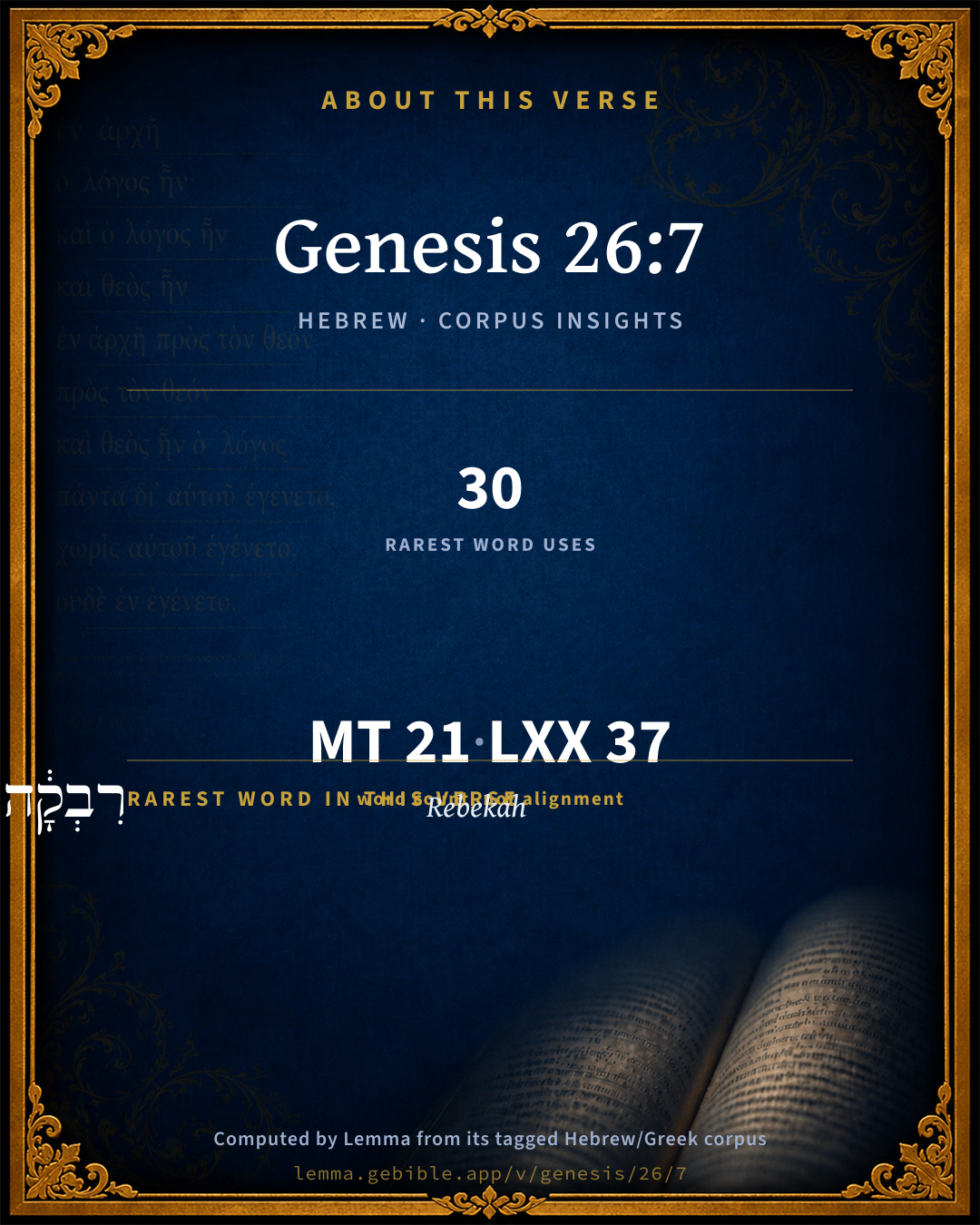
רִבְקָ֔ה
Ribqâh
H7259
“Rebekah”
Noun, Proper
Part of Speech
Noun
Type
Proper
Full BDB Definition

Origin: from an unused root probably meaning to clog by tying up the fetlock

TWOT: None

Rebekah = "ensnarer" - daughter of Bethuel, sister of Laban, wife of Isaac, and mother of Esau and Jacob
  1. וַֽיִּשְׁאֲל֞וּ shâʼal H7592 “and · to ask” Conjunction + Verb, Qal, Sequential Imperfect, 3rd Person, Masculine, Plural
  2. אַנְשֵׁ֤י ʼîysh H376 “men of” Noun, Common, Masculine, Plural, Construct
  3. הַמָּקוֹם֙ mâqôwm H4725 “the · place” Particle, Definite Article + Noun, Common, Masculine, Singular, Absolute
  4. לְאִשְׁתּ֔וֹ ʼishshâh H802 “to/for · woman · his” Preposition + Noun, Common, Feminine, Singular, Construct + Suffix, Personal, 3rd Person, Masculine, Singular
  5. וַיֹּ֖אמֶר ʼâmar H559 “and · to say” Conjunction + Verb, Qal, Sequential Imperfect, 3rd Person, Masculine, Singular
  6. אֲחֹ֣תִי ʼâchôwth H269 “sister · my” Noun, Common, Feminine, Singular, Construct + Suffix, Personal, 1st Person, Common, Singular
  7. הִ֑וא hûwʼ H1931 “he” Pronoun, Personal, 3rd Person, Feminine, Singular
  8. כִּ֤י kîy H3588 “that” Conjunction
  9. יָרֵא֙ yârêʼ H3372 “to fear” Verb, Qal, Perfect, 3rd Person, Masculine, Singular
  10. לֵאמֹ֣ר ʼâmar H559 “to say” Preposition + Verb, Qal, Infinitive Construct
  11. אִשְׁתִּ֔י ʼishshâh H802 “woman · my” Noun, Common, Feminine, Singular, Construct + Suffix, Personal, 1st Person, Common, Singular
  12. פֶּן pên H6435 “lest” Conjunction
  13. יַֽהַרְגֻ֜נִי hârag H2026 “to kill · me” Verb, Qal, Imperfect, 3rd Person, Masculine, Plural + Suffix, Personal, 1st Person, Common, Singular
  14. אַנְשֵׁ֤י ʼîysh H376 “men of” Noun, Common, Masculine, Plural, Construct
  15. הַמָּקוֹם֙ mâqôwm H4725 “the · place” Particle, Definite Article + Noun, Common, Masculine, Singular, Absolute
  16. עַל ʻal H5921 “upon” Preposition
  17. כִּֽי kîy H3588 “that” Conjunction
  18. טוֹבַ֥ת ṭôwb H2896 “good of” Adjective, Adjective, Feminine, Singular, Construct
  19. מַרְאֶ֖ה marʼeh H4758 “sight” Noun, Common, Masculine, Singular, Absolute
  20. הִֽיא hûwʼ H1931 “he” Pronoun, Personal, 3rd Person, Feminine, Singular

About this verse

These counts appear in no published source. They are computed here, from the morphology-tagged text and Lemma’s own curated glosses. What Lemma adds →

21
words
15
distinct lemmas
Pentateuch
section

Shared distinctive vocabulary

רִבְקָ֔ה Rebekah H7259 occurs in 29 verses of the Hebrew Bible. Also found in:

Grammatical profile

  • 5 verbs
  • 9 nouns
  • 1 adjective
  • 2 pronouns
  • 1 preposition
  • 3 conjunctions

Verb forms

  • וַֽיִּשְׁאֲל֞וּ Qal · Sequential Imperfect
  • וַיֹּ֖אמֶר Qal · Sequential Imperfect
  • יָרֵא֙ Qal · Perfect
  • לֵאמֹ֣ר Qal · Infinitive Construct
  • יַֽהַרְגֻ֜נִי Qal · Imperfect

Repetition

Words recur within this verse — often emphatic in Hebrew:

  • אַנְשֵׁ֤י man H376 ×2
  • הַמָּקוֹם֙ place H4725 ×2
  • לְאִשְׁתּ֔וֹ woman H802 ×2
  • וַיֹּ֖אמֶר to say H559 ×2
  • הִ֑וא he H1931 ×2
  • כִּ֤י that H3588 ×2

Hebrew & Septuagint length

In English translation the verse runs 44 words from the Hebrew and 47 from the Septuagint (LXX English) — closely comparable.

A rough comparison of the two English renderings, which tokenize alike — not a word-level alignment.

Word counts can differ between the Hebrew and the Greek without any difference in meaning — e.g. the Hebrew direct-object marker אֵת has no separate Greek word, and Greek often adds the article ὁ.

In the original languages it is 21 Hebrew tokens and 37 Greek tokens — but the two are counted differently (Hebrew bundles its prefixes and suffixes into one token; the Greek is in lemma form), so that isn’t a like-for-like length.

Cross-references

9

Topical passages linked to Genesis 26:7 in the Treasury of Scripture Knowledge — connected by theme and wording, ordered by reader-vote popularity; previews shown in the World English Bible.

  • Proverbs 29:25 The fear of man proves to be a snare, But whoever puts his trust in Yahweh is kept safe.
  • Genesis 12:13 Please say that you are my sister, that it may be well with me for your sake, and that my soul may live because of you."
  • Genesis 20:2 Abraham said about Sarah his wife, "She is my sister." Abimelech king of Gerar sent, and took Sarah.
  • Genesis 24:16 The young lady was very beautiful to look at, a virgin, neither had any man known her. She went down to the spring, filled her pitcher, and came up.
  • Genesis 20:12–13 Moreover she is indeed my sister, the daughter of my father, but not the daughter of my mother; and she became my wife.
  • Matthew 10:28 Don't be afraid of those who kill the body, but are not able to kill the soul. Rather, fear him who is able to destroy both soul and body in Gehenna.
  • Ephesians 5:25 Husbands, love your wives, even as Christ also loved the assembly, and gave himself up for it;
  • Colossians 3:9 Don't lie to one another, seeing that you have put off the old man with his doings,
  • Genesis 20:5 Didn't he tell me, 'She is my sister?' She, even she herself said, 'He is my brother.' In the integrity of my heart and the innocence of my hands have I done this."

Cross-references courtesy of OpenBible.info (CC BY 4.0).

Hebrew and Greek witnesses Masoretic Hebrew ↔ Greek Septuagint

The same verse in the two great witnesses to the Old Testament, shown verse-for-verse.

These are two independent witnesses, not word-aligned to each other, and the Septuagint is shown in lemma (dictionary) form.

Hebrew Genesis 26:7 Masoretic · Westminster Leningrad Codex

וַֽיִּשְׁאֲל֞וּ אַנְשֵׁ֤י הַמָּקוֹם֙ לְאִשְׁתּ֔וֹ וַיֹּ֖אמֶר אֲחֹ֣תִי הִ֑וא כִּ֤י יָרֵא֙ לֵאמֹ֣ר אִשְׁתִּ֔י פֶּן יַֽהַרְגֻ֜נִי אַנְשֵׁ֤י הַמָּקוֹם֙ עַל רִבְקָ֔ה כִּֽי טוֹבַ֥ת מַרְאֶ֖ה הִֽיא

The men of the place asked him about his wife. He said, "She is my sister," for he was afraid to say, "My wife," lest, he thought, the men of the place might kill me for Rebekah, because she was beautiful to look on.

World English Bible · Public Domain

Greek LXX Genesis 26:7 Septuagint · lemma form

ἐπιἐρωτάω δέ ὁ ἀνήρ ὁ τόπος περί ρεβεκκα ὁ γυνή αὐτός καί εἶπον ἀδελφή ἐγώ εἰμί φοβέω γάρ εἶπον ὅτι γυνή ἐγώ εἰμί μήποτε ἀποκτείνω αὐτός ὁ ἀνήρ ὁ τόπος περί ρεβεκκα ὅτι ὡραῖος ὁ ὄψις εἰμί

And the men of the place questioned him concerning Rebecca his wife, and he said, She is my sister, for he feared to say, She is my wife, lest at any time the men of the place should kill him because of Rebecca, because she was fair.

LXX2012 (modern English Septuagint) · Public Domain

Hebrew: Westminster Leningrad Codex (CC BY 4.0). Greek: Septuagint (public domain); English from LXX2012 (modern English Septuagint) (Public Domain). How the Septuagint differs from the Hebrew →

Targum (Aramaic paraphrase)

2

The Targum is the ancient Jewish Aramaic paraphrase of the Hebrew Scriptures — an interpretive translation, not the Hebrew text itself. Onkelos (literal) and Pseudo-Jonathan (expansive) render the Torah, and Jonathan the Prophets. Coverage is partial: where no permissively-licensed English translation exists for a verse, only the Aramaic is shown. This is verse-level text, not a word-by-word alignment to the Hebrew.

  1. Targum Onkelos Torah (Genesis–Deuteronomy)
    וּשְׁאִילוּ אֲנָשֵׁי אַתְרָא (עַל עֵיסַק אִתְּתֵהּ) לְאִתְּתֵהּ וַאֲמַר אֲחָתִי הִיא אֲרֵי דְחִיל לְמֵימַר אִתְּתִי דִּלְמָא יִקְטְּלֻנַּנִי אֲנָשֵׁי אַתְרָא עַל רִבְקָה אֲרֵי שַׁפִּירַת חֵיזוּ הִיא

    (no public-domain English translation for this verse)

    Targum Onkelos — Aramaic: “Onkelos Genesis” (public domain); “Onkelos Exodus” (public domain); “Onkelos Leviticus” (public domain); “Onkelos Numbers” (public domain); “Onkelos Deuteronomy” (public domain). English: “Sefaria Community Translation” (CC0 1.0 (public-domain dedication)); “J.W. Etheridge. The Targums of Onkelos and Jonathan Ben Uzziel on the Pentateuch. London: Longmans, Green, 1862” (public domain). Text via Sefaria.

  2. Targum Pseudo-Jonathan Torah (Genesis–Deuteronomy)
    וּשְׁאִילוּ אִינְשֵׁי אַתְרָא עַל אִינְתְּתֵיהּ וַאֲמַר אַחְתִי הִיא אֲרוּם דָחִיל לְמֵימָר לָהּ אִינְתְּתִי אֲרוּם חָשִׁיב בְּלִבֵּיהּ דִלְמָא יִקְטְלוּנַנִי אִינְשֵי אַתְרָא עַל עֵיסַק רִבְקָה אֲרוּם שַׁפִּירָא חֵיזוּ הִיא

    And the man of the place inquired concerning his wife; and he said, She is my sister: for he reasoned in his heart, Lest the men of the place should kill me for Rivekah, because she was of beautiful appearance.

    Targum Pseudo-Jonathan — Aramaic: “Targum Jonathan on Genesis” (public domain); “Targum Jonathan on Exodus” (public domain); “Targum Jonathan on Leviticus” (public domain); “Targum Jonathan on Numbers” (public domain); “Targum Jonathan on Deuteronomy” (public domain). English: “The Targum of Jonathan ben Uzziel, trans. J. W. Etheridge, London, 1862” (public domain). Text via Sefaria.

Commentary

Notes on Genesis 26:7 from classic Christian and Jewish commentators (each source and its license shown beneath its notes). The classic Christian expositions comment on the surrounding passage and are grouped to its opening verse, so a note may address several verses; the Jewish commentaries on the Tanakh (Rashi and others) are per-verse, so they appear only where the commentator wrote on this verse.

Lemma curates 59 commentaries, every one of them public domain or Creative Commons licensed, each selected and text-cleaned for this edition rather than reprinted as found. About our sources →

Trapp's Complete Commentary

John Trapp

Gen 26:7 And the men of the place asked [him] of his wife; and he said, She [is] my sister: for he feared to say, [She is] my wife; lest, [said he], the men of the place should kill me for Rebekah; because she [was] fair to look upon.

Ver. 7. She is my sister.] How apt are children to imitate their father’s infirmities! Pατροπαραδοτου. {1Pe 1:18} Which yet is no excuse, {Eze 18:14} but an aggravation. {Dan 5:22-23} The orator {a} therefore was far wide, that said, Me ex ea opinione, quam a Maioribus accepi, de cultu deorum immortalium, nullius unquam oratio aut docti aut indocti movebit. Isaac’s fault here, was greater than Abraham’s, because he was not warned by domestical examples. Seest thou another make shipwreck of a good conscience? look well to thy tacklings. Sin is worse after warning.

For he feared to say, &c.] Fear and infidelity are found in the most faithful. Corruption, in the best, will have some flurts, some outbursts. As therefore Luther entreats his readers, if they find in his writings anything that smelleth of the old cask of Popery, to remember he was once a poor monk; so when we see the saints humanum aliquid pati, to play some mad pranks, we must consider they were but lately cured of a spiritual frenzy.

Because she was fair to look upon.] Beauty therefore is not much to be desired, or the want of it to be bewailed; because it creates so many dangers to them that have it, and their dearest husbands. The British virgins deformed themselves, that the Danes might not deflower them. {b}

{a} Cic., De Natur. Deor.

{b} Sabina, cum aliquando se non satis bona formia in speeulo cerneret, mori priusquam senesceret, optavit. - Dio.

John Trapp, A Commentary or Exposition upon All the Books of the Old and New Testament (1647–1656) — public domain. Text from a community e-Sword module.

Joseph Benson's Commentary

Gen 26:7. She is my sister — So Isaac enters into the same temptation that his father had been once and again surprised and overcome by, namely, to deny his wife, and to give out that she was his sister! It is an unaccountable thing, that both these great and good men should be guilty of so odd a piece of dissimulation, by which they so much exposed both their own and their wives’ reputation.

Joseph Benson's Commentary on the Old and New Testaments (1811–1818) — public domain. Text from a community e-Sword module.

The Pulpit Commentary

CHAPTER 26:7-11

And the men of the place (i.e. the inhabitants of Gerar) asked him (literally, asked, or made inquiries; probably first at each other, though ultimately the interrogations might reach Isaac himself) of his wife (being in all likelihood fascinated by her beauty); and he said, falling into the same infirmity as Abraham. (Gen_12:13 Gen_20:2) She is my sister: which was certainly an equivocation, since, although sometimes used todesignate a female relative generally, (vide Gen_24:60) the term "sister" was here designed to suggest that Rebekah was his own sister, born of the same parents. In propagating this deception Isaac appears to have been actuated by a similar motive to that which impelled his fatherfor he feared to say, She is my wife; lest, said he (sc. to himself, the words describing the good man"s secret apprehensions), the men of the place should kill me for Rebekah; the historian adding, as the explanation of his fearsbecause she was fair to look upon. (vide Gen_24:16)

Vers. 7-11.

A good man"s transgression.

I A LIE TOLD.

1. An unmitigated lie. It was scarcely entitled to claim the apology of being what Abraham"s falsehood was, an equivocation, Rebekah not being Isaac"s half-sister, but cousin.

2. A deliberate lie. Asked about his relations to Rebekah, he coolly replies that they are sister and brother. He had no right to suppose his interrogators had ulterior designs against Rebekah"s honor.

3. A cowardly lie. All falsehoods spring from craven fear fear of the consequences that may flow from telling the honest truth.

4. A dangerous lie. By his wicked suppression of the truth he was guilty of imperiling the chastity of her whom he sought to protect. Almost all falsehoods are perilous, and most of them are mistakes.

5. An unnecessary lie. No lie ever can be necessary; but least of all could this have been, when God had already promised to be with him in the land of the Philistines.

6. An unbelieving lie. Had Isaac"s faith been active, he would hardly have deemed it needful to disown his wife.

7. A wholly worthless lie. Isaac might have remembered that twice over his father had resorted to this miserable stratagem, and that in neither instance had it sufficed to avert the danger which he dreaded. But lies generally are wretched hiding-places for endangered bodies or anxious souls.

II A LIE DETECTED.

1. God by his providence assists in the detection of liars. By the merest accident, as it might seem, Abimelech discovered the true relationship of Isaac and Rebekah; but both the time, place, and manner of that discovery were arranged by God. So the face of God is set against them that do evil, even though they should be his own people.

2. Liars commonly assist in their own detection. Truth alone is sure-footed, and never slips; error is liable to stumble at every step. It is difficult to maintain a disguise for any lengthened period. The best fitting mask is sure in time to fall off. Actions good in themselves often lead to the detection of crimes.

III A LIE REPROVED. The conduct of Isaac Abimelech rebukes

1. With promptitude. Sending for Isaac, he charges him with his sin. It is the part of a true friend to expose deception whenever it is practiced, and, pro vide d it be done in a proper spirit, the sooner it is done the better. Sin that long eludes detection is apt to harden the sinning heart and sear the guilty conscience.

2. With fidelity. Characterizing it as

(1) a surprising inconsistency on the part of a good man like Isaac;

(2) a reckless exposure of his wife"s person, which was far from becoming in a kindly husband; and

(3) an unjustifiable offence against the people of the land, who, by his carelessness and cowardice, might have been led into grievous wickedness.

3. With forgiveness. That Abimelech did not intend to exact punishment from Isaac, or even cherish resentment against him in consequence of his behavior, he proved by charging his people to beware of injuring in any way either Isaac or Rebekah. It is good and beautiful when mercy seasons judgment, and the reproofs of friendship are accompanied by messages of love.

The Pulpit Commentary (1880–1919), ed. H.D.M. Spence-Jones & Joseph S. Exell — public domain. Text from a community e-Sword module.

Geneva Bible (1599)

Geneva Bible translators

Whereby we see that fear and distrust is found in the most faithful.

Geneva Bible (1599) marginal notes — public domain. Text via Bolls.life.

Adam Clarke's Commentary

Verse 7. He said, She is my sister] It is very strange that in the same place, and in similar circumstances, Isaac should have denied his wife, precisely as his father had done before him! It is natural to ask, Did Abraham never mention this circumstance to his son? Probably be did not, as he was justly ashamed of his weakness on the occasion - the only blot in his character; the son, therefore, not being forewarned, was not armed against the temptation. It may not be well in general for parents to tell their children of their former failings or vices, as this might lessen their authority or respect, and the children might make a bad use of it in extenuation of their own sins. But there are certain cases, which, from the nature of their circumstances, may often occur, where a candid acknowledgment, with suitable advice, may prevent those children from repeating the evil; but this should be done with great delicacy and caution, lest even the advice itself should serve as an incentive to the evil. I had not known lust, says St. Paul, if the law had not said, Thou shalt not covet. Isaac could not say of Rebekah, as Abraham had done of Sarah, She is my sister; in the case of Abraham this was literally true; it was not so in the case of Isaac, for Rebekah was only his cousin. Besides, though relatives, in the Jewish forms of speaking, are often called brothers and sisters, and the thing may be perfectly proper when this use of the terms is generally known and allowed, yet nothing of this kind can be pleaded here in behalf of Isaac; for he intended that the Gerarites should understand him in the proper sense of the term, and consequently have no suspicion that she was his wife. We have already seen that the proper definition of a lie is any word spoken with the intention to deceive. See Ge 20:12.

Adam Clarke's Commentary on the Bible (1810–1826) — public domain. Text from a community e-Sword/MySword module.

John Calvin's Commentaries

7. And the men of the place asked him. Moses relates that Isaac was tempted in the same manner as his father Abraham, in having his wife taken from him; and without doubt he was so led by the example of his father, that he, being instructed by the similarity of the circumstances, might become associated with him in his faith. Nevertheless, on this point he ought rather to have avoided than imitated his father’s fault; for no doubt he well remembered that the chastity of his mother had twice been put in great danger; and although she had been wonderfully rescued by the hand of God, yet both she and her husband paid the penalty of their distrust: therefore the negligence of Isaac is inexcusable, in that he now strikes against the same stone. He does not in express terms deny his wife; but he is to be blamed, first, because, for the sake of preserving his life, he resorts to an evasion not far removed from a lie; and secondly, because, in absolving his wife from conjugal fidelity, he exposes her to prostitution: but he aggravates his fault, principally (as I have said) in not taking warning from domestic examples, but voluntarily casting his wife into manifest danger. Whence it appears how great is the propensity of our nature to distrust, and how easy it is to be devoid of wisdom in affairs of perplexity. Since, therefore, we are surrounded on all sides with so many dangers, we must ask the Lord to confirm us by his Spirit, lest our minds should faint, and be dissolved in fear and trembling; otherwise we shall be frequently engaged in vain enterprises, of which we shall repent soon, and yet too late to remedy the evil.

John Calvin's Commentaries (1540-1563) — public domain. Text from the Calvin Translation Society English edition (1840s-50s) via the Christian Classics Ethereal Library (ccel.org). Calvin's coverage is partial (roughly two-thirds of the Bible); uncommented books and verses are honest gaps, never fabricated. The 19th-century editor's footnotes and remarks are omitted so the notes are faithfully Calvin's own voice.

Ellicott's Commentary for English Readers

(7) He said, She is my sister.—We have already seen that Abraham at Gerar showed no consciousness of having done wrong in denying his wife (Gen_20:2); and we now find Isaac imitating his example with even less reason for his conduct. The circumstances are, however, different. It is the people who inquire about Isaac’s relation to Rebekah, and though she was “fair to look upon,” yet no annoyance followed upon his denial of her. The king after “a long time” detects their intimacy; but there are no presents, and no marks of respect to Rebekah, and no friendship. It is only after long quarrels, during which Isaac is obliged to withdraw to a long distance from Gerar, that finally peace is made between them.

A Bible Commentary for English Readers, edited by Charles John Ellicott (1878–1897) — public domain. Text from a community e-Sword module.

The Cambridge Bible for Schools and Colleges

gen. ed. J. J. S. Perowne

7. my sister] See Gen_12:12-13, Gen_20:5.

7–11 (J). Isaac and Rebekah at the Court of Abimelech

In this narrative Isaac from motives of fear tells the inhabitants of Gerar that Rebekah is his sister. The resemblance to the similar narratives in the story of Abraham (1) in Egypt, Gen_12:13, (2) at Gerar, chap. 20, is obvious.

The plea of the relationship of a half-sister could be made for Sarah, but not for Rebekah. The same story was repeated in slightly different versions. It commemorated (a) the moral weakness of the patriarch, and (b) the protection which was accorded by Jehovah to the ancestors of the Israelite people. Contact with civilization brought perils no less real than the solitary life of the nomad.

The Cambridge Bible for Schools and Colleges (gen. ed. J. J. S. Perowne; Cambridge University Press, 1878–1918) — public domain. Text from a community e-Sword module.

John Gill's Exposition

And it came to pass, when he had been there a long time,.... Perhaps some years: for though it is in the original, "when days were prolonged to him there" (b); yet days are sometimes put for years:

that Abimelech king of the Philistines looked out at a window; in his own palace, near to which, in all likelihood, were the apartments that Isaac and Rebekah dwelt in; and this he did accidentally, and not out of curiosity, or with any intention to observe or pry into the behaviour and conduct of these two persons one towards the other:

and saw, and, behold, Isaac was sporting with Rebekah his wife; laughing and joking with her, which by his motions and gestures, and the airs and freedoms he took, Abimelech could perceive were such as were not usual between brothers and sisters, though honest and lawful between man and wife; such as embracing her in his arms, and frequently kissing her, and the like.

(b) "cum prolongati essent ei ibi dies", Pagninus, Montanus, Schmidt.

John Gill's Exposition of the Whole Bible (1746–1763) — public domain (CC PDM 1.0). Text via the HelloAO Bible API.

Haydock's Catholic Bible Commentary

Sister, or niece. Though lawful at that time, it was not very common for people to marry such near relations; and therefore Isaac, by saying Rebecca was his sister, wished the people of Gerara to be ignorant of her being his wife; being under the like apprehension as his father had been twice before. He imitates his example, trusting in the protection of God, which had rescued Abraham from danger, chap. xxi. (Haydock)

George Leo Haydock (1774–1849), Haydock's Catholic Family Bible and Commentary, 1859 edition — public domain. Excludes Psalms (Douay-Rheims chapter numbering differs from Protestant) and Deuterocanonical books (Catholic canon only).

Whedon's Commentary on the Bible

Daniel D. Whedon

7. Should kill me — Comp. Gen_12:12; Gen_20:11, notes; and for the agreement and differences of these narratives the note at the beginning of this chapter.

Daniel D. Whedon (gen. ed.), Commentary on the Old and New Testaments (1874–1909) — public domain. Text from a community e-Sword module.

John Wesley's Explanatory Notes

He said, she is my sister - So Isaac enters into the same temptation that his father had been once and again surprised and overcome by, viz. to deny his wife, and to give out that she was his sister! It is an unaccountable thing, that both these great and good men should be guilty of so odd a piece of dissimulation, by which they so much exposed both their own and their wives reputation.

John Wesley, Explanatory Notes Upon the Whole Bible (1754–1765) — public domain. Text via the GEBible commentary corpus.

Rashi

Rabbi Shlomo Yitzchaki (Rashi)

לאשתו means CONCERNING HIS WIFE, just as (20:13) “Say about me (לי), He is my brother”.

Rashi on the Tanakh — English translations: “The Judaica Press complete Tanach with Rashi, translated by A. J. Rosenberg” (CC BY 4.0); “Pentateuch with Rashi's commentary by M. Rosenbaum and A.M. Silbermann, 1929-1934” (public domain); “The Metsudah Tanach series, Lakewood, N.J” (CC BY 4.0); and “The Book of Joshua, Metsudah Publications, 1997” (CC BY 4.0). Text via Sefaria.

Ramban (Nachmanides)

Rabbi Moshe ben Nachman (Ramban / Nachmanides)

AND HE SAID: SHE IS MY SISTER. They did not ask concerning the children for he would say, “They are my children from another woman.”

Ramban (Nachmanides) on the Tanakh — English translation: “Commentary on the Torah by Ramban (Nachmanides). Translated and annotated by Charles B. Chavel. New York, Shilo Pub. House, 1971-1976” (CC BY 4.0). Text via Sefaria.

Radak

Rabbi David Kimhi (Radak)

וישאלו...לאשתו, an inquiry regarding his marital status, especially the woman in whose company he had been seen. We find a parallel construction in 20,13. There are numerous such constructions, and I have dealt wit them in my commentary on 12,12.

Radak on the Tanakh — English translations: “Sefaria Community Translation” (CC0 1.0 (public-domain dedication)); “Eliyahu Munk, HaChut Hameshulash” (CC BY 4.0); “Rabbi Mike Feuer, Jerusalem Anthology” (CC BY 4.0); and “R. David Kimhi on the first book of Psalms, Translated by R.G. Finch, London, 1919” (public domain). Text via Sefaria.

Lesson kit

Teaching starters — assembled from the data on this page, not authored interpretation. Every prompt links to the verse data it draws on. Edit before teaching.

Genesis, in the Pentateuch, opens this verse with 21 words (15 distinct Hebrew lemmas). Its most distinctive word is Ribqâh (“Rebekah”). A historical commentator’s framing appears above. Read the whole chapter for the surrounding context.

Discussion questions

  1. The word Ribqâh carries the sense “Rebekah.” How does it shape the verse?
  2. How does Genesis 22:23, which shares the word «Rebekah», read alongside this verse?
  3. What does the repetition of “man” (2× in this one verse) do in this verse?
  4. These translations render this verse differently; the difference is in the English rendering, not the original. What questions does that raise?
  5. «וַֽיִּשְׁאֲל֞וּ» is a Qal Sequential Imperfect verb. How does that grammatical form shape the action described?
  6. Compare how Trapp's Complete Commentary and Joseph Benson's Commentary read this verse. Where do they agree or differ?

Things to notice

Reading settings

Reading text

Shown beneath each verse's original-language words.

Old Testament
Old Testament edition

Read the OT as the Masoretic Hebrew (MT) or the Greek Septuagint (LXX).

English shown for the Greek Septuagint (in the Hebrew ↔ Greek comparison).

Comparing translations? Open the Compare panel on any verse page to stack up to four side by side.