
Joshua 1:5

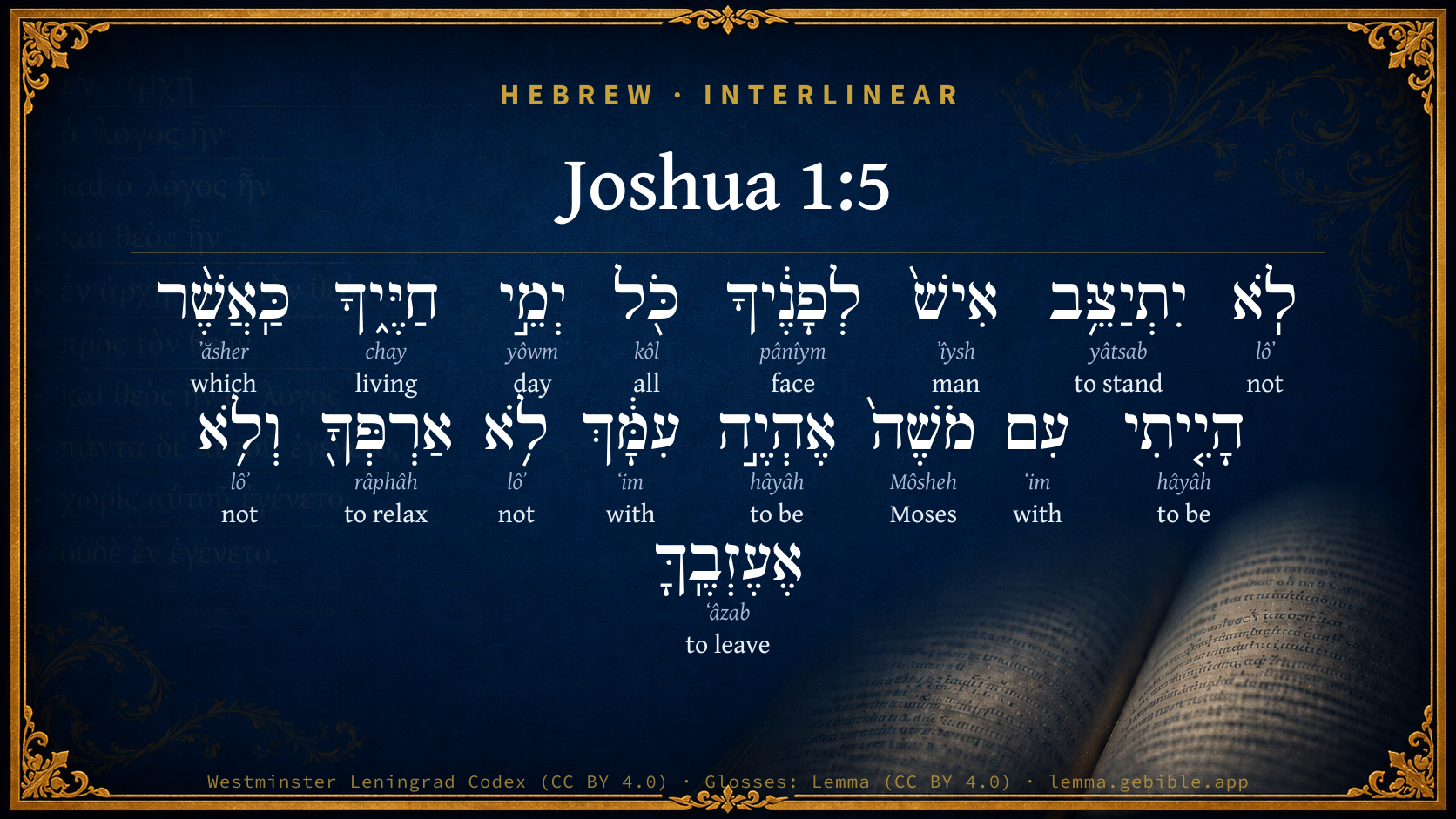
Hebrew (Westminster Leningrad Codex) Joshua 1:5 appears in the Hebrew Old Testament. The text above is from the Westminster Leningrad Codex. Each word links to its Strong’s number, a concise gloss, and parsing drawn from the Open Scriptures Hebrew Bible morphology. Click any word for its full Brown-Driver-Briggs (BDB) entry.
Download image
Cite this verse

Joshua 1:5 (World English Bible). Public Domain. Lemma interlinear Bible study tool, https://lemma.gebible.app/v/joshua/1/5.

Show BibTeX & RIS
BibTeX
RIS
English Translation
There shall not any man be able to stand before you all the days of your life. As I was with Moses, so I will be with you; I will not fail you, nor forsake you.
World English Bible · Public Domain
Download a study sheet

One document with this verse’s original text, its word-by-word gloss line, the meaning frame, cross-references with their text, attributed commentary, and full source and license credits — printable, and it pastes into notes with its structure intact.

This verse Autodidact and up

Study sheet (.html) Plain text (.txt)

A passage Seminary Student

Up to 50 verses in one chapter. A passage sheet keeps up to 6 commentary sources and 12 cross-references per verse, in the order this page ranks them, and says so on the sheet whenever that leaves anything out. Ask for a single verse and you get the Autodidact verse sheet above.

Everything on this page stays free to read, with no account — the sheet is a download of what is already on screen, not access to it.

Want to remove ads? Support Godless Engineer
Compare translations 3

The same verse in 3 English versions, stacked beneath the original-language interlinear above. Click any original word for its lexicon entry.

Each is an independent rendering of the whole verse — the interlinear is not word-aligned to these translations.

Highlighted words mark where these versions differ — a whole-verse word diff, not a word-by-word alignment.

  • World English Bible Public Domain
    There shall not any man be able to stand before you all the days of your life. As I was with Moses, so I will be with you; I will not fail you, nor forsake you.
  • King James Version Public Domain
    There shall not any man be able to stand before thee all the days of thy life: as I was with Moses, so I will be with thee: I will not fail thee, nor forsake thee.
  • unfoldingWord Literal Text CC BY-SA 4.0
    No man will stand to your face all of the days of your life. I will be with you just as I was with Moses. I will not abandon you and I will not leave you.

unfoldingWord Literal Text — © unfoldingWord, licensed CC BY-SA 4.0. Word-aligned USFM3 via Door43 (git.door43.org/unfoldingWord/en_ult).

Versions to compare (up to 4)

3 of 4 selected

Show all 18 translations

Every available English version of this verse, each an independent rendering of the whole verse.

  • World English Bible Public Domain
    There shall not any man be able to stand before you all the days of your life. As I was with Moses, so I will be with you; I will not fail you, nor forsake you.
  • Berean Standard Bible Public Domain
    No one shall stand against you all the days of your life. As I was with Moses, so will I be with you; I will never leave you nor forsake you.
  • Majority Standard Bible Public Domain
    No one shall stand against you all the days of your life. As I was with Moses, so will I be with you; I will never leave you nor forsake you.
  • King James Version Public Domain
    There shall not any man be able to stand before thee all the days of thy life: as I was with Moses, so I will be with thee: I will not fail thee, nor forsake thee.
  • American Standard Version (1901) Public Domain
    There shall not any man be able to stand before thee all the days of thy life. as I was with Moses, so I will be with thee; I will not fail thee, nor forsake thee.
  • Revised Version (1885) Public Domain
    There shall not any man be able to stand before thee all the days of thy life: as I was with Moses, so I will be with thee: I will not fail thee nor forsake thee.
  • Geneva Bible (1599) Public Domain
    There shall not a man be able to withstande thee all the dayes of thy life: as I was with Moses, so will I be with thee: I will not leaue thee, nor forsake thee.
  • Douay-Rheims (1899) Public Domain
    No man shall be able to resist you all the days of thy life: as I have been with Moses, so will I be with thee: I will not leave thee, nor forsake thee.
  • Young's Literal Translation Public Domain
    `No man doth station himself before thee all days of thy life; as I have been with Moses, I am with thee, I do not fail thee, nor forsake thee;
  • Literal Standard Version CC BY-SA 4.0
    No man stations himself before you all [the] days of your life; as I have been with Moses, I am with you, I do not fail you, nor forsake you;
  • Unlocked Literal Bible CC BY-SA 4.0
    No one will be able to stand before you all the days of your life. I will be with you as I was with Moses. I will not abandon you or leave you.
  • unfoldingWord Literal Text CC BY-SA 4.0
    No man will stand to your face all of the days of your life. I will be with you just as I was with Moses. I will not abandon you and I will not leave you.
  • Darby Bible Public Domain
    None shall be able to stand before thee all the days of thy life: as I was with Moses, so will I be with thee; I will not leave thee, neither will I forsake thee.
  • World Messianic Bible Public Domain
    No man will be able to stand before you all the days of your life. As I was with Moses, so I will be with you. I will not fail you nor forsake you.
  • Webster's Bible Public Domain
    There shall not any man be able to stand before thee all the days of thy life: as I was with Moses, so I will be with thee: I will not fail thee, nor forsake thee.
  • Free Bible Version CC BY-SA 4.0
    No one will be able to stand against you while you live. Just as I was with Moses, I will be with you. I will never leave you; I will never abandon you.
  • Bible in Basic English Public Domain
    While you are living, all will give way before you: as I was with Moses, so I will be with you; I will not take away my help from you or give you up.
  • JPS Tanakh (1917) Public Domain
    There shall not any man be able to stand before thee all the days of thy life; as I was with Moses, so I will be with thee; I will not fail thee, nor forsake thee.

Literal Standard Version (2020), Covenant Press — licensed CC BY-SA 4.0. Text via the HelloAO Bible API (eBible.org). Unlocked Literal Bible (unfoldingWord) — licensed CC BY-SA 4.0. Text via the HelloAO Bible API (eBible.org). unfoldingWord Literal Text — © unfoldingWord, licensed CC BY-SA 4.0. Word-aligned USFM3 via Door43 (git.door43.org/unfoldingWord/en_ult). Free Bible Version, Dr. Jonathan Gallagher — licensed CC BY-SA 4.0. Text via the HelloAO Bible API (eBible.org).

Word by word

More ways to search: Search by grammar → Find every occurrence → Compare this word →

Practice this passage: Drill this verse → Learn its vocabulary →

אַרְפְּךָ֖
râphâh
H7503
“to relax · you”
Verb, Hiphil, Imperfect, 1st Person, Common, Singular + Suffix, Personal, 2nd Person, Masculine, Singular
Part of Speech
Verb
Stem
Hiphil
Form
Imperfect
Person
1st Person
Gender
Common
Number
Singular
Full BDB Definition

Origin: a primitive root

TWOT: 2198

to sink, relax, sink down, let drop, be disheartened - (Qal) - to sink down - to sink, drop - to sink, relax, abate - to relax, withdraw - (Niphal) idle (participle) - (Piel) to let drop - (Hiphil) - to let drop, abandon, relax, refrain, forsake - to let go - to refrain, let alone - to be quiet - (Hithpael) to show oneself slack
  1. לֹֽא lôʼ H3808 “not” Particle, Negative
  2. יִתְיַצֵּ֥ב yâtsab H3320 “to stand” Verb, Hithpael, Imperfect, 3rd Person, Masculine, Singular
  3. אִישׁ֙ ʼîysh H376 “man” Noun, Common, Masculine, Singular, Absolute
  4. לְפָנֶ֔יךָ pânîym H6440 “to/for · face(s) · your” Preposition + Noun, Common, Both, Plural, Construct + Suffix, Personal, 2nd Person, Masculine, Singular
  5. כֹּ֖ל kôl H3605 “all of” Noun, Common, Masculine, Singular, Construct
  6. יְמֵ֣י yôwm H3117 “days of” Noun, Common, Masculine, Plural, Construct
  7. חַיֶּ֑יךָ chay H2416 “living things · your” Noun, Common, Masculine, Plural, Construct + Suffix, Personal, 2nd Person, Masculine, Singular
  8. כַּֽאֲשֶׁ֨ר ʼăsher H834 “like/as · which” Preposition + Particle, Relative
  9. הָיִ֤יתִי hâyâh H1961 “to be” Verb, Qal, Perfect, 1st Person, Common, Singular
  10. עִם ʻim H5973 “with” Preposition
  11. מֹשֶׁה֙ Môsheh H4872 “Moses” Noun, Proper
  12. אֶהְיֶ֣ה hâyâh H1961 “to be” Verb, Qal, Imperfect, 1st Person, Common, Singular
  13. עִמָּ֔ךְ ʻim H5973 “with · you” Preposition + Suffix, Personal, 2nd Person, Feminine, Singular
  14. לֹ֥א lôʼ H3808 “not” Particle, Negative
  15. וְלֹ֥א lôʼ H3808 “and · not” Conjunction + Particle, Negative
  16. אֶעֶזְבֶֽךָּ ʻâzab H5800 “to leave · you” Verb, Qal, Imperfect, 1st Person, Common, Singular + Suffix, Personal, 2nd Person, Masculine, Singular

About this verse

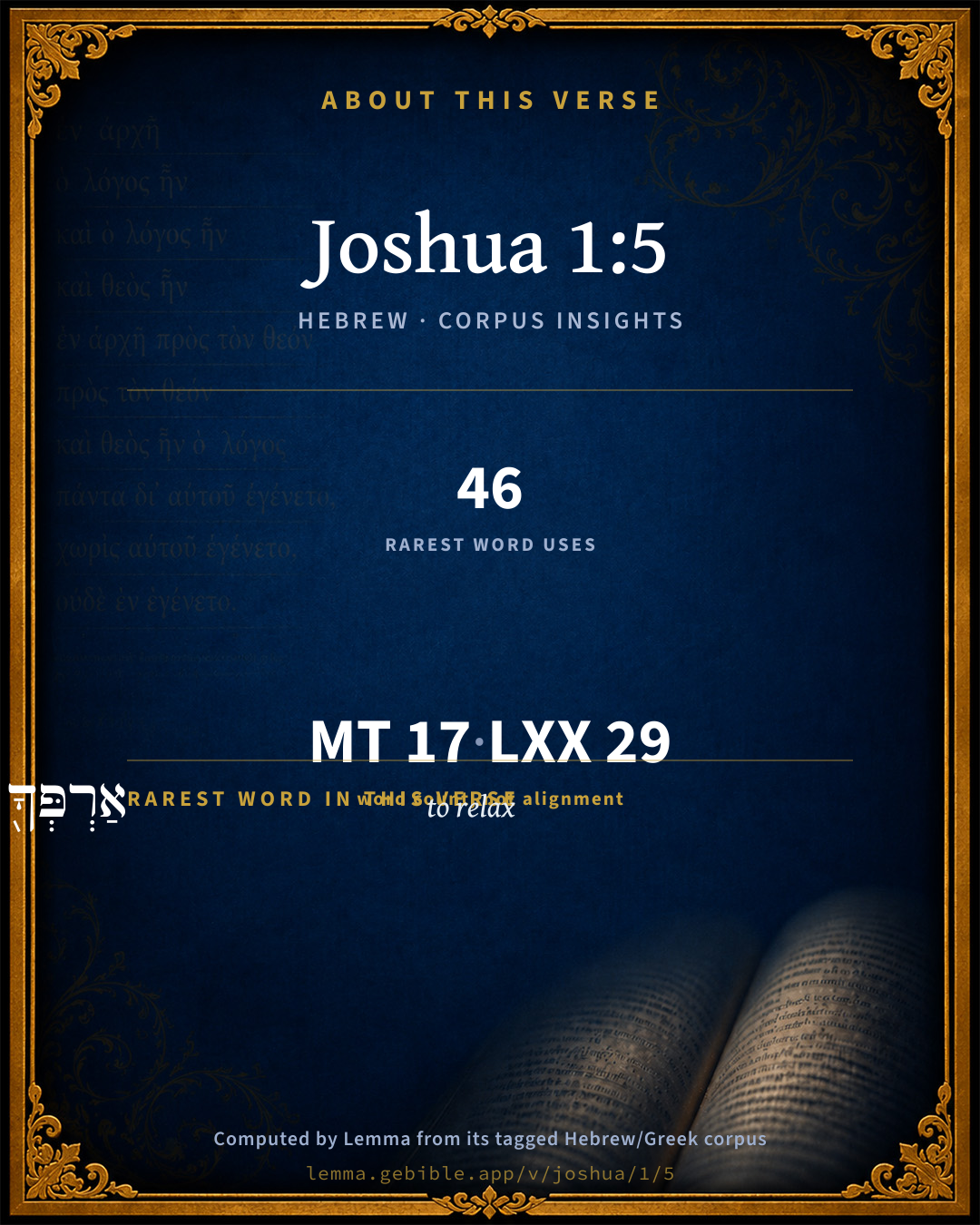
These counts appear in no published source. They are computed here, from the morphology-tagged text and Lemma’s own curated glosses. What Lemma adds →

17
words
13
distinct lemmas
Historical
section

Shared distinctive vocabulary

אַרְפְּךָ֖ to relax H7503 occurs in 45 verses of the Hebrew Bible. Also found in:

Grammatical profile

  • 5 verbs
  • 6 nouns
  • 2 prepositions
  • 4 particles

Verb forms

  • יִתְיַצֵּ֥ב Hithpael · Imperfect
  • הָיִ֤יתִי Qal · Perfect
  • אֶהְיֶ֣ה Qal · Imperfect
  • אַרְפְּךָ֖ Hiphil · Imperfect
  • אֶעֶזְבֶֽךָּ Qal · Imperfect

Repetition

Words recur within this verse — often emphatic in Hebrew:

  • הָיִ֤יתִי to be H1961 ×2
  • לֹֽא not H3808 ×3
  • עִם with H5973 ×2

Hebrew & Septuagint length

In English translation the verse runs 36 words from the Hebrew and 35 from the Septuagint (LXX English) — closely comparable.

A rough comparison of the two English renderings, which tokenize alike — not a word-level alignment.

Word counts can differ between the Hebrew and the Greek without any difference in meaning — e.g. the Hebrew direct-object marker אֵת has no separate Greek word, and Greek often adds the article ὁ.

In the original languages it is 17 Hebrew tokens and 29 Greek tokens — but the two are counted differently (Hebrew bundles its prefixes and suffixes into one token; the Greek is in lemma form), so that isn’t a like-for-like length.

Cross-references

18

Topical passages linked to Joshua 1:5 in the Treasury of Scripture Knowledge — connected by theme and wording, ordered by reader-vote popularity; previews shown in the World English Bible.

  • Romans 8:31 What then shall we say about these things? If God is for us, who can be against us?
  • Deuteronomy 31:6–8 Be strong and of good courage, don't be afraid, nor be scared of them: for Yahweh your God, he it is who does go with you; he will not fail you, nor forsake you.
  • Matthew 28:20 teaching them to observe all things that I commanded you. Behold, I am with you always, even to the end of the age." Amen.
  • Isaiah 41:10–14 Don't you be afraid, for I am with you; don't be dismayed, for I am your God; I will strengthen you; yes, I will help you; yes, I will uphold you with the right hand of my righteousness.
  • Joshua 1:9 Haven't I commanded you? Be strong and of good courage; don't be afraid, neither be dismayed: for Yahweh your God is with you wherever you go.
  • Deuteronomy 20:4 for Yahweh your God is he who goes with you, to fight for you against your enemies, to save you.
  • Acts 18:9–10 The Lord said to Paul in the night by a vision, "Don't be afraid, but speak and don't be silent;
  • 2 Timothy 4:17 But the Lord stood by me, and strengthened me, that through me the message might be fully proclaimed, and that all the Gentiles might hear; and I was delivered out of the mouth of the lion.
  • Psalms 46:11 Yahweh of Hosts is with us. The God of Jacob is our refuge. Selah.
  • Isaiah 43:2–5 When you pass through the waters, I will be with you; and through the rivers, they shall not overflow you: when you walk through the fire, you shall not be burned, neither shall the flame kindle on you.
  • Exodus 3:12 He said, "Certainly I will be with you. This will be the token to you, that I have sent you: when you have brought forth the people out of Egypt, you shall serve God on this mountain."
  • Joshua 3:7 Yahweh said to Joshua, This day will I begin to magnify you in the sight of all Israel, that they may know that, as I was with Moses, so I will be with you.
  • Hebrews 13:5 Be free from the love of money, content with such things as you have, for he has said, "I will in no way leave you, neither will I in any way forsake you."
  • Romans 8:37 No, in all these things, we are more than conquerors through him who loved us.
  • Joshua 1:17 According as we listened to Moses in all things, so will we listen to you: only Yahweh your God be with you, as he was with Moses.
  • Deuteronomy 7:24 He will deliver their kings into your hand, and you shall make their name to perish from under the sky: there shall no man be able to stand before you, until you have destroyed them.
  • Deuteronomy 31:23 He gave Joshua the son of Nun a charge, and said, Be strong and of good courage; for you shall bring the children of Israel into the land which I swore to them: and I will be with you.
  • Joshua 6:27 So Yahweh was with Joshua; and his fame was in all the land.

Cross-references courtesy of OpenBible.info (CC BY 4.0).

Hebrew and Greek witnesses Masoretic Hebrew ↔ Greek Septuagint

The same verse in the two great witnesses to the Old Testament, shown verse-for-verse.

These are two independent witnesses, not word-aligned to each other, and the Septuagint is shown in lemma (dictionary) form.

Hebrew Joshua 1:5 Masoretic · Westminster Leningrad Codex

לֹֽא יִתְיַצֵּ֥ב אִישׁ֙ לְפָנֶ֔יךָ כֹּ֖ל יְמֵ֣י חַיֶּ֑יךָ כַּֽאֲשֶׁ֨ר הָיִ֤יתִי עִם מֹשֶׁה֙ אֶהְיֶ֣ה עִמָּ֔ךְ לֹ֥א אַרְפְּךָ֖ וְלֹ֥א אֶעֶזְבֶֽךָּ

There shall not any man be able to stand before you all the days of your life. As I was with Moses, so I will be with you; I will not fail you, nor forsake you.

World English Bible · Public Domain

Greek LXX Joshua 1:5 Septuagint · lemma form

οὐ ἀντιἵστημι ἄνθρωπος κατενώπιον σύ πᾶς ὁ ἡμέρα ὁ ζωή σύ καί ὥσπερ εἰμί μετά μωυσῆς οὕτως εἰμί καί μετά σύ καί οὐ ἐν καταλείπω σύ οὐδέ ὑπερὁράω σύ

Not a man shall stand against you all the days of your life; and as I was with Moses, so will I also be with you, and I will not fail you, or neglect you.

LXX2012 (modern English Septuagint) · Public Domain

On this verse, The Pulpit Commentary discusses the Septuagint’s reading. Read the note in Commentary ↓

Hebrew: Westminster Leningrad Codex (CC BY 4.0). Greek: Septuagint (public domain); English from LXX2012 (modern English Septuagint) (Public Domain). How the Septuagint differs from the Hebrew →

Targum (Aramaic paraphrase)

1

The Targum is the ancient Jewish Aramaic paraphrase of the Hebrew Scriptures — an interpretive translation, not the Hebrew text itself. Onkelos (literal) and Pseudo-Jonathan (expansive) render the Torah, and Jonathan the Prophets. Coverage is partial: where no permissively-licensed English translation exists for a verse, only the Aramaic is shown. This is verse-level text, not a word-by-word alignment to the Hebrew.

  1. Targum Jonathan Prophets (Joshua–Malachi)
    לָא יִתְעַתַּד אֱנָשׁ קֳדָמָךְ כָּל יוֹמֵי חַיָיךְ כְּמָא דַהֲוָא מֵימְרִי בְּסַעֲדֵיהּ דְמֹשֶׁה כֵּן אֶהֱוֵי עִמָךְ לָא אַשְׁבְּקִינָךְ וְלָא אַרְחְקִינָךְ:

    (no public-domain English translation for this verse)

    Targum Jonathan — Aramaic: “Mikraot Gedolot” (public domain). English: “Sefaria Community Translation” (CC0 1.0 (public-domain dedication)); “London "Chaldee Paraphrase," 1871” (public domain). Text via Sefaria.

Commentary

Notes on Joshua 1:5 from classic Christian and Jewish commentators (each source and its license shown beneath its notes). The classic Christian expositions comment on the surrounding passage and are grouped to its opening verse, so a note may address several verses; the Jewish commentaries on the Tanakh (Rashi and others) are per-verse, so they appear only where the commentator wrote on this verse.

Lemma curates 59 commentaries, every one of them public domain or Creative Commons licensed, each selected and text-cleaned for this edition rather than reprinted as found. About our sources →

Trapp's Complete Commentary

John Trapp

Jos 1:5 There shall not any man be able to stand before thee all the days of thy life: as I was with Moses, [so] I will be with thee: I will not fail thee, nor forsake thee.

Ver. 5. I will not fail thee.] This promise is five times, at least, found in Scriptures, and in Heb 13:6, applied to all true believers. As for others, let them read that terrible text, Eze 22:20; Eze 29:5; - "I will gather you in mine anger and in my fury, and I will leave you there." Lord, "leave us not," saith the Church, {Jer 14:9} and, "Let him not leave us, nor forsake us," saith Solomon in his prayer. {1Ki 8:57} The promises must be sued out. {See Trapp on "Heb 13:6"}

John Trapp, A Commentary or Exposition upon All the Books of the Old and New Testament (1647–1656) — public domain. Text from a community e-Sword module.

Joseph Benson's Commentary

Jos 1:5. I was with Moses — To assist him against all his enemies, and in all the difficulties of governing this stiff-necked people, which Joshua might justly fear no less than the Canaanites. Forsake thee — I will not leave thee destitute, either of inward support, or of outward assistance.

Joseph Benson's Commentary on the Old and New Testaments (1811–1818) — public domain. Text from a community e-Sword module.

Tyndale Open Study Notes

Tyndale Open Resources

1:5 God promised never to fail or abandon Joshua, just as he had promised Moses (cp. Deut 31:6-8).

Tyndale Open Study Notes — © Tyndale Open Resources, licensed CC BY-SA 4.0. Text via the HelloAO Bible API.

Jamieson, Fausset & Brown

Robert Jamieson, A. R. Fausset & David Brown

There shall not any man be able to stand before thee--Canaan was theirs by a divine grant; and the renewed confirmation of that grant to Joshua when about to lead the people into it, intimated not only a certain but an easy conquest. It is remarkable, however, that his courage and hope of victory were made to depend (see on Deu 17:18) on his firm and inflexible adherence to the law of God, not only that regarding the extirpation of the Canaanites, but the whole divine code.

Jamieson, Fausset & Brown — Commentary Critical and Explanatory on the Whole Bible (1871) — public domain (CC PDM 1.0). Text via the HelloAO Bible API.

Adam Clarke's Commentary

Verse 5. Be able to stand before thee] Because God shall be with thee, therefore thou shalt be irresistible. This promise was most punctually literally fulfilled.

Adam Clarke's Commentary on the Bible (1810–1826) — public domain. Text from a community e-Sword/MySword module.

John Calvin's Commentaries

5. There shall not any man, etc As a contest was about to be waged with numerous and warlike enemies, it was necessary thus to inspire Joshua with special confidence. But for this, the promise of delivering over the land which God had given, would ever and anon have become darkened; for how vast the enterprise to overthrow so many nations! This objection therefore is removed. And the better to free him from all doubt, he is reminded of the victories of Moses, by which God had made it manifest that nothing was easier for him than utterly to discomfit any host however great and powerful. Joshua, therefore, is ordered to behold in the assistance given to Moses the future issue of the wars which he was to undertake under the same guidance and protection. For the series of favors is continued without interruption to the successor.

What follows is to the same effect, though it is more fully expressed by the words, I will not fail thee, etc Hence the Apostle, (Hebrews 13:5,) when wishing to draw off believers from avarice, makes an application of these words for the purpose of calming down all anxieties, and suppressing all excessive fears. And in fact, the distrust which arises from anxiety kindles in us such tumultuous feelings that on the least appearance of danger, we turmoil and miserably torment ourselves until we feel assured that God both will be with us and more than suffice for our protection. And, indeed, while he prescribes no other cure for our timidity, he reminds us that we ought to be satisfied with his present aid.

John Calvin's Commentaries (1540-1563) — public domain. Text from the Calvin Translation Society English edition (1840s-50s) via the Christian Classics Ethereal Library (ccel.org). Calvin's coverage is partial (roughly two-thirds of the Bible); uncommented books and verses are honest gaps, never fabricated. The 19th-century editor's footnotes and remarks are omitted so the notes are faithfully Calvin's own voice.

Ellicott's Commentary for English Readers

(5) I will not fail thee, nor forsake thee.—Compare Gen_28:15. And consider Heb_13:5 as a combination of the two Old Testament passages.

(6,7) Be strong and of a good courage . . . that thou mayest observe to do according to all the law.—This command to “be strong,” repeated again and again to Joshua, may perhaps be taken as reflecting light upon his natural character, which might not have led him to desire so prominent a position. But it may also be observed that courage was especially needed to carry out the conquest of Canaan in the way that was ordered by the law. For a discussion of this question and its difficulties, see Joshua 13

A Bible Commentary for English Readers, edited by Charles John Ellicott (1878–1897) — public domain. Text from a community e-Sword module.

The Cambridge Bible for Schools and Colleges

gen. ed. J. J. S. Perowne

5. as I was with Moses] “The narrative labours to impress upon us the sense that the continuity of the nation and of its high purpose was not broken by the choice of person and situation.”

I will not fail thee] Comp. Deu_31:6; Deu_31:8; 1Ch_28:20. The words are cited in Heb_13:5, “Let your conversation be without covetousness; and be content with such things as ye have: for he hath said, I will never leave thee, nor forsake thee.”

The Cambridge Bible for Schools and Colleges (gen. ed. J. J. S. Perowne; Cambridge University Press, 1878–1918) — public domain. Text from a community e-Sword module.

John Gill's Exposition

There shall not any man be able to stand before thee all the days of thy life,.... What is promised to the people in common, Deu 11:25; is here particularly promised to Joshua their general; and which was fulfilled in him, and still more in Christ his antitype, who made an end of sin, destroyed the devil, spoiled principalities and powers, abolished death, and overcame the world:

as I was with Moses, so will I be with thee; to counsel and advise, guide and direct, protect and defend, prosper and succeed; the Targum of Jonathan is, as my Word"was for the help of Moses, so will I be with thee:"

I will not fail thee, nor forsake thee; but grant him his presence, communicate strength unto him, make good his promises, and leave him not till he had made an entire conquest of the land of Canaan, and even not till the end of his days; and was true of Christ in his state of humiliation, in his sufferings and death, and even in the grave, where he was not left so long as to see corruption; as this is applied to particular believers; see Gill on Heb 13:5.

John Gill's Exposition of the Whole Bible (1746–1763) — public domain (CC PDM 1.0). Text via the HelloAO Bible API.

Haydock's Catholic Bible Commentary

Resist you. They shall at last be overcome, and their resistance will prove detrimental to themselves. (Calmet)

George Leo Haydock (1774–1849), Haydock's Catholic Family Bible and Commentary, 1859 edition — public domain. Excludes Psalms (Douay-Rheims chapter numbering differs from Protestant) and Deuterocanonical books (Catholic canon only).

Matthew Poole's English Annotations

As I was with Moses, to assist him against all his enemies, and in all the difficulties of governing this stiff-necked people, which Joshua might justly fear no less than the Canaanites.

I will not fail thee, nor forsake thee; I will not leave thee destitute either of inward support, or of outward assistance.

Matthew Poole's English Annotations on the Holy Bible (1683–1685) — public domain. Text from a community e-Sword/MySword module.

Whedon's Commentary on the Bible

Daniel D. Whedon

5. Not any man be able to stand before thee — Literally, There shall not place himself a man before thee, that is, for the purpose of opposition. Compare Deu_7:24; Deu_9:2; Deu_11:25. Divine promises often imply a condition, in this case the condition is found in the next verse — “Be strong.”

I will be with thee — He needs no other allies who is allied with the Almighty. All that He has done for Moses He pledges to do for Joshua, and all his successors who possess like precious faith. Joshua needed these strong and cheering assurances; for he appreciated the magnitude of the nation’s loss in the death of Moses, and knew that a crisis had arrived in the history of the Hebrew nation. They had advanced to the borders of the Promised Land. and found it bristling with armed foes. Years of peril, warfare, and suffering were awaiting them. Although Moses had laid his hands upon him, consecrating him to the headship of his people, (Num_27:18,) he was justified in waiting for the imposition of a mightier hand.

Daniel D. Whedon (gen. ed.), Commentary on the Old and New Testaments (1874–1909) — public domain. Text from a community e-Sword module.

The Pulpit Commentary

THE SOURCE OF JOSHUA"S CONFIDENCE.

There shall not any man be able to stand before thee. Literally, no one shall set himself up against thee, i.e., successfully resist thee (antisthsetai , LXX). As I was with Moses. Literally, as I have been with Moses: that is to say, was with him and remained with him unto the end. The continuity of the work of God under the old dispensation is thus as clearly marked as that of the new in Mat_28:20, and Joh_20:21-23. The promises made to Abraham, the law given to Moses, the gift of a new life in Christ, are so many parts of one great work, and that work the regeneration of mankind. I will not fail thee. Literally, I will not be weak towards thee, relax towards thee. God is ever the same, If His attitude to us be altered, it is not He who has changed, but ourselves.

Vers. 5-9. The source of Joshua"s confidence.

I HE HAD BEEN CHOSEN BY GOD. Moses was dead, and Joshua"s heart might well have failed him. For the great lawgiver had found the task of leading the Israelites from Egypt to the borders of the promised land too much for his strength and spirit. (Exo_18:13-17 Num_11:11-17 Deu_1:9-15) Constant rebellions and murmurings had weakened his hands. "They provoked his spirit, so that he spake unadvisedly with his lips, (Psa_106:33) and in consequence he was not permitted to lead them into Canaan. To Joshua a harder task was assigned. He was not only to lead the Israelites, but to lead them in battle, and against foes more numerous and better prepared for war than themselves. Yet the sense that he had been marked out for the task, as well as his determination to obey the orders he had received, sustained him. He was never known to waver but once (ch. 7.), nor did the confidence of his followers in him ever falter. So may all those who have received a charge from God rest assured that they will be able to execute it.

II HE REPOSED UPON GOD"S PROMISE. He "believed God," and it was not only "counted unto him for righteousness," but his faith led him to victory. Nothing could have nerved him for such a task but the consciousness that God was with him. For he had no personal ambition, (Jos_19:49) such as often stimulates men to great tasks. Thus the Christian warrior of today, who contends not for himself but for his Master, may emulate Joshua"s courage and confidence, for the same promises are his as were Joshua"s. (Heb_13:5, 6 Eph_6:10 2Th_3:3)

III HE WAS DILIGENT IN THE STUDY OF THE SCRIPTURES, AND HE GUIDED HIMSELF BY THEIR INJUNCTIONS. He had only the law of Moses, but he kept it (ch. 5, 6, 7). He had been warned to extirpate the Canaanites, and he obeyed the command to the letter. (Jos 10,Jos_11:15) The Christian who would conquer in his conflict with the powers of evil must be diligent in his study of God"s Word, and careful to frame his life by its precepts. He must "meditate therein day and night (cf. Psa_1:2 Psa_119:1 Psa_119:97-99; also Deu_4:9 Deu_11:18-20 Deu_17:18, Deu_17:19), and must take heed to carry out the lessons he has learned.

HOMILIES BY R. GLOVER Vers. 5, 6. The leader"s promise.

Such is God"s word to Joshua when commencing his great task. He needed the urgent precept and the supporting promise. He was no youthful dreamer, but one long past middle life, who had no exaggerated estimate of Israel"s faithfulness, and no illusions about its task. He needed, and here he gets, the quickening influence of a sacred charge. As God spake to him, so he would speak to all who are constrained by a sense of duty to God or man to undertake some task that seems beyond their powers. Let us take its general lessons to all.

I HEROES PASS AWAY, BUT THE POWER THAT MADE THEM STILL REMAINS. When Moses left his task it seemed as if the work must come to a stand. Where should they find such grace again? or how could they do without it? Such a combination of courage and meekness, faith to follow anywhere, patience with those who had hardly faith to follow at all; such wisdom, such love could it be repeated? could it be dispensed with? Especially now, when the finish of their great enterprise was so full of difficulty. They know little of the human heart who imagine that Joshua could gaily assume the responsibilities of his command. They who enter into great wars "with light heart" do not take long to gather heaviness. And Joshua, advanced in life, acquainted with the difficulties of his task, doubtless was tempted to feel that with Moses the heroic age had ended, and prosaic common life alone remained. Probably the people shared this feeling; and with the departure of this great hero there was the feeling that all greatness and glory was gone. The first thing that will quicken men with hope is this heroes leave us, but God remains. Before the special promise will operate its special comfort there must be this general thought of comfort cherished and realised. And we all shall be prepared to realise the promises which suit ourselves, if we realise that amidst all changes God remains unchanged, and whatever leaves us He abides. We are all apt to say that former times were better than the present; to imagine that former greatness cannot be grown now; that grandeur of thought, saintliness, courage, will come no more "to dignify our times;" that there was special grace vouchsafed to past ages which made them rich, and which has evaporated long ago. Churchmen look back to the Fathers; Dissenters to the Reformers of the Church. Now the martyrs of the ancient days, now the stalwart heroes of Puritan times, are gilded with our reverent memory; and then rises the pensive thought that "the tender grace of the day that is dead" will never return. "As I was with Moses, so will I be with thee." Revere the saintly past, but recognise the Divine present. The great ones have gone; that which made them great remains. The fixed constancy of their maturer service makes us forget with what gradualness their characters grew. How by lowly ventures, by difficult waiting, by support only sufficient to prevent despair, they rose step by step; God"s grace entering them ever the more largely and obeyed ever the more fully. So, blade to ear, ear to full corn in the ear, their character grew; and so may ours. Today the Spirit of all grace broods on humanity, kindling all wakeful spirits, entering and employing them. Still Christ"s love helps and harbours all. The peculiarities of the nineteenth century do not enfeeble God. And He is here, fresh and strong today. He will hallow, not equalise, varieties of constitution; will not make a Joshua into a Moses, nor an Elisha into an Elijah; but with special grace for their special task will equally endue each. Despair not of God"s Church; tremble not for the ark of God; despair not of our country, or of mankind. Whoever, whatever has gone, God remains. "As He was with our fathers, so He will be with us.

II WITH EVERY DUTY COMES THE POWER TO DO IT. "I will not fall thee, nor forsake thee." If the first clause of the text promised the presence, the second pledges the power and help, of God. He will be with Joshua not merely in sense of ubiquity, but in sense of interest; not to watch faults and failures, but to prevent them. There was the fear that in this enterprise many things might "fail" them. The people"s courage might fail; they might withdraw from allegiance to him; his wisdom might be at fault, his endurance might fail. But God comes in and says, "I will not fail thee." Will disappoint no expectation, withhold no needed help; will not fail you when you are weak, nor forsake you when you are faulty. With the duty there will be the power, for God will not fail us. There is no part of the gospel more necessary or more sweet than this that with duty power always comes; they walk hand in hand. The moment the Saviour"s precept makes it the man"s duty to stretch forth his hand, that moment he has power to do it. When the disciples are bidden to feed the multitude they have power to do so. The acceptance of a charge opens the heart to God, and He floods it with His grace. If the disciples are sent out to cast out devils they have the power to do so, for God does not fail them. They never get power apart from Him, of which they can be conscious and proud. But He is there by them, in them; and when they are feeling all weakness, and unfitness, He, not failing, charges them with all the grace they need. You are called to confess Christ; to forsake some pleasant or profitable course of evil; to stand alone; to take up some forlorn hope of philanthropy... and you feel no strength, energy, vigour for your task. Take this comfort: with duty there invariably comes the power to discharge it. "I will never fail thee, nor forsake thee." Observe lastly

III COURAGE IS THE SUPREME REQUIREMENT OF GOD"S SAINTS, AND STRENGTH GOES WITH IT. "Be strong and of a good courage. It is striking how large a place exhortations to courage hold in all the Bible. "Add to your faith, courage (not virtue), says Peter; and so saying sums up many testimonies. You cannot easily count the "fear nots" of the Bible. And these are not merely soothing words, calming solicitude, but quickening words, calling to conflict and to victory. Take the eleventh chapter of Hebrews, and you will find that in almost every instance in which the writer attributes men"s greatness to their faith he might have done so with equal truth to their courage. Fear is the parent of every kind of vice; fear of conflict, fear of shame, fear of failure, fear that God will leave fidelity unrewarded and prayer unanswered. "They were afraid to confess him," says the Evangelist of those who sold their birthright for a mess of pottage. "I was afraid and went and hid my talent." Fear exaggerates difficulties, murmurs at duties, shrinks from reproach, postpones duty, then neglects it, and then hates God with the bitterness of despair. Be of good courage. If seeking God, seek hopefully, expecting to find Him. If distressed with doubts, face them bravely, and calmly wait the rising of the broader light which will include all that is best of old and new. Are you afflicted, bereaved, and broken? Be brave and of good courage. Look the grave in the face, and summon your energy to meet the falsehoods of despair. Are you failing almost gone," "perplexed," and all but in despair? Be of good courage, for hardihood of spirit, while it is needed, is sufficient for what you have to do. Strength goes with it. The momentum of a projectile is the product of its mass and velocity; and a lighter ball, if driven with greater force, will do all the work of a heavier one that moves more slowly. And this law of mechanics is true of souls. There is many a soul light, fragile, weak, but which hurls itself with energy against resisting forces, which has a power of overcoming far in excess of that possessed by many stronger and lordlier natures. Be strong and of good courage. If God appoints the task and leads the way, you are in a course in which fear of failure is superfluous. Let the eye be brighter; go not to your task burdened with melancholy of dark foreboding. Courage gladdening, strengthening you is duty and strength in one. Joshua obeyed the precept, and exceedingly abundantly above all he thought realised the promise. Let us act like him, and then from a pinnacle of high performance and blest success we shall look back and praise our God for the "faithful word on which he caused us to hope. G.

The Pulpit Commentary (1880–1919), ed. H.D.M. Spence-Jones & Joseph S. Exell — public domain. Text from a community e-Sword module.

John Wesley's Explanatory Notes

With Moses - To assist him against all his enemies, and in all the difficulties of governing this stiff-necked people, which Joshua might justly fear no less than the Canaanites. Forsake thee - I will not leave thee destitute either of inward support, or of outward assistance.

John Wesley, Explanatory Notes Upon the Whole Bible (1754–1765) — public domain. Text via the GEBible commentary corpus.

Lesson kit

Teaching starters — assembled from the data on this page, not authored interpretation. Every prompt links to the verse data it draws on. Edit before teaching.

Joshua, in the Historical, opens this verse with 17 words (13 distinct Hebrew lemmas). Its most distinctive word is râphâh (“to relax”). A historical commentator’s framing appears above. Read the whole chapter for the surrounding context.

Discussion questions

  1. What does “to relax” (râphâh) contribute to the verse as a whole?
  2. Exodus 4:26 shares the word «to relax» with this verse. How do the two illuminate each other?
  3. “to be” occurs 2× in this one verse. What is the effect of the repetition?
  4. The translations on this page render this verse differently — a whole-verse word diff, not a word-by-word alignment. What might account for the different wordings?
  5. The verb «יִתְיַצֵּ֥ב» is Hithpael Imperfect. How does its form color the action?
  6. Reading how Trapp's Complete Commentary and Joseph Benson's Commentary read this verse, where do the two commentators agree and where do they part?

Things to notice

Reading settings

Reading text

Shown beneath each verse's original-language words.

Old Testament
Old Testament edition

Read the OT as the Masoretic Hebrew (MT) or the Greek Septuagint (LXX).

English shown for the Greek Septuagint (in the Hebrew ↔ Greek comparison).

Comparing translations? Open the Compare panel on any verse page to stack up to four side by side.