
Exodus 12:4

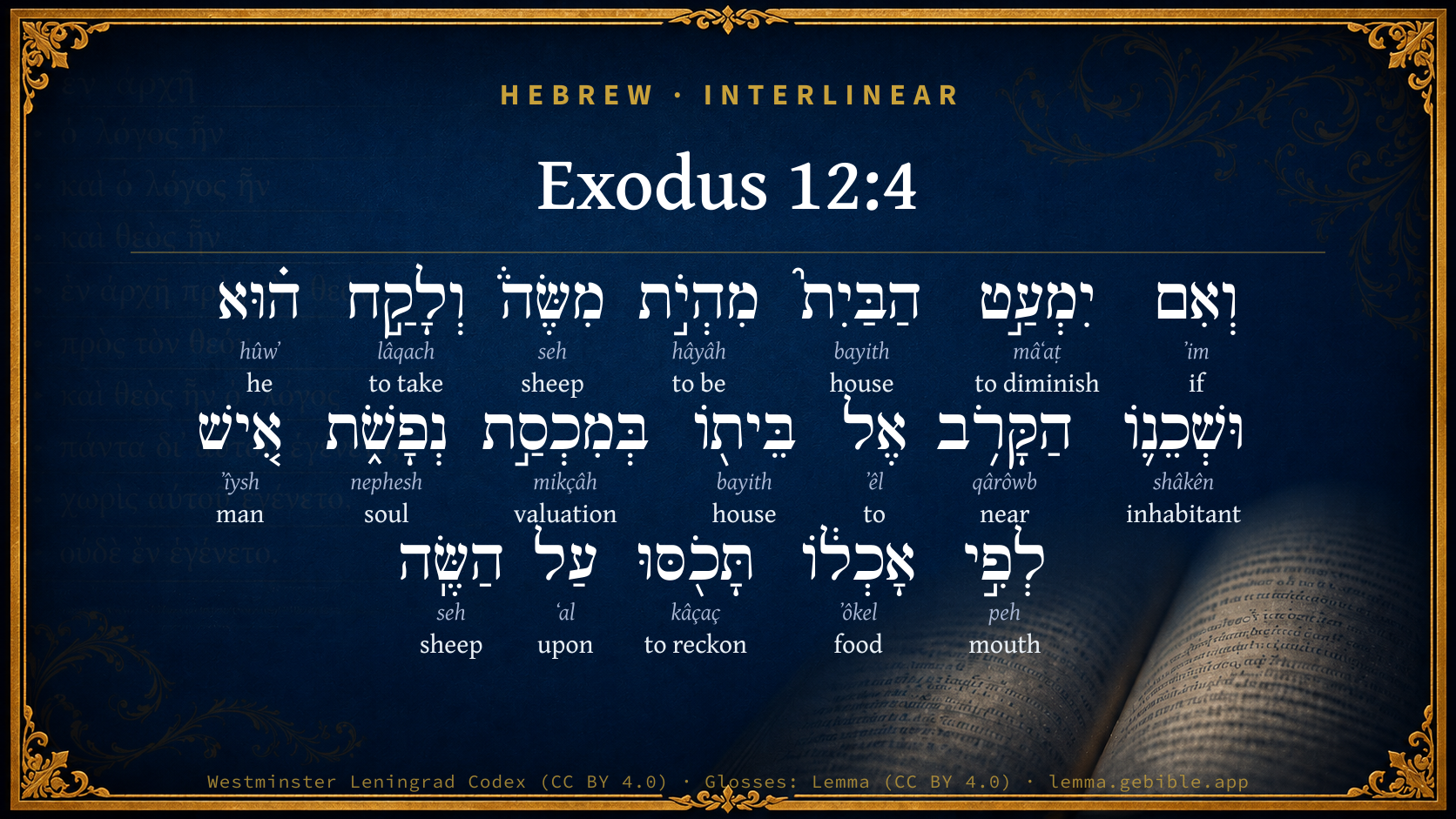
Hebrew (Westminster Leningrad Codex) Exodus 12:4 appears in the Hebrew Old Testament. The text above is from the Westminster Leningrad Codex. Each word links to its Strong’s number, a concise gloss, and parsing drawn from the Open Scriptures Hebrew Bible morphology. Click any word for its full Brown-Driver-Briggs (BDB) entry.
Download image
Cite this verse

Exodus 12:4 (World English Bible). Public Domain. Lemma interlinear Bible study tool, https://lemma.gebible.app/v/exodus/12/4.

Show BibTeX & RIS
BibTeX
RIS
English Translation
and if the household be too little for a lamb, then he and his neighbor next to his house shall take one according to the number of the souls; according to what everyone can eat you shall make your count for the lamb.
World English Bible · Public Domain
Highlights
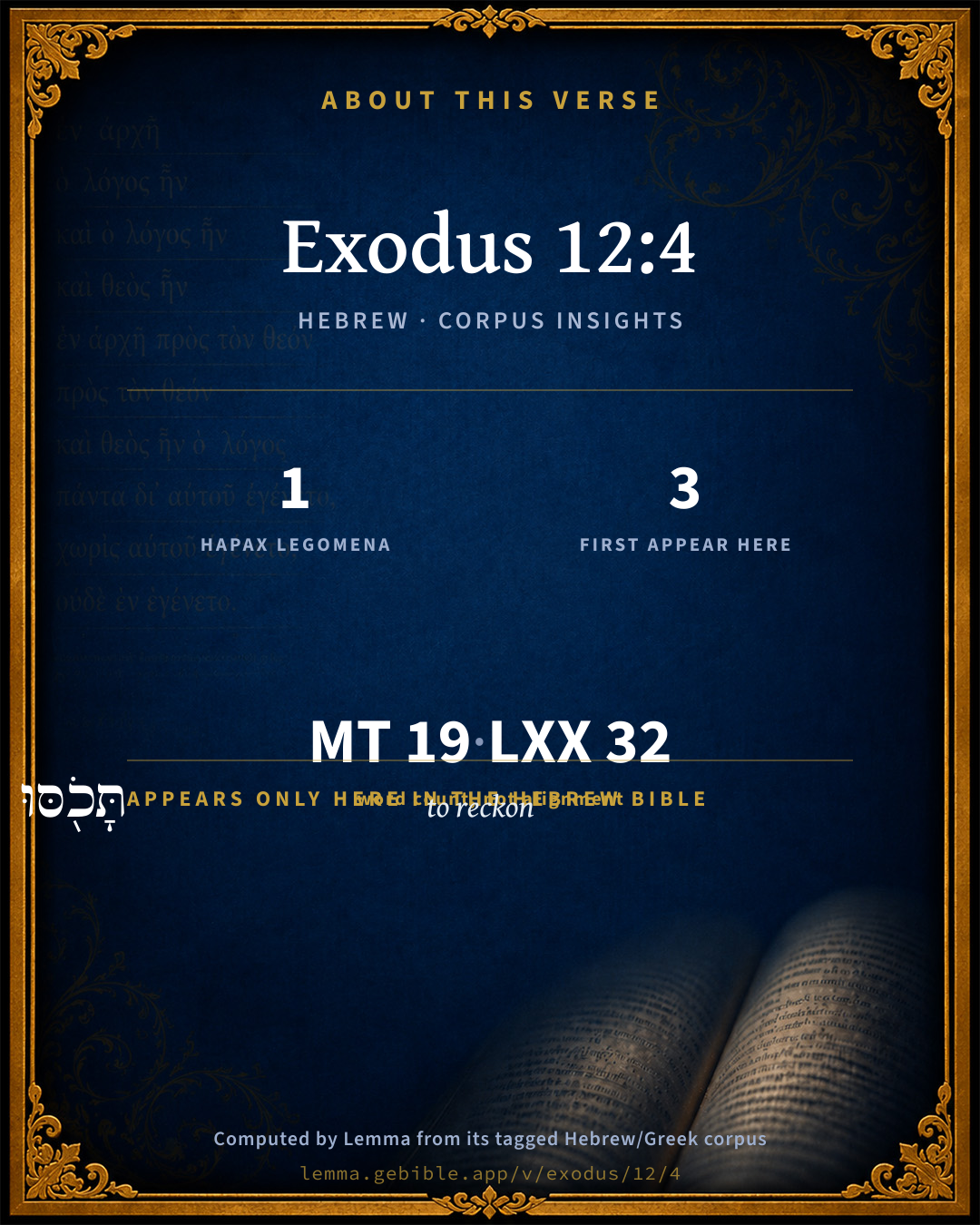
  • 1 hapax legomenon — only here in the Hebrew Bible
  • 3 first appearances in the Hebrew Bible
Full analysis ↓
Download a study sheet

One document with this verse’s original text, its word-by-word gloss line, the meaning frame, cross-references with their text, attributed commentary, and full source and license credits — printable, and it pastes into notes with its structure intact.

This verse Autodidact and up

Study sheet (.html) Plain text (.txt)

A passage Seminary Student

Up to 50 verses in one chapter. A passage sheet keeps up to 6 commentary sources and 12 cross-references per verse, in the order this page ranks them, and says so on the sheet whenever that leaves anything out. Ask for a single verse and you get the Autodidact verse sheet above.

Everything on this page stays free to read, with no account — the sheet is a download of what is already on screen, not access to it.

Want to remove ads? Support Godless Engineer
Compare translations 3

The same verse in 3 English versions, stacked beneath the original-language interlinear above. Click any original word for its lexicon entry.

Each is an independent rendering of the whole verse — the interlinear is not word-aligned to these translations.

Highlighted words mark where these versions differ — a whole-verse word diff, not a word-by-word alignment.

  • World English Bible Public Domain
    and if the household be too little for a lamb, then he and his neighbor next to his house shall take one according to the number of the souls; according to what everyone can eat you shall make your count for the lamb.
  • King James Version Public Domain
    And if the household be too little for the lamb, let him and his neighbor next unto his house take it according to the number of the souls; every man according to his eating shall make your count for the lamb.
  • unfoldingWord Literal Text CC BY-SA 4.0
    And if the household is too few for having a lamb, then he and his neighbor near to his house by the number of people shall take the lamb; according to the eating of the mouth of each man you shall calculate it.

unfoldingWord Literal Text — © unfoldingWord, licensed CC BY-SA 4.0. Word-aligned USFM3 via Door43 (git.door43.org/unfoldingWord/en_ult).

Versions to compare (up to 4)

3 of 4 selected

Show all 18 translations

Every available English version of this verse, each an independent rendering of the whole verse.

  • World English Bible Public Domain
    and if the household be too little for a lamb, then he and his neighbor next to his house shall take one according to the number of the souls; according to what everyone can eat you shall make your count for the lamb.
  • Berean Standard Bible Public Domain
    If the household is too small for a whole lamb, they are to share with the nearest neighbor based on the number of people, and apportion the lamb accordingly.
  • Majority Standard Bible Public Domain
    If the household is too small for a whole lamb, they are to share with the nearest neighbor based on the number of people, and apportion the lamb accordingly.
  • King James Version Public Domain
    And if the household be too little for the lamb, let him and his neighbor next unto his house take it according to the number of the souls; every man according to his eating shall make your count for the lamb.
  • American Standard Version (1901) Public Domain
    and if the household be too little for a lamb, then shall he and his neighbor next unto his house take one according to the number of the souls; according to every man's eating ye shall make your count for the lamb.
  • Revised Version (1885) Public Domain
    and if the household be too little for a lamb, then shall he and his neighbour next unto his house take one according to the number of the souls; according to every man’s eating ye shall make your count for the lamb.
  • Geneva Bible (1599) Public Domain
    And if the housholde be too litle for the lambe, he shall take his neighbour, which is next vnto his house, according to the nomber of the persons: euery one of you, according to his eating shall make your count for the lambes,
  • Douay-Rheims (1899) Public Domain
    But if the number be less than may suffice to eat the lamb, he shall take unto him his neighbour that joineth to his house, according to the number of souls which may be enough to eat the lamb.
  • Young's Literal Translation Public Domain
    `(And if the household be too few for a lamb, then hath he taken, he and his neighbour who is near unto his house, for the number of persons, each according to his eating ye do count for the lamb,)
  • Literal Standard Version CC BY-SA 4.0
    And if the household is too few for a lamb, then he has taken, he and his neighbor who is near to his house, for the number of persons, each according to his eating you count for the lamb.
  • Unlocked Literal Bible CC BY-SA 4.0
    If the household is too small for a lamb, the man and his next door neighbor are to take lamb or young goat meat that will be enough for the number of the people. It should be enough for everyone to eat, so they must take enough meat to feed them all.
  • unfoldingWord Literal Text CC BY-SA 4.0
    And if the household is too few for having a lamb, then he and his neighbor near to his house by the number of people shall take the lamb; according to the eating of the mouth of each man you shall calculate it.
  • Darby Bible Public Domain
    And if the household be too small for a lamb, let him and his neighbour next unto his house take [it] according to the number of the souls; each according to [the measure] of his eating shall ye count for the lamb.
  • World Messianic Bible Public Domain
    and if the household is too little for a lamb, then he and his neighbor next to his house shall take one according to the number of the souls. You shall make your count for the lamb according to what everyone can eat.
  • Webster's Bible Public Domain
    And if the household shall be too small for the lamb, let him and his neighbor next to his house take it according to the number of the souls; every man according to his eating shall make your count for the lamb.
  • Free Bible Version CC BY-SA 4.0
    However, if the household is too small for a whole lamb, then he and his nearest neighbor may choose a lamb according to the total number of people. Divide up the lamb depending on what everybody can eat.
  • Bible in Basic English Public Domain
    And if the lamb is more than enough for the family, let that family and its nearest neighbour have a lamb between them, taking into account the number of persons and how much food is needed for every man.
  • JPS Tanakh (1917) Public Domain
    and if the household be too little for a lamb, then shall he and his neighbour next unto his house take one according to the number of the souls; according to every man's eating ye shall make your count for the lamb.

Literal Standard Version (2020), Covenant Press — licensed CC BY-SA 4.0. Text via the HelloAO Bible API (eBible.org). Unlocked Literal Bible (unfoldingWord) — licensed CC BY-SA 4.0. Text via the HelloAO Bible API (eBible.org). unfoldingWord Literal Text — © unfoldingWord, licensed CC BY-SA 4.0. Word-aligned USFM3 via Door43 (git.door43.org/unfoldingWord/en_ult). Free Bible Version, Dr. Jonathan Gallagher — licensed CC BY-SA 4.0. Text via the HelloAO Bible API (eBible.org).

Word by word

More ways to search: Search by grammar → Find every occurrence → Compare this word →

Practice this passage: Drill this verse → Learn its vocabulary →

תָּכֹ֖סּוּ
kâçaç
H3699
“to reckon”
Verb, Qal, Imperfect, 2nd Person, Masculine, Plural
Part of Speech
Verb
Stem
Qal
Form
Imperfect
Person
2nd Person
Gender
Masculine
Number
Plural
Full BDB Definition

Origin: a primitive root

TWOT: 1014

(Qal) to estimate, reckon, compute
  1. וְאִם ʼim H518 “and · if” Conjunction + Conjunction
  2. יִמְעַ֣ט mâʻaṭ H4591 “to diminish” Verb, Qal, Imperfect, 3rd Person, Masculine, Singular
  3. הַבַּיִת֮ bayith H1004 “the · house” Particle, Definite Article + Noun, Common, Masculine, Singular, Absolute
  4. מִהְיֹ֣ת hâyâh H1961 “from · to be” Preposition + Verb, Qal, Infinitive Construct
  5. מִשֶּׂה֒ seh H7716 “from · sheep” Preposition + Noun, Common, Both, Singular, Absolute
  6. וְלָקַ֣ח lâqach H3947 “and · to take” Conjunction + Verb, Qal, Sequential Perfect, 3rd Person, Masculine, Singular
  7. ה֗וּא hûwʼ H1931 “he” Pronoun, Personal, 3rd Person, Masculine, Singular
  8. וּשְׁכֵנ֛וֹ shâkên H7934 “and · inhabitant · his” Conjunction + Adjective, Adjective, Masculine, Singular, Construct + Suffix, Personal, 3rd Person, Masculine, Singular
  9. הַקָּרֹ֥ב qârôwb H7138 “the · near” Particle, Definite Article + Adjective, Adjective, Masculine, Singular, Absolute
  10. אֶל ʼêl H413 “to” Preposition
  11. בֵּית֖וֹ bayith H1004 “house · his” Noun, Common, Masculine, Singular, Construct + Suffix, Personal, 3rd Person, Masculine, Singular
  12. בְּמִכְסַ֣ת mikçâh H4373 “in/at · valuation of” Preposition + Noun, Common, Feminine, Singular, Construct
  13. נְפָשֹׁ֑ת nephesh H5315 “souls” Noun, Common, Both, Plural, Absolute
  14. אִ֚ישׁ ʼîysh H376 “man” Noun, Common, Masculine, Singular, Absolute
  15. לְפִ֣י peh H6310 “to/for · mouth of” Preposition + Noun, Common, Masculine, Singular, Construct
  16. אָכְל֔וֹ ʼôkel H400 “food · his” Noun, Common, Masculine, Singular, Construct + Suffix, Personal, 3rd Person, Masculine, Singular
  17. עַל ʻal H5921 “upon” Preposition
  18. הַשֶּֽׂה seh H7716 “the · sheep” Particle, Definite Article + Noun, Common, Both, Singular, Absolute

About this verse

These counts appear in no published source. They are computed here, from the morphology-tagged text and Lemma’s own curated glosses. What Lemma adds →

19
words
17
distinct lemmas
Pentateuch
section

Notable vocabulary

1 hapax legomenon — a word that appears only here in the entire Hebrew Bible:

  • תָּכֹ֖סּוּ to reckon H3699

First appearance in Scripture

These words make their first canonical appearance in the Hebrew Bible here:

  • יִמְעַ֣ט to diminish H4591
  • בְּמִכְסַ֣ת valuation H4373
  • תָּכֹ֖סּוּ to reckon H3699

Shared distinctive vocabulary

בְּמִכְסַ֣ת valuation H4373 occurs in 2 verses of the Hebrew Bible. Also found in:

Grammatical profile

  • 4 verbs
  • 9 nouns
  • 2 adjectives
  • 1 pronoun
  • 2 prepositions
  • 1 conjunction

Verb forms

  • יִמְעַ֣ט Qal · Imperfect
  • מִהְיֹ֣ת Qal · Infinitive Construct
  • וְלָקַ֣ח Qal · Sequential Perfect
  • תָּכֹ֖סּוּ Qal · Imperfect

Repetition

Words recur within this verse — often emphatic in Hebrew:

  • הַבַּיִת֮ house H1004 ×2
  • מִשֶּׂה֒ sheep H7716 ×2

Hebrew & Septuagint length

In English translation the verse runs 43 words from the Hebrew and 50 from the Septuagint (LXX English) — closely comparable.

A rough comparison of the two English renderings, which tokenize alike — not a word-level alignment.

Word counts can differ between the Hebrew and the Greek without any difference in meaning — e.g. the Hebrew direct-object marker אֵת has no separate Greek word, and Greek often adds the article ὁ.

In the original languages it is 19 Hebrew tokens and 32 Greek tokens — but the two are counted differently (Hebrew bundles its prefixes and suffixes into one token; the Greek is in lemma form), so that isn’t a like-for-like length.

Hebrew and Greek witnesses Masoretic Hebrew ↔ Greek Septuagint

The same verse in the two great witnesses to the Old Testament, shown verse-for-verse.

These are two independent witnesses, not word-aligned to each other, and the Septuagint is shown in lemma (dictionary) form.

Hebrew Exodus 12:4 Masoretic · Westminster Leningrad Codex

וְאִם יִמְעַ֣ט הַבַּיִת֮ מִהְיֹ֣ת מִשֶּׂה֒ וְלָקַ֣ח ה֗וּא וּשְׁכֵנ֛וֹ הַקָּרֹ֥ב אֶל בֵּית֖וֹ בְּמִכְסַ֣ת נְפָשֹׁ֑ת אִ֚ישׁ לְפִ֣י אָכְל֔וֹ תָּכֹ֖סּוּ עַל הַשֶּֽׂה

and if the household be too little for a lamb, then he and his neighbor next to his house shall take one according to the number of the souls; according to what everyone can eat you shall make your count for the lamb.

World English Bible · Public Domain

Greek LXX Exodus 12:4 Septuagint · lemma form

ἐάν δέ ὀλιγοστός εἰμί ὁ ἐν ὁ οἰκία ὥστε μή ἱκανός εἰμί εἰς πρόβατον συνλαμβάνω μετά ἑαυτοῦ ὁ γείτων ὁ πλησίον αὐτός κατά ἀριθμός ψυχή ἕκαστος ὁ ἀρκέω αὐτός συνἀριθμέω εἰς πρόβατον

And if they be few in a household, so that there are not enough for the lamb, he shall take with himself his neighbor that lives near to him, —as to the number of souls, every one according to that which suffices him shall make a reckoning for the lamb.

LXX2012 (modern English Septuagint) · Public Domain

Hebrew: Westminster Leningrad Codex (CC BY 4.0). Greek: Septuagint (public domain); English from LXX2012 (modern English Septuagint) (Public Domain). How the Septuagint differs from the Hebrew →

Targum (Aramaic paraphrase)

2

The Targum is the ancient Jewish Aramaic paraphrase of the Hebrew Scriptures — an interpretive translation, not the Hebrew text itself. Onkelos (literal) and Pseudo-Jonathan (expansive) render the Torah, and Jonathan the Prophets. Coverage is partial: where no permissively-licensed English translation exists for a verse, only the Aramaic is shown. This is verse-level text, not a word-by-word alignment to the Hebrew.

  1. Targum Onkelos Torah (Genesis–Deuteronomy)
    וְאִם יִזְעֵיר בֵּיתָא מִלְאִתְמְנָאָה עַל אִמְרָא וְיִסַב הוּא וְשֵׁיבָבֵהּ דְקָרִיב לְבֵיתֵהּ בְּמִנְיַן נַפְשָׁתָא גְבַר לְפוּם מֵיכְלֵהּ תִּתְמְנוּן עַל אִמְרָא:

    (no public-domain English translation for this verse)

    Targum Onkelos — Aramaic: “Onkelos Genesis” (public domain); “Onkelos Exodus” (public domain); “Onkelos Leviticus” (public domain); “Onkelos Numbers” (public domain); “Onkelos Deuteronomy” (public domain). English: “Sefaria Community Translation” (CC0 1.0 (public-domain dedication)); “J.W. Etheridge. The Targums of Onkelos and Jonathan Ben Uzziel on the Pentateuch. London: Longmans, Green, 1862” (public domain). Text via Sefaria.

  2. Targum Pseudo-Jonathan Torah (Genesis–Deuteronomy)
    וְאִין זְעִירִין אִינְשֵׁי בֵיתָא מִמִּנְיַן עַשְרָא כְּמִיסַת לְמֵיכוּל אִימְרָא וְיִסַב הוּא וְשִׁיבְבֵיהּ דִּקָרֵיב לְבֵיתֵיהּ בִּסְכוּם נַפְשָׁתָא גְּבַר לְפוּם מֵיסַב מֵיכְלֵיהּ תִּיכְסוּן יַת אִימְרָא

    but if the men of the house are fewer than ten in number, in proportion to a sufficient number to eat the lamb, he and his neighbour who is nearest to his house shall take according to the number of souls: each man according to the sufficiency of his eating shall be counted for the lamb.

    Targum Pseudo-Jonathan — Aramaic: “Targum Jonathan on Genesis” (public domain); “Targum Jonathan on Exodus” (public domain); “Targum Jonathan on Leviticus” (public domain); “Targum Jonathan on Numbers” (public domain); “Targum Jonathan on Deuteronomy” (public domain). English: “The Targum of Jonathan ben Uzziel, trans. J. W. Etheridge, London, 1862” (public domain). Text via Sefaria.

Commentary

Notes on Exodus 12:4 from classic Christian and Jewish commentators (each source and its license shown beneath its notes). The classic Christian expositions comment on the surrounding passage and are grouped to its opening verse, so a note may address several verses; the Jewish commentaries on the Tanakh (Rashi and others) are per-verse, so they appear only where the commentator wrote on this verse.

Lemma curates 59 commentaries, every one of them public domain or Creative Commons licensed, each selected and text-cleaned for this edition rather than reprinted as found. About our sources →

Trapp's Complete Commentary

John Trapp

Exo 12:4 And if the household be too little for the lamb, let him and his neighbour next unto his house take [it] according to the number of the souls; every man according to his eating shall make your count for the lamb.

Ver. 4. Shall make your count,] sc., Of communicants; that the whole may be eaten up, and every one have enough. Spiritual blessing may be divided in solidum: one may have as much as another, and all alike. The Gentiles also are called to fruition and feeding on the Lamb.

John Trapp, A Commentary or Exposition upon All the Books of the Old and New Testament (1647–1656) — public domain. Text from a community e-Sword module.

Joseph Benson's Commentary

Exo 12:4. If the household be too little — The Hebrew doctors tell us, that there were not to be fewer than ten persons, nor more than twenty, to the eating of one lamb. And at this sacred repast, men, women, and children, masters and servants, if circumcised, were entertained.

Joseph Benson's Commentary on the Old and New Testaments (1811–1818) — public domain. Text from a community e-Sword module.

Geneva Bible (1599)

Geneva Bible translators

He shall take so many as are sufficient to eat the lamb.

Geneva Bible (1599) marginal notes — public domain. Text via Bolls.life.

Jamieson, Fausset & Brown

Robert Jamieson, A. R. Fausset & David Brown

if the household be too little for the lamb, &c.--It appears from JOSEPHUS that ten persons were required to make up the proper paschal communion.

every man according to his eating--It is said that the quantity eaten of the paschal lamb, by each individual, was about the size of an olive.

Jamieson, Fausset & Brown — Commentary Critical and Explanatory on the Whole Bible (1871) — public domain (CC PDM 1.0). Text via the HelloAO Bible API.

Adam Clarke's Commentary

Verse 4. If the household be too little] That is, if there be not persons enough in one family to eat a whole lamb, then two families must join together. The rabbins allow that there should be at least ten persons to one paschal lamb, and not more than twenty.

Take it, according to the number of the souls] The persons who were to eat of it were to be first ascertained, and then the lamb was to be slain and dressed for that number.

Adam Clarke's Commentary on the Bible (1810–1826) — public domain. Text from a community e-Sword/MySword module.

Ellicott's Commentary for English Readers

(4) If the household be too little for the lamb.—There would be cases where the family would not be large enough to consume an entire lamb at a sitting. Where this was so, men were to club with their neighbours, either two small families joining together, or a large family drafting off some of its members to bring up the numbers of a small one. According to Josephus (Bell. Jud., vi. 9, § 3), ten was the least number regarded as sufficient, while twenty was not considered too many.

Every man according to his eating shall make your count for the lamb.—Rather, shall ye count. In determining the number for any given Paschal meal, ye shall “count men according to their eating,” admitting more or fewer, as they are likely to consume less or more.

A Bible Commentary for English Readers, edited by Charles John Ellicott (1878–1897) — public domain. Text from a community e-Sword module.

The Cambridge Bible for Schools and Colleges

gen. ed. J. J. S. Perowne

4. too little for a lamb] According to the later Jews, fewer than ten (cf. Jos. BJ. vi. 9. 3; and Targ. Ps.-Jon. here), in accordance with the Rabb. exegesis of Num_14:27, that ten was the smallest number the could constitute a ‘congregation’ (the ‘congregation’ there being interpreted of the ten murmuring spies).

according to every man’s eating, &c.] In determining the number of persons sufficient for one lamb, you are to be guided by the usual measure or amount of their eating,—according, for example, as they are adults or children, healthy or infirm, &c.

The Cambridge Bible for Schools and Colleges (gen. ed. J. J. S. Perowne; Cambridge University Press, 1878–1918) — public domain. Text from a community e-Sword module.

John Gill's Exposition

And if the household be too little for the lamb,.... That they cannot eat it up at once:

let him and his neighbour next unto his house take it according to the number of the souls; which Josephus (e) says were never fewer than ten, and were often twenty, but no man might feast alone; with which agrees the Jewish canon (f),"they do not kill the passover lamb for a single person, nor even for a society consisting of one hundred, that cannot eat the quantity of an olive:"

every man according to his eating shall make your count for the lamb: that is, a man must reckon up how many he has in his own house to eat of the lamb, and what their appetites be, by which he will he able to judge whether he can dispense with a lamb himself, or whether he must take in some of his neighbours, and how many, so as to eat up the whole lamb, for, for such persons the lamb was to be slain. The rule is,"if a man slays it for those that do not eat of it, or for those that are not counted, for the uncircumcised, and the unclean, it was wrong, and not allowed of (g).''The taking in his neighbours may respect the call of the Gentiles to partake of Christ with the Jews, see Eph 3:5.

(e) De Bello Jud. l. 6. c. 9. sect. 3. (f) Misn. Pesach. c. 8. sect. 7. (g) lbid. c. 5. sect. 3.

John Gill's Exposition of the Whole Bible (1746–1763) — public domain (CC PDM 1.0). Text via the HelloAO Bible API.

Albert Barnes' Notes on the Bible

Tradition specifies ten as the least number; but the matter was probably left altogether to the discretion of the heads of families.

The last clause should be rendered: “each man, according to his eating, ye shall count for the lamb.”

Albert Barnes' Notes on the Bible (1834–1885) — public domain. Text from a community e-Sword/MySword module.

Haydock's Catholic Bible Commentary

Less. Moses does not specify the number. But in never comprised fewer than ten, nor more than twenty, in which number Menoch does not think women or children are comprised. The Jews satisfied the inquiry of Cestius, concerning the multitude which might be assembled at the paschal solemnity, by allowing ten for every victim; and finding that 250,600 victims had been sacrificed in the space of two hours, they concluded 2,700,000 people were collected at Jerusalem. (Josephus, Jewish Wars vii. 16.)

George Leo Haydock (1774–1849), Haydock's Catholic Family Bible and Commentary, 1859 edition — public domain. Excludes Psalms (Douay-Rheims chapter numbering differs from Protestant) and Deuterocanonical books (Catholic canon only).

Matthew Poole's English Annotations

Too little for the lamb, i.e. for the eating of the whole lamb at one meal, according to the rule, Exo 12:8,10; if the persons be so few that they cannot eat it up without gluttony.

Take it; or rather thus, word for word, And, or Then he (the master of that family) shall take also his neighbour next unto his house; he shall take him and his family into society with himself; they shall join together.

To the number of the souls, or persons, i.e. as the two families shall consist of more or fewer persons. I suppose the meaning is, that if his next neighbour’s family were of itself sufficient for the eating of the whole lamb, that he should pass over that to the next small family, which being joined with his might make up a fit number, which, as the Hebrew doctors tell us, was ten, besides women and children.

According to his eating, i.e. according to the proportion which he can or commonly doth eat. The meaning is this, The whole lamb being to be eaten at once, and a sufficient number being necessary to that end, and there being great variety in men’s stomachs and meals, they were to give allowance for that, and to take either more or fewer persons, as their stomachs were better or worse.

Matthew Poole's English Annotations on the Holy Bible (1683–1685) — public domain. Text from a community e-Sword/MySword module.

The Pulpit Commentary

If the household be too little for the lambi.e., "too few to consume it at a sitting." Usage in course of time fixed the minimum number at ten. (Joseph. Bell. Jud: 6:9, The whole family, men, women and children participated. The lamb was generally slain between the ninth hour (3 p.m.) and the eleventh (5 p.m.). Let him and his neighbour take it according to the number of the souls. If there were a household of only five, which could not possibly consume the lamb, any large neighbouring family was to send five or six of its number, to make up the deficiency. Every man according to his eating, etc. It is difficult to see what sense our translators intended. The real direction is that, in providing a proper number of guests, consideration should be had of the amount which they would be likely to eat. Children and the very aged were not to be reckoned as if they were men in the vigour of life. Translate man according to his eating shall ye count towards the lamb."

The Pulpit Commentary (1880–1919), ed. H.D.M. Spence-Jones & Joseph S. Exell — public domain. Text from a community e-Sword module.

Rashi

Rabbi Shlomo Yitzchaki (Rashi)

ואם ימעט הבית מהיות משה — This means: if they are too few to be sufficient for one lamb — that they are unable to eat the whole of it, and it would therefore come under the category of נותר “left over”. ולקח הוא ושכנו וגו׳ THEN LET HIM AND HIS NEIGHBOUR TAKE etc. — This is what these words and those that precede it imply in its literal sense, but there is also a derivation from it of a Halachic character — that the verse intends to teach that after they have counted themselves (formed themselves into a company) for it, they may reduce their number by withdrawing from it and may register themselves for a different lamb; but if they intend to withdraw and thereby reduce their number מהיות משה — they must reduce only whilst the lamb is still in being — whilst it is alive (מחיות משה = מהיות משה) — and not after it has been slaughtered (Pesachim 89a; cf. Mekhilta).

במכסת means ACCORDING TO THE NUMBER. Similar is, (Leviticus 27:23) “The number (מכסת) of thy valuation”.

לפי אכלו [EVERY MAN] ACCORDING TO HIS EATING — every man who is fitted to eat the quantity prescribed by the Law; this excludes a sick person and an aged person who are unable to eat a portion the size of an olive (Mekhilta).

תכסו means ye shall number yourselves, as the Targum renders it. (It is not to be translated: ye shall number others.)

Rashi on the Tanakh — English translations: “The Judaica Press complete Tanach with Rashi, translated by A. J. Rosenberg” (CC BY 4.0); “Pentateuch with Rashi's commentary by M. Rosenbaum and A.M. Silbermann, 1929-1934” (public domain); “The Metsudah Tanach series, Lakewood, N.J” (CC BY 4.0); and “The Book of Joshua, Metsudah Publications, 1997” (CC BY 4.0). Text via Sefaria.

Lesson kit

Teaching starters — assembled from the data on this page, not authored interpretation. Every prompt links to the verse data it draws on. Edit before teaching.

Exodus, in the Pentateuch, opens this verse with 19 words (17 distinct Hebrew lemmas). Its most distinctive word is kâçaç (“to reckon”). A historical commentator’s framing appears above. Read the whole chapter for the surrounding context.

Discussion questions

  1. What does “to reckon” (kâçaç) contribute to the verse as a whole?
  2. 1 word here appears nowhere else in the Hebrew Bible. Why might the author reach for such rare wording?
  3. 3 words make their first appearance in Scripture here. What does this debut establish?
  4. How does Leviticus 27:23, which shares the word «valuation», read alongside this verse?
  5. What does the repetition of “house” (2× in this one verse) do in this verse?
  6. These translations render this verse differently; the difference is in the English rendering, not the original. What questions does that raise?
  7. «יִמְעַ֣ט» is a Qal Imperfect verb. How does that grammatical form shape the action described?
  8. Compare how Trapp's Complete Commentary and Joseph Benson's Commentary read this verse. Where do they agree or differ?

Things to notice

  • 1 word in this verse appears nowhere else in the Hebrew Bible.
  • 3 words make their first canonical appearance in Scripture here.
  • This verse counts 19 Hebrew ↔ 32 Greek words.
  • These translations choose different wording for 23 words in this verse.
  • “house” occurs 2× in this single verse.

Reading settings

Reading text

Shown beneath each verse's original-language words.

Old Testament
Old Testament edition

Read the OT as the Masoretic Hebrew (MT) or the Greek Septuagint (LXX).

English shown for the Greek Septuagint (in the Hebrew ↔ Greek comparison).

Comparing translations? Open the Compare panel on any verse page to stack up to four side by side.