Exodus 22:31

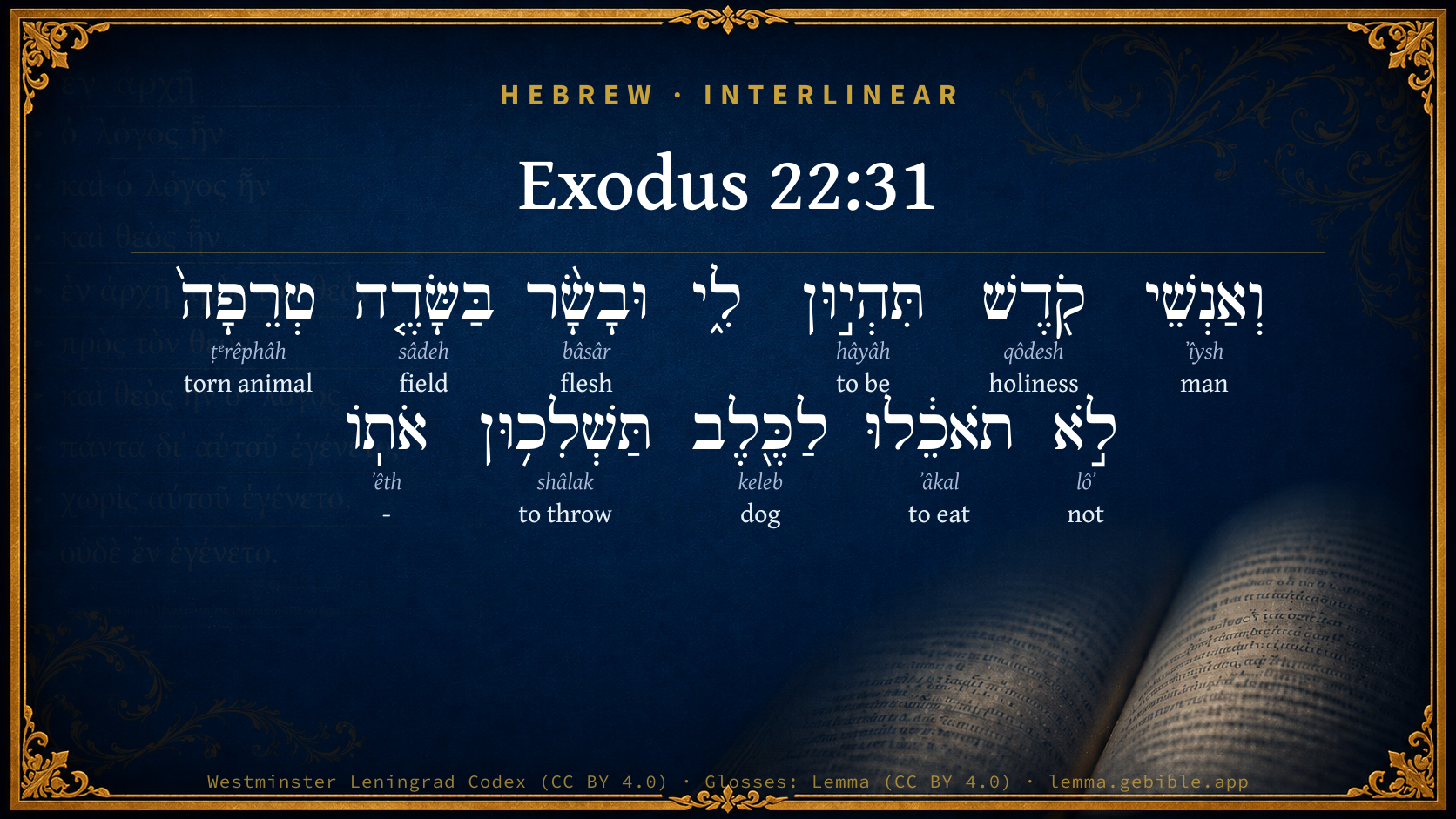
Hebrew (Westminster Leningrad Codex) Exodus 22:31 appears in the Hebrew Old Testament. The text above is from the Westminster Leningrad Codex. Each word links to its Strong’s number, a concise gloss, and parsing drawn from the Open Scriptures Hebrew Bible morphology. Click any word for its full Brown-Driver-Briggs (BDB) entry.
Download image
Cite this verse

Exodus 22:31 (World English Bible). Public Domain. Lemma interlinear Bible study tool, https://lemma.gebible.app/v/exodus/22/31.

Show BibTeX & RIS
BibTeX
RIS
English Translation
"You shall be holy men to me, therefore you shall not eat any flesh that is torn by animals in the field. You shall cast it to the dogs.
World English Bible · Public Domain
Download a study sheet

One document with this verse’s original text, its word-by-word gloss line, the meaning frame, cross-references with their text, attributed commentary, and full source and license credits — printable, and it pastes into notes with its structure intact.

This verse Autodidact and up

Study sheet (.html) Plain text (.txt)

A passage Seminary Student

Up to 50 verses in one chapter. A passage sheet keeps up to 6 commentary sources and 12 cross-references per verse, in the order this page ranks them, and says so on the sheet whenever that leaves anything out. Ask for a single verse and you get the Autodidact verse sheet above.

Everything on this page stays free to read, with no account — the sheet is a download of what is already on screen, not access to it.

Want to remove ads? Support Godless Engineer
Compare translations 3

The same verse in 3 English versions, stacked beneath the original-language interlinear above. Click any original word for its lexicon entry.

Each is an independent rendering of the whole verse — the interlinear is not word-aligned to these translations.

Highlighted words mark where these versions differ — a whole-verse word diff, not a word-by-word alignment.

  • World English Bible Public Domain
    "You shall be holy men to me, therefore you shall not eat any flesh that is torn by animals in the field. You shall cast it to the dogs.
  • King James Version Public Domain
    And ye shall be holy men unto me: neither shall ye eat any flesh that is torn of beasts in the field; ye shall cast it to the dogs.
  • unfoldingWord Literal Text CC BY-SA 4.0
    And you shall be men of holiness to me. And you shall not eat animal-torn-in-the-field meat. You shall throw it to the dogs.

unfoldingWord Literal Text — © unfoldingWord, licensed CC BY-SA 4.0. Word-aligned USFM3 via Door43 (git.door43.org/unfoldingWord/en_ult).

Versions to compare (up to 4)

3 of 4 selected

Show all 18 translations

Every available English version of this verse, each an independent rendering of the whole verse.

  • World English Bible Public Domain
    "You shall be holy men to me, therefore you shall not eat any flesh that is torn by animals in the field. You shall cast it to the dogs.
  • Berean Standard Bible Public Domain
    You are to be My holy people. You must not eat the meat of a mauled animal found in the field; you are to throw it to the dogs.
  • Majority Standard Bible Public Domain
    You are to be My holy people. You must not eat the meat of a mauled animal found in the field; you are to throw it to the dogs.
  • King James Version Public Domain
    And ye shall be holy men unto me: neither shall ye eat any flesh that is torn of beasts in the field; ye shall cast it to the dogs.
  • American Standard Version (1901) Public Domain
    And ye shall be holy men unto me: therefore ye shall not eat any flesh that is torn of beasts in the field; ye shall cast it to the dogs.
  • Revised Version (1885) Public Domain
    And ye shall be holy men unto me: therefore ye shall not eat any flesh that is torn of beasts in the field; ye shall cast it to the dogs.
  • Geneva Bible (1599) Public Domain
    Ye shall be an holy people vnto me, neither shall ye eate any flesh that is torne of beastes in the fielde: ye shall cast it to the dogge.
  • Douay-Rheims (1899) Public Domain
    You shall be holy men to me: the flesh that beasts have tasted of before, you shall not eat, but shall cast it to the dogs.
  • Young's Literal Translation Public Domain
    `And ye are holy men to Me, and flesh torn in the field ye do not eat, to a dog ye do cast it.
  • Literal Standard Version CC BY-SA 4.0
    And you are holy men to Me, and you do not eat flesh torn in the field, you cast it to a dog.
  • Unlocked Literal Bible CC BY-SA 4.0
    You will be people that are set apart for me. So you must not eat any meat that was torn by animals in the field. Instead, you must throw it to the dogs.
  • unfoldingWord Literal Text CC BY-SA 4.0
    And you shall be men of holiness to me. And you shall not eat animal-torn-in-the-field meat. You shall throw it to the dogs.
  • Darby Bible Public Domain
    -- And ye shall be holy men unto me; and ye shall not eat flesh torn in the field: ye shall cast it to the dog.
  • World Messianic Bible Public Domain
    “You shall be holy men to me, therefore you shall not eat any meat that is torn by animals in the field. You shall cast it to the dogs.
  • Webster's Bible Public Domain
    And ye shall be holy men to me: neither shall ye eat any flesh that is torn of beasts in the field; ye shall cast it to the dogs.
  • Free Bible Version CC BY-SA 4.0
    You are to be holy people to me. You must not eat any animal carcass that you find in the countryside that has been killed by wild animals. Throw it to the dogs to eat.”
  • Bible in Basic English Public Domain
    You are to be holy men to me: the flesh of no animal whose death has been caused by the beasts of the field may be used for your food; it is to be given to the dogs.
  • JPS Tanakh (1917) Public Domain
    (22-30) And ye shall be holy men unto Me; therefore ye shall not eat any flesh that is torn of beasts in the field; ye shall cast it to the dogs.

Literal Standard Version (2020), Covenant Press — licensed CC BY-SA 4.0. Text via the HelloAO Bible API (eBible.org). Unlocked Literal Bible (unfoldingWord) — licensed CC BY-SA 4.0. Text via the HelloAO Bible API (eBible.org). unfoldingWord Literal Text — © unfoldingWord, licensed CC BY-SA 4.0. Word-aligned USFM3 via Door43 (git.door43.org/unfoldingWord/en_ult). Free Bible Version, Dr. Jonathan Gallagher — licensed CC BY-SA 4.0. Text via the HelloAO Bible API (eBible.org).

Word by word

More ways to search: Search by grammar → Find every occurrence → Compare this word →

Practice this passage: Drill this verse → Learn its vocabulary →

טְרֵפָה֙
ṭᵉrêphâh
H2966
“torn animal”
Noun, Common, Feminine, Singular, Absolute
Part of Speech
Noun
Type
Common
Gender
Feminine
Number
Singular
State
Absolute
Full BDB Definition

Origin: from (collectively) H2964

TWOT: 827c

that which is torn, animal torn (by beasts)
  1. וְאַנְשֵׁי ʼîysh H376 “and · men of” Conjunction + Noun, Common, Masculine, Plural, Construct
  2. קֹ֖דֶשׁ qôdesh H6944 “holiness” Noun, Common, Masculine, Singular, Absolute
  3. תִּהְי֣וּן hâyâh H1961 “to be” Verb, Qal, Imperfect, 2nd Person, Masculine, Plural + Suffix, n
  4. וּבָשָׂ֨ר bâsâr H1320 “and · flesh” Conjunction + Noun, Common, Masculine, Singular, Absolute
  5. בַּשָּׂדֶ֤ה sâdeh H7704 “in/at the · field” Preposition, Determined + Noun, Common, Masculine, Singular, Absolute
  6. לֹ֣א lôʼ H3808 “not” Particle, Negative
  7. תֹאכֵ֔לוּ ʼâkal H398 “to eat” Verb, Qal, Imperfect, 2nd Person, Masculine, Plural
  8. לַכֶּ֖לֶב keleb H3611 “to/for the · dog” Preposition, Determined + Noun, Common, Masculine, Singular, Absolute
  9. תַּשְׁלִכ֥וּן shâlak H7993 “to throw” Verb, Hiphil, Imperfect, 2nd Person, Masculine, Plural + Suffix, n
  10. אֹתֽוֹ ʼêth H853 “- · him” Particle, Direct Object + Suffix, Personal, 3rd Person, Masculine, Singular

About this verse

These counts appear in no published source. They are computed here, from the morphology-tagged text and Lemma’s own curated glosses. What Lemma adds →

12
words
11
distinct lemmas
Pentateuch
section

Notable vocabulary

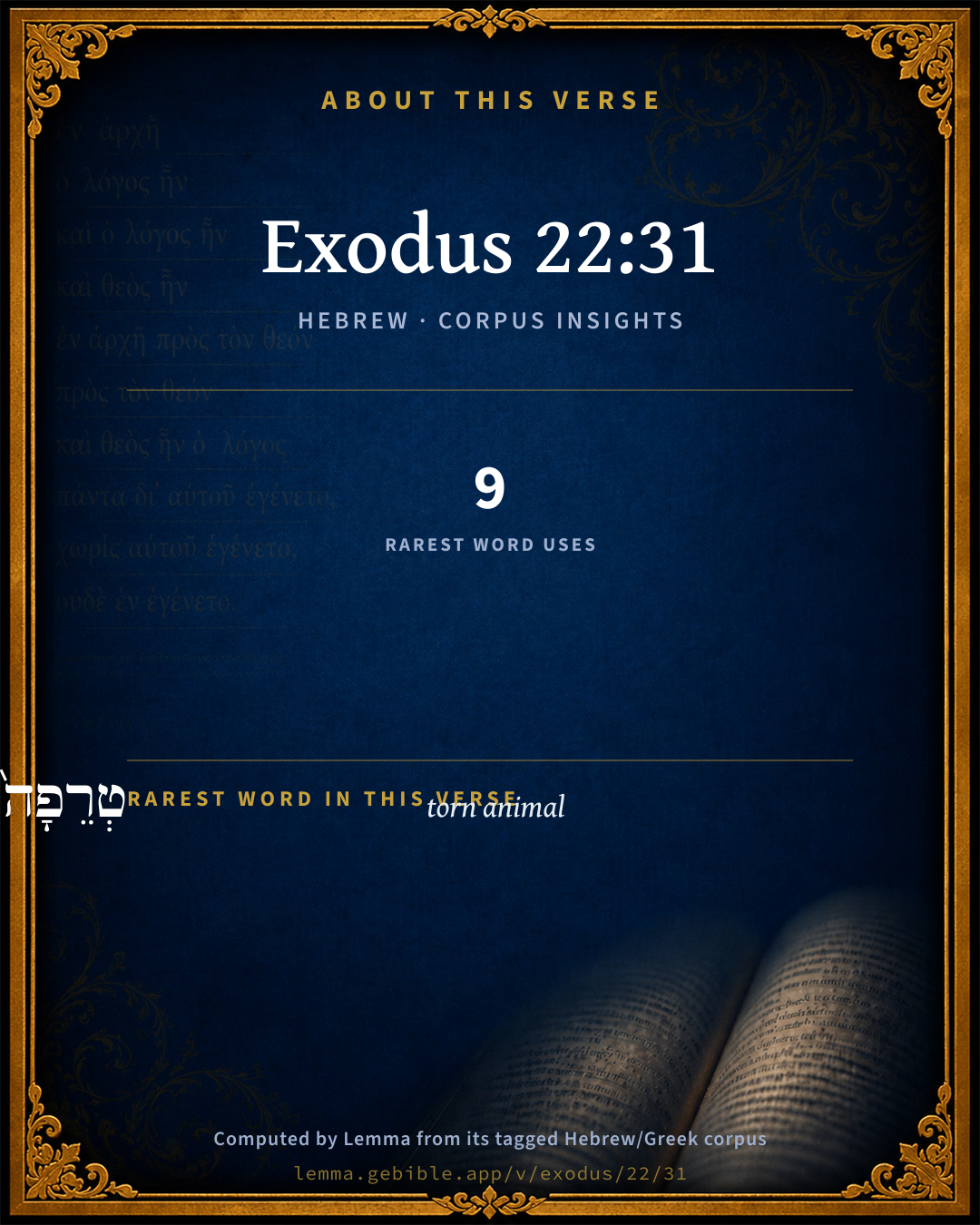
The rarest word here is טְרֵפָה֙ torn animal H2966 — appearing just 9 times in the whole Hebrew Bible.

Shared distinctive vocabulary

טְרֵפָה֙ torn animal H2966 occurs in 9 verses of the Hebrew Bible. Also found in:

Grammatical profile

  • 3 verbs
  • 6 nouns
  • 1 preposition
  • 2 particles

Verb forms

  • תִּהְי֣וּן Qal · Imperfect
  • תֹאכֵ֔לוּ Qal · Imperfect
  • תַּשְׁלִכ֥וּן Hiphil · Imperfect

Hebrew & Septuagint length

In English translation the verse runs 29 words from the Hebrew and 24 from the Septuagint (LXX English) — closely comparable.

A rough comparison of the two English renderings, which tokenize alike — not a word-level alignment.

Word counts can differ between the Hebrew and the Greek without any difference in meaning — e.g. the Hebrew direct-object marker אֵת has no separate Greek word, and Greek often adds the article ὁ.

Cross-references

12

Topical passages linked to Exodus 22:31 in the Treasury of Scripture Knowledge — connected by theme and wording, ordered by reader-vote popularity; previews shown in the World English Bible.

  • Leviticus 19:2 "Speak to all the congregation of the children of Israel, and tell them, 'You shall be holy; for I Yahweh your God am holy.
  • Ezekiel 4:14 Then said I, Ah Lord Yahweh! behold, my soul has not been polluted; for from my youth up even until now have I not eaten of that which dies of itself, or is torn of animals; neither came there abominable flesh into my mouth.
  • Leviticus 22:8 That which dies of itself, or is torn by animals, he shall not eat, defiling himself by it. I am Yahweh.
  • Deuteronomy 14:21 You shall not eat of anything that dies of itself: you may give it to the foreigner living among you who is within your gates, that he may eat it; or you may sell it to a foreigner: for you are a holy people to Yahweh your God. You shall not boil a kid in its mother's milk.
  • Ezekiel 44:31 The priests shall not eat of anything that dies of itself, or is torn, whether it be bird or animal.
  • Acts 15:20 but that we write to them that they abstain from the pollution of idols, from sexual immorality, from what is strangled, and from blood.
  • 1 Peter 1:15–16 but just as he who called you is holy, you yourselves also be holy in all of your behavior;
  • Exodus 19:5–6 Now therefore, if you will indeed obey my voice, and keep my covenant, then you shall be my own possession from among all peoples; for all the earth is mine;
  • Leviticus 11:44–45 For I am Yahweh your God. Sanctify yourselves therefore, and be holy; for I am holy: neither shall you defile yourselves with any kind of creeping thing that moves on the earth.
  • Leviticus 17:15–16 "'Every person that eats what dies of itself, or that which is torn by animals, whether he is native-born or a foreigner, he shall wash his clothes, and bathe himself in water, and be unclean until the evening: then he shall be clean.
  • Leviticus 20:25 "'You shall therefore make a distinction between the clean animal and the unclean, and between the unclean fowl and the clean: and you shall not make yourselves abominable by animal, or by bird, or by anything with which the ground teems, which I have separated from you as unclean for you.
  • Acts 10:14 But Peter said, "Not so, Lord; for I have never eaten anything that is common or unclean."

Cross-references courtesy of OpenBible.info (CC BY 4.0).

Hebrew and Greek witnesses Masoretic Hebrew ↔ Greek Septuagint

The same verse in the two great witnesses to the Old Testament, shown verse-for-verse.

These are two independent witnesses, not word-aligned to each other, and the Septuagint is shown in lemma (dictionary) form.

Hebrew Exodus 22:31 Masoretic · Westminster Leningrad Codex

וְאַנְשֵׁי קֹ֖דֶשׁ תִּהְי֣וּן לִ֑י וּבָשָׂ֨ר בַּשָּׂדֶ֤ה טְרֵפָה֙ לֹ֣א תֹאכֵ֔לוּ לַכֶּ֖לֶב תַּשְׁלִכ֥וּן אֹתֽוֹ

"You shall be holy men to me, therefore you shall not eat any flesh that is torn by animals in the field. You shall cast it to the dogs.

World English Bible · Public Domain

Greek LXX Exodus 22:31 Septuagint · lemma form
And you⌃ shall be holy men to me; and you⌃ shall not eat flesh taken of beasts, you⌃ shall cast it to the dog.

LXX2012 (modern English Septuagint) · Public Domain

On this verse, Haydock's Catholic Bible Commentary discusses the Septuagint’s reading. Read the note in Commentary ↓

Hebrew: Westminster Leningrad Codex (CC BY 4.0). Greek: Septuagint (public domain); English from LXX2012 (modern English Septuagint) (Public Domain). How the Septuagint differs from the Hebrew →

Commentary

Notes on Exodus 22:31 from classic Christian and Jewish commentators (each source and its license shown beneath its notes). The classic Christian expositions comment on the surrounding passage and are grouped to its opening verse, so a note may address several verses; the Jewish commentaries on the Tanakh (Rashi and others) are per-verse, so they appear only where the commentator wrote on this verse.

Lemma curates 59 commentaries, every one of them public domain or Creative Commons licensed, each selected and text-cleaned for this edition rather than reprinted as found. About our sources →

Trapp's Complete Commentary

John Trapp

Exo 22:31 And ye shall be holy men unto me: neither shall ye eat [any] flesh [that is] torn of beasts in the field; ye shall cast it to the dogs.

Ver. 31. Holy men.] Heb., Men of holiness, which should run through our whole lives, as the woof doth through the web.

John Trapp, A Commentary or Exposition upon All the Books of the Old and New Testament (1647–1656) — public domain. Text from a community e-Sword module.

Joseph Benson's Commentary

Exo 22:31. Ye shall be holy unto me — And one mark of that honourable distinction is appointed in their diet, which was, that they should not eat any flesh that was torn of beasts — Both because the blood was not duly taken out of it, and because the clean beast was ceremonially defiled by the touch of the unclean.

Joseph Benson's Commentary on the Old and New Testaments (1811–1818) — public domain. Text from a community e-Sword module.

Tyndale Open Study Notes

Tyndale Open Resources

22:31 Because of the symbolic significance of blood as life itself, God forbade eating meat with the blood still in it (see Lev 17:10-16).

Tyndale Open Study Notes — © Tyndale Open Resources, licensed CC BY-SA 4.0. Text via the HelloAO Bible API.

Geneva Bible (1599)

Geneva Bible translators

And so have nothing to do with it.

Geneva Bible (1599) marginal notes — public domain. Text via Bolls.life.

Adam Clarke's Commentary

Verse 31. Neither shall ye eat - flesh - torn of beasts in the field] This has been supposed to be an ordinance against eating flesh cut off the animal while alive, and so the Syriac seems to have understood it. If we can credit Mr. Bruce, this is a frequent custom in Abyssinia; but human nature revolts from it. The reason of the prohibition against eating the flesh of animals that had been torn, or as we term it worried in the field, appears to have been simply this: That the people might not eat the blood, which in this case must be coagulated in the flesh; and the blood, being the life of the beast, and emblematical of the blood of the covenant, was ever to be held sacred, and was prohibited from the days of Noah. See Clarke on Ge 9:4.

IN the conclusion of this chapter we see the grand reason of all the ordinances and laws which it contains. No command was issued merely from the sovereignty of God. He gave them to the people as restraints on disorderly passions, and incentives to holiness; and hence he says, Ye shall be holy men unto me. Mere outward services could neither please him nor profit them; for from the very beginning of the world the end of the commandment was love out of a pure heart and good conscience, and faith unfeigned, 1Ti 1:5. And without these accompaniments no set of religious duties, however punctually performed, could be pleasing in the sight of that God who seeks truth in the inward parts, and in whose eyes the faith that worketh by love is alone valuable. A holy heart and a holy, useful life God invariably requires in all his worshippers. Reader, how standest thou in his sight?

Adam Clarke's Commentary on the Bible (1810–1826) — public domain. Text from a community e-Sword/MySword module.

Ellicott's Commentary for English Readers

(31) Ye shall be holy men unto me.—Compare Exo_19:6. The holiness really desired was holiness of heart and spirit. Outward ordinances could not effect this; but, to keep the thought perpetually before- men’s minds, a network of external obligations was devised, whereof a specimen is given in the law which follows. The flesh of an animal torn by a carnivorous beast would be doubly unclean: (1) By contact with the unclean carnivorous beast; and (2) through not having all the blood properly drained from it. It was therefore not to be eaten by a Hebrew.

Ye shall cast it to the dogs—i.e., ye shall do this rather than eat it. The flesh might probably be given, or even sold, to an alien. (Compare Deu_14:21.)

A Bible Commentary for English Readers, edited by Charles John Ellicott (1878–1897) — public domain. Text from a community e-Sword module.

Albert Barnes' Notes on the Bible

The sanctification of the nation was emphatically symbolized by strictness of diet as regards both the kind of animal, and the mode of slaughtering. See Lev. 11; 17.

Albert Barnes' Notes on the Bible (1834–1885) — public domain. Text from a community e-Sword/MySword module.

Haydock's Catholic Bible Commentary

Beasts. "Wild beasts," Septuagint. --- This was to encourage humanity. (Theodoret)

George Leo Haydock (1774–1849), Haydock's Catholic Family Bible and Commentary, 1859 edition — public domain. Excludes Psalms (Douay-Rheims chapter numbering differs from Protestant) and Deuterocanonical books (Catholic canon only).

Matthew Poole's English Annotations

Ye shall be holy, i.e. separated from all filthiness, both moral and ceremonial.

Neither shall ye eat any flesh that is torn of beasts; partly, because the blood was not taken out of it; partly, because the clean beast was ceremonially defiled by the touch of the unclean; and partly, to beget in them a detestation of cruelty, even in the beasts, and much more in men.

Matthew Poole's English Annotations on the Holy Bible (1683–1685) — public domain. Text from a community e-Sword/MySword module.

Whedon's Commentary on the Bible

Daniel D. Whedon

31. Torn of beasts — Such meat was likely to be left unfit for eating by the violent death of the animal, and the failure to pour out its blood. It exposed to the liability of eating flesh with the blood, which was most imperatively forbidden. See Lev_17:10-15.

Daniel D. Whedon (gen. ed.), Commentary on the Old and New Testaments (1874–1909) — public domain. Text from a community e-Sword module.

The Pulpit Commentary

And ye shall be holy men unto me. Ye shall not be as other men, but "a holy nation, a peculiar people;" and therefore your separateness shall be marked by all manner of laws and regulations with respect to meats and drinks, designed to keep you free from every uncleanness. One such law then followsLaw against eating the flesh of an animal killed by another. The blood of such an animal would not be properly drained from it. Some would remain in the tissues, and thence the antrum would be unclean; again, the carnivorous beast which "tore" it would also be unclean, and by contact would impart of its uncleanness to the other. Ye shall cast it to the dogs, is probably not intended to exclude the giving or selling of it to a Mien, if one were at hand, according to the permission accorded in Deu_14:21; but points simply to the mode whereby the flesh was to be got rid of, if aliens were not at hand, or if they declined to eat the animals. Dogs were so unclean that they might be fed on anything. Their chief use was to be scavengers. (2Ki_9:35, 2Ki_9:36)

The Pulpit Commentary (1880–1919), ed. H.D.M. Spence-Jones & Joseph S. Exell — public domain. Text from a community e-Sword module.

John Wesley's Explanatory Notes

Ye shall be holy unto me - And one mark of that honourable distinction is appointed in their diet, which was, that they should not eat any flesh that was torn of beasts - Both because the blood was not duly taken out of it, and because the clean beast was ceremonially defiled, by the touch of the unclean.

John Wesley, Explanatory Notes Upon the Whole Bible (1754–1765) — public domain. Text via the GEBible commentary corpus.

Keil & Delitzsch

C. F. Keil & F. Delitzsch

As the whole nation sanctified itself to the Lord in the sanctification of the first-born, the Israelites were to show themselves to be holy men unto the Lord by not eating "flesh torn to pieces in the field," i.e., the flesh of an animal that had been torn to pieces by a wild beast in the field. Such flesh they were to throw to the dogs, because eating it would defile (cf. Lev 17:15).

Keil & Delitzsch — Biblical Commentary on the Old Testament (1861–1891) — public domain (CC PDM 1.0). Text via the HelloAO Bible API. (Old Testament only.)

Lesson kit

Teaching starters — assembled from the data on this page, not authored interpretation. Every prompt links to the verse data it draws on. Edit before teaching.

Exodus, in the Pentateuch, opens this verse with 12 words (11 distinct Hebrew lemmas). Its most distinctive word is ṭᵉrêphâh (“torn animal”). A historical commentator’s framing appears above. Read the whole chapter for the surrounding context.

Discussion questions

  1. What does “torn animal” (ṭᵉrêphâh) contribute to the verse as a whole?
  2. Genesis 31:39 shares the word «torn animal» with this verse. How do the two illuminate each other?
  3. These translations render this verse differently; the difference is in the English rendering, not the original. What questions does that raise?
  4. The verb «תִּהְי֣וּן» is Qal Imperfect. How does its form color the action?
  5. Reading how Trapp's Complete Commentary and Joseph Benson's Commentary read this verse, where do the two commentators agree and where do they part?

Things to notice

Reading settings

Reading text

Shown beneath each verse's original-language words.

Old Testament
Old Testament edition

Read the OT as the Masoretic Hebrew (MT) or the Greek Septuagint (LXX).

English shown for the Greek Septuagint (in the Hebrew ↔ Greek comparison).

Comparing translations? Open the Compare panel on any verse page to stack up to four side by side.