Exodus 21:33

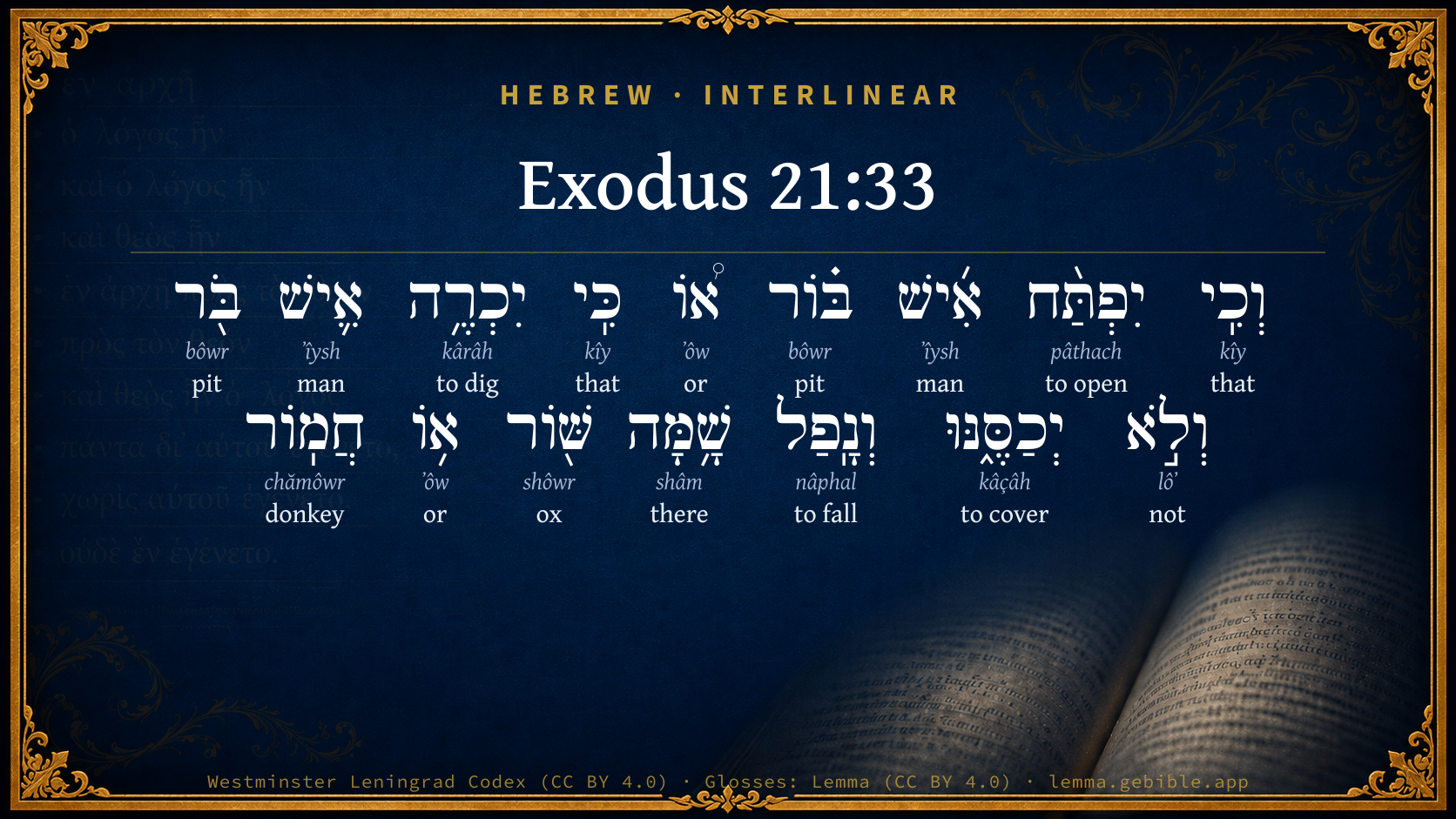
Hebrew (Westminster Leningrad Codex) Exodus 21:33 appears in the Hebrew Old Testament. The text above is from the Westminster Leningrad Codex. Each word links to its Strong’s number, a concise gloss, and parsing drawn from the Open Scriptures Hebrew Bible morphology. Click any word for its full Brown-Driver-Briggs (BDB) entry.
Download image
Cite this verse

Exodus 21:33 (World English Bible). Public Domain. Lemma interlinear Bible study tool, https://lemma.gebible.app/v/exodus/21/33.

Show BibTeX & RIS
BibTeX
RIS
English Translation
"If a man opens a pit, or if a man digs a pit and doesn't cover it, and a bull or a donkey falls into it,
World English Bible · Public Domain
Download a study sheet

One document with this verse’s original text, its word-by-word gloss line, the meaning frame, cross-references with their text, attributed commentary, and full source and license credits — printable, and it pastes into notes with its structure intact.

This verse Autodidact and up

Study sheet (.html) Plain text (.txt)

A passage Seminary Student

Up to 50 verses in one chapter. A passage sheet keeps up to 6 commentary sources and 12 cross-references per verse, in the order this page ranks them, and says so on the sheet whenever that leaves anything out. Ask for a single verse and you get the Autodidact verse sheet above.

Everything on this page stays free to read, with no account — the sheet is a download of what is already on screen, not access to it.

Want to remove ads? Support Godless Engineer
Compare translations 3

The same verse in 3 English versions, stacked beneath the original-language interlinear above. Click any original word for its lexicon entry.

Each is an independent rendering of the whole verse — the interlinear is not word-aligned to these translations.

Highlighted words mark where these versions differ — a whole-verse word diff, not a word-by-word alignment.

  • World English Bible Public Domain
    "If a man opens a pit, or if a man digs a pit and doesn't cover it, and a bull or a donkey falls into it,
  • King James Version Public Domain
    And if a man shall open a pit, or if a man shall dig a pit, and not cover it, and an ox or an ass fall therein;
  • unfoldingWord Literal Text CC BY-SA 4.0
    And if a man opens a cistern or if a man digs a cistern and does not cover it and an ox or a donkey falls there,

unfoldingWord Literal Text — © unfoldingWord, licensed CC BY-SA 4.0. Word-aligned USFM3 via Door43 (git.door43.org/unfoldingWord/en_ult).

Versions to compare (up to 4)

3 of 4 selected

Show all 18 translations

Every available English version of this verse, each an independent rendering of the whole verse.

  • World English Bible Public Domain
    "If a man opens a pit, or if a man digs a pit and doesn't cover it, and a bull or a donkey falls into it,
  • Berean Standard Bible Public Domain
    If a man opens or digs a pit and fails to cover it, and an ox or a donkey falls into it,
  • Majority Standard Bible Public Domain
    If a man opens or digs a pit and fails to cover it, and an ox or a donkey falls into it,
  • King James Version Public Domain
    And if a man shall open a pit, or if a man shall dig a pit, and not cover it, and an ox or an ass fall therein;
  • American Standard Version (1901) Public Domain
    And if a man shall open a pit, or if a man shall dig a pit and not cover it, and an ox or an ass fall therein,
  • Revised Version (1885) Public Domain
    And if a man shall open a pit, or if a man shall dig a pit and not cover it, and an ox or an ass fall therein,
  • Geneva Bible (1599) Public Domain
    And when a man shall open a well, or when he shall dig a pit and couer it not, and an oxe or an asse fall therein,
  • Douay-Rheims (1899) Public Domain
    If a man open a pit, and dig one, and cover it not, and an ox or an ass fall into it,
  • Young's Literal Translation Public Domain
    `And when a man doth open a pit, or when a man doth dig a pit, and doth not cover it, and an ox or ass hath fallen thither, --
  • Literal Standard Version CC BY-SA 4.0
    And when a man opens a pit, or when a man digs a pit, and does not cover it, and an ox or donkey has fallen [in] there—
  • Unlocked Literal Bible CC BY-SA 4.0
    If a man opens a pit, or if a man digs a pit and does not cover it, and an ox or a donkey falls into it,
  • unfoldingWord Literal Text CC BY-SA 4.0
    And if a man opens a cistern or if a man digs a cistern and does not cover it and an ox or a donkey falls there,
  • Darby Bible Public Domain
    -- And if a man open a pit, or if a man dig a pit, and do not cover it, and an ox or an ass fall into it,
  • World Messianic Bible Public Domain
    “If a man opens a pit, or if a man digs a pit and doesn’t cover it, and a bull or a donkey falls into it,
  • Webster's Bible Public Domain
    And if a man shall open a pit, or if a man shall dig a pit, and not cover it, and an ox or an ass shall fall into it;
  • Free Bible Version CC BY-SA 4.0
    If someone removes the cover of a cistern or digs one and doesn't cover it, and an ox or a donkey falls into it,
  • Bible in Basic English Public Domain
    If a man makes a hole in the earth without covering it up, and an ox or an ass dropping into it comes to its death;
  • JPS Tanakh (1917) Public Domain
    And if a man shall open a pit, or if a man shall dig a pit and not cover it, and an ox or an ass fall therein,

Literal Standard Version (2020), Covenant Press — licensed CC BY-SA 4.0. Text via the HelloAO Bible API (eBible.org). Unlocked Literal Bible (unfoldingWord) — licensed CC BY-SA 4.0. Text via the HelloAO Bible API (eBible.org). unfoldingWord Literal Text — © unfoldingWord, licensed CC BY-SA 4.0. Word-aligned USFM3 via Door43 (git.door43.org/unfoldingWord/en_ult). Free Bible Version, Dr. Jonathan Gallagher — licensed CC BY-SA 4.0. Text via the HelloAO Bible API (eBible.org).

Word by word

More ways to search: Search by grammar → Find every occurrence → Compare this word →

Practice this passage: Drill this verse → Learn its vocabulary →

יִכְרֶ֥ה
kârâh
H3738
“to dig”
Verb, Qal, Imperfect, 3rd Person, Masculine, Singular
Part of Speech
Verb
Stem
Qal
Form
Imperfect
Person
3rd Person
Gender
Masculine
Number
Singular
Full BDB Definition

Origin: a primitive root

TWOT: 1033 , 1034 , 1035

to dig, excavate, dig through - (Qal) to dig - (Niphal) to be dug - (Qal) to give a banquet or feast - (Qal) to get by trade, trade, buy
  1. וְכִֽי kîy H3588 “and · that” Conjunction + Conjunction
  2. יִפְתַּ֨ח pâthach H6605 “to open” Verb, Qal, Imperfect, 3rd Person, Masculine, Singular
  3. אִ֜ישׁ ʼîysh H376 “man” Noun, Common, Masculine, Singular, Absolute
  4. בּ֗וֹר bôwr H953 “pit” Noun, Common, Masculine, Singular, Absolute
  5. א֠וֹ ʼôw H176 “or” Conjunction
  6. כִּֽי kîy H3588 “that” Conjunction
  7. אִ֛ישׁ ʼîysh H376 “man” Noun, Common, Masculine, Singular, Absolute
  8. בֹּ֖ר bôwr H953 “pit” Noun, Common, Masculine, Singular, Absolute
  9. וְלֹ֣א lôʼ H3808 “and · not” Conjunction + Particle, Negative
  10. יְכַסֶּ֑נּוּ kâçâh H3680 “to cover · him” Verb, Piel, Imperfect, 3rd Person, Masculine, Singular + Suffix, Personal, 3rd Person, Masculine, Singular
  11. וְנָֽפַל nâphal H5307 “and · to fall” Conjunction + Verb, Qal, Perfect, 3rd Person, Masculine, Singular
  12. שָׁ֥מָּה shâm H8033 “there · toward” Adverb + Suffix, Demonstrative
  13. שּׁ֖וֹר shôwr H7794 “ox” Noun, Common, Masculine, Singular, Absolute
  14. א֥וֹ ʼôw H176 “or” Conjunction
  15. חֲמֽוֹר chămôwr H2543 “donkey” Noun, Common, Both, Singular, Absolute

About this verse

These counts appear in no published source. They are computed here, from the morphology-tagged text and Lemma’s own curated glosses. What Lemma adds →

16
words
12
distinct lemmas
Pentateuch
section

Notable vocabulary

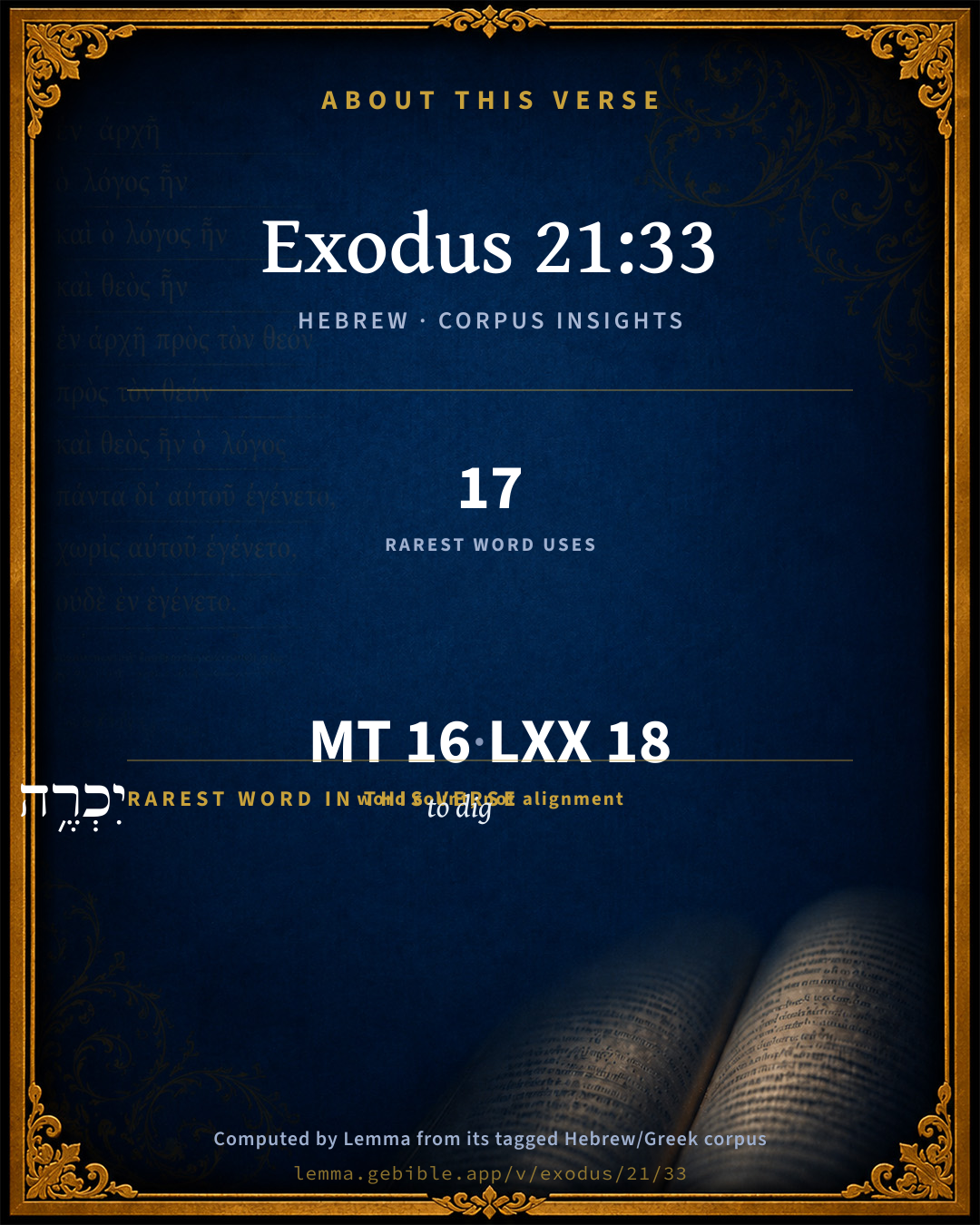
The rarest word here is יִכְרֶ֥ה to dig H3738 — appearing just 17 times in the whole Hebrew Bible.

Shared distinctive vocabulary

יִכְרֶ֥ה to dig H3738 occurs in 17 verses of the Hebrew Bible. Also found in:

Grammatical profile

  • 4 verbs
  • 6 nouns
  • 4 conjunctions
  • 1 adverb
  • 1 particle

Verb forms

  • יִפְתַּ֨ח Qal · Imperfect
  • יִכְרֶ֥ה Qal · Imperfect
  • יְכַסֶּ֑נּוּ Piel · Imperfect
  • וְנָֽפַל Qal · Perfect

Repetition

Words recur within this verse — often emphatic in Hebrew:

  • אִ֜ישׁ man H376 ×2
  • בּ֗וֹר pit H953 ×2
  • וְכִֽי that H3588 ×2
  • א֠וֹ or H176 ×2

Hebrew & Septuagint length

In English translation the verse runs 26 words from the Hebrew and 26 from the Septuagint (LXX English) — the same length.

A rough comparison of the two English renderings, which tokenize alike — not a word-level alignment.

Word counts can differ between the Hebrew and the Greek without any difference in meaning — e.g. the Hebrew direct-object marker אֵת has no separate Greek word, and Greek often adds the article ὁ.

In the original languages it is 16 Hebrew tokens and 18 Greek tokens — but the two are counted differently (Hebrew bundles its prefixes and suffixes into one token; the Greek is in lemma form), so that isn’t a like-for-like length.

Cross-references

6

Topical passages linked to Exodus 21:33 in the Treasury of Scripture Knowledge — connected by theme and wording, ordered by reader-vote popularity; previews shown in the World English Bible.

  • Psalms 9:15 The nations have sunk down in the pit that they made; In the net which they hid, their own foot is taken.
  • Psalms 119:85 The proud have dug pits for me, Contrary to your law.
  • Proverbs 28:10 Whoever causes the upright to go astray in an evil way, He will fall into his own trap; But the blameless will inherit good.
  • Ecclesiastes 10:8 He who digs a pit may fall into it; and whoever breaks through a wall may be bitten by a snake.
  • Jeremiah 18:20 Shall evil be recompensed for good? for they have dug a pit for my soul. Remember how I stood before you to speak good for them, to turn away your wrath from them.
  • Jeremiah 18:22 Let a cry be heard from their houses, when you shall bring a troop suddenly on them; for they have dug a pit to take me, and hid snares for my feet.

Cross-references courtesy of OpenBible.info (CC BY 4.0).

Hebrew and Greek witnesses Masoretic Hebrew ↔ Greek Septuagint

The same verse in the two great witnesses to the Old Testament, shown verse-for-verse.

These are two independent witnesses, not word-aligned to each other, and the Septuagint is shown in lemma (dictionary) form.

Hebrew Exodus 21:33 Masoretic · Westminster Leningrad Codex

וְכִֽי יִפְתַּ֨ח אִ֜ישׁ בּ֗וֹר א֠וֹ כִּֽי יִכְרֶ֥ה אִ֛ישׁ בֹּ֖ר וְלֹ֣א יְכַסֶּ֑נּוּ וְנָֽפַל שָׁ֥מָּה שּׁ֖וֹר א֥וֹ חֲמֽוֹר

"If a man opens a pit, or if a man digs a pit and doesn't cover it, and a bull or a donkey falls into it,

World English Bible · Public Domain

Greek LXX Exodus 21:33 Septuagint · lemma form

ἐάν δέ τις ἀναοἴγω λάκκος ἤ λατομέω λάκκος καί μή καλύπτω αὐτός καί ἐνπίπτω ἐκεῖ μόσχος ἤ ὄνος

And if any one open a pit or dig a cavity in stone, and cover it not, and an ox or an ass fall in there,

LXX2012 (modern English Septuagint) · Public Domain

Hebrew: Westminster Leningrad Codex (CC BY 4.0). Greek: Septuagint (public domain); English from LXX2012 (modern English Septuagint) (Public Domain). How the Septuagint differs from the Hebrew →

Targum (Aramaic paraphrase)

2

The Targum is the ancient Jewish Aramaic paraphrase of the Hebrew Scriptures — an interpretive translation, not the Hebrew text itself. Onkelos (literal) and Pseudo-Jonathan (expansive) render the Torah, and Jonathan the Prophets. Coverage is partial: where no permissively-licensed English translation exists for a verse, only the Aramaic is shown. This is verse-level text, not a word-by-word alignment to the Hebrew.

  1. Targum Onkelos Torah (Genesis–Deuteronomy)
    וַאֲרֵי יִפְתַּח גְבַר גוֹב אוֹ אֲרֵי יִכְרֶה גְבַר גוֹב וְלָא יְכַסִנֵהּ וְיִפֵּל תַּמָן תּוֹרָא אוֹ חֲמָרָא:

    (no public-domain English translation for this verse)

    Targum Onkelos — Aramaic: “Onkelos Genesis” (public domain); “Onkelos Exodus” (public domain); “Onkelos Leviticus” (public domain); “Onkelos Numbers” (public domain); “Onkelos Deuteronomy” (public domain). English: “Sefaria Community Translation” (CC0 1.0 (public-domain dedication)); “J.W. Etheridge. The Targums of Onkelos and Jonathan Ben Uzziel on the Pentateuch. London: Longmans, Green, 1862” (public domain). Text via Sefaria.

  2. Targum Pseudo-Jonathan Torah (Genesis–Deuteronomy)
    וַאֲרוּם יִפְתָּח אֵינַשׁ גּוּב אוֹ אֲרוּם יַחְפֵּס אֵינָשׁ גּוּב בְּשׁוּקָא וְלָא יְכַסִּינֵיהּ וּנְפוֹל תַּמָּן תּוֹרָא אוֹ חַמָרָא

    And if a man openeth a pit in the street, and doth not cover it, and an ox or an ass fall therein;

    Targum Pseudo-Jonathan — Aramaic: “Targum Jonathan on Genesis” (public domain); “Targum Jonathan on Exodus” (public domain); “Targum Jonathan on Leviticus” (public domain); “Targum Jonathan on Numbers” (public domain); “Targum Jonathan on Deuteronomy” (public domain). English: “The Targum of Jonathan ben Uzziel, trans. J. W. Etheridge, London, 1862” (public domain). Text via Sefaria.

Commentary

Notes on Exodus 21:33 from classic Christian and Jewish commentators (each source and its license shown beneath its notes). The classic Christian expositions comment on the surrounding passage and are grouped to its opening verse, so a note may address several verses; the Jewish commentaries on the Tanakh (Rashi and others) are per-verse, so they appear only where the commentator wrote on this verse.

Lemma curates 59 commentaries, every one of them public domain or Creative Commons licensed, each selected and text-cleaned for this edition rather than reprinted as found. About our sources →

Adam Clarke's Commentary

Verse 33. And if a man shall open a pit, or - dig a pit] That is, if a man shall open a well or cistern that had been before closed up, or dig a new one; for these two cases are plainly intimated: and if he did this in some public place where there was danger that men or cattle might fall into it; for a man might do as he pleased in his own grounds, as those were his private right. In the above case, if he had neglected to cover the pit, and his neighbour's ox or ass was killed by falling into it, he was to pay its value in money. Ex 21:33 and Ex 21:34 seem to be out of their places. They probably should conclude the chapters, as, where they are, they interrupt the statutes concerning the goring ox, which begin at Ex 21:28.

THESE different regulations are as remarkable for their justice and prudence as for their humanity. Their great tendency is to show the valuableness of human life, and the necessity of having peace and good understanding in every neighbourhood; and they possess that quality which should be the object of all good and wholesome laws - the prevention of crimes. Most criminal codes of jurisprudence seem more intent on the punishment of crimes than on preventing the commission of them. The law of God always teaches and warns, that his creatures may not fall into condemnation; for judgment is his strange work, i.e., one reluctantly and seldom executed, as this text is frequently understood.

Adam Clarke's Commentary on the Bible (1810–1826) — public domain. Text from a community e-Sword/MySword module.

Trapp's Complete Commentary

John Trapp

Exo 21:33 And if a man shall open a pit, or if a man shall dig a pit, and not cover it, and an ox or an ass fall therein;

Ver. 33. And an ox or an ass.] We can hardly open the deep pit of God’s bottomless, boundless mercy, but some silly beast will be falling thereinto; "stumbling at the word, being disobedient, whereunto also they were appointed." {1Pe 2:8}

John Trapp, A Commentary or Exposition upon All the Books of the Old and New Testament (1647–1656) — public domain. Text from a community e-Sword module.

Tyndale Open Study Notes

Tyndale Open Resources

21:33–22:15 In cases involving loss of property, the responsible person had to pay compensation equal to the value of what was lost. If the person had actually stolen the property, the compensation was multiplied (22:1, 4, 7). Where there was a question of responsibility, the parties were to appear before God for adjudication (22:8). The means by which the judgment was reached is not reported.

Tyndale Open Study Notes — © Tyndale Open Resources, licensed CC BY-SA 4.0. Text via the HelloAO Bible API.

Ellicott's Commentary for English Readers

(33) If a man shall open a pit.—Rather, uncover a well. The wells in the East commonly have covers, which are removed when water is drawn, and then replaced. If a man neglected to replace a cover, he was rightly answerable for any damage that might ensue. The case was the same if he dug a new well, and neglected to cover it over.

LAWS CONCERNING THE RIGHTS OF PROPERTY.

(33-36) The legislation slides from rights of persons to rights of property easily and without effort, by passing from the injuries which cattle cause to those which they suffer. They are injured (1) by the culpable laches of persons leaving their pits uncovered; (2) by hurts which one man’s cattle inflict upon another’s. Both kinds of loss have to be made good.

A Bible Commentary for English Readers, edited by Charles John Ellicott (1878–1897) — public domain. Text from a community e-Sword module.

The Cambridge Bible for Schools and Colleges

gen. ed. J. J. S. Perowne

33, 34. Injury caused by culpable neglect in leaving an open pit.

open] i.e. open a pit which already existed = reopen.

a pit] for the storage of water or (cf. Jer_41:8; Thomson, L. and B. i. 89, 90, ii. 194, iii. 458) grain, or perhaps also for the capture of wild beasts. Thomson (ii. 283) writes, ‘I have been astonished at the recklessness with which wells and pits are left uncovered and unprotected all over this country’; and adds that he had seen a blind man walk into such a well, and known a valuable horse lost similarly

The Cambridge Bible for Schools and Colleges (gen. ed. J. J. S. Perowne; Cambridge University Press, 1878–1918) — public domain. Text from a community e-Sword module.

John Gill's Exposition

If a man shall open a pit,.... That has been dug in time past, and filled up again, or take the covering from it, and leave it uncovered: "or if a man shall dig a pit, and not cover it": a new one, in the street, as the Targum of Jonathan; or in a public place, as Jarchi and Aben Ezra; otherwise a man might dig one for water, in his own fields, in enclosed places, where there was no danger of cattle coming thither, and falling therein:

and an ox or an ass fall therein; or any other beast, as Jarchi observes; for these are mentioned only as instances, and are put for all others. Maimonides (s) says,"if a man digs a pit in a public place, and an ox or ass fall into it and die, though the pit is full of shorn wool, and the like, the owner of the pit is bound to pay the whole damage; and this pit (he says) must be ten hands deep; if it is less than that, and an ox, or any other beast or fowl fall into it and die, he is free,''

(s) Hilchot Niske Maimon. c. 12. sect, 1, 10. so Bartenora in Misn. Bava Kama, c. 1. sect. 1.

John Gill's Exposition of the Whole Bible (1746–1763) — public domain (CC PDM 1.0). Text via the HelloAO Bible API.

Albert Barnes' Notes on the Bible

The usual mode of protecting a well in the East was probably then, as now, by building round it a low circular wall.

Albert Barnes' Notes on the Bible (1834–1885) — public domain. Text from a community e-Sword/MySword module.

Matthew Poole's English Annotations

If a man shall either

open an old pit which hath been covered with earth; or

dig a new

pit, to wit, in a public way, as the reason of the law shows; for if it were done in a man’s own house or ground, there was no danger of such an accident, except the beast transgressed his bounds, and then the man was not culpable.

Matthew Poole's English Annotations on the Holy Bible (1683–1685) — public domain. Text from a community e-Sword/MySword module.

Whedon's Commentary on the Bible

Daniel D. Whedon

33-36. The provisions of this section must commend themselves as both wise and prudent. Caution, forethought, and most equitable dealing were hereby inculcated.

Daniel D. Whedon (gen. ed.), Commentary on the Old and New Testaments (1874–1909) — public domain. Text from a community e-Sword module.

The Pulpit Commentary

II LAWS CONNECTED WITH RIGHTS OF PROPERTY (vers. 33-36). From the consideration of injuries to the person, the legislator proceeds to treat of injuries to property, and, as he has been speaking of cattle under the one head, places cattle in the fore-front of the other. In this chapter two enactments only are made one providing compensation in the case of a man"s cattle being killed by falling into the pit, or well, of a neighbour (vers. 33, 34); and the other making provision for the case of one man"s cattle killing the cattle of another (vers. 35, 36)

If a man shall open a pit. Rather, "If a man shall uncover a cistern." Cisterns, very necessary in Palestine, were usually closed by a flat-stone, or a number of planks. To obtain water from them, they had to be uncovered; but it was the duty of the man who uncovered them, to replace the covering when his wants were satisfied. Or dig a pit and not cover it. A man who was making a cistern might neglect to cover it while it was in course of construction, or even afterwards, if he thought his own cattle would take no hurt. But in the unfenced fields of Palestine it was always possible that a neighbour"s cattle might go astray and suffer injury through such a piece of negligence. An ox, or an ass, falling into a cistern, would be unable to extricate itself, and might be drowned.

HOMILETICS Vers. 33-36. The guilt of neglect.

Sins of omission are thought lightly of by most men; but God holds us answerable for them, as much as for sins of commission. The Psalmist defines the wicked man as one who neglects to "set himself in any good way." The neglect of the Israelites to cover their wells, or keep their cattle from goring others was to be heavily punished. Neglect and carelessness are culpable

I BECAUSE THEIR EFFECTS ARE AS RUINOUS AS THOSE OF MALICE AND EVIL INTENT. Carelessness and neglect of precautions may set a town on fire and burn hundreds in their beds. Or it may spread a loathsome and dangerous disease through a whole district. Or it may destroy the cattle of a whole county. Or it may allow moral evil to have free course, until an entire nation is sunk in corruption. Or, again, it may endanger our own lives, or destroy our souls. It is a question whether more evil does not actually result from carelessness than from deliberate intent. Youth is naturally careless. Desultory habits intensify carelessness. A deficient sense of the seriousness of life encourages and fosters it. Advanced civilisation, with its foppishness and superciliousness, developes its growth. The present age asks, "Is anything worth caring about? and is deaf to the Prophet"s words, "Tremble and be troubled, ye careless. (Isa_32:11)

II BECAUSE GOD HAS IMPLANTED IN US FACULTIES OF PREVISION AND CALCULATION OF CONSEQUENCES, WHICH WERE INTENDED TO PREVENT OUR BEING CARELESS AND NEGLIGENT. Man differs from the lower animals chiefly in the possession of reason; and it is an essential part of human reason to look to the future, to forecast results, and calculate the balance of ultimate advantage and disadvantage. We know instinctively that our happiness depends on our actions; and it is therefore wholly unreasonable to be careless about how we act. If we have faculties which we might use and refuse to use them, God will be righteous to punish us for despising his gifts.

III BECAUSE GOD HAS EXPRESSLY WARNED US AGAINST BEING CARELESS, AND EXHORTED US TO PRUDENCE AND FORETHOUGHT. "I will send a fire among them that dwell carelessly," said the Lord by Ezekiel. "Rise up, ye women that are at ease; hear my voice, ye careless daughters; give ear unto my speech; many days and years shall ye be troubled, ye careless women," are God"s words by Isaiah. "Go to the ant, thou sluggard," exclaims the wise man, "consider her ways and be wise." And again "Ponder the path of thy feet, and let all thy ways be established keep thy heart with diligence remove thy feet from evil." A careful cautious walk through the dangers and difficulties of life is everywhere enjoined upon us in the Scriptures; and we are plainly disobedient if we are careless.

The Pulpit Commentary (1880–1919), ed. H.D.M. Spence-Jones & Joseph S. Exell — public domain. Text from a community e-Sword module.

Keil & Delitzsch

C. F. Keil & F. Delitzsch

Passing from life to property, in connection with the foregoing, the life of the animal, the most important possession of the Israelites, is first of all secured against destruction through carelessness. If any one opened or dug a pit or cistern, and did not close it up again, and another man's ox or ass (mentioned, for the sake of example, as the most important animals among the live stock of the Israelites) fell in and was killed, the owner of the pit was to pay its full value, and the dead animal to belong to him. If an ox that was not known to be vicious gored another man's ox to death, the vicious animal was to be sold, and its money (what it fetched) to be divided; the dead animal was also to be divided, so that both parties bore an equal amount of damage. If, on the other hand, the ox had been known to be vicious before, and had not been kept in, carefully secured, by its possessor, he was to compensate the owner of the one that had been killed with the full value of an ox, but to receive the dead one instead.

Keil & Delitzsch — Biblical Commentary on the Old Testament (1861–1891) — public domain (CC PDM 1.0). Text via the HelloAO Bible API. (Old Testament only.)

unfoldingWord translationNotes

Door43 World Missions Community

opens a pit

"uncovers a hole in the ground" or "takes a cover off a hole in the ground"

repay the loss

The owner must be paid for the loss of his animal. AT: "pay the owner for the dead animal" (See: Assumed Knowledge and Implicit Information)

will become his

The one who paid for the loss of the animal will become the owner of the dead animal and can do what he wants with it. The full meaning of this statement can be made explicit. AT: "will belong to the owner of the pit" (See: Assumed Knowledge and Implicit Information)

translationWords

pit

donkey

unfoldingWord translationNotes — © Distant Shores Media and the Door43 World Missions Community, licensed CC BY-SA 4.0. Source: git.door43.org/Door43/en_tn.

Rashi

Rabbi Shlomo Yitzchaki (Rashi)

וכי יפתח איש בור AND IF A MAN SHALL OPEN A PIT which was covered over, and he now uncovered it.

או כי יכרה OR IF A MAN SHALL DIG [A PIT] — Why is this stated? If he becomes liable for opening one that already exists how much the more is he liable for digging a new one! However, it does not mean that he digs a pit from beginning to end but it is intended to include in this law a person who digs after another has dug (i. e. who deepens to a height of ten handbreaths a pit which another has already excavated to a depth less than this. Before he did this an animal which fell into the pit was unlikely to kill itself; now, however, such a fall may prove fatal) — that such a one alone becomes liable (cf. Bava Kamma 51a).

ולא יכסנו AND SHALL NOT COVER IT — if, however, he did cover it, though he did not fill it in with earth” he is not liable (Bava Kamma 50a). Scripture speaks of one who excavates a pit in a public thoroughfare (cf. Bava Kamma 49b).

שור או חמור AN OX OR AN ASS — This is the law also with respect to all cattle and beasts, because wherever the Torah prescribes something with regard to “ox or ass”, we derive it (the fact that it applies to all cattle and beasts) on the grounds of the verbal similarity of שור in the text in question with שור which occurs in the law prescribing the Sabbath rest, for — with regard to the latter — it is stated, (Exodus 23:12) “that thine ox and thine ass may rest”. Now how is it in the latter case? We know that all cattle and beasts are to be treated in this respect as the “ox”, because in another passage referring to Sabbath (Deuteronomy 5:14) it is expressly said “[thy ox and thy ass] and all thy cattle”! So here, too, all cattle and beasts are to be treated as the ox. The only reason why ox and ass are alone mentioned is to imply: “an ox” — but not a man, “an ass” — but not vessels (Bava Kamma 53b).

Rashi on the Tanakh — English translations: “The Judaica Press complete Tanach with Rashi, translated by A. J. Rosenberg” (CC BY 4.0); “Pentateuch with Rashi's commentary by M. Rosenbaum and A.M. Silbermann, 1929-1934” (public domain); “The Metsudah Tanach series, Lakewood, N.J” (CC BY 4.0); and “The Book of Joshua, Metsudah Publications, 1997” (CC BY 4.0). Text via Sefaria.

Lesson kit

Teaching starters — assembled from the data on this page, not authored interpretation. Every prompt links to the verse data it draws on. Edit before teaching.

Exodus, in the Pentateuch, opens this verse with 16 words (12 distinct Hebrew lemmas). Its most distinctive word is kârâh (“to dig”). A historical commentator’s framing appears above. Read the whole chapter for the surrounding context.

Discussion questions

  1. What does “to dig” (kârâh) contribute to the verse as a whole?
  2. How does Genesis 26:25, which shares the word «to dig», read alongside this verse?
  3. What does the repetition of “man” (2× in this one verse) do in this verse?
  4. These translations render this verse differently. What is at stake in choosing one wording over another?
  5. «יִפְתַּ֨ח» is a Qal Imperfect verb. How does that grammatical form shape the action described?
  6. Compare how Adam Clarke's Commentary and Trapp's Complete Commentary read this verse. Where do they agree or differ?

Things to notice

Reading settings

Reading text

Shown beneath each verse's original-language words.

Old Testament
Old Testament edition

Read the OT as the Masoretic Hebrew (MT) or the Greek Septuagint (LXX).

English shown for the Greek Septuagint (in the Hebrew ↔ Greek comparison).

Comparing translations? Open the Compare panel on any verse page to stack up to four side by side.