
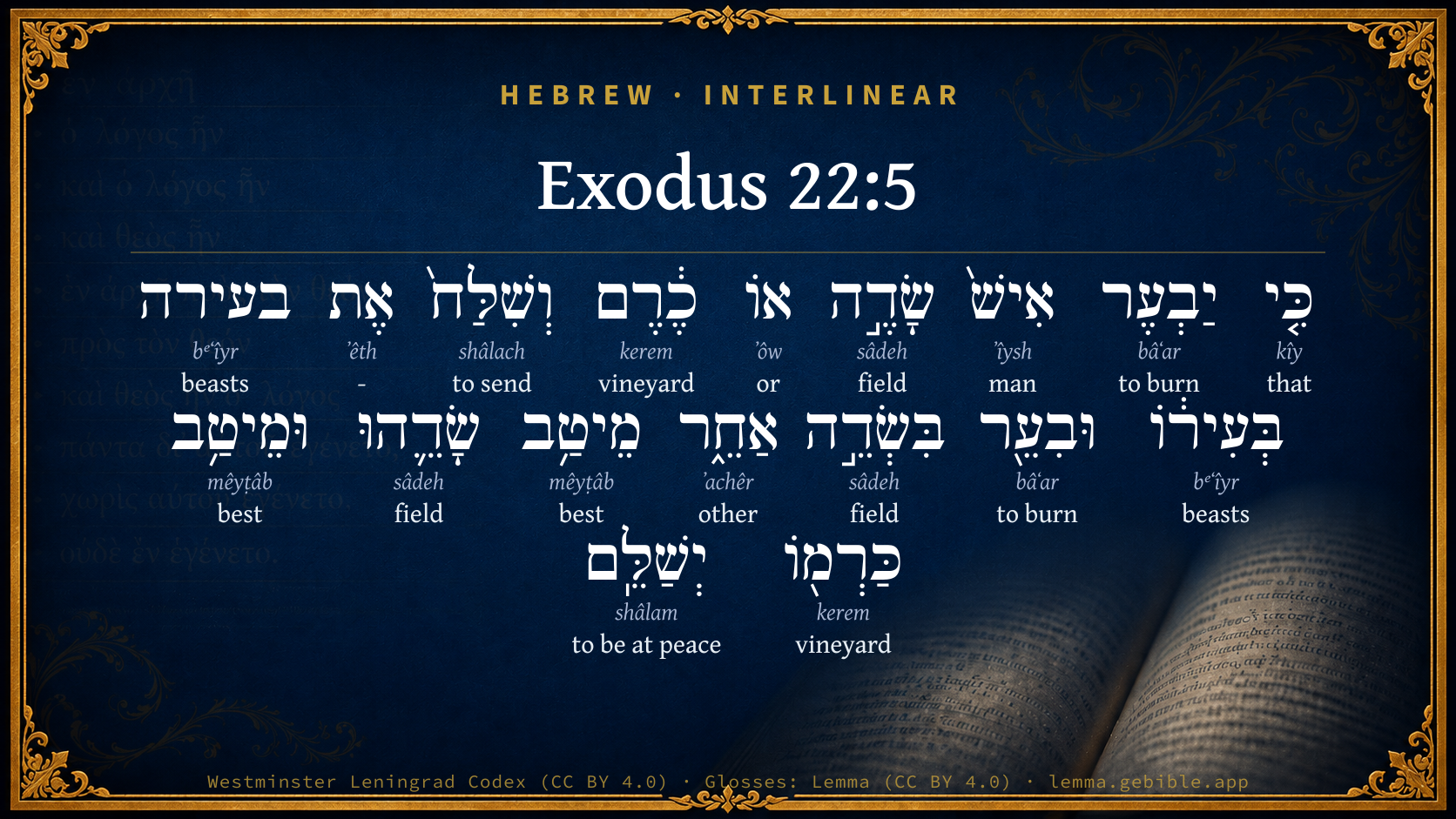
Exodus 22:5

Hebrew (Westminster Leningrad Codex) Exodus 22:5 appears in the Hebrew Old Testament. The text above is from the Westminster Leningrad Codex. Each word links to its Strong’s number, a concise gloss, and parsing drawn from the Open Scriptures Hebrew Bible morphology. Click any word for its full Brown-Driver-Briggs (BDB) entry.
Download image
Cite this verse

Exodus 22:5 (World English Bible). Public Domain. Lemma interlinear Bible study tool, https://lemma.gebible.app/v/exodus/22/5.

Show BibTeX & RIS
BibTeX
RIS
English Translation
"If a man causes a field or vineyard to be eaten, and lets his animal loose, and it grazes in another man's field, he shall make restitution from the best of his own field, and from the best of his own vineyard.
World English Bible · Public Domain
Download a study sheet

One document with this verse’s original text, its word-by-word gloss line, the meaning frame, cross-references with their text, attributed commentary, and full source and license credits — printable, and it pastes into notes with its structure intact.

This verse Autodidact and up

Study sheet (.html) Plain text (.txt)

A passage Seminary Student

Up to 50 verses in one chapter. A passage sheet keeps up to 6 commentary sources and 12 cross-references per verse, in the order this page ranks them, and says so on the sheet whenever that leaves anything out. Ask for a single verse and you get the Autodidact verse sheet above.

Everything on this page stays free to read, with no account — the sheet is a download of what is already on screen, not access to it.

Want to remove ads? Support Godless Engineer
Compare translations 3

The same verse in 3 English versions, stacked beneath the original-language interlinear above. Click any original word for its lexicon entry.

Each is an independent rendering of the whole verse — the interlinear is not word-aligned to these translations.

Highlighted words mark where these versions differ — a whole-verse word diff, not a word-by-word alignment.

  • World English Bible Public Domain
    "If a man causes a field or vineyard to be eaten, and lets his animal loose, and it grazes in another man's field, he shall make restitution from the best of his own field, and from the best of his own vineyard.
  • King James Version Public Domain
    If a man shall cause a field or vineyard to be eaten, and shall put in his beast, and shall feed in another man's field; of the best of his own field, and of the best of his own vineyard, shall he make restitution.
  • unfoldingWord Literal Text CC BY-SA 4.0
    If a man causes his livestock to graze a field or vineyard and lets it go, and it grazes in the field of another, he shall compensate from the best of his field and from the best of his vineyard.

unfoldingWord Literal Text — © unfoldingWord, licensed CC BY-SA 4.0. Word-aligned USFM3 via Door43 (git.door43.org/unfoldingWord/en_ult).

Versions to compare (up to 4)

3 of 4 selected

Show all 18 translations

Every available English version of this verse, each an independent rendering of the whole verse.

  • World English Bible Public Domain
    "If a man causes a field or vineyard to be eaten, and lets his animal loose, and it grazes in another man's field, he shall make restitution from the best of his own field, and from the best of his own vineyard.
  • Berean Standard Bible Public Domain
    If a man grazes his livestock in a field or vineyard and allows them to stray so that they graze in someone else’s field, he must make restitution from the best of his own field or vineyard.
  • Majority Standard Bible Public Domain
    If a man grazes his livestock in a field or vineyard and allows them to stray so that they graze in someone else’s field, he must make restitution from the best of his own field or vineyard.
  • King James Version Public Domain
    If a man shall cause a field or vineyard to be eaten, and shall put in his beast, and shall feed in another man's field; of the best of his own field, and of the best of his own vineyard, shall he make restitution.
  • American Standard Version (1901) Public Domain
    If a man shall cause a field or vineyard to be eaten, and shall let his beast loose, and it feed in another man's field; of the best of his own field, and of the best of his own vineyard, shall he make restitution.
  • Revised Version (1885) Public Domain
    If a man shall cause a field or vineyard to be eaten, and shall let his beast loose, and it feed in another man’s field; of the best of his own field, and of the best of his own vineyard, shall he make restitution.
  • Geneva Bible (1599) Public Domain
    If a man doe hurt fielde, or vineyarde, and put in his beast to feed in an other mans fielde, he shall recompence of the best of his owne fielde, and of the best of his owne vineyard.
  • Douay-Rheims (1899) Public Domain
    If any man hurt a field or a vineyard, and put in his beast to feed upon that which is other men's: he shall restore the best of whatsoever he hath in his own field, or in his vineyard, according to the estimation of the damage.
  • Young's Literal Translation Public Domain
    `When a man depastureth a field or vineyard, and hath sent out his beast, and it hath pastured in the field of another, `of' the best of his field, and the best of his vineyard, he doth repay.
  • Literal Standard Version CC BY-SA 4.0
    When a man depastures a field or vineyard, and has sent out his beast, and it has pastured in the field of another, he repays [with] the best of his field, and the best of his vineyard.
  • Unlocked Literal Bible CC BY-SA 4.0
    If a man grazes his livestock in a field or vineyard and lets his animal loose, and it grazes in another man's field, he must make restitution from the best of his own field and from the best of his own vineyard.
  • unfoldingWord Literal Text CC BY-SA 4.0
    If a man causes his livestock to graze a field or vineyard and lets it go, and it grazes in the field of another, he shall compensate from the best of his field and from the best of his vineyard.
  • Darby Bible Public Domain
    If a man shall cause a field or vineyard to be eaten, and put in his cattle, and pasture in another man's field, of the best of his own field, and of the best of his own vineyard shall he make [it] good.
  • World Messianic Bible Public Domain
    “If a man causes a field or vineyard to be eaten by letting his animal loose, and it grazes in another man’s field, he shall make restitution from the best of his own field, and from the best of his own vineyard.
  • Webster's Bible Public Domain
    If a man shall cause a field or vineyard to be eaten, and shall put in his beast, and shall feed in another man's field: of the best of his own field, and of the best of his own vineyard shall he make restitution.
  • Free Bible Version CC BY-SA 4.0
    If livestock are grazing in a field or vineyard and their owner lets them stray so that they graze in someone else's field, their owner must pay compensation from the best of their own fields or vineyards.
  • Bible in Basic English Public Domain
    If a man makes a fire in a field or a vine-garden, and lets the fire do damage to another man's field, he is to give of the best produce of his field or his vine-garden to make up for it.
  • JPS Tanakh (1917) Public Domain
    (22-4) If a man cause a field or vineyard to be eaten, and shall let his beast loose, and it feed in another man's field; of the best of his own field, and of the best of his own vineyard, shall he make restitution.

Literal Standard Version (2020), Covenant Press — licensed CC BY-SA 4.0. Text via the HelloAO Bible API (eBible.org). Unlocked Literal Bible (unfoldingWord) — licensed CC BY-SA 4.0. Text via the HelloAO Bible API (eBible.org). unfoldingWord Literal Text — © unfoldingWord, licensed CC BY-SA 4.0. Word-aligned USFM3 via Door43 (git.door43.org/unfoldingWord/en_ult). Free Bible Version, Dr. Jonathan Gallagher — licensed CC BY-SA 4.0. Text via the HelloAO Bible API (eBible.org).

Word by word

More ways to search: Search by grammar → Find every occurrence → Compare this word →

Practice this passage: Drill this verse → Learn its vocabulary →

מֵיטַ֥ב
mêyṭâb
H4315
“best of”
Noun, Common, Masculine, Singular, Construct
Part of Speech
Noun
Type
Common
Gender
Masculine
Number
Singular
State
Construct
Full BDB Definition

Origin: from H3190

TWOT: 863a

the best - as superlative
  1. כִּ֤י kîy H3588 “that” Conjunction
  2. יַבְעֶר bâʻar H1197 “to burn” Verb, Hiphil, Imperfect, 3rd Person, Masculine, Singular
  3. אִישׁ֙ ʼîysh H376 “man” Noun, Common, Masculine, Singular, Absolute
  4. שָׂדֶ֣ה sâdeh H7704 “field” Noun, Common, Masculine, Singular, Absolute
  5. אוֹ ʼôw H176 “or” Conjunction
  6. כֶ֔רֶם kerem H3754 “vineyard” Noun, Common, Both, Singular, Absolute
  7. וְשִׁלַּח֙ shâlach H7971 “and · to send” Conjunction + Verb, Piel, Perfect, 3rd Person, Masculine, Singular
  8. אֶת ʼêth H853 “-” Particle, Direct Object
  9. בעירה bᵉʻîyr H1165 “beasts · his” Noun, Common, Masculine, Singular, Construct + Suffix, Personal, 3rd Person, Masculine, Singular
  10. בְּעִיר֔וֹ bᵉʻîyr H1165 “beasts · his” Noun, Common, Masculine, Singular, Construct + Suffix, Personal, 3rd Person, Masculine, Singular
  11. וּבִעֵ֖ר bâʻar H1197 “and · to burn” Conjunction + Verb, Piel, Sequential Perfect, 3rd Person, Masculine, Singular
  12. בִּשְׂדֵ֣ה sâdeh H7704 “in/at · field of” Preposition + Noun, Common, Masculine, Singular, Construct
  13. אַחֵ֑ר ʼachêr H312 “other” Adjective, Adjective, Masculine, Singular, Absolute
  14. שָׂדֵ֛הוּ sâdeh H7704 “field · his” Noun, Common, Masculine, Singular, Construct + Suffix, Personal, 3rd Person, Masculine, Singular
  15. וּמֵיטַ֥ב mêyṭâb H4315 “and · best of” Conjunction + Noun, Common, Masculine, Singular, Construct
  16. כַּרְמ֖וֹ kerem H3754 “vineyard · his” Noun, Common, Both, Singular, Construct + Suffix, Personal, 3rd Person, Masculine, Singular
  17. יְשַׁלֵּֽם shâlam H7999 “to be at peace” Verb, Piel, Imperfect, 3rd Person, Masculine, Singular

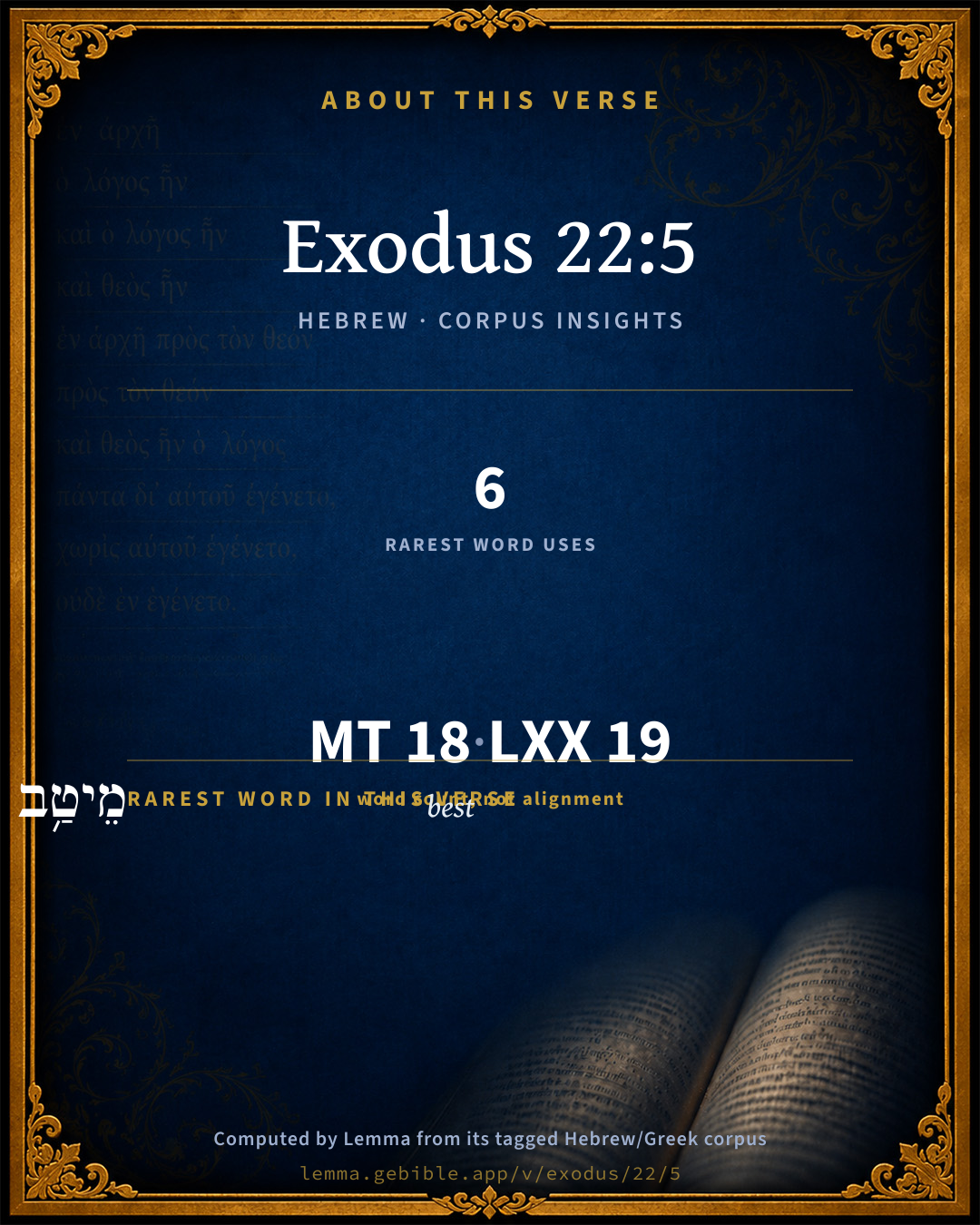
About this verse

These counts appear in no published source. They are computed here, from the morphology-tagged text and Lemma’s own curated glosses. What Lemma adds →

18
words
12
distinct lemmas
Pentateuch
section

Notable vocabulary

The rarest word here is מֵיטַ֥ב best H4315 — appearing just 6 times in the whole Hebrew Bible.

Shared distinctive vocabulary

מֵיטַ֥ב best H4315 occurs in 5 verses of the Hebrew Bible. Also found in:

Grammatical profile

  • 4 verbs
  • 10 nouns
  • 1 adjective
  • 2 conjunctions
  • 1 particle

Verb forms

  • יַבְעֶר Hiphil · Imperfect
  • וְשִׁלַּח֙ Piel · Perfect
  • וּבִעֵ֖ר Piel · Sequential Perfect
  • יְשַׁלֵּֽם Piel · Imperfect

Repetition

Words recur within this verse — often emphatic in Hebrew:

  • שָׂדֶ֣ה field H7704 ×3
  • יַבְעֶר to burn H1197 ×2
  • כֶ֔רֶם vineyard H3754 ×2
  • בעירה beasts H1165 ×2
  • מֵיטַ֥ב best H4315 ×2

Hebrew & Septuagint length

In English translation the verse runs 42 words from the Hebrew and 62 from the Septuagint (LXX English) — the Septuagint runs noticeably longer here. See the side-by-side →

A rough comparison of the two English renderings, which tokenize alike — not a word-level alignment.

Word counts can differ between the Hebrew and the Greek without any difference in meaning — e.g. the Hebrew direct-object marker אֵת has no separate Greek word, and Greek often adds the article ὁ.

In the original languages it is 18 Hebrew tokens and 19 Greek tokens — but the two are counted differently (Hebrew bundles its prefixes and suffixes into one token; the Greek is in lemma form), so that isn’t a like-for-like length.

Cross-references

4

Topical passages linked to Exodus 22:5 in the Treasury of Scripture Knowledge — connected by theme and wording, ordered by reader-vote popularity; previews shown in the World English Bible.

  • Exodus 21:34 the owner of the pit shall make it good. He shall give money to its owner, and the dead animal shall be his.
  • Exodus 22:3 If the sun has risen on him, there shall be guilt of bloodshed for him; he shall make restitution. If he has nothing, then he shall be sold for his theft.
  • Exodus 22:12 But if it is stolen from him, he shall make restitution to the owner of it.
  • Job 20:18 That for which he labored he shall restore, and shall not swallow it down; According to the substance that he has gotten, he shall not rejoice.

Cross-references courtesy of OpenBible.info (CC BY 4.0).

Hebrew and Greek witnesses Masoretic Hebrew ↔ Greek Septuagint

The same verse in the two great witnesses to the Old Testament, shown verse-for-verse.

Here the Septuagint runs noticeably longer than the Hebrew — LXX2012 (modern English Septuagint) 62 words vs World English Bible 42. A rough length comparison of the two English translations, not a word-level alignment — read both below.

These are two independent witnesses, not word-aligned to each other, and the Septuagint is shown in lemma (dictionary) form.

Hebrew Exodus 22:5 Masoretic · Westminster Leningrad Codex

כִּ֤י יַבְעֶר אִישׁ֙ שָׂדֶ֣ה אוֹ כֶ֔רֶם וְשִׁלַּח֙ אֶת בעירה בְּעִיר֔וֹ וּבִעֵ֖ר בִּשְׂדֵ֣ה אַחֵ֑ר מֵיטַ֥ב שָׂדֵ֛הוּ וּמֵיטַ֥ב כַּרְמ֖וֹ יְשַׁלֵּֽם

"If a man causes a field or vineyard to be eaten, and lets his animal loose, and it grazes in another man's field, he shall make restitution from the best of his own field, and from the best of his own vineyard.

World English Bible · Public Domain

Greek LXX Exodus 22:5 Septuagint · lemma form

ἐάν δέ ἐκἔρχομαι πῦρ εὑρίσκω ἄκανθα καί προσ ἐνπίμπρημι ἅλων ἤ στάχυς ἤ πεδίον ἀποτίνω ὁ ὁ πῦρ ἐκκαίω

And if any one should feed down a field or a vineyard, and should send in his beast to feed down another field, he shall make compensation of his own field according to his produce; and if he shall have fed down the whole field, he shall pay for compensation the best of his own field and the best of his vineyard.

LXX2012 (modern English Septuagint) · Public Domain

On this verse, The Cambridge Bible for Schools and Colleges discusses the Septuagint’s reading. Read the note in Commentary ↓

Hebrew: Westminster Leningrad Codex (CC BY 4.0). Greek: Septuagint (public domain); English from LXX2012 (modern English Septuagint) (Public Domain). How the Septuagint differs from the Hebrew →

Targum (Aramaic paraphrase)

2

The Targum is the ancient Jewish Aramaic paraphrase of the Hebrew Scriptures — an interpretive translation, not the Hebrew text itself. Onkelos (literal) and Pseudo-Jonathan (expansive) render the Torah, and Jonathan the Prophets. Coverage is partial: where no permissively-licensed English translation exists for a verse, only the Aramaic is shown. This is verse-level text, not a word-by-word alignment to the Hebrew.

  1. Targum Onkelos Torah (Genesis–Deuteronomy)
    אֲרֵי תִתַּפַּק נוּר וְיַשְׁכַּח כּוּבִין וְיֵיכוּל גְדִישִׁין אוֹ קֳמָא אוֹ חַקְלָא שַׁלָמָא יְשַׁלֵם דְאַדְלֵק יָת דְלֶקְתָּא:

    (no public-domain English translation for this verse)

    Targum Onkelos — Aramaic: “Onkelos Genesis” (public domain); “Onkelos Exodus” (public domain); “Onkelos Leviticus” (public domain); “Onkelos Numbers” (public domain); “Onkelos Deuteronomy” (public domain). English: “Sefaria Community Translation” (CC0 1.0 (public-domain dedication)); “J.W. Etheridge. The Targums of Onkelos and Jonathan Ben Uzziel on the Pentateuch. London: Longmans, Green, 1862” (public domain). Text via Sefaria.

  2. Targum Pseudo-Jonathan Torah (Genesis–Deuteronomy)
    אֲרוּם תִּתְפּוֹק נוּר וְתַשְׁכַּח כּוּבִין וְתִגְמַר גָּדִישׁ אוֹ מִדַּעַם דְּקָאִי אוֹ חֲקִיל שַׁלָמָא יְשַׁלִים מַאן דְּאַדְלִיק יַת דְּלֵיקְתָּא

    If fire break out, and catch thorns, and consume the sheaves, or whatever is standing, or the field, whoever kindled the fire shall surely restore.

    Targum Pseudo-Jonathan — Aramaic: “Targum Jonathan on Genesis” (public domain); “Targum Jonathan on Exodus” (public domain); “Targum Jonathan on Leviticus” (public domain); “Targum Jonathan on Numbers” (public domain); “Targum Jonathan on Deuteronomy” (public domain). English: “The Targum of Jonathan ben Uzziel, trans. J. W. Etheridge, London, 1862” (public domain). Text via Sefaria.

Commentary

Notes on Exodus 22:5 from classic Christian and Jewish commentators (each source and its license shown beneath its notes). The classic Christian expositions comment on the surrounding passage and are grouped to its opening verse, so a note may address several verses; the Jewish commentaries on the Tanakh (Rashi and others) are per-verse, so they appear only where the commentator wrote on this verse.

Lemma curates 59 commentaries, every one of them public domain or Creative Commons licensed, each selected and text-cleaned for this edition rather than reprinted as found. About our sources →

Trapp's Complete Commentary

John Trapp

Exo 22:5 If a man shall cause a field or vineyard to be eaten, and shall put in his beast, and shall feed in another man’s field; of the best of his own field, and of the best of his own vineyard, shall he make restitution.

Ver. 5. To be eaten.] By unadvised turning in of his cattle, through mistake or neglect.

John Trapp, A Commentary or Exposition upon All the Books of the Old and New Testament (1647–1656) — public domain. Text from a community e-Sword module.

Joseph Benson's Commentary

Exo 22:5. He that wilfully put his cattle into his neighbour’s field, must make restitution of the best of his own. The Jews hence observed it as a general rule, that restitution must always be made of the best; and that no man should keep any cattle that were likely to trespass upon his neighbour, or do him any damage.

Joseph Benson's Commentary on the Old and New Testaments (1811–1818) — public domain. Text from a community e-Sword module.

Ellicott's Commentary for English Readers

(5) If a man shall cause a field . . . to be eaten.—On theft follows trespass, another injury to property. Two kinds of trespass alone are mentioned; but from these the principles to be followed in punishing trespass generally can be sufficiently made out. Accidental injury, such as that caused by fire extending from one man’s field into another’s, was to be simply compensated up to the amount of damage done; but voluntary injury, such as followed on the turning of beasts into a neighbour’s ground, was to be more than compensated. The amount of produce destroyed was to be exactly calculated, and then the injurer was to make good the full amount of his neighbour’s loss out of the best of his own produce.

A Bible Commentary for English Readers, edited by Charles John Ellicott (1878–1897) — public domain. Text from a community e-Sword module.

The Cambridge Bible for Schools and Colleges

gen. ed. J. J. S. Perowne

5. a field] i.e. a field of his own, from which he allows the cattle to stray into the field of a neighbour.

the best] The Heb. as Gen_47:6; Gen_47:11, also of land. The verse contains difficulties, however; and two corrections have accordingly been proposed. (1) Why, as no malicious intention seems to be imputed to the owner of the cattle, is compensation to be made from the best of his field? LXX. Sam. read words after ‘another man’s field,’ which remove this difficulty, viz. ‘[he shall surely make it good from his own field according to its produce; but if it eat the whole of the field,] of the best of his own field,’ &c.; the whole of the crop is eaten; the carelessness is accordingly greater, no judgement can be formed of the quality of the destroyed crop, and it is consequently to be replaced from the best which can be given. (2) This however by no means removes all the difficulties: (a) a ‘vineyard’ was not a pasture-ground for cattle, it was protected against animals by a stone fence, Isa_5:5; (b) the renderings ‘cause to be eaten’ and ‘feed’ (הבעיר and בער) are doubtful: to ‘eat’ or to ‘feed’ (i.e. to graze) is an uncertain rendering of בער, even in Isa_3:14; Isa_5:5; Isa_6:13; and both words elsewhere mean only to kindle (fire: so in v. 6), to burn, or (fig.) to destroy. Hence it is very probable that we should read with slight changes (הבערה for בעירה, and ובערה for ובער), ‘If a man cause a field or a vineyard to be burnt [to destroy stubble or weeds, as is still the custom in Palestine in summer: cf. on ch. Exo_15:7, and Verg. G. i. 84 f.], and let the burning (same word as in v. 6b, ‘the fire’) spread, and it burn in another man’s field, of the best,’ &c. (so Bä.; and, long before him, Aldis Wright, Journ. of Phil. iv., 1872, p. 72 f.): as the damage is due carelessness, if not (Wright) to incendiarism, the reason why compensation is to be made of the ‘best’ becomes apparent (cf. Cook, p. 202). Fire spreads rapidly in the hot summers of Palestine; and such carelessness is punished severely by the Arabs (L. and B. ii. 293).

5, 6. Compensation to be paid for damage done by cattle being allowed negligently to stray (v. 5—if the text be sound); and by fire spreading accidentally (v. 6) to another man’s field.

The Cambridge Bible for Schools and Colleges (gen. ed. J. J. S. Perowne; Cambridge University Press, 1878–1918) — public domain. Text from a community e-Sword module.

John Gill's Exposition

If a man shall cause a field or vineyard to be eaten,.... Which is not his own, by putting cattle into it to feed upon it, as it is explained in the next clause:

and shall put in his beast, and shall feed in another man's field; do damage in one or both those two ways, either by his feet treading down the grass and fruits of the earth, which the Rabbins, as Jarchi says, think, is meant by putting in his beast; or with his beast eating up the same, which is intended by the latter phrase:

of the best of his own field, and of the best of his own vineyard, shall he make restitution for what damage is done by his beast in his neighbour's field or vineyard; and this held good of any garden or orchard injured in like manner; and it is a general rule with the Jews, that when any damage is sustained, he that does the damage is obliged to pay with the best the earth produces (l), even though better than was the man's that suffered the loss, that for the future he might be more careful of doing injury to another (m).

(l) Misc. Bava Kama, c. 1. sect. 1. (m) Bartenora in Misn. Gittin, c. 5. sect. 1.

John Gill's Exposition of the Whole Bible (1746–1763) — public domain (CC PDM 1.0). Text via the HelloAO Bible API.

Albert Barnes' Notes on the Bible

Shall put in his beast, and shall feed - Rather, shall let his beast go loose, and it shall feed.

Albert Barnes' Notes on the Bible (1834–1885) — public domain. Text from a community e-Sword/MySword module.

Matthew Poole's English Annotations

A field or vineyard, or orchard, or other things of like nature; which is generally to be observed in laws.

Matthew Poole's English Annotations on the Holy Bible (1683–1685) — public domain. Text from a community e-Sword/MySword module.

The Pulpit Commentary

Vers. 5, 6. LAW OF TRESPASS. Next to theft, and not much behind it, is the wanton damage of what belongs to another as when a person injures his neighbour"s crops, either by turning beasts into his field, or by causing a conflagration in it. To turn beasts in was the more determinedly malicious act, and therefore the damage done was to be compensated by making over to the injured party a like quantity of produce out of the best that a man was possessed of; whereas simple restitution, was sufficient when fire had spread accidentally from a man"s own land to his neighbour"s. We may conclude that if the trespass of the cattle were accidental, simple restitution sufficed; and if the fire were kindled of set purpose, the heavier rate of penalty was exacted.

If a man shall cause a field or vineyard to be eaten. Rather "to be eaten of," or "to be browsed upon." And shall feed. Rather, "and it shall feed." Of the best, etc. This means that, without reference to the quality of the crop damaged, the injurer should forfeit an equal amount of his own best produce.

Vers. 5, 6. The law of love forbids all injury to a neighbour.

There are many who would scorn to steal the property of a neighbour, who yet make light of injuring it in other ways, as by trespass, or by negligence. But if we love our neighbour we shall be anxious not to injure him in any way. "Love worketh no ill to his neighbour." lie that allows his cattle to pasture in a neighbour"s field, or his hares and rabbits to spoil a neighbour"s crops, or his poultry to break bounds and damage a neighbour"s garden, cannot feel towards him as a Christian should feel. Love would hinder any injuries, nay, even any intrusive or obnoxious act. Love would also be a strong check upon neglect and carelessness. Men are careful enough not to damage their own property; did they really love them, they would be as careful not to damage the property of their neighbours. And what is true of property is true of other things also. We are bound

I NOT TO INJURE OUR NEIGHBOUR"S CHARACTER, either by direct attacks upon it, or by carelessly suffering it to be maligned by others.

II NOT TO INJURE HIS DOMESTIC PEACE.

1. By impertinent intrusion;

2. By spying and tale-bearing;

3. By scattering suspicions.

III NOT TO INJURE HIS INTERESTS.

1. By divulging without necessity what may hurt him;

2. By pushing our own interests at his expense;

3. By knowingly advising him ill;

4. By setting pitfalls that he may fall into them.

If we offend in any of these respects, it is our duty, so far as possible, to "make restitution

(1) By compensating to him any loss he may have sustained;

(2) By disabusing those whose minds we may have poisoned;

(3) By ample and humble apology.

Too often this last will be all that is in our power; for "the tongue is a fire", (Jam_3:6) which scatters its brands far and wide, and creates conflagrations that it is impossible to extinguish. Let each and all seek to control that "unruly member" which "setteth on fire the course of nature," and is itself "set on fire of hell."

The Pulpit Commentary (1880–1919), ed. H.D.M. Spence-Jones & Joseph S. Exell — public domain. Text from a community e-Sword module.

John Wesley's Explanatory Notes

He that wilfully put his cattle into his neighbour's field, must make restitution of the best of his own. The Jews hence observed it as a general rule, that restitution must always be made of the best; and that no man should keep any cattle that were likely to trespass upon his neighbour, or do him any damage.

John Wesley, Explanatory Notes Upon the Whole Bible (1754–1765) — public domain. Text via the GEBible commentary corpus.

Keil & Delitzsch

C. F. Keil & F. Delitzsch

Injury done to another man's field or corn was also to be made good by compensation for the injury done. If any one should consume a field or a vineyard, and let loose his beast, so that it fed in another man's field, he was to give the best of his field and vineyard as restitution. These words do not refer to wilful injury, for שׁלּח does not mean to drive in, but simply to let loose, set at liberty; they refer to injury done from carelessness, when any one neglected to take proper care of a beast that was feeding in his field, and it strayed in consequence, and began grazing in another man's. Hence simple compensation was all that was demanded; though this was to be made "from the best of his field," i.e., quicquid optimum habebit in agro vel vinea (Jerome).

(Note: The lxx have expanded this law by interpolating ἀποτίσει ἐκ τοῦ ἀγροῦ αὐτοῦ κατὰ τὸ γέννημα αὐτοῦ ἐὰν δὲ πάντα τὸν ἀγρὸν καταβοσκήσῃ before מיטב. And the Samaritan does the same. But this expansion is proved to be an arbitrary interpolation, by the simple fact that πάντα τὸν ἀγρόν forms no logical antithesis to ἀγρὸν ἕτερον.)

Exo 22:6

Exo 22:6 also relates to unintentional injury, arising from want of proper care: "If fire break out and catch thorns (thorn-hedges surrounding a corn-field, Isa 5:5; Sir. 28:24), and sheaves, or the standing seed (הקּמה the corn standing in the straw), or the field be consumed, he that kindleth the fire shall make compensation (for the damage done)."

Keil & Delitzsch — Biblical Commentary on the Old Testament (1861–1891) — public domain (CC PDM 1.0). Text via the HelloAO Bible API. (Old Testament only.)

unfoldingWord translationNotes

Door43 World Missions Community

If a man grazes his livestock

"If a man lets his animals eat plants"

it grazes

"it eats plants"

he must make restitution

"he must pay back the owner of that field"

translationWords

vineyard

unfoldingWord translationNotes — © Distant Shores Media and the Door43 World Missions Community, licensed CC BY-SA 4.0. Source: git.door43.org/Door43/en_tn.

Rashi

Rabbi Shlomo Yitzchaki (Rashi)

כי תצא אש IF A FIRE GOETH FORTH — i. e. even if it goeth forth (extends) by itself (Bava Kamma 24b) from the field in which it has been lit into another persons field.

ומצאה קוצים AND CATCH IN THORNS —chardons in old French

ונאכל גדיש SO THAT THE STACKS OF CORN [OR THE STANDING CORN] BE CONSUMED, because it (the fire) licked up the thorns and gradually reached the stacks of corn or the standing corn, i. e. corn that is still attached to the ground.

או השדה OR THE FIELD — because it (the fire) liked up his furrow (the newly broken soil), so that it became hard and he (the owner) has to plough it again (Bava Kamma 60a).

שלם ישלם המבער HE THAT KINDLED [THE CONFLAGRATION] SHALL SURELY PAY — Although he has lit the fire on his own soil and it extended by itself through the thorns which it came across, he has to make restitution because he did not guard his fire (lit., burning coals) that it should not extend and cause damage.

Rashi on the Tanakh — English translations: “The Judaica Press complete Tanach with Rashi, translated by A. J. Rosenberg” (CC BY 4.0); “Pentateuch with Rashi's commentary by M. Rosenbaum and A.M. Silbermann, 1929-1934” (public domain); “The Metsudah Tanach series, Lakewood, N.J” (CC BY 4.0); and “The Book of Joshua, Metsudah Publications, 1997” (CC BY 4.0). Text via Sefaria.

Lesson kit

Teaching starters — assembled from the data on this page, not authored interpretation. Every prompt links to the verse data it draws on. Edit before teaching.

Exodus, in the Pentateuch, opens this verse with 18 words (12 distinct Hebrew lemmas). Its most distinctive word is mêyṭâb (“best”). The Greek Septuagint runs longer here. A historical commentator’s framing appears above. Read the whole chapter for the surrounding context.

Discussion questions

  1. What does “best” (mêyṭâb) contribute to the verse as a whole?
  2. How does Genesis 47:6, which shares the word «best», read alongside this verse?
  3. What does the repetition of “field” (3× in this one verse) do in this verse?
  4. The Septuagint runs longer here than the Hebrew. What might account for the difference?
  5. These translations render this verse differently; the difference is in the English rendering, not the original. What questions does that raise?
  6. «יַבְעֶר» is a Hiphil Imperfect verb. How does that grammatical form shape the action described?
  7. Compare how Trapp's Complete Commentary and Joseph Benson's Commentary read this verse. Where do they agree or differ?

Things to notice

Reading settings

Reading text

Shown beneath each verse's original-language words.

Old Testament
Old Testament edition

Read the OT as the Masoretic Hebrew (MT) or the Greek Septuagint (LXX).

English shown for the Greek Septuagint (in the Hebrew ↔ Greek comparison).

Comparing translations? Open the Compare panel on any verse page to stack up to four side by side.