Genesis 41:44

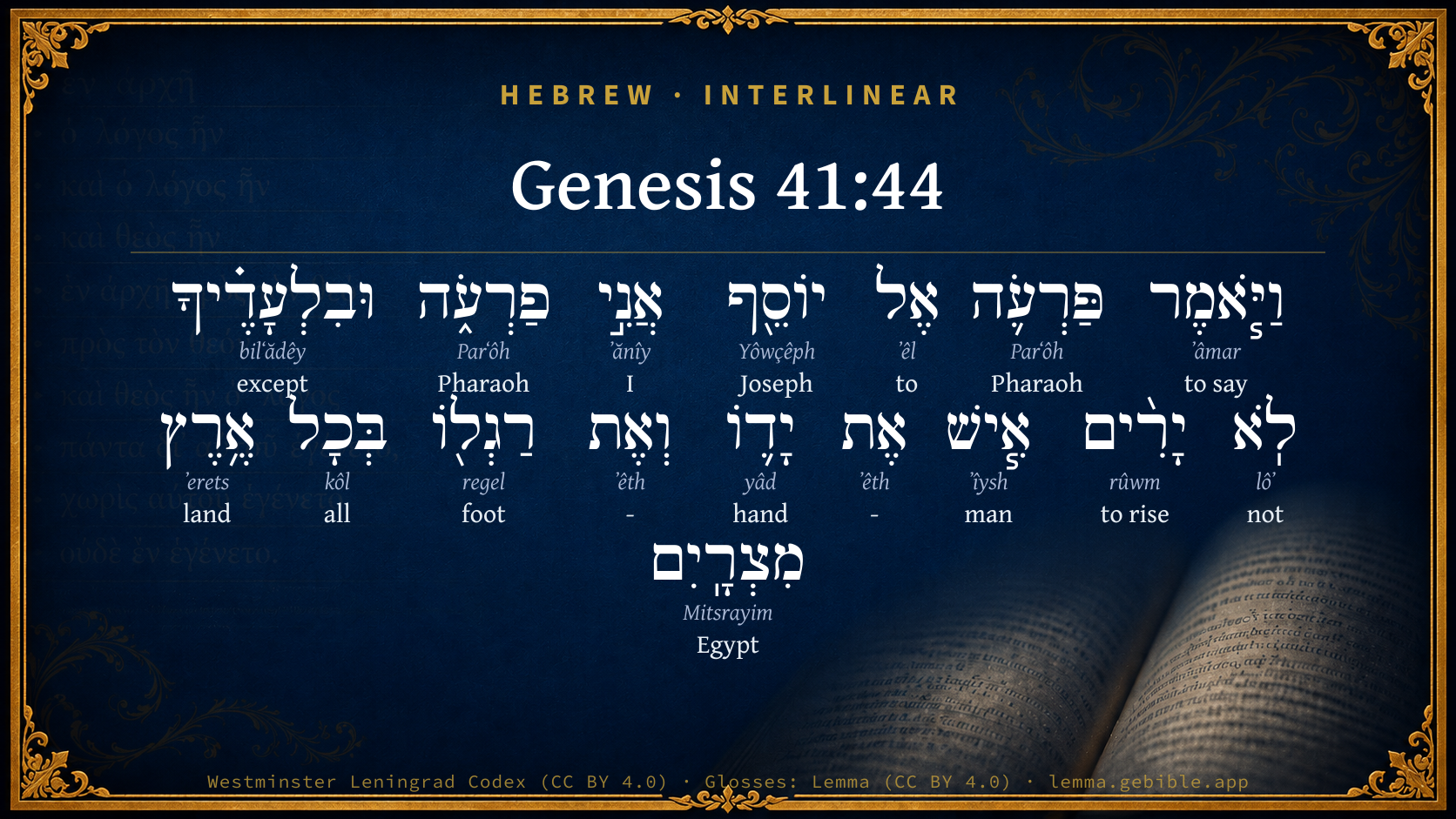
Hebrew (Westminster Leningrad Codex) Genesis 41:44 appears in the Hebrew Old Testament. The text above is from the Westminster Leningrad Codex. Each word links to its Strong’s number, a concise gloss, and parsing drawn from the Open Scriptures Hebrew Bible morphology. Click any word for its full Brown-Driver-Briggs (BDB) entry.
Download image
Cite this verse

Genesis 41:44 (World English Bible). Public Domain. Lemma interlinear Bible study tool, https://lemma.gebible.app/v/genesis/41/44.

Show BibTeX & RIS
BibTeX
RIS
English Translation
Pharaoh said to Joseph, "I am Pharaoh, and without you shall no man lift up his hand or his foot in all the land of Egypt."
World English Bible · Public Domain
Download a study sheet

One document with this verse’s original text, its word-by-word gloss line, the meaning frame, cross-references with their text, attributed commentary, and full source and license credits — printable, and it pastes into notes with its structure intact.

This verse Autodidact and up

Study sheet (.html) Plain text (.txt)

A passage Seminary Student

Up to 50 verses in one chapter. A passage sheet keeps up to 6 commentary sources and 12 cross-references per verse, in the order this page ranks them, and says so on the sheet whenever that leaves anything out. Ask for a single verse and you get the Autodidact verse sheet above.

Everything on this page stays free to read, with no account — the sheet is a download of what is already on screen, not access to it.

Want to remove ads? Support Godless Engineer
Compare translations 3

The same verse in 3 English versions, stacked beneath the original-language interlinear above. Click any original word for its lexicon entry.

Each is an independent rendering of the whole verse — the interlinear is not word-aligned to these translations.

Highlighted words mark where these versions differ — a whole-verse word diff, not a word-by-word alignment.

  • World English Bible Public Domain
    Pharaoh said to Joseph, "I am Pharaoh, and without you shall no man lift up his hand or his foot in all the land of Egypt."
  • King James Version Public Domain
    And Pharaoh said unto Joseph, I am Pharaoh, and without thee shall no man lift up his hand or foot in all the land of Egypt.
  • unfoldingWord Literal Text CC BY-SA 4.0
    Then Pharaoh said to Joseph, “I Pharaoh, and without you a person will not lift his hand or his foot in all the land of Egypt!”

unfoldingWord Literal Text — © unfoldingWord, licensed CC BY-SA 4.0. Word-aligned USFM3 via Door43 (git.door43.org/unfoldingWord/en_ult).

Versions to compare (up to 4)

3 of 4 selected

Show all 18 translations

Every available English version of this verse, each an independent rendering of the whole verse.

  • World English Bible Public Domain
    Pharaoh said to Joseph, "I am Pharaoh, and without you shall no man lift up his hand or his foot in all the land of Egypt."
  • Berean Standard Bible Public Domain
    And Pharaoh declared to Joseph, “I am Pharaoh, but without your permission, no one in all the land of Egypt shall lift his hand or foot.”
  • Majority Standard Bible Public Domain
    And Pharaoh declared to Joseph, “I am Pharaoh, but without your permission, no one in all the land of Egypt shall lift his hand or foot.”
  • King James Version Public Domain
    And Pharaoh said unto Joseph, I am Pharaoh, and without thee shall no man lift up his hand or foot in all the land of Egypt.
  • American Standard Version (1901) Public Domain
    And Pharaoh said unto Joseph, I am Pharaoh, and without thee shall no man lift up his hand or his foot in all the land of Egypt.
  • Revised Version (1885) Public Domain
    And Pharaoh said unto Joseph, I am Pharaoh, and without thee shall no man lift up his hand or his foot in all the land of Egypt.
  • Geneva Bible (1599) Public Domain
    Againe Pharaoh saide vnto Ioseph, I am Pharaoh, and without thee shall no man lift vp his hand or his foote in all the land of Egypt.
  • Douay-Rheims (1899) Public Domain
    And he took his ring from his own hand, and gave it into his hand: and he put upon him a robe of silk, and put a chain of gold about his neck.
  • Young's Literal Translation Public Domain
    And Pharaoh saith unto Joseph, `I `am' Pharaoh, and without thee a man doth not lift up his hand and his foot in all the land of Egypt;'
  • Literal Standard Version CC BY-SA 4.0
    And Pharaoh says to Joseph, “I [am] Pharaoh, and without you a man does not lift up his hand and his foot in all the land of Egypt”;
  • Unlocked Literal Bible CC BY-SA 4.0
    Pharaoh said to Joseph, “I am Pharaoh, and apart from you, no man will lift his hand or his foot in all the land of Egypt.”
  • unfoldingWord Literal Text CC BY-SA 4.0
    Then Pharaoh said to Joseph, “I Pharaoh, and without you a person will not lift his hand or his foot in all the land of Egypt!”
  • Darby Bible Public Domain
    And Pharaoh said to Joseph, I am Pharaoh; and without thee shall no man lift up his hand or his foot in all the land of Egypt.
  • World Messianic Bible Public Domain
    Pharaoh said to Joseph, “I am Pharaoh. Without you, no man shall lift up his hand or his foot in all the land of Egypt.”
  • Webster's Bible Public Domain
    And Pharaoh said to Joseph, I am Pharaoh, and without thee shall no man lift up his hand or foot in all the land of Egypt.
  • Free Bible Version CC BY-SA 4.0
    Then Pharaoh told Joseph, “I am Pharaoh, but without your permission nobody will lift a hand or a foot anywhere in the whole country.”
  • Bible in Basic English Public Domain
    Then Pharaoh said to Joseph, I am Pharaoh; and without your order no man may do anything in all the land of Egypt.
  • JPS Tanakh (1917) Public Domain
    And Pharaoh said unto Joseph: 'I am Pharaoh, and without thee shall no man lift up his hand or his foot in all the land of Egypt.'

Literal Standard Version (2020), Covenant Press — licensed CC BY-SA 4.0. Text via the HelloAO Bible API (eBible.org). Unlocked Literal Bible (unfoldingWord) — licensed CC BY-SA 4.0. Text via the HelloAO Bible API (eBible.org). unfoldingWord Literal Text — © unfoldingWord, licensed CC BY-SA 4.0. Word-aligned USFM3 via Door43 (git.door43.org/unfoldingWord/en_ult). Free Bible Version, Dr. Jonathan Gallagher — licensed CC BY-SA 4.0. Text via the HelloAO Bible API (eBible.org).

Word by word

More ways to search: Search by grammar → Find every occurrence → Compare this word →

Practice this passage: Drill this verse → Learn its vocabulary →

וּבִלְעָדֶ֗יךָ
bilʻădêy
H1107
“and · except · you”
Conjunction + Preposition + Suffix, Personal, 2nd Person, Masculine, Singular
Part of Speech
Conjunction + Preposition
Full BDB Definition

Origin: constructive pl. from H1077 and H5703

TWOT: 246h

apart from, except, without, besides
  1. וַיֹּ֧אמֶר ʼâmar H559 “and · to say” Conjunction + Verb, Qal, Sequential Imperfect, 3rd Person, Masculine, Singular
  2. פַּרְעֹ֛ה Parʻôh H6547 “Pharaoh” Noun, Proper
  3. אֶל ʼêl H413 “to” Preposition
  4. יוֹסֵ֖ף Yôwçêph H3130 “Joseph” Noun, Proper
  5. אֲנִ֣י ʼănîy H589 “I” Pronoun, Personal, 1st Person, Common, Singular
  6. פַרְעֹ֑ה Parʻôh H6547 “Pharaoh” Noun, Proper
  7. לֹֽא lôʼ H3808 “not” Particle, Negative
  8. יָרִ֨ים rûwm H7311 “to rise” Verb, Hiphil, Imperfect, 3rd Person, Masculine, Singular
  9. אִ֧ישׁ ʼîysh H376 “man” Noun, Common, Masculine, Singular, Absolute
  10. אֶת ʼêth H853 “-” Particle, Direct Object
  11. יָד֛וֹ yâd H3027 “hand · his” Noun, Common, Both, Singular, Construct + Suffix, Personal, 3rd Person, Masculine, Singular
  12. וְאֶת ʼêth H853 “and · -” Conjunction + Particle, Direct Object
  13. רַגְל֖וֹ regel H7272 “foot · his” Noun, Common, Feminine, Singular, Construct + Suffix, Personal, 3rd Person, Masculine, Singular
  14. בְּכָל kôl H3605 “in/at · all of” Preposition + Noun, Common, Masculine, Singular, Construct
  15. אֶ֥רֶץ ʼerets H776 “land of” Noun, Common, Both, Singular, Construct
  16. מִצְרָֽיִם Mitsrayim H4714 “Egypt” Noun, Proper

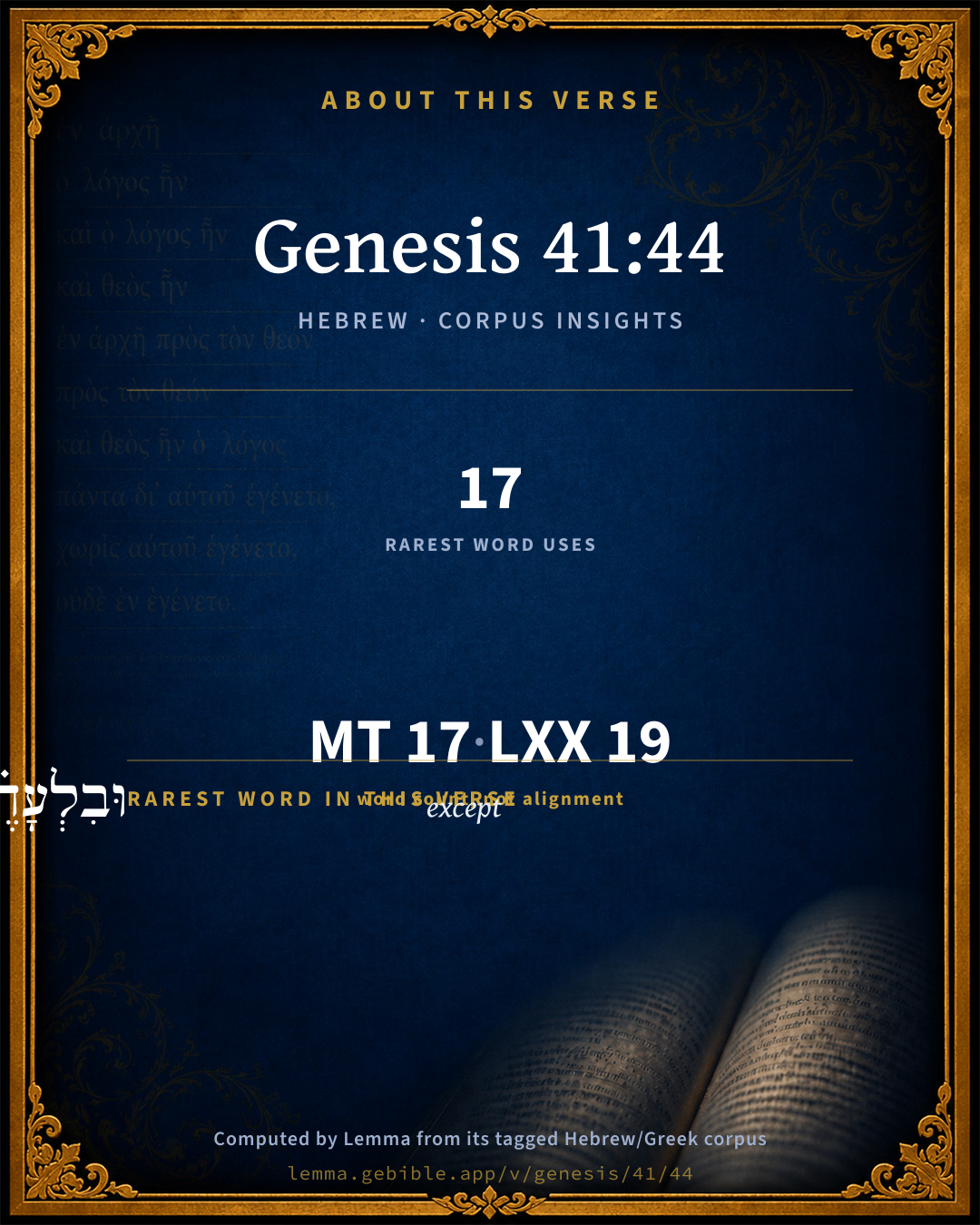
About this verse

These counts appear in no published source. They are computed here, from the morphology-tagged text and Lemma’s own curated glosses. What Lemma adds →

17
words
15
distinct lemmas
Pentateuch
section

Notable vocabulary

The rarest word here is וּבִלְעָדֶ֗יךָ except H1107 — appearing just 17 times in the whole Hebrew Bible.

Shared distinctive vocabulary

וּבִלְעָדֶ֗יךָ except H1107 occurs in 16 verses of the Hebrew Bible. Also found in:

Grammatical profile

  • 2 verbs
  • 9 nouns
  • 1 pronoun
  • 2 prepositions
  • 3 particles

Verb forms

  • וַיֹּ֧אמֶר Qal · Sequential Imperfect
  • יָרִ֨ים Hiphil · Imperfect

Repetition

A word recurs within this verse — often emphatic in Hebrew:

  • פַּרְעֹ֛ה Pharaoh H6547 ×2

Hebrew & Septuagint length

In English translation the verse runs 26 words from the Hebrew and 23 from the Septuagint (LXX English) — closely comparable.

A rough comparison of the two English renderings, which tokenize alike — not a word-level alignment.

Word counts can differ between the Hebrew and the Greek without any difference in meaning — e.g. the Hebrew direct-object marker אֵת has no separate Greek word, and Greek often adds the article ὁ.

In the original languages it is 17 Hebrew tokens and 19 Greek tokens — but the two are counted differently (Hebrew bundles its prefixes and suffixes into one token; the Greek is in lemma form), so that isn’t a like-for-like length.

Cross-references

2

Topical passages linked to Genesis 41:44 in the Treasury of Scripture Knowledge — connected by theme and wording, ordered by reader-vote popularity; previews shown in the World English Bible.

  • Psalms 105:22 To discipline his princes at his pleasure, And to teach his elders wisdom.
  • Exodus 11:7 But against any of the children of Israel a dog won't even bark or move its tongue, against man or animal; that you may know that Yahweh makes a distinction between the Egyptians and Israel.

Cross-references courtesy of OpenBible.info (CC BY 4.0).

Hebrew and Greek witnesses Masoretic Hebrew ↔ Greek Septuagint

The same verse in the two great witnesses to the Old Testament, shown verse-for-verse.

These are two independent witnesses, not word-aligned to each other, and the Septuagint is shown in lemma (dictionary) form.

Hebrew Genesis 41:44 Masoretic · Westminster Leningrad Codex

וַיֹּ֧אמֶר פַּרְעֹ֛ה אֶל יוֹסֵ֖ף אֲנִ֣י פַרְעֹ֑ה וּבִלְעָדֶ֗יךָ לֹֽא יָרִ֨ים אִ֧ישׁ אֶת יָד֛וֹ וְאֶת רַגְל֖וֹ בְּכָל אֶ֥רֶץ מִצְרָֽיִם

Pharaoh said to Joseph, "I am Pharaoh, and without you shall no man lift up his hand or his foot in all the land of Egypt."

World English Bible · Public Domain

Greek LXX Genesis 41:44 Septuagint · lemma form

εἶπον δέ φαραώ ὁ ιωσηφ ἐγώ φαραώ ἄνευ σύ οὐ ἐκαἴρω οὐδείς ὁ χείρ αὐτός ἐπί πᾶς γῆ αἴγυπτος

And Pharao said to Joseph, I am Pharao; without you no one shall lift up his hand on all the land of Egypt.

LXX2012 (modern English Septuagint) · Public Domain

Hebrew: Westminster Leningrad Codex (CC BY 4.0). Greek: Septuagint (public domain); English from LXX2012 (modern English Septuagint) (Public Domain). How the Septuagint differs from the Hebrew →

Targum (Aramaic paraphrase)

2

The Targum is the ancient Jewish Aramaic paraphrase of the Hebrew Scriptures — an interpretive translation, not the Hebrew text itself. Onkelos (literal) and Pseudo-Jonathan (expansive) render the Torah, and Jonathan the Prophets. Coverage is partial: where no permissively-licensed English translation exists for a verse, only the Aramaic is shown. This is verse-level text, not a word-by-word alignment to the Hebrew.

  1. Targum Onkelos Torah (Genesis–Deuteronomy)
    וַאֲמַר פַּרְעֹה לְיוֹסֵף אֲנָא פַרְעֹה וּבַר מֵימְרָךְ לָא יְרִים גְּבַר יָת יְדֵהּ לְמֵיחַד זֵין וְיָת רִגְלֵהּ לְמִרְכַּב עַל סוּסְיָא בְּכָל אַרְעָא דְמִצְרָיִם

    (no public-domain English translation for this verse)

    Targum Onkelos — Aramaic: “Onkelos Genesis” (public domain); “Onkelos Exodus” (public domain); “Onkelos Leviticus” (public domain); “Onkelos Numbers” (public domain); “Onkelos Deuteronomy” (public domain). English: “Sefaria Community Translation” (CC0 1.0 (public-domain dedication)); “J.W. Etheridge. The Targums of Onkelos and Jonathan Ben Uzziel on the Pentateuch. London: Longmans, Green, 1862” (public domain). Text via Sefaria.

  2. Targum Pseudo-Jonathan Torah (Genesis–Deuteronomy)
    וַאֲמַר פַּרְעה לְיוֹסֵף אֲנָא פַרְעה מַלְכָּא וְאַנְתְּ אַלְקַפְטָא וּבַר מִמֵימְרָךְ לָא יְרִים גְבַר יְדֵיהּ לְמִיסוֹר זַיְינֵיהּ וְיַת רִיגְלֵיהּ לְמִירְכְּוּב עַל סוּסְיָא בְּכָל אַרְעָא דְמִצְרַיִם

    And Pharoh said to Joseph, I am Pharoh the king, and thou art viceregent, and without thy word a man shall not lift up his hand to gird on arms, or his foot to mount a horse in all the land of Mizraim.

    Targum Pseudo-Jonathan — Aramaic: “Targum Jonathan on Genesis” (public domain); “Targum Jonathan on Exodus” (public domain); “Targum Jonathan on Leviticus” (public domain); “Targum Jonathan on Numbers” (public domain); “Targum Jonathan on Deuteronomy” (public domain). English: “The Targum of Jonathan ben Uzziel, trans. J. W. Etheridge, London, 1862” (public domain). Text via Sefaria.

Commentary

Notes on Genesis 41:44 from classic Christian and Jewish commentators (each source and its license shown beneath its notes). The classic Christian expositions comment on the surrounding passage and are grouped to its opening verse, so a note may address several verses; the Jewish commentaries on the Tanakh (Rashi and others) are per-verse, so they appear only where the commentator wrote on this verse.

Lemma curates 59 commentaries, every one of them public domain or Creative Commons licensed, each selected and text-cleaned for this edition rather than reprinted as found. About our sources →

Trapp's Complete Commentary

John Trapp

Gen 41:44 And Pharaoh said unto Joseph, I [am] Pharaoh, and without thee shall no man lift up his hand or foot in all the land of Egypt.

Ver. 44. I am Pharaoh.] Of a root ( פרע) that signifieth to make bare, because, say some, he was to be bared - that is, sifted and manifested by Joseph.

Without thee shall no man lift up his hand.] And yet the Egyptians, in Seneca’s time, however, were a proud peremptory people, apt to cast contempt and contumely upon their governors, were they never so upright and unblamable. {a} Joseph had said, Without me, God shall answer Pharaoh; and now he heareth, Without thee shall no man, &c.

{a} Aegyptus loquax et ingeniosa in contumeliam praefectorum provincia: in qua qui vitaverit culpam, non effugit infamiam. - Seneca.

John Trapp, A Commentary or Exposition upon All the Books of the Old and New Testament (1647–1656) — public domain. Text from a community e-Sword module.

Joseph Benson's Commentary

Gen 41:44. Without thee shall no man lift up his hand or foot — A hyperbolical phrase, signifying that all the affairs of the kingdom should pass through his hands. Only in the throne will I be greater than thou — It is probable there were those about court that opposed Joseph’s preferment, which occasioned Pharaoh so oft to repeat the grant, and with that solemn sanction, I am Pharaoh. Hence, besides the honours just mentioned, he also gave him a new name, and such a name as spoke the value he had for him, Zaphnath-paaneah, a revealer of secrets; and he married him honourably to a priest’s, or rather, as the word also signifies, a prince’s daughter. Thus where God had been liberal in giving wisdom and other merits, Pharaoh was not sparing in conferring honours. Now this preferment of Joseph was, 1st, an abundant recompense for his innocent and patient suffering, a lasting instance of the equity and goodness of Providence, and an encouragement to all to trust in a good God; 2d, it was typical of the exaltation of Christ, with great revealer of secrets, (Joh 1:18,) or, as some translate Joseph’s new name, the Saviour of the world. The brightest glories of the upper world are upon him, the highest trusts lodged in his hand, and all power given him both in heaven and earth. He is gatherer, keeper, and disposer of all the stores of divine grace, and chief ruler of the kingdom of God among men. The work of ministers is to cry before him, Bow the knee; kiss the Son.

Joseph Benson's Commentary on the Old and New Testaments (1811–1818) — public domain. Text from a community e-Sword module.

Jamieson, Fausset & Brown

Robert Jamieson, A. R. Fausset & David Brown

These ceremonies of investiture were closed in usual form by the king in council solemnly ratifying the appointment.

I am Pharaoh, and without thee, &c.--a proverbial mode of expression for great power.

Jamieson, Fausset & Brown — Commentary Critical and Explanatory on the Whole Bible (1871) — public domain (CC PDM 1.0). Text via the HelloAO Bible API.

Adam Clarke's Commentary

Verse 44. I am Pharaoh] The same as if he had said, I am the king; for Pharaoh was the common title of the sovereigns of Egypt.

Adam Clarke's Commentary on the Bible (1810–1826) — public domain. Text from a community e-Sword/MySword module.

John Gill's Exposition

And in the seven plenteous years the earth brought forth by handfuls. Such as the gatherers take up in their hands when reaped, in order to bind up in sheaves: now such was the fruitfulness of the land during the seven years of plenty, that either one stalk produced as many ears as a man could hold in his hand; or one grain produced an handful, as Ben Melech observes; though Onkelos paraphrases the words,"the inhabitants of the earth in the seven years of plenty gathered even into their treasuries:''and this they did by the order and direction of Joseph as he passed through the land; what he bought of them they brought, and put into the granaries, as he directed them.

And in the seven plenteous years the earth brought forth by handfuls. Such as the gatherers take up in their hands when reaped, in order to bind up in sheaves: now such was the fruitfulness of the land during the seven years of plenty, that either one stalk produced as many ears as a man could hold in his hand; or one grain produced an handful, as Ben Melech observes; though Onkelos paraphrases the words,"the inhabitants of the earth in the seven years of plenty gathered even into their treasuries:''and this they did by the order and direction of Joseph as he passed through the land; what he bought of them they brought, and put into the granaries, as he directed them.

Genesis 41:48

gen 41:48

gen 41:48

gen 41:48And he gathered up all the food of the seven years,.... That is, of plenty; not all the fruits of the earth, or all that was eatable, but the corn, as in Gen 41:49; and not all of that the earth produced, but the fifth part of it, as he proposed, which he bought with Pharaoh's money, and therefore: had a right to sell it again as he did:

which were in the land of Egypt; in which only he had a concern, and where only was this plenty:

and laid up the food in the cities; in places built for that purpose, and whither the people round about could easily bring it, and fetch it, when it was wanted:

the food of the field, which was round about every city, laid he up in the same; which was very wisely done, for present carriage, and for the convenience of the people in time of famine. At this day, at old Cairo, is an edifice the most considerable in it, called Joseph's granary; it occupies a square, surrounded by a wall, and has divers partitions contrived within it, where is deposited the corn, that is paid as a tax to the Gram Seignior, brought from different parts of Egypt (o).

(o) Norden's Travels in Egypt, &c. vol. 1. p. 72.

John Gill's Exposition of the Whole Bible (1746–1763) — public domain (CC PDM 1.0). Text via the HelloAO Bible API.

Haydock's Catholic Bible Commentary

Pharao, or the king. This is the preamble to the decree for the exaltation of Joseph, which subjected to him the armies and all the people of Egypt.

George Leo Haydock (1774–1849), Haydock's Catholic Family Bible and Commentary, 1859 edition — public domain. Excludes Psalms (Douay-Rheims chapter numbering differs from Protestant) and Deuterocanonical books (Catholic canon only).

Matthew Poole's English Annotations

I am Pharaoh, i.e. I only am the king, I reserve to myself the sovereign power over thee, and over all. As the name of Caesar among the Romans was commonly used for the emperor, so the name of Pharaoh for the king. Or thus, I have the supreme power, and therefore as I have authority to give thee the following power, so I will make it good to thee, and oblige all my people to observe and obey thee. No man shall do any thing in the public affairs of the kingdom concerning matters of war or peace without thy commission or licence.

Matthew Poole's English Annotations on the Holy Bible (1683–1685) — public domain. Text from a community e-Sword/MySword module.

The Pulpit Commentary

And Pharaoh-said unto Joseph, I am Pharaoh, and without thee shall no man lift up his hand or foot in all the land of Egypt. Joseph"s authority was to be absolute and universal.

The Pulpit Commentary (1880–1919), ed. H.D.M. Spence-Jones & Joseph S. Exell — public domain. Text from a community e-Sword module.

John Wesley's Explanatory Notes

Without thee shall no man lift up his hand or foot - All the affairs of the kingdom must pass through his hand. Only in the throne will I be greater than thou - It is probable there were those about court that opposed Joseph's preferment, which occasioned Pharaoh so oft to repeat the grant, and with that solemn sanction, I am Pharaoh. He gave him his own ring as a ratification of his commission, and in token of peculiar favour; or it was like delivering him the great seal. He put fine clothes upon him instead of his prison garments, and adorned him with a chain of gold. He made him ride in the second chariot next his own, and ordered all to do obeisance to him, as to Pharaoh himself; he gave him a new name and such a name as spoke the value he had for him, Zaphnath-paaneah, a Revealer of secrets. He married him honourably to a prince's daughter. Where God had been liberal in giving wisdom and other merits, Pharaoh was not sparing in conferring honours. Now this preferment of Joseph, was, 1st, an abundant recompense for his innocent and patient suffering, a lasting instance of the equity and goodness of providence, and an encouragement to all to trust in a good God. 2ndly, It was typical of the exaltation of Christ, that great revealer of secrets, (John i, 18,) or as some translate Joseph's new name, the saviour of the world. The brightest glories of the upper world are upon him, the highest trusts lodged in his hand, and all power given him both in heaven and earth. He is gatherer, keeper, and disposer of all the stores of divine grace, and chief ruler of the kingdom of God among men. The work of ministers is to cry before him; Bow the knee; kiss the Son.

John Wesley, Explanatory Notes Upon the Whole Bible (1754–1765) — public domain. Text via the GEBible commentary corpus.

Keil & Delitzsch

C. F. Keil & F. Delitzsch

"I am Pharaoh," he said to him, "and without thee shall no man lift his hand or foot in all the land of Egypt;" i.e., I am the actual king, and thou, the next to me, shalt rule over all my people.

Keil & Delitzsch — Biblical Commentary on the Old Testament (1861–1891) — public domain (CC PDM 1.0). Text via the HelloAO Bible API. (Old Testament only.)

unfoldingWord translationNotes

Door43 World Missions Community

I am Pharaoh, and apart from you

Pharaoh is emphasizing his authority. AT: "As Pharaoh, I command that apart from you"

apart from you, no man will lift his hand or his foot in all the land of Egypt

Here "hand" and "foot" stand for a person's actions. AT: "no person in Egypt will do anything without your permission" or "every person in Egypt must ask your permission before they do anything" (See: Metonymy)

no man

Here "man" refers to any person in general, whether male or female. (See: When Masculine Words Include Women)

Zaphenath-Paneah

Translators may add the following footnote: The name Zaphenath-Paneah means "a revealer of secrets." (See: How to Translate Names)

He gave him Asenath, the daughter of Potiphera priest of On, as a wife

Priests in Egypt were the highest and most privileged caste. This marriage signifies Joseph's place of honor and privilege. (See: Symbolic Action)

gave him Asenath

"Asenath" is the name of the woman whom Pharaoh gave to Joseph as his wife. (See: How to Translate Names)

daughter of Potiphera

"Potiphera" is the father of Asenath. (See: How to Translate Names)

priest of On

On is a city, also called Heliopolis, which was "the City of the Sun" and the center of worship of the sun god Ra. (See: How to Translate Names)

Joseph went out over the land of Egypt

Joseph traveled over the land to supervise the preparations for the coming drought.

translationWords

Pharaoh

Joseph (OT)

hand

Egypt

priest

authority

unfoldingWord translationNotes — © Distant Shores Media and the Door43 World Missions Community, licensed CC BY-SA 4.0. Source: git.door43.org/Door43/en_tn.

Rashi

Rabbi Shlomo Yitzchaki (Rashi)

אני פרעה I AM PHARAOH in whose power it is to issue decrees for my kingdom, and I order that no man shall lift up his hand בלעדיך — without your permission. Another explanation of אני פרעה: I AM PHARAOH — I shall be king, but without thy permission etc. It is exactly similar in meaning to (v. 40) “only in the throne [will I be greater than thou]”.

את ידו ואת רגלו HIS HAND OR HIS FOOT — Understand it as the Targum does: no man shall raise his hand to gird on a sword or raise his foot to mount a horse.

Rashi on the Tanakh — English translations: “The Judaica Press complete Tanach with Rashi, translated by A. J. Rosenberg” (CC BY 4.0); “Pentateuch with Rashi's commentary by M. Rosenbaum and A.M. Silbermann, 1929-1934” (public domain); “The Metsudah Tanach series, Lakewood, N.J” (CC BY 4.0); and “The Book of Joshua, Metsudah Publications, 1997” (CC BY 4.0). Text via Sefaria.

Radak

Rabbi David Kimhi (Radak)

אני פרעה, even though I am nominally king, without your permission לא ירים איש את ידו ואת רגלו, in all respects. [Joseph was appointed as absolute dictator, benevolent, of course. Ed.]

Radak on the Tanakh — English translations: “Sefaria Community Translation” (CC0 1.0 (public-domain dedication)); “Eliyahu Munk, HaChut Hameshulash” (CC BY 4.0); “Rabbi Mike Feuer, Jerusalem Anthology” (CC BY 4.0); and “R. David Kimhi on the first book of Psalms, Translated by R.G. Finch, London, 1919” (public domain). Text via Sefaria.

Lesson kit

Teaching starters — assembled from the data on this page, not authored interpretation. Every prompt links to the verse data it draws on. Edit before teaching.

Genesis, in the Pentateuch, opens this verse with 17 words (15 distinct Hebrew lemmas). Its most distinctive word is bilʻădêy (“except”). A historical commentator’s framing appears above. Read the whole chapter for the surrounding context.

Discussion questions

  1. What does “except” (bilʻădêy) contribute to the verse as a whole?
  2. How does Genesis 14:24, which shares the word «except», read alongside this verse?
  3. What does the repetition of “Pharaoh” (2× in this one verse) do in this verse?
  4. The translations on this page render this verse differently — a whole-verse word diff, not a word-by-word alignment. What might account for the different wordings?
  5. «וַיֹּ֧אמֶר» is a Qal Sequential Imperfect verb. How does that grammatical form shape the action described?
  6. Compare how Trapp's Complete Commentary and Joseph Benson's Commentary read this verse. Where do they agree or differ?

Things to notice

Reading settings

Reading text

Shown beneath each verse's original-language words.

Old Testament
Old Testament edition

Read the OT as the Masoretic Hebrew (MT) or the Greek Septuagint (LXX).

English shown for the Greek Septuagint (in the Hebrew ↔ Greek comparison).

Comparing translations? Open the Compare panel on any verse page to stack up to four side by side.