
Daniel 12:7

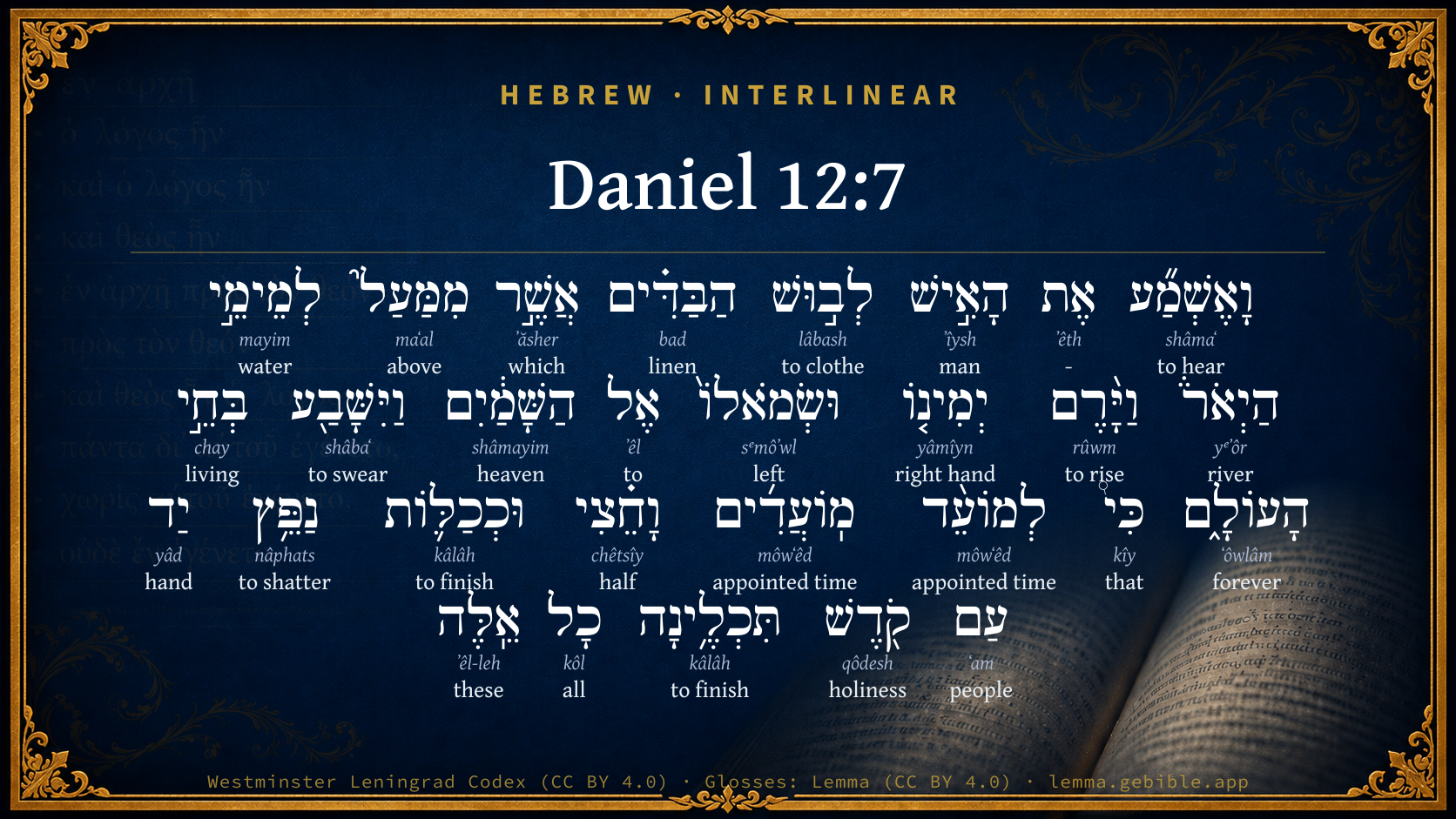
Hebrew (Westminster Leningrad Codex) Daniel 12:7 appears in the Hebrew Old Testament. The text above is from the Westminster Leningrad Codex. Each word links to its Strong’s number, a concise gloss, and parsing drawn from the Open Scriptures Hebrew Bible morphology. Click any word for its full Brown-Driver-Briggs (BDB) entry.
Download image
Cite this verse

Daniel 12:7 (World English Bible). Public Domain. Lemma interlinear Bible study tool, https://lemma.gebible.app/v/daniel/12/7.

Show BibTeX & RIS
BibTeX
RIS
English Translation
I heard the man clothed in linen, who was above the waters of the river, when he held up his right hand and his left hand to heaven, and swore by him who lives forever that it shall be for a time, times, and a half; and when they have made an end of breaking in pieces the power of the holy people, all these things shall be finished.
World English Bible · Public Domain
Download a study sheet

One document with this verse’s original text, its word-by-word gloss line, the meaning frame, cross-references with their text, attributed commentary, and full source and license credits — printable, and it pastes into notes with its structure intact.

This verse Autodidact and up

Study sheet (.html) Plain text (.txt)

A passage Seminary Student

Up to 50 verses in one chapter. A passage sheet keeps up to 6 commentary sources and 12 cross-references per verse, in the order this page ranks them, and says so on the sheet whenever that leaves anything out. Ask for a single verse and you get the Autodidact verse sheet above.

Everything on this page stays free to read, with no account — the sheet is a download of what is already on screen, not access to it.

Want to remove ads? Support Godless Engineer
Compare translations 3

The same verse in 3 English versions, stacked beneath the original-language interlinear above. Click any original word for its lexicon entry.

Each is an independent rendering of the whole verse — the interlinear is not word-aligned to these translations.

Highlighted words mark where these versions differ — a whole-verse word diff, not a word-by-word alignment.

  • World English Bible Public Domain
    I heard the man clothed in linen, who was above the waters of the river, when he held up his right hand and his left hand to heaven, and swore by him who lives forever that it shall be for a time, times, and a half; and when they have made an end of breaking in pieces the power of the holy people, all these things shall be finished.
  • King James Version Public Domain
    And I heard the man clothed in linen, which was upon the waters of the river, when he held up his right hand and his left hand unto heaven, and sware by him that liveth for ever that it shall be for a time, times, and an half; and when he shall have accomplished to scatter the power of the holy people, all these things shall be finished.
  • unfoldingWord Literal Text CC BY-SA 4.0
    I heard the man clothed in linen, who was above the waters of the stream. He raised his right hand and his left hand toward heaven and swore by him who lives forever that it would be for a time, times, and half a time. When the smashing of the power of the holy people has come to an end, all these things will be completed.

unfoldingWord Literal Text — © unfoldingWord, licensed CC BY-SA 4.0. Word-aligned USFM3 via Door43 (git.door43.org/unfoldingWord/en_ult).

Versions to compare (up to 4)

3 of 4 selected

Show all 18 translations

Every available English version of this verse, each an independent rendering of the whole verse.

  • World English Bible Public Domain
    I heard the man clothed in linen, who was above the waters of the river, when he held up his right hand and his left hand to heaven, and swore by him who lives forever that it shall be for a time, times, and a half; and when they have made an end of breaking in pieces the power of the holy people, all these things shall be finished.
  • Berean Standard Bible Public Domain
    And the man dressed in linen, who was above the waters of the river, raised his right hand and his left hand toward heaven, and I heard him swear by Him who lives forever, saying, “It will be for a time, and times, and half a time. When the power of the holy people has finally been shattered, all these things will be completed.”
  • Majority Standard Bible Public Domain
    And the man dressed in linen, who was above the waters of the river, raised his right hand and his left hand toward heaven, and I heard him swear by Him who lives forever, saying, “It will be for a time, and times, and half a time. When the power of the holy people has finally been shattered, all these things will be completed.”
  • King James Version Public Domain
    And I heard the man clothed in linen, which was upon the waters of the river, when he held up his right hand and his left hand unto heaven, and sware by him that liveth for ever that it shall be for a time, times, and an half; and when he shall have accomplished to scatter the power of the holy people, all these things shall be finished.
  • American Standard Version (1901) Public Domain
    And I heard the man clothed in linen, who was above the waters of the river, when he held up his right hand and his left hand unto heaven, and sware by him that liveth for ever that it shall be for a time, times, and a half; and when they have made an end of breaking in pieces the power of the holy people, all these things shall be finished.
  • Revised Version (1885) Public Domain
    And I heard the man clothed in linen, which was above the waters of the river, when he held up his right hand and his left hand unto heaven, and sware by him that liveth fear ever that it shall be for a time, times, and an half; and when they have made an end of breaking in pieces the power of the holy people, all these things shall be finished.
  • Geneva Bible (1599) Public Domain
    And I heard ye man clothed in line which was vpon the waters of the riuer, when he helde vp his right hand, and his left hand vnto heauen, and sware by him that liueth for euer, that it shall tarie for a time, two times and an halfe: and when he shall haue accomplished to scatter the power of the holy people, all these things shall be finished.
  • Douay-Rheims (1899) Public Domain
    And I heard the man that was clothed in linen, that stood upon the waters of the river: when he had lifted up his right hand, and his left hand to heaven, and had sworn, by him that liveth for ever, that it should be unto a time, and times, and half a time. And when the scattering of the band of the holy people shall be accomplished, all these things shall be finished.
  • Young's Literal Translation Public Domain
    And I hear the one clothed in linen, who `is' upon the waters of the flood, and he doth lift up his right hand and his left unto the heavens, and sweareth by Him who is living to the age, that, `After a time, times, and a half, and at the completion of the scattering of the power of the holy people, finished are all these.'
  • Literal Standard Version CC BY-SA 4.0
    And I hear the one clothed in linen, who [is] on the waters of the flood, and he lifts up his right hand and his left to the heavens, and swears by Him who is living for all time, that, After a time, times, and a half, and at the completion of the scattering of the power of the holy people, all these are finished.
  • Unlocked Literal Bible CC BY-SA 4.0
    I heard the man clothed in linen, who was upstream along the river—he raised his right hand and his left hand to heaven and swore by the one who lives forever that it would be for a time, times, and half a time. When the power of the holy people has been finally broken, all these things will be completed.
  • unfoldingWord Literal Text CC BY-SA 4.0
    I heard the man clothed in linen, who was above the waters of the stream. He raised his right hand and his left hand toward heaven and swore by him who lives forever that it would be for a time, times, and half a time. When the smashing of the power of the holy people has come to an end, all these things will be completed.
  • Darby Bible Public Domain
    And I heard the man clothed in linen, who was above the waters of the river; and he held up his right hand and his left hand unto the heavens, and swore by him that liveth for ever that it is for a time, times, and a half; and when the scattering of the power of the holy people shall be accomplished, all these things shall be finished.
  • World Messianic Bible Public Domain
    I heard the man clothed in linen, who was above the waters of the river, when he held up his right hand and his left hand to heaven, and swore by him who lives forever that it will be for a time, times, and a half; and when they have finished breaking in pieces the power of the holy people, all these things will be finished.
  • Webster's Bible Public Domain
    And I heard the man clothed in linen, who was upon the waters of the river, when he held up his right hand and his left hand to heaven, and swore by him that liveth for ever, that it shall be for a time, times, and a half; and when he shall have accomplished to scatter the power of the holy people, all these things shall be finished.
  • Free Bible Version CC BY-SA 4.0
    The man dressed in linen, who was above the river's waters, lifted both hands to heaven and made a solemn promise by the One who lives eternally. I heard him say, “It will last for a time, times, and half a time. When the scattering of the power of the holy people has come to an end, then all these things will also come to an end.”
  • Bible in Basic English Public Domain
    Then in my hearing the man clothed in linen, who was over the river, lifting up his right hand and his left hand to heaven, took an oath by him who is living for ever that it would be a time, times, and a half; and when the power of the crusher of the holy people comes to an end, all these things will be ended.
  • JPS Tanakh (1917) Public Domain
    And I heard the man clothed in linen, who was above the waters of the river, when he lifted up his right hand and his left hand unto heaven, and swore by Him that liveth for ever that it shall be for a time, times, and a half; and when they have made an end of breaking in pieces the power of the holy people, all these things shall be finished.

Literal Standard Version (2020), Covenant Press — licensed CC BY-SA 4.0. Text via the HelloAO Bible API (eBible.org). Unlocked Literal Bible (unfoldingWord) — licensed CC BY-SA 4.0. Text via the HelloAO Bible API (eBible.org). unfoldingWord Literal Text — © unfoldingWord, licensed CC BY-SA 4.0. Word-aligned USFM3 via Door43 (git.door43.org/unfoldingWord/en_ult). Free Bible Version, Dr. Jonathan Gallagher — licensed CC BY-SA 4.0. Text via the HelloAO Bible API (eBible.org).

Word by word

More ways to search: Search by grammar → Find every occurrence → Compare this word →

Practice this passage: Drill this verse → Learn its vocabulary →

נַפֵּ֥ץ
nâphats
H5310
“to shatter”
Verb, Piel, Infinitive Construct
Part of Speech
Verb
Stem
Piel
Form
Infinitive Construct
Full BDB Definition

Origin: a primitive root

TWOT: 1394

to shatter, break, dash, beat in pieces - (Qal) - to shatter - shattering (infinitive) - (Piel) to dash to pieces - (Pual) to pulverise - to scatter, disperse, overspread, be scattered - (Qal) - to be scattered - dispersed (participle)
  1. וָאֶשְׁמַ֞ע shâmaʻ H8085 “and · to hear” Conjunction + Verb, Qal, Sequential Imperfect, 1st Person, Common, Singular
  2. אֶת ʼêth H853 “-” Particle, Direct Object
  3. הָאִ֣ישׁ ʼîysh H376 “the · man” Particle, Definite Article + Noun, Common, Masculine, Singular, Absolute
  4. לְב֣וּשׁ lâbash H3847 “clothed” Verb, Qal, Participle Passive, Masculine, Singular, Construct
  5. הַבַּדִּ֗ים bad H906 “the · linen” Particle, Definite Article + Noun, Common, Masculine, Plural, Absolute
  6. אֲשֶׁ֣ר ʼăsher H834 “which” Particle, Relative
  7. מִמַּעַל֮ maʻal H4605 “from · above” Preposition + Adverb
  8. לְמֵימֵ֣י mayim H4325 “to/for · water(s) of” Preposition + Noun, Common, Masculine, Plural, Construct
  9. הַיְאֹר֒ yᵉʼôr H2975 “the · river” Particle, Definite Article + Noun, Common, Masculine, Singular, Absolute
  10. וַיָּ֨רֶם rûwm H7311 “and · to rise” Conjunction + Verb, Hiphil, Sequential Imperfect, 3rd Person, Masculine, Singular
  11. יְמִינ֤וֹ yâmîyn H3225 “right hand · his” Noun, Common, Feminine, Singular, Construct + Suffix, Personal, 3rd Person, Masculine, Singular
  12. וּשְׂמֹאלוֹ֙ sᵉmôʼwl H8040 “and · left · his” Conjunction + Noun, Common, Masculine, Singular, Construct + Suffix, Personal, 3rd Person, Masculine, Singular
  13. אֶל ʼêl H413 “to” Preposition
  14. הַשָּׁמַ֔יִם shâmayim H8064 “the · heaven(s)” Particle, Definite Article + Noun, Common, Masculine, Plural, Absolute
  15. וַיִּשָּׁבַ֖ע shâbaʻ H7650 “and · to swear” Conjunction + Verb, Niphal, Sequential Imperfect, 3rd Person, Masculine, Singular
  16. בְּחֵ֣י chay H2416 “in/at · living of” Preposition + Noun, Common, Both, Singular, Construct
  17. הָעוֹלָ֑ם ʻôwlâm H5769 “the · forever” Particle, Definite Article + Noun, Common, Masculine, Singular, Absolute
  18. כִּי֩ kîy H3588 “that” Conjunction
  19. לְמוֹעֵ֨ד môwʻêd H4150 “to/for · appointed time” Preposition + Noun, Common, Masculine, Singular, Absolute
  20. מֽוֹעֲדִ֜ים môwʻêd H4150 “appointed times” Noun, Common, Masculine, Plural, Absolute
  21. וָחֵ֗צִי chêtsîy H2677 “and · half” Conjunction + Noun, Common, Masculine, Singular, Absolute
  22. וּכְכַלּ֛וֹת kâlâh H3615 “and · like/as · to finish” Conjunction + Preposition + Verb, Piel, Infinitive Construct
  23. יַד yâd H3027 “hand of” Noun, Common, Both, Singular, Construct
  24. עַם ʻam H5971 “people of” Noun, Common, Masculine, Singular, Construct
  25. קֹ֖דֶשׁ qôdesh H6944 “holiness” Noun, Common, Masculine, Singular, Absolute
  26. תִּכְלֶ֥ינָה kâlâh H3615 “to finish” Verb, Qal, Imperfect, 3rd Person, Feminine, Plural
  27. כָל kôl H3605 “all of” Noun, Common, Masculine, Singular, Construct
  28. אֵֽלֶּה ʼêl-leh H428 “these” Pronoun, Demonstrative, Common, Plural

About this verse

These counts appear in no published source. They are computed here, from the morphology-tagged text and Lemma’s own curated glosses. What Lemma adds →

29
words
27
distinct lemmas
Prophets
section

Notable vocabulary

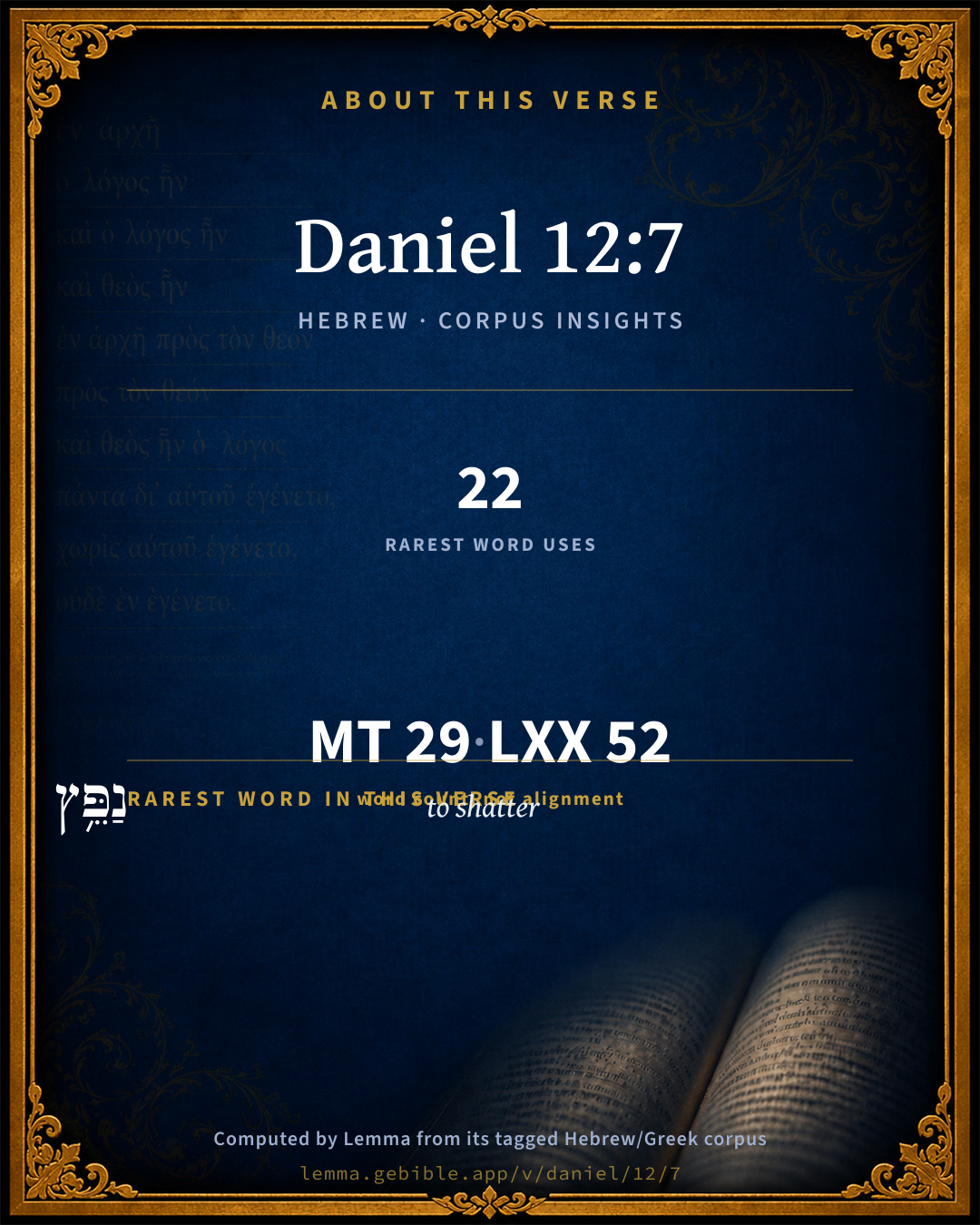
The rarest word here is נַפֵּ֥ץ to shatter H5310 — appearing just 22 times in the whole Hebrew Bible.

Shared distinctive vocabulary

נַפֵּ֥ץ to shatter H5310 occurs in 17 verses of the Hebrew Bible. Also found in:

Grammatical profile

  • 7 verbs
  • 16 nouns
  • 1 pronoun
  • 1 preposition
  • 1 conjunction
  • 1 adverb
  • 2 particles

Verb forms

  • וָאֶשְׁמַ֞ע Qal · Sequential Imperfect
  • לְב֣וּשׁ Qal · Participle Passive
  • וַיָּ֨רֶם Hiphil · Sequential Imperfect
  • וַיִּשָּׁבַ֖ע Niphal · Sequential Imperfect
  • וּכְכַלּ֛וֹת Piel · Infinitive Construct
  • נַפֵּ֥ץ Piel · Infinitive Construct
  • תִּכְלֶ֥ינָה Qal · Imperfect

Repetition

Words recur within this verse — often emphatic in Hebrew:

  • לְמוֹעֵ֨ד appointed time H4150 ×2
  • וּכְכַלּ֛וֹת to finish H3615 ×2

Hebrew & Septuagint length

In English translation the verse runs 69 words from the Hebrew and 61 from the Septuagint (LXX English) — closely comparable.

A rough comparison of the two English renderings, which tokenize alike — not a word-level alignment.

Word counts can differ between the Hebrew and the Greek without any difference in meaning — e.g. the Hebrew direct-object marker אֵת has no separate Greek word, and Greek often adds the article ὁ.

In the original languages it is 29 Hebrew tokens and 52 Greek tokens — but the two are counted differently (Hebrew bundles its prefixes and suffixes into one token; the Greek is in lemma form), so that isn’t a like-for-like length.

Cross-references

22

Topical passages linked to Daniel 12:7 in the Treasury of Scripture Knowledge — connected by theme and wording, ordered by reader-vote popularity; previews shown in the World English Bible.

  • Daniel 7:25 He shall speak words against the Most High, and shall wear out the saints of the Most High; and he shall think to change the times and the law; and they shall be given into his hand until a time and times and half a time.
  • Revelation 12:14 Two wings of the great eagle were given to the woman, that she might fly into the wilderness to her place, so that she might be nourished for a time, and times, and half a time, from the face of the serpent.
  • Daniel 8:24 His power shall be mighty, but not by his own power; and he shall destroy wonderfully, and shall prosper and do [his pleasure]; and he shall destroy the mighty ones and the holy people.
  • Revelation 10:5–7 The angel who I saw standing on the sea and on the land lifted up his right hand to the sky,
  • Revelation 13:5 A mouth speaking great things and blasphemy was given to him. Authority to make war for forty-two months was given to him.
  • Jeremiah 4:2 and you shall swear, As Yahweh lives, in truth, in justice, and in righteousness; and the nations shall bless themselves in him, and in him shall they glory.
  • Daniel 4:34 At the end of the days I, Nebuchadnezzar, lifted up my eyes to heaven, and my understanding returned to me, and I blessed the Most High, and I praised and honored him who lives forever; for his dominion is an everlasting dominion, and his kingdom from generation to generation.
  • Luke 21:24 They will fall by the edge of the sword, and will be led captive into all the nations. Jerusalem will be trampled down by the Gentiles, until the times of the Gentiles are fulfilled.
  • Revelation 11:2–3 Leave out the court which is outside of the temple, and don't measure it, for it has been given to the gentiles. They will tread the holy city under foot for forty-two months.
  • Revelation 12:6 The woman fled into the wilderness, where she has a place prepared by God, that there they may nourish her one thousand two hundred sixty days.
  • Deuteronomy 7:6 For you are a holy people to Yahweh your God: Yahweh your God has chosen you to be a people for his own possession, above all peoples who are on the face of the earth.
  • Deuteronomy 26:19 and to make you high above all nations that he has made, in praise, and in name, and in honor; and that you may be a holy people to Yahweh your God, as he has spoken.
  • Isaiah 62:12 They shall call them The holy people, The redeemed of Yahweh: and you shall be called Sought out, A city not forsaken.
  • 1 Peter 2:9 But you are a chosen race, a royal priesthood, a holy nation, a people for God's own possession, that you may show forth the excellencies of him who called you out of darkness into his marvelous light:
  • Revelation 11:7–15 When they have finished their testimony, the beast that comes up out of the abyss will make war with them, and overcome them, and kill them.
  • Deuteronomy 32:40 For I lift up my hand to heaven, And say, As I live forever,
  • Daniel 8:14 He said to me, To two thousand and three hundred evenings [and] mornings; then shall the sanctuary be cleansed.
  • Daniel 11:13 The king of the north shall return, and shall set forth a multitude greater than the former; and he shall come on at the end of the times, [even of] years, with a great army and with much substance.
  • Daniel 12:6 One said to the man clothed in linen, who was above the waters of the river, How long shall it be to the end of these wonders?
  • Job 27:2 "As God lives, who has taken away my right, The Almighty, who has made my soul bitter.
  • Daniel 12:11–12 From the time that the continual [burnt offering] shall be taken away, and the abomination that makes desolate set up, there shall be one thousand two hundred ninety days.
  • Luke 21:14 Settle it therefore in your hearts not to meditate beforehand how to answer,

Cross-references courtesy of OpenBible.info (CC BY 4.0).

Hebrew and Greek witnesses Masoretic Hebrew ↔ Greek Septuagint

The same verse in the two great witnesses to the Old Testament, shown verse-for-verse.

These are two independent witnesses, not word-aligned to each other, and the Septuagint is shown in lemma (dictionary) form.

Hebrew Daniel 12:7 Masoretic · Westminster Leningrad Codex

וָאֶשְׁמַ֞ע אֶת הָאִ֣ישׁ לְב֣וּשׁ הַבַּדִּ֗ים אֲשֶׁ֣ר מִמַּעַל֮ לְמֵימֵ֣י הַיְאֹר֒ וַיָּ֨רֶם יְמִינ֤וֹ וּשְׂמֹאלוֹ֙ אֶל הַשָּׁמַ֔יִם וַיִּשָּׁבַ֖ע בְּחֵ֣י הָעוֹלָ֑ם כִּי֩ לְמוֹעֵ֨ד מֽוֹעֲדִ֜ים וָחֵ֗צִי וּכְכַלּ֛וֹת נַפֵּ֥ץ יַד עַם קֹ֖דֶשׁ תִּכְלֶ֥ינָה כָל אֵֽלֶּה

I heard the man clothed in linen, who was above the waters of the river, when he held up his right hand and his left hand to heaven, and swore by him who lives forever that it shall be for a time, times, and a half; and when they have made an end of breaking in pieces the power of the holy people, all these things shall be finished.

World English Bible · Public Domain

Greek LXX Daniel 12:7 Septuagint · lemma form

καί ἀκούω ὁ περιβάλλω ὁ βύσσινος ὅς εἰμί ἐπάνω ὁ ὕδωρ ὁ ποταμός ἕως καιρός συντέλεια καί ὑψόω ὁ δεξιός καί ὁ ἀριστερός εἰς ὁ οὐρανός καί ὄμνυμι ὁ ζάω εἰς ὁ αἰών θεός ὅτι εἰς καιρός καί καιρός καί ἥμισυς καιρός ὁ συντέλεια χείρ ἄφεσις λαός ἅγιος καί συντελέω πᾶς οὗτος

And I heard the man clothed in linen, who was over the water of the river, and he lifted up his right hand and his left hand to heaven, and swore by him that lives for ever, that it should be for a time of times and half a time: when the dispersion is ended they shall know all these things.

LXX2012 (modern English Septuagint) · Public Domain

On this verse, Ellicott's Commentary for English Readers discusses the Septuagint’s reading. Read the note in Commentary ↓

Hebrew: Westminster Leningrad Codex (CC BY 4.0). Greek: Septuagint (public domain); English from LXX2012 (modern English Septuagint) (Public Domain). How the Septuagint differs from the Hebrew →

Commentary

Notes on Daniel 12:7 from classic Christian and Jewish commentators (each source and its license shown beneath its notes). The classic Christian expositions comment on the surrounding passage and are grouped to its opening verse, so a note may address several verses; the Jewish commentaries on the Tanakh (Rashi and others) are per-verse, so they appear only where the commentator wrote on this verse.

Lemma curates 59 commentaries, every one of them public domain or Creative Commons licensed, each selected and text-cleaned for this edition rather than reprinted as found. About our sources →

Trapp's Complete Commentary

John Trapp

Dan 12:7 And I heard the man clothed in linen, which [was] upon the waters of the river, when he held up his right hand and his left hand unto heaven, and sware by him that liveth for ever that [it shall be] for a time, times, and an half; and when he shall have accomplished to scatter the power of the holy people, all these [things] shall be finished.

Ver. 7. And I heard the man.] The man Christ Jesus.

When he held up his right hand and his left hand.] Assuring and assevering the matter with both hands earnestly.

That it shall be for a time, and times and a half,] i.e., For a time most certain with God, and by him determined, but to us uncertain and unknown. Broughton thinketh that this term of "three years and a half" showeth the term of Christ’s persecution in the days of his flesh, which was just so many years, But there is more in it than so. See Rev 6:11, a parallel text, and such, like glasses set one against another, do cast a mutual light.

When he shall have accomplished to scatter the power.] When the Church shall be at the greatest under, when the number of the elect shall be consummated, and they sorely afflicted by the devil and his agents, then shall Christ appear to their relief, as it were, out of an engine. See 2Th 2:7-12 1Ti 4:1-3 Rev 6:12-17

John Trapp, A Commentary or Exposition upon All the Books of the Old and New Testament (1647–1656) — public domain. Text from a community e-Sword module.

Joseph Benson's Commentary

Dan 12:7. And he held up his right hand and his left unto heaven — It was the general custom, in swearing, to lift up one hand to heaven: see Gen 14:22; Deu 32:40; but here Christ is represented as holding up both his hands, as a greater confirmation of the truth and importance of what he was about to say; and sware by him that liveth for ever — By the self-existent and everlasting God. Thus the mighty angel, whom St. John saw, Rev 10:5-6, is brought in, with a plain reference to this vision here, standing with his right foot on the sea and his left foot on the earth, and, with his hand lifted up to heaven, swearing that there should be no longer any delay of the execution of the divine counsels. That it should be for a time, times, and a half, or, the dividing of time, as it is expressed in Chaldee, Dan 7:25, where see the note, which contains, understood literally, three years and a half, during which time the public sacrifices and worship were discontinued through the persecution of Antiochus, the type of antichrist. But this line of time is expressly applied to the antichristian persecution, Rev 12:14, and is further explained in that chapter, Dan 12:6, by one thousand two hundred and sixty days, which is three years and a half, reckoning three hundred and sixty days to a year: see note on Dan 9:24. And if we suppose each day to signify a year, which is the prophetical sense of the word day, this period of time denotes one thousand two hundred and sixty years: see note on Dan 8:14. And when he shall have accomplished to disperse the power of the holy people — When the dispersions of the Jews shall be ended, then the most remarkable events contained in this prophecy shall be fulfilled. The restoration of the Jewish nation is foretold by the prophets, as one of those signal events to be brought to pass in the latter days, or times, of the world. Mr. Mede makes this parallel with those words of Christ, Luk 21:24; Jerusalem shall be trodden down of the Gentiles until the times of the Gentiles be fulfilled; that is, till the times of the fourth monarchy and the reign of antichrist be expired. Many commentators understand this last clause, which speaks of accomplishing to scatter the power of the holy people, not of the termination of the time of their dispersions, but of the beginning of it; and suppose that it will be one thousand two hundred and sixty years, from the beginning to the end of that time. But then, by the power of the holy people, they do not understand the Jews, but the Christians. They do not, therefore, calculate this period from the destruction of Jerusalem by the Romans, and the subsequent dispersion of the Jews; but from the time when the anti- christian usurpers began to scatter the power of true Christians, by false doctrines, persecutions, massacres, and religious wars; and they extend it to the period when these powers shall be subverted.

Joseph Benson's Commentary on the Old and New Testaments (1811–1818) — public domain. Text from a community e-Sword module.

Tyndale Open Study Notes

Tyndale Open Resources

12:7 time, times, and half a time: God appoints times for all things as he rules the flow of earthly and heavenly events (see study note on 7:24-25). • The shattering of the holy people was part of God’s purpose to purify them (12:10).

Tyndale Open Study Notes — © Tyndale Open Resources, licensed CC BY-SA 4.0. Text via the HelloAO Bible API.

Geneva Bible (1599)

Geneva Bible translators

Which was as were a double oath, and did the more confirm the thing.

Meaning, a long time, a longer time, and at length a short time: signifying that their troubles should have an end.

When the Church shall be scattered and diminished in such sort as it shall seem to have no power.

Geneva Bible (1599) marginal notes — public domain. Text via Bolls.life.

Jamieson, Fausset & Brown

Robert Jamieson, A. R. Fausset & David Brown

held up . . . right . . . and . . . left hand--Usually the right hand was held up in affirmation as an appeal to heaven to attest the truth (Deu 32:40; Rev 10:5-6). Here both hands are lifted up for the fuller confirmation.

time, times, and a half--(See on Dan 7:25). NEWTON, referring this prophecy to the Eastern apostasy, Mohammedanism, remarks that the same period of three and a half years, or 1260 prophetic days, is assigned to it as the Western apostasy of the little horn (Dan 7:25); and so, says PRIDEAUX, Mohammed began to forge his imposture, retiring to his cave, A.D. 606, the very year that Phocas made the grant to the bishop of Rome, whence he assumed the title, The Universal Pastor; Antichrist thus setting both his feet on Christendom together, the one in the East, and the other in the West. Three and a half is the time of the world power, in which the earthly kingdoms rule over the heavenly [AUBERLEN]. "Three and a half" represents the idea of spiritual trial; (besides this certain symbolical meaning, there is doubtless an accurate chronological meaning, which is as yet to us uncertain): it is half of "seven," the complete number, so a semi-perfect state, one of probation. The holy city is trodden by the Gentiles forty-two months (Rev 11:2), so the exercise of the power of the beast (Rev 13:5). The two witnesses preach in sackcloth 1260 days, and remained unburied three days and a half: so the woman in the wilderness: also the same for a "time, times, and a half" (Rev 11:3, Rev 11:9, Rev 11:11; Rev 12:6, Rev 12:14). Forty-two connects the Church with Israel, whose haltings in the wilderness were forty-two (Num. 33:1-50). The famine and drought on Israel in Elijah's days were for "three years and six months" (Luk 4:25; Jam 5:17); there same period as Antiochus' persecution: so the ministry of the Man of Sorrows, which ceased in the midst of a week (Dan 9:27) [WORDSWORTH, Apocalypse].

scatter . . . holy people--"accomplished" here answers to "the consummation" (Dan 9:27), namely, the "pouring out" of the last dregs of the curse on the "desolated holy people." Israel's lowest humiliation (the utter "scattering of her power") is the precursor of her exaltation, as it leads her to seek her God and Messiah (Mat 23:39).

Jamieson, Fausset & Brown — Commentary Critical and Explanatory on the Whole Bible (1871) — public domain (CC PDM 1.0). Text via the HelloAO Bible API.

Adam Clarke's Commentary

Verse 7. Which was upon the waters] By this description, he was standing on the water. This is very similar to the description of the angel, Re 10:5-6, and in the seventh verse there seems to be a reference to this prophecy "a time, times, and a half." See the note on Da 7:25.

Adam Clarke's Commentary on the Bible (1810–1826) — public domain. Text from a community e-Sword/MySword module.

John Calvin's Commentaries

He says, This angel raised up his hands to heaven Those who consider this action as a symbol of power are mistaken, for without doubt the Prophet intended to manifest the usual method of swearing. They usually raised the right hand, according to the testimony of numerous passages of Scripture. I have raised my hand towards God. (Genesis 14:22.) Here the angel raises both his hands, wishing by this action to express the importance of the subject. Thus to raise both hands, as if doubling the oath, is stronger than raising the right hand after the ordinary manner. We must consider then the use of both hands as intended to confirm the oath, as the subject was one of great importance. It follows, for a time, times, and half a time I have stated my objection to the opinion of those who think one year, and two, and a half, to be here intended. I confess the passage ought to be understood of that pollution of the Temple which the Prophet has already treated. History clearly assures us that the Temple was not cleansed till the close of the third year, and seven or eight months afterwards. That explanation may suit its own passage, but with reference to the doctrine here delivered, its meaning is very simple, time means a long period, times, a longer period, and a half means the end or closing period. The sum of the whole is this’ many years must elapse before God fulfills what his Prophet had declared. Time therefore signifies a long period; times, double this period; as if he had said, While the sons of God are kept in suspense so long without obtaining an answer to their petitions, the time will be prolonged, nay, even doubled. We see then that a time does not mean precisely one year, nor do times signify two years, but an indefinite period. With respect to the half of a time, this is added for the comfort of the pious, to prevent their sinking under the delay, because God does not accomplish their desire. Thus they rest patiently until this “time” as well as “the times” pass away. Besides, the issue is set before them by the words half a time, to prevent them from despairing through excessive weariness. I admit the allusion to years, but the words are not to be understood literally but metaphorically, signifying, as I have already stated, an indefinite period.

He afterwards adds, And in the complement or consumption of the dispersion or contrition of the hand of God’s people, all these things shall be fulfilled: first, the time must pass away, next, the times must be added, then the half time must follow; all these things must arrive at their accomplishment, and when they are thoroughly completed, says he, then will come the contrition of the hand of the holy people The angel again proclaims how the Church of God should be oppressed by many calamities; and thus the whole of this verse contains an exhortation to endurance, to prevent the faithful from becoming utterly hopeless, and completely losing their spirits, in consequence of their suffering severe and multiplied cares, not for a few months merely, but for a lengthened duration. He uses this phrase, the wearing down of the hand of the holy people — if you please to read it so — metaphorically, meaning, the holy people should be deprived of strength, just as if their hands were completely worn down. Whatever agility men possess is usually shewn in the hands, and they were given to men by God for the special purpose of being extended to all parts of the body, and for executing the ordinary operations of mankind. This metaphor is now very suitable, as the people were so mutilated, as to be deprived of all strength and rigor. This is a slight sketch of the meaning of the clause.

If we read “dispersion” according to the common signification, it will suit very well, since the hand of the holy people should be dispersed; meaning, the Church should be a stranger in the world, and be dispersed throughout it. This was continually fulfilled from that day to the present. How sad is the dispersion of the Church in these days! God indeed defends it by His power, but this is beyond human expectation For how does the body of the Church now appear to us? how has it appeared throughout all ages? surely it has ever been torn in pieces and dispersed. Hence the angel’s prediction is not in vain, if we adopt the interpretation — the hand of the holy people should be dispersed — but yet the end should be prosperous, as he had previously announced, when treating of its resurrection and final salvation. It now follows:

John Calvin's Commentaries (1540-1563) — public domain. Text from the Calvin Translation Society English edition (1840s-50s) via the Christian Classics Ethereal Library (ccel.org). Calvin's coverage is partial (roughly two-thirds of the Bible); uncommented books and verses are honest gaps, never fabricated. The 19th-century editor's footnotes and remarks are omitted so the notes are faithfully Calvin's own voice.

Ellicott's Commentary for English Readers

(7) Held up his right hand . . .—In general, a person when swearing lifted up the right hand only (see Gen_14:22; Deu_32:40). Both hands are represented here as being raised up, so as to give greater importance to the words. (See Note on Rev_10:5, and comp. Dan_4:34.)

A time, times . . .—See Note on Dan_7:25; and observe that any reference to the period of the persecution under Antiochus is impossible, on account of the difference between the measures of time. (See Dan_7:14.)

To scatter.—The ancient versions (not the LXX., however) appear to have understood this to mean the dispersion of Israel (see Deu_7:6), and seem to have connected the “end,” of which Daniel speaks, with the cessation of the dispersion of Israel, or, in other words, to have regarded it as a prediction of the re-gathering of Israel, which would immediately precede the coming of Elias. (See the remarks of Theodoret on the passage.) But by the “holy people” are meant, more probably, those who shall suffer in the last days (comp. Dan_7:25, “the saints”), and the word “scatter” means to break in pieces, as Psa_2:9, &c. So that the words imply that the end will not come till “the shattering of the power of the saints” has been accomplished, or till persecution appears to have stamped out all that remains of godliness. This makes the prophecy accord with Dan_7:25 and the parallel passages in the New Testament.

A Bible Commentary for English Readers, edited by Charles John Ellicott (1878–1897) — public domain. Text from a community e-Sword module.

The Cambridge Bible for Schools and Colleges

gen. ed. J. J. S. Perowne

7. The answer to the inquiry, given with solemn emphasis, and overheard by Daniel.

upon] above, as Dan_12:6.

and he lifted up, &c.] The lifting up of the (right) hand implied an appeal to heaven, and is frequently mentioned as a gesture accompanying an oath: Gen_14:22; and (with another Heb. word for lift up) Exo_6:8, Deu_32:40, Eze_20:5 al. Of an angel, as here, Rev_10:5.

and his left hand] both hands, as the more complete guarantee of the truth of what is about to be affirmed.

by him that liveth for ever] cf. Rev_10:6. The usual form of oath in the O.T. is ‘(As) Jehovah liveth’ (e.g. Jdg_8:19), or (in God’s mouth) ‘(As) I live,’—once (Deu_32:40) ‘(As) I live for ever.’ The formula here used seems to be based upon the last-cited passage: comp. also ‘him that liveth for ever’ in Dan_4:34.

for a time, times, and a half] i.e. 3½ years, to be reckoned, probably, as was explained on Dan_7:25 (where the same expression occurs), from the mission of Apollonius in the middle of b.c. 168 to the re-dedication of the Temple in Dec. 165.

and as they finish shattering (Psa_2:9, Jer_51:20-23 [A.V. ‘dash or break in pieces’]) the power of the holy people] alluding to the persecution of Antiochus.

‘Power’ is lit. hand, figurative of power to act, strength: cf. Deu_32:36, ‘for he saw that power (lit. hand) was gone’; Isa_37:27, ‘their inhabitants were of small power’ (lit. short of hand), &c. To shatter the hand is an obvious figure for reducing to helplessness.

all these things shall be finished] The end of what has been foretold (Isa_37:31-36) will coincide with the end of the persecution.

The Heb. of the last clause but one is however unusual: and the definition given of the end of the persecution seems almost tautologous. Hence Bevan and Marti, transposing two words, and changing the punctuation, read, ‘and as the power of the shatterer of the holy people cometh to an end [or, ‘as the hand (cf. Dan_7:25) … faileth (Psa_71:9)’], all these things shall be finished,’ i.e. Antiochus is to be the last oppressor of all, when his power has ceased, the sufferings of the holy people will be ended for ever.

The Cambridge Bible for Schools and Colleges (gen. ed. J. J. S. Perowne; Cambridge University Press, 1878–1918) — public domain. Text from a community e-Sword module.

John Gill's Exposition

And I heard the man clothed in linen, which was upon the waters of the river,.... Christ, as he appeared in a human form, and as the High Priest our profession, and as the Mediator that has power over all flesh; so he pronounced articulate sounds with a human voice, and so loud, clear, and distinct, that Daniel could hear every word he said, and for whose sake it was said:

when he held up his right hand and his left hand unto heaven; the lifting up of the right hand is a gesture used in swearing, and the lifting up of both hands is either for the greater solemnity of the action, or with respect to the two angels that stood one on one side of him, and the other on the other, that both might be eyewitnesses of this solemn affair; though lifting up both hands is often a prayer gesture, and there may be a mixture of both in this action, of both praying and swearing; Christ, as the High Priest, intercedes for his church and people, that their faith fail not till the end of their troubles comes:

and sware by him that liveth for ever; by the living God, the immortal One, who only hath immortality. Maimonides (n) interprets it, "by the Life of the world"; that is, by God, who is the Life of the world, that gives life and being to all creatures; all live, and move, and have their being in him, and so is greater than all, and by whom an oath is only to be taken. Christ, as man, swears by his divine Father, who, as such, was greater than he; though, if we understand it of God, Father, Son, and Spirit, the one, only, true, and living God, there is no impropriety in Christ's swearing by himself the living God, which is a character he sometimes bears; see Heb 3:12, what he here swears to is,

that it shall be for a time, times, and an half; that it would be so long to the end of these wonderful things; or that the troubles of the church would last so long, and, at the end of that date here fixed, a glorious scene would open, and amazing things appear, to the great joy and comfort of the saints. "Time" signifies a prophetic year, or 360 years; and "times" two prophetic years, or 720 years; and half a time half a prophetic year, or 180 years, in all 1260 years; which is the exact date and duration of the reign of antichrist, of the church's being in the wilderness, and of the witnesses prophesying in sackcloth, and of the treading under foot the holy city, expressed both by 1260 days, and by forty two months, which are the same; see Rev 11:2,

and when he shall have accomplished to scatter the power of the holy people: that is, either, "when he (God) shall have finished the scattering the power of the holy people", the Jews; when the dispersion of them, who were formerly a holy people to the Lord, and shall be so again, will be over; and they shall be gathered out of all nations where they have been dispersed, and, being converted, shall return to their own land: or, "when he" (antichrist) "shall have done scattering", the church and people of God in general; when his wars with the saints, and victories over them, will be ended; and particularly when the slaying of the witnesses will be over, at which time there will be a great scattering of the saints; they will be as sheep without a shepherd, their pastors being smitten, slain, or removed into corners; all which things will be fulfilled about the end of the date before mentioned:

and then all these things shall be finished; or, as the same glorious Person explains it, "time will be no longer, and the mystery of God will be finished", Rev 10:6, the time of antichrist's reign, and of the troubles of the church, and the witnesses' prophesying in sackcloth, will be protracted no longer than the time, and times, and half a time, or the 1260 days, or forty months, that is, 1260 years; then all the afflictions of the church will be at an end, and glorious times will succeed, as before spoken of; the spiritual reign of Christ, the first resurrection, and the Millennium, in their order.

(n) Moreh Nevochim, par. 1. c. 72. p. 146. So R. Joseph Albo, Sepher Ikkarim, l. 1. c. 69. "per vitam aeternitatis", so some in Gejerus.

John Gill's Exposition of the Whole Bible (1746–1763) — public domain (CC PDM 1.0). Text via the HelloAO Bible API.

Albert Barnes' Notes on the Bible

And I heard the man ... - That is, he replied to the question at once, and in a most solemn manner, as if he were communicating a great and momentous truth respecting the future.

When he held up his right hand and his left hand unto heaven - Toward heaven; as if appealing to heaven for the sincerity and truth of what he was about to utter. The act of swearing or taking an oath was often accompanied with the lifting up of the hand to heaven, usually the right hand (compare Gen 14:22; Exo 6:8; Deu 32:40; Eze 20:5; Rev 10:5); but here the angel stretched both hands toward heaven, as if he were about to make the affirmation in the most solemn manner conceivable.

And sware by him that liveth for ever - By the eternal God. That is, he appealed to him: he made the solemn asseveration in his presence; he called him to witness to the truth of what he said. The occasion; the manner; the posture of the angel; the appeal to the Eternal One - all give great sublimity to this transaction, and all imply that the answer was to be one of great consequence in regard to future times.

That it shall be for a time, times, and an half - Margin, or, a part. The word חצי chătsı̂y means, properly, half, the half part, that which is divided (חצץ châtsats) - to divide), s. c., in the middle. The word “times” means two times, for it is dual in its form, and the expression means three times, or periods, and a half. See the meaning of the language fully considered and explained in the notes at Dan 7:24-28. (See Editor’s Essay on Year-day Principle, prefixed to the vol. on Revelation.)

And when he shall have accomplished - When he shall have finished his purpose in the matter; when he shall have done all that he could do.

To scatter the power - All that constituted the power - their armies, means of defense, etc. The word rendered “power” (יד yâd) means, properly, hand, but it is sometimes used to denote a part of a thing - as a portion that we take up by the hand - a handful; that is, a part of a thing taken up at once in dividing - Gesenius, Lexicon See Jer 6:3; 2Ki 11:7; Gen 47:24. In accordance with this, Gesenius, Lengerke, and De Wette suppose that the reference here is to the scattering of a portion or part of the Hebrew people in other lands, and to the hope that they would be restored again to their own country; and that the meaning of the angel is, that when these dispersions were ended, all this would have been accomplished. The word has also the sense of power, might, strength (Gesenius, Lexicon), the hand being regarded as the seat of strength, Isa 28:2; Job 27:11; Psa 76:5 (6).

Thus employed, it may denote whatever constituted their strength; and then the idea in the passage before us is, that all this would be scattered. When that should have been done; when that dispersion should have been ended; when these scattered forces and people should have been again restored, then all this that was predicted would be accomplished, and these troubles cease. This would be in the period designated by the “time, and times, and an half.” If it refers to Antiochus, it means that the scattered forces and people of the Hebrews would be rallied under the Maccabees, and that on their return victory would crown their efforts, and the land would be again at peace. If it has a higher and an ultimate signification, it would seem to imply that when the scattered Hebrew people should be gathered into the Christian church - when their dispersions and their wanderings should come to an end by their returning to the Messiah, and, under him, to the true God, then the series of predictions will have received their complete fulfillment - for then religion will triumph in the world, and the kingdom of God be set up over all the nations, agreeably to Rom 11:15-25. In reference, then, to the meaning of the passage as used by the angel here, the following remarks may be made:

(1) It had an applicability to the times of Antiochus, and to the duration of the calamities that would come upon the Hebrew people under his reign. If there had been nothing further intended than this, the mere language employed would have found a literal fulfillment in these events, and there can be no reasonable doubt that the primary reference of the angel was to them. See this point fully considered and illustrated in the notes at Dan 7:24-28.

(2) Yet there are circumstances which lead us to suppose that, at the same time, and by the laws of prophetic suggestion (see Introduction to Isaiah, Section 7.), more important events were also referred to, and were designed to be connected with this statement. Those circumstances are

(a) the manner in which the angel introduces the subject - by a solemn appeal, with out-stretched arms, to heaven. This would look as if he regarded the answer as of momentous importance, and as if he were contemplating vast movements in the future.

(b) The fact that the language here had a settled meaning - referring, as used, elsewhere, to future events deeply affecting the welfare of the world. The language is so couched, indeed, that it would express the fact in regard to the duration of the troubles under Antiochus; but it was also of such a nature that in its higher signification it would describe the duration of more momentous transactions, and would designate a period when the true religion would begin its universal reign; when the evils of a vast Anti-christian power would come to an end, and when the kingdom of the saints would be set up in the world. See the notes at Dan 7:24-28.

(3) The full meaning of the language would then seem to be, that the angel designed to include all in the future to which those words, as intended by the Divine Spirit, would be applicable. The period designated by the phrase, “a time, and times, and an half,” was most momentous. In that time the troubles introduced by Antiochus would end, and a state of peace and prosperity would succeed; and in that time, also, far greater troubles and woes - those connected with a most fearful apostasy from the true religion, and the setting up of a kingdom of oppression and wrong over the people of God, of which the oppressions and wrongs under Antiochus would be but an emblem, would also come to an end, and there would be a state of peace - a reign of righteousness - a prevalence of religion - and a far-diffused happiness in the world, at which the joy at the dedication of the temple, and the triumphs over Antiochus, would be but a symbol. The ultimate reference, therefore, I suppose, is to the downfall of that great Anti-christian power, the Papacy, and the spread and triumphs of the true religion subsequent to that, and consequent on that in the world. These were events that justified the solemn asseveration of the angel, and that made it proper for him, in referring to them, to stretch out both his hands in this sublime manner to heaven.

Albert Barnes' Notes on the Bible (1834–1885) — public domain. Text from a community e-Sword/MySword module.

Haydock's Catholic Bible Commentary

Heaven. He thus shews that he is not God. (Calmet) --- Time often implies a year. (Chap. iv. 13.) Hence he means three years and a half. Christ assures us that those days shall be shortened, (Matthew xxiv. 22.) and the persecutor shall tarry a short time. (Apocalypse xvii. 10. and xii. 14.) The same period is insinuated by 1290 days, (ver. 11) and 1330. (ver. 12.) The two witnesses prophesy 1260 days, during which the Church shall be fed in the wilderness. (Apocalypse xii. 6.) But the term is most exactly specified by forty-two months. (Apocalypse xi. 2. and xiii. 5.) Hence all the Fathers agree that the last persecution shall continue no longer. (Worthington) --- How absurdly do some Protestants explain this of years during which, they say, the papacy shall subsist! Whence will they date its origin? But they will readily trifle with the word of God, and admit any one to indulge his fancy, as long as he does not strike at the thirty-nine articles. If he do, he may expect that treatment of poor Stone, (Haydock) whose death in the King’s Bench, aged 75, has been just announced. He pleaded that one article decided, "nothing was to be maintained which could not be proved by Scripture." Yet he was deprived of his living by Dr. Porteus, who at one time was as eager to procure a change in the articles, yet was not prevented by his scruples from mounting the episcopal throne of Chester or of London. Stone had not this discretion. (Rock. N. 306.) He fell a victim to contradictory articles. He might be in error. But what right had Proteus to throw the first stone at him? or how will Protestants shew that any man is reprehensible for adopting the principles of the Reformation, which was entirely built on private interpretation? The applaud Luther, who established Scripture self-interpreted for the only rule, and they condemn Stone, Wesley, &c. for acting accordingly. If they have such just weights and measures for their own, what wonder then if the rights of Catholics be disregarded? (Haydock) --- Half a time. The idol of Jupiter remained just three years. Yet the temple was not ready for sacrifices till other ten days had elapsed. They had been interrupted six months before that idol was set up. (Calmet) --- We must date from the profanation and distress caused by Apllonius. (1 Machabees iv. 52.; Jos. [Josephus?]; S. Hypol. [St. Hippolytus?]; Usher, A. 3836. [in the year of the world 3836.]) (Calmet) --- Band. Literally, "hand." (Haydock) --- When the people shall be destitute of strength, God will miraculously deliver them.

Noon, at which time the Jews dined, (ver. 13.; Jos. [Josephus?] vita) and the streets were as little frequented as they are at night among us. Hence the judges thought this a fit opportunity. (Calmet)

George Leo Haydock (1774–1849), Haydock's Catholic Family Bible and Commentary, 1859 edition — public domain. Excludes Psalms (Douay-Rheims chapter numbering differs from Protestant) and Deuterocanonical books (Catholic canon only).

Matthew Poole's English Annotations

He held up his right hand and his left hand unto heaven: here he calls God to witness the truth of this thing: many reasons are given by sundry expositors of it why he held up both hands to heaven.

1. For the more sure and solemn confirmation of it.

2. To denote the unchangeableness of God’s decrees, both for good to the church, and for evil to her enemies.

By him that liveth for ever; by God the Father, and by the Deity, which was himself, that liveth for ever, to show the eternal God only knew that decreed it, and would bring it to pass; that he only is master of the times, Act 1:7.

It shall be for a time, times, and an half; it shall be for a long time, and yet a definite time. Some will have all this to be and end in Antiochus’s time, but we have proved before that this is a great mistake, and the text and this chapter disprove that conceit.

When he shall have accomplished to scatter the power of the holy people, all these things shall be finished; which reacheth to the calling of the Jews upon the destruction of antichrist, for till he be down the church will suffer and will not be up, which will fall out upon the pouring out the sixth vial and after, Rev 16:12, &c., and the seventh vial, then all is finished, Rev 16:17; see also 2Th 2 3. The judgment of Christ will not come till the man of sin come and fall.

Matthew Poole's English Annotations on the Holy Bible (1683–1685) — public domain. Text from a community e-Sword/MySword module.

Whedon's Commentary on the Bible

Daniel D. Whedon

7. Gabriel held up both hands to heaven in order to strengthen his oath by this double appeal to Jehovah. (Compare Gen_14:22; Exo_6:8.) Even yet in Syria the strongest oath is by the blood taken from the arm, because the arm represents strength. To uplift the arm suggests swearing by one’s blood and proffering it in its strength as an inviolable covenant with God (Trumbull, Blood Covenant, p. 236). The angel swears by the ever-living Jehovah (compare Dan_4:34) that it should be for a time, times, and a half. (See notes Dan_7:25; Dan_9:27.) Interpreters differ as to whether this merely means to reaffirm the truth of the statement previously made (Dan_7:25) or whether, in the providence of God, another cycle — corresponding to the former as the seventy weeks of Daniel corresponded to the seventy years of Jeremiah — should be hinted at here. Even though we explain this strictly according to the historical method, as pointing to the three and a half years which elapsed from the defilement of the sanctuary to the death of Antiochus, we can yet accept it as the prototype of another cycle of suffering which should lengthen into centuries until full deliverance through the Messiah should come (Mat_24:30; Mat_24:34; Rev_12:14).

And when he shall have accomplished, etc. — R.V., “and when they have made an end of breaking in pieces the power of the holy people, all these things shall be finished.” This refers primarily to Antiochus Epiphanes and the adversaries of God’s people who stood with him against the Maccabean patriots; but this does not exclude its continuous application to the suffering saints in every great crisis of the Christian Church. God rules, and therefore right must ultimately triumph. Notwithstanding this “breaking” of the saints — nay often because of the rack and the sword and the fire — the power of Jehovah shall be exalted, and beyond even the blessed “end” which Daniel saw shall come another “end,” more triumphant still, when the heavenly Son of man shall enter fully into his kingdom.

Daniel D. Whedon (gen. ed.), Commentary on the Old and New Testaments (1874–1909) — public domain. Text from a community e-Sword module.

The Pulpit Commentary

And I heard the man clothed in linen, which was upon the waters of the river, when he held up his right hand and his left hand unto heaven, and sware by him that liveth for ever that it shall be for a time, times, and a half; and when he shall have accomplished to scatter the power of the holy people, all these things shall be finished.

The Septuagint essentially agrees with this. It omits "man" in the first clause; has "water" instead of "waters;" adds "God" as explanatory of "him that liveth for ever;" it renders "scatter the power" by "loose the hands." Theodotion, while agreeing with the Massoretic text as to the first portion of the verse, differs very much in the end. He renders, "when the scattering is finished, they shall know these things." There is, as will be seen, no reference to the "holy people." His manuscript must have omitted "holy," for the rest may be explained by a false division into words, being read wdy The Massoretic reading is to be preferred. The Peshitta and Vulgate do not call for remark. When he held up his right hand and his left hand unto heaven. The lifting up the hand, in sign of making a solemn asseveration, is used of God himself, (Deu_32:40) of Abraham, (Gen_14:22) of the angel in the passage in Revelation founded on Rev_10:5. Here the fact that both right hand and left hand are lifted up to heaven gives greater solemnity to the act. And sware by him that liveth for ever. This title is ascribed to God in Dan_4:34 (31); also in Deu_32:40; the idea is involved in the name Jehovah (Yahveh) The relationship between the oath and the ascription to God, on whose faithfulness its fulfilment depended, is obvious, The fact that the "man clothed in linen" thus "swears" implies that in some way he is the source of the determination of the period. This notion is involved in the whole spiritual scenery of the Book of Daniel; the angels of the nations are the agents under God for carrying out the decrees of providence. That it shall be for a time, times, and a half. This is a space of time repeatedly used in the Biblical apocalypses (Dan_7:25; Rev_12:14) in Rev_11:3, the same period seems to be represented by twelve hundred and sixty days. In the present case twelve hundred and ninety days seem to be regarded as equivalent to the "time, times, and a half (ver. 11). The divergency of interpretation comes to its height here. A great number of interpreters not merely those of the critical school maintain that "time" here is a literal year, and the days of the succeeding verses literal days, and that the period in question is that between the desecration of the temple by Antiochus"s orders, and the setting up "the abomination of desolation", (RAPC 1Ma 1:54) till the Jews were able to sacrifice once more in the re-consecrated temple. (RAPC 1Ma 4:52) This period, however, is only ten days over the three years from the 15th Casleu, 145 of the era of the Seleucids, to the 25th Casleu, 148. Or, if we take the date from the time that sacrifices to Jupiter began, till the re-establishment of the worship of Jehovah, it is then exactly three years from the 25th Casleu to the 25th Casleu. This period is not sufficient. Professor Moses Stuart gets over the difficulty by reckoning back from the cleansing of the temple to what he consider, the probable date of Antiochus"s entrance into Jerusalem on his retreat from Egypt. This, however, is arbitrary, as the eleventh verse makes the terminus a quo the setting up of the "abomination of desolation," which occurred in 145, Seleucid era. Professor Bevan would reckon to the death of Antiochus. Of this event we only know it happened in 149, Seleucid era. (RAPC 1Ma 6:16) If the year began, as the Maceabaean reckoning seems to have been, with the month Nisan, it might be that approximately three years and a half was the time from the desecration of the temple to the death of Anti-ochua But the death of Antiochus produced but little change on the condition of the Jews. In the following year Lysias inflicted a defeat on Judas and besieged Jerusalem, and captured a portion of the city. To some extent we have anticipated our remarks on this text when considering, Dan_7:25. There are, however, peculiarities due to the fact that Aramaic, not Hebrew, is the language used in that passage. dewOm ( mo"ed) here rendered "time." is translated "congregation" most generally in the Peutatcuch. Sometimes it is "feast," and sometimes it is "season;" but if the word here means a definite period of time, it is the only case in which it does so, and it is a word that appears several hundreds of times in the Scriptures. We admit that the enumeration of days which follows renders the assertion that moed means here a "year," to some extent plausible, yet only plausible. But the next question arises Even though we should grant that it means a year, are we to understand a literal year? We saw that the "weeks" of ch. 9. are not to be taken literally, but as weeks of years, in which each day stands for a year; the contention of the traditional interpreters has then a justification from analogy in taking a mo"ed, if a "year," to be one of three hundred and sixty or three hundred and sixty-five years. Not only is the extent of time indicated here extremely doubtful, but the terminus a qao is also. Although the writer of 1 Maccabees fixes the setting up the abomination of desolation, that is only his interpretation. Our Lord, on the other hand, refers it to the Roman conquest of Jerusalem, which was a vastly more thorough destruction than that inflicted by Antiochus. The meaning of this period is not fixed yet.

When he shall have accomplished to scatter the power of the holy people.

Professor Bevan would change the reading here, as from the order of the Greek words in the Septuagint he deduces that the order in the text before the translator was different from that in the Massoretic text. He would render, "When the power of the shatterer of the holy people shall come to an end." Behrmann sees grammatical difficulties, but these are not cogent; but the argument for this change is weak. Yet we prefer, though with difficulty, Professor Bevan"s reading. It makes the connection much simpler to take this solution, as the end of all things is not the scattering of the holy people, but their building up. If we had any authority from the versions we should be inclined to read twOlKmi instead of twOLkkW, and insert d before hnylkTi, and thus would wish to render, "From the breaking of the power of the scatterer of the holy people till all these things are ended." This gives beth termini, but none of the versions gives any hint of such a reading. All these things shall be finished. As the resurrection is mentioned in the second verse, we might at once assume that this refers to the end of time; but Mat_24:34, compared with 30, renders this conclusion doubtful.

The Pulpit Commentary (1880–1919), ed. H.D.M. Spence-Jones & Joseph S. Exell — public domain. Text from a community e-Sword module.

John Wesley's Explanatory Notes

He held up his right hand - He held up both hands to heaven, for the more sure and solemn confirmation of it; and to denote the unchangeableness of God's decrees both for good to the church, and for evil to her enemies. By him - By God the father, and by himself that liveth forever, to shew the eternal God only knew that decreed it, and would bring it to pass. And an half - That is, a year, two years and half a year. We meet with this in the Revelation, under the title, some times of three days and an half, put for three years and an half, sometimes, forty two months, sometimes, twelve hundred and sixty days. Shall be finished - Which reaches to the calling of the Jews upon the destruction of antichrist.

John Wesley, Explanatory Notes Upon the Whole Bible (1754–1765) — public domain. Text via the GEBible commentary corpus.

unfoldingWord translationNotes

Door43 World Missions Community

the man clothed in linen

This can be stated in active form. AT: "the man who was wearing linen clothes" or "the angel who was wearing linen clothes" (See: Active or Passive)

upstream along the river

Possible meanings are 1) the man clothed in linen was above the river or 2) the man was further upstream along the river.

the one who lives forever

"God, who lives forever"

it would be for a time, times, and half a time

It is best to leave it ambiguous as to when this begins. If you must choose a starting point, the three and a half years probably start with the events of Daniel 12:1-4.

a time, times, and half a time

"three and a half years." These "times" are generally understood to refer to years. One and two and a half equal three and a half.

all these things will be completed

This can be stated in active form. AT: "all these things will have happened" (See: Active or Passive)

all these things

At the time when the man clothed in linen spoke to Daniel, none of the events in this vision had happened. This refers to the events in Daniel 12:1-4, and may include the events in the vision from chapter 11.

translationWords

heaven

oath

life

eternity

power

holy

unfoldingWord translationNotes — © Distant Shores Media and the Door43 World Missions Community, licensed CC BY-SA 4.0. Source: git.door43.org/Door43/en_tn.

Rashi

Rabbi Shlomo Yitzchaki (Rashi)

and when they have ended shattering the strength of the holy people Heb. נַפֵּץ יַד, lit. shattering the hand. When Israel’s strength terminates, [similar to] (Deut. 32:36): “that power has vanished (אָזְלַת יַד) and nothing left to keep or abandon.”

Rashi on the Tanakh — English translations: “The Judaica Press complete Tanach with Rashi, translated by A. J. Rosenberg” (CC BY 4.0); “Pentateuch with Rashi's commentary by M. Rosenbaum and A.M. Silbermann, 1929-1934” (public domain); “The Metsudah Tanach series, Lakewood, N.J” (CC BY 4.0); and “The Book of Joshua, Metsudah Publications, 1997” (CC BY 4.0). Text via Sefaria.

Lesson kit

Teaching starters — assembled from the data on this page, not authored interpretation. Every prompt links to the verse data it draws on. Edit before teaching.

Daniel, in the Prophets, opens this verse with 29 words (27 distinct Hebrew lemmas). Its most distinctive word is nâphats (“to shatter”). A historical commentator’s framing appears above. Read the whole chapter for the surrounding context.

Discussion questions

  1. What does “to shatter” (nâphats) contribute to the verse as a whole?
  2. How does Genesis 9:19, which shares the word «to shatter», read alongside this verse?
  3. What does the repetition of “appointed time” (2× in this one verse) do in this verse?
  4. These translations render this verse differently. What is at stake in choosing one wording over another?
  5. «וָאֶשְׁמַ֞ע» is a Qal Sequential Imperfect verb. How does that grammatical form shape the action described?
  6. Compare how Trapp's Complete Commentary and Joseph Benson's Commentary read this verse. Where do they agree or differ?

Things to notice

Reading settings

Reading text

Shown beneath each verse's original-language words.

Old Testament
Old Testament edition

Read the OT as the Masoretic Hebrew (MT) or the Greek Septuagint (LXX).

English shown for the Greek Septuagint (in the Hebrew ↔ Greek comparison).

Comparing translations? Open the Compare panel on any verse page to stack up to four side by side.