
Exodus 16:19

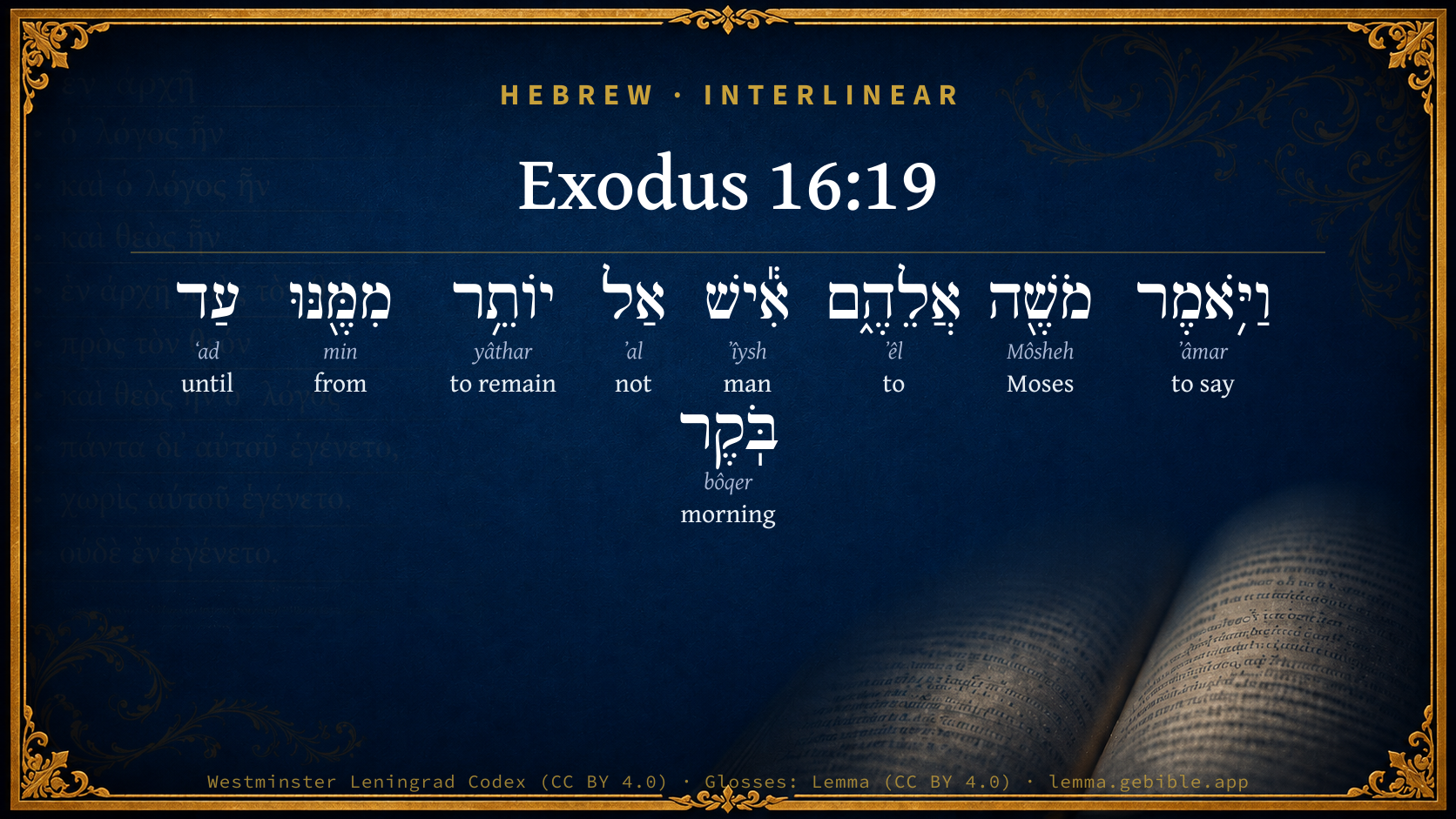
Hebrew (Westminster Leningrad Codex) Exodus 16:19 appears in the Hebrew Old Testament. The text above is from the Westminster Leningrad Codex. Each word links to its Strong’s number, a concise gloss, and parsing drawn from the Open Scriptures Hebrew Bible morphology. Click any word for its full Brown-Driver-Briggs (BDB) entry.
Download image
Cite this verse

Exodus 16:19 (World English Bible). Public Domain. Lemma interlinear Bible study tool, https://lemma.gebible.app/v/exodus/16/19.

Show BibTeX & RIS
BibTeX
RIS
English Translation
Moses said to them, "Let no one leave of it until the morning."
World English Bible · Public Domain
Download a study sheet

One document with this verse’s original text, its word-by-word gloss line, the meaning frame, cross-references with their text, attributed commentary, and full source and license credits — printable, and it pastes into notes with its structure intact.

This verse Autodidact and up

Study sheet (.html) Plain text (.txt)

A passage Seminary Student

Up to 50 verses in one chapter. A passage sheet keeps up to 6 commentary sources and 12 cross-references per verse, in the order this page ranks them, and says so on the sheet whenever that leaves anything out. Ask for a single verse and you get the Autodidact verse sheet above.

Everything on this page stays free to read, with no account — the sheet is a download of what is already on screen, not access to it.

Want to remove ads? Support Godless Engineer
Compare translations 3

The same verse in 3 English versions, stacked beneath the original-language interlinear above. Click any original word for its lexicon entry.

Each is an independent rendering of the whole verse — the interlinear is not word-aligned to these translations.

Highlighted words mark where these versions differ — a whole-verse word diff, not a word-by-word alignment.

  • World English Bible Public Domain
    Moses said to them, "Let no one leave of it until the morning."
  • King James Version Public Domain
    And Moses said, Let no man leave of it till the morning.
  • unfoldingWord Literal Text CC BY-SA 4.0
    And Moses said to them, “A man shall not save any of it until morning.”

unfoldingWord Literal Text — © unfoldingWord, licensed CC BY-SA 4.0. Word-aligned USFM3 via Door43 (git.door43.org/unfoldingWord/en_ult).

Versions to compare (up to 4)

3 of 4 selected

Show all 18 translations

Every available English version of this verse, each an independent rendering of the whole verse.

  • World English Bible Public Domain
    Moses said to them, "Let no one leave of it until the morning."
  • Berean Standard Bible Public Domain
    Then Moses said to them, “No one may keep any of it until morning.”
  • Majority Standard Bible Public Domain
    Then Moses said to them, “No one may keep any of it until morning.”
  • King James Version Public Domain
    And Moses said, Let no man leave of it till the morning.
  • American Standard Version (1901) Public Domain
    And Moses said unto them, Let no man leave of it till the morning.
  • Revised Version (1885) Public Domain
    And Moses said unto them, Let no man leave of it till the morning.
  • Geneva Bible (1599) Public Domain
    Moses then said vnto them, Let no man reserue thereof till morning.
  • Douay-Rheims (1899) Public Domain
    And Moses said to them: Let no man leave thereof till the morning.
  • Young's Literal Translation Public Domain
    And Moses saith unto them, `Let no man leave of it till morning;'
  • Literal Standard Version CC BY-SA 4.0
    And Moses says to them, “Let no man leave of it until morning”;
  • Unlocked Literal Bible CC BY-SA 4.0
    Then Moses said to them, “No one must leave any of it until morning.”
  • unfoldingWord Literal Text CC BY-SA 4.0
    And Moses said to them, “A man shall not save any of it until morning.”
  • Darby Bible Public Domain
    And Moses said to them, Let no man leave [any] of it until the morning.
  • World Messianic Bible Public Domain
    Moses said to them, “Let no one leave of it until the morning.”
  • Webster's Bible Public Domain
    And Moses said, Let no man leave of it till the morning.
  • Free Bible Version CC BY-SA 4.0
    Then Moses said to them, “No one is to leave any of it until the morning.”
  • Bible in Basic English Public Domain
    And Moses said to them, Let nothing be kept till the morning.
  • JPS Tanakh (1917) Public Domain
    And Moses said unto them: 'Let no man leave of it till the morning.'

Literal Standard Version (2020), Covenant Press — licensed CC BY-SA 4.0. Text via the HelloAO Bible API (eBible.org). Unlocked Literal Bible (unfoldingWord) — licensed CC BY-SA 4.0. Text via the HelloAO Bible API (eBible.org). unfoldingWord Literal Text — © unfoldingWord, licensed CC BY-SA 4.0. Word-aligned USFM3 via Door43 (git.door43.org/unfoldingWord/en_ult). Free Bible Version, Dr. Jonathan Gallagher — licensed CC BY-SA 4.0. Text via the HelloAO Bible API (eBible.org).

Word by word

More ways to search: Search by grammar → Find every occurrence → Compare this word →

Practice this passage: Drill this verse → Learn its vocabulary →

יוֹתֵ֥ר
yâthar
H3498
“to remain”
Verb, Hiphil, Jussive, 3rd Person, Masculine, Singular
Part of Speech
Verb
Stem
Hiphil
Form
Jussive
Person
3rd Person
Gender
Masculine
Number
Singular
Full BDB Definition

Origin: a primitive root

TWOT: 936

to be left over, remain, remain over, leave - (Qal) remainder (participle) - (Niphal) to be left over, remain over, be left behind - (Hiphil) - to leave over, leave - to save over, preserve alive - to excel, show pre-eminence - to show excess, have more than enough, have an excess
  1. וַיֹּ֥אמֶר ʼâmar H559 “and · to say” Conjunction + Verb, Qal, Sequential Imperfect, 3rd Person, Masculine, Singular
  2. מֹשֶׁ֖ה Môsheh H4872 “Moses” Noun, Proper
  3. אֲלֵהֶ֑ם ʼêl H413 “to · them” Preposition + Suffix, Personal, 3rd Person, Masculine, Plural
  4. אִ֕ישׁ ʼîysh H376 “man” Noun, Common, Masculine, Singular, Absolute
  5. אַל ʼal H408 “not” Particle, Negative
  6. מִמֶּ֖נּוּ min H4480 “from · us” Preposition + Suffix, Personal, 1st Person, Common, Plural
  7. עַד ʻad H5704 “until” Preposition
  8. בֹּֽקֶר bôqer H1242 “morning” Noun, Common, Masculine, Singular, Absolute

About this verse

These counts appear in no published source. They are computed here, from the morphology-tagged text and Lemma’s own curated glosses. What Lemma adds →

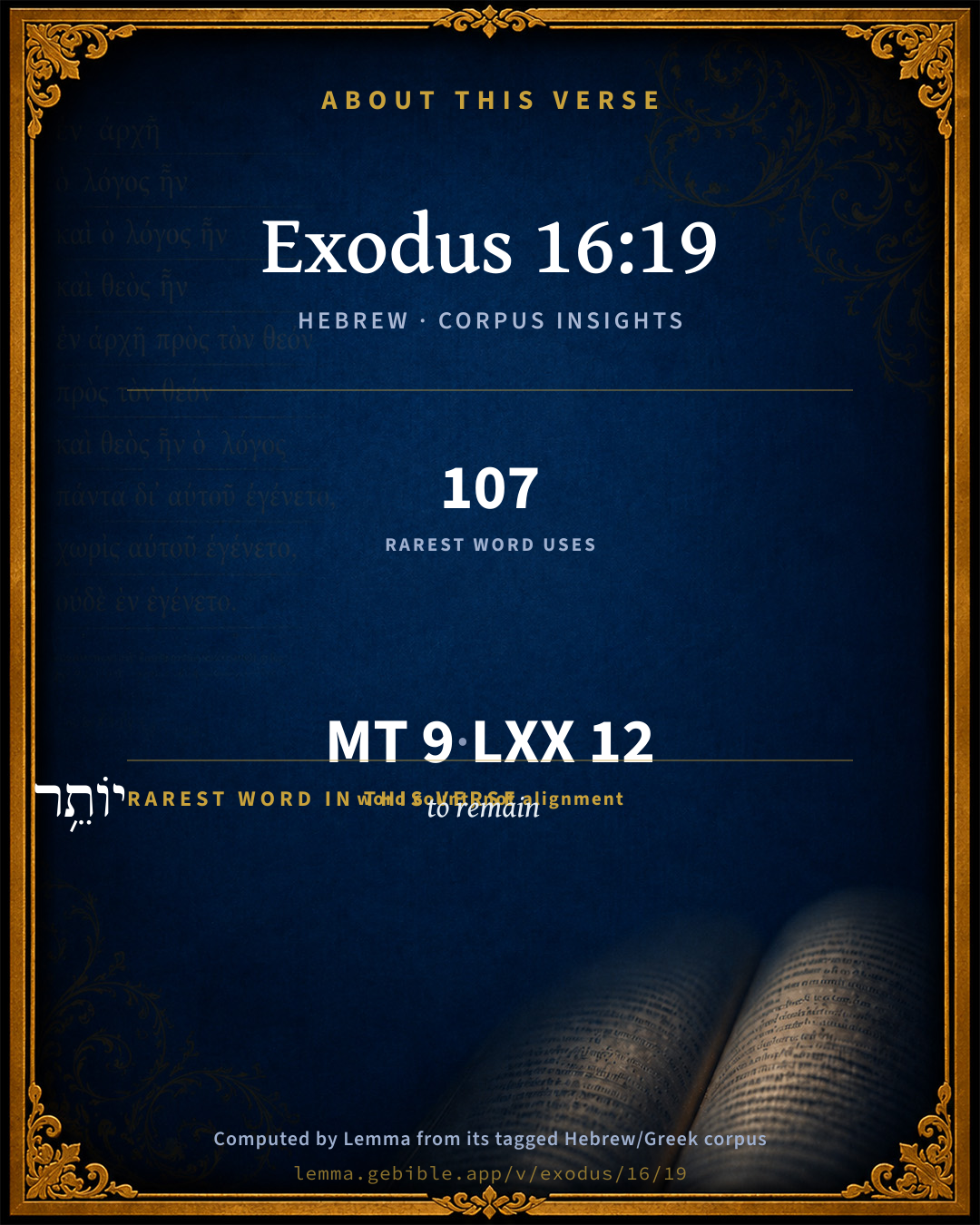
9
words
9
distinct lemmas
Pentateuch
section

Grammatical profile

  • 2 verbs
  • 3 nouns
  • 3 prepositions
  • 1 particle

Verb forms

  • וַיֹּ֥אמֶר Qal · Sequential Imperfect
  • יוֹתֵ֥ר Hiphil · Jussive

Hebrew & Septuagint length

In English translation the verse runs 13 words from the Hebrew and 14 from the Septuagint (LXX English) — closely comparable.

A rough comparison of the two English renderings, which tokenize alike — not a word-level alignment.

Word counts can differ between the Hebrew and the Greek without any difference in meaning — e.g. the Hebrew direct-object marker אֵת has no separate Greek word, and Greek often adds the article ὁ.

In the original languages it is 9 Hebrew tokens and 12 Greek tokens — but the two are counted differently (Hebrew bundles its prefixes and suffixes into one token; the Greek is in lemma form), so that isn’t a like-for-like length.

Cross-references

4

Topical passages linked to Exodus 16:19 in the Treasury of Scripture Knowledge — connected by theme and wording, ordered by reader-vote popularity; previews shown in the World English Bible.

  • Exodus 12:10 You shall let nothing of it remain until the morning; but that which remains of it until the morning you shall burn with fire.
  • Exodus 23:18 "You shall not offer the blood of my sacrifice with leavened bread, neither shall the fat of my feast remain all night until the morning.
  • Matthew 6:34 Therefore don't be anxious for tomorrow, for tomorrow will be anxious for itself. Each day's own evil is sufficient.
  • Exodus 16:23 He said to them, "This is that which Yahweh has spoken, 'Tomorrow is a solemn rest, a holy Sabbath to Yahweh. Bake that which you want to bake, and boil that which you want to boil; and all that remains over lay up for yourselves to be kept until the morning."

Cross-references courtesy of OpenBible.info (CC BY 4.0).

Hebrew and Greek witnesses Masoretic Hebrew ↔ Greek Septuagint

The same verse in the two great witnesses to the Old Testament, shown verse-for-verse.

These are two independent witnesses, not word-aligned to each other, and the Septuagint is shown in lemma (dictionary) form.

Hebrew Exodus 16:19 Masoretic · Westminster Leningrad Codex

וַיֹּ֥אמֶר מֹשֶׁ֖ה אֲלֵהֶ֑ם אִ֕ישׁ אַל יוֹתֵ֥ר מִמֶּ֖נּוּ עַד בֹּֽקֶר

Moses said to them, "Let no one leave of it until the morning."

World English Bible · Public Domain

Greek LXX Exodus 16:19 Septuagint · lemma form

εἶπον δέ μωυσῆς πρός αὐτός μηδείς καταλείπω ἀπό αὐτός εἰς ὁ πρωΐ

And Moses said to them, Let no man leave of it till the morning.

LXX2012 (modern English Septuagint) · Public Domain

Hebrew: Westminster Leningrad Codex (CC BY 4.0). Greek: Septuagint (public domain); English from LXX2012 (modern English Septuagint) (Public Domain). How the Septuagint differs from the Hebrew →

Targum (Aramaic paraphrase)

2

The Targum is the ancient Jewish Aramaic paraphrase of the Hebrew Scriptures — an interpretive translation, not the Hebrew text itself. Onkelos (literal) and Pseudo-Jonathan (expansive) render the Torah, and Jonathan the Prophets. Coverage is partial: where no permissively-licensed English translation exists for a verse, only the Aramaic is shown. This is verse-level text, not a word-by-word alignment to the Hebrew.

  1. Targum Onkelos Torah (Genesis–Deuteronomy)
    וַאֲמַר משֶׁה לְהוֹן אֱנַשׁ לָא יַשְׁאַר מִנֵהּ עַד צַפְרָא:

    (no public-domain English translation for this verse)

    Targum Onkelos — Aramaic: “Onkelos Genesis” (public domain); “Onkelos Exodus” (public domain); “Onkelos Leviticus” (public domain); “Onkelos Numbers” (public domain); “Onkelos Deuteronomy” (public domain). English: “Sefaria Community Translation” (CC0 1.0 (public-domain dedication)); “J.W. Etheridge. The Targums of Onkelos and Jonathan Ben Uzziel on the Pentateuch. London: Longmans, Green, 1862” (public domain). Text via Sefaria.

  2. Targum Pseudo-Jonathan Torah (Genesis–Deuteronomy)
    וַאֲמַר משֶׁה לְהוֹן גְּבַר לָא יְשַׁיֵּיר מִנֵּיהּ עַד צַפְרָא

    And Mosheh said to them, Let no man make a reserve of it till the morning.

    Targum Pseudo-Jonathan — Aramaic: “Targum Jonathan on Genesis” (public domain); “Targum Jonathan on Exodus” (public domain); “Targum Jonathan on Leviticus” (public domain); “Targum Jonathan on Numbers” (public domain); “Targum Jonathan on Deuteronomy” (public domain). English: “The Targum of Jonathan ben Uzziel, trans. J. W. Etheridge, London, 1862” (public domain). Text via Sefaria.

Commentary

Notes on Exodus 16:19 from classic Christian and Jewish commentators (each source and its license shown beneath its notes). The classic Christian expositions comment on the surrounding passage and are grouped to its opening verse, so a note may address several verses; the Jewish commentaries on the Tanakh (Rashi and others) are per-verse, so they appear only where the commentator wrote on this verse.

Lemma curates 59 commentaries, every one of them public domain or Creative Commons licensed, each selected and text-cleaned for this edition rather than reprinted as found. About our sources →

Trapp's Complete Commentary

John Trapp

Exo 16:19 And Moses said, Let no man leave of it till the morning.

Ver. 19. Let no man leave of it, &c.] It was to be gathered in the morning, and not kept till the morrow. "I made haste and delayed not," saith David. {Psa 119:60}

John Trapp, A Commentary or Exposition upon All the Books of the Old and New Testament (1647–1656) — public domain. Text from a community e-Sword module.

Joseph Benson's Commentary

Exo 16:19. Let no man leave of it till the morning — For the provision of the next day, as distrusting God’s care and goodness in giving him more. Not that every one was bound to eat the whole of what he had gathered; but they were to dissolve or burn it, as they did the remains of some sacrifices, or to consume it some other way. Thus, they were to learn to go to bed quietly, though they had not a bit of bread in their tents, nor in all their camp, trusting God with the following day to bring them their daily bread. Never was there such a market of provisions as this, where so many hundred thousand men were daily furnished without money and without price: never was there such an open house kept as God kept in the wilderness for forty years together, nor such free and plentiful entertainment given. And the same wisdom, power, and goodness that now brought food daily out of the clouds, doth, in the constant course of nature, bring food yearly out of the earth, and gives us all things richly to enjoy.

Joseph Benson's Commentary on the Old and New Testaments (1811–1818) — public domain. Text from a community e-Sword module.

Tyndale Open Study Notes

Tyndale Open Resources

16:19-20 Regarding these instructions, see study note on 16:4-5.

Tyndale Open Study Notes — © Tyndale Open Resources, licensed CC BY-SA 4.0. Text via the HelloAO Bible API.

Adam Clarke's Commentary

Verse 19. Let no man leave of it till the morning.] For God would have them to take no thought for the morrow, and constantly to depend on him for their dally bread. And is not that petition in our Lord's prayer founded on this very circumstance, Give us day by day our daily bread?

Adam Clarke's Commentary on the Bible (1810–1826) — public domain. Text from a community e-Sword/MySword module.

Ellicott's Commentary for English Readers

(19) Let no man leave of it.—Moses must have been divinely instructed to issue this command. It was doubtless given in order that the Israelites might realise their absolute dependence upon God for food from day to day, and might so be habituated to complete trust and confidence in Him.

A Bible Commentary for English Readers, edited by Charles John Ellicott (1878–1897) — public domain. Text from a community e-Sword module.

The Cambridge Bible for Schools and Colleges

gen. ed. J. J. S. Perowne

19, 20. None to be left over till the morning. The manna was to be the daily food of the Israelites in the wilderness, and so to be eaten fresh every day. In the East, it is the custom to bake bread daily, and yesterday’s bread is not eaten.

The Cambridge Bible for Schools and Colleges (gen. ed. J. J. S. Perowne; Cambridge University Press, 1878–1918) — public domain. Text from a community e-Sword module.

John Gill's Exposition

Notwithstanding they hearkened not unto Moses,.... That is, not all of them, some of them did, and perhaps the far greater part of them:

but some of them left it until the morning; out of distrust, for fear they should have none the next day; being men of little faith, that could not trust God for a supply for the morrow; the Targum of Jonathan says, these were Dathan and Abiram; and so Jarchi:

and it bred worms, and stank; or by an "hysteron proteron", and transposition of the words, the sense may be, that it stank, corrupted, and putrefied, and so produced worms, in which order the words lie, Exo 16:24, and this was not from the nature of the manna to breed worms so soon, but God so ordering and disposing it, that it should do so; for otherwise it would keep to another day, as what was gathered on the sixth day kept to the seventh, and there was a part of it kept for many ages, see Exo 16:24, and since the manna was of the meal kind, perhaps those worms it bred might be of the weevil sort, as Scheuchzer conjectures (s):

and Moses was wroth with them; for breaking the commandment of God.

(s) Physica Sacra, vol. 2. p. 179.

John Gill's Exposition of the Whole Bible (1746–1763) — public domain (CC PDM 1.0). Text via the HelloAO Bible API.

Matthew Poole's English Annotations

viz. For the provision of the next day, as distrusting God’s care and goodness in giving them more. Not that every one was bound to eat all of it, which certainly many of their stomachs could not bear; but that they were to dissolve it, or but it, as they did the remains of some sacrifices, Exo 12:10; 29:34, or consume it some other way.

Matthew Poole's English Annotations on the Holy Bible (1683–1685) — public domain. Text from a community e-Sword/MySword module.

The Pulpit Commentary

Let no man leave of it till the morning. Moses, divinely instructed, warned the people that they were not to lay up in store any of their manna to be eaten the next day. God would have them trust their future wants to him, and "take no thought for the morrow." Some of them, however, were disobedient, with the result stated in the next verse.

Vers. 19, 20. God"s curse upon ill-gotten gains. In order to try the Israelites, whether they would be obedient to him orno (ver. 4), God gave them, by the mouth of Moses, a positive law no man leave of the manna till the morning." By some the law was disobeyed. Disregarding the Divine command perhaps distrusting the Divine promise (ver. 4), to give them food day by day, a certain number of the Israelites, kept some of the manna till the morning. They wished to have a store laid up, on which they might subsist, should the daily supply fail. But God would not be disobeyed with impunity. His curse was on the ill-gotten gain it bred worms and stank, becoming a source of annoyance both to themselves and their neighbours. So, God"s curse is ever on ill-gotten gainse.g.:

I WHEN MEN SET THEIR HEARTS ON HOARDING ALL THEY CAN. Some provision for the future is required of us. "Go to the ant, thou sluggard," says the wise man, "consider her ways, and be wise." "He that doth not provide for them of his own household," St. Paul declares, "is worse than an infidel." Prudence is a Christian, no less than a heathen virtue. But to hoard everything, to give nothing away, to make the accumulation of wealth our main object, is to fly in the face of a hundred plain precepts, and necessarily brings God"s curse upon us. The wealth rots the concerns wherein it is invested fail it disappears and is brought to nought and all our careful saving advantages us nothing. God vindicates his own honour; and disperses or destroys the hoard accumulated contrary to his will.

II WHEN, TO AUGMENT THEIR HOARDS, MEN BREAK A DIVINE COMMAND. There are some who, in their haste to be rich, disregard the Divine injunction to keep holy one day in seven, and pursue their secular calling without any intermission. Conveyancers draw out their deeds, barristers study their briefs, business men balance their books, authors ply their pens, as busily on the Sunday as on week days. What blessing can be expected on the gains thus made? Is it not likely that they will breed corruption? Still more wholly under a curse are gains made by unlawful trades or dishonest practices by the false weight or the scant measure, or the adulterated article or again by usurious lending, by gaming, by brothel-keeping.

III WHEN THE MOTIVE FOR THE HOARDING IS DISTRUST OF GOD"S PROMISES. God bids us not to be anxious for the morrow, what we shall eat, or what we shall drink, or what we shall put on (Mat_6:31) and promises that, if we will "seek first the kingdom of God and his righteousness, all these things shall be added unto us" (ib. 33). He caused holy David to declare have been young and now am old, yet saw I never the righteous forsaken, nor his seed begging their bread." If men hoard in distrust of these gracious words, not believing that God will make them good, and thinking to assure the future of wife or child, or both, by their own accumulations, they provoke God to bring their accumulations to nothing. Riches, however invested, can make themselves wings and disappear, if God"s blessing does not rest on their possessor.

HOMILIES BY J. URQUHART

Vers. 19-36. The law of the manna.

I THERE MUST BE INDIVIDUAL EFFORT FOR INDIVIDUAL NEED.

1. The manna lay around their tents, but it had to be gathered. To feed onChrist each must lay hold of him for his own soul by meditation and prayer and trust.

2. If we do not "taste and see that the Lord is gracious," his nearness to uswill only deepen our condemnation. How shall we escape if we neglect so great salvation?

II CHRIST MUST BE LAID HOLD OF DAILY DURING THE WEEK"S TOIL,

1. The sabbath has its provision without labour. This law is sometimes inverted sabbath day"s toil, six days" negligence but in this way Christ will be fed upon neither in labour nor in rest. They who come from daily walking with Christ, find the sabbath feast spread for them.

2. The life of labour in striving to lay hold of and feed upon him, isfollowed by the rest that remaineth and the feast which his own hand will spread.

III GRACE WILL NOT CONSORT WITH DISOBEDIENCE. The manna stored up to save from toiling, when God commands to toil, was unfit for use. We cannot live on the memories of past experiences of Christ"s graciousness. He must be daily sought for.

IV CHRIST THE SOUL"S FOOD DURING THE ENTIRE EARTHLY PILGRIMAGE (ver. 35). During the whole forty years Israel fed upon the manna. We must feed daily upon Christ till we reach the inheritance. They who will be sustained in their journey must determine to know nothing save Christ and him crucified. U.

The Pulpit Commentary (1880–1919), ed. H.D.M. Spence-Jones & Joseph S. Exell — public domain. Text from a community e-Sword module.

John Wesley's Explanatory Notes

Let no man leave 'till morning - But let them learn to go to bed and sleep quietly, though they had not a bit of bread in their tent, nor in all their camp, trusting God with the following day to bring them their daily bread. Never was there such a market of provisions as this, where so many hundred thousand men were daily furnished without money, and without price: never was there such an open house kept as God kept in the wilderness for 40 years together, nor such free and plentiful entertainment given. And the same wisdom, power and goodness that now brought food daily out of the clouds, doth in the constant course of nature bring food yearly out of the earth, and gives us all things richly to enjoy.

John Wesley, Explanatory Notes Upon the Whole Bible (1754–1765) — public domain. Text via the GEBible commentary corpus.

Keil & Delitzsch

C. F. Keil & F. Delitzsch

In the second place, Moses commanded them, that no one was to leave any of what had been gathered till the next morning. Some of them disobeyed, but what was left went into worms (תּולעים ירם literally rose into worms) and stank. Israel was to take no care for the morrow (Mat 6:34), but to enjoy the daily bread received from God in obedience to the giver. The gathering was to take place in the morning (Exo 16:21); for when the sun shone brightly, it melted away.

Keil & Delitzsch — Biblical Commentary on the Old Testament (1861–1891) — public domain (CC PDM 1.0). Text via the HelloAO Bible API. (Old Testament only.)

unfoldingWord translationNotes

Door43 World Missions Community

translationWords

anger

unfoldingWord translationNotes — © Distant Shores Media and the Door43 World Missions Community, licensed CC BY-SA 4.0. Source: git.door43.org/Door43/en_tn.

Ibn Ezra

Rabbi Abraham ibn Ezra

Let no man leave over. This was in order that they would have to trust in Hashem to send it to them the next day as well. Thus they were not required to finish each day’s portion but only to dispose of the leftovers rather than saving them.

Ibn Ezra on the Tanakh — English translations: “Sefaria Community Translation” (CC0 1.0 (public-domain dedication)); “Yalkut, Sifsei Chachomim Chumash, Metsudah Publications, 2009” (CC BY 4.0); and “Commentary of Ibn Ezra on Isaiah - trans. by M. Friedlander, 1873” (public domain). Text via Sefaria.

Lesson kit

Teaching starters — assembled from the data on this page, not authored interpretation. Every prompt links to the verse data it draws on. Edit before teaching.

Exodus, in the Pentateuch, opens this verse with 9 words (9 distinct Hebrew lemmas). Its most distinctive word is yâthar (“to remain”). A historical commentator’s framing appears above. Read the whole chapter for the surrounding context.

Discussion questions

  1. How does “to remain” (yâthar) shape what this verse is saying?
  2. How does Exodus 12:10, which shares this passage’s theme, read alongside this verse?
  3. These translations render this verse differently. What is at stake in choosing one wording over another?
  4. «וַיֹּ֥אמֶר» is a Qal Sequential Imperfect verb. How does that grammatical form shape the action described?
  5. Compare how Trapp's Complete Commentary and Joseph Benson's Commentary read this verse. Where do they agree or differ?

Things to notice

Reading settings

Reading text

Shown beneath each verse's original-language words.

Old Testament
Old Testament edition

Read the OT as the Masoretic Hebrew (MT) or the Greek Septuagint (LXX).

English shown for the Greek Septuagint (in the Hebrew ↔ Greek comparison).

Comparing translations? Open the Compare panel on any verse page to stack up to four side by side.